Results of the SYRTO
Project
SYstemic Risk TOmography:
Signals, Measurements, Transmission Channels, and
Policy Interventions
Roberto Savona - Primary Coordinator of the SYRTO Project
University of Brescia
Final SYRTO Conference - Université Paris1 Panthéon-Sorbonne
February 19, 2016
Συρτό
Seven Women Dancing
Archaeological Museum of Olympia
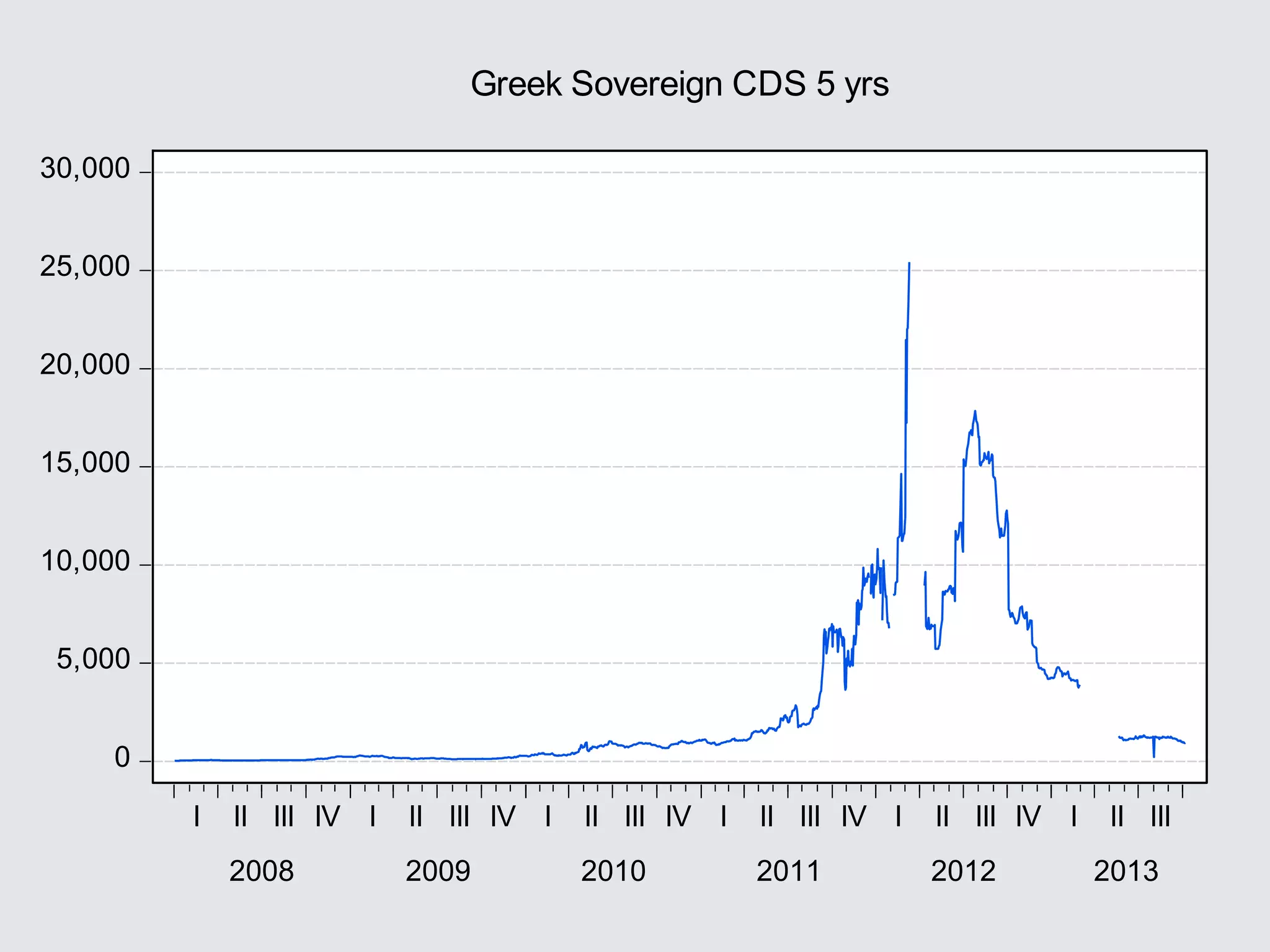
0
5,000
10,000
15,000
20,000
25,000
30,000
I II III IV I II III IV I II III IV I II III IV I II III IV I II III
2008 2009 2010 2011 2012 2013
Greek Sovereign CDS 5 yrs
0
5,000
10,000
15,000
20,000
25,000
30,000
I II III IV I II III IV I II III IV I II III IV I II III IV I II III
2008 2009 2010 2011 2012 2013
Greek Sovereign CDS 5 yrs-300
-250
-200
-150
-100
-50
0
50
II III IV I II III IV I II III IV I II III IV I II
2009 2010 2011 2012 2013
BANK
-200
-150
-100
-50
0
50
100
II III IV I II III IV I II III IV I II III IV I II
2009 2010 2011 2012 2013
DEFICIT
-400
-300
-200
-100
0
100
II III IV I II III IV I II III IV I II III IV I II
2009 2010 2011 2012 2013
GDP
0
50
100
150
200
250
300
II III IV I II III IV I II III IV I II III IV I II
2009 2010 2011 2012 2013
GIPSI
-150
-100
-50
0
50
II III IV I II III IV I II III IV I II III IV I II
2009 2010 2011 2012 2013
IND_PROD
-200
-100
0
100
200
300
II III IV I II III IV I II III IV I II III IV I II
2009 2010 2011 2012 2013
INFL
-120
-80
-40
0
40
80
120
II III IV I II III IV I II III IV I II III IV I II
2009 2010 2011 2012 2013
UNEMPL
Daily Cross-Sectional CDS Loadings – EU Countries (excl. Greece)
Balduzzi, Savona, Alessi (2016) – preliminary results
Results of the SYRTO Project
Paris, 19 February 2016
Roberto Savona
Primary and Scientific Coordinator of the SYRTO Project
Department of Economics and Management
University of Brescia
SYRTO Kick-Out Meeting &
First LabEx ReFi Conference on Systemic Risk
Agenda
Structure, Objectives & Main Deliverables
Research activity
WPs 2-6
WP 7 – EWS
WP 8 – SYRTO Code
Structure, Objectives &
Main Deliverables
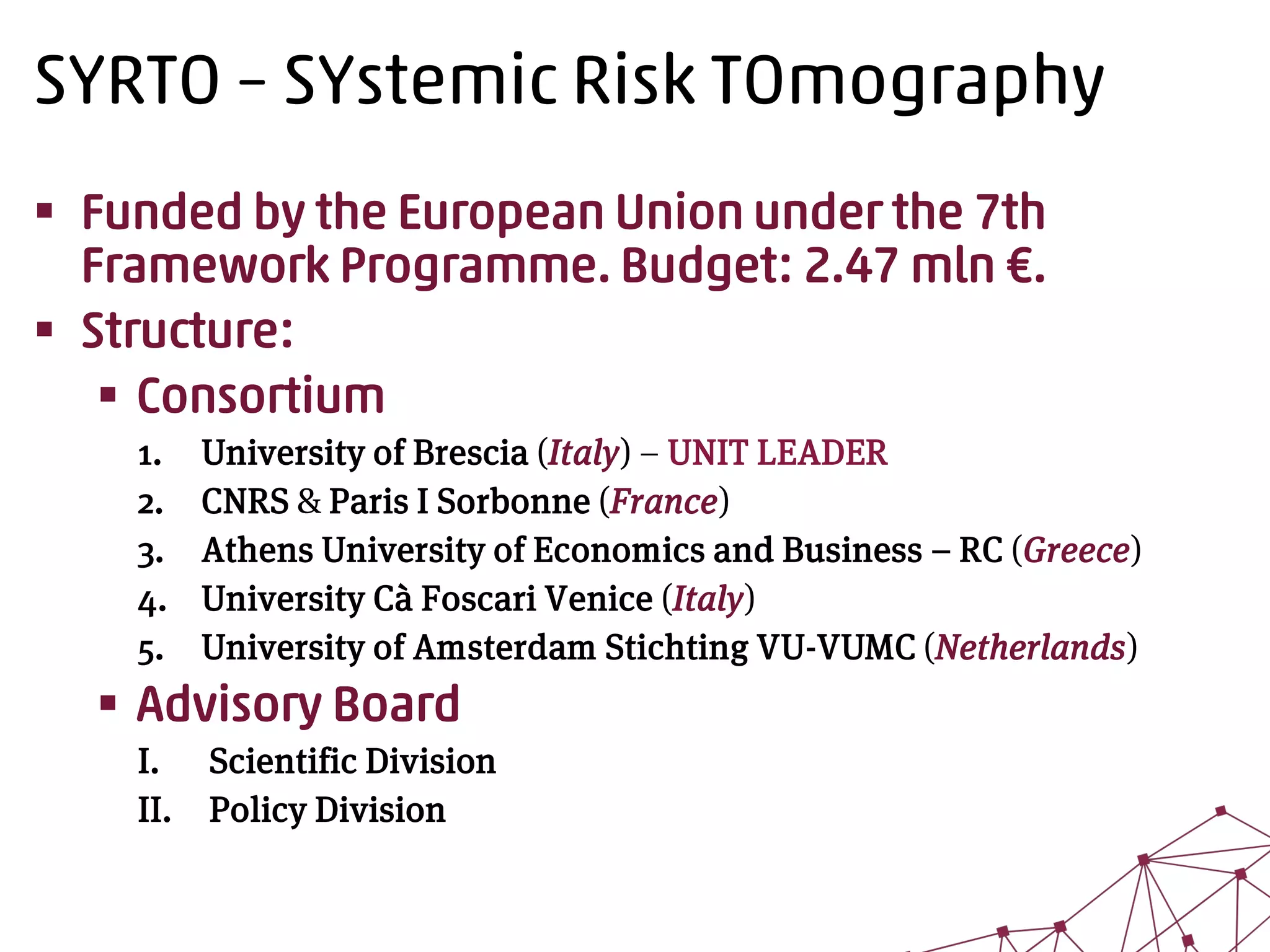
SYRTO – SYstemic Risk TOmography
Funded by the European Union under the 7th
Framework Programme. Budget: 2.47 mln €.
Structure:
Consortium
1. University of Brescia (Italy) – UNIT LEADER
2. CNRS & Paris I Sorbonne (France)
3. Athens University of Economics and Business – RC (Greece)
4. University Cà Foscari Venice (Italy)
5. University of Amsterdam Stichting VU-VUMC (Netherlands)
Advisory Board
I. Scientific Division
II. Policy Division
Consortium
Our team (40 full-time researchers)
I. UNIVERSITY OF BRESCIA
• Roberto Savona
(Primary and Scientific Coordinator)
• Maurizio Carpita
• Chiara Carini
• Marica Manisera
• Marco Sandri
• Marika Vezzoli
• Flaminio Squazzoni
• Paola Zuccolotto
• Enrico Ciavolino (University of Salento)
• Silvia Figini (University of Pavia)
II. CENTRE NATIONAL DE LA RECHERCHE SCIENTIFIQUE
• Philippe de Peretti
• Jorgen Vitting-Andersen
• Peter Addo
• Hayette Gatfaoui
• Dominique Guégan
• Rania Kaffel
• Lorenzo Frattarolo
• Liu Yifang
III. ATHENS UNIVERSITY OF ECONOMICS AND BUSINESS – RC
• Petros Dellaportas
• Efstathia Agelonidi
• Anastasios Plataniotis
• Ioannis Vrontos
IV. UNIVERSITY CA’ FOSCARI VENICE
• Monica Billio
(Scientific Coordinator)
• Loriana Pelizzon
• Diana Barro
• Roberto Casarin
• Michele Costola
• Fulvio Corsi
• Gloria Gardenal
• Martina Nardon
• Marcella Lucchetta
• Antonio Paradiso
• Domenico Sartore
• Massimiliano Caporin (University of Padova)
V. UNIVERSITY OF AMSTERDAM STICHTING VU-VUMC
• Andre Lucas
• Arjen Siegman
• Siem Jan Koopman
• Francisco Blasques
• Julia Schaumburg
• Dirk Schoenmaker
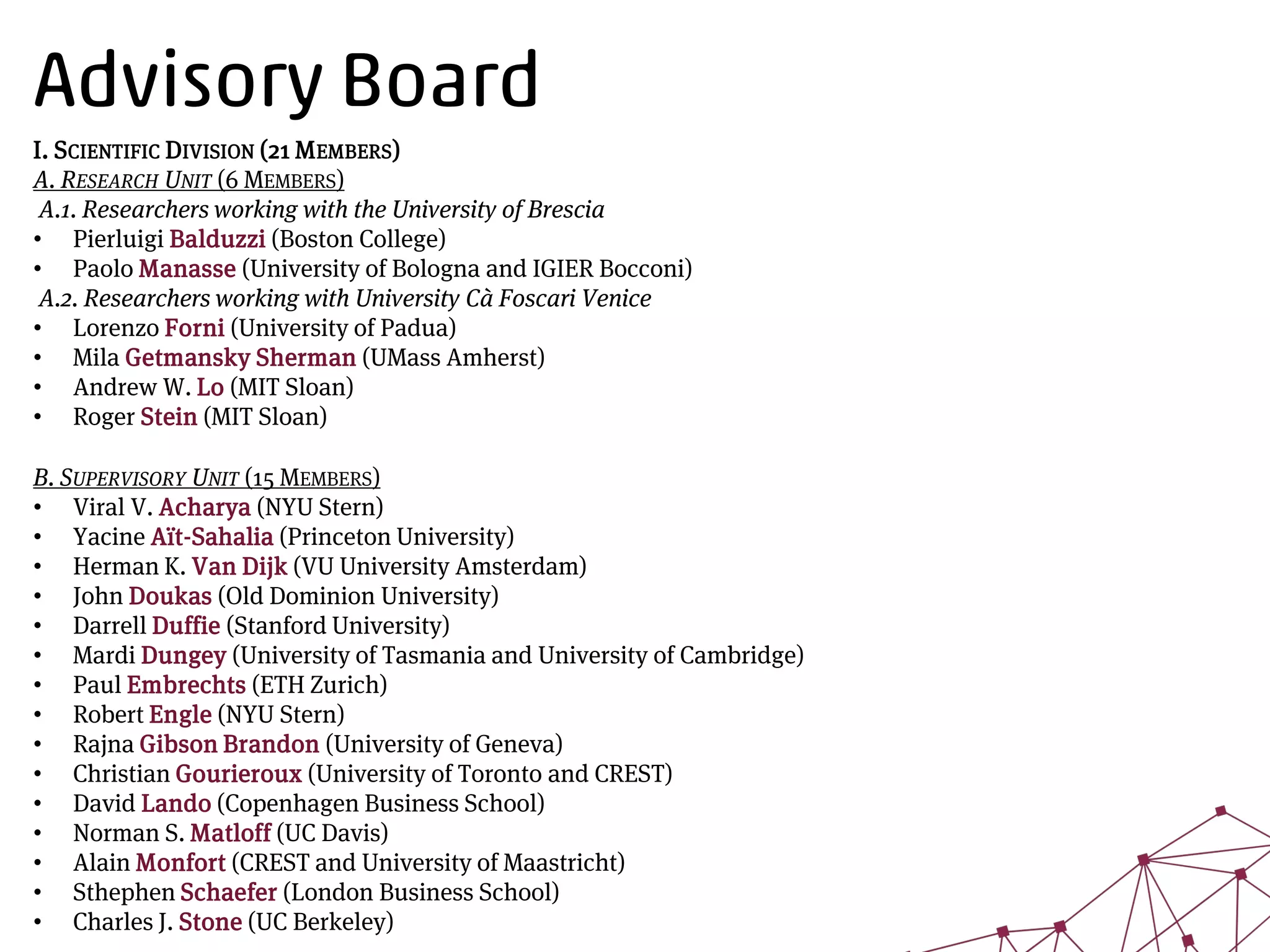
Advisory Board
I. SCIENTIFIC DIVISION (21 MEMBERS)
A. RESEARCH UNIT (6 MEMBERS)
A.1. Researchers working with the University of Brescia
• Pierluigi Balduzzi (Boston College)
• Paolo Manasse (University of Bologna and IGIER Bocconi)
A.2. Researchers working with University Cà Foscari Venice
• Lorenzo Forni (University of Padua)
• Mila Getmansky Sherman (UMass Amherst)
• Andrew W. Lo (MIT Sloan)
• Roger Stein (MIT Sloan)
B. SUPERVISORY UNIT (15 MEMBERS)
• Viral V. Acharya (NYU Stern)
• Yacine Aït-Sahalia (Princeton University)
• Herman K. Van Dijk (VU University Amsterdam)
• John Doukas (Old Dominion University)
• Darrell Duffie (Stanford University)
• Mardi Dungey (University of Tasmania and University of Cambridge)
• Paul Embrechts (ETH Zurich)
• Robert Engle (NYU Stern)
• Rajna Gibson Brandon (University of Geneva)
• Christian Gourieroux (University of Toronto and CREST)
• David Lando (Copenhagen Business School)
• Norman S. Matloff (UC Davis)
• Alain Monfort (CREST and University of Maastricht)
• Sthephen Schaefer (London Business School)
• Charles J. Stone (UC Berkeley)
Advisory Board (cont’d)
II. POLICY DIVISION (14 MEMBERS)
• Carsten Detken (ECB)
• Gianni Amisano (FRB)
• Lucia Alessi (EC)
• Thilo Liebig (ESRB, Deutsche Bundesbank)
• Andrea M. Maechler (IMF)
• Simone Manganelli (ECB)
• Bernd Schwaab (ECB)
• Giovanni Dell’Ariccia (IMF)
• Gianni De Nicolò (IMF)
• John Berrigan (DG ECFIN)
• Sebastian Schich (OECD)
• Mario Quagliariello (EBA)
• Kostas Tsatsaronis (BIS)
• Xin Zhang (Sveriges Riksbank)
Objectives
Thinking and rethinking the
economic and financial system as a
system of Sovereigns, Banks with
other Financial Intermediaries and
Corporations.
Financial Networks
Topology
Looking at the financial system as a biological entity and try to
identify the main risk signals also providing the right measures
of prevention and interventions.
HIV infected cell
Banks &
Other Fin Int
Corporations
Sovereigns
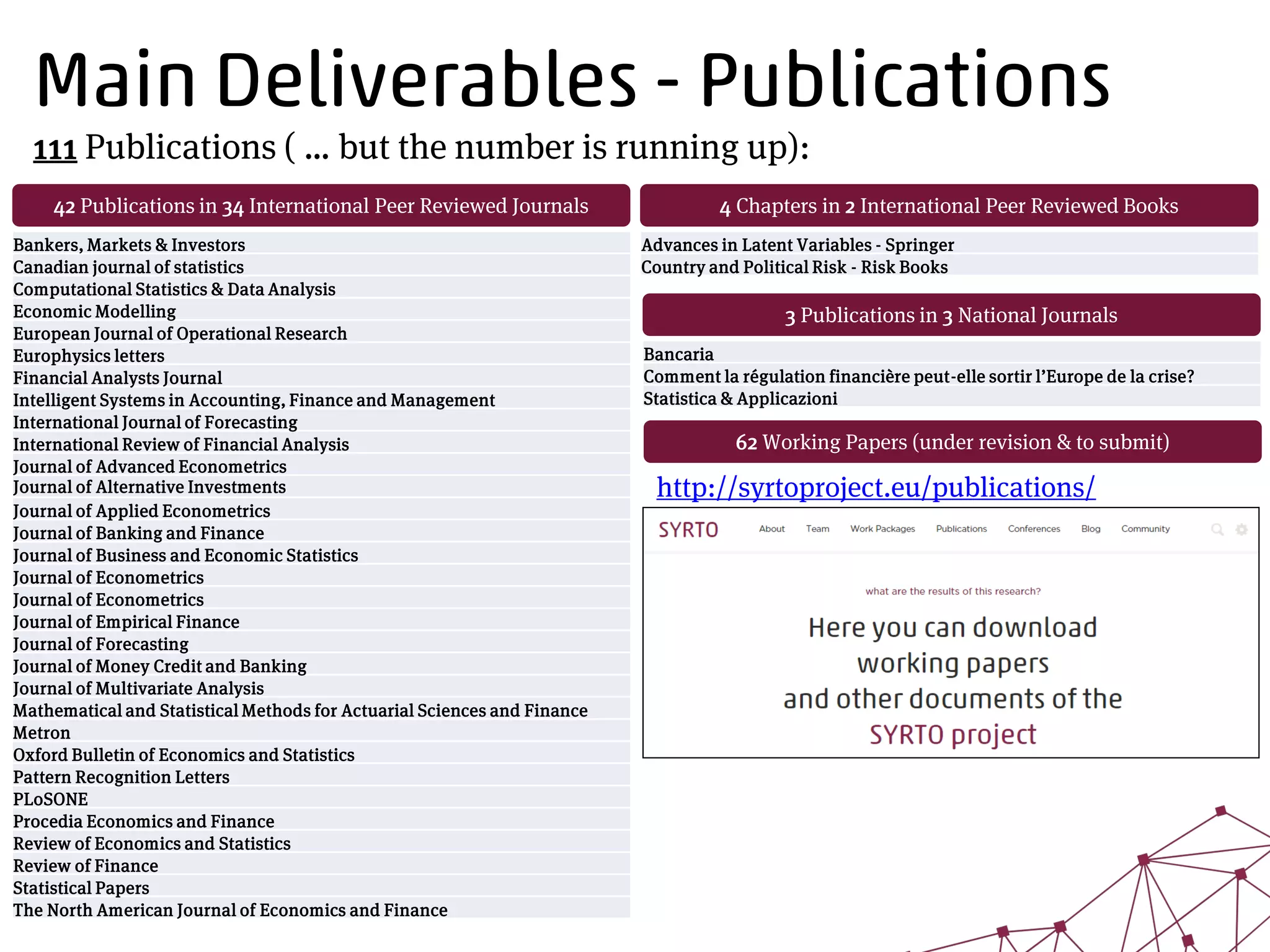
Main Deliverables - Publications
111 Publications ( … but the number is running up):
Bankers, Markets & Investors
Canadian journal of statistics
Computational Statistics & Data Analysis
Economic Modelling
European Journal of Operational Research
Europhysics letters
Financial Analysts Journal
Intelligent Systems in Accounting, Finance and Management
International Journal of Forecasting
International Review of Financial Analysis
Journal of Advanced Econometrics
Journal of Alternative Investments
Journal of Applied Econometrics
Journal of Banking and Finance
Journal of Business and Economic Statistics
Journal of Econometrics
Journal of Empirical Finance
Journal of Forecasting
Journal of Money Credit and Banking
Journal of Multivariate Analysis
Mathematical and Statistical Methods for Actuarial Sciences and Finance
Metron
Oxford Bulletin of Economics and Statistics
Pattern Recognition Letters
PLoSONE
Procedia Economics and Finance
Review of Economics and Statistics
Review of Finance
Statistical Papers
The North American Journal of Economics and Finance
42 Publications in 34 International Peer Reviewed Journals
Advances in Latent Variables - Springer
Country and Political Risk - Risk Books
4 Chapters in 2 International Peer Reviewed Books
Bancaria
Comment la régulation financière peut-elle sortir l’Europe de la crise?
Statistica & Applicazioni
3 Publications in 3 National Journals
62 Working Papers (under revision & to submit)
http://syrtoproject.eu/publications/
Main Deliverables – Special Issue
Special Issue on
Systemic Risk
Mila Getmanky & Roger M. Stein (eds)
Issue: Spring 2016
Contributors:
P. Glasserman, G. Tangiralaz (Columbia)
S. Das (Santa Clara)
S. Battiston, M. D’Errico, S. Gurciullo (Zurich)
M. Flood, P. Monin (OFR)
H. Mamaysky (Columbia)
M. Billio, L. Frattarolo, L. Pelizzon (Ca’ Foscari )
E. Ciavolino, R. Savona (Brescia)
A. Lo, R. Stein (MIT)
Note: All papers and co-authors presented at CSRA
Main Deliverables – Book
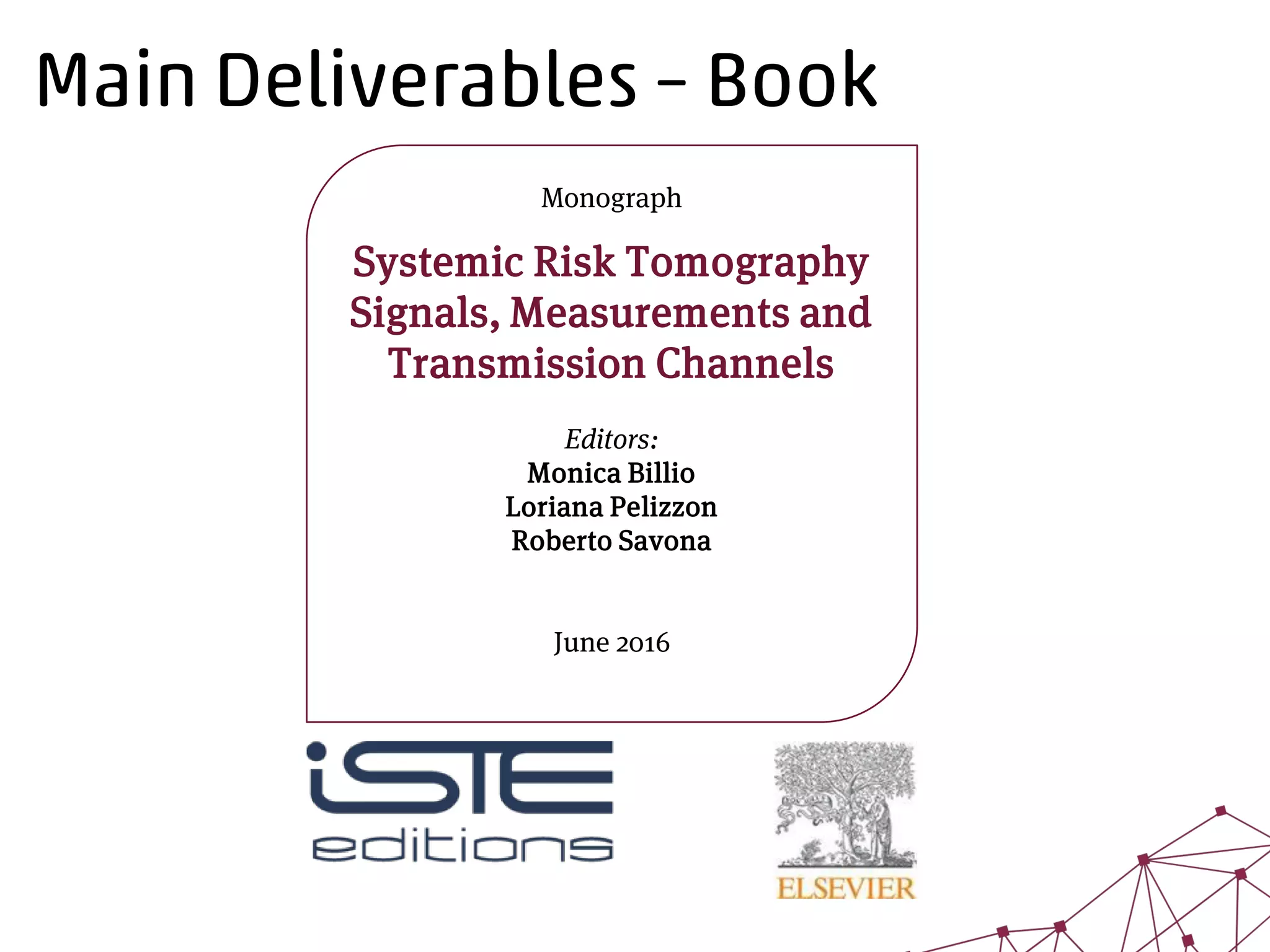
Monograph
Systemic Risk Tomography
Signals, Measurements and
Transmission Channels
Editors:
Monica Billio
Loriana Pelizzon
Roberto Savona
June 2016
Main Deliverables – Conferences
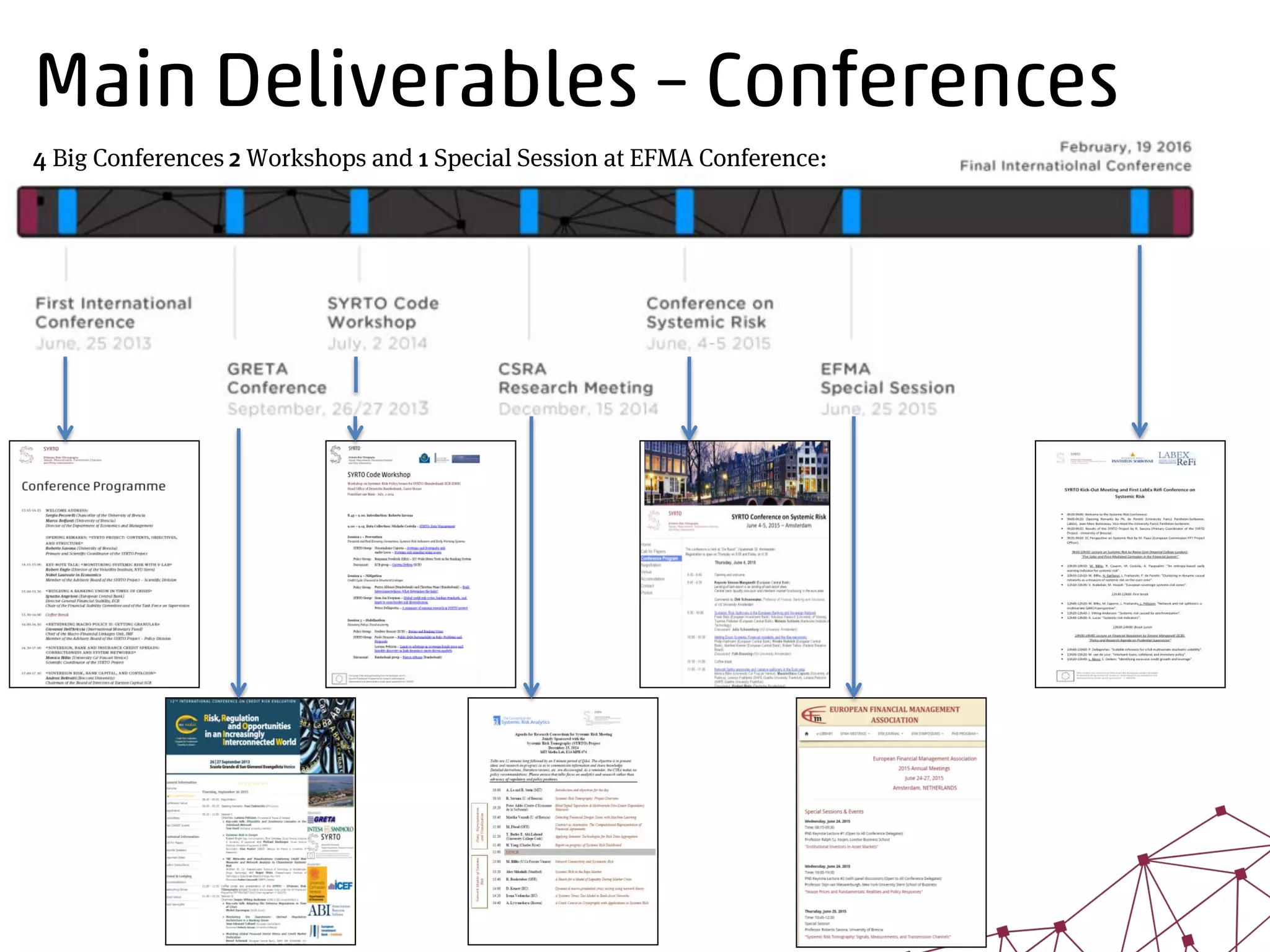
4 Big Conferences 2 Workshops and 1 Special Session at EFMA Conference:
Research activity
Research activity
A step-by-step process
Idiosyncratic
Risks
• We inspected idiosyncratic risks within the financial system thereby making clear the
main risk predictors and how these are related to:
a) Sovereign risk
b) Banks and other Financial Intermediaries risk
c) Non-Financial Corporates risk
Risk
connections
• We inspected both the two-way and multi-way risk connections among macro-sectors
(Sovereign, Bank & other Financial intermediaries, Non-Financial Corporates)
• We explored the main risk linkages and related transmission channels
• We proposed novel systemic risk measures
EWS
SYRTO Code
• We assemble an overall EWS to be used as risk barometer for each sector and
countries alike, identifying potential threats to financial stability
• We realized a “SYRTO Code”: a series of recommendations and prescriptions, on: (a)
how to prevent and minimize systemic risks; (b) the best coordination of macro and
micro-prudential responsibilities
Management
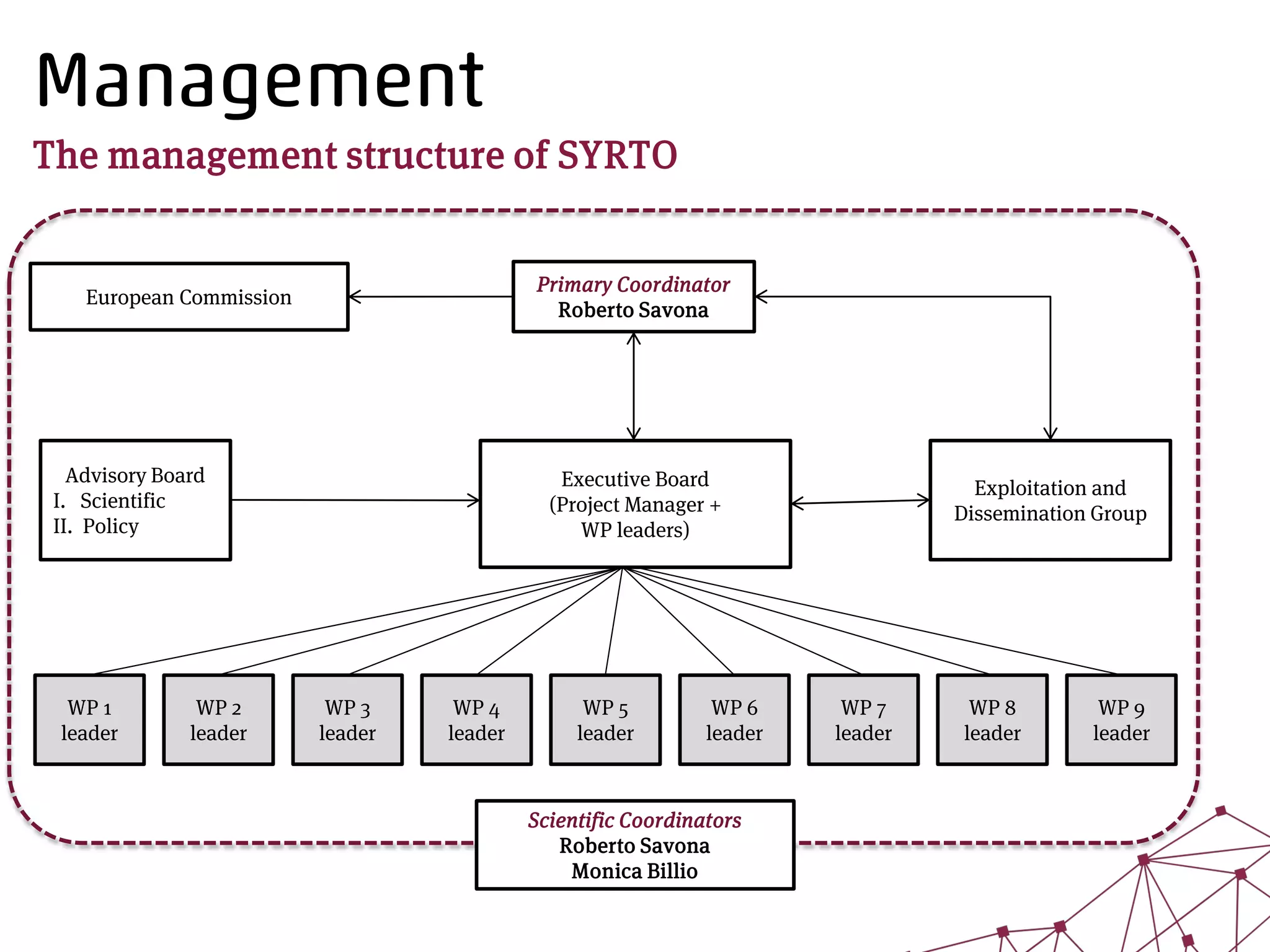
The management structure of SYRTO
Exploitation and
Dissemination Group
Primary Coordinator
Roberto Savona
European Commission
Executive Board
(Project Manager +
WP leaders)
WP 2
leader
WP 3
leader
WP 5
leader
WP 6
leader
WP 7
leader
WP 1
leader
WP 8
leader
WP 4
leader
WP 9
leader
Advisory Board
I. Scientific
II. Policy
Scientific Coordinators
Roberto Savona
Monica Billio
WPs 2-6
WP 2 – Data Collection
Data Center
We collect data in order to:
(i) Collect relevant information to monitor markets, financial institutions and the economy
(ii) Evaluate the severity of the risks impact, both considering individual and systemic risks
(iii) Realize a data management infrastructure where data are downloaded for empirical
analysis and model calibration
Data Management Infrastructure
The SYRTO data process is developed using the Konstanz Information Miner Platform (KNIME)
(www.knime.org). KNIME is an open-source platform based on the Eclipse Platform, which allows
the user to easily and intuitively manage modular data analysis environments.
WP 3 – Idiosyncratic Risk Mapping
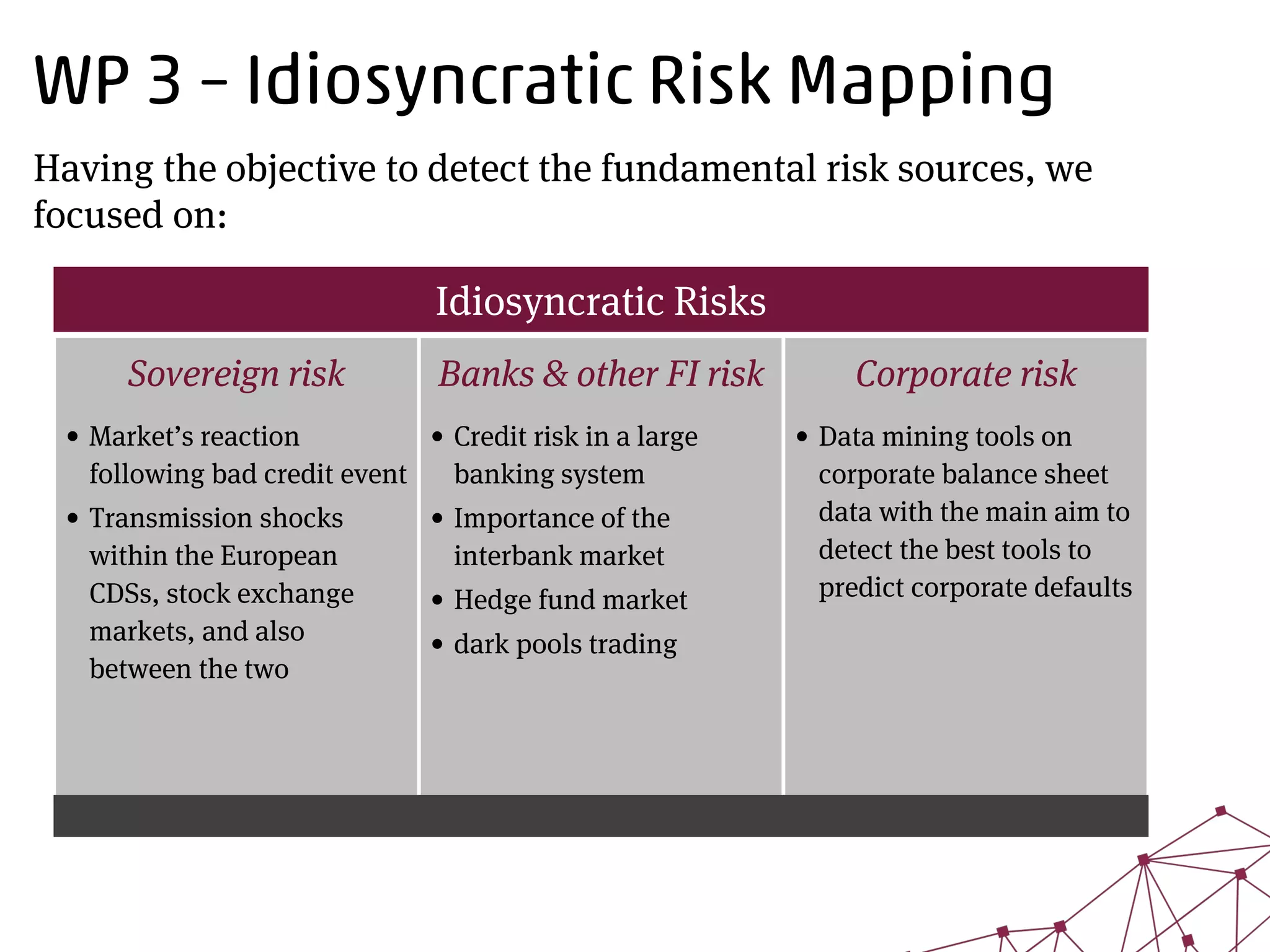
Having the objective to detect the fundamental risk sources, we
focused on:
Idiosyncratic Risks
Sovereign risk
• Market’s reaction
following bad credit event
• Transmission shocks
within the European
CDSs, stock exchange
markets, and also
between the two
Banks & other FI risk
• Credit risk in a large
banking system
• Importance of the
interbank market
• Hedge fund market
• dark pools trading
Corporate risk
• Data mining tools on
corporate balance sheet
data with the main aim to
detect the best tools to
predict corporate defaults
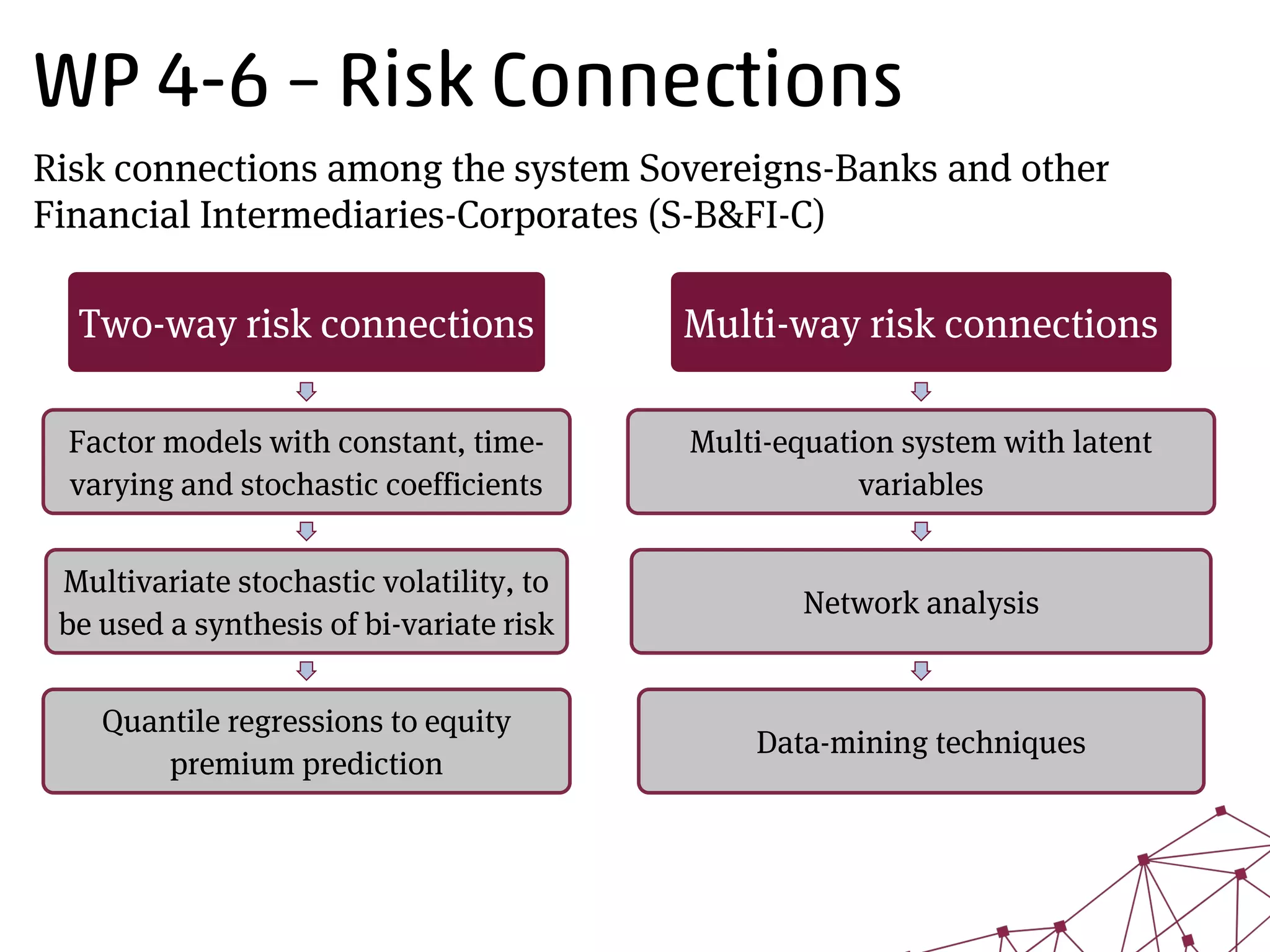
WP 4-6 – Risk Connections
Risk connections among the system Sovereigns-Banks and other
Financial Intermediaries-Corporates (S-B&FI-C)
Two-way risk connections
Factor models with constant, time-
varying and stochastic coefficients
Multivariate stochastic volatility, to
be used a synthesis of bi-variate risk
Quantile regressions to equity
premium prediction
Multi-way risk connections
Multi-equation system with latent
variables
Network analysis
Data-mining techniques
WP 5 – Systemic Risk Indicators
Micro
Financial Institutions
Macro
Financial System
Aggregate/Disaggregate
Institutions ↔ System
Standard Measures
• Equity-side (CoVaR, …)
• Bond-side (CoRisk, ...)
New Measures
• Risk Ranking
• Markov-Switching
• Multivariate Stochastic
Volatility Model
Standard Measures
• Dynamic Granger Causality
• Principal Component Analysis
New Measures
• Normalized Ranking
• Joint Default Probs, Cycles
• Dynamic PCA & Factor Model
• Leading Indicators
Institutions → System
• Entropy Measures
• Stress indices & Panels
Institutions ← System
• Graphical Models
• Network Analysis
• Dynamic PCA & Factor Model
• Leading Indicators
WP 7 – EWS
EWS
A web platform is realized to visualize our systemic risk measures for Sovereigns,
B&FIs and Corporations
EWS (cont’d)
… monitor their risk signals
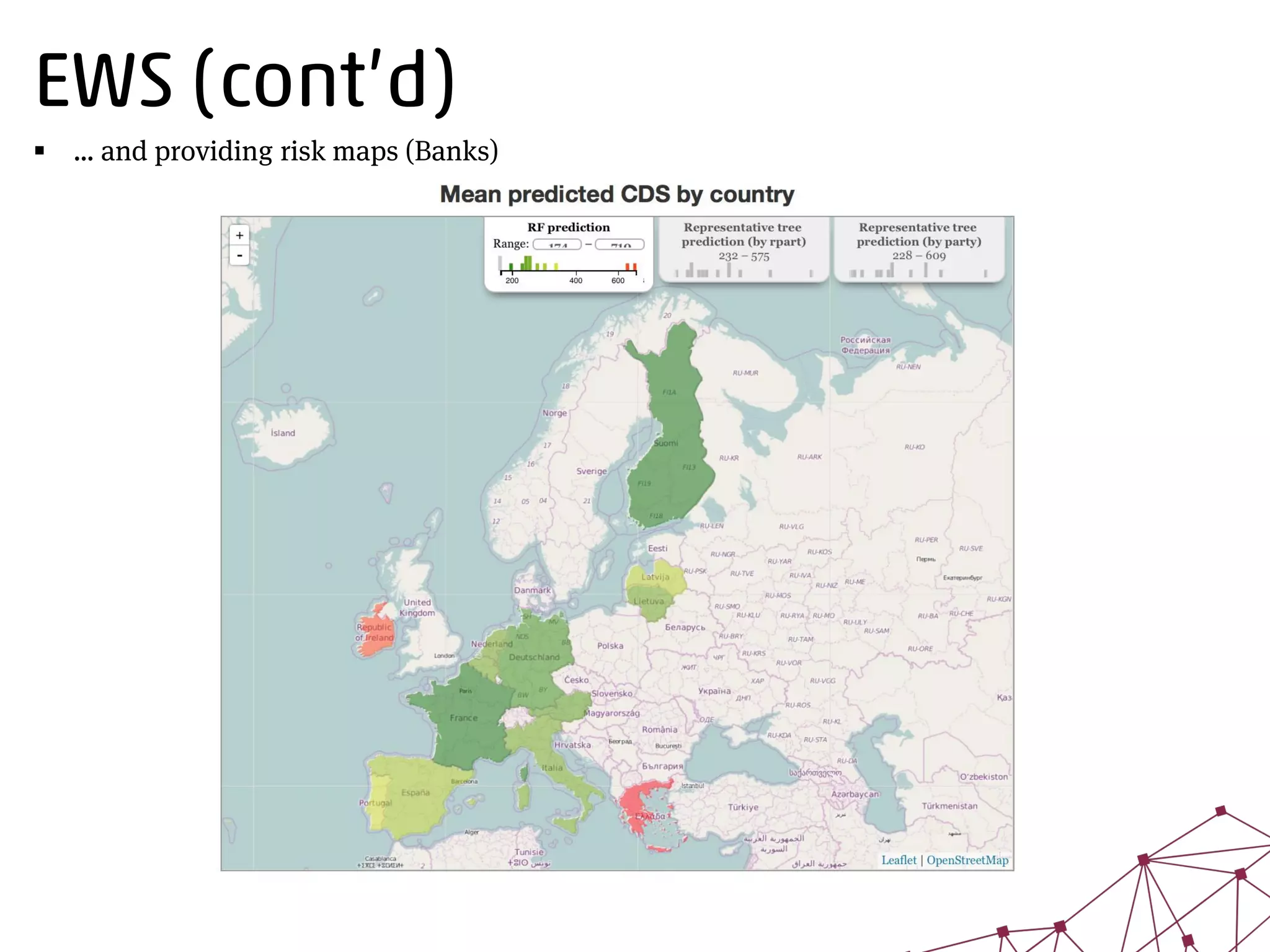
EWS (cont’d)
… and providing risk maps (Banks)
WP 8 – SYRTO Code
SYRTO Code
SYRTO Code – 6 Take Aways
1. Models to give early warning signals of systemic crisis
2. Low financial stress levels are not synonymous of financial stability
3. Make hard decisions based on soft information
4. Manage the complexity of the financial system
5. There is evidence for a country specific financial role
6. Systemically important institutions are correctly identified
www.syrtoproject.eu
This project has received funding from the European Union’s
Seventh Framework Programme for research, technological
development and demonstration under grant agreement n° 320270
www.syrtoproject.eu
This document reflects only the author’s views.
The European Union is not liable for any use that may be made of the information contained therein.

Results of the SYRTO Project

  • 1.
    Results of theSYRTO Project SYstemic Risk TOmography: Signals, Measurements, Transmission Channels, and Policy Interventions Roberto Savona - Primary Coordinator of the SYRTO Project University of Brescia Final SYRTO Conference - Université Paris1 Panthéon-Sorbonne February 19, 2016
  • 2.
  • 3.
    0 5,000 10,000 15,000 20,000 25,000 30,000 I II IIIIV I II III IV I II III IV I II III IV I II III IV I II III 2008 2009 2010 2011 2012 2013 Greek Sovereign CDS 5 yrs
  • 4.
    0 5,000 10,000 15,000 20,000 25,000 30,000 I II IIIIV I II III IV I II III IV I II III IV I II III IV I II III 2008 2009 2010 2011 2012 2013 Greek Sovereign CDS 5 yrs-300 -250 -200 -150 -100 -50 0 50 II III IV I II III IV I II III IV I II III IV I II 2009 2010 2011 2012 2013 BANK -200 -150 -100 -50 0 50 100 II III IV I II III IV I II III IV I II III IV I II 2009 2010 2011 2012 2013 DEFICIT -400 -300 -200 -100 0 100 II III IV I II III IV I II III IV I II III IV I II 2009 2010 2011 2012 2013 GDP 0 50 100 150 200 250 300 II III IV I II III IV I II III IV I II III IV I II 2009 2010 2011 2012 2013 GIPSI -150 -100 -50 0 50 II III IV I II III IV I II III IV I II III IV I II 2009 2010 2011 2012 2013 IND_PROD -200 -100 0 100 200 300 II III IV I II III IV I II III IV I II III IV I II 2009 2010 2011 2012 2013 INFL -120 -80 -40 0 40 80 120 II III IV I II III IV I II III IV I II III IV I II 2009 2010 2011 2012 2013 UNEMPL Daily Cross-Sectional CDS Loadings – EU Countries (excl. Greece) Balduzzi, Savona, Alessi (2016) – preliminary results
  • 5.
    Results of theSYRTO Project Paris, 19 February 2016 Roberto Savona Primary and Scientific Coordinator of the SYRTO Project Department of Economics and Management University of Brescia SYRTO Kick-Out Meeting & First LabEx ReFi Conference on Systemic Risk
  • 6.
    Agenda Structure, Objectives &Main Deliverables Research activity WPs 2-6 WP 7 – EWS WP 8 – SYRTO Code
  • 7.
  • 8.
    SYRTO – SYstemicRisk TOmography Funded by the European Union under the 7th Framework Programme. Budget: 2.47 mln €. Structure: Consortium 1. University of Brescia (Italy) – UNIT LEADER 2. CNRS & Paris I Sorbonne (France) 3. Athens University of Economics and Business – RC (Greece) 4. University Cà Foscari Venice (Italy) 5. University of Amsterdam Stichting VU-VUMC (Netherlands) Advisory Board I. Scientific Division II. Policy Division
  • 9.
    Consortium Our team (40full-time researchers) I. UNIVERSITY OF BRESCIA • Roberto Savona (Primary and Scientific Coordinator) • Maurizio Carpita • Chiara Carini • Marica Manisera • Marco Sandri • Marika Vezzoli • Flaminio Squazzoni • Paola Zuccolotto • Enrico Ciavolino (University of Salento) • Silvia Figini (University of Pavia) II. CENTRE NATIONAL DE LA RECHERCHE SCIENTIFIQUE • Philippe de Peretti • Jorgen Vitting-Andersen • Peter Addo • Hayette Gatfaoui • Dominique Guégan • Rania Kaffel • Lorenzo Frattarolo • Liu Yifang III. ATHENS UNIVERSITY OF ECONOMICS AND BUSINESS – RC • Petros Dellaportas • Efstathia Agelonidi • Anastasios Plataniotis • Ioannis Vrontos IV. UNIVERSITY CA’ FOSCARI VENICE • Monica Billio (Scientific Coordinator) • Loriana Pelizzon • Diana Barro • Roberto Casarin • Michele Costola • Fulvio Corsi • Gloria Gardenal • Martina Nardon • Marcella Lucchetta • Antonio Paradiso • Domenico Sartore • Massimiliano Caporin (University of Padova) V. UNIVERSITY OF AMSTERDAM STICHTING VU-VUMC • Andre Lucas • Arjen Siegman • Siem Jan Koopman • Francisco Blasques • Julia Schaumburg • Dirk Schoenmaker
  • 10.
    Advisory Board I. SCIENTIFICDIVISION (21 MEMBERS) A. RESEARCH UNIT (6 MEMBERS) A.1. Researchers working with the University of Brescia • Pierluigi Balduzzi (Boston College) • Paolo Manasse (University of Bologna and IGIER Bocconi) A.2. Researchers working with University Cà Foscari Venice • Lorenzo Forni (University of Padua) • Mila Getmansky Sherman (UMass Amherst) • Andrew W. Lo (MIT Sloan) • Roger Stein (MIT Sloan) B. SUPERVISORY UNIT (15 MEMBERS) • Viral V. Acharya (NYU Stern) • Yacine Aït-Sahalia (Princeton University) • Herman K. Van Dijk (VU University Amsterdam) • John Doukas (Old Dominion University) • Darrell Duffie (Stanford University) • Mardi Dungey (University of Tasmania and University of Cambridge) • Paul Embrechts (ETH Zurich) • Robert Engle (NYU Stern) • Rajna Gibson Brandon (University of Geneva) • Christian Gourieroux (University of Toronto and CREST) • David Lando (Copenhagen Business School) • Norman S. Matloff (UC Davis) • Alain Monfort (CREST and University of Maastricht) • Sthephen Schaefer (London Business School) • Charles J. Stone (UC Berkeley)
  • 11.
    Advisory Board (cont’d) II.POLICY DIVISION (14 MEMBERS) • Carsten Detken (ECB) • Gianni Amisano (FRB) • Lucia Alessi (EC) • Thilo Liebig (ESRB, Deutsche Bundesbank) • Andrea M. Maechler (IMF) • Simone Manganelli (ECB) • Bernd Schwaab (ECB) • Giovanni Dell’Ariccia (IMF) • Gianni De Nicolò (IMF) • John Berrigan (DG ECFIN) • Sebastian Schich (OECD) • Mario Quagliariello (EBA) • Kostas Tsatsaronis (BIS) • Xin Zhang (Sveriges Riksbank)
  • 12.
    Objectives Thinking and rethinkingthe economic and financial system as a system of Sovereigns, Banks with other Financial Intermediaries and Corporations. Financial Networks Topology Looking at the financial system as a biological entity and try to identify the main risk signals also providing the right measures of prevention and interventions. HIV infected cell Banks & Other Fin Int Corporations Sovereigns
  • 13.
    Main Deliverables -Publications 111 Publications ( … but the number is running up): Bankers, Markets & Investors Canadian journal of statistics Computational Statistics & Data Analysis Economic Modelling European Journal of Operational Research Europhysics letters Financial Analysts Journal Intelligent Systems in Accounting, Finance and Management International Journal of Forecasting International Review of Financial Analysis Journal of Advanced Econometrics Journal of Alternative Investments Journal of Applied Econometrics Journal of Banking and Finance Journal of Business and Economic Statistics Journal of Econometrics Journal of Econometrics Journal of Empirical Finance Journal of Forecasting Journal of Money Credit and Banking Journal of Multivariate Analysis Mathematical and Statistical Methods for Actuarial Sciences and Finance Metron Oxford Bulletin of Economics and Statistics Pattern Recognition Letters PLoSONE Procedia Economics and Finance Review of Economics and Statistics Review of Finance Statistical Papers The North American Journal of Economics and Finance 42 Publications in 34 International Peer Reviewed Journals Advances in Latent Variables - Springer Country and Political Risk - Risk Books 4 Chapters in 2 International Peer Reviewed Books Bancaria Comment la régulation financière peut-elle sortir l’Europe de la crise? Statistica & Applicazioni 3 Publications in 3 National Journals 62 Working Papers (under revision & to submit) http://syrtoproject.eu/publications/
  • 14.
    Main Deliverables –Special Issue Special Issue on Systemic Risk Mila Getmanky & Roger M. Stein (eds) Issue: Spring 2016 Contributors: P. Glasserman, G. Tangiralaz (Columbia) S. Das (Santa Clara) S. Battiston, M. D’Errico, S. Gurciullo (Zurich) M. Flood, P. Monin (OFR) H. Mamaysky (Columbia) M. Billio, L. Frattarolo, L. Pelizzon (Ca’ Foscari ) E. Ciavolino, R. Savona (Brescia) A. Lo, R. Stein (MIT) Note: All papers and co-authors presented at CSRA
  • 15.
    Main Deliverables –Book Monograph Systemic Risk Tomography Signals, Measurements and Transmission Channels Editors: Monica Billio Loriana Pelizzon Roberto Savona June 2016
  • 16.
    Main Deliverables –Conferences 4 Big Conferences 2 Workshops and 1 Special Session at EFMA Conference:
  • 17.
  • 18.
    Research activity A step-by-stepprocess Idiosyncratic Risks • We inspected idiosyncratic risks within the financial system thereby making clear the main risk predictors and how these are related to: a) Sovereign risk b) Banks and other Financial Intermediaries risk c) Non-Financial Corporates risk Risk connections • We inspected both the two-way and multi-way risk connections among macro-sectors (Sovereign, Bank & other Financial intermediaries, Non-Financial Corporates) • We explored the main risk linkages and related transmission channels • We proposed novel systemic risk measures EWS SYRTO Code • We assemble an overall EWS to be used as risk barometer for each sector and countries alike, identifying potential threats to financial stability • We realized a “SYRTO Code”: a series of recommendations and prescriptions, on: (a) how to prevent and minimize systemic risks; (b) the best coordination of macro and micro-prudential responsibilities
  • 19.
    Management The management structureof SYRTO Exploitation and Dissemination Group Primary Coordinator Roberto Savona European Commission Executive Board (Project Manager + WP leaders) WP 2 leader WP 3 leader WP 5 leader WP 6 leader WP 7 leader WP 1 leader WP 8 leader WP 4 leader WP 9 leader Advisory Board I. Scientific II. Policy Scientific Coordinators Roberto Savona Monica Billio
  • 20.
  • 21.
    WP 2 –Data Collection Data Center We collect data in order to: (i) Collect relevant information to monitor markets, financial institutions and the economy (ii) Evaluate the severity of the risks impact, both considering individual and systemic risks (iii) Realize a data management infrastructure where data are downloaded for empirical analysis and model calibration Data Management Infrastructure The SYRTO data process is developed using the Konstanz Information Miner Platform (KNIME) (www.knime.org). KNIME is an open-source platform based on the Eclipse Platform, which allows the user to easily and intuitively manage modular data analysis environments.
  • 22.
    WP 3 –Idiosyncratic Risk Mapping Having the objective to detect the fundamental risk sources, we focused on: Idiosyncratic Risks Sovereign risk • Market’s reaction following bad credit event • Transmission shocks within the European CDSs, stock exchange markets, and also between the two Banks & other FI risk • Credit risk in a large banking system • Importance of the interbank market • Hedge fund market • dark pools trading Corporate risk • Data mining tools on corporate balance sheet data with the main aim to detect the best tools to predict corporate defaults
  • 23.
    WP 4-6 –Risk Connections Risk connections among the system Sovereigns-Banks and other Financial Intermediaries-Corporates (S-B&FI-C) Two-way risk connections Factor models with constant, time- varying and stochastic coefficients Multivariate stochastic volatility, to be used a synthesis of bi-variate risk Quantile regressions to equity premium prediction Multi-way risk connections Multi-equation system with latent variables Network analysis Data-mining techniques
  • 24.
    WP 5 –Systemic Risk Indicators Micro Financial Institutions Macro Financial System Aggregate/Disaggregate Institutions ↔ System Standard Measures • Equity-side (CoVaR, …) • Bond-side (CoRisk, ...) New Measures • Risk Ranking • Markov-Switching • Multivariate Stochastic Volatility Model Standard Measures • Dynamic Granger Causality • Principal Component Analysis New Measures • Normalized Ranking • Joint Default Probs, Cycles • Dynamic PCA & Factor Model • Leading Indicators Institutions → System • Entropy Measures • Stress indices & Panels Institutions ← System • Graphical Models • Network Analysis • Dynamic PCA & Factor Model • Leading Indicators
  • 25.
  • 26.
    EWS A web platformis realized to visualize our systemic risk measures for Sovereigns, B&FIs and Corporations
  • 27.
    EWS (cont’d) … monitortheir risk signals
  • 28.
    EWS (cont’d) … andproviding risk maps (Banks)
  • 29.
    WP 8 –SYRTO Code
  • 30.
  • 31.
    SYRTO Code –6 Take Aways 1. Models to give early warning signals of systemic crisis 2. Low financial stress levels are not synonymous of financial stability 3. Make hard decisions based on soft information 4. Manage the complexity of the financial system 5. There is evidence for a country specific financial role 6. Systemically important institutions are correctly identified
  • 32.
  • 33.
    This project hasreceived funding from the European Union’s Seventh Framework Programme for research, technological development and demonstration under grant agreement n° 320270 www.syrtoproject.eu This document reflects only the author’s views. The European Union is not liable for any use that may be made of the information contained therein.