Spillover Dynamics for Systemic
Risk Measurement Using Spatial
Financial Time Series Models
SYstemic Risk TOmography:
Signals, Measurements, Transmission Channels,
and Policy Interventions
FranciscoBlasques(a,b)
SiemJan Koopman(a,b,c)
AndreLucas(a,b,d)
JuliaSchaumburg(a,b)
(a)VU University Amsterdam (b)Tinbergen Institute (c)CREATES (d)Duisenberg School ofFinance
SeventhAnnualSoFiE Conference
Toronto,June 11-13,2014
This project has received funding from the European Union’s
Seventh Framework Programme for research, technological
development and demonstration under grant agreement no° 320270
www.syrtoproject.eu
This document reflects only the author’s views.
The European Union is not liable for any use that may be made of the information contained therein.
Introduction 3
Systemic sovereign credit risk
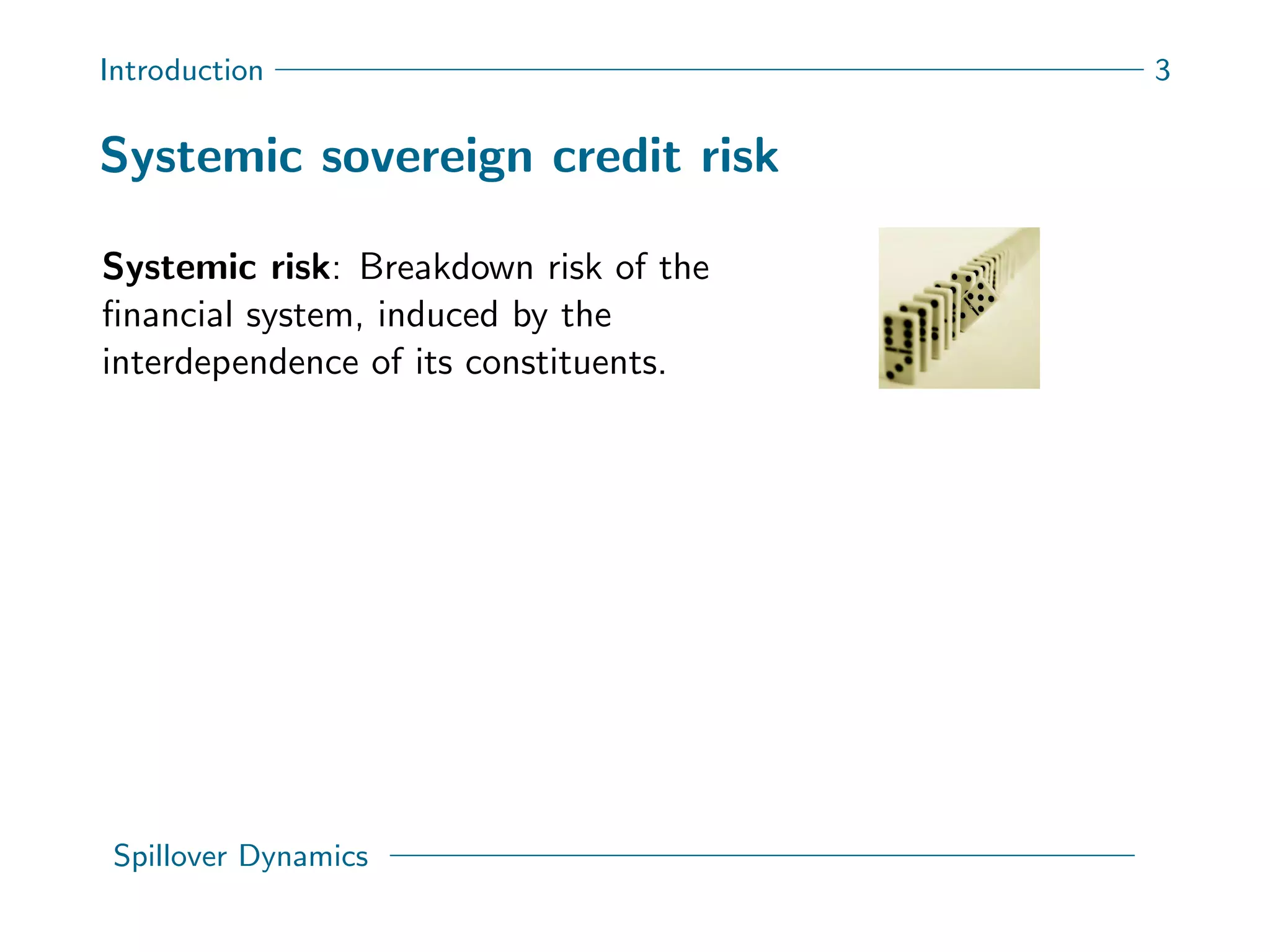
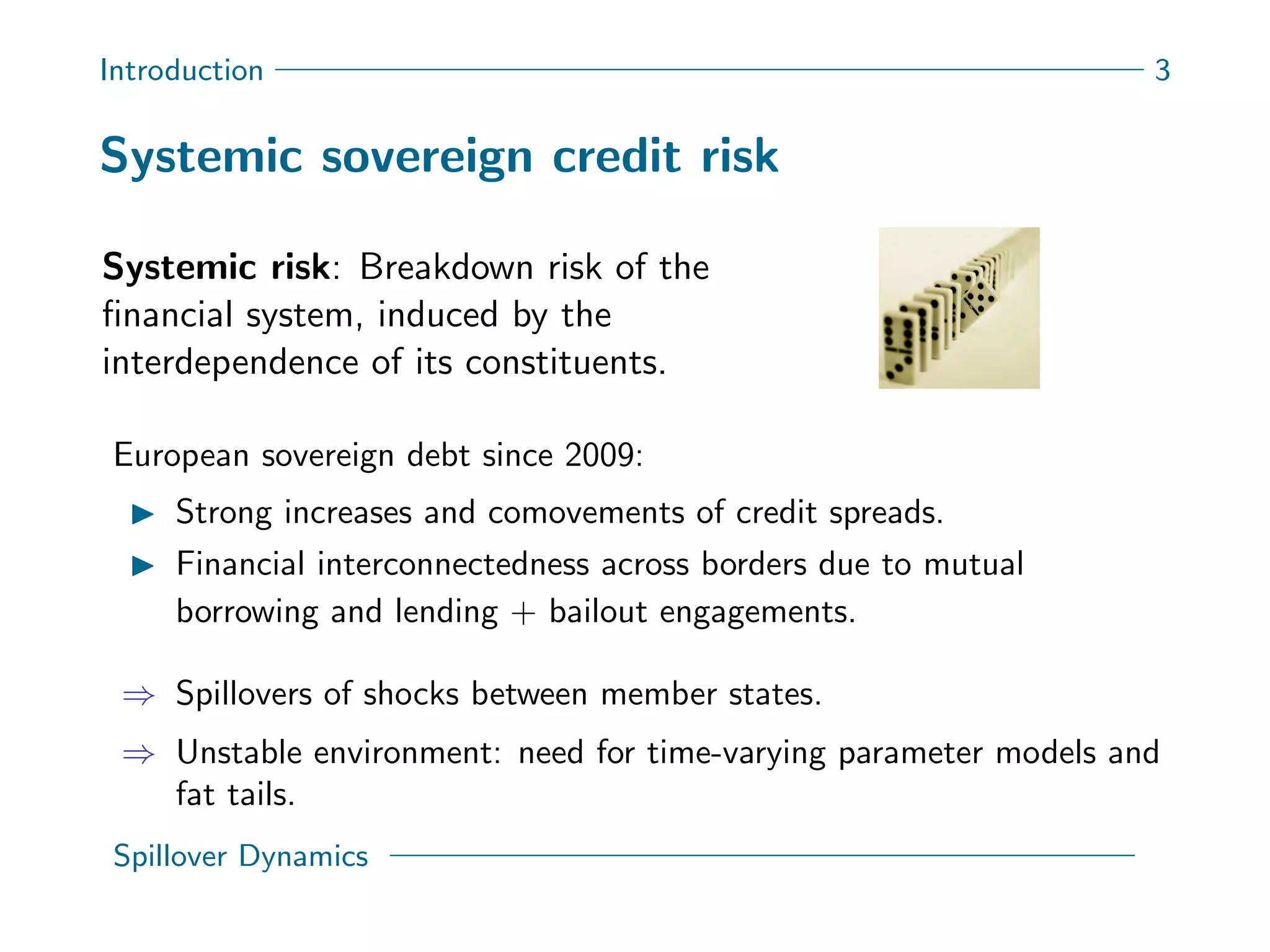
Systemic risk: Breakdown risk of the
financial system, induced by the
interdependence of its constituents.
Spillover Dynamics
Introduction 3
Systemic sovereign credit risk
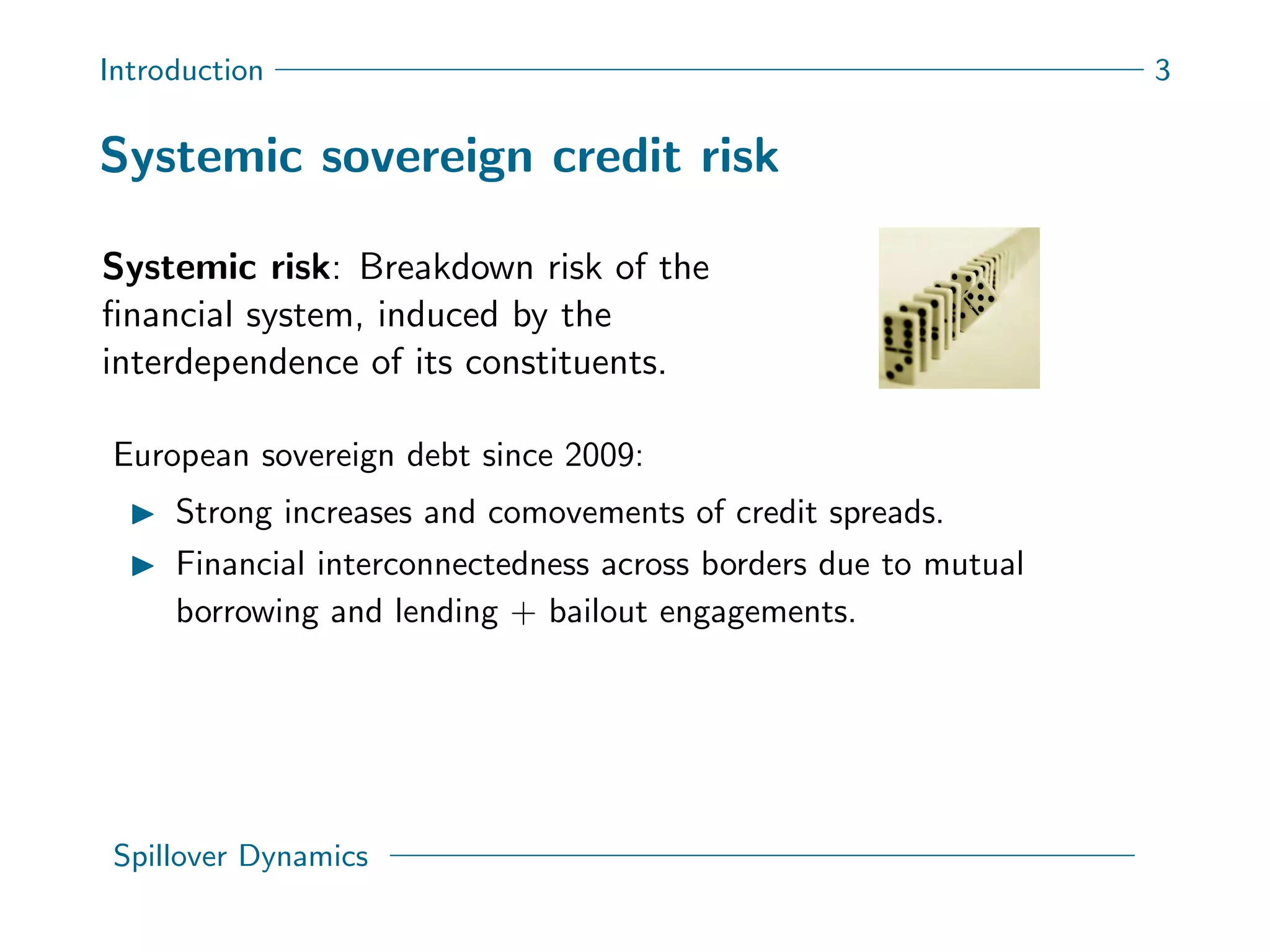
Systemic risk: Breakdown risk of the
financial system, induced by the
interdependence of its constituents.
European sovereign debt since 2009:
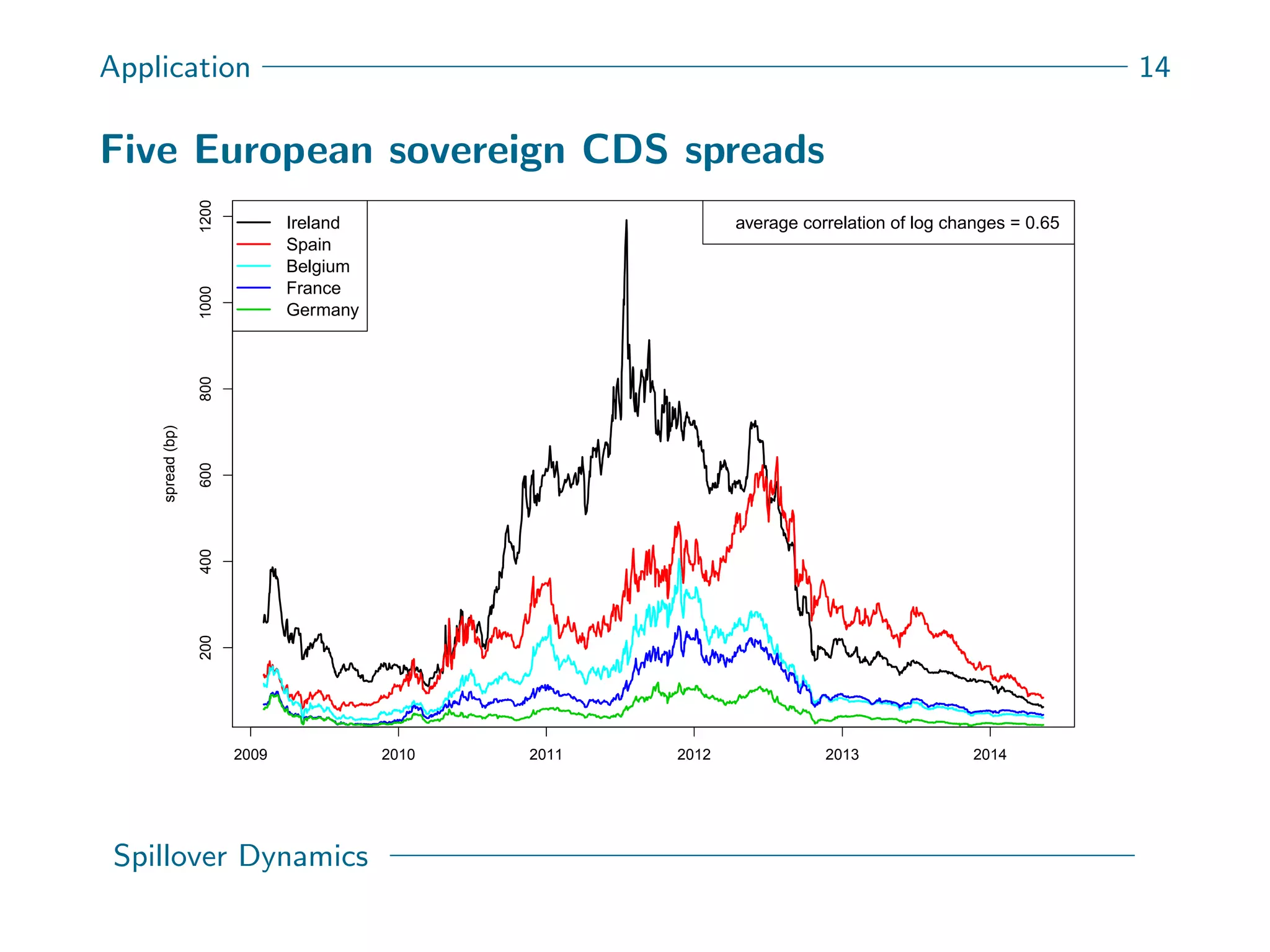
Strong increases and comovements of credit spreads.
Financial interconnectedness across borders due to mutual
borrowing and lending + bailout engagements.
Spillover Dynamics
Introduction 3
Systemic sovereign credit risk
Systemic risk: Breakdown risk of the
financial system, induced by the
interdependence of its constituents.
European sovereign debt since 2009:
Strong increases and comovements of credit spreads.
Financial interconnectedness across borders due to mutual
borrowing and lending + bailout engagements.
⇒ Spillovers of shocks between member states.
⇒ Unstable environment: need for time-varying parameter models and
fat tails.
Spillover Dynamics
Introduction 4
This project
New parsimonious model for overall time-varying strength of
cross-sectional spillovers in credit spreads (systemic risk).
⇒ Useful for flexible monitoring of policy measure effects.
Extension of widely used spatial lag model to generalized
autoregressive score (GAS) dynamics and fat tails in financial data.
Asymptotic theory and assessment of finite sample performance of
this ’Spatial GAS model’.
Spillover Dynamics
Introduction 5
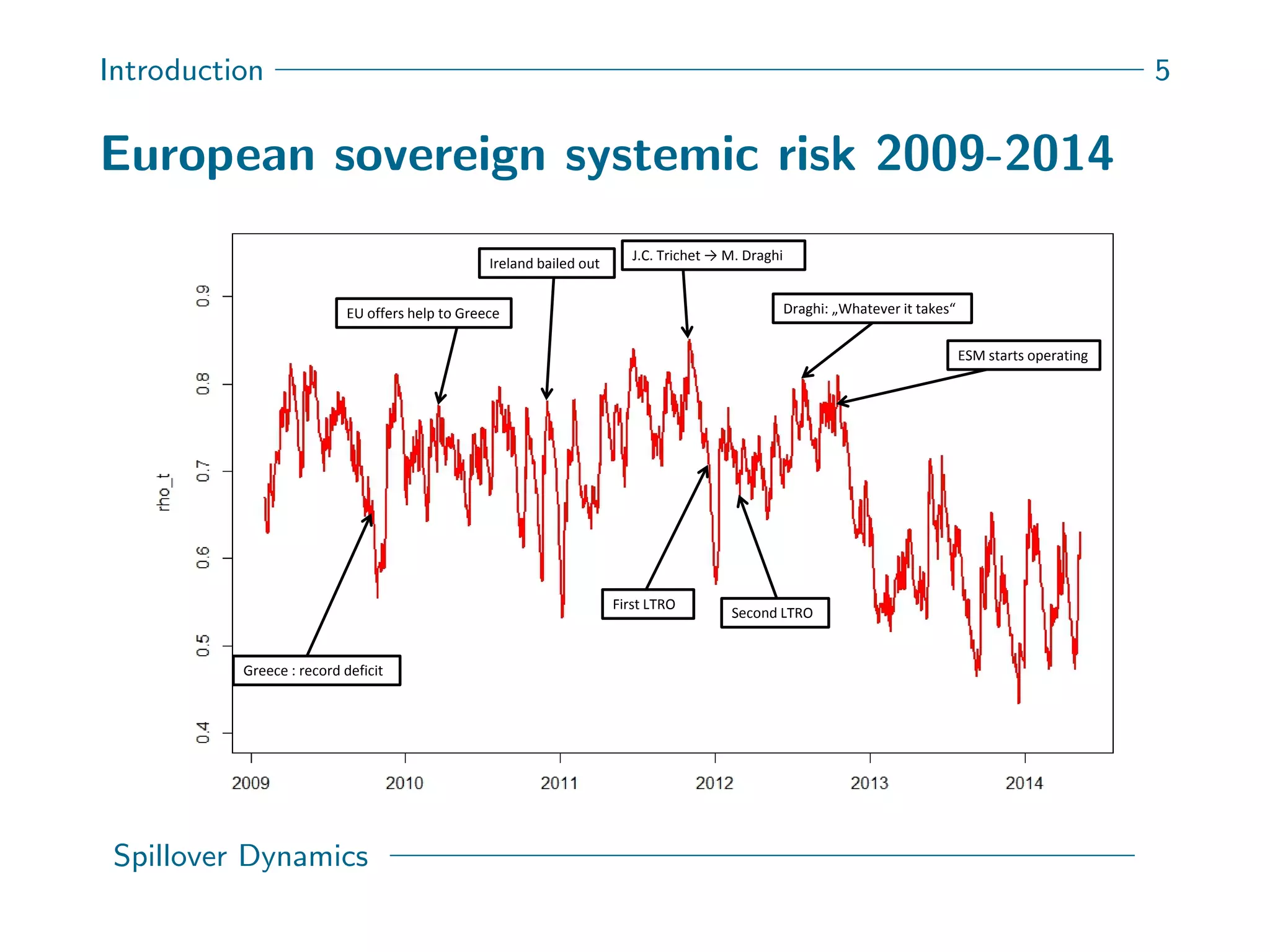
European sovereign systemic risk 2009-2014
Draghi: „Whatever it takes“
Ireland bailed out
EU offers help to Greece
J.C. Trichet → M. Draghi
First LTRO
Second LTRO
ESM starts operating
Greece : record deficit
Spillover Dynamics
Introduction 6
Some related literature
Systemic risk in sovereign credit markets:
Ang/Longstaff (2013), Lucas/Schwaab/Zhang (2013),
Aretzki/Candelon/Sy (2011), Kalbaska/Gatkowski (2012), De Santis
(2012), Caporin et al. (2014), Korte/Steffen (2013),
Kallestrup/Lando/Murgoci (2013), Beetsma et al. (2013, 2014).
Spatial econometrics:
General: Cliff/Ord (1973), Anselin (1988), Cressie (1993), LeSage/Pace
(2009), Ord (1975), Lee (2004), Elhorst (2003);
Panel data: Kelejian/Prucha (2010), Yu/de Jong/Lee (2008, 2012),
Baltagi et al. (2007, 2013), Kapoor/Kelejian/Prucha (2007);
Empirical finance: Keiler/Eder (2013), Fernandez (2011),
Asgarian/Hess/Liu (2013), Arnold/Stahlberg/Wied (2013), Wied (2012),
Denbee/Julliard/Li/Yuan (2013), Saldias (2013).
Spillover Dynamics
Spatial GAS model 7
Spatial lag model for panel data
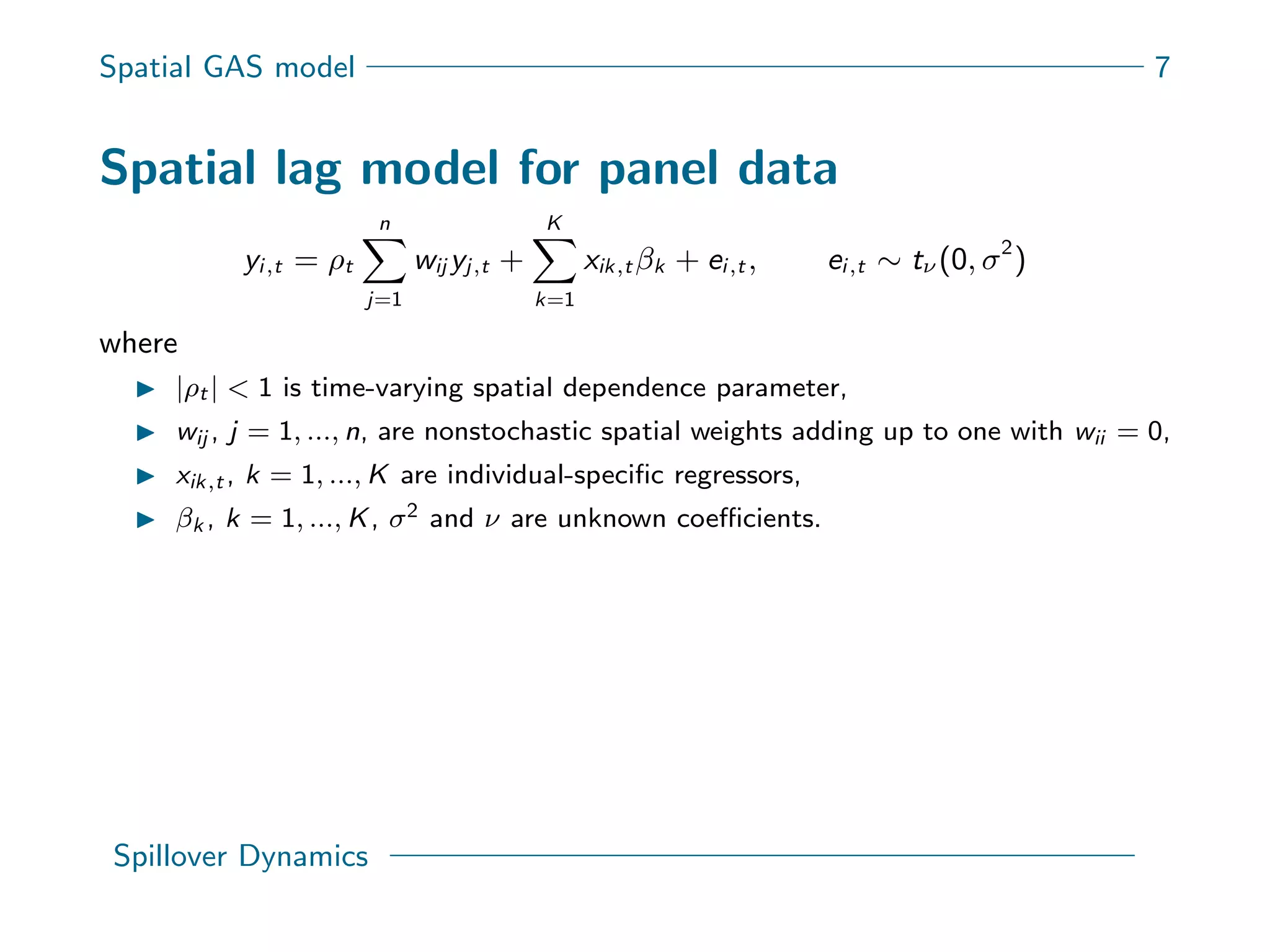
yi,t = ρt
n
j=1
wij yj,t +
K
k=1
xik,t βk + ei,t , ei,t ∼ tν (0, σ2
)
where
|ρt | < 1 is time-varying spatial dependence parameter,
wij , j = 1, ..., n, are nonstochastic spatial weights adding up to one with wii = 0,
xik,t , k = 1, ..., K are individual-specific regressors,
βk , k = 1, ..., K, σ2 and ν are unknown coefficients.
Spillover Dynamics
Spatial GAS model 7
Spatial lag model for panel data
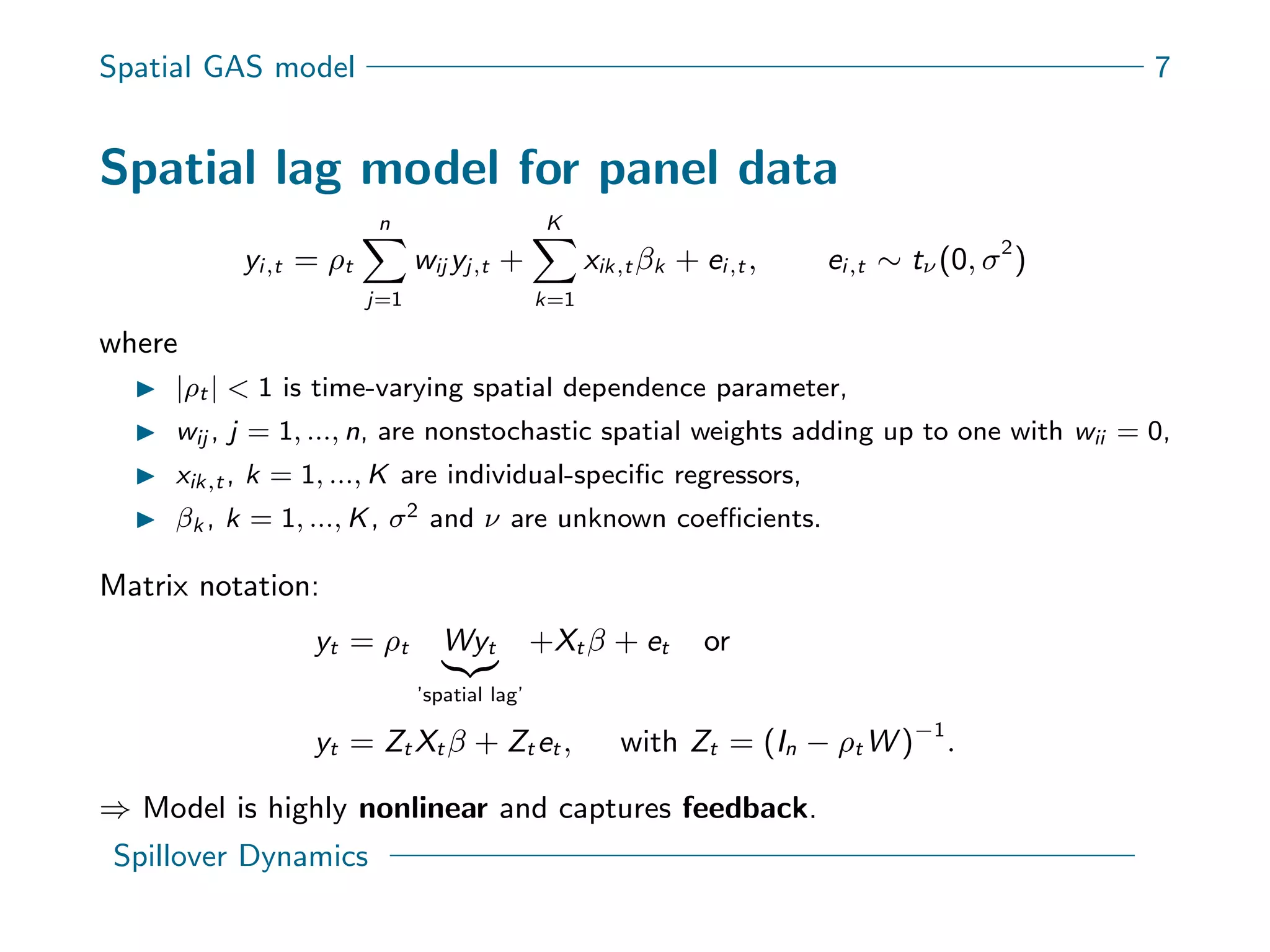
yi,t = ρt
n
j=1
wij yj,t +
K
k=1
xik,t βk + ei,t , ei,t ∼ tν (0, σ2
)
where
|ρt | < 1 is time-varying spatial dependence parameter,
wij , j = 1, ..., n, are nonstochastic spatial weights adding up to one with wii = 0,
xik,t , k = 1, ..., K are individual-specific regressors,
βk , k = 1, ..., K, σ2 and ν are unknown coefficients.
Matrix notation:
yt = ρt Wyt
’spatial lag’
+Xt β + et or
yt = Zt Xt β + Zt et , with Zt = (In − ρt W )−1
.
⇒ Model is highly nonlinear and captures feedback.
Spillover Dynamics
Spatial GAS model 8
GAS dynamics for ρt
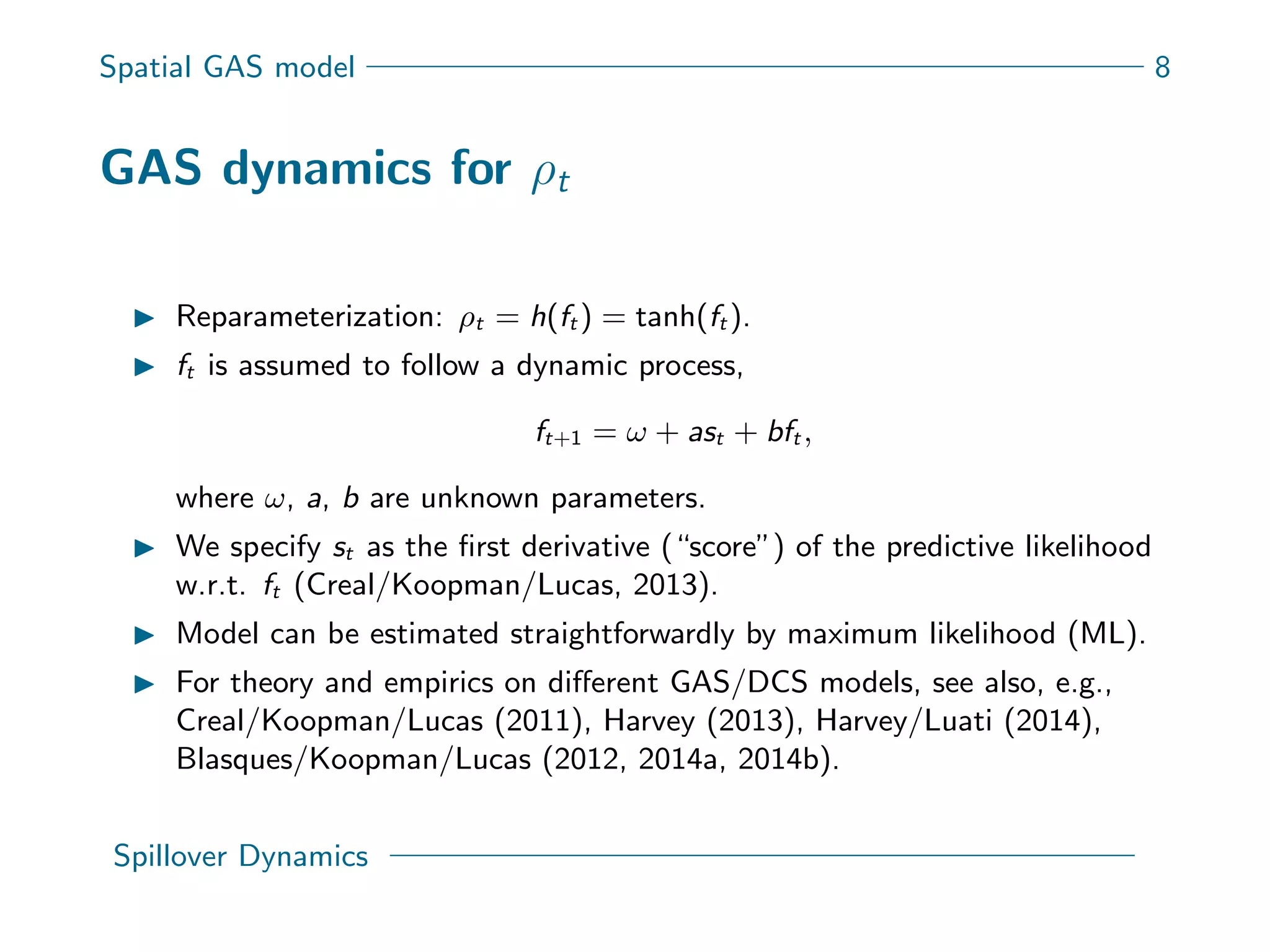
Reparameterization: ρt = h(ft ) = tanh(ft ).
ft is assumed to follow a dynamic process,
ft+1 = ω + ast + bft ,
where ω, a, b are unknown parameters.
We specify st as the first derivative (“score”) of the predictive likelihood
w.r.t. ft (Creal/Koopman/Lucas, 2013).
Model can be estimated straightforwardly by maximum likelihood (ML).
For theory and empirics on different GAS/DCS models, see also, e.g.,
Creal/Koopman/Lucas (2011), Harvey (2013), Harvey/Luati (2014),
Blasques/Koopman/Lucas (2012, 2014a, 2014b).
Spillover Dynamics
Spatial GAS model 9
Score
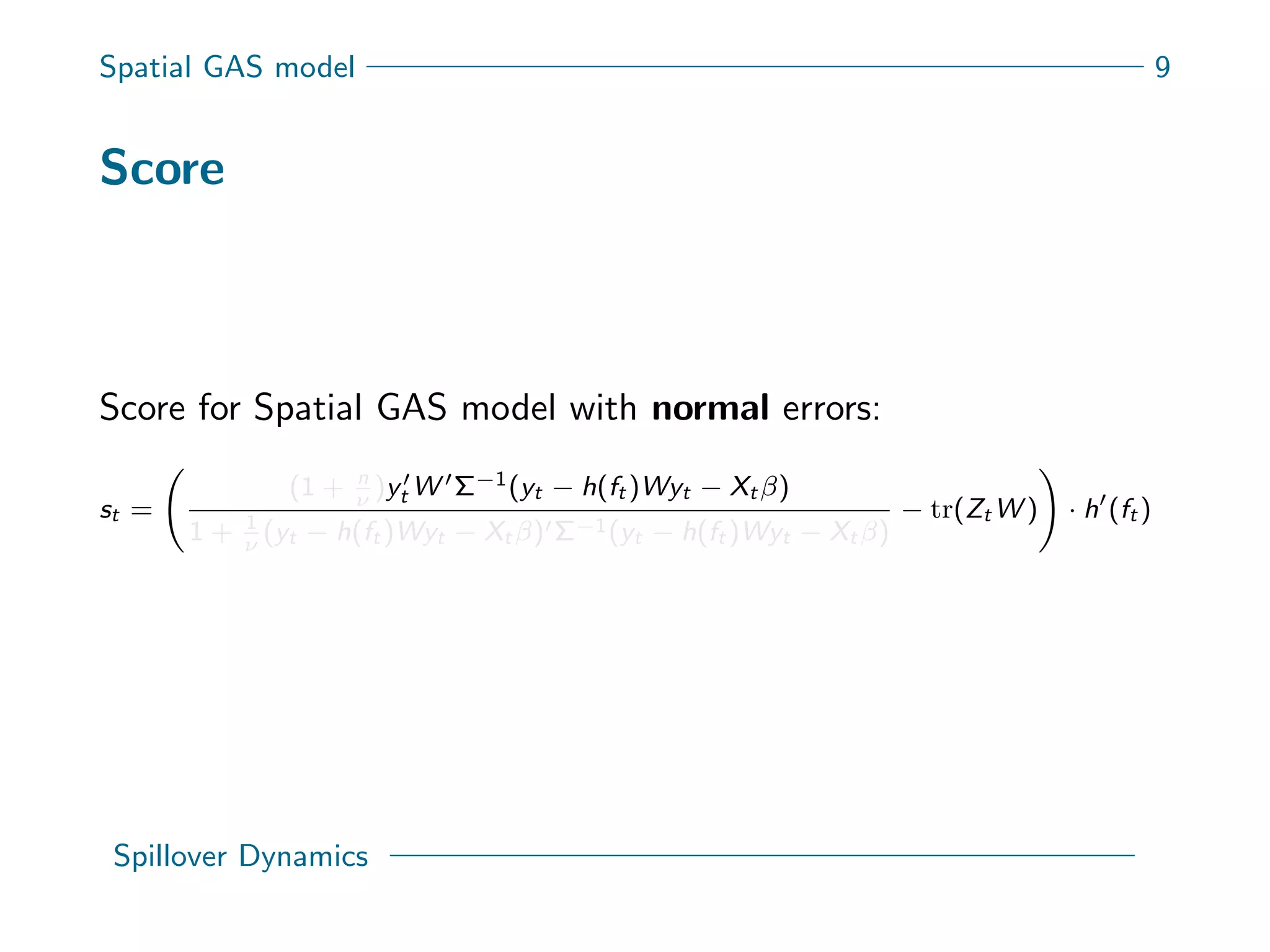
Score for Spatial GAS model with normal errors:
st =
(1 + n
ν
)yt W Σ−1(yt − h(ft )Wyt − Xt β)
1 + 1
ν
(yt − h(ft )Wyt − Xt β) Σ−1(yt − h(ft )Wyt − Xt β)
− tr(Zt W ) · h (ft )
Spillover Dynamics
Spatial GAS model 10
Score
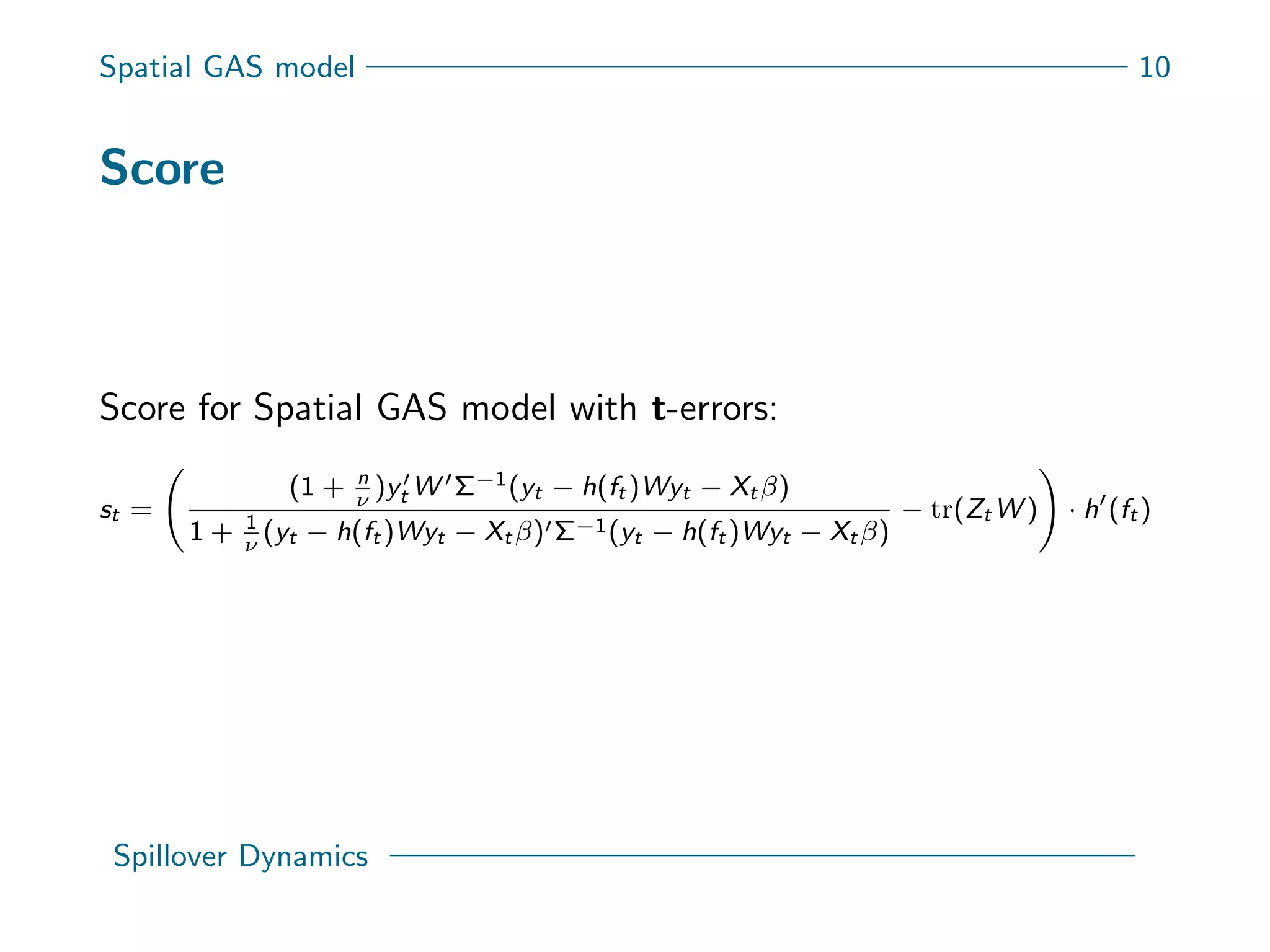
Score for Spatial GAS model with t-errors:
st =
(1 + n
ν
)yt W Σ−1(yt − h(ft )Wyt − Xt β)
1 + 1
ν
(yt − h(ft )Wyt − Xt β) Σ−1(yt − h(ft )Wyt − Xt β)
− tr(Zt W ) · h (ft )
Spillover Dynamics
Theory 11
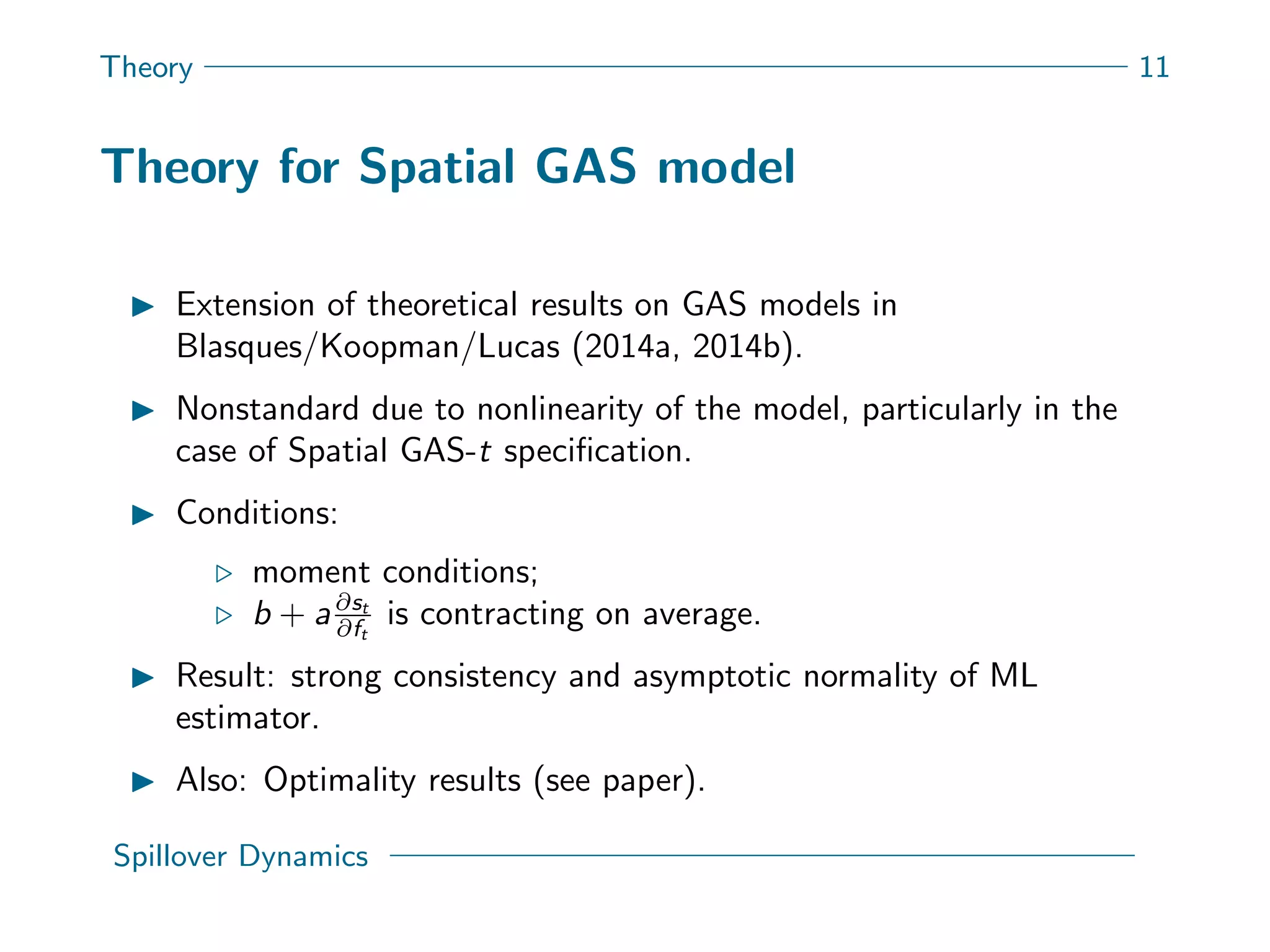
Theory for Spatial GAS model
Extension of theoretical results on GAS models in
Blasques/Koopman/Lucas (2014a, 2014b).
Nonstandard due to nonlinearity of the model, particularly in the
case of Spatial GAS-t specification.
Conditions:
moment conditions;
b + a∂st
∂ft
is contracting on average.
Result: strong consistency and asymptotic normality of ML
estimator.
Also: Optimality results (see paper).
Spillover Dynamics
Simulation 12
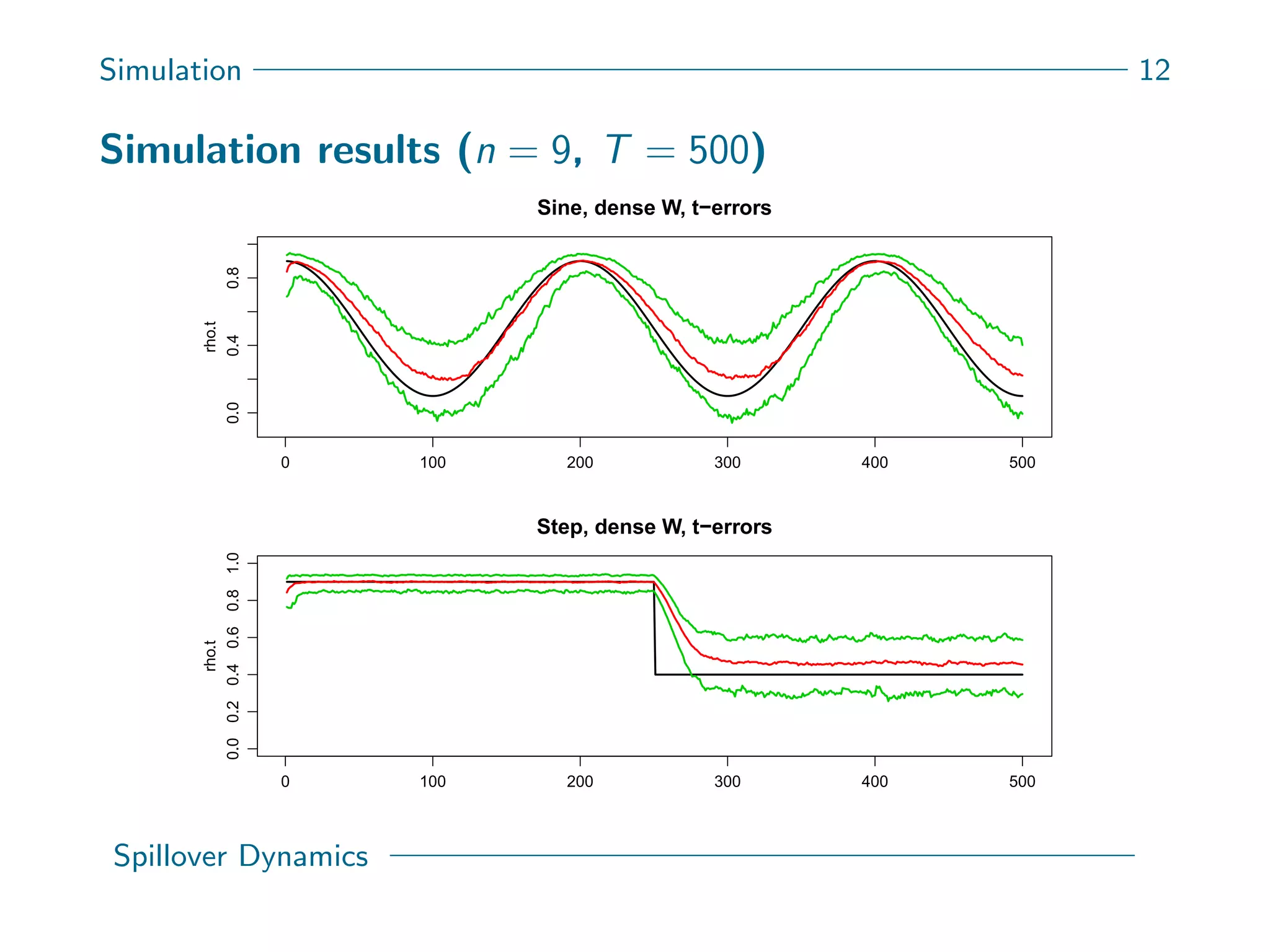
Simulation results (n = 9, T = 500)
0 100 200 300 400 500
0.00.40.8
Sine, dense W, t−errorsrho.t
0 100 200 300 400 500
0.00.20.40.60.81.0
Step, dense W, t−errors
rho.t
Spillover Dynamics
Application 13
Systemic risk in European credit spreads:
Data
Daily log changes in CDS spreads from February 2, 2009 - May 12,
2014 (1375 observations).
9 European countries: Belgium, France, Germany, Ireland, Italy,
Netherlands, Portugal, Spain, United Kingdom.
Country-specific covariates (lags):
returns from leading stock indices,
changes in 10-year government bond yields.
Europe-wide control variables (lags):
term spread: difference between three-month Euribor and EONIA,
interbank interest rate: change in three-month Euribor,
change in volatility index VSTOXX.
Spillover Dynamics
Application 14
Five European sovereign CDS spreads
2009 2010 2011 2012 2013 2014
20040060080010001200
spread(bp)
Ireland
Spain
Belgium
France
Germany
average correlation of log changes = 0.65
Spillover Dynamics
Application 15
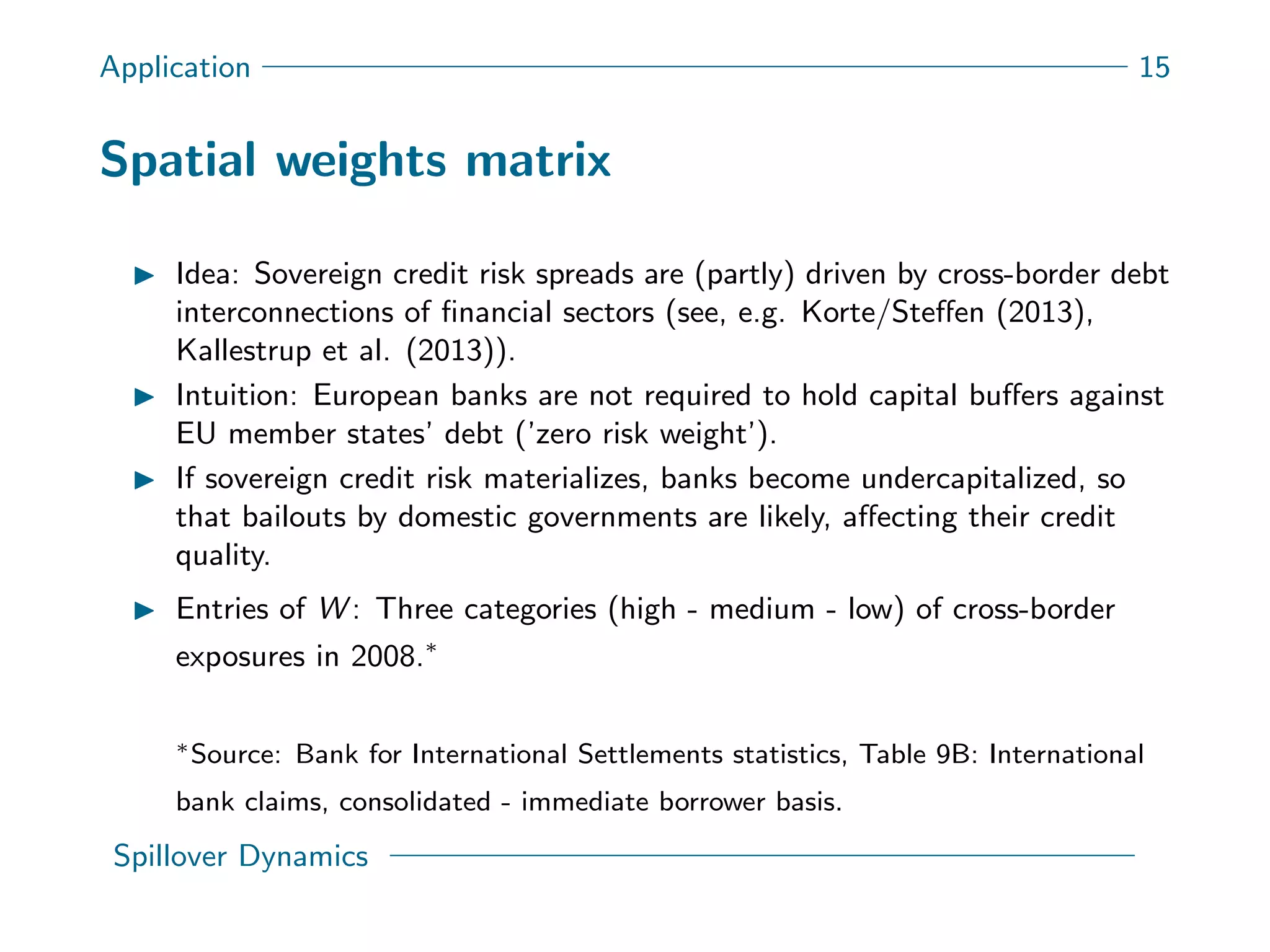
Spatial weights matrix
Idea: Sovereign credit risk spreads are (partly) driven by cross-border debt
interconnections of financial sectors (see, e.g. Korte/Steffen (2013),
Kallestrup et al. (2013)).
Intuition: European banks are not required to hold capital buffers against
EU member states’ debt (’zero risk weight’).
If sovereign credit risk materializes, banks become undercapitalized, so
that bailouts by domestic governments are likely, affecting their credit
quality.
Entries of W : Three categories (high - medium - low) of cross-border
exposures in 2008.∗
∗Source: Bank for International Settlements statistics, Table 9B: International
bank claims, consolidated - immediate borrower basis.
Spillover Dynamics
Application 16
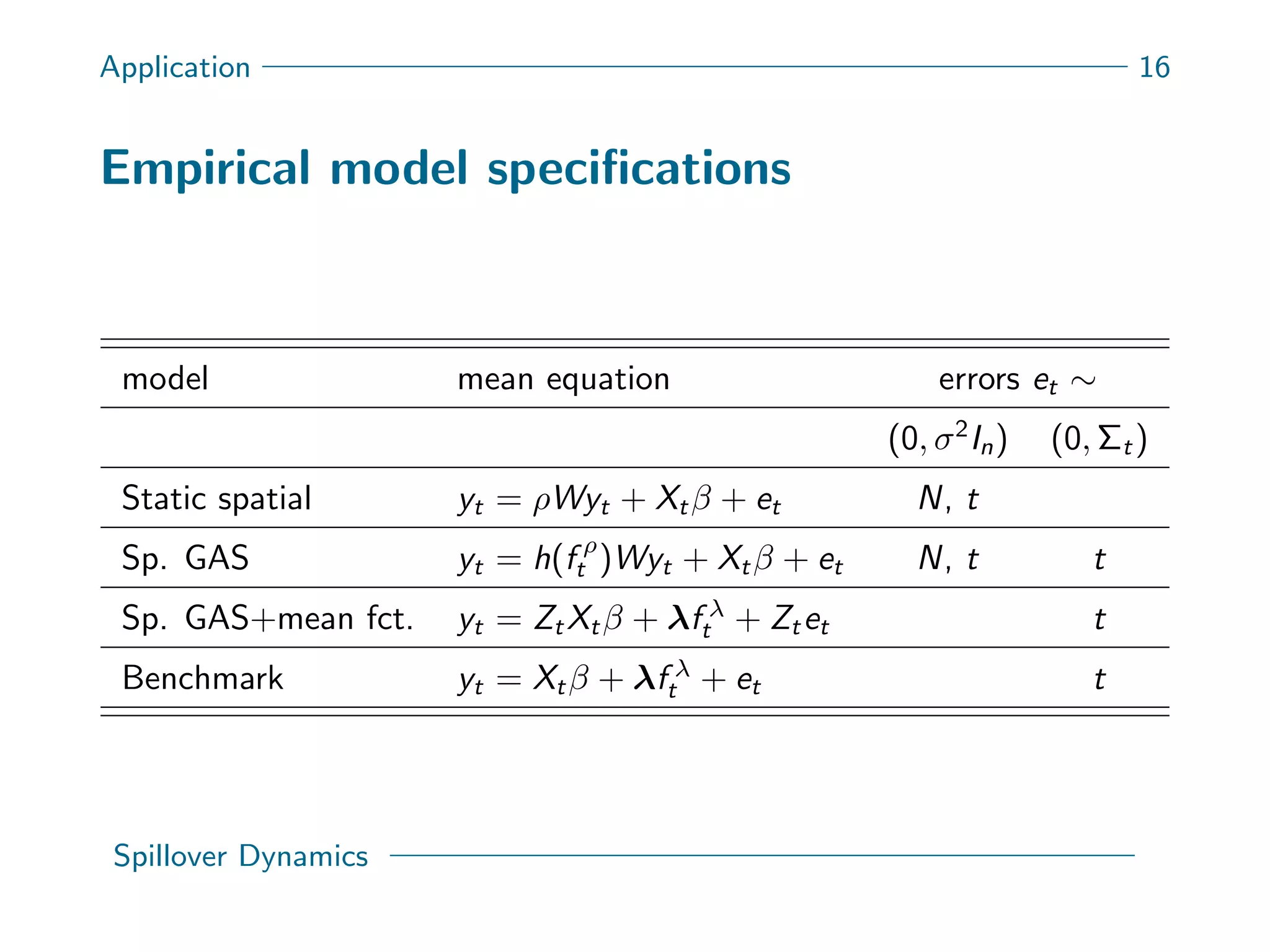
Empirical model specifications
model mean equation errors et ∼
(0, σ2
In) (0, Σt)
Static spatial yt = ρWyt + Xtβ + et N, t
Sp. GAS yt = h(f ρ
t )Wyt + Xtβ + et N, t t
Sp. GAS+mean fct. yt = ZtXtβ + λf λ
t + Ztet t
Benchmark yt = Xtβ + λf λ
t + et t
Spillover Dynamics
Application 17
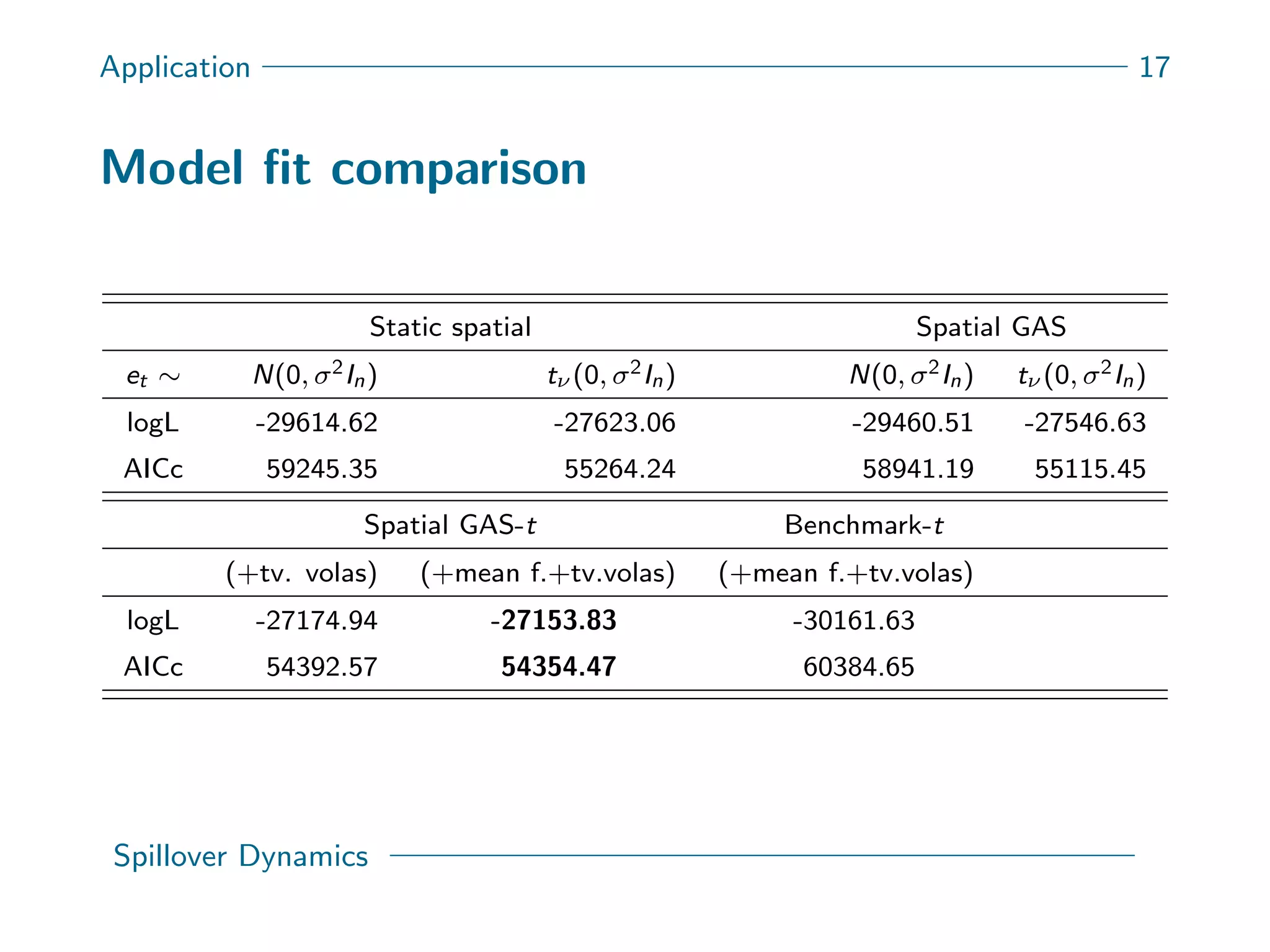
Model fit comparison
Static spatial Spatial GAS
et ∼ N(0, σ2In) tν (0, σ2In) N(0, σ2In) tν (0, σ2In)
logL -29614.62 -27623.06 -29460.51 -27546.63
AICc 59245.35 55264.24 58941.19 55115.45
Spatial GAS-t Benchmark-t
(+tv. volas) (+mean f.+tv.volas) (+mean f.+tv.volas)
logL -27174.94 -27153.83 -30161.63
AICc 54392.57 54354.47 60384.65
Spillover Dynamics
Application 18
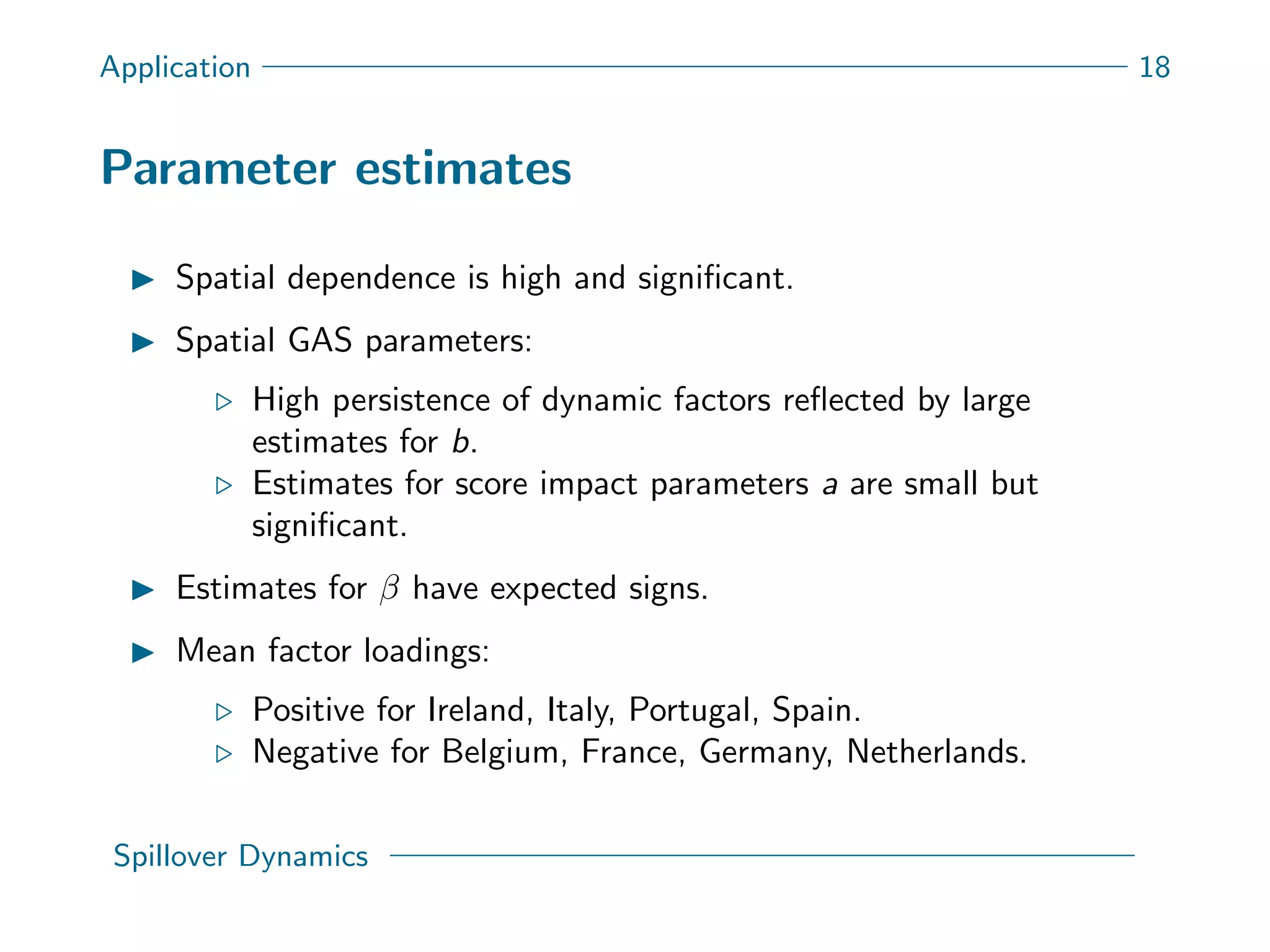
Parameter estimates
Spatial dependence is high and significant.
Spatial GAS parameters:
High persistence of dynamic factors reflected by large
estimates for b.
Estimates for score impact parameters a are small but
significant.
Estimates for β have expected signs.
Mean factor loadings:
Positive for Ireland, Italy, Portugal, Spain.
Negative for Belgium, France, Germany, Netherlands.
Spillover Dynamics
Application 19
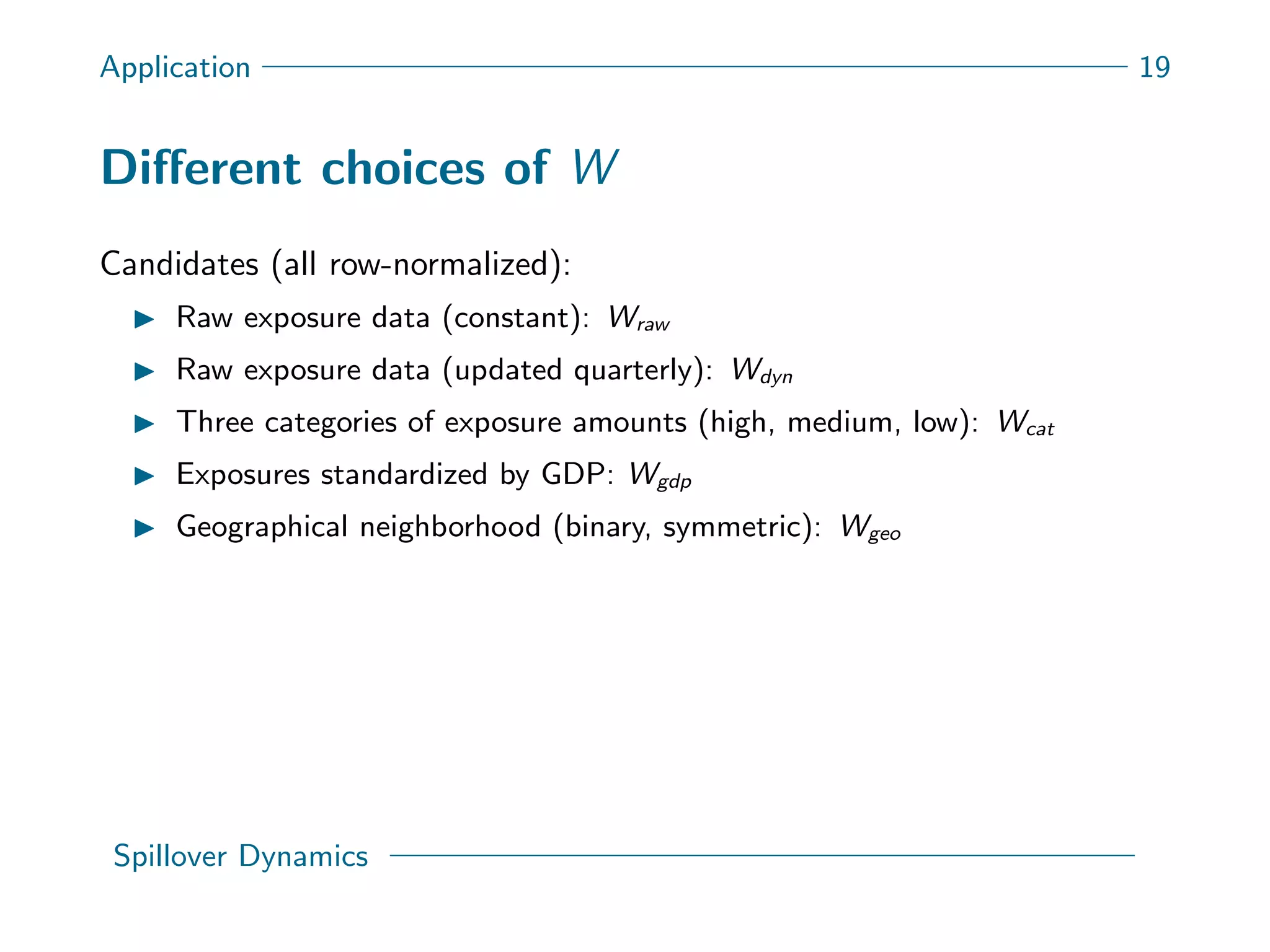
Different choices of W
Candidates (all row-normalized):
Raw exposure data (constant): Wraw
Raw exposure data (updated quarterly): Wdyn
Three categories of exposure amounts (high, medium, low): Wcat
Exposures standardized by GDP: Wgdp
Geographical neighborhood (binary, symmetric): Wgeo
Spillover Dynamics
Application 19
Different choices of W
Candidates (all row-normalized):
Raw exposure data (constant): Wraw
Raw exposure data (updated quarterly): Wdyn
Three categories of exposure amounts (high, medium, low): Wcat
Exposures standardized by GDP: Wgdp
Geographical neighborhood (binary, symmetric): Wgeo
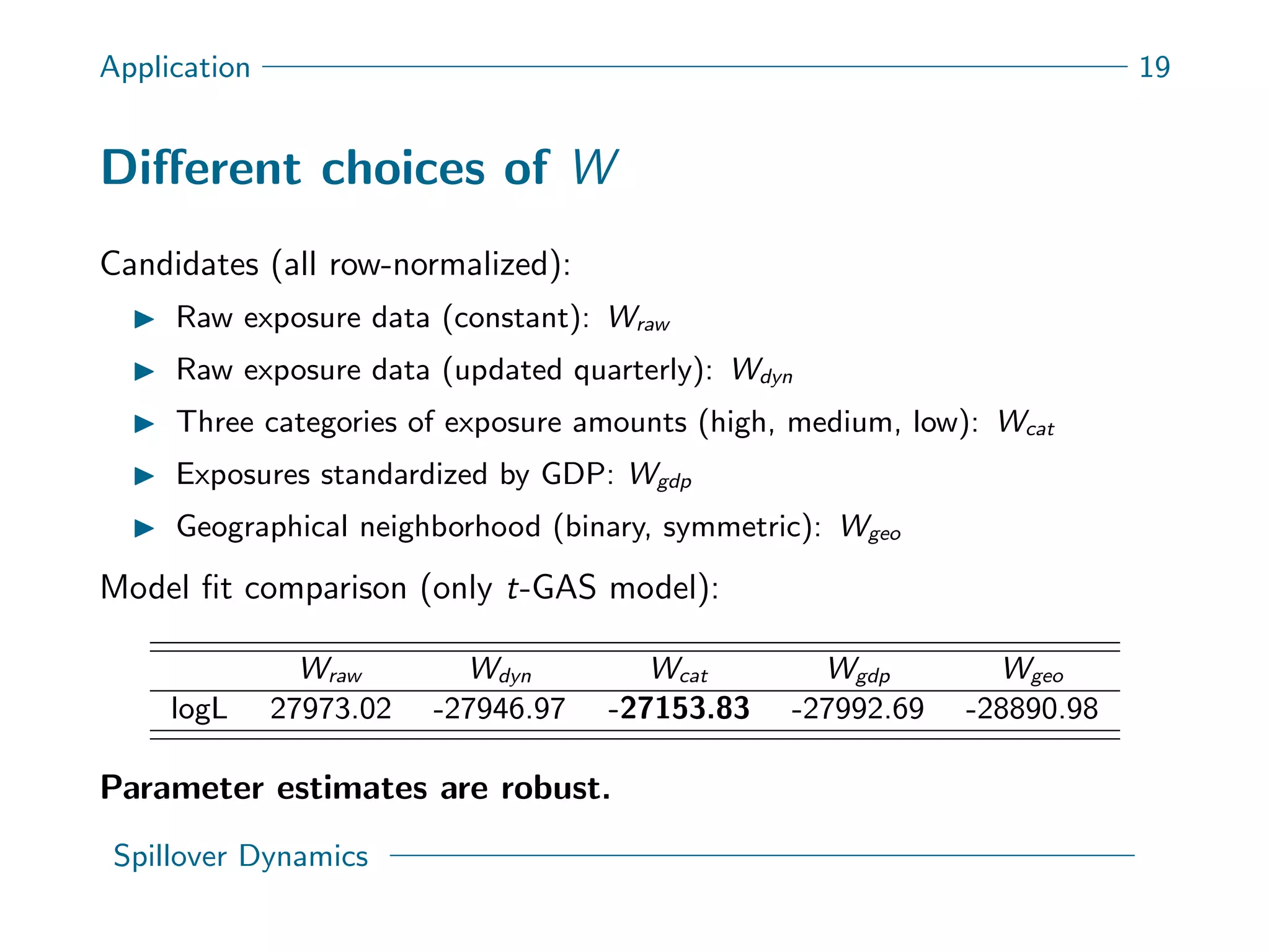
Model fit comparison (only t-GAS model):
Wraw Wdyn Wcat Wgdp Wgeo
logL 27973.02 -27946.97 -27153.83 -27992.69 -28890.98
Parameter estimates are robust.
Spillover Dynamics
Application 20
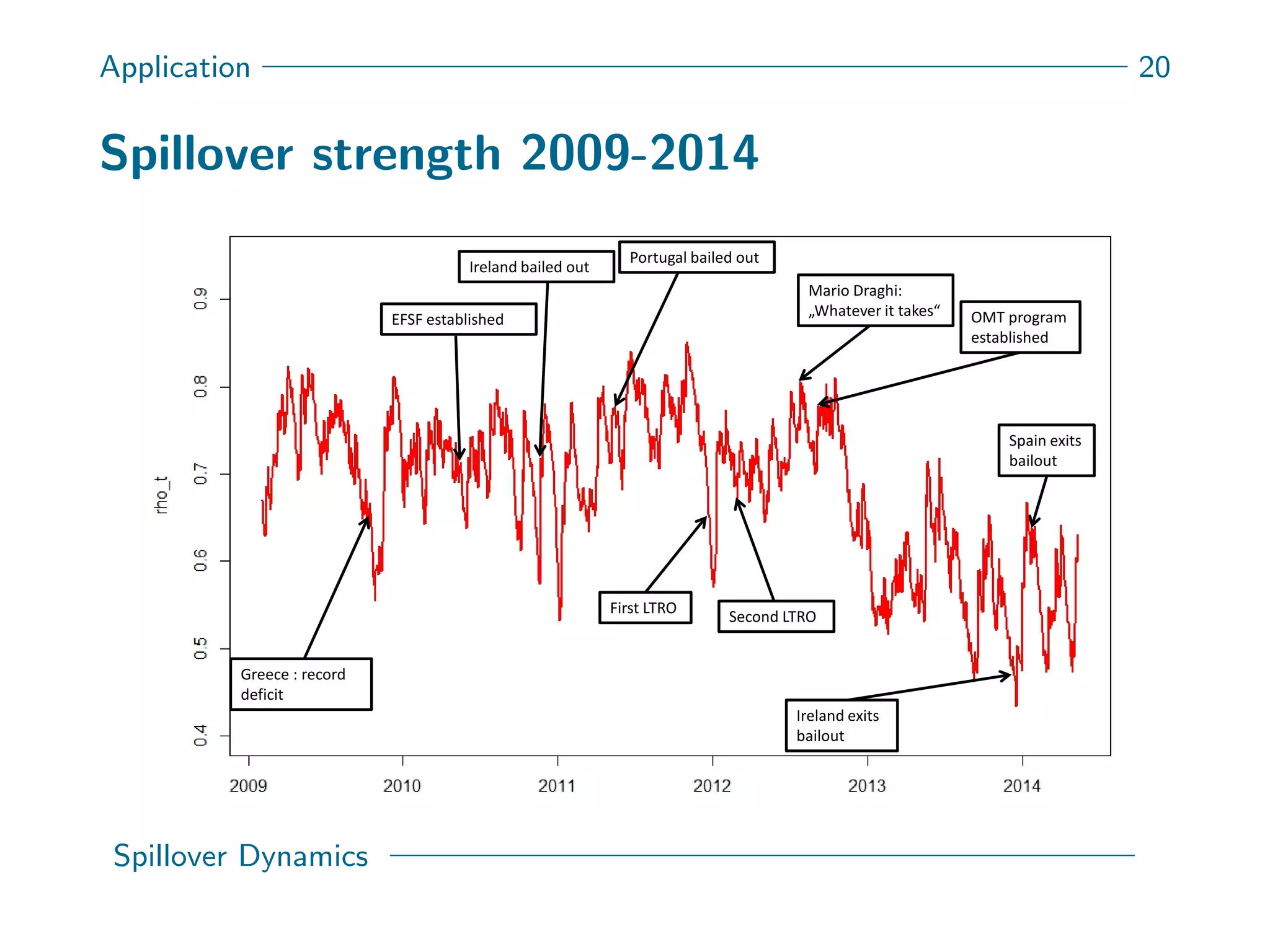
Spillover strength 2009-2014
Mario Draghi:
„Whatever it takes“
Ireland bailed out
EFSF established
Portugal bailed out
First LTRO
Second LTRO
OMT program
established
Greece : record
deficit
Ireland exits
bailout
Spain exits
bailout
Spillover Dynamics
Conclusions 21
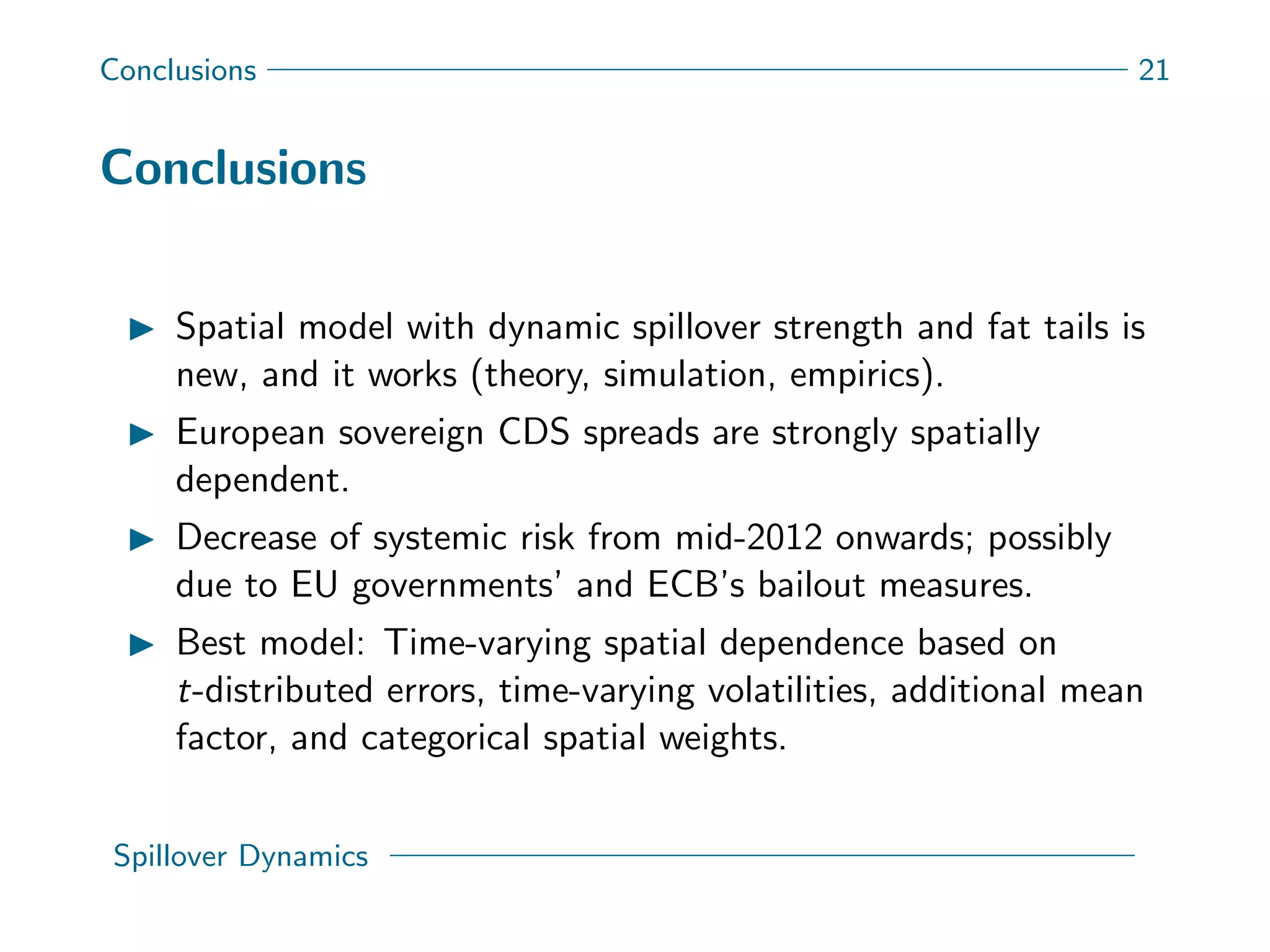
Conclusions
Spatial model with dynamic spillover strength and fat tails is
new, and it works (theory, simulation, empirics).
European sovereign CDS spreads are strongly spatially
dependent.
Decrease of systemic risk from mid-2012 onwards; possibly
due to EU governments’ and ECB’s bailout measures.
Best model: Time-varying spatial dependence based on
t-distributed errors, time-varying volatilities, additional mean
factor, and categorical spatial weights.
Spillover Dynamics
Thank you.

Spillover dynamics for systemic risk measurement using spatial financial time series models - Blasques F., Koopman S.J., Lucas A., Schaumburg J. June, 12 2014

  • 1.
    Spillover Dynamics forSystemic Risk Measurement Using Spatial Financial Time Series Models SYstemic Risk TOmography: Signals, Measurements, Transmission Channels, and Policy Interventions FranciscoBlasques(a,b) SiemJan Koopman(a,b,c) AndreLucas(a,b,d) JuliaSchaumburg(a,b) (a)VU University Amsterdam (b)Tinbergen Institute (c)CREATES (d)Duisenberg School ofFinance SeventhAnnualSoFiE Conference Toronto,June 11-13,2014
  • 2.
    This project hasreceived funding from the European Union’s Seventh Framework Programme for research, technological development and demonstration under grant agreement no° 320270 www.syrtoproject.eu This document reflects only the author’s views. The European Union is not liable for any use that may be made of the information contained therein.
  • 3.
    Introduction 3 Systemic sovereigncredit risk Systemic risk: Breakdown risk of the financial system, induced by the interdependence of its constituents. Spillover Dynamics
  • 4.
    Introduction 3 Systemic sovereigncredit risk Systemic risk: Breakdown risk of the financial system, induced by the interdependence of its constituents. European sovereign debt since 2009: Strong increases and comovements of credit spreads. Financial interconnectedness across borders due to mutual borrowing and lending + bailout engagements. Spillover Dynamics
  • 5.
    Introduction 3 Systemic sovereigncredit risk Systemic risk: Breakdown risk of the financial system, induced by the interdependence of its constituents. European sovereign debt since 2009: Strong increases and comovements of credit spreads. Financial interconnectedness across borders due to mutual borrowing and lending + bailout engagements. ⇒ Spillovers of shocks between member states. ⇒ Unstable environment: need for time-varying parameter models and fat tails. Spillover Dynamics
  • 6.
    Introduction 4 This project Newparsimonious model for overall time-varying strength of cross-sectional spillovers in credit spreads (systemic risk). ⇒ Useful for flexible monitoring of policy measure effects. Extension of widely used spatial lag model to generalized autoregressive score (GAS) dynamics and fat tails in financial data. Asymptotic theory and assessment of finite sample performance of this ’Spatial GAS model’. Spillover Dynamics
  • 7.
    Introduction 5 European sovereignsystemic risk 2009-2014 Draghi: „Whatever it takes“ Ireland bailed out EU offers help to Greece J.C. Trichet → M. Draghi First LTRO Second LTRO ESM starts operating Greece : record deficit Spillover Dynamics
  • 8.
    Introduction 6 Some relatedliterature Systemic risk in sovereign credit markets: Ang/Longstaff (2013), Lucas/Schwaab/Zhang (2013), Aretzki/Candelon/Sy (2011), Kalbaska/Gatkowski (2012), De Santis (2012), Caporin et al. (2014), Korte/Steffen (2013), Kallestrup/Lando/Murgoci (2013), Beetsma et al. (2013, 2014). Spatial econometrics: General: Cliff/Ord (1973), Anselin (1988), Cressie (1993), LeSage/Pace (2009), Ord (1975), Lee (2004), Elhorst (2003); Panel data: Kelejian/Prucha (2010), Yu/de Jong/Lee (2008, 2012), Baltagi et al. (2007, 2013), Kapoor/Kelejian/Prucha (2007); Empirical finance: Keiler/Eder (2013), Fernandez (2011), Asgarian/Hess/Liu (2013), Arnold/Stahlberg/Wied (2013), Wied (2012), Denbee/Julliard/Li/Yuan (2013), Saldias (2013). Spillover Dynamics
  • 9.
    Spatial GAS model7 Spatial lag model for panel data yi,t = ρt n j=1 wij yj,t + K k=1 xik,t βk + ei,t , ei,t ∼ tν (0, σ2 ) where |ρt | < 1 is time-varying spatial dependence parameter, wij , j = 1, ..., n, are nonstochastic spatial weights adding up to one with wii = 0, xik,t , k = 1, ..., K are individual-specific regressors, βk , k = 1, ..., K, σ2 and ν are unknown coefficients. Spillover Dynamics
  • 10.
    Spatial GAS model7 Spatial lag model for panel data yi,t = ρt n j=1 wij yj,t + K k=1 xik,t βk + ei,t , ei,t ∼ tν (0, σ2 ) where |ρt | < 1 is time-varying spatial dependence parameter, wij , j = 1, ..., n, are nonstochastic spatial weights adding up to one with wii = 0, xik,t , k = 1, ..., K are individual-specific regressors, βk , k = 1, ..., K, σ2 and ν are unknown coefficients. Matrix notation: yt = ρt Wyt ’spatial lag’ +Xt β + et or yt = Zt Xt β + Zt et , with Zt = (In − ρt W )−1 . ⇒ Model is highly nonlinear and captures feedback. Spillover Dynamics
  • 11.
    Spatial GAS model8 GAS dynamics for ρt Reparameterization: ρt = h(ft ) = tanh(ft ). ft is assumed to follow a dynamic process, ft+1 = ω + ast + bft , where ω, a, b are unknown parameters. We specify st as the first derivative (“score”) of the predictive likelihood w.r.t. ft (Creal/Koopman/Lucas, 2013). Model can be estimated straightforwardly by maximum likelihood (ML). For theory and empirics on different GAS/DCS models, see also, e.g., Creal/Koopman/Lucas (2011), Harvey (2013), Harvey/Luati (2014), Blasques/Koopman/Lucas (2012, 2014a, 2014b). Spillover Dynamics
  • 12.
    Spatial GAS model9 Score Score for Spatial GAS model with normal errors: st = (1 + n ν )yt W Σ−1(yt − h(ft )Wyt − Xt β) 1 + 1 ν (yt − h(ft )Wyt − Xt β) Σ−1(yt − h(ft )Wyt − Xt β) − tr(Zt W ) · h (ft ) Spillover Dynamics
  • 13.
    Spatial GAS model10 Score Score for Spatial GAS model with t-errors: st = (1 + n ν )yt W Σ−1(yt − h(ft )Wyt − Xt β) 1 + 1 ν (yt − h(ft )Wyt − Xt β) Σ−1(yt − h(ft )Wyt − Xt β) − tr(Zt W ) · h (ft ) Spillover Dynamics
  • 14.
    Theory 11 Theory forSpatial GAS model Extension of theoretical results on GAS models in Blasques/Koopman/Lucas (2014a, 2014b). Nonstandard due to nonlinearity of the model, particularly in the case of Spatial GAS-t specification. Conditions: moment conditions; b + a∂st ∂ft is contracting on average. Result: strong consistency and asymptotic normality of ML estimator. Also: Optimality results (see paper). Spillover Dynamics
  • 15.
    Simulation 12 Simulation results(n = 9, T = 500) 0 100 200 300 400 500 0.00.40.8 Sine, dense W, t−errorsrho.t 0 100 200 300 400 500 0.00.20.40.60.81.0 Step, dense W, t−errors rho.t Spillover Dynamics
  • 16.
    Application 13 Systemic riskin European credit spreads: Data Daily log changes in CDS spreads from February 2, 2009 - May 12, 2014 (1375 observations). 9 European countries: Belgium, France, Germany, Ireland, Italy, Netherlands, Portugal, Spain, United Kingdom. Country-specific covariates (lags): returns from leading stock indices, changes in 10-year government bond yields. Europe-wide control variables (lags): term spread: difference between three-month Euribor and EONIA, interbank interest rate: change in three-month Euribor, change in volatility index VSTOXX. Spillover Dynamics
  • 17.
    Application 14 Five Europeansovereign CDS spreads 2009 2010 2011 2012 2013 2014 20040060080010001200 spread(bp) Ireland Spain Belgium France Germany average correlation of log changes = 0.65 Spillover Dynamics
  • 18.
    Application 15 Spatial weightsmatrix Idea: Sovereign credit risk spreads are (partly) driven by cross-border debt interconnections of financial sectors (see, e.g. Korte/Steffen (2013), Kallestrup et al. (2013)). Intuition: European banks are not required to hold capital buffers against EU member states’ debt (’zero risk weight’). If sovereign credit risk materializes, banks become undercapitalized, so that bailouts by domestic governments are likely, affecting their credit quality. Entries of W : Three categories (high - medium - low) of cross-border exposures in 2008.∗ ∗Source: Bank for International Settlements statistics, Table 9B: International bank claims, consolidated - immediate borrower basis. Spillover Dynamics
  • 19.
    Application 16 Empirical modelspecifications model mean equation errors et ∼ (0, σ2 In) (0, Σt) Static spatial yt = ρWyt + Xtβ + et N, t Sp. GAS yt = h(f ρ t )Wyt + Xtβ + et N, t t Sp. GAS+mean fct. yt = ZtXtβ + λf λ t + Ztet t Benchmark yt = Xtβ + λf λ t + et t Spillover Dynamics
  • 20.
    Application 17 Model fitcomparison Static spatial Spatial GAS et ∼ N(0, σ2In) tν (0, σ2In) N(0, σ2In) tν (0, σ2In) logL -29614.62 -27623.06 -29460.51 -27546.63 AICc 59245.35 55264.24 58941.19 55115.45 Spatial GAS-t Benchmark-t (+tv. volas) (+mean f.+tv.volas) (+mean f.+tv.volas) logL -27174.94 -27153.83 -30161.63 AICc 54392.57 54354.47 60384.65 Spillover Dynamics
  • 21.
    Application 18 Parameter estimates Spatialdependence is high and significant. Spatial GAS parameters: High persistence of dynamic factors reflected by large estimates for b. Estimates for score impact parameters a are small but significant. Estimates for β have expected signs. Mean factor loadings: Positive for Ireland, Italy, Portugal, Spain. Negative for Belgium, France, Germany, Netherlands. Spillover Dynamics
  • 22.
    Application 19 Different choicesof W Candidates (all row-normalized): Raw exposure data (constant): Wraw Raw exposure data (updated quarterly): Wdyn Three categories of exposure amounts (high, medium, low): Wcat Exposures standardized by GDP: Wgdp Geographical neighborhood (binary, symmetric): Wgeo Spillover Dynamics
  • 23.
    Application 19 Different choicesof W Candidates (all row-normalized): Raw exposure data (constant): Wraw Raw exposure data (updated quarterly): Wdyn Three categories of exposure amounts (high, medium, low): Wcat Exposures standardized by GDP: Wgdp Geographical neighborhood (binary, symmetric): Wgeo Model fit comparison (only t-GAS model): Wraw Wdyn Wcat Wgdp Wgeo logL 27973.02 -27946.97 -27153.83 -27992.69 -28890.98 Parameter estimates are robust. Spillover Dynamics
  • 24.
    Application 20 Spillover strength2009-2014 Mario Draghi: „Whatever it takes“ Ireland bailed out EFSF established Portugal bailed out First LTRO Second LTRO OMT program established Greece : record deficit Ireland exits bailout Spain exits bailout Spillover Dynamics
  • 25.
    Conclusions 21 Conclusions Spatial modelwith dynamic spillover strength and fat tails is new, and it works (theory, simulation, empirics). European sovereign CDS spreads are strongly spatially dependent. Decrease of systemic risk from mid-2012 onwards; possibly due to EU governments’ and ECB’s bailout measures. Best model: Time-varying spatial dependence based on t-distributed errors, time-varying volatilities, additional mean factor, and categorical spatial weights. Spillover Dynamics
  • 26.