Interactions of reading and assessment activities
Niels Seidel, Dennis Menze
27/07/2022
1
Agenda
Introduction
Data & Methods
Results
Discussion
Conclusion and Outlook
2
Introduction
3
Online Learning
4
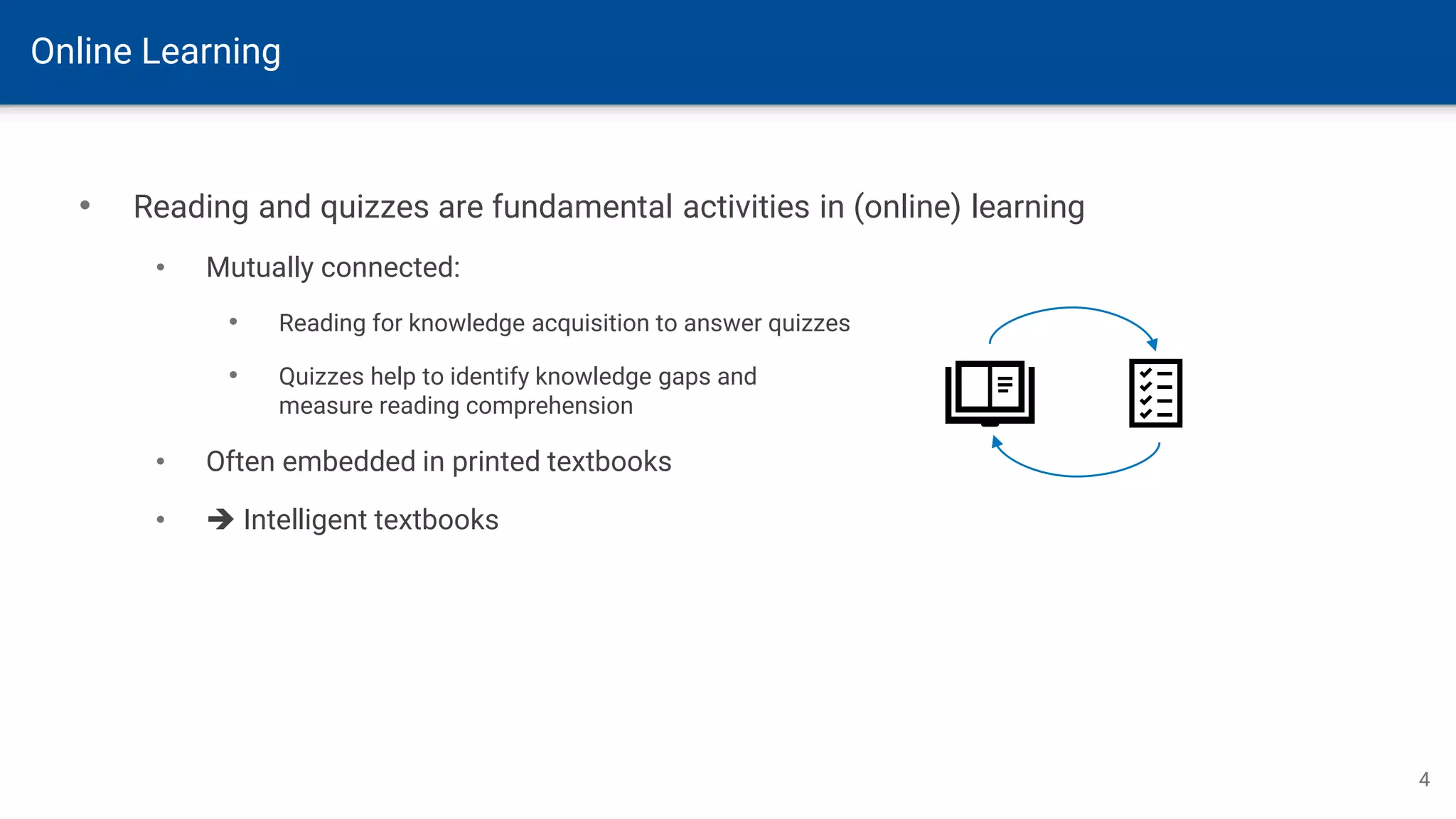
• Reading and quizzes are fundamental activities in (online) learning
• Mutually connected:
• Reading for knowledge acquisition to answer quizzes
• Quizzes help to identify knowledge gaps and
measure reading comprehension
• Often embedded in printed textbooks
• ➔ Intelligent textbooks
Online Learning
5
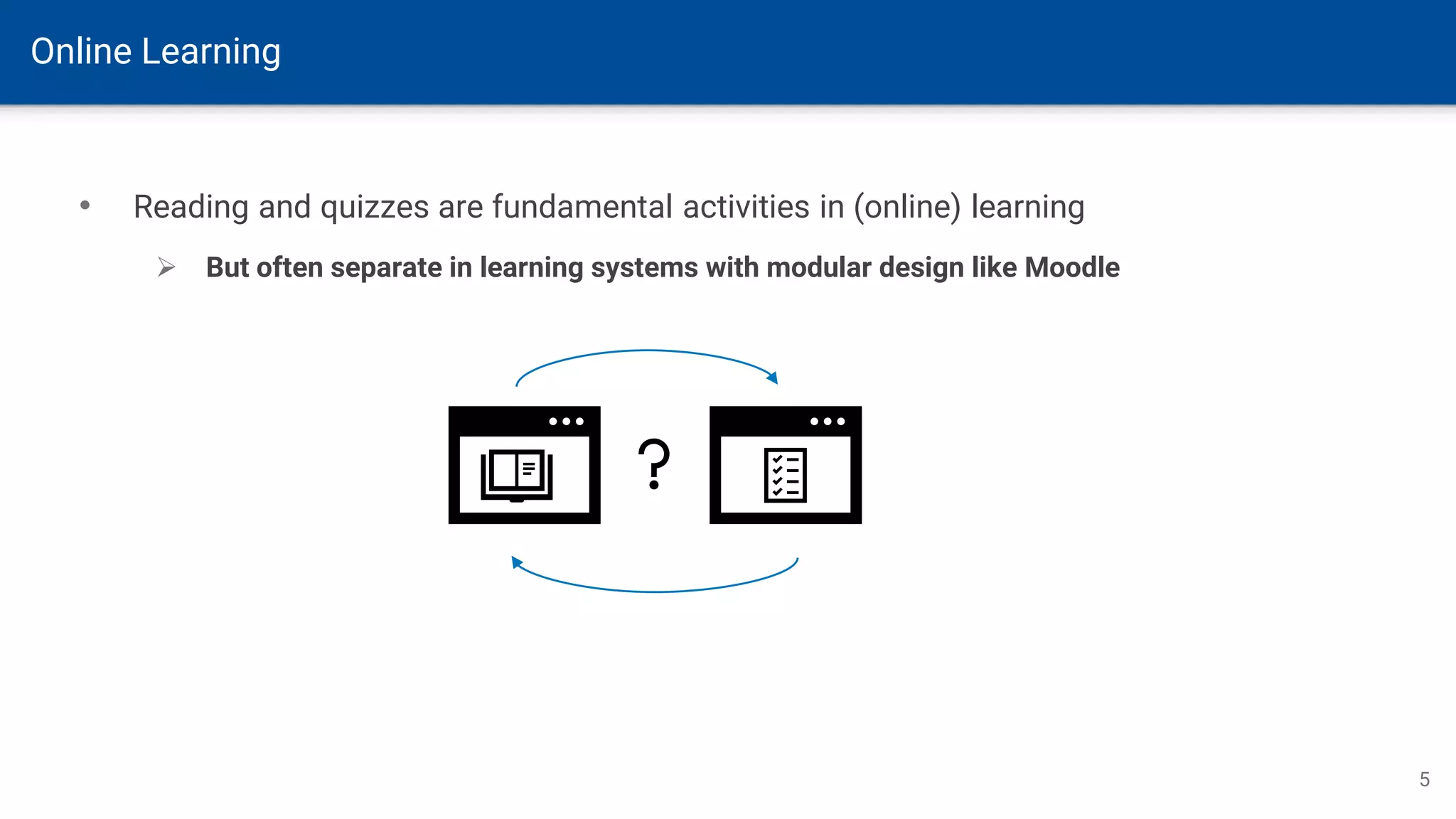
• Reading and quizzes are fundamental activities in (online) learning
➢ But often separate in learning systems with modular design like Moodle
Motivation
6
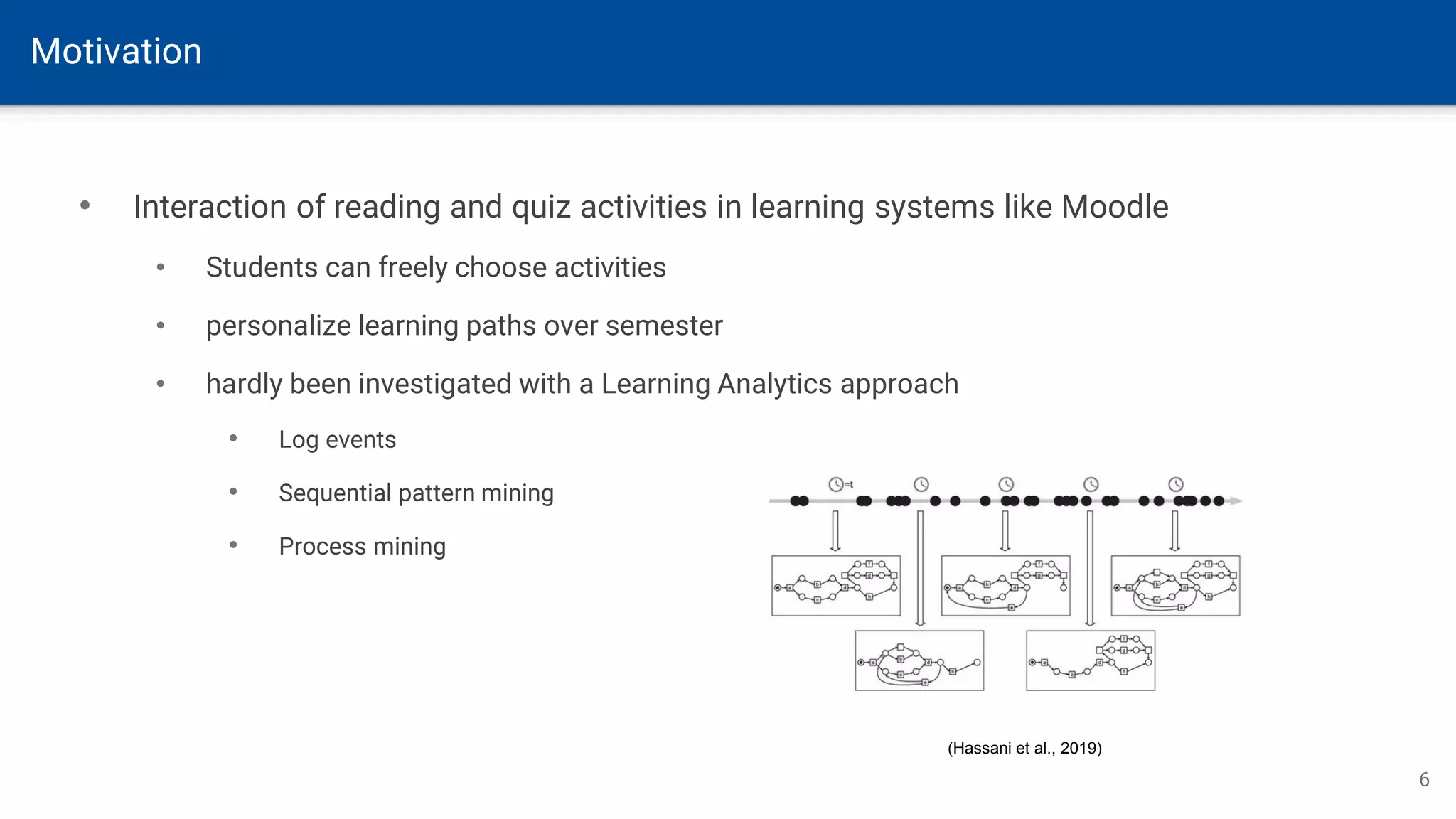
• Interaction of reading and quiz activities in learning systems like Moodle
• Students can freely choose activities
• personalize learning paths over semester
• hardly been investigated with a Learning Analytics approach
• Log events
• Sequential pattern mining
• Process mining
(Hassani et al., 2019)
Research Question
7
• What sequential patterns can be identified in reading and quiz activities?
• Individual user sessions
• Clusters of frequent learning behaviors
➢ Insights about situations that may require an adaptive learning support
Related Work:
• Sequential patterns of reading and test behaviors → page turns, no scrolling (Sun et al., 2019)
• Transition diagrams of interactions with course material → students not grouped based on
behavioral similarities (Cheng et al., 2017)
Data & Methods
8
Participants and Design
9
• Compulsory course Operating Systems and Computer Networks of distance learning
B.Sc. Computer Science study program in the winter semester 2020/2021
• Supplementary course set up in Moodle
• Voluntary, additional learning opportunities
• N=142 (of 534 course participants)
• Age: 19-65 (M=37.21, SD=9.03), gender: 52 female, 128 male
Material
10
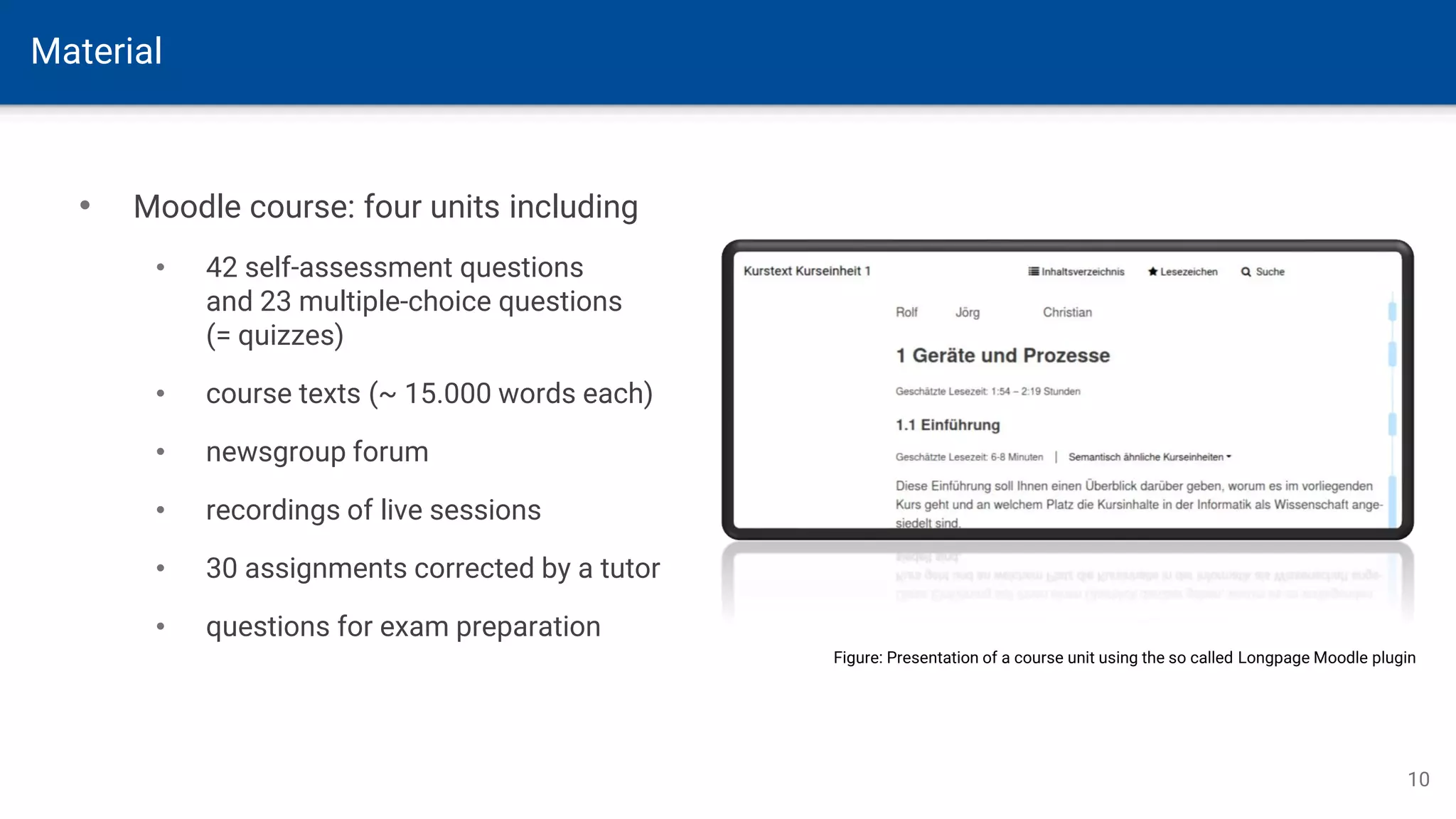
• Moodle course: four units including
• 42 self-assessment questions
and 23 multiple-choice questions
(= quizzes)
• course texts (~ 15.000 words each)
• newsgroup forum
• recordings of live sessions
• 30 assignments corrected by a tutor
• questions for exam preparation
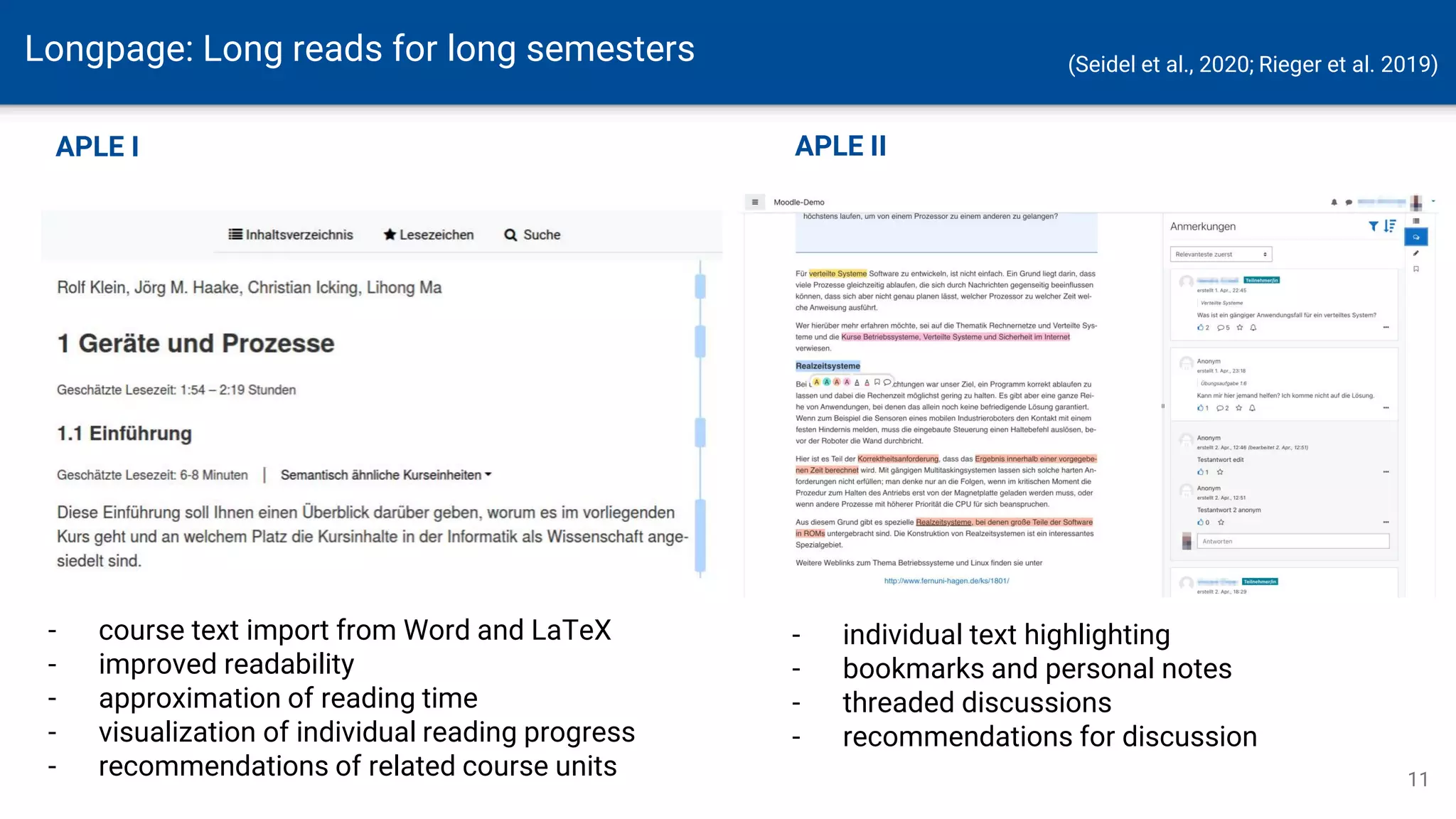
Figure: Presentation of a course unit using the so called Longpage Moodle plugin
Longpage: Long reads for long semesters
- course text import from Word and LaTeX
- improved readability
- approximation of reading time
- visualization of individual reading progress
- recommendations of related course units
- individual text highlighting
- bookmarks and personal notes
- threaded discussions
- recommendations for discussion
APLE I APLE II
11
(Seidel et al., 2020; Rieger et al. 2019)
Data collection and preprocessing
12
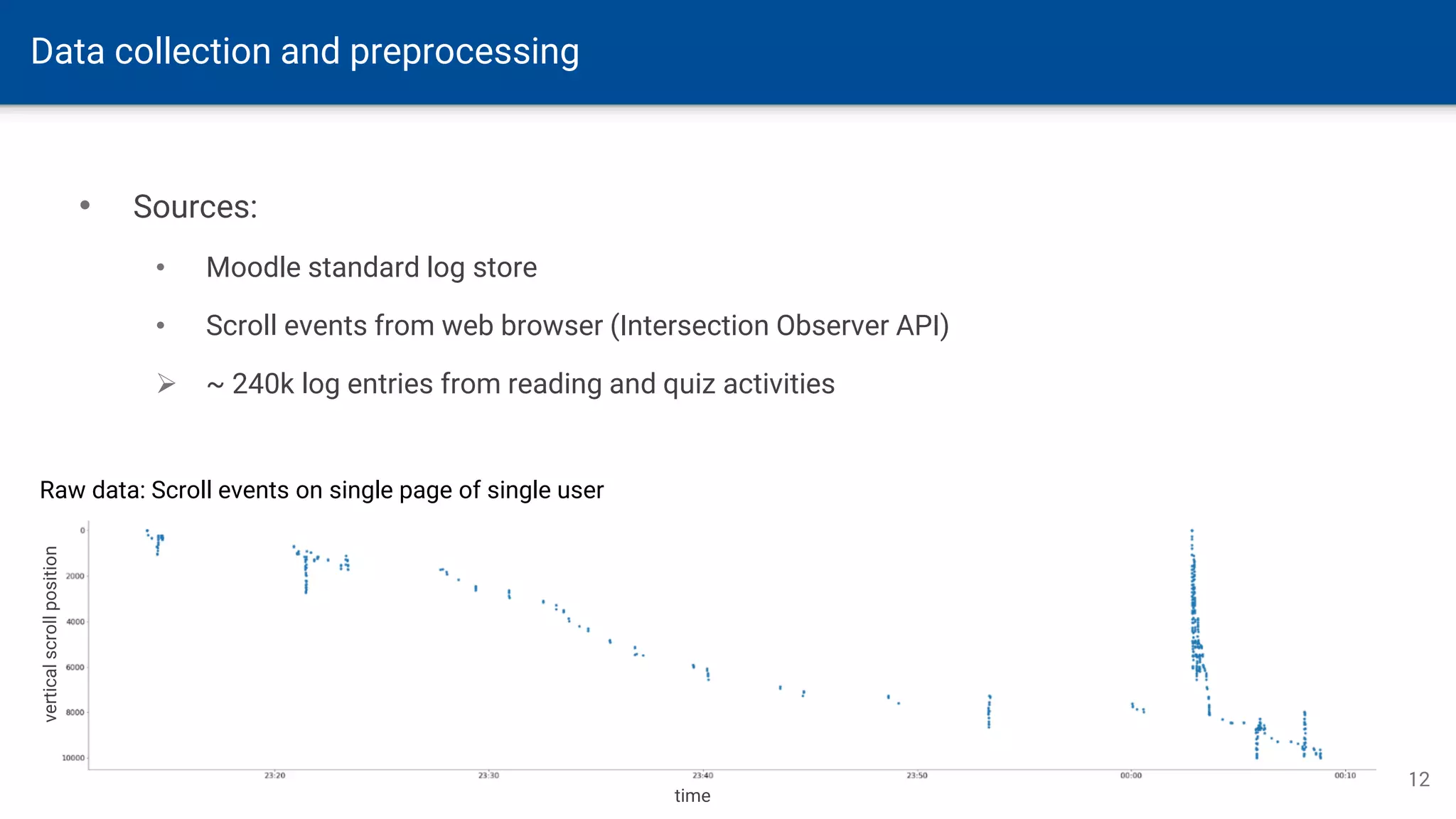
• Sources:
• Moodle standard log store
• Scroll events from web browser (Intersection Observer API)
➢ ~ 240k log entries from reading and quiz activities
Raw data: Scroll events on single page of single user
Data collection and preprocessing
13
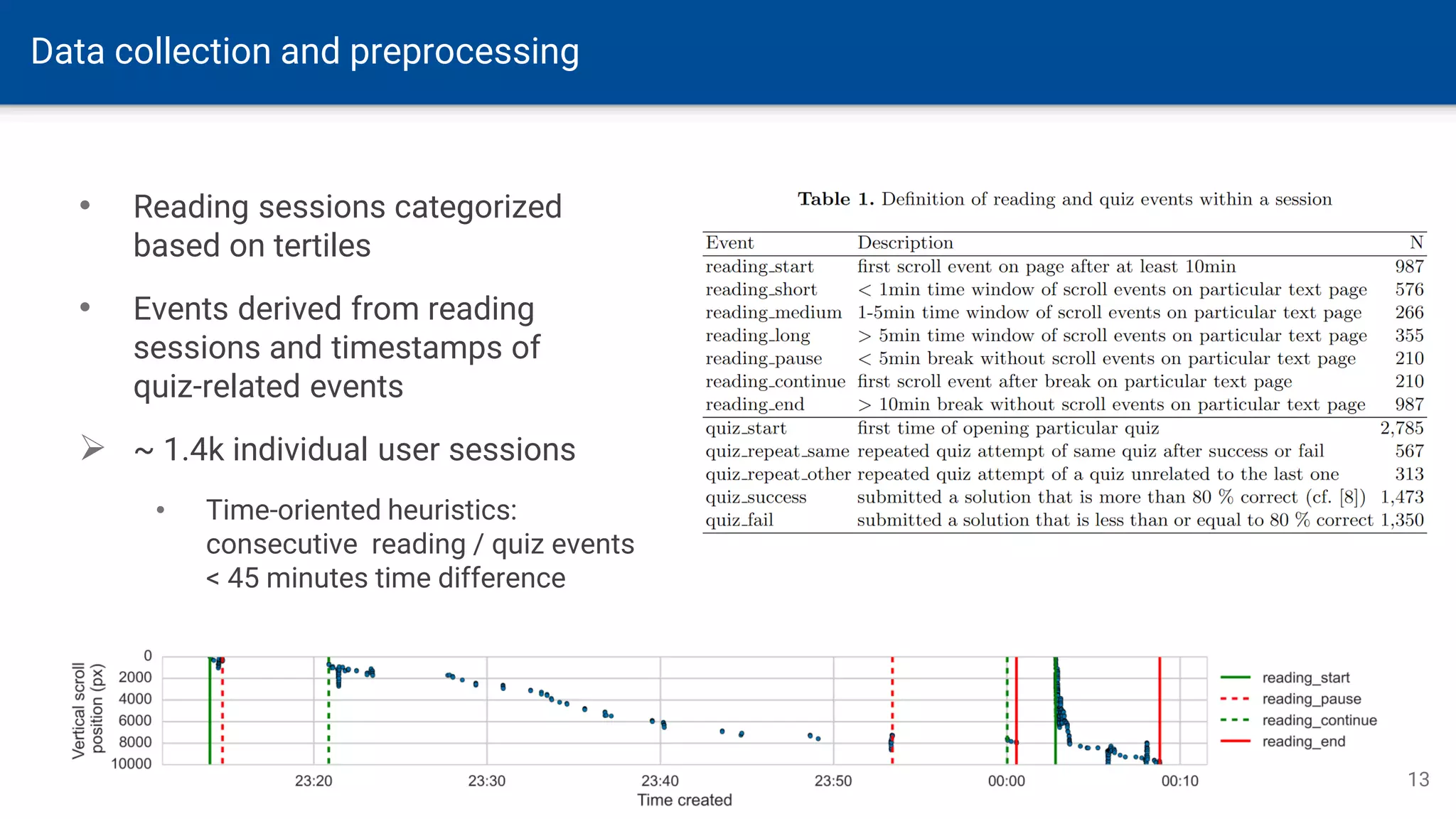
• Reading sessions categorized
based on tertiles
• Events derived from reading
sessions and timestamps of
quiz-related events
➢ ~ 1.4k individual user sessions
• Time-oriented heuristics:
consecutive reading / quiz events
< 45 minutes time difference
Mining processes and sequences
14
• Hypothesis-driven approach: finding study patterns by labeling sub-sequences
• Nominal features:
• Session starts with, ends with and/or mainly consists of reading or quiz activities
• Tertile of the length of the sequence of events per session: [1, 3] < (3, 7] < (7, 84]
• K-means for clustering user sessions by these features
• HeuristicsMiner for visualization of clusters
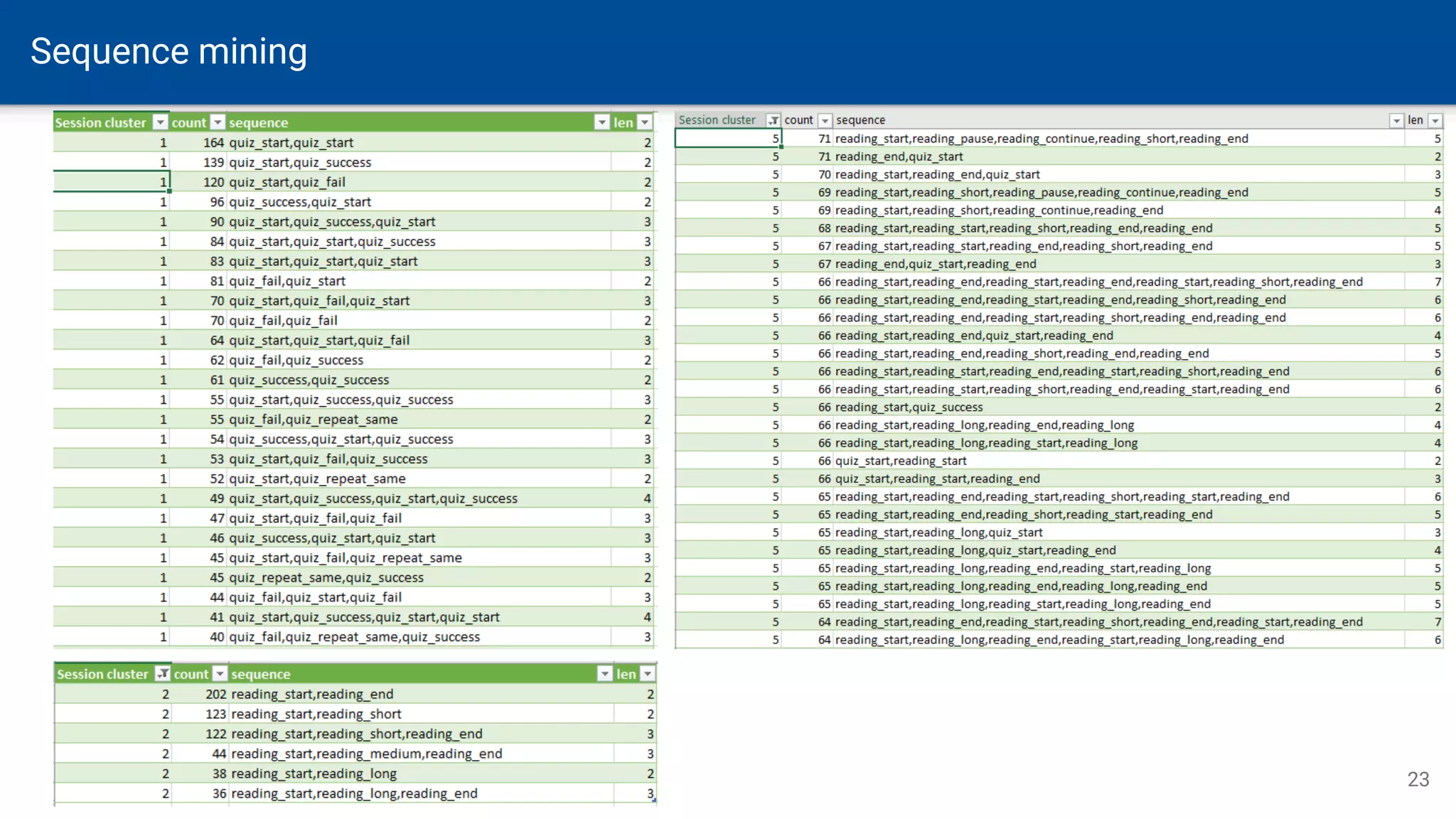
• PrefixSpan for mining sequential patterns
• Most frequent sequences using support measure
Results
15
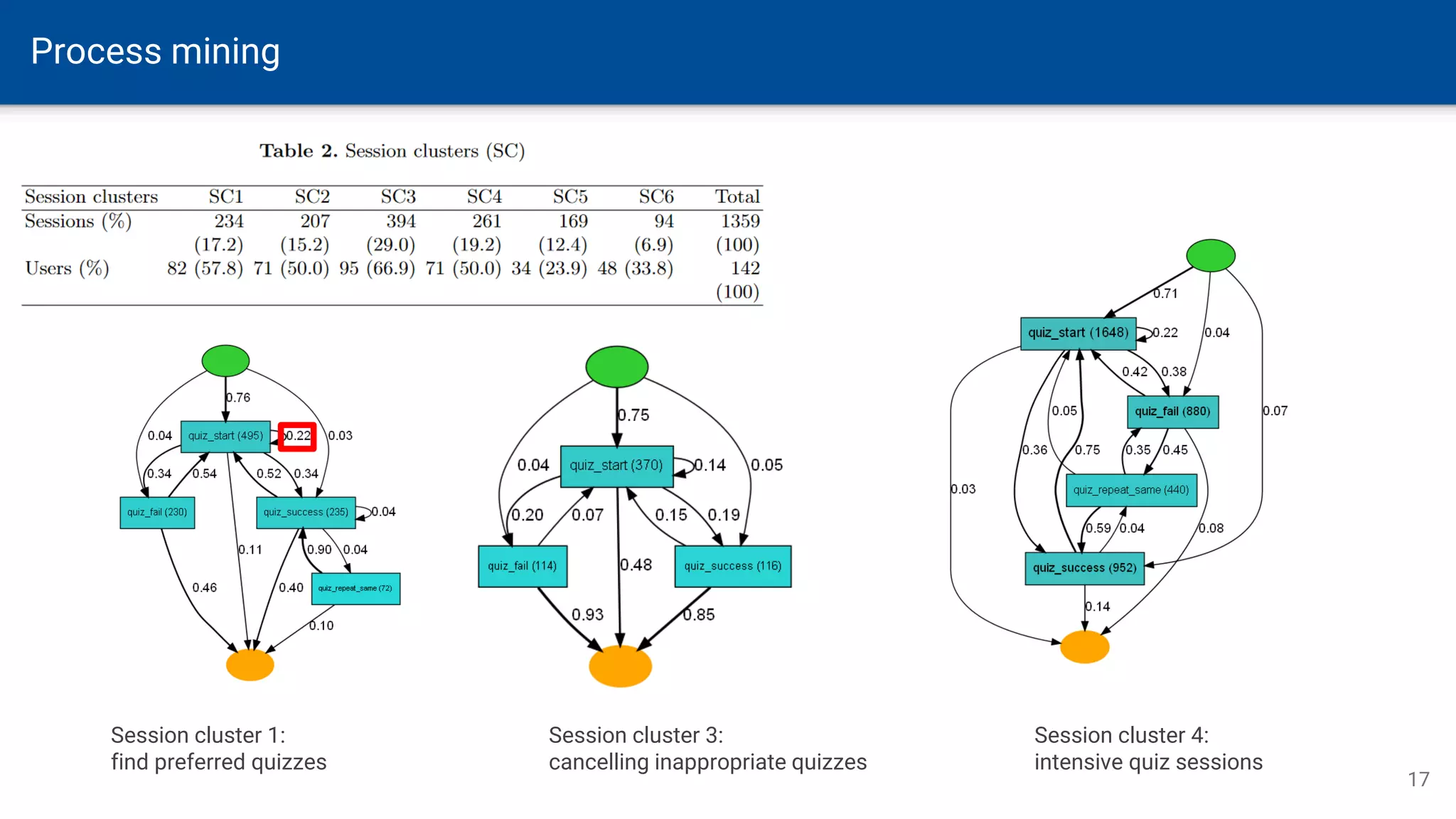
Process mining
16
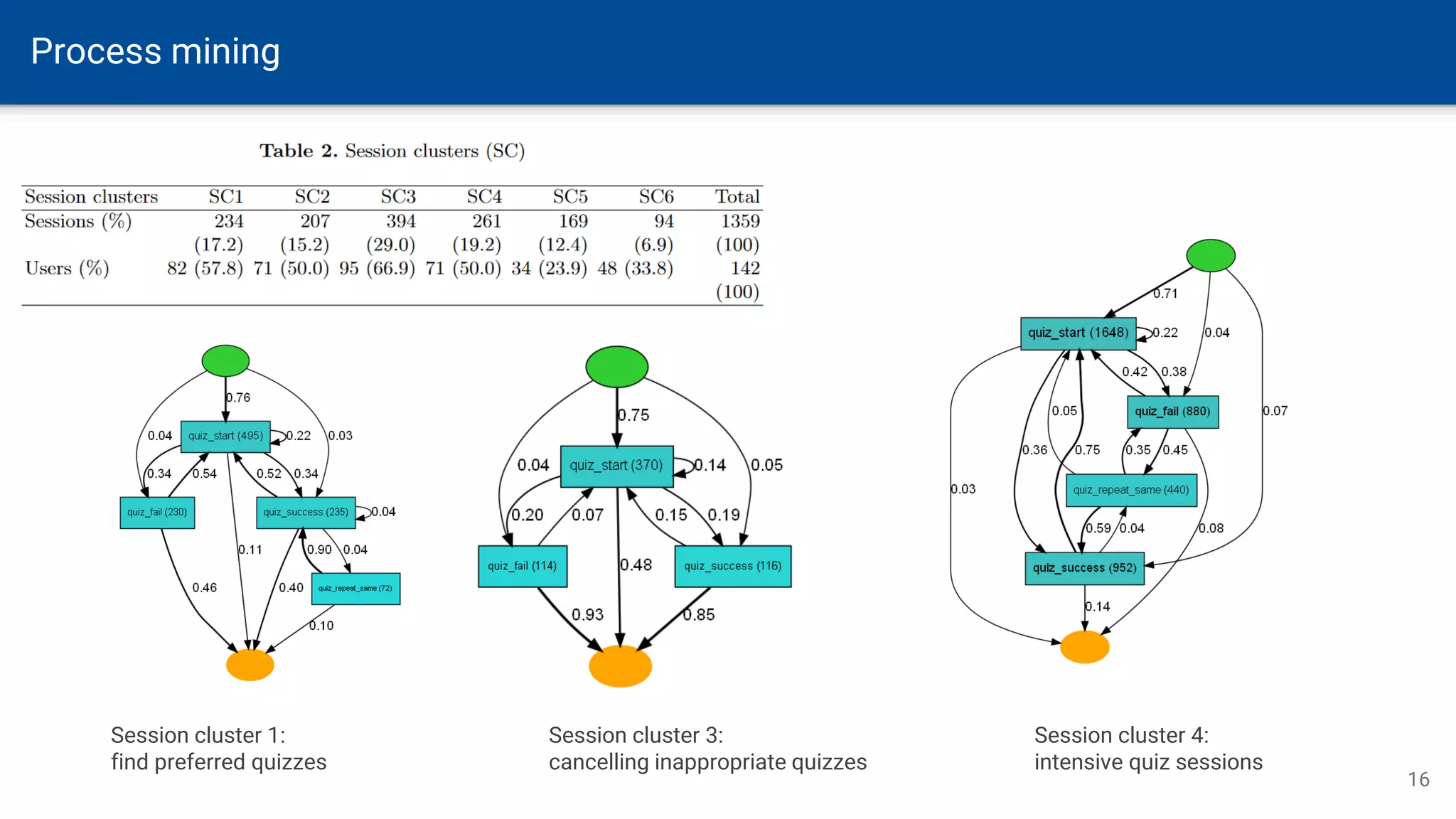
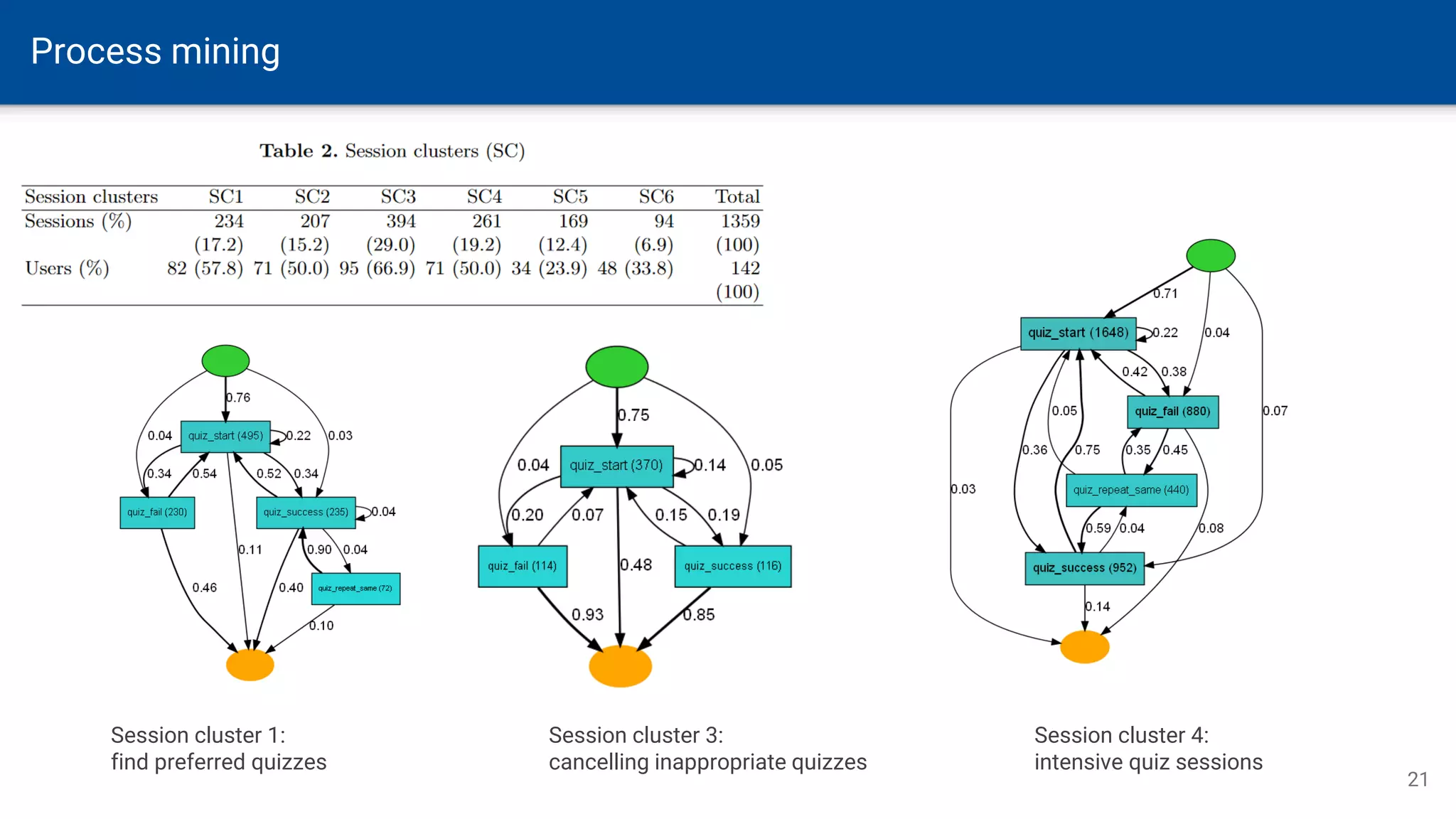
Session cluster 1:
find preferred quizzes
Session cluster 3:
cancelling inappropriate quizzes
Session cluster 4:
intensive quiz sessions
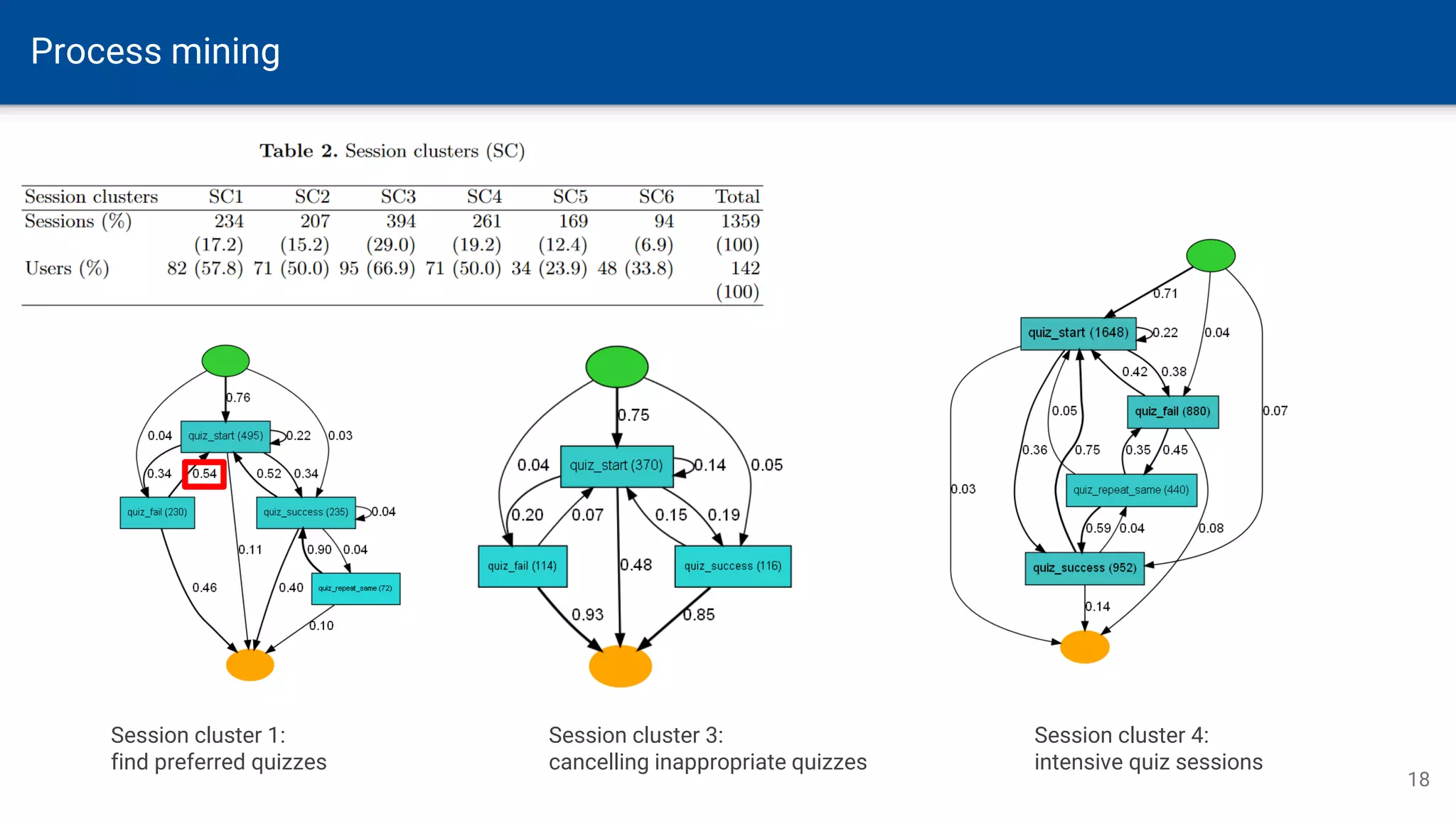
Process mining
17
Session cluster 1:
find preferred quizzes
Session cluster 3:
cancelling inappropriate quizzes
Session cluster 4:
intensive quiz sessions
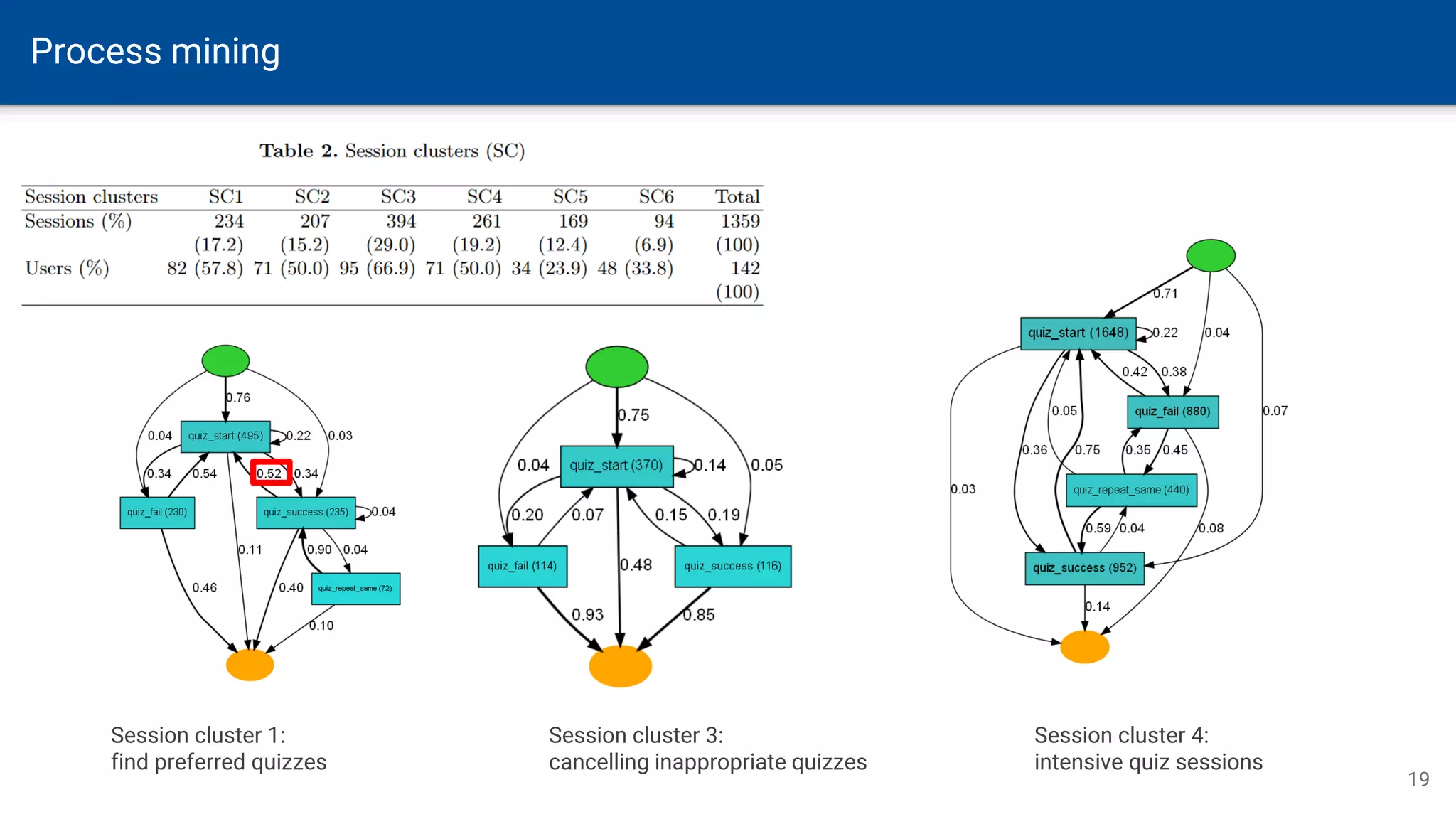
Process mining
18
Session cluster 1:
find preferred quizzes
Session cluster 3:
cancelling inappropriate quizzes
Session cluster 4:
intensive quiz sessions
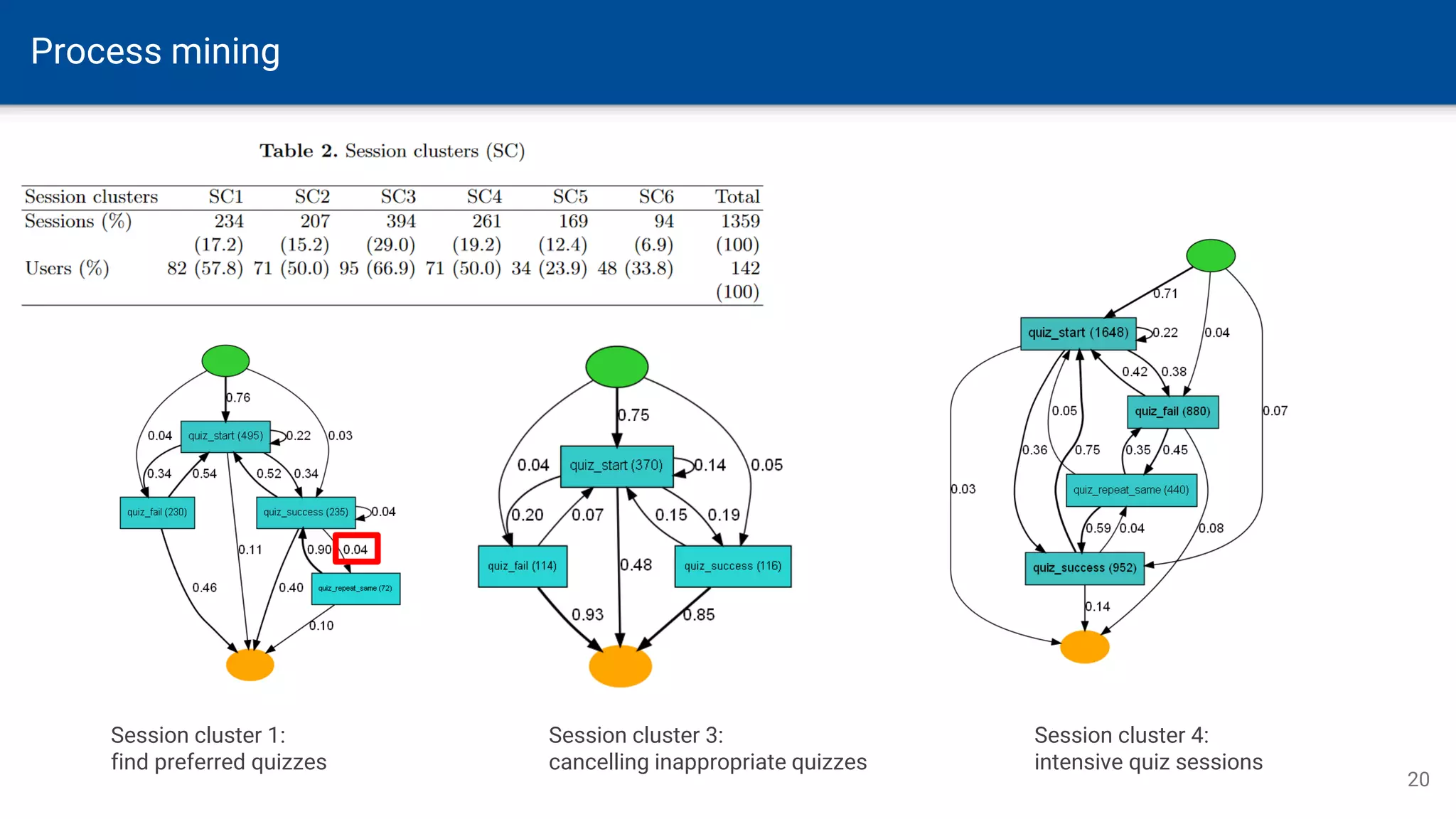
Process mining
19
Session cluster 1:
find preferred quizzes
Session cluster 3:
cancelling inappropriate quizzes
Session cluster 4:
intensive quiz sessions
Process mining
20
Session cluster 1:
find preferred quizzes
Session cluster 3:
cancelling inappropriate quizzes
Session cluster 4:
intensive quiz sessions
Process mining
21
Session cluster 1:
find preferred quizzes
Session cluster 3:
cancelling inappropriate quizzes
Session cluster 4:
intensive quiz sessions
Process mining
22
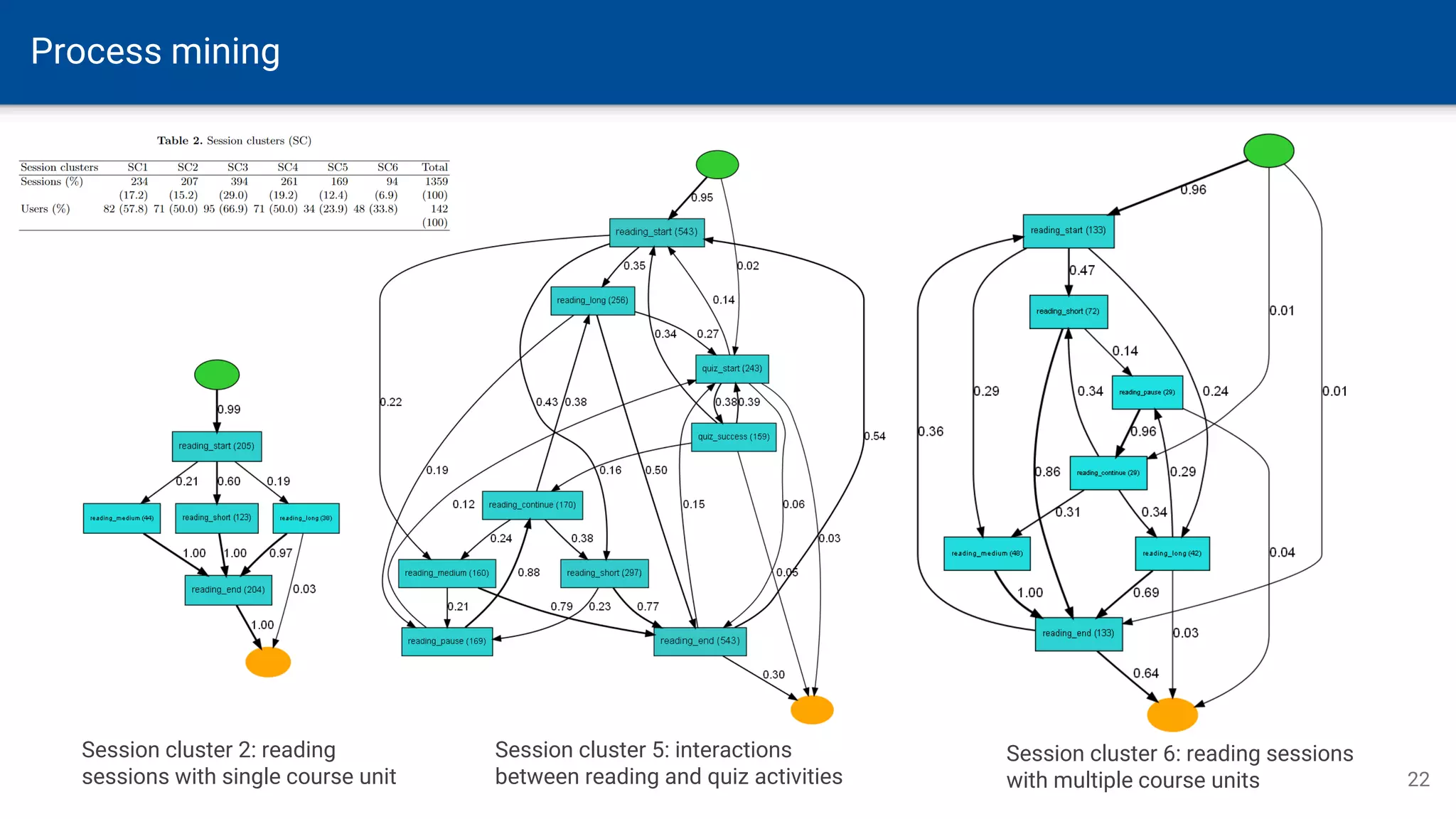
Session cluster 2: reading
sessions with single course unit
Session cluster 5: interactions
between reading and quiz activities
Session cluster 6: reading sessions
with multiple course units
Sequence mining
23
Discussion
24
Critical reflection of methods
25
• Other activities like newsgroup discussions, assignments, live sessions,
and self-regulated learning support ignored
• Only 1/3 of sessions and 50% participants with reading activities
• But: print and PDF versions available
• Session identification: time-oriented vs. navigation-oriented heuristics
• semantical interrelations between quizzes and course texts not considered
Critical reflection of methods
26
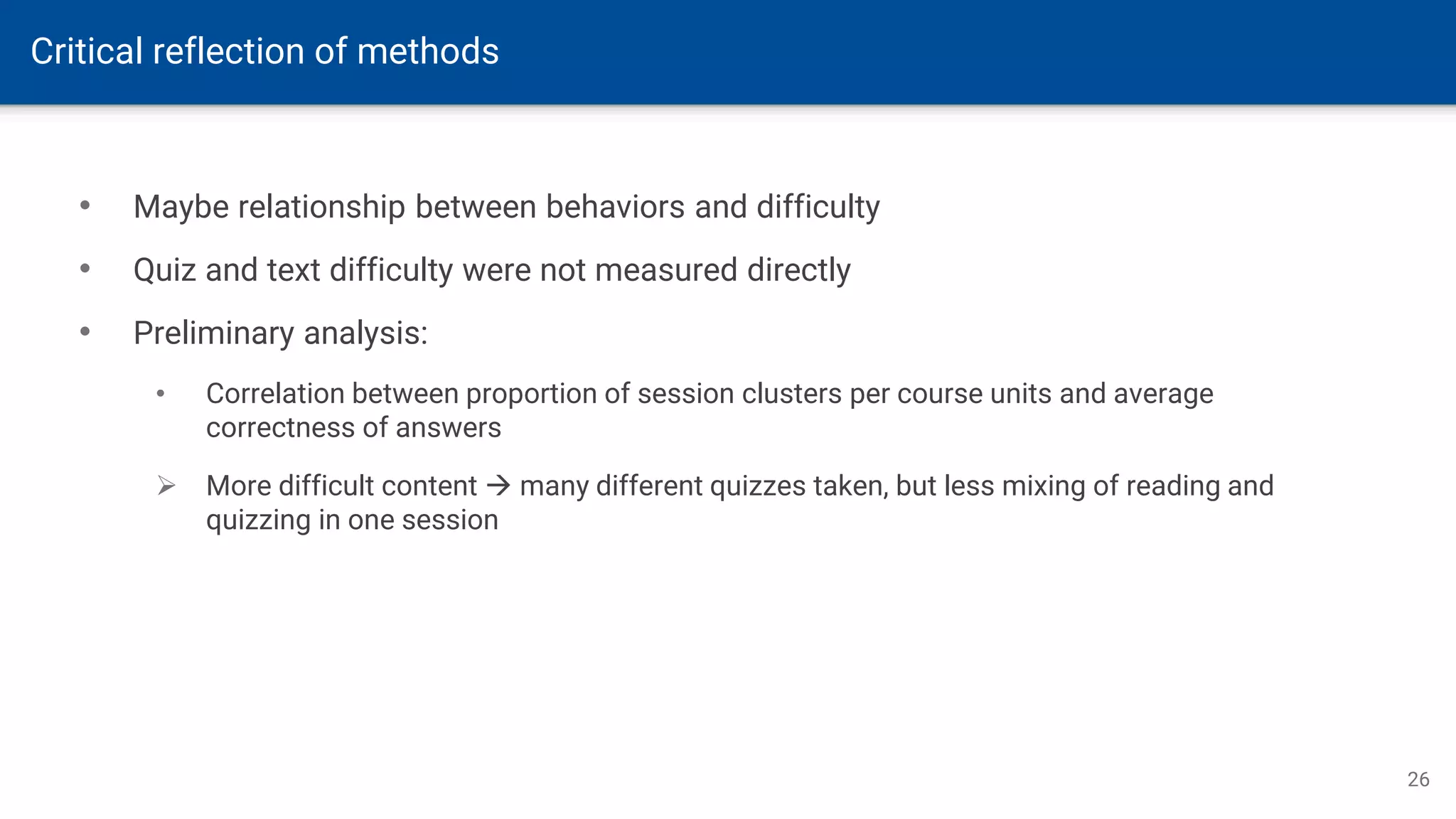
• Maybe relationship between behaviors and difficulty
• Quiz and text difficulty were not measured directly
• Preliminary analysis:
• Correlation between proportion of session clusters per course units and average
correctness of answers
➢ More difficult content → many different quizzes taken, but less mixing of reading and
quizzing in one session
Adaptive learning support
27
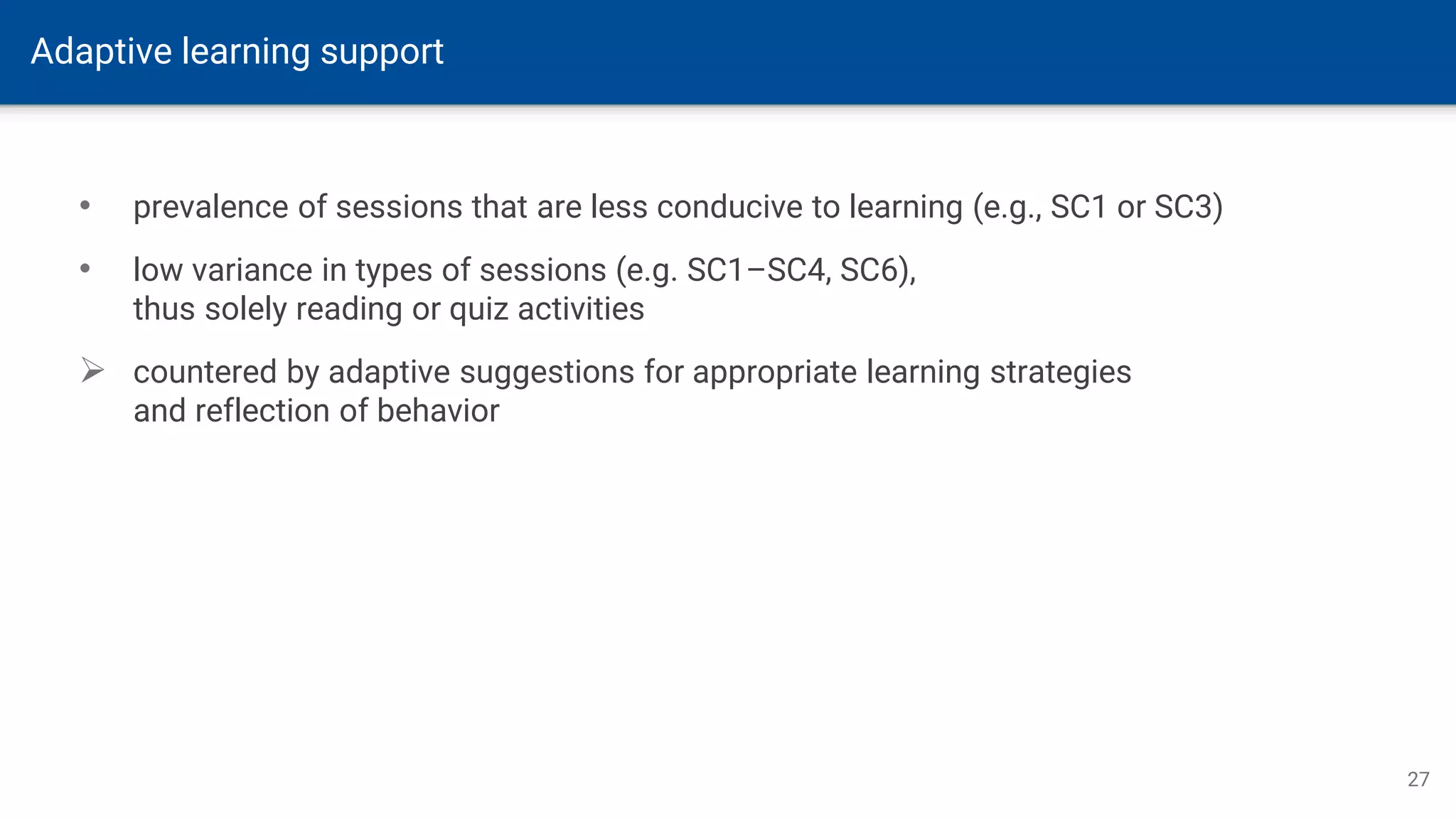
• prevalence of sessions that are less conducive to learning (e.g., SC1 or SC3)
• low variance in types of sessions (e.g. SC1–SC4, SC6),
thus solely reading or quiz activities
➢ countered by adaptive suggestions for appropriate learning strategies
and reflection of behavior
Conclusion and Outlook
28
Summary
29
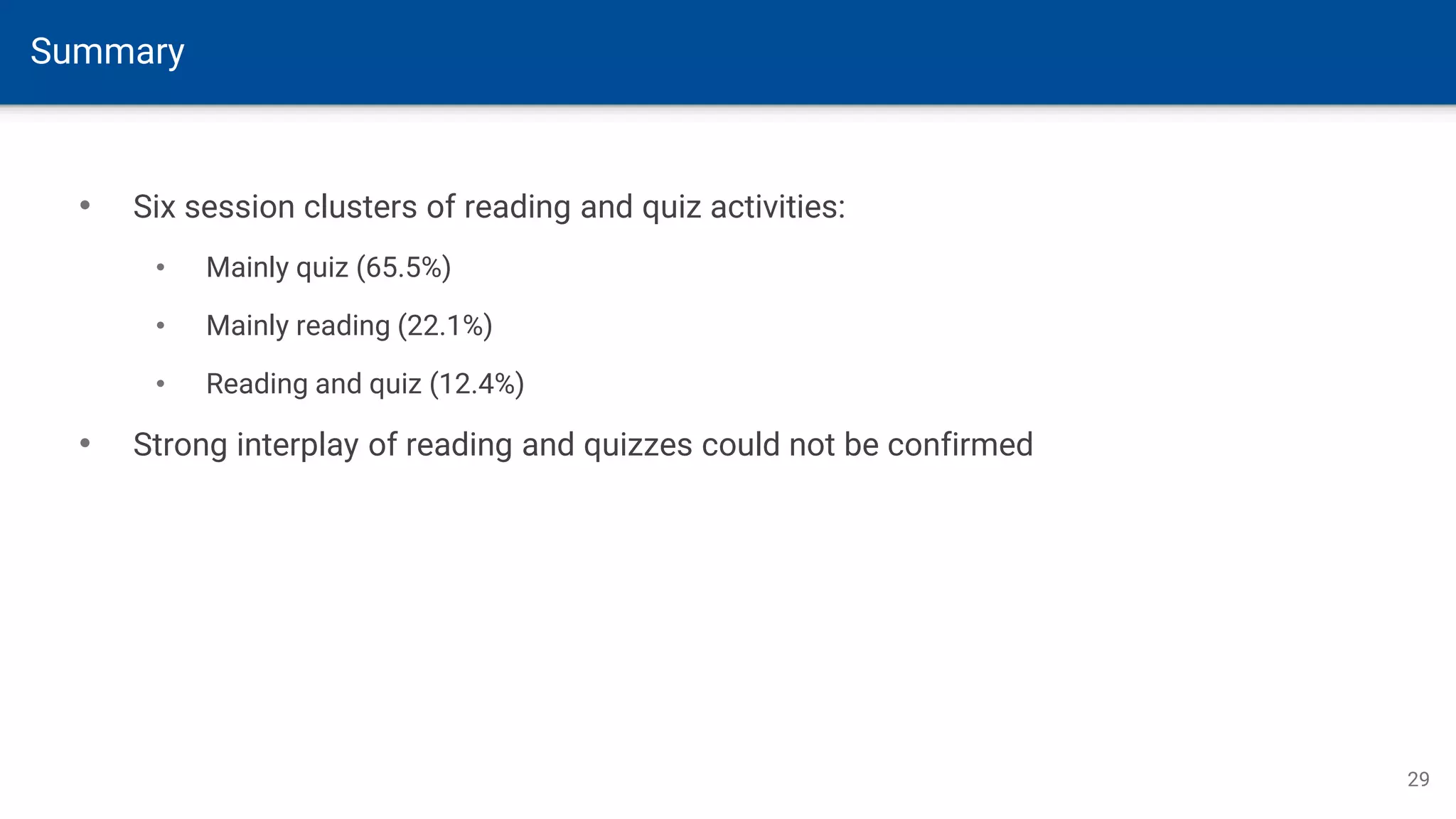
• Six session clusters of reading and quiz activities:
• Mainly quiz (65.5%)
• Mainly reading (22.1%)
• Reading and quiz (12.4%)
• Strong interplay of reading and quizzes could not be confirmed
Outlook
30
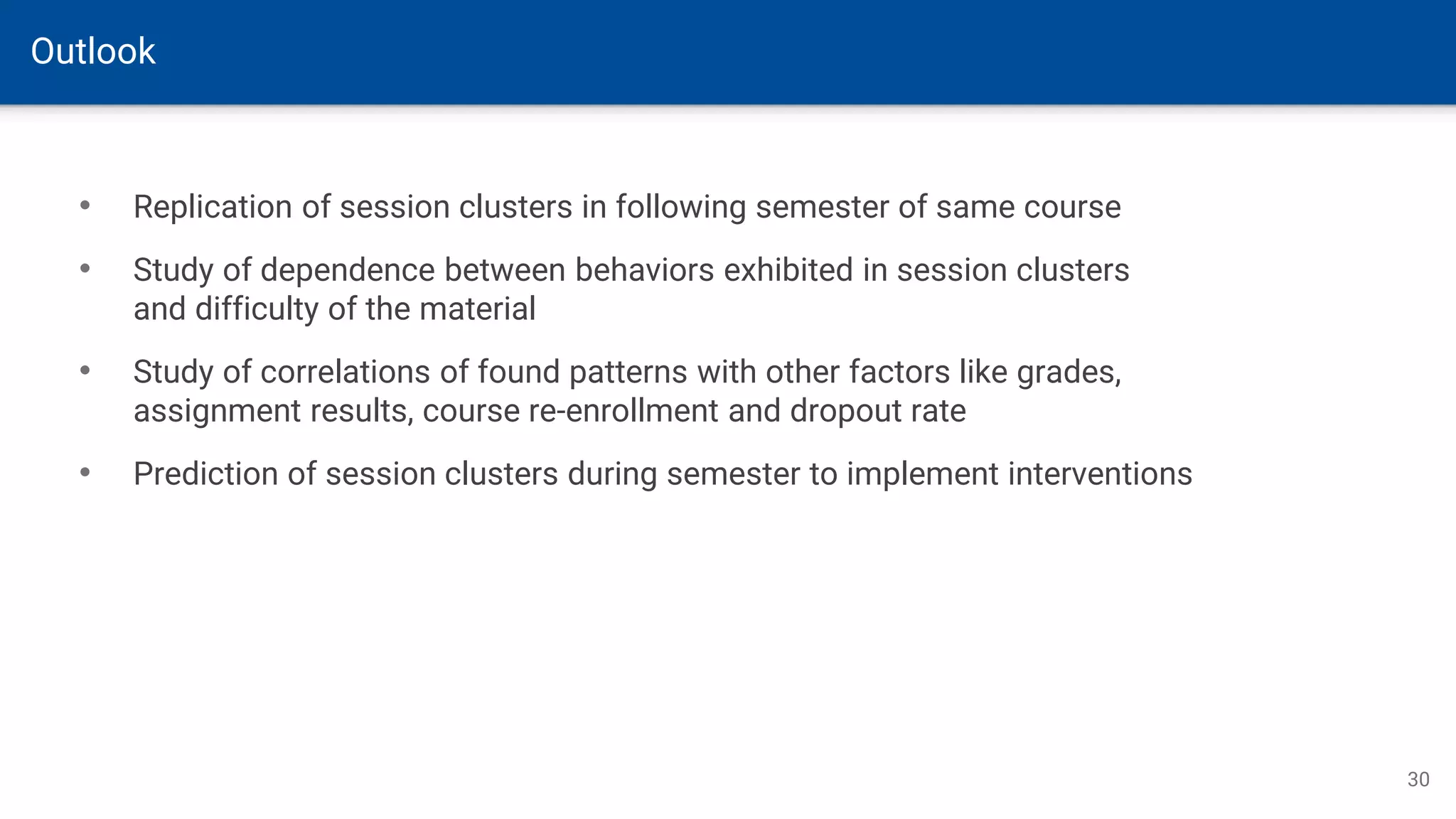
• Replication of session clusters in following semester of same course
• Study of dependence between behaviors exhibited in session clusters
and difficulty of the material
• Study of correlations of found patterns with other factors like grades,
assignment results, course re-enrollment and dropout rate
• Prediction of session clusters during semester to implement interventions
31
(Menze et al., subm.)
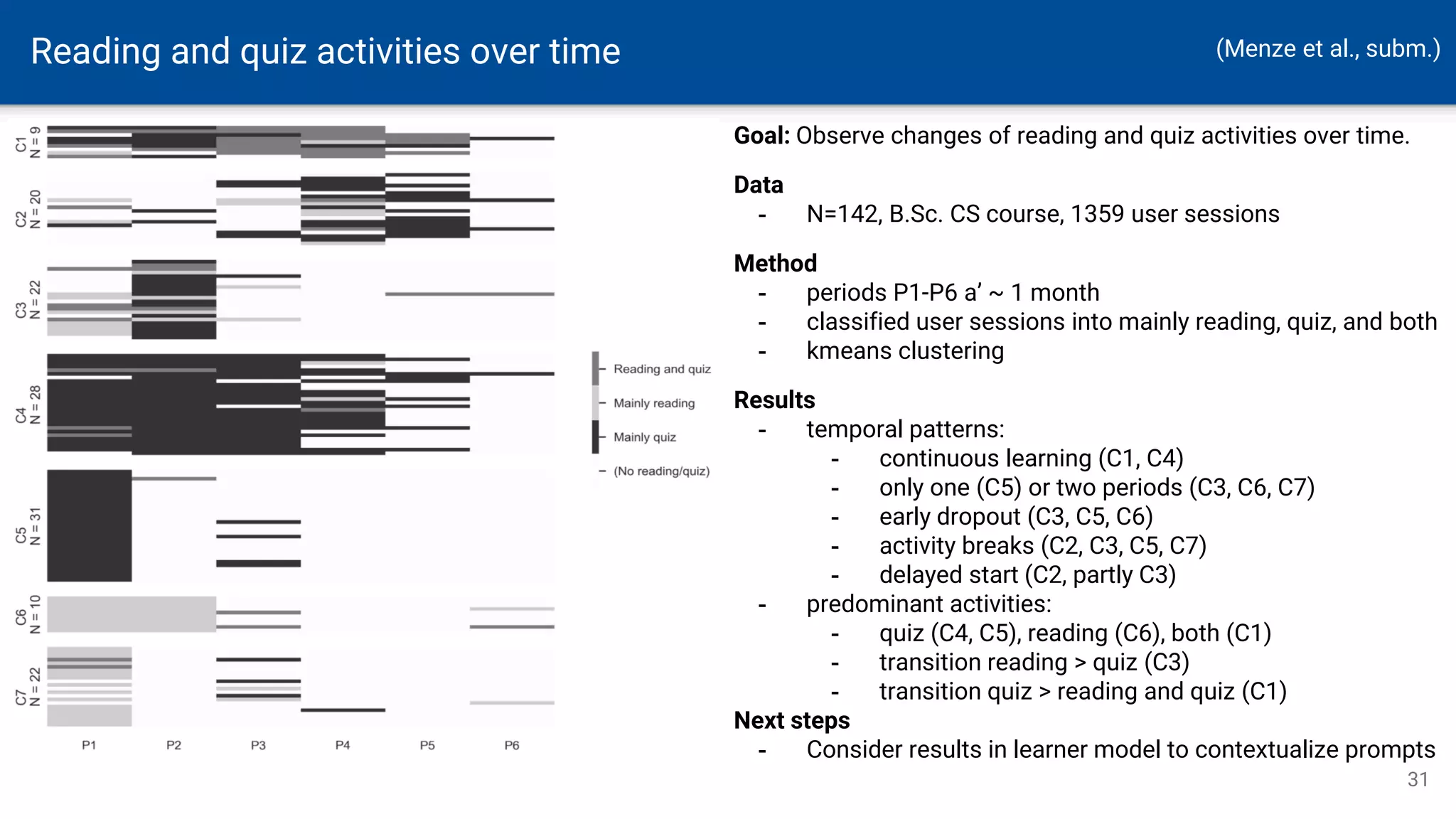
Reading and quiz activities over time
Goal: Observe changes of reading and quiz activities over time.
Data
- N=142, B.Sc. CS course, 1359 user sessions
Method
- periods P1-P6 a’ ~ 1 month
- classified user sessions into mainly reading, quiz, and both
- kmeans clustering
Results
- temporal patterns:
- continuous learning (C1, C4)
- only one (C5) or two periods (C3, C6, C7)
- early dropout (C3, C5, C6)
- activity breaks (C2, C3, C5, C7)
- delayed start (C2, partly C3)
- predominant activities:
- quiz (C4, C5), reading (C6), both (C1)
- transition reading > quiz (C3)
- transition quiz > reading and quiz (C1)
Next steps
- Consider results in learner model to contextualize prompts
Thank you for your attention!
32

Interactions of reading and assessment activities

  • 1.
    Interactions of readingand assessment activities Niels Seidel, Dennis Menze 27/07/2022 1
  • 2.
  • 3.
  • 4.
    Online Learning 4 • Readingand quizzes are fundamental activities in (online) learning • Mutually connected: • Reading for knowledge acquisition to answer quizzes • Quizzes help to identify knowledge gaps and measure reading comprehension • Often embedded in printed textbooks • ➔ Intelligent textbooks
  • 5.
    Online Learning 5 • Readingand quizzes are fundamental activities in (online) learning ➢ But often separate in learning systems with modular design like Moodle
  • 6.
    Motivation 6 • Interaction ofreading and quiz activities in learning systems like Moodle • Students can freely choose activities • personalize learning paths over semester • hardly been investigated with a Learning Analytics approach • Log events • Sequential pattern mining • Process mining (Hassani et al., 2019)
  • 7.
    Research Question 7 • Whatsequential patterns can be identified in reading and quiz activities? • Individual user sessions • Clusters of frequent learning behaviors ➢ Insights about situations that may require an adaptive learning support Related Work: • Sequential patterns of reading and test behaviors → page turns, no scrolling (Sun et al., 2019) • Transition diagrams of interactions with course material → students not grouped based on behavioral similarities (Cheng et al., 2017)
  • 8.
  • 9.
    Participants and Design 9 •Compulsory course Operating Systems and Computer Networks of distance learning B.Sc. Computer Science study program in the winter semester 2020/2021 • Supplementary course set up in Moodle • Voluntary, additional learning opportunities • N=142 (of 534 course participants) • Age: 19-65 (M=37.21, SD=9.03), gender: 52 female, 128 male
  • 10.
    Material 10 • Moodle course:four units including • 42 self-assessment questions and 23 multiple-choice questions (= quizzes) • course texts (~ 15.000 words each) • newsgroup forum • recordings of live sessions • 30 assignments corrected by a tutor • questions for exam preparation Figure: Presentation of a course unit using the so called Longpage Moodle plugin
  • 11.
    Longpage: Long readsfor long semesters - course text import from Word and LaTeX - improved readability - approximation of reading time - visualization of individual reading progress - recommendations of related course units - individual text highlighting - bookmarks and personal notes - threaded discussions - recommendations for discussion APLE I APLE II 11 (Seidel et al., 2020; Rieger et al. 2019)
  • 12.
    Data collection andpreprocessing 12 • Sources: • Moodle standard log store • Scroll events from web browser (Intersection Observer API) ➢ ~ 240k log entries from reading and quiz activities Raw data: Scroll events on single page of single user
  • 13.
    Data collection andpreprocessing 13 • Reading sessions categorized based on tertiles • Events derived from reading sessions and timestamps of quiz-related events ➢ ~ 1.4k individual user sessions • Time-oriented heuristics: consecutive reading / quiz events < 45 minutes time difference
  • 14.
    Mining processes andsequences 14 • Hypothesis-driven approach: finding study patterns by labeling sub-sequences • Nominal features: • Session starts with, ends with and/or mainly consists of reading or quiz activities • Tertile of the length of the sequence of events per session: [1, 3] < (3, 7] < (7, 84] • K-means for clustering user sessions by these features • HeuristicsMiner for visualization of clusters • PrefixSpan for mining sequential patterns • Most frequent sequences using support measure
  • 15.
  • 16.
    Process mining 16 Session cluster1: find preferred quizzes Session cluster 3: cancelling inappropriate quizzes Session cluster 4: intensive quiz sessions
  • 17.
    Process mining 17 Session cluster1: find preferred quizzes Session cluster 3: cancelling inappropriate quizzes Session cluster 4: intensive quiz sessions
  • 18.
    Process mining 18 Session cluster1: find preferred quizzes Session cluster 3: cancelling inappropriate quizzes Session cluster 4: intensive quiz sessions
  • 19.
    Process mining 19 Session cluster1: find preferred quizzes Session cluster 3: cancelling inappropriate quizzes Session cluster 4: intensive quiz sessions
  • 20.
    Process mining 20 Session cluster1: find preferred quizzes Session cluster 3: cancelling inappropriate quizzes Session cluster 4: intensive quiz sessions
  • 21.
    Process mining 21 Session cluster1: find preferred quizzes Session cluster 3: cancelling inappropriate quizzes Session cluster 4: intensive quiz sessions
  • 22.
    Process mining 22 Session cluster2: reading sessions with single course unit Session cluster 5: interactions between reading and quiz activities Session cluster 6: reading sessions with multiple course units
  • 23.
  • 24.
  • 25.
    Critical reflection ofmethods 25 • Other activities like newsgroup discussions, assignments, live sessions, and self-regulated learning support ignored • Only 1/3 of sessions and 50% participants with reading activities • But: print and PDF versions available • Session identification: time-oriented vs. navigation-oriented heuristics • semantical interrelations between quizzes and course texts not considered
  • 26.
    Critical reflection ofmethods 26 • Maybe relationship between behaviors and difficulty • Quiz and text difficulty were not measured directly • Preliminary analysis: • Correlation between proportion of session clusters per course units and average correctness of answers ➢ More difficult content → many different quizzes taken, but less mixing of reading and quizzing in one session
  • 27.
    Adaptive learning support 27 •prevalence of sessions that are less conducive to learning (e.g., SC1 or SC3) • low variance in types of sessions (e.g. SC1–SC4, SC6), thus solely reading or quiz activities ➢ countered by adaptive suggestions for appropriate learning strategies and reflection of behavior
  • 28.
  • 29.
    Summary 29 • Six sessionclusters of reading and quiz activities: • Mainly quiz (65.5%) • Mainly reading (22.1%) • Reading and quiz (12.4%) • Strong interplay of reading and quizzes could not be confirmed
  • 30.
    Outlook 30 • Replication ofsession clusters in following semester of same course • Study of dependence between behaviors exhibited in session clusters and difficulty of the material • Study of correlations of found patterns with other factors like grades, assignment results, course re-enrollment and dropout rate • Prediction of session clusters during semester to implement interventions
  • 31.
    31 (Menze et al.,subm.) Reading and quiz activities over time Goal: Observe changes of reading and quiz activities over time. Data - N=142, B.Sc. CS course, 1359 user sessions Method - periods P1-P6 a’ ~ 1 month - classified user sessions into mainly reading, quiz, and both - kmeans clustering Results - temporal patterns: - continuous learning (C1, C4) - only one (C5) or two periods (C3, C6, C7) - early dropout (C3, C5, C6) - activity breaks (C2, C3, C5, C7) - delayed start (C2, partly C3) - predominant activities: - quiz (C4, C5), reading (C6), both (C1) - transition reading > quiz (C3) - transition quiz > reading and quiz (C1) Next steps - Consider results in learner model to contextualize prompts
  • 32.
    Thank you foryour attention! 32