Inter Integrated Circuit Serial Communication.pptx
1.
Devices and Busesfor Device
Networks
Dr Suman Nelaturi
Assistant Professor
Department of ECE
NIT Kurukshetra
2.
Serial Communication usingI2C
I2C stands for Inter-Integrated Circuit.
Communication between microcontrollers and different peripheral
devices require some sort of digital protocol.
I2C is a common communication protocol that is used in a variety
of devices from many different product families produced by TI.
It is a bus interface connection protocol incorporated into devices
for serial communication.
It was originally designed by Philips Semiconductor (now NXP
Semiconductor) in 1982.
Recently, it is a widely used protocol for short-distance
communication. It is also known as Two Wired Interface(TWI).
3.
Working of I2CCommunication Protocol
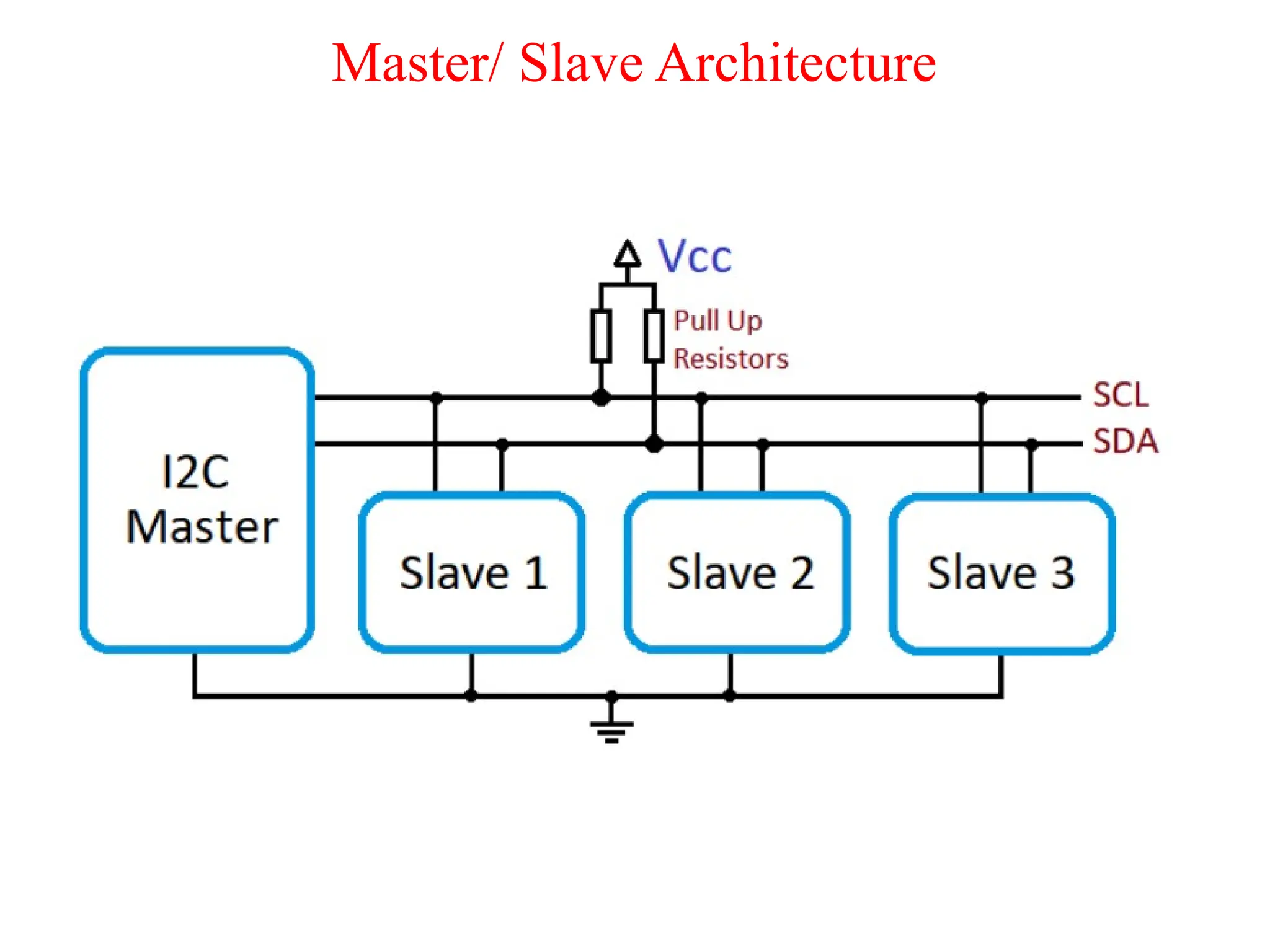
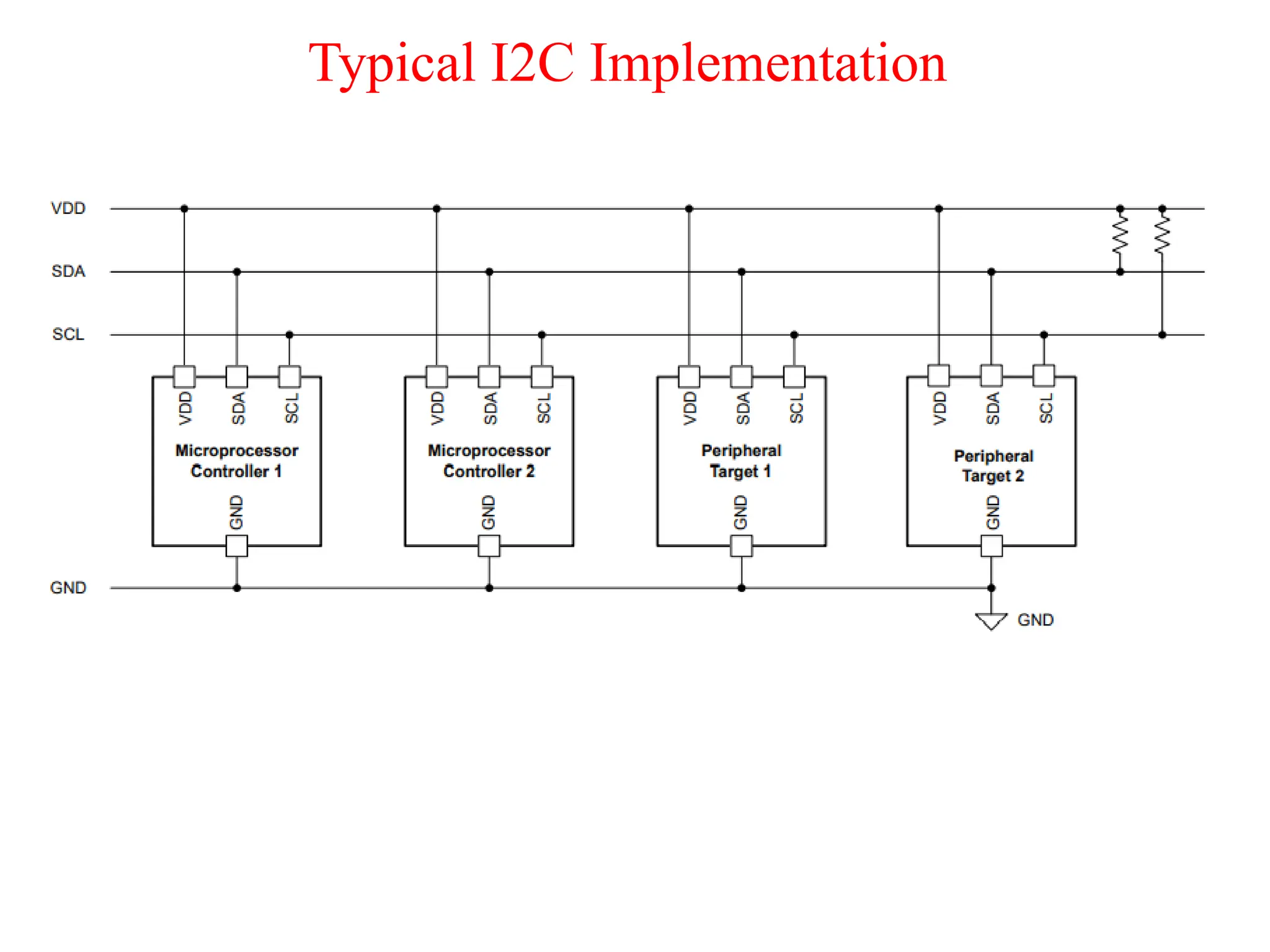
It uses only 2 bi-directional open-drain lines for data
communication called SDA and SCL. Both these lines are pulled
high.
Serial Data (SDA) : Transfer of data takes place through this pin.
Serial Clock (SCL) : It carries the clock signal.
4.
Working of I2CCommunication Protocol
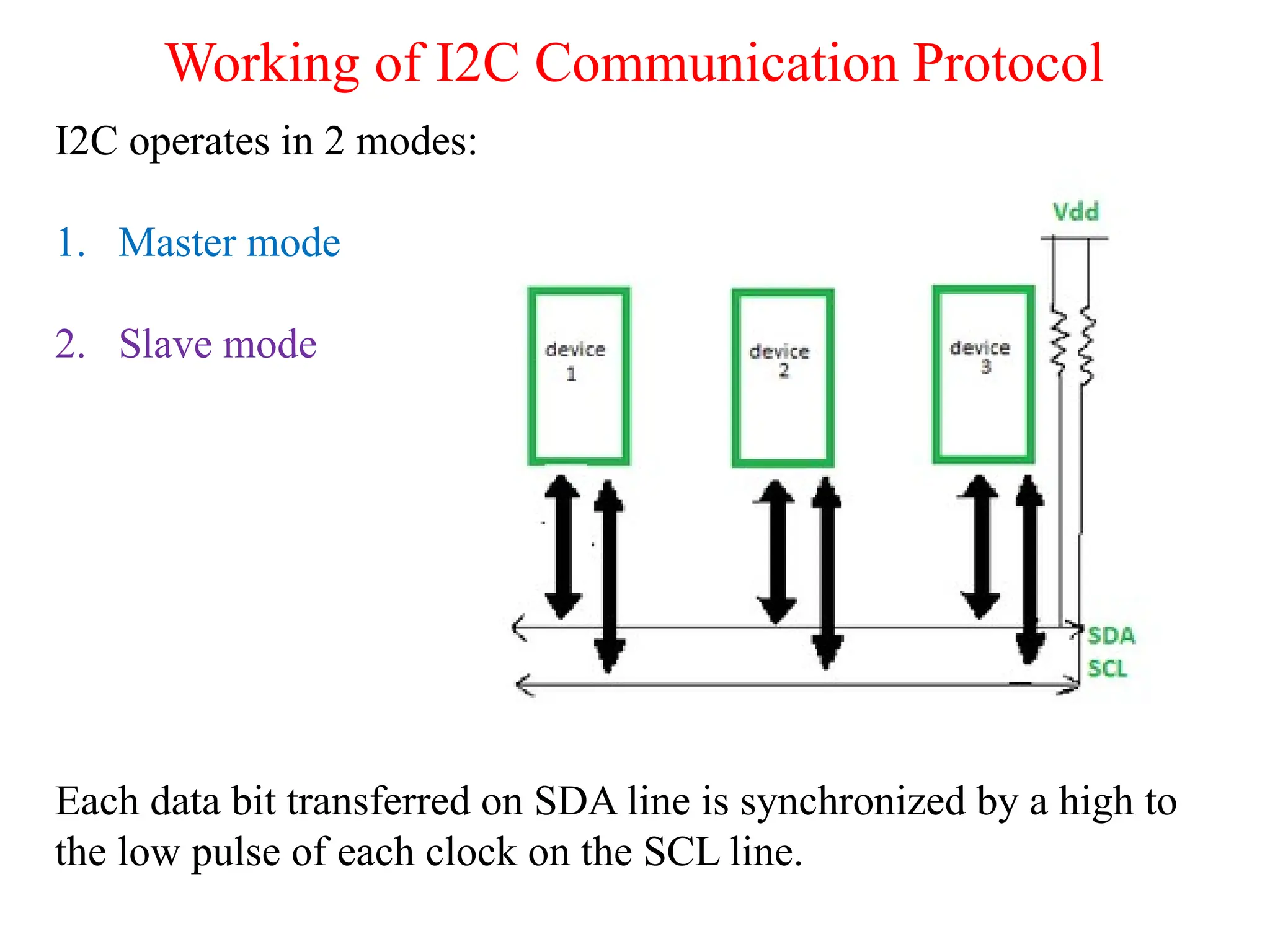
I2C operates in 2 modes:
1. Master mode
2. Slave mode
Each data bit transferred on SDA line is synchronized by a high to
the low pulse of each clock on the SCL line.
5.
Working of I2CCommunication Protocol
According to I2C protocols, the data line can not change when the
clock line is high, it can change only when the clock line is low.
The 2 lines are open drain, hence a pull-up resistor is required so
that the lines are high since the devices on the I2C bus are active
low.
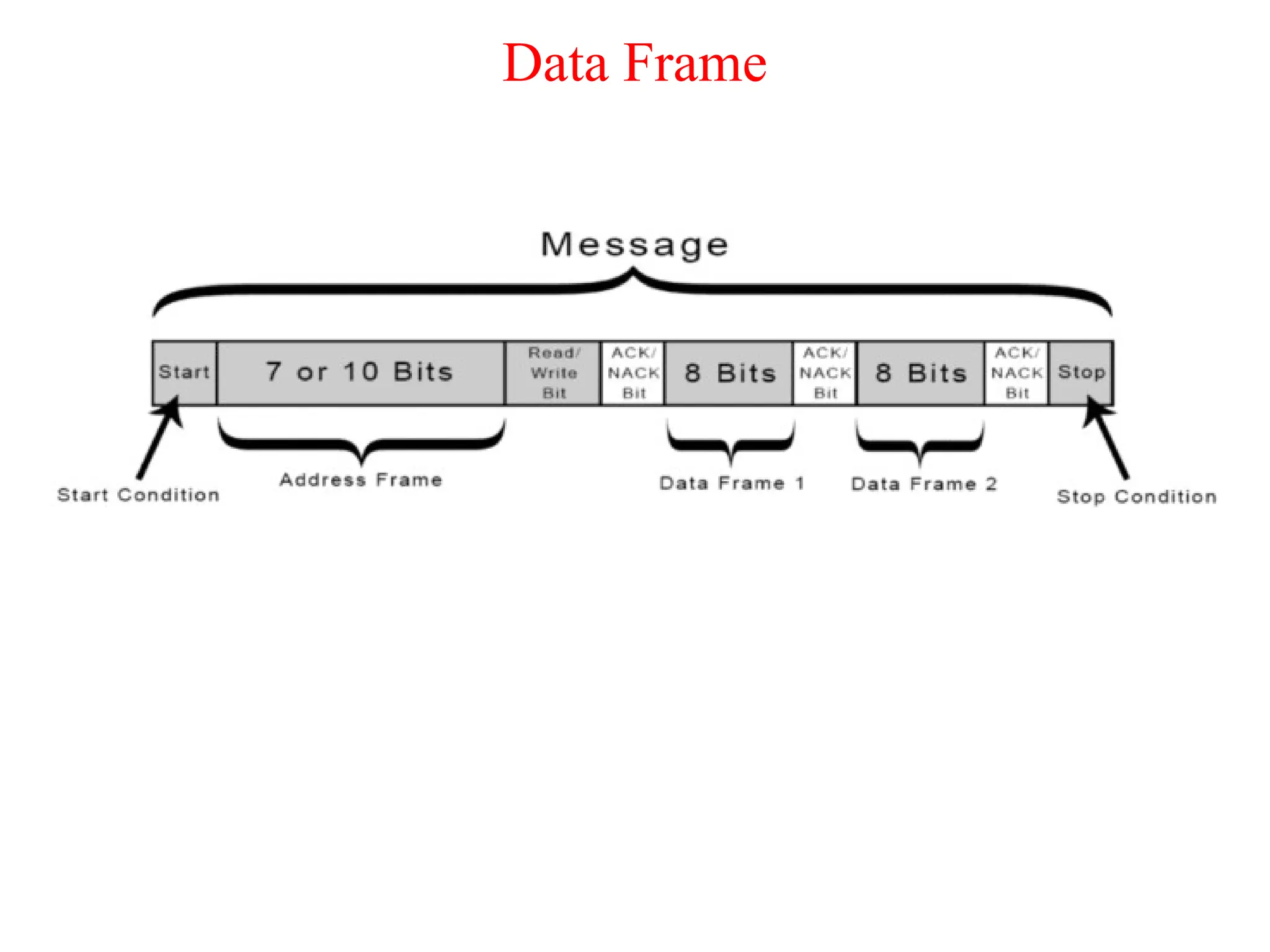
The data is transmitted in the form of packets which comprises 9
bits. The sequence of these bits are –
1. Start Condition: 1 bit
2. Slave Address: 8 bit
3. Acknowledge: 1 bit
6.
Steps of I2CData Transmission
Start Condition: The master device sends a start condition by pulling the SDA
line low while the SCL line is high. This signals that a transmission is about to
begin.
Addressing the Slave: The master sends the 7-bit address of the slave device it
wants to communicate with, followed by a read/write bit. The read/write bit
indicates whether it wants to read from or write to the slave.
Acknowledge Bit (ACK): The addressed slave device responds by pulling the
SDA line low during the next clock pulse (SCL). This confirms that the slave is
ready to communicate.
Data Transmission: The master or slave (depending on the read/write operation)
sends data in 8-bit chunks. After each byte, an ACK is sent to confirm that the
data has been received successfully.
Stop Condition: When the transmission is complete, the master sends a stop
condition by releasing the SDA line to high while the SCL line is high. This
signals that the communication session has ended.
7.
What is Startand Stop Conditions
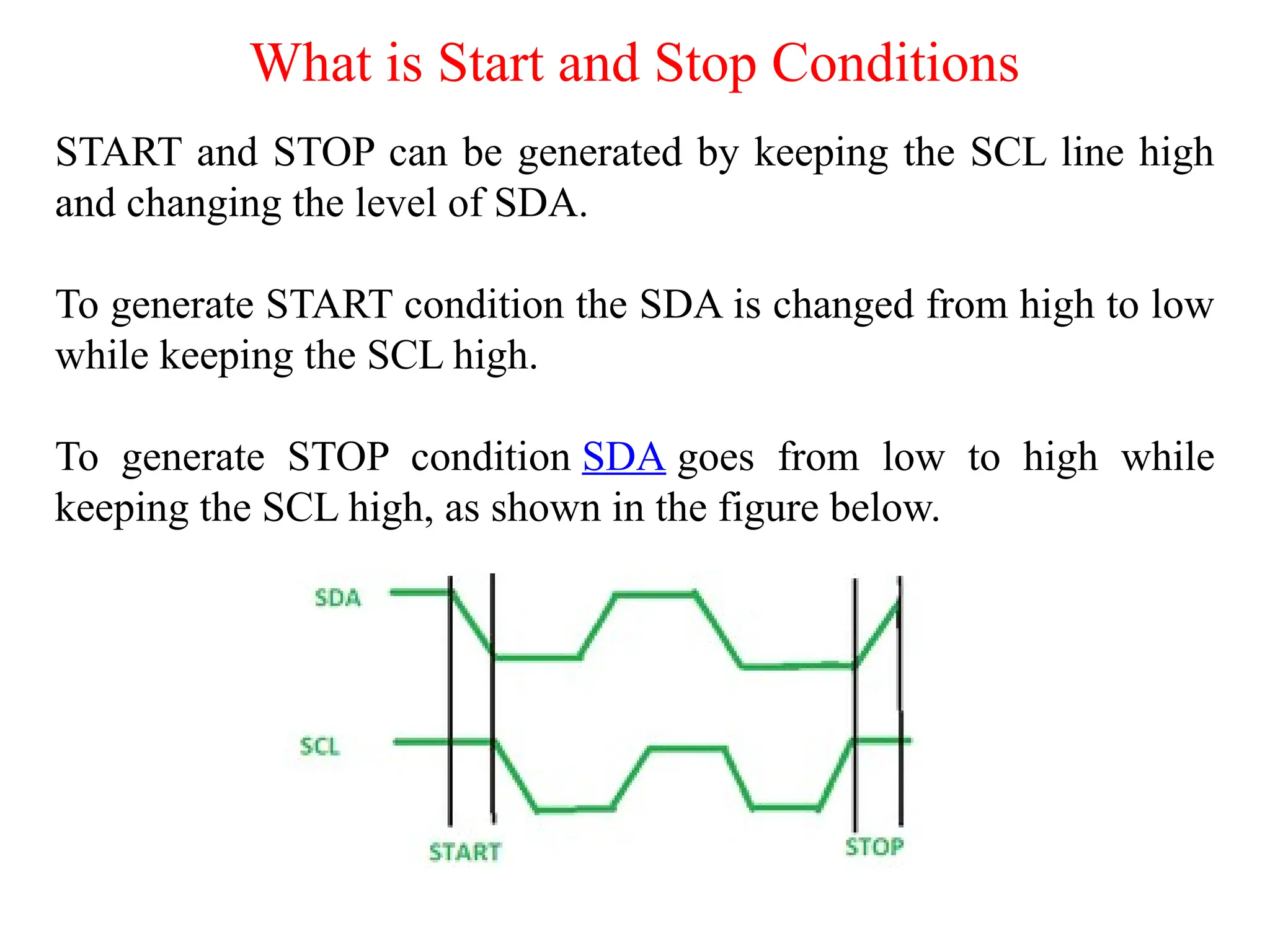
START and STOP can be generated by keeping the SCL line high
and changing the level of SDA.
To generate START condition the SDA is changed from high to low
while keeping the SCL high.
To generate STOP condition SDA goes from low to high while
keeping the SCL high, as shown in the figure below.
8.
What is RepeatedStart Condition
Between each start and stop condition pair, the bus is considered as
busy and no master can take control of the bus.
If the master tries to initiate a new transfer and does not want to
release the bus before starting the new transfer, it issues a new
START condition.
It is called a REPEATED START condition.
9.
Read/Write Bit &ACK/NACK Bit & Addressing
Read/Write Bit
A high Read/Write bit indicates that the master is sending the data
to the slave, whereas a low Read/Write bit indicates that the master
is receiving data from the slave.
ACK/NACK Bit
After every data frame, follows an ACK/NACK bit. If the data
frame is received successfully then ACK bit is sent to the sender by
the receiver.
Addressing
The address frame is the first frame after the start bit. The address
of the slave with which the master wants to communicate is sent by
the master to every slave connected with it. The slave then
compares its own address with this address and sends ACK.
10.
I2C Packet Format
Inthe I2C communication protocol, the data is transmitted in the
form of packets.
These packets are 9 bits long, out of which the first 8 bits are put in
SDA line and the 9th bit is reserved for ACK/NACK i.e.
Acknowledge or Not Acknowledge by the receiver.
START condition plus address packet plus one more data
packet plus STOP condition collectively form a complete Data
transfer.
11.
Features of I2CCommunication Protocol
Half-duplex Communication Protocol -
Bi-directional communication is possible but not simultaneously.
Synchronous Communication -
The data is transferred in the form of frames or blocks.
Can be configured in a multi-master configuration.
Clock Stretching -
The clock is stretched when the slave device is not ready to accept more data by
holding the SCL line low, hence disabling the master to raise the clock line.
Master will not be able to raise the clock line because the wires are AND wired
and wait until the slave releases the SCL line to show it is ready to transfer next
bit.
Arbitration -
I2C protocol supports multi-master bus system but more than one bus can not be
used simultaneously. The SDA and SCL are monitored by the masters. If the SDA
is found high when it was supposed to be low it will be inferred that another
master is active and hence it stops the transfer of data.
Serial transmission -
I2C uses serial transmission for transmission of data.
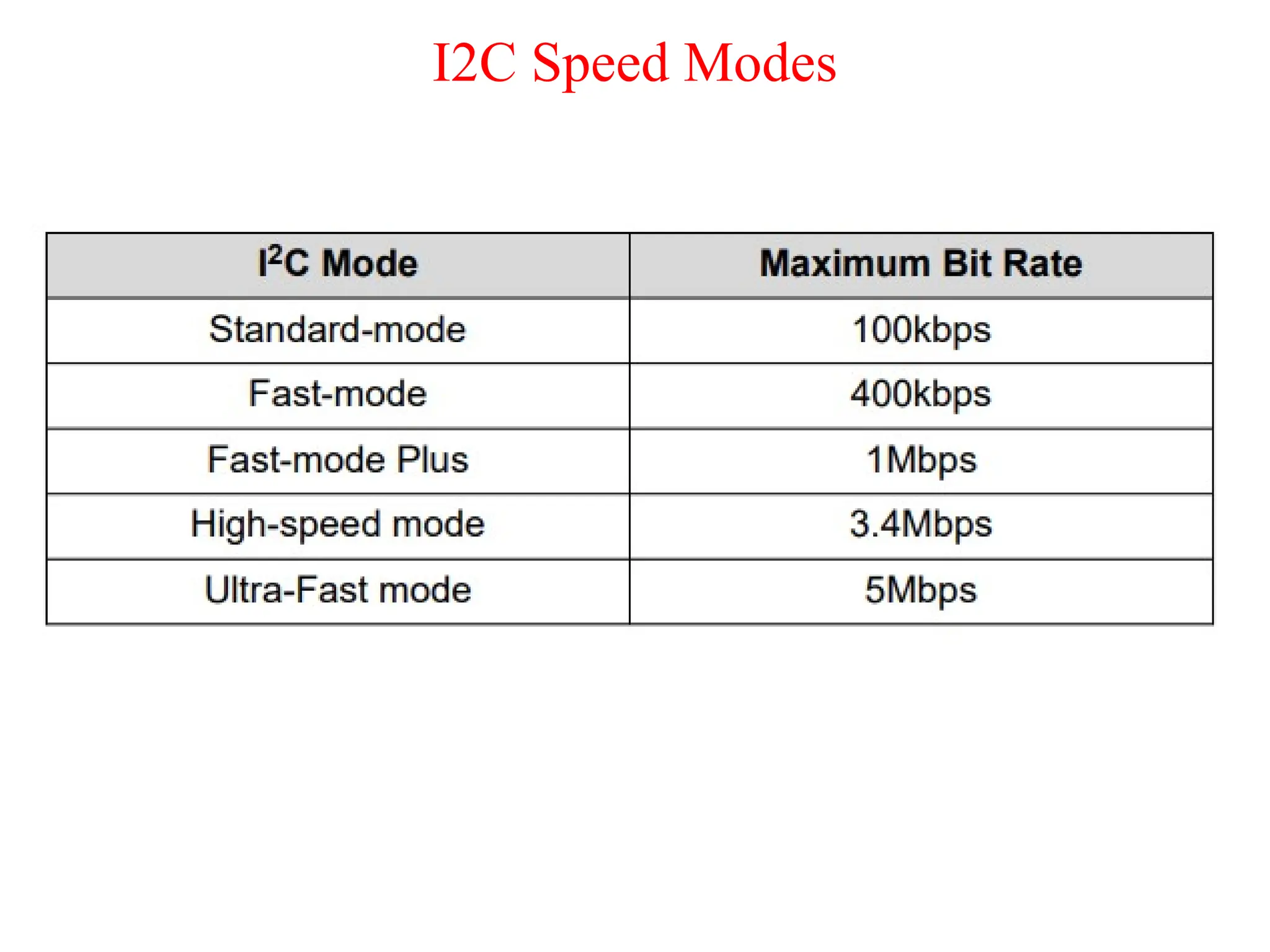
Used for low-speed communication.
12.
Advantages of I2CCommunication Protocol
Can be configured in multi-master mode.
Complexity is reduced because it uses only 2 bi-directional lines
(unlike SPI Communication).
Cost-efficient.
It uses ACK/NACK feature due to which it has improved error
handling capabilities.
Fewer Wires: Only two wires are needed, making it easier to set
up.
Multiple Devices: You can connect many devices to the same bus.
Simple Communication: It’s relatively easy to program and use.
13.
Disadvantages of I2CCommunication Protocol
Speed Limitations: I2C is slower compared to some other
protocols like SPI.
Distance: It’s not suitable for long-distance communication.
Half-duplex communication is used in the I2C communication
protocol.
14.
Conclusion
The I2C communicationprotocol is a simple and effective way for
devices to communicate with each other.
It allows multiple devices to connect using just two wires, making it
easy to add new components to a system.
I2C is popular in various applications because it supports multiple
devices, is relatively easy to implement, and requires less wiring
compared to other protocols.
Overall, I2C is a reliable choice for connecting sensors, displays,
and other peripherals in electronic projects.