Intentional Strategy
Instruction
Asking Questions
Proficient Readers Ask Questions
• Before Reading
• Activate prior knowledge
• Make predictions
• Set a purpose for reading

• During Reading
• Monitor understanding
• Clarify concepts and/or vocabulary

• After Reading
• Make connections
• Extend comprehension
• Analyze and evaluate ideas
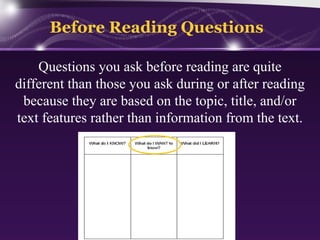
Before Reading Questions
Questions you ask before reading are quite
different than those you ask during or after reading
because they are based on the topic, title, and/or
text features rather than information from the text.
During & After Reading Questions
Questions asked during and after reading are based on
information from the text and the author’s message.

Let’s take a closer
look at these types
of questions and
how they help you
as a reader.
Asking Questions

When you ask questions, you pause to make sure you
understand the key ideas, events, and details in a text.
Asking questions using who, what, where, when, why,
and how will help you better understand the text.
When you cannot answer your questions,
you may need to reread the text.
How Does Asking Questions Help
Me as a Reader?
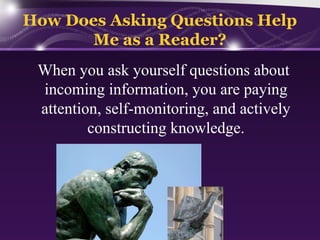
When you ask yourself questions about
incoming information, you are paying
attention, self-monitoring, and actively
constructing knowledge.
Thick and Thin Questions
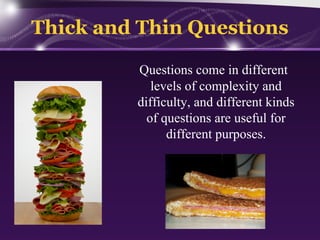
Questions come in different
levels of complexity and
difficulty, and different kinds
of questions are useful for
different purposes.
Thin Questions
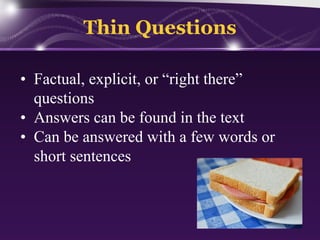
• Factual, explicit, or “right there”
questions
• Answers can be found in the text
• Can be answered with a few words or
short sentences
Thick Questions
• Inferential or “author and me” questions
• Require the reader to think more deeply since
the answers do not come solely from the text the text should support the answer
• Often begin with:
• Why?
• How come?
• I wonder?
• What would happen If?
• What does he/she means by?
Thick or Thin?
• Thick Questions require the reader to form an
opinion or offer support in order to answer it.
• They go far beyond identifying information
and details explicitly stated by an author.
Proficient Readers:
• ask themselves questions to clarify
information and ideas in a text
• recognize that thoughtful reading goes far
beyond identifying information and details
explicitly stated by an author
• gain essential practice with and feedback on
becoming question-posers rather than merely
question-responders
Teachers shouldn’t be the only
ones asking thick questions!
Asking ?’s - Like 5 Hour Energy
for Your Brain!
The ability to routinely generate mental questions
while reading, listening, or viewing something not
only boosts attention and alertness, but also
strengthens comprehension (Duke & Pearson, 2002).
Resources
Buehl, Doug. "Reading Room." Wisconsin Education Association Council. N.p., 18 Nov.
2005. Web. 04 Nov. 2013.

Harvey, Stephanie, and Anne Goudvis. Strategies That Work: Teaching Comprehension to
Enhance Understanding. York, Me.: Stenhouse, 2000. Print.

Young, John. "Questioning: A Comprehension Strategy for Small-Group Guided Reading."
Readwritethink.org. International Reading Association, n.d. Web. 04 Nov. 2013.

Compiled by: P. Muehlenkamp, 2013

Intentional Strategy Instruction - Asking Questions

  • 1.
  • 2.
    Proficient Readers AskQuestions • Before Reading • Activate prior knowledge • Make predictions • Set a purpose for reading • During Reading • Monitor understanding • Clarify concepts and/or vocabulary • After Reading • Make connections • Extend comprehension • Analyze and evaluate ideas
  • 3.
    Before Reading Questions Questionsyou ask before reading are quite different than those you ask during or after reading because they are based on the topic, title, and/or text features rather than information from the text.
  • 4.
    During & AfterReading Questions Questions asked during and after reading are based on information from the text and the author’s message. Let’s take a closer look at these types of questions and how they help you as a reader.
  • 5.
    Asking Questions When youask questions, you pause to make sure you understand the key ideas, events, and details in a text. Asking questions using who, what, where, when, why, and how will help you better understand the text. When you cannot answer your questions, you may need to reread the text.
  • 6.
    How Does AskingQuestions Help Me as a Reader? When you ask yourself questions about incoming information, you are paying attention, self-monitoring, and actively constructing knowledge.
  • 7.
    Thick and ThinQuestions Questions come in different levels of complexity and difficulty, and different kinds of questions are useful for different purposes.
  • 8.
    Thin Questions • Factual,explicit, or “right there” questions • Answers can be found in the text • Can be answered with a few words or short sentences
  • 9.
    Thick Questions • Inferentialor “author and me” questions • Require the reader to think more deeply since the answers do not come solely from the text the text should support the answer • Often begin with: • Why? • How come? • I wonder? • What would happen If? • What does he/she means by?
  • 10.
    Thick or Thin? •Thick Questions require the reader to form an opinion or offer support in order to answer it. • They go far beyond identifying information and details explicitly stated by an author.
  • 11.
    Proficient Readers: • askthemselves questions to clarify information and ideas in a text • recognize that thoughtful reading goes far beyond identifying information and details explicitly stated by an author • gain essential practice with and feedback on becoming question-posers rather than merely question-responders Teachers shouldn’t be the only ones asking thick questions!
  • 12.
    Asking ?’s -Like 5 Hour Energy for Your Brain! The ability to routinely generate mental questions while reading, listening, or viewing something not only boosts attention and alertness, but also strengthens comprehension (Duke & Pearson, 2002).
  • 13.
    Resources Buehl, Doug. "ReadingRoom." Wisconsin Education Association Council. N.p., 18 Nov. 2005. Web. 04 Nov. 2013. Harvey, Stephanie, and Anne Goudvis. Strategies That Work: Teaching Comprehension to Enhance Understanding. York, Me.: Stenhouse, 2000. Print. Young, John. "Questioning: A Comprehension Strategy for Small-Group Guided Reading." Readwritethink.org. International Reading Association, n.d. Web. 04 Nov. 2013. Compiled by: P. Muehlenkamp, 2013