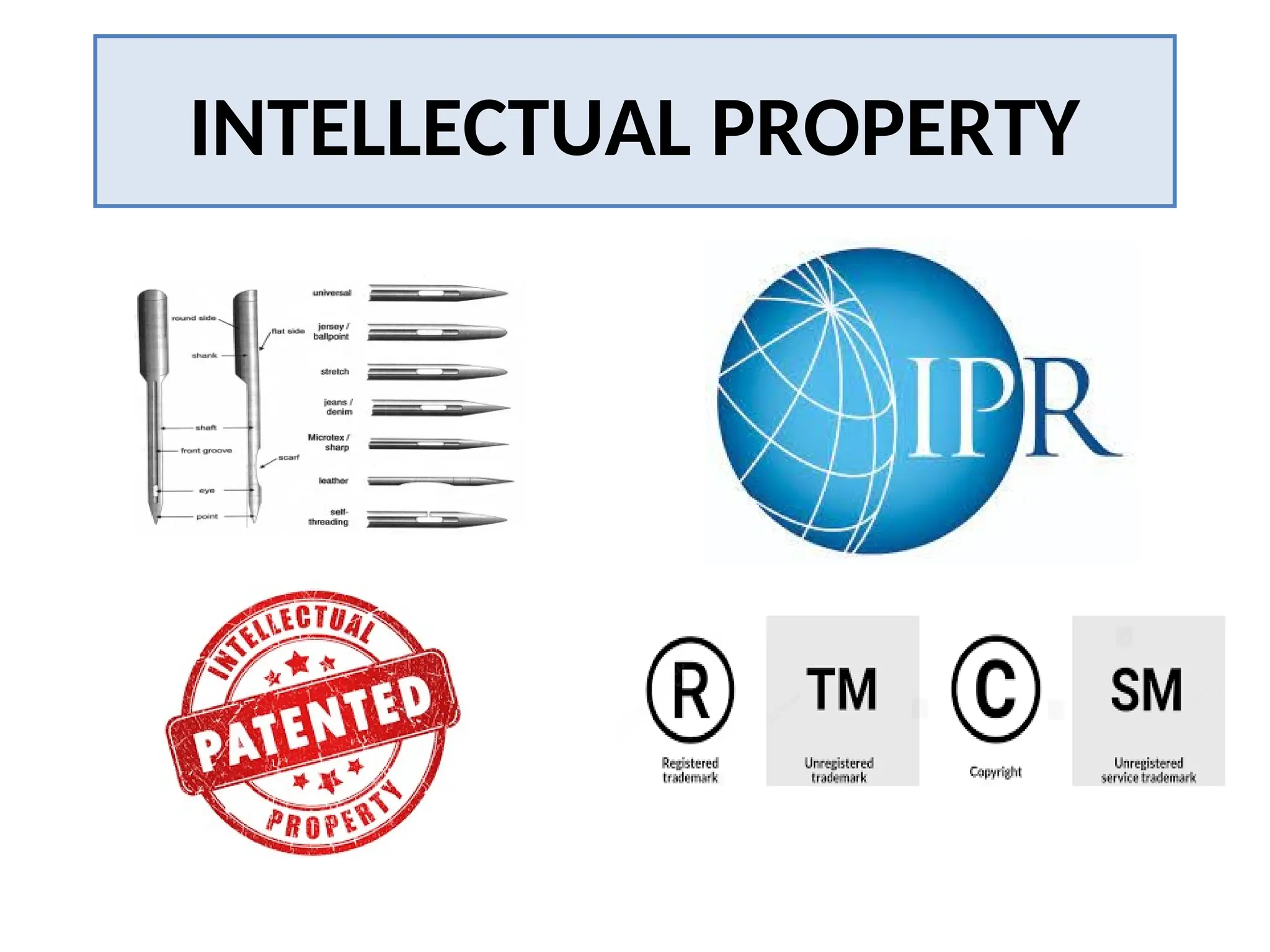
Intellectual property (IP)is a term referring to creations of the
intellect for which a monopoly is assigned to designated owners by
law.[1]
Some common types of intellectual property rights (IPR) are
copyright, patents, and industrial design rights; and the rights that
protect trademarks, trade dress, and in some jurisdictions
trade secrets: all these cover music, literature, and other artistic
works; discoveries and inventions; and words, phrases, symbols,
and designs.
The first known use of the term intellectual property dates
to 1769, when a piece published in the Monthly Review used the
phrase.[4]
The first clear example of modern usage goes back as early
as 1808, when it was used as a heading title in a collection of essays
INTELLECTUAL PROPERTY (IP)
How to Filea Patent in India:
Filing a patent in India involves the following steps:
Determine Patentability: Ensure the invention is novel, non-obvious, and has industrial
applicability.
Draft a Patent Application: Prepare a detailed and comprehensive patent application.
File the Application: Submit the application to the Indian Patent Office along with the
prescribed fees.
Examination and Grant: The patent application undergoes examination, and if deemed fit, a
patent is granted.
• Patent rights are granted by Government.
• A patent is issued to protect the rights of the innovator.
• It is covered under The Indian Patent Act, 1970.
• 20 years
• Can be renewed if expired.
9.
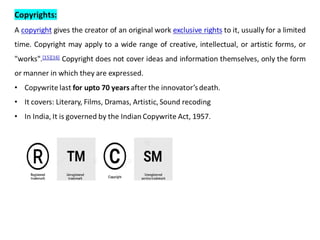
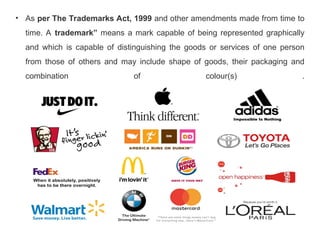
• As perThe Trademarks Act, 1999 and other amendments made from time to
time. A trademark” means a mark capable of being represented graphically
and which is capable of distinguishing the goods or services of one person
from those of others and may include shape of goods, their packaging and
combination of colour(s) .
10.
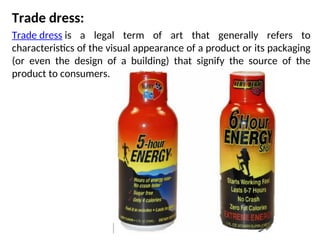
Trade dress:
Trade dressis a legal term of art that generally refers to
characteristics of the visual appearance of a product or its packaging
(or even the design of a building) that signify the source of the
product to consumers.
11.
A trade secretis a
formula, practice,
process, design,
instrument, pattern, or
compilation of
information which is not
generally known or
reasonably ascertainable,
by which a business can
obtain an economic
advantage over
competitors or
customers.
12.
Objectives of IP
Promoteprogress: By exchanging limited exclusive rights for
disclosure of inventions and creative works, society and the
patentee/copyright owner mutually benefit, and an incentive is
created for inventors and authors to create and disclose their work.
Absolute protection: This absolute protection or full value view
treats intellectual property as another type of "real" property,
typically adopting its law and rhetoric.
Financial incentiveThese exclusive rights allow owners of
intellectual property to benefit from the property they have created,
providing a financial incentive for the creation of an investment in
intellectual property, and, in case of patents, pay
associated research and development costs.
13.
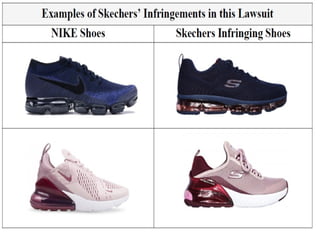
Patent infringement
Patent infringementtypically is caused by using or selling a
patented invention without permission from the patent holder. The
scope of the patented invention or the extent of protection is
defined in the claims of the granted patent. There is safe harbour in
many jurisdictions to use a patented invention for research.
In general, patent infringement cases are handled under civil law
(e.g., in the United States) but several jurisdictions incorporate
infringement in criminal law also (for example, Argentina, China,
France, Japan, Russia, South Korea).
15.
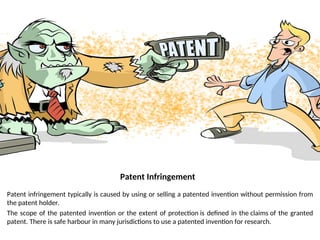
Patent Infringement
Patent infringementtypically is caused by using or selling a patented invention without permission from
the patent holder.
The scope of the patented invention or the extent of protection is defined in the claims of the granted
patent. There is safe harbour in many jurisdictions to use a patented invention for research.

![Intellectual property (IP) is a term referring to creations of the
intellect for which a monopoly is assigned to designated owners by
law.[1]
Some common types of intellectual property rights (IPR) are
copyright, patents, and industrial design rights; and the rights that
protect trademarks, trade dress, and in some jurisdictions
trade secrets: all these cover music, literature, and other artistic
works; discoveries and inventions; and words, phrases, symbols,
and designs.
The first known use of the term intellectual property dates
to 1769, when a piece published in the Monthly Review used the
phrase.[4]
The first clear example of modern usage goes back as early
as 1808, when it was used as a heading title in a collection of essays
INTELLECTUAL PROPERTY (IP)](https://image.slidesharecdn.com/module5intellectualpropertyrights-250909104029-5534058f/85/Module-5_Intellectual-Property-Rights-ppt-2-320.jpg)