Patentable Inventions in India
By Atul S. Jaybhaye
Assistant Professor
Hidayatullah National Law University, Raipur
B.A.,LL.M.,NET
6/26/2020
Concept of Patent
• Patent is short for “Letters Patent” derived from Latin
“Literae patents” i.e. open letters.
• It is the type of legal instrument in the form of a
published written order.
• Its antonym is latent which means hidden.
• Invention should always be open to the public.
• Government’s right to issue compulsory licences.
6/26/2020
Nature of the Patent right
• It is an exclusive right conferred on the
patentee.
• It is also negative right.
• It is also “right in rem” and conditional right.
Note: See section 48 of the Patent Act, 1970.
6/26/2020
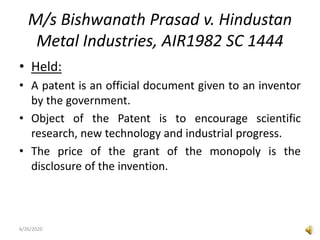
M/s Bishwanath Prasad v. Hindustan
Metal Industries, AIR1982 SC 1444
• Held:
• A patent is an official document given to an inventor
by the government.
• Object of the Patent is to encourage scientific
research, new technology and industrial progress.
• The price of the grant of the monopoly is the
disclosure of the invention.
6/26/2020
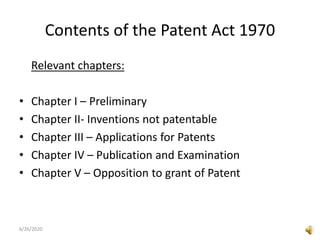
Contents of the Patent Act 1970
Relevant chapters:
• Chapter I – Preliminary
• Chapter II- Inventions not patentable
• Chapter III – Applications for Patents
• Chapter IV – Publication and Examination
• Chapter V – Opposition to grant of Patent
6/26/2020
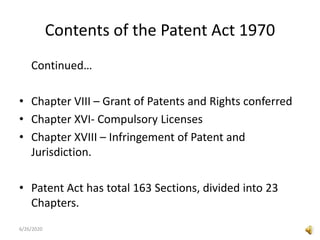
Contents of the Patent Act 1970
Continued…
• Chapter VIII – Grant of Patents and Rights conferred
• Chapter XVI- Compulsory Licenses
• Chapter XVIII – Infringement of Patent and
Jurisdiction.
• Patent Act has total 163 Sections, divided into 23
Chapters.
6/26/2020
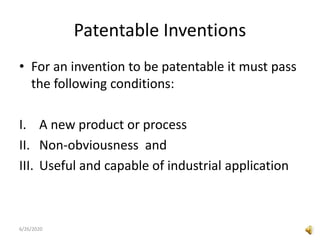
Patentable Inventions
• For an invention to be patentable it must pass
the following conditions:
I. A new product or process
II. Non-obviousness and
III. Useful and capable of industrial application
6/26/2020
Patentable Inventions
New product or process:
• There must be novelty in the work invented.
• no novelty if there has been prior publication and
prior use.
• Invention must involve any innovation or technology
which has not been anticipated or used in the
country or elsewhere before filing an application for
patent.
6/26/2020
Patentable Inventions
Non-obviousness :
• The invention must be non-obvious to a person
skilled in the art.
• What is obvious to a person skilled in the art can’t be
patented.
• For ex. An invention in carpentry may be non-
obvious to a layman but it may be obvious to a
carpenter of average skill.
• Test for determination of Non-obviousness
explained.
6/26/2020
Patentable Inventions
Usefulness/utility:
• It is also known as Utility.
• An invention must be useful for society at large.
• If invention is new, non-obvious but not useful for
public then patent can’t granted to such invention.
• It must be capable of industrial application.
6/26/2020
Capable of Industrial application
• Section 2(ac) of the Patents Act, 1970 Defines as:
It means that the invention is capable of being
made or used in an industry.
• Relevant Case: EL Lilly v. Human Genome, 2010 RPC
429 (English Court of Appeals case)
6/26/2020
What constitutes prior art?
• Specifications for a patent
• Any other document
• Published knowledge either
a) Oral or
b) By means of use or
c) By any other manner
Relevant case: Syntham v. Smith kline 2006 A11 ER 685.
6/26/2020
Date of prior art
Imp. Points:
• Prior art or state of the art is all information that has
been made available to the public in any form before
a given date.
• A patent must be novel and involve an inventive step,
when compared to the prior art.
• In most countries, the relevant date is the day of
filing of the patent application.
• However, it is advisable to have a professional prior
art search conducted thorough a patent agent.
6/26/2020
SC on Inventive Step
In the Biswanath Prasad Radhey Shyam case, SC Observed
as follows:
• “It is important to bear in mind that in order to be patentable an
improvement on something known before or a combination of
different matters already known, should be something more than a
mere workshop improvement; and must independently satisfy the
test of invention or an ‘inventive step’. To be patentable the
improvement or the combination must produce a new result, or a
new article or a better or cheaper article than before. The
combination of old known integers may be so combined that by
their working inter relation they produce a new process or improved
result. Mere collocation of more than one integer or things, not
involving the exercise of any inventive faculty, does not qualify for
the grant of a patent.”
6/26/2020
Ram Narain Kher v. M/s Ambassador Industries,
AIR 1976 Del 87
Held:
• The party claiming patent should specify what
particular features of his device distinguish it from
those which had gone before and show the nature of
the improvement which is said to constitute the
invention.
• Usefulness of the invention and any improvements
need to be specified in application.
• Even, the novelty or the invention has to be
succinctly stated in the claim.
6/26/2020
Thank you…
6/26/2020

Patentable inventions

  • 1.
    Patentable Inventions inIndia By Atul S. Jaybhaye Assistant Professor Hidayatullah National Law University, Raipur B.A.,LL.M.,NET 6/26/2020
  • 2.
    Concept of Patent •Patent is short for “Letters Patent” derived from Latin “Literae patents” i.e. open letters. • It is the type of legal instrument in the form of a published written order. • Its antonym is latent which means hidden. • Invention should always be open to the public. • Government’s right to issue compulsory licences. 6/26/2020
  • 3.
    Nature of thePatent right • It is an exclusive right conferred on the patentee. • It is also negative right. • It is also “right in rem” and conditional right. Note: See section 48 of the Patent Act, 1970. 6/26/2020
  • 4.
    M/s Bishwanath Prasadv. Hindustan Metal Industries, AIR1982 SC 1444 • Held: • A patent is an official document given to an inventor by the government. • Object of the Patent is to encourage scientific research, new technology and industrial progress. • The price of the grant of the monopoly is the disclosure of the invention. 6/26/2020
  • 5.
    Contents of thePatent Act 1970 Relevant chapters: • Chapter I – Preliminary • Chapter II- Inventions not patentable • Chapter III – Applications for Patents • Chapter IV – Publication and Examination • Chapter V – Opposition to grant of Patent 6/26/2020
  • 6.
    Contents of thePatent Act 1970 Continued… • Chapter VIII – Grant of Patents and Rights conferred • Chapter XVI- Compulsory Licenses • Chapter XVIII – Infringement of Patent and Jurisdiction. • Patent Act has total 163 Sections, divided into 23 Chapters. 6/26/2020
  • 7.
    Patentable Inventions • Foran invention to be patentable it must pass the following conditions: I. A new product or process II. Non-obviousness and III. Useful and capable of industrial application 6/26/2020
  • 8.
    Patentable Inventions New productor process: • There must be novelty in the work invented. • no novelty if there has been prior publication and prior use. • Invention must involve any innovation or technology which has not been anticipated or used in the country or elsewhere before filing an application for patent. 6/26/2020
  • 9.
    Patentable Inventions Non-obviousness : •The invention must be non-obvious to a person skilled in the art. • What is obvious to a person skilled in the art can’t be patented. • For ex. An invention in carpentry may be non- obvious to a layman but it may be obvious to a carpenter of average skill. • Test for determination of Non-obviousness explained. 6/26/2020
  • 10.
    Patentable Inventions Usefulness/utility: • Itis also known as Utility. • An invention must be useful for society at large. • If invention is new, non-obvious but not useful for public then patent can’t granted to such invention. • It must be capable of industrial application. 6/26/2020
  • 11.
    Capable of Industrialapplication • Section 2(ac) of the Patents Act, 1970 Defines as: It means that the invention is capable of being made or used in an industry. • Relevant Case: EL Lilly v. Human Genome, 2010 RPC 429 (English Court of Appeals case) 6/26/2020
  • 12.
    What constitutes priorart? • Specifications for a patent • Any other document • Published knowledge either a) Oral or b) By means of use or c) By any other manner Relevant case: Syntham v. Smith kline 2006 A11 ER 685. 6/26/2020
  • 13.
    Date of priorart Imp. Points: • Prior art or state of the art is all information that has been made available to the public in any form before a given date. • A patent must be novel and involve an inventive step, when compared to the prior art. • In most countries, the relevant date is the day of filing of the patent application. • However, it is advisable to have a professional prior art search conducted thorough a patent agent. 6/26/2020
  • 14.
    SC on InventiveStep In the Biswanath Prasad Radhey Shyam case, SC Observed as follows: • “It is important to bear in mind that in order to be patentable an improvement on something known before or a combination of different matters already known, should be something more than a mere workshop improvement; and must independently satisfy the test of invention or an ‘inventive step’. To be patentable the improvement or the combination must produce a new result, or a new article or a better or cheaper article than before. The combination of old known integers may be so combined that by their working inter relation they produce a new process or improved result. Mere collocation of more than one integer or things, not involving the exercise of any inventive faculty, does not qualify for the grant of a patent.” 6/26/2020
  • 15.
    Ram Narain Kherv. M/s Ambassador Industries, AIR 1976 Del 87 Held: • The party claiming patent should specify what particular features of his device distinguish it from those which had gone before and show the nature of the improvement which is said to constitute the invention. • Usefulness of the invention and any improvements need to be specified in application. • Even, the novelty or the invention has to be succinctly stated in the claim. 6/26/2020
  • 16.