5th Patents as a Competitive Strategy Course
             June 18 & 19, 2012


 Aligning IP with Corporate
  Strategy and Cultivating
 Corporate Patent Practices
                     by
                  Naim Khan
The Fundamental IP Question


Why do you need Intellectual Property
            Protection?
      To Navigate Risk Free!!
    But navigate through what?
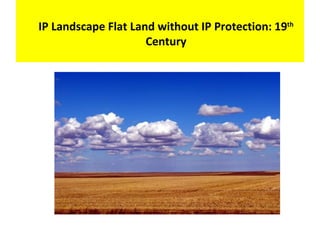
IP Landscape Flat Land without IP Protection: 19th
                     Century
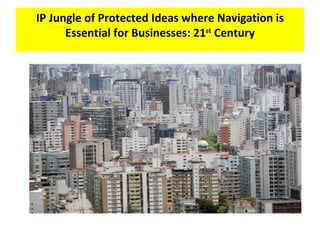
IP Jungle of Protected Ideas where Navigation is
      Essential for Businesses: 21st Century
Screening Corporate Objectives: Defining
    and Incorporating IP Objectives
Every Contemporary Business Strategy has IP in it. Here is
  the reason why.
• A business strategy is designed to avoid risks and reap
  rewards
• An IP strategy manages risks and rewards for a business
• An IP strategy does not automatically mean filing of a
  patent
• You need freedom to operate to launch your products or
  services or even just to adopt a name
• You should not take a risk without having at least a basic
  freedom to operate knowledge
• Without IP protection a business will not be able to
  maintain its competitive advantage
IP Strategy

• An IP strategy largely interacts with a corporate
  strategy with two essential interlinked components
• First component: Choice of how to practice Freedom
  to Operate
• Second component: Creation and Management of
  Ideas
Incorporating Freedom to Operate

• "Freedom to operate" is usually used to mean
  determining whether a particular action, such as
  testing or commercializing a product, can be done
  without infringing valid intellectual property rights of
  others
Incorporating Freedom to Operate
• What choices do you have?
• Freedom to operate gives businesses the latitude to execute their
  product or service strategy without the fear of competition
• An open freedom to operate: Possible in mature technologies; High
  legal and financial risk in new technologies and low profitability
• An exclusive freedom to operate: File patent, acquire patent or
  acquire an exclusive license; Low risk and potentially high reward
• A shared freedom to operate: Acquire a non-exclusive license; Low
  risk and medium to low reward
• Generate freedom to operate: License your patented technology;
  Low risk and high to low reward
The Most Important Resource of a
                 Company
• Ideas
• Ideas lead to inventions
• Ideas are needed for competitive advantage
• Ideas can always be generated
• If you buy a company stock you are likely to buy it for the
  innovation and technology the company owns
• The ownership gives the company freedom to operate and
  adds value to a company
• Ideas no longer come only from the research and
  development activity
• Ideas can be related to any valued activity
Creation of Ideas

•
•   Critical aspects ofof in-house idea creation
    Critical aspects in-house idea creation
•   Ideas come from everywhere
    Ideas come from everywhere
•   Incentives for idea generation
    Ideas and therefore inventions come as a whole not in
    pieces
•   Monitor areas of idea generation
•   Managing idea generators
•   IP in contemporary technologies rely heavily
•   Monitor areas of idea generation
    on connecting ideas as absolute originality is
•   IP in contemporary technologies relies heavily on
    hard to come by absolute originality is hard to
    connecting ideas as
    come by
Creation of Ideas
• Ideas come from everywhere
• There should be company wide participation to come with an idea
  be it R&D or any other department
• Pump up your idea generation base with presentations or talks by
  influential speakers
• Demonstrate how idea generation is helping the company in its
  profitability
• Initially treat all ideas on equal footing
• Expose your in-house audience to your general technology base
• Out source innovation: the IP story is now world wide and it may be
  likely that the your company may not keep pace with innovations in
  your technology space
Creation of Ideas
• Ideas and therefore inventions come as a whole not in
  pieces
• Contemporary technologies are connected at the very least as
  core technologies and associated technologies
• Idea in a core technology may likely be enabled by many
  different aspects of core technology
• Develop expertise that can at least sense this connection of
  technologies
• Ideas and therefore subsequent inventions may likely
  spillover in associated technologies
• Do not discard non core inventions and develop a strategy to
  leverage this spillover
Creation of Ideas
• Managing Idea Generators
• An important aspect of Idea Management is to Liberate,
  Lubricate and Refocus inventors insight
• Train IP evaluators to handle inventors
• Train IP evaluators to build trust with inventors by being open
  and making them feel very important
• Never disappoint someone with an idea
• Treat first contact with an idea generation effort as a triage
• Send back the idea for improvement by citing enabling
  aspects and connections to other associated areas of
  application
• Always give incentives to at least enabling ideas at some level
Creation of Ideas
• Monitor areas of idea generation
• Monitor if enough ideas are not being generated in-
  house for critical areas to have a competitive
  advantage
• Demonstrate in-house audience how to strategically
  think about idea generation for IP in the technology
  of interest (they are always willing to learn)
• At least have an IP training session for all technology
  managers and R&D staff about critical IP thinking and
  get feedback to incorporate in future sessions
Creation of Ideas
• IP in contemporary technologies relies heavily on
  connecting ideas as absolute originality is hard to come
  by
• Create your core technology map overlaid with at least
  two layers of associated technologies
• Examine the IP and product landscape
• Examine the idea space you have generated and the idea
  space you need
• Train IP evaluators to see the interconnectedness of
  technologies and same for patents in the landscape
• These IP evaluators will in turn maximize your return in
  converting ideas into possible patents
Management of Ideas
• Start an IP project for an idea
• Recording and Documentation (Technical & Legal)
• Evaluating novelty (Technical & Legal)
• Evaluating completeness: Is the idea workable (Technical)
• Evaluating value proposition: how the idea is connected to
  your business and product strategy (Technical & Marketing
  and Sales)
• Validating novelty (Legal)
Management of Ideas
• Identify deliverable and alternate paths to deliverable
  (Technical & Legal)
• Evaluate competing technologies and competitors (Technical
  & Legal)
• Evaluate future modifications (Technical)
• Evaluate markets: financial (Marketing and Sales)
• Evaluate markets: geographical (Technical, Marketing and
  Sales & Legal)
Management of Ideas
• Evaluate budget to file patent (Legal & Finance)
• Determine availability of budget and track yearly budget
  (Finance)
• Determine your choice of freedom to operate (Executive)
• You may still have to file for a patent (Legal)
• If you patent, ensure that the invention is legally owned by
  the company (Legal)
Outcome of Execution of IP Process
• Patenting activity is an outcome of a business process
• Lowered cost across the board for IP activity
• Justified IP spending
• Informed understanding of your business, future vision and
  competition
• Acquire Not just Freedom to Operate but Freedom to Plan,
  Execute and Reshape Vision
• Intangible now feels tangible
• YOUR IP IS ALIGNED TO YOUR BUSINESS GOALS
Feedback and Communication
• Management of ideas involves all departments: Legal,
  Technical, Marketing, Financial and Executive Management
• They are delivering their required input
• Need to stress the importance of an IP project
  as a mission critical project
• Assemble a team from all business units
• Have all departments present their reports in team meetings
• Present final report in a team meeting along with executive
  management
Strategic Technology Map: The Missing Link

•   Generate scenarios to anticipate probable futures: essential
•   Three components and many derivatives
•   Inventory of ideas
•   Global market survey
•   IP survey
Technology Map
              Strategic Technology Map
•   Inventory of ideas
•   Collect all ideas
•   Do not discard any idea initially
•   Connect ideas to existing products or services
•   Connect ideas to future
•   Invent upon ideas
•   See the complete picture
Technology Map
            Strategic Technology Map
• Global Market Survey
• Identify the ecosystem in which your company exists
• Identify broad components of the ecosystem
• Collect statistical and financial data to see what the market is
  saying
• See the underlying trends unfolding in the ecosystem
• Collect information on all relevant M&A activity and with IP
  details on patent evaluation, licensing and the synergy
  between merging companies
• Write down key questions to answer
Technology Map
              Strategic Technology Map
•   IP Survey
•   Identify competing companies
•   Identify their IP
•   Bridge their IP to their published strategy and products
•   Identify the risk from competition
•   Identify patent prior art
•   Identify non-patent literature
•   Identify key researchers and clusters
•   Identify relevant court decisions
Time Horizons
• Determine your time horizon for bringing product/service to
  market or investors (absolutely critical will affect every
  decision including IP)
• For patents determine your neighbourhood of IP Jungle:
  Create a landscape of your neighbourhood technologies
  (what you may uncover affect your initial time horizons or re-
  affirm them)
• Determine your immediate and midterm potential and target
  markets (this will be big factor to estimate IP costs)
Bridging IP to Scenarios
•   Connect all components of Technology Map
•   Observe the intersections
•   Document and Answer key questions
•   Bridge the intersections of Technology Map to your generated
    scenarios to document key future developments and overlay your
    Time Horizons
•   Design your IP Strategy to include these future developments
•   IP Strategy is always ahead of time by design and necessity
•   IP Strategy by design should be flexible to change with evolving IP
    and Business landscape
•   Use Technology Map extensively in management of ideas
•   Update continuously
•   Shrink delay of time to market
Anticipate the Future
•   IP strategy today is about carving your space in future
•   Do not miss the boat by not examining what is in front of you
•   Evaluate your ideas
•   Best way to see the future is to invent it

Aligning IP Strategy

  • 1.
    5th Patents asa Competitive Strategy Course June 18 & 19, 2012 Aligning IP with Corporate Strategy and Cultivating Corporate Patent Practices by Naim Khan
  • 2.
    The Fundamental IPQuestion Why do you need Intellectual Property Protection? To Navigate Risk Free!! But navigate through what?
  • 3.
    IP Landscape FlatLand without IP Protection: 19th Century
  • 4.
    IP Jungle ofProtected Ideas where Navigation is Essential for Businesses: 21st Century
  • 5.
    Screening Corporate Objectives:Defining and Incorporating IP Objectives Every Contemporary Business Strategy has IP in it. Here is the reason why. • A business strategy is designed to avoid risks and reap rewards • An IP strategy manages risks and rewards for a business • An IP strategy does not automatically mean filing of a patent • You need freedom to operate to launch your products or services or even just to adopt a name • You should not take a risk without having at least a basic freedom to operate knowledge • Without IP protection a business will not be able to maintain its competitive advantage
  • 6.
    IP Strategy • AnIP strategy largely interacts with a corporate strategy with two essential interlinked components • First component: Choice of how to practice Freedom to Operate • Second component: Creation and Management of Ideas
  • 7.
    Incorporating Freedom toOperate • "Freedom to operate" is usually used to mean determining whether a particular action, such as testing or commercializing a product, can be done without infringing valid intellectual property rights of others
  • 8.
    Incorporating Freedom toOperate • What choices do you have? • Freedom to operate gives businesses the latitude to execute their product or service strategy without the fear of competition • An open freedom to operate: Possible in mature technologies; High legal and financial risk in new technologies and low profitability • An exclusive freedom to operate: File patent, acquire patent or acquire an exclusive license; Low risk and potentially high reward • A shared freedom to operate: Acquire a non-exclusive license; Low risk and medium to low reward • Generate freedom to operate: License your patented technology; Low risk and high to low reward
  • 9.
    The Most ImportantResource of a Company • Ideas • Ideas lead to inventions • Ideas are needed for competitive advantage • Ideas can always be generated • If you buy a company stock you are likely to buy it for the innovation and technology the company owns • The ownership gives the company freedom to operate and adds value to a company • Ideas no longer come only from the research and development activity • Ideas can be related to any valued activity
  • 10.
    Creation of Ideas • • Critical aspects ofof in-house idea creation Critical aspects in-house idea creation • Ideas come from everywhere Ideas come from everywhere • Incentives for idea generation Ideas and therefore inventions come as a whole not in pieces • Monitor areas of idea generation • Managing idea generators • IP in contemporary technologies rely heavily • Monitor areas of idea generation on connecting ideas as absolute originality is • IP in contemporary technologies relies heavily on hard to come by absolute originality is hard to connecting ideas as come by
  • 11.
    Creation of Ideas •Ideas come from everywhere • There should be company wide participation to come with an idea be it R&D or any other department • Pump up your idea generation base with presentations or talks by influential speakers • Demonstrate how idea generation is helping the company in its profitability • Initially treat all ideas on equal footing • Expose your in-house audience to your general technology base • Out source innovation: the IP story is now world wide and it may be likely that the your company may not keep pace with innovations in your technology space
  • 12.
    Creation of Ideas •Ideas and therefore inventions come as a whole not in pieces • Contemporary technologies are connected at the very least as core technologies and associated technologies • Idea in a core technology may likely be enabled by many different aspects of core technology • Develop expertise that can at least sense this connection of technologies • Ideas and therefore subsequent inventions may likely spillover in associated technologies • Do not discard non core inventions and develop a strategy to leverage this spillover
  • 13.
    Creation of Ideas •Managing Idea Generators • An important aspect of Idea Management is to Liberate, Lubricate and Refocus inventors insight • Train IP evaluators to handle inventors • Train IP evaluators to build trust with inventors by being open and making them feel very important • Never disappoint someone with an idea • Treat first contact with an idea generation effort as a triage • Send back the idea for improvement by citing enabling aspects and connections to other associated areas of application • Always give incentives to at least enabling ideas at some level
  • 14.
    Creation of Ideas •Monitor areas of idea generation • Monitor if enough ideas are not being generated in- house for critical areas to have a competitive advantage • Demonstrate in-house audience how to strategically think about idea generation for IP in the technology of interest (they are always willing to learn) • At least have an IP training session for all technology managers and R&D staff about critical IP thinking and get feedback to incorporate in future sessions
  • 15.
    Creation of Ideas •IP in contemporary technologies relies heavily on connecting ideas as absolute originality is hard to come by • Create your core technology map overlaid with at least two layers of associated technologies • Examine the IP and product landscape • Examine the idea space you have generated and the idea space you need • Train IP evaluators to see the interconnectedness of technologies and same for patents in the landscape • These IP evaluators will in turn maximize your return in converting ideas into possible patents
  • 16.
    Management of Ideas •Start an IP project for an idea • Recording and Documentation (Technical & Legal) • Evaluating novelty (Technical & Legal) • Evaluating completeness: Is the idea workable (Technical) • Evaluating value proposition: how the idea is connected to your business and product strategy (Technical & Marketing and Sales) • Validating novelty (Legal)
  • 17.
    Management of Ideas •Identify deliverable and alternate paths to deliverable (Technical & Legal) • Evaluate competing technologies and competitors (Technical & Legal) • Evaluate future modifications (Technical) • Evaluate markets: financial (Marketing and Sales) • Evaluate markets: geographical (Technical, Marketing and Sales & Legal)
  • 18.
    Management of Ideas •Evaluate budget to file patent (Legal & Finance) • Determine availability of budget and track yearly budget (Finance) • Determine your choice of freedom to operate (Executive) • You may still have to file for a patent (Legal) • If you patent, ensure that the invention is legally owned by the company (Legal)
  • 19.
    Outcome of Executionof IP Process • Patenting activity is an outcome of a business process • Lowered cost across the board for IP activity • Justified IP spending • Informed understanding of your business, future vision and competition • Acquire Not just Freedom to Operate but Freedom to Plan, Execute and Reshape Vision • Intangible now feels tangible • YOUR IP IS ALIGNED TO YOUR BUSINESS GOALS
  • 20.
    Feedback and Communication •Management of ideas involves all departments: Legal, Technical, Marketing, Financial and Executive Management • They are delivering their required input • Need to stress the importance of an IP project as a mission critical project • Assemble a team from all business units • Have all departments present their reports in team meetings • Present final report in a team meeting along with executive management
  • 21.
    Strategic Technology Map:The Missing Link • Generate scenarios to anticipate probable futures: essential • Three components and many derivatives • Inventory of ideas • Global market survey • IP survey
  • 22.
    Technology Map Strategic Technology Map • Inventory of ideas • Collect all ideas • Do not discard any idea initially • Connect ideas to existing products or services • Connect ideas to future • Invent upon ideas • See the complete picture
  • 23.
    Technology Map Strategic Technology Map • Global Market Survey • Identify the ecosystem in which your company exists • Identify broad components of the ecosystem • Collect statistical and financial data to see what the market is saying • See the underlying trends unfolding in the ecosystem • Collect information on all relevant M&A activity and with IP details on patent evaluation, licensing and the synergy between merging companies • Write down key questions to answer
  • 24.
    Technology Map Strategic Technology Map • IP Survey • Identify competing companies • Identify their IP • Bridge their IP to their published strategy and products • Identify the risk from competition • Identify patent prior art • Identify non-patent literature • Identify key researchers and clusters • Identify relevant court decisions
  • 25.
    Time Horizons • Determineyour time horizon for bringing product/service to market or investors (absolutely critical will affect every decision including IP) • For patents determine your neighbourhood of IP Jungle: Create a landscape of your neighbourhood technologies (what you may uncover affect your initial time horizons or re- affirm them) • Determine your immediate and midterm potential and target markets (this will be big factor to estimate IP costs)
  • 26.
    Bridging IP toScenarios • Connect all components of Technology Map • Observe the intersections • Document and Answer key questions • Bridge the intersections of Technology Map to your generated scenarios to document key future developments and overlay your Time Horizons • Design your IP Strategy to include these future developments • IP Strategy is always ahead of time by design and necessity • IP Strategy by design should be flexible to change with evolving IP and Business landscape • Use Technology Map extensively in management of ideas • Update continuously • Shrink delay of time to market
  • 27.
    Anticipate the Future • IP strategy today is about carving your space in future • Do not miss the boat by not examining what is in front of you • Evaluate your ideas • Best way to see the future is to invent it

Editor's Notes

  • #7 How will you create will affect how will you manage New generation of ideas will mean newer business plans and models Focus should be on exiting platform and more so on newer but related ideas so that buisness strategy can be continued… Technologies inherently are nature is disruptive and so idea creation should also have at least a disruptive element
  • #9 Even though the options are well defined the actual situation may demand a mix to two or more options
  • #14 Targeted and focused brain storming is not straight forward.. Guiding inventors and R&D to understand how to navigate around an idea is essential Working on inventor psychology is essential