Note:Please choose one of the first five “start page” styles.  Just delete the other four style slides after choosing.
Intellectual Property 101 Protect Your Competitive EdgeGreg StarkPatent Attorney - SLWJanuary 30, 2010Note:Please choose one of the first five “start page” styles.  Just delete the other four style slides after choosing.
Agenda…What is Intellectual PropertyWhy should I care?Overview of basic types of IP protectionWith some emphasis on Patents…Apple Case Study
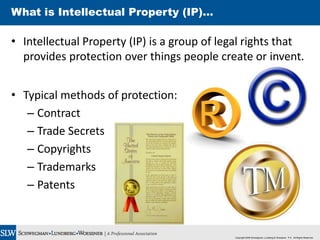
What is Intellectual Property (IP)…Intellectual Property (IP) is a group of legal rights that provides protection over things people create or invent.Typical methods of protection:ContractTrade SecretsCopyrightsTrademarksPatents
Why should I care about IP…Intellectual Property Protection can…Attract investment $$$$$Or increasing exit valuation (e.g., IPO, M&A)Deter others from stealing your ideasDeter others from entering a marketDefend against other patent portfoliosLicense or Trade with others (Cross-License)Provide alterative sources of income…
Methods of Protecting IP…ContractsCopyrightsTrademarksTrade SecretsPatents
Contracts…Affordable cost to gain protectionProtection defined by contract Examples:non-compete termsanti-reverse engineering termsassignment of IP rightsLength of time protection lastsFlexibleDepends on terms of the contractCommercial Importancealways important at some stage of businessEnforcement – contract…
Copyrights…“Expression”Art, Writing, Music, Movies, etc…Any “work” reduced to a tangible medium of expressionPolicyMoral rights of the AuthorEuropeIncentive to produceU.S.
Copyrights…Free and AutomaticProtection is automatic as soon as the work is reduced to a tangible medium…Aspects of ProtectionScope - NarrowTermLife + 70 yearsCommercial (Work for Hire) - 120 yearsCommercial BenefitsSupports entire industriesMusicMoviesetc…
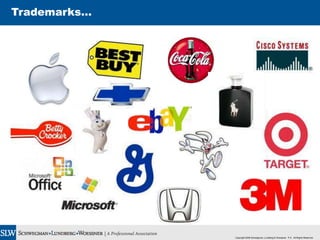
Trademarks…
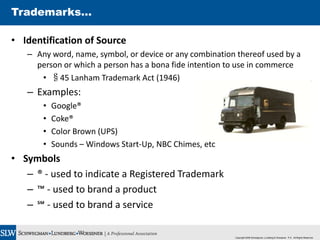
Trademarks…Identification of SourceAny word, name, symbol, or device or any combination thereof used by a person or which a person has a bona fide intention to use in commerce§45 Lanham Trademark Act (1946)Examples:Google® Coke®Color Brown (UPS)Sounds – Windows Start-Up, NBC Chimes, etcSymbols® - used to indicate a Registered Trademark™ - used to brand a product℠ - used to brand a service
Trademarks…Relatively inexpensive to obtain ~ $500 - $2,500Protection lasts as long as the mark is used in commerceAs long as the mark identifies sourceUse it or lose it…Commercial BenefitsPowerful barrier to entryPrice supportGenericide…Popular marks must police use
Trade Secrets…Shhh, don’t tell anyone…Information that not known outside of an organization that provides a competitive advantageExamples:Formula for Coca-Cola (Coke™)Decided not to patent to keep secret FOREVER…KFC’s secret recipeOnly 3 executives have access to the recipeWD-40Guarded in a bank vaultCompany mixes the formula in only three facilities to maintain the secret
Trade Secrets…Relatively low cost to gain protectionSome consider it practically freeMust take precautions to maintain secrecyProtection lasts as long as the secret remains a secretprotects information/knowledge that can be kept “relatively secret”Commercial BenefitsCan provide critical barriers to entryEnforcement…Enforcement complicated by variation in State law
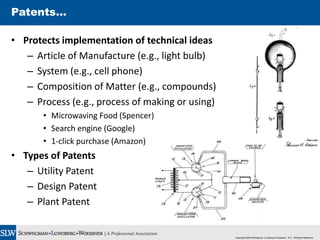
Patents…Protects implementation of technical ideasArticle of Manufacture (e.g., light bulb)System (e.g., cell phone)Composition of Matter (e.g., compounds)Process (e.g., process of making or using)Microwaving Food (Spencer)Search engine (Google)1-click purchase (Amazon)Types of PatentsUtility PatentDesign PatentPlant Patent
Patents…Relatively expensive to obtain Initial filing ~$8,000 - $12,000Prosecution ~ $10,000+Limited term of protection20 years from filingCommercial BenefitsExclusivityMonopoly PricingLicensing
Patents…What is the standard for getting a patent?NewUsefulNon-obviousWhat do you get if you meet the standard?Right to exclude others from the invention for a limited timeNot a right to use the inventionWhat do you give up by getting a patent?You have to teach others how to make and use the inventionWhat do you risk by not patenting your invention?i.e., trying to keep it a trade secretSomeone else can patent it and exclude you from using it.
Patents…Selecting what to Patent?Business Value:What is the likely value of the technology?Will exclusivity provide a competitive advantage?Does the technology align with your commercial products?Legal Strength:What is the novelty over prior art?Business Methods?Exclusivity:Will competitors have viable design-around options?Can infringement be detected?
Patents…Patent Strategy - Benefits from PatentsMonopoly PricingIncrease profit margins through exclusionary powerExtra IncomeGenerate income through licensing activitiesAccess to TechnologyCross-license to access other technologiesBusiness AssetCan be used to assist in securing funding or obtaining desired exit valuationsMarketing ToolPatent Pending Chilling effect on competitionDemonstrated expertise in a particular field
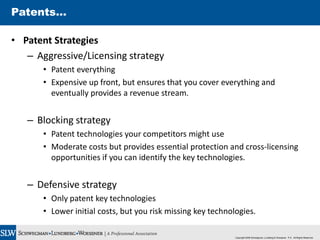
Patents…Patent StrategiesAggressive/Licensing strategyPatent everythingExpensive up front, but ensures that you cover everything and eventually provides a revenue stream.Blocking strategyPatent technologies your competitors might useModerate costs but provides essential protection and cross-licensing opportunities if you can identify the key technologies.Defensive strategy Only patent key technologiesLower initial costs, but you risk missing key technologies.
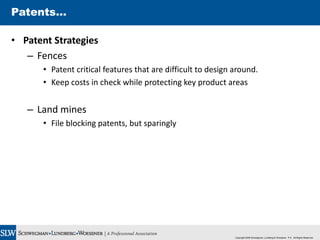
Patents…Patent StrategiesFencesPatent critical features that are difficult to design around.Keep costs in check while protecting key product areasLand minesFile blocking patents, but sparingly
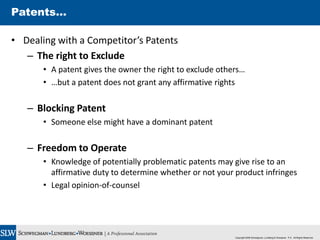
Patents…Dealing with a Competitor’s PatentsThe right to ExcludeA patent gives the owner the right to exclude others……but a patent does not grant any affirmative rightsBlocking PatentSomeone else might have a dominant patentFreedom to OperateKnowledge of potentially problematic patents may give rise to an affirmative duty to determine whether or not your product infringesLegal opinion-of-counsel
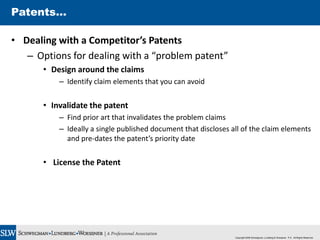
Patents…Dealing with a Competitor’s PatentsOptions for dealing with a “problem patent”Design around the claimsIdentify claim elements that you can avoidInvalidate the patentFind prior art that invalidates the problem claimsIdeally a single published document that discloses all of the claim elements and pre-dates the patent’s priority date License the Patent
Patents…Damages for InfringementInjunctionLost ProfitsReasonable RoyaltyCost of Litigation$2M+ if case goes to trial
Patents…Recent Damage Awards$290M verdict upheld on appeal in Microsoft v. i4i (2009)$192M jury verdict in hazardous waste recycling patent suit (2009)$250M damages awarded to Medtronic in stent patent case against Boston Scientific (2008)Settlements$1.35B paid by Medtronic o settle spinal implant patent dispute, purchasing 700 patents (~$2M per patent) (2005)$612M  Amount Blackberry-maker Research in Motion agreed to pay NTP in patent infringement dispute settlement.  (2006)
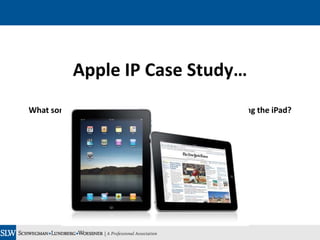
Apple IP Case Study…What sort of IP did Apple take into consideration in launching the iPad?
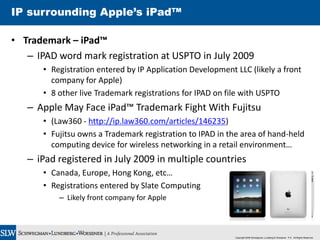
IP surrounding Apple’s iPad™Trademark – iPad™IPAD word mark registration at USPTO in July 2009Registration entered by IP Application Development LLC (likely a front company for Apple)8 other live Trademark registrations for IPAD on file with USPTOApple May Face iPad™ Trademark Fight With Fujitsu (Law360 - http://ip.law360.com/articles/146235)Fujitsu owns a Trademark registration to IPAD in the area of hand-held computing device for wireless networking in a retail environment…iPad registered in July 2009 in multiple countries Canada, Europe, Hong Kong, etc…Registrations entered by Slate ComputingLikely front company for Apple
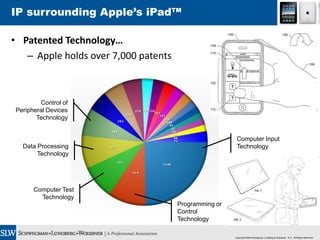
IP surrounding Apple’s iPad™Patented Technology…Apple holds over 7,000 patentsControl of Peripheral Devices TechnologyComputer Input TechnologyData Processing TechnologyComputer Test TechnologyProgramming orControl Technology
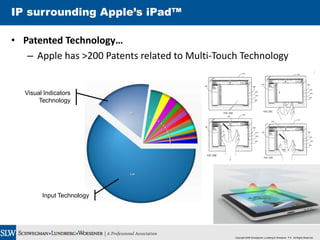
IP surrounding Apple’s iPad™Patented Technology…Apple has >200 Patents related to Multi-Touch TechnologyVisual Indicators TechnologyInput Technology
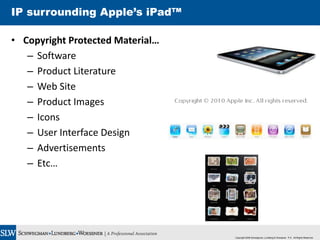
IP surrounding Apple’s iPad™Copyright Protected Material…SoftwareProduct LiteratureWeb SiteProduct ImagesIconsUser Interface DesignAdvertisementsEtc…
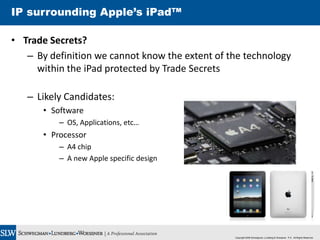
IP surrounding Apple’s iPad™Trade Secrets?By definition we cannot know the extent of the technology within the iPad protected by Trade SecretsLikely Candidates:Software OS, Applications, etc…Processor A4 chip A new Apple specific design
IP surrounding Apple’s iPad™Contracts…(i.e. Confidentiality Agreements)Employment AgreementsSuppliersHardware fabricationProduct LiteratureEtc…PartnersAT&TVerizon
Intellectual Property Goals…Develop a proactive approach toward protecting your intellectual property(1)  Make sure existing features are coveredIntegrate patent filing into product development process(e.g., design review, or even concept review)(3)  Watch and analyze competitor’s filings and file blocking patents, as appropriate.Develop a proactive approach to product clearance of your productsIdentify any problem patents early in the design processDesign-around, invalidate, or license problem patents
Note:Please use this slide at the vary end.  Feel free to change the Thank You message as desired.Thank YouFor more information please visit :www.SLWip.comGreg Starkgstark@slwip.com(612) 373-6904Minneapolis, MN office

Intellectual Property 101

  • 1.
    Note:Please choose oneof the first five “start page” styles. Just delete the other four style slides after choosing.
  • 2.
    Intellectual Property 101Protect Your Competitive EdgeGreg StarkPatent Attorney - SLWJanuary 30, 2010Note:Please choose one of the first five “start page” styles. Just delete the other four style slides after choosing.
  • 3.
    Agenda…What is IntellectualPropertyWhy should I care?Overview of basic types of IP protectionWith some emphasis on Patents…Apple Case Study
  • 4.
    What is IntellectualProperty (IP)…Intellectual Property (IP) is a group of legal rights that provides protection over things people create or invent.Typical methods of protection:ContractTrade SecretsCopyrightsTrademarksPatents
  • 5.
    Why should Icare about IP…Intellectual Property Protection can…Attract investment $$$$$Or increasing exit valuation (e.g., IPO, M&A)Deter others from stealing your ideasDeter others from entering a marketDefend against other patent portfoliosLicense or Trade with others (Cross-License)Provide alterative sources of income…
  • 6.
    Methods of ProtectingIP…ContractsCopyrightsTrademarksTrade SecretsPatents
  • 7.
    Contracts…Affordable cost togain protectionProtection defined by contract Examples:non-compete termsanti-reverse engineering termsassignment of IP rightsLength of time protection lastsFlexibleDepends on terms of the contractCommercial Importancealways important at some stage of businessEnforcement – contract…
  • 8.
    Copyrights…“Expression”Art, Writing, Music,Movies, etc…Any “work” reduced to a tangible medium of expressionPolicyMoral rights of the AuthorEuropeIncentive to produceU.S.
  • 9.
    Copyrights…Free and AutomaticProtectionis automatic as soon as the work is reduced to a tangible medium…Aspects of ProtectionScope - NarrowTermLife + 70 yearsCommercial (Work for Hire) - 120 yearsCommercial BenefitsSupports entire industriesMusicMoviesetc…
  • 10.
  • 11.
    Trademarks…Identification of SourceAnyword, name, symbol, or device or any combination thereof used by a person or which a person has a bona fide intention to use in commerce§45 Lanham Trademark Act (1946)Examples:Google® Coke®Color Brown (UPS)Sounds – Windows Start-Up, NBC Chimes, etcSymbols® - used to indicate a Registered Trademark™ - used to brand a product℠ - used to brand a service
  • 12.
    Trademarks…Relatively inexpensive toobtain ~ $500 - $2,500Protection lasts as long as the mark is used in commerceAs long as the mark identifies sourceUse it or lose it…Commercial BenefitsPowerful barrier to entryPrice supportGenericide…Popular marks must police use
  • 13.
    Trade Secrets…Shhh, don’ttell anyone…Information that not known outside of an organization that provides a competitive advantageExamples:Formula for Coca-Cola (Coke™)Decided not to patent to keep secret FOREVER…KFC’s secret recipeOnly 3 executives have access to the recipeWD-40Guarded in a bank vaultCompany mixes the formula in only three facilities to maintain the secret
  • 14.
    Trade Secrets…Relatively lowcost to gain protectionSome consider it practically freeMust take precautions to maintain secrecyProtection lasts as long as the secret remains a secretprotects information/knowledge that can be kept “relatively secret”Commercial BenefitsCan provide critical barriers to entryEnforcement…Enforcement complicated by variation in State law
  • 15.
    Patents…Protects implementation oftechnical ideasArticle of Manufacture (e.g., light bulb)System (e.g., cell phone)Composition of Matter (e.g., compounds)Process (e.g., process of making or using)Microwaving Food (Spencer)Search engine (Google)1-click purchase (Amazon)Types of PatentsUtility PatentDesign PatentPlant Patent
  • 16.
    Patents…Relatively expensive toobtain Initial filing ~$8,000 - $12,000Prosecution ~ $10,000+Limited term of protection20 years from filingCommercial BenefitsExclusivityMonopoly PricingLicensing
  • 17.
    Patents…What is thestandard for getting a patent?NewUsefulNon-obviousWhat do you get if you meet the standard?Right to exclude others from the invention for a limited timeNot a right to use the inventionWhat do you give up by getting a patent?You have to teach others how to make and use the inventionWhat do you risk by not patenting your invention?i.e., trying to keep it a trade secretSomeone else can patent it and exclude you from using it.
  • 18.
    Patents…Selecting what toPatent?Business Value:What is the likely value of the technology?Will exclusivity provide a competitive advantage?Does the technology align with your commercial products?Legal Strength:What is the novelty over prior art?Business Methods?Exclusivity:Will competitors have viable design-around options?Can infringement be detected?
  • 19.
    Patents…Patent Strategy -Benefits from PatentsMonopoly PricingIncrease profit margins through exclusionary powerExtra IncomeGenerate income through licensing activitiesAccess to TechnologyCross-license to access other technologiesBusiness AssetCan be used to assist in securing funding or obtaining desired exit valuationsMarketing ToolPatent Pending Chilling effect on competitionDemonstrated expertise in a particular field
  • 20.
    Patents…Patent StrategiesAggressive/Licensing strategyPatenteverythingExpensive up front, but ensures that you cover everything and eventually provides a revenue stream.Blocking strategyPatent technologies your competitors might useModerate costs but provides essential protection and cross-licensing opportunities if you can identify the key technologies.Defensive strategy Only patent key technologiesLower initial costs, but you risk missing key technologies.
  • 21.
    Patents…Patent StrategiesFencesPatent criticalfeatures that are difficult to design around.Keep costs in check while protecting key product areasLand minesFile blocking patents, but sparingly
  • 22.
    Patents…Dealing with aCompetitor’s PatentsThe right to ExcludeA patent gives the owner the right to exclude others……but a patent does not grant any affirmative rightsBlocking PatentSomeone else might have a dominant patentFreedom to OperateKnowledge of potentially problematic patents may give rise to an affirmative duty to determine whether or not your product infringesLegal opinion-of-counsel
  • 23.
    Patents…Dealing with aCompetitor’s PatentsOptions for dealing with a “problem patent”Design around the claimsIdentify claim elements that you can avoidInvalidate the patentFind prior art that invalidates the problem claimsIdeally a single published document that discloses all of the claim elements and pre-dates the patent’s priority date License the Patent
  • 24.
    Patents…Damages for InfringementInjunctionLostProfitsReasonable RoyaltyCost of Litigation$2M+ if case goes to trial
  • 25.
    Patents…Recent Damage Awards$290Mverdict upheld on appeal in Microsoft v. i4i (2009)$192M jury verdict in hazardous waste recycling patent suit (2009)$250M damages awarded to Medtronic in stent patent case against Boston Scientific (2008)Settlements$1.35B paid by Medtronic o settle spinal implant patent dispute, purchasing 700 patents (~$2M per patent) (2005)$612M  Amount Blackberry-maker Research in Motion agreed to pay NTP in patent infringement dispute settlement. (2006)
  • 26.
    Apple IP CaseStudy…What sort of IP did Apple take into consideration in launching the iPad?
  • 27.
    IP surrounding Apple’siPad™Trademark – iPad™IPAD word mark registration at USPTO in July 2009Registration entered by IP Application Development LLC (likely a front company for Apple)8 other live Trademark registrations for IPAD on file with USPTOApple May Face iPad™ Trademark Fight With Fujitsu (Law360 - http://ip.law360.com/articles/146235)Fujitsu owns a Trademark registration to IPAD in the area of hand-held computing device for wireless networking in a retail environment…iPad registered in July 2009 in multiple countries Canada, Europe, Hong Kong, etc…Registrations entered by Slate ComputingLikely front company for Apple
  • 28.
    IP surrounding Apple’siPad™Patented Technology…Apple holds over 7,000 patentsControl of Peripheral Devices TechnologyComputer Input TechnologyData Processing TechnologyComputer Test TechnologyProgramming orControl Technology
  • 29.
    IP surrounding Apple’siPad™Patented Technology…Apple has >200 Patents related to Multi-Touch TechnologyVisual Indicators TechnologyInput Technology
  • 30.
    IP surrounding Apple’siPad™Copyright Protected Material…SoftwareProduct LiteratureWeb SiteProduct ImagesIconsUser Interface DesignAdvertisementsEtc…
  • 31.
    IP surrounding Apple’siPad™Trade Secrets?By definition we cannot know the extent of the technology within the iPad protected by Trade SecretsLikely Candidates:Software OS, Applications, etc…Processor A4 chip A new Apple specific design
  • 32.
    IP surrounding Apple’siPad™Contracts…(i.e. Confidentiality Agreements)Employment AgreementsSuppliersHardware fabricationProduct LiteratureEtc…PartnersAT&TVerizon
  • 33.
    Intellectual Property Goals…Developa proactive approach toward protecting your intellectual property(1) Make sure existing features are coveredIntegrate patent filing into product development process(e.g., design review, or even concept review)(3) Watch and analyze competitor’s filings and file blocking patents, as appropriate.Develop a proactive approach to product clearance of your productsIdentify any problem patents early in the design processDesign-around, invalidate, or license problem patents
  • 34.
    Note:Please use thisslide at the vary end. Feel free to change the Thank You message as desired.Thank YouFor more information please visit :www.SLWip.comGreg Starkgstark@slwip.com(612) 373-6904Minneapolis, MN office