Concept
Intellectual property (IP)refers to the creations of the
human mind like inventions, literary and artistic works,
symbols, names, images and designs used in commerce.
Intellectual property is divided into two categories:
1. Industrial property, which includes inventions
(patents), trademarks, industrial designs, and geographic
indications of source; &
3.
Concept
2. Copyright, whichincludes literary and artistic works such as novels,
poems and plays, films, musical works, artistic works such as drawings,
paintings, photographs and sculptures, and architectural designs.
Rights related to copyright include those of performing artists in their
performances, producers of phonograms in their recordings, and
those of broadcasters in their radio and television programs.
Intellectual property rights protect the interests of creators by giving
them property rights over their creations.
4.
Concept
Generally, IPR includesfour separate and distinct types of intangible
property namely — patents, trademarks, copyrights, and trade
secrets, which collectively are referred to as “intellectual property.”
However, it is including newer emerging forms.
In recent times, geographical indications, protection of plant varieties,
protection for semi-conductors and integrated circuits, and
undisclosed information have been brought under the umbrella of
intellectual property.
5.
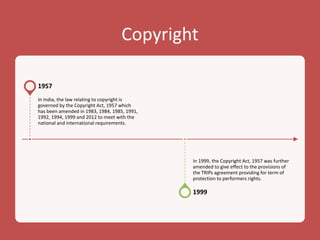
Concept
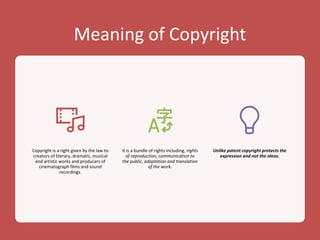
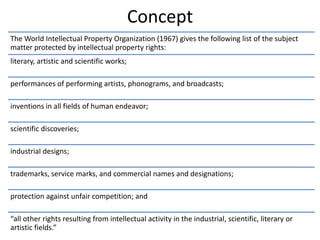
The World IntellectualProperty Organization (1967) gives the following list of the subject
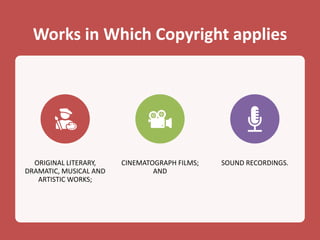
matter protected by intellectual property rights:
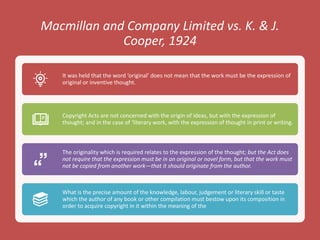
literary, artistic and scientific works;
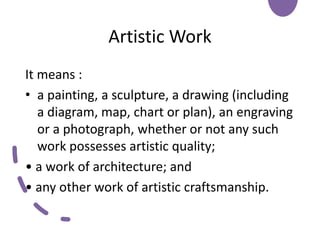
performances of performing artists, phonograms, and broadcasts;
inventions in all fields of human endeavor;
scientific discoveries;
industrial designs;
trademarks, service marks, and commercial names and designations;
protection against unfair competition; and
“all other rights resulting from intellectual activity in the industrial, scientific, literary or
artistic fields.”
6.
WHAT COUNTS ASINTELLECTUAL
PROPERTY?
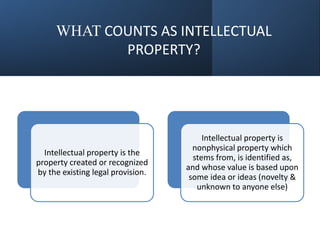
Intellectual property is the
property created or recognized
by the existing legal provision.
Intellectual property is
nonphysical property which
stems from, is identified as,
and whose value is based upon
some idea or ideas (novelty &
unknown to anyone else)
7.
WHAT COUNTS ASINTELLECTUAL
PROPERTY?
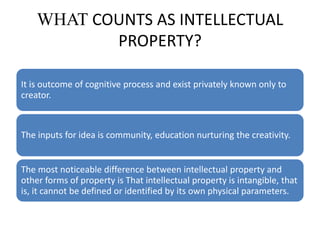
It is outcome of cognitive process and exist privately known only to
creator.
The inputs for idea is community, education nurturing the creativity.
The most noticeable difference between intellectual property and
other forms of property is That intellectual property is intangible, that
is, it cannot be defined or identified by its own physical parameters.
8.
Concept
The most noticeable
differencebetween
intellectual property and
other forms of property
is ;
That intellectual property
is intangible, that is, it
cannot be defined or
identified by its own
physical parameters.
9.
Concept
• With theestablishment of
the world trade
Organization (WTO), the
importance and role of
the intellectual property
protection has been
crystallized in the Trade -
Related Intellectual
Property Systems (TRIPS)
Agreement.
10.
Concept
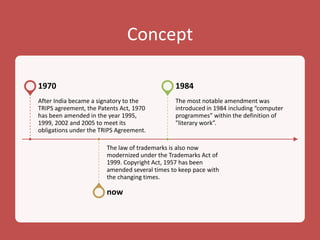
After India becamea signatory to the
TRIPS agreement, the Patents Act, 1970
has been amended in the year 1995,
1999, 2002 and 2005 to meet its
obligations under the TRIPS Agreement.
1970
The law of trademarks is also now
modernized under the Trademarks Act of
1999. Copyright Act, 1957 has been
amended several times to keep pace with
the changing times.
now
The most notable amendment was
introduced in 1984 including “computer
programmes” within the definition of
"literary work”.
1984
11.
Concept
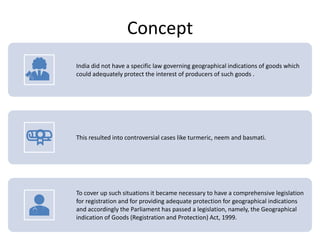
India did nothave a specific law governing geographical indications of goods which
could adequately protect the interest of producers of such goods .
This resulted into controversial cases like turmeric, neem and basmati.
To cover up such situations it became necessary to have a comprehensive legislation
for registration and for providing adequate protection for geographical indications
and accordingly the Parliament has passed a legislation, namely, the Geographical
indication of Goods (Registration and Protection) Act, 1999.
12.
Concept
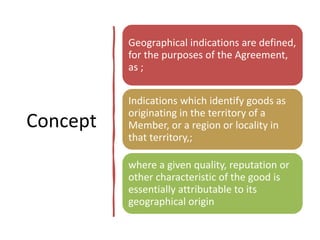
Geographical indications aredefined,
for the purposes of the Agreement,
as ;
Indications which identify goods as
originating in the territory of a
Member, or a region or locality in
that territory,;
where a given quality, reputation or
other characteristic of the good is
essentially attributable to its
geographical origin
13.
Concept
The Protection ofPlant Varieties and
Farmers’ Rights Act 2001 was
enacted in India to protect the new
plant varieties.
Strong intellectual property rights
help consumers make an educated
choice about the safety, reliability,
and effectiveness of their purchases.
Enforced intellectual property rights
ensure that products are authentic,
and of the high-quality that
consumers recognize and expect
14.
Concept of Patent
•A patent is an exclusive right granted by a
country to the owner of an invention to
make, use, manufacture and market the
invention, provided the invention
satisfies certain conditions stipulated in
the law.
• A patent is an official document given to
an inventor by the government allowing
him to exclude anyone else from
commercially exploiting his invention for
a limited period which is 20 years at
present.
15.
Patent
Act, 1970
• ThePatents Act, 1970 remained in force
for about 24 years without any change
till December 1994.
• India was put under the contractual
obligation to amend its Patents Act in
compliance with the provisions of TRIPS.
(1994,1995 &1999)
• The Agreement on Trade-Related
Aspects of Intellectual Property Rights
(TRIPS) is an international agreement
administered by the World Trade
Organization (WTO) that sets down
minimum standards for many forms of
intellectual property (IP) regulation as
applied to nationals of other WTO
Members.
• In 2002 comprehensive amendment.
16.
Duration
of Patent
• Section53 provides that the term
of every patent granted after the
commencement of the Patents
(Amendment) Act, 2002 on the
date of such commencement,
• shall be twenty years from the date
of filing of application for the
patent.
• The patentee has to pay renewal
fee according to Sec 53 of the
Indian Patent Act.
• Renewal fee or Maintenance fee is
paid every year for keeping a patent
in force for the term of paten
17.
PATENTABLE SUBJECT MATTER
Apatent is granted for an invention which may be related to any process or product.
New Invention
“New invention” is defined as any invention or technology which has not been
anticipated by publication in any document
or used in the country or elsewhere in the world before the date of filing of patent
application with complete specification;
the subject matter has not fallen in public domain or that it does not form part of the
state of the art [Section 2(1)(l);
Where, capable of industrial application, in relation to an invention, means that the
invention is capable of being made or used in an industry [Section 2(1)(ac)].
18.
PATENTABLE SUBJECT MATTER
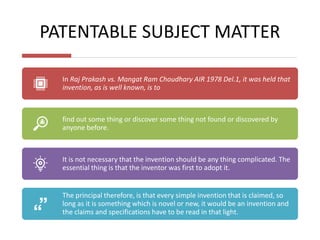
InRaj Prakash vs. Mangat Ram Choudhary AIR 1978 Del.1, it was held that
invention, as is well known, is to
find out some thing or discover some thing not found or discovered by
anyone before.
It is not necessary that the invention should be any thing complicated. The
essential thing is that the inventor was first to adopt it.
The principal therefore, is that every simple invention that is claimed, so
long as it is something which is novel or new, it would be an invention and
the claims and specifications have to be read in that light.
19.
Conditions
of
Patentability
Patent
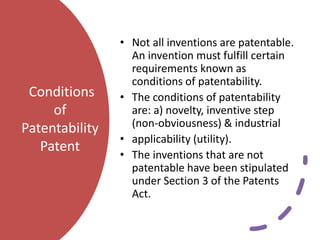
• Not allinventions are patentable.
An invention must fulfill certain
requirements known as
conditions of patentability.
• The conditions of patentability
are: a) novelty, inventive step
(non-obviousness) & industrial
• applicability (utility).
• The inventions that are not
patentable have been stipulated
under Section 3 of the Patents
Act.
20.
NOVELTY
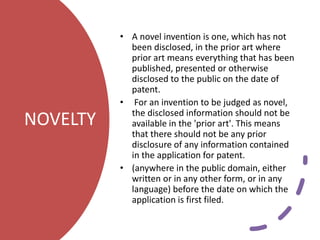
• A novelinvention is one, which has not
been disclosed, in the prior art where
prior art means everything that has been
published, presented or otherwise
disclosed to the public on the date of
patent.
• For an invention to be judged as novel,
the disclosed information should not be
available in the 'prior art'. This means
that there should not be any prior
disclosure of any information contained
in the application for patent.
• (anywhere in the public domain, either
written or in any other form, or in any
language) before the date on which the
application is first filed.
21.
NOVELTY
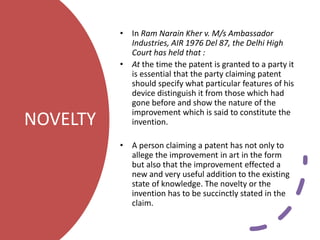
• In RamNarain Kher v. M/s Ambassador
Industries, AIR 1976 Del 87, the Delhi High
Court has held that :
• At the time the patent is granted to a party it
is essential that the party claiming patent
should specify what particular features of his
device distinguish it from those which had
gone before and show the nature of the
improvement which is said to constitute the
invention.
• A person claiming a patent has not only to
allege the improvement in art in the form
but also that the improvement effected a
new and very useful addition to the existing
state of knowledge. The novelty or the
invention has to be succinctly stated in the
claim.
22.
Application
Process of
Patent
• Applicationfor a patent for an
invention may be made
• (a) by any person claiming to be the
true and first inventor of the
invention;
• (b) by any person being the
assignee of the person claiming to
be the true and first inventor in
respect of the right to make such an
application;
• (c)by the legal representative of any
deceased
• person who immediately before his
death was entitled to make such an
application.
23.
Application
Process of
Patent
• Everyapplication for a patent
is to be made for one
invention only.
• Where the application is
made by virtue
• of an assignment of the right
to apply for a patent for the
invention,
• there shall be furnished with
the application proof of the
right to make the application.
24.
Application
Process of
Patent
• Forobtaining obtain a patent, an
applicant must fully and particularly
describe the invention claimed in a
complete specification.
• The disclosure of the invention in a
complete specification must be
such that a person skilled in the art
may be able to perform the
invention.
• This is possible only when an
applicant discloses the invention
fully and particularly including the
best method of performing the
invention.
25.
IPR
• Where anapplication for a patent has
been published but a patent has not been
granted;
• any person may in writing, represent by
way of opposition to the Controller
against the grant of patent on the
grounds stipulated therein;
• The Controller on request of such person
shall hear him and dispose of the
representation in the prescribed manner
and specified time.
26.
IPR
• If anapplication for a
patent has been found to
be in order for grant of the
patent and is not found to
be in contravention of any
of the provisions of the Act,
the patent shall be granted
as expeditiously as possible
to the applicant
27.
IPR
• The workrelating to drafting
of specifications, making of
application for a patent,
subsequent correspondence
with the Patent Office on the
objections raised,
• representing the applicant’s
case at the hearings, filing
opposition and defending
application against
opposition, is entrusted to a
qualified Patent Agent.
28.
Copyright
• Introduction
• Theidea of Copyright protection
only began to emerge with the
invention of printing, which made it
for literary works to be duplicated
by mechanical processes instead of
being copied by hand.
• This led to the grant of privileges,
by authorities and kings, entitling
beneficiaries exclusive rights of
reproduction and distribution, for
limited period, with remedies in the
form of fines, seizure, confiscation
of infringing copies and possibly
damages.
29.
Copyright
In India, thelaw relating to copyright is
governed by the Copyright Act, 1957 which
has been amended in 1983, 1984, 1985, 1991,
1992, 1994, 1999 and 2012 to meet with the
national and international requirements.
1957
In 1999, the Copyright Act, 1957 was further
amended to give effect to the provisions of
the TRIPs agreement providing for term of
protection to performers rights.
1999
30.
Meaning of Copyright
Copyrightis a right given by the law to
creators of literary, dramatic, musical
and artistic works and producers of
cinematograph films and sound
recordings.
It is a bundle of rights including, rights
of reproduction, communication to
the public, adaptation and translation
of the work.
Unlike patent copyright protects the
expression and not the ideas.
31.
Works in WhichCopyright applies
ORIGINAL LITERARY,
DRAMATIC, MUSICAL AND
ARTISTIC WORKS;
CINEMATOGRAPH FILMS;
AND
SOUND RECORDINGS.
32.
Macmillan and CompanyLimited vs. K. & J.
Cooper, 1924
It was held that the word ‘original’ does not mean that the work must be the expression of
original or inventive thought.
Copyright Acts are not concerned with the origin of ideas, but with the expression of
thought; and in the case of ‘literary work, with the expression of thought in print or writing.
The originality which is required relates to the expression of the thought; but the Act does
not require that the expression must be in an original or novel form, but that the work must
not be copied from another work—that it should originate from the author.
What is the precise amount of the knowledge, labour, judgement or literary skill or taste
which the author of any book or other compilation must bestow upon its composition in
order to acquire copyright in it within the meaning of the
33.
Artistic Work
It means:
• a painting, a sculpture, a drawing (including
a diagram, map, chart or plan), an engraving
or a photograph, whether or not any such
work possesses artistic quality;
• a work of architecture; and
• any other work of artistic craftsmanship.
34.
Copy
• A copyis one which is either a
reproduction of the original or a work
which closely resembles the original
[Challenger Knitting Mills v. Kothari
Hosery Factory 2002.
• "Cinematograph film" means any work
of visual recording on any medium
produced through a process from which
a moving image may be produced by any
means and includes a sound recording
accompanying such visual recording and
"cinematograph" shall be construed as
including any work produced by any
process analogous to cinematography
including video films.
35.
Does
performance
of acting
comes under
copyright
•The Bombay High Court in
Fortune Films International v.
Dev Anand & Another 1979
Bom.17, has held that in view
of the definitions of “artistic
work”, “dramatic work” and
cinematograph film”, it would
appear that
• the Copyright Act, 1957 does
not recognize the
performance of an actor as
‘work’ which is protected by
the Copyright Act.
36.
AUTHORSHIP
AND
OWNERSHIP
• Copyright protectsthe rights of authors.
• “Author” as per Section 2(d) of the Act
means:
o In the case of a literary or dramatic work the
author, i.e., the person who creates the work.
o In the case of a musical work, the composer.
o In the case of a cinematograph film, the
producer.
o In the case of a sound recording, the
producer.
o In the case of a photograph, the
photographer.
o In the case of any literary, dramatic, musical
or artistic work which is computer-
generated, the person who causes the work
to be created.
37.
AUTHORSHIP
AND
OWNERSHIP
• In amusical sound recording there are
many right holders. For example, the
lyricist who wrote the lyrics, the
composer who set the music, the singer
who sang the song, the musician (s) who
performed the background music, and
the person or company who produced
the sound recording.
• A sound recording generally comprises
various rights. It is necessary to obtain
the licences from each and every right
owner in the sound recording. This
would ,inter alia, include the producer of
the sound recording, the lyricist who
wrote the lyrics, and the musician who
composed the music.
38.
AUTHORSHIP AND OWNERSHIP
•In the case of a literary, dramatic or artistic
work made by the author in the course of his
employment by the proprietor of a newspaper,
magazine or similar periodical under a
contract of service or apprenticeship, for the
purpose of publication in a newspaper,
magazine or similar periodical, the said
proprietor shall, in the absence of any
agreement to the contrary, be the first owner
of the copyright
39.
Term of
Copyright
• Literary,dramatic, musical or
artistic works enjoy copyright
protection for the life time of the
author plus 60 years beyond i.e.
60 years after his death.
• In the case of joint authorship
which implies collaboration of
two or more authors in the
production of the work, the term
of copyright is to be construed as
a reference to the author who
dies last. (Essential to have
permission from all the authors.)
40.
Term of
Copyright
• Inthe case of copyright in
posthumous, anonymous and
pseudonymous works,
photographs, cinematograph
films, sound recordings,
works of Government, public
undertaking and international
organizations, the term of
protection is 60 years from
the beginning of the calendar
year next following the year
in which the work has been
first published.
41.
Term of
Copyright
• TheCopyright (Amendment) Act, 1994 has given
special right to every broadcasting organization
known as broadcast reproduction right in respect
of its broadcasts.
• This right is to be enjoyed by every broadcasting
organization for a period of twenty-five years
from the beginning of the calendar year next
following the year in which the broadcast is
made.
• In terms of Copyright (Amendment) Act, 1999 if
any performer appears or engages in any
performance, he has a special right in relation to
such performance called performers right to be
enjoyed for a period of fifty years.
42.
Copyright
Board
• Section 11of the Act provides for
the establishment of the Copyright
Board and empowers the Central
Government to constitute the same
consisting of a Chairman and not
less than two, but not more than
fourteen members.
• Chairman of the Board should be a
sitting or retired judge of the High
Court or a person qualified to be
appointed as judge of the High
Court.
• The Registrar of Copyright to act as
Secretary of the Copyright Board.
43.
Functions
of the
Copyright
Board
• 1.Settlement of disputes as to whether copies of any
literary, dramatic or artistic work or records are issued to
the public in sufficient numbers.
• 2. Settlement of disputes as to whether the term of
copyright for any work is shorter in any other country than
that provided for that work under the Act.
• 3. Settlement of disputes with respect to assignment of
copyright as dealt with in Section 19A.
• 4. Granting of compulsory licences in respect of Indian
works withheld from public.
• 5. Granting of compulsory licence to publish unpublished
Indian works.
• 6. Granting of compulsory licence to produce and publish
translation of literary and dramatic works.
• 7. Granting of compulsory licence to reproduce and publish
literary, scientific or artistic works for certain purposes.
• 8. Determination of royalties payable to the owner of
copyright.
• 9. Determination of objection lodged by any person as to
the fees charged by Performing Rights Societies.
• 10. Rectification of Register on the application of the
Registrar of Copyright or of any person aggrieved.
44.
Assignment
of Copyright
• Theowner of the copyright in an
existing work or the prospective
owner of the copyright in a future
work may assign to any person the
copyright.
• Section 18 of the Copyright Act
provides for the assignment of
copyright in an existing work as well
as future work.
• In both the cases an assignment
may be made of the copyright
either wholly or partially and
generally or subject to limitations
and that too for the whole period of
copyright or part thereof.
45.
Assignment
of Copyright
• Ifa work is done by an author
for a consideration for a
publisher, the copyright in it
would normally vest in the
publisher subject to any
contract to the contrary, as is
provided by Section 17 of the
said Act.
• Secondly as provided by
Section 18, the copyright
could be assigned, and if it is
so done it would be vested in
the purchaser.
46.
Mode of
Assignment
• Section19 of the Act provides
that an assignment of copyright
should be in writing signed by
the owner of the copyright or his
duly authorized agent.
• Mere acceptance of
remuneration or delivery of
manuscript does not constitute
an assignment of copyright.
• Oral assignment is invalid and it
is impermissible in law
47.
Registration
of Copyright
• Theregistration of the work
under the Copyright Act is
not compulsory and is not a
condition precedent for
maintaining a suit for
damages, if somebody
infringes the copyright.
48.
Moral
Rights —
Author’s
Special
Right
• Apartfrom remedies for infringement of
copyright, the Act expressly provides for
the protection of special rights of the
author known as moral rights.
• Under Section 57 of the Act an author of
copyright work can restrain or claim
damages in respect of any distortion or
mutilation of the work or any other
action in relation to the said work which
would be prejudicial to his honour or
reputation.
• These rights can be exercised even after
the assignment of the copyright. They
can be enforced by an action for breach
of contract or confidence, a suit for
defamation, or passing off, as the case
may be
49.
Rupendra
Kashyap v.
Jiwan
Publishing
House
• Itwas held that CBSE is a
public undertaking;
examination papers are
literary work made under
the direction and control of
CBSE and CBSE is the first
owner of the copyright in
the examination papers on
which examinations are
conducted by it.
50.
In another caseAllahabad high Court has held that the
copyright in the question papers set for the High School and
Intermediate examinations belongs to the paper-setters.
Since this copyright neither belonged to nor has been
assigned to the Board, the notification which declares that
‘copyright of the question papers set at the examinations
conducted by Board shall vest in the Board’ is clearly bad.
Simply by issuing a notification under the Intermediate
Education Act, the State Government could not arrogate to
itself or to the Board a right which neither of them
possessed under the law relating to copyright


![PATENTABLE SUBJECT MATTER
A patent is granted for an invention which may be related to any process or product.
New Invention
“New invention” is defined as any invention or technology which has not been
anticipated by publication in any document
or used in the country or elsewhere in the world before the date of filing of patent
application with complete specification;
the subject matter has not fallen in public domain or that it does not form part of the
state of the art [Section 2(1)(l);
Where, capable of industrial application, in relation to an invention, means that the
invention is capable of being made or used in an industry [Section 2(1)(ac)].](https://image.slidesharecdn.com/ipr-250404193336-8fb7bacc/85/Intellectual-Property-Rights-Presentation-17-320.jpg)