 The school of St Peter, at Lyons was founded about
1750 for the instruction of draftsmen employed in
preparing patterns for the silk manufacture.
 The practical draughtsman's book of industrial
design by Jacques-Eugène Armengaud was printed
in 1853
 Robert Lepper helped to establish one of the
country's first industrial design degree programs
at Carnegie Institute ofTechnology
 The first use of the term "industrial design" is often attributed
to the industrial designer Joseph Claude Sinel in 1919 (although
he himself denied this in interviews) but the discipline predates
1919 by at least a decade.
 Christopher Dresser is considered the world's first industrial
designer.
 Industrial design's origins lie in the industrialization of
consumer products.
 Deutscher Werkbund, founded in 1907 and a precursor to
the Bauhaus, was a state-sponsored effort to integrate
traditional crafts and industrial mass-production techniques, to
put Germany on a competitive footing with England and
the United States.
“Industrial design is an applied art whereby the
aesthetics and usability of mass-produced
products may be improved for marketability
and production.
The role of an Industrial Designer is to create
and execute design solutions towards problems
of form, usability, user ergonomics,
engineering, marketing, brand development
and sales.”
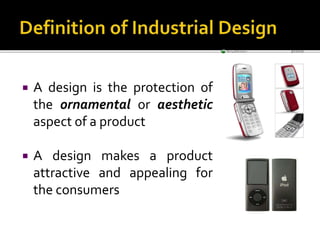
 A design is the protection of
the ornamental or aesthetic
aspect of a product
 A design makes a product
attractive and appealing for
the consumers
 Applied art to improve product:
 Aesthetics
 Usability
 create and execute design solutions
 Form,
 Ergonomics
 Engineering
 Marketing
 Brand development
 Sales
 The human aspects of machine-made
products and their relationship to people and
the environment.
 Product's human factors engineering,
 Safety,
 Form,
 Color,
 Maintenance
 Cost.
 Industrial design deals with consumer
products as well as industrial products.
 Human behavior,
 The human-machine interface,
 The environment,
 Product it self.
 Industrial Design is concerned with all the human
aspects of machine-made products and their
relationship to people and the environment.
 The designer is responsible for these products and
their impact on society and nature.
 The designer accounts for the product's human
factors engineering, safety, form, color, maintenance
and cost.
 Industrial design deals with consumer products as
well as industrial products.
 In order to achieve these ends, designers must be
involved in four major design and research activities:
 human behavior,
 the human-machine interface,
 the environment,
 and the product itself.
 Areas of design investigation include furniture,
housewares, appliances, transportation, tools, farm
equipment, medical/electronic instruments, human
interface, and recreational support equipment.”
“Industrial design (ID) is the professional service
of creating and developing concepts and
specifications that optimize the function, value
and appearance of products and systems for
the mutual benefit of both user and
manufacturer.”
What can be registered as a design?
The look of the product or part of the product
but
Not the function or idea
All kinds of products - being ugly or nice
e.g. bottles, chairs, jewellery or appliances
and
Could also be the packaging, a homepage,
the interior or setup of a shop
e.g. McDonald’s layout, Exclusive branded
shops layouts
 A right to forbid others from producing,
selling or importing the same products or
products with the same look
 25 years
 Rights cover nationally
 India's Design Act, 2000 was enacted to consolidate and
amend the law relating to protection of design and to
comply with the articles 25 and 26 ofTRIPS agreement.
 The new act, (earlier Patent and Design Act, 1911
was repealed by this act)
 now defines "design" to mean only the features of shape,
configuration, pattern, ornament, or composition of lines or
colours applied to any article, whether in two- or three-
dimensional, or in both forms, by any industrial process or
means, whether manual or mechanical or chemical, separate or
combined, which in the finished article appeal to and are judged
solely by the eye; but does not include any mode or principle of
construction.
Condition 1
Novelty
Completely new look on the market prior to filing but could
have been shown up to 12 months before filing
Condition 2
Individual character
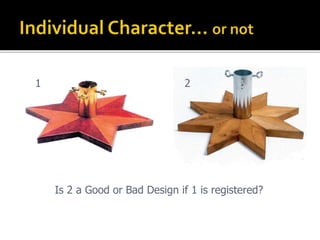
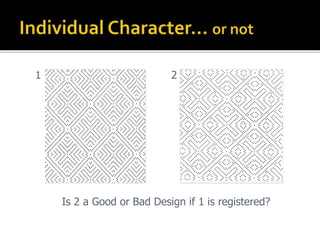
To have individual character a design:
has to differ in various ways from the designs already
known
Is 2 a Good or Bad Design if 1 is registered?
1 2
Is 2 a Good or Bad Design if 1 is registered?
1 2
 To have exclusive right
 Ban others from copying
 Certificate of ownership
 Design registration can be used in Court
 A better licens position
 Design registration gives a broader
protection than copyright
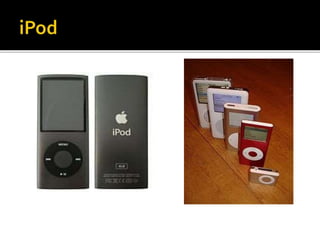
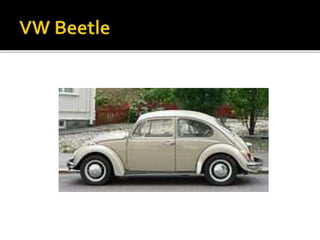
 “However, some classic industrial designs are
considered as much works of art as works of
engineering: the iPod, the Jeep, the Coke
bottle, and the VW Beetle are frequently-
cited examples.”
Industrial Design
Industrial Design

Industrial Design

  • 2.
     The schoolof St Peter, at Lyons was founded about 1750 for the instruction of draftsmen employed in preparing patterns for the silk manufacture.  The practical draughtsman's book of industrial design by Jacques-Eugène Armengaud was printed in 1853  Robert Lepper helped to establish one of the country's first industrial design degree programs at Carnegie Institute ofTechnology
  • 3.
     The firstuse of the term "industrial design" is often attributed to the industrial designer Joseph Claude Sinel in 1919 (although he himself denied this in interviews) but the discipline predates 1919 by at least a decade.  Christopher Dresser is considered the world's first industrial designer.  Industrial design's origins lie in the industrialization of consumer products.  Deutscher Werkbund, founded in 1907 and a precursor to the Bauhaus, was a state-sponsored effort to integrate traditional crafts and industrial mass-production techniques, to put Germany on a competitive footing with England and the United States.
  • 4.
    “Industrial design isan applied art whereby the aesthetics and usability of mass-produced products may be improved for marketability and production. The role of an Industrial Designer is to create and execute design solutions towards problems of form, usability, user ergonomics, engineering, marketing, brand development and sales.”
  • 5.
     A designis the protection of the ornamental or aesthetic aspect of a product  A design makes a product attractive and appealing for the consumers
  • 6.
     Applied artto improve product:  Aesthetics  Usability  create and execute design solutions  Form,  Ergonomics  Engineering  Marketing  Brand development  Sales
  • 7.
     The humanaspects of machine-made products and their relationship to people and the environment.  Product's human factors engineering,  Safety,  Form,  Color,  Maintenance  Cost.
  • 8.
     Industrial designdeals with consumer products as well as industrial products.  Human behavior,  The human-machine interface,  The environment,  Product it self.
  • 9.
     Industrial Designis concerned with all the human aspects of machine-made products and their relationship to people and the environment.  The designer is responsible for these products and their impact on society and nature.  The designer accounts for the product's human factors engineering, safety, form, color, maintenance and cost.  Industrial design deals with consumer products as well as industrial products.
  • 10.
     In orderto achieve these ends, designers must be involved in four major design and research activities:  human behavior,  the human-machine interface,  the environment,  and the product itself.  Areas of design investigation include furniture, housewares, appliances, transportation, tools, farm equipment, medical/electronic instruments, human interface, and recreational support equipment.”
  • 11.
    “Industrial design (ID)is the professional service of creating and developing concepts and specifications that optimize the function, value and appearance of products and systems for the mutual benefit of both user and manufacturer.”
  • 12.
    What can beregistered as a design? The look of the product or part of the product but Not the function or idea
  • 13.
    All kinds ofproducts - being ugly or nice e.g. bottles, chairs, jewellery or appliances and Could also be the packaging, a homepage, the interior or setup of a shop e.g. McDonald’s layout, Exclusive branded shops layouts
  • 14.
     A rightto forbid others from producing, selling or importing the same products or products with the same look  25 years  Rights cover nationally
  • 15.
     India's DesignAct, 2000 was enacted to consolidate and amend the law relating to protection of design and to comply with the articles 25 and 26 ofTRIPS agreement.  The new act, (earlier Patent and Design Act, 1911 was repealed by this act)  now defines "design" to mean only the features of shape, configuration, pattern, ornament, or composition of lines or colours applied to any article, whether in two- or three- dimensional, or in both forms, by any industrial process or means, whether manual or mechanical or chemical, separate or combined, which in the finished article appeal to and are judged solely by the eye; but does not include any mode or principle of construction.
  • 16.
    Condition 1 Novelty Completely newlook on the market prior to filing but could have been shown up to 12 months before filing
  • 17.
    Condition 2 Individual character Tohave individual character a design: has to differ in various ways from the designs already known
  • 18.
    Is 2 aGood or Bad Design if 1 is registered? 1 2
  • 19.
    Is 2 aGood or Bad Design if 1 is registered? 1 2
  • 20.
     To haveexclusive right  Ban others from copying  Certificate of ownership  Design registration can be used in Court  A better licens position  Design registration gives a broader protection than copyright
  • 21.
     “However, someclassic industrial designs are considered as much works of art as works of engineering: the iPod, the Jeep, the Coke bottle, and the VW Beetle are frequently- cited examples.”