I B
A  RB
Tracy Heath
Ecology, Evolution, & Organismal Biology
Iowa State University
@trayc7
http://phyloworks.org
2017 Workshop on Molecular Evolution
Woods Hole, MA
O
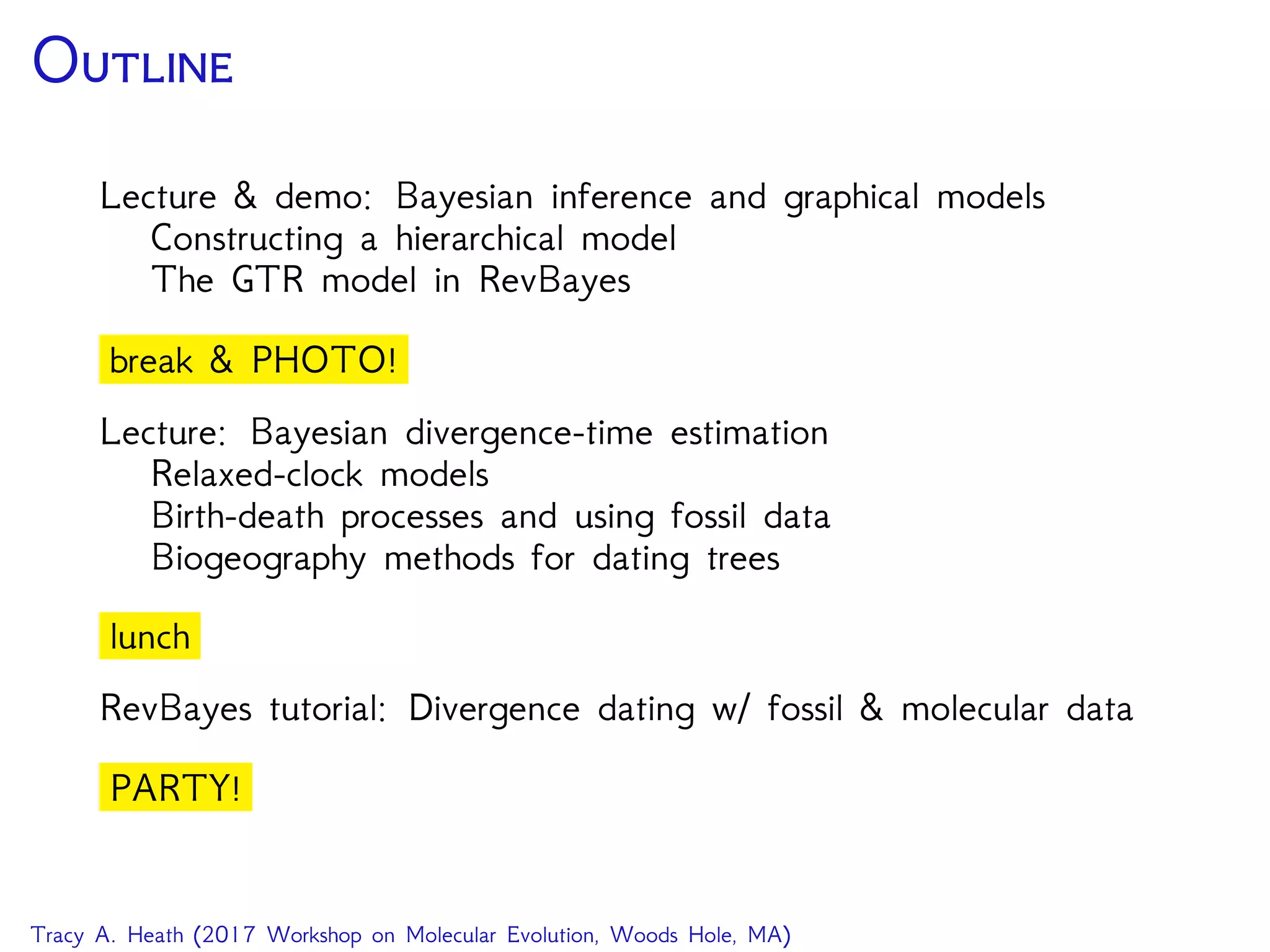
Lecture & demo: Bayesian inference and graphical models
Constructing a hierarchical model
The GTR model in RevBayes
break & PHOTO!
Lecture: Bayesian divergence-time estimation
Relaxed-clock models
Birth-death processes and using fossil data
Biogeography methods for dating trees
lunch
RevBayes tutorial: Divergence dating w/ fossil & molecular data
PARTY!
Tracy A. Heath (2017 Workshop on Molecular Evolution, Woods Hole, MA)
A P
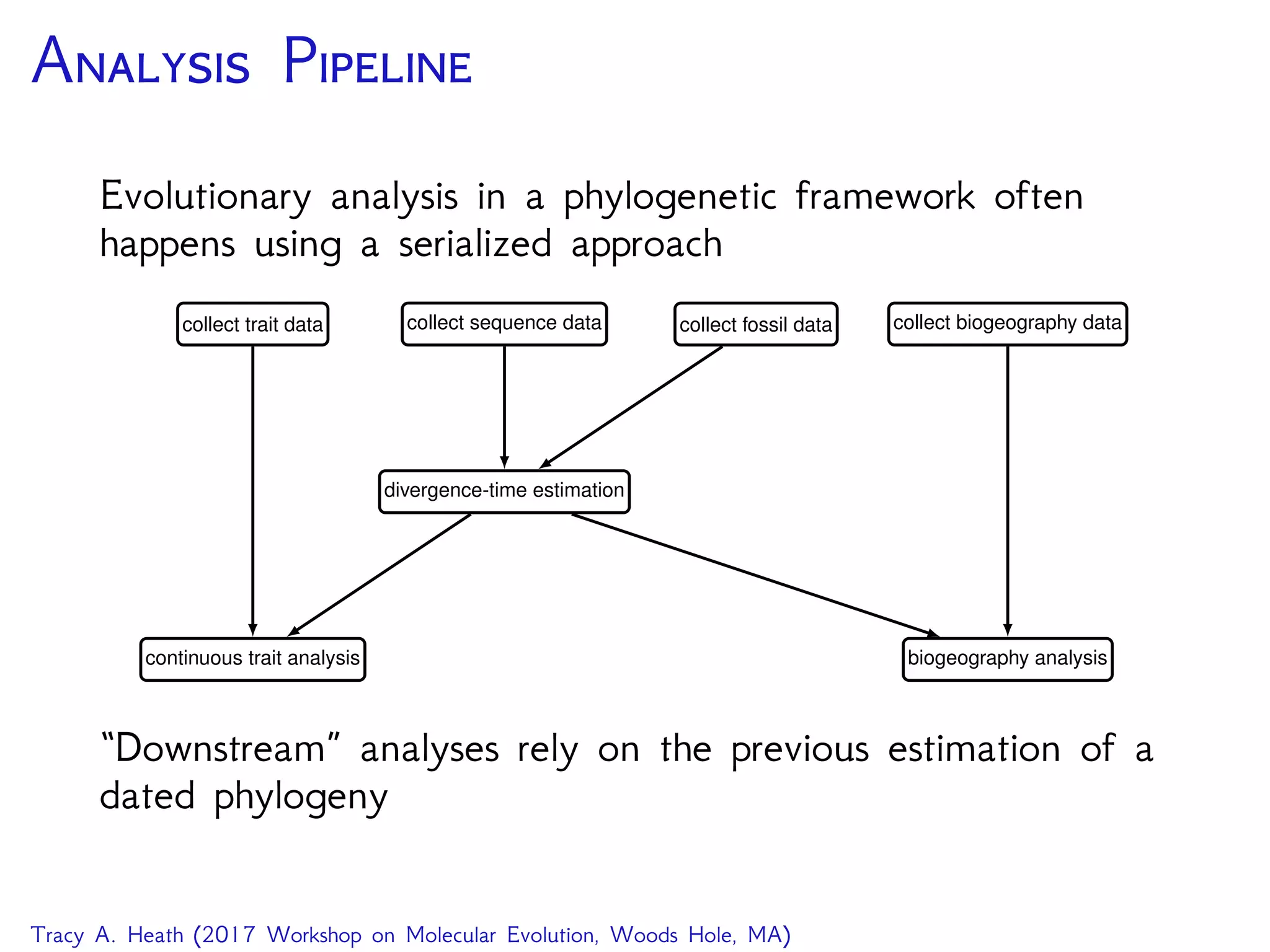
Evolutionary analysis in a phylogenetic framework often
happens using a serialized approach
collect sequence data collect fossil datacollect trait data collect biogeography data
divergence-time estimation
continuous trait analysis biogeography analysis
“Downstream” analyses rely on the previous estimation of a
dated phylogeny
Tracy A. Heath (2017 Workshop on Molecular Evolution, Woods Hole, MA)
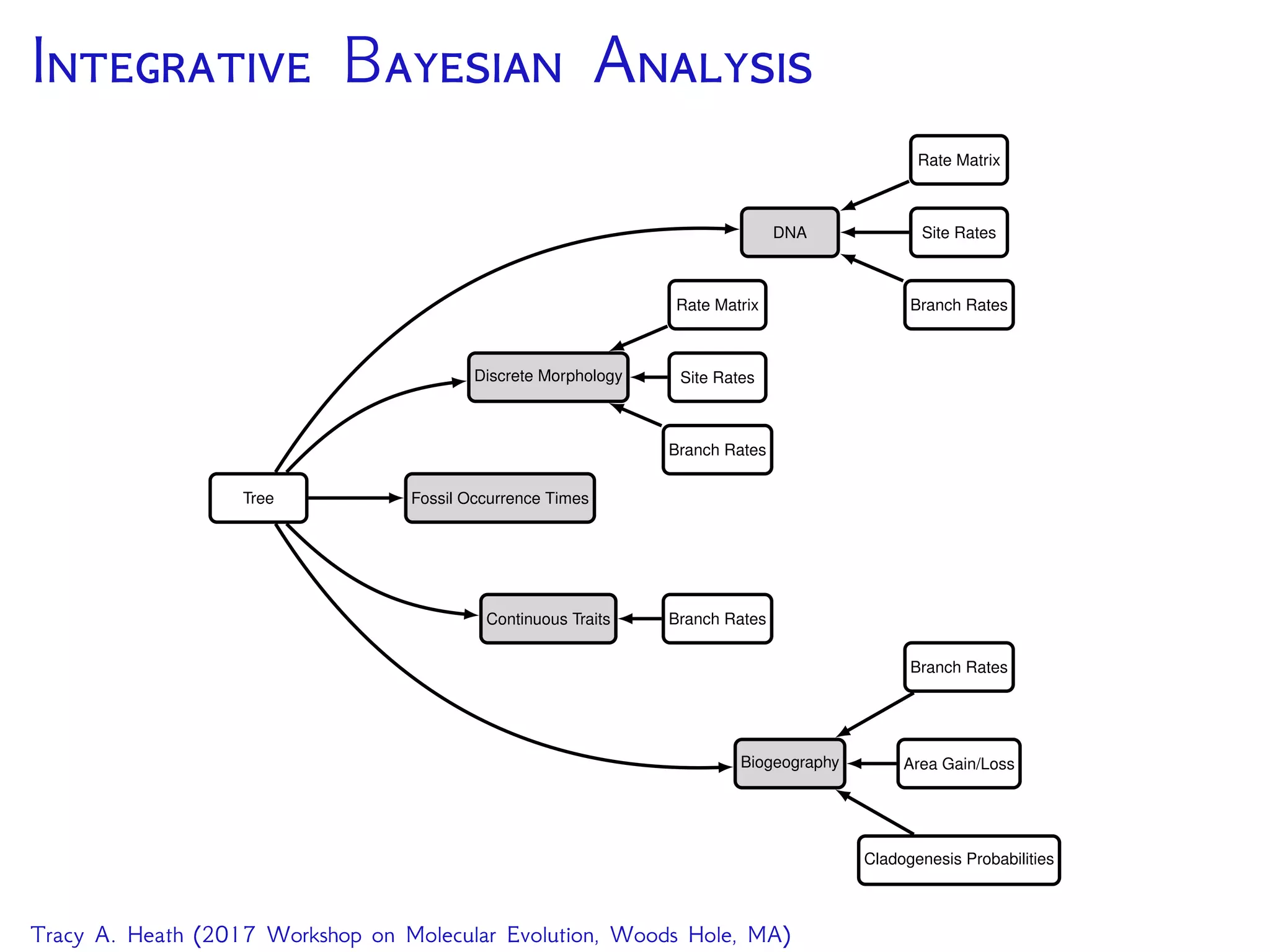
I B A
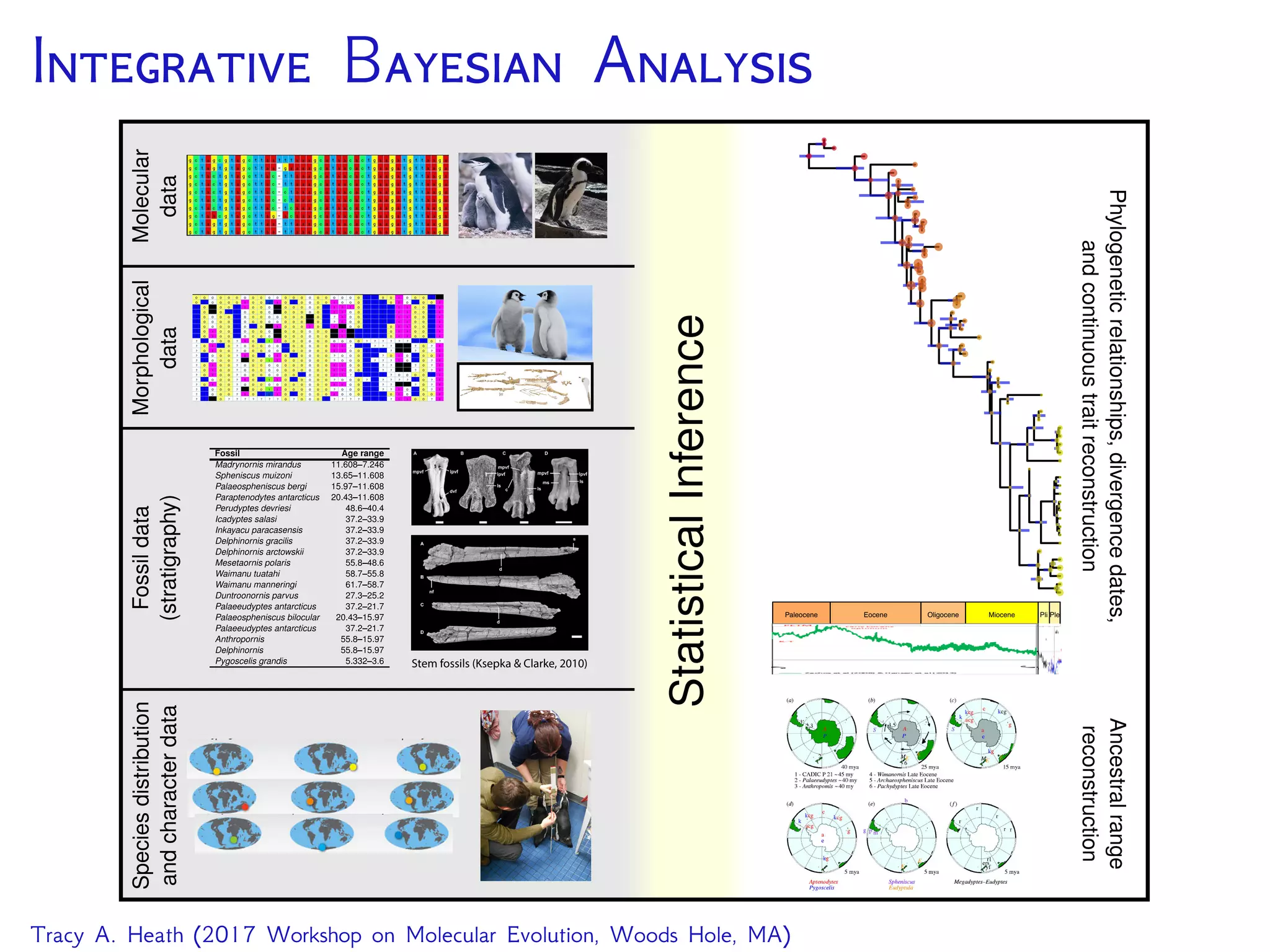
Paleocene Eocene Oligocene Miocene Pli Ple
Stem fossils (Ksepka & Clarke, 2010)
Tracy A. Heath (2017 Workshop on Molecular Evolution, Woods Hole, MA)
I B A
Tracy A. Heath (2017 Workshop on Molecular Evolution, Woods Hole, MA)
C  H M
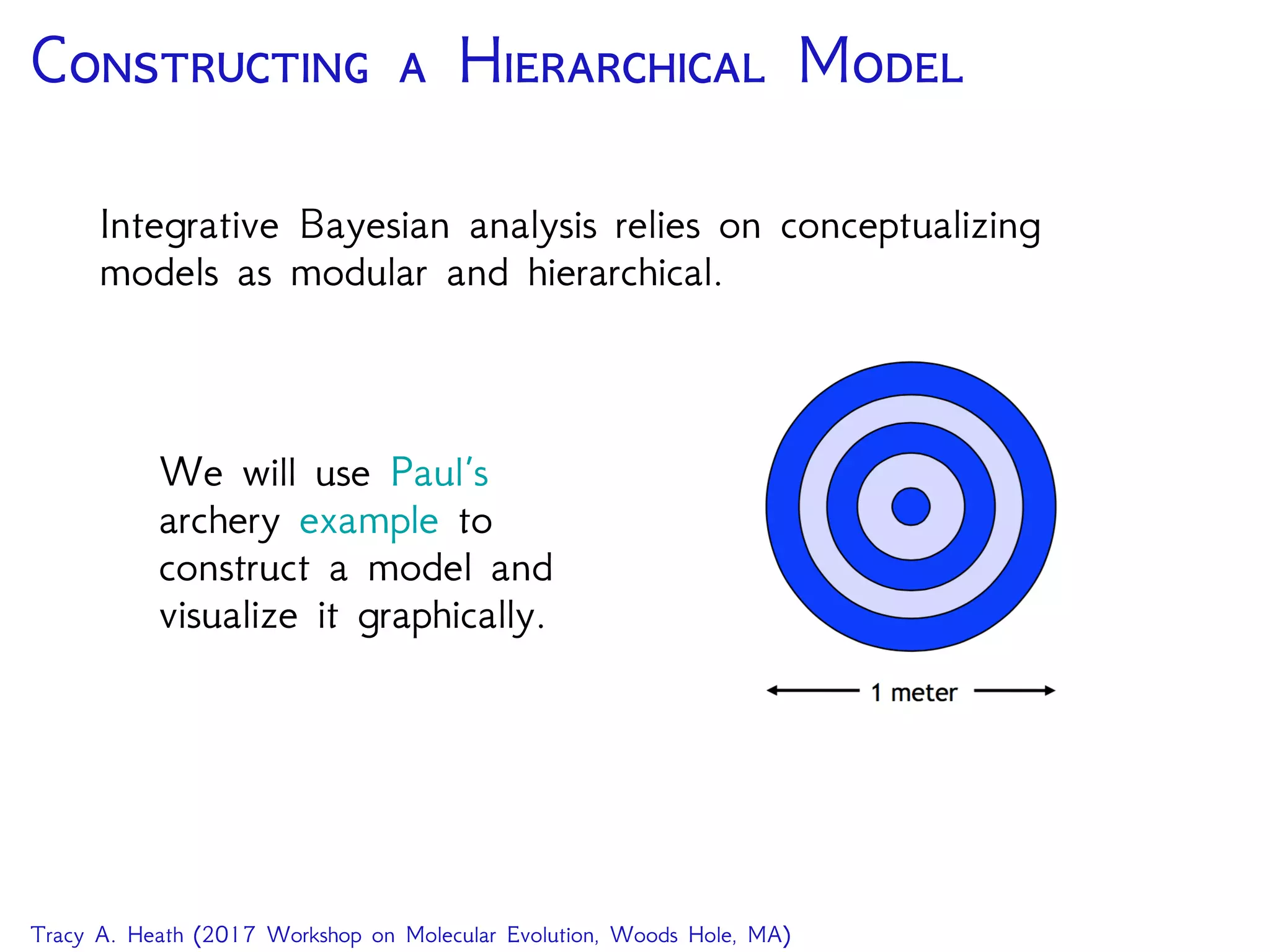
Integrative Bayesian analysis relies on conceptualizing
models as modular and hierarchical.
We will use Paul’s
archery example to
construct a model and
visualize it graphically.
Tracy A. Heath (2017 Workshop on Molecular Evolution, Woods Hole, MA)
P: A E
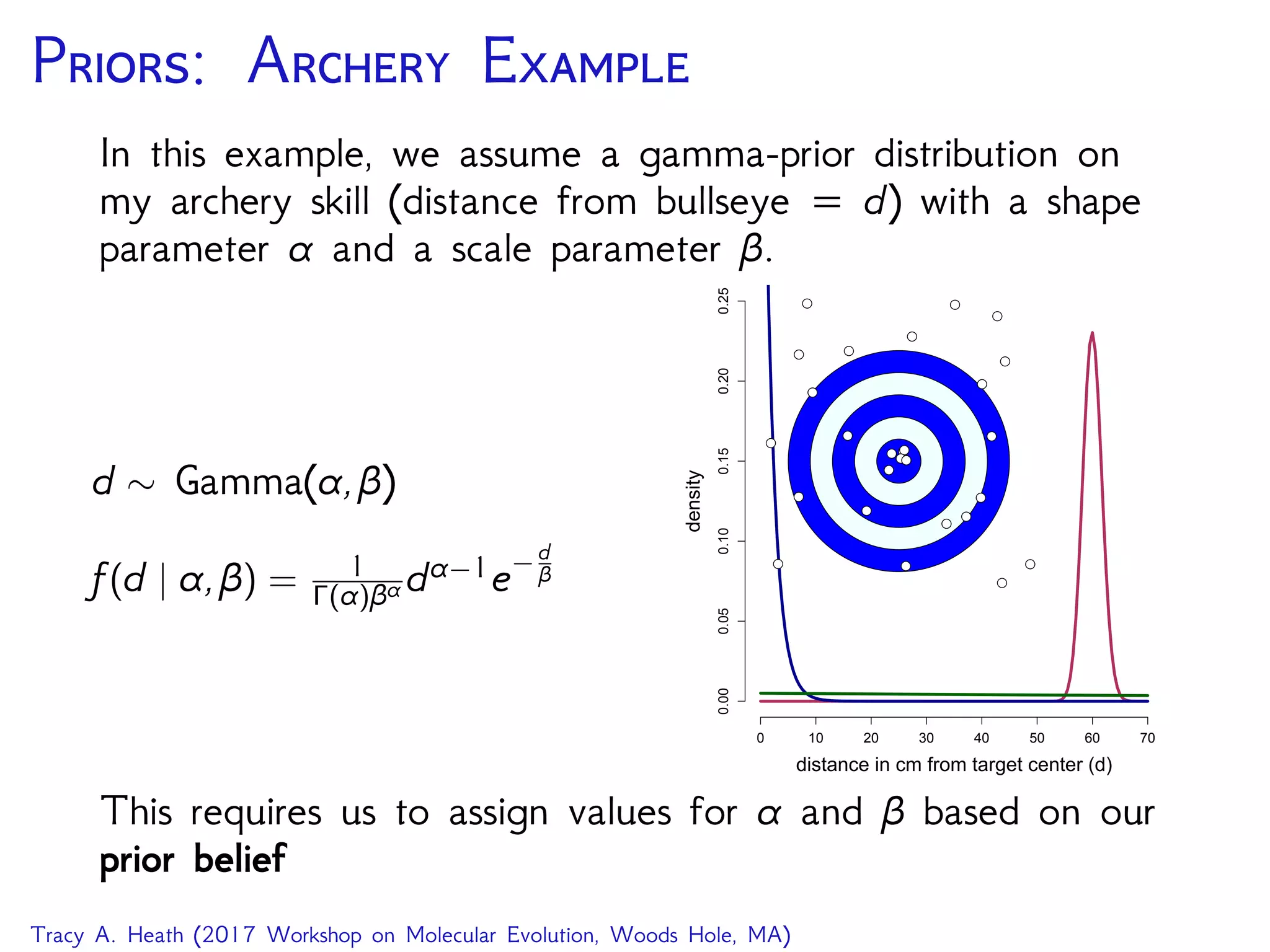
In this example, we assume a gamma-prior distribution on
my archery skill (distance from bullseye d) with a shape
parameter α and a scale parameter β.
d ∼ Gamma(α,β)
f(d | α,β) = 1
Γ(α)βα dα−1e− d
β
0 10 20 30 40 50 60 70
0.000.050.100.150.200.25
distance in cm from target center (d)
density
q
q
q
q
q
q
q
q
q
q
q
q q
q
q
q
q
q
q
q
q
qqq
q
qq
This requires us to assign values for α and β based on our
prior belief
Tracy A. Heath (2017 Workshop on Molecular Evolution, Woods Hole, MA)
P: A E
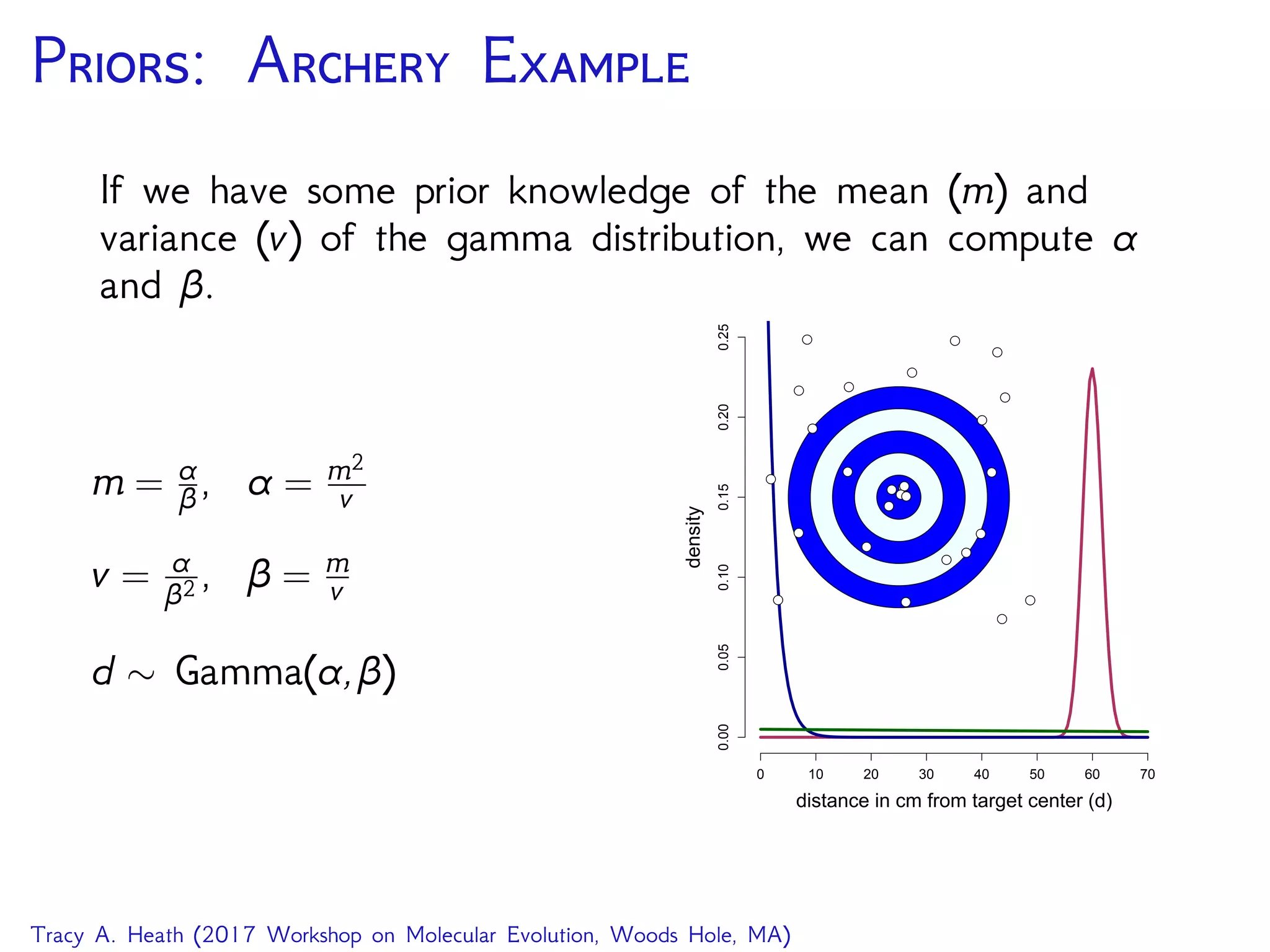
If we have some prior knowledge of the mean (m) and
variance (v) of the gamma distribution, we can compute α
and β.
m = α
β, α = m2
v
v = α
β2 , β = m
v
d ∼ Gamma(α,β)
0 10 20 30 40 50 60 70
0.000.050.100.150.200.25
distance in cm from target center (d)
density
q
q
q
q
q
q
q
q
q
q
q
q q
q
q
q
q
q
q
q
q
qqq
q
qq
Tracy A. Heath (2017 Workshop on Molecular Evolution, Woods Hole, MA)
P: A E
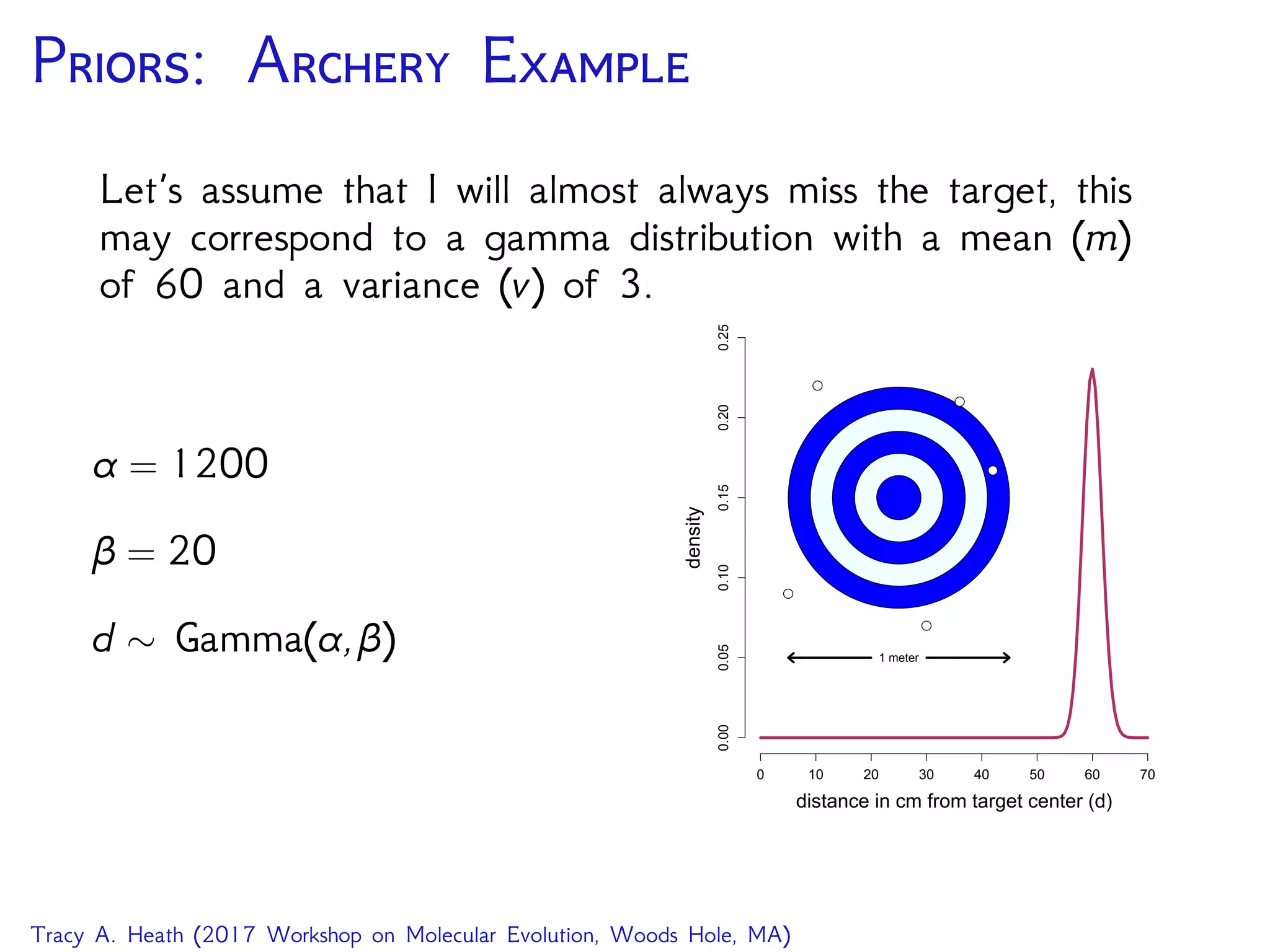
Let’s assume that I will almost always miss the target, this
may correspond to a gamma distribution with a mean (m)
of 60 and a variance (v) of 3.
α = 1200
β = 20
d ∼ Gamma(α,β)
0 10 20 30 40 50 60 70
0.000.050.100.150.200.25
distance in cm from target center (d)
density
1 meter
q
q
q
q
q
Tracy A. Heath (2017 Workshop on Molecular Evolution, Woods Hole, MA)
P: A E
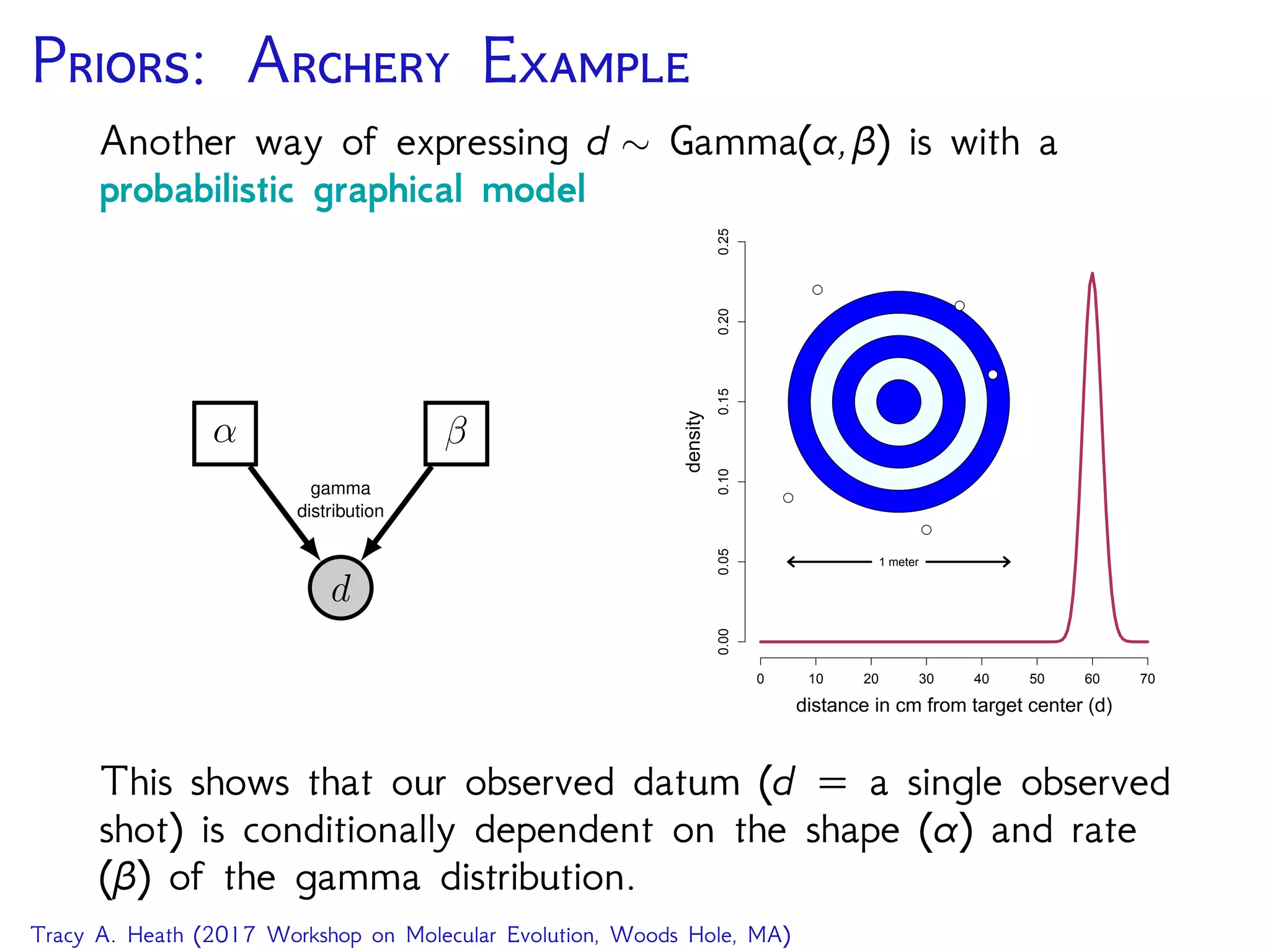
Another way of expressing d ∼ Gamma(α,β) is with a
probabilistic graphical model
d
α β
gamma
distribution
0 10 20 30 40 50 60 70
0.000.050.100.150.200.25
distance in cm from target center (d)
density
1 meter
q
q
q
q
q
This shows that our observed datum (d a single observed
shot) is conditionally dependent on the shape (α) and rate
(β) of the gamma distribution.
Tracy A. Heath (2017 Workshop on Molecular Evolution, Woods Hole, MA)
P: A E
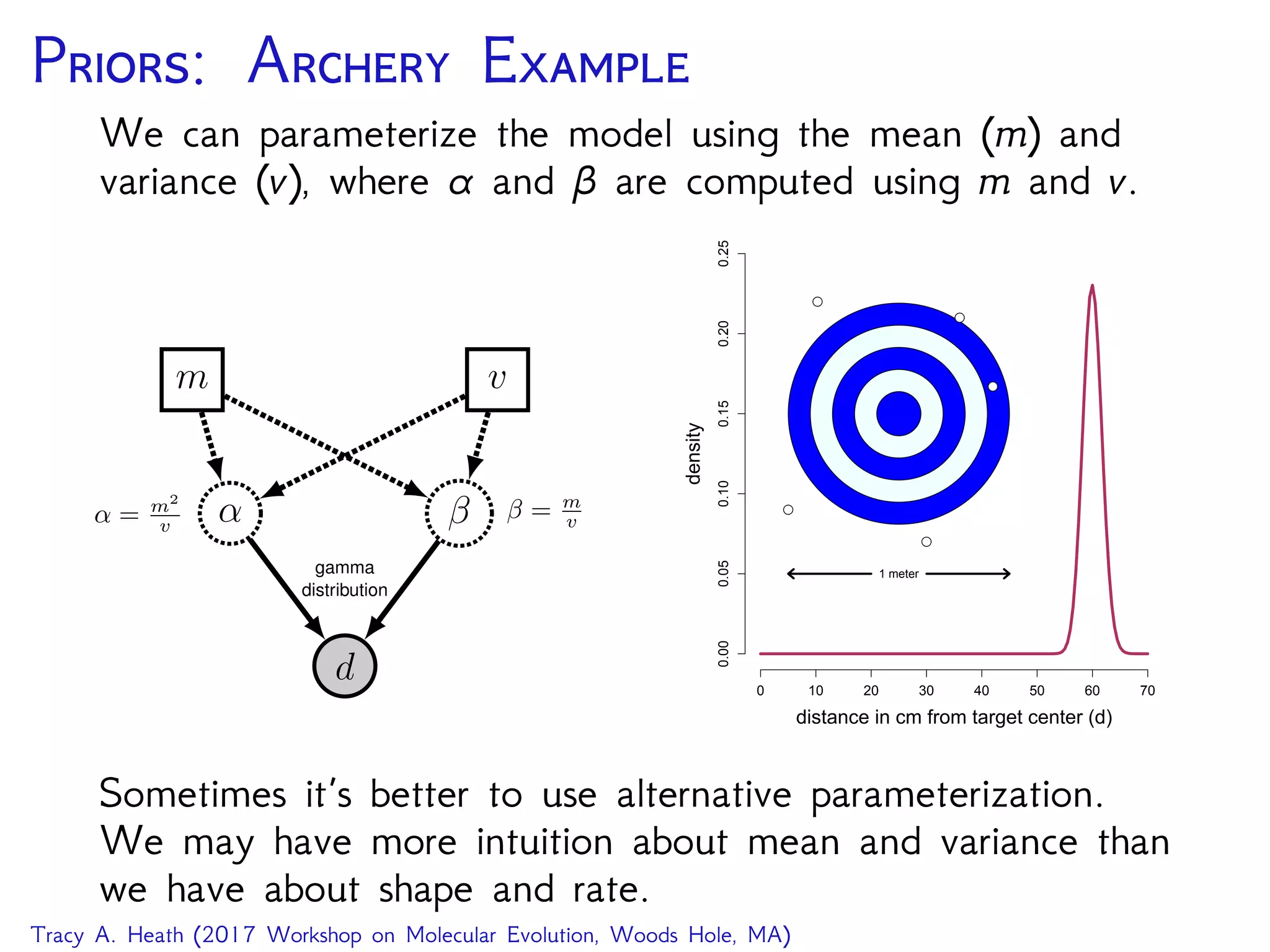
We can parameterize the model using the mean (m) and
variance (v), where α and β are computed using m and v.
d
α β
gamma
distribution
m v
β = m
vα = m2
v
0 10 20 30 40 50 60 70
0.000.050.100.150.200.25 distance in cm from target center (d)
density
1 meter
q
q
q
q
q
Sometimes it’s better to use alternative parameterization.
We may have more intuition about mean and variance than
we have about shape and rate.
Tracy A. Heath (2017 Workshop on Molecular Evolution, Woods Hole, MA)
P G M
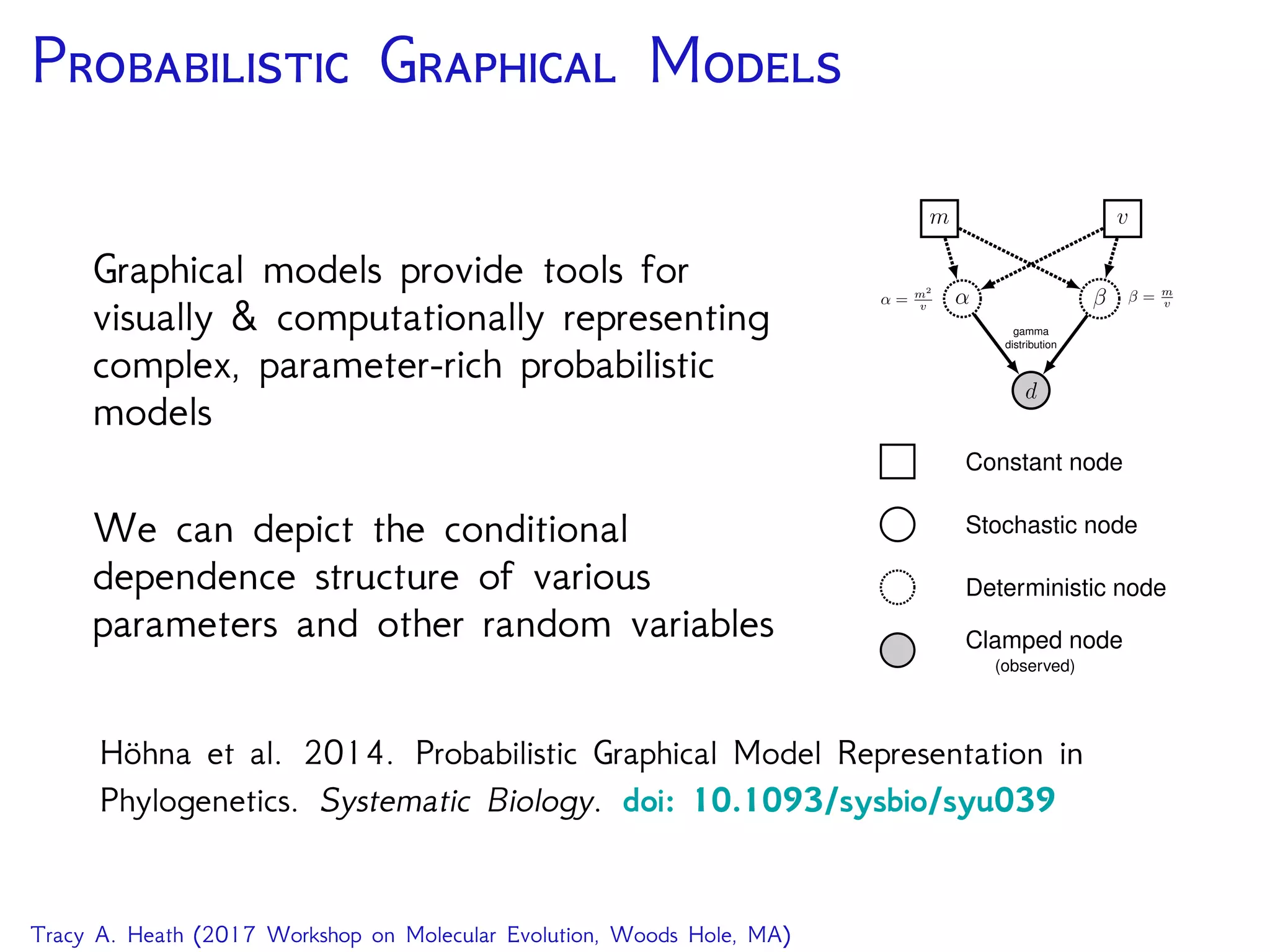
Graphical models provide tools for
visually & computationally representing
complex, parameter-rich probabilistic
models
We can depict the conditional
dependence structure of various
parameters and other random variables
d
α β
gamma
distribution
m v
β = m
vα = m2
v
Clamped node
(observed)
Deterministic node
Stochastic node
Constant node
Höhna et al. 2014. Probabilistic Graphical Model Representation in
Phylogenetics. Systematic Biology. doi: 10.1093/sysbio/syu039
Tracy A. Heath (2017 Workshop on Molecular Evolution, Woods Hole, MA)
P: A E
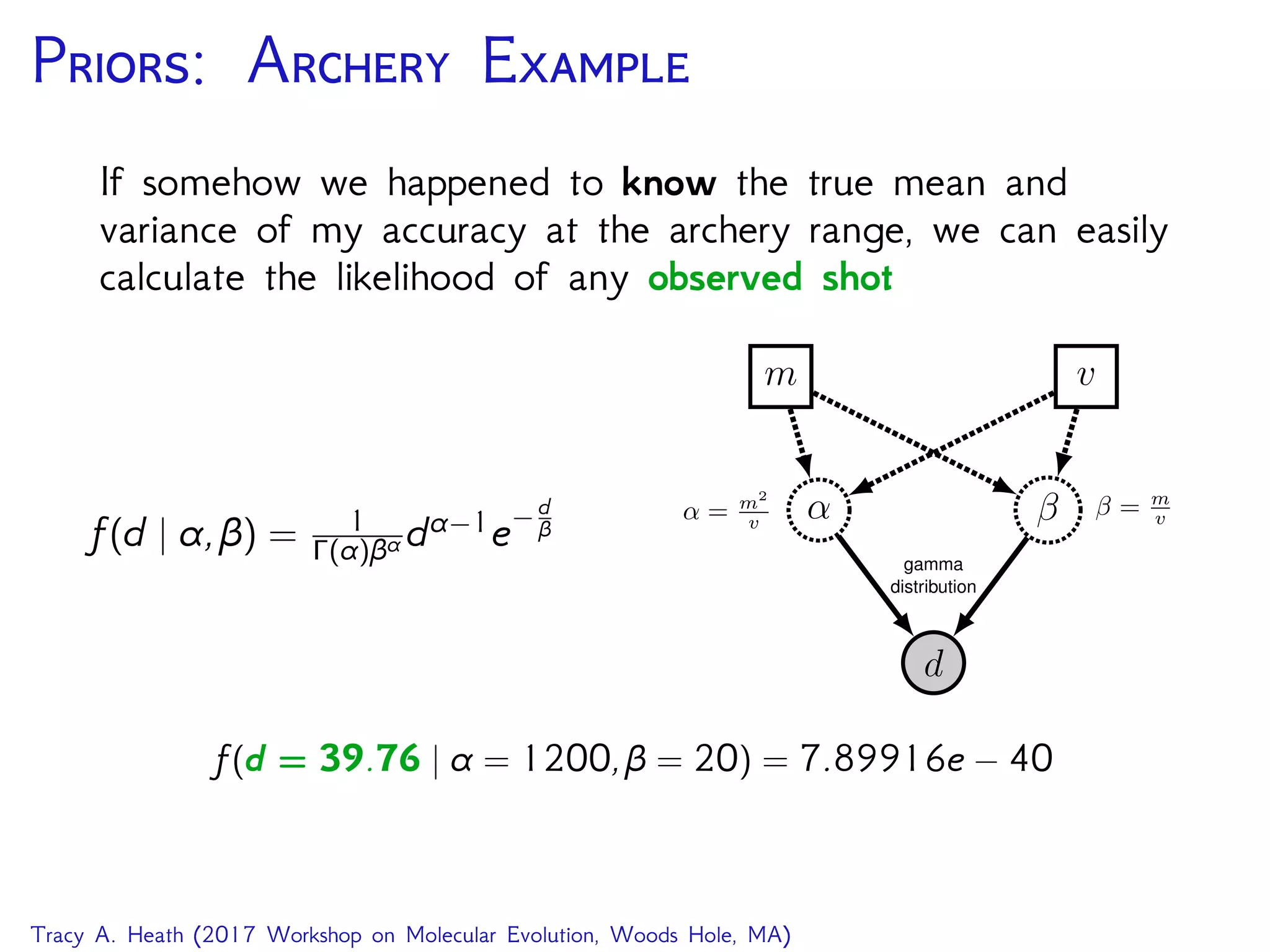
If somehow we happened to know the true mean and
variance of my accuracy at the archery range, we can easily
calculate the likelihood of any observed shot
f(d | α,β) = 1
Γ(α)βα dα−1e− d
β
d
α β
gamma
distribution
m v
β = m
vα = m2
v
f(d = 39.76 | α = 1200,β = 20) = 7.89916e − 40
Tracy A. Heath (2017 Workshop on Molecular Evolution, Woods Hole, MA)
RB D: A A
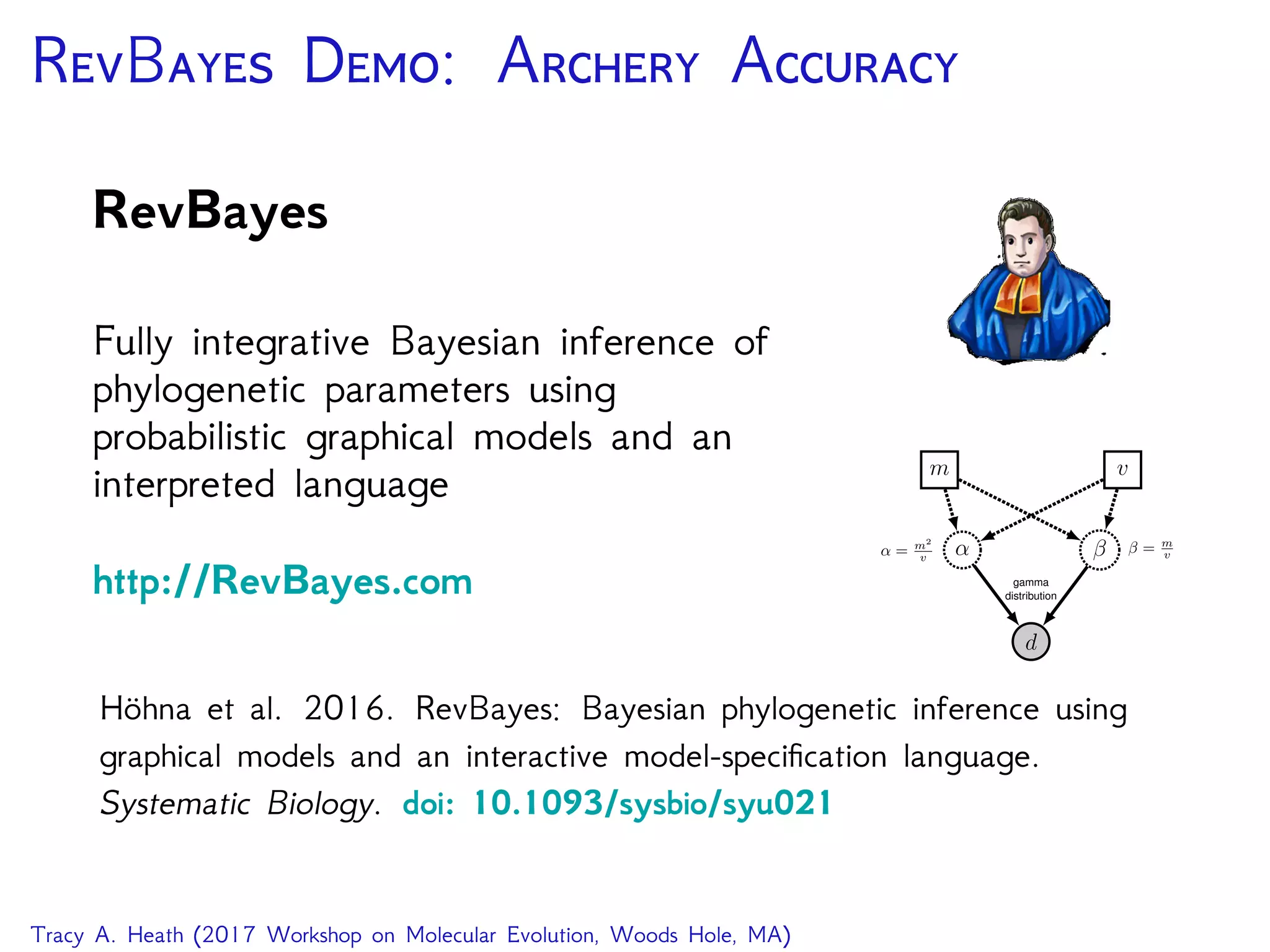
RevBayes
Fully integrative Bayesian inference of
phylogenetic parameters using
probabilistic graphical models and an
interpreted language
http://RevBayes.com
d
α β
gamma
distribution
m v
β = m
vα = m2
v
Höhna et al. 2016. RevBayes: Bayesian phylogenetic inference using
graphical models and an interactive model-specification language.
Systematic Biology. doi: 10.1093/sysbio/syu021
Tracy A. Heath (2017 Workshop on Molecular Evolution, Woods Hole, MA)
RB D: M  A S
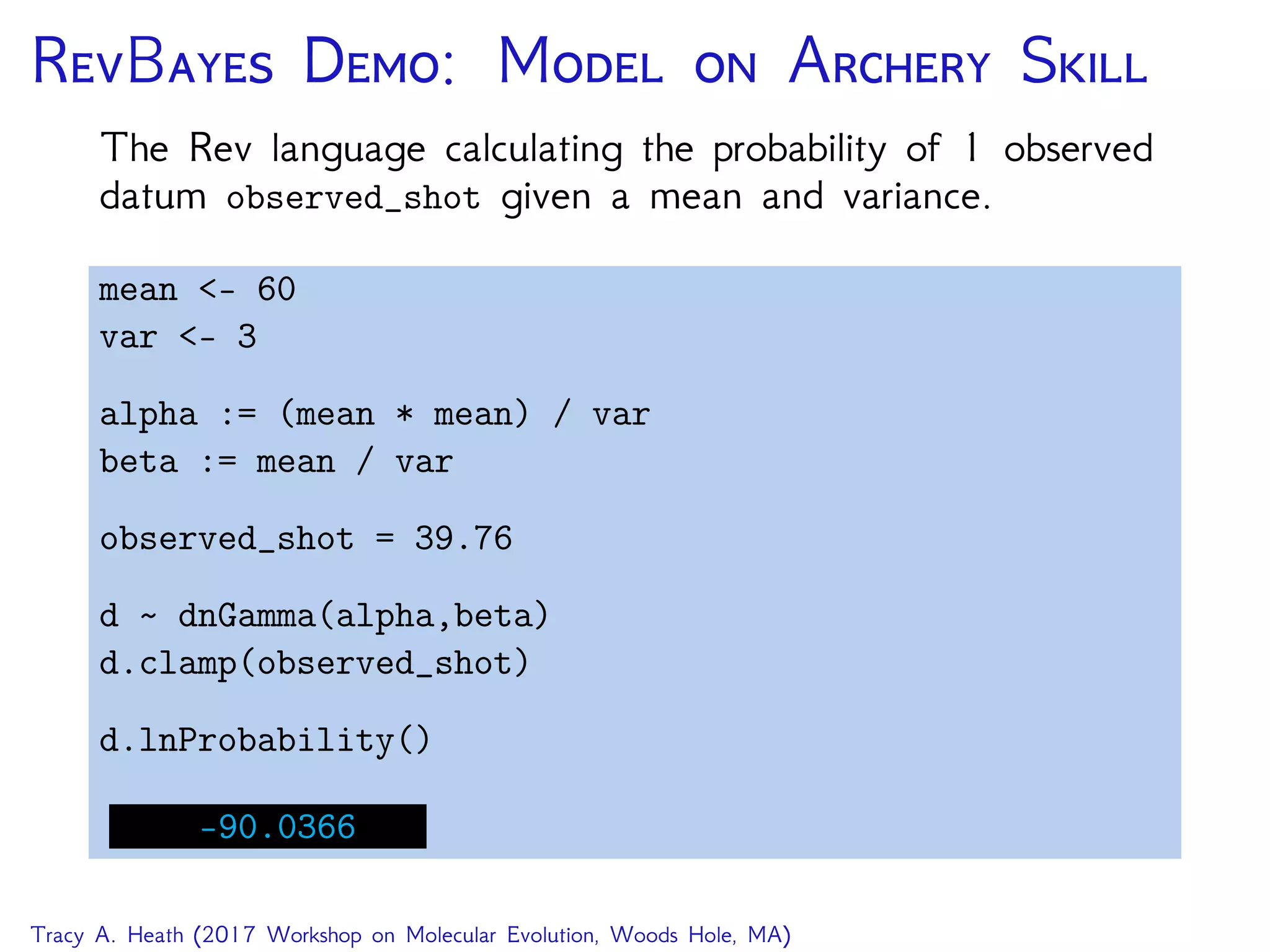
The Rev language calculating the probability of 1 observed
datum observed_shot given a mean and variance.
mean <- 60
var <- 3
alpha := (mean * mean) / var
beta := mean / var
observed_shot = 39.76
d dnGamma(alpha,beta)
d.clamp(observed_shot)
d.lnProbability()
-90.0366
Tracy A. Heath (2017 Workshop on Molecular Evolution, Woods Hole, MA)
E: M  A S
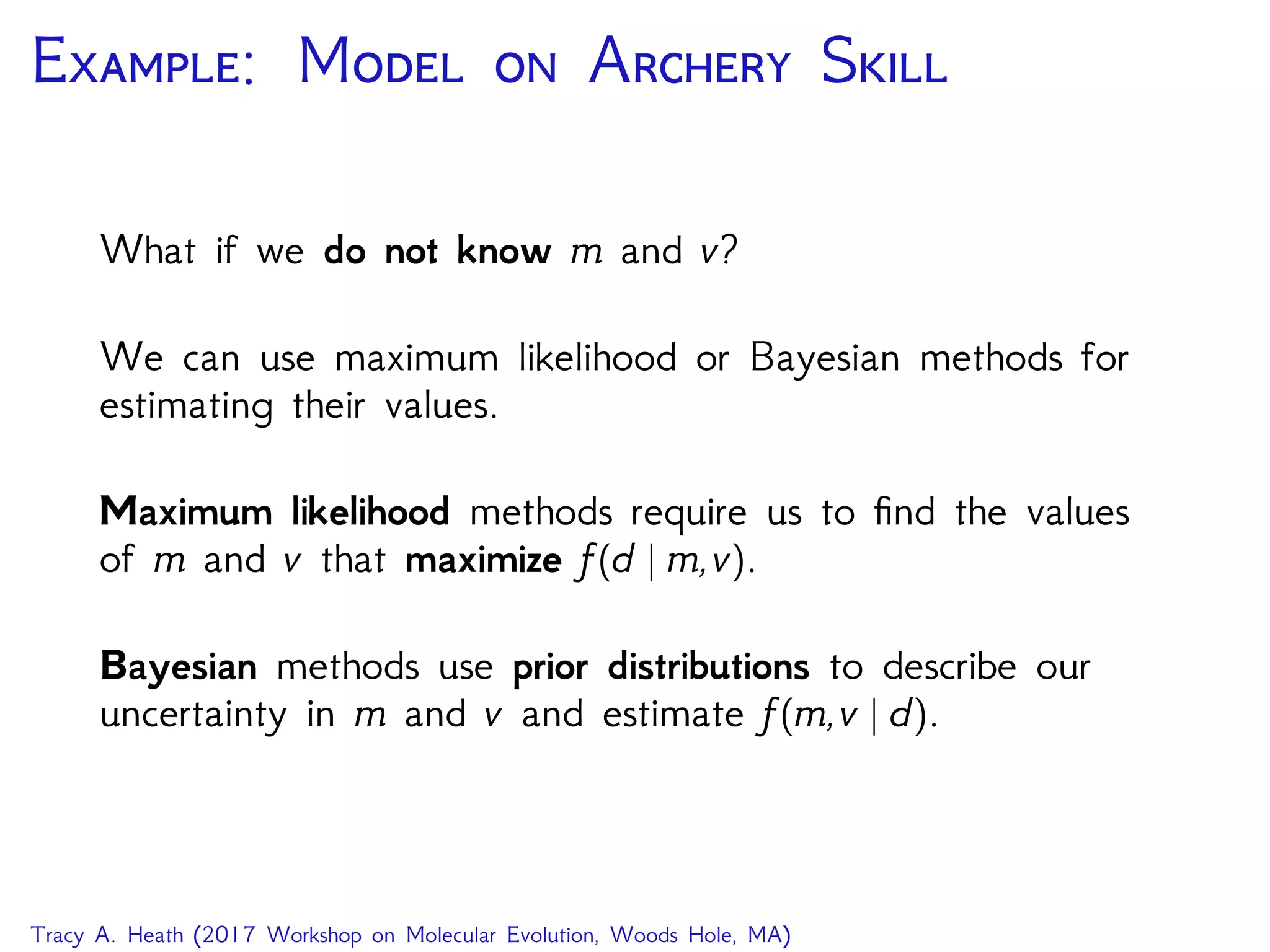
What if we do not know m and v?
We can use maximum likelihood or Bayesian methods for
estimating their values.
Maximum likelihood methods require us to find the values
of m and v that maximize f(d | m,v).
Bayesian methods use prior distributions to describe our
uncertainty in m and v and estimate f(m,v | d).
Tracy A. Heath (2017 Workshop on Molecular Evolution, Woods Hole, MA)
E: H A M
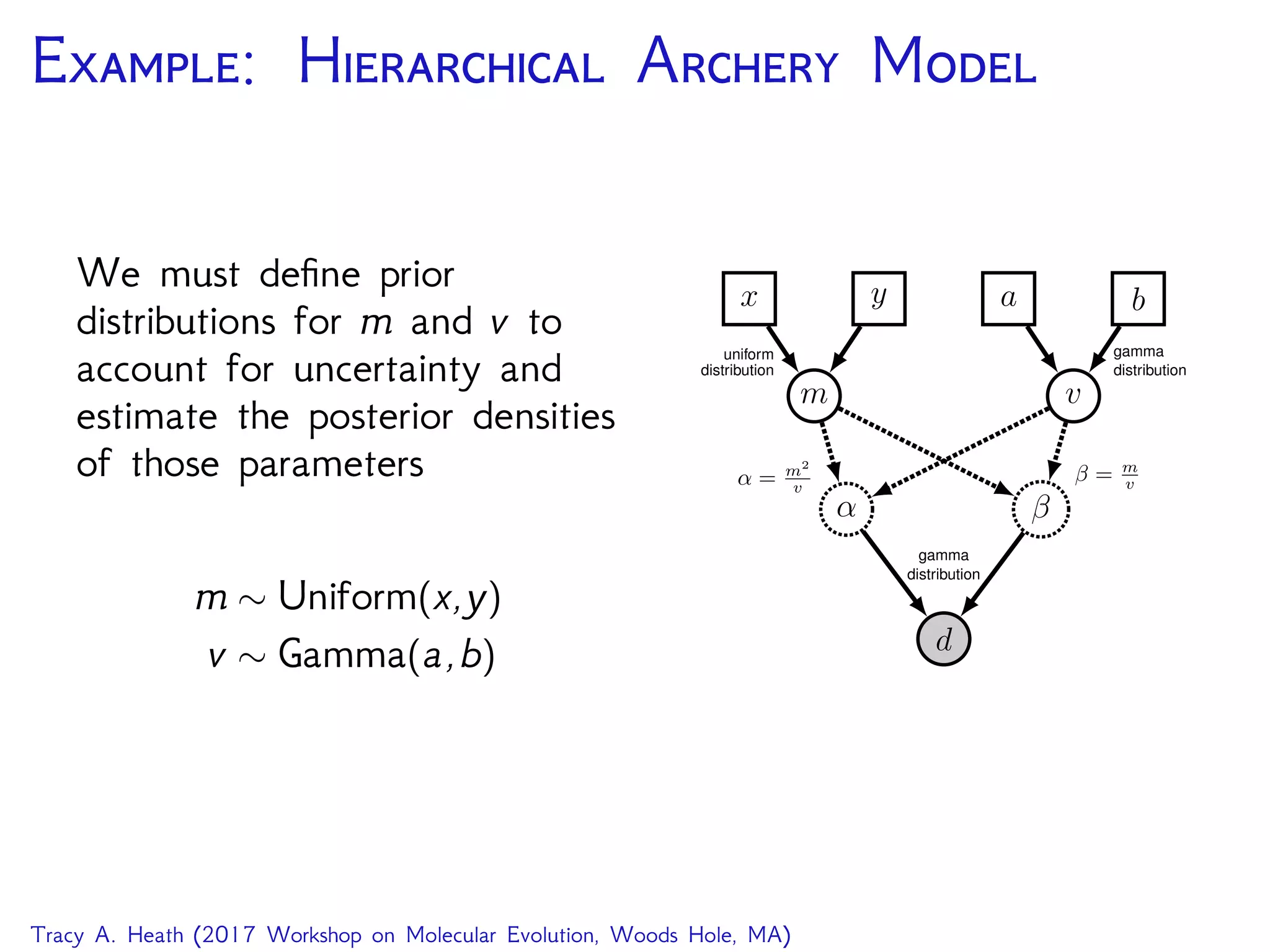
We must define prior
distributions for m and v to
account for uncertainty and
estimate the posterior densities
of those parameters
m ∼ Uniform(x,y)
v ∼ Gamma(a,b) d
α β
gamma
distribution
m v
β = m
vα = m2
v
x y a b
uniform
distribution
gamma
distribution
Tracy A. Heath (2017 Workshop on Molecular Evolution, Woods Hole, MA)
E: H A M
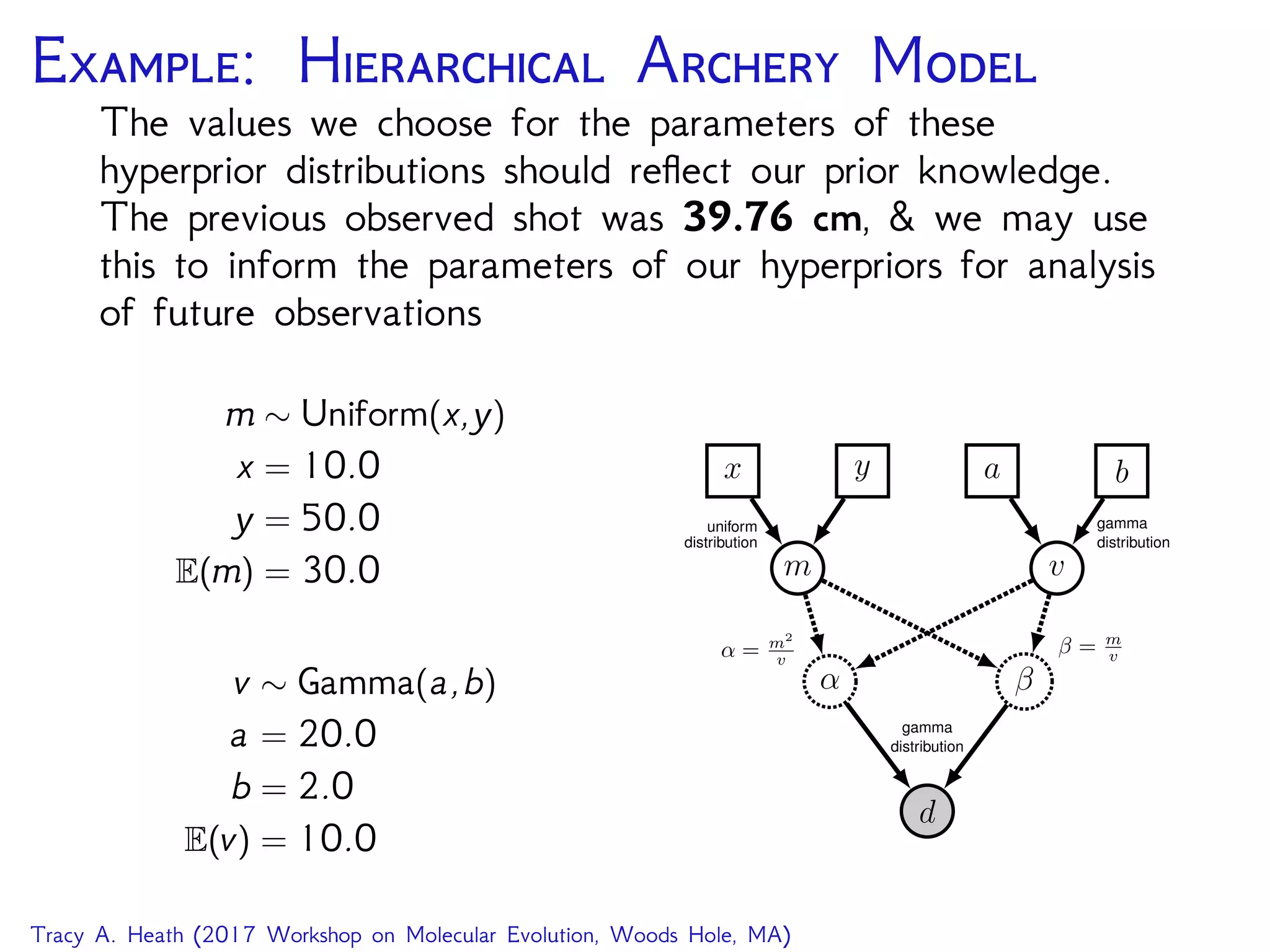
The values we choose for the parameters of these
hyperprior distributions should reflect our prior knowledge.
The previous observed shot was 39.76 cm, & we may use
this to inform the parameters of our hyperpriors for analysis
of future observations
m ∼ Uniform(x,y)
x = 10.0
y = 50.0
E(m) = 30.0
v ∼ Gamma(a,b)
a = 20.0
b = 2.0
E(v) = 10.0
d
α β
gamma
distribution
m v
β = m
vα = m2
v
x y a b
uniform
distribution
gamma
distribution
Tracy A. Heath (2017 Workshop on Molecular Evolution, Woods Hole, MA)
RB D: H A M
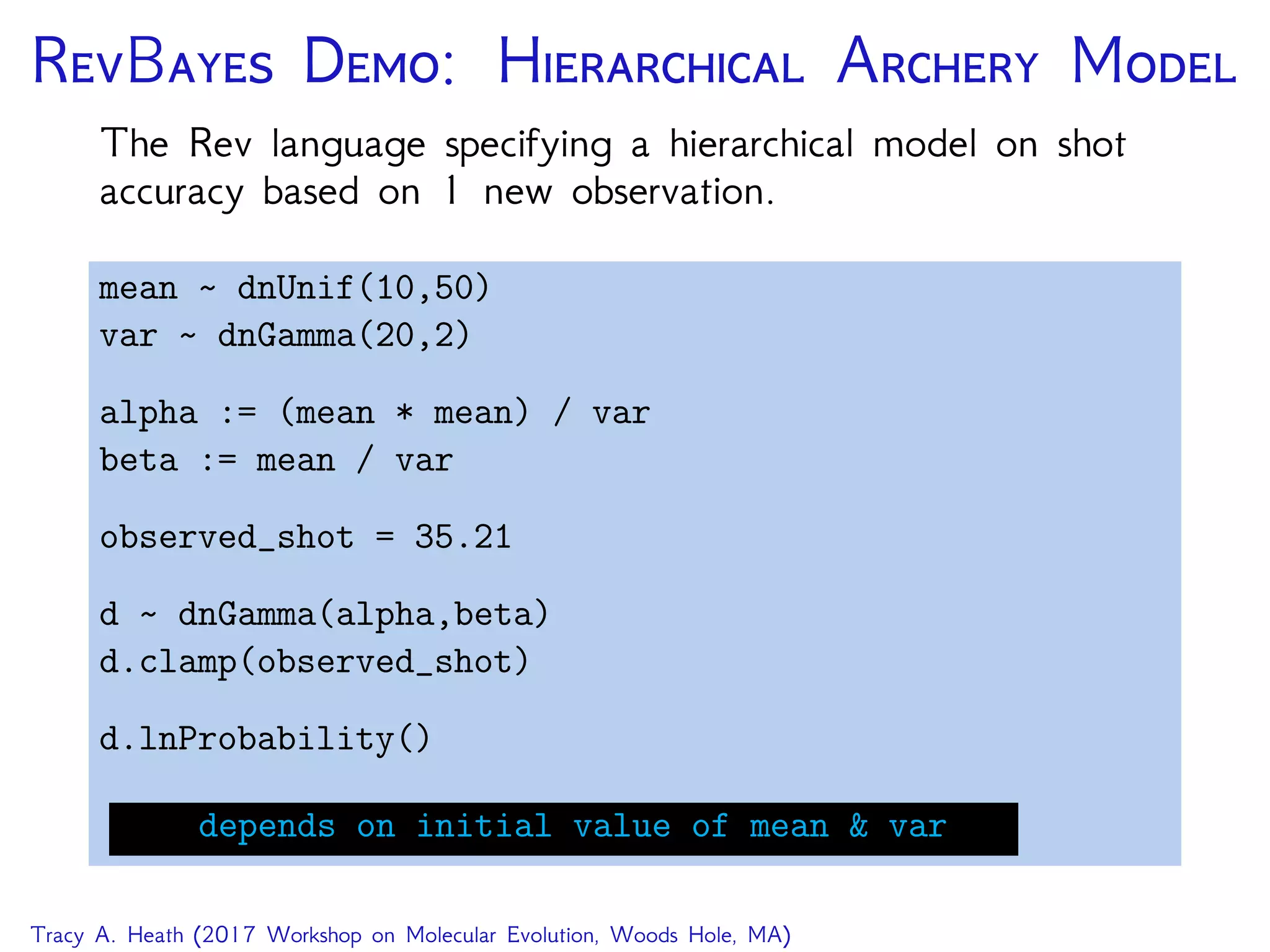
The Rev language specifying a hierarchical model on shot
accuracy based on 1 new observation.
mean dnUnif(10,50)
var dnGamma(20,2)
alpha := (mean * mean) / var
beta := mean / var
observed_shot = 35.21
d dnGamma(alpha,beta)
d.clamp(observed_shot)
d.lnProbability()
depends on initial value of mean & var
Tracy A. Heath (2017 Workshop on Molecular Evolution, Woods Hole, MA)
E: H A M
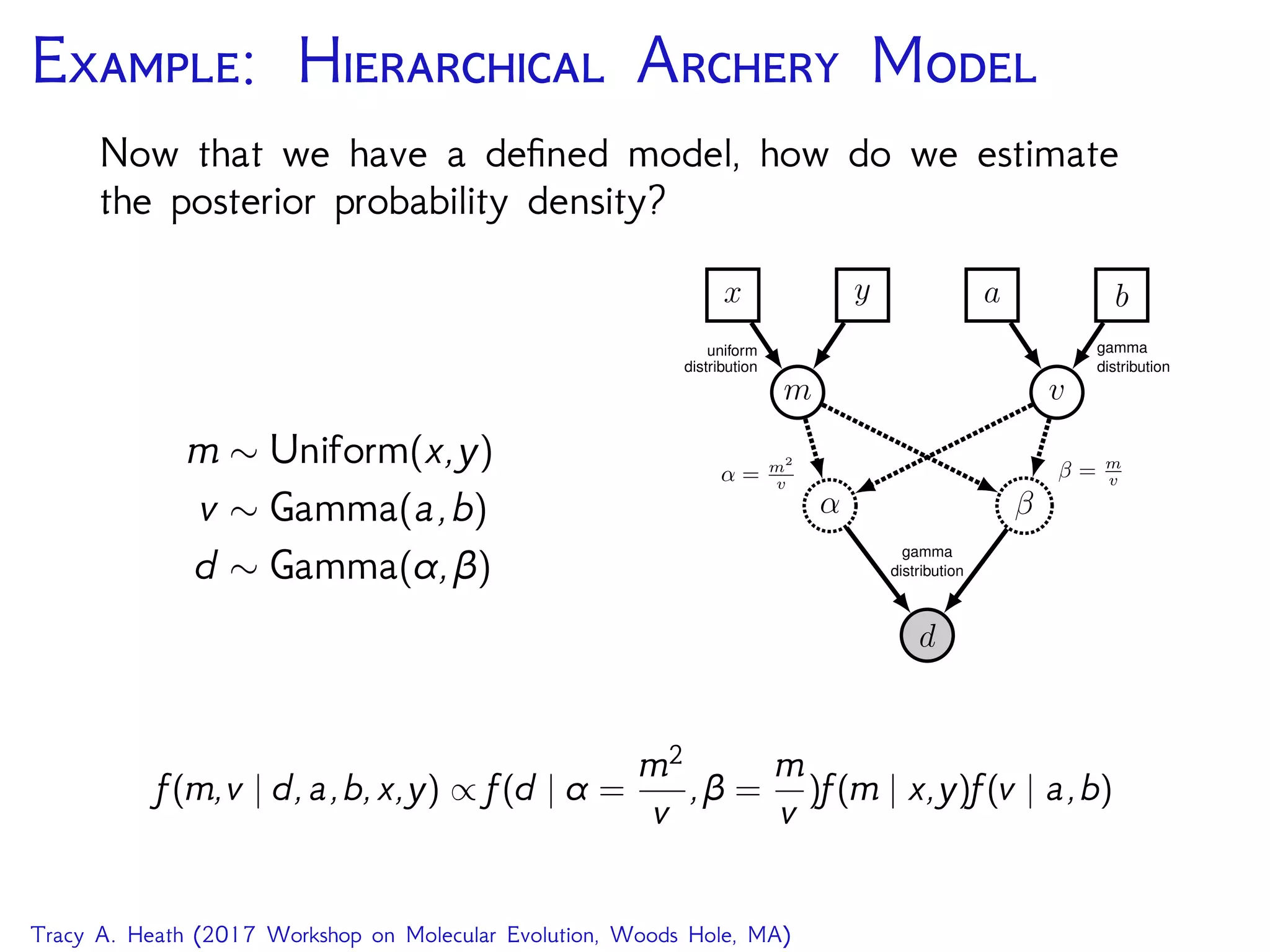
Now that we have a defined model, how do we estimate
the posterior probability density?
m ∼ Uniform(x,y)
v ∼ Gamma(a,b)
d ∼ Gamma(α,β)
d
α β
gamma
distribution
m v
β = m
vα = m2
v
x y a b
uniform
distribution
gamma
distribution
f(m,v | d,a,b,x,y) ∝ f(d | α =
m2
v
,β =
m
v
)f(m | x,y)f(v | a,b)
Tracy A. Heath (2017 Workshop on Molecular Evolution, Woods Hole, MA)
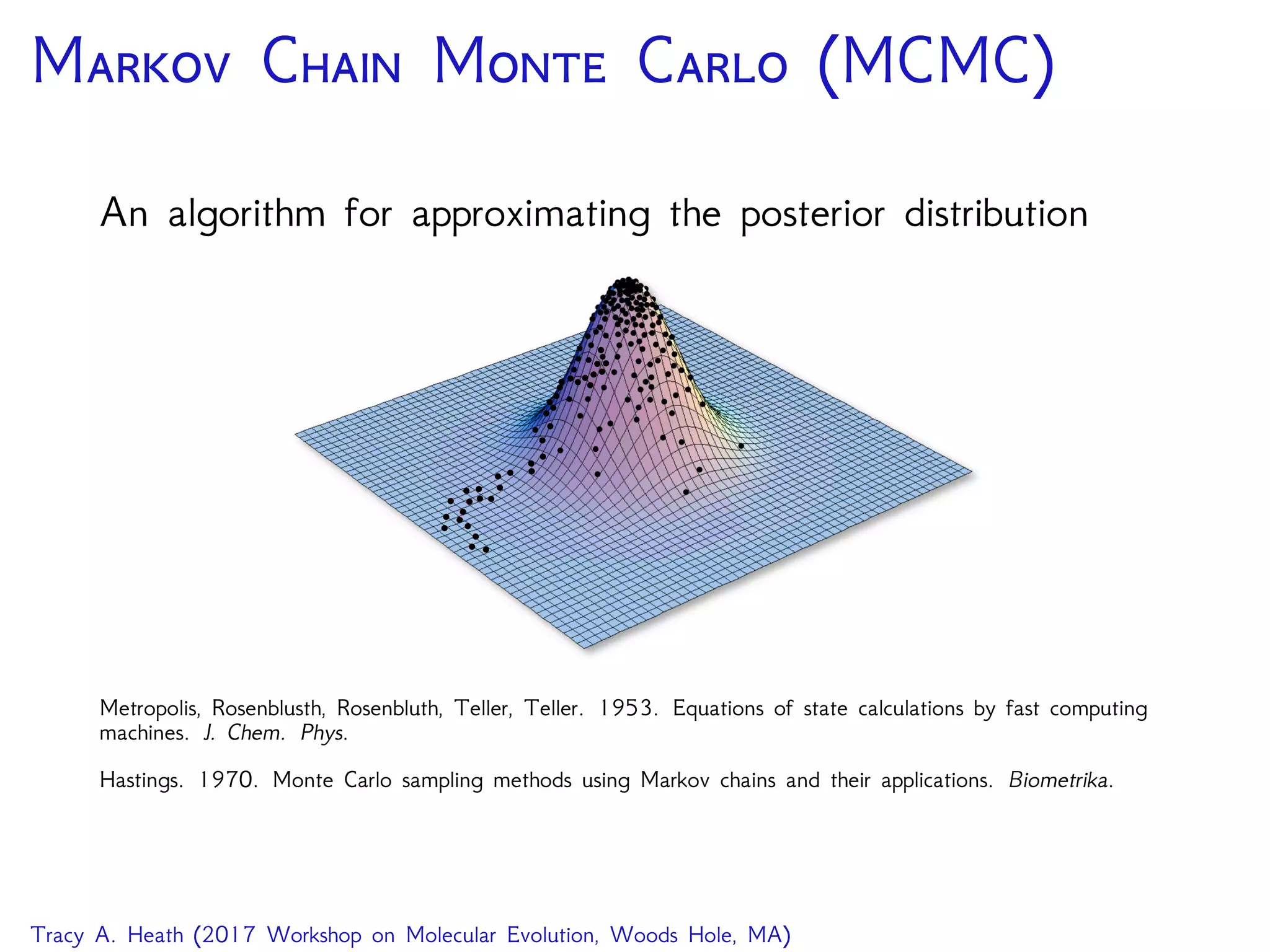
M C M C (MCMC)
An algorithm for approximating the posterior distribution
Metropolis, Rosenblusth, Rosenbluth, Teller, Teller. 1953. Equations of state calculations by fast computing
machines. J. Chem. Phys.
Hastings. 1970. Monte Carlo sampling methods using Markov chains and their applications. Biometrika.
Tracy A. Heath (2017 Workshop on Molecular Evolution, Woods Hole, MA)
RB D: H A M
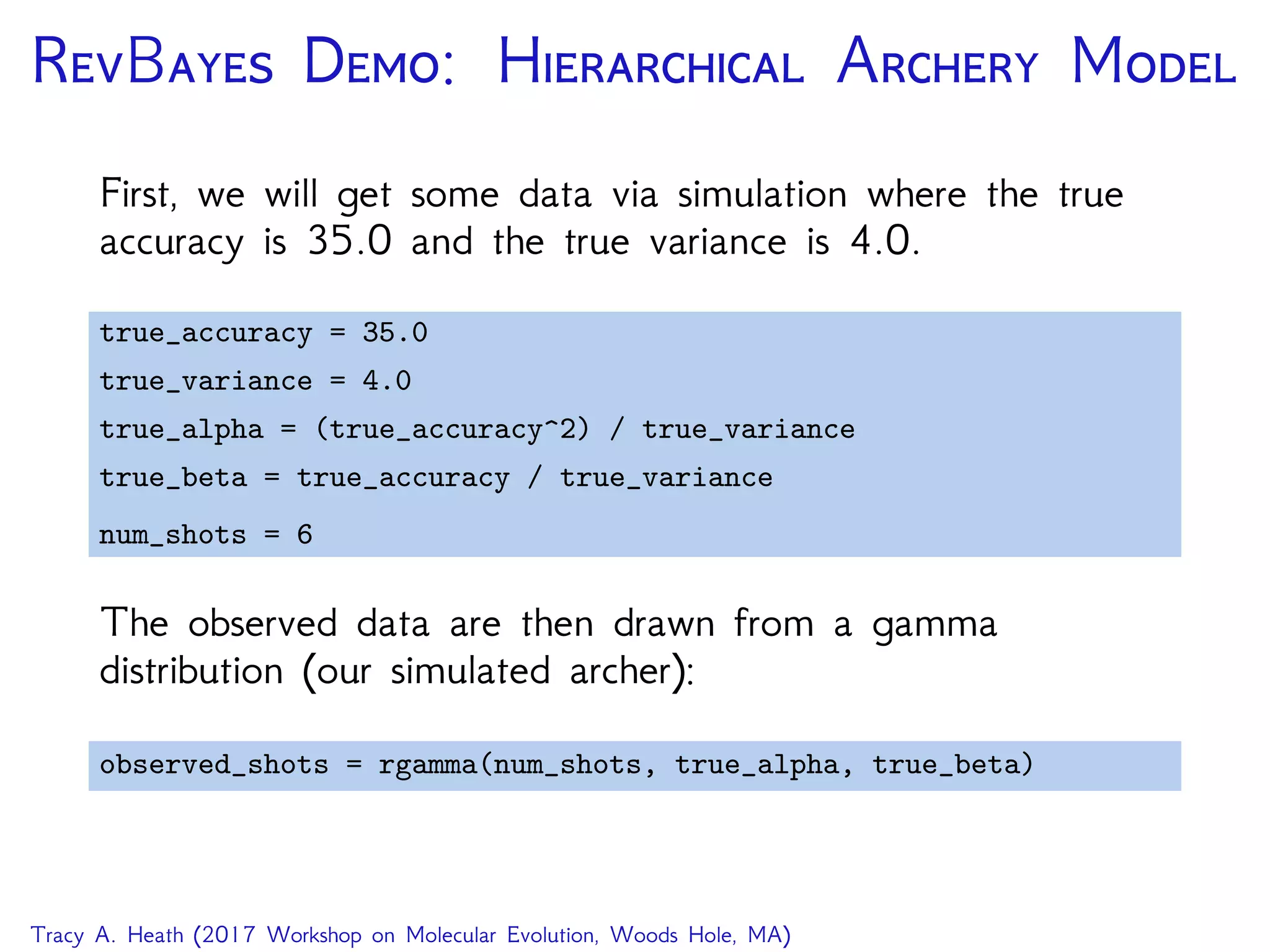
First, we will get some data via simulation where the true
accuracy is 35.0 and the true variance is 4.0.
true_accuracy = 35.0
true_variance = 4.0
true_alpha = (true_accuracy^2) / true_variance
true_beta = true_accuracy / true_variance
num_shots = 6
The observed data are then drawn from a gamma
distribution (our simulated archer):
observed_shots = rgamma(num_shots, true_alpha, true_beta)
Tracy A. Heath (2017 Workshop on Molecular Evolution, Woods Hole, MA)
RB D: H A M
The Rev language specifying the MCMC sampler for the
hierarchical model on archery accuracy.
... # model specification from previous demo
mymodel = model(beta)
moves[1] = mvSlide(mean,delta=1.0,tune=true,weight=3.0)
moves[2] = mvScale(var,lambda=1.0,tune=true,weight=3.0)
monitors[1] = mnModel(file="archery_mcmc_1.log",printgen=10, ...)
monitors[2] = mnScreen(printgen=1000, mean, var)
mymcmc = mcmc(mymodel, monitors, moves,nruns=1)
mymcmc.burnin(generations=10000,tuningInterval=1000)
mymcmc.run(generations=40000,underPrior=false)
MCMC screen output
Tracy A. Heath (2017 Workshop on Molecular Evolution, Woods Hole, MA)
RB D: H A M
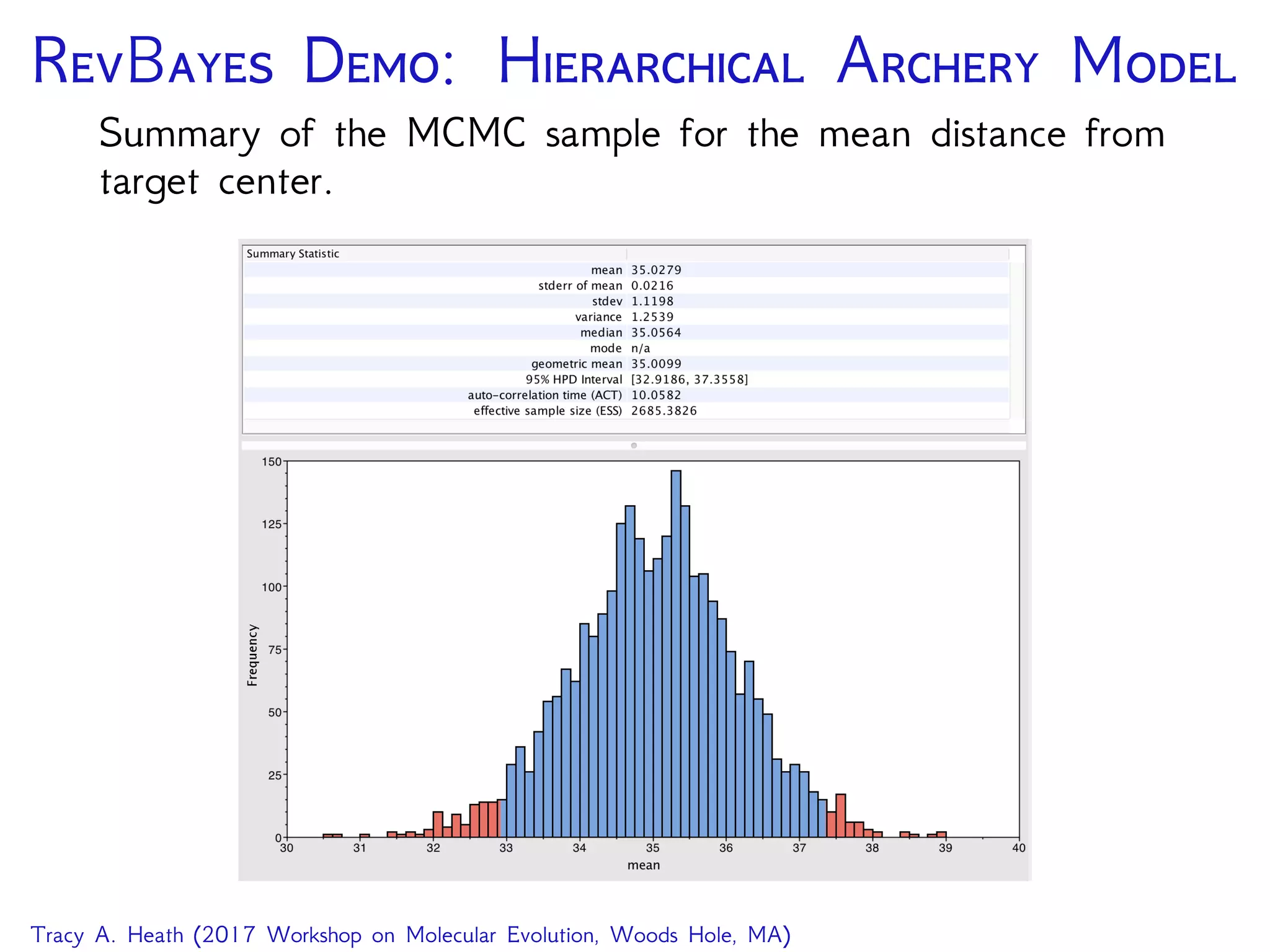
Summary of the MCMC sample for the mean distance from
target center.
Tracy A. Heath (2017 Workshop on Molecular Evolution, Woods Hole, MA)
RB D: H A M
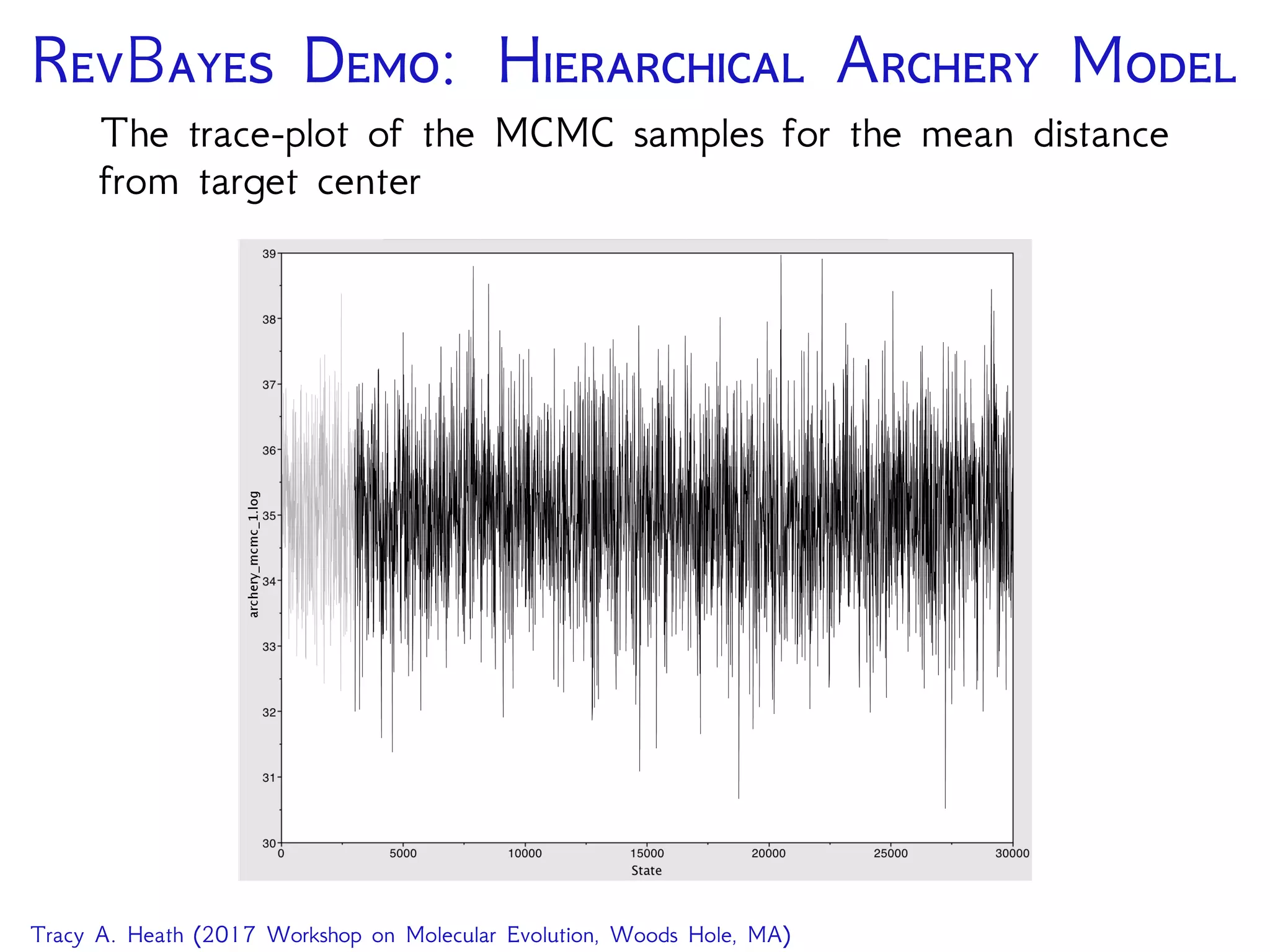
The trace-plot of the MCMC samples for the mean distance
from target center
Tracy A. Heath (2017 Workshop on Molecular Evolution, Woods Hole, MA)
E: H A M
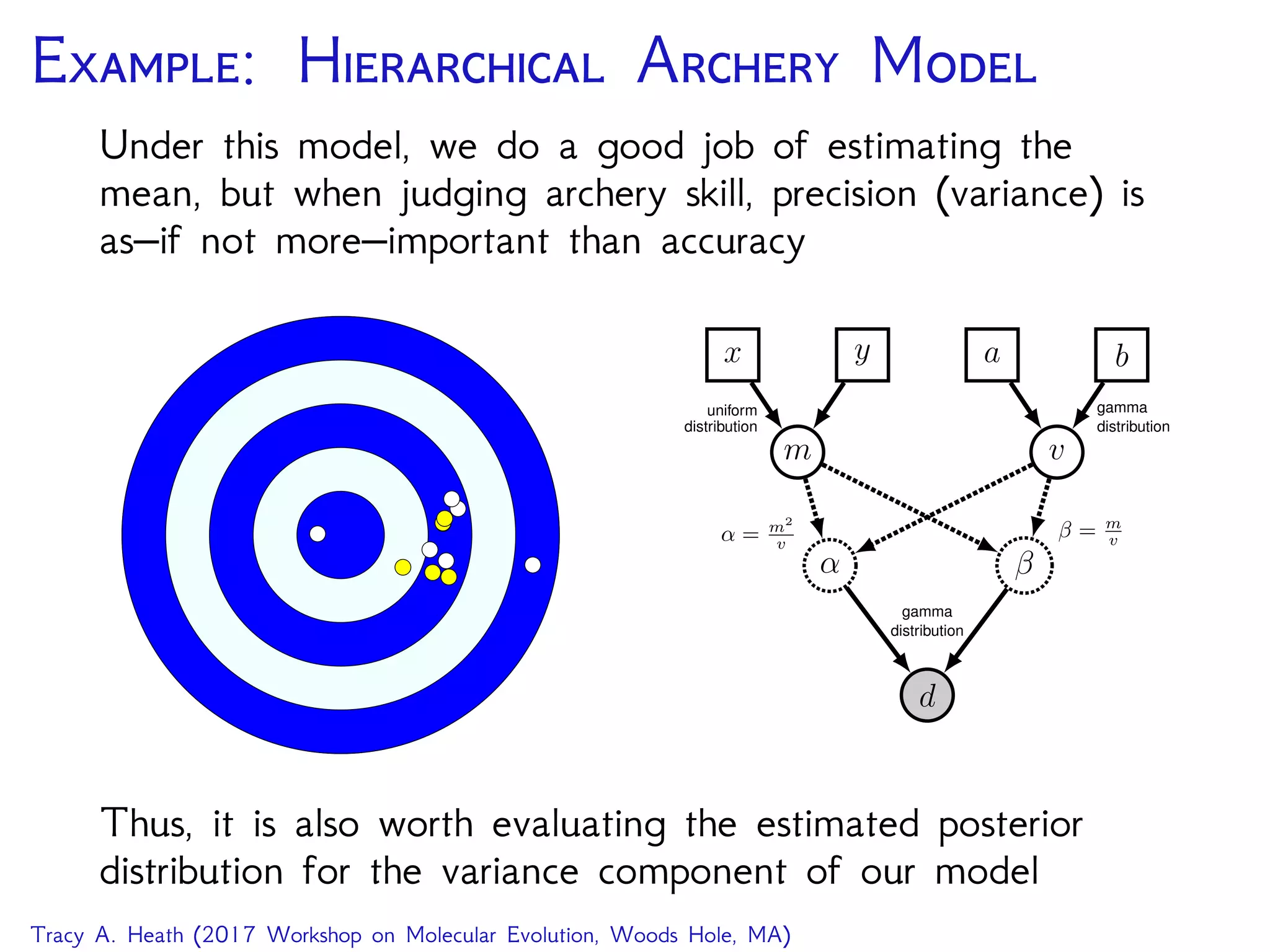
Under this model, we do a good job of estimating the
mean, but when judging archery skill, precision (variance) is
as–if not more–important than accuracy
q
q
qq
q
q
q
q q
qqq
q
d
α β
gamma
distribution
m v
β = m
vα = m2
v
x y a b
uniform
distribution
gamma
distribution
Thus, it is also worth evaluating the estimated posterior
distribution for the variance component of our model
Tracy A. Heath (2017 Workshop on Molecular Evolution, Woods Hole, MA)
E: V
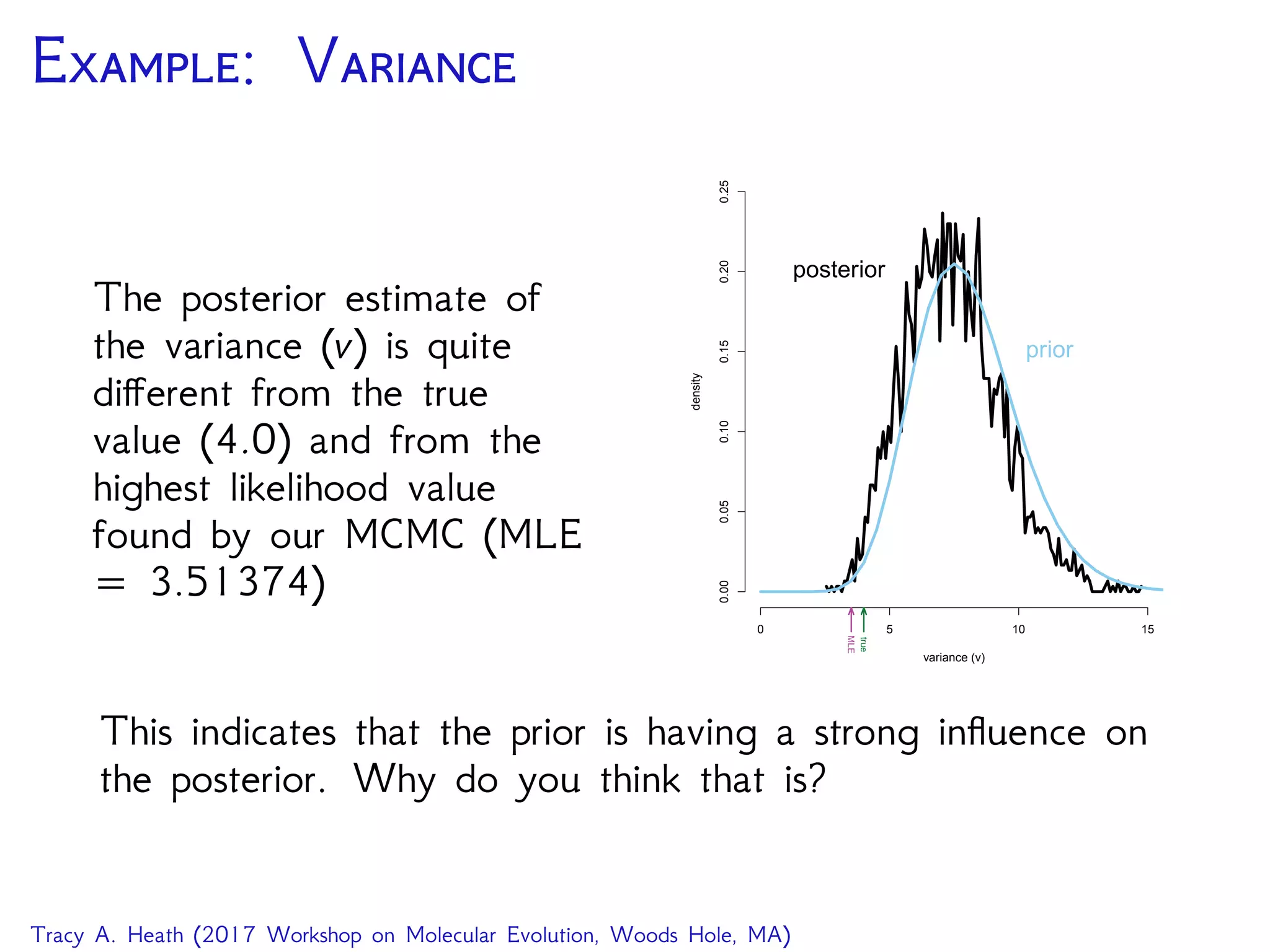
The posterior estimate of
the variance (v) is quite
different from the true
value (4.0) and from the
highest likelihood value
found by our MCMC (MLE
3.51374)
0 5 10 15
0.000.050.100.150.200.25
variance (v)
density
MLE
true
posterior
prior
This indicates that the prior is having a strong influence on
the posterior. Why do you think that is?
Tracy A. Heath (2017 Workshop on Molecular Evolution, Woods Hole, MA)
E: V
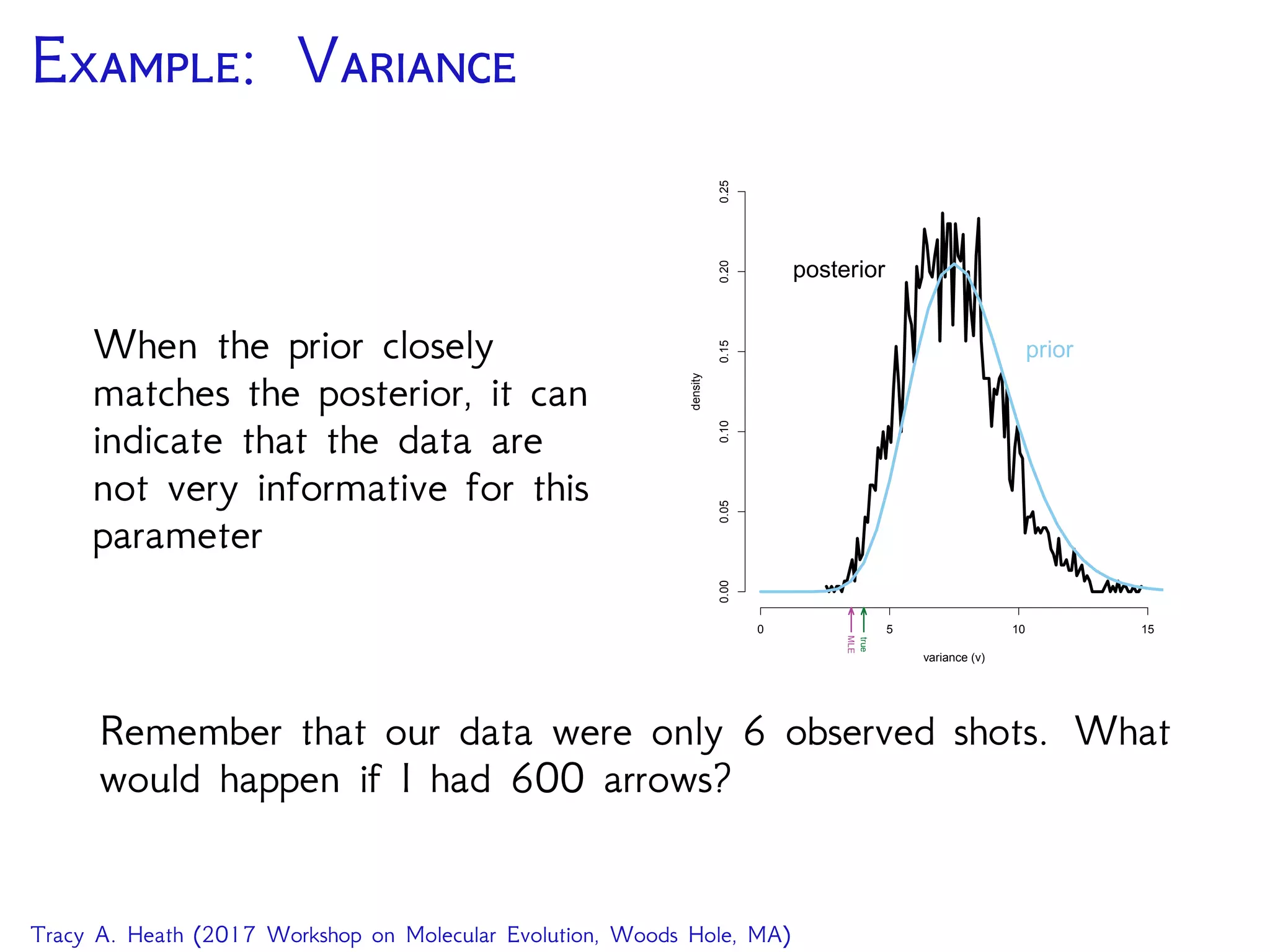
When the prior closely
matches the posterior, it can
indicate that the data are
not very informative for this
parameter
0 5 10 15
0.000.050.100.150.200.25
variance (v)
density
MLE
true
posterior
prior
Remember that our data were only 6 observed shots. What
would happen if I had 600 arrows?
Tracy A. Heath (2017 Workshop on Molecular Evolution, Woods Hole, MA)
E: W   M D
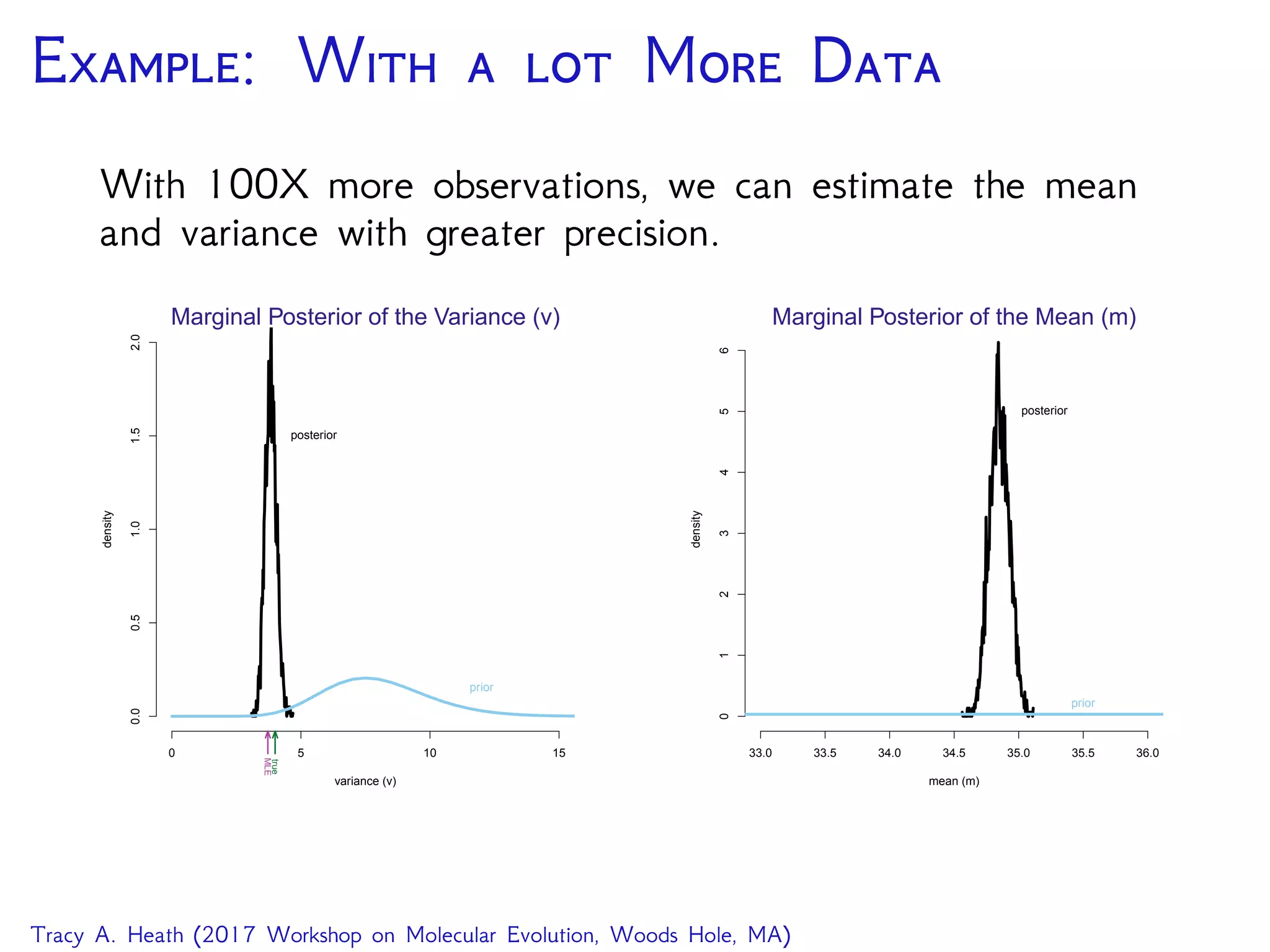
With 100X more observations, we can estimate the mean
and variance with greater precision.
0 5 10 15
0.00.51.01.52.0
variance (v)
density
MLE
true
posterior
prior
Marginal Posterior of the Variance (v)
33.0 33.5 34.0 34.5 35.0 35.5 36.0
0123456
mean (m)
density
posterior
prior
Marginal Posterior of the Mean (m)
Tracy A. Heath (2017 Workshop on Molecular Evolution, Woods Hole, MA)
B P
How is this applied to phylogenetic inference?
GTR on an unrooted tree
seq
PhyloCTMC
Q
GTRTree
bli ⌧
Exponential Uniform
10 N
i 2 2N 3
pi
Dirichlet
er
Dirichlet
↵2 ↵1
for (i in 1:n_branches) {
bl[i] ⇠ dnExponential(10.0)
}
topology ⇠ dnUniformTopology(taxa)
psi := treeAssembly(topology, bl)
alpha1 <- v(1,1,1,1,1,1)
alpha2 <- v(1,1,1,1)
er ⇠ dnDirichlet( alpha1 )
pi ⇠ dnDirichlet( alpha2 )
Q := fnGTR(er, pi)
seq ⇠ dnPhyloCTMC( tree=psi, Q=Q, pInv=p_invar,
siteRates=sr, type="DNA" )
seq.clamp( data )
(image source RevBayes Substitution Models Tutorial)
We can assemble a phylogenetic model in the same way,
using previously described models and probability
distributions as priors.
Tracy A. Heath (2017 Workshop on Molecular Evolution, Woods Hole, MA)
D: GTR T  RB
GTR on an unrooted tree
seq
PhyloCTMC
Q
GTRTree
bli ⌧
Exponential Uniform
10 N
i 2 2N 3
pi
Dirichlet
er
Dirichlet
↵2 ↵1
for (i in 1:n_branches) {
bl[i] ⇠ dnExponential(10.0)
}
topology ⇠ dnUniformTopology(taxa)
psi := treeAssembly(topology, bl)
alpha1 <- v(1,1,1,1,1,1)
alpha2 <- v(1,1,1,1)
er ⇠ dnDirichlet( alpha1 )
pi ⇠ dnDirichlet( alpha2 )
Q := fnGTR(er, pi)
seq ⇠ dnPhyloCTMC( tree=psi, Q=Q, pInv=p_invar,
siteRates=sr, type="DNA" )
seq.clamp( data )
(image source RevBayes Substitution Models Tutorial)
Let’s step through this model and the MCMC in RevBayes!
Tracy A. Heath (2017 Workshop on Molecular Evolution, Woods Hole, MA)

Integrative Bayesian Analysis in RevBayes

  • 1.
    I B A RB Tracy Heath Ecology, Evolution, & Organismal Biology Iowa State University @trayc7 http://phyloworks.org 2017 Workshop on Molecular Evolution Woods Hole, MA
  • 2.
    O Lecture & demo:Bayesian inference and graphical models Constructing a hierarchical model The GTR model in RevBayes break & PHOTO! Lecture: Bayesian divergence-time estimation Relaxed-clock models Birth-death processes and using fossil data Biogeography methods for dating trees lunch RevBayes tutorial: Divergence dating w/ fossil & molecular data PARTY! Tracy A. Heath (2017 Workshop on Molecular Evolution, Woods Hole, MA)
  • 3.
    A P Evolutionary analysisin a phylogenetic framework often happens using a serialized approach collect sequence data collect fossil datacollect trait data collect biogeography data divergence-time estimation continuous trait analysis biogeography analysis “Downstream” analyses rely on the previous estimation of a dated phylogeny Tracy A. Heath (2017 Workshop on Molecular Evolution, Woods Hole, MA)
  • 4.
    I B A PaleoceneEocene Oligocene Miocene Pli Ple Stem fossils (Ksepka & Clarke, 2010) Tracy A. Heath (2017 Workshop on Molecular Evolution, Woods Hole, MA)
  • 5.
    I B A TracyA. Heath (2017 Workshop on Molecular Evolution, Woods Hole, MA)
  • 6.
    C  HM Integrative Bayesian analysis relies on conceptualizing models as modular and hierarchical. We will use Paul’s archery example to construct a model and visualize it graphically. Tracy A. Heath (2017 Workshop on Molecular Evolution, Woods Hole, MA)
  • 7.
    P: A E Inthis example, we assume a gamma-prior distribution on my archery skill (distance from bullseye d) with a shape parameter α and a scale parameter β. d ∼ Gamma(α,β) f(d | α,β) = 1 Γ(α)βα dα−1e− d β 0 10 20 30 40 50 60 70 0.000.050.100.150.200.25 distance in cm from target center (d) density q q q q q q q q q q q q q q q q q q q q q qqq q qq This requires us to assign values for α and β based on our prior belief Tracy A. Heath (2017 Workshop on Molecular Evolution, Woods Hole, MA)
  • 8.
    P: A E Ifwe have some prior knowledge of the mean (m) and variance (v) of the gamma distribution, we can compute α and β. m = α β, α = m2 v v = α β2 , β = m v d ∼ Gamma(α,β) 0 10 20 30 40 50 60 70 0.000.050.100.150.200.25 distance in cm from target center (d) density q q q q q q q q q q q q q q q q q q q q q qqq q qq Tracy A. Heath (2017 Workshop on Molecular Evolution, Woods Hole, MA)
  • 9.
    P: A E Let’sassume that I will almost always miss the target, this may correspond to a gamma distribution with a mean (m) of 60 and a variance (v) of 3. α = 1200 β = 20 d ∼ Gamma(α,β) 0 10 20 30 40 50 60 70 0.000.050.100.150.200.25 distance in cm from target center (d) density 1 meter q q q q q Tracy A. Heath (2017 Workshop on Molecular Evolution, Woods Hole, MA)
  • 10.
    P: A E Anotherway of expressing d ∼ Gamma(α,β) is with a probabilistic graphical model d α β gamma distribution 0 10 20 30 40 50 60 70 0.000.050.100.150.200.25 distance in cm from target center (d) density 1 meter q q q q q This shows that our observed datum (d a single observed shot) is conditionally dependent on the shape (α) and rate (β) of the gamma distribution. Tracy A. Heath (2017 Workshop on Molecular Evolution, Woods Hole, MA)
  • 11.
    P: A E Wecan parameterize the model using the mean (m) and variance (v), where α and β are computed using m and v. d α β gamma distribution m v β = m vα = m2 v 0 10 20 30 40 50 60 70 0.000.050.100.150.200.25 distance in cm from target center (d) density 1 meter q q q q q Sometimes it’s better to use alternative parameterization. We may have more intuition about mean and variance than we have about shape and rate. Tracy A. Heath (2017 Workshop on Molecular Evolution, Woods Hole, MA)
  • 12.
    P G M Graphicalmodels provide tools for visually & computationally representing complex, parameter-rich probabilistic models We can depict the conditional dependence structure of various parameters and other random variables d α β gamma distribution m v β = m vα = m2 v Clamped node (observed) Deterministic node Stochastic node Constant node Höhna et al. 2014. Probabilistic Graphical Model Representation in Phylogenetics. Systematic Biology. doi: 10.1093/sysbio/syu039 Tracy A. Heath (2017 Workshop on Molecular Evolution, Woods Hole, MA)
  • 13.
    P: A E Ifsomehow we happened to know the true mean and variance of my accuracy at the archery range, we can easily calculate the likelihood of any observed shot f(d | α,β) = 1 Γ(α)βα dα−1e− d β d α β gamma distribution m v β = m vα = m2 v f(d = 39.76 | α = 1200,β = 20) = 7.89916e − 40 Tracy A. Heath (2017 Workshop on Molecular Evolution, Woods Hole, MA)
  • 14.
    RB D: AA RevBayes Fully integrative Bayesian inference of phylogenetic parameters using probabilistic graphical models and an interpreted language http://RevBayes.com d α β gamma distribution m v β = m vα = m2 v Höhna et al. 2016. RevBayes: Bayesian phylogenetic inference using graphical models and an interactive model-specification language. Systematic Biology. doi: 10.1093/sysbio/syu021 Tracy A. Heath (2017 Workshop on Molecular Evolution, Woods Hole, MA)
  • 15.
    RB D: M A S The Rev language calculating the probability of 1 observed datum observed_shot given a mean and variance. mean <- 60 var <- 3 alpha := (mean * mean) / var beta := mean / var observed_shot = 39.76 d dnGamma(alpha,beta) d.clamp(observed_shot) d.lnProbability() -90.0366 Tracy A. Heath (2017 Workshop on Molecular Evolution, Woods Hole, MA)
  • 16.
    E: M A S What if we do not know m and v? We can use maximum likelihood or Bayesian methods for estimating their values. Maximum likelihood methods require us to find the values of m and v that maximize f(d | m,v). Bayesian methods use prior distributions to describe our uncertainty in m and v and estimate f(m,v | d). Tracy A. Heath (2017 Workshop on Molecular Evolution, Woods Hole, MA)
  • 17.
    E: H AM We must define prior distributions for m and v to account for uncertainty and estimate the posterior densities of those parameters m ∼ Uniform(x,y) v ∼ Gamma(a,b) d α β gamma distribution m v β = m vα = m2 v x y a b uniform distribution gamma distribution Tracy A. Heath (2017 Workshop on Molecular Evolution, Woods Hole, MA)
  • 18.
    E: H AM The values we choose for the parameters of these hyperprior distributions should reflect our prior knowledge. The previous observed shot was 39.76 cm, & we may use this to inform the parameters of our hyperpriors for analysis of future observations m ∼ Uniform(x,y) x = 10.0 y = 50.0 E(m) = 30.0 v ∼ Gamma(a,b) a = 20.0 b = 2.0 E(v) = 10.0 d α β gamma distribution m v β = m vα = m2 v x y a b uniform distribution gamma distribution Tracy A. Heath (2017 Workshop on Molecular Evolution, Woods Hole, MA)
  • 19.
    RB D: HA M The Rev language specifying a hierarchical model on shot accuracy based on 1 new observation. mean dnUnif(10,50) var dnGamma(20,2) alpha := (mean * mean) / var beta := mean / var observed_shot = 35.21 d dnGamma(alpha,beta) d.clamp(observed_shot) d.lnProbability() depends on initial value of mean & var Tracy A. Heath (2017 Workshop on Molecular Evolution, Woods Hole, MA)
  • 20.
    E: H AM Now that we have a defined model, how do we estimate the posterior probability density? m ∼ Uniform(x,y) v ∼ Gamma(a,b) d ∼ Gamma(α,β) d α β gamma distribution m v β = m vα = m2 v x y a b uniform distribution gamma distribution f(m,v | d,a,b,x,y) ∝ f(d | α = m2 v ,β = m v )f(m | x,y)f(v | a,b) Tracy A. Heath (2017 Workshop on Molecular Evolution, Woods Hole, MA)
  • 21.
    M C MC (MCMC) An algorithm for approximating the posterior distribution Metropolis, Rosenblusth, Rosenbluth, Teller, Teller. 1953. Equations of state calculations by fast computing machines. J. Chem. Phys. Hastings. 1970. Monte Carlo sampling methods using Markov chains and their applications. Biometrika. Tracy A. Heath (2017 Workshop on Molecular Evolution, Woods Hole, MA)
  • 22.
    RB D: HA M First, we will get some data via simulation where the true accuracy is 35.0 and the true variance is 4.0. true_accuracy = 35.0 true_variance = 4.0 true_alpha = (true_accuracy^2) / true_variance true_beta = true_accuracy / true_variance num_shots = 6 The observed data are then drawn from a gamma distribution (our simulated archer): observed_shots = rgamma(num_shots, true_alpha, true_beta) Tracy A. Heath (2017 Workshop on Molecular Evolution, Woods Hole, MA)
  • 23.
    RB D: HA M The Rev language specifying the MCMC sampler for the hierarchical model on archery accuracy. ... # model specification from previous demo mymodel = model(beta) moves[1] = mvSlide(mean,delta=1.0,tune=true,weight=3.0) moves[2] = mvScale(var,lambda=1.0,tune=true,weight=3.0) monitors[1] = mnModel(file="archery_mcmc_1.log",printgen=10, ...) monitors[2] = mnScreen(printgen=1000, mean, var) mymcmc = mcmc(mymodel, monitors, moves,nruns=1) mymcmc.burnin(generations=10000,tuningInterval=1000) mymcmc.run(generations=40000,underPrior=false) MCMC screen output Tracy A. Heath (2017 Workshop on Molecular Evolution, Woods Hole, MA)
  • 24.
    RB D: HA M Summary of the MCMC sample for the mean distance from target center. Tracy A. Heath (2017 Workshop on Molecular Evolution, Woods Hole, MA)
  • 25.
    RB D: HA M The trace-plot of the MCMC samples for the mean distance from target center Tracy A. Heath (2017 Workshop on Molecular Evolution, Woods Hole, MA)
  • 26.
    E: H AM Under this model, we do a good job of estimating the mean, but when judging archery skill, precision (variance) is as–if not more–important than accuracy q q qq q q q q q qqq q d α β gamma distribution m v β = m vα = m2 v x y a b uniform distribution gamma distribution Thus, it is also worth evaluating the estimated posterior distribution for the variance component of our model Tracy A. Heath (2017 Workshop on Molecular Evolution, Woods Hole, MA)
  • 27.
    E: V The posteriorestimate of the variance (v) is quite different from the true value (4.0) and from the highest likelihood value found by our MCMC (MLE 3.51374) 0 5 10 15 0.000.050.100.150.200.25 variance (v) density MLE true posterior prior This indicates that the prior is having a strong influence on the posterior. Why do you think that is? Tracy A. Heath (2017 Workshop on Molecular Evolution, Woods Hole, MA)
  • 28.
    E: V When theprior closely matches the posterior, it can indicate that the data are not very informative for this parameter 0 5 10 15 0.000.050.100.150.200.25 variance (v) density MLE true posterior prior Remember that our data were only 6 observed shots. What would happen if I had 600 arrows? Tracy A. Heath (2017 Workshop on Molecular Evolution, Woods Hole, MA)
  • 29.
    E: W  M D With 100X more observations, we can estimate the mean and variance with greater precision. 0 5 10 15 0.00.51.01.52.0 variance (v) density MLE true posterior prior Marginal Posterior of the Variance (v) 33.0 33.5 34.0 34.5 35.0 35.5 36.0 0123456 mean (m) density posterior prior Marginal Posterior of the Mean (m) Tracy A. Heath (2017 Workshop on Molecular Evolution, Woods Hole, MA)
  • 30.
    B P How isthis applied to phylogenetic inference? GTR on an unrooted tree seq PhyloCTMC Q GTRTree bli ⌧ Exponential Uniform 10 N i 2 2N 3 pi Dirichlet er Dirichlet ↵2 ↵1 for (i in 1:n_branches) { bl[i] ⇠ dnExponential(10.0) } topology ⇠ dnUniformTopology(taxa) psi := treeAssembly(topology, bl) alpha1 <- v(1,1,1,1,1,1) alpha2 <- v(1,1,1,1) er ⇠ dnDirichlet( alpha1 ) pi ⇠ dnDirichlet( alpha2 ) Q := fnGTR(er, pi) seq ⇠ dnPhyloCTMC( tree=psi, Q=Q, pInv=p_invar, siteRates=sr, type="DNA" ) seq.clamp( data ) (image source RevBayes Substitution Models Tutorial) We can assemble a phylogenetic model in the same way, using previously described models and probability distributions as priors. Tracy A. Heath (2017 Workshop on Molecular Evolution, Woods Hole, MA)
  • 31.
    D: GTR T RB GTR on an unrooted tree seq PhyloCTMC Q GTRTree bli ⌧ Exponential Uniform 10 N i 2 2N 3 pi Dirichlet er Dirichlet ↵2 ↵1 for (i in 1:n_branches) { bl[i] ⇠ dnExponential(10.0) } topology ⇠ dnUniformTopology(taxa) psi := treeAssembly(topology, bl) alpha1 <- v(1,1,1,1,1,1) alpha2 <- v(1,1,1,1) er ⇠ dnDirichlet( alpha1 ) pi ⇠ dnDirichlet( alpha2 ) Q := fnGTR(er, pi) seq ⇠ dnPhyloCTMC( tree=psi, Q=Q, pInv=p_invar, siteRates=sr, type="DNA" ) seq.clamp( data ) (image source RevBayes Substitution Models Tutorial) Let’s step through this model and the MCMC in RevBayes! Tracy A. Heath (2017 Workshop on Molecular Evolution, Woods Hole, MA)