Integrating CMS 
and eCommerce 
platforms - different 
models and pros & cons for each 
model 
Perttu Tolvanen, Web & CMS Expert, @perttutolvanen 
North Patrol Oy 2014 / 2014 1 -10-06 / CMS Expert Group / Helsinki
Advisor for large web projects 
2 © 2014 North Patrol Oy 
- Vendor-neutral CMS consultants 
- Helsinki-based, but most clients 
operate in Northern Europe / 
Scandinavia / Russia 
- CMS selections and partner 
selections for large projects 
- Founded 2012, growing
Agenda 
Typical 
differences 
between CMS 
platforms and 
eCommerce 
platforms 
3 North Patrol Oy 2014 
Different 
models: a) side-by- 
side, b) 
WCM-heavy, c) 
eCommerce-heavy 
Key decision 
factors in 
choosing the 
right model
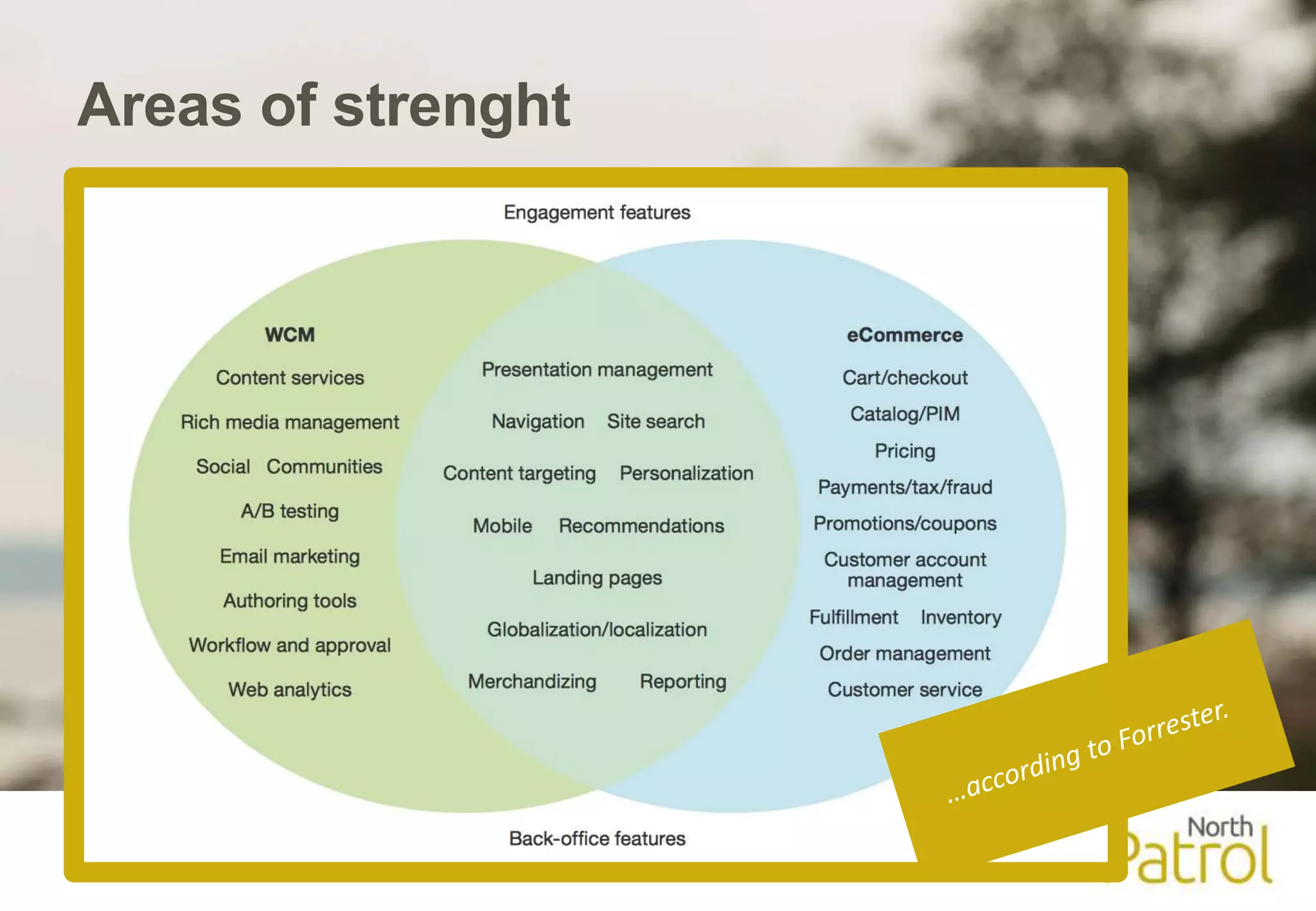
Areas of strenght 
North Patrol Oy 2014 
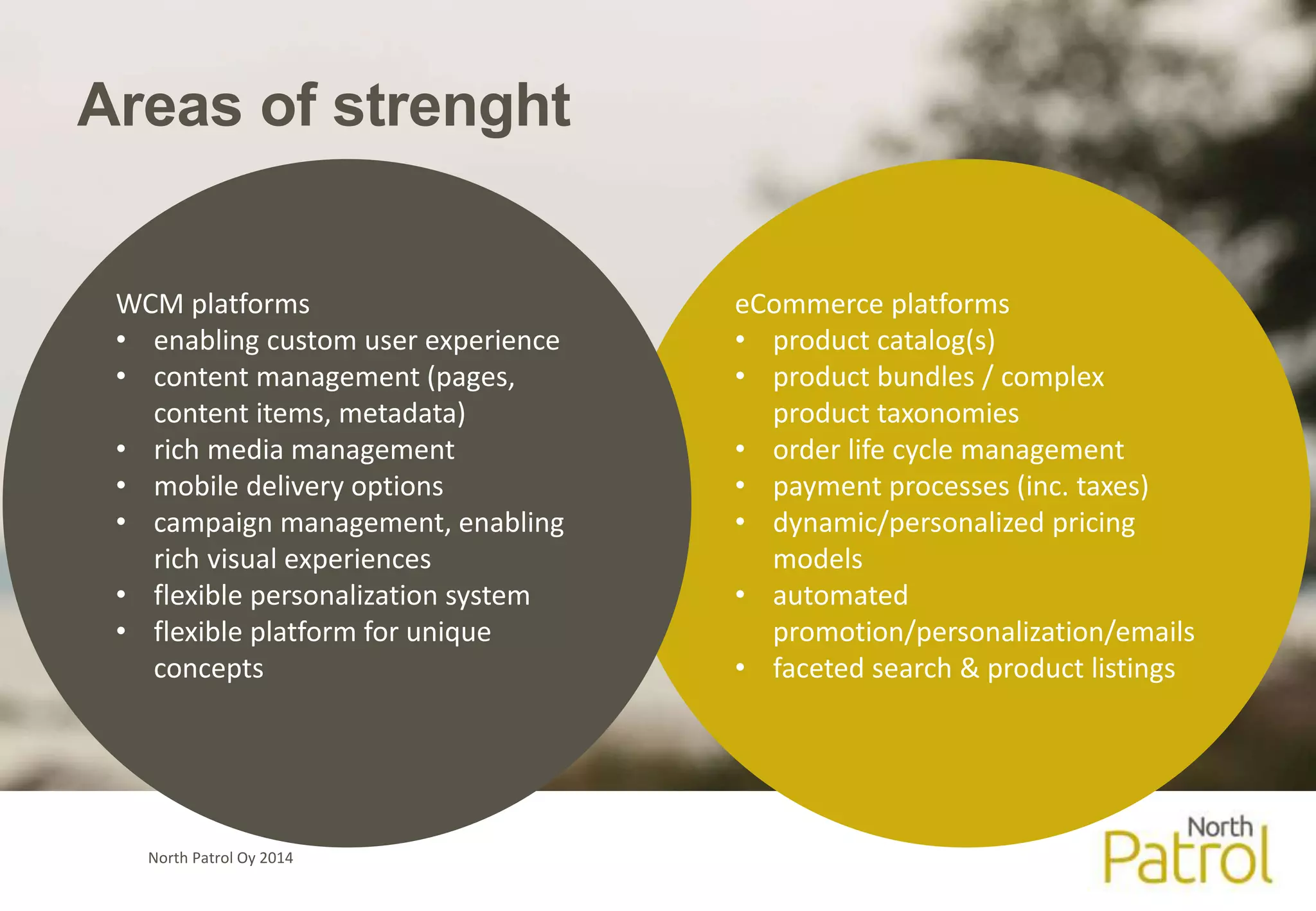
eCommerce platforms 
• product catalog(s) 
• product bundles / complex 
product taxonomies 
• order life cycle management 
• payment processes (inc. taxes) 
• dynamic/personalized pricing 
models 
• automated 
promotion/personalization/emails 
• faceted search & product listings 
WCM platforms 
• enabling custom user experience 
• content management (pages, 
content items, metadata) 
• rich media management 
• mobile delivery options 
• campaign management, enabling 
rich visual experiences 
• flexible personalization system 
• flexible platform for unique 
concepts
Areas of strenght 
North Patrol Oy 2014
Side-by-side model 
6 North Patrol Oy 2014
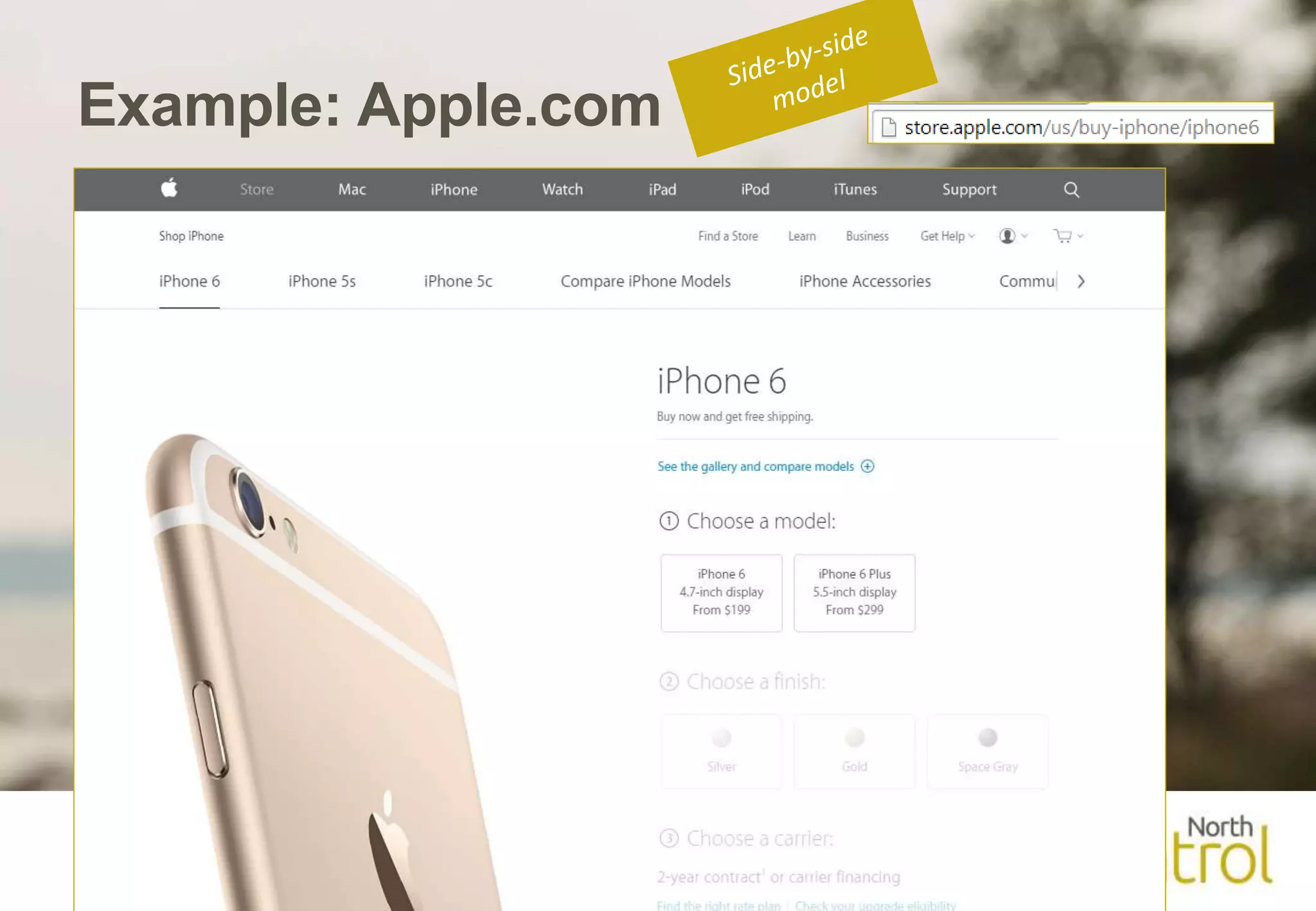
Example: Apple.com 
North Patrol Oy 2014
Example: Apple.com 
North Patrol Oy 2014
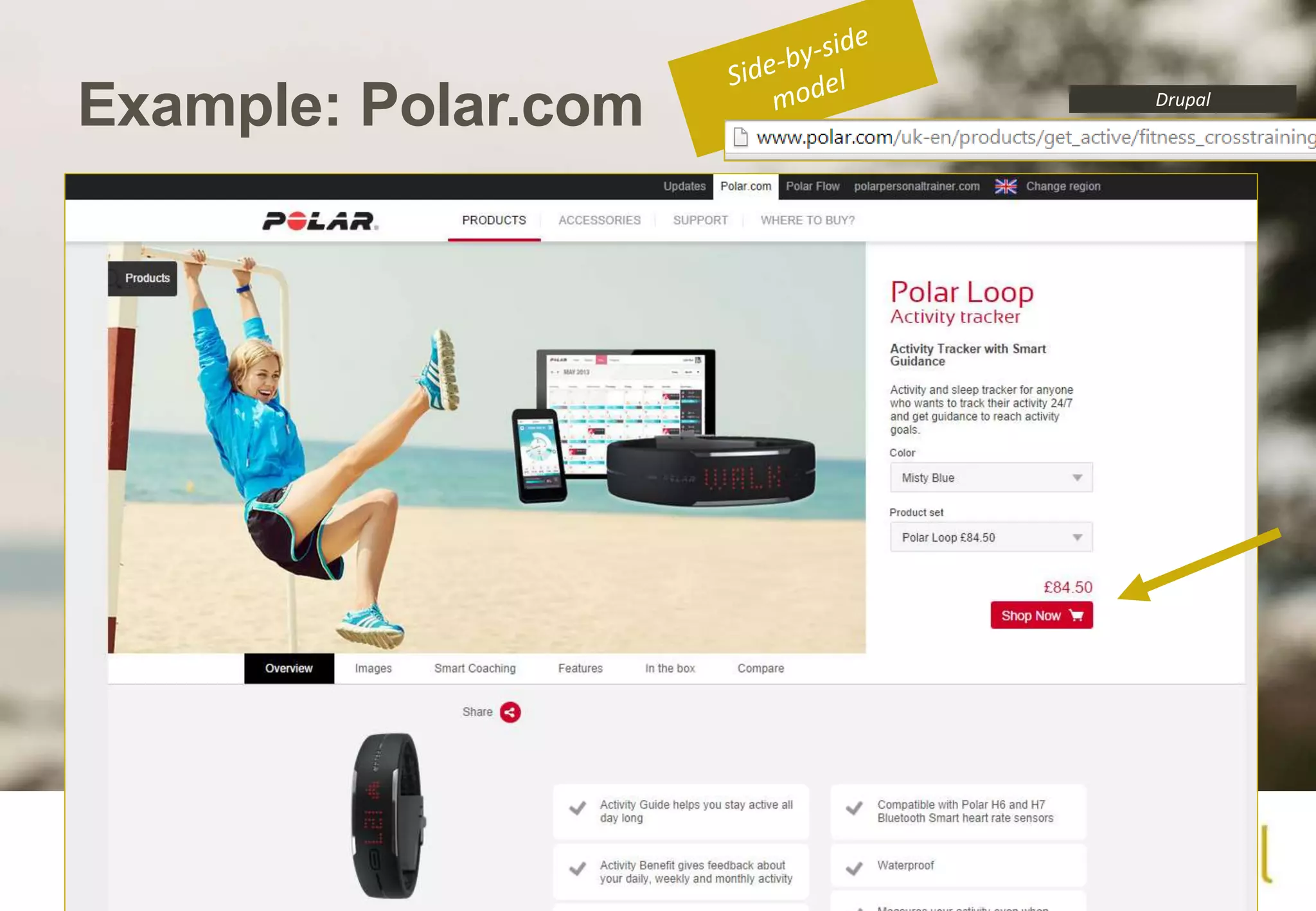
Example: Polar.com Drupal 
North Patrol Oy 2014
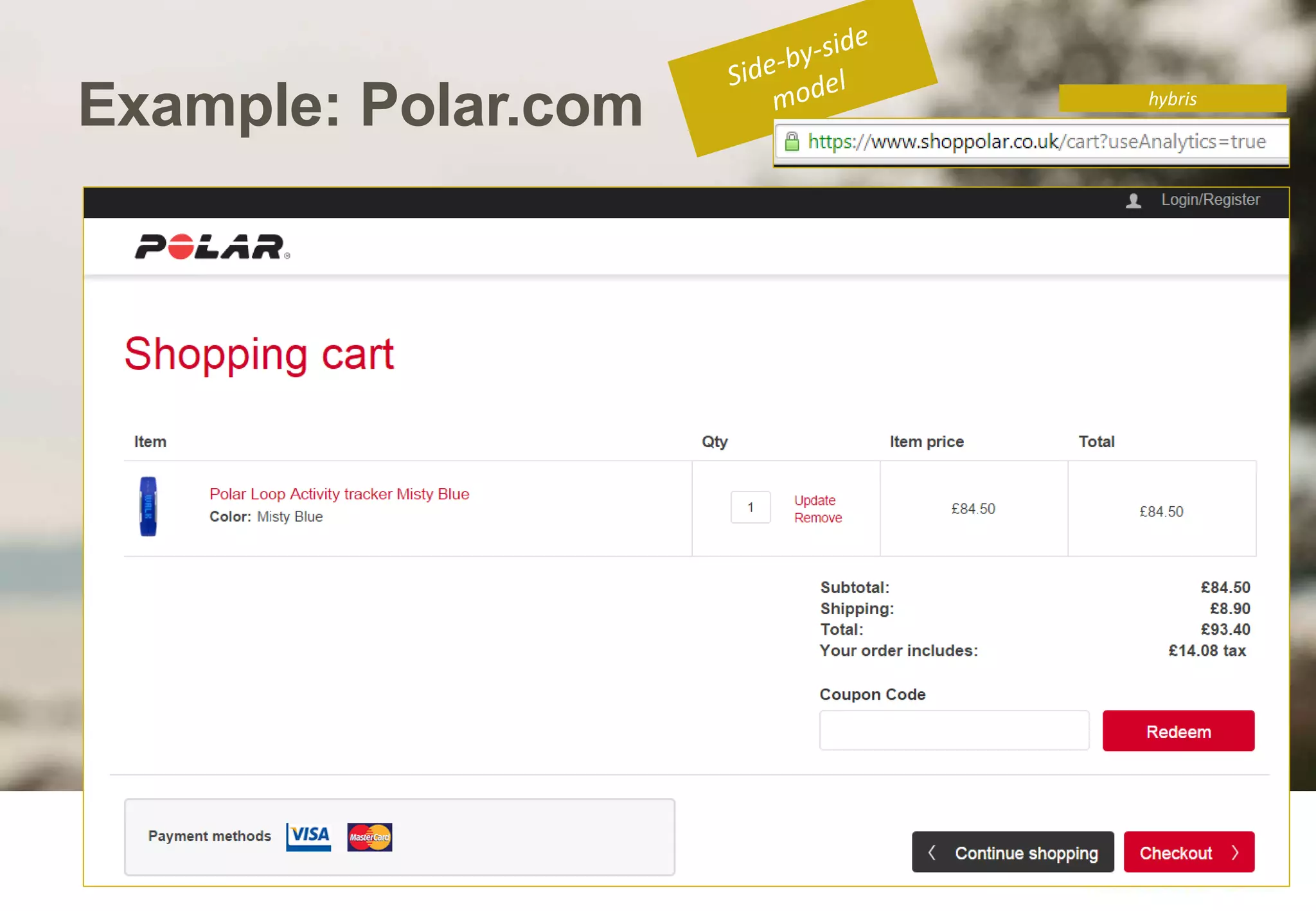
Example: Polar.com hybris 
North Patrol Oy 2014
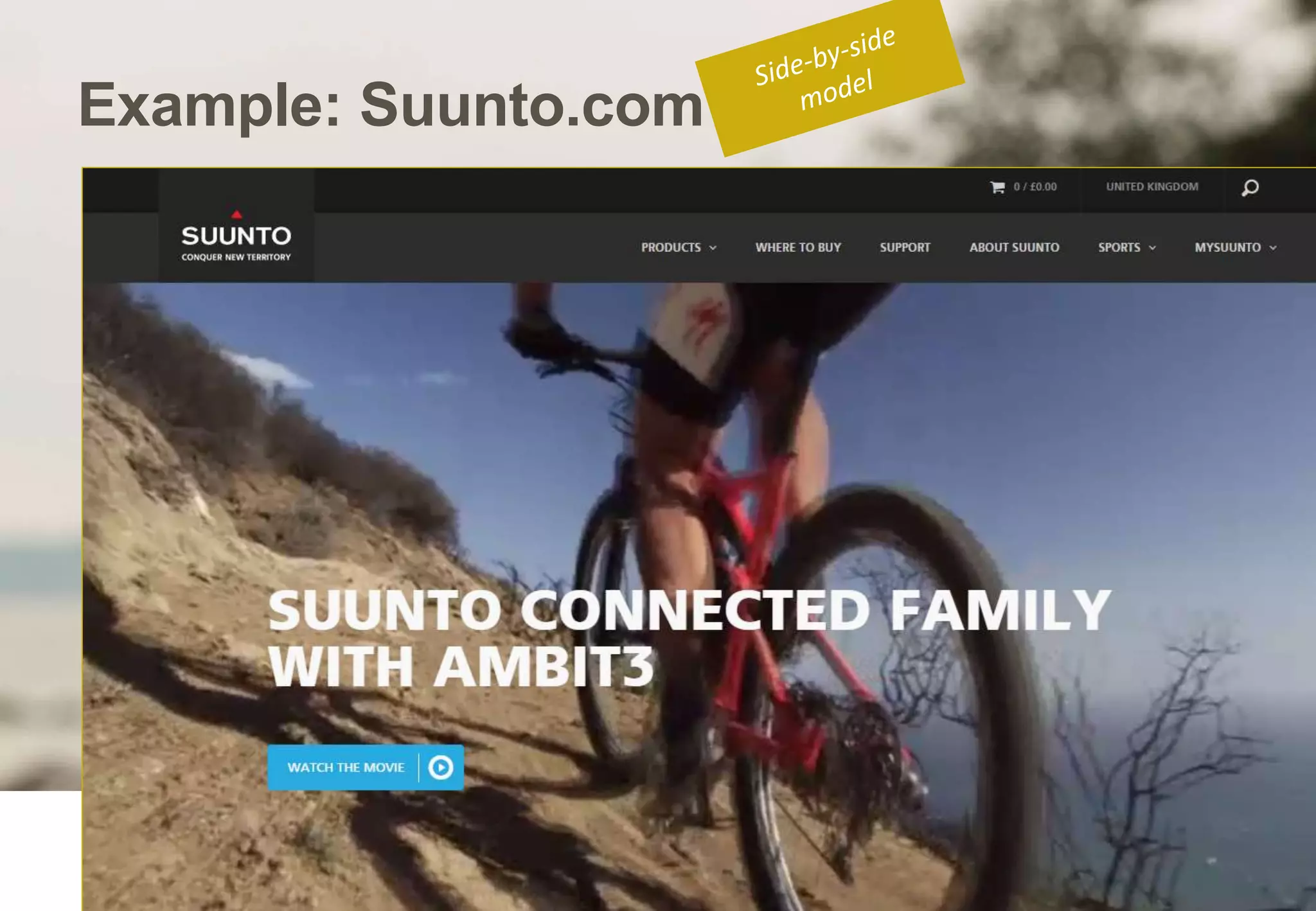
Example: Suunto.com 
North Patrol Oy 2014
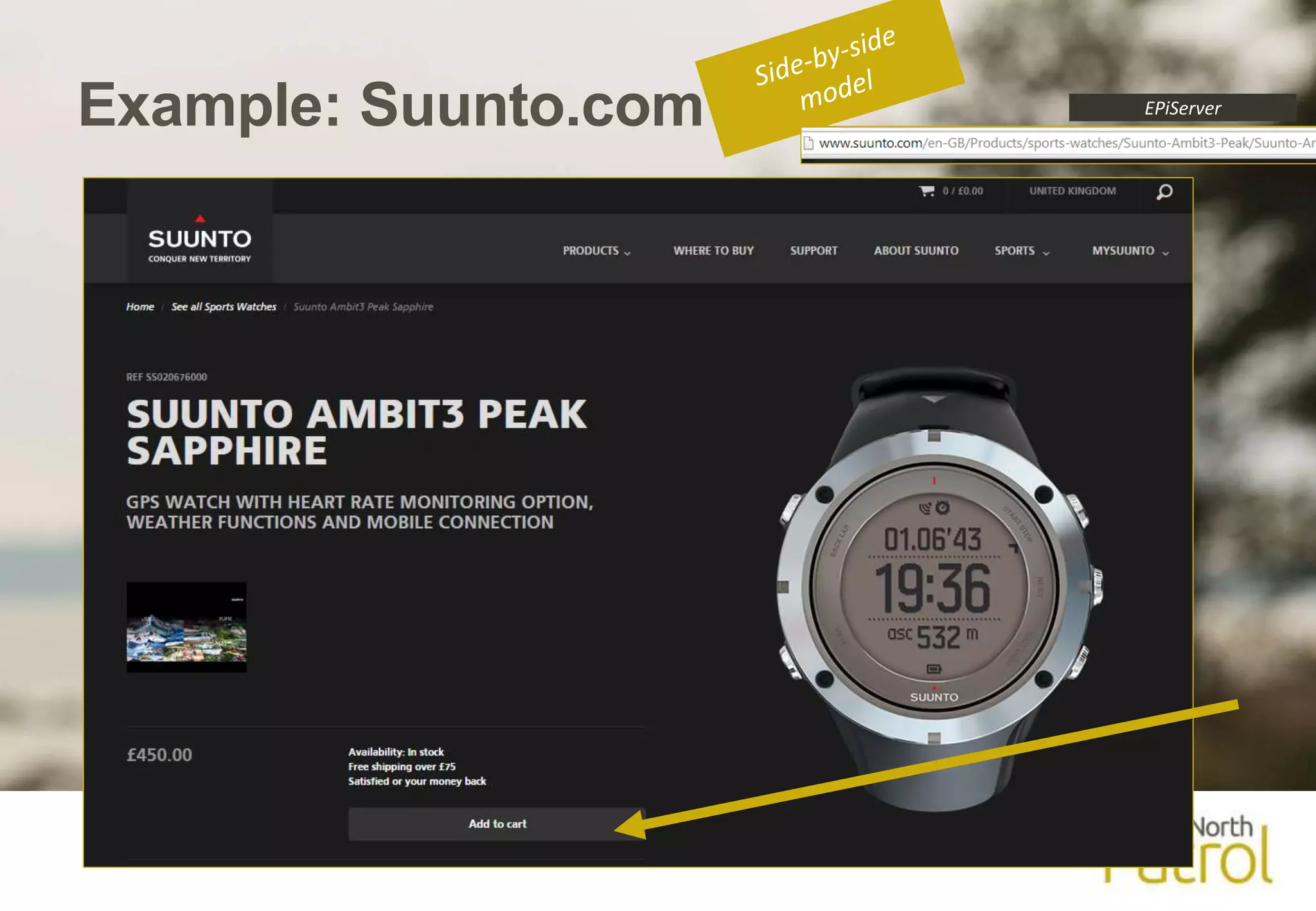
Example: Suunto.com EPiServer 
North Patrol Oy 2014
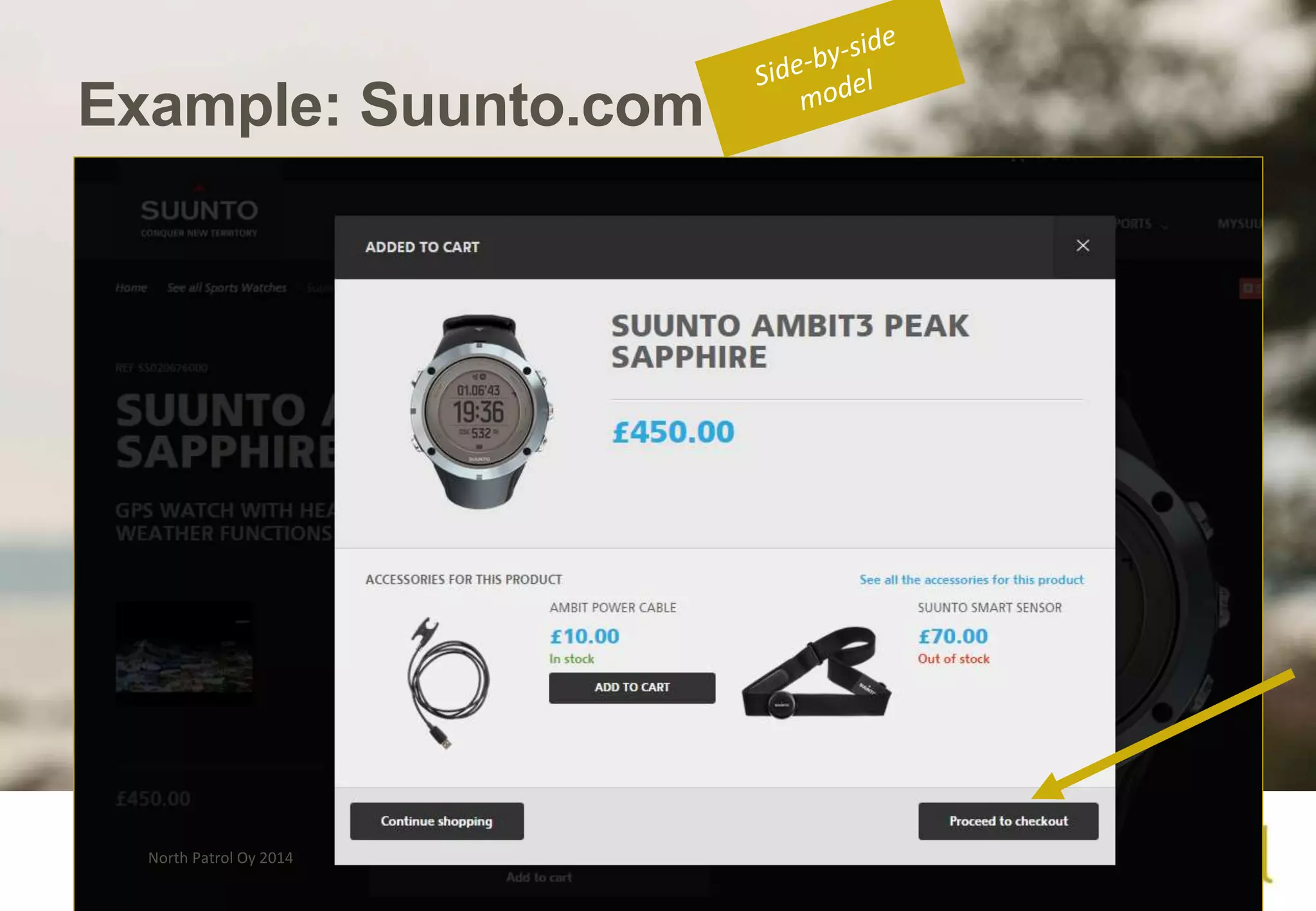
Example: Suunto.com 
North Patrol Oy 2014
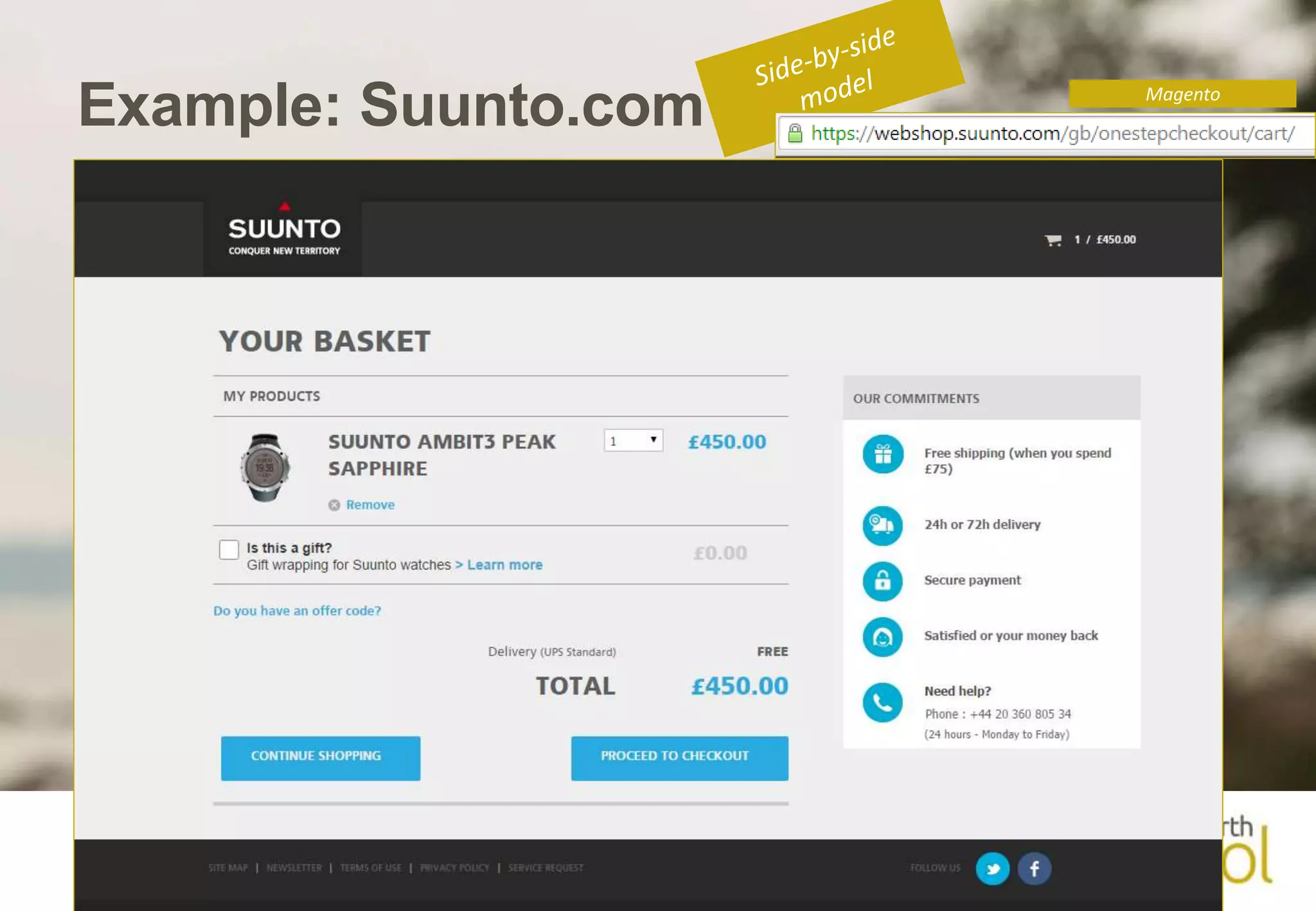
Example: Suunto.com Magento 
North Patrol Oy 2014
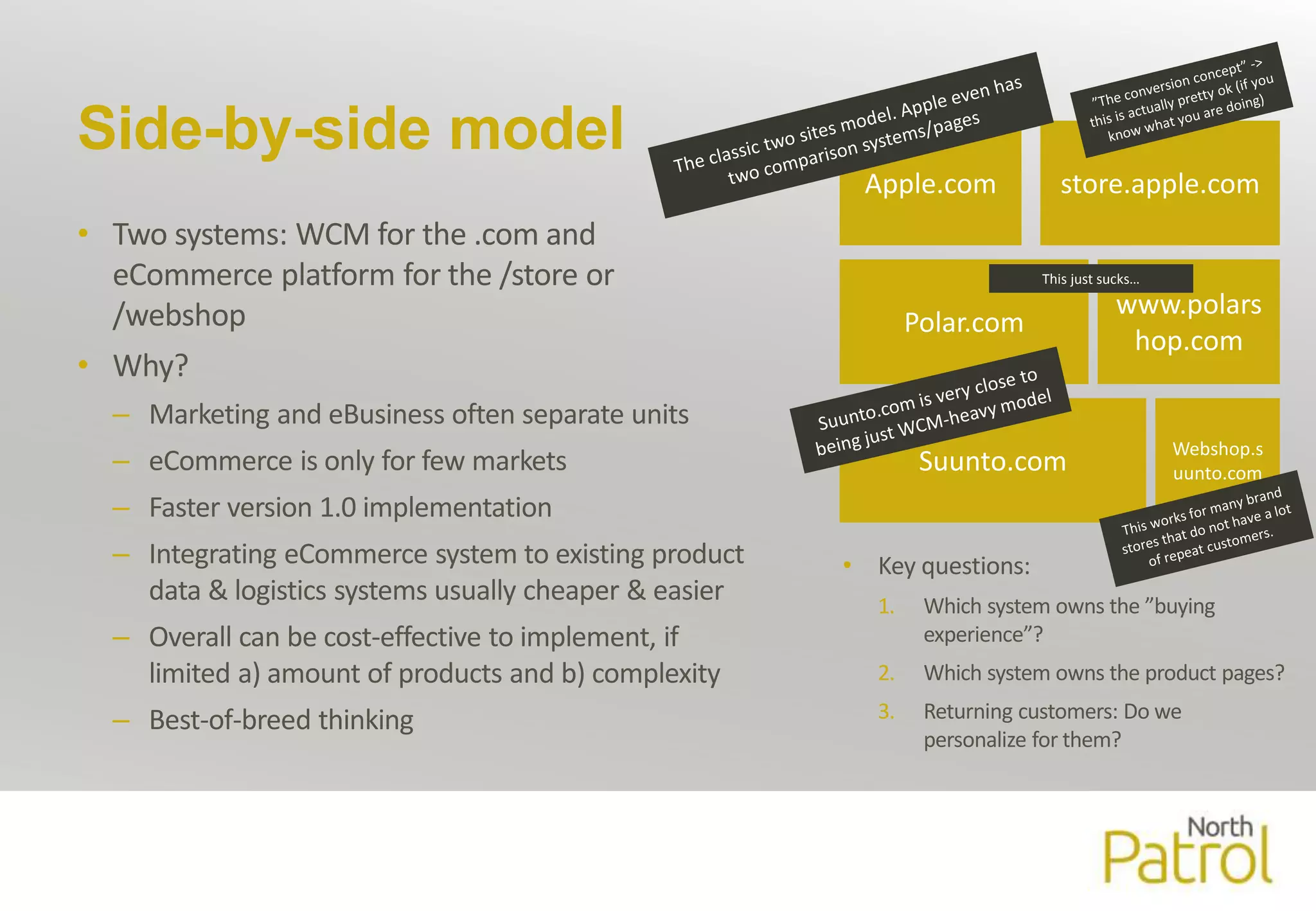
Side-by-side model 
• Two systems: WCM for the .com and 
eCommerce platform for the /store or 
/webshop 
• Why? 
– Marketing and eBusiness often separate units 
– eCommerce is only for few markets 
– Faster version 1.0 implementation 
– Integrating eCommerce system to existing product 
data & logistics systems usually cheaper & easier 
– Overall can be cost-effective to implement, if 
limited a) amount of products and b) complexity 
– Best-of-breed thinking 
Apple.com store.apple.com 
Polar.com 
This just sucks… 
Suunto.com 
www.polars 
hop.com 
Webshop.s 
uunto.com 
• Key questions: 
1. Which systemowns the ”buying 
experience”? 
2. Which systemowns the product pages? 
3. Returning customers: Do we 
personalize for them?
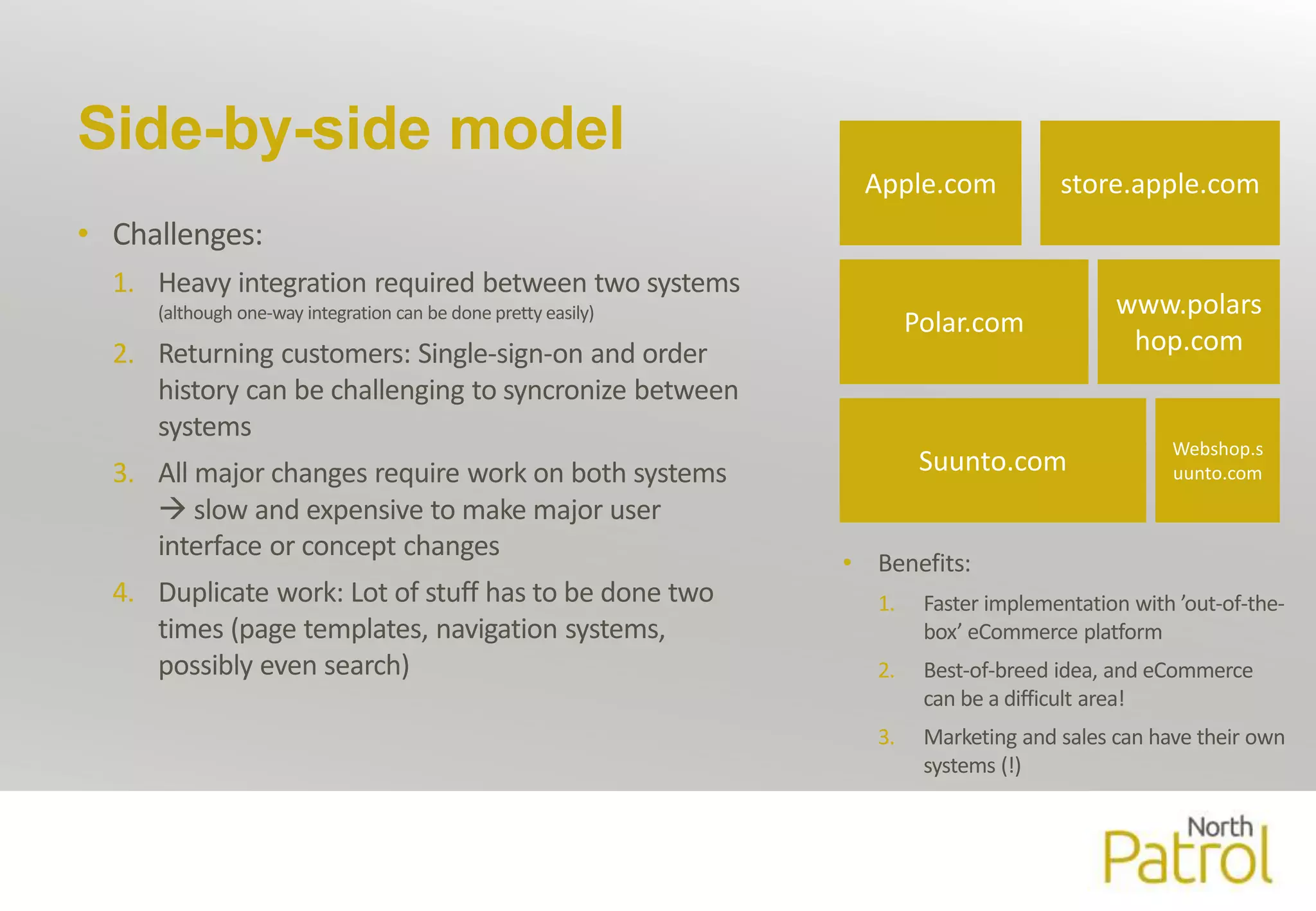
Side-by-side model 
• Challenges: 
1. Heavy integration required between two systems 
(although one-way integration can be done pretty easily) 
2. Returning customers: Single-sign-on and order 
history can be challenging to syncronize between 
systems 
3. All major changes require work on both systems 
 slow and expensive to make major user 
interface or concept changes 
4. Duplicate work: Lot of stuff has to be done two 
times (page templates, navigation systems, 
possibly even search) 
Apple.com store.apple.com 
Polar.com 
Suunto.com 
www.polars 
hop.com 
Webshop.s 
uunto.com 
• Benefits: 
1. Faster implementation with ’out-of-the-box’ 
eCommerce platform 
2. Best-of-breed idea, and eCommerce 
can be a difficult area! 
3. Marketing and sales can have their own 
systems (!)
Side-by-side model – final thoughts 
1. If you know what you are doing, side-by-side model can be pretty good. 
2. But themore you rely on external partners, the more complex and difficult it 
can be. You need strong project management to manage two systems. 
3. Recommendation: If you are a brand store that doesn’t have a lot of repeat 
customers and complex pricing models you should consider the side-by-side 
model. But even then you should decide which system owns 90% of the buying 
experience (=WCM for brand stores). See Suunto.com as a good example.
WCM-heavy vs. eCommerce-heavy 
18 North Patrol Oy 2014
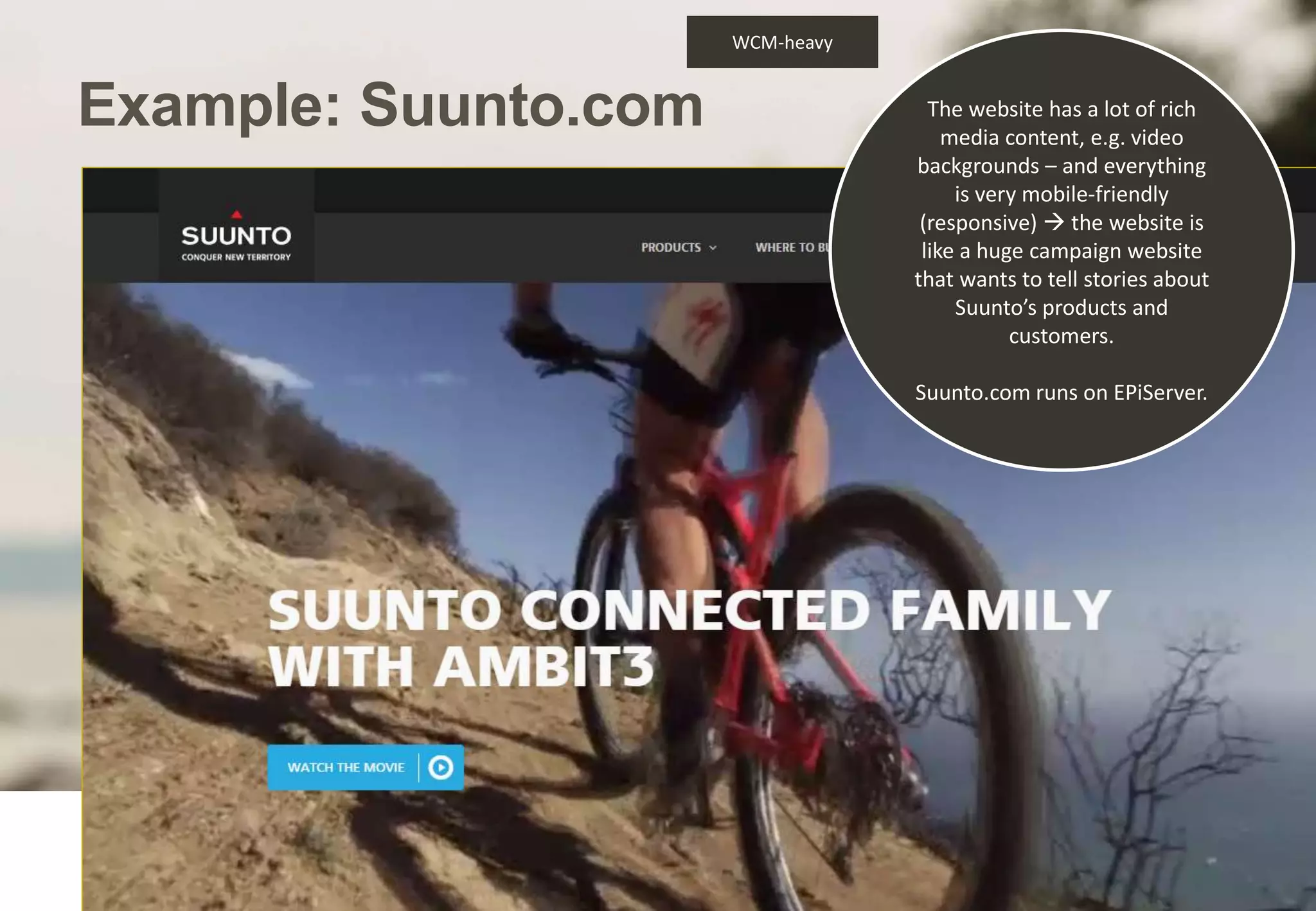
Example: Suunto.com 
North Patrol Oy 2014 
The website has a lot of rich 
media content, e.g. video 
backgrounds – and everything 
is very mobile-friendly 
(responsive)  the website is 
like a huge campaign website 
that wants to tell stories about 
Suunto’s products and 
customers. 
Suunto.com runs on EPiServer. 
WCM-heavy
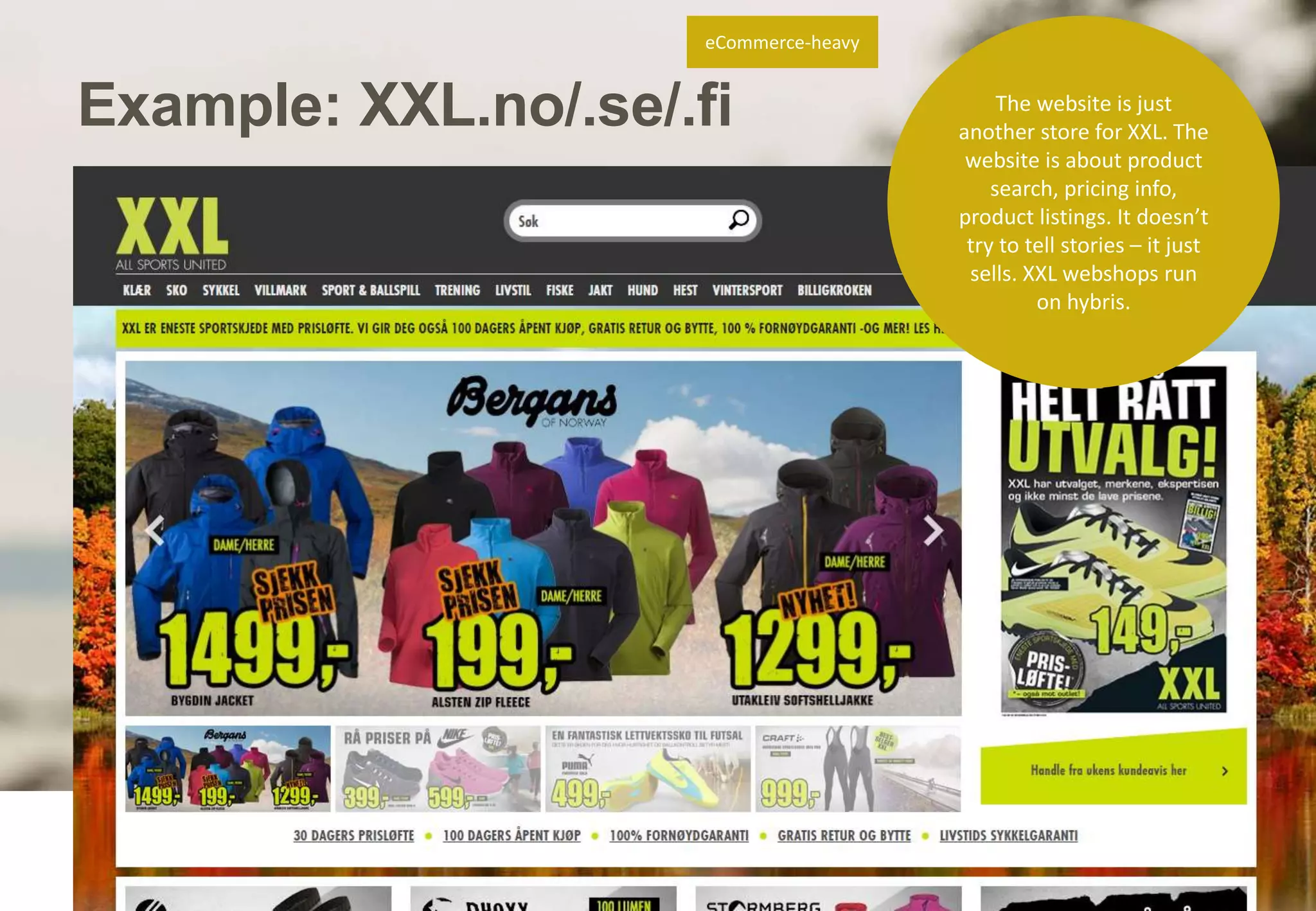
Example: XXL.no/.se/.fi 
North Patrol Oy 2014 
The website is just 
another store for XXL. The 
website is about product 
search, pricing info, 
product listings. It doesn’t 
try to tell stories – it just 
sells. XXL webshops run 
on hybris. 
eCommerce-heavy
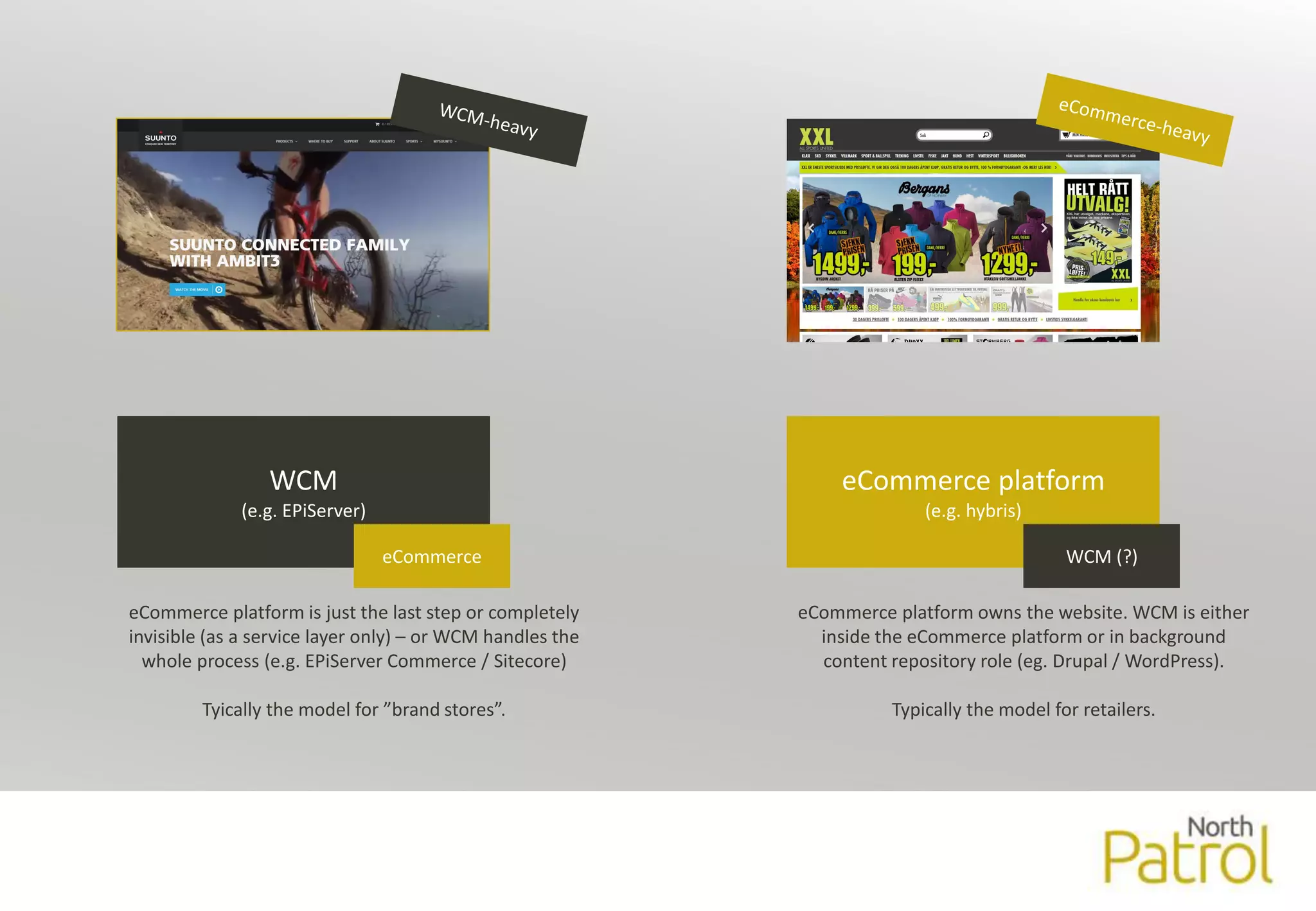
WCM 
(e.g. EPiServer) 
eCommerce 
eCommerce platform is just the last step or completely 
invisible (as a service layer only) – orWCM handles the 
whole process (e.g. EPiServer Commerce / Sitecore) 
Tyically the model for ”brand stores”. 
eCommerce platform 
(e.g. hybris) 
WCM (?) 
eCommerce platform owns the website. WCM is either 
inside the eCommerce platform or in background 
content repository role (eg. Drupal / WordPress). 
Typically the model for retailers.
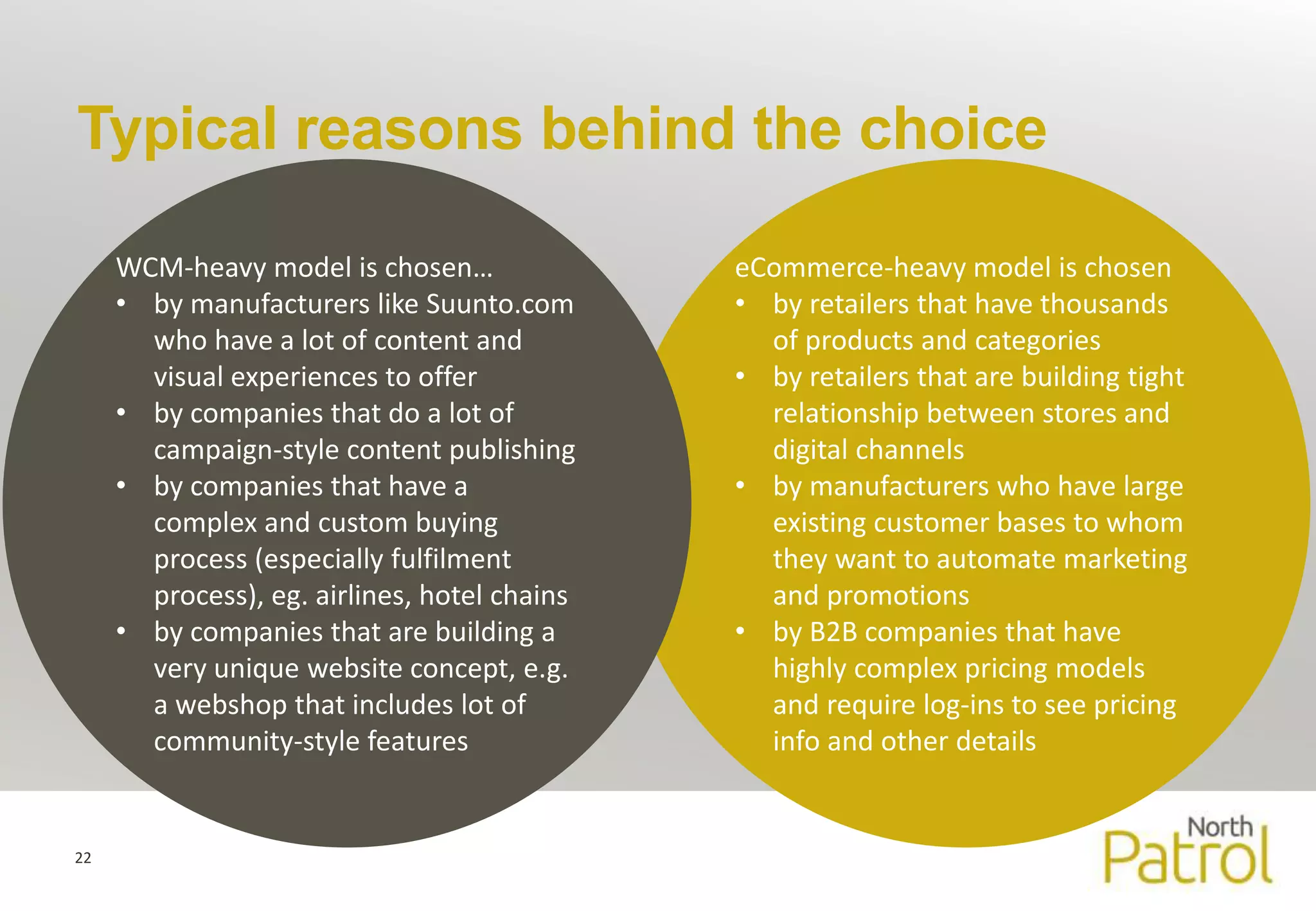
Typical reasons behind the choice 
22 
eCommerce-heavy model is chosen 
• by retailers that have thousands 
of products and categories 
• by retailers that are building tight 
relationship between stores and 
digital channels 
• by manufacturers who have large 
existing customer bases to whom 
they want to automate marketing 
and promotions 
• by B2B companies that have 
highly complex pricing models 
and require log-ins to see pricing 
info and other details 
WCM-heavy model is chosen… 
• by manufacturers like Suunto.com 
who have a lot of content and 
visual experiences to offer 
• by companies that do a lot of 
campaign-style content publishing 
• by companies that have a 
complex and custom buying 
process (especially fulfilment 
process), eg. airlines, hotel chains 
• by companies that are building a 
very unique website concept, e.g. 
a webshop that includes lot of 
community-style features
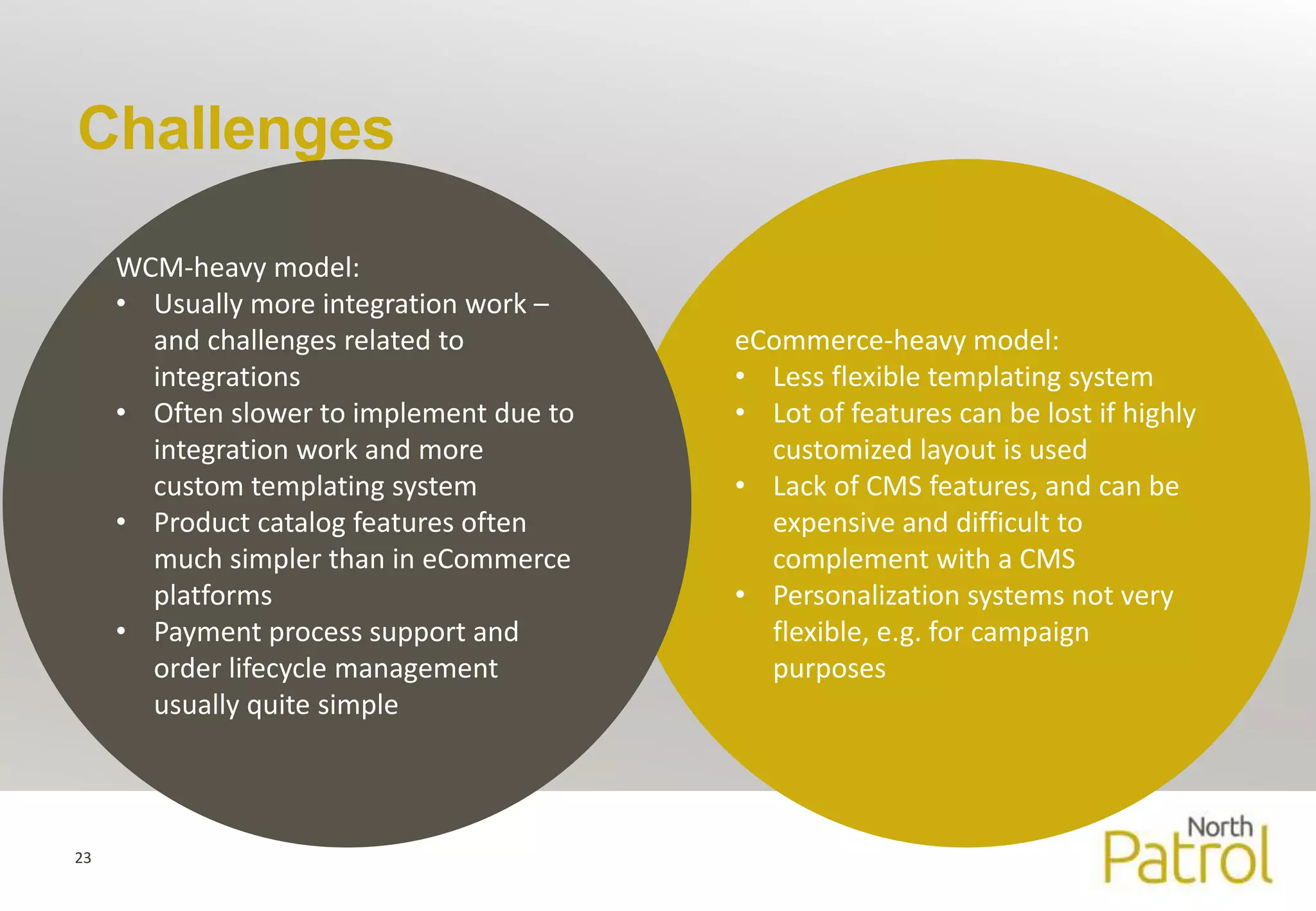
Challenges 
23 
eCommerce-heavy model: 
• Less flexible templating system 
• Lot of features can be lost if highly 
customized layout is used 
• Lack of CMS features, and can be 
expensive and difficult to 
complement with a CMS 
• Personalization systems not very 
flexible, e.g. for campaign 
purposes 
WCM-heavy model: 
• Usually more integration work – 
and challenges related to 
integrations 
• Often slower to implement due to 
integration work and more 
custom templating system 
• Product catalog features often 
much simpler than in eCommerce 
platforms 
• Payment process support and 
order lifecycle management 
usually quite simple
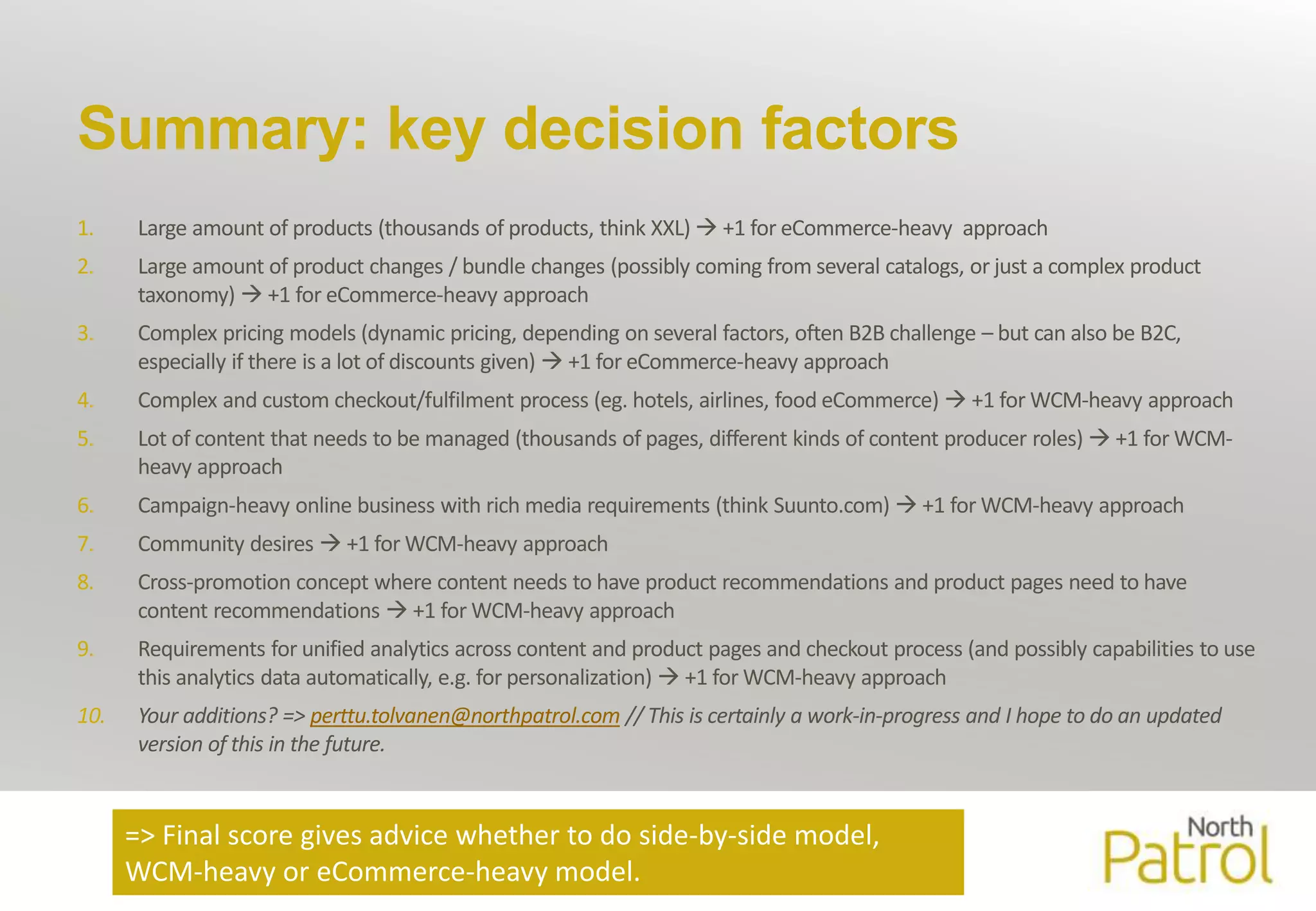
Summary: key decision factors 
1. Large amount of products (thousands of products, think XXL)  +1 for eCommerce-heavy approach 
2. Large amount of product changes / bundle changes (possibly coming fromseveral catalogs, or just a complex product 
taxonomy)  +1 for eCommerce-heavy approach 
3. Complex pricing models (dynamic pricing, depending on several factors, often B2B challenge – but can also be B2C, 
especially if there is a lot of discounts given)  +1 for eCommerce-heavy approach 
4. Complex and customcheckout/fulfilment process (eg. hotels, airlines, food eCommerce)  +1 for WCM-heavy approach 
5. Lot of content that needs to bemanaged (thousands of pages, different kinds of content producer roles)  +1 for WCM-heavy 
approach 
6. Campaign-heavy online business with richmedia requirements (think Suunto.com)  +1 for WCM-heavy approach 
7. Community desires  +1 for WCM-heavy approach 
8. Cross-promotion concept where content needs to have product recommendations and product pages need to have 
content recommendations  +1 for WCM-heavy approach 
9. Requirements for unified analytics across content and product pages and checkout process (and possibly capabilities to use 
this analytics data automatically, e.g. for personalization)  +1 for WCM-heavy approach 
10. Your additions? => perttu.tolvanen@northpatrol.com // This is certainly a work-in-progress and I hope to do an updated 
version of this in the future. 
=> Final score gives advice whether to do side-by-side model, 
WCM-heavy or eCommerce-heavy model.
Conclusions 
1. There are business cases for all models. 
2. CMSs are evolving and building eCommerce feature sets (through acquisitions or in-house) 
 but it will take years to truly catch up the dedicated eCommerce platforms 
3. For big brand stores the availability of choices is really good right now – for large 
retailers it often still makes sense to go with eCommerce platforms (due 
complexities related to product catalog or to dynamic pricing requirements). 
4. Future: For most customers eCommerce should be an invisible service that could be 
”started” from any point – and content producers could embed it everywhere they 
want. But right now the productmarket isin’t really taking huge steps in this 
direction.
Thank you. 
North 26 Patrol Oy 2014 / www.northpatrol.com
BUYER´S GUIDE TO WEB 
PROJECTS 
www.northpatrol.com/blog 
27 North Patrol Oy

Integrating CMS and eCommerce platforms

  • 1.
    Integrating CMS andeCommerce platforms - different models and pros & cons for each model Perttu Tolvanen, Web & CMS Expert, @perttutolvanen North Patrol Oy 2014 / 2014 1 -10-06 / CMS Expert Group / Helsinki
  • 2.
    Advisor for largeweb projects 2 © 2014 North Patrol Oy - Vendor-neutral CMS consultants - Helsinki-based, but most clients operate in Northern Europe / Scandinavia / Russia - CMS selections and partner selections for large projects - Founded 2012, growing
  • 3.
    Agenda Typical differences between CMS platforms and eCommerce platforms 3 North Patrol Oy 2014 Different models: a) side-by- side, b) WCM-heavy, c) eCommerce-heavy Key decision factors in choosing the right model
  • 4.
    Areas of strenght North Patrol Oy 2014 eCommerce platforms • product catalog(s) • product bundles / complex product taxonomies • order life cycle management • payment processes (inc. taxes) • dynamic/personalized pricing models • automated promotion/personalization/emails • faceted search & product listings WCM platforms • enabling custom user experience • content management (pages, content items, metadata) • rich media management • mobile delivery options • campaign management, enabling rich visual experiences • flexible personalization system • flexible platform for unique concepts
  • 5.
    Areas of strenght North Patrol Oy 2014
  • 6.
    Side-by-side model 6North Patrol Oy 2014
  • 7.
  • 8.
  • 9.
    Example: Polar.com Drupal North Patrol Oy 2014
  • 10.
    Example: Polar.com hybris North Patrol Oy 2014
  • 11.
  • 12.
    Example: Suunto.com EPiServer North Patrol Oy 2014
  • 13.
  • 14.
    Example: Suunto.com Magento North Patrol Oy 2014
  • 15.
    Side-by-side model •Two systems: WCM for the .com and eCommerce platform for the /store or /webshop • Why? – Marketing and eBusiness often separate units – eCommerce is only for few markets – Faster version 1.0 implementation – Integrating eCommerce system to existing product data & logistics systems usually cheaper & easier – Overall can be cost-effective to implement, if limited a) amount of products and b) complexity – Best-of-breed thinking Apple.com store.apple.com Polar.com This just sucks… Suunto.com www.polars hop.com Webshop.s uunto.com • Key questions: 1. Which systemowns the ”buying experience”? 2. Which systemowns the product pages? 3. Returning customers: Do we personalize for them?
  • 16.
    Side-by-side model •Challenges: 1. Heavy integration required between two systems (although one-way integration can be done pretty easily) 2. Returning customers: Single-sign-on and order history can be challenging to syncronize between systems 3. All major changes require work on both systems  slow and expensive to make major user interface or concept changes 4. Duplicate work: Lot of stuff has to be done two times (page templates, navigation systems, possibly even search) Apple.com store.apple.com Polar.com Suunto.com www.polars hop.com Webshop.s uunto.com • Benefits: 1. Faster implementation with ’out-of-the-box’ eCommerce platform 2. Best-of-breed idea, and eCommerce can be a difficult area! 3. Marketing and sales can have their own systems (!)
  • 17.
    Side-by-side model –final thoughts 1. If you know what you are doing, side-by-side model can be pretty good. 2. But themore you rely on external partners, the more complex and difficult it can be. You need strong project management to manage two systems. 3. Recommendation: If you are a brand store that doesn’t have a lot of repeat customers and complex pricing models you should consider the side-by-side model. But even then you should decide which system owns 90% of the buying experience (=WCM for brand stores). See Suunto.com as a good example.
  • 18.
    WCM-heavy vs. eCommerce-heavy 18 North Patrol Oy 2014
  • 19.
    Example: Suunto.com NorthPatrol Oy 2014 The website has a lot of rich media content, e.g. video backgrounds – and everything is very mobile-friendly (responsive)  the website is like a huge campaign website that wants to tell stories about Suunto’s products and customers. Suunto.com runs on EPiServer. WCM-heavy
  • 20.
    Example: XXL.no/.se/.fi NorthPatrol Oy 2014 The website is just another store for XXL. The website is about product search, pricing info, product listings. It doesn’t try to tell stories – it just sells. XXL webshops run on hybris. eCommerce-heavy
  • 21.
    WCM (e.g. EPiServer) eCommerce eCommerce platform is just the last step or completely invisible (as a service layer only) – orWCM handles the whole process (e.g. EPiServer Commerce / Sitecore) Tyically the model for ”brand stores”. eCommerce platform (e.g. hybris) WCM (?) eCommerce platform owns the website. WCM is either inside the eCommerce platform or in background content repository role (eg. Drupal / WordPress). Typically the model for retailers.
  • 22.
    Typical reasons behindthe choice 22 eCommerce-heavy model is chosen • by retailers that have thousands of products and categories • by retailers that are building tight relationship between stores and digital channels • by manufacturers who have large existing customer bases to whom they want to automate marketing and promotions • by B2B companies that have highly complex pricing models and require log-ins to see pricing info and other details WCM-heavy model is chosen… • by manufacturers like Suunto.com who have a lot of content and visual experiences to offer • by companies that do a lot of campaign-style content publishing • by companies that have a complex and custom buying process (especially fulfilment process), eg. airlines, hotel chains • by companies that are building a very unique website concept, e.g. a webshop that includes lot of community-style features
  • 23.
    Challenges 23 eCommerce-heavymodel: • Less flexible templating system • Lot of features can be lost if highly customized layout is used • Lack of CMS features, and can be expensive and difficult to complement with a CMS • Personalization systems not very flexible, e.g. for campaign purposes WCM-heavy model: • Usually more integration work – and challenges related to integrations • Often slower to implement due to integration work and more custom templating system • Product catalog features often much simpler than in eCommerce platforms • Payment process support and order lifecycle management usually quite simple
  • 24.
    Summary: key decisionfactors 1. Large amount of products (thousands of products, think XXL)  +1 for eCommerce-heavy approach 2. Large amount of product changes / bundle changes (possibly coming fromseveral catalogs, or just a complex product taxonomy)  +1 for eCommerce-heavy approach 3. Complex pricing models (dynamic pricing, depending on several factors, often B2B challenge – but can also be B2C, especially if there is a lot of discounts given)  +1 for eCommerce-heavy approach 4. Complex and customcheckout/fulfilment process (eg. hotels, airlines, food eCommerce)  +1 for WCM-heavy approach 5. Lot of content that needs to bemanaged (thousands of pages, different kinds of content producer roles)  +1 for WCM-heavy approach 6. Campaign-heavy online business with richmedia requirements (think Suunto.com)  +1 for WCM-heavy approach 7. Community desires  +1 for WCM-heavy approach 8. Cross-promotion concept where content needs to have product recommendations and product pages need to have content recommendations  +1 for WCM-heavy approach 9. Requirements for unified analytics across content and product pages and checkout process (and possibly capabilities to use this analytics data automatically, e.g. for personalization)  +1 for WCM-heavy approach 10. Your additions? => perttu.tolvanen@northpatrol.com // This is certainly a work-in-progress and I hope to do an updated version of this in the future. => Final score gives advice whether to do side-by-side model, WCM-heavy or eCommerce-heavy model.
  • 25.
    Conclusions 1. Thereare business cases for all models. 2. CMSs are evolving and building eCommerce feature sets (through acquisitions or in-house)  but it will take years to truly catch up the dedicated eCommerce platforms 3. For big brand stores the availability of choices is really good right now – for large retailers it often still makes sense to go with eCommerce platforms (due complexities related to product catalog or to dynamic pricing requirements). 4. Future: For most customers eCommerce should be an invisible service that could be ”started” from any point – and content producers could embed it everywhere they want. But right now the productmarket isin’t really taking huge steps in this direction.
  • 26.
    Thank you. North26 Patrol Oy 2014 / www.northpatrol.com
  • 27.
    BUYER´S GUIDE TOWEB PROJECTS www.northpatrol.com/blog 27 North Patrol Oy