IAS 37
Provisions, contingent liabilities and
contingent assets
IAS 37 - content
• Provisions
• Contingent liabilities and contingent assets
2
IAS 37 - content
Provisions
• Definition
• Recognition
• Obligation
• Accounting Treatment
• Measurement
• Change in a provision
• Provision resulting in an asset
• Specific applications
▫ Future operating losses
▫ Onerous contracts
▫ Restructuring
• Disclosures
3
IAS 37 - content
4
Contingent Liabilities
• Definition
• Accounting treatment
• Disclosures
Contingent Assets
• Definition
• Accounting treatment
• Disclosures
Provisions - definition
Provision – a liability of uncertain timing or amount.
Liability – a present obligation of the entity arising from past events,
the settlement of which is expected to result in an outflow
from the entity of resources embodying economic benefits.
5
Recognition
Per IAS 37 a provision should be recognised when:
• An entity has a present obligation (legal or constructive) arising from
a past event
• It is probable that an outflow of resources embodying economic
benefits will be required to settle the obligation
• A reliable estimate can be made of the amount of the obligation
6
Obligation
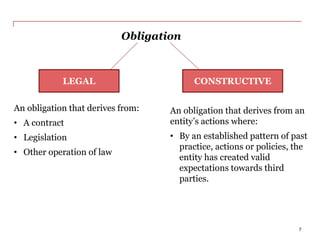
An obligation that derives from:
• A contract
• Legislation
• Other operation of law
An obligation that derives from an
entity’s actions where:
• By an established pattern of past
practice, actions or policies, the
entity has created valid
expectations towards third
parties.
LEGAL CONSTRUCTIVE
7
Accounting Treatment
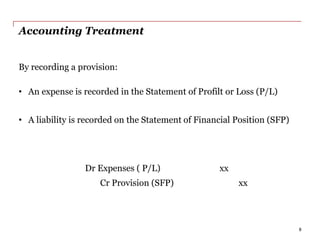
By recording a provision:
• An expense is recorded in the Statement of Profilt or Loss (P/L)
• A liability is recorded on the Statement of Financial Position (SFP)
8
Dr Expenses ( P/L) xx
Cr Provision (SFP) xx
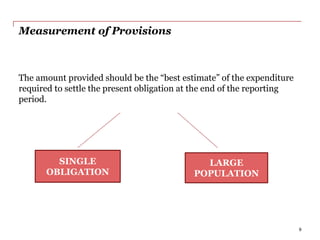
Measurement of Provisions
The amount provided should be the “best estimate” of the expenditure
required to settle the present obligation at the end of the reporting
period.
SINGLE
OBLIGATION
LARGE
POPULATION
9
Single Obligation
Example
The expenditure of a single obligation is estimated at €20,000 and
there is a 60% chance of the expenditure being incurred.
The process of estimating the amount involves two steps:
1. Is it probable there will be an outflow of economic resources?
2. Can a reliable estimate be made?
10
Large Population
Where there is a large population of items, the obligation is estimated
by weighting all possible outcomes by their associated probabilities to
arrive at the expected value.
Example: Warranties
11
Example
ABC plc sells goods which carry a one-year repair warranty. If minor
repairs were to be required for all goods sold in 2014, the cost would be
£100,000. If major repairs were to be needed for all goods sold in 2010,
the cost would be €500,000.
ABC plc estimates that 80% of goods sold in 2014 will have no defects,
15% will have minor defects and 5% will have major defects.
Requirement
Calculate the provision for repairs required at 31 December 2014
12
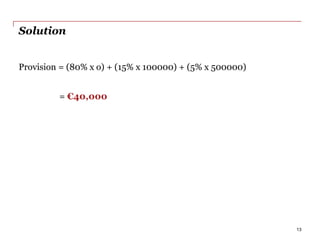
Solution
Provision = (80% x o) + (15% x 100000) + (5% x 500000)
= €40,000
13
Discounting
• Where the effect of the time value of money is material, the amount of
the provision should be discounted
• i.e. it should be recorded at the present value of the expenditure
required to settle the obligation.
• This is likely to be an issue when there is a significant period of time
between the end of the reporting period and settlement of the
obligation.
• The discount rate used should be the pre-tax rate that reflects current
market assessments of the time value of money and the risks specific
to the liability.
14
Discounting
• Over the period between the recognition of a provision and its
ultimate settlement, the provision should be increased each year by
the discount rate.
• The increase should be recognised as a finance cost in profit or loss,
not as a further expense under the line item where the original
provision was charged.
• This is known as “unwinding of the discount”.
15
Example
ABC Plc has a present obligation at 31 December 2014, which it expects
to settle in three years' time for €100,000. The rate which reflects the
time value of money and the risks specific to the liability is 10%.
Requirement
1. At what amount should the provision be measured at 31 December
2014?
2. How much should be recognised as a finance charge in each of the
three years ending 31 December 2015, 2016 and 2017?
16
Solution
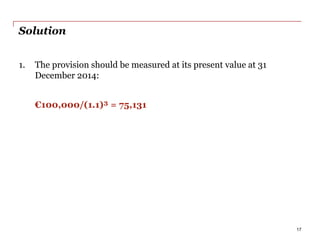
1. The provision should be measured at its present value at 31
December 2014:
€100,000/(1.1)³ = 75,131
17
Solution
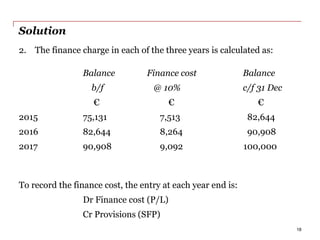
2. The finance charge in each of the three years is calculated as:
Balance Finance cost Balance
b/f @ 10% c/f 31 Dec
€ € €
2015 75,131 7,513 82,644
2016 82,644 8,264 90,908
2017 90,908 9,092 100,000
To record the finance cost, the entry at each year end is:
Dr Finance cost (P/L)
Cr Provisions (SFP)
18
Future events
• Future events such as changes in technologies, efficiency improvements
and changes in legislation may have a significant impact on the
measurement of provisions.
• These should be taken into account where there is sufficient objective
evidence that they will occur.
19
Expected disposals of assets
• Gains from the expected disposal of assets should not be taken into
account in measuring a provision even if the expected disposal is closely
linked to the event giving rise to the provision.
• Instead, such gains are accounted for under the relevant IFRS
IAS 16 Property, Plant and Equipment
IFRS 5 Non-current Assets Held for Sale and Discontinued Operations
20
Reimbursements
• In some cases, an insurance company or a supplier under a warranty
may reimburse all or part of a company’s expenditure to settle a
provision.
• If so the reimbursement should be recognised only when it is virtually
certain that reimbursement will be received if the entity settles the
obligation.
• IAS 37 requires that the reimbursement should be:
1. Treated as an asset in the SFP separate from the provision; and
2. Recognised in the SFP at an amount not exceeding the amount of
the provision
21
Example
• A customer sues Restaurant X for food poisoning, €50,000.
• Restaurant X makes a counter claim against their suppliers for
€70,000.
• Per the legal advisers, both claims are certain to succeed.
22
Solution
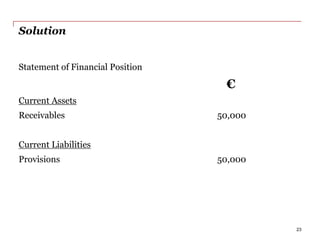
Statement of Financial Position
€
Current Assets
Receivables 50,000
Current Liabilities
Provisions 50,000
23
Changes in Provisions
• Provisions are inherently uncertain
• IAS 37 requires that they should be reviewed at the end of each
reporting period and adjusted to reflect the current best estimate
• If a transfer of economic benefit is no longer probable, the provision
should be reversed.
24
Use of provisions
• IAS 37 specifies that a provision should be used only for expenditures
for which the provision was originally recognised.
• If a provision is no longer required for its originally intended purpose,
it should be reversed and not used to conceal the impact of other
unrelated expenditure.
• The reversal is a change of accounting estimate (IAS 8) and is
recognised in profit or loss in the year of reversal.
25
Recognising an asset when recognising a
provision
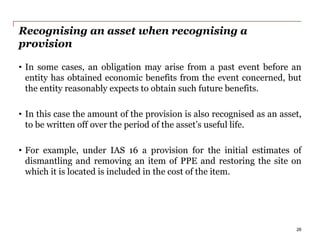
• In some cases, an obligation may arise from a past event before an
entity has obtained economic benefits from the event concerned, but
the entity reasonably expects to obtain such future benefits.
• In this case the amount of the provision is also recognised as an asset,
to be written off over the period of the asset’s useful life.
• For example, under IAS 16 a provision for the initial estimates of
dismantling and removing an item of PPE and restoring the site on
which it is located is included in the cost of the item.
26
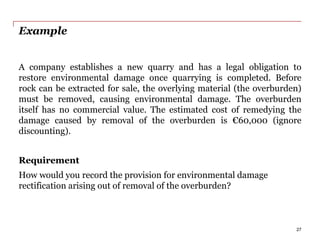
Example
A company establishes a new quarry and has a legal obligation to
restore environmental damage once quarrying is completed. Before
rock can be extracted for sale, the overlying material (the overburden)
must be removed, causing environmental damage. The overburden
itself has no commercial value. The estimated cost of remedying the
damage caused by removal of the overburden is €60,000 (ignore
discounting).
Requirement
How would you record the provision for environmental damage
rectification arising out of removal of the overburden?
27
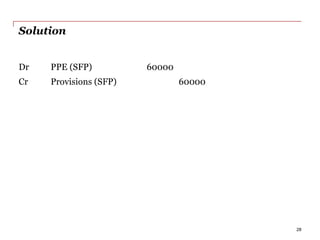
Solution
Dr PPE (SFP) 60000
Cr Provisions (SFP) 60000
28
Specific Applications per IAS 37
• Future operating losses
• Onerous contracts
• Restructuring
29
Future operating losses
• Provisions should not be recognised for future operating losses
• They do not meet:
- the definition of a liability
(as they arise from future, not past events)
- the general recognition criteria per IAS 37
30
Onerous contracts
Definition
An onerous contract is a contract in which the unavoidable costs of
meeting the obligations under the contract exceed the economic benefit
expected to be received under it.
31
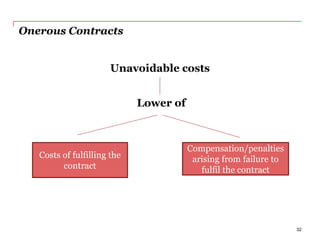
Onerous Contracts
Unavoidable costs
Lower of
Costs of fulfilling the
contract
Compensation/penalties
arising from failure to
fulfil the contract
32
Onerous Contracts
Treatment
• At the year end, there is an obligation to meet the contract
• Therefore a provision must be recognised
33
Example
A company rents a building under an operating lease, but vacates the
building shortly before the end of its reporting period, due to business
relocation. The lease on the vacated building has three years to run and
cannot be cancelled. The building cannot be sub-let.
34
Solution
In this case, the conditions for making a provision are met as:
• A present obligation exists as a result of a past event (the signing of
the lease)
• An outflow of resources embodying economic benefit in settlement is
probable (rentals for the remainder of the lease term); and
• The amount can be measured reliably (the future rentals, discounted if
material).
35
Restructuring
Definition
Restructuring is a programme that is planned and controlled by
management, and materially changes either:
• The scope of a business undertaken by an entity; or
• The manner in which that business is conducted.
36
Restructuring
Examples
• Sale or termination of a line of business
• Closure of business locations or the relocation of business activities
• Changes in management structure
• Fundamental reorganisations that have a material effect on the nature
and focus of the entity’s operations.
37
Restructuring
• The key accounting issue is whether, and if so, when, to recognise a
provision for a planned restructuring.
• IAS 37 treats a restructuring as creating a constructive obligation
38
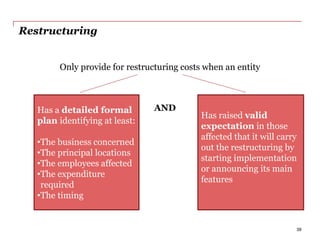
Restructuring
Only provide for restructuring costs when an entity
Has a detailed formal
plan identifying at least:
•The business concerned
•The principal locations
•The employees affected
•The expenditure
required
•The timing
Has raised valid
expectation in those
affected that it will carry
out the restructuring by
starting implementation
or announcing its main
features
AND
39
Restructuring
A management or board decision taken before the end of the reporting
period in itself does not give rise to a constructive obligation at the end
of the reporting period unless the entity has:
• Already begun implementation; or
• Made a public announcement of the main features sufficient to
establish a constructive obligation.
40
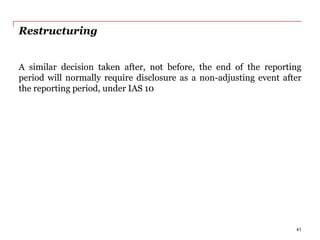
Restructuring
A similar decision taken after, not before, the end of the reporting
period will normally require disclosure as a non-adjusting event after
the reporting period, under IAS 10
41
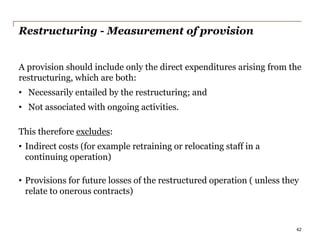
Restructuring - Measurement of provision
A provision should include only the direct expenditures arising from the
restructuring, which are both:
• Necessarily entailed by the restructuring; and
• Not associated with ongoing activities.
This therefore excludes:
• Indirect costs (for example retraining or relocating staff in a
continuing operation)
• Provisions for future losses of the restructured operation ( unless they
relate to onerous contracts)
42
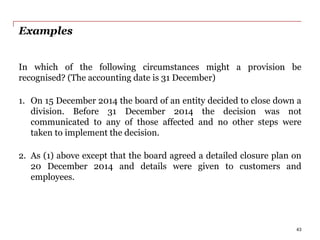
Examples
In which of the following circumstances might a provision be
recognised? (The accounting date is 31 December)
1. On 15 December 2014 the board of an entity decided to close down a
division. Before 31 December 2014 the decision was not
communicated to any of those affected and no other steps were
taken to implement the decision.
2. As (1) above except that the board agreed a detailed closure plan on
20 December 2014 and details were given to customers and
employees.
43
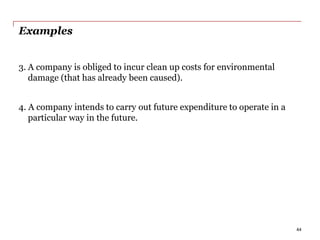
Examples
3. A company is obliged to incur clean up costs for environmental
damage (that has already been caused).
4. A company intends to carry out future expenditure to operate in a
particular way in the future.
44
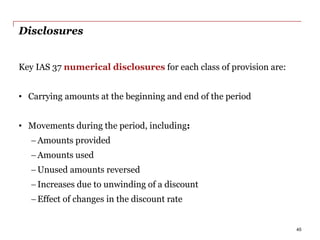
Disclosures
Key IAS 37 numerical disclosures for each class of provision are:
• Carrying amounts at the beginning and end of the period
• Movements during the period, including:
 Amounts provided
 Amounts used
 Unused amounts reversed
 Increases due to unwinding of a discount
 Effect of changes in the discount rate
45
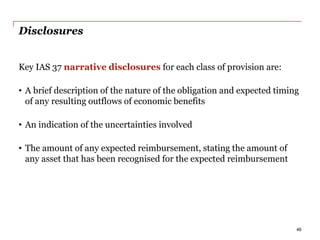
Disclosures
Key IAS 37 narrative disclosures for each class of provision are:
• A brief description of the nature of the obligation and expected timing
of any resulting outflows of economic benefits
• An indication of the uncertainties involved
• The amount of any expected reimbursement, stating the amount of
any asset that has been recognised for the expected reimbursement
46
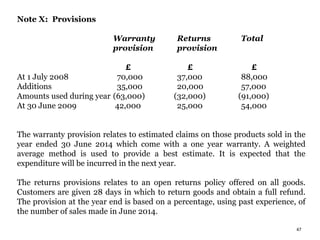
Note X: Provisions
Warranty Returns Total
provision provision
£ £ £
At 1 July 2008 70,000 37,000 88,000
Additions 35,000 20,000 57,000
Amounts used during year (63,000) (32,000) (91,000)
At 30 June 2009 42,000 25,000 54,000
The warranty provision relates to estimated claims on those products sold in the
year ended 30 June 2014 which come with a one year warranty. A weighted
average method is used to provide a best estimate. It is expected that the
expenditure will be incurred in the next year.
The returns provisions relates to an open returns policy offered on all goods.
Customers are given 28 days in which to return goods and obtain a full refund.
The provision at the year end is based on a percentage, using past experience, of
the number of sales made in June 2014.
47
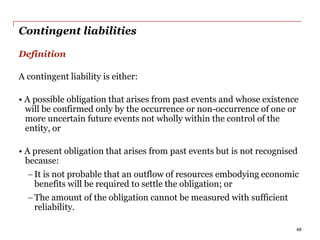
Contingent liabilities
Definition
A contingent liability is either:
• A possible obligation that arises from past events and whose existence
will be confirmed only by the occurrence or non-occurrence of one or
more uncertain future events not wholly within the control of the
entity, or
• A present obligation that arises from past events but is not recognised
because:
 It is not probable that an outflow of resources embodying economic
benefits will be required to settle the obligation; or
 The amount of the obligation cannot be measured with sufficient
reliability.
48
Accounting treatment
• Contingent liabilities should not be recognised in the financial
statements, but may require disclosure
• Because contingent liabilities are inherently uncertain, they should be
assessed continually to identify whether the criteria for recognising a
provision have been met.
• If this occurs, a provision should be recognised in the period in which
the criteria are met.
• This would represent a change of accounting estimate regarding the
likely outcome of an uncertain situation.
49
Disclosures – Contingent Liabilities
Unless the possibility of any outflow in settlement is remote, the
following disclosures should be made for each class of contingent
liability at the end of the reporting period:
• A brief description of its nature; and
• Where practicable:
 An estimate of the financial effect (measured in the same way as a
provision)
 An indication of the uncertainties; and
 The possibility of any reimbursement
50
Contingent assets
Definition
A contingent asset is a possible asset that arises from past events and
whose existence will be confirmed only by the occurrence or non-
occurrence of one or more uncertain future events not wholly within the
control of the entity.
51
Accounting treatment
• A contingent asset must not be recognised.
• Recognition only takes place when the realisation of the related
economic benefits is virtually certain ie at the point the asset is no
longer contingent (This is an application of the prudence concept).
• Contingent assets should be assessed continually to identify whether
the uncertainty has been removed.
• If events confirm the existence of an asset, it should be recognised
provided that it can be measured reliably.
52
Disclosures – Contingent Assets
• Where an inflow of economic benefits is probable (more likely than
not), the contingent asset must be disclosed.
• The following information is required:
- A brief description of the nature of the contingent asset
- An estimate of the financial effect
53
Disclosures
NOTE
For both contingent assets and contingent liabilities, these disclosures
may be avoided on the grounds that it is impractical to provide the
information or would be seriously prejudicial to the entity
54
Thank you!

2 ias 37 provisions-updated.pptx

  • 1.
    IAS 37 Provisions, contingentliabilities and contingent assets
  • 2.
    IAS 37 -content • Provisions • Contingent liabilities and contingent assets 2
  • 3.
    IAS 37 -content Provisions • Definition • Recognition • Obligation • Accounting Treatment • Measurement • Change in a provision • Provision resulting in an asset • Specific applications ▫ Future operating losses ▫ Onerous contracts ▫ Restructuring • Disclosures 3
  • 4.
    IAS 37 -content 4 Contingent Liabilities • Definition • Accounting treatment • Disclosures Contingent Assets • Definition • Accounting treatment • Disclosures
  • 5.
    Provisions - definition Provision– a liability of uncertain timing or amount. Liability – a present obligation of the entity arising from past events, the settlement of which is expected to result in an outflow from the entity of resources embodying economic benefits. 5
  • 6.
    Recognition Per IAS 37a provision should be recognised when: • An entity has a present obligation (legal or constructive) arising from a past event • It is probable that an outflow of resources embodying economic benefits will be required to settle the obligation • A reliable estimate can be made of the amount of the obligation 6
  • 7.
    Obligation An obligation thatderives from: • A contract • Legislation • Other operation of law An obligation that derives from an entity’s actions where: • By an established pattern of past practice, actions or policies, the entity has created valid expectations towards third parties. LEGAL CONSTRUCTIVE 7
  • 8.
    Accounting Treatment By recordinga provision: • An expense is recorded in the Statement of Profilt or Loss (P/L) • A liability is recorded on the Statement of Financial Position (SFP) 8 Dr Expenses ( P/L) xx Cr Provision (SFP) xx
  • 9.
    Measurement of Provisions Theamount provided should be the “best estimate” of the expenditure required to settle the present obligation at the end of the reporting period. SINGLE OBLIGATION LARGE POPULATION 9
  • 10.
    Single Obligation Example The expenditureof a single obligation is estimated at €20,000 and there is a 60% chance of the expenditure being incurred. The process of estimating the amount involves two steps: 1. Is it probable there will be an outflow of economic resources? 2. Can a reliable estimate be made? 10
  • 11.
    Large Population Where thereis a large population of items, the obligation is estimated by weighting all possible outcomes by their associated probabilities to arrive at the expected value. Example: Warranties 11
  • 12.
    Example ABC plc sellsgoods which carry a one-year repair warranty. If minor repairs were to be required for all goods sold in 2014, the cost would be £100,000. If major repairs were to be needed for all goods sold in 2010, the cost would be €500,000. ABC plc estimates that 80% of goods sold in 2014 will have no defects, 15% will have minor defects and 5% will have major defects. Requirement Calculate the provision for repairs required at 31 December 2014 12
  • 13.
    Solution Provision = (80%x o) + (15% x 100000) + (5% x 500000) = €40,000 13
  • 14.
    Discounting • Where theeffect of the time value of money is material, the amount of the provision should be discounted • i.e. it should be recorded at the present value of the expenditure required to settle the obligation. • This is likely to be an issue when there is a significant period of time between the end of the reporting period and settlement of the obligation. • The discount rate used should be the pre-tax rate that reflects current market assessments of the time value of money and the risks specific to the liability. 14
  • 15.
    Discounting • Over theperiod between the recognition of a provision and its ultimate settlement, the provision should be increased each year by the discount rate. • The increase should be recognised as a finance cost in profit or loss, not as a further expense under the line item where the original provision was charged. • This is known as “unwinding of the discount”. 15
  • 16.
    Example ABC Plc hasa present obligation at 31 December 2014, which it expects to settle in three years' time for €100,000. The rate which reflects the time value of money and the risks specific to the liability is 10%. Requirement 1. At what amount should the provision be measured at 31 December 2014? 2. How much should be recognised as a finance charge in each of the three years ending 31 December 2015, 2016 and 2017? 16
  • 17.
    Solution 1. The provisionshould be measured at its present value at 31 December 2014: €100,000/(1.1)³ = 75,131 17
  • 18.
    Solution 2. The financecharge in each of the three years is calculated as: Balance Finance cost Balance b/f @ 10% c/f 31 Dec € € € 2015 75,131 7,513 82,644 2016 82,644 8,264 90,908 2017 90,908 9,092 100,000 To record the finance cost, the entry at each year end is: Dr Finance cost (P/L) Cr Provisions (SFP) 18
  • 19.
    Future events • Futureevents such as changes in technologies, efficiency improvements and changes in legislation may have a significant impact on the measurement of provisions. • These should be taken into account where there is sufficient objective evidence that they will occur. 19
  • 20.
    Expected disposals ofassets • Gains from the expected disposal of assets should not be taken into account in measuring a provision even if the expected disposal is closely linked to the event giving rise to the provision. • Instead, such gains are accounted for under the relevant IFRS IAS 16 Property, Plant and Equipment IFRS 5 Non-current Assets Held for Sale and Discontinued Operations 20
  • 21.
    Reimbursements • In somecases, an insurance company or a supplier under a warranty may reimburse all or part of a company’s expenditure to settle a provision. • If so the reimbursement should be recognised only when it is virtually certain that reimbursement will be received if the entity settles the obligation. • IAS 37 requires that the reimbursement should be: 1. Treated as an asset in the SFP separate from the provision; and 2. Recognised in the SFP at an amount not exceeding the amount of the provision 21
  • 22.
    Example • A customersues Restaurant X for food poisoning, €50,000. • Restaurant X makes a counter claim against their suppliers for €70,000. • Per the legal advisers, both claims are certain to succeed. 22
  • 23.
    Solution Statement of FinancialPosition € Current Assets Receivables 50,000 Current Liabilities Provisions 50,000 23
  • 24.
    Changes in Provisions •Provisions are inherently uncertain • IAS 37 requires that they should be reviewed at the end of each reporting period and adjusted to reflect the current best estimate • If a transfer of economic benefit is no longer probable, the provision should be reversed. 24
  • 25.
    Use of provisions •IAS 37 specifies that a provision should be used only for expenditures for which the provision was originally recognised. • If a provision is no longer required for its originally intended purpose, it should be reversed and not used to conceal the impact of other unrelated expenditure. • The reversal is a change of accounting estimate (IAS 8) and is recognised in profit or loss in the year of reversal. 25
  • 26.
    Recognising an assetwhen recognising a provision • In some cases, an obligation may arise from a past event before an entity has obtained economic benefits from the event concerned, but the entity reasonably expects to obtain such future benefits. • In this case the amount of the provision is also recognised as an asset, to be written off over the period of the asset’s useful life. • For example, under IAS 16 a provision for the initial estimates of dismantling and removing an item of PPE and restoring the site on which it is located is included in the cost of the item. 26
  • 27.
    Example A company establishesa new quarry and has a legal obligation to restore environmental damage once quarrying is completed. Before rock can be extracted for sale, the overlying material (the overburden) must be removed, causing environmental damage. The overburden itself has no commercial value. The estimated cost of remedying the damage caused by removal of the overburden is €60,000 (ignore discounting). Requirement How would you record the provision for environmental damage rectification arising out of removal of the overburden? 27
  • 28.
    Solution Dr PPE (SFP)60000 Cr Provisions (SFP) 60000 28
  • 29.
    Specific Applications perIAS 37 • Future operating losses • Onerous contracts • Restructuring 29
  • 30.
    Future operating losses •Provisions should not be recognised for future operating losses • They do not meet: - the definition of a liability (as they arise from future, not past events) - the general recognition criteria per IAS 37 30
  • 31.
    Onerous contracts Definition An onerouscontract is a contract in which the unavoidable costs of meeting the obligations under the contract exceed the economic benefit expected to be received under it. 31
  • 32.
    Onerous Contracts Unavoidable costs Lowerof Costs of fulfilling the contract Compensation/penalties arising from failure to fulfil the contract 32
  • 33.
    Onerous Contracts Treatment • Atthe year end, there is an obligation to meet the contract • Therefore a provision must be recognised 33
  • 34.
    Example A company rentsa building under an operating lease, but vacates the building shortly before the end of its reporting period, due to business relocation. The lease on the vacated building has three years to run and cannot be cancelled. The building cannot be sub-let. 34
  • 35.
    Solution In this case,the conditions for making a provision are met as: • A present obligation exists as a result of a past event (the signing of the lease) • An outflow of resources embodying economic benefit in settlement is probable (rentals for the remainder of the lease term); and • The amount can be measured reliably (the future rentals, discounted if material). 35
  • 36.
    Restructuring Definition Restructuring is aprogramme that is planned and controlled by management, and materially changes either: • The scope of a business undertaken by an entity; or • The manner in which that business is conducted. 36
  • 37.
    Restructuring Examples • Sale ortermination of a line of business • Closure of business locations or the relocation of business activities • Changes in management structure • Fundamental reorganisations that have a material effect on the nature and focus of the entity’s operations. 37
  • 38.
    Restructuring • The keyaccounting issue is whether, and if so, when, to recognise a provision for a planned restructuring. • IAS 37 treats a restructuring as creating a constructive obligation 38
  • 39.
    Restructuring Only provide forrestructuring costs when an entity Has a detailed formal plan identifying at least: •The business concerned •The principal locations •The employees affected •The expenditure required •The timing Has raised valid expectation in those affected that it will carry out the restructuring by starting implementation or announcing its main features AND 39
  • 40.
    Restructuring A management orboard decision taken before the end of the reporting period in itself does not give rise to a constructive obligation at the end of the reporting period unless the entity has: • Already begun implementation; or • Made a public announcement of the main features sufficient to establish a constructive obligation. 40
  • 41.
    Restructuring A similar decisiontaken after, not before, the end of the reporting period will normally require disclosure as a non-adjusting event after the reporting period, under IAS 10 41
  • 42.
    Restructuring - Measurementof provision A provision should include only the direct expenditures arising from the restructuring, which are both: • Necessarily entailed by the restructuring; and • Not associated with ongoing activities. This therefore excludes: • Indirect costs (for example retraining or relocating staff in a continuing operation) • Provisions for future losses of the restructured operation ( unless they relate to onerous contracts) 42
  • 43.
    Examples In which ofthe following circumstances might a provision be recognised? (The accounting date is 31 December) 1. On 15 December 2014 the board of an entity decided to close down a division. Before 31 December 2014 the decision was not communicated to any of those affected and no other steps were taken to implement the decision. 2. As (1) above except that the board agreed a detailed closure plan on 20 December 2014 and details were given to customers and employees. 43
  • 44.
    Examples 3. A companyis obliged to incur clean up costs for environmental damage (that has already been caused). 4. A company intends to carry out future expenditure to operate in a particular way in the future. 44
  • 45.
    Disclosures Key IAS 37numerical disclosures for each class of provision are: • Carrying amounts at the beginning and end of the period • Movements during the period, including:  Amounts provided  Amounts used  Unused amounts reversed  Increases due to unwinding of a discount  Effect of changes in the discount rate 45
  • 46.
    Disclosures Key IAS 37narrative disclosures for each class of provision are: • A brief description of the nature of the obligation and expected timing of any resulting outflows of economic benefits • An indication of the uncertainties involved • The amount of any expected reimbursement, stating the amount of any asset that has been recognised for the expected reimbursement 46
  • 47.
    Note X: Provisions WarrantyReturns Total provision provision £ £ £ At 1 July 2008 70,000 37,000 88,000 Additions 35,000 20,000 57,000 Amounts used during year (63,000) (32,000) (91,000) At 30 June 2009 42,000 25,000 54,000 The warranty provision relates to estimated claims on those products sold in the year ended 30 June 2014 which come with a one year warranty. A weighted average method is used to provide a best estimate. It is expected that the expenditure will be incurred in the next year. The returns provisions relates to an open returns policy offered on all goods. Customers are given 28 days in which to return goods and obtain a full refund. The provision at the year end is based on a percentage, using past experience, of the number of sales made in June 2014. 47
  • 48.
    Contingent liabilities Definition A contingentliability is either: • A possible obligation that arises from past events and whose existence will be confirmed only by the occurrence or non-occurrence of one or more uncertain future events not wholly within the control of the entity, or • A present obligation that arises from past events but is not recognised because:  It is not probable that an outflow of resources embodying economic benefits will be required to settle the obligation; or  The amount of the obligation cannot be measured with sufficient reliability. 48
  • 49.
    Accounting treatment • Contingentliabilities should not be recognised in the financial statements, but may require disclosure • Because contingent liabilities are inherently uncertain, they should be assessed continually to identify whether the criteria for recognising a provision have been met. • If this occurs, a provision should be recognised in the period in which the criteria are met. • This would represent a change of accounting estimate regarding the likely outcome of an uncertain situation. 49
  • 50.
    Disclosures – ContingentLiabilities Unless the possibility of any outflow in settlement is remote, the following disclosures should be made for each class of contingent liability at the end of the reporting period: • A brief description of its nature; and • Where practicable:  An estimate of the financial effect (measured in the same way as a provision)  An indication of the uncertainties; and  The possibility of any reimbursement 50
  • 51.
    Contingent assets Definition A contingentasset is a possible asset that arises from past events and whose existence will be confirmed only by the occurrence or non- occurrence of one or more uncertain future events not wholly within the control of the entity. 51
  • 52.
    Accounting treatment • Acontingent asset must not be recognised. • Recognition only takes place when the realisation of the related economic benefits is virtually certain ie at the point the asset is no longer contingent (This is an application of the prudence concept). • Contingent assets should be assessed continually to identify whether the uncertainty has been removed. • If events confirm the existence of an asset, it should be recognised provided that it can be measured reliably. 52
  • 53.
    Disclosures – ContingentAssets • Where an inflow of economic benefits is probable (more likely than not), the contingent asset must be disclosed. • The following information is required: - A brief description of the nature of the contingent asset - An estimate of the financial effect 53
  • 54.
    Disclosures NOTE For both contingentassets and contingent liabilities, these disclosures may be avoided on the grounds that it is impractical to provide the information or would be seriously prejudicial to the entity 54
  • 55.