
DEPRECIATION
 The word depreciation is the diminution in the value
of assets due to use or lapse of time. It is measure of
exhaustion of the effective life of the assets from any
cause during the given period.
 Depreciation is a reduction in the value of the assets
which is permanent, gradual and of continuing
nature, depreciation takes place gradually unless there
is a quice physical deterioration or obsolescence due
to technological developments.
 “Depreciation means decline or fall in the value of
an assets, due to use, passage of time or
obsolescence”.
 In other words, depreciation may be described as a
permanent, continuing and gradual shrinkage in the
book value of fixed assets. It is based on the cost of
assets consumed in a business and not on its market
value.
 “Depreciation may be defined as the permanent and
continuing diminution in the quality, quantity or
the value of an assets”.
–W. Pickles.
 “Depreciation may be defined as the permanent
decrease in the value of an assets through wear and
tear in the use or the passage of time.
-B.G. Wickery
 It is decline in the value of Fixed Assets.
 It is a continuing process.
 It is charged on fixed assets and not on floating assets.
 It include loss of value due to effluxion of time, usage,
or obsolescence.
 It is a process of spreading the burden of cost of an
assets over its life period.
 The diminution in value takes place gradually.
 Wear and Tear
 Depletion
 Obsolescence
 Efflux-ion of time
 Permanent fall in market value
 Accidents
 Matching of Costs and Revenue
 Consideration of Tax
 True and Fair Financial Position
 Compliance with Law
 To Ascertain True Value of Assets
 To recover the cost incurred on fixed assets over its life.
 To facilitate the purchase of new asset, when the old asset is
disposed.
 Find out the correct profit or loss for the particular period.
 Find out the correct financial position through balance sheet.
 To show the proper value of Assets.
 Provision of funds for replacement of assets.
 Ascertaining accurate cost of production.
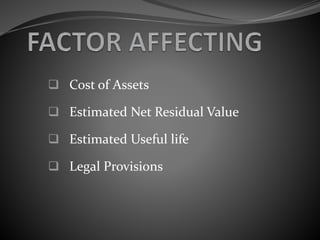
 Cost of Assets
 Estimated Net Residual Value
 Estimated Useful life
 Legal Provisions
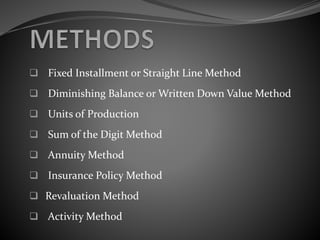
 Fixed Installment or Straight Line Method
 Diminishing Balance or Written Down Value Method
 Units of Production
 Sum of the Digit Method
 Annuity Method
 Insurance Policy Method
 Revaluation Method
 Activity Method
Depreciation

Depreciation

  • 1.
  • 2.
     The worddepreciation is the diminution in the value of assets due to use or lapse of time. It is measure of exhaustion of the effective life of the assets from any cause during the given period.  Depreciation is a reduction in the value of the assets which is permanent, gradual and of continuing nature, depreciation takes place gradually unless there is a quice physical deterioration or obsolescence due to technological developments.
  • 3.
     “Depreciation meansdecline or fall in the value of an assets, due to use, passage of time or obsolescence”.  In other words, depreciation may be described as a permanent, continuing and gradual shrinkage in the book value of fixed assets. It is based on the cost of assets consumed in a business and not on its market value.
  • 4.
     “Depreciation maybe defined as the permanent and continuing diminution in the quality, quantity or the value of an assets”. –W. Pickles.  “Depreciation may be defined as the permanent decrease in the value of an assets through wear and tear in the use or the passage of time. -B.G. Wickery
  • 5.
     It isdecline in the value of Fixed Assets.  It is a continuing process.  It is charged on fixed assets and not on floating assets.  It include loss of value due to effluxion of time, usage, or obsolescence.  It is a process of spreading the burden of cost of an assets over its life period.  The diminution in value takes place gradually.
  • 6.
     Wear andTear  Depletion  Obsolescence  Efflux-ion of time  Permanent fall in market value  Accidents
  • 7.
     Matching ofCosts and Revenue  Consideration of Tax  True and Fair Financial Position  Compliance with Law  To Ascertain True Value of Assets
  • 8.
     To recoverthe cost incurred on fixed assets over its life.  To facilitate the purchase of new asset, when the old asset is disposed.  Find out the correct profit or loss for the particular period.  Find out the correct financial position through balance sheet.  To show the proper value of Assets.  Provision of funds for replacement of assets.  Ascertaining accurate cost of production.
  • 9.
     Cost ofAssets  Estimated Net Residual Value  Estimated Useful life  Legal Provisions
  • 10.
     Fixed Installmentor Straight Line Method  Diminishing Balance or Written Down Value Method  Units of Production  Sum of the Digit Method  Annuity Method  Insurance Policy Method  Revaluation Method  Activity Method