Insurance for Logistics:
CH 3: Motor Insurance
Dr Narudh Cheramakara
2017
CLS-SSRU
1. Introduction
• Vehicle insurance (also known as car insurance, motor
insurance or auto insurance)
is insurance for cars, trucks, motorcycles, and other road
vehicles.
• Its primary use is to provide financial protection against
physical damage or bodily injury resulting from traffic
collisions and against liability that could also arise there
from.
• The specific terms of vehicle insurance vary with
legal regulations in each region. To a lesser degree vehicle
insurance may additionally offer financial protection against
theft of the vehicle and possibly damage to the vehicle,
sustained from things other than traffic collisions, such
as vandalism and damage sustained by colliding with
stationary objects.
1. Introduction
• First widedespread use of the automobile began after
the First World War in urban areas. Cars were relatively fast
and dangerous by that stage, yet there was still no
compulsory form of car insurance anywhere in the world.
This meant that injured victims would seldom get any
compensation in an accident, and drivers often faced
considerable costs for damage to their car and property.
• A compulsory car insurance scheme was first introduced in
the United Kingdom with the Road Traffic Act 1930. This
ensured that all vehicle owners and drivers had to be
insured for their liability for injury or death to third parties
whilst their vehicle was being used on a public
road. Germany enacted similar legislation in 1939.
2. Types of Motor Insurance
1. Compulsory Motor Insurance
• (In compliance with the Compulsory Automobile Insurance Act)
The law requires that owners of all the cars registered with the Department of
Land Transport comply with the Compulsory Automobile Insurance Act. Violations
of this law will result in a fine of not exceeding 10,000 Baht. Owners or car users
are required to have evidence of having insurance against damage caused to other
parties because of their cars ready to be presented to a competent officer at any
time the car is in use, except in the case that the car has already been registered or
that the annual tax has already been paid
Upon processing your request for registration of your car or payment of the annual
car tax, the Department of Land Transport will check whether an insurance policy
under such act has been acquired before accepting your car for registration or
accepting the annual tax payment.
Car insurance under the Compulsory Automobile Insurance Act provides coverage
for everyone affected by a car accident, regardless of whether the person is a
driver, a passenger, or a pedestrian, in the case that involves a loss of life or body
parts, or health damage. In the case of death, the deceased person’s heir will also
be covered.
2. Types of Motor Insurance
2. Voluntary Motor Insurance
Type 1 Policy
Maximum coverage:
Liability to damage to life, body, or health of third parties
Property damage of third property
Damage to the insured car due to fire/theft
Damage to the insured car
2. Types of Motor Insurance
Type 2 Policy
Coverage slightly less to Type 1 Policy:
Bodily injury/Death of third party & passengers
Property damage of third property
Damage to the insured car due to fire/theft
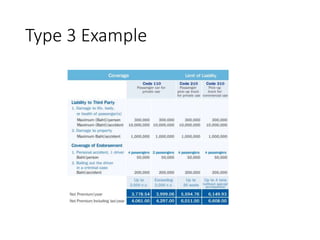
Type 3 Policy
Providing coverage for third parties only:
Bodily injury/Death of third party & passengers
Property damage of third property
Type 3 Example
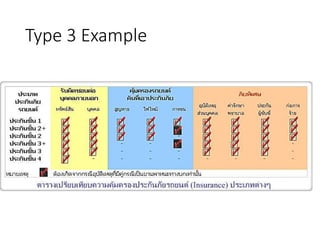
Type 3 Example
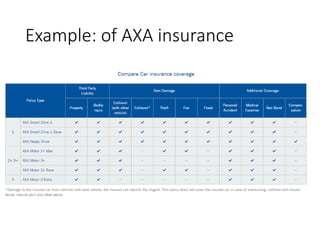
Example: of AXA insurance
3. Excess ค่าเสียหายส่วนแรก
• An excess payment, also known as a deductible, is a
fixed contribution that must be paid each time a
car is repaired with the charges billed to an
automotive insurance policy. Normally this
payment is made directly to the accident repair
"garage"
• If the accident was the other driver's fault, and this
fault is accepted by the third party's insurer, then
the vehicle owner may be able to reclaim the
excess payment from the other person's insurance
company.
3. Excess ค่าเสียหายส่วนแรก
• Compulsory excess
A compulsory excess is the minimum excess
payment the insurer will accept on the insurance
policy. Minimum excesses vary according to the
personal details, driving record and the insurance
company. For example, young or inexperienced
drivers and types of incident can incur additional
compulsory excess charges.
3. Excess ค่าเสียหายส่วนแรก
• Voluntary excess
To reduce the insurance premium, the insured party
may offer to pay a higher excess (deductible) than
the compulsory excess demanded by the insurance
company. The voluntary excess is the extra amount,
over and above the compulsory excess, that is agreed
to be paid in the event of a claim on the policy. As a
bigger excess reduces the financial risk carried by the
insurer, the insurer is able to offer a significantly
lower premium.
4. Basis for Premium Charges (very
prevalence in Western countries)
• Gender (Males more expensive)  discrimation
• Profession
• Age
• Marital Status
• Vehicle Classifications (sport cars, luxuary etc)
• Distance  Low mileage discounts, routine routes
• Credit rating
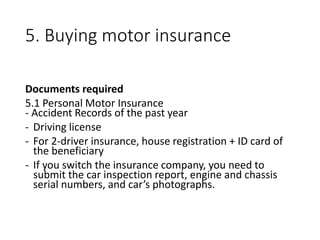
5. Buying motor insurance
Documents required
5.1 Personal Motor Insurance
- Accident Records of the past year
- Driving license
- For 2-driver insurance, house registration + ID card of
the beneficiary
- If you switch the insurance company, you need to
submit the car inspection report, engine and chassis
serial numbers, and car’s photographs.
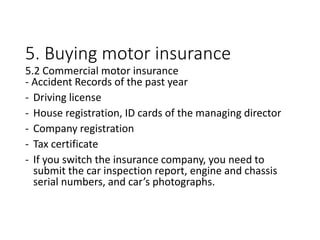
5. Buying motor insurance
5.2 Commercial motor insurance
- Accident Records of the past year
- Driving license
- House registration, ID cards of the managing director
- Company registration
- Tax certificate
- If you switch the insurance company, you need to
submit the car inspection report, engine and chassis
serial numbers, and car’s photographs.
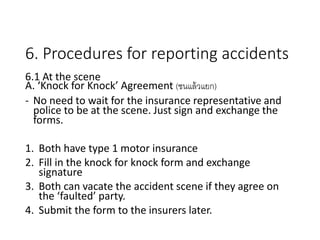
6. Procedures for reporting accidents
6.1 At the scene
A. ‘Knock for Knock’ Agreement (ชนแล้วแยก)
- No need to wait for the insurance representative and
police to be at the scene. Just sign and exchange the
forms.
1. Both have type 1 motor insurance
2. Fill in the knock for knock form and exchange
signature
3. Both can vacate the accident scene if they agree on
the ‘faulted’ party.
4. Submit the form to the insurers later.
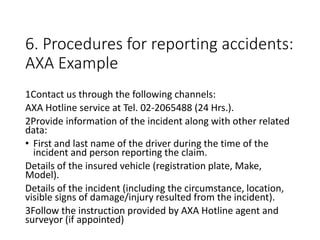
6. Procedures for reporting accidents:
AXA Example
1Contact us through the following channels:
AXA Hotline service at Tel. 02-2065488 (24 Hrs.).
2Provide information of the incident along with other related
data:
• First and last name of the driver during the time of the
incident and person reporting the claim.
Details of the insured vehicle (registration plate, Make,
Model).
Details of the incident (including the circumstance, location,
visible signs of damage/injury resulted from the incident).
3Follow the instruction provided by AXA Hotline agent and
surveyor (if appointed)
6. Procedures for reporting accidents:
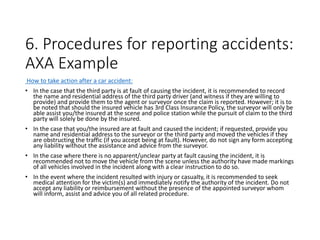
AXA Example
How to take action after a car accident:
• In the case that the third party is at fault of causing the incident, it is recommended to record
the name and residential address of the third party driver (and witness if they are willing to
provide) and provide them to the agent or surveyor once the claim is reported. However; it is to
be noted that should the insured vehicle has 3rd Class Insurance Policy, the surveyor will only be
able assist you/the insured at the scene and police station while the pursuit of claim to the third
party will solely be done by the insured.
• In the case that you/the insured are at fault and caused the incident; if requested, provide you
name and residential address to the surveyor or the third party and moved the vehicles if they
are obstructing the traffic (if you accept being at fault). However, do not sign any form accepting
any liability without the assistance and advice from the surveyor.
• In the case where there is no apparent/unclear party at fault causing the incident, it is
recommended not to move the vehicle from the scene unless the authority have made markings
of all vehicles involved in the incident along with a clear instruction to do so.
• In the event where the incident resulted with injury or casualty, it is recommended to seek
medical attention for the victim(s) and immediately notify the authority of the incident. Do not
accept any liability or reimbursement without the presence of the appointed surveyor whom
will inform, assist and advice you of all related procedure.
6. Procedures for reporting accidents:
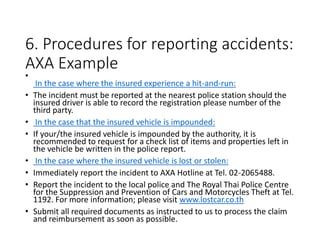
AXA Example
•
In the case where the insured experience a hit-and-run:
• The incident must be reported at the nearest police station should the
insured driver is able to record the registration please number of the
third party.
• In the case that the insured vehicle is impounded:
• If your/the insured vehicle is impounded by the authority, it is
recommended to request for a check list of items and properties left in
the vehicle be written in the police report.
• In the case where the insured vehicle is lost or stolen:
• Immediately report the incident to AXA Hotline at Tel. 02-2065488.
• Report the incident to the local police and The Royal Thai Police Centre
for the Suppression and Prevention of Cars and Motorcycles Theft at Tel.
1192. For more information; please visit www.lostcar.co.th
• Submit all required documents as instructed to us to process the claim
and reimbursement as soon as possible.
6. Procedures for reporting accidents: AXA Example
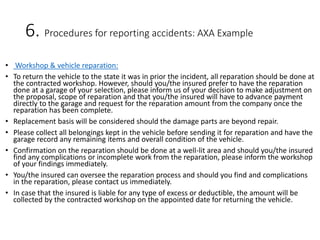
• Workshop & vehicle reparation:
• To return the vehicle to the state it was in prior the incident, all reparation should be done at
the contracted workshop. However, should you/the insured prefer to have the reparation
done at a garage of your selection, please inform us of your decision to make adjustment on
the proposal, scope of reparation and that you/the insured will have to advance payment
directly to the garage and request for the reparation amount from the company once the
reparation has been complete.
• Replacement basis will be considered should the damage parts are beyond repair.
• Please collect all belongings kept in the vehicle before sending it for reparation and have the
garage record any remaining items and overall condition of the vehicle.
• Confirmation on the reparation should be done at a well-lit area and should you/the insured
find any complications or incomplete work from the reparation, please inform the workshop
of your findings immediately.
• You/the insured can oversee the reparation process and should you find and complications
in the reparation, please contact us immediately.
• In case that the insured is liable for any type of excess or deductible, the amount will be
collected by the contracted workshop on the appointed date for returning the vehicle.
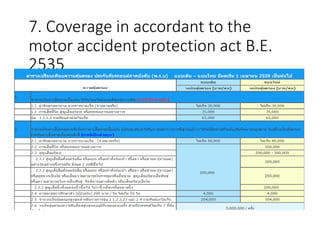
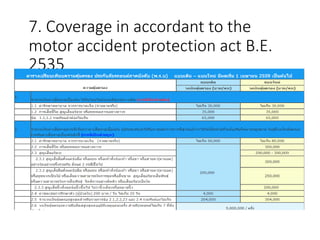
7. Coverage in accordant to the
motor accident protection act B.E.
2535
7. Coverage in accordant to the
motor accident protection act B.E.
2535
Exercise:
Go and compare the type one insurance for Toyota altis registered in 2005
The for claiming indemnity for Injury by third arty.