



Marine Insurance seminar
28 November 2018
Chris Zavos and Patrick Foss
Norton Rose Fulbright LLP
Pieter den Haan, Robert Hoepel and Haco van der Houven van Oordt
AKD Transport & Energy
Norton Rose Fulbright LLP
Chris Zavos
chris.zavos@nortonrosefulbright.com
+44 (0)20 7444 2209
2
Patrick Foss
Patrick.foss@nortonrosefulbright.com
+44 (0)20 7444 2202
AKD Transport & Energy
Pieter den Haan
pdenhaan@akd.nl
+31 88 253 5420
Haco van der Houven van Oordt
hvanoordt@akd.nl
+31 88 253 5392
Robert Hoepel
rhoepel@akd.nl
+31 88 253 5311
Welcome
• Opening speech by Pieter den Haan
• English marine insurance – the new law
- Chris Zavos and Patrick Foss
• Marine Insurance – Some Dutch lessons
- Robert Hoepel
• Discussion
- Haco van der Houven van Oordt
5
6
7
8
Program
• Opening speech by Pieter den Haan
• English marine insurance – the new law
- Chris Zavos and Patrick Foss
• Marine Insurance – Some Dutch lessons
- Robert Hoepel
• Discussion
- Haco van der Houven van Oordt
English marine insurance – the new law
Chris Zavos and Patrick Foss
Partners
Norton Rose Fulbright LLP
28 November 2018
Outline
12
• The new pre-contractual duty to
make a “fair presentation of the
risk” to insurers.
• The new remedies available to
insurers for a breach of this duty.
• Changes to the law relating to
breach of warranties and other
policy terms.
• The availability of damages for
late payment of claims by
insurers.
• The definition of fraudulent claims
following the Supreme Court
decision in the “DC Merwestone”
(2016).
• Clarification of the remedies
available to Insurers in respect of
a fraudulent claim.
Introduction
13
• Insurance Act 2015 replaces
large parts of the Marine
Insurance Act 1906
• Single biggest change to English
insurance law in 300 years
• Far reaching changes
• Applies to new risks or variations
post 12 August 2016
• More changes for new risks post
4 May 2017
• Many parts of the Act are
“optional” but limited contracting
out in the marine market
• As yet, no reported English Court
decisions
1. Fair Presentation
14
The old law
• Duty on assured (and brokers) to
disclose:
– every material circumstance;
– which they knew/ought to know;
– prior to inception.
• Inducement - any material non-
disclosure or misrepresentation
must have induced the actual
underwriter to write the risk on the
terms he/she did
• Single remedy – avoidance
• Win or lose all remedy – “a blot
on English insurance law”.
1. Fair Presentation
15
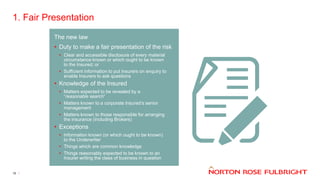
The new law
• Duty to make a fair presentation of the risk
• Clear and accessible disclosure of every material
circumstance known or which ought to be known
to the Insured; or
• Sufficient information to put Insurers on enquiry to
enable Insurers to ask questions
• Knowledge of the Insured
• Matters expected to be revealed by a
“reasonable search”
• Matters known to a corporate Insured’s senior
management
• Matters known to those responsible for arranging
the insurance (including Brokers)
• Exceptions
• Information known (or which ought to be known)
to the Underwriter
• Things which are common knowledge
• Things reasonably expected to be known to an
Insurer writing the class of business in question
2. Remedies
16
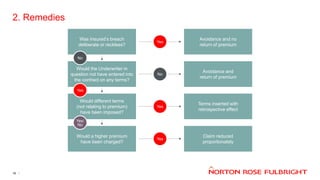
Was Insured’s breach
deliberate or reckless?
Avoidance and no
return of premium
Would the Underwriter in
question not have entered into
the contract on any terms?
Avoidance and
return of premium
Would different terms
(not relating to premium)
have been imposed?
Terms inserted with
retrospective effect
Would a higher premium
have been charged?
Claim reduced
proportionately
Yes
No
Yes
Yes
No
Yes
Yes/
No
2. Remedies – removal of the “blot”
17
Was Insured’s breach
deliberate or reckless?
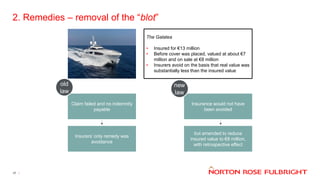
The Galatea
• Insured for €13 million
• Before cover was placed, valued at about €7
million and on sale at €8 million
• Insurers avoid on the basis that real value was
substantially less than the insured value
Claim failed and no indemnity
payable
Insurance would not have
been avoided
Insurers’ only remedy was
avoidance
but amended to reduce
insured value to €8 million,
with retrospective effect
old
law
3. Warranties and Conditions
18
• The old law
• Breach of warranty
automatically terminates
insurer’s liability from date of
breach
• No possibility that a corrected
breach would save the insured
• Non-causative breach a
defence for an insurer
• As a result:
• judicial efforts to lessen the
injustice for insureds
• suspensive effect
• construed very narrowly against
Insurers
3. Warranties and Conditions
19
• The new law under sect 10
• suspensive effect to warranties
i.e. breach can be remedied
prior to loss and the loss
recovered
• special provisions on late
compliance with time-sensitive
warranties:
remedied once "the risk to
which the warranty relates
later becomes essentially the
same as that originally
contemplated by the parties“
• Insurers may still rely on non-
causative breach, subject sect
11
3. Warranties and conditions
20
• The new law: section 11
 considers relevance of a breach and may operate
to save a claim, which would fail on the old law
 applies to warranties and other terms/conditions
(possibly exclusions)
 but not terms which “define the risk as a whole”
• If a term is breached regarding
prevention of loss
 of a particular kind
 at a particular location
 at a particular time
• then the insured may still recover if the
insured can demonstrate that
compliance with the term would not
have reduced the risk of loss of the type
which actually occurred
• Simple … relevance and not causation?
3. Warranties and Conditions
21
Terms which “define the risk
as a whole”
• Terms defining the nature of the
business or geographical limits
• class?
• navigation limits?
• towage?
• sanctions clauses?
• condition surveys?
4. Damages for Late Payment of Claims
22
The Old Law
• “Hold harmless” principle
• No “damages on damages”
• Sprung v Royal Insurance (UK)
Ltd [1999] 1 Lloyd’s Rep IR 111
The New Law
• Applies to all contracts of
(re)insurance written on or after 4
May 2017
• Implied term of every insurance
contract that Insurers
must pay any sums due in
respect of the claim within a
“reasonable time”
4. Damages for Late Payment of Claims
23
What is a “reasonable time”?
• Reasonable time to “investigate and
assess” the claim
• Depends on all relevant
circumstances:
– Type of insurance
– Size and complexity of the claim
– Compliance with any relevant statutory or
regulatory rules or guidance
– Factors outside Insurers’ control
4. Damages for Late Payment of Claims
24
Consequences of a Breach
• Insured may have a claim
for damages
• Insured would need to establish:
– Actual loss suffered
– Causation
– Loss was foreseeable (Hadley v
Baxendale [1854] 9 Ex 341)
– Reasonable steps taken to mitigate
the loss
Disputed Claims
• Reasonable grounds?
• Insurers’ conduct
4. Damages for Late Payment of Claims
25
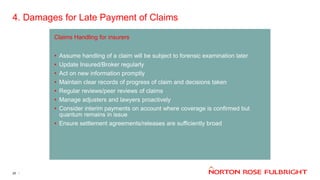
Claims Handling for insurers
• Assume handling of a claim will be subject to forensic examination later
• Update Insured/Broker regularly
• Act on new information promptly
• Maintain clear records of progress of claim and decisions taken
• Regular reviews/peer reviews of claims
• Manage adjusters and lawyers proactively
• Consider interim payments on account where coverage is confirmed but
quantum remains in issue
• Ensure settlement agreements/releases are sufficiently broad
4. Damages for Late Payment of Claims
26
Issues/Uncertainties
• Exercise of claims control by
Reinsurers?
• Damages for late payment
recoverable under reinsurance?
• Layered programmes –
unreasonable delay by
primary layer?
• Subscription market –
conduct of leaders?
5. Fraudulent Claims – what are they?
27
Definition
False representation made:
• in the knowledge that it is false; or
• without belief in its truth; or
• recklessly, careless as to whether
it is true or false
• Derry v Peek [1889]
Types of Fraudulent Claim
• Fabrication of entire claim
• Exaggeration of genuine claim
• “Fraudulent device”?
– Claim is genuine but the insured supplies
false information in support.
5. Fraudulent Claims – what are they?
28
Versloot Dredging BV v HDI Gerling
Industrie Versicherung AG [2016]
UKSC 45
• Engine room flooding.
• Vessel managers alleged that the
bilge alarm had sounded.
• At first instance, this lie resulted in
forfeiture of entire claim.
• Decision upheld by Court of
Appeal.
• Supreme Court (4:1) held that the
use of a fraudulent device or
“collateral lie” to support a valid
claim did not render the claim
fraudulent.
• “The lie is dishonest, but the claim
is not”.
6. Remedies for fraudulent claims
29
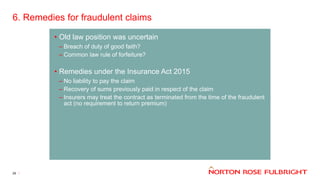
• Old law position was uncertain
– Breach of duty of good faith?
– Common law rule of forfeiture?
• Remedies under the Insurance Act 2015
– No liability to pay the claim
– Recovery of sums previously paid in respect of the claim
– Insurers may treat the contract as terminated from the time of the fraudulent
act (no requirement to return premium)
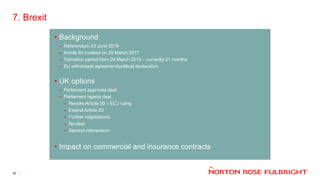
7. Brexit
30
• Background
– Referendum 23 June 2016
– Article 50 invoked on 29 March 2017
– Transition period from 29 March 2019 – currently 21 months
– EU withdrawal agreement/political declaration.
• UK options
– Parliament approves deal
– Parliament rejects deal
– Revoke Article 50 – ECJ ruling
– Extend Article 50
– Further negotiations
– No deal
– Second referendum
• Impact on commercial and insurance contracts
Disclaimer
Norton Rose Fulbright US LLP, Norton Rose Fulbright LLP, Norton Rose Fulbright Australia, Norton Rose Fulbright Canada LLP and Norton Rose Fulbright South Africa Inc are separate legal entities
and all of them are members of Norton Rose Fulbright Verein, a Swiss verein. Norton Rose Fulbright Verein helps coordinate the activities of the members but does not itself provide legal services to
clients.
References to ‘Norton Rose Fulbright’, ‘the law firm’ and ‘legal practice’ are to one or more of the Norton Rose Fulbright members or to one of their respective affiliates (together ‘Norton Rose
Fulbright entity/entities’). No individual who is a member, partner, shareholder, director, employee or consultant of, in or to any Norton Rose Fulbright entity (whether or not such individual is
described as a ‘partner’) accepts or assumes responsibility, or has any liability, to any person in respect of this communication. Any reference to a partner or director is to a member, employee or
consultant with equivalent standing and qualifications of the relevant Norton Rose Fulbright entity.
The purpose of this communication is to provide general information of a legal nature. It does not contain a full analysis of the law nor does it constitute an opinion of any Norton Rose Fulbright
entity on the points of law discussed. You must take specific legal advice on any particular matter which concerns you. If you require any advice or further information, please speak to your usual
contact at Norton Rose Fulbright.
32
Marine insurance – some Dutch lessons
Robert Hoepel
AKD Transport & Energy
Topics for today
1. Duty of disclosure (mededelingsplicht)
2. Late payment consequences
3. ‘Warranties’ (vervalbedingen, preventieve garanties)
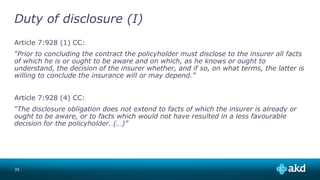
Duty of disclosure (I)
Article 7:928 (1) CC:
“Prior to concluding the contract the policyholder must disclose to the insurer all facts
of which he is or ought to be aware and on which, as he knows or ought to
understand, the decision of the insurer whether, and if so, on what terms, the latter is
willing to conclude the insurance will or may depend.”
Article 7:928 (4) CC:
“The disclosure obligation does not extend to facts of which the insurer is already or
ought to be aware, or to facts which would not have resulted in a less favourable
decision for the policyholder. (…)”
35
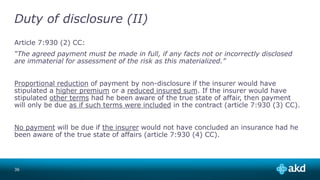
Duty of disclosure (II)
Article 7:930 (2) CC:
“The agreed payment must be made in full, if any facts not or incorrectly disclosed
are immaterial for assessment of the risk as this materialized.”
Proportional reduction of payment by non-disclosure if the insurer would have
stipulated a higher premium or a reduced insured sum. If the insurer would have
stipulated other terms had he been aware of the true state of affair, then payment
will only be due as if such terms were included in the contract (article 7:930 (3) CC).
No payment will be due if the insurer would not have concluded an insurance had he
been aware of the true state of affairs (article 7:930 (4) CC).
36
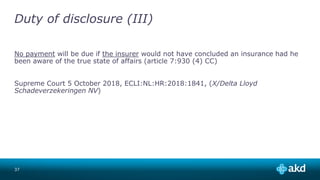
Duty of disclosure (III)
No payment will be due if the insurer would not have concluded an insurance had he
been aware of the true state of affairs (article 7:930 (4) CC)
Supreme Court 5 October 2018, ECLI:NL:HR:2018:1841, (X/Delta Lloyd
Schadeverzekeringen NV)
37
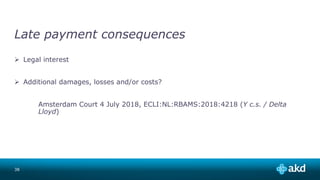
Late payment consequences
 Legal interest
 Additional damages, losses and/or costs?
Amsterdam Court 4 July 2018, ECLI:NL:RBAMS:2018:4218 (Y c.s. / Delta
Lloyd)
38
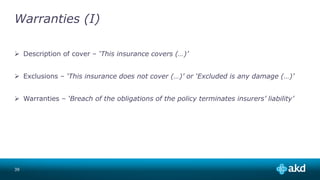
Warranties (I)
 Description of cover – ‘This insurance covers (…)’
 Exclusions – ‘This insurance does not cover (…)’ or ‘Excluded is any damage (…)’
 Warranties – ‘Breach of the obligations of the policy terminates insurers’ liability’
39
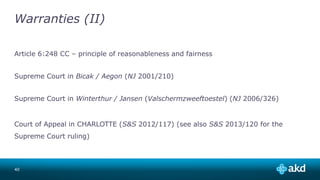
Warranties (II)
Article 6:248 CC – principle of reasonableness and fairness
Supreme Court in Bicak / Aegon (NJ 2001/210)
Supreme Court in Winterthur / Jansen (Valschermzweeftoestel) (NJ 2006/326)
Court of Appeal in CHARLOTTE (S&S 2012/117) (see also S&S 2013/120 for the
Supreme Court ruling)
40
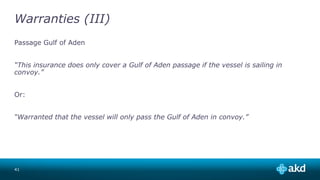
Warranties (III)
Passage Gulf of Aden
“This insurance does only cover a Gulf of Aden passage if the vessel is sailing in
convoy.”
Or:
“Warranted that the vessel will only pass the Gulf of Aden in convoy.”
41
Discussion
Thank you for attending

Marine Insurance seminar

  • 1.
    Marine Insurance seminar 28November 2018 Chris Zavos and Patrick Foss Norton Rose Fulbright LLP Pieter den Haan, Robert Hoepel and Haco van der Houven van Oordt AKD Transport & Energy
  • 2.
    Norton Rose FulbrightLLP Chris Zavos chris.zavos@nortonrosefulbright.com +44 (0)20 7444 2209 2 Patrick Foss Patrick.foss@nortonrosefulbright.com +44 (0)20 7444 2202
  • 3.
    AKD Transport &Energy Pieter den Haan pdenhaan@akd.nl +31 88 253 5420 Haco van der Houven van Oordt hvanoordt@akd.nl +31 88 253 5392 Robert Hoepel rhoepel@akd.nl +31 88 253 5311
  • 4.
    Welcome • Opening speechby Pieter den Haan • English marine insurance – the new law - Chris Zavos and Patrick Foss • Marine Insurance – Some Dutch lessons - Robert Hoepel • Discussion - Haco van der Houven van Oordt
  • 5.
  • 6.
  • 7.
  • 8.
  • 10.
    Program • Opening speechby Pieter den Haan • English marine insurance – the new law - Chris Zavos and Patrick Foss • Marine Insurance – Some Dutch lessons - Robert Hoepel • Discussion - Haco van der Houven van Oordt
  • 11.
    English marine insurance– the new law Chris Zavos and Patrick Foss Partners Norton Rose Fulbright LLP 28 November 2018
  • 12.
    Outline 12 • The newpre-contractual duty to make a “fair presentation of the risk” to insurers. • The new remedies available to insurers for a breach of this duty. • Changes to the law relating to breach of warranties and other policy terms. • The availability of damages for late payment of claims by insurers. • The definition of fraudulent claims following the Supreme Court decision in the “DC Merwestone” (2016). • Clarification of the remedies available to Insurers in respect of a fraudulent claim.
  • 13.
    Introduction 13 • Insurance Act2015 replaces large parts of the Marine Insurance Act 1906 • Single biggest change to English insurance law in 300 years • Far reaching changes • Applies to new risks or variations post 12 August 2016 • More changes for new risks post 4 May 2017 • Many parts of the Act are “optional” but limited contracting out in the marine market • As yet, no reported English Court decisions
  • 14.
    1. Fair Presentation 14 Theold law • Duty on assured (and brokers) to disclose: – every material circumstance; – which they knew/ought to know; – prior to inception. • Inducement - any material non- disclosure or misrepresentation must have induced the actual underwriter to write the risk on the terms he/she did • Single remedy – avoidance • Win or lose all remedy – “a blot on English insurance law”.
  • 15.
    1. Fair Presentation 15 Thenew law • Duty to make a fair presentation of the risk • Clear and accessible disclosure of every material circumstance known or which ought to be known to the Insured; or • Sufficient information to put Insurers on enquiry to enable Insurers to ask questions • Knowledge of the Insured • Matters expected to be revealed by a “reasonable search” • Matters known to a corporate Insured’s senior management • Matters known to those responsible for arranging the insurance (including Brokers) • Exceptions • Information known (or which ought to be known) to the Underwriter • Things which are common knowledge • Things reasonably expected to be known to an Insurer writing the class of business in question
  • 16.
    2. Remedies 16 Was Insured’sbreach deliberate or reckless? Avoidance and no return of premium Would the Underwriter in question not have entered into the contract on any terms? Avoidance and return of premium Would different terms (not relating to premium) have been imposed? Terms inserted with retrospective effect Would a higher premium have been charged? Claim reduced proportionately Yes No Yes Yes No Yes Yes/ No
  • 17.
    2. Remedies –removal of the “blot” 17 Was Insured’s breach deliberate or reckless? The Galatea • Insured for €13 million • Before cover was placed, valued at about €7 million and on sale at €8 million • Insurers avoid on the basis that real value was substantially less than the insured value Claim failed and no indemnity payable Insurance would not have been avoided Insurers’ only remedy was avoidance but amended to reduce insured value to €8 million, with retrospective effect old law
  • 18.
    3. Warranties andConditions 18 • The old law • Breach of warranty automatically terminates insurer’s liability from date of breach • No possibility that a corrected breach would save the insured • Non-causative breach a defence for an insurer • As a result: • judicial efforts to lessen the injustice for insureds • suspensive effect • construed very narrowly against Insurers
  • 19.
    3. Warranties andConditions 19 • The new law under sect 10 • suspensive effect to warranties i.e. breach can be remedied prior to loss and the loss recovered • special provisions on late compliance with time-sensitive warranties: remedied once "the risk to which the warranty relates later becomes essentially the same as that originally contemplated by the parties“ • Insurers may still rely on non- causative breach, subject sect 11
  • 20.
    3. Warranties andconditions 20 • The new law: section 11  considers relevance of a breach and may operate to save a claim, which would fail on the old law  applies to warranties and other terms/conditions (possibly exclusions)  but not terms which “define the risk as a whole” • If a term is breached regarding prevention of loss  of a particular kind  at a particular location  at a particular time • then the insured may still recover if the insured can demonstrate that compliance with the term would not have reduced the risk of loss of the type which actually occurred • Simple … relevance and not causation?
  • 21.
    3. Warranties andConditions 21 Terms which “define the risk as a whole” • Terms defining the nature of the business or geographical limits • class? • navigation limits? • towage? • sanctions clauses? • condition surveys?
  • 22.
    4. Damages forLate Payment of Claims 22 The Old Law • “Hold harmless” principle • No “damages on damages” • Sprung v Royal Insurance (UK) Ltd [1999] 1 Lloyd’s Rep IR 111 The New Law • Applies to all contracts of (re)insurance written on or after 4 May 2017 • Implied term of every insurance contract that Insurers must pay any sums due in respect of the claim within a “reasonable time”
  • 23.
    4. Damages forLate Payment of Claims 23 What is a “reasonable time”? • Reasonable time to “investigate and assess” the claim • Depends on all relevant circumstances: – Type of insurance – Size and complexity of the claim – Compliance with any relevant statutory or regulatory rules or guidance – Factors outside Insurers’ control
  • 24.
    4. Damages forLate Payment of Claims 24 Consequences of a Breach • Insured may have a claim for damages • Insured would need to establish: – Actual loss suffered – Causation – Loss was foreseeable (Hadley v Baxendale [1854] 9 Ex 341) – Reasonable steps taken to mitigate the loss Disputed Claims • Reasonable grounds? • Insurers’ conduct
  • 25.
    4. Damages forLate Payment of Claims 25 Claims Handling for insurers • Assume handling of a claim will be subject to forensic examination later • Update Insured/Broker regularly • Act on new information promptly • Maintain clear records of progress of claim and decisions taken • Regular reviews/peer reviews of claims • Manage adjusters and lawyers proactively • Consider interim payments on account where coverage is confirmed but quantum remains in issue • Ensure settlement agreements/releases are sufficiently broad
  • 26.
    4. Damages forLate Payment of Claims 26 Issues/Uncertainties • Exercise of claims control by Reinsurers? • Damages for late payment recoverable under reinsurance? • Layered programmes – unreasonable delay by primary layer? • Subscription market – conduct of leaders?
  • 27.
    5. Fraudulent Claims– what are they? 27 Definition False representation made: • in the knowledge that it is false; or • without belief in its truth; or • recklessly, careless as to whether it is true or false • Derry v Peek [1889] Types of Fraudulent Claim • Fabrication of entire claim • Exaggeration of genuine claim • “Fraudulent device”? – Claim is genuine but the insured supplies false information in support.
  • 28.
    5. Fraudulent Claims– what are they? 28 Versloot Dredging BV v HDI Gerling Industrie Versicherung AG [2016] UKSC 45 • Engine room flooding. • Vessel managers alleged that the bilge alarm had sounded. • At first instance, this lie resulted in forfeiture of entire claim. • Decision upheld by Court of Appeal. • Supreme Court (4:1) held that the use of a fraudulent device or “collateral lie” to support a valid claim did not render the claim fraudulent. • “The lie is dishonest, but the claim is not”.
  • 29.
    6. Remedies forfraudulent claims 29 • Old law position was uncertain – Breach of duty of good faith? – Common law rule of forfeiture? • Remedies under the Insurance Act 2015 – No liability to pay the claim – Recovery of sums previously paid in respect of the claim – Insurers may treat the contract as terminated from the time of the fraudulent act (no requirement to return premium)
  • 30.
    7. Brexit 30 • Background –Referendum 23 June 2016 – Article 50 invoked on 29 March 2017 – Transition period from 29 March 2019 – currently 21 months – EU withdrawal agreement/political declaration. • UK options – Parliament approves deal – Parliament rejects deal – Revoke Article 50 – ECJ ruling – Extend Article 50 – Further negotiations – No deal – Second referendum • Impact on commercial and insurance contracts
  • 32.
    Disclaimer Norton Rose FulbrightUS LLP, Norton Rose Fulbright LLP, Norton Rose Fulbright Australia, Norton Rose Fulbright Canada LLP and Norton Rose Fulbright South Africa Inc are separate legal entities and all of them are members of Norton Rose Fulbright Verein, a Swiss verein. Norton Rose Fulbright Verein helps coordinate the activities of the members but does not itself provide legal services to clients. References to ‘Norton Rose Fulbright’, ‘the law firm’ and ‘legal practice’ are to one or more of the Norton Rose Fulbright members or to one of their respective affiliates (together ‘Norton Rose Fulbright entity/entities’). No individual who is a member, partner, shareholder, director, employee or consultant of, in or to any Norton Rose Fulbright entity (whether or not such individual is described as a ‘partner’) accepts or assumes responsibility, or has any liability, to any person in respect of this communication. Any reference to a partner or director is to a member, employee or consultant with equivalent standing and qualifications of the relevant Norton Rose Fulbright entity. The purpose of this communication is to provide general information of a legal nature. It does not contain a full analysis of the law nor does it constitute an opinion of any Norton Rose Fulbright entity on the points of law discussed. You must take specific legal advice on any particular matter which concerns you. If you require any advice or further information, please speak to your usual contact at Norton Rose Fulbright. 32
  • 33.
    Marine insurance –some Dutch lessons Robert Hoepel AKD Transport & Energy
  • 34.
    Topics for today 1.Duty of disclosure (mededelingsplicht) 2. Late payment consequences 3. ‘Warranties’ (vervalbedingen, preventieve garanties)
  • 35.
    Duty of disclosure(I) Article 7:928 (1) CC: “Prior to concluding the contract the policyholder must disclose to the insurer all facts of which he is or ought to be aware and on which, as he knows or ought to understand, the decision of the insurer whether, and if so, on what terms, the latter is willing to conclude the insurance will or may depend.” Article 7:928 (4) CC: “The disclosure obligation does not extend to facts of which the insurer is already or ought to be aware, or to facts which would not have resulted in a less favourable decision for the policyholder. (…)” 35
  • 36.
    Duty of disclosure(II) Article 7:930 (2) CC: “The agreed payment must be made in full, if any facts not or incorrectly disclosed are immaterial for assessment of the risk as this materialized.” Proportional reduction of payment by non-disclosure if the insurer would have stipulated a higher premium or a reduced insured sum. If the insurer would have stipulated other terms had he been aware of the true state of affair, then payment will only be due as if such terms were included in the contract (article 7:930 (3) CC). No payment will be due if the insurer would not have concluded an insurance had he been aware of the true state of affairs (article 7:930 (4) CC). 36
  • 37.
    Duty of disclosure(III) No payment will be due if the insurer would not have concluded an insurance had he been aware of the true state of affairs (article 7:930 (4) CC) Supreme Court 5 October 2018, ECLI:NL:HR:2018:1841, (X/Delta Lloyd Schadeverzekeringen NV) 37
  • 38.
    Late payment consequences Legal interest  Additional damages, losses and/or costs? Amsterdam Court 4 July 2018, ECLI:NL:RBAMS:2018:4218 (Y c.s. / Delta Lloyd) 38
  • 39.
    Warranties (I)  Descriptionof cover – ‘This insurance covers (…)’  Exclusions – ‘This insurance does not cover (…)’ or ‘Excluded is any damage (…)’  Warranties – ‘Breach of the obligations of the policy terminates insurers’ liability’ 39
  • 40.
    Warranties (II) Article 6:248CC – principle of reasonableness and fairness Supreme Court in Bicak / Aegon (NJ 2001/210) Supreme Court in Winterthur / Jansen (Valschermzweeftoestel) (NJ 2006/326) Court of Appeal in CHARLOTTE (S&S 2012/117) (see also S&S 2013/120 for the Supreme Court ruling) 40
  • 41.
    Warranties (III) Passage Gulfof Aden “This insurance does only cover a Gulf of Aden passage if the vessel is sailing in convoy.” Or: “Warranted that the vessel will only pass the Gulf of Aden in convoy.” 41
  • 42.
  • 43.
    Thank you forattending