Emulsions
What are Emulsions?
A mixture of two or more immiscible liquids, where one liquid (the
dispersed phase) is dispersed as droplets throughout the other (the
continuous phase).
Types:
Oil-in-water (O/W): Oil droplets dispersed in water. (Example: Milk)
Water-in-oil (W/O): Water droplets dispersed in oil. (Example:
Butter)
Emulsion Instability
Emulsions are thermodynamically unstable and tend to separate over
time.
Key Instability Mechanisms:
Creaming: Upward movement of dispersed droplets due to density
differences. (Image: Cream separating from milk)
Coalescence: Merging of droplets to form larger ones.
Phase Separation: Complete separation of the dispersed and
continuous phases.
Flocculation: Aggregation of droplets into loose clumps. (Image:
Droplets clumping together)
Factors Affecting Stability:
Droplet size, viscosity of the continuous phase, interfacial tension, and
presence of emulsifiers.
Stability Assessment
Methods:
Visual Observation: Simple but subjective.
Microscopy: Determines droplet size and distribution.
Zeta Potential: Measures the electrical charge on droplets, indicating
repulsion and stability.
Rheology: Measures viscosity changes over time.
Accelerated Stability Studies: Using stress conditions (e.g.,
temperature, centrifugation) to predict long-term stability.
Drug Release from Emulsions
Mechanism: Drug release depends on factors like:
Drug Partitioning: Between the oil and water phases.
Droplet Size: Smaller droplets generally lead to faster release.
Viscosity of Continuous Phase: Affects diffusion of the drug.
Emulsifier: Can influence drug release.
Example:
Lipophilic drugs are often incorporated into the oil phase of O/W
emulsions for better delivery.
Applications of Emulsions- Oral
Advantages:
Improved bioavailability of poorly water-soluble drugs.
Enhanced drug absorption.
Can mask unpleasant tastes.
Disadvantages:
Stability issues during storage.
Manufacturing challenges.
Potential for phase separation in the GI tract.
Example:
Some vitamin supplements and cod liver oil are formulated as
emulsions.
Applications of Emulsions- Topical
Advantages:
Allows for delivery of drugs to the skin.
Can control drug release.
Provides a moisturizing effect.
Disadvantages:
Can be greasy or sticky.
Potential for skin irritation.
Formulation can be complex.
Example:
Many creams and lotions are emulsions (e.g., sunscreen,
moisturizers).
Suspensions
What are Suspensions?
A heterogeneous mixture of a solid
(dispersed phase) in a liquid
(continuous phase).
The solid particles are relatively large
and will settle over time.
Rationale for Suspensions
Why Use Suspensions?
Poor solubility of the drug in the
desired solvent.
To improve drug stability (some
drugs are more stable in suspension
than in solution).
To mask unpleasant tastes.
For controlled drug release.
Desired Features of Suspensions
Ideal Suspension Characteristics
Uniform Dispersion: Particles should be evenly distributed
throughout the liquid.
Easy Redispersibility: The settled particles should be easily
resuspended with gentle shaking.
Small Particle Size: Reduces sedimentation and improves
texture.
Acceptable Viscosity: Should be pourable and easy to
administer.
Chemical Stability: The drug should be stable in the
suspension.
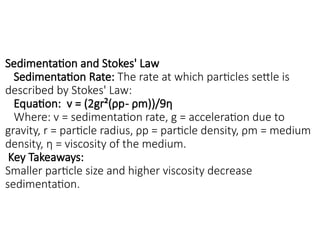
Sedimentation and Stokes' Law
Sedimentation Rate: The rate at which particles settle is
described by Stokes' Law:
Equation: v = (2gr²(ρp- ρm))/9η
Where: v = sedimentation rate, g = acceleration due to
gravity, r = particle radius, ρp = particle density, ρm = medium
density, η = viscosity of the medium.
Key Takeaways:
Smaller particle size and higher viscosity decrease
sedimentation.
Suspension Preparation
Steps:
Wetting: Wetting the powder with a small amount of the
liquid to displace air and facilitate dispersion.
Dispersion: Adding the wetted powder to the remaining
liquid, often with the aid of a mixer.
Particle Size Reduction (if needed): Milling or
micronization.
Addition of Excipients: Wetting agents, flocculating
agents, viscosity enhancers.
Key Excipients
Wetting Agents: Reduce surface tension and improve
wettability of the powder (e.g., surfactants like
polysorbates).
Flocculating Agents: Promote the formation of loose
aggregates (flocs) which settle more readily but are easily
redispersed (e.g., electrolytes).
Viscosity Enhancers: Increase the viscosity of the
continuous phase to slow down sedimentation (e.g.,
polymers like carboxymethylcellulose).
group two.pptx presentation about emulsion

group two.pptx presentation about emulsion

  • 1.
    Emulsions What are Emulsions? Amixture of two or more immiscible liquids, where one liquid (the dispersed phase) is dispersed as droplets throughout the other (the continuous phase). Types: Oil-in-water (O/W): Oil droplets dispersed in water. (Example: Milk) Water-in-oil (W/O): Water droplets dispersed in oil. (Example: Butter)
  • 2.
    Emulsion Instability Emulsions arethermodynamically unstable and tend to separate over time. Key Instability Mechanisms: Creaming: Upward movement of dispersed droplets due to density differences. (Image: Cream separating from milk) Coalescence: Merging of droplets to form larger ones. Phase Separation: Complete separation of the dispersed and continuous phases. Flocculation: Aggregation of droplets into loose clumps. (Image: Droplets clumping together) Factors Affecting Stability: Droplet size, viscosity of the continuous phase, interfacial tension, and presence of emulsifiers.
  • 3.
    Stability Assessment Methods: Visual Observation:Simple but subjective. Microscopy: Determines droplet size and distribution. Zeta Potential: Measures the electrical charge on droplets, indicating repulsion and stability. Rheology: Measures viscosity changes over time. Accelerated Stability Studies: Using stress conditions (e.g., temperature, centrifugation) to predict long-term stability.
  • 4.
    Drug Release fromEmulsions Mechanism: Drug release depends on factors like: Drug Partitioning: Between the oil and water phases. Droplet Size: Smaller droplets generally lead to faster release. Viscosity of Continuous Phase: Affects diffusion of the drug. Emulsifier: Can influence drug release. Example: Lipophilic drugs are often incorporated into the oil phase of O/W emulsions for better delivery.
  • 5.
    Applications of Emulsions-Oral Advantages: Improved bioavailability of poorly water-soluble drugs. Enhanced drug absorption. Can mask unpleasant tastes. Disadvantages: Stability issues during storage. Manufacturing challenges. Potential for phase separation in the GI tract. Example: Some vitamin supplements and cod liver oil are formulated as emulsions.
  • 6.
    Applications of Emulsions-Topical Advantages: Allows for delivery of drugs to the skin. Can control drug release. Provides a moisturizing effect. Disadvantages: Can be greasy or sticky. Potential for skin irritation. Formulation can be complex. Example: Many creams and lotions are emulsions (e.g., sunscreen, moisturizers).
  • 7.
    Suspensions What are Suspensions? Aheterogeneous mixture of a solid (dispersed phase) in a liquid (continuous phase). The solid particles are relatively large and will settle over time.
  • 8.
    Rationale for Suspensions WhyUse Suspensions? Poor solubility of the drug in the desired solvent. To improve drug stability (some drugs are more stable in suspension than in solution). To mask unpleasant tastes. For controlled drug release.
  • 9.
    Desired Features ofSuspensions Ideal Suspension Characteristics Uniform Dispersion: Particles should be evenly distributed throughout the liquid. Easy Redispersibility: The settled particles should be easily resuspended with gentle shaking. Small Particle Size: Reduces sedimentation and improves texture. Acceptable Viscosity: Should be pourable and easy to administer. Chemical Stability: The drug should be stable in the suspension.
  • 10.
    Sedimentation and Stokes'Law Sedimentation Rate: The rate at which particles settle is described by Stokes' Law: Equation: v = (2gr²(ρp- ρm))/9η Where: v = sedimentation rate, g = acceleration due to gravity, r = particle radius, ρp = particle density, ρm = medium density, η = viscosity of the medium. Key Takeaways: Smaller particle size and higher viscosity decrease sedimentation.
  • 11.
    Suspension Preparation Steps: Wetting: Wettingthe powder with a small amount of the liquid to displace air and facilitate dispersion. Dispersion: Adding the wetted powder to the remaining liquid, often with the aid of a mixer. Particle Size Reduction (if needed): Milling or micronization. Addition of Excipients: Wetting agents, flocculating agents, viscosity enhancers.
  • 12.
    Key Excipients Wetting Agents:Reduce surface tension and improve wettability of the powder (e.g., surfactants like polysorbates). Flocculating Agents: Promote the formation of loose aggregates (flocs) which settle more readily but are easily redispersed (e.g., electrolytes). Viscosity Enhancers: Increase the viscosity of the continuous phase to slow down sedimentation (e.g., polymers like carboxymethylcellulose).