LEVEL MEASUREMENT
• In modern manufacturing industries which use many solvents,
chemicals, steam and other liquids and in power plants which use
vast amount of water, the accurate measurement of liquid level is
very essential.
• Liquid level refers to the position or height of a liquid surface
above a datum line.
• Level measurements are made to a certain quantity of the liquid
held with in a container.
• Level measurements are made to a certain quantity of the liquid
held with in a container.
• Level offers both the pressure and rate of flow in and out of the
container and as such its measurement and control is an
important function in a variety of processes.
• The task of liquid level measurement may be accomplished by
direct methods and indirect methods.
LIQUID LEVEL MEASUREMENT
• Generally, there are two methods used in industries for
measuring liquid level.
These are
1. Direct Method
2. Indirect Method
• Direct method use the varying level of the liquid as a mean of
obtaining the measurement.
• The indirect method use a variable that changes with the liquid
level to accurate the measuring mechanism.
1. DIRECT METHOD
• This is the simplest method of measuring liquid level. In this
method, the level of the liquid is measured directly by means of the
following level indicators
1. Sight Glass
2. Float Type
3. Hook-type Level Indicator
SIGHT GLASS
• Sight glass is used for the continuous indication of liquid level
within a tank or vessel. A sight glass instrument consists of a
graduated tube of toughened glass which is connected to the
interior of the tank at the bottom in which the water level is
required.
WORKING
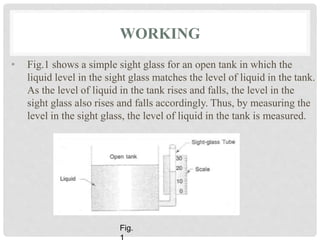
• Fig.1 shows a simple sight glass for an open tank in which the
liquid level in the sight glass matches the level of liquid in the tank.
As the level of liquid in the tank rises and falls, the level in the
sight glass also rises and falls accordingly. Thus, by measuring the
level in the sight glass, the level of liquid in the tank is measured.
Fig.
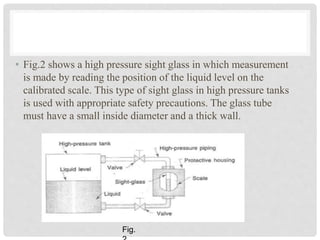
• Fig.2 shows a high pressure sight glass in which measurement
is made by reading the position of the liquid level on the
calibrated scale. This type of sight glass in high pressure tanks
is used with appropriate safety precautions. The glass tube
must have a small inside diameter and a thick wall.
Fig.
DISADVANTAGES
• It is read only where the tank is located, which is not always
convenient.
• Overlapping gauges are needed for long level spans
• Accuracy and readability depend on the cleanliness of glass
and fluid
ADVANTAGES
• Direct reading is possible
• Special designs are available for use up to 316°C and 10000
psi.
• Glassless designs are available in numerous materials for
corrosion resistance.
FLOAT TYPE
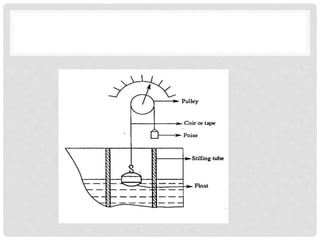
• Float -Type Level Indicator moat operated level indicator is used
to measure liquid levels in a tank in which a float rests on the
surface of liquid and follows the changing level of liquid.
• The movement of the float is transmitted to a pointer through a
suitable mechanism which indicates the level on a calibrated
scale.
• Various types of floats are used such as hollow mewl spheres,
cylindrical-shaped floats and disc shaped floats.
WORKING
• When the liquid level rises or falls a buoyant force equal to weight
of the displaced liquid is available
• It pushes the float up or down.
• The float movement is transmitted to a pointer through a suitable
mechanism
• It indicates the level on a calibrated scale
ADVANTAGES
• Economical
• Reliable designs
• It is possible to read the liquid levels in tanks below ground
level
• Operated at large temperature ranges
DISADVANTAGES
• Limited to moderate pressures
• Float design should be considered for liquids with suspensions
HOOK-TYPE LEVEL INDICATOR
• When the level of liquid in an open tank is measured directly
on a scale (the scale may be in the liquid or outside it), it is
sometimes difficult to read the level accurately because of
parallax error.
• In this case a hook type of level indicator is used.
WORKING
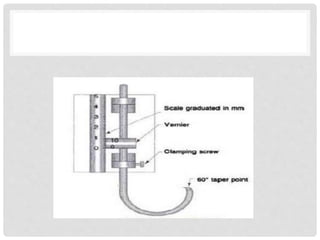
• In hook-type level indicator, the hook is pushed below the
surface of liquid whose level is to be measured and gradually
raised until the point is just about to break through the surface.
• It is then clamped, and the level is read on the scale.
• This principle is further utilized in the measuring point
manometer in which the measuring point consists of a steel point
fixed with the point upwards underneath the water surface.
REFERENCES
• A.P. KULKARNI, PROCESS INSTRUMENTATION AND
CONTROL, NIRALI PUBLICATION
• Chapter 10: Level Measurement, “Industrial Instrumentation
and Control” by S K Singh. Tata McGraw Hill, 3rd Edition,
New Delhi.
• Chapter 6: Level Measurement, “Principles of Industrial
Instrumentation”, 2nd Edition. D. Patranabis Tata McGraw-
Hill, New Delhi,
THANK YOU.

Instumentation and process control

  • 1.
    LEVEL MEASUREMENT • Inmodern manufacturing industries which use many solvents, chemicals, steam and other liquids and in power plants which use vast amount of water, the accurate measurement of liquid level is very essential. • Liquid level refers to the position or height of a liquid surface above a datum line. • Level measurements are made to a certain quantity of the liquid held with in a container.
  • 2.
    • Level measurementsare made to a certain quantity of the liquid held with in a container. • Level offers both the pressure and rate of flow in and out of the container and as such its measurement and control is an important function in a variety of processes. • The task of liquid level measurement may be accomplished by direct methods and indirect methods.
  • 3.
    LIQUID LEVEL MEASUREMENT •Generally, there are two methods used in industries for measuring liquid level. These are 1. Direct Method 2. Indirect Method • Direct method use the varying level of the liquid as a mean of obtaining the measurement. • The indirect method use a variable that changes with the liquid level to accurate the measuring mechanism.
  • 4.
    1. DIRECT METHOD •This is the simplest method of measuring liquid level. In this method, the level of the liquid is measured directly by means of the following level indicators 1. Sight Glass 2. Float Type 3. Hook-type Level Indicator
  • 5.
    SIGHT GLASS • Sightglass is used for the continuous indication of liquid level within a tank or vessel. A sight glass instrument consists of a graduated tube of toughened glass which is connected to the interior of the tank at the bottom in which the water level is required.
  • 6.
    WORKING • Fig.1 showsa simple sight glass for an open tank in which the liquid level in the sight glass matches the level of liquid in the tank. As the level of liquid in the tank rises and falls, the level in the sight glass also rises and falls accordingly. Thus, by measuring the level in the sight glass, the level of liquid in the tank is measured. Fig.
  • 7.
    • Fig.2 showsa high pressure sight glass in which measurement is made by reading the position of the liquid level on the calibrated scale. This type of sight glass in high pressure tanks is used with appropriate safety precautions. The glass tube must have a small inside diameter and a thick wall. Fig.
  • 8.
    DISADVANTAGES • It isread only where the tank is located, which is not always convenient. • Overlapping gauges are needed for long level spans • Accuracy and readability depend on the cleanliness of glass and fluid
  • 9.
    ADVANTAGES • Direct readingis possible • Special designs are available for use up to 316°C and 10000 psi. • Glassless designs are available in numerous materials for corrosion resistance.
  • 10.
    FLOAT TYPE • Float-Type Level Indicator moat operated level indicator is used to measure liquid levels in a tank in which a float rests on the surface of liquid and follows the changing level of liquid. • The movement of the float is transmitted to a pointer through a suitable mechanism which indicates the level on a calibrated scale. • Various types of floats are used such as hollow mewl spheres, cylindrical-shaped floats and disc shaped floats.
  • 12.
    WORKING • When theliquid level rises or falls a buoyant force equal to weight of the displaced liquid is available • It pushes the float up or down. • The float movement is transmitted to a pointer through a suitable mechanism • It indicates the level on a calibrated scale
  • 13.
    ADVANTAGES • Economical • Reliabledesigns • It is possible to read the liquid levels in tanks below ground level • Operated at large temperature ranges
  • 14.
    DISADVANTAGES • Limited tomoderate pressures • Float design should be considered for liquids with suspensions
  • 15.
    HOOK-TYPE LEVEL INDICATOR •When the level of liquid in an open tank is measured directly on a scale (the scale may be in the liquid or outside it), it is sometimes difficult to read the level accurately because of parallax error. • In this case a hook type of level indicator is used.
  • 17.
    WORKING • In hook-typelevel indicator, the hook is pushed below the surface of liquid whose level is to be measured and gradually raised until the point is just about to break through the surface. • It is then clamped, and the level is read on the scale. • This principle is further utilized in the measuring point manometer in which the measuring point consists of a steel point fixed with the point upwards underneath the water surface.
  • 18.
    REFERENCES • A.P. KULKARNI,PROCESS INSTRUMENTATION AND CONTROL, NIRALI PUBLICATION • Chapter 10: Level Measurement, “Industrial Instrumentation and Control” by S K Singh. Tata McGraw Hill, 3rd Edition, New Delhi. • Chapter 6: Level Measurement, “Principles of Industrial Instrumentation”, 2nd Edition. D. Patranabis Tata McGraw- Hill, New Delhi,
  • 19.