Disclosure
I have no actual or potential conflict of interest in relation to
this program/presentation
Prof. Dr. Mohammed Shadrul Alam
MBBS, MS, FCPS, FRCS, FACS
Pediatric Urologist & Health Economist
MuMCH
What is laparoscopy and its
applications
History
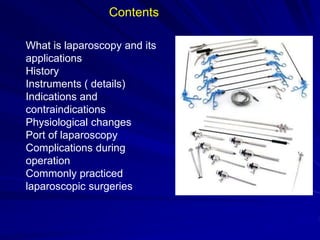
Instruments ( details)
Indications and
contraindications
Physiological changes
Port of laparoscopy
Complications during
operation
Commonly practiced
laparoscopic surgeries
Contents
Definition
It is a minimally access procedure allowing
endoscopic access to peritoneal cavity after
insufflation of gas to create space between the
anterior abd. Wall & viscera for safe manipulation
of instruments & organs.
What is laparoscopic surgery?
Operation performed in pelvis or abdomen
through small incisions
Done for diagnostic purpose or to perform a
surgery
Small camera called laparoscope is used
Benefits- patients experience less pain,
smaller chance of hemorrhaging, and
shorter recovery time
Tools for Standard Laparoscopic Surgery
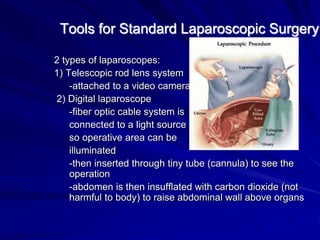
2 types of laparoscopes:
1) Telescopic rod lens system
-attached to a video camera
2) Digital laparoscope
-fiber optic cable system is
connected to a light source
so operative area can be
illuminated
-then inserted through tiny tube (cannula) to see the
operation
-abdomen is then insufflated with carbon dioxide (not
harmful to body) to raise abdominal wall above organs
HISTORY
George Kellingused cystoscope to observe abd organs of dogs—
CYSTOSCOPY
1910 – Swedish physician Hans Christian Jacobaeus used this procedure
in man and coined the term – LAPAROSCOPY
1987 – Mourett in France successfully removed a diseased gall bladder
laparoscopically
Introduction
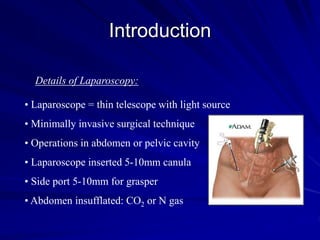
• Laparoscope = thin telescope with light source
• Minimally invasive surgical technique
• Operations in abdomen or pelvic cavity
• Laparoscope inserted 5-10mm canula
• Side port 5-10mm for grasper
• Abdomen insufflated: CO2 or N gas
Details of Laparoscopy:
Introduction (cont.)
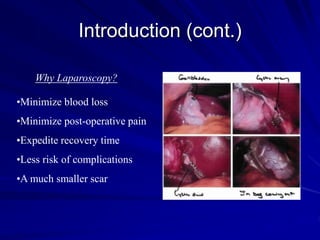
Why Laparoscopy?
•Minimize blood loss
•Minimize post-operative pain
•Expedite recovery time
•Less risk of complications
•A much smaller scar
Endoscopic vs. Laparoscopic Surgery
Endoscopy: An illuminated usually fiber-optic flexible or rigid tubular
instrument for visualizing the interior of a hollow organ or part (as the
bladder or esophagus) for diagnostic or therapeutic purposes that
typically has one or more channels to enable passage of instruments
(as forceps or scissors). Examples: bronchoscopy, cystoscopy.
Laparoscopy:
1: visual examination of the inside of the abdomen by means of a
laparoscope—called also peritoneoscopy
2: an operation (as tubal ligation or gallbladder removal) involving
laparoscopy.
Examples: laparoscopic appendectomy, LAVH.
 Smaller incisions
Less likely to suffer wound-related complications.
 Less post-operative pain
 Decreased hospital stay
Some laparoscopic procedures are performed on an
outpatient basis.
 Accelerated recovery and
improved outcome
Advantages of Laparoscopic Procedures
Background
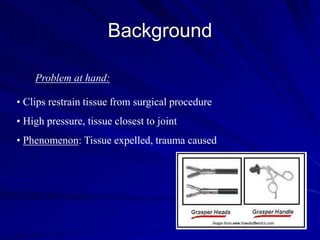
Problem at hand:
• Clips restrain tissue from surgical procedure
• High pressure, tissue closest to joint
• Phenomenon: Tissue expelled, trauma caused
Design Objective
• Grasping instrument designed for internal use
• Minimize moving parts and safety hazards
• Equalize pressure across length of clip
• Device must be <5mm diameter
Specifications:
INSTRUMENTS USED
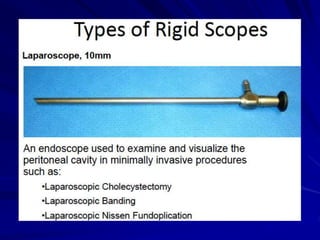
1. Zero degree laparoscope
2. Cold light source (Halogen and Xenon lamp)
3. Camera ( 3chip camera commonly used with high resolution
4. Video monitor to display images
5. CO2 insuffulator
6. Long fine dissectors
7. Hooks and spatulas with cautery for dissections
8. Clip applicators
9. Needle holders
10. Veress needle
11. Trocars of different sizes – 10mm, 5mm
12. Suction irrigation apparatus
13. Reducers to negotiate smaller instruments through larger
ports
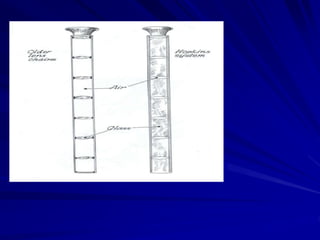
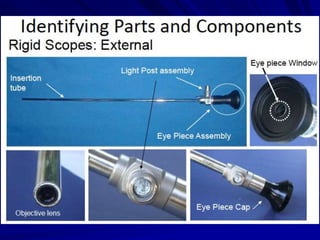
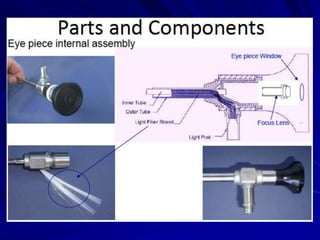
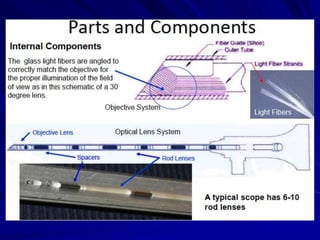
Telescope
There are three important structural differences in
telescope available
1. 6 to 18 rod lens system telescopes are available
2. 0 to 120 degree telescopes are available
3. 1.5 mm to 15 mm of telescopes are available
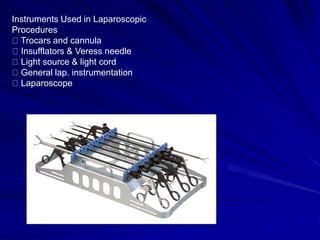
Instruments Used in Laparoscopic
Procedures
Trocars and cannula
Insufflators & Veress needle
Light source & light cord
General lap. instrumentation
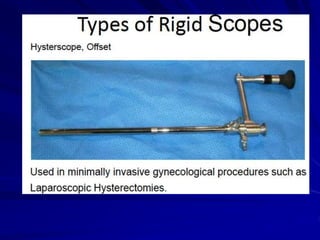
Laparoscope
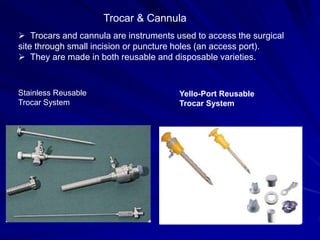
Trocar & Cannula
 Trocars and cannula are instruments used to access the surgical
site through small incision or puncture holes (an access port).
 They are made in both reusable and disposable varieties.
Stainless Reusable
Trocar System
Yello-Port Reusable
Trocar System
Trocar
The trocar has a blade with a shaft and body.
The body includes a pointed tip which makes the initial
incision in the abdominal wall of the patient.
(Trocar diameters range from 2mm-30 mm)
Most common trocer is 5mm & 10mm
Technique
Head end of the table is lowered to have easier insertion of
needle scope
Pressure bandages are applied to both legs to improve the
venous return
Ryle’s tube and foley’s catheter are essential before insertion
of the trocars
Pneumoperitoneum is created using veress needle through
umbilical incision
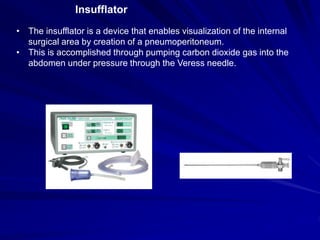
Insufflator
• The insufflator is a device that enables visualization of the internal
surgical area by creation of a pneumoperitoneum.
• This is accomplished through pumping carbon dioxide gas into the
abdomen under pressure through the Veress needle.
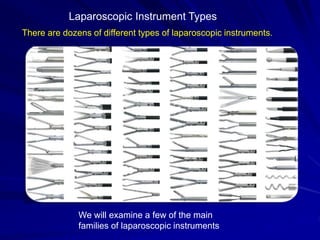
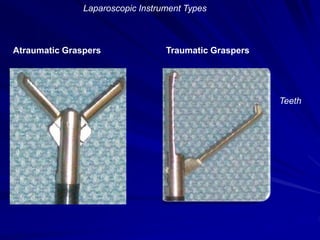
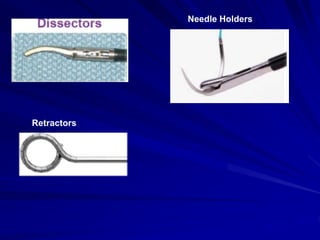
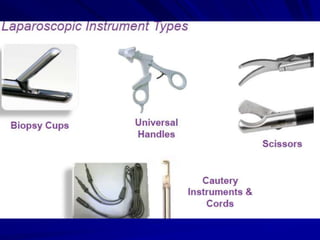
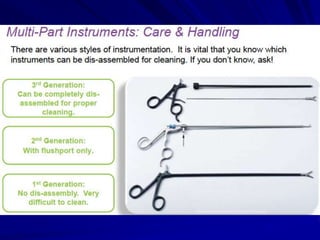
Laparoscopic Instrument Types
There are dozens of different types of laparoscopic instruments.
We will examine a few of the main
families of laparoscopic instruments
Laparoscopic Instrument Types
Traumatic Graspers
Atraumatic Graspers
Teeth
Needle Holders
Retractors
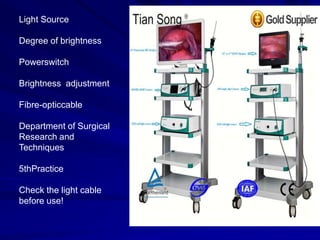
Light Source
Degree of brightness
Powerswitch
Brightness adjustment
Fibre-opticcable
Department of Surgical
Research and
Techniques
5thPractice
Check the light cable
before use!
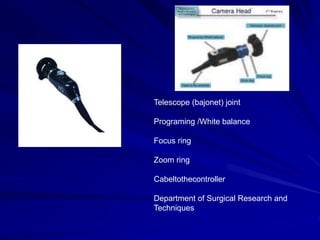
Telescope (bajonet) joint
Programing /White balance
Focus ring
Zoom ring
Cabeltothecontroller
Department of Surgical Research and
Techniques
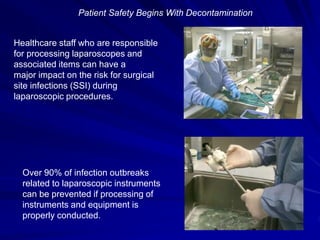
Patient Safety Begins With Decontamination
Healthcare staff who are responsible
for processing laparoscopes and
associated items can have a
major impact on the risk for surgical
site infections (SSI) during
laparoscopic procedures.
Over 90% of infection outbreaks
related to laparoscopic instruments
can be prevented if processing of
instruments and equipment is
properly conducted.
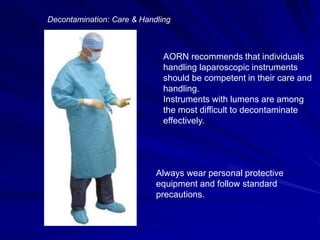
AORN recommends that individuals
handling laparoscopic instruments
should be competent in their care and
handling.
Instruments with lumens are among
the most difficult to decontaminate
effectively.
Decontamination: Care & Handling
Always wear personal protective
equipment and follow standard
precautions.
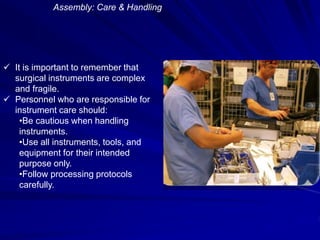
Assembly: Care & Handling
 It is important to remember that
surgical instruments are complex
and fragile.
 Personnel who are responsible for
instrument care should:
•Be cautious when handling
instruments.
•Use all instruments, tools, and
equipment for their intended
purpose only.
•Follow processing protocols
carefully.
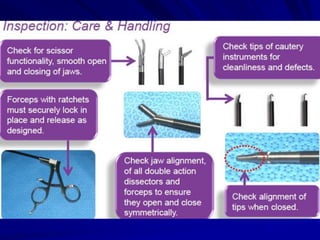
Inspection: Care & Handling
Laparoscopic instruments should be inspected after use, ALL
instruments in set!
Evaluate equipment’s integrity, function, and cleanliness.
All insulated laparoscopic instruments should be tested with a
current tester every time the set is assembled!
Damaged instruments should removed from service.
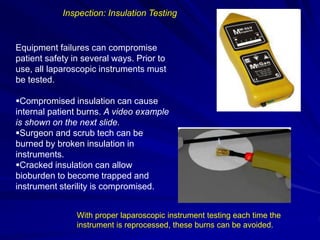
Equipment failures can compromise
patient safety in several ways. Prior to
use, all laparoscopic instruments must
be tested.
Compromised insulation can cause
internal patient burns. A video example
is shown on the next slide.
Surgeon and scrub tech can be
burned by broken insulation in
instruments.
Cracked insulation can allow
bioburden to become trapped and
instrument sterility is compromised.
Inspection: Insulation Testing
With proper laparoscopic instrument testing each time the
instrument is reprocessed, these burns can be avoided.
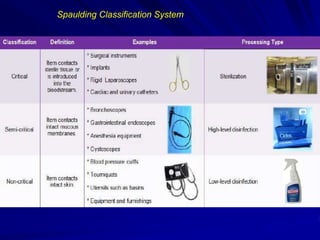
Spaulding Classification System
Care & Cleaning
In order to avoid drying of operation residues and spreading of germs in
the endoscopy areas, the instruments must be placed in a combined
disinfecting and cleaning solution immediately after use.
In connection with this:
 Store optical and mechanical components separately.
 Dismantle instruments.
 Take off rubber and sealing caps.
 Clean thoroughly since blood, pus, protein residues etc. can call subsequent
disinfection or sterilization into question.
 Clean existing inner areas, such as guide channels etc., with the relevant
cleaning brush and swab.
 Rinse open valves and narrow channels with a cleaning gun. Carry out rinsing
and brushing of the channels under the surface of water, to avoid spraying of
germs in the environment.
 Rinse all components first with cold and then with warm water.
 Lay the used instruments carefully in the boxes. The detergent solution must be
appropriate for the disinfectant.
 Lay the instruments in a combined cleaning and disinfecting solution.
 Subsequently rinse with distilled water and then dry inside and out with a cloth,
swab or dry air.
Inspection & Functionality
Inspect instruments for functionality and for any damage that has
occurred after each cleaning.
• Replace brittle and cracked sealing caps.
• Oil all moving components sparingly after cleaning with endoscope
oil. Wipe off excess oil with a disposable towel.
• Sparingly grease rotating valves, valve pistons from trocar sleeves
etc. after cleaning (before steam sterilization) with endoscope
grease.
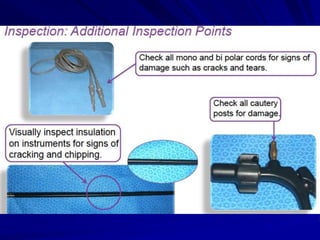
• Inspect the insulation of the cable and connections for cuts, holes,
cracks, blowing, wear, etc. Do not use any damaged instruments.
• Send damaged instruments to the factory for repair.
What gas is commonly used to inflate the abdominal
cavity for a laparoscopic procedure?
• Oxygen
• Carbon Dioxide
• Carbon Monoxide
• Nitrous Oxide
What is the medical term for making internal organs
easier to visualize by inserting gas into the
abdominal cavity?
• Pneumoperitoneum
• Pneumothorax
• Pneumonisis
• Indigestion
What instruments are used to access the
surgical site through small puncture holes?
a) Trocanter & Cannula
b) Trocar & Candlestick
c) Trocar & Cannula
d) Trocanter & Calendula
What is an advantage of minimally invasive
surgery?
a) Smaller Incision
b) Decreased Hospital Stay
c) Less Pain
d) All of the above
What is part of the laparoscopic instrument inspection
process contributes the most to patient safety?
a) Assuring it’s lubricated
b) Checking for faulty insulation
c) Handle feels comfortable
d) Tip protectors are secured
LAVH is an abbreviation for a surgical
procedure. What does the abbreviation
stand for?
a) Look Around Very Hard
b) Lap Assisted Vaginal Hysterectomy
c) Lap Assisted Vaginal Hysteroscopy
d) Laparotomy And Vaginal Hysterectomy
CONTRAINDICATIONS
1. Absolute - none
2. Relative
i) severe COAD
ii) recent MI
iii) ventriculoperitoneal shunts
iv) Increased ICT
v) extensive organomegaly
vi) CHF
Complications
Insertion Related :
1) Major vascular injury
2) GI Injury
3) Bladder injury
4) CO2 embolism
5) Abdominal wall
haemorrhage
Post Insertional:
1) GI perforations
2) Laceration & bleeding from
solid organs
3) Abdominal wall hernia
Pneumoperitoneal Related:
1) CO2 embolism
2) Hypercarbia
3) Respiratory acidosis
4) Subcutaneous emphysema
5) Renal failure
6) Venous thrombosis
7) Pneumothorax
Ergonomics of Laparoscopy
Increased Time/Fatigue
Length of instruments
- Increased Tremor
- Only about 4 Degrees of Freedom compared
to human hands that provide 36 DOF and
mechanical redundancy
Spatial disorientation/ instrument movement
- Fulcrum Effect
Greater force required to grip instruments
Only one size of instruments often available
Ergonomics of Laparoscopy
Increased Time/Fatigue*
Reduced ability to sense tissue characteristics
Surgical Fatigue Syndrome
- A four hour performance “wall” that is manifested
by mental exhaustion, irritability, impaired surgical
judgment, and reduced manual dexterity
Visual fatigue
- long term effect is unknown
Possibly significant cardiovascular stress
*D. A. G. Reyes, B. Tang, A. Cuschieri, 2006, Minimal access surgery (MAS)-related
surgeon morbidity syndromes, Surgical Endoscopy, v.20(1), p. 1-13
Ergonomics of Laparoscopy
Posture*
Overhead or side placement of monitor
- Ideal placement is to the front, near the hands
There is an increase in the amount of equipment,
which leads to a need to maneuver around them
Stiff upright with little movement
- Less opportunity to shift weight
Requires raised arms placed in awkward positions for
extended periods of time
*D. A. G. Reyes, B. Tang, A. Cuschieri, 2006, Minimal access surgery (MAS)-related
surgeon morbidity syndromes, Surgical Endoscopy, v.20(1), p. 1-13
Berguer R., 1999, Surgery and ergonomics, Archives of Surgery, v.134(9), p. 1011-1016
Ergonomics Of NOTES
No tactile response
Visual fatigue
Constant holding of the endoscope
induces fatigue
Endoscopy can lead to musculoskeletal
pain in fingers, wrists and shoulders*
Young Hye Byun, Jun Haeng Lee, Moon Kyung Park, 2008, Procedure-related musculoskeletal
symptoms in gastrointestinal endoscopists in Korea, World J Gastroenterol, v.14(27)
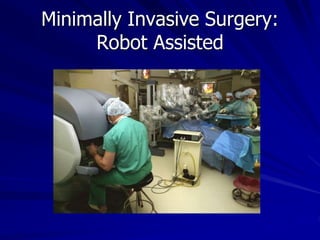
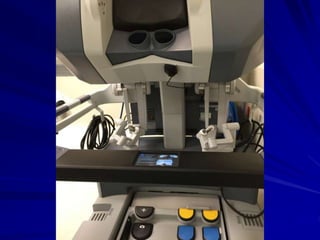
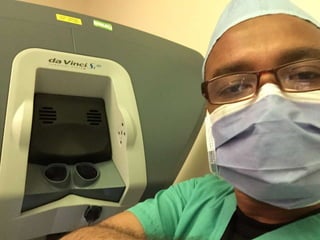
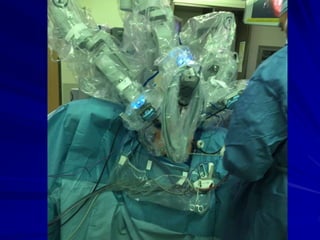
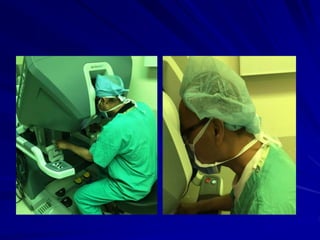
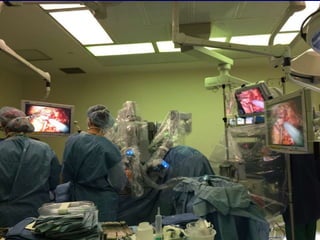
Minimally Invasive Surgery:
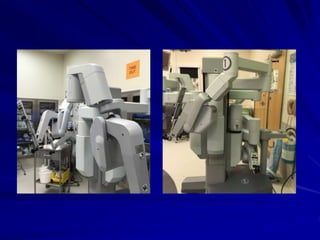
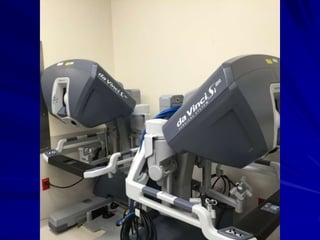
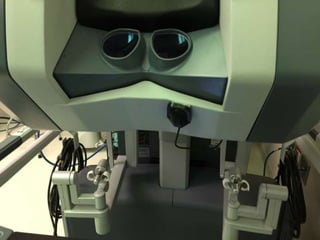
Robot Assisted
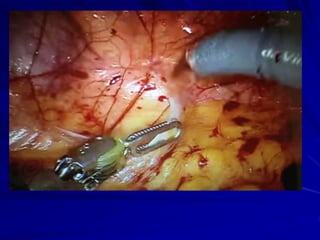
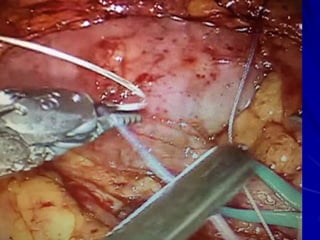
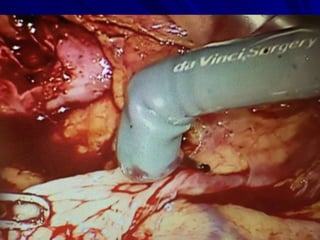
Why Robotic Surgery ?
■a 400X magnified 3D high-definition vision with
adequate precision and control
■special wristed instruments that bend and rotate far
greater than the human wrist
■Less blood loss
■Shorter total operating time
■Less need for narcotic pain medicine
■Shorter hospital stay
■Faster return to normal activities
■ Nevertheless, disadvantages to
robotic-assisted laparoscopic surgeries
are
■ no tactile feedback,
■ increased setup time, and
■ cost
The Ever Changing Future
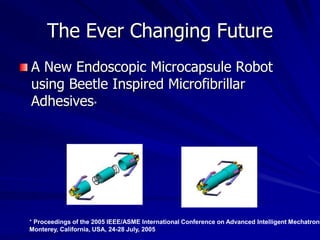
A New Endoscopic Microcapsule Robot
using Beetle Inspired Microfibrillar
Adhesives*
* Proceedings of the 2005 IEEE/ASME International Conference on Advanced Intelligent Mechatroni
Monterey, California, USA, 24-28 July, 2005
The Ever Changing Future
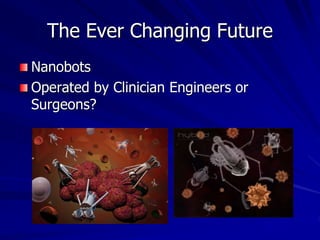
Nanobots
Operated by Clinician Engineers or
Surgeons?
Instruments used in  Laparoscopic  surgery.pptx

Instruments used in Laparoscopic surgery.pptx

  • 1.
    Disclosure I have noactual or potential conflict of interest in relation to this program/presentation Prof. Dr. Mohammed Shadrul Alam MBBS, MS, FCPS, FRCS, FACS Pediatric Urologist & Health Economist MuMCH
  • 2.
    What is laparoscopyand its applications History Instruments ( details) Indications and contraindications Physiological changes Port of laparoscopy Complications during operation Commonly practiced laparoscopic surgeries Contents
  • 3.
    Definition It is aminimally access procedure allowing endoscopic access to peritoneal cavity after insufflation of gas to create space between the anterior abd. Wall & viscera for safe manipulation of instruments & organs.
  • 4.
    What is laparoscopicsurgery? Operation performed in pelvis or abdomen through small incisions Done for diagnostic purpose or to perform a surgery Small camera called laparoscope is used Benefits- patients experience less pain, smaller chance of hemorrhaging, and shorter recovery time
  • 5.
    Tools for StandardLaparoscopic Surgery 2 types of laparoscopes: 1) Telescopic rod lens system -attached to a video camera 2) Digital laparoscope -fiber optic cable system is connected to a light source so operative area can be illuminated -then inserted through tiny tube (cannula) to see the operation -abdomen is then insufflated with carbon dioxide (not harmful to body) to raise abdominal wall above organs
  • 6.
    HISTORY George Kellingused cystoscopeto observe abd organs of dogs— CYSTOSCOPY 1910 – Swedish physician Hans Christian Jacobaeus used this procedure in man and coined the term – LAPAROSCOPY 1987 – Mourett in France successfully removed a diseased gall bladder laparoscopically
  • 7.
    Introduction • Laparoscope =thin telescope with light source • Minimally invasive surgical technique • Operations in abdomen or pelvic cavity • Laparoscope inserted 5-10mm canula • Side port 5-10mm for grasper • Abdomen insufflated: CO2 or N gas Details of Laparoscopy:
  • 8.
    Introduction (cont.) Why Laparoscopy? •Minimizeblood loss •Minimize post-operative pain •Expedite recovery time •Less risk of complications •A much smaller scar
  • 9.
    Endoscopic vs. LaparoscopicSurgery Endoscopy: An illuminated usually fiber-optic flexible or rigid tubular instrument for visualizing the interior of a hollow organ or part (as the bladder or esophagus) for diagnostic or therapeutic purposes that typically has one or more channels to enable passage of instruments (as forceps or scissors). Examples: bronchoscopy, cystoscopy. Laparoscopy: 1: visual examination of the inside of the abdomen by means of a laparoscope—called also peritoneoscopy 2: an operation (as tubal ligation or gallbladder removal) involving laparoscopy. Examples: laparoscopic appendectomy, LAVH.
  • 10.
     Smaller incisions Lesslikely to suffer wound-related complications.  Less post-operative pain  Decreased hospital stay Some laparoscopic procedures are performed on an outpatient basis.  Accelerated recovery and improved outcome Advantages of Laparoscopic Procedures
  • 11.
    Background Problem at hand: •Clips restrain tissue from surgical procedure • High pressure, tissue closest to joint • Phenomenon: Tissue expelled, trauma caused
  • 12.
    Design Objective • Graspinginstrument designed for internal use • Minimize moving parts and safety hazards • Equalize pressure across length of clip • Device must be <5mm diameter Specifications:
  • 13.
    INSTRUMENTS USED 1. Zerodegree laparoscope 2. Cold light source (Halogen and Xenon lamp) 3. Camera ( 3chip camera commonly used with high resolution 4. Video monitor to display images 5. CO2 insuffulator 6. Long fine dissectors 7. Hooks and spatulas with cautery for dissections 8. Clip applicators 9. Needle holders 10. Veress needle 11. Trocars of different sizes – 10mm, 5mm 12. Suction irrigation apparatus 13. Reducers to negotiate smaller instruments through larger ports
  • 15.
    Telescope There are threeimportant structural differences in telescope available 1. 6 to 18 rod lens system telescopes are available 2. 0 to 120 degree telescopes are available 3. 1.5 mm to 15 mm of telescopes are available
  • 16.
    Instruments Used inLaparoscopic Procedures Trocars and cannula Insufflators & Veress needle Light source & light cord General lap. instrumentation Laparoscope
  • 17.
    Trocar & Cannula Trocars and cannula are instruments used to access the surgical site through small incision or puncture holes (an access port).  They are made in both reusable and disposable varieties. Stainless Reusable Trocar System Yello-Port Reusable Trocar System
  • 18.
    Trocar The trocar hasa blade with a shaft and body. The body includes a pointed tip which makes the initial incision in the abdominal wall of the patient. (Trocar diameters range from 2mm-30 mm) Most common trocer is 5mm & 10mm Technique Head end of the table is lowered to have easier insertion of needle scope Pressure bandages are applied to both legs to improve the venous return Ryle’s tube and foley’s catheter are essential before insertion of the trocars Pneumoperitoneum is created using veress needle through umbilical incision
  • 19.
    Insufflator • The insufflatoris a device that enables visualization of the internal surgical area by creation of a pneumoperitoneum. • This is accomplished through pumping carbon dioxide gas into the abdomen under pressure through the Veress needle.
  • 20.
    Laparoscopic Instrument Types Thereare dozens of different types of laparoscopic instruments. We will examine a few of the main families of laparoscopic instruments
  • 21.
    Laparoscopic Instrument Types TraumaticGraspers Atraumatic Graspers Teeth
  • 22.
  • 24.
    Light Source Degree ofbrightness Powerswitch Brightness adjustment Fibre-opticcable Department of Surgical Research and Techniques 5thPractice Check the light cable before use!
  • 25.
    Telescope (bajonet) joint Programing/White balance Focus ring Zoom ring Cabeltothecontroller Department of Surgical Research and Techniques
  • 31.
    Patient Safety BeginsWith Decontamination Healthcare staff who are responsible for processing laparoscopes and associated items can have a major impact on the risk for surgical site infections (SSI) during laparoscopic procedures. Over 90% of infection outbreaks related to laparoscopic instruments can be prevented if processing of instruments and equipment is properly conducted.
  • 32.
    AORN recommends thatindividuals handling laparoscopic instruments should be competent in their care and handling. Instruments with lumens are among the most difficult to decontaminate effectively. Decontamination: Care & Handling Always wear personal protective equipment and follow standard precautions.
  • 34.
    Assembly: Care &Handling  It is important to remember that surgical instruments are complex and fragile.  Personnel who are responsible for instrument care should: •Be cautious when handling instruments. •Use all instruments, tools, and equipment for their intended purpose only. •Follow processing protocols carefully.
  • 36.
    Inspection: Care &Handling Laparoscopic instruments should be inspected after use, ALL instruments in set! Evaluate equipment’s integrity, function, and cleanliness. All insulated laparoscopic instruments should be tested with a current tester every time the set is assembled! Damaged instruments should removed from service.
  • 37.
    Equipment failures cancompromise patient safety in several ways. Prior to use, all laparoscopic instruments must be tested. Compromised insulation can cause internal patient burns. A video example is shown on the next slide. Surgeon and scrub tech can be burned by broken insulation in instruments. Cracked insulation can allow bioburden to become trapped and instrument sterility is compromised. Inspection: Insulation Testing With proper laparoscopic instrument testing each time the instrument is reprocessed, these burns can be avoided.
  • 39.
  • 40.
    Care & Cleaning Inorder to avoid drying of operation residues and spreading of germs in the endoscopy areas, the instruments must be placed in a combined disinfecting and cleaning solution immediately after use. In connection with this:  Store optical and mechanical components separately.  Dismantle instruments.  Take off rubber and sealing caps.  Clean thoroughly since blood, pus, protein residues etc. can call subsequent disinfection or sterilization into question.  Clean existing inner areas, such as guide channels etc., with the relevant cleaning brush and swab.  Rinse open valves and narrow channels with a cleaning gun. Carry out rinsing and brushing of the channels under the surface of water, to avoid spraying of germs in the environment.  Rinse all components first with cold and then with warm water.  Lay the used instruments carefully in the boxes. The detergent solution must be appropriate for the disinfectant.  Lay the instruments in a combined cleaning and disinfecting solution.  Subsequently rinse with distilled water and then dry inside and out with a cloth, swab or dry air.
  • 41.
    Inspection & Functionality Inspectinstruments for functionality and for any damage that has occurred after each cleaning. • Replace brittle and cracked sealing caps. • Oil all moving components sparingly after cleaning with endoscope oil. Wipe off excess oil with a disposable towel. • Sparingly grease rotating valves, valve pistons from trocar sleeves etc. after cleaning (before steam sterilization) with endoscope grease. • Inspect the insulation of the cable and connections for cuts, holes, cracks, blowing, wear, etc. Do not use any damaged instruments. • Send damaged instruments to the factory for repair.
  • 42.
    What gas iscommonly used to inflate the abdominal cavity for a laparoscopic procedure? • Oxygen • Carbon Dioxide • Carbon Monoxide • Nitrous Oxide What is the medical term for making internal organs easier to visualize by inserting gas into the abdominal cavity? • Pneumoperitoneum • Pneumothorax • Pneumonisis • Indigestion
  • 43.
    What instruments areused to access the surgical site through small puncture holes? a) Trocanter & Cannula b) Trocar & Candlestick c) Trocar & Cannula d) Trocanter & Calendula What is an advantage of minimally invasive surgery? a) Smaller Incision b) Decreased Hospital Stay c) Less Pain d) All of the above
  • 44.
    What is partof the laparoscopic instrument inspection process contributes the most to patient safety? a) Assuring it’s lubricated b) Checking for faulty insulation c) Handle feels comfortable d) Tip protectors are secured LAVH is an abbreviation for a surgical procedure. What does the abbreviation stand for? a) Look Around Very Hard b) Lap Assisted Vaginal Hysterectomy c) Lap Assisted Vaginal Hysteroscopy d) Laparotomy And Vaginal Hysterectomy
  • 45.
    CONTRAINDICATIONS 1. Absolute -none 2. Relative i) severe COAD ii) recent MI iii) ventriculoperitoneal shunts iv) Increased ICT v) extensive organomegaly vi) CHF
  • 46.
    Complications Insertion Related : 1)Major vascular injury 2) GI Injury 3) Bladder injury 4) CO2 embolism 5) Abdominal wall haemorrhage Post Insertional: 1) GI perforations 2) Laceration & bleeding from solid organs 3) Abdominal wall hernia Pneumoperitoneal Related: 1) CO2 embolism 2) Hypercarbia 3) Respiratory acidosis 4) Subcutaneous emphysema 5) Renal failure 6) Venous thrombosis 7) Pneumothorax
  • 47.
    Ergonomics of Laparoscopy IncreasedTime/Fatigue Length of instruments - Increased Tremor - Only about 4 Degrees of Freedom compared to human hands that provide 36 DOF and mechanical redundancy Spatial disorientation/ instrument movement - Fulcrum Effect Greater force required to grip instruments Only one size of instruments often available
  • 48.
    Ergonomics of Laparoscopy IncreasedTime/Fatigue* Reduced ability to sense tissue characteristics Surgical Fatigue Syndrome - A four hour performance “wall” that is manifested by mental exhaustion, irritability, impaired surgical judgment, and reduced manual dexterity Visual fatigue - long term effect is unknown Possibly significant cardiovascular stress *D. A. G. Reyes, B. Tang, A. Cuschieri, 2006, Minimal access surgery (MAS)-related surgeon morbidity syndromes, Surgical Endoscopy, v.20(1), p. 1-13
  • 49.
    Ergonomics of Laparoscopy Posture* Overheador side placement of monitor - Ideal placement is to the front, near the hands There is an increase in the amount of equipment, which leads to a need to maneuver around them Stiff upright with little movement - Less opportunity to shift weight Requires raised arms placed in awkward positions for extended periods of time *D. A. G. Reyes, B. Tang, A. Cuschieri, 2006, Minimal access surgery (MAS)-related surgeon morbidity syndromes, Surgical Endoscopy, v.20(1), p. 1-13 Berguer R., 1999, Surgery and ergonomics, Archives of Surgery, v.134(9), p. 1011-1016
  • 50.
    Ergonomics Of NOTES Notactile response Visual fatigue Constant holding of the endoscope induces fatigue Endoscopy can lead to musculoskeletal pain in fingers, wrists and shoulders* Young Hye Byun, Jun Haeng Lee, Moon Kyung Park, 2008, Procedure-related musculoskeletal symptoms in gastrointestinal endoscopists in Korea, World J Gastroenterol, v.14(27)
  • 51.
  • 52.
    Why Robotic Surgery? ■a 400X magnified 3D high-definition vision with adequate precision and control ■special wristed instruments that bend and rotate far greater than the human wrist ■Less blood loss ■Shorter total operating time ■Less need for narcotic pain medicine ■Shorter hospital stay ■Faster return to normal activities
  • 53.
    ■ Nevertheless, disadvantagesto robotic-assisted laparoscopic surgeries are ■ no tactile feedback, ■ increased setup time, and ■ cost
  • 65.
    The Ever ChangingFuture A New Endoscopic Microcapsule Robot using Beetle Inspired Microfibrillar Adhesives* * Proceedings of the 2005 IEEE/ASME International Conference on Advanced Intelligent Mechatroni Monterey, California, USA, 24-28 July, 2005
  • 66.
    The Ever ChangingFuture Nanobots Operated by Clinician Engineers or Surgeons?