Energy Sources used in
Endo-Laparoscopy
Prof. Dr. Rafiques Salehin
Professor & Head
Department of Surgery
Sir Salimullah Medical College Mitford Hospital
Most convenient Way of Dissection / Laparoscopic dissection
 Electro-surgery
 Blunt dissection
 Pledget
 Gauze
 Instrument
 Sharp – knife , Scissor.
 Newer device – Laser / Ultrasound / hybrid.
Electro-surgery – use of A/C current. Most convenient but risky.
 Energy sources in laparoscopic surgery -- 3 categories.
 Electrosurgery – When alternate current is passed between the tissue & the heat is
produced used to create the desired effect of cutting & coagulation. Exact effect
depends on the temperature achieved.
At temp. 70 – 100 c coagulation occur. Above 100 c desiccation occur.
Effect on tissue can be further modified by alternating the waveform of ac current.
For cutting effect low voltage current creates faster heat generation & vaporization
For coagulation burst of high voltage current used. Tissue does not vaporizes but cools
between burst.
Blend contains a mix of cutting & coagulation
1.Monopolar Electrosurgery 2.Bipolar Electrosurgery 3. Advance Bipolar.
 Ultrasonic Source
 Laser Energy source
Electrosurgery
 Vriables impacting tissue effect
 Waveform – Fulguration (Small fulguration, Spray), Desiccation, Blend, Pure cut.
 Power setting – Not more than 40 watt. As minimum
 Site of electrode
 Time - 3 sec burst.
 Manipulation of electrode
 Type of tissue
 Eschar
Burn – Intensity of current . Time. Area.
Remote burn.
Charcoal. Like cigarette.
Tripolar electrosurgery – Disection, Grasping, Bipolar coagulation, Bipolar cut.
Physics of Electricity
Circuit = Pathway or flow of electrons
Current = Amount of electrons flowing (amps) (I)
Voltage = Driving force (volts) (V)
Resistance = Impedance or obstacle to flow of electrons (ohms) (R)
Ohm’s Law: (V = I x R)
Power = Energy/ heat produced or used over a period of time (watts)
(P = V x I)
Ohams law – V = IR : I = V/R : R = V/I.
V = Voltage , I = Current flow, directly proportionate to resistance. R =
Resistance
Amount of steady current is directly proportionate to potential difference
or voltage.
Current through a conductor is proportional to the voltage across the
conductor.
Temperature remains constant
There are T wo types of current: Alternating and Direct.
With Direct Current, electrons flow in one direction. Example: a flashlight.
Current flows from the battery to the lamp and creates light.
With Alternating Current, electrons flow bi-directionally. The direction of
flow is constantly being reversed.
Both Monopolar and Bipolar Electrosurgery utilize Alternating Current.
Two Types of Electrical Circuit
DC - Direct Current
Unidirectional flow of electricity
eg - Battery
AC - Alternating Current
Direction reverses cyclically
eg - Household electricity
Monopoloar Electrosurgery
Bipolar
Cautery - Electrocautery - Electrosurgery
Cautery
The surgical use of heat
Electro-cautery
The process of destroying tissue with an object that is heated with electricity
There is no current flowing through the patient.
Electro-surgery
The use of alternating current passing through the patient to cut and coagulate tissue
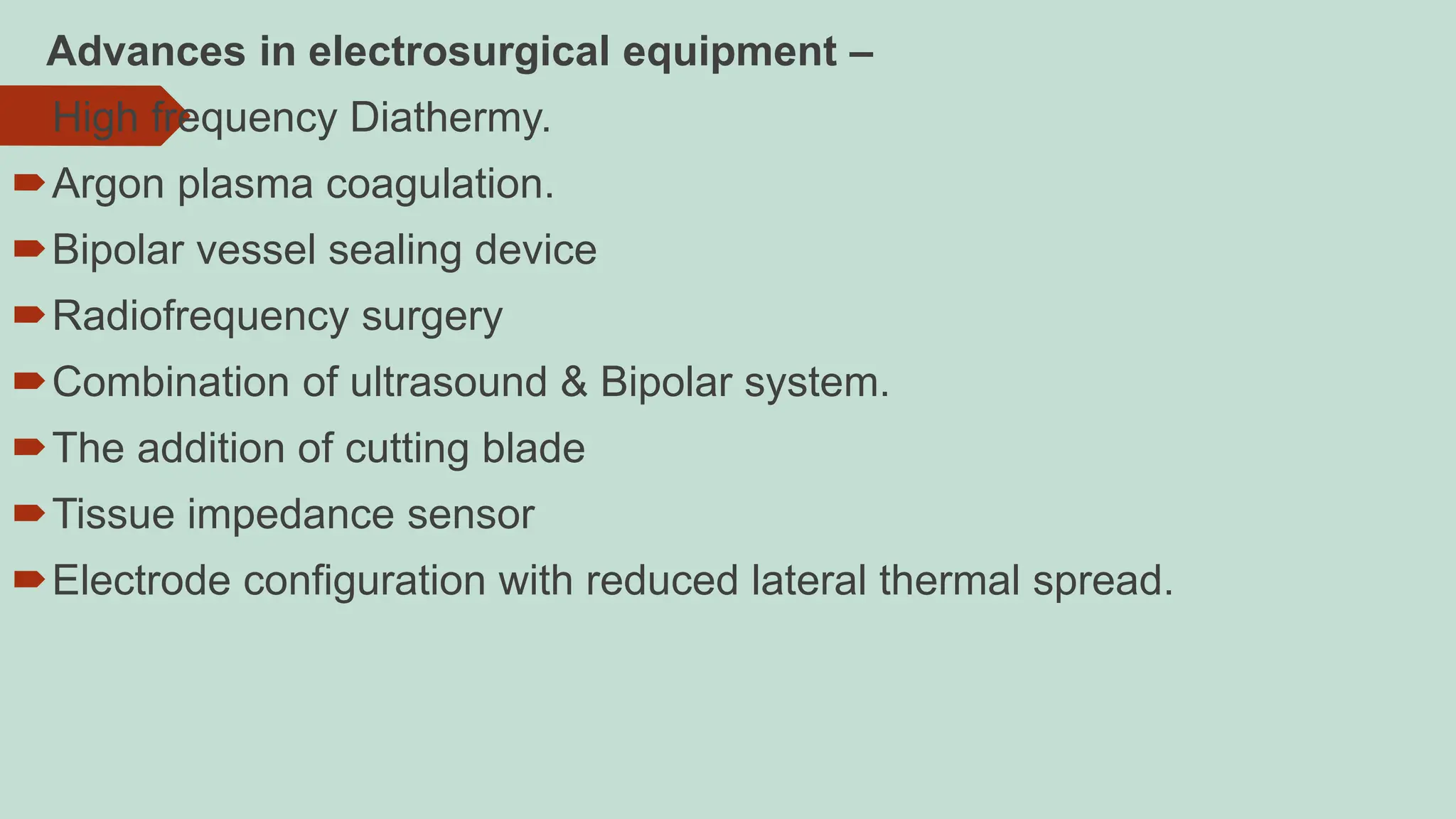
Advances in electrosurgical equipment –
High frequency Diathermy.
Argon plasma coagulation.
Bipolar vessel sealing device
Radiofrequency surgery
Combination of ultrasound & Bipolar system.
The addition of cutting blade
Tissue impedance sensor
Electrode configuration with reduced lateral thermal spread.
Electrosurgical injury during laparoscopic surgery – Main causes
Inadverent grasping or touching of tissue during application.
Insulation break in the electrode.
Direct sparking to the intestine from the diathermy.
Direct coupling /DC Coupling/ Conductive Coupling between a portion of
intestine & a metal probe that is touching the activated probe.
Inductive coupling / Magnetically coupled – Changes through one wire induces
a voltage across the end of other wire through electromagnetic induction
Capacitive coupling – Transfer of energy within a network or between distant
network by means of displacement current between circuits. Nodes, induced
by the electric field.
Disperse electrode burn
Alternate site burn
Ground point burn
Tissue effects of heating
Temperature (Centigrade)
34-44 44-50 50-80
Effect
Visible None None Blanching
Delayed Edema Necrosis Sloughing
Mechanism Vasodilatation
Inflammation
Disruption of cell
metabolism
Collagen
denaturation
Tissue effects of heating
Temperature (Centigrade)
80-100 100-200 >200
Effect
Visible Shrinkage Steam “popcorn” Carbonization
cratering
Delayed Sloughing Ulceration Larger crater-
Mechanism Desiccation Vaporization Combustion of
tissue hydrocarbons
Monopolar Electrosurgery
Waveform refers to the shape of the electrical signal as it travels along the circuit.
Different waveforms indicate the generator is delivering current at different voltages.
Low voltage is safer simply because it delivers less force.
Any modality can be used to desiccate (dry up) tissue. The difference is how the
current is applied to the tissue.
In Electrosurgery, there are 3 basic waveforms:
• Cut (vaporization)
• Coagulation – Fulguration , Coagulation.
• Blend (cutting and coagulation)
Monopolar Electrosurgery
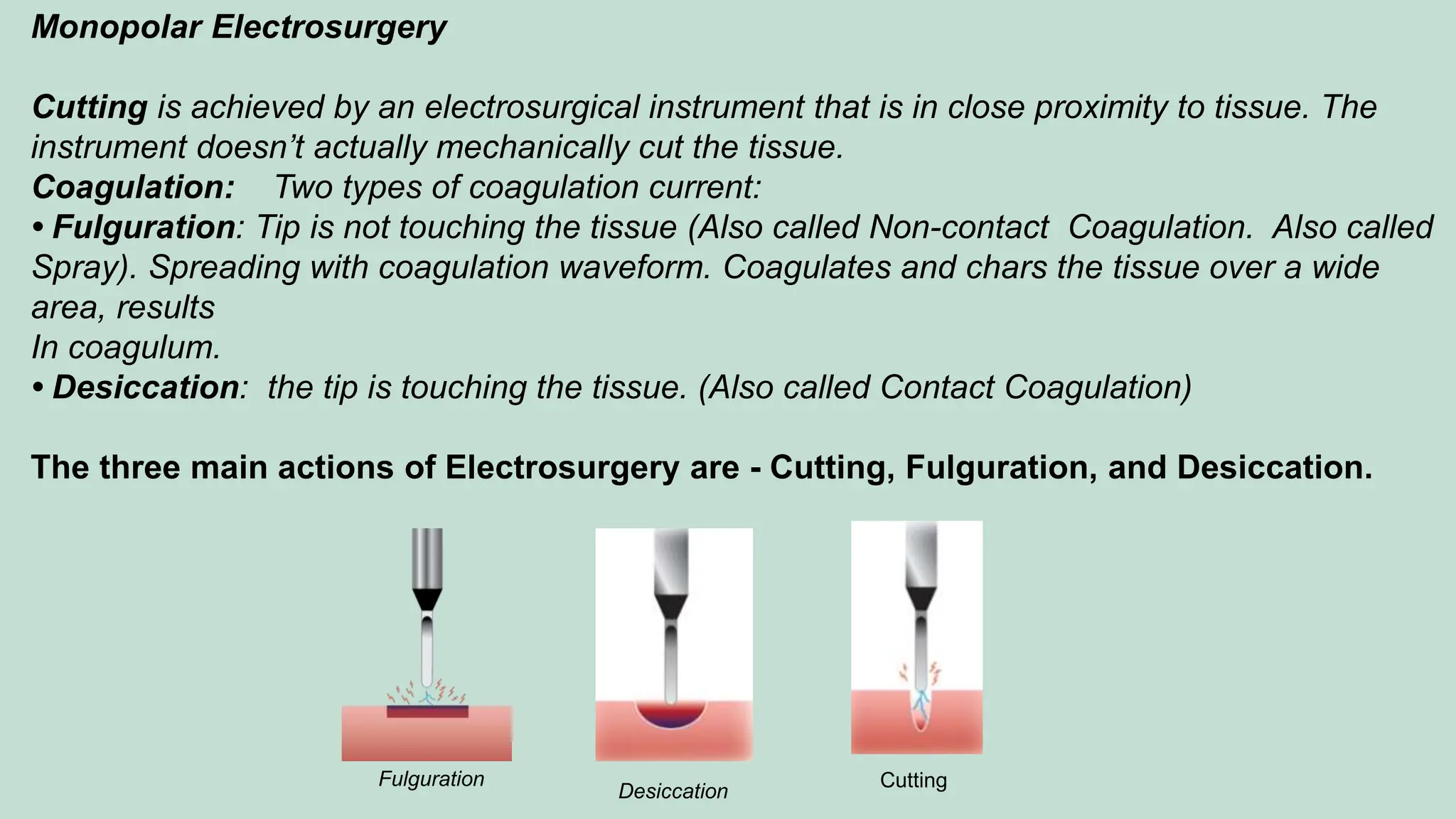
Cutting is achieved by an electrosurgical instrument that is in close proximity to tissue. The
instrument doesn’t actually mechanically cut the tissue.
Coagulation: Two types of coagulation current:
• Fulguration: Tip is not touching the tissue (Also called Non-contact Coagulation. Also called
Spray). Spreading with coagulation waveform. Coagulates and chars the tissue over a wide
area, results
In coagulum.
• Desiccation: the tip is touching the tissue. (Also called Contact Coagulation)
The three main actions of Electrosurgery are - Cutting, Fulguration, and Desiccation.
Cutting
Fulguration
Desiccation
Traditional Bipolar
Monopolar Circuit
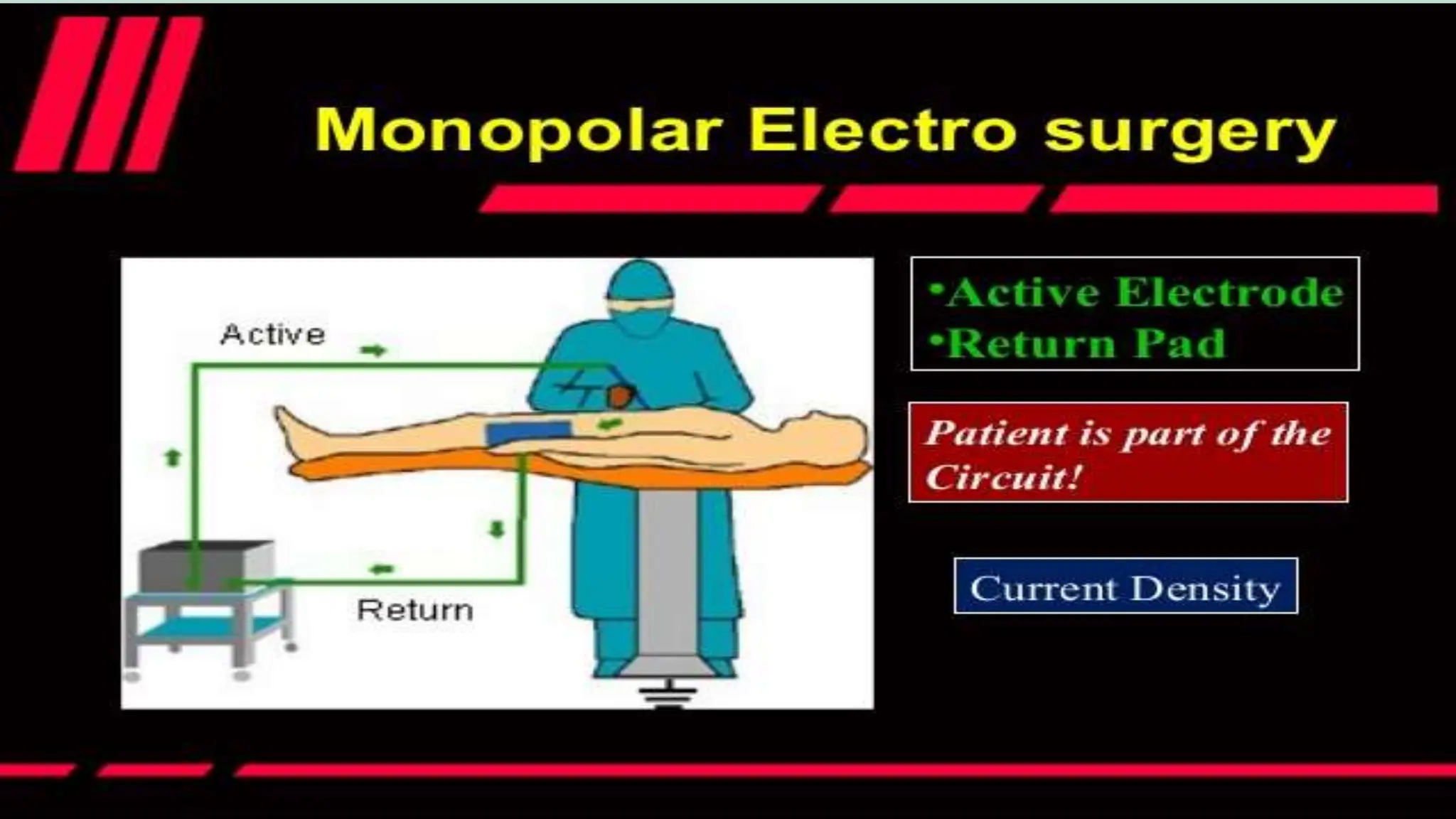
•Current flows from a small (active) electrode to and through
the patient to a large, indifferent (ground) electrode
•The patient is vital to completing the circuit
How it works
Monopolar Electrosurgery
In Electrosurgery, a complete circuit is necessary for current to flow.
In Monopolar Electrosurgery,
• The current flows from the pencil through the patient to the pad and back to the
generator.
• The patient’s tissue completes the circuit.
What’s the difference between the pencil and the pad?
The pencil is small and delivers higher current concentrations.
The pad is larger and dissipates the current over a larger area.
The tissue effect occurs at the pencil, where current concentrations are high.
Advantages of Electro cutting
• Reduced bleeding
• Prevention of germ implantation
• Avoidance of mechanical damage to the tissue
• Endoscopic applicability
Risk of Monopolar Electrosurgery
• Active Electrode Trauma
• Current diversion
– Alternate ground site burns
– Direct coupling
– Indirect coupling
– Capacitive coupling
• Dispersive electrode burns
• Smoke inhalation
•Insulation failure
Impact of unintended current flow.
As you’re treating the tissue, the tissue impedance changes
As the tissue impedance (resistance) increases on the gallbladder side then
the current starts to flow towards the duodenum
Effect may be compounded by current density on duodenal side
gallblader
deodenum
Increased current
density
Potential Risks of Monopolar Electrosurgery
Indifferent Electrode (Return Pad) Failure
If the pad lost partial contact, current could concentrate at that site and
produce injury. This resulted in the classic “grounding pad injury or burn”
often experienced with older electrosurgical systems.
Tissue
Correct
Active
Electrode
(pencil)
Incorrect
Active
Electrode
(pencil)
Indifferent
Electrode
Safe Use of Monopolar Electrosurgery
Best Practices
Consider using cut waveform Use lowest power setting for desired tissue effect.
Check insulation on all instruments and connectors before use.
Use isolated generator and patient contact quality monitoring system (standard practice in the
U.S.)
Techniques to Avoid
Avoid an open circuit Limit activation with electrode off tissue (limit direct coupling)
Clean eschar off of the instrument tip
Avoid inadvertent contact of metal-to-metal
Bipolar Electro surgery
Bipolar energy
• First described in Gyne surgery in 1973 by Rioux.
• Described as an evolution in comparison to monopolar energy: safer & less thermal spread
Rioux JE, Cloutier D. A new bipolar instrument for laparoscopic tubal sterilization.
Am J Obstet Gynecol. 1974;119:737–741.
How it works
Traditional Bipolar Circuit
Voltage is applied to the patient using forceps
A high frequency electrical current flows from one of the tines to the other tine,
through the intervening tissue
The tissue within the forceps completes the circuit
An indifferent electrode is not required
Technology: Traditional Bipolar Electrosurgery
High current concentrations
Relatively low voltage
Current generates heat in
tissue
Reduced risk of capacitive and
direct coupling
Surgeon visually controls the
delivery of energy
Principles:
– Closed system with active electrode and passive electrode
– Interrupted frequency of about 500 KHz
– Low voltage interrupted current
– Specific instrumentation: graspers or forceps
Bipolar energy Introduction
Disadvantages
Minimal cutting effect
Capacity of thermal damage Spread
Advanced Bipolar Circuit
High frequency, low voltage, current flows from one jaw to the other
Tissue within the jaws completes the circuit
Return pad is not required
NO alternate site burns
Less direct and capacitive coupling
Bipolar energy ROBI bipolar
Advantages
• Excellent dissection tool
• Grasping forceps
• Cheap
• Re-usable
Disadvantages
• Important lateral spread of heat
• Possible to touch by accident other tissues
(not covered tip)
• Does not measure tissue impedance or
temperature
Bipolar energy Enseal
Advantages
• Fast & efficient (up to 7mm) coagulation & cut
• Measure tissue impedance & temperature
• Minimal thermal spread
Disadvantages
• Capacity of thermal damage spread
• Dissection limited
• Similar to Ligassure
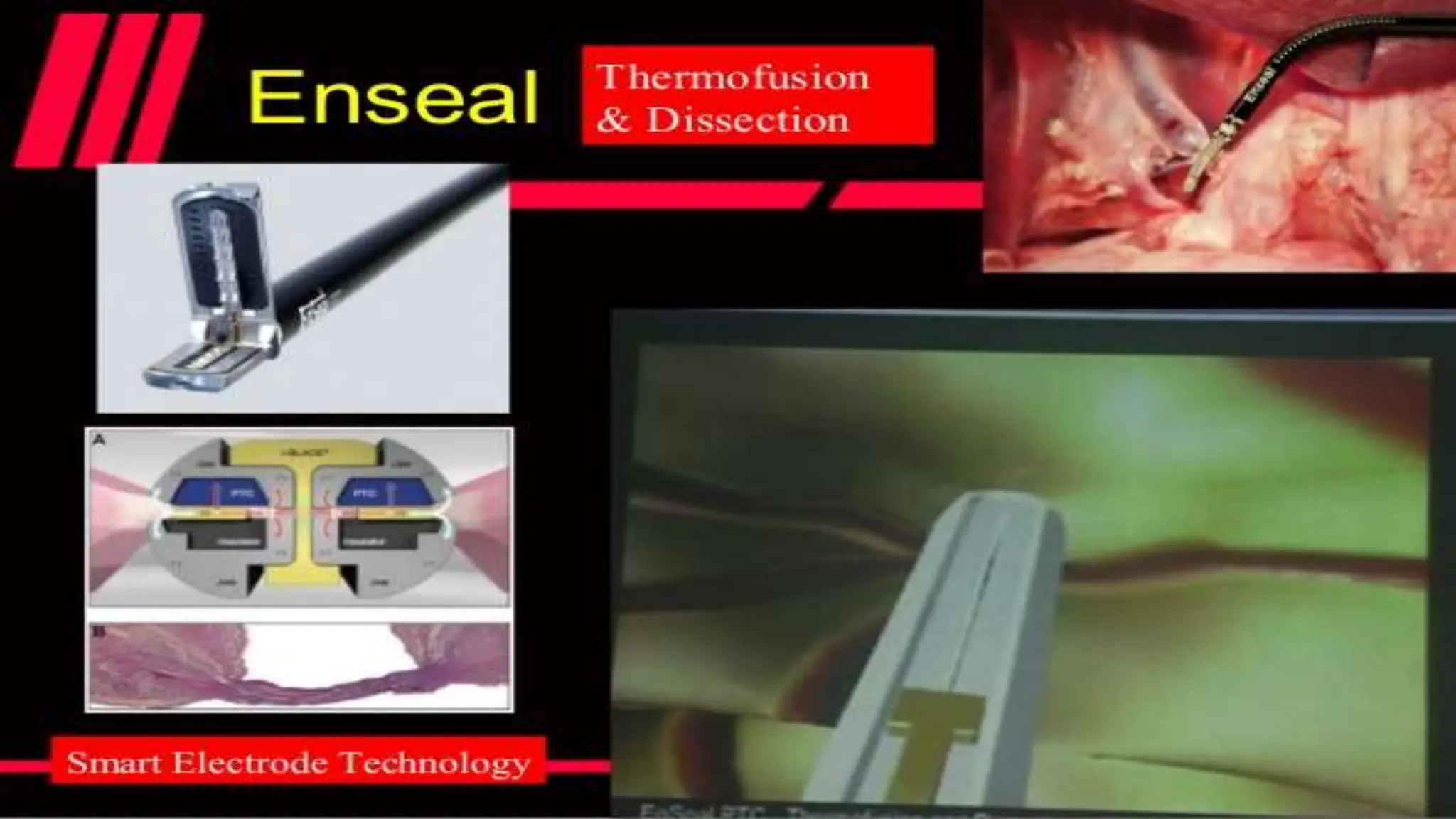
EnSeal
This system provides vessel sealing by combining a compression mechanism with
thermal energy control in a bipolar sealing device.
The instrument is capable of achieving seal strengths up to seven times the normal
systolic pressures on vessels up to 7 mm with a typical thermal spread of
approximately 1 mm.
Although there have been few publications about this device in the medical literature , it
is already in widespread use among surgeons.
The compression mechanism applies uniform pressure along the full length of the
instrument jaw, similar to those of a linear stapler.
Compression is combined with controlled energy delivery utilizing NanoPolar™
thermostats to reach collagen denaturation temperatures in seconds, which are
maintained at approximately 100ºC throughout the power delivery cycle.
The device also has a cutting mechanism to allow one-step sealing and
transection of vessels and soft tissues.
EnSeal
Bipolar energy Ligasure
LigaSure
Precise amount of bipolar energy and pressure to fuse collagen and elastin within the
vessel walls.
This results in a permanent seal that can withstand
Three times the normal systolic pressure
Seals vessels up to 7 mm
.
The sealing is achieved with minimal sticking and charring.
Thermal spread approximately 2 mm to adjacent tissue.
The generator for this device uses a feedback-controlled response system to ensure
adequate tissue sealing
LigaSure
Used successfully in a variety of procedures, such as TLH and laparoscopic
oncology surgery
Used effectively in laparoscopic Colectomy, Hepatectomy, Splenectomy .
The main disadvantage in using this system over standard bipolar technology is Cost,
especially since these devices are disposable.
Non disposable devices that use similar technology have been introduced with
promising initial results
Advantages
Fast and efficient (up to 7mm) coagulation and cut
Measure tissue impedance
Minimal thermal spread (2mm)
Cut function
Disadvantages
Capacity of thermal damage spread
Dissection limited
Bipolar energy Ligasure
Bipolar energy Thunderbeat
Advantages
• Combines ultrasonic energy to bipolar
• Better cutting
• Strong pressure distributed to tissue
• Minimal thermal damage
Disadvantages
• To control tip of the instrument after activation
• To know how to use two different types of energy
Bipolar energy
PKS Plasma SORD
PK Bipolar morcellator
Advantages
• Reduced time
• Continuous bipolar
morcellation: no blunt
blades
• Less fatigue for
operating surgeon
Disadvantages
• Possible thermal
lesion to patient
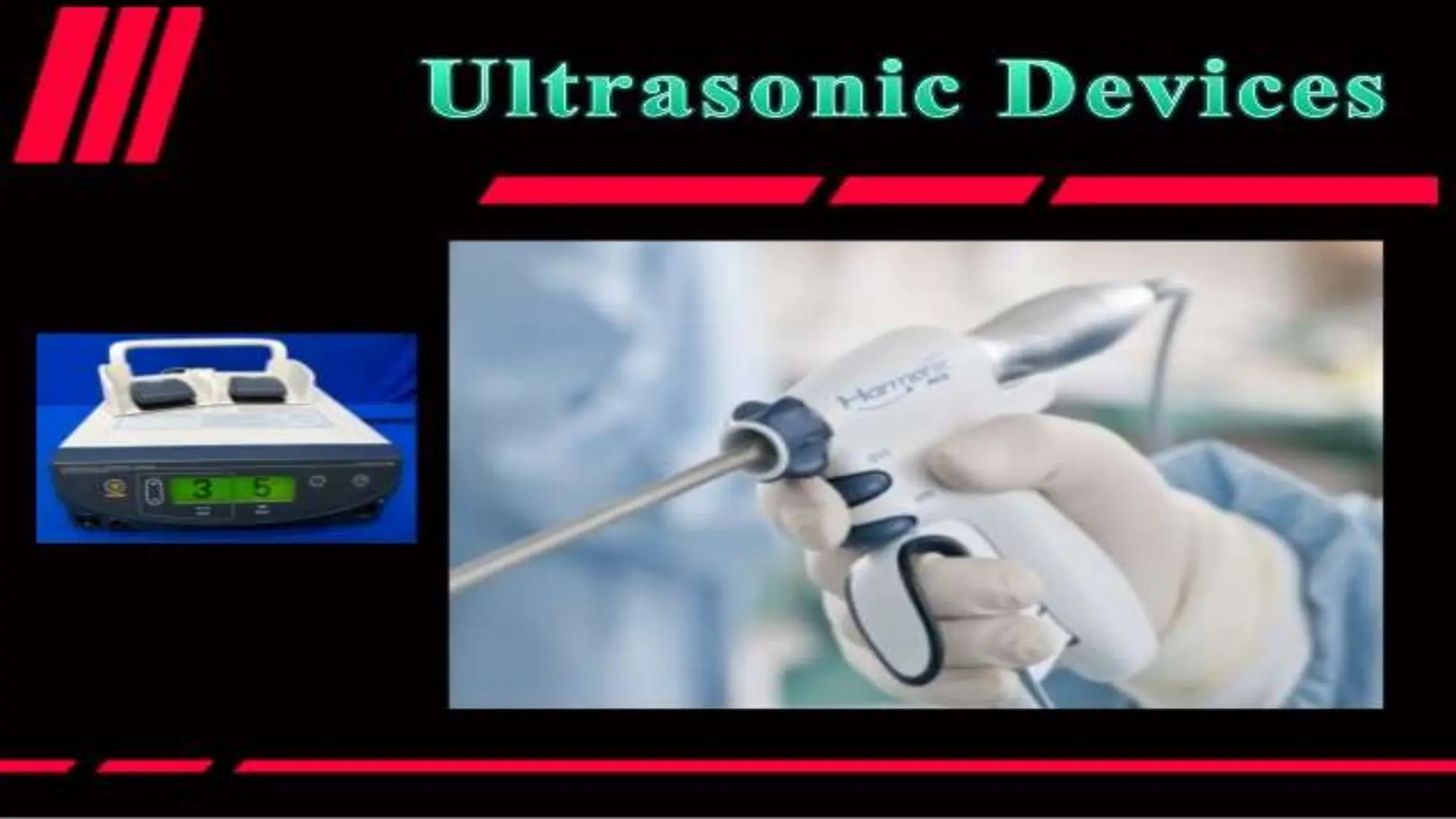
The HARMONIC System
Electrical energy from the generator is converted to
mechanical motion in the hand piece.
Harmonic Scalple
A Harmonic scalpel Cuts and Coagulates tissue via vibration.
The scalpel surface itself cuts through tissue by vibrating in the range of 55,500 Hz.
The high frequency vibration of tissue molecules generates stress and friction in tissue,
which generates heat and causes protein denaturation.
This technique causes minimal energy transfer to surrounding tissue, potentially limiting
collateral damage.
However, incidents have been reported where the active jaw has caused bowel
perforation
Harmonic Scalpel
Ultrasonic cutting and coagulating device
The ultrasonic cutting and coagulating surgical device converts ultrasonic energy
into mechanical energy at the functional end of the instrument.
A piezoelectric crystal in the hand piece generates vibration at the tip of the active
blade at 55,500 times per second over a variable excursion of 50 to 100
micrometers .
This results in rupture of hydrogen bonds and produces heat, which leads to
denaturation of proteins and, eventually, separation of tissue.
These effects are reached at tissue temperatures of 60 to 80ºC, resulting in
coagulum formation without the desiccation and charring caused by temperatures of
80ºC and higher associated with traditional electrosurgical methods
The harmonic scalple used successfully in a number of open and laparoscopic
procedures
The advantages of this technology include
Minimal thermal spread,
Decreased tissue charring and
Decreased smoke formation compared traditional electrosurgical instruments.
No risk of electrical injury.
It is also a versatile instrument, allowing the surgeon to dissect, cut, and coagulate
using one instrument.
Harmonic scalpel
Energy source used in laparoscopic surgery(1) (1).pptx

Energy source used in laparoscopic surgery(1) (1).pptx

  • 1.
    Energy Sources usedin Endo-Laparoscopy Prof. Dr. Rafiques Salehin Professor & Head Department of Surgery Sir Salimullah Medical College Mitford Hospital
  • 3.
    Most convenient Wayof Dissection / Laparoscopic dissection  Electro-surgery  Blunt dissection  Pledget  Gauze  Instrument  Sharp – knife , Scissor.  Newer device – Laser / Ultrasound / hybrid. Electro-surgery – use of A/C current. Most convenient but risky.
  • 4.
     Energy sourcesin laparoscopic surgery -- 3 categories.  Electrosurgery – When alternate current is passed between the tissue & the heat is produced used to create the desired effect of cutting & coagulation. Exact effect depends on the temperature achieved. At temp. 70 – 100 c coagulation occur. Above 100 c desiccation occur. Effect on tissue can be further modified by alternating the waveform of ac current. For cutting effect low voltage current creates faster heat generation & vaporization For coagulation burst of high voltage current used. Tissue does not vaporizes but cools between burst. Blend contains a mix of cutting & coagulation 1.Monopolar Electrosurgery 2.Bipolar Electrosurgery 3. Advance Bipolar.  Ultrasonic Source  Laser Energy source
  • 5.
    Electrosurgery  Vriables impactingtissue effect  Waveform – Fulguration (Small fulguration, Spray), Desiccation, Blend, Pure cut.  Power setting – Not more than 40 watt. As minimum  Site of electrode  Time - 3 sec burst.  Manipulation of electrode  Type of tissue  Eschar Burn – Intensity of current . Time. Area. Remote burn. Charcoal. Like cigarette. Tripolar electrosurgery – Disection, Grasping, Bipolar coagulation, Bipolar cut.
  • 6.
    Physics of Electricity Circuit= Pathway or flow of electrons Current = Amount of electrons flowing (amps) (I) Voltage = Driving force (volts) (V) Resistance = Impedance or obstacle to flow of electrons (ohms) (R) Ohm’s Law: (V = I x R) Power = Energy/ heat produced or used over a period of time (watts) (P = V x I)
  • 7.
    Ohams law –V = IR : I = V/R : R = V/I. V = Voltage , I = Current flow, directly proportionate to resistance. R = Resistance Amount of steady current is directly proportionate to potential difference or voltage. Current through a conductor is proportional to the voltage across the conductor. Temperature remains constant
  • 8.
    There are Two types of current: Alternating and Direct. With Direct Current, electrons flow in one direction. Example: a flashlight. Current flows from the battery to the lamp and creates light. With Alternating Current, electrons flow bi-directionally. The direction of flow is constantly being reversed. Both Monopolar and Bipolar Electrosurgery utilize Alternating Current.
  • 9.
    Two Types ofElectrical Circuit DC - Direct Current Unidirectional flow of electricity eg - Battery AC - Alternating Current Direction reverses cyclically eg - Household electricity Monopoloar Electrosurgery Bipolar
  • 10.
    Cautery - Electrocautery- Electrosurgery Cautery The surgical use of heat Electro-cautery The process of destroying tissue with an object that is heated with electricity There is no current flowing through the patient. Electro-surgery The use of alternating current passing through the patient to cut and coagulate tissue
  • 14.
    Advances in electrosurgicalequipment – High frequency Diathermy. Argon plasma coagulation. Bipolar vessel sealing device Radiofrequency surgery Combination of ultrasound & Bipolar system. The addition of cutting blade Tissue impedance sensor Electrode configuration with reduced lateral thermal spread.
  • 21.
    Electrosurgical injury duringlaparoscopic surgery – Main causes Inadverent grasping or touching of tissue during application. Insulation break in the electrode. Direct sparking to the intestine from the diathermy. Direct coupling /DC Coupling/ Conductive Coupling between a portion of intestine & a metal probe that is touching the activated probe. Inductive coupling / Magnetically coupled – Changes through one wire induces a voltage across the end of other wire through electromagnetic induction Capacitive coupling – Transfer of energy within a network or between distant network by means of displacement current between circuits. Nodes, induced by the electric field. Disperse electrode burn Alternate site burn Ground point burn
  • 40.
    Tissue effects ofheating Temperature (Centigrade) 34-44 44-50 50-80 Effect Visible None None Blanching Delayed Edema Necrosis Sloughing Mechanism Vasodilatation Inflammation Disruption of cell metabolism Collagen denaturation
  • 41.
    Tissue effects ofheating Temperature (Centigrade) 80-100 100-200 >200 Effect Visible Shrinkage Steam “popcorn” Carbonization cratering Delayed Sloughing Ulceration Larger crater- Mechanism Desiccation Vaporization Combustion of tissue hydrocarbons
  • 42.
  • 43.
    Monopolar Electrosurgery Waveform refersto the shape of the electrical signal as it travels along the circuit. Different waveforms indicate the generator is delivering current at different voltages. Low voltage is safer simply because it delivers less force. Any modality can be used to desiccate (dry up) tissue. The difference is how the current is applied to the tissue. In Electrosurgery, there are 3 basic waveforms: • Cut (vaporization) • Coagulation – Fulguration , Coagulation. • Blend (cutting and coagulation)
  • 44.
    Monopolar Electrosurgery Cutting isachieved by an electrosurgical instrument that is in close proximity to tissue. The instrument doesn’t actually mechanically cut the tissue. Coagulation: Two types of coagulation current: • Fulguration: Tip is not touching the tissue (Also called Non-contact Coagulation. Also called Spray). Spreading with coagulation waveform. Coagulates and chars the tissue over a wide area, results In coagulum. • Desiccation: the tip is touching the tissue. (Also called Contact Coagulation) The three main actions of Electrosurgery are - Cutting, Fulguration, and Desiccation. Cutting Fulguration Desiccation
  • 45.
    Traditional Bipolar Monopolar Circuit •Currentflows from a small (active) electrode to and through the patient to a large, indifferent (ground) electrode •The patient is vital to completing the circuit How it works
  • 46.
    Monopolar Electrosurgery In Electrosurgery,a complete circuit is necessary for current to flow. In Monopolar Electrosurgery, • The current flows from the pencil through the patient to the pad and back to the generator. • The patient’s tissue completes the circuit. What’s the difference between the pencil and the pad? The pencil is small and delivers higher current concentrations. The pad is larger and dissipates the current over a larger area. The tissue effect occurs at the pencil, where current concentrations are high.
  • 47.
    Advantages of Electrocutting • Reduced bleeding • Prevention of germ implantation • Avoidance of mechanical damage to the tissue • Endoscopic applicability
  • 48.
    Risk of MonopolarElectrosurgery • Active Electrode Trauma • Current diversion – Alternate ground site burns – Direct coupling – Indirect coupling – Capacitive coupling • Dispersive electrode burns • Smoke inhalation •Insulation failure
  • 49.
    Impact of unintendedcurrent flow. As you’re treating the tissue, the tissue impedance changes As the tissue impedance (resistance) increases on the gallbladder side then the current starts to flow towards the duodenum Effect may be compounded by current density on duodenal side gallblader deodenum Increased current density
  • 50.
    Potential Risks ofMonopolar Electrosurgery
  • 51.
    Indifferent Electrode (ReturnPad) Failure If the pad lost partial contact, current could concentrate at that site and produce injury. This resulted in the classic “grounding pad injury or burn” often experienced with older electrosurgical systems. Tissue Correct Active Electrode (pencil) Incorrect Active Electrode (pencil) Indifferent Electrode
  • 58.
    Safe Use ofMonopolar Electrosurgery Best Practices Consider using cut waveform Use lowest power setting for desired tissue effect. Check insulation on all instruments and connectors before use. Use isolated generator and patient contact quality monitoring system (standard practice in the U.S.) Techniques to Avoid Avoid an open circuit Limit activation with electrode off tissue (limit direct coupling) Clean eschar off of the instrument tip Avoid inadvertent contact of metal-to-metal
  • 59.
  • 60.
    Bipolar energy • Firstdescribed in Gyne surgery in 1973 by Rioux. • Described as an evolution in comparison to monopolar energy: safer & less thermal spread Rioux JE, Cloutier D. A new bipolar instrument for laparoscopic tubal sterilization. Am J Obstet Gynecol. 1974;119:737–741.
  • 61.
    How it works TraditionalBipolar Circuit Voltage is applied to the patient using forceps A high frequency electrical current flows from one of the tines to the other tine, through the intervening tissue The tissue within the forceps completes the circuit An indifferent electrode is not required
  • 64.
    Technology: Traditional BipolarElectrosurgery High current concentrations Relatively low voltage Current generates heat in tissue Reduced risk of capacitive and direct coupling Surgeon visually controls the delivery of energy
  • 65.
    Principles: – Closed systemwith active electrode and passive electrode – Interrupted frequency of about 500 KHz – Low voltage interrupted current – Specific instrumentation: graspers or forceps Bipolar energy Introduction
  • 66.
    Bipolar energy Introduction Disadvantages Minimalcutting effect Capacity of thermal damage Spread Advanced Bipolar Circuit High frequency, low voltage, current flows from one jaw to the other Tissue within the jaws completes the circuit Return pad is not required NO alternate site burns Less direct and capacitive coupling
  • 67.
    Bipolar energy ROBIbipolar Advantages • Excellent dissection tool • Grasping forceps • Cheap • Re-usable Disadvantages • Important lateral spread of heat • Possible to touch by accident other tissues (not covered tip) • Does not measure tissue impedance or temperature
  • 68.
    Bipolar energy Enseal Advantages •Fast & efficient (up to 7mm) coagulation & cut • Measure tissue impedance & temperature • Minimal thermal spread Disadvantages • Capacity of thermal damage spread • Dissection limited • Similar to Ligassure
  • 69.
    EnSeal This system providesvessel sealing by combining a compression mechanism with thermal energy control in a bipolar sealing device. The instrument is capable of achieving seal strengths up to seven times the normal systolic pressures on vessels up to 7 mm with a typical thermal spread of approximately 1 mm. Although there have been few publications about this device in the medical literature , it is already in widespread use among surgeons.
  • 70.
    The compression mechanismapplies uniform pressure along the full length of the instrument jaw, similar to those of a linear stapler. Compression is combined with controlled energy delivery utilizing NanoPolar™ thermostats to reach collagen denaturation temperatures in seconds, which are maintained at approximately 100ºC throughout the power delivery cycle. The device also has a cutting mechanism to allow one-step sealing and transection of vessels and soft tissues. EnSeal
  • 71.
  • 72.
    LigaSure Precise amount ofbipolar energy and pressure to fuse collagen and elastin within the vessel walls. This results in a permanent seal that can withstand Three times the normal systolic pressure Seals vessels up to 7 mm . The sealing is achieved with minimal sticking and charring. Thermal spread approximately 2 mm to adjacent tissue. The generator for this device uses a feedback-controlled response system to ensure adequate tissue sealing
  • 73.
    LigaSure Used successfully ina variety of procedures, such as TLH and laparoscopic oncology surgery Used effectively in laparoscopic Colectomy, Hepatectomy, Splenectomy . The main disadvantage in using this system over standard bipolar technology is Cost, especially since these devices are disposable. Non disposable devices that use similar technology have been introduced with promising initial results
  • 74.
    Advantages Fast and efficient(up to 7mm) coagulation and cut Measure tissue impedance Minimal thermal spread (2mm) Cut function Disadvantages Capacity of thermal damage spread Dissection limited Bipolar energy Ligasure
  • 75.
    Bipolar energy Thunderbeat Advantages •Combines ultrasonic energy to bipolar • Better cutting • Strong pressure distributed to tissue • Minimal thermal damage Disadvantages • To control tip of the instrument after activation • To know how to use two different types of energy
  • 76.
    Bipolar energy PKS PlasmaSORD PK Bipolar morcellator Advantages • Reduced time • Continuous bipolar morcellation: no blunt blades • Less fatigue for operating surgeon Disadvantages • Possible thermal lesion to patient
  • 77.
    The HARMONIC System Electricalenergy from the generator is converted to mechanical motion in the hand piece.
  • 78.
    Harmonic Scalple A Harmonicscalpel Cuts and Coagulates tissue via vibration. The scalpel surface itself cuts through tissue by vibrating in the range of 55,500 Hz. The high frequency vibration of tissue molecules generates stress and friction in tissue, which generates heat and causes protein denaturation. This technique causes minimal energy transfer to surrounding tissue, potentially limiting collateral damage. However, incidents have been reported where the active jaw has caused bowel perforation
  • 79.
    Harmonic Scalpel Ultrasonic cuttingand coagulating device The ultrasonic cutting and coagulating surgical device converts ultrasonic energy into mechanical energy at the functional end of the instrument. A piezoelectric crystal in the hand piece generates vibration at the tip of the active blade at 55,500 times per second over a variable excursion of 50 to 100 micrometers . This results in rupture of hydrogen bonds and produces heat, which leads to denaturation of proteins and, eventually, separation of tissue. These effects are reached at tissue temperatures of 60 to 80ºC, resulting in coagulum formation without the desiccation and charring caused by temperatures of 80ºC and higher associated with traditional electrosurgical methods
  • 80.
    The harmonic scalpleused successfully in a number of open and laparoscopic procedures The advantages of this technology include Minimal thermal spread, Decreased tissue charring and Decreased smoke formation compared traditional electrosurgical instruments. No risk of electrical injury. It is also a versatile instrument, allowing the surgeon to dissect, cut, and coagulate using one instrument. Harmonic scalpel