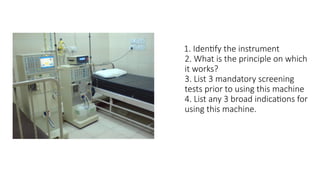
1. Identify theinstrument
2. What is the principle on which
it works?
3. List 3 mandatory screening
tests prior to using this machine
4. List any 3 broad indications for
using this machine.
3.
1. Hemodialysis machine0.5
2. Selective removal of molecules across a semipermeable membrane
0.5
3. HIV, HBsAg, Anti-HCV 0.5 x 3
4. Any 3 of : Acute renal failure ( hypervolemia, intractable
hypertension, hyperkalemia), endstage renal failure,
hyperphosphatemia, poisoning ( ethylene glycol, methanol etc)
0.5 x 3
4.
1. Identify theprocedure
2. What is it used for ?
3. How does it work?
4. List 1 advantage of this
particular system. What is the
mechanism behind this?
5.
1. Transcutaneous bilirubinometry1
2. Noninvasive screening for neonatal jaundice 1 ( must mention
noninvasive and screening; no marks for using word ‘diagnosis’)
3. Use spectrum of visible light reflected from the skin for assessment
of jaundice 1
4. Corrects for skin pigmentation. This is done by using multiple
wavelengths 0.5 x 2
6.
1. Identify theequipment giving
the treatment
2. What's the mechanism of action
3. Name few complications
enountered
1. Identify theequipment
2. What is the principle on
which it works?
3. What is the major
disadvantage?
4. what would be the
saturations recorded in a case of
carbon monoxide poisoning?
9.
1. Finger Pulseoximeter 0.5
2. Difference in the pattern of absorption 1.5
of light by oxygenated and reduced Hb
3. Wide range in PaO2 at high levels of StcO2 1.5
4. 100 %, though the patient is severely hypoxemic, there is erroneous
recording as it records both the hb bound to oxygen and carbon
monoxide.
10.
1. What equipmentsupport is the baby on?
2. What are the three main ways by which
the support is provided?
3. name 4 conditions where its used
4. name 2 complications
5. what is the interphase used. Name 2
more
1. Identify theinstrument used here.
2, what is the important difference in
hfnc and CPAP
3. what are the advantages of using
humidification
13.
• 1. HFNC
•2. CPAP is closed system, HFNC an open system
• 3. Advantages of humidification:
• protects respiratory epithelium
• maintains ciliary function of respiratory epithelium
• Improves lung compliance
14.
1. What isthe equipment?
2. What is the use of POP up valve
3. how do you sterilise it?
15.
• 1. selfinflating ambu bag
• 3. wash with detergent and hot water. Dry thoroughly.
• If soiled with blood/body fluids clean and send to central sterilisation
dept.
• 2.
17.
• Identify theprocedure going on.
• Name 2 cardiac and 2 resoiratory indications, 2 contraindications
• Name 4 complications
18.
• ECMO support
•2. indications
• cardiac: refractory arythmias in cardiogenic shock
• myocarditis
• inability to come off cardio pulm bypass postoperatively
• respiratory: MAS, PPHN,CDH
• Contraindications: <32 wks, major IC bleed, lethal malformations not
compatible with life
• 3. complications: bleed, decanulation
19.
1. Whats thedevise called?
2. Whats its use?
3. What does the number indicate?
20.
• 1. orchidometer
•2. for measuring testicular volume
• 3. number indicates volume in mm
22.
1. Identify theinstrument.
2. Which illness is it used in ?
3. What are the three
settings ?
23.
1.Peak Flow Meter1
2.Bronchial Asthma 0.5
3.(a)Green zone >80% PEF 0.5X3 1.5
(b)Yellow Zone 50-80 % PEF
(c) Red zone < 50% PEF
(Total marks 3)
24.
Demonstrate the useof
this instrument on this 7
year old child Explain the
mother about its use
Explain about prevention
of asthma triggers
25.
• Avoid themaneuver in patients with severe airway obstruction, as it
may worsen bronchospasm acutely.
• • Do not attempt in a child less than 5 to 7 years of age unless the
child has previous experience before the present ED visit.
• • Review the procedure before the patient performs it.
• • Be sure the patient has a tight seal on the mouthpiece, the
exhalation hole on the meter is not blocked, and the meter measuring
gauge is unimpeded by the patient.
• • Coach the patient with encouraging words during the maneuve
26.
• Take thebest of three measures for the current peak flow. •
• If done after use of a bronchodilator, wait 10 to 15 minutes to obtain
an adequate response. A clinically relevant bronchodilator response is
an improvement in PEFR of greater than 15%.
• • Check the result against the standard for this child or against the
standard nomograms for the patient's size.
• • Observe the technique for: – Poor maximal inspiration – Less than
maximal effort – Occlusion of the exhalation hole or gauge –
Premature cessation of the exhalation
27.
1) Identify theinstruments?
2) Administer MDI inhalations to a 1 year
old child?
3) Advice about cleaning of these
instruments
• 1.What isthis device?
2. Two Indications?
3. Contraindication?
4. Two Limitations?
5. Complication?
32.
• 1.
Laryngeal MaskAirway
2. Indications?
a. Routine airway in operating room,
b. In cases with difficult bag mask ventilation
3. Contraindication?
Severe airway obstruction
4. Two Limitations?
a.Dislodgement during transport,
b. minimizes but cannot prevent aspiration
5. Complication?
Regurgitation and aspiration
33.
1. Identify theinstrument
2, write two advantages over the conventional
mode
3. two contraindiactions
34.
• Video laryngoscope
•VLs improved glottis visualization in pediatric patients,
• this was at the expense of prolonged TTI (total time of intubation) and
increased failures.
36.
1. PICC 1
2.Preserves veins, 0.5X2 1
allows concentrated infusates,
permits long term IV alimentation
3. Complications- 0.5X4 2
a. Catheter fracture and embolisation,
b. Leakage
c. Thrombosis of catheter
d. Accidental displacement / Tip Migration
e. Deep Venous Thrombosis
f. Infection
(Total marks-4)
37.
1. Name thecatheter
2.How is it different from
regular catheter?
3.Disadvantage ?
4.Precaution for continuous
drainage ?
38.
• 1.intercostal /chest drainage with trocar
• 2.with trocar for easy closed method introduction
• 3.sharp tip will injure the mediastinum when overshooted
• 4. always in underwater seal drainage
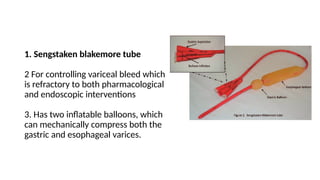
1. Sengstaken blakemoretube
2 For controlling variceal bleed which
is refractory to both pharmacological
and endoscopic interventions
3. Has two inflatable balloons, which
can mechanically compress both the
gastric and esophageal varices.