INTENSIVE THERAPY -
APPARATUS
ENDOTRACHEAL TUBES, TRACHEOTOMY
TUBES, AND AIRWAYS :
• The purpose of these tubes is to maintain a clear airway. They
were originally made of red rubber, but now plastic tubes are
universal.
• The endotracheal tube is one which passes either through the
mouth or the nose, the pharynx, the larynx and into the
trachea. They vary in size and design.
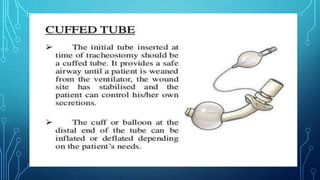
• There are two basic tubes, the plain and cuffed.
• The cuffed oral tubes is usually the type chosen for adult
patient and plain for children and babies.
• The use of endotracheal tubes can only be a temporary measure
as prolonged intubation may cause inflamation and ulceration
of the larynx.
• It is usually considered that 3 to 4 days is the time for safe use .
TRACHEOTOMY
It is an operation , usually performed under a general anaesthetic
, in which a short horizontal incision is made in the neck and a
small opening in the trachea.
To ensure that the tracheotomy tube will be parallel with the
walls of trachea it is necessary for the surgeon to perform a high
tracheotomy at the level of the 2nd & 3rd or 3rd & 4th tracheal
rings. The tube is secure in position by a piece of cotton tape
fastened round the patient’s neck in the form of bow for easy
release.
The tracheotomy tube should provide a clear airway with a low
resistance to the flow , it should be well fitted to prevent the
HUMIDIFICATION
*Method by which humidified air can be introduced into
respiratory system:-
• A Face mask
• A mouthpiece which the patient has to hold . This method is
frequently used with a nebulizer for chest clearance.
• Tracheotomy mask .
• A tracheotomy humidifying T-tubes. This method is suitable
for patient with endotracheal tube.
TYPES OF HUMIDIFIER
• Boys and Howells classified humidifier into suppliers and
conservers of waters.
• SUPPLIERS:-
1. Ambient temperature vapour suppliers :- Gas is bubbled
through room temperature water , if passed through a very
fine sieve so that the bubbles are very tiny then some useful
humidification can perhaps be obtained.
2. Heated vapour suppliers:- Gas is passed across or
preferably , through hot water. Alternatively it may be dripped
onto very hot plate . The patient tubing may be lagged ,or
heated as in the Fischer –paykell device , to prevent
temperature loss and rain out. It is vital that no danger of
burning the patient exists.
• 3. AMBIENT AEROSOL SUPPLIERS:- These produce a mist of
liquid water, either by breaking up water entrained by a high
pressure gas jet or by generating the mist with high speed
spinning disc or an ultrasonic vibrating crystal.
• 4.HEATED AEROSOL SUPPLIERS:- The water to be nebulized is
heated and in particular the Bernouilli –type devices are often
made to take a heating element or hot- rod.
• 5 .INSTALLATION:- water may be simply added to the airway
by direct instillation from the syringe , drip set or pump.
1)-EXCHANGE OF GASES IE;
INSPIRATION AND
EXPIRATION.
2)-OXYGENATION OF
BLOOD
• FUNCTIONS OF.
VENTILATION
• INSPIRATORY PHASE
• CYCLING OR CHANGING TO EXPIRATION
• EXPIRATORY PHASE
• CYCLING TO INSPIRATION(TRIGGER PHASE)
CLASSIFICATION OF VENTILATORS:
it is characterised by period of time when air is
flowing into the lungs…it has two types of
control systems:
Volume or flow Control: a constant volume of
breathes are delivered to the patient
regardless of changing in airway resistance.
 Pressure control: it is a mode of controlling
the inhalation phase so that pressure
remains stable throughout inhalation.
INSPIRATORY PHASE:
Ventilators may be:
• Pressure cycled: it terminates inhalation of a preset
pressure within the machine.
• Volume cycled: it terminates inhalation after a preset
volume has been delivered to the patient.
• Time cycled: it continues in the inhalation phase for a
preset time interval.
CYCLING TO EXPIRATORY PHASE
During expiration, ventilators are normally
open to atmosphere ,and the patient is
allowed to exhale by normal physiological
process. It may be of 3 phases:
 ZEEP(ZERO END EXPIRATORY PHASE): when
the pressure in lungs at end of the
expiration is returned to zero
 NEEP(NEGATIVE END EXPIRATORY PHASE):
when the pressure in lungs at end of
expiration is slightly below the atmospheric
pressure
 PEEP(POSITIVE END EXPIRATORY PRESSURE):
EXPIRATORY PHASE
It refers to a point in time when the ventilator initiates the positive
pressure breath. It can be either…
• TIME TRIGGER: the mechanical breathing is initiated by preset time.
• PATIENT TRIGGER: the mechanical breathing is initiated by patients
effort.
• PRESSURE TRIGGER: the mechanical breathing is initiated by preset
pressure.
• VOLUME TRIGGER: the mechanical breathing is initiated by preset volume
.
CYCLING TO INSPIRATION(TRIGGER)
• High frequency jet ventilation
• High frequency oscillation
HIGH FREQUENCY VENTILATORS:
IN HFV, THE BREATHES ARE DELIVERED
AT EXTREMELY HIGH RESPIRATORY
FREQUENCY 60/MINUTE UPTO
3000/MINUTES.MOST OF THE TIDAL
BREATHES ARE DIRECTED TOWARDS THE
LOWER LOBES. THERE ARE TWO TYPES:
• It consists of application of high pressure jet to the airways via
cannula or endotracheal tube at selected frequency upto
250/minute or sometimes upto 600/minutes .The expiration is
passive as in normal IPPV. And because the expiratory time for
each breathe is short. So some air is trapped into lungs and
develops PEEP automatically.
HIGH FREQUENCY JET VENTILATOR
• It uses the reciprocating piston and in this case the expiration
is active that is the piston will aid expiration on its return
stroke. For this reason the PEEP is not developed and rate goes
upto 3000/minutes.
HIGH FEQUENCY OSCILLATION
• When a patient has a bilateral lung pathology (eg,
bronchopneumonia) and needs IPPV, then, using a conventional
machine, gas from the ventilatoris distributed preferentially to
the more compliant, nondependent (uppermost) regions of the
lungs. Perfusion of the lungs with blood ,affected by gravity.
The result is that most gas goes into the uppermost parts of
the lungs and most blood goes into the lowermost parts,
creating the ventilation-to-perfusion mismatch. This mismatch
is corrected by using the double-lumen endobromchial tube
and two ventilators, one for each lung.
DIFFERENTIAL VENTILATION
• In CPAP breathing ,both the inspiratory and expiratory
phases of ventilator are pressurized to a set level .
• The patient provides all of the ventilatory work.
• Used for the patients with obstructive sleep APNEA
ie,for temporary prevention of upper airway closure.
CPAP(CONTINOUS POSITIVE
AIRWAYS PRESSURE)
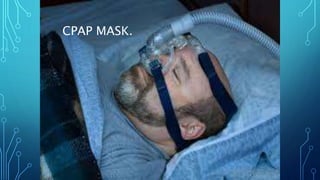
CPAP MASK.
Presentation.power point presentation for

Presentation.power point presentation for

  • 1.
  • 2.
    ENDOTRACHEAL TUBES, TRACHEOTOMY TUBES,AND AIRWAYS : • The purpose of these tubes is to maintain a clear airway. They were originally made of red rubber, but now plastic tubes are universal. • The endotracheal tube is one which passes either through the mouth or the nose, the pharynx, the larynx and into the trachea. They vary in size and design. • There are two basic tubes, the plain and cuffed. • The cuffed oral tubes is usually the type chosen for adult patient and plain for children and babies.
  • 3.
    • The useof endotracheal tubes can only be a temporary measure as prolonged intubation may cause inflamation and ulceration of the larynx. • It is usually considered that 3 to 4 days is the time for safe use .
  • 4.
    TRACHEOTOMY It is anoperation , usually performed under a general anaesthetic , in which a short horizontal incision is made in the neck and a small opening in the trachea. To ensure that the tracheotomy tube will be parallel with the walls of trachea it is necessary for the surgeon to perform a high tracheotomy at the level of the 2nd & 3rd or 3rd & 4th tracheal rings. The tube is secure in position by a piece of cotton tape fastened round the patient’s neck in the form of bow for easy release. The tracheotomy tube should provide a clear airway with a low resistance to the flow , it should be well fitted to prevent the
  • 6.
    HUMIDIFICATION *Method by whichhumidified air can be introduced into respiratory system:- • A Face mask • A mouthpiece which the patient has to hold . This method is frequently used with a nebulizer for chest clearance. • Tracheotomy mask . • A tracheotomy humidifying T-tubes. This method is suitable for patient with endotracheal tube.
  • 7.
    TYPES OF HUMIDIFIER •Boys and Howells classified humidifier into suppliers and conservers of waters. • SUPPLIERS:- 1. Ambient temperature vapour suppliers :- Gas is bubbled through room temperature water , if passed through a very fine sieve so that the bubbles are very tiny then some useful humidification can perhaps be obtained. 2. Heated vapour suppliers:- Gas is passed across or preferably , through hot water. Alternatively it may be dripped onto very hot plate . The patient tubing may be lagged ,or heated as in the Fischer –paykell device , to prevent temperature loss and rain out. It is vital that no danger of burning the patient exists.
  • 8.
    • 3. AMBIENTAEROSOL SUPPLIERS:- These produce a mist of liquid water, either by breaking up water entrained by a high pressure gas jet or by generating the mist with high speed spinning disc or an ultrasonic vibrating crystal. • 4.HEATED AEROSOL SUPPLIERS:- The water to be nebulized is heated and in particular the Bernouilli –type devices are often made to take a heating element or hot- rod. • 5 .INSTALLATION:- water may be simply added to the airway by direct instillation from the syringe , drip set or pump.
  • 9.
    1)-EXCHANGE OF GASESIE; INSPIRATION AND EXPIRATION. 2)-OXYGENATION OF BLOOD • FUNCTIONS OF. VENTILATION
  • 10.
    • INSPIRATORY PHASE •CYCLING OR CHANGING TO EXPIRATION • EXPIRATORY PHASE • CYCLING TO INSPIRATION(TRIGGER PHASE) CLASSIFICATION OF VENTILATORS:
  • 11.
    it is characterisedby period of time when air is flowing into the lungs…it has two types of control systems: Volume or flow Control: a constant volume of breathes are delivered to the patient regardless of changing in airway resistance.  Pressure control: it is a mode of controlling the inhalation phase so that pressure remains stable throughout inhalation. INSPIRATORY PHASE:
  • 12.
    Ventilators may be: •Pressure cycled: it terminates inhalation of a preset pressure within the machine. • Volume cycled: it terminates inhalation after a preset volume has been delivered to the patient. • Time cycled: it continues in the inhalation phase for a preset time interval. CYCLING TO EXPIRATORY PHASE
  • 13.
    During expiration, ventilatorsare normally open to atmosphere ,and the patient is allowed to exhale by normal physiological process. It may be of 3 phases:  ZEEP(ZERO END EXPIRATORY PHASE): when the pressure in lungs at end of the expiration is returned to zero  NEEP(NEGATIVE END EXPIRATORY PHASE): when the pressure in lungs at end of expiration is slightly below the atmospheric pressure  PEEP(POSITIVE END EXPIRATORY PRESSURE): EXPIRATORY PHASE
  • 14.
    It refers toa point in time when the ventilator initiates the positive pressure breath. It can be either… • TIME TRIGGER: the mechanical breathing is initiated by preset time. • PATIENT TRIGGER: the mechanical breathing is initiated by patients effort. • PRESSURE TRIGGER: the mechanical breathing is initiated by preset pressure. • VOLUME TRIGGER: the mechanical breathing is initiated by preset volume . CYCLING TO INSPIRATION(TRIGGER)
  • 15.
    • High frequencyjet ventilation • High frequency oscillation HIGH FREQUENCY VENTILATORS: IN HFV, THE BREATHES ARE DELIVERED AT EXTREMELY HIGH RESPIRATORY FREQUENCY 60/MINUTE UPTO 3000/MINUTES.MOST OF THE TIDAL BREATHES ARE DIRECTED TOWARDS THE LOWER LOBES. THERE ARE TWO TYPES:
  • 16.
    • It consistsof application of high pressure jet to the airways via cannula or endotracheal tube at selected frequency upto 250/minute or sometimes upto 600/minutes .The expiration is passive as in normal IPPV. And because the expiratory time for each breathe is short. So some air is trapped into lungs and develops PEEP automatically. HIGH FREQUENCY JET VENTILATOR
  • 17.
    • It usesthe reciprocating piston and in this case the expiration is active that is the piston will aid expiration on its return stroke. For this reason the PEEP is not developed and rate goes upto 3000/minutes. HIGH FEQUENCY OSCILLATION
  • 18.
    • When apatient has a bilateral lung pathology (eg, bronchopneumonia) and needs IPPV, then, using a conventional machine, gas from the ventilatoris distributed preferentially to the more compliant, nondependent (uppermost) regions of the lungs. Perfusion of the lungs with blood ,affected by gravity. The result is that most gas goes into the uppermost parts of the lungs and most blood goes into the lowermost parts, creating the ventilation-to-perfusion mismatch. This mismatch is corrected by using the double-lumen endobromchial tube and two ventilators, one for each lung. DIFFERENTIAL VENTILATION
  • 19.
    • In CPAPbreathing ,both the inspiratory and expiratory phases of ventilator are pressurized to a set level . • The patient provides all of the ventilatory work. • Used for the patients with obstructive sleep APNEA ie,for temporary prevention of upper airway closure. CPAP(CONTINOUS POSITIVE AIRWAYS PRESSURE)
  • 20.