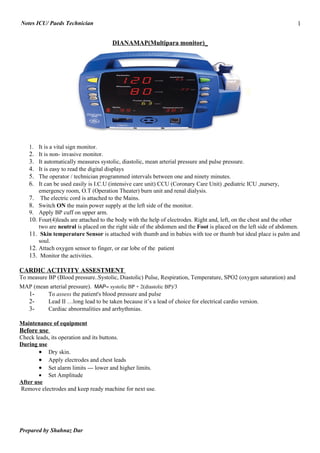
Notes ICU/ Paeds Technician                                                                                          1

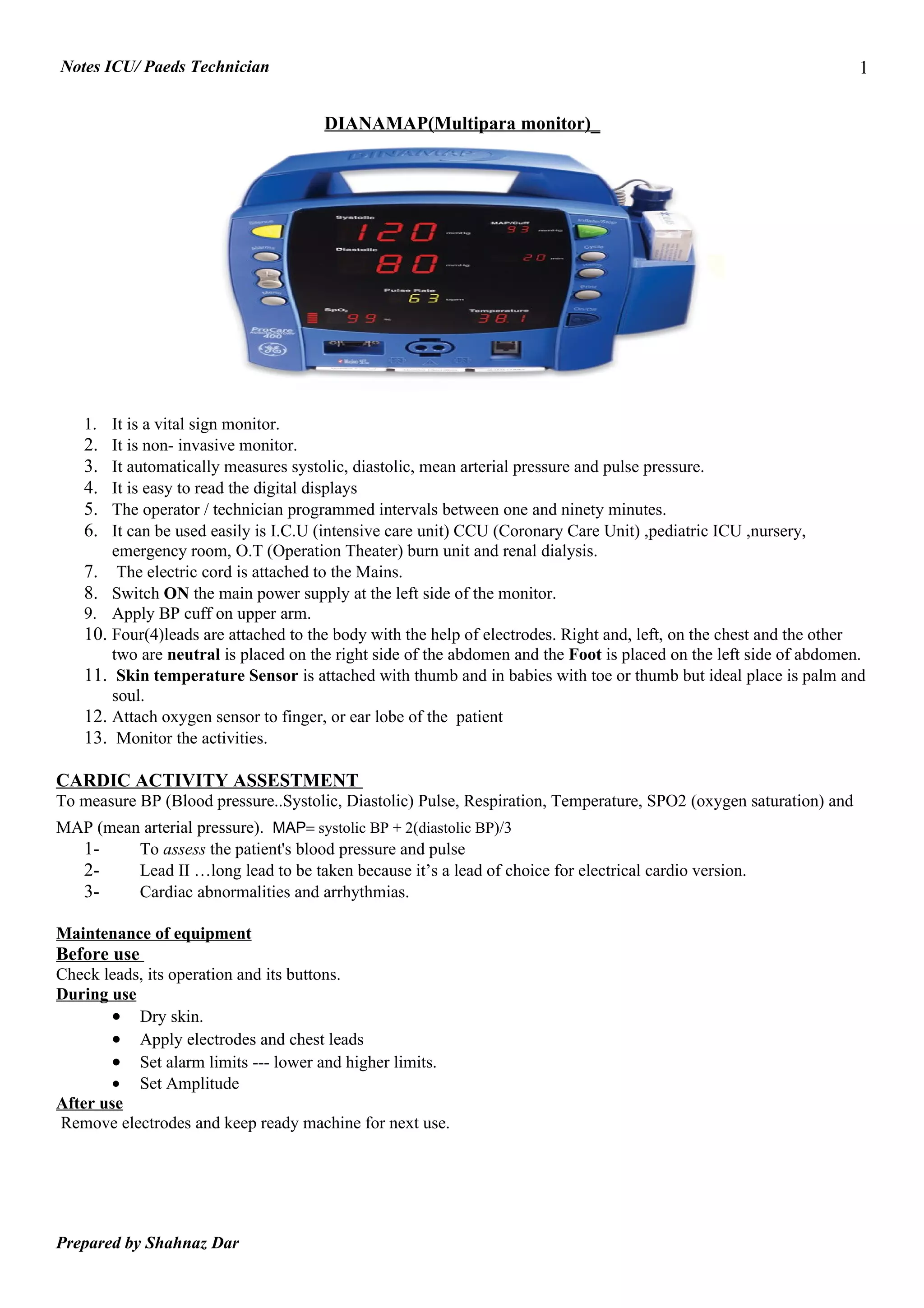
                                       DIANAMAP(Multipara monitor)_


    1. It is a vital sign monitor.
    2. It is non- invasive monitor.
    3. It automatically measures systolic, diastolic, mean arterial pressure and pulse pressure.
    4. It is easy to read the digital displays
    5. The operator / technician programmed intervals between one and ninety minutes.
    6. It can be used easily is I.C.U (intensive care unit) CCU (Coronary Care Unit) ,pediatric ICU ,nursery,
        emergency room, O.T (Operation Theater) burn unit and renal dialysis.
    7. The electric cord is attached to the Mains.
    8. Switch ON the main power supply at the left side of the monitor.
    9. Apply BP cuff on upper arm.
    10. Four(4)leads are attached to the body with the help of electrodes. Right and, left, on the chest and the other
        two are neutral is placed on the right side of the abdomen and the Foot is placed on the left side of abdomen.
    11. Skin temperature Sensor is attached with thumb and in babies with toe or thumb but ideal place is palm and
        soul.
    12. Attach oxygen sensor to finger, or ear lobe of the patient
    13. Monitor the activities.

CARDIC ACTIVITY ASSESTMENT
To measure BP (Blood pressure..Systolic, Diastolic) Pulse, Respiration, Temperature, SPO2 (oxygen saturation) and
MAP (mean arterial pressure). MAP= systolic BP + 2(diastolic BP)/3
  1-     To assess the patient's blood pressure and pulse
  2-     Lead II …long lead to be taken because it’s a lead of choice for electrical cardio version.
  3-     Cardiac abnormalities and arrhythmias.

Maintenance of equipment
Before use
Check leads, its operation and its buttons.
During use
       • Dry skin.
       • Apply electrodes and chest leads
       • Set alarm limits --- lower and higher limits.
       • Set Amplitude
After use
Remove electrodes and keep ready machine for next use.


Prepared by Shahnaz Dar
Notes ICU/ Paeds Technician                                                                              2


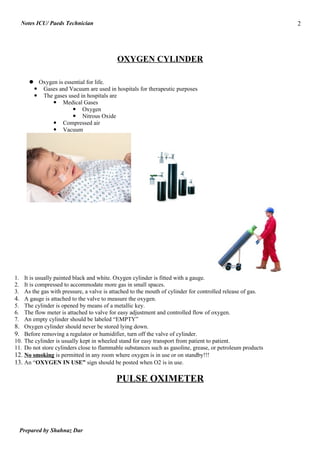
                                          OXYGEN CYLINDER

       Oxygen is essential for life.
        Gases and Vacuum are used in hospitals for therapeutic purposes
        The gases used in hospitals are
              Medical Gases
                      Oxygen
                      Nitrous Oxide
              Compressed air
              Vacuum


1. It is usually painted black and white. Oxygen cylinder is fitted with a gauge.
2. It is compressed to accommodate more gas in small spaces.
3. As the gas with pressure, a valve is attached to the mouth of cylinder for controlled release of gas.
4. A gauge is attached to the valve to measure the oxygen.
5. The cylinder is opened by means of a metallic key.
6. The flow meter is attached to valve for easy adjustment and controlled flow of oxygen.
7. An empty cylinder should be labeled “EMPTY”
8. Oxygen cylinder should never be stored lying down.
9. Before removing a regulator or humidifier, turn off the valve of cylinder.
10. The cylinder is usually kept in wheeled stand for easy transport from patient to patient.
11. Do not store cylinders close to flammable substances such as gasoline, grease, or petroleum products
12. No smoking is permitted in any room where oxygen is in use or on standby!!!
13. An “OXYGEN IN USE” sign should be posted when O2 is in use.

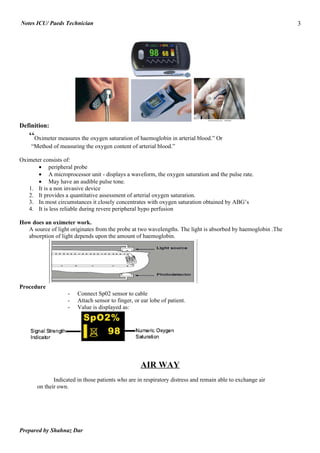
                                          PULSE OXIMETER


  Prepared by Shahnaz Dar
Notes ICU/ Paeds Technician                                                                                   3


Definition:
   “Oximeter measures the oxygen saturation of haemoglobin in arterial blood.” Or
    “Method of measuring the oxygen content of arterial blood.”

Oximeter consists of:
       • peripheral probe
       • A microprocessor unit - displays a waveform, the oxygen saturation and the pulse rate.
       • May have an audible pulse tone.
   1. It is a non invasive device
   2. It provides a quantitative assessment of arterial oxygen saturation.
   3. In most circumstances it closely concentrates with oxygen saturation obtained by ABG’s
   4. It is less reliable during revere peripheral hypo perfusion

How does an oximeter work.
  A source of light originates from the probe at two wavelengths. The light is absorbed by haemoglobin .The
  absorption of light depends upon the amount of haemoglobin.


Procedure
                    -   Connect Sp02 sensor to cable
                    -   Attach sensor to finger, or ear lobe of patient.
                    -   Value is displayed as:


                                                    AIR WAY
              Indicated in those patients who are in respiratory distress and remain able to exchange air
       on their own.


Prepared by Shahnaz Dar
Notes ICU/ Paeds Technician                                                                                            4


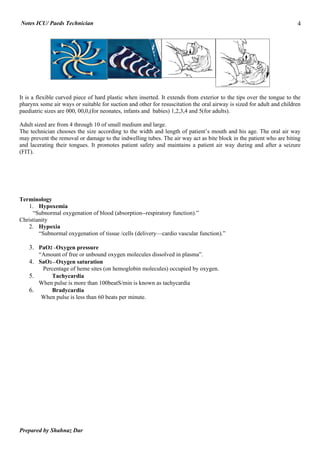
It is a flexible curved piece of hard plastic when inserted. It extends from exterior to the tips over the tongue to the
pharynx some air ways or suitable for suction and other for resuscitation the oral airway is sized for adult and children
paediatric sizes are 000, 00,0,(for neonates, infants and babies) 1,2,3,4 and 5(for adults).

Adult sized are from 4 through 10 of small medium and large.
The technician chooses the size according to the width and length of patient’s mouth and his age. The oral air way
may prevent the removal or damage to the indwelling tubes. The air way act as bite block in the patient who are biting
and lacerating their tongues. It promotes patient safety and maintains a patient air way during and after a seizure
(FIT).


Terminology
   1. Hypoxemia
     “Subnormal oxygenation of blood (absorption--respiratory function).”
Christianity
   2. Hypoxia
        “Subnormal oxygenation of tissue /cells (delivery—cardio vascular function).”

    3. PaO2 –Oxygen pressure
        “Amount of free or unbound oxygen molecules dissolved in plasma”.
    4. SaO2—Oxygen saturation
        Percentage of heme sites (on hemoglobin molecules) occupied by oxygen.
    5.     Tachycardia
       When pulse is more than 100beatS/min is known as tachycardia
    6.     Bradycardia
       When pulse is less than 60 beats per minute.


Prepared by Shahnaz Dar

Dianamap

  • 1.
    Notes ICU/ PaedsTechnician 1 DIANAMAP(Multipara monitor)_ 1. It is a vital sign monitor. 2. It is non- invasive monitor. 3. It automatically measures systolic, diastolic, mean arterial pressure and pulse pressure. 4. It is easy to read the digital displays 5. The operator / technician programmed intervals between one and ninety minutes. 6. It can be used easily is I.C.U (intensive care unit) CCU (Coronary Care Unit) ,pediatric ICU ,nursery, emergency room, O.T (Operation Theater) burn unit and renal dialysis. 7. The electric cord is attached to the Mains. 8. Switch ON the main power supply at the left side of the monitor. 9. Apply BP cuff on upper arm. 10. Four(4)leads are attached to the body with the help of electrodes. Right and, left, on the chest and the other two are neutral is placed on the right side of the abdomen and the Foot is placed on the left side of abdomen. 11. Skin temperature Sensor is attached with thumb and in babies with toe or thumb but ideal place is palm and soul. 12. Attach oxygen sensor to finger, or ear lobe of the patient 13. Monitor the activities. CARDIC ACTIVITY ASSESTMENT To measure BP (Blood pressure..Systolic, Diastolic) Pulse, Respiration, Temperature, SPO2 (oxygen saturation) and MAP (mean arterial pressure). MAP= systolic BP + 2(diastolic BP)/3 1- To assess the patient's blood pressure and pulse 2- Lead II …long lead to be taken because it’s a lead of choice for electrical cardio version. 3- Cardiac abnormalities and arrhythmias. Maintenance of equipment Before use Check leads, its operation and its buttons. During use • Dry skin. • Apply electrodes and chest leads • Set alarm limits --- lower and higher limits. • Set Amplitude After use Remove electrodes and keep ready machine for next use. Prepared by Shahnaz Dar
  • 2.
    Notes ICU/ PaedsTechnician 2 OXYGEN CYLINDER  Oxygen is essential for life.  Gases and Vacuum are used in hospitals for therapeutic purposes  The gases used in hospitals are  Medical Gases  Oxygen  Nitrous Oxide  Compressed air  Vacuum 1. It is usually painted black and white. Oxygen cylinder is fitted with a gauge. 2. It is compressed to accommodate more gas in small spaces. 3. As the gas with pressure, a valve is attached to the mouth of cylinder for controlled release of gas. 4. A gauge is attached to the valve to measure the oxygen. 5. The cylinder is opened by means of a metallic key. 6. The flow meter is attached to valve for easy adjustment and controlled flow of oxygen. 7. An empty cylinder should be labeled “EMPTY” 8. Oxygen cylinder should never be stored lying down. 9. Before removing a regulator or humidifier, turn off the valve of cylinder. 10. The cylinder is usually kept in wheeled stand for easy transport from patient to patient. 11. Do not store cylinders close to flammable substances such as gasoline, grease, or petroleum products 12. No smoking is permitted in any room where oxygen is in use or on standby!!! 13. An “OXYGEN IN USE” sign should be posted when O2 is in use. PULSE OXIMETER Prepared by Shahnaz Dar
  • 3.
    Notes ICU/ PaedsTechnician 3 Definition: “Oximeter measures the oxygen saturation of haemoglobin in arterial blood.” Or “Method of measuring the oxygen content of arterial blood.” Oximeter consists of: • peripheral probe • A microprocessor unit - displays a waveform, the oxygen saturation and the pulse rate. • May have an audible pulse tone. 1. It is a non invasive device 2. It provides a quantitative assessment of arterial oxygen saturation. 3. In most circumstances it closely concentrates with oxygen saturation obtained by ABG’s 4. It is less reliable during revere peripheral hypo perfusion How does an oximeter work. A source of light originates from the probe at two wavelengths. The light is absorbed by haemoglobin .The absorption of light depends upon the amount of haemoglobin. Procedure - Connect Sp02 sensor to cable - Attach sensor to finger, or ear lobe of patient. - Value is displayed as: AIR WAY Indicated in those patients who are in respiratory distress and remain able to exchange air on their own. Prepared by Shahnaz Dar
  • 4.
    Notes ICU/ PaedsTechnician 4 It is a flexible curved piece of hard plastic when inserted. It extends from exterior to the tips over the tongue to the pharynx some air ways or suitable for suction and other for resuscitation the oral airway is sized for adult and children paediatric sizes are 000, 00,0,(for neonates, infants and babies) 1,2,3,4 and 5(for adults). Adult sized are from 4 through 10 of small medium and large. The technician chooses the size according to the width and length of patient’s mouth and his age. The oral air way may prevent the removal or damage to the indwelling tubes. The air way act as bite block in the patient who are biting and lacerating their tongues. It promotes patient safety and maintains a patient air way during and after a seizure (FIT). Terminology 1. Hypoxemia “Subnormal oxygenation of blood (absorption--respiratory function).” Christianity 2. Hypoxia “Subnormal oxygenation of tissue /cells (delivery—cardio vascular function).” 3. PaO2 –Oxygen pressure “Amount of free or unbound oxygen molecules dissolved in plasma”. 4. SaO2—Oxygen saturation Percentage of heme sites (on hemoglobin molecules) occupied by oxygen. 5. Tachycardia When pulse is more than 100beatS/min is known as tachycardia 6. Bradycardia When pulse is less than 60 beats per minute. Prepared by Shahnaz Dar