INSTRUMENTS (ANALOG, DIGITAL, AND
COMPUTERBASED) AND EQUIPMENT AND
ACCESSORIES
WHAT IS AN ANALOG INSTRUMENT?
An analog instrument shows the measurement results
either in a wave or by the deflection of a pointer on an
analog scale. Analog instruments work on the
principle of electromagnetic induction, consisting of a
magnet (permanent or electromagnet) and a coil
through which the current flows. The measurement is
then performed by the interaction between the
magnet's magnetic field and the magnetic field
produced by the electric current in the coil, and the
results of the measurement are generally shown by
the deflection of a pointer on a scale.
EXAMPLES OF ANALOG INSTRUMENTS INCLUDE:
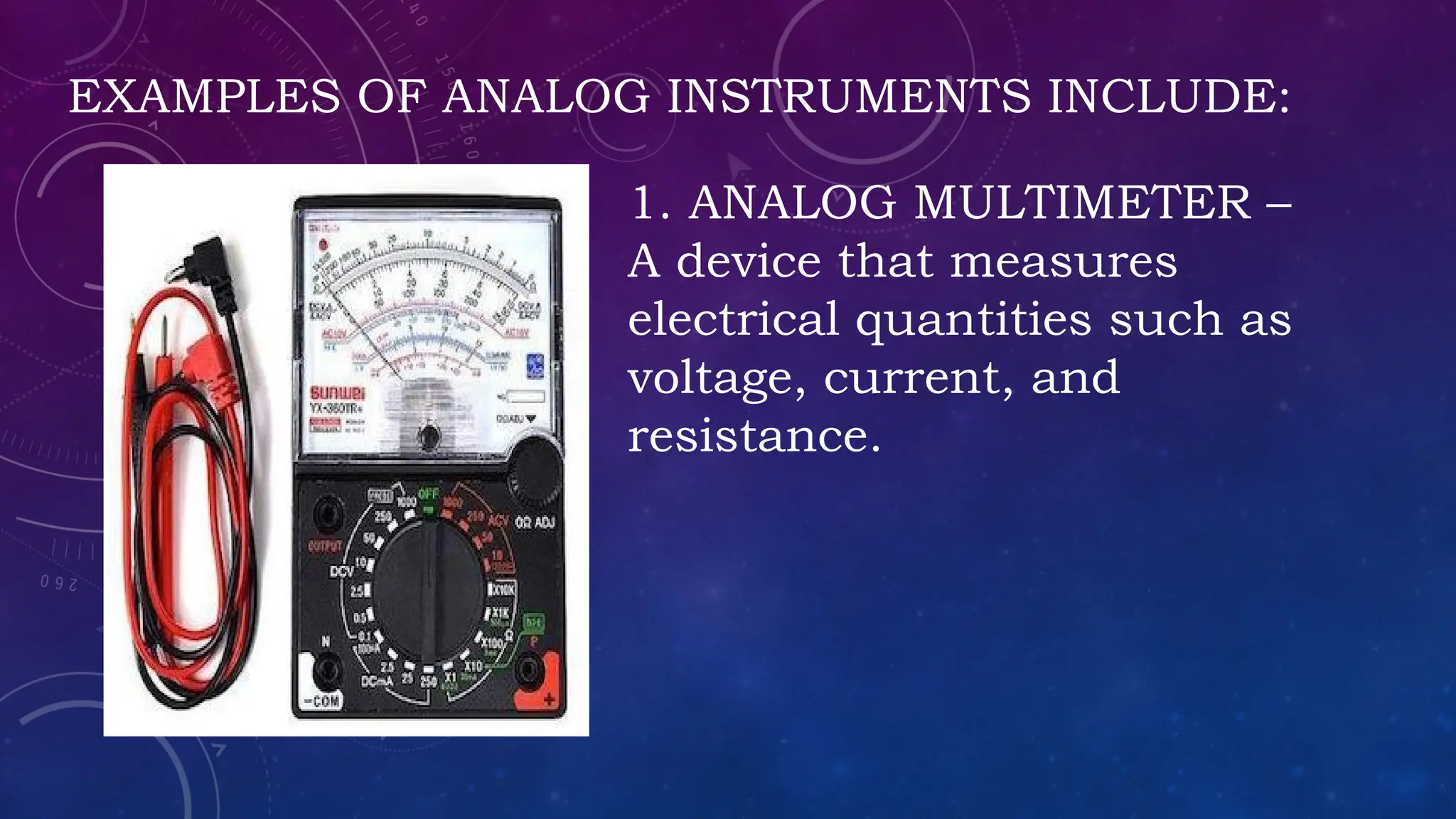
1. ANALOG MULTIMETER –
A device that measures
electrical quantities such as
voltage, current, and
resistance.
EXAMPLES OF ANALOG INSTRUMENTS INCLUDE:
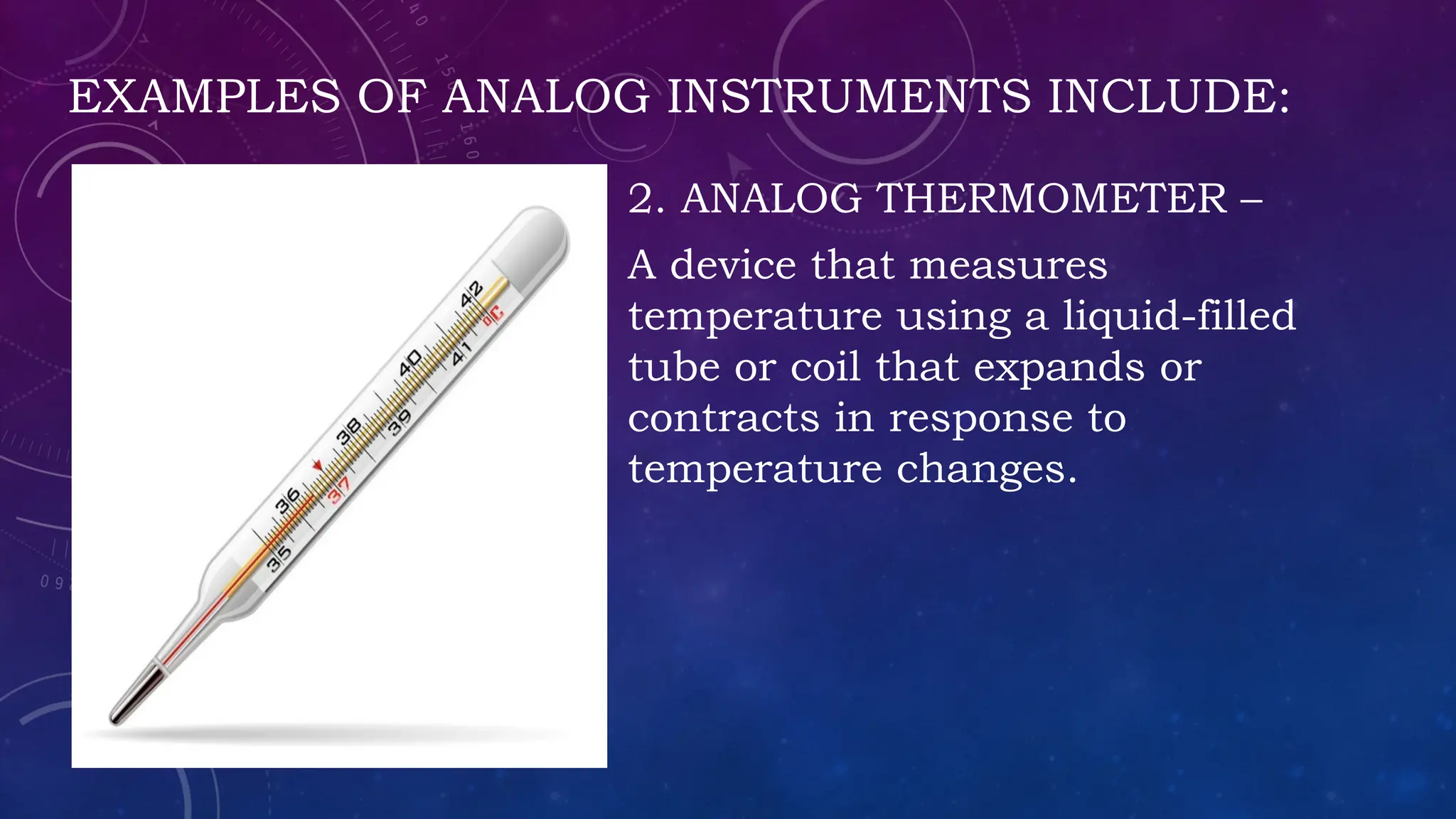
2. ANALOG THERMOMETER –
A device that measures
temperature using a liquid-filled
tube or coil that expands or
contracts in response to
temperature changes.
EXAMPLES OF ANALOG INSTRUMENTS INCLUDE:
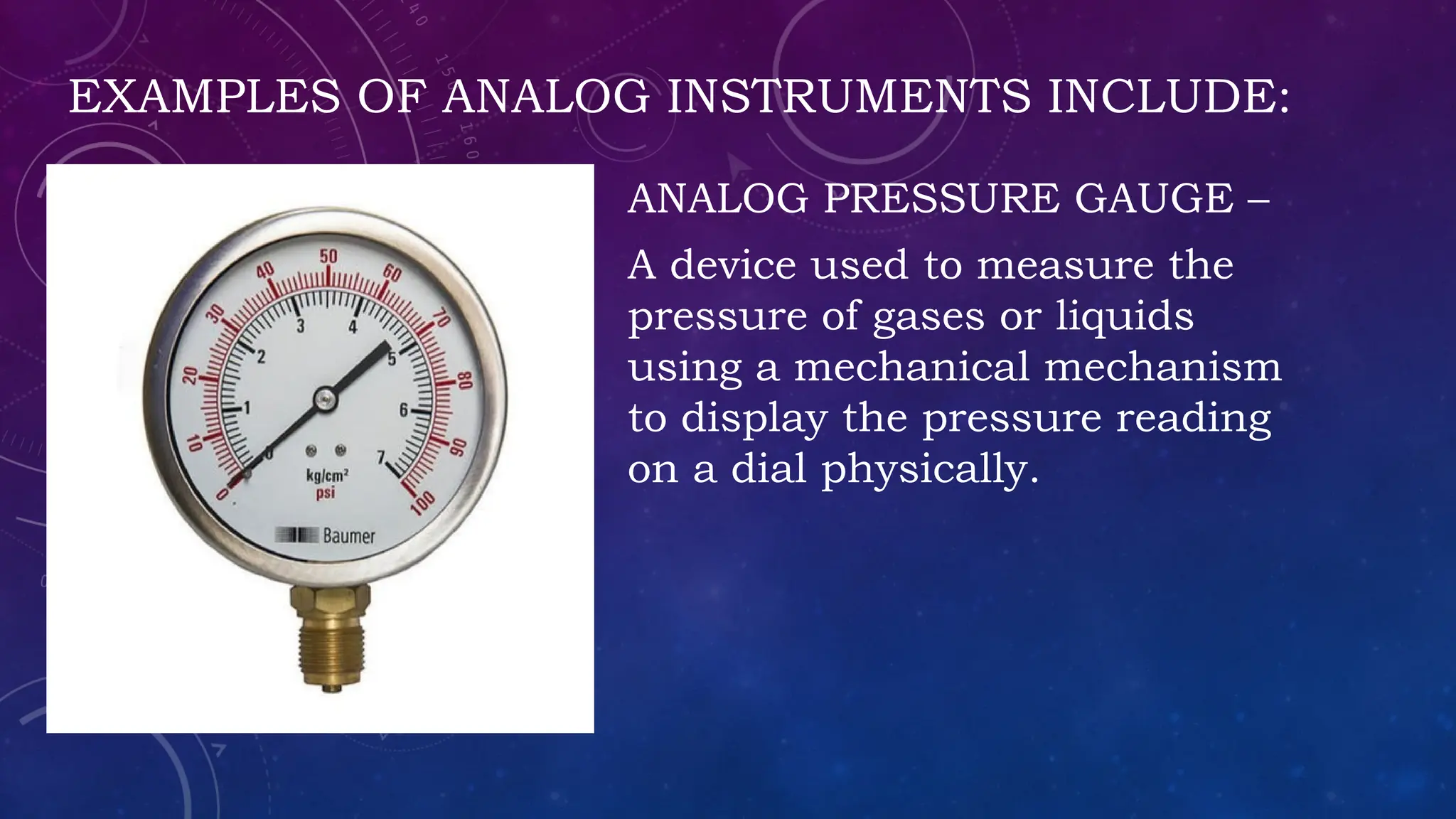
ANALOG PRESSURE GAUGE –
A device used to measure the
pressure of gases or liquids
using a mechanical mechanism
to display the pressure reading
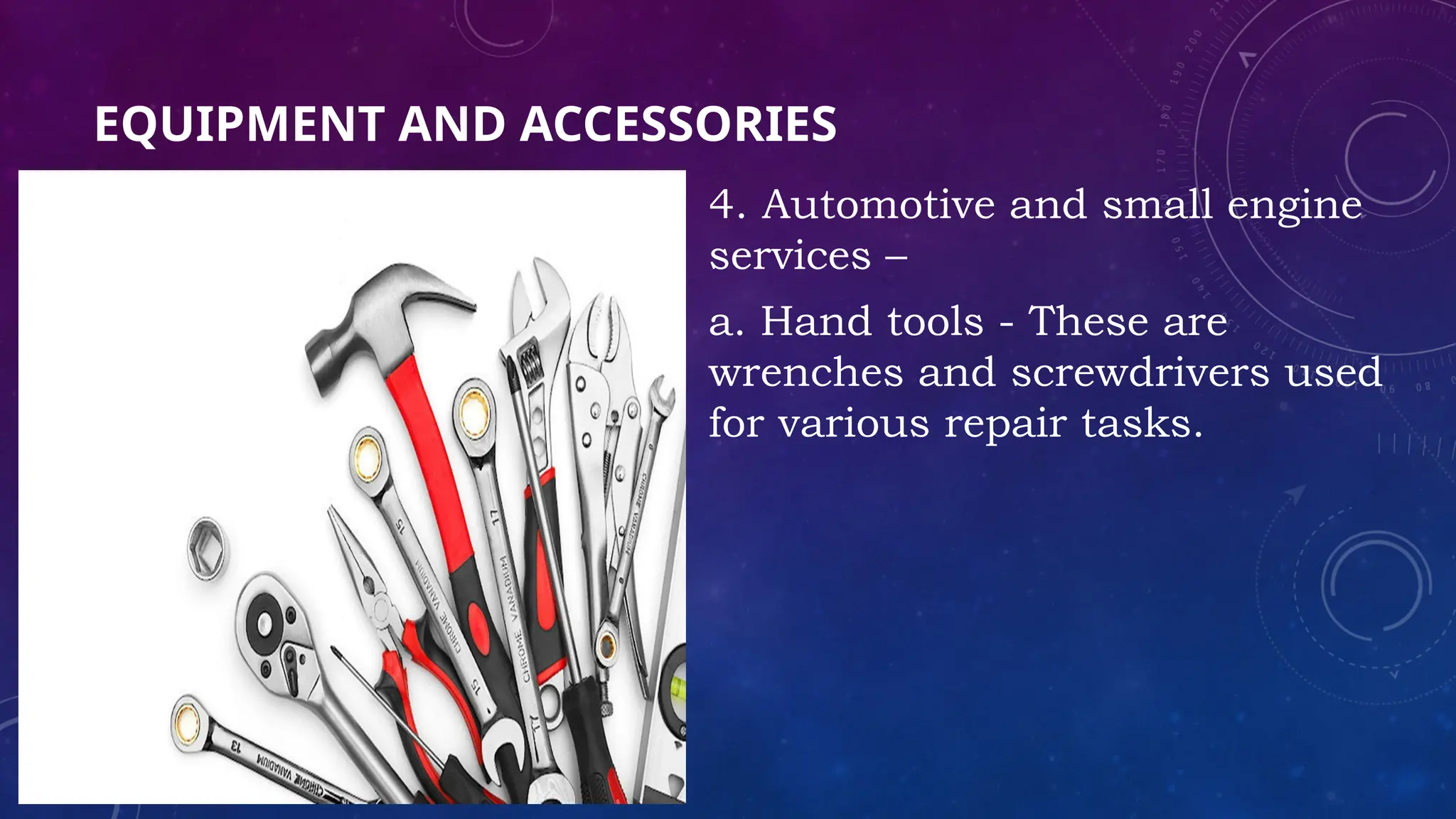
on a dial physically.
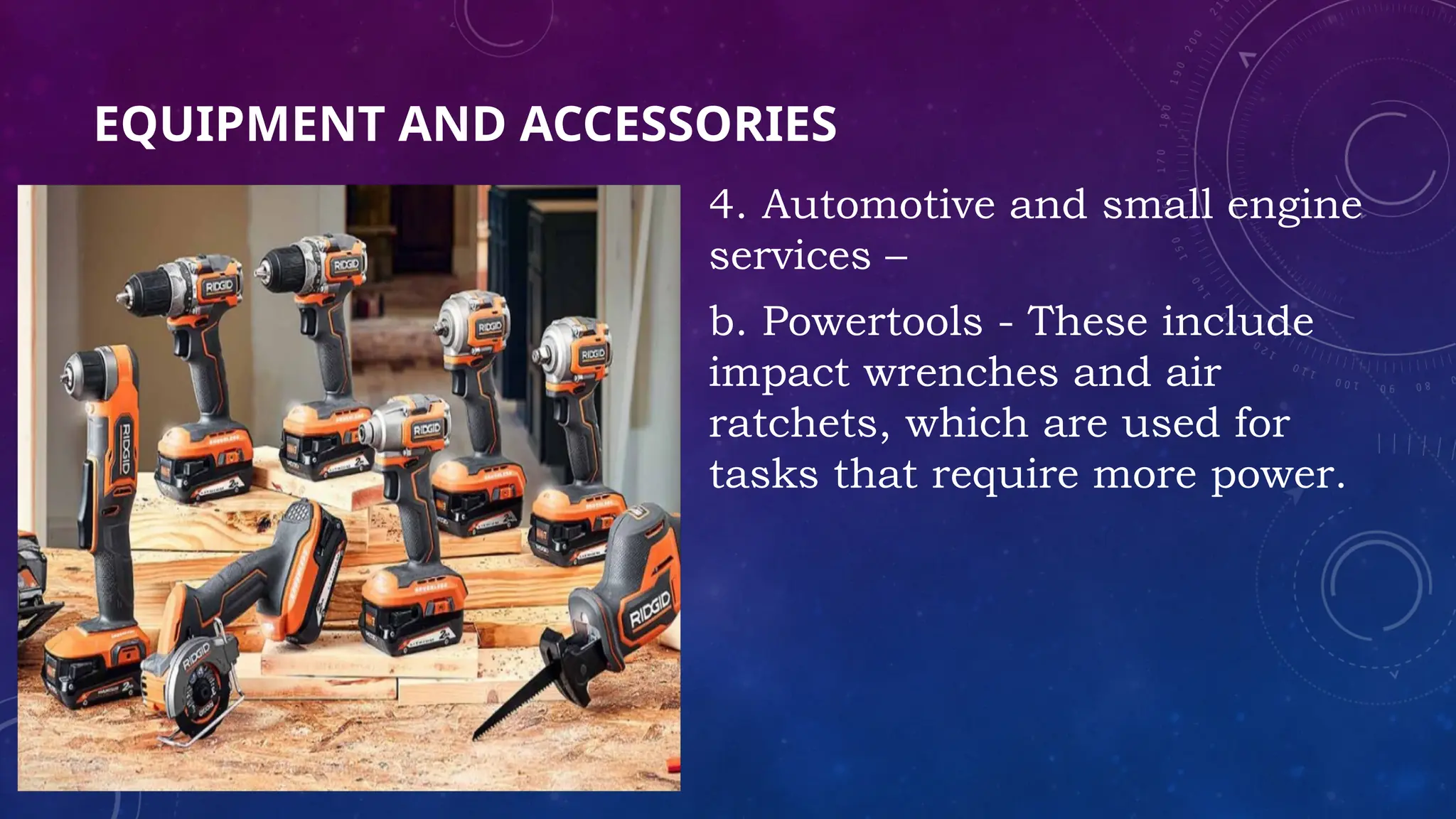
EXAMPLES OF ANALOG INSTRUMENTS INCLUDE:
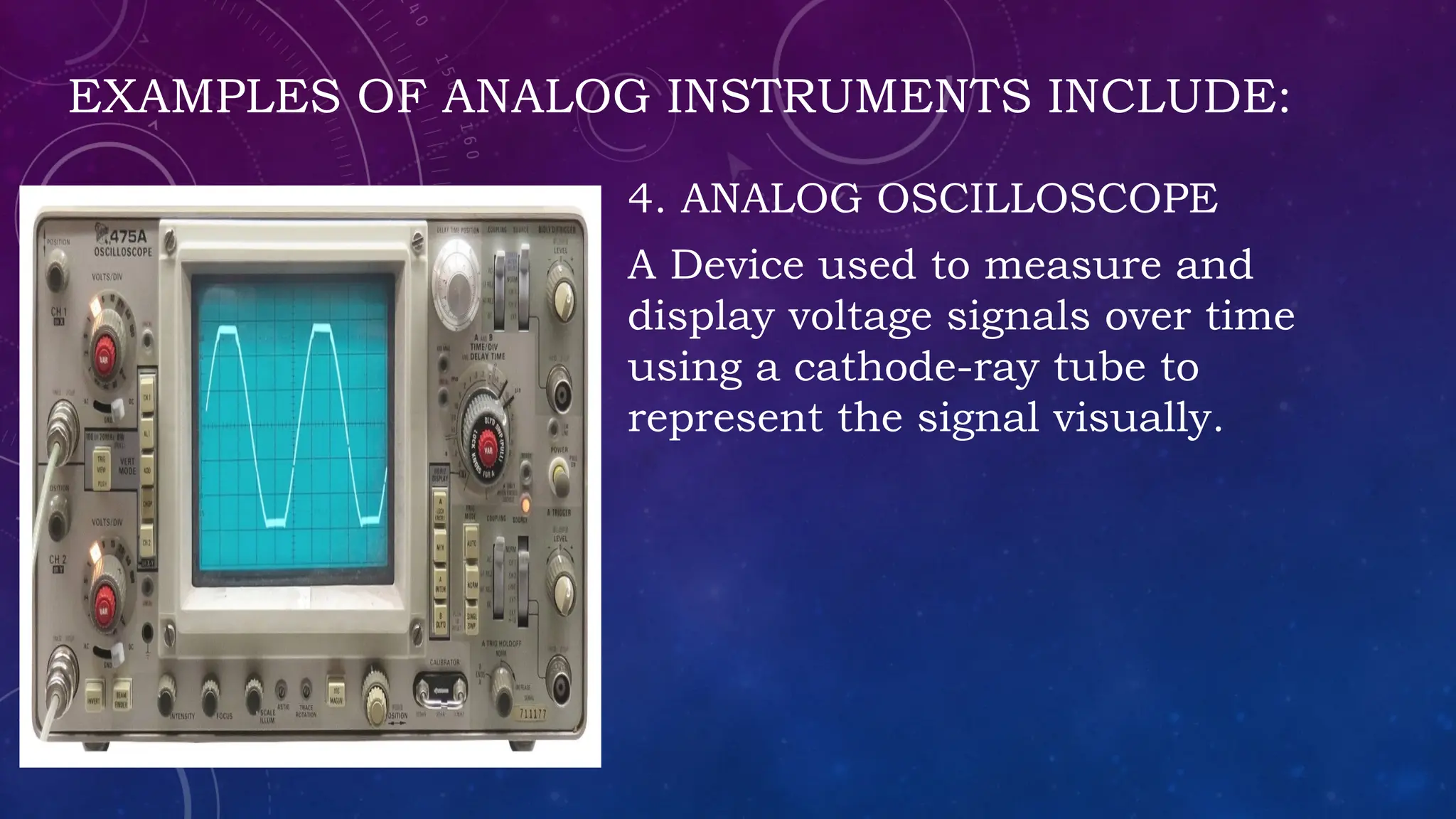
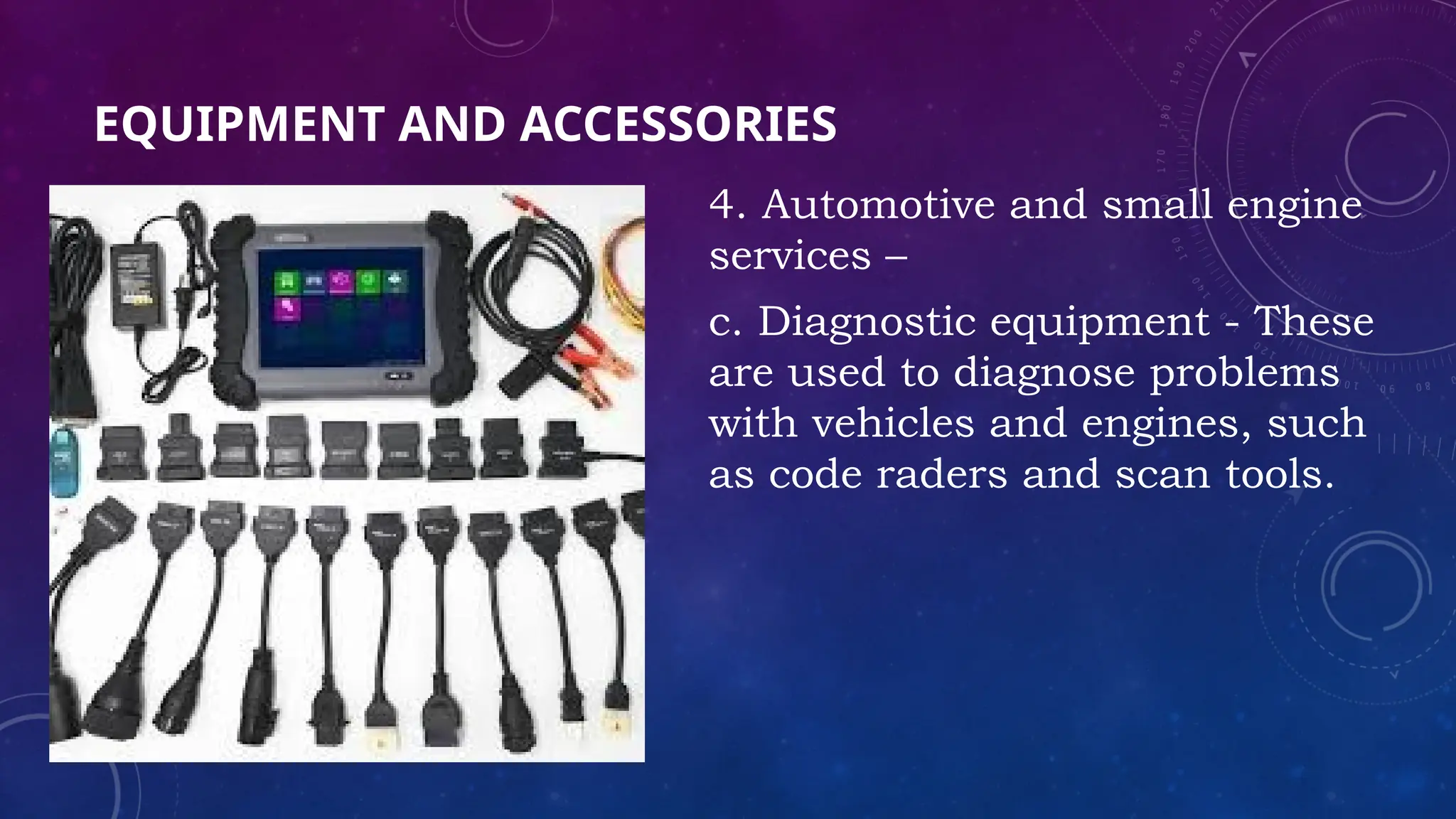
4. ANALOG OSCILLOSCOPE
A Device used to measure and
display voltage signals over time
using a cathode-ray tube to
represent the signal visually.
EXAMPLES OF ANALOG INSTRUMENTS INCLUDE:
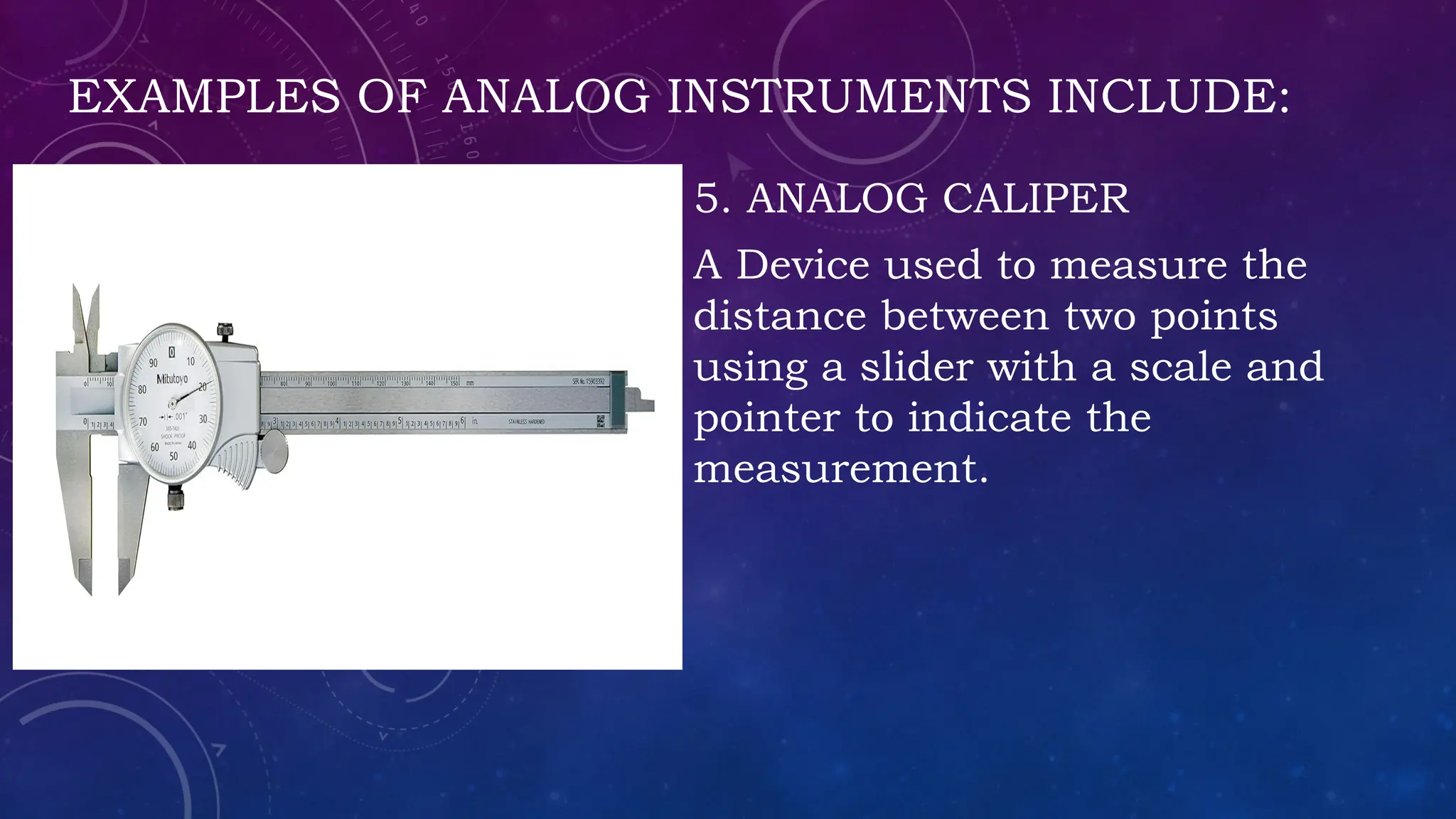
5. ANALOG CALIPER
A Device used to measure the
distance between two points
using a slider with a scale and
pointer to indicate the
measurement.
WHAT IS A DIGITAL INSTRUMENT?
A digital instrument is a measuring instrument that
represents the output in the form of digits on a screen
(LCD or LED). The principle of a digital instrument is
based on the binary number system where two binary
digits (0 and 1) denote two distinct values. Digital
instruments are made of solid-state devices such as
diodes, transistors, mosfets, leds, etc. The results shown
by the digital instruments are straightforward and
accurate. Some common examples of digital instruments
are digital multimeters, digital ammeters and voltmeters,
digital energy meters, digital speedometers, etc.
EXAMPLES OF DIGITAL INSTRUMENTS INCLUDE
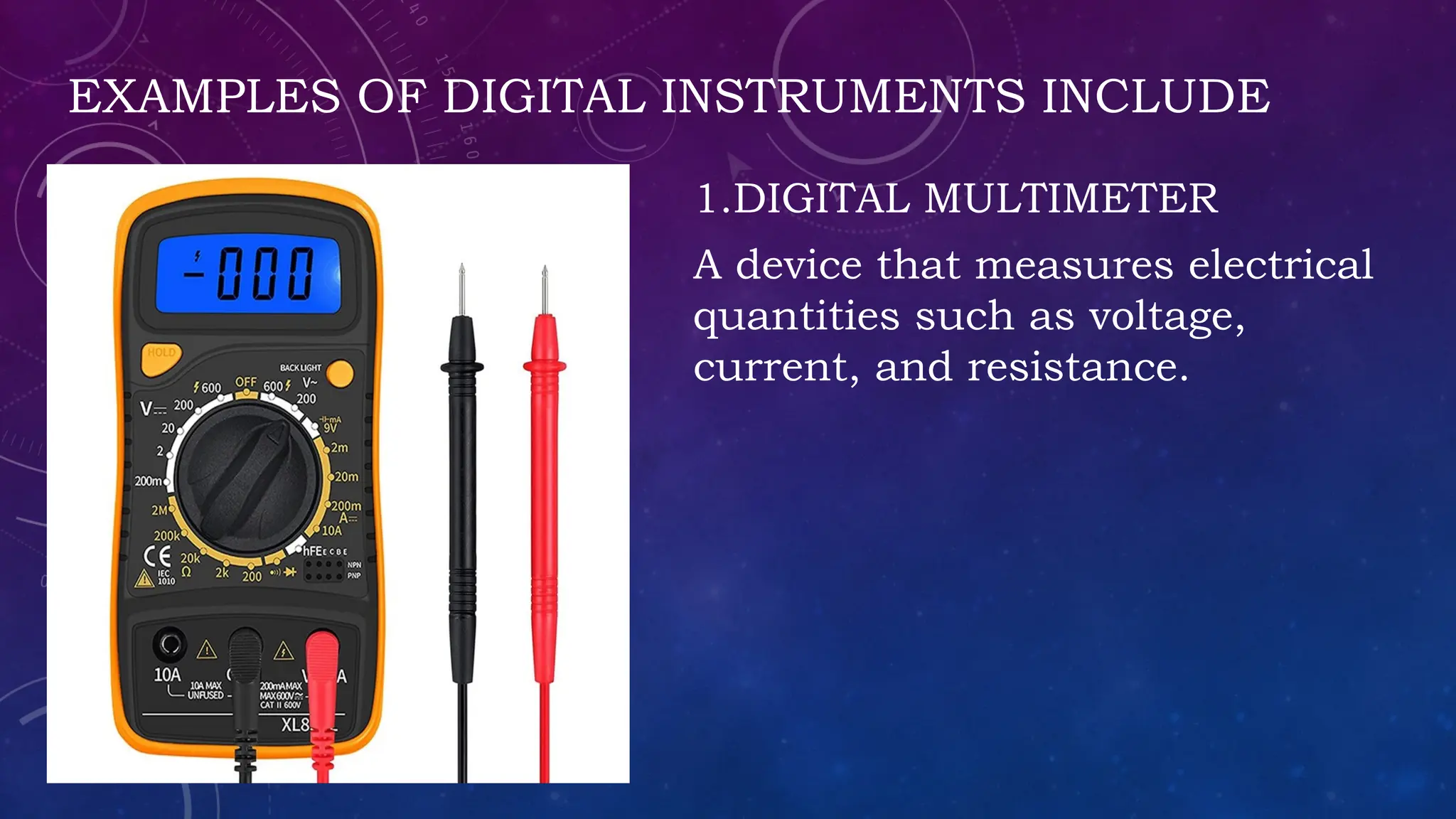
1.DIGITAL MULTIMETER
A device that measures electrical
quantities such as voltage,
current, and resistance.
EXAMPLES OF DIGITAL INSTRUMENTS INCLUDE
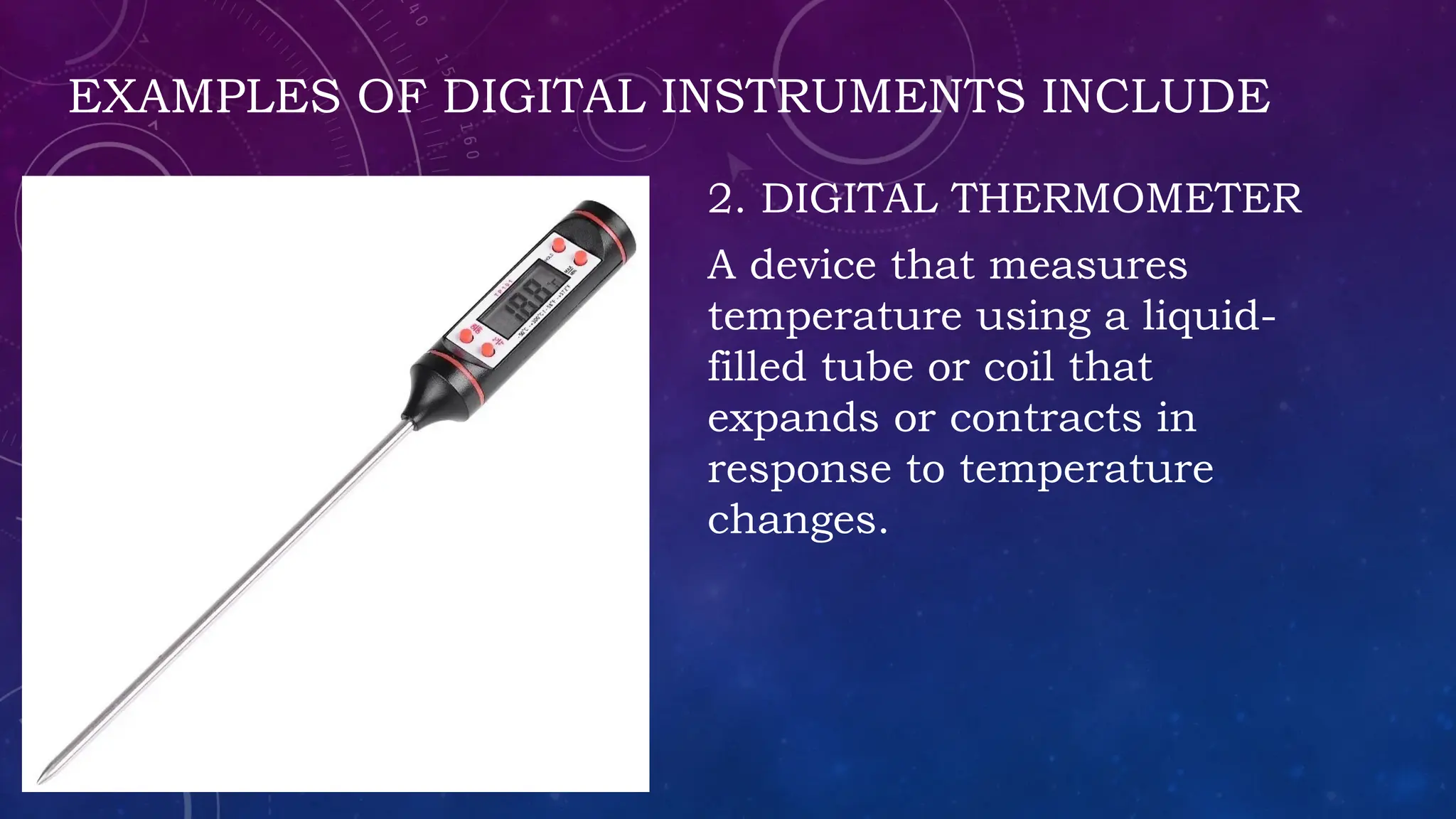
2. DIGITAL THERMOMETER
A device that measures
temperature using a liquid-
filled tube or coil that
expands or contracts in
response to temperature
changes.
EXAMPLES OF DIGITAL INSTRUMENTS INCLUDE
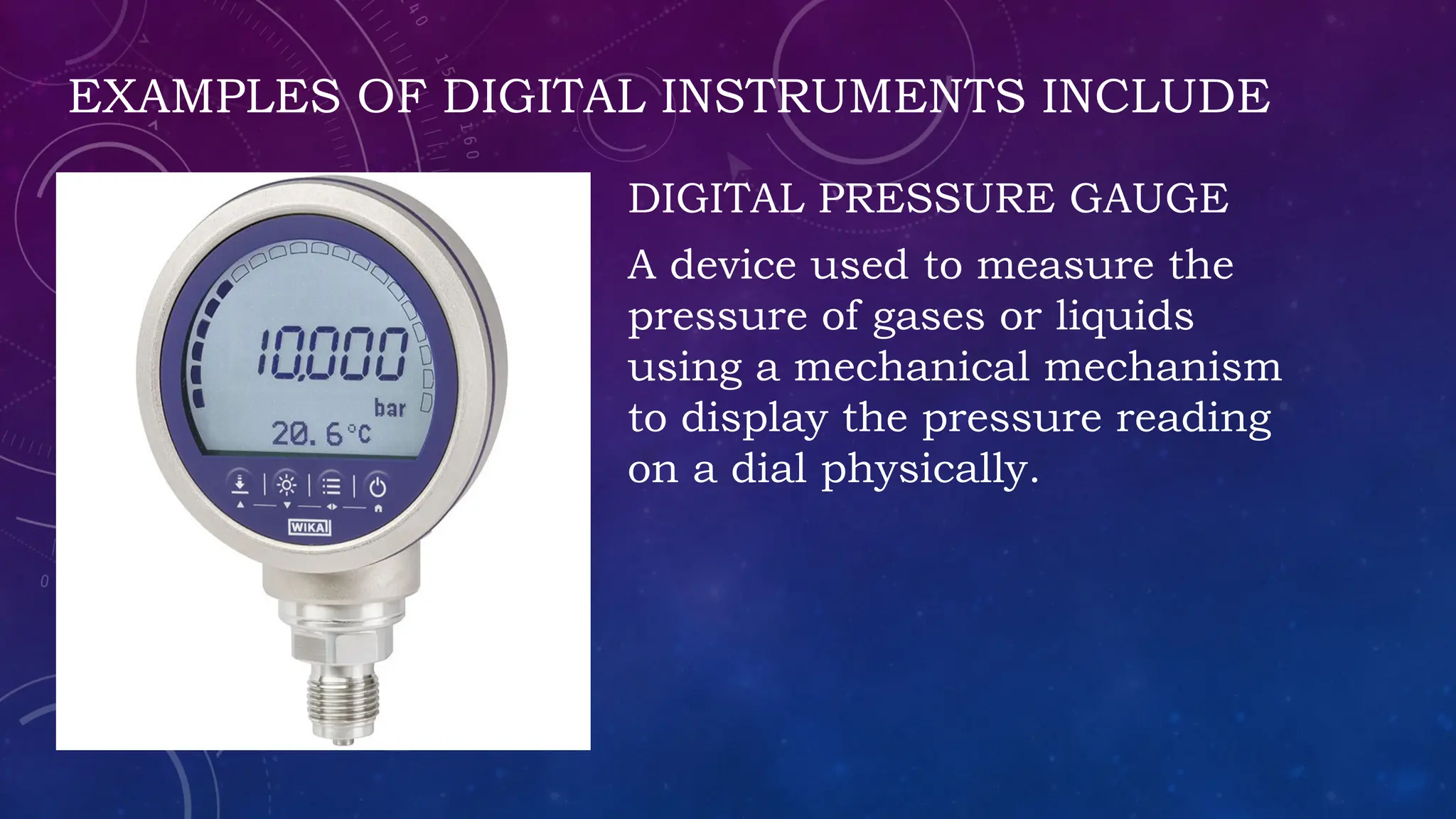
DIGITAL PRESSURE GAUGE
A device used to measure the
pressure of gases or liquids
using a mechanical mechanism
to display the pressure reading
on a dial physically.
EXAMPLES OF DIGITAL INSTRUMENTS INCLUDE
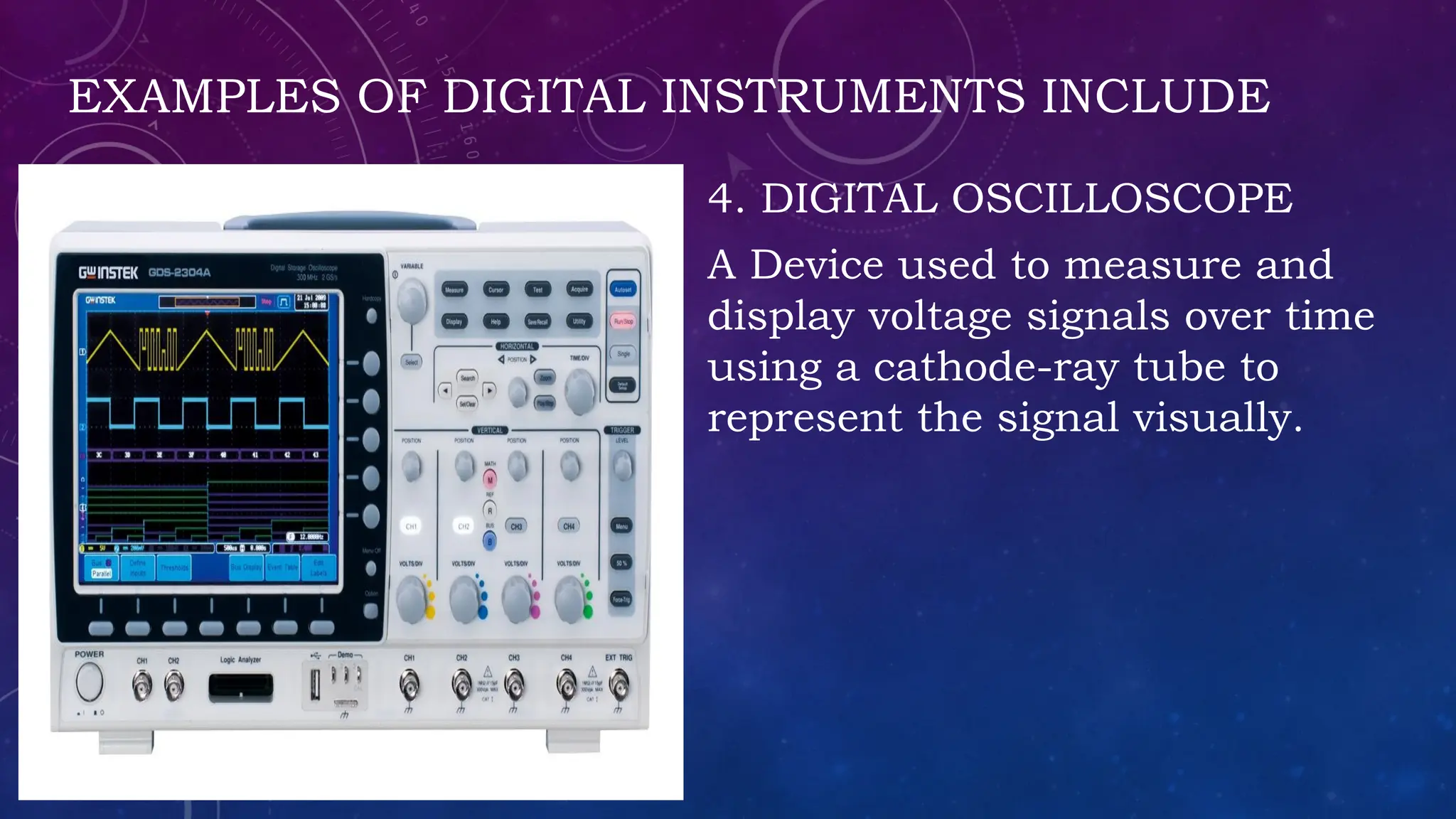
4. DIGITAL OSCILLOSCOPE
A Device used to measure and
display voltage signals over time
using a cathode-ray tube to
represent the signal visually.
EXAMPLES OF DIGITAL INSTRUMENTS INCLUDE
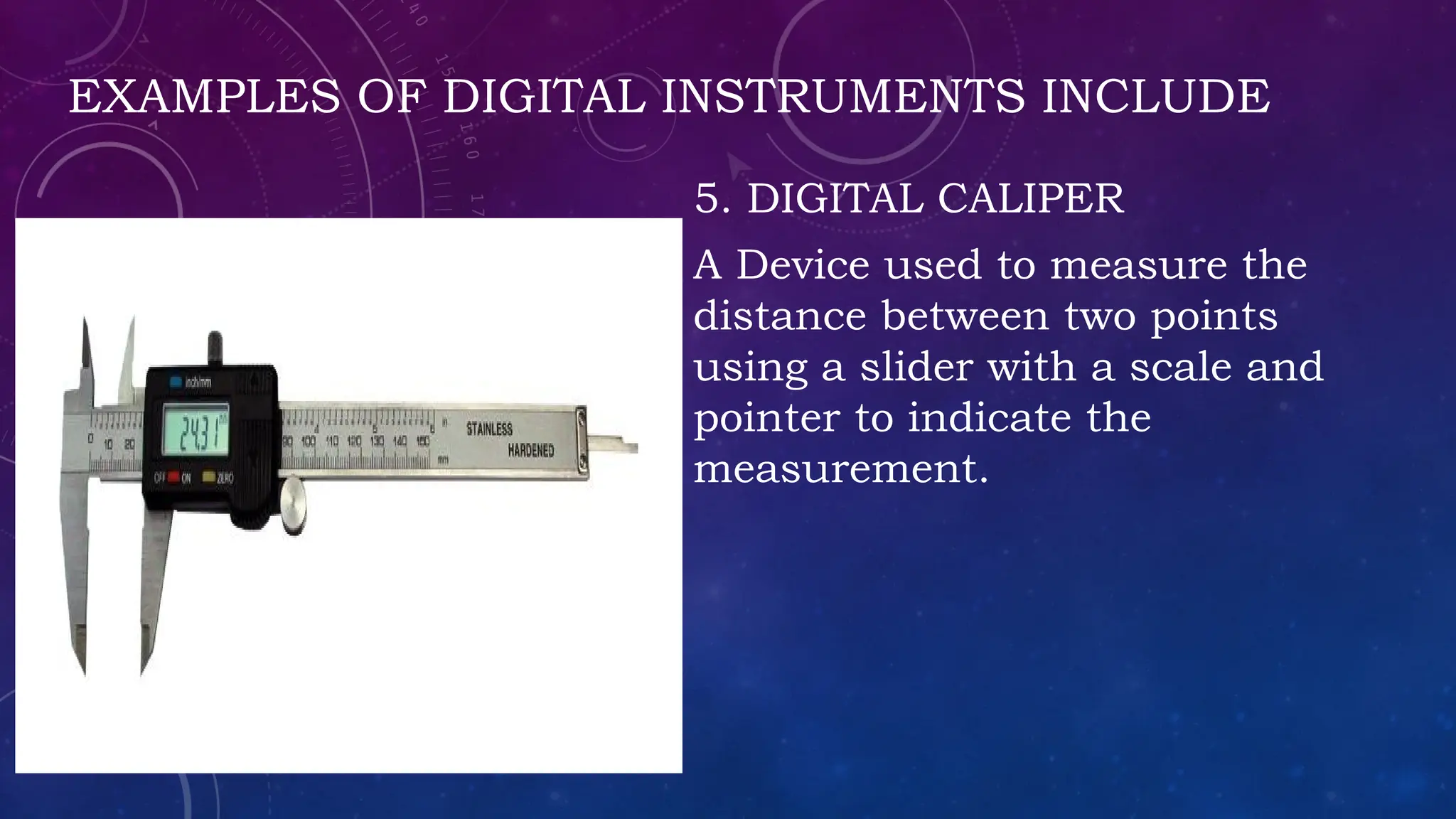
5. DIGITAL CALIPER
A Device used to measure the
distance between two points
using a slider with a scale and
pointer to indicate the
measurement.
WHAT IS A COMPUTER-BASED INSTRUMENT?
Computer-based instruments require a computer to be
connected to them or be a part of a computer to measure
and display data. As a system controller, the computer
or microprocessor chip oversees the system. Computer-
based instruments are calibrated by comparing their
output to the input signal of a standard, validated
instrument. It detects and identifies any errors in the
device under test.
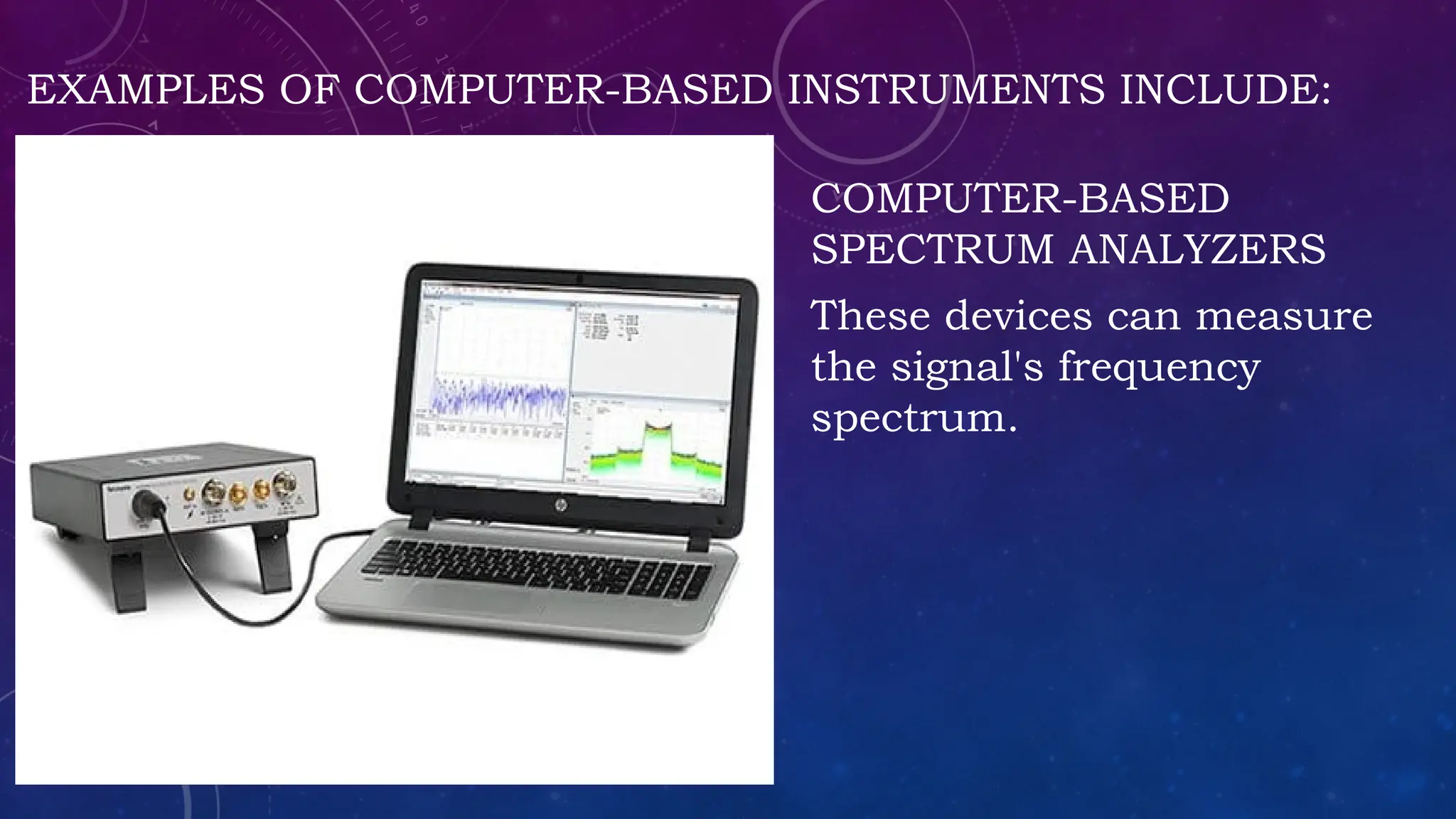
EXAMPLES OF COMPUTER-BASED INSTRUMENTS INCLUDE:
COMPUTER-BASED
SPECTRUM ANALYZERS
These devices can measure
the signal's frequency
spectrum.
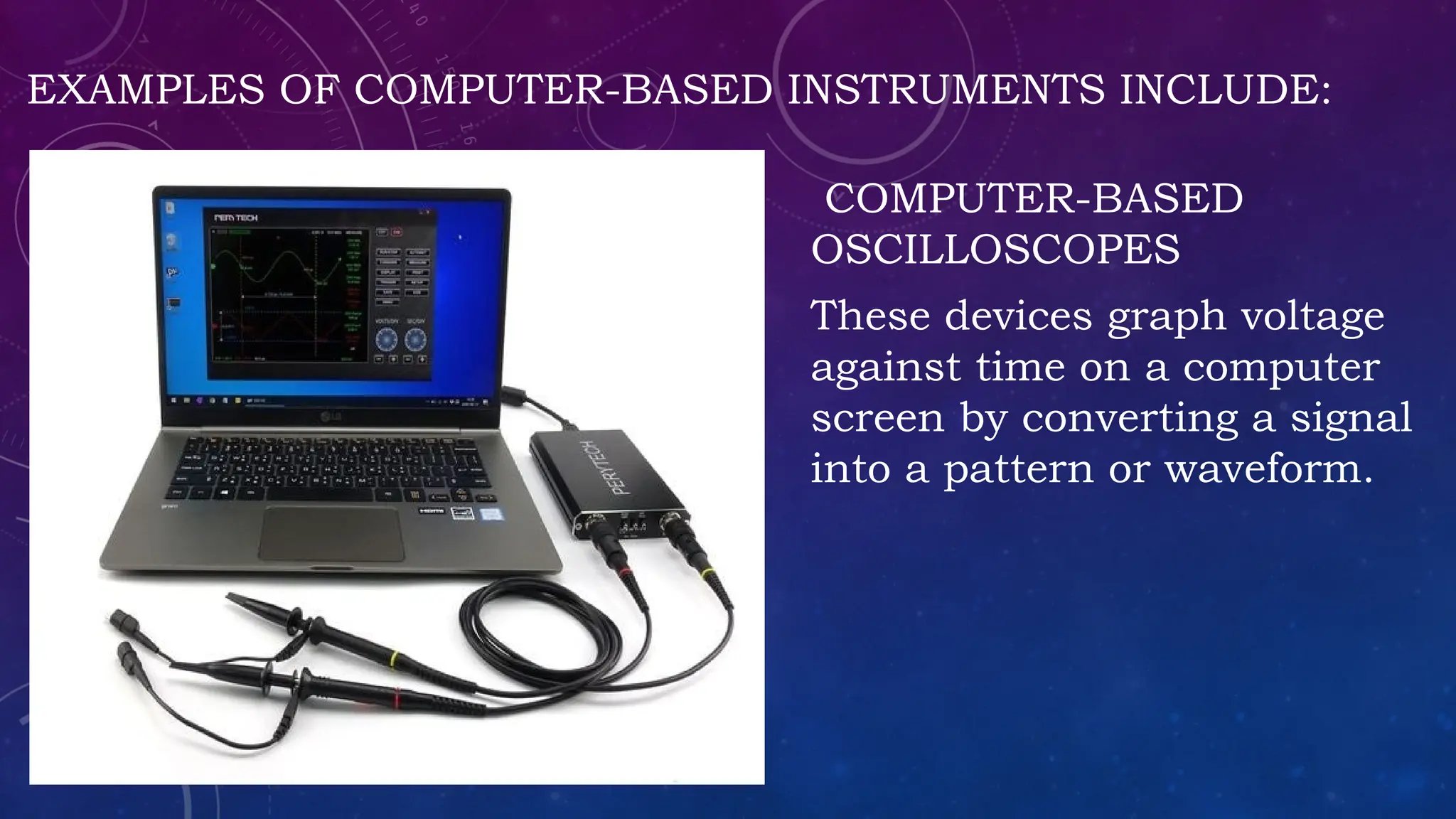
EXAMPLES OF COMPUTER-BASED INSTRUMENTS INCLUDE:
COMPUTER-BASED
OSCILLOSCOPES
These devices graph voltage
against time on a computer
screen by converting a signal
into a pattern or waveform.
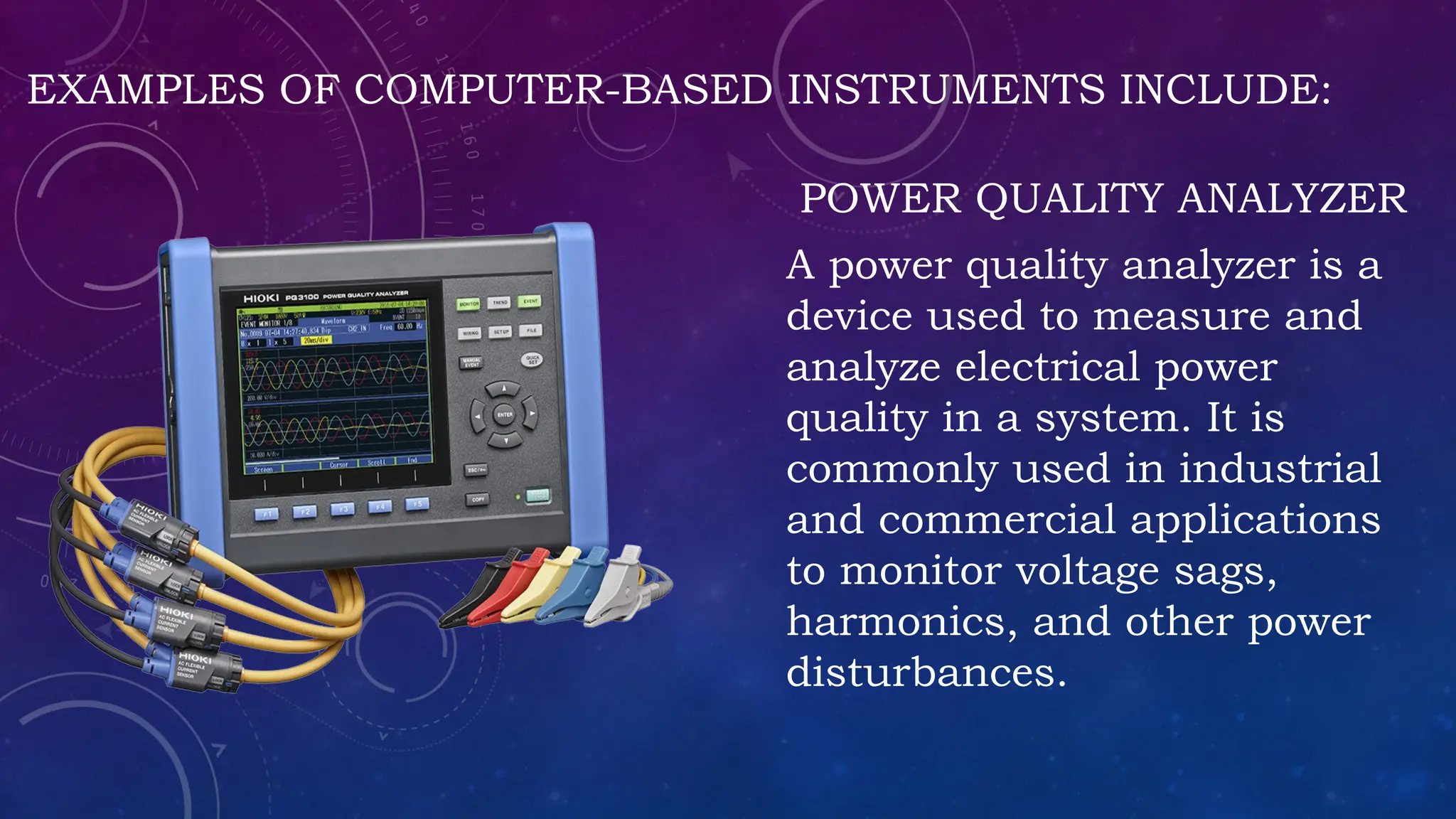
EXAMPLES OF COMPUTER-BASED INSTRUMENTS INCLUDE:
POWER QUALITY ANALYZER
A power quality analyzer is a
device used to measure and
analyze electrical power
quality in a system. It is
commonly used in industrial
and commercial applications
to monitor voltage sags,
harmonics, and other power
disturbances.
EXAMPLES OF COMPUTER-BASED INSTRUMENTS INCLUDE:
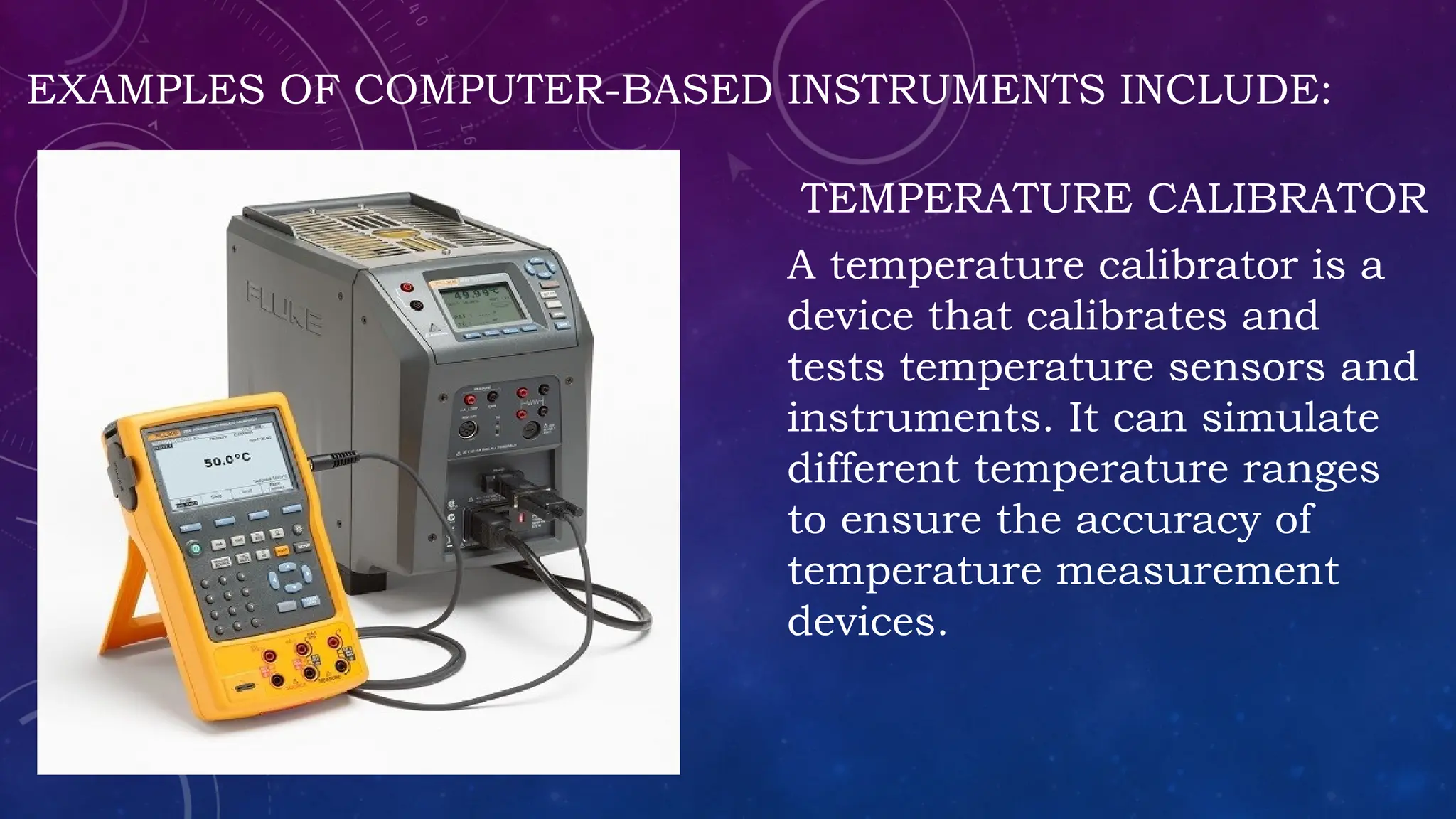
TEMPERATURE CALIBRATOR
A temperature calibrator is a
device that calibrates and
tests temperature sensors and
instruments. It can simulate
different temperature ranges
to ensure the accuracy of
temperature measurement
devices.
EXAMPLES OF COMPUTER-BASED INSTRUMENTS INCLUDE:
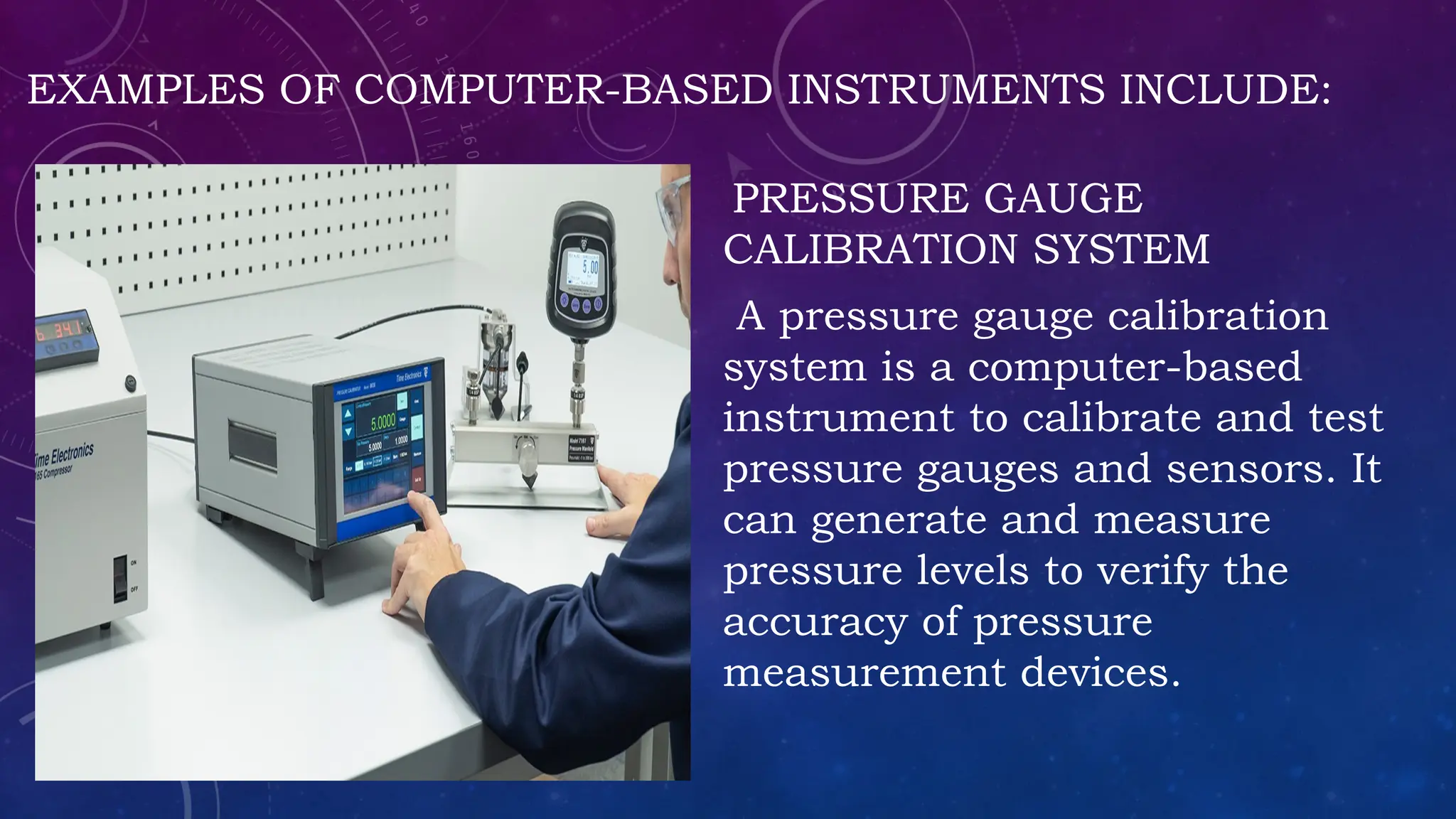
PRESSURE GAUGE
CALIBRATION SYSTEM
A pressure gauge calibration
system is a computer-based
instrument to calibrate and test
pressure gauges and sensors. It
can generate and measure
pressure levels to verify the
accuracy of pressure
measurement devices.
EQUIPMENT AND ACCESSORIES
1. Construction services - The design and construction
of structures are included in construction services. The
following tools and extras are utilized in construction
services:
EQUIPMENT AND ACCESSORIES
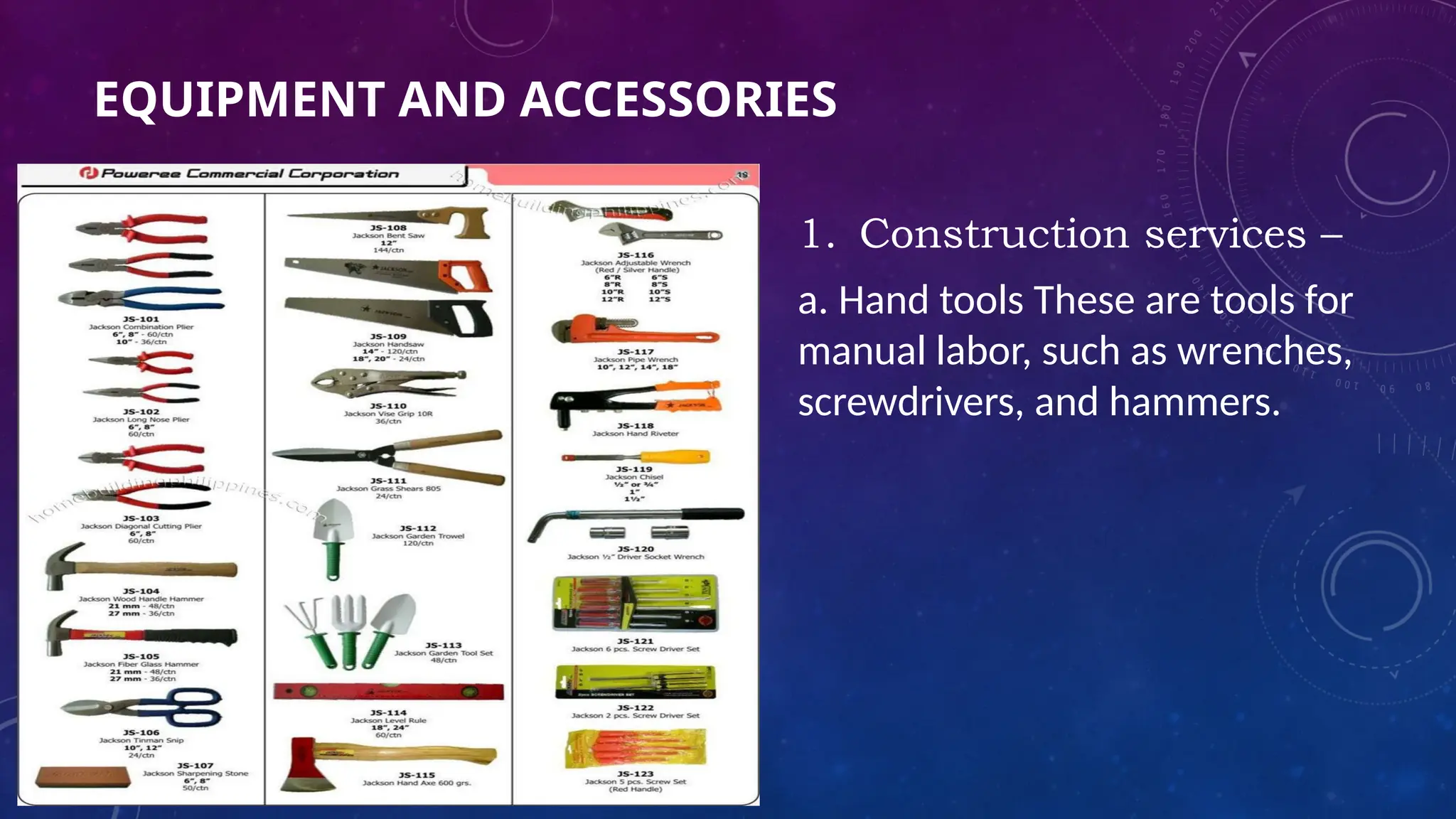
1. Construction services –
a. Hand tools These are tools for
manual labor, such as wrenches,
screwdrivers, and hammers.
EQUIPMENT AND ACCESSORIES
1. Construction services –
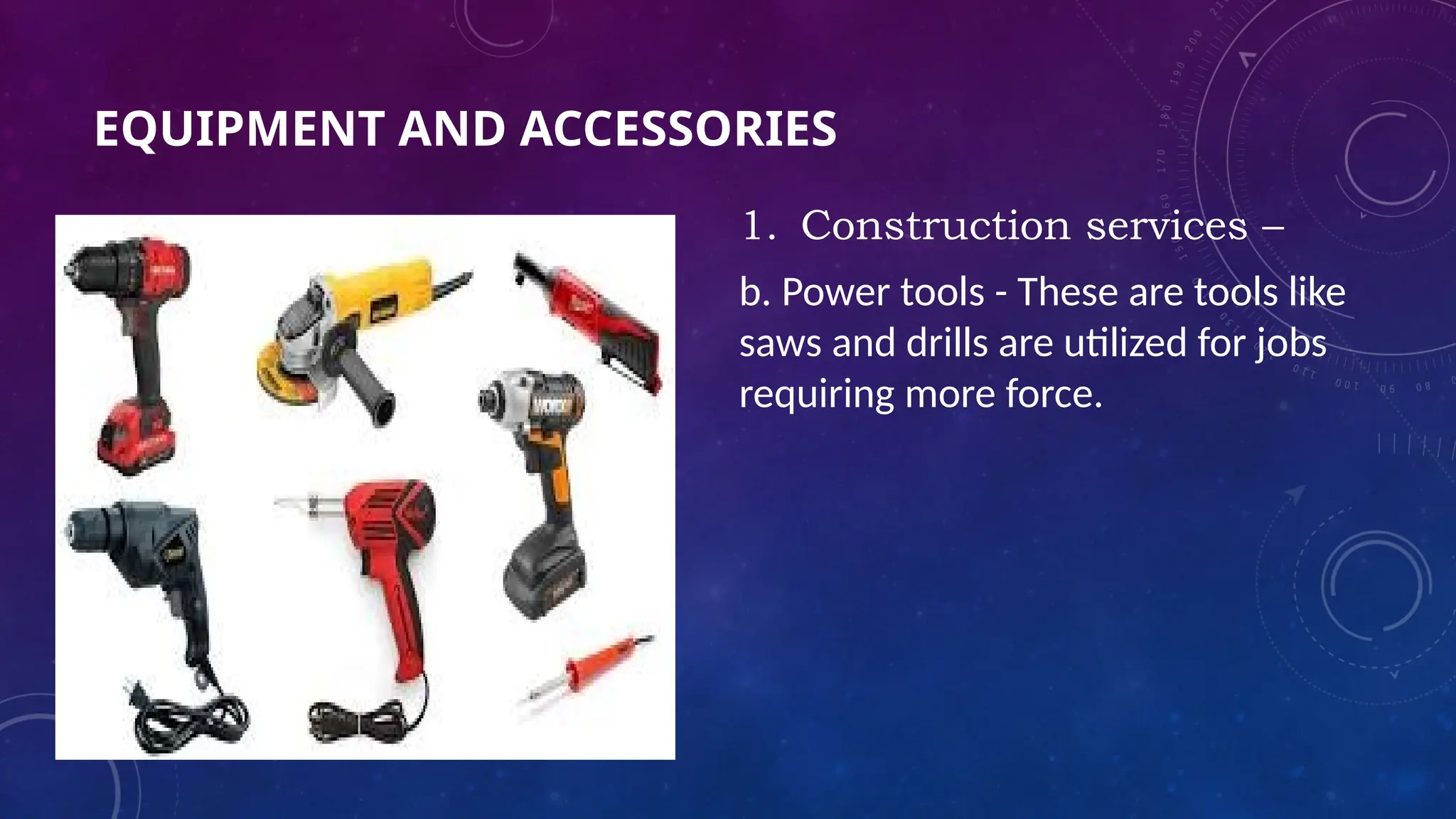
b. Power tools - These are tools like
saws and drills are utilized for jobs
requiring more force.
EQUIPMENT AND ACCESSORIES
1. Construction services
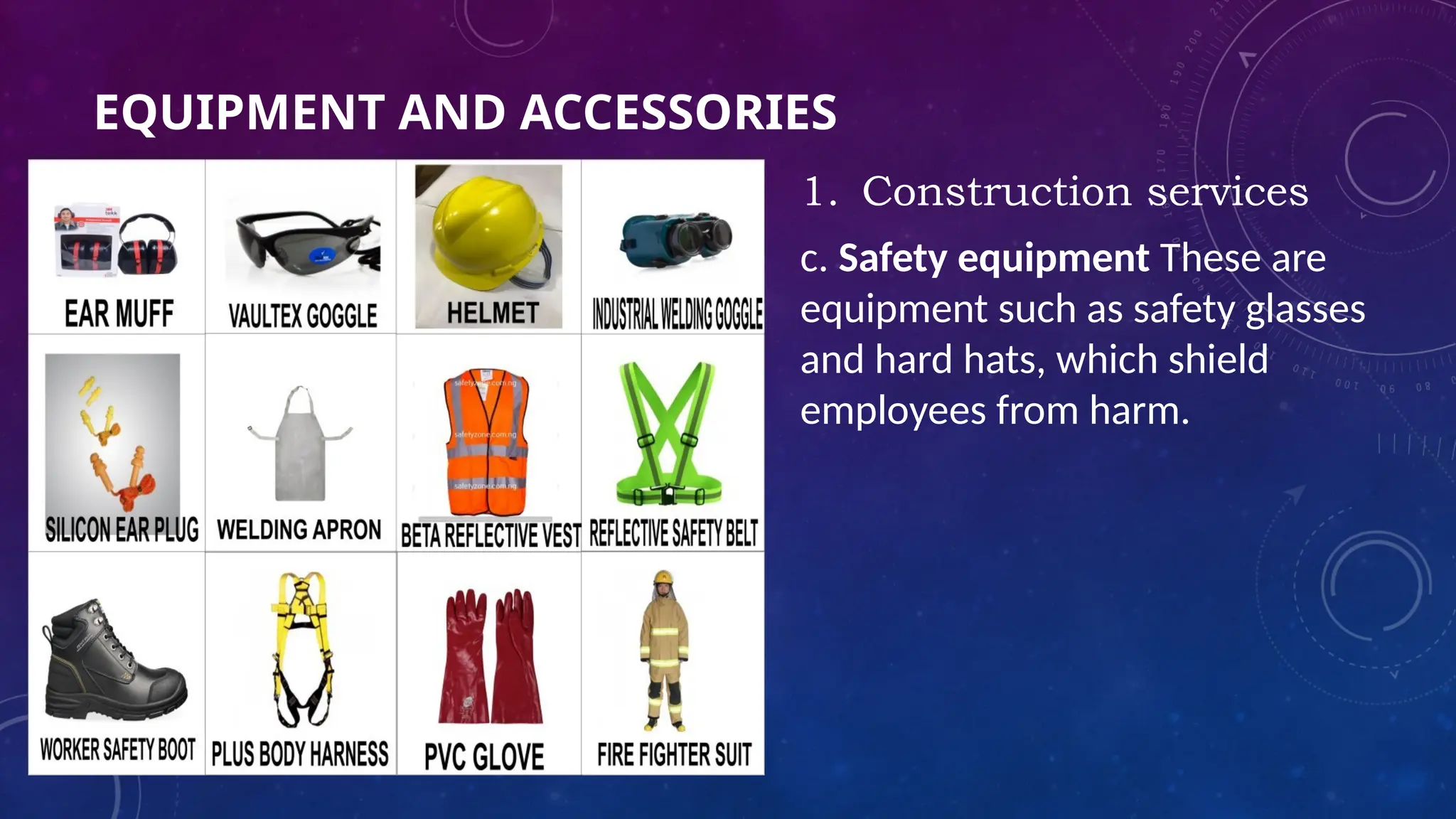
c. Safety equipment These are
equipment such as safety glasses
and hard hats, which shield
employees from harm.
EQUIPMENT AND ACCESSORIES
1. Construction services –
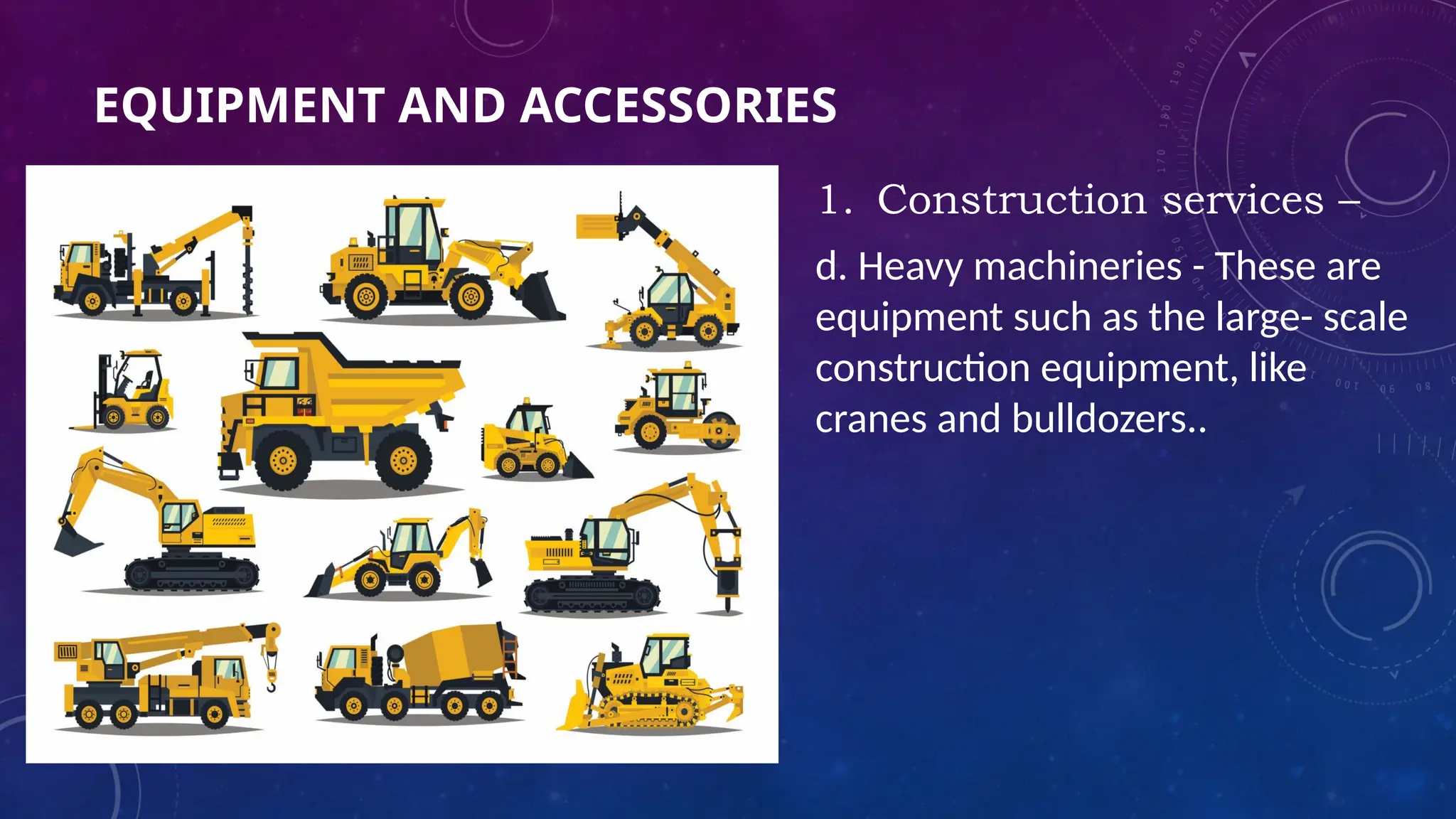
d. Heavy machineries - These are
equipment such as the large- scale
construction equipment, like
cranes and bulldozers..
EQUIPMENT AND ACCESSORIES
2. Electro-mechanical services In electro-mechanical services,
mechanical and electrical processes are combined to create
machinery and other devices. In electro-mechanical services,
the following tools and accessories are used:
EQUIPMENT AND ACCESSORIES
2. Electro-mechanical services
In electro-mechanical
services,
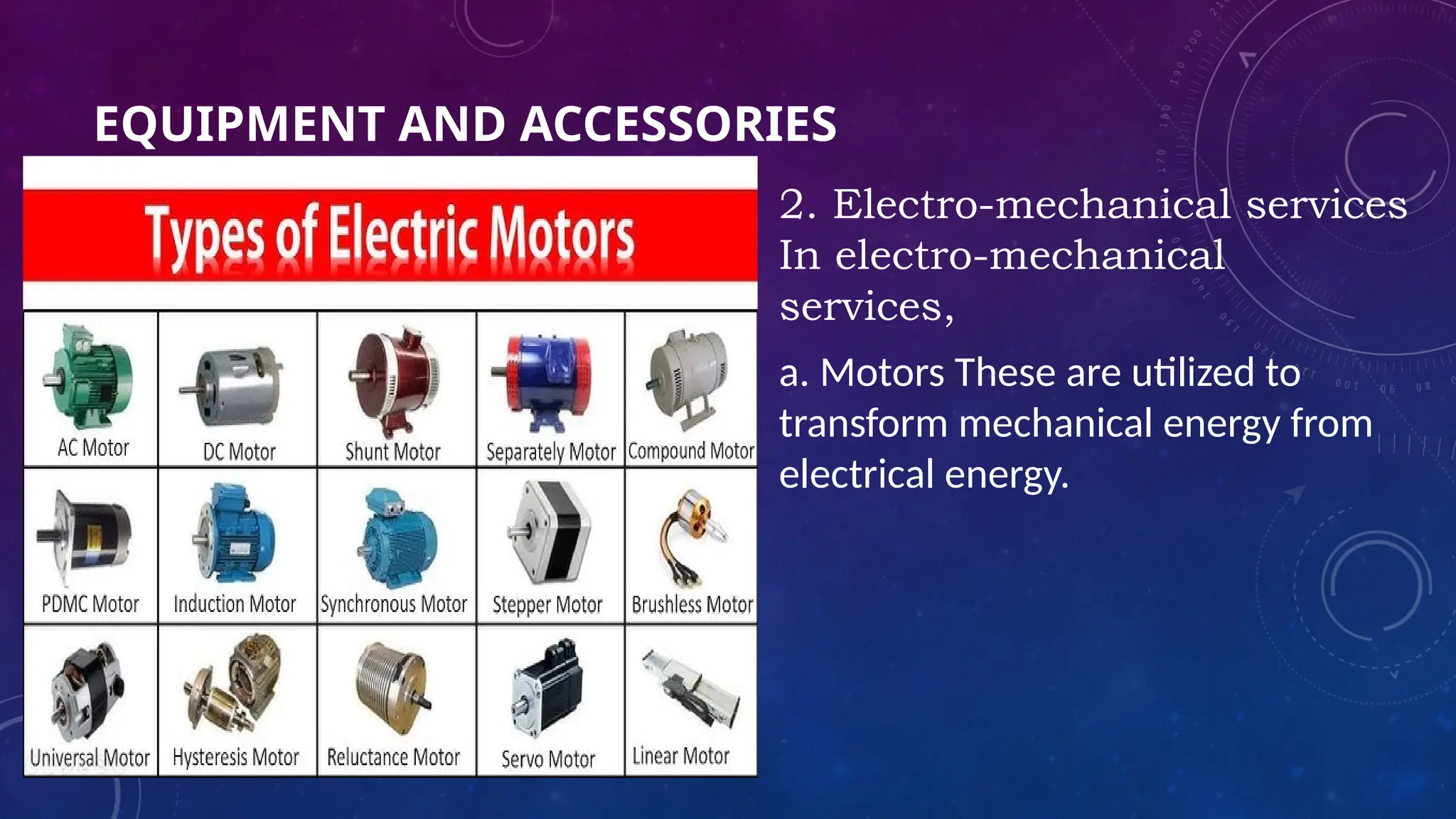
a. Motors These are utilized to
transform mechanical energy from
electrical energy.
EQUIPMENT AND ACCESSORIES
2. Electro-mechanical services
In electro-mechanical
services,
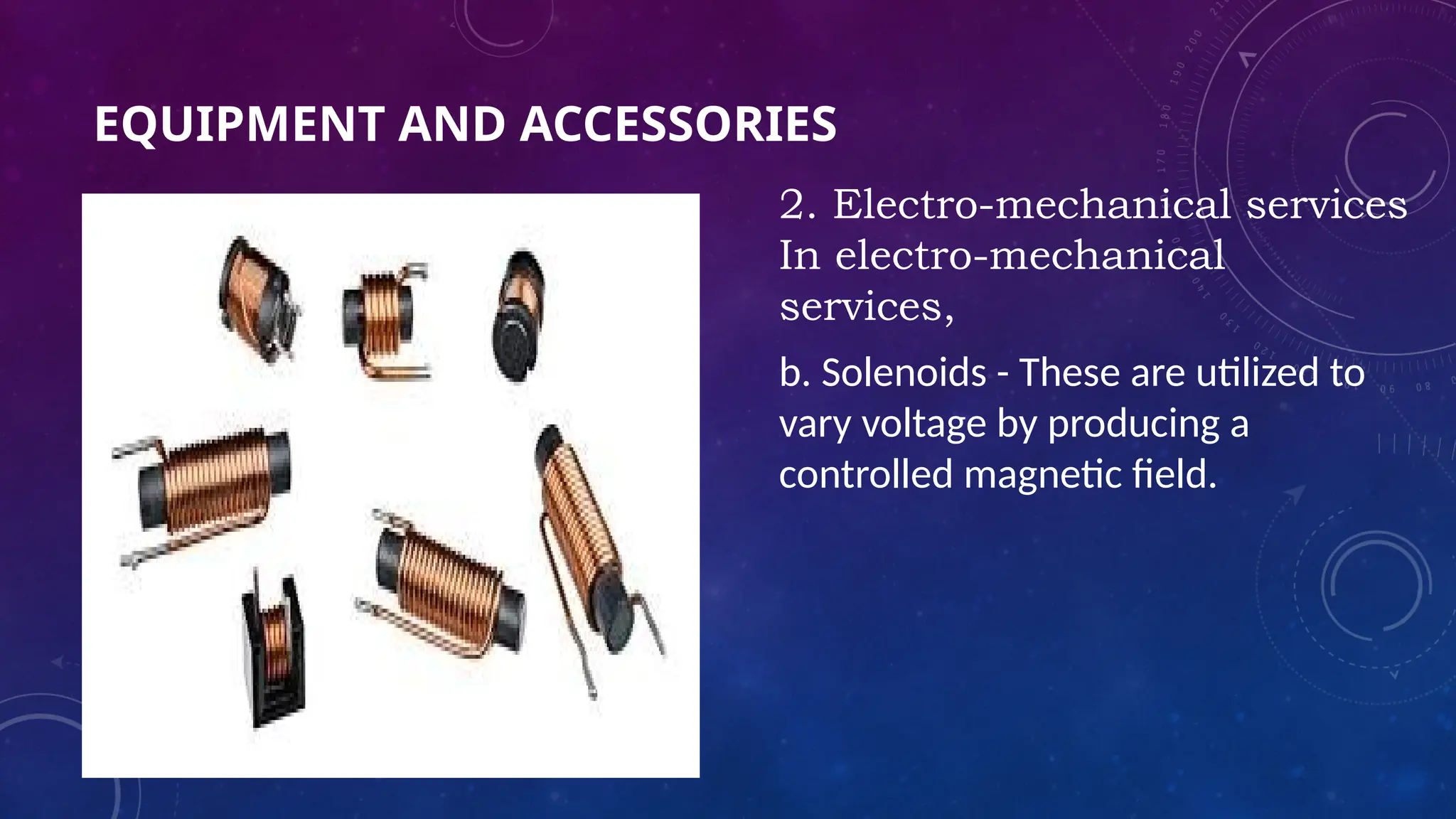
b. Solenoids - These are utilized to
vary voltage by producing a
controlled magnetic field.
EQUIPMENT AND ACCESSORIES
2. Electro-mechanical services
In electro-mechanical
services,
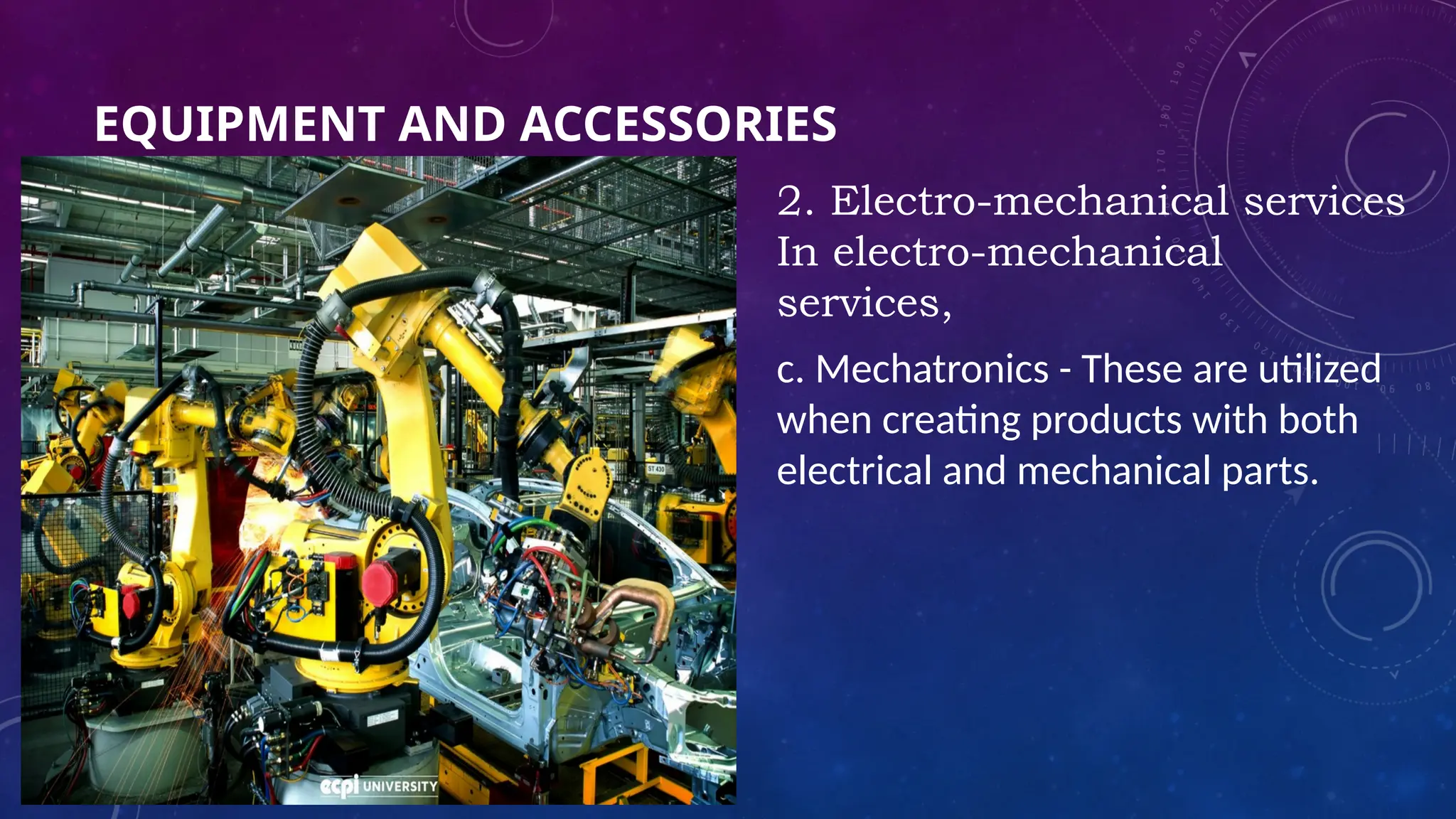
c. Mechatronics - These are utilized
when creating products with both
electrical and mechanical parts.
EQUIPMENT AND ACCESSORIES
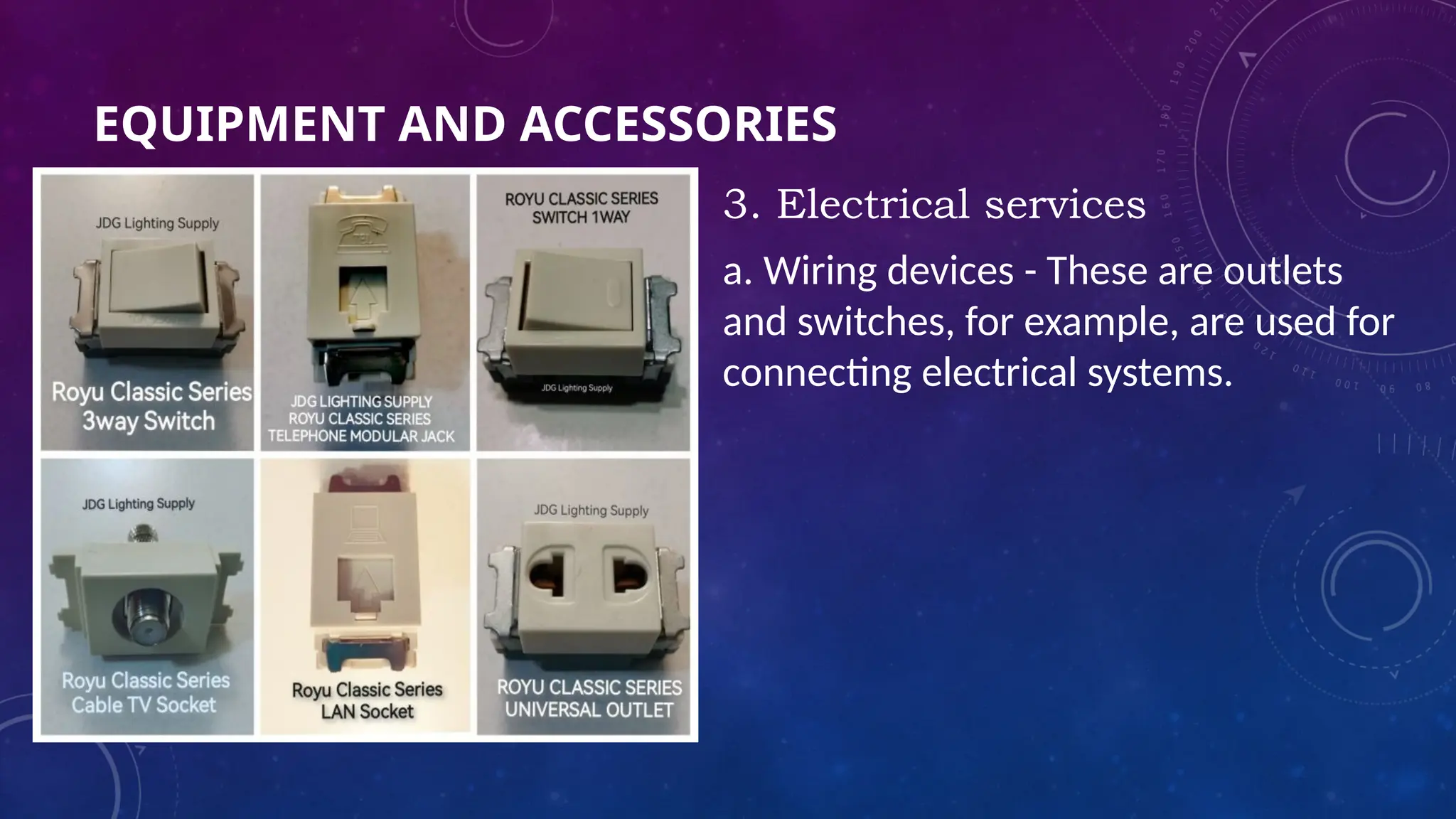
3. Electrical services The design, installation, and upkeep of
electrical systems are all included in electrical services. The
following tools and accessories are used in electrical services:
EQUIPMENT AND ACCESSORIES
3. Electrical services
a. Wiring devices - These are outlets
and switches, for example, are used for
connecting electrical systems.
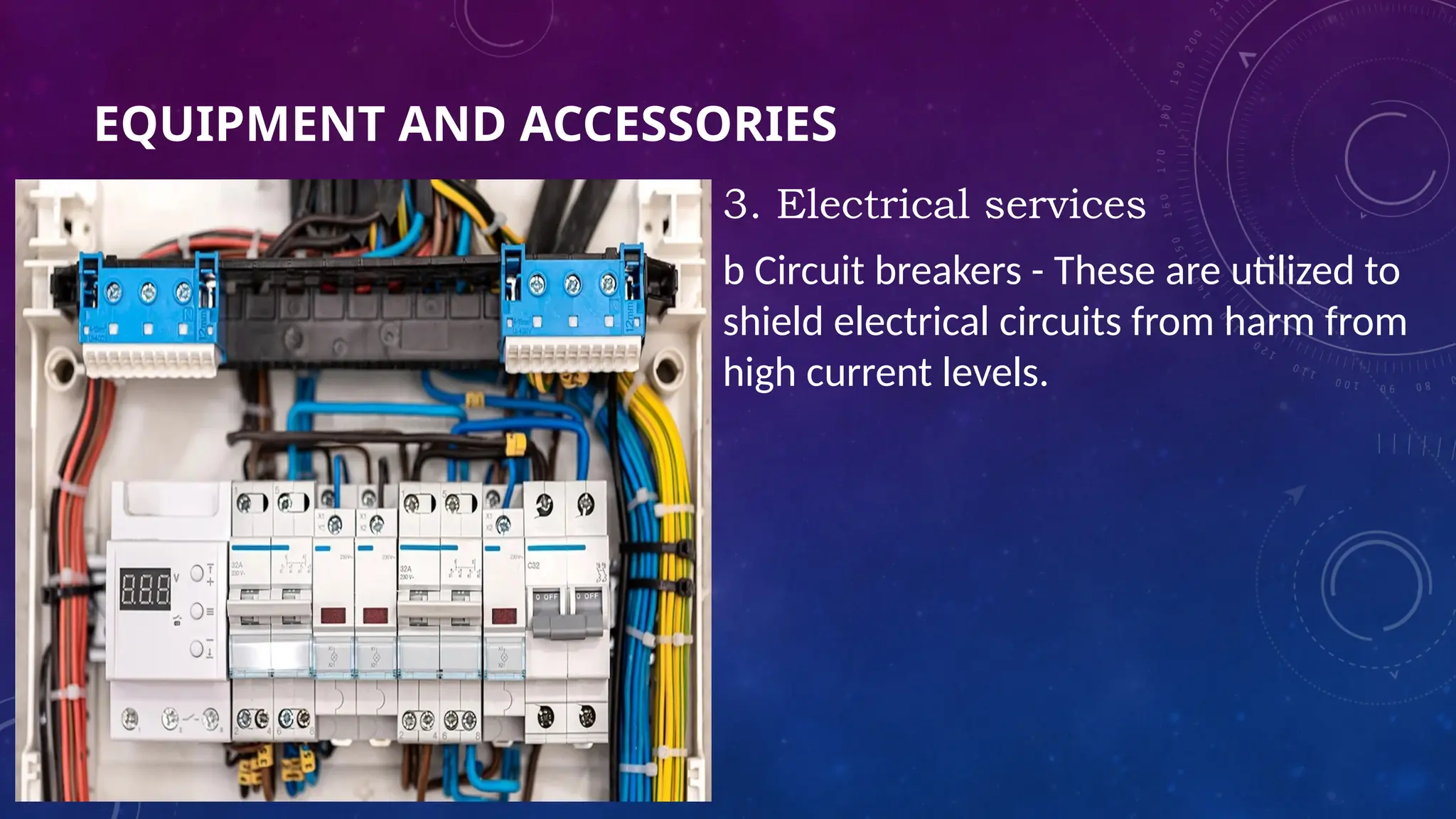
EQUIPMENT AND ACCESSORIES
3. Electrical services
b Circuit breakers - These are utilized to
shield electrical circuits from harm from
high current levels.
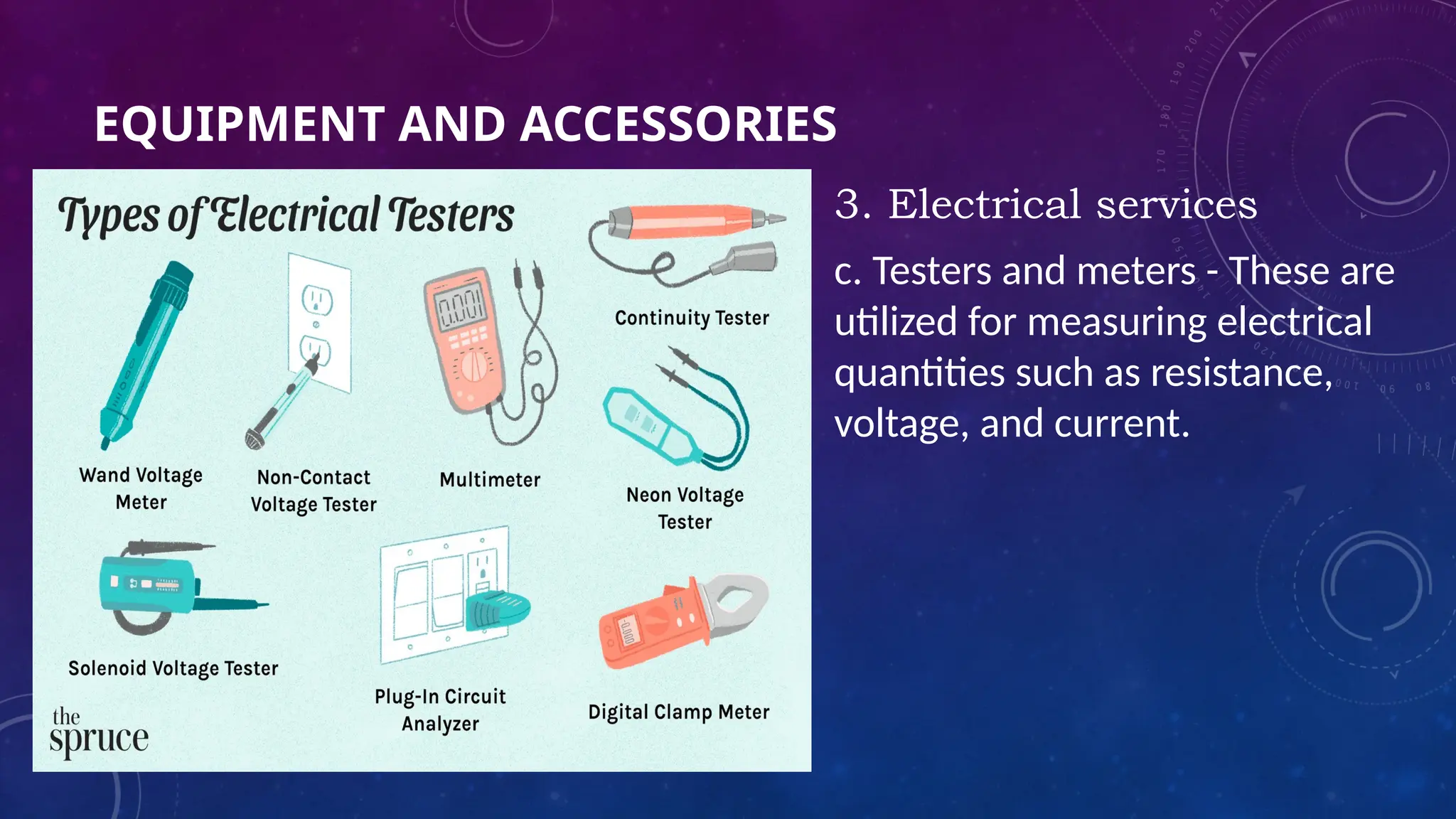
EQUIPMENT AND ACCESSORIES
3. Electrical services
c. Testers and meters - These are
utilized for measuring electrical
quantities such as resistance,
voltage, and current.
EQUIPMENT AND ACCESSORIES
4. Automotive and small engine services - Vehicle and small
engine maintenance and repair are included in automotive and
small engine services. The equipment and accessories used in
automotive and small engine services include:
EQUIPMENT AND ACCESSORIES
4. Automotive and small engine
services –
a. Hand tools - These are
wrenches and screwdrivers used
for various repair tasks.
EQUIPMENT AND ACCESSORIES
4. Automotive and small engine
services –
b. Powertools - These include
impact wrenches and air
ratchets, which are used for
tasks that require more power.
EQUIPMENT AND ACCESSORIES
4. Automotive and small engine
services –
c. Diagnostic equipment - These
are used to diagnose problems
with vehicles and engines, such
as code raders and scan tools.
EQUIPMENT AND ACCESSORIES
4. Automotive and small engine
services –
d. Lifting equipment - These are
used to lift vehicles for repairs,
such as jacks and hoists.
• Let the students think of 9 tools, 3 analog,3 digital, and
• 3 computer-based. Also, 3 Equipment and Accessories in each area,
• construction services, electro-mechanical, electrical, and automotive, and
• small engine services
• ● Let them present their work in class.
• ● Facilitate the discussion, especially when students need further explanations.

Instruments-Analog-Digital-and-Computerbased.pptx

  • 1.
    INSTRUMENTS (ANALOG, DIGITAL,AND COMPUTERBASED) AND EQUIPMENT AND ACCESSORIES
  • 2.
    WHAT IS ANANALOG INSTRUMENT? An analog instrument shows the measurement results either in a wave or by the deflection of a pointer on an analog scale. Analog instruments work on the principle of electromagnetic induction, consisting of a magnet (permanent or electromagnet) and a coil through which the current flows. The measurement is then performed by the interaction between the magnet's magnetic field and the magnetic field produced by the electric current in the coil, and the results of the measurement are generally shown by the deflection of a pointer on a scale.
  • 3.
    EXAMPLES OF ANALOGINSTRUMENTS INCLUDE: 1. ANALOG MULTIMETER – A device that measures electrical quantities such as voltage, current, and resistance.
  • 4.
    EXAMPLES OF ANALOGINSTRUMENTS INCLUDE: 2. ANALOG THERMOMETER – A device that measures temperature using a liquid-filled tube or coil that expands or contracts in response to temperature changes.
  • 5.
    EXAMPLES OF ANALOGINSTRUMENTS INCLUDE: ANALOG PRESSURE GAUGE – A device used to measure the pressure of gases or liquids using a mechanical mechanism to display the pressure reading on a dial physically.
  • 6.
    EXAMPLES OF ANALOGINSTRUMENTS INCLUDE: 4. ANALOG OSCILLOSCOPE A Device used to measure and display voltage signals over time using a cathode-ray tube to represent the signal visually.
  • 7.
    EXAMPLES OF ANALOGINSTRUMENTS INCLUDE: 5. ANALOG CALIPER A Device used to measure the distance between two points using a slider with a scale and pointer to indicate the measurement.
  • 8.
    WHAT IS ADIGITAL INSTRUMENT? A digital instrument is a measuring instrument that represents the output in the form of digits on a screen (LCD or LED). The principle of a digital instrument is based on the binary number system where two binary digits (0 and 1) denote two distinct values. Digital instruments are made of solid-state devices such as diodes, transistors, mosfets, leds, etc. The results shown by the digital instruments are straightforward and accurate. Some common examples of digital instruments are digital multimeters, digital ammeters and voltmeters, digital energy meters, digital speedometers, etc.
  • 9.
    EXAMPLES OF DIGITALINSTRUMENTS INCLUDE 1.DIGITAL MULTIMETER A device that measures electrical quantities such as voltage, current, and resistance.
  • 10.
    EXAMPLES OF DIGITALINSTRUMENTS INCLUDE 2. DIGITAL THERMOMETER A device that measures temperature using a liquid- filled tube or coil that expands or contracts in response to temperature changes.
  • 11.
    EXAMPLES OF DIGITALINSTRUMENTS INCLUDE DIGITAL PRESSURE GAUGE A device used to measure the pressure of gases or liquids using a mechanical mechanism to display the pressure reading on a dial physically.
  • 12.
    EXAMPLES OF DIGITALINSTRUMENTS INCLUDE 4. DIGITAL OSCILLOSCOPE A Device used to measure and display voltage signals over time using a cathode-ray tube to represent the signal visually.
  • 13.
    EXAMPLES OF DIGITALINSTRUMENTS INCLUDE 5. DIGITAL CALIPER A Device used to measure the distance between two points using a slider with a scale and pointer to indicate the measurement.
  • 14.
    WHAT IS ACOMPUTER-BASED INSTRUMENT? Computer-based instruments require a computer to be connected to them or be a part of a computer to measure and display data. As a system controller, the computer or microprocessor chip oversees the system. Computer- based instruments are calibrated by comparing their output to the input signal of a standard, validated instrument. It detects and identifies any errors in the device under test.
  • 15.
    EXAMPLES OF COMPUTER-BASEDINSTRUMENTS INCLUDE: COMPUTER-BASED SPECTRUM ANALYZERS These devices can measure the signal's frequency spectrum.
  • 16.
    EXAMPLES OF COMPUTER-BASEDINSTRUMENTS INCLUDE: COMPUTER-BASED OSCILLOSCOPES These devices graph voltage against time on a computer screen by converting a signal into a pattern or waveform.
  • 17.
    EXAMPLES OF COMPUTER-BASEDINSTRUMENTS INCLUDE: POWER QUALITY ANALYZER A power quality analyzer is a device used to measure and analyze electrical power quality in a system. It is commonly used in industrial and commercial applications to monitor voltage sags, harmonics, and other power disturbances.
  • 18.
    EXAMPLES OF COMPUTER-BASEDINSTRUMENTS INCLUDE: TEMPERATURE CALIBRATOR A temperature calibrator is a device that calibrates and tests temperature sensors and instruments. It can simulate different temperature ranges to ensure the accuracy of temperature measurement devices.
  • 19.
    EXAMPLES OF COMPUTER-BASEDINSTRUMENTS INCLUDE: PRESSURE GAUGE CALIBRATION SYSTEM A pressure gauge calibration system is a computer-based instrument to calibrate and test pressure gauges and sensors. It can generate and measure pressure levels to verify the accuracy of pressure measurement devices.
  • 20.
    EQUIPMENT AND ACCESSORIES 1.Construction services - The design and construction of structures are included in construction services. The following tools and extras are utilized in construction services:
  • 21.
    EQUIPMENT AND ACCESSORIES 1.Construction services – a. Hand tools These are tools for manual labor, such as wrenches, screwdrivers, and hammers.
  • 22.
    EQUIPMENT AND ACCESSORIES 1.Construction services – b. Power tools - These are tools like saws and drills are utilized for jobs requiring more force.
  • 23.
    EQUIPMENT AND ACCESSORIES 1.Construction services c. Safety equipment These are equipment such as safety glasses and hard hats, which shield employees from harm.
  • 24.
    EQUIPMENT AND ACCESSORIES 1.Construction services – d. Heavy machineries - These are equipment such as the large- scale construction equipment, like cranes and bulldozers..
  • 25.
    EQUIPMENT AND ACCESSORIES 2.Electro-mechanical services In electro-mechanical services, mechanical and electrical processes are combined to create machinery and other devices. In electro-mechanical services, the following tools and accessories are used:
  • 26.
    EQUIPMENT AND ACCESSORIES 2.Electro-mechanical services In electro-mechanical services, a. Motors These are utilized to transform mechanical energy from electrical energy.
  • 27.
    EQUIPMENT AND ACCESSORIES 2.Electro-mechanical services In electro-mechanical services, b. Solenoids - These are utilized to vary voltage by producing a controlled magnetic field.
  • 28.
    EQUIPMENT AND ACCESSORIES 2.Electro-mechanical services In electro-mechanical services, c. Mechatronics - These are utilized when creating products with both electrical and mechanical parts.
  • 29.
    EQUIPMENT AND ACCESSORIES 3.Electrical services The design, installation, and upkeep of electrical systems are all included in electrical services. The following tools and accessories are used in electrical services:
  • 30.
    EQUIPMENT AND ACCESSORIES 3.Electrical services a. Wiring devices - These are outlets and switches, for example, are used for connecting electrical systems.
  • 31.
    EQUIPMENT AND ACCESSORIES 3.Electrical services b Circuit breakers - These are utilized to shield electrical circuits from harm from high current levels.
  • 32.
    EQUIPMENT AND ACCESSORIES 3.Electrical services c. Testers and meters - These are utilized for measuring electrical quantities such as resistance, voltage, and current.
  • 33.
    EQUIPMENT AND ACCESSORIES 4.Automotive and small engine services - Vehicle and small engine maintenance and repair are included in automotive and small engine services. The equipment and accessories used in automotive and small engine services include:
  • 34.
    EQUIPMENT AND ACCESSORIES 4.Automotive and small engine services – a. Hand tools - These are wrenches and screwdrivers used for various repair tasks.
  • 35.
    EQUIPMENT AND ACCESSORIES 4.Automotive and small engine services – b. Powertools - These include impact wrenches and air ratchets, which are used for tasks that require more power.
  • 36.
    EQUIPMENT AND ACCESSORIES 4.Automotive and small engine services – c. Diagnostic equipment - These are used to diagnose problems with vehicles and engines, such as code raders and scan tools.
  • 37.
    EQUIPMENT AND ACCESSORIES 4.Automotive and small engine services – d. Lifting equipment - These are used to lift vehicles for repairs, such as jacks and hoists.
  • 38.
    • Let thestudents think of 9 tools, 3 analog,3 digital, and • 3 computer-based. Also, 3 Equipment and Accessories in each area, • construction services, electro-mechanical, electrical, and automotive, and • small engine services • ● Let them present their work in class. • ● Facilitate the discussion, especially when students need further explanations.