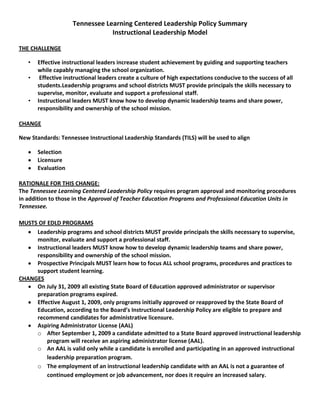
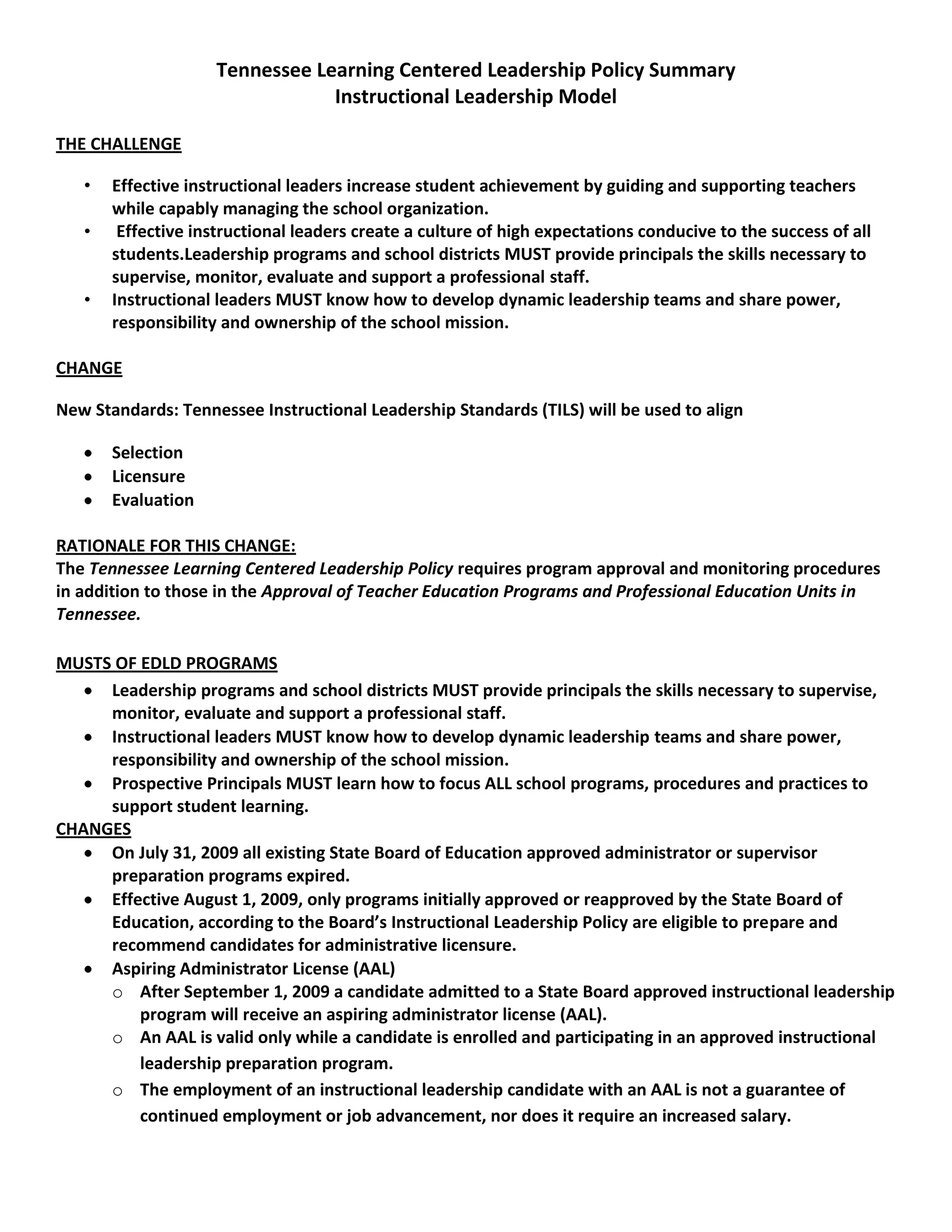
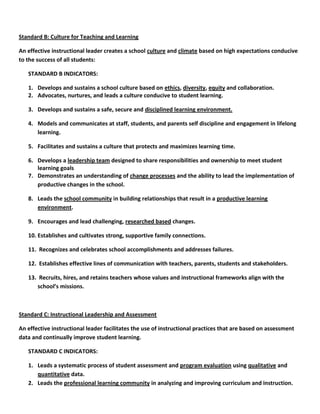
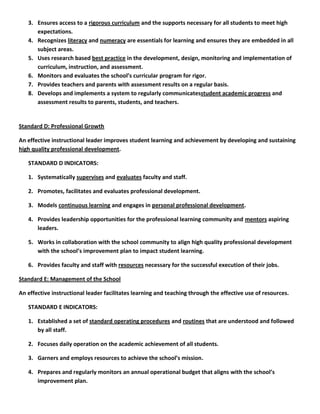
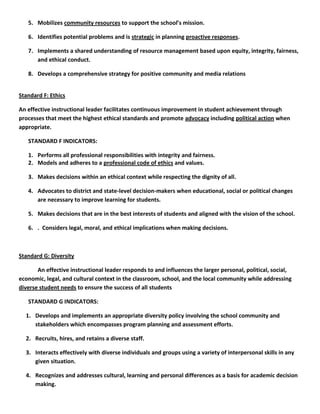

Tennessee Learning Centered Leadership Policy Summary<br />Instructional Leadership Model<br />THE CHALLENGE <br />Effective instructional leaders increase student achievement by guiding and supporting teachers while capably managing the school organization.<br /> Effective instructional leaders create a culture of high expectations conducive to the success of all students. Leadership programs and school districts MUST provide principals the skills necessary to supervise, monitor, evaluate and support a professional staff.<br />Instructional leaders MUST know how to develop dynamic leadership teams and share power, responsibility and ownership of the school mission.<br />CHANGE<br />New Standards: Tennessee Instructional Leadership Standards (TILS) will be used to align <br />Selection<br />Licensure <br />Evaluation <br />RATIONALE FOR THIS CHANGE: <br />The Tennessee Learning Centered Leadership Policy requires program approval and monitoring procedures in addition to those in the Approval of Teacher Education Programs and Professional Education Units in Tennessee. <br />MUSTS OF EDLD PROGRAMS <br />Leadership programs and school districts MUST provide principals the skills necessary to supervise, monitor, evaluate and support a professional staff.<br />Instructional leaders MUST know how to develop dynamic leadership teams and share power, responsibility and ownership of the school mission.<br />Prospective Principals MUST learn how to focus ALL school programs, procedures and practices to support student learning.   <br />CHANGES<br />On July 31, 2009 all existing State Board of Education approved administrator or supervisor preparation programs expired.<br />Effective August 1, 2009, only programs initially approved or reapproved by the State Board of Education, according to the Board’s Instructional Leadership Policy are eligible to prepare and recommend candidates for administrative licensure.<br />Aspiring Administrator License (AAL)
After September 1, 2009 a candidate admitted to a State Board approved instructional leadership program will receive an aspiring administrator license (AAL).
An AAL is valid only while a candidate is enrolled and participating in an approved instructional leadership preparation program.
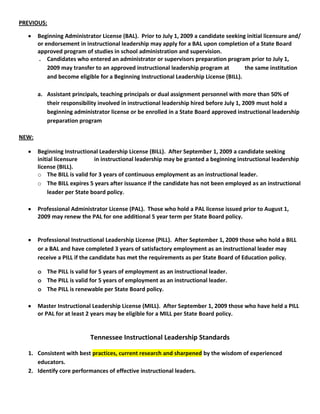
The employment of an instructional leadership candidate with an AAL is not a guarantee of continued employment or job advancement, nor does it require an increased salary.  PREVIOUS:  <br />Beginning Administrator License (BAL).  Prior to July 1, 2009 a candidate seeking initial licensure and/ or endorsement in instructional leadership may apply for a BAL upon completion of a State Board approved program of studies in school administration and supervision.
Candidates who entered an administrator or supervisors preparation program prior to July 1, 2009 may transfer to an approved instructional leadership program at the same institution and become eligible for a Beginning Instructional Leadership License (BILL).
Assistant principals, teaching principals or dual assignment personnel with more than 50% of their responsibility involved in instructional leadership hired before July 1, 2009 must hold a beginning administrator license or be enrolled in a State Board approved instructional leadership preparation program NEW:  <br />Beginning Instructional Leadership License (BILL).  After September 1, 2009 a candidate seeking initial licensure  in instructional leadership may be granted a beginning instructional leadership license (BILL).
The BILL is valid for 3 years of continuous employment as an instructional leader.

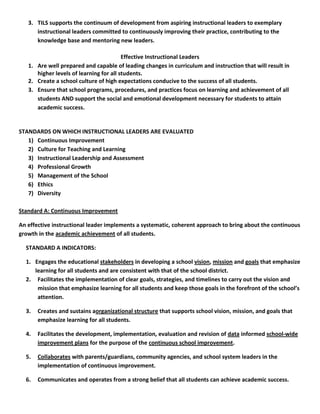
Instructional leadership model

  • 1.
    Tennessee Learning CenteredLeadership Policy Summary<br />Instructional Leadership Model<br />THE CHALLENGE <br />Effective instructional leaders increase student achievement by guiding and supporting teachers while capably managing the school organization.<br /> Effective instructional leaders create a culture of high expectations conducive to the success of all students. Leadership programs and school districts MUST provide principals the skills necessary to supervise, monitor, evaluate and support a professional staff.<br />Instructional leaders MUST know how to develop dynamic leadership teams and share power, responsibility and ownership of the school mission.<br />CHANGE<br />New Standards: Tennessee Instructional Leadership Standards (TILS) will be used to align <br />Selection<br />Licensure <br />Evaluation <br />RATIONALE FOR THIS CHANGE: <br />The Tennessee Learning Centered Leadership Policy requires program approval and monitoring procedures in addition to those in the Approval of Teacher Education Programs and Professional Education Units in Tennessee. <br />MUSTS OF EDLD PROGRAMS <br />Leadership programs and school districts MUST provide principals the skills necessary to supervise, monitor, evaluate and support a professional staff.<br />Instructional leaders MUST know how to develop dynamic leadership teams and share power, responsibility and ownership of the school mission.<br />Prospective Principals MUST learn how to focus ALL school programs, procedures and practices to support student learning. <br />CHANGES<br />On July 31, 2009 all existing State Board of Education approved administrator or supervisor preparation programs expired.<br />Effective August 1, 2009, only programs initially approved or reapproved by the State Board of Education, according to the Board’s Instructional Leadership Policy are eligible to prepare and recommend candidates for administrative licensure.<br />Aspiring Administrator License (AAL)
  • 2.
    After September 1,2009 a candidate admitted to a State Board approved instructional leadership program will receive an aspiring administrator license (AAL).
  • 3.
    An AAL isvalid only while a candidate is enrolled and participating in an approved instructional leadership preparation program.
  • 4.
    The employment ofan instructional leadership candidate with an AAL is not a guarantee of continued employment or job advancement, nor does it require an increased salary. PREVIOUS: <br />Beginning Administrator License (BAL). Prior to July 1, 2009 a candidate seeking initial licensure and/ or endorsement in instructional leadership may apply for a BAL upon completion of a State Board approved program of studies in school administration and supervision.
  • 5.
    Candidates who enteredan administrator or supervisors preparation program prior to July 1, 2009 may transfer to an approved instructional leadership program at the same institution and become eligible for a Beginning Instructional Leadership License (BILL).
  • 6.
    Assistant principals, teachingprincipals or dual assignment personnel with more than 50% of their responsibility involved in instructional leadership hired before July 1, 2009 must hold a beginning administrator license or be enrolled in a State Board approved instructional leadership preparation program NEW: <br />Beginning Instructional Leadership License (BILL). After September 1, 2009 a candidate seeking initial licensure in instructional leadership may be granted a beginning instructional leadership license (BILL).
  • 7.
    The BILL isvalid for 3 years of continuous employment as an instructional leader.