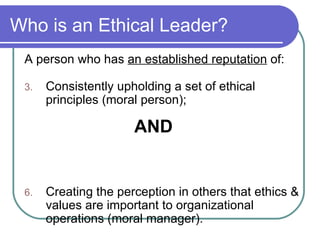
Who is an Ethical Leader? A person who has  an established reputation  of: Consistently upholding a set of ethical principles (moral person); AND Creating the perception in others that ethics & values are important to organizational operations (moral manager).
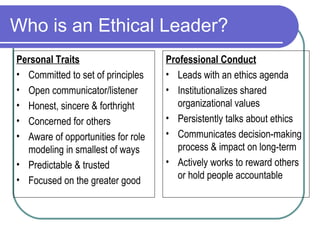
Who is an Ethical Leader ? Personal Traits Committed to set of principles Open communicator/listener Honest, sincere & forthright Concerned for others Aware of opportunities for role modeling in smallest of ways Predictable & trusted Focused on the greater good Professional Conduct Leads with an ethics agenda Institutionalizes shared organizational values Persistently talks about ethics Communicates decision-making process & impact on long-term Actively works to reward others or hold people accountable
Effective Ethical Leaders Repeatedly lets employees know that:  Every person has to make ethical decisions They are not alone Every organization faces ethical challenges How we as an organization react to ethical challenges
Impact of Ethical Leaders When leaders: Talk about the importance of ethics; Keep promises & commitments; Model ethical behavior; Discipline employees who violate ethical standards; & Consider ethics when making important decisions…
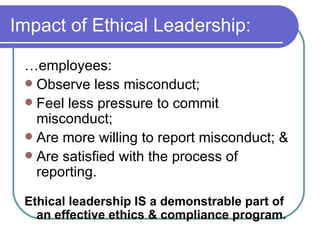
Impact of Ethical Leadership: … employees: Observe less misconduct; Feel less pressure to commit misconduct; Are more willing to report misconduct; &  Are satisfied with the process of reporting.  Ethical leadership IS a demonstrable part of an effective ethics & compliance program.
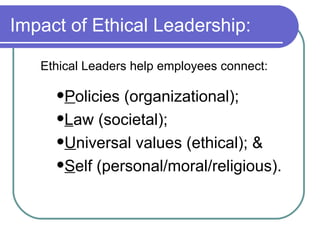
Impact of Ethical Leadership: Ethical Leaders help employees connect: P olicies (organizational); L aw (societal); U niversal values (ethical); & S elf (personal/moral/religious).
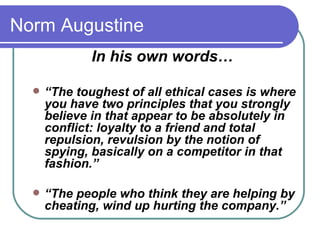
Norm Augustine In his own words…  “ The toughest of all ethical cases is where you have two principles that you strongly believe in that appear to be absolutely in conflict: loyalty to a friend and total repulsion, revulsion by the notion of spying, basically on a competitor in that fashion.”  “ The people who think they are helping by cheating, wind up hurting the company.”
CEO of General Electric Jeffrey Immelt wrote in 2002,  “ GE spends billions each year to protect one of our most valuable assets – our reputation” .
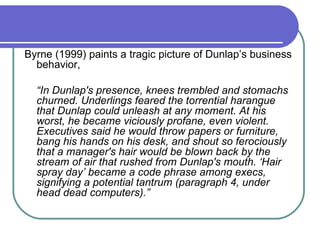
Byrne (1999) paints a tragic picture of Dunlap’s business behavior,  “ In Dunlap's presence, knees trembled and stomachs churned. Underlings feared the torrential harangue that Dunlap could unleash at any moment. At his worst, he became viciously profane, even violent. Executives said he would throw papers or furniture, bang his hands on his desk, and shout so ferociously that a manager's hair would be blown back by the stream of air that rushed from Dunlap's mouth. ‘Hair spray day’ became a code phrase among execs, signifying a potential tantrum (paragraph 4, under head dead computers).”
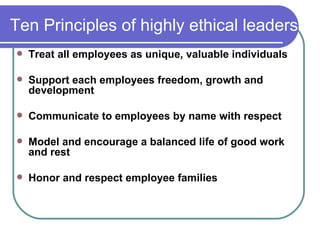
Ten Principles of highly ethical leaders Treat all employees as unique, valuable individuals   Support each employees freedom, growth and development Communicate to employees by name with respect   Model and encourage a balanced life of good work and rest Honor and respect employee families
Protect employees' life, safety and health Create a working environment free of sexual harassment Be fair and just in financial matters Communicate honestly and truthfully Cultivate a positive attitude towards others and their accomplishments

ethical leadership

  • 1.
    Who is anEthical Leader? A person who has an established reputation of: Consistently upholding a set of ethical principles (moral person); AND Creating the perception in others that ethics & values are important to organizational operations (moral manager).
  • 2.
    Who is anEthical Leader ? Personal Traits Committed to set of principles Open communicator/listener Honest, sincere & forthright Concerned for others Aware of opportunities for role modeling in smallest of ways Predictable & trusted Focused on the greater good Professional Conduct Leads with an ethics agenda Institutionalizes shared organizational values Persistently talks about ethics Communicates decision-making process & impact on long-term Actively works to reward others or hold people accountable
  • 3.
    Effective Ethical LeadersRepeatedly lets employees know that: Every person has to make ethical decisions They are not alone Every organization faces ethical challenges How we as an organization react to ethical challenges
  • 4.
    Impact of EthicalLeaders When leaders: Talk about the importance of ethics; Keep promises & commitments; Model ethical behavior; Discipline employees who violate ethical standards; & Consider ethics when making important decisions…
  • 5.
    Impact of EthicalLeadership: … employees: Observe less misconduct; Feel less pressure to commit misconduct; Are more willing to report misconduct; & Are satisfied with the process of reporting. Ethical leadership IS a demonstrable part of an effective ethics & compliance program.
  • 6.
    Impact of EthicalLeadership: Ethical Leaders help employees connect: P olicies (organizational); L aw (societal); U niversal values (ethical); & S elf (personal/moral/religious).
  • 7.
    Norm Augustine Inhis own words… “ The toughest of all ethical cases is where you have two principles that you strongly believe in that appear to be absolutely in conflict: loyalty to a friend and total repulsion, revulsion by the notion of spying, basically on a competitor in that fashion.” “ The people who think they are helping by cheating, wind up hurting the company.”
  • 8.
    CEO of GeneralElectric Jeffrey Immelt wrote in 2002, “ GE spends billions each year to protect one of our most valuable assets – our reputation” .
  • 9.
    Byrne (1999) paintsa tragic picture of Dunlap’s business behavior, “ In Dunlap's presence, knees trembled and stomachs churned. Underlings feared the torrential harangue that Dunlap could unleash at any moment. At his worst, he became viciously profane, even violent. Executives said he would throw papers or furniture, bang his hands on his desk, and shout so ferociously that a manager's hair would be blown back by the stream of air that rushed from Dunlap's mouth. ‘Hair spray day’ became a code phrase among execs, signifying a potential tantrum (paragraph 4, under head dead computers).”
  • 10.
    Ten Principles ofhighly ethical leaders Treat all employees as unique, valuable individuals Support each employees freedom, growth and development Communicate to employees by name with respect Model and encourage a balanced life of good work and rest Honor and respect employee families
  • 11.
    Protect employees' life,safety and health Create a working environment free of sexual harassment Be fair and just in financial matters Communicate honestly and truthfully Cultivate a positive attitude towards others and their accomplishments

Editor's Notes