INSTRUCTIONAL APPROACHES
In planning instruction, teachers draw upon a repertoire of instructional
approaches and methods, and use combinations of these in each lesson
and unit. Instructional approaches may be categorized as:
• direct instruction
• indirect instruction
• experiential learning
• independent study
• interactive instruction
Most teachers draw from all of these categories to ensure variety in their classroom
activities, to engage students with various intelligences and a range of learning
approaches, and to achieve instructional goals.
• In selecting instructional approaches and methods, teachers
consider which combination will assist students in achieving
the learning outcomes targeted for a particular lesson or unit.
Teachers consider the advantages and limitations of the
approaches and methods, as well as the interests, knowledge,
skills and strategies, and attitudes of their students. Some of
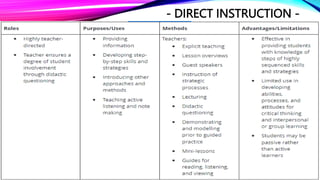
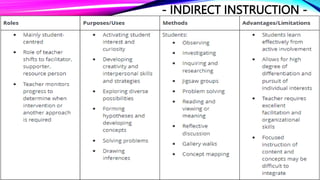
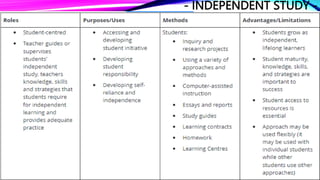
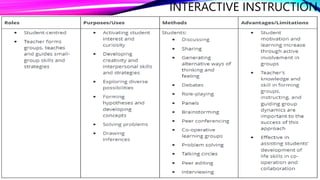
these elements are represented in the following chart.
- DIRECT INSTRUCTION -
- INDIRECT INSTRUCTION -
- EXPERIENTIAL LEARNING -
- INDEPENDENT STUDY -
INTERACTIVE INSTRUCTION

Instructional Approaches.pptx

  • 1.
  • 2.
    INSTRUCTIONAL APPROACHES In planninginstruction, teachers draw upon a repertoire of instructional approaches and methods, and use combinations of these in each lesson and unit. Instructional approaches may be categorized as: • direct instruction • indirect instruction • experiential learning • independent study • interactive instruction Most teachers draw from all of these categories to ensure variety in their classroom activities, to engage students with various intelligences and a range of learning approaches, and to achieve instructional goals.
  • 3.
    • In selectinginstructional approaches and methods, teachers consider which combination will assist students in achieving the learning outcomes targeted for a particular lesson or unit. Teachers consider the advantages and limitations of the approaches and methods, as well as the interests, knowledge, skills and strategies, and attitudes of their students. Some of these elements are represented in the following chart.
  • 4.
  • 5.
  • 6.
  • 7.
  • 8.