KEY ISSUES IN
LANGUAGE TEACHING
JACK C. RICHARDS
JACK C. RICHARDS
KEY ISSUES IN
LANGUAGE
TEACHING
KEY ISSUES IN
LANGUAGE TEACHING
JACK C. RICHARDS
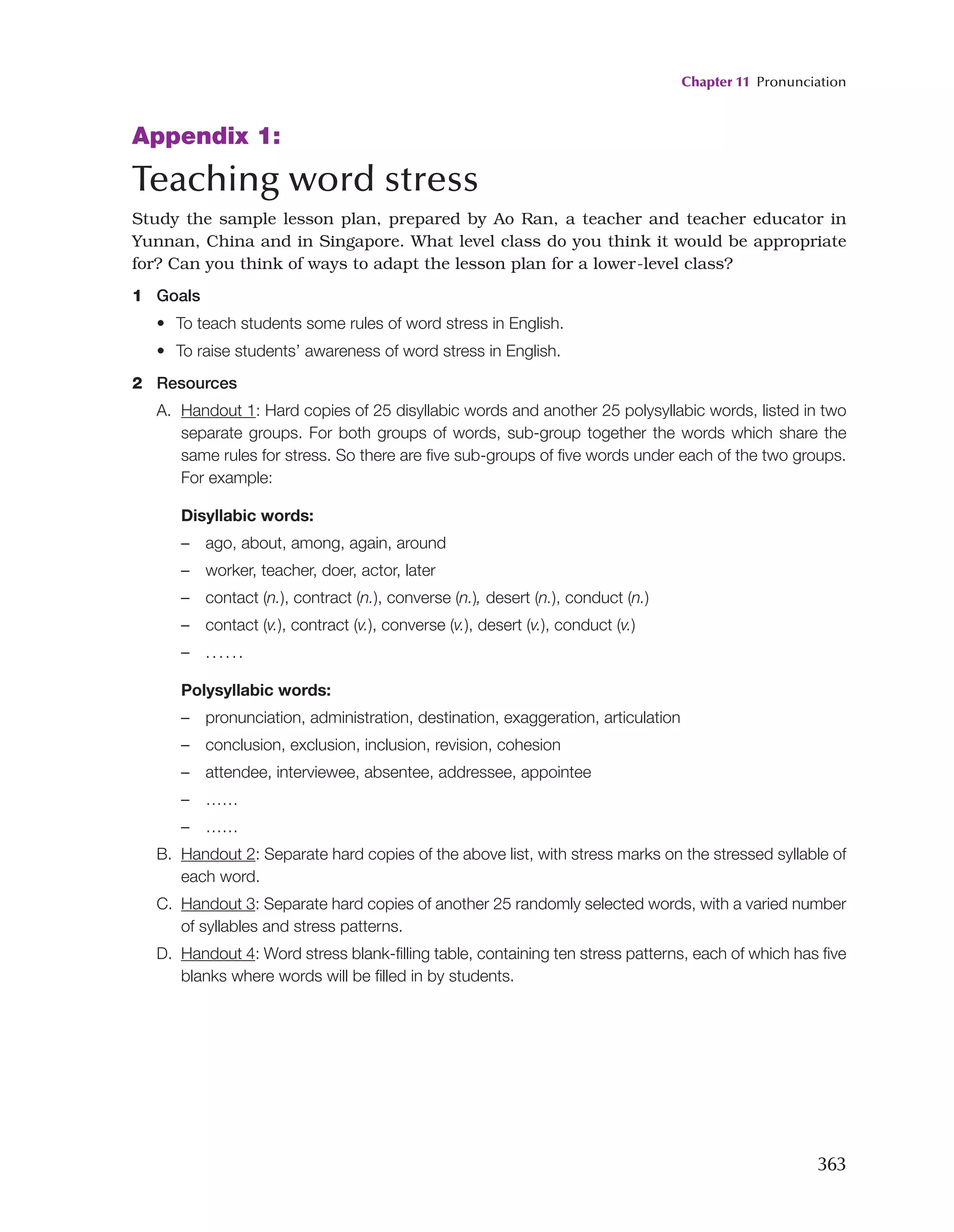
Key Issues in Language Teaching provides a comprehensive
overview of the field of English language teaching. Informed
by theory, research and practice, it is an essential resource
for student-teachers at graduate and post-graduate level
as well as for classroom teachers and teacher educators.
Written in a clear and accessible style, the book links
theory to practice and includes reflections from classroom
teachers in many parts of the world. Key Issues in
Language Teaching surveys a broad range of core topics
that are important in understanding approaches to teaching
English as a second or international language, and which
form the content of many professional development
courses for language teachers.
Among the issues that are examined are second
language learning, approaches and methods, classroom
management, grammar, pronunciation, vocabulary, the
four skills, technology, textbooks, course design and
professional development.
Discussion questions, illustrative examples and follow-up
activities throughout provide practical application to the
teacher’s context and help establish the relevance of
theory and research to classroom issues.
KEY
ISSUES
IN
LANGUAGE
TEACHING
JACK
C.RICHARDS
978-1-107-45610-5
CMYK
CambridgeEnglishTeacher.org
ISBN 978 1107 675964 ISBN 978 1107 684676
Cambridge English Teacher
Continuous development for
every teacher
This text is also available to purchase separately as
an enhanced eBook, with the additional feature of
embedded video introducing each topic. Download
the ‘Cambridge Bookshelf’ app to find out more.
Key Issues in
Language Teaching
Jack C. Richards
University Printing House, Cambridge CB2 8BS, United Kingdom
Cambridge University Press is part of the University of Cambridge.
It furthers the University’s mission by disseminating knowledge in the pursuit of
education, learning and research at the highest international levels of excellence.
www.cambridge.org
Information on this title: www.cambridge.org/9781107456105
© Cambridge University Press 2015
This publication is in copyright. Subject to statutory exception
and to the provisions of relevant collective licensing agreements,
no reproduction of any part may take place without the written
permission of Cambridge University Press.
First published 2015
Printed in
A catalogue record for this publication is available from the British Library
Library of Congress Cataloguing-in-Publication Data
Richards, Jack C.
Key issues in language teaching / Jack C. Richards.
   pages cm.
Includes bibliographical references and index.
ISBN 978-1-107-45610-5 (pbk.) -- ISBN 978-1-107-66329-9
(Vitalsource eBook) -- ISBN 978-1-107-66906-2 (Apple iBook)
1. Language and languages -- Study and teaching -- Methodology.
2. Language teachers -- Methodology. I. Title.
P53.R494 2015
418.0071 -- dc23
            2014036802
ISBN 978-1-107-45610-5 Paperback
ISBN 978-1-107-66329-9 Vitalsource eBook
ISBN 978-1-107-66906-2 Apple iBook
Cambridge University Press has no responsibility for the persistence or accuracy
of URLs for external or third-party internet websites referred to in this publication,
and does not guarantee that any content on such websites is, or will remain,
accurate or appropriate.
iii
Contents
Acknowledgements v
Introduction xix
Part 1 English language teaching today 1
1 The scope of English and English language
teaching 3
2 Second language learning 30
3 Approaches and methods 57
4 Developing knowledge, skills and
awareness in teaching 105
Part 2 Facilitating student learning 133
5 The second language learner 135
6 The language lesson 168
7 Managing classroom learning 195
8 Age-appropriate pedagogy 220
Part 3 Language and the four skills 259
9 Grammar 261
10 Vocabulary 296
11 Pronunciation 335
12 Listening 369
13 Speaking 406
14 Reading 442
iv
15 Writing 478
16 Discourse and pragmatics 516
Part 4 The teacher’s environment 555
17 The language course 557
18 Textbooks 593
19 Technology 634
20 Testing and assessment 665
21 Professional development 694
Glossary 730
About the author 753
List of contributors 754
References 760
Index 804
Contents
v
Acknowledgements
The authors and publishers acknowledge the following sources of copyright material
and are grateful for the permissions granted. While every effort has been made, it has
not always been possible to identify the sources of all the material used, or to trace all
copyright holders. If any omissions are brought to our notice, we will be happy to include
the appropriate acknowledgements on reprinting and in the next update to the digital
edition, as applicable.
Pusat Data and Analisa Tempo for the text on p. 9 excerpted from ‘Translator’s introduction’
by Jennifer Lindsay, Goenawan Mohamad from Sharp Times: Selections from Sidelines,
Jakarta. Copyright © 2011 by Pusat Data and Analisa Tempo. Reproduced with permission
of Pusat Data and Analisa Tempo; Multilingual Matters for the text on pp. 10–11 excerpted
from The Idea of English in Japan: Ideology and the Evolution of a Global Language by Philip
Seargeant. Copyright © 2009 by Multilingual Matters. Reproduced with permission of
Multilingual Matters; Text on p. 14 excerpted from ‘The discursive accomplishment of
normality: On “lingua franca” English and conversation analysis’ by Alan Firth, Journal
of Pragmatics, Vol. 26, Iss. 2, 1996; Text on p. 14 adapted from ‘Misunderstanding in
intercultural communication: Interactions in English as a lingua franca and the myth of
mutual intelligibility’ by J. House from Teaching and Learning English as a Global
Language edited by Claus Gnutzmann, Tübingen: Stauffenburg Verlag, 1999; Multilingual
Matters for the text on p. 19 excerpted from ‘Situating the L2 self: two Indonesian school
learners of English’ by Martin Lamb from Motivation, Language Identity and the L2 Self,
edited by Zoltán Dörnyei, Ema Ushioda. Copyright © 2009 by Multilingual Matters.
Reproduced with permission of Multilingual Matters; Text on p. 33 excerpted from
Curriculum Renewal in School Foreign Language Learning by John L. Clark, Oxford University
Press, 1987; Basic Books for the text on p. 34 excerpted from ‘The Science and Psychology
of Second Language Acquisition’ by Ellen Bialystok and Kenji Hakuta. Copyright © 1994 by
Basic Books. Reproduced with permission of Basic Books; Sage Publications for the text
on p. 36 excerpted from Effective Teaching with Internet Technologies: Pedagogy and
Practice by Alan Pritchard. Copyright © 2007 by Sage Publications. Reproduced with
permission of Sage Publications; SEAMEO Regional Language Centre for the text on
pp. 36–37 excerpted from ‘Integrating language and content teaching through collaborative
tasks’ by M. Swain from Language Teaching: New Insights for the Teacher, edited by
C. Ward and W. Renandya. Copyright © 1999 by SEAMEO Regional Language Centre.
Reproduced with permission of SEAMEO Regional Language Centre; Palgrave Macmillan
for the text on p. 42 excerpted from Optimizing a Lexical Approach to Instructed Second
Language Acquisition by F. Boers and S. Lindstromberg 2009. Copyright © 2009 by Palgrave
Macmillan. Reproduced with permission of Palgrave Macmillan; Text on pp. 49–50 adapted
from Sociocultural Theory and the Genesis of Second Language Development by James
For Moon Won Gyu and Gillian Armstrong
vi
Acknowledgements
P. Lantolf and Steven L. Thorne, Oxford University Press, 2006; Cambridge University Press
for the text on p. 51 excerpted from ‘Learner Centred Teaching’ by Phil Benson from The
Cambridge Guide to Pedagogy and Practice in Language Teaching, edited by A. Burns and
J. C. Richards. Copyright © 2012 by Cambridge University Press. Reproduced with the
permission of Cambridge University Press; Text on p. 51 adapted from ‘What the good
language learner can teach us’ by Joan Rubin from TESOL Quarterly, Vol. 9, Iss. 1, John
Wiley  Sons, 1975; Cambridge University Press for the text on p. 52 excerpted from
Learning Strategies in Second Language Acquisition by J. Michael, O’Malley, Anna Uhl
Chamot. Copyright © 1990 by Cambridge University Press. Reproduced with the permission
of Cambridge University Press; Text on p. 52 adapted from Language Learning Strategies:
What Every Teacher Should Know by Rebecca L. Oxford, Newbury House Publishers, 1990;
Text on pp. 61 and 70 excerpted from ‘Cultures of learning: Language classrooms in Asia’
by M. Cortazzi and L. Jin, from Society and the Language Classroom edited by H. Coleman,
Cambridge University Press, 1996; Text on pp. 63–64 excerpted from English Sentence
Patterns: Understanding and Producing English Grammatical Structures – An Oral Approach
by Robert Lado and Charles C. Fries, University of Michigan Press, 1957; Cambridge
University Press for the text on p. 65 excerpted from Psychology for Language Teachers: A
Social Constructivist Approach by Marion Williams and Robert L. Burden. Copyright
© 1997 by Cambridge University Press. Reproduced with the permission of Cambridge
University Press; Palgrave Macmillan for the text on pp. 67 and 90 excerpted from ‘Task-
based language learning and teaching: Theories and applications’ by Ali Shehadeh. From
Teachers Exploring Tasks in English Language Teaching edited by C. Edwards and
J. Willis. Copyright © 2005 by Palgrave Macmillan. Reproduced with permission of Palgrave
Macmillan; Text on p. 69 excerpted from ‘Toward a realization of psycholinguistic principles
in the ESL reading class’ by Mark A. Clarke and Sandra Silberstein from Language
Learning, Vol. 27, Iss. 1. Language Learning Research Club, University of Michigan, 1996;
John Wiley and Sons for the text on pp. 79–80 adapted from ‘Competency-based ESL: One
step forward or two steps back?’ by Elisa Roberts Auerbach from TESOL Quarterly Vol. 20,
Iss. 3. Copyright © 1986 TESOL International Association. Reproduced with permission of
John Wiley and Sons; Cambridge University Press for the text on pp. 85 and 240 excerpted
from CLIL: Content and Language Integrated Learning by Do Coyle, Philip Hood and David
Marsh. Copyright © 2010 Cambridge University Press. Reproduced with permission of
Cambridge University Press; University of Michigan Press for the text on p. 87 excerpted
from Genre and the Language Learning Classroom by Brian Paltridge. Copyright © 2001 by
University of Michigan Press. Reproduced with permission of University of Michigan Press;
Cambridge University Press for the text on p. 87 excerpted from The Roles of Languages in
CLIL by Ana Llinares, Tom Morton, Rachel Whittaker. Copyright © 2012 by Cambridge
University Press. Reproduced with the permission of Cambridge University Press; Council
of Europe for the text on p. 91 adapted from Common European Framework of Reference
for Languages: Learning, Teaching, Assessment. Copyright © 2001 by Council of Europe.
Reproduced with permission of Council of Europe; Cambridge University Press for the text
on p. 92 excerpted from ‘Developing language tasks for primary and secondary education’
by Katrien Van Gorp and Nora Bogaert from Task-Based Language Education: From Theory
to Practice edited by Kris Van den Branden. Copyright © 2006 by Cambridge University
Press. Reproduced with the permission of Cambridge University Press; Multilingual
vii
Matters for the text on p. 95 excerpted from ‘Teacher education for EIL: Working toward a
situated meta-praxis’ by Dogancay-Aktuna and J. Hardman from Principles and Practices
of Teaching English as an International Language edited by Aya Matsuda. Copyright
© 2012 by Multilingual Matters. Reproduced with the permission of Multilingual Matters;
Cambridge University Press for the text and illustrations on pp. 102–103 excerpted from
Ventures by K. Lynn Savage, Sylvia Ramirez, Donna Price, Dennis Johnson and Gretchen
Bitterlin. Copyright © 2007 by Cambridge University Press. Reproduced with permission
of Cambridge University Press; National Centre for English Language Teaching and
Research for the text on p. 106–107 excerpted from China: a Handbook in Intercultural
Communication by Jean Brick. Copyright © 1991 by National Centre for English Language
Teaching and Research. Reproduced with the permission of National Centre for English
Language Teaching and Research; Cambridge University Press for the text on p. 110
excerpted from Voices From the Language Classroom edited by Kathleen M. Bailey and
David Nunan. Copyright © 1996 by Cambridge University Press. Reproduced with
permission of Cambridge University Press; Palgrave Macmillan for the text on p. 111
excerpted from Classroom Management in Language Education by Tony Wright 2005,
Palgrave Macmillan. Copyright © 2005 by Palgrave Macmillan. Reproduced by permission
of Palgrave Macmillan; Multilingual Matters for the text on p. 112, 113 and pp. 118–119
excerpted from ‘NESTs versus Non-NESTs: Rethinking English-language teacher identities’
by Vodopija-Krstanovic from Theory and Practice in EFL Teacher Education: Bridging the
Gap edited by Julia Hüttner, B. Mehlmauer-Larcher, S. Reichl and B. Schiftner. Copyright
© 2011 by Multilingual Matters. Reproduced with the permission of Multilingual Matters;
Cambridge University Press for the text and illustrations on pp. 116, 169–170, 184 and
185 excerpted from Beyond Training by Jack C. Richards. Copyright © 1998 by Cambridge
University Press. Reproduced with permission of Cambridge University Press; Center for
Technology and Teacher Education for the text on p. 117 and 445 excerpted from Bringing
new literacies into the content area literacy methods course, Contemporary Issues in
Technology and Education by Sara B. Kajder. Copyright © 2007 by Center for Technology
and Teacher Education. Reproduced with the permission of Center for Technology and
Teacher Education; Text on p. 123 adapted from ‘A pragmatics of language teaching: From
practice to principles’ by M. P. Breen. Manuscript; Cambridge University Press for the text
and illustrations on pp. 139–140, 256–258, 264–265 excerpted and adapted from Reflective
Teaching in Second Language Classrooms by Jack C. Richards and Charles Lockhart.
Copyright © 1994 by Cambridge University Press. Reproduced with permission of
Cambridge University Press; Cengage Learning for the text on pp. 141–142 excerpted from
Reid. Learning Styles in the ESL /EFL Classroom, 1E. © 1995 Heinle/ELT, a part of Cengage
Learning, Inc. Reproduced by permission. www.cengage.com/permissions; Cambridge
University Press for the text on p. 143 excerpted from ‘Learning style and good language
learners’ by Carisma Nel from Lessons from Good Language Learners edited by C. Griffiths.
Copyright © 2008 by Cambridge University Press. Reproduced with the permission of
Cambridge University Press; Palgrave Macmillan for the text on p. 152 excerpted from
‘Identity: The situated construction of identity and positionality in multilingual classrooms’
by Naoko Morita from Psychology for Language Learning: Insights from Research, Theory,
and Practice edited by Sarah Mercer, S. Ryan and Marion Williams. Copyright © 2012 by
Palgrave Macmillan. Reproduced with the permission of Palgrave Macmillan; Sage
Acknowledgements
viii
Publications for the text on p. 155 excerpted from ‘Anxiety and speaking English as a
second language’ by L. Woodrow in RELC Journal, Vol. 37, Iss. 3. Copyright © 2006 by
Sage Publications. Reproduced with the permission of Sage Publications; Text on p. 171
excerpted from ‘Making sense of language teaching: Teachers’ principles and classroom
practice’ by Michael Breen, et al. from Applied Linguistics, Vol. 22, Iss. 4, Cambridge
University Press, 2001; Cambridge University Press for the text on pp. 175–176 excerpted
from Understanding Expertise in Teaching by Amy B. M. Tsui. Copyright © 2003 by
Cambridge University Press. Reproduced with permission of Cambridge University Press;
Cambridge University Press for the text on p. 197 excerpted from Motivational Strategies
in the Language Classroom by Zoltan Dörnyei. Copyright © 2001 by Cambridge University
Press. Reproduced with permission of Cambridge University Press; Text on p. 199 adapted
from Group Dynamics in the Language Classroom by Zoltan Dörnyei and Tim Murphey,
Cambridge University Press, 2003; Cambridge University Press for the text on pp. 201,
215 and 218–219 excerpted from Classroom Management Techniques by Jim Scrivener.
Copyright © 2012 by Cambridge University Press. Reproduced with permission of
Cambridge University Press; Oxford University Press Journals for the text on pp. 202–
203 from ‘A Class-Centered Approach to Language Teaching’ by Rose M. Senior, ELT
Journal, Vol. 56, No. 4. Copyright © Oxford University Press 2002. Reproduced with
permission of Oxford University Press; The National Academies Press for the text on p.
203 from How People Learn: Brain, Mind, Experience and School by John D. Bransford,
Ann L. Brown, and Rodney R. Cocking. Reprinted with permission from the National
Academies Press, Copyright © 2000, National Academy of Sciences; Oxford University
Press for the text on p. 205 excerpted from ‘Student perceptions of student interaction in
a British EFL’ by I-Chun Kuo from ELT Journal, Vol. 65, Iss. 3. Copyright © 2011 by
Oxford University Press. Reproduced with the permission of Oxford University Press;
Adam Case and UsingEnglish.com for the text on pp. 205–206 from ‘A Well-Balanced Use
of Pairwork’ by Adam Case, www.usingenglish.com/articles/wellbalanced-use-pairwork.
html. Copyright © 2011 Alex Case. All Rights Reserved; British Council for the text on
p. 221 excerpted from English Next by David Graddol. Copyright © 2006 by British Council.
Reproduced with the permission of British Council; Text on p. 225 from ‘The globalization
of English: its impact on the tertiary education sector in Taiwan’ by J. H. Her, Unpublished
PhD dissertation, University of Waikato: New Zealand, 2007; Cambridge University Press
for the text on pp. 225 and 226 excerpted from Teaching Children English: A Training
Course for Teachers of English by David Vale and Anne Feunteun. Copyright © 1998 by
Cambridge University Press. Reproduced with permission of Cambridge University Press;
Cambridge University Press for the text on p. 227 excerpted from Teaching Languages to
Young Children by Lynne Cameron. Copyright © 2001 by Cambridge University Press.
Reproduced by the permission of Cambridge University Press; Text on pp. 229–230 and
230–231 excerpted and adapted from Children Learning English, by J. Moon, Macmillan,
2000; Cambridge University Press for the text on pp. 234, 235 and 236 excerpted from
‘Teaching teenagers’ by Michael Legutke from The Cambridge Guide to Pedagogy and
Practice in Language Teaching edited by Anne Burns and Jack C. Richards. Copyright
© 2012 by Cambridge University Press 2012. Reproduced with the permission of Cambridge
University Press; Text on p. 238 from ‘The Teenaged Language Learner.’ http://ddeubel.
edublogs.org/2010/08/02/the-teenaged-language-learner/. Copyright © 2010 by
Acknowledgements
ix
Raymond Duncan; Text on pp. 238–239 adapted from The Experience of Language Teaching
by Rose Senior, Cambridge University Press, 2006;
Cambridge University Press for the text on pp. 240–241 and 242 excerpted from
Language Activities for Teenagers by Seth Lindstromberg. Copyright © 2004 by Cambridge
University Press. Reproduced with permission of Cambridge University Press; For the
text on p. 245: Brundage, D. and MacKeracher, D. (1980), Adult Learning Principles and
Their Application to Program Planning. Toronto: Ontario Institute for Studies in Education
© Queen’s Printer for Ontario, 1980. Reproduced with permission; Cambridge University
Press for the text on p. 250 excerpted from Teaching Adult Second Language Learners
by Heather McKay and Abigail Tom. Copyright © 1999 by Cambridge University Press.
Reproduced with the permission of Cambridge University Press; Text on p. 251 excerpted
from ‘Maryland Adult ESL Program Standards,’ Maryland Department of Labor, Licensing
and Regulation; Cambridge University Press for the text on p. 251 excerpted from The
Learner Centred Curriculum by David Nunan. Copyright © 1998 by Cambridge University
Press. Reproduced with permission of Cambridge University Press; John Wiley  Sons for
the text on p. 254 excerpted from ‘Closing the gap between learning and instruction’ by
Nunan David in TESOL Quarterly, Vol. 29, Iss. 1. Copyright © 1995 by John Wiley  Sons.
Reproduced with permission of John Wiley  Sons; Cambridge University Press for the text
on p. 263 excerpted from Cambridge Grammar of English by Ronald Carter and Michael
McCarthy. Copyright © 2006 by Cambridge University Press. Reproduced with permission
of Cambridge University Press; John Wiley  Sons for the text on p. 267 excerpted from
‘Grammar teaching for the Acquisition-Rich Classroom’ from Foreign Language Annals,
Volume 26, Issue 4 by Van Patten, 1993. Copyright © 1993 by John Wiley  Sons.
Reproduced with permission of John Wiley  Sons; Cambridge University Press for the
text on p. 269 excerpted from Using Corpora in the Language Classroom by Randi Reppen.
Copyright © 2010 by Cambridge University Press. Reproduced with the permission of
Cambridge University Press; Text on p. 272 adapted from ‘Understanding non-restrictive
which-clauses in spoken English, which is not an easy thing’ by Michael McCarthy and
HongyinTao in Language Science, Vol. 23, No. 6, 2001; Cambridge University Press for
the text on p. 272 excerpted from Touchstone: Student Book 1 by Michael McCarthy and
Jeanne McCarten. Copyright © 2005 by Cambridge University Press. Reproduced with
permission of Cambridge University Press; Text on p. 278 excerpted from The Practice
of English Language Teaching by Jeremy Harmer, Longman Pearson, 2007; Text on
p. 279 adapted from A Cognitive Approach to Language Learning by Peter Skehan, Oxford
University Press, 1998; Text on p. 280 adapted from Four Corners, Student’s Book 1 by
Jack C. Richards and D. Bohike, Cambridge University Press, 2011; Text on pp. 283,
284–285, 286 excerpted from Discourse Analysis: A Resource Book for Students by Rodney
Jones, Routledge, 2012; Cambridge University Press for the text on pp. 283–284 from
Testing for Language Teachers by Arthur Hughes. Copyright © 2003 by Cambridge
University Press. Reprinted by permission of Cambridge University Press; Cambridge
University Press for the text on pp. 285–286 excerpted from Assessing Grammar by
James E. Purpura. Copyright © 2004 by Cambridge University Press. Reproduced with
permission of Cambridge University Press; Cambridge University Press for the text on p. 293
excerpted from English Unlimited by David Rea, Theresa Clementson, with Alex Tilbury,
Acknowledgements
Leslie Anne Hendra. Copyright © 2010 by Cambridge University Press. Reproduced with
permission of Cambridge University Press; Cambridge University Press for the text on
p. 294 excerpted from Viewpoint, Student’s Book 1 by Michael McCarthy and Jeanne
McCarten. Copyright © 2012 by Cambridge University Press. Reproduced with permission
of Cambridge University Press; Cambridge University Press for the text on pp. 298, 301,
303, 308, 310, 313–314, 318 and 570 excerpted and adapted from Learning Vocabulary
in a Second Language by I. S. P. Nation. Copyright © 2001 by Cambridge University Press.
Reproduced with permission of Cambridge University Press; Cambridge University Press
for the text on pp. 298, 299, 300, and 304–305 excerpted from From Corpus to Classroom
by Anne O’Keeffe and Michael McCarthy. Copyright © 2007 by Cambridge University
Press. Reproduced with permission of Cambridge University Press; University of London,
Institute of Education for the text on p. 304 excerpted from A General Service List of
English Words by Michael West. Copyright © 1953 by University of London, Institute of
Education. Reproduced by the permission of University of London, Institute of Education;
John Wiley and Sons for the text on p. 306 excerpted from ‘A New Academic Word List’
by Averil Coxhead from TESOL Quarterly, Vol. 34, No. 2. Copyright © 2000 by TESOL
International Association. Reproduced with permission of John Wiley and Sons; Text on
p. 307 adapted from Focus on Vocabulary by I. S. P. Nation and P. Y. Gu, Macquarie
University, 2007; Cambridge University Press for the text on p. 307 excerpted from
‘Vocabulary in Language Teaching’ by Norbert Schmitt. Copyright © 2000 by Cambridge
University Press. Reproduced with the permission of Cambridge University Press; Text on
p. 314 adapted from Managing Vocabulary Learning by I. S. P. Nation, Regional Language
Center: Singapore, 2002; Text on p. 315 excerpted from Vocabulary Levels Test by I. S.
P. Nation, http://www.er.uqam.ca/nobel/r21270/levels/, Laufer and Nation, 1999; Sage
Publications for the text on p. 315 adapted from Language Testing by Paul Nation and
Batia Laufer. Copyright © 1999 by Sage Publications. Reproduced by the permission of
Sage Publications; Text on p. 316 adapted from Teaching and Learning in the Language
Classroom by Tricia Hedge, Oxford University Press, 2000; Text on p. 319 from ‘Vocabulary
and reading’ by I. S. P. Nation and J. Coady in Vocabulary and Language Teaching edited
by R. Carter and M. McCarthy, Longman, 1988; Text on p. 321 adapted from ‘Teaching
vocabulary to advanced students: a lexical approach’ by S. Moras, http://www3.telus.
net/linguisticsissues/teachingvocabulary.html, 2007;
Cambridge University Press for the text on pp. 321–322 and 448 excerpted and adapted
from From Reader to Reading Teacher by Jo Ann Aebersold and Mary Lee Field. Copyright
© 1997 by Cambridge University Press. Reproduced with permission of Cambridge
University Press; Text on p. 322 excerpted from COBUILD dictionaries’ entry on “agree,”
by Bank of English, www.mycobuild.com/about-collins-corpus.aspx; Oxford University
Press for the text on p. 322 excerpted from ‘Can a graded reader corpus provides authentic
input?’ by R. Allan, ELT Journal, Vol. 63, Iss. 1. Copyright © 2008 by Oxford University
Press. Reproduced with the permission of Oxford University Press;
Cambridge University Press for the text and illustrations on pp. 332–333 excerpted from
Passages, Student’s Book 1, 2nd
ed. by Jack C. Richards and Chuck Sandy. Copyright
© 2008 by Cambridge University Press. Reproduced with permission of Cambridge University
Press; Palgrave Macmillan for the text on p. 341 excerpted from ‘Intonational meaning
Acknowledgements
x
xi
starting from talk ’ by A. Wennerstrom in Spoken English, TESOL, and Applied Linguistics
edited by Rebecca Hughes. Copyright © 2009 by Palgrave Macmillan. Reproduced by the
permission of Palgrave Macmillan; Cambridge University Press for the text on p. 343
excerpted from The Phonetic Description of Voice Quality by James Laver. Copyright © 1980
by Cambridge University Press. Reproduced with the permission of Cambridge University
Press; The British Library Board for the text on pp. 343–344 from www.bl.uk/learning/
langlit/sounds/find-out-more/received-pronunciation/. Copyright by British Library
Board. Reproduced with the permission of British Library Board; Multilingual Matters for
the text on p. 344 excerpted from I am good at speaking, but I failed my phonetics class, –
pronunciation and speaking in advanced learners of English by Waniek-Klimczak. Copyright
© 2011 by Multilingual Matters. Reproduced by the permission of Multilingual Matters;
Cambridge University Press for the text on p. 348 excerpted from Teaching Pronunciation:
A Course Book and Reference Guide, 2nd
ed. by Marianne Celce-Murcia, Donna M. Brinton,
Janet M. Goodwin, with Barry Griner. Copyright © 2010 by Cambridge University Press.
Reproduced with permission of Cambridge University Press; Cambridge University Press
for the text on pp. 348 and 354 excerpted from Teaching Pronunciation: A Course Book and
Reference Guide, 2nd
ed. by Marianne Celce-Murcia, Donna M. Brinton, Janet M. Goodwin,
with Barry Griner. Copyright © 2010 by Cambridge University Press. Reproduced with
permission of Cambridge University Press; Text on pp. 349 and 357 adapted from Teaching
American English Pronunciation by P. Avery and S. Ehrlich, Oxford University Press; Text
on pp. 355–356 and 358 adapted from Tips for Teaching Pronunciation by L. Lane, Pearson
Longman, 2010; Cambridge University Press for the text on pp. 365–366 excerpted from
‘It’s not what you say, but how you say it!’ by J. Herbert in Methodology in Language
Teaching: An Anthology of Current Practice edited by Jack C. Richards and Willy A.
Renandya. Copyright © 2002 by Cambridge University Press. Reproduced with permission
of Cambridge University Press; Cambridge University Press for the text and illustrations
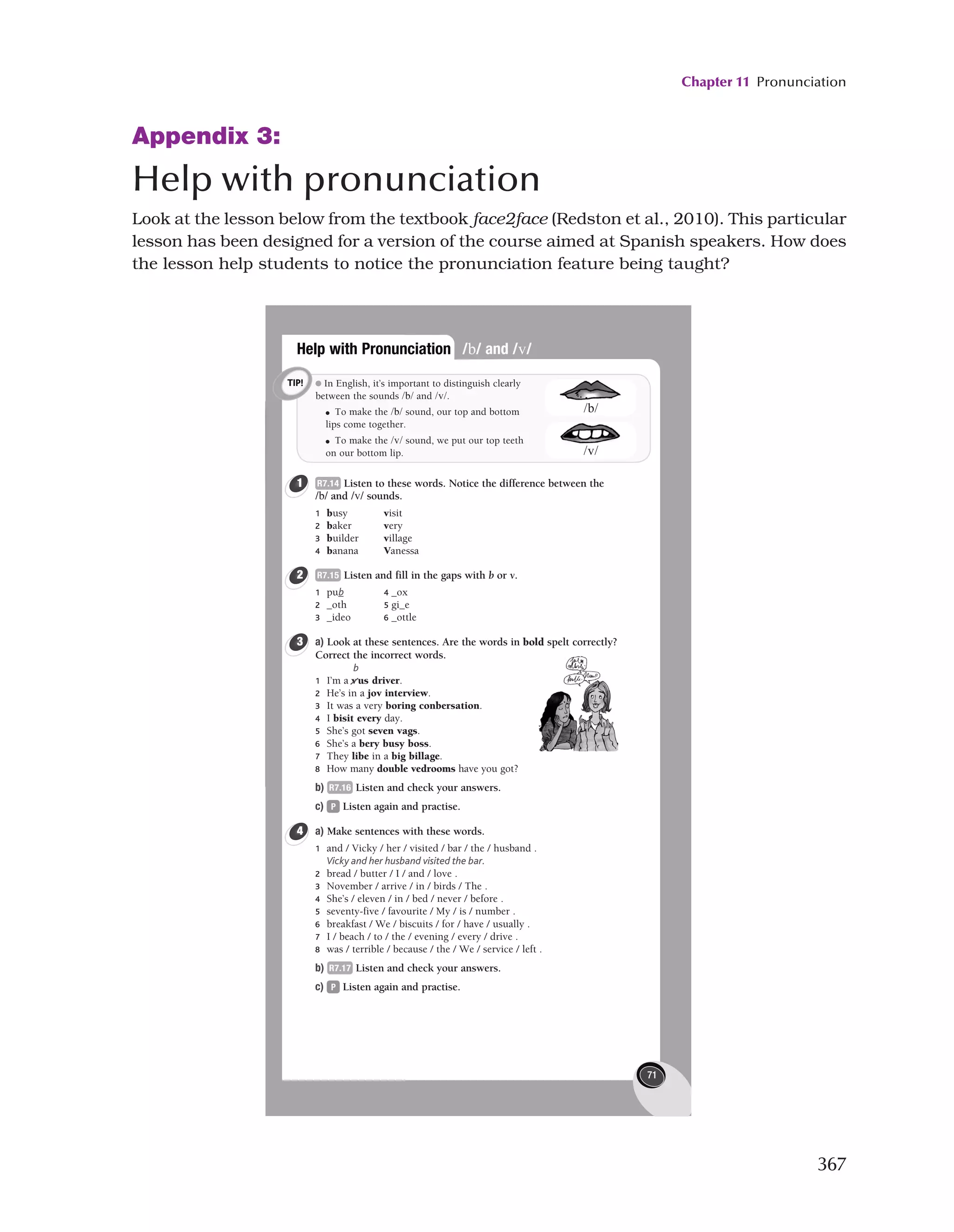
on p. 367 excerpted from face2face, Elementary Student’s Book by Chris Redston and Gillie
Cunningham. Copyright © 2010 by Cambridge University Press. Reproduced with
permission of Cambridge University Press; Cambridge University Press for the text on
pp. 372, 375, 376, 379, 380–381 excerpted from Listening in the Language Classroom by
John Field. Copyright © 2008 by Cambridge University Press. Reproduced with permission
of Cambridge University Press; Cambridge University Press for the text on p. 374 excerpted
from Conversation: From Description to Pedagogy by Scott Thornbury and Diane Slade.
Copyright © 2006 by Cambridge University Press. Reproduced with permission of
Cambridge University Press; Herbert H. Clark for the text on pp. 377–378 excerpted from
Section TK from Psychology and Language: An Introduction to Psycholinguistics by Herbert
H. Clark and E. V. Clark, New York: Harcourt Brace Jovanovich, 1977. Copyright © Herbert
H. Clark 1977. Reproduced with permission; Council of Europe for the text on p. 386
adapted from “Overall Listening Comprehension, A1 and A2” in ‘Language use and the
language user/learner’ in Common European Framework of Reference for Languages:
Learning, teaching, assessment. Copyright © 2001 Council of Europe. Reproduce by
permission of the Council of Europe; Oxford University Press for the text on p. 389
excerpted from ‘Metacognitive instruction in listening for young learners’ by C. Goh and
T. Yusnita in ELT Journal, Vol. 60, Iss. 3. Copyright © 2006 by Oxford University Press.
Reproduced with the permission of Oxford University Press; Text on pp. 389–390 and
Acknowledgements
xii
398–399 excerpted and adapted from Teaching Listening in the Language Classroom by
C. Goh, Regional Language Center: Singapore, 2006; Taylor and Francis Group for the
text on pp. 401–402 excerpted from Teaching and Learning Second Language Listening:
Metacognition in Action by Larry Vandergrift and Christine C. M. Goh. Copyright © 2012 by
Routledge. Reproduce with permission of Taylor and Francis Group; Cambridge University
Press for the text and illustrations on pp. 403–404 excerpted from Real Listening and
Speaking 1 by Miles Craven. Copyright © 2008 by Cambridge University Press. Reproduced
with permission of Cambridge University Press; Text on pp. 410–411 excerpted from
‘Responding to learners’ language needs in an oral EFL class’ by J. McAndrew in Planning
and Teaching Creatively with a Required Curriculum from TESOL Quarterly, John Wiley 
Sons, 2007; SEAMEO Regional Language Centre and Dr. Alvin Pang for the text on
pp. 411 and 413–415 excerpted from ‘Small-talk: the passport to internationalization’ by
A. Wajasath in New Dimensions in the Teaching of Oral Communication edited by J. Foley.
Copyright © 2005 by SEAMEO Regional Language Centre. Reproduced with permission of
SEAMEO Regional Language Centre and Dr. Alvin Pang; Council of Europe for the text on
p. 412 adapted from “Conversation” in ‘Language use and the language user/learner’ in
Common European Framework of Reference for Languages: Learning, teaching, assessment.
Copyright © 2001 Council of Europe. Reproduced by permission of the Council of Europe;
Cambridge University Press for the text on pp. 412–413, 431–432, 434–435 adapted from
Teaching Speaking: A Holistic Approach by Christine C. M. Goh and Anne Burns. Copyright
© 2012 by Cambridge University Press. Reproduced with permission of Cambridge
University Press; Text on p. 413 adapted from The Language of Conversation by F. Pridham,
Routledge, 2001; Primary English Teaching Association Australia (PETAA) for the text on
p. 424 excerpted from ‘Planning an oral language program’ from Talking to Learn by
Pauline Jones. Copyright © 1996 by Primary English Teaching Association Australia.
Reproduced with the permission of Primary English Teaching Association Australia;
SEAMEO Regional Language Centre for the text on p. 426 excerpted from ‘Structuring
learning with the flux of communication: A role for constructive repetition in oral language
pedagogy’ by M. Bygate from New Dimensions in the Teaching of Oral Communication edited
by J. A. Foley. Copyright © 2005 by SEAMEO Regional Language Centre. Reproduced with
permission of SEAMEO Regional Language Centre; Council of Europe for the text on
pp. 421–422 adapted from “Formal Discussion and Meetings” in ‘Language use and the
language user/learner’ in Common European Framework of Reference for Languages:
Learning, teaching, assessment. Copyright © 2001 Council of Europe. Reproduced by
permission of the Council of Europe; Applied Linguistics Association of Australia for the
text on p. 423 excerpted from ‘Discourse analysis and language teaching’ by A. Tabensky
in Australian Review of Applied Linguistics: Series S. Copyright © 2000 by Applied
Linguistics Association of Australia. Reproduced by permission of Applied Linguistics
Association of Australia; Oxford University Press for the text on pp. 426 and 437–438
excerpted from ‘Preparing ESP Learners for workplace placement’ by David Wood from ELT
Journal, Vol. 63, No. 4. Copyright © 2009 by Oxford University Press. Reproduced by
permission of Oxford University Press; IELTS Australia for the text on p. 445 from IELTS
Research Reports, Vol. 11 by Moore, Morton and Price, and the University of Melbourne.
Copyright © 2007 by the University of Melbourne. Reproduced by the permission of IELTS
Australia; Cambridge University Press for the text on pp. 447, 467 and 579 excerpted from
Acknowledgements
xiii
Reading in a Second Language by William Grabe. Copyright © 2009 by Cambridge
University Press. Reproduced with the permission of Cambridge University Press; Text on
pp. 451–452 adapted from Teaching Second Language Reading by T. Hudson, Oxford
University Press, 2007;
Cambridge University Press for the text on pp. 453–454 from Communicative Syllabus
Design by John Munby. Copyright © 1978 by Cambridge University Press. Reproduced
with permission of Cambridge University Press; Text on pp. 455–456 and 466 excerpted
and adapted from Teaching Reading by F. Rohim, The Indonesian Ministry of Education,
2009; JoAnn Crandall for the text on pp. 459–460, 461–462 and 463 adapted from ‘The
why, what, and how of ESL reading instruction: some guidelines for writers of ESL reading
textbooks’ in Material Writer’s Guide by P. Bird, New York: Heinle and Heinle. Copyright
© 1995 JoAnn Crandall. Reproduced with permission of JoAnn Crandall; Macmillan
Education for the text on p. 461 excerpted from Beyond the Sentence: Introducing Discourse
Analysis by Scott Thornbury. Copyright © 2005 by Macmillan Education. Reproduced
with the permission of Macmillan Education; Cambridge University Press for the text on
pp. 464–465 adapted from Extensive Reading Activities for Teaching Language by Richard
R. Day and Julian Bamford. Copyright © 2004 by Cambridge University Press. Reproduced
with permission of Cambridge University Press; Cambridge University Press for the text
and images on pp. 474–476 excerpted from Strategic Reading, Level 1 Student’s Book, 2nd
Edition by Jack C. Richards and Samuela Eckstut-Didier. Copyright © 2012 by Cambridge
University Press. Reproduced with permission of Cambridge University Press; Pearson
Education for the text on p. 480 excerpted from Teaching ESL Writing by Joy M. Reid.
Copyright © 1993 by Pearson Education. Reproduced with the permission of Pearson
Education; Text on p. 483 excerpted from Discourse Analysis by B. Paltridge, Continuum,
2006; Cambridge University Press for the text on p. 485 excerpted from ‘Ten steps in
planning a writing course and training teachers of writing’ by Ann Raimes in Methodology
in Language Teaching edited by Jack C. Richards and Willy A. Renandya. Copyright © 2002
by Cambridge University Press. Reproduced with permission of Cambridge University
Press; Cambridge University Press for the text on pp. 483 and 491–492 excerpted and
adapted from Second Language Writing by Ken Hyland. Copyright © 2003 by Cambridge
University Press. Reproduced with permission of Cambridge University Press; Text on
pp. 487–488 adapted from Cohesion in English by M. A. K. Halliday and R. Hasan, Pearson
Longman, 1976; Text on p. 489 excerpted from Developing Reading Skills by F. Grellet,
Cambridge University Press, 1983; Janet Holst for the text on pp. 491–492 from Writ 101
– Writing English by Janet Holst. Published by Victoria University of Wellington. Copyright
© 1993 Janet Holst. Reproduced by permission of Janet Holst; Cambridge University
Press for the text on p. 498 excerpted from ‘Second language composition instruction:
developments, issues and directions’ by Tony Silva from Second Language Writing edited
by Barbara Kroll. Copyright © 1990 by Cambridge University Press. Reproduced with the
permission of Cambridge University Press; Text on pp. 498–499 adapted from ‘Creative
writing: Taking risks with words’ by A. Green in Unlocking Creativity: Teaching Across the
Curriculum edited by R. Fisher and M. Williams, Routledge, 2004; University of Michigan
Press for the text on p. 501 excerpted from Discourse Analysis in the Language Classroom:
Volume 2: Genres of Writing by Ann Wennerstrom. Copyright © 2003 by University of
Acknowledgements
xiv
Michigan Press. Reproduced with the permission of University of Michigan Press; Oxford
University Press for the text on pp. 503–504 from ‘Using online corpora to develop students’
writing skills’ by Alex Gilmore from ELT Journal, Vol. 63, No. 4. Copyright © 2009 by
Oxford University Press. Reproduced by permission of Oxford University Press; Oxford
University Press for the text on p. 505 excerpted from ‘Tech-era L2 writing: towards a new
kind of process’ by P. Stapleton and P. Radia in ELT Journal, Vol. 64, Iss. 2, 2009. Copyright
© 2009 by Oxford University Press. Reproduced with the permission of Oxford University
Press; Cambridge University Press for the text on pp. 513–514 excerpted from Academic
Encounters, Level 4 Student’s Book, Reading and Writing: Human Behavior 2nd
edition by
Bernard Seal. Copyright © 2012 by Cambridge University Press. Reproduced with
permission of Cambridge University Press; Text on p. 517 adapted from ‘Acquiring French
norms through instruction’ by A. J. Liddicoat in Pragmatics in Langauge Teaching by
K. R. Rose and G. Kaspar, Cambridge University Press, 2001; Text on pp. 517, 532, 534,
and 535 excerpted and adapted from Discourse Analysis: A Resource Book for Students by
R. Jones, Routledge, 2012; Text on pp. 518 and 527–528 excerpted and adapted from
‘Discourse analysis for language teachers’ by D. Demo, http://www.cal.org.ericLL/
digest/0107demo.html, 2001; Council of Europe for the text p. 520 adapted from
“4.6.3 Text-Types,” from ‘Language use and the language user/learner’ in Common
European Framework of Reference for Languages: Learning, teaching, assessment.
Copyright © 2001 Council of Europe. Reproduced by permission of the Council of Europe;
Text on pp. 524–525 adapted from Conversation: From Description to Pedagogy by
S. Thornbury and D. Slade, Cambridge University Press, 2006; Cambridge University Press
for the text on pp. 526–527 adapted from Understanding Communication in Second
Language Classrooms by Karen E. Johnson. Copyright © 1995 by Cambridge University
Press. Reproduced with permission of Cambridge University Press; Text on p. 528 from
Exploring Classroom Discourse by S. Walsh, Routledge, 2011; Text on pp. 530, 547
excerpted and adapted from Exploring How Texts Work by B. Derewianka, Primary English
Teachers’ Association: Sydney, 1991; Cambridge University Press for the text on p. 531
excerpted from Discourse Analysis for Language Teachers by Michael McCarthy. Copyright
© 1991 by Cambridge University Press. Reproduced with permission of Cambridge
University Press; SAGE Publications for the text on p. 533 excerpted from ‘Frameworks for
Comprehending Discourse’ by Richard C. Anderson, Ralph E. Reynolds, Diane L. Schallert
and Ernest T. Goetz in American Educational Research Journal, Vol. 14, No. 4. Copyright
© 1977 by SAGE Publications. Reprinted with permission of SAGE Publications; Text on
p. 537 adapted from Teaching and Learning Pragmatics by N. Ishihara and A. D. Cohen,
Pearson/Harlow, 2010; Cambridge University Press for the text on p. 543 adapted from
‘Research perspectives on teaching English as a lingua franca’ by Barbara Seidlhofer from
Annual Review of Applied Linguistics, Vol. 24. Copyright © 2004 by Cambridge University
Press. Reproduced with permission of Cambridge University Press; Multilingual Matters
for the text on pp. 544–545 adapted from ‘Pragmatics and EIL pedagogy’ by Sandra Lee
McKay in English as an International Language: Theoretical Framework and Application
edited by F. Sharifian. Copyright © 2009 Multilingual Matters. Reproduced with permission
of Multilingual Matters; Better At English for the text on pp. 548–550 excerpted from ‘Real
English Conversations: Perfectionism and procrastination 3’ by Lori Linstruth, 6 May
2010, www.betteratenglish.com. Copyright © 2010 Better At English. Reproduced by
Acknowledgements
xv
permission of Better At English; Cambridge University Press for the text on p. 553
excerpted from Touchstone: Student Book 2 by Michael McCarthy and Jeanne McCarten.
Copyright © 2005 by Cambridge University Press. Reproduced with permission of
Cambridge University Press; Text on p. 563 adapted from Developing Courses in English
for Specific Purposes by H. Basturkmen, Palgrave Macmillan, 2010; Cambridge University
Press for the text on p. 564 excerpted from ‘Outcomes-based language teaching’ by
C. Leung from The Cambridge Guide to Pedagogy and Practice in Language Teaching edited
by Anne Burns and Jack C. Richards. Copyright © 2012 by Cambridge University Press.
Reproduced with the permission of Cambridge University Press; Text on p. 568 adapted
from ‘Designing a pre-EAP reading course: practical problems’ by M. A. Frankel in Case
Studies in ELT edited by R. R. Jordan, HarperCollins, 1983; Center for Applied Linguistics
for the text on p. 574–575 excerpted from Approaches to Syllabus Design for Foreign
Language Teaching by Karl Krahnke. Copyright © 1987 by Center for Applied Linguistics.
Reproduced with the permission of Center for Applied Linguistics; Adult Migrant Education
Service, N. S. W for the text on p. 578 excerpted from Needs Analysis and Objective Setting
in the Adult Migrant Education Program by G. Brindley. Copyright © 1984 by Adult Migrant
Education Service, N. S. W. Reproduced with the permission of Adult Migration Education
Service; Text on pp. 580, 581, 584 excerpted and adapted from Understanding by Design:
A Framework for Effecting Curriculum Developmernt and Assessment by G. Wiggins and
J. McTighe, Association for Supervision and Curriculum Development, 2006; Text on
p. 582 adapted from Curriculum Renewal in School Foreign Language Learning by J. L.
Clark, Oxford University Press, 1987; Cambridge University Press for the text on pp. 583–
584 from ‘The language curriculum: a social contextual perspective’ by Kathleen Graves
from Language Teaching, Vol. 41, Iss. 02. Copyright © 2008 by Cambridge University
Press. Reproduced with permission of Cambridge University Press; Cambridge University
Press for the text on p. 586 excerpted from ‘Standards and second language teacher
education’ by Anne Katz and Marguerite Ann Snow from The Cambridge Guide to Second
Language Teacher Education edited by Anne Burns and Jack C. Richards. Copyright
© 2009 by Cambridge University Press. Reproduced with the permission of Cambridge
University Press; Cambridge University Press for the text on p. 594 excerpted from ‘The
role of materials in the language classroom’ by J. Crawford from Methodology in Language
Teaching edited by Jack C. Richards. Copyright © 2002 by Cambridge University Press.
Reproduced with the permission of Cambridge University Press; Cambridge University
Press for the text on p. 595 excerpted from ‘Materials development for language learning
and teaching’ by B. Tomlinson in Language Teaching, Vol. 45, Iss. 2. Copyright © 2012 by
Cambridge University Press. Reproduced with the permission of Cambridge University
Press; Text on pp. 596–597 adapted from New English 900 by Edwin T. Collier, Macmillan
International, 1977; Oxford University Press for the text on p. 598 excerpted from ‘What
is communicative?’ by Jeremy Harmer from ELT Journal, Vol. 36, No. 3. Copyright © 1982
by Oxford University Press. Reproduced by permission of Oxford University Press. Text on
p. 609 excerpted from ‘Real language – the vitamin for the student studying English
outside the English-speaking world’ by Joan Saslow; Edinburgh University Press for the
text on pp. 609, 612 adapted from Materials Evaluation and Design for Language Teaching,
First Edition by I. McGrath. Copyright © 2002 by Edinburgh University Press. Reproduced
with permission of Edinburgh University Press; Edinburgh University Press for the text on
Acknowledgements
xvi
p. 611 adapted from ‘Corpora and course books: destined to be strangers forever?’ by
G. Burton in Corpora, Vol. 7, Iss. 1. Copyright © 2012 by Edinburgh University Press.
Reproduced with permission of Edinburgh University Press; Palgrave Macmillan for the
text on p. 614 adapted from The Construction of English: Culture, Consumerism and
Promotion in the ELT Global Coursebook by John Gray. Copyright © 2010 by Palgrave
Macmillan. Reproduced by the permission of Palgrave Macmillan; Text on pp. 615–616
excerpted from ‘Language learning through communication practice’ by Richard Allwright,
ELT Documents (76/3), 1976; Text on pp. 618–619 excerpted and adapted from ‘What do
textbook evaluation schemes tell us? A study of the textbook evaluation schemes of the
three decades’ by M. Riazi in Methodology and Materials Design in Language Teaching
edited by W. Renandya, Regional Language Centre: Singapore, 2003; Cambridge University
Press for the text and illustrations on pp. 628–629 excerpted from Interchange, Student’s
Book 2, 4th edition by Jack C. Richards. Copyright © 2012 by Cambridge University
Press. Reproduced with permission of Cambridge University Press; Cambridge University
Press for the text and images on pp. 630–631 excerpted from Four Corners, Student’s Book 3
by Jack C. Richards and D. Bohike. Copyright © 2011 by Cambridge University Press.
Reproduced with permission of Cambridge University Press; Cambridge University Press
for the text on p. 632 excerpted from face2face, Intermediate Workbook, Spanish edition,
by Nicholas Tims, Chris Redston with Gillie Cunningham. Copyright © 2009 by Cambridge
University Press. Reproduced with permission of Cambridge University Press; Text on
p. 610 credited from ‘Thinking out of the textbook: Toward authenticity and politeness
awareness’ by C. S. C. Chan in Using Textbooks Effectively edited by L. Savova, TESOL
Quarterly, 2009; SEAMEO Regional Language Centre for the text on p. 639 adapted from
‘Synchronizing language pedagogy and language software’ by D. Healey from The Impact
of Technology on Language Learning and Teaching: What, How, and Why edited by C. War,
2010. Copyright © 2010 by SEAMEO Regional Language Centre. Reproduced with
permission of SEAMEO Regional Language Centre; Taylor and Francis Group for the text
on p. 641 adapted from ‘Teaching English language learners through technology’ by
T. Erben, R. Ben and M. Castaneda from Professional Development in Education, Vol. 35,
Iss. 4. Copyright © 2009 by Routledge. Reproduced by permission of Taylor and Francis
Group; Cambridge University Press for the text on pp. 662–663 excerpted from Language
Learning with Technology by Graham Stanley. Copyright © 2013 by Cambridge University
Press. Reproduced with permission of Cambridge University Press; Council of Europe for
the text on p. 671 adapted from “Overall Listening Comprehension, B1” in ‘Language use
and the language user/learner’ in Common European Framework of Reference for
Languages: Learning, teaching, assessment. Copyright © 2001 Council of Europe.
Reproduce by permission of the Council of Europe; Cambridge University Press for the
text on p. 672 excerpted from The Common European Framework of Reference by Spiros
Papa Georgiou and Elif Kantarcioglu. Copyright © 2012 by Cambridge University Press.
Reproduced with the permission of Cambridge University Press; Cambridge University
Press for the text on pp. 672–673 excerpted from ‘Outcomes-based language teaching’ by
Constant Leung in The Cambridge Guide to Pedagogy and Practice in Language Teaching
edited by Anne Burns and Jack C. Richards. Copyright © 2012 by Cambridge University
Press. Reproduced with permission of Cambridge University Press; Cambridge University
Acknowledgements
xvii
Press for the text on pp. 674–675 excerpted from ‘Choosing the right type of assessment’
by J. D. Brown in The Cambridge Guide to Second Language Assessment edited by
Christine Coombe, Peter Davidson, Barry O’Sullivan and Stephen Stoynoff. Copyright
© 2012 by Cambridge University Press. Reproduced with permission of Cambridge University
Press; John Wiley and Sons for the text on pp. 677, 681 adapted from ‘Current issues in
English language teacher-based assessment’ by Constant Leung and Chris Davison from
TESOL Quarterly, Vol. 43, Iss. 3. Copyright © 1986 TESOL International Association.
Reproduced with permission of John Wiley and Sons; John Wiley and Sons for the text on
pp. 680–681 excerpted from ‘The alternatives in language assessment’ by James D. Brown
and Thom Hudson from TESOL Quarterly, Vol. 32, Iss. 4. Copyright © 1998 TESOL
International Association. Reproduced with permission of John Wiley and Sons; Cambridge
University Press for the text on p. 683 excerpted from ‘The assessment development
process’ by B. O’Sullivan in The Cambridge Guide to Second Language Assessment edited
by Christine Coombe, Peter Davidson, Barry O’Sullivan and Stephen Stoynoff. Copyright
© 2012 by Cambridge University Press. Reproduced with permission of Cambridge
University Press; For the text on pp. 684–685: POPHAM, CRITERION-REFERENCED
MEASUREMENT., 1st, © 1978. Printed and electronically reproduced by permission of
Pearson Education, Inc., Upper Saddle River, New Jersey; Daphne van Weijen for the text
on pp. 691–693 excerpted from Writing Processes, Text Quality, and Task Effects by
Daphne van Weijen. Published by Netherlands Graduate School of Linguistics, 2008.
Copyright © 2008 by Daphne van Weijen. Reproduced by permission of Daphne van
Weijen; John Wiley and Sons for the text on p. 699 excerpted from ‘Observing teachers:
three approaches to in-service training and development’ by Donald Freeman from TESOL
Quarterly, Vol. 16, Iss. 1. Copyright © 1982 TESOL International Association. Reproduced
with permission of John Wiley and Sons; Association for Supervision and Curriculum
Development for the text on p. 704 adapted from ‘The doors to school improvement’ by
Bruce Joyce in Education Leadership, Vol. 48, No. 8. Copyright © 1991 by the Association
for Supervision and Curriculum Development. Reproduced by permission of the Association
for Supervision and Curriculum Development. University of Guanajuato for the text in
p. 708 from Becoming an English teacher: Participants Voices and Identities in an In-Service
Teacher Training Course in Central Mexico by M. Martha Lengeling, Guanajuato, Mexico:
University of Guanajuato. Copyright © University of Guanajuato 2010. Reproduced with
permission of University of Guanajuato; IATEFL for the text on p. 708 adapted from
‘Fulfilling the promise of professional development’ in IATEFL Issues (August-September)
by Diaz Maggioli, 2003. Copyright © 2003 by IATEFL. Reproduced with permission of
IATEFL; For the text on p. 709: Reprinted by permission of the Publisher. From Thomas
R. Guskey and Michael Huberman, eds., Professional Development in Education: New
Paradigms  Practices, New York: Teachers College Press. Copyright © 1995 by Teachers
College, Columbia University. All rights reserved; National Council of Teachers and
English for the text on p. 713 adapted from ‘Youth in the middle: Our guides to improved
literacy instruction’ by Donna Alvermann in Voices from the Middle, Vol. 14, Iss. 2.
Copyright © 2006 by National Council of Teachers of English. Reproduced with permission
of National Council of Teachers of English; Text on pp. 713,715 excerpted and adapted
from ‘Bringing new literacies into the content area literacy methods course’ by S. B. Kadjer
Acknowledgements
xviii
in Contemporary Issues in Technology and Education, Vol. 7, Iss. 2, Center for Technology
and Teacher Education, 2007, (http://www.citejournal.org/vol7/iss2/general/article3.
cfm); SUNY Press for the text on p. 716 adapted from Teaching Selves: Identity, Pedagogy,
and Teacher Education by Michael J. Danielewicz. Copyright © 2001 by SUNY Press.
Reproduced with permission of SUNY Press; Text on p. 723 adapted from Reflective
Teaching in Second Language Classrooms by Jack C. Richard and C. Lockhart, Cambridge
University Press, 1994.
Acknowledgements
xix
Introduction
This book is a response to the need for a comprehensive text that explores key issues
in English language teaching today. The current status of English as an international
language has enormous implications for people worldwide. English is not only the language
of international communication, commerce and trade, and of media and pop culture, but
increasingly, in countries where it was taught in the past as a second or foreign language,
a medium of instruction for some or all subjects in schools, colleges and universities.
English is no longer viewed as the property of countries where it is the mother tongue of
much of the population such as the United States, Australia or the United Kingdom, or of
countries such as Nigeria, India, Singapore and the Philippines where it is used alongside
other local languages; it is an international language that reflects many new contexts and
purposes for its use, as well as the different identities of its users.
Parallel to the changes we have witnessed in the status of English in the last 30 or more
years have been new developments in the language-teaching profession itself. The spread
of English has brought with it the demand by national educational authorities for new
language-teaching policies: for the development of standards for English teaching as well
as teacher preparation, for new approaches to curriculum design, teaching and assessment
and for greater central control over teaching and teacher education. The discipline of
teaching English to speakers of other languages, variously referred to as TESOL, ESOL,
ELT (English language teaching), ESL (English as a second language) and EFL (English
as a foreign language) continually revises its theories, principles and practices, through
the efforts of applied linguists and specialists in the field of second language acquisition,
advancements in language-teaching methodology and enhancements in language-teacher
education, as well as through the practices of creative and skilled classroom practitioners.
This knowledge base has expanded enormously in both breadth and depth in recent
years, as research and theory add to what we know or understand about the teaching and
learning of English. It is important for teachers to understand these developments so that
they can review their own understanding of language teaching and learning and consider
innovations and developments in classroom practices that may be relevant to their own
teaching contexts.
Factors such as these require a rethinking of many of our assumptions about the teaching
of English. Because of the changing needs for English-language skills among today’s
learners and the many different motivations that learners bring to the learning of English,
English teachers today need both a broad and flexible range of teaching skills, as well
as an understanding of the complex and developing knowledge base that supports the
language-teaching profession.
Key Issues in Language Teaching thus provides an account of the issues that are involved
in the teaching of English as a second or foreign language and describes approaches to
the teaching of English, in light of the issues mentioned above. The book covers a wide
xx
Introduction
range of territory, but aims to address the most important issues and topics that teachers
in training generally encounter in their teacher-education courses or that practising
teachers will find useful if they wish to review their own understanding and approaches.
My goal has been to cover the issues in an accessible style, with key points in each
chapter summarized after every section. The book does not assume a prior background
in applied linguistics. It is accessible to those undertaking courses in TESOL and applied
linguistics at both the graduate and undergraduate levels. It is designed to be used as a
core text in TESOL teacher-education programmes, as well as a reference for the many
practising teachers interested in accounts of contemporary issues involved in teaching
English today. The issues covered are those that, in my experience, are of concern to all
teachers and teacher educators, and include such diverse areas as language-learning
theories and methodology, the language learner and lesson planning, the teaching of the
four skills, testing and assessment, and the role of technology. Throughout the book, I
have tried to keep the focus on practical classroom issues, although where relevant, I have
linked these issues to theory and research that can inform them. The chapters may be
read in any order, and cross-references direct the reader to other chapters offering more
background on selected topics.
This book puts each classroom issue into context and considers the implications that
current understanding has on the decisions made in the classroom. The book is equally
appropriate for readers new to a given topic, as well as those who wish to refresh their
understanding, and seeks to present a broad and in-depth overview of the issues.
Reflective questions throughout each chapter, vignettes provided by practicing teachers in
different parts of the world and discussion questions following the chapter are designed
to help make connections to the reader’s experience. Also offered are case studies, lesson
plans and textbook lessons, with guided tasks that allow readers to apply the knowledge
gained in a given chapter. Suggestions for further reading are also given at the end of each
chapter.
The chapters are grouped into four parts, each addressing major themes of importance
to teachers today and exploring the key issues within these areas. The first part, ‘English
language teaching today’, serves as an introduction to the book as a whole. Its chapters
provide an overview of the role of English in the world, theories of second language learning,
an account of the main teaching approaches that are in current or recent use, and an
account of the knowledge and skills base experienced teachers make use of in teaching.
This section, with its overview of both second language learning and methodology, is
equally useful to those wishing to review or expand their knowledge of the research on
these topics, and to those encountering these topics for the first time.
The second part, ‘Facilitating student learning’, deals with the critical role learners play
in language learning. It covers the attributes that influence their approach to learning,
the structure of a language lesson and how to increase its effectiveness, the nature and
function of classroom management strategies and the differences between teaching
learners of different age groups. Each chapter seeks to provide the background knowledge
as well as the conceptual tools that teachers can make use of in order to develop a learner-
centred approach to teaching.
xxi
Introduction
Part three, ‘Language and the four skills’, covers the systems and skills of English, with
chapters on grammar, vocabulary, pronunciation, listening, speaking, reading and writing,
as well as the important role of discourse and pragmatics in both speech and writing.
These chapters are equally relevant to those teaching single-skills courses, integrated-
skills courses or any combination of skills that an institution may offer.
In the final part, ‘The teacher’s environment’, the focus is on the resources teachers use.
The section begins with an overview of curriculum planning and course design and then
examines the nature and use of textbooks, the integration of technology in language
courses, testing and assessment, and the nature of professional development and how
teachers can continue their teacher education.
Taken together, the four sections of this book aim to provide teachers and teachers in
training with a foundation of essential knowledge and skills to support their teaching and
ongoing career development.
This book is also available as an e-book. This is one of the first teacher’s reference books
from Cambridge University Press to be offered in an innovative electronic format. This
format has a number of advantages. In addition to ease of access from computers, tablets
and mobile phones, the e-book format allows readers to access short videos, where I
summarize each of the chapters and the major sections of the book. Readers can also
access a variety of links offering additional information, including brief biographies of the
many teachers and teacher educators who have contributed their personal experiences.
1
Part
1
English language
teaching today
3
Overview
This chapter includes the following key issues:
●
● What characterizes the global spread of English?
• Factors promoting the use of English around the world.
●
● What do we mean by English as an international language?
• Learners’ views of English.
• Varieties of English.
• Using English as a lingua franca.
●
● What are the implications for English language teaching curriculums?
• The status of English in the school curriculum.
• English language teaching in English-speaking countries.
• The role of the private sector in English instruction.
• The impact of technology.
1
The scope of
English and English
language teaching
Part 1 English language teaching today
4
1.1 Introduction
In recent years, there has been a dramatic change in the scope of English language
teaching worldwide and an increasing demand for competent English language teachers,
as well as for language programmes that can deliver the English language skills and
competencies needed by today’s global citizens. The teaching of English consumes a
considerable portion of available educational resources in many countries, and English is
not necessarily a neutral commodity offering equal opportunities for all. English teachers,
therefore, need to appreciate the special status English has in modern life, what its costs
and benefits are to those who seek to learn it, the different motivations learners may have
for learning English and the different circumstances in which they learn it. This chapter
seeks to clarify some of these issues and to describe how English language teaching is
realized in different parts of the world.
1.2 The global spread of English
The English language has a complex status in today’s world. For some people, it is acquired
as a first language. For some, it may be learned at school, and be essential for academic
and professional success. For others, it may represent a subject that they are required to
study in school, but for which they have no immediate need. And English means different
things to people in different parts of the world. For some, it may arouse positive feelings –
as the language of pop culture, the media and social networking. For others, it may have
associations with colonialism, elitism or social and economic inequality.
English today has a unique status, as a consequence of the role it plays around the
world and its function as an ‘international’ or ‘world language’. It has been described
as the world’s lingua franca. Although some 380 million people are said to speak it as a
first language in countries like Australia, Canada, the United States and Great Britain, a
further 600 million people use it, alongside other languages, as a ‘second language’ – in
countries like Nigeria, India and the Philippines. And another one billion people are said
to be studying it, at any one time, as a ‘foreign language’, in countries like China, South
Korea, France, Germany, Russia and Spain.
English is learned for many different reasons. It may be an essential tool for education
and business for some learners; it may be the language of travel and related activities of
sightseeing for others; and it may be needed for social survival and employment for new
immigrants in English-speaking countries. For some, it may be a popular language for
the media, entertainment, the internet and other forms of electronic communication. For
many, however, it may merely be a language that they are obliged to study, but which they
may never really have any obvious need for.
Despite the emphasis on learning English in many parts of the world, it is worth
remembering that many people can survive perfectly well in their own countries without
ever having to use English (Seargeant, 2009), and that fluency in English does not
Chapter 1 The scope of English and English language teaching
5
necessarily offer learners any social or economic advantages. And as some have pointed
out (e.g. Pennycook, 1994: Lin, 2001), the spread of English does not necessarily
promote social equality. Lin (2001) argued that ability in English and access to adequate
opportunities to learn it has a considerable impact on the lives of many learners worldwide,
including both children and adult learners. She suggests that the classroom is a site in
which learners experience a power asymmetry due to the social identities that all learners
and teachers adopt. As a consequence, learners may develop a ‘want-hate’ relationship
with English, one in which they struggle to acquire a language that may eventually put
them at a disadvantage within the classroom context.
? To what extent do you think mastery of English affects your learners’ social
mobility? What other benefits do you think your learners perceive in learning
English?
Factors promoting the use of English around the world
The status of English in the world today has nothing to do with its intrinsic characteristics
as a language. It did not become the world’s second language because it has some special
features that gave it that status or because it is superior in some way to other languages
that might have assumed this role. Rather, the spread of English is the result of a number
of historical and pragmatic factors (McCrum, 2010).
Historical factors
Primary among the factors that account for the spread of English is the fact that it was the
language of the British Empire, and later, that of American expansion. One of the legacies of
the British Empire was the use of English as the primary language needed for government,
communication, commerce and education in those parts of the world under British colonial
administration. And the countries in the Empire were located in many different parts of
the world, from Africa to Asia and the Pacific. When colonial administrations were replaced
by national ones, through independence, English remained as a major working language,
facilitating communication among peoples speaking different languages (i.e. functioning
as a link language or lingua franca) and providing a primary language for administration,
education and the media. The English that became established in these vast territories
took on local characteristics, giving rise to the ‘new Englishes’ that we recognize today,
such as Indian English, Malaysian English or Nigerian English.
Globalization
The spread of English is often linked to globalization, since it provides for high levels
of interconnectedness among nation states and local economies and cultures. The fact
that English has become the primary language for communication within international
Part 1 English language teaching today
6
organizations such as the United Nations, the Council of Europe and the European
Union is an example of such globalization. However, as Seargeant observes (2009: 63),
globalization has contributed as much to the ‘idea’ of English as it has to its actual role in
communication. In other words, in many parts of the world, English represents an image
in popular imagination, established through the media, advertising and so on, rather than
a practical necessity or reality for many people.
Scholars and educationists differ in their attitudes towards the global spread of
English. Some (e.g. Graddol, 2006) think this spread is natural, inevitable, neutral and
beneficial, and have been accused of ‘English triumphalism’. Crystal (1997: 32) suggests
that English ‘fosters cultural opportunity and promotes a climate of international
intelligibility’. Others see the spread of English as threatening local cultures, languages
and identities. Phillipson (1992) used the phrase ‘linguistic imperialism’ to explain
how English has come to play a leading role in maintaining the economic and political
dominance of some societies over others. Because of the role of English as the dominant
international language, the theory of linguistic imperialism asserts that other languages
have been prevented from going through processes of development and expansion,
and have been allocated a secondary status, along with the cultures they represent.
Proponents of the theory of linguistic imperialism view the English language teaching
industry as contributing to the propagation of the economic, cultural or religious values
of dominant world powers.
Economic development
Many countries see English as important to their economic development. A recent report
suggested that countries with poor English-language skills also have lower levels of
trade, innovation and income. The report ranked 54 countries where English is not a first
language and claimed that English is key to innovation and competitiveness. The top five
were Sweden, Denmark, the Netherlands, Finland and Norway. The lowest were Colombia,
Panama, Saudi Arabia, Thailand and Libya. The report also suggested that Italy, Spain
and Portugal were held back as a result of poor English-language skills (New York Times,
28 October 2012).
Communication
Since English is widely taught and used around the world, it is a convenient language
for communication across national boundaries and in a wide range of professions. In
many cases, the speakers (or writers) involved both may be using English as a foreign
or second language (see section 1.3 below). Nerrier (2006), reporting as observer of
communication in situations like these, noted that non-native English speakers are
often better able to communicate with business clients in Korea and Japan than
native speakers of English, due to the fact that their English is not likely to contain
the kind of unfamiliar idioms and colloquial expressions used by native speakers of
English.
Chapter 1 The scope of English and English language teaching
7
Business and entrepreneurship
As the United States emerged as a global economic power after World War II, international
trade and commerce became increasingly dependent on the use of English. Today,
large business organizations are increasingly multinational in their operations, and
English is increasingly the most frequent language used for both written and spoken
communication within such organizations. Many of the world’s English language learners
require knowledge of English in order to enter the workforce in their countries and in
order to advance professionally. Similarly, for many young IT graduates in countries like
India, China, Singapore, Malaysia and Thailand, knowledge of English provides a chance
to market their expertise outside of their countries. Their fluency in English, together
with their creative and innovative thinking, is part of the driving force of thousands of
successful businesses and companies worldwide.
Education
In many parts of the world where English has traditionally had the status of a school subject,
it is now becoming the medium of instruction, particularly at university level. For example,
since 2014 the Politecnico di Milano – a premium university in Italy – has been teaching its
graduate courses in English (www.bbc.co.uk/news/business-17958520). The motivation
for teaching subjects through English is partially to improve the English language skills
of graduates (as with universities in Turkey, where many courses are taught in English).
This trend also reflects the growing need for European universities to offer programmes in
English to attract an international body of students and raise their international profiles –
an aspect of the internationalization of higher education through English. There are now
more than 2,000 such programmes in European universities. It is often assumed that
these courses will be taught by younger lecturers who have themselves spent part of their
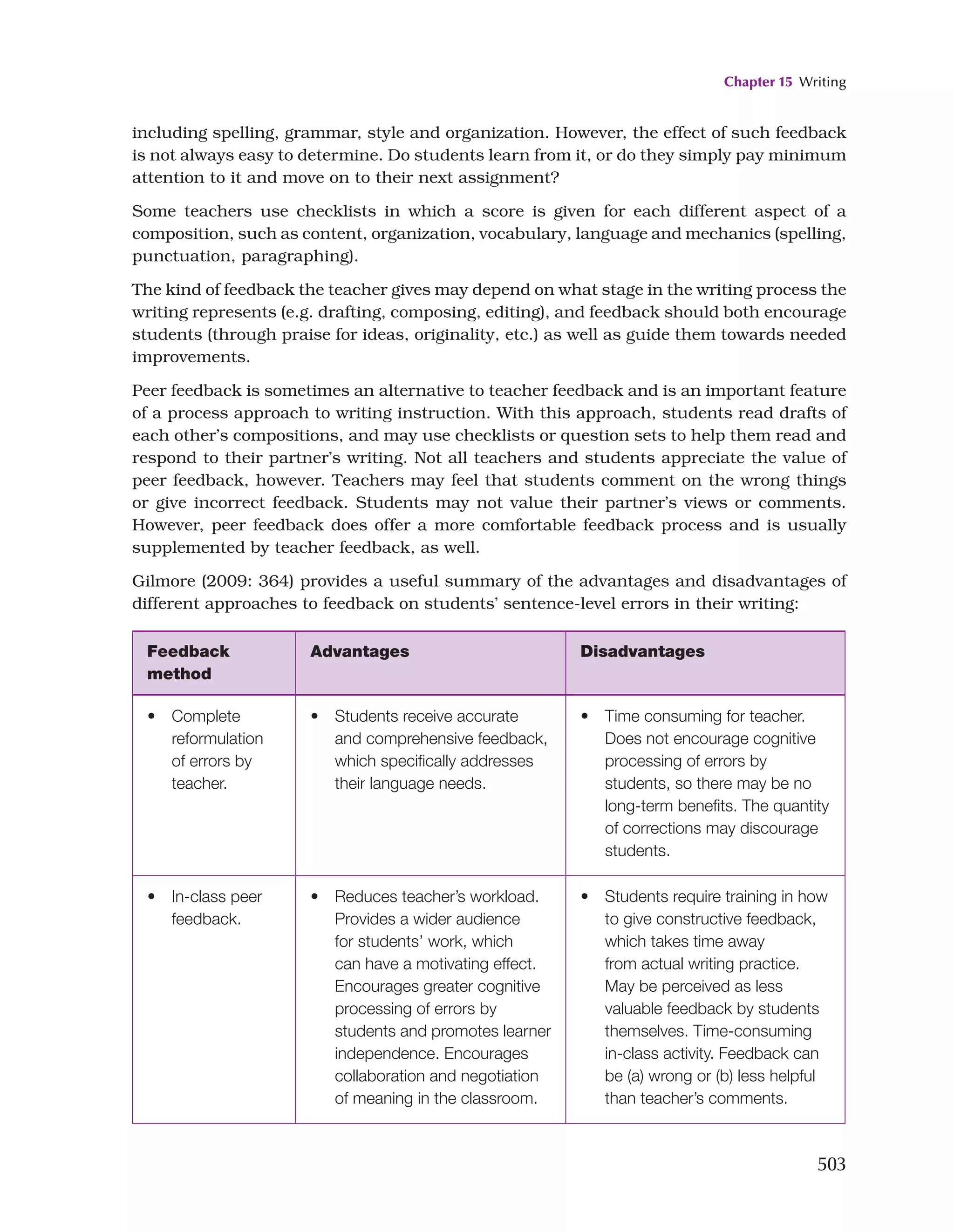
education abroad. However, the kind of teaching observed in these situations is reported
to be similar to what is observed at international academic conferences where few people
are native speakers of English: discussion tends to settle around what is described as
the ‘lowest common denominator’. In subjects like mathematics, this may not be a major
problem, but in disciplines where language is more central to intellectual debate, there
is a risk that meaningful scholarly discourse could be compromised. (Aisha Labi, 2011:
Europe’s Push to Teach in English Creates Barriers in the Classroom (http://chronicle.
com/article/article-content/126326/).
Another factor likely to further consolidate the spread of English is the growing popularity
of content-based teaching, or CLIL, as it is referred to in Europe – that is, the use of
English to teach some school subjects (see Chapter 3). (This is referred to as bilingual
education in Central and South America.) The teaching of school subjects in English
may start at secondary school and continue at university. And just as English-medium
education was crucial in establishing local varieties of English in countries like India,
Nigeria and Singapore (see section 1.3 below), we can assume that the teaching of content
subjects through English is likely to produce students who speak English fluently, but
with marked local features.
Part 1 English language teaching today
8
Travel
Today’s citizens are often mobile, either moving to a new location for tourism or to seek
employment. The development of tourism within a country is often dependent upon
providing resources in English for visitors, and international travellers generally find that
they need some knowledge of English in order to travel abroad. This provides a reason for
many people to acquire some mastery of the language.
Popular culture
English today is an important language for the expression of western popular culture,
as seen in movies, television and music. It is visible everywhere in sport, in advertising
and in packaging and labelling of consumer items, particularly those aimed at younger
buyers. In some parts of Europe (e.g. Finland), English-language movies and television
programmes are broadcast in English (usually with subtitles), rather than in dubbed
versions, providing young learners with increased opportunities to learn English.
The media
English is the language used in newspapers intended for an international readership,
such as the Bangkok Post or China Daily, and in international magazines like Time and
Newsweek. Similarly, it is used by international television networks, such as CNN and
Al-Jazeera, and for television channels, such as RT, an English-language news channel
which presents the Russian view on global news for an international audience, or CCTV,
which presents the Chinese view of China and the world through English.
A global English language teaching industry
The spread of English is also supported by a global industry that involves publishers, private
and public language-teaching institutions, and testing organizations, such as those offering
international examinations. Two examples from the private language school industry are
illustrative. The Swedish language-teaching company EF (Education First) is the world’s
largest private educator, with over 25,000 teachers and 15 million students worldwide, with
headquarters in Lucerne, Switzerland. In China, supplementary English classes for preschool
and primary school age learners is a multibillion-dollar industry that is expected to grow by
30% per year. The Walt Disney Company has schools in major cities there, and China’s
biggest private-education organization – New Oriental Education and Technology Group –
has some 500 schools and earns over US$60 million a year from children’s English classes.
Symbolism
Although mastery of English is a practical goal for many learners, as noted earlier, in
many parts of the world English has also accrued a value and status that transcends its
role as a communicative resource. It is seen as a symbol of globalization, modernization,
Chapter 1 The scope of English and English language teaching
9
technical innovation and progress. Therefore, educational planners believe that English
should have a significant role in a national curriculum, because not to do so would be to
opt out of contemporary views of progressivism. As one writer puts it, English is sometimes
‘ensnared by an ideology that positions English as a language which everyone must know’
(Cozy, 2010: 738), a language that everyone must study for the sake of the few. In an
interesting study, Sayer (2010) examined the social meanings of English in the Mexican
city of Oaxaca, as reflected in the use of English in street signs, shop names and product
brands. He identified six themes or ‘ideas’ that English represents in that context:
●
● English is advanced and sophisticated.
●
● English is fashion.
●
● English is being cool.
●
● English is sex(y).
●
● English is for expressions of love.
●
● English is for expressing subversive identities.
Some describe the attraction of English as representing imagined communities of English
speakers that the learner may wish to join (McKay  Bokhorst-Heng, 2008). This was
the focus of an interesting study by Lamb (2004), who explored the idea of what English
represents in the minds of a group of Indonesian learners of English. For them, it was not
linked to any particular geographical area (such as the United States, Australia or Great
Britain) nor with any particular cultural community (e.g. such as Canadians, New Zealanders
or Singaporeans) but rather was linked in their minds to international culture. This included
international business, the spread of technology, consumerism and materialism, democracy,
tourism and world travel as well as the worlds of fashion, sport and popular music.
The status of English also impacts negatively on people’s views of their own language in some
countries. An observer of the impact of English in Indonesia (Lindsay, 2011: xi) comments:
A quick glance at Indonesian newspapers, advertisements or television shows the extent to
which English is infiltrating and even replacing Indonesian, but more significantly, the extent to
which pride in speaking and writing Indonesian is declining. There was a time when speaking
Indonesian was a sign of modernity, a symbol of the adoption of a broad identity beyond
one’s regional self expressed in one’s regional language. Even twenty years ago, characters in
Indonesian films and advertisements speaking regional languages or heavily regional language
inflected-Indonesian were inevitably portrayed as ‘traditional’ (i.e. of the past), or as lower class,
country hicks. By now, this same image is shifting to Indonesian. To be trendy is to speak
English, or more commonly, heavily English-inflected Indonesian. There seems to be no longer
any pride in speaking or writing Indonesian well.
? Among the factors in this chapter that have promoted the spread of English,
can you suggest the five which you think are most important in establishing
the role of English in the country where you teach (or a country where English
is a second or foreign language)?
Part 1 English language teaching today
10
1.3 English as an international language
Learners’ views of English
Learners study English for many different reasons, and many have no choice in doing
so. Their reasons for studying English relate to how English impacts on their present or
future lives, and how they understand and perceive the nature and role of English. The
‘idea’ of English – what it means in the minds of teachers and students – is shaped by
the efforts of applied linguists, educational planners and policy makers, as well as by
the culture of a particular country. The English language teaching profession, as well as
government policy makers, normally articulate the idea of English through reference to
communicative needs, authentic language use and the functional or instrumental value
of English for learners, as opposed to a language that the learner has an emotional and
personal identification with. For many learners, whether they like it or not, English is a
language they must learn. It can be regarded as a form of linguistic and economic capital.
In the twenty-first century, for many people, competence in English adds greatly to an
individual’s capital, a fact that justifies the large amounts of money spent on teaching
and learning it. Learners’ motivations for learning English often reflect this instrumental
perspective (Canagarajah, 2001). Critical educators have also drawn attention to learners’
often ambivalent attitudes towards learning English (Lin, 1999; Canagarajah, 2001).
Many learners need English, but they don’t necessarily want it (Lin, 1999: 394). For some
learners, it is an obstacle that they may resent. Teachers, therefore, need to be sensitive to
their learners’ perceptions of English and not simply assume that they share the teacher’s
views of the value of English.
? What are the main reasons your students are studying English? Do your
students want to learn English, or need to learn it?
The situation in Japan, as described by Seargeant (2009), is perhaps unique. Seargeant
suggests that many people in Japan have an intense fascination with English, as is seen
in acts of cultural display like advertising, and thousands of people devote huge amounts
of time to studying it; yet, the English language has no official status in Japan, nor do
most of the citizens have any real need for it in their everyday lives. Instrumental ambition
for learning English in Japan is much less important than the ‘idea’ of English, that is, its
symbolic meaning. Some observers have suggested that the continued use of grammar-
translation in Japan, the use of ‘decorative English’ in advertisements and popular
culture, and the notion that English is too difficult for Japanese students to master reflect
a particular ‘idea’ of the nature of English in Japan. Seargeant (2009: 56) suggests that
one consequence of relating the concept of Japanese ethnocentrism to foreign-language
learning is that it prioritizes the role of culture in English language teaching, rather than
mastery of spoken English:
The language becomes not so much a tool for international communication, but a living artifact
belonging to a foreign culture. Likewise, native-speaker teachers become specimens of that
Chapter 1 The scope of English and English language teaching
11
foreign culture, their role as instructors of specialized knowledge overshadowed by their status
as foreign nationals, so it is the emblematic presence of a foreign culture in the classroom that
is the defining factor of their appointment in schools, their status as language informants being
overshadowed by their status as foreign nationals.
Varieties of English
But when we talk about teaching English, what exactly do we mean by ‘English’? Whose
English are we talking about, and what kind of English? The concept of ‘English’ is really
an abstraction since it refers to a whole range of speech varieties and speech styles, used
differently by people in many parts of the world. In a sense, there is no such thing as
‘English’: there are only ‘Englishes’ – or different ways of using English. Different ways of
using English reflect the different identities people express through their use of English.
Identity may be shaped by many factors, including personal biography, nationality,
culture, working conditions, age and gender.
Due to the complex and diverse functions of English around the world, as well as the
changing status of English in today’s world, finding a convenient way to describe the
different roles English plays is difficult. In some countries, English is the majority
language and the mother tongue, or first language, of the majority of its population, such
as in Australia, Canada, the United States and the United Kingdom. The applied linguist
Kachru refers to these countries as ‘the traditional cultural and linguistic bases of English’
(1992: 356) or the ‘inner circle’. The terms English as a native language (ENL) or English
as a mother tongue have been used to refer to the status of English in these countries. In
countries where English is the dominant first language for most of the population, it is the
main language used in government, education, the media, business, etc. The way English
is spoken in these countries has traditionally been a reference point in teaching English
to speakers of other languages, and these are the countries where the major approaches
to teaching English have also been developed.
However, there are many other parts of the world where English has a different status.
These are multilingual countries where widespread use of English – particularly in
education, government, commerce and the media – is a legacy of colonialism. This refers
to the status of English in many parts of Africa, in Pakistan and India, in Singapore,
Malaysia, the Philippines, Fiji and elsewhere, as noted earlier in this chapter. Kachru
referred to these countries as the ‘outer circle’ and worldwide there are greater numbers
of English speakers in outer circle than inner circle countries. A feature of outer circle
countries is that local varieties of English have emerged there, reflecting the need for
English to accommodate to the cultures of the contexts where it is used. People speak
these newer varieties of English (just as people do when speaking other varieties of English,
such as Australian or South African English) because they express their cultural and
national identity. Older varieties of English, such as American or British English, are not
considered targets for learning in countries where new Englishes have become established
(Foley, 1988). The status of English in these countries has traditionally been referred to
as a second language, and the countries where English has this status as ESL countries.
Part 1 English language teaching today
12
Many educators, including myself, object to the use of these terms since they suggest
a secondary status for users of English in these contexts, but a satisfactory alternative
term has not yet emerged. The varieties of English that have developed in these contexts
(largely as a result of English-medium education) have been called new Englishes (Platt
et al., 1984). And since many learners may encounter these new varieties of English, they
need to be represented in materials for teaching listening comprehension. There is one
group of new Englishes in India, Pakistan, Sri Lanka and Bangladesh, sometimes referred
to as South Asian Englishes. There is another group in the former British colonies in East
and West Africa. Another group is found in the Caribbean, and there is the group found in
South-East Asia – Malaysia, Singapore and the Philippines. Then there is a Pacific group,
such as Fiji.
? To what extent do you think learners should be exposed to many different
varieties of pronunciation – including examples of the new Englishes referred
to above?
In contexts where English is used alongside local languages, but for high domains –
such as education – there is a tendency for speakers of the local language to incorporate
English lexical items into their use of the local language as a sign of social status or to
mark their identity in other ways. For example, in Chennai, in the south Indian state of
Tamil Nadu, and where Tamil is the local language, anglicized Tamil – sometimes referred
to as Tanglish – is fashionable among young people, particularly the English educated.
Some advocates of Tamil complain that the language is being threatened by the influx of
English words. Young people in Hong Kong, similarly, find it natural to mix English words
into their everyday Cantonese. The mixed code, it has been suggested, plays an important
role in marking out the Hong Kong identity, serving as a distinctive linguistic and cultural
marker of ‘Hong Kongness’. In post-apartheid South Africa, many black South Africans
have adopted a local variety of English, laced with words from local languages, as a sign
of freedom – in contrast to Afrikaans, which they may view as the language of oppression
(http://medienportal.univie.ac.at/uniview/detail/artikel/the-image-of-afrikaans-in-
south-africa-part-2/).
? Language is an important way in which our identity is expressed. What are
some ways in which personal identity can be expressed through language?
In many other parts of the world, English is taught as a subject in school, and that may
be necessary for certain practical purposes, but it is not widely used within the country.
Kachru referred to these countries as the ‘expanding circle’. English in expanding circle
countries like China, Japan, Spain and Russia has usually been described as a foreign
language, another term which it is difficult to find a convenient replacement for. In contexts
Chapter 1 The scope of English and English language teaching
13
where English is a foreign language, local varieties of English are less likely to emerge,
and the target for learning has traditionally been an external variety of English, such as
British or North American English. However, there is evidence that, for many learners in
these contexts in recent years, speaking English with an accent that reflects features of
the learner’s mother tongue (e.g. a French accent, a Dutch accent, a Korean accent) is no
longer considered a sign of inadequate language mastery, but is instead a valid expression
of cultural identity (Kirkpatrick, 2007).
Nevertheless, a teacher educator notes that learners often have an unsophisticated
understanding of accents:
Learners’ views of accents
New teachers are often confused when interrogated by their students about accents.
My first teaching job was in France where my classes divided themselves into two
groups. Group A decided that they only wanted to learn an ‘American accent’;
Group B only wanted to acquire a ‘British accent’. Both were actually more anti- the
other than pro- their own choice. I come from New Zealand so it was easy for me to
placate Group A by telling them that the New Zealand accent is nearly the same as
the ‘American’ accent and Group B by telling them that the New Zealand accent was
nearly the same as the ‘British’ accent. The nonsense of the whole thing was which
American or which British accent did they mean, and could or should they even be
bothering? It seems that, for all but a very few people, the accent you end up with,
no matter how high your proficiency level, will be that of your L1, and why should it
be any different? Learners do have a strange perception of the importance of accents.
One low-intermediate Korean learner once told me that I couldn’t understand him
because he had an American accent. Actually, it was because he had a very strong
Korean accent, and his knowledge of vocabulary and grammar was only that of a
low-intermediate learner.
Peter Nicoll, teacher and teacher educator, Auckland, New Zealand
? Do your students have a preference for a particular accent in English, such
as British or North American? What do you think are the reasons for their
preference?
Using English as a lingua franca
One of the major functions English fulfils in today’s world is as a ‘link language’ or ‘lingua
franca’, that is, as a means of communication between people who have no other shared
language. This, of course, is the case for Germans using English to communicate with
Russians or Japanese speakers, or for Italians learning English to communicate mainly
Part 1 English language teaching today
14
with people who speak another European language, such as Polish or Dutch. Increasingly,
around the world, English is used for communicating in circumstances like these, where it
functions as a ‘common language’ between people who do not share a language. The terms
English as an international language (EIL) and English as a lingua franca (ELF) have been
used to describe the use of English in these situations. ELF has been defined as follows
(Firth, 1996: 240):
[ELF] is a contact language between persons who share neither a common native tongue
nor a common (national) culture, and for whom English is the chosen foreign language of
communication.
Another definition offers the following (House, 1999: 74):
ELF interactions are defined as interactions between members of two or more different
linguacultures in English, for none of whom English is the mother tongue.
The concept of English as an international language (or lingua franca) has a number of
important implications for English teaching.
Learning English as an international language
As mentioned previously, in the past, English was often regarded as the property of ‘native
speakers of English’ and of countries where it has the status of a mother tongue, or
first language, for the majority of the population. It was these varieties of English (and
particularly the standard accents within these varieties) that were considered legitimate
models to teach to second or foreign language learners. And it was also assumed that
English had to be taught in relation to the culture(s) of English-speaking countries. This
picture has changed somewhat today. Now that English is the language of globalization,
international communication, commerce, the media and pop culture, different motivations
for learning it come into play. English is no longer viewed as the property of the English-
speaking world, but is an international commodity. New goals for the learning of English
have emerged, which include ‘interest in foreign or international affairs, willingness to
go overseas to study or work, readiness to interact with intercultural partners...and a
non-ethnocentric attitude toward different cultures’ (Yashima, 2002: 57), as well as other
goals, such as friendship, travel and knowledge orientations (Clement and Kruidenier,
1983). The cultural values of the United Kingdom and the United States are often seen as
irrelevant to language teaching, except in situations where the learner has a pragmatic
need for such information. The language teacher no longer needs to be an expert on
British and American culture, or a literature specialist either.
Therefore, new varieties of English reflect the pragmatic needs of using English as a lingua
franca. For example, Bisong (1995) says that in Nigeria, English is simply one of a number
of languages that form the speech repertoire of Nigerians, a language which they learn ‘for
pragmatic reasons to do with maximizing their chances of success in a multilingual and
multicultural society’. English is still promoted as a tool that will assist with educational
and economic advancement, but is viewed in many parts of the world as one that can be
Chapter 1 The scope of English and English language teaching
15
acquired without any of the cultural trappings that go with it. Proficiency in English is
needed for employees to advance in international companies and improve their technical
knowledge and skills. It provides a foundation for what has been called ‘process skills’ –
those problem-solving and critical-thinking skills that are needed to cope with the
rapidly changing environment of the workplace, one where English plays an increasingly
important role.
When it was taken for granted that the variety of English which learners needed to master
was a native-speaker one, the choice was often determined by proximity. In Europe, due
to its proximity to the United Kingdom, British English was usually the model presented
in teaching materials. In many other parts of the world, North American English was
normally the target. In some places (e.g. Indonesia), learners are more likely to encounter
Australian English, and this may be the variety of English they feel most comfortable
learning. However, in recent years, there has been a growing demand for North American
English in places where British English was the traditional model, particularly among
young people for whom American English is ‘cool’. It seems, perhaps, that it more closely
resembles their ‘idea’ of English.
The two schools of thought concerning how closely learners should try to approximate
native-speaker usage can be summarized as follows: The traditional view is that mastery
of English means mastering a native-speaker variety of English. The presence of a foreign
accent, influenced by the learner’s mother tongue, was considered a sign of incomplete
learning. Teaching materials presented exclusively native-speaker models – usually
spoken with a standard or prestige accent – as learning targets. The second school of
thought is that when English is regarded as an international language, speakers may wish
to preserve markers of their cultural identity through the way they speak English. In such
cases, learners may regard a French, Italian, Russian or Spanish accent in their English
as something valid – something they do not want to lose. This is a question of personal
choice for learners, and teachers, therefore, should not assume that learners always
want to master a native-speaker accent when they learn English. As one learner puts it,
‘I am Korean, so why should I try to sound like an American?’ This issue has important
implications for the design of textbooks and is discussed in Chapter 18.
? To what extent do your learners want to master a native-like pronunciation?
How do you think they would respond if it was suggested to them that this
wasn’t necessary?
Cosmopolitan English
Another concept that can be used to account for the way English is used in some newly-
established contexts is cosmopolitan English, which can also be regarded as a European
manifestation of English as an international language (Seidlhofer, 2004). Increasingly, in
many European cities English serves as a lingua franca in the workplace, in particular
within multicultural organizations. Many younger people in large cosmopolitan cities these
Part 1 English language teaching today
16
days are comfortable and confident using English and speak it with reasonable fluency.
The English these young people learn to speak, however, often is not clearly British, nor
American, though it frequently has more characteristics of American English, perhaps due
to the influence of American pop culture, than the type of English they learned in school
Their accent may reflect their mother tongue, and they may not make a strong effort to
lose it. The people with whom they interact could have five or six different mother tongues.
There may be native speakers of English among them, but not always. Their vocabulary
may have its limitations, and their sentence grammar, likewise, may not always conform
to standard English. They speak cosmopolitan English – a variety of English that has
not yet stabilized and whose characteristics have not yet been fully described. A teacher
comments on cosmopolitan English in practice:
Cosmopolitan English
The concept of cosmopolitan English is a good characterization of the way many
young Europeans use English. Take the case of the children of a family I know
who moved to Finland from Brazil. They were raised by a Finnish mother and a
Brazilian father, speaking Portuguese as their principal language, but also developed
reasonable fluency in spoken English, prior to moving back to Finland. The two
young-adult sons speak minimal Finnish and are more comfortable speaking
English. Their peer group are mainly Finnish, but they use English almost exclusively
among themselves. Their Finnish friends have no objection to using English – they
regard it as ‘cool’ and see it as giving them an edge. Their English is cosmopolitan
English.
I think cosmopolitan English is a phenomenon more common in certain parts of
Europe than in other parts of the world. It explains why young people in the northern
European countries, such as Sweden and Finland, speak English so well when they
leave school, and why students in countries like Spain, Italy, Korea and Japan, of
the same age, have such difficulties with English. It isn’t because the teaching is
much better in some parts of Europe. Talk to young people from Finland, Sweden,
Denmark and Holland, and they typically tell you that they learned most of their
English from the media, from watching TV programmes and movies in English. Some
80% of the films shown in Western Europe are imported either from Britain or the
US. But the important fact about the media in these countries is that foreign movies
are not usually dubbed: subtitles in the mother tongue are provided, giving students
a bilingual mode of developing their comprehension and, to some extent, their oral
skills, something which doesn’t happen in those countries like Spain, Italy and Japan,
where English learning is much less successful. Movies and other English-language
based visual media there are almost always dubbed, and students go through the
educational system rarely encountering a word of English outside of their English
lessons.
Dino Mahoney, teacher, teacher educator and writer, London, United Kingdom
Chapter 1 The scope of English and English language teaching
17
Some European linguists, such as Seidlhofer (2004), believe that the increased use of
English in Europe as a lingua franca will lead to a variety of cosmopolitan Englishes, or
‘Euro Englishes’, and that there are already clear signs of the emergence of European
English. Other new Englishes, such as Japanese English, are also the focus of description
(e.g. Hino, 2012). Seidlhofer believes it will be possible to provide descriptions of these
varieties of English as they stabilize, and that eventually these descriptions will be codified
in grammars and dictionaries. Others, such as Jenkins (2007), believe a core of Euro
English will emerge, but there will be different varieties of Euro English, each with its own
distinctive features, depending on the learner’s mother tongue (Kirkpatrick, 2007). So as
English becomes one of the primary languages of the European Union, British English may
eventually become merely one sub-variety of it, along with French English, Dutch English,
Danish English and so on. Widdowson (in Howatt and Widdowson, 2004: 361) commented
on this situation and suggested that by acknowledging the different types of lingua-francas
used, there was no intention to propose a reduced form of English. Rather it was simply to
recognize that the modified varieties of English which are being used should be accepted as
legitimate varieties that develop through the use of English as an international language.
He argued that the functional capacity of the language is not in fact being restricted, but it
is actually being enhanced, giving its users the opportunity to express their own identities
through English rather than the socio-cultural identity of others.
? Is the notion of cosmopolitan English relevant to your teaching context? Why,
or why not?
Impact on native speakers of English
In the past, native speakers of English tended to assume that when they spoke English
to non-native speakers, it was the responsibility of the other person to do their best to
understand native-speaker English. Today, this might be regarded as a sign of what has
been termed ‘cultural imperialism’ and that it is in fact the responsibility of native speakers
to make themselves understood when they use English with non-native speakers. Native
speakers of English who use English daily as an international language, and particularly
English language teachers and teacher educators, need to develop the ability to use a type
of English that makes use of high-frequency vocabulary and that avoids colloquialisms,
vague language, obscure syntax or a marked regional accent or dialect – particularly
when teaching students with limited proficiency in English. Some have termed this
variety of English Globish (Nerrier, 2006). In Europe, meetings of the European Union
are increasingly carried out in English, since it is argued that English is the language
that excludes the fewest people present. However, this comes at a cost, since many native
speakers of English are notoriously hard for colleagues in Brussels to understand, and it
is often observed that they talk too quickly and use obscure idioms.
When dealing with global business, native speakers are often at a disadvantage when
it comes to brokering deals in their mother tongue. In 2005, Korean Airlines chose a
Part 1 English language teaching today
18
French supplier for its flight simulators, rather than a simulator made by a British
manufacturer, because the ‘offshore’ international English of the French manufacturer
was more comprehensible and clearer than the English spoken by the manufacturer from
the United Kingdom.
Consequently, some language schools are now offering courses in offshore English to
help CEOs develop a more comprehensible way of using English when working abroad.
Offshore English is said to consist of 1,500 or so of the most common English words and
a syntax that is stripped of unnecessary complexity and vagueness. In classes in offshore
English, native speakers are taught to speak core English, to avoid idioms (e.g. to say make
every effort instead of pull out all the stops), to use Latin-based words like obtain instead
of those with Germanic roots such as get, to avoid colloquial usage and strong regional
accents, and to use a slower rate of speaking.
? Can you suggest ways in which teachers who are native speakers of English
often modify their English when teaching to make it more comprehensible to
learners?
1.4 Implications for English language
teaching
The growing demand for English worldwide and the changing nature of English itself as it
assumes the role of the world’s second language have had an important impact on policies
and practices in English language teaching.
The status of English in the school curriculum
In view of the role of English worldwide, it is not surprising that, in most countries,
English language teaching is a major educational priority and financial commitment.
Due to the importance governments attribute to the learning of English, in most countries
today, learners in state as well as private schools are required to take English courses
at some stage in their school careers. The form in which English instruction is provided,
however, may differ considerably. For example, it may be a required or optional subject at
grade school / elementary school and a required subject at middle school / junior high or
high school / senior high. If English is taught at grade school, a gradual introduction to
English is normally provided, the nature of the course sometimes depending on whether
the children’s mother tongue uses a Roman alphabet or a different writing system, such as
Chinese or Arabic. English may be taught as a subject in its own right, or it may be used
as a medium of instruction for some or most school subjects. The intensity with which
English instruction is provided may range from a few hours per week, at grade school, to
one or more hours per day, at middle school and high school. In many parts of Asia and
Chapter 1 The scope of English and English language teaching
19
Latin America, English is generally a required subject in state schools. However, the time
devoted to it is very limited, large class sizes make teaching difficult and the curriculum
often fosters an exam-oriented or grammar-based approach to teaching. In China, more
than 100 million people are currently studying English. In France, 96% of school children
are studying English as an elective subject at school.
? What is the official status of English in the country where you teach (or a
country you are familiar with), and what is its status in the national curriculum?
Countries regularly evaluate their curriculums, as shown by this information provided by
a teacher in Japan:
In Japan, English language policy is determined by the Ministry of Education, Culture,
Sports, Science and Technology, [known as] MEXT (2008), and disseminated to local
school administrators and teachers. The focus of the policy for foreign-language education
is on ‘communicative English’, but content coverage and entrance-exam preparation are
in reality the main focus of practising teachers. However, the 2013 curriculum aims to
improve the content and delivery of English education, with an emphasis on language
across the curriculum. Central to the 2013 curriculum guidelines is the concept of gengo
ryoku (language ability), implying a coordinated focus on expression in Japanese across the
curriculum. It is assumed that skills learned in the first language will transfer more easily to
foreign-language instruction. For example, for senior-high-school English, more emphasis
will be placed on speaking and listening, in an integrated-skills approach, and less of a
focus on the grammar-translation approach of previous years.
In many countries, courses at secondary level typically focus on grammar, vocabulary
and the four skills, but also reflect teaching trends in local contexts, where in some
places, approaches such as content and language integrated learning (CLIL) may be
used (see Chapter 3). Doubtless, the styles of teaching that occur around the world vary
considerably; however, for many students, the following approach, observed in English
classes in Indonesia (Lamb, 2009: 240), would be familiar:
My observation notes report teacher-dominated lessons based on a standard textbook with
a grammatico-lexical syllabus and offering a set of traditional activities, including teacher
explanations of language, reading-comprehension tasks, reading texts aloud, grammar and
vocabulary exercises, and feedback sessions involving pupils writing their answers up on the
blackboard. Oral work consisted mainly of teacher questions, plus some choral chanting.
Many students may have to take a local or national examination in English, as part of their
school studies. The students’ English teacher may be someone from their own country,
or the teacher may be someone from another country. In the former case, the teacher’s
English proficiency may vary from minimal to advanced. In some countries (e.g. Japan,
Part 1 English language teaching today
20
South Korea, China), young graduates from English-speaking countries (‘native speakers’)
are often employed to work, sometimes alongside local teachers, as conversation teachers.
In many countries, English is a required subject for entry into university and is also
a required subject for freshman/first-year university students. In some contexts (e.g.
China), a pass in an English examination may be a requirement for university graduation.
The kinds of English courses offered at university level may vary considerably. They may
be general-English courses, based on the assumption that the students did not master
enough basic communication skills during their school English programme, or, in some
cases, they may be courses that prepare students for English-medium instruction (if some
of their university courses will be taught in English). The use of English to teach graduate,
and even undergraduate, courses is now a growing trend in many parts of the world.
When this occurs, students entering university may be required to take an intensive
English course to prepare them to follow courses taught in English, particularly if they are
majoring in science or technology. These are called Foundation or Pre-sessional courses in
the United Kingdom, and are sometimes referred to as Preparatory courses or simply Prep
courses in other countries (e.g. Turkey).
English language teaching in English-speaking countries
While English language teaching is a major educational enterprise in countries where
English has the status of a foreign language, it also plays an important role in ‘English-
speaking’ countries such as Australia, Canada, the United States and the United Kingdom.
In 2010, there were 40 million foreign-born residents in the United States, some 17% of
whom arrived between 2005 and 2010, and many of whom would be described as having
limited English proficiency (LEP). The growth in numbers of LEP students in recent years
has major implications for state/public schools in the United States.
English-teaching programmes in countries like these serve a variety of different kinds of
learners, including refugees and immigrants as well as students from different parts of
the world seeking to improve their English. Such programmes involve both the public and
private sector. For example, in Australia, the Adult Migrant Education Programme (AMEP)
is a nationally administered language programme and one of the largest programmes
of its kind in the world (www.immi.gov.au/living-in-australia/help-with-english/amep/
facts-figures/amep-overview.htm).
The programme reflects the government’s commitment to long-term sustainable settlement
outcomes for newly arrived migrants, through integrated, targeted and well-designed
programmes that support clients in their transition to life in Australia. Gaining English language
proficiency is key to successfully settling in Australia...The number of hours of free English
courses offered depends on the individual client’s circumstances. All AMEP clients have access
to up to 510 hours of English courses for five years from their visa commencement date or the
number of hours it takes to reach functional English (whichever comes first).
Similarly, in Canada, the Language Instruction for Newcomers to Canada (LINC)
programme provides English (and French) language courses for adult permanent residents.
Immigrants who wish to take a course contact the nearest LINC assessment centre, or
Chapter 1 The scope of English and English language teaching
21
immigrant-services organization, for an assessment of their language needs and are
referred to LINC course providers in their community. The content of these courses follows
the standardized descriptions of an individual’s language proficiency at 12 benchmark
levels (www.servicecanada.gc.ca/eng/goc/linc.shtml).
In the United States, ESOL (English for speakers of other languages) curriculums are
developed by education departments in individual states, based on the specific needs
of each state, and are often framed around descriptions of competencies linked to state
standards for English as a second language instruction.
The kinds of English courses offered in these contexts depend on the learners’ individual
needs. For example, ‘mainstreaming’ courses seek to prepare school-age learners to study
in primary and secondary schools and to participate in the mainstream curriculum, and
are often content-based (see Chapter 3). Some schools have procedures in place to recruit
international students at high school or college level, since they can be an important source
of revenue for the school. If students have limited English-language skills on arrival, they
are often given intensive English-language support prior to entering regular classes (or
sometimes parallel with them), to assist them with the language skills needed to master
content and tasks in English, i.e. to enter the mainstream. Outside of school-related
courses, social-survival courses prepare learners to participate in the communities in
which they live. These courses aim to meet students’ basic daily communicative needs and
are generally competency based (see Chapter 3). Occupational or work-related courses
seek to develop the English language skills or competencies needed in different fields of
employment.
Tertiary institutions provide English language support for students in a variety of
ways. Students may be tested on entry to determine if they need support for academic
courses (such as support offered through courses in academic reading, writing, listening
or speaking), and courses will typically be provided through a language centre or ESL
department. Drop-in centres may also be available, where students can get individual
assistance in essay writing, etc. Approaches used in such courses are often skill-based
(i.e. based on a set of common skills that can be applied across many different disciplines)
or text-based (see Chapters 3 and 16). General English may be delivered as a short,
intensive course and, in some countries, may be linked to Cambridge English Language
Assessment exams (described below).
? What is your teaching context? What kinds of students do you teach or plan to
teach? What are their goals in learning English?
The role of the private sector in English instruction
In many countries where the state school system provides limited English instruction (e.g.
Central and South America, Japan, Korea and China), parents may send their children
to private institutes for extra English instruction after school – sometimes for up to ten
hours a week. Many teachers from English-speaking countries find employment in private
Part 1 English language teaching today
22
institutes when they work overseas. Whereas in the state school system local textbooks
are generally used, sometimes prepared by the ministry of education, private institutes
generally use commercial materials published by the major international publishers.
Private language schools often represent a response to a recurring problem in many
countries – the ‘false-beginner syndrome’. Children may commence studying English at
state primary schools, but receive only one or two hours of instruction a week. By the
time they enter secondary school they have retained very little of the language they had
learned, so instruction starts again at beginner level. But due to the limited exposure
to English they often receive at secondary school, and the grammar and exam-based
focus of teaching, when they leave secondary school their English is still rudimentary. If
they enter college or university, they then recommence learning English, often again at
beginner level. Learning English can be a source of frustration for such learners who find
that despite several years of attempting to learn English, they have to keep starting again.
As a response to the limited opportunities for learning English in state/public schools
in many countries, a parallel system of private language schools exists to cater for those
students who can afford to take additional English-language courses. The provision of
English courses to fee-paying private students is a major industry worldwide. Students
in such courses may simply want to improve their general English communication skills,
since these may not have been emphasized in their school English programme. Some may
have specific needs, such as English for business or travel, and some may want to enter
local or overseas colleges and universities for tertiary studies.
? How significant is the private language school industry in your country? What
kinds of students do the schools cater for?
In addition to offering general English, private language schools often prepare students for
international examinations, such as TOEFL, IELTS or TOEIC1. In some countries, schools
may offer courses linked to the ‘Cambridge Exams’ – a set of examinations developed by
Cambridge English Language Assessment which place students according to five levels of
proficiency, from basic (1) to advanced (5):
1 Cambridge English: Key (KET)
2 Cambridge English: Preliminary (PET)
3 Cambridge English: First (FCE)
4 Cambridge English: Advanced (CAE)
5 Cambridge English: Proficiency (CPE)
Private institutes may use their own school-based teaching materials, commercial
textbooks or a mixture of both. Teachers may be native speakers or trained local teachers.
1 TOEFL and TOEIC are registered trademarks of Educational Testing Service (ETS). This product is not
endorsed or approved by ETS.
Chapter 1 The scope of English and English language teaching
23
In recent years, too, there has been a rapid expansion in private-language institute courses
directed at young learners and teens.
A teacher educator comments on teachers who teach at both state and private institutions:
Teachers’ roles
Pre-service teacher training is usually geared towards employment in a particular
sector: primary schools, middle schools, secondary schools or universities. The
curriculum and teaching methods presented point to this goal. Overseas ‘experts’
running in-service courses in Southeast Asia are usually asked to work with teachers
from the state system, although, in my experience, many teachers actually have two
roles. By day, they teach at the state institution from which they have been sent on
the course, but in the evenings, they teach at private language schools.
One can only admire people who move between the state textbook, with its
culturally appropriate content, to one of the commercial textbooks with scenarios
about flying overseas and booking into international hotels. (The popular preparation
classes for international examinations are another story.) Teachers are remarkably
adaptable. They will take ideas that they think are realistic and apply them, as well
as they can, to both their classrooms. But international trainers need to keep in
mind that spare time is one thing missing. An activity taking hours of preparation
is unlikely to be acted on. After all, like teachers everywhere, they do have
responsibilities beyond the classroom.
Marilyn Lewis, teacher and teacher educator, Auckland, New Zealand
The impact of technology
In recent years, there has been a substantial change in where and how learning takes
place. 40 or 50 years ago, teaching mainly took place in the classroom and in the language
laboratory. The teacher used ‘chalk and talk’ and the textbook. Technology amounted to
the tape recorder and overhead projector. However, with the emergence of communicative
language teaching in the 1970s and, more recently, with the emergence of the internet,
learning began to move away from the teacher’s direct control and into the hands of
learners, through the use of individualized learning, group work and project work, as
well as online learning. The physical contexts for learning have also seen many changes.
Learning is not confined to the classroom: it can take place at home, or in other places,
as well as at school, using the computer and other forms of technology. Today’s teachers
and learners live in a technology-enhanced learning environment. Videos, computers,
interactive whiteboards and the internet are accessible to almost all teachers and learners,
and the language laboratory has been turned into a multimedia centre that supports
online learning. Technology has facilitated the shift from teacher-centred to learner-
centred learning, advocated by proponents of communicative language teaching. The role
of technology is discussed in Chapter 19.
Part 1 English language teaching today
24
1.5 Conclusion
The status of English in today’s world raises many issues for teachers and learners of
English. The themes we have covered in this chapter, including the contexts where English
is spoken, perceptions of English as a lingua franca and implications for English language
teaching curriculums, can perhaps best be summarized through a set of principles, or
considerations, that teachers need to keep in mind.
1. English means different things to different people
Learners associate English with a variety of values and roles, and these may influence
their attitudes towards learning English and the kinds of learning experiences they prefer.
Some may associate English with things they enjoy, such as pop culture, entertainment
or the internet. For some, English may be viewed as something that will have economic
value for them in the future, but this may not be the case for others. And not all learners
may be seeking to acquire an overall general communicative ability in English, nor be
aiming to acquire a native-like mastery of a particular variety of English. Teachers will
need to realize that many learners may be satisfied with making themselves intelligible in
English and speaking English in a way that reflects their cultural identity. All learners are
different, as a Taiwanese learner cited by Holliday (2009b: 22) comments:
Although I did feel comfortable to be told that I did not have to be native-speaker like, I would
definitely feel upset if I could not reach my own expectation in pronunciation...I just wanted to
draw attention to the psychological part, the feeling, how people feel about themselves in terms
of speaking...If we take Jenkins’ view and tell them to stay where they are – you don’t need to
twist your tongue this way and that, and it’s perfectly all right to keep your accent – at some point,
we would terribly upset the learners because they might want to...I prefer to speak for myself.
The complex roles that English plays in different situations suggests that a ‘balanced
approach’ to teaching English is appropriate (Farrell  Martin, 2009). This requires teachers
‘to be culturally sensitive to the diversity of contexts in which English is taught and used’
(McKay, 2002: 128). Thus, the variety of English emphasized should be based on the
teaching context, the teacher’s abilities and style, as well as their learners’ needs and goals,
both educationally and culturally. In such an approach, there is no single correct choice for
all contexts (Christenson, 1992). Thus, choosing to teach standard British English in Doha
can be just as appropriate as choosing to teach ‘Chinese English’ in Beijing.
2. Language teaching is a localized activity
Despite the global nature of English language teaching, each language-teaching situation
is unique, and global solutions to local conditions are seldom effective. Language-teaching
programmes need to reflect the individual contexts in which they operate. As Clark (1987:
11) comments:
A language curriculum is a function of the interrelationships that hold between subject-specific
concerns and other broader factors embracing socio-political and philosophical matters,
Chapter 1 The scope of English and English language teaching
25
educational value systems, theory and practice in curriculum design, teacher experiential
wisdom and learner motivation. In order to understand the foreign language curriculum in
any particular context, it is, therefore, necessary to attempt to understand how all the various
influences interrelate to give a particular shape to the planning and execution of the teacher/
learning process.
Seidlhofer (2004: 227–8) reflects a similar perspective, when she comments on the
implications of English as a lingua franca (ELF):
Rather than just being trained in a restricted set of pre-formulated techniques for specific
teaching contexts, teachers will need a more comprehensive education which enables them to
judge the implications of the ELF phenomenon for their own teaching contexts, and to adapt
their teaching to the particular requirements of their learners. Such teacher education would
foster an understanding of the processes of language variation and change, the relationship
between language and identity, the importance of social-psychological factors in intercultural
communication and the suspect nature of any supposedly universal solutions to pedagogical
problems.
3. 
Learners need to appreciate the diversity of English
and the varieties of English that exist in the world
Learners should have the opportunity to hear different varieties of English, including ‘new
Englishes’, as well as more familiar varieties of English (and perhaps to appreciate that
English is not ‘owned’ by users of English in English-dominant countries, such as the
United States, Canada and the United Kingdom). The internet provides a rich resource
for illustrating how English is used around the world. A teacher comments on the use of
Singapore English, or Singlish:
Learners’ views of varieties of English
Outside the ESL classroom, our foreign students are exposed to a colloquial form
of English, broadly known as Singlish. What might be a more constructive way
of helping our students think through issues concerning Singlish in our linguistic
environment so that they do not simply see themselves in an adverse situation, where
they must swim against the tide of ‘deviant’ language? I was pleasantly surprised by a
group of Vietnamese students I was interviewing. As they were aware of the different
regional varieties of Vietnamese spoken in their own country, they told me it was
acceptable that Singaporeans spoke English the way they did, even though it was not
the variety they would want to acquire themselves. These students were also able to
identify salient features of Singlish. As teachers who are ourselves users of non-native
forms of English, we need to be proficient, informed and confident enough to discuss
these issues with our students, be aware of how they view our local variety and also
encourage them to build a realistic set of expectations as regards their own accents.
Part 1 English language teaching today
26
4. Interlocutors may not be native speakers of English
Traditional views of English teaching often seek to prepare students to be able to manage
interactions with native speakers of English. This may still be a relevant aim for learners
who are studying English in an English-speaking environment. However, for many learners,
their uses of English may mainly be with other speakers of English as an ‘international
language’. With globalization, English language learners need to be prepared for future
encounters with speakers of varieties of English that differ from their own. One way to
prepare learners is to expose them to different varieties of English (Matsuda, 2003). There
are many examples of English varieties available on the internet, radio and television, and
in different newspapers from around the world (Cook, 1999). For example, on the internet,
teachers and learners can access the International Corpus of English (ICE) (www.ucl.
ac.uk/english-usage/ice), which provides samples of many national and regional varieties
of English, and they can also access World Newspapers and Magazines (www.world-
newspapers.com), which provides links to English newspapers from around the world. On
the internet, it is also possible to view English television channels from around the world,
such as New Delhi television (www.ndtv.com) from India, in which the broadcasters use
Indian English.
5. Learners’ English should be valued
Regardless of the English variety that teachers may choose to teach, learners should
be reminded that the chosen model is an example of just one type of English, and that
the learners’ own English is valuable, even though it may differ significantly from the
model presented in class. Some educators argue that teachers can encourage learners
to ‘refer to idiomatic expressions of their own language and enrich the communicative
dialect of English with exotic and poetic elements’ (El-Sayed, 1991: 166). For example,
Dutch speakers of English might say, ‘If you need help, just pull on the bell’, which is
a word-for-word translation of a Dutch expression. Although this expression is not one
that a native speaker of English would use, the message is clear, so there is perhaps
no need to ‘correct’ the speakers or to provide an alternative English expression. Thus,
rather than being thought of as unsuccessful speakers of standard English, learners will
be considered successful English-language users who make contributions to their speech
community. This change in perspective, it is suggested, can increase learners’ confidence
and willingness to communicate in English (Cook, 1999). Hence, Kramsch (1993: 28)
argues that learners can start using the foreign language ‘not merely as imperfect native
speakers, but as speakers in their own right’.
How do we set the stage for learning so that they can ultimately understand that in
the reality of English language learning today, what truly exist [as stated by Kachru]
are ‘nativized webs of language structure and functional appropriateness’?
Chee Soo Lian, teacher and teacher educator, Singapore
Chapter 1 The scope of English and English language teaching
27
6. 
Native speakers need to use English in ways that
facilitate communication
Native-speaker teachers of English need to recognize that the way they use English
with other native speakers, and with people from their own linguistic and cultural
backgrounds, is not necessarily helpful in contexts where English is an international
language. They should learn how to monitor their speech to avoid the use of obscure
idioms and expressions and endeavour to use English in a way that facilitates cross-
cultural communication.
7. 
Learners need to develop intercultural communicative
competence
From the viewpoint of English as an international language, the goal of English teaching
is not merely to develop communicative skills in English. Byram (1988: 15) argues that
language learning provides ‘the opportunity for emancipation from the confines of learners’
native habits and culture, with the development of new perceptions into foreign and native
cultures alike’. Learning English thus becomes an opportunity to compare cultures, and
for learners to validate their own cultural and linguistic heritages.
In sum, no monolithic standard of English exists as a target for English learning worldwide.
Learners in different parts of the world have very different motivations for learning English,
for the kind of English they seek to acquire and for the level of proficiency they need –
and language-teaching policies and practices in different parts of the world reflect these
differences. The expanding role of English in many countries prompts regular review of
curriculum policies and associated teaching practices. The need for citizens with better
English skills feeds the demand by national educational authorities for new language-
teaching policies, for greater central control over teaching and teacher education, for
new and more effective approaches to teaching English, and for standards and other
forms of accountability. Yet despite the resources expended on English language teaching
worldwide, in almost every country results normally do not match expectations – hence,
the constant pressure to adopt ever-changing curriculums, teaching methods, materials
and forms of assessment. As a consequence, the language-teaching profession is obliged
to continually review its knowledge base and instructional practices through the efforts
of applied linguists, researchers, teachers and teacher educators. Throughout this book,
we will focus on the process of reflection and review of issues, approaches and practices
in English language teaching.
Discussion questions
1 Technology (particularly the internet) has had a major impact on the role of English in
the world. How has the ubiquity of the internet impacted English language education
in your country?
Part 1 English language teaching today
28
2 Listen to an English language news broadcast available in your country. To what
extent would the voices heard in this material expose students to different varieties of
English? Consider both the programme announcers and those interviewed.
3 What examples of English being used as a lingua franca have you encountered – that
is, as a means of communication between people who have no other shared language?
4 Consider this quote (Bruthiaux, 2010: 367): ‘In developing, resource-poor EFL settings
especially, the top priority for students must be to acquire some English (for whatever
purpose), with little time available and minimal resources from teachers who often lack
proficiency and may have little awareness of the outside world. As a general principle,
given the difficulties inherent in learning any L2 beyond early adolescence, models
should be kept constant, with variation minimized or even artificially excluded.’ Do you
agree? Why, or why not?
5 Do you think the ‘core English’ which is currently featured in ‘offshore-English’
courses should provide the model for all users of English as an international language –
native speakers/writers and non-native speakers/writers of English alike?
6 Employing young native-speaker graduates to work as English conversation teachers,
in public schools in places such as Japan, China and South Korea and in private
institutes worldwide, suggests that the ideal teacher of a foreign language is a native
speaker of that language. What advantages do a) native speakers, and b) non-native
speakers, bring to language teaching?
7 Look at principles/considerations 1–7 presented in the Conclusion part of this chapter.
Can you think of ways you could implement these principles/considerations in your
teaching?
Further reading
Alsagoff, L., Mackay, S. L., Hu, G. and Renandya, W. A. (eds.) (2012) Principles and
Practices for Teaching English as an International Language, New York: Routledge.
Cooke, M. and Simpson, J. (2008) ESOL: A Critical Guide, Oxford: Oxford University Press.
Crystal, D. (1997) English as a Global Language, New York: Cambridge University Press.
Crystal, D. (2001) ‘The future of Englishes’, in A. Burns and C. Coffin (eds.), Analyzing
English in a Global Context, London: Routledge, pp. 53–64.
Graddol, D. (2001) ‘English in the Future’, in A. Burns and C. Coffin (eds.), Analyzing
English in a Global Context, London: Routledge, pp. 26–37.
Graddol, D. (2006) English Next, London: British Council.
Jenkins, J. (2007) English as a Lingua Franca: Attitude and Identity, Oxford: Oxford
University Press.
Chapter 1 The scope of English and English language teaching
29
Kohn, K. (2011) ‘English as a lingua franca and the standard English misunderstanding’, In
A. De Hower and A. Wilton (eds.) English in Europe Today: Sociocultural and Educational
Perspectives, Amsterdam/Philadelphia: John Benjamins Publishing Company, pp. 71–
94.
McKay, S. L. (1992) Teaching English Overseas: An Introduction, Oxford: Oxford University
Press.
McKay, S. L. and Bokhorst-Heng, W. (2008) International English in its Sociolinguistic
Contexts, New York: Routledge.
Saxena, M. and Omoniyi, T. (eds.) (2010) Contending with Globalization in World Englishes,
Bristol: Multilingual Matters.
Seargeant, P. (2012) Exploring World Englishes: Language in a Global Context, New York:
Routledge.
Sharifian, F. (ed.) (2009) English as an International Language: Perspectives and Pedagogical
Issues, Bristol: Multilingual Matters.
30
Overview
This chapter includes the following key issue:
●
● What are the key theories of language learning?
• Early history: behaviourism.
• Language learning as a cognitive process.
• Skill-based and performance-based learning.
• Language learning as an interactive process.
• Language learning as a social process.
• Language learning as a strategic process.
2
Second language
learning
Chapter 2 Second language learning
31
2.1 Introduction
Any approach to language teaching needs to be firmly grounded in what we know
about the nature of second language learning. Every classroom activity we make use
of reflects knowledge and assumptions about how pupils learn and how we can best
make use of this knowledge in teaching. Second language learning is a very complex
phenomenon and is studied from many different perspectives, which means that there
are a number of complementary – and sometimes competing – theories of second
language learning. Language learning theories draw on learning theory from other
fields, such as psychology and cognitive science, as well as from the findings of second
language research. (This field of research is generally referred to as second language
acquisition, or SLA. SLA includes a broader range of issues than those covered in this
chapter, not all of them with practical applications – hence, the title of this chapter.)
It is important to recognize that there are theories of second language learning, rather
than a single theory of how second language learning takes place. No single theory
of learning can account for the learning of something as complex as language, since
learning a second language involves many different dimensions of knowledge and
behaviour. Atkinson (2011b) has emphasized that second language acquisition is a
very complex phenomenon with many different dimensions, and for this reason no
single theory of second language acquisition can be expected to provide a complete
understanding of it.
Van Patten (2010: 29–30) points out: although research ‘cannot speak to the day-to-day
issues that confront teachers’, it can help them ‘understand acquisition and thus inform
instruction’ by offering ‘insight into what the learning problems are’. Here, a teacher
educator reflects on the importance of making SLA research accessible and relevant to
teachers:
Teachers’ views of research
As a teacher trainer, I am always interested in how experienced language teachers
respond differently to SLA research. On the Cambridge DELTA course [Diploma in
English Language Teaching to Adults], for example, we have a couple of sessions on
SLA and the implications for teaching, concentrating on issues such as L1 interference,
interlanguage, the role of input and interaction, and individual differences. I notice
that some teachers are very interested in the formal research perspective of SLA –
how researchers go about collecting data on a particular problem, how the data is
analyzed, what conclusions are drawn – and generally feel that, despite inconclusive
findings in many cases, teachers need to pay attention to this research, seeing SLA as
an important part of the knowledge base of a professional teacher. Other teachers,
on the other hand, can react quite negatively, claiming that SLA research has little
to offer practising teachers. I think it is largely a matter of how the research is often
Part 1 English language teaching today
32
Behaviourism and teaching methods
Clark (1987) sees a behaviourist learning approach in many language-teaching methods,
which first identify a set of target behaviours to be acquired (skills, functional ability,
etc.) that are broken down into smaller units – that is, small elements of knowledge
presented in the literature – in highly theoretical terms, using quantitative methods,
and often without considering the complex classroom variables that teachers, quite
rightly, feel matter.
Neil England, teacher, teacher educator and materials writer, Sydney, Australia
In this chapter we will examine a number of theories of second language learning which
have been applied in different ways in language teaching. These are behaviourism,
learning as a cognitive process, skill and performance-based learning, learning through
interaction, and learning strategies.
2.2 Theories of language learning
Behaviourism
A learning theory that had an important impact on many fields of teaching including
language teaching is known as behaviourism – a theory which states that human and
animal behaviour can and should be studied only in terms of physical processes, without
reference to the mind. Behaviourism was based on the view that learning is a process in
which specific responses are acquired in response to specific stimuli. Correct responses
are reinforced and increase the chance of the behaviour becoming learned. Behaviourist
learning principles have been successfully used for many years in training animals to
perform the complex routines audiences enjoy watching in circuses and other public
entertainments. According to the American psychologist Skinner (1957), an advocate of
behaviourist views of learning that had been developed earlier by Watson (1913) and others,
the learning of language was no different from the learning of any other kind of behaviour.
Learning was said to involve habit formation, through repetition and reinforcement. This
may sound familiar to many teachers, since it provided part of the theoretical support for
the audiolingual method – a popular method in the 1950s and 1960s – which is discussed
in Chapter 3. Language was taught through extensive drilling and repetition exercises,
and through making use of activities that minimized the chances of producing mistakes.
? Do you think there is any value in drills and similar repetition-based exercises
in language teaching?
Chapter 2 Second language learning
33
and part-skills. These units are then sequenced from simple to more complex and build
towards the desired outcomes. Thus, Clark (1987: 23) states:
[Behaviourism] has had a powerful influence in recent years on the design of foreign-language
curriculums. It has given rise to the audiolingual, audiovisual / situational, topic-based and
functional-notional approach to foreign language learning … All of these approaches have
sought to bring about an effective communicative ability in learners as their ultimate goal, but
have conceptualized this ability and the way to bring it about in different ways, adopting different
organizing principles in the design of the foreign-language curriculum, The audiolingual approach
conceptualized a communicative ability in terms of good grammatical habits. The audiovisual /
situational approach focused on the ability to understand and produce appropriate phrases
related to particular situations. Topic-based approaches emphasized the ability to cope with
certain topics. The functional-notional approach has focused on mastery of formal means to
interpret and express certain predetermined meanings.
While the specifics of these approaches are the topic of Chapter 3, it is worth noting that
the concept of breaking the whole down into small units and sequencing them for mastery
based on practice is still at the core of most current approaches to syllabus development
(see Chapter 17).
Contrastive analysis and language transfer
Lightbown and Spada (2006: 33) point out that behaviourism is reflected in the contrastive
analysis hypothesis (CA), which states that where the first language and the target
language are similar, learners will generally acquire structures with ease, and where they
are different, learners will have difficulty. CA was based on the related theory of language
transfer: difficulty in second language learning results from transfer of features of the first
language to the second language. Transfer (also known as interference) was considered
the main explanation for learners’ errors. Teachers were encouraged to spend time on
features of English that were most likely to be affected by first-language transfer. Today,
transfer is considered only one of many possible causes of learners’ errors. Since grammar
is one of the main areas of language that is influenced by transfer, transfer is discussed
more fully in relation to the learning of grammar (see Chapter 9).
However, in the 1960s the contrastive analysis hypothesis was criticized, as research
began to reveal that second language learners use simple structures ‘that are very similar
across learners from a variety of backgrounds, even if their respective first languages are
different from each other and different from the target languages’ (Lightbown and Spada,
ibid.). My early work on error analysis supported this view (Richards, 1974). Behaviourism
as an explanation for language learning was subsequently rejected by advocates of more
cognitive theories of language and of language learning that appeared in the 1960s and
1970s. One of the first people to develop a cognitive perspective on language was the
prominent American linguist Noam Chomsky. His critique of Skinner’s views (Chomsky,
1959) was extremely influential and introduced the view that language learning should
be seen not simply as something that comes from outside but is determined by internal
processes of the mind, i.e. by cognitive processes.
Part 1 English language teaching today
34
Language learning as a cognitive process
To view language learning as a cognitive process, learning is understood as a mental
activity, one in which the learner is a lone scientist or explorer, building up his or her
understanding of language from exposure to and experience of it. Cognitive approaches
to learning are an established approach in psychology and are based on the view that
learning reflects properties of the mind: ‘Cognition is an overall term that includes all of
the mental activities that facilitate the acquisition, storage, retrieval and use of knowledge’
(Pritchard, 2007: 8).
Here is a good description of this model of learning (Bialystock and Hakuta, 1994: 119–21):
Mind is an indispensable part of the system involved in learning a second language. It is the
source of the cognitive operations that process the stream of language, make sense of it, and
extract from it knowledge of a linguistic system. Mind is also the repository of the knowledge that
the learner brings to the task: knowledge of the world, knowledge of social relations, knowledge
of context and meanings, and knowledge of other languages...Second-language learners do
not begin from scratch. The fact that the mind has already taken part in the process of discovery
for one language prepares it to learn a second.
The goal of research from this perspective is to understand how changes in linguistic
knowledge occur, what kinds of mental representations are constructed and the nature of
the information-processing systems learners make use of. Atkinson (2011a: 4–5) identifies
a number of core features and assumptions of a cognitive view of language learning, or
cognitivism:
1 Mind as a computer: A set of operations that take in input, process it and produce
output, as with a computer.
2 Representationalism: Processesthatthemindengagesintostoreinternalrepresentations
of external events (in this case, language input).
3 Learning as abstract knowledge acquisition: Abstracting the rules of the competence
that underlies linguistic performance, as Chomsky put it.
A cognitive view of language learning is seen in the theories of universal grammar, schema
theory, restructuring, explicit and implicit learning and noticing.
Universal grammar
This theory was proposed by Chomsky (1968) and suggested that learners come to language
learning with an innate faculty for language learning that is activated by exposure to
? Can you give examples from your own language learning, or that of your learners,
of errors that reflect transfer from the first language?
Chapter 2 Second language learning
35
Schema theory
The notion of schemas is another way of capturing cognitive aspects of learning. Schemas
are mental models, or frameworks, which organize information in the mind and represent
generalized knowledge about events, situations, objects, actions and feelings. They are
part of prior knowledge that learners bring to new experience. For example, the schema
of ‘the evening meal’, for some people, will consist of information about the time of the
meal, where it takes place, the sequence of activities involved, the food items eaten and
utensils used, and the participants and their roles and actions. Such a schema may differ
language and that accounts for the rapid development of language in children. Universal
grammar consists of innate ‘principles’ for the organization of language – particularly its
grammar – that children apply to the input they receive. Some second language researchers,
since the 1970s, have sought to apply this theory to explain features of grammatical
development in second language learning, and to account for some of the features of
learners’ developing language systems (Ellis, 1994). The theory of universal grammar
suggests that learners apply innate and universal cognitive processes when they seek to
learn a language, and these may account for similarities often observed in the language
learners produce. This view was reflected in the creative-construction hypothesis, a view
that emerged in the 1970s, which held that language learners develop an interlanguage
system – one not directly reflecting the input they have received – through abstracting
rules and principles and through making use of an internal mechanism – the language
acquisition device – to create a developing learner’s grammar. This hypothesis accounted
for the similarity observed among learners in the order of acquisition of grammatical
items in a second language and offered a contrasting view of learning to the (then current)
notion of language transfer, which attributed learners’ errors to interference from the first
language. Now, errors were not viewed as signs of faulty learning, but were an indication of
a creative-construction process at work as learners tested out hypotheses and abstracted
the underlying rules and principles that accounted for language knowledge. Provided
learners were exposed to the right kinds of input, learning would automatically occur.
Teachers were encouraged to spend less time on correcting errors and trying to elicit
error-free production, and more time on providing rich, meaningful input for learning
(Dulay et al., 1982; Lightbown and Spada, 2006). Although more general psychological
and social theories have emerged to add to our understanding of language acquisition, the
original focus of the creative-construction hypothesis, as a creative process drawing on
different cognitive processes, is still part of contemporary SLA theory.
? The following learner sentences can be regarded as evidence of the creative-
construction hypothesis. What language learning process do you think they
illustrate?
●
● ‘I don’t know how do I pronounce this word.’
●
● ‘We are usually walk to school.’
Part 1 English language teaching today
36
In second language learning, the process that results when new learning builds on existing
knowledge is known as restructuring.
Restructuring
Restructuring refers to adjusting what has been learned in order to accommodate new
information. For example, if a learner has acquired the present simple tense and the past
tense, when he or she encounters the present perfect – a form that involves a perspective
on both the past and the present – the learner will have to restructure what has been
learned in order to accommodate the new meanings communicated by the perfect tense.
Language learning is believed to involve an ongoing process of restructuring previous
knowledge in this way, whether a schema, words or grammatical knowledge. Swain (1999:
60) gives the following example of a restructuring task:
Students, working together in pairs, are each given a different set of numbered pictures that tell
a story. Together, the pair of students must jointly construct the storyline. After they have worked
considerably from one culture to another and may need to be revised as new experience is
encountered, described by Pritchard (2007: 4) as follows:
An existing schema represents the sum of an individual’s current state of knowledge and
understanding of the topic in question. New learning concerned with the topic will involve the
process of assimilation (adding new information) and accommodation (adding new information
and altering existing structures) and the expansion of and an increase in complexity, of the
schema in question.
Schema theory has had a significant influence on our understanding of the nature of
listening comprehension and reading in a second language, and on approaches to
teaching both of these skills (see Chapters 12 and 14). It has emphasized the role of
prior knowledge in comprehension, and the importance of pre-listening and pre-reading
activities in preparing students to understand spoken and written texts. Teaching schemas
involves helping students develop the interconnected meanings and relationships that
make up schemas, and an understanding of the hierarchies of meanings and connections
that underlie many concepts. The role of prior knowledge in learning is a core feature
of constructivist theories of learning – one kind of cognitive approach to learning.
Constructivist theory emphasizes that new learning is built upon existing knowledge and
understanding. As Pritchard (ibid) describes it:
Prior knowledge has a crucial part to play in constructivist learning. An existing schema represents
the sum of an individual’s current state of knowledge and understanding of the topic in question.
New learning concerned with the topic will involve the process of assimilation (adding new
information) and accommodation (adding new information and altering existing structures) and
the expansion of and increase in complexity of the schema in question.
? What prior knowledge do you think you would draw on when reading a text
called ‘A visit to the dentist’?
Chapter 2 Second language learning
37
out what the story is, they write it down. In so doing, students encounter linguistic problems
they need to solve to continue with the task. These problems include how best to say what they
want to say; problems of lexical choice; which morphological endings to use; the best syntactic
structures to use; and problems about the language needed to sequence the story correctly.
These problems arise as the students try to ‘make meaning’, that is, as they construct and
write out the story, as they understand it. And as they encounter these linguistic problems, they
focus on linguistic form – the form that is needed to express the meaning in the way they want
to convey it.
Restructuring is a central process in the learning of grammar and is discussed more fully
in Chapter 9.
Explicit and implicit learning
An important distinction that originated in the field of cognitive psychology is the distinction
between two kinds of learning. Explicit learning is conscious learning and results in
knowledge that can be described and explained. Implicit learning is learning that takes
place without conscious awareness and results in knowledge that the learner may not be
able to verbalize or explain. For example, in teaching English, we often present students
with information about different aspects of language and language use. They may study
grammar rules and learn the features of a good cause–effect composition, and they may
be able to describe and explain some of the rules underlying correct language use – such
as the difference between the past simple tense and the present perfect. However, often
learners (and also teachers) may be asked to explain things that we ‘know’, but which
are difficult to explain, such as when we use a definite article in English and when we
do not need to use one, or when we use will and when we use shall. People are also often
consciously aware that something may be wrong about the way someone says something,
but may not be able to explain exactly what it is.
The ability to use either explicit or implicit language knowledge in communication
is sometimes called procedural knowledge. So when a learner can use the past tense
appropriately in conversation, when referring to past events, and structure an account of a
past event in the form of a narrative, he or she makes use of procedural knowledge. A learner
demonstrates procedural knowledge when he or she participates naturally and fluently in
a conversation, using appropriate expressions for opening a conversation; introducing and
elaborating topics and information; and using strategies for turn taking, for responding
to listener feedback and for bringing the conversation to a close. Researchers suggest that
second language performance makes use of both explicit and implicit knowledge, and that
explicit knowledge may be used to monitor or evaluate language production in situations
where learners have time available for online planning (e.g. when composing an essay).
In other situations involving spontaneous language use (e.g. conversation), speakers may
not be able to access explicit knowledge (Ellis, 1994).
The distinction between explicit, implicit and procedural knowledge clarifies a number
of questions that often arise in language teaching. For example: Does knowing ‘about’
language improve the learner’s ability to use such knowledge? Not necessarily. This
Part 1 English language teaching today
38
The role of explicit and implicit knowledge is illustrated in this description of an adult
learner’s experience:
knowledge has to become procedural knowledge, through practice. Over time, this
knowledge becomes implicit knowledge and the basis for fluent language use. And can
one master a language without necessarily knowing anything about its rules? Some would
say, yes. Many first and second language users do so, making use of implicit knowledge.
However, many would say that a focus on form was necessary to take learners beyond a
plateau they would reach through purely implicit knowledge.
The implications of the distinction between explicit and implicit learning can be summarized
as:
●
● Presentation of explicit knowledge facilitates understanding and awareness of the
nature of language and how language is used.
●
● Some aspects of language may also be acquired implicitly.
●
● Explicit knowledge can become implicit knowledge, through practice.
●
● Procedural knowledge is based on practice in using both explicit and implicit knowledge.
? Can you think of examples of language knowledge that people generally acquire
as implicit knowledge?
Explicit and implicit knowledge
Teachers wanting to explore the differences between implicit and explicit language
knowledge sometimes call on their own experiences of language learning at school
or university, where the emphasis was often on the explicit. By contrast, teachers
who have been bilingual since childhood have an implicit knowledge of two or more
languages. My own experience fell somewhere between these two. As an adult, my
goal was to learn (partly relearn) the childhood language of my family, which, in
my early years, had been banned in favour of an English-only policy. Therefore, my
attempt to learn Welsh was more of a start than a review. My two sources of learning
were commercial books and tapes, as well as an elderly bilingual tutor to whom time
was unimportant and who loved talking, singing and baking. She made no attempts
to explain the language which she had acquired implicitly; to her, that was simply
the way the language was. However, she was an excellent speaker and listener. I
would recommend this dual explicit/implicit approach of formal materials with their
explanations about language, plus a native-speaking informant who is willing to use
the language socially.
Marilyn Lewis, teacher and teacher educator, Auckland, New Zealand
Chapter 2 Second language learning
39
The teaching of many aspects of language use reflects a difference between implicit and
explicit knowledge, particularly in relation to the ways speaking and writing are sometimes
taught. An example is in the way that different text types such as recounts, descriptions
and reports are taught (see Chapters 15 and 16). Initially, learners study examples of texts
and study how they are organized. This information is typically provided as ‘rules’ and
presented explicitly. Students then ‘practise’ applying the rules in creating texts of their
own that reflect the rules. It is assumed that, over time, these will become part of implicit
knowledge. However, the ‘rules’ can also be accessed if necessary during the process of
constructing or revising texts.
Noticing
The distinction between explicit and implicit learning introduces the role of conscious
awareness of features of language in learning. It has been proposed that some aspects
of language are learned more easily if the learner is consciously aware of them in the
language he or she hears – i.e. the learner ‘notices’ them (Schmidt, 1990; Cross, 2002).
This is known as the noticing hypothesis. Schmidt (1990, with Frota, 1986) proposed that
for learners to acquire new forms from input (language they hear) it is necessary for them
to notice such forms in the input. Consciousness of features of the input can serve as a
trigger that activates the first stage in the process of incorporating new linguistic features
into one’s language competence. As Slobin (1985: 1164) remarked of first language
learning:
The only linguistic materials that can figure in language-making are stretches of speech that
attract the child’s attention to a sufficient degree to be noticed and held in memory.
Schmidt (1990: 139) further clarifies this point in distinguishing between input (what the
learner hears) and intake (that part of the input that the learner notices). Only intake
can serve as the basis for language development. In his own study of his acquisition of
Portuguese (Schmidt and Frota, 1986), Schmidt found that there was a close connection
between noticing features of the input, and their later emergence in his own speech. The
extent to which a learner notices new features of language in the input (for example, the
use of the past perfect tense in a narrative) may depend upon how frequently the item is
encountered, how salient or ‘noticeable’ it is, whether the teacher has drawn attention to
it or the nature of the activity the learner is taking part in. Schmidt found from a detailed
longitudinal study of his own acquisition of Portuguese that new forms appeared in his
Portuguese only after he had become aware of them in the Portuguese he was exposed
to. On the other hand, forms that were frequent in the input he was exposed to, but that
he was not consciously aware of (i.e. that he had not noticed) did not appear in his use
of Portuguese (Schmidt and Frota, 1986). The noticing hypothesis emphasizes the role of
? Teachers provide models for learners, but so do other learners. If the language
that learners hear from other learners is not accurate, do you think such
modelling can have a negative effect, and if so, how do you minimize it?
Part 1 English language teaching today
40
A teacher educator comments on how he came to incorporate noticing in his teaching:
awareness in language learning and has implications both for the teaching of grammar as
well as the teaching of listening. It is more fully discussed in the chapters on those topics
(see Chapters 9 and 12).
Language learning as skill-based and
performance-based learning
Some aspects of language learning can also be regarded as examples of skill-based
and performance-based learning. Skill-acquisition theory emerged in the 1980s as an
alternative to cognitive views of learning (Ortega, 2009).
Skill-based learning
Skills can be understood as integrated sets of behaviours that are learned through
practice. They are made up of individual components or sub-skills that may be learned
separately and that come together, as a whole, to constitute skilled performance. One
thinks of learning to ride a bicycle or to play the piano as consisting of skill-based learning
of this kind. DeKeyser (2007b: 97) describes this process as follows:
? Some aspects of language use may be easier to notice than others. Can you
give examples of features of English which are a) easy and b) difficult to notice?
Noticing in teacher training
I did my pre-service language-teacher education course in the early 80s and clearly
remember a session titled, ‘Highlighting new language on the whiteboard’. In
this session, we were taught to highlight the form and pronunciation features of
a grammatical structure, such as the third person s and the use of do vs. does in
the question form of the present simple. We were told to use underlining, enlarged
letters, a red board marker – anything to draw the students’ attention to tricky form
features, ‘to hit them in the eye’, so to speak. Long before the noticing hypothesis
came along in the 1990s to provide theoretical support for this practice, it seemed to
make very good sense to me when I tried to see things from a learner’s perspective.
This almost certainly explains why I was quick to adopt this practice in my own
teaching.
Neil England, teacher, teacher educator and materials writer, Sydney, Australia
Chapter 2 Second language learning
41
Many aspects of second language learning can similarly be understood from a skill-based
perspective, such as the ability to compose complex written texts, the ability to understand
spoken and written texts, and the ability to speak fluently and coherently. And central
to the notion of skill-based learning is the notion of practice. Practice refers to repeated
opportunities to use language over time. Practice is normally accompanied by feedback,
allowing the learner to gradually improve his or her performance (DeKeyser, 2007a). Cook
(2008) discusses this view of language learning in terms of ‘processing models’, whereby
language learning is viewed as the gradual development of familiar classroom practices,
an idea that has been central to many language teaching methods. Methods such as
audiolingualism as well as techniques from communicative language teaching, such as
information-gap tasks, depend on the idea that practice makes perfect. Cook’s processing
models (2008) therefore remind us that language development involves knowledge,
behaviour and skills developed through practice.
The basic claim of skill-acquisition theory is that the learning of a wide variety of skills shows
a remarkable similarity in development, from initial representation of knowledge through initial
changes in behaviour to eventual fluent [and] largely spontaneous, and highly skilled behaviour,
and that this set of phenomenon [sic] can be accounted for by a set of basic principles common
to the acquisition of all skills.
Skill-based learning theory suggests that complex behaviours are made up of a hierarchy
of skills. Complex skills, such as how to take part in conversation or how to read a
newspaper, can be broken down into individual component skills. These exist in a
hierarchy from lower-level skills (e.g. in reading a text, recognizing key words in a text)
to higher-level skills (e.g. recognizing the writer’s attitude to the topic of a text), and the
lower-level skills need to be acquired before the higher-level skills can be used. Initially,
skills are often consciously managed and directed by the learner. This is called controlled
processing (Ellis, 1994). Over time, skills can become automatic and do not require
conscious attention. This is called automatic processing. Learning involves development
from controlled to automatic processing, i.e. the cumulative learning of lower-level skills.
For example, when pianists learn to play a new piece of music, they often initially study
the score to make decisions about fingering, phrasing and so on. They then learn the
piece, usually in sections, often starting with a very slow performance of the piece, as they
master difficult sections using controlled processing, and gradually moving towards faster
performance. Eventually, they learn to play it from memory, without using the printed
score as a guide. Many of the decisions they had to make while learning the piece are now
made automatically, as the piece is performed using automatic processing. Sometimes,
however, as part of their regular practice sessions, they may return to the use of controlled
processing and practise the piece again very slowly, and in shorter sections, until they
pick up fluent performance of the piece again.
? Can you think of other examples of things you have learned and where you have
moved from controlled to automatic processing in building a complex skill?
Part 1 English language teaching today
42
This view is supported by Boers and Lindstromberg (2009: 28), who observe:
It is now believed by many, especially in the paradigm of Cognitive Linguistics (CL), that children
acquire their mother tongue ‘bottom-up’ or, more precisely, ‘from chunks up’. In this view
of the matter, a large portion of the acquisition process is simply a matter of imitation and
generalization of what is encountered time and again in the input...Again, it follows that it is the
highest-frequency elements that stand the best chance of being noticed, understood, learned,
remembered, and employed as exemplars.
Performance-based learning
The notion of language learning as skill-based learning can be extended to describe
how we use skills as the basis for communicative performance: we develop our ability
to use language through participation in social activities that can be understood as acts
of performance, such as using the telephone, taking part in a discussion or ordering
food in a restaurant. Skill-based learning is thus complemented by viewing language
learning as performance-based learning. From this perspective – sometimes referred to as
a sociocognitive approach (Atkinson, 2011a) – learning involves acquiring repertories of
performance for use in specific contexts. As mentioned, as we practise, our performance
becomes more skilful over time. We become more effective users of language, and more
skilled at using it for the variety of communicative purposes it serves.
The performance-based view of learning focuses on language as a means of achieving social
goals and actions. We use spoken language to buy things, order food, make telephone
calls, invite someone for dinner and so on; we use written language to write letters, essays,
reports, and to send email or text messages and so on. In other words, we use language to
perform, or carry out, different functions. We learn language for real-world use and not as
an abstract system in the mind, as implied by a cognitive approach to learning. And when
these activities are performed, we call upon knowledge of specific conventions for the use
of spoken and written language – conventionalized forms of discourse that are embedded
in specific social activities (see Chapter 16). Learning is successful to the extent that we
achieve our goals and that we employ recognized conventions of discourse organization
for doing so. We learn how to use language, in this way, through repeated opportunities
to practise doing so, and presumably, our performance becomes more skilful over time.
The focus in performance-based learning is hence on the social aspects of learning, rather
than the ‘systems’ dimensions. By performing the activities repeatedly over time, the
learner becomes more proficient in them.
Many aspects of language as performance can be acquired through observing examples
or ‘models’ of how language is used for particular purposes, and the ‘rules’ that account
for how they are used. Teachers incorporate these principles into activities they plan
in order to present language and then to facilitate student practice, such as activities
that use dialogues and role plays to simulate authentic situations. For example, learning
how to answer telephone calls, to order food in a restaurant, to ask for the bill in a café
or to give instructions to a taxi driver can be learned through watching people perform
Chapter 2 Second language learning
43
Below a teacher describes how she has used performance-based learning in an activity
where students ask for directions and information about their neighbourhood:
these activities, understanding the means they used and then using the same procedures
repeatedly, on other occasions, until they can be performed automatically (Nguyen, 2011).
My own experience bears this out (author’s data):
I recently observed four young Swedish teenagers in a café in Prague, giving their orders to
a waiter (who was Egyptian). The first student to give his order expressed it using will: ‘I will
have the hamburger and coke’. Each of the other students used exactly the same strategy
for ordering their meals (‘I will have...And I will also have...’), modelling their requests on the
expression used by the first speaker.
Similarly, in a recent stay at a hotel in Ecuador, during a daily visit to the coffee shop to
purchase a cappuccino, an exchange that I observed took place each time between the
clerk and customers after ordering a coffee, and consisted of Para aquí o para llevar? (‘For
here or to take away?’), the meaning of which was clear from the context and from the
customer’s response. The routine was added to my Spanish speech repertoire. In the same
way, through sharing meals in restaurants with Spanish-speaking friends and colleagues
over several weeks, I was able to quickly master the language and routines needed to order
in Spanish from a menu.
? Can you think of other examples of where language routines are learned through
participation in social or real-world activities?
Neighbourhood scavenger hunt
One of the best things about teaching in New York City is the ability to use the
city in my instruction. I often require my students to go out and use the language
from our class lessons in ‘real life’. One activity that I’ve used many times is the
neighbourhood scavenger hunt. When I was working with beginners at a language
institute in the city, we had a unit on neighbourhoods and giving and getting
directions. (Unit 8 of Interchange 1, plus supplementary vocabulary.) Towards the
end of the unit, I divided the class into pairs and gave each pair one copy of a
handout, with eight questions highlighting the vocabulary and structures we had
studied. (See the worksheet below, ‘What’s around here?’) We did this as a race,
and I usually offered a small prize to the first pair to correctly complete the handout
(including correct grammar).
When all pairs had returned, we went over the answers. This was a practice run for
the task that would occur the next day. The next day, we did a similar activity in Union
Square, a popular neighbourhood in the city. We met at school, where I gave each
Part 1 English language teaching today
44
pair a map of the neighbourhood with my cell-phone number on it, in case someone
got lost, and a copy of the worksheet, ‘Union Square: What’s around here?’ We took
the subway to Union Square, where I oriented them to the map, showing them which
way was north, etc. Students had one hour to walk around and complete the handout.
They were encouraged to ask people on the street where things were. At the end of the
hour, we met at a local restaurant, where students would share what they had found
out and have something to eat.
What’s around here?
1 What classroom is next to room 1617?
2 What is across from our school?
3 What’s between the bathrooms and the classrooms?
4 Is room 1601 near our classroom?
5 What’s on the corner of 45th
Street and 3rd
Avenue?
6 What’s in front of the windows in the computer lab?
7 Is there a drugstore near our school? If yes, where?
8 Are there any grocery stores around here? If yes, where?
The first pair to answer all questions correctly wins!
Union Square: What’s around here?
1 What are the names of three restaurants on 14th
Street?
2 Is there a movie theater around here? If yes, where?
3 There’s a bookstore on 17th
Street across from the park. What’s the name of it?
4 What’s next to the bookstore?
5 Are there any drugstores near here? If yes, where?
6 How many grocery stores are there on 14th
Street between University Place and
3rd
Avenue?
7 Is there a post office near here? If yes, where?
8 What’s on the corner of 12th
Street and Broadway?
9 Are there any laundromats around here? If yes, where?
10 Look for Max Brenner chocolate restaurant on Broadway. It is between 13th
Street and 14th
Street. What’s across from Max Brenner?
11 Go inside Max Brenner, find Marcella, check your answers and eat something
delicious!
Marcella Caprario, teacher, New York, NY, US
Chapter 2 Second language learning
45
Language learning as an interactive process
A learning theory that has had considerable influence on language teaching is interactional
theory – a social view of language acquisition that focuses on the nature of the interaction
that occurs between a language learner and others he or she interacts with, and how
such communication facilitates second language acquisition. Communicative language
teaching and task-based teaching both reflect this view of learning.
Modification of input
At the core of the theory of language learning as an interactive process is the view
that communication can be achieved between a second language learner and a
more proficient language user (e.g. a native speaker) only if the more proficient user
modifies the difficulty of the language he or she uses. Lightbown and Spada (2006: 43)
mention that in the original (1983) formulation of the interaction hypothesis, Long
postulates that ‘there are no cases of beginner-level learners acquiring a second
language from native-speaker talk that has not been modified in some way’. If the
input is too difficult or complex, of course, it may lead to communication breakdown.
Therefore, when communicating with learners with limited English proficiency,
speakers will typically modify their input by using known vocabulary, speaking more
slowly, saying things in different ways, adjusting the topic, avoiding idioms, using
a slower rate of speech, using stress on key words, repeating key elements, using
simpler grammatical structures, paraphrasing and elaborating. In this way, the input
better facilitates both understanding as well as learning. The applied linguist Steven
Krashen drew on these theories in developing the natural approach (Krashen, 1981;
1982), which emphasized the role of comprehensible input in facilitating second
language learning (see Chapter 3).
The following are strategies that can be used to facilitate comprehension:
Negotiation of meaning
This refers to meaning that is arrived at through the collaboration of both people involved.
This negotiation may take several forms:
●
● The meaning may be realized through several exchanges, or turns, rather than in a
single exchange.
●
● One speaker may expand on what the other has said.
●
● One speaker may provide words or expressions the other needs.
●
● One person may ask questions to clarify what the other has said.
Interactions of this kind are believed to facilitate language acquisition, evidence for which
may be seen both in short term as well as longer-term improvements in grammatical
accuracy (Ortega, 2009).
Part 1 English language teaching today
46
Repairing misunderstanding
If the learner is to succeed in communicating with others, despite limitations in his or her
language proficiency, he or she needs to be able to manage the process of communication
in a way that deals with communication difficulties. This can be achieved through the use
of communication strategies such as the following:
●
● Indicating that he or she has misunderstood something.
●
● Repeating something the other person has said, to confirm understanding.
●
● Restating something, to clarify meaning.
●
● Asking the other person to repeat.
●
● Asking the other person for clarification.
●
● Repeating a word or phrase that was misunderstood.
In interactional theory, the learner’s ability to pay attention and request feedback is
considered an essential feature of successful second language learning.
Clarifying input
A feature of interactions between native speakers (or advanced language users) and
second language learners is modification of the native speaker’s language to facilitate
comprehension. Clarification of ‘input’ is often seen in interactions like these:
●
● Clerk to customer: You need to fill in the form. The form. You need to fill it in. Write
here, please.
●
● Adult to visitor: Which part of Japan are you from? Are you from Tokyo?
●
● Supervisor to factory worker: You start this one first. Finish. Then you see me.
●
● Advanced-level learner to lower-level learner: You need to review your essay before you
hand it in – you know, go through and check the spelling and the organization carefully.
When people communicate with learners who have a very limited level of proficiency in
a second language, they often use strategies of this kind, using a form of communication
sometimes referred to as ‘foreigner talk’. Other examples of this kind of modified talk
are known as ‘teacher talk’, and ‘caretaker talk’ (e.g. the interaction between a parent
and a very young child). Similarly, when a learner interacts with a person who is a
more advanced language user, the input the advanced user provides often helps the
learner expand his or her language resources. For example, the reformulation of
the learner’s utterance may draw attention to, or help the learner notice, features of
the language, as we see in these exchanges between a student and a teacher (author
data):
S: I’m going away for weekend.
T: You’re going away for the weekend?
S: Yes, away for the weekend.
Chapter 2 Second language learning
47
Negotiation of meaning often occurs spontaneously as well. For example, the following
negotiation of meaning was observed between a learner and a native speaker: the learner
wished to express that she lived in a shared apartment near the campus with two other
students.
S1: So, where are you staying now?
S2: Staying an apartment. Together some friends.
S1: That’s nice. How many of you?
S2: Staying with three friend. Sharing with Nada and Anna. Very near.
S1: It’s near here? Near the campus?
S2: Yes, it’s near the campus. On Forbes Street.
Repeated opportunities to communicate in this way are said to provide opportunities
for learners to expand their language resources and are often used with communicative
approaches to teaching.
Language learning as a social process
Beginning in the 1990s, another influential view of learning was developed that draws on an
approach known as sociocultural theory – a theory developed by the Russian psychologist
Vygotsky in the 1930s, and whose work became known in the West from translations that
appeared in the 1960s. In the 1980s and 1990s the notions of scaffolding and the zone
of proximal development were introduced to language teachers by researchers seeking
to apply Vygotsky’s theories to second language teaching and can be regarded as an
expansion of interactional views of learning (Lightbown and Spada, 2006).
Scaffolding
Sociocultural theory views language learning as a social process in which meaning
and understanding is constructed through dialogue between a learner and a more
T: What did you buy at the sale?
S: I bought it. This bag.
T: Oh, you bought this bag? It’s nice.
S: Yes, I bought this bag.
S: Last week, I go away.
T: Oh, you went away last week?
S: Yes, I went away.
? Do you think reformulations of learners’ utterances as in the example above
are likely to lead to learning? What other forms of feedback do you think would
be useful?
Part 1 English language teaching today
48
Zone of proximal development (ZPD)
Central to the notion of mediated learning is a concept referred to as the zone of proximal
development, which focuses on the gap between what the learner can currently do and
knowledgeable other person. The term sociocultural means that learning takes place
in a particular social setting (e.g. a classroom), in which there is interaction between
people (teachers and students), objects (texts, books and images) and culturally organized
activities and events (instructional acts and sequences). In order for the experienced
knower to communicate with the learner, a process of mediation occurs. Learning is a
process of guided participation, mediated through the guidance of a more knowledgeable
other. Through repeated participation in a variety of joint activities, the novice gradually
develops new knowledge and skills (Rogoff, 1990). The term mediation emphasizes the
external social process that is taking place and extends the theory of language learning as
interaction, as well as the concept of modified input.
Scaffolding refers to this process of mediation. Initially, learners depend on others with
more experience than themselves and gradually take on more responsibility, over time, for
their own learning, in joint activity (Lave and Wenger, 1991). In the classroom, scaffolding
is the process of interaction between two or more people as they carry out a classroom
activity, and where one person (e.g. the teacher or another learner) has more advanced
knowledge than the other (the learner) (Swain et al., 2010). During the process, discourse
is jointly created through the process of assisted or mediated performance, and interaction
proceeds as a kind of joint problem-solving between teacher and student. For example, in
a classroom setting, the teacher assists the learners in completing learning activities by
observing what they are capable of and providing a series of guided stages through the
task. Collaborative dialogue ‘scaffolds’ the learning process by initially providing support
(the ‘scaffold’) and gradually removing support as learning develops. Learning is initially
mediated and directed by the teacher, or other more advanced learners, and is gradually
appropriated by the individual learner. Throughout, the teacher provides opportunities for
noticing how language is used, experimenting with language use, practising new modes of
discourse and restructuring existing language knowledge – all essential aspects of teaching,
and an account of teaching that many find conforms to a common-sense understanding
of the process of teaching. Wells (1999: 221), drawing on Mercer and Fisher (1993: 343),
identifies three qualities for a learning event to qualify as an example of scaffolding:
●
● Learners should be enabled to do something they could not do before the event.
●
● Learners should be brought to a state of competence which enables them to complete
the task on their own.
●
● The learning event should be followed by evidence of learners having achieved a greater
level of independent competence, as a result of the scaffolding experience.
? Scaffolding can take place between teacher and learner, and between two
or more learners. Do you think scaffolding also occurs between learners of
roughly the same level when they carry out an activity?
Chapter 2 Second language learning
49
what needs to be achieved to reach the next stage in learning – the level of potential
development. Vygotsky defined it as ‘the distance between the actual developmental level
as determined by independent problem-solving and the level of potential development as
determined through problem-solving and adult guidance or in collaboration with more
capable peers’ (1978: 86). Teaching is optimally effective, the theory goes, when it ‘awakens
and rouses into life those functions which are in the stage of maturing, which lie in the
zone of proximal development’ (Vygotsky, 1934, quoted in Wertsch, 1985: 71). During
the interaction between learner and teacher, the learner is guided through the process
of scaffolding until he or she is gradually able to function independently. To participate
in mediated learning, the learner must develop interactional competence, the ability to
manage exchanges despite limited language development. Personality, motivation and
cognitive style may all play a role in influencing the learner’s willingness to take risks, his
or her openness to social interaction, and attitudes towards the target language and users
of the target language.
The sociocultural theory of learning and the notions of mediated learning, scaffolding and
the ZPD provide an explanation for things that teachers normally do when they teach, but
also provide a different way of conceptualizing and understanding these processes.
The following example of how this process takes place shows the interactions between an
ESL/ELT tutor in a US college programme and a student during feedback sessions on
the student’s essay writing, and is described by Lantolf and Thorne (2006: 278–80). The
strategies the tutor uses in responding to grammatical errors in the student’s composition
are summarized as follows, and arranged according to whether they reflect independent
functioning on the part of the learner (0) or different degrees of collaborative interaction
between the tutor and the learner (stages 1–12):
0 Tutor asks the learner to read, find the errors and correct them independently, prior to
the tutorial.
1 Construction of a ‘collaborative frame’, prompted by the presence of the tutor as a
potential dialogic partner.
2 Prompted or focused reading of the sentence that contains the error by the learner or
the tutor.
3 Tutor indicates that something may be wrong in the segment (for example, sentence,
clause, line): ‘Is there anything wrong in this sentence?’
4 Tutor rejects unsuccessful attempts at recognizing the error.
5 Tutor narrows down the location of the error (for example, tutor repeats or points to the
specific segment which contains the error).
6 Tutor indicates the nature of the error, but does not identify the error (for example,
‘There is something wrong with the tense here’).
7 Tutor identifies error (for example, ‘You can’t use an auxiliary here’).
8 Tutor rejects learner’s unsuccessful attempts at correcting error.
Part 1 English language teaching today
50
Language learning as a strategic process
Another approach to understanding second language learning is through the study
of learner strategies. A focus on learner strategies was part of a movement known as
‘learner-centredness’ that originated in the 1970s and 1980s, in both general education
and language teaching, and has led to a great deal of research since then. Benson (2012:
31) comments:
9 Tutor provides clues to help the learner arrive at the correct form (for example, ‘It is
not really past, but something that is still going on’).
10 Tutor provides the correct form.
11 Tutor provides some explanation for the use of the correct form.
12 Tutor provides examples of the correct pattern when other forms of help fail to produce
an appropriate responsive action.
In the following example a teacher describes the importance of scaffolding:
Providing appropriate scaffolding for classroom
tasks
Student failure to produce as expected is often the result of lack of, or ineffective,
scaffolding.Take writing, for example. With effective scaffolding, students can produce
texts that they would never be able to produce by themselves. In the ELT institute I
work for, writing assignments typically follow this structure:
a 
Students are presented with a model that they read, discuss and subsequently
analyze so as to identify relevant rhetorical features, such as what genre or type
of text it is, the types of discourse markers used, how the text is organized into
introduction, development and conclusion, etc.
b Students are given a topic to develop in the same genre as the model text.
c 
Students engage in activities to generate ideas, such as free writing, debating, etc.
d Students organize the ideas generated in an outline or diagram.
e Students write their first draft.
f Teacher and/or peers give feedback on the content and form of the first draft.
g 
Students rewrite their text. The end product is the result of the scaffolding
provided and the social construction that took place among students and
between students and teacher.
Isabela Villas Boas, teacher and teacher educator, Brasilia, Brazil
Chapter 2 Second language learning
51
The learner-centred approach involved a shift away from a subject-centred view of language
education, which views language learning as the mastery of a fixed body of words and
grammatical structures, toward a view that emphasized the acquisition of language skills,
participation in communicative processes and the construction of language knowledge.
The notion of learner strategies reflects the philosophy of learner-centredness because it
addresses how learners can be actively involved in managing their own learning, through
awareness of strategy use and through reflecting on their own learning processes. Learning
strategies are defined as specific actions and behaviours that learners use to improve
their skill in learning or using a second language, and that they believe will improve
the effectiveness of their learning or language use (Chamot, 2001). A useful definition of
strategies is ‘activities consciously chosen by learners for the purpose of regulating their
own learning’ (Griffiths, 2008: 94).
Strategies are normally identified through interviews with learners and through the use
of self-report questionnaires, as well as through giving learners tasks to carry out (e.g. to
read a difficult text) and reflect on, or report, how they go about it. The notion of strategies
raises important questions about language learning. For example:
●
● Are some learners more successful than others because they are more aware of
strategies and use them more often than other learners?
●
● What strategies do successful learners use?
●
● Can strategies be taught?
Rubin (1975: 45–8) was one of the first to try to identify the strategies of successful
language learners and identified seven characteristics of ‘good language learners’:
●
● They are willing and accurate guessers who are comfortable with uncertainty.
●
● They have a strong drive to communicate, or to learn from communication, and are
willing to do many things to get their message across.
●
● They are often not inhibited and are willing to appear foolish if reasonable communication
results.
●
● They are prepared to attend to form, constantly looking for patterns in the language.
●
● They practise, and also seek out opportunities to practise.
●
● They monitor their own speech and the speech of others, constantly attending to how
well their speech is being received and whether their performance meets the standards
they have learned. They attend to meaning, knowing that in order to understand a
message, it is not sufficient to attend only to the grammar or surface form of a language.
Hall (2011: 147) suggests that lists such as these reflect the principles of communicative
language teaching – the dominant methodology of the time (see Chapter 3) – and need to
be viewed with some degree of scepticism. There has been a great deal of research and
theorizing related to the nature of learning strategies since that time. A useful classification
(adapted by Dörnyei, 2005, from O’Malley and Chamot, 1990) identifies the following
types of strategies used by second language learners: cognitive strategies, metacognitive
strategies, social strategies, and affective strategies.
Part 1 English language teaching today
52
The motivation for much of the research on strategies has been to determine what the
most effective strategies are for particular kinds of learning tasks and to teach students
to use effective strategies (Oxford, 2011). This was prompted by O’Malley and Chamot’s
(1990: 140) finding that:
In general, more effective students used a greater variety of strategies and used them in ways
that helped the students complete the language task successfully. Less effective students not
only had few strategy types in their repertoire but also frequently used strategies that were
inappropriate to the task.
Cognitive strategies are ways in which we try to better understand or remember learning
materials or input, such as by making mental associations, underlining key phrases in a
text, making word lists to review following a lesson and so on. The following is an example
(author’s data):
When I was learning Indonesian, I had a great deal of difficulty trying to distinguish kanan (right)
and kiri (left) and always got the two confused, until I used the strategy of mentally reminding
myself that kanan does NOT contain the letter ‘r’ for ‘right’.
Metacognitive strategies are ways in which learners analyze, prepare for, monitor and
organize their own learning. They can involve the planning a learner does before a classroom
activity, monitoring performance during an activity and evaluating how he or she carries
out an activity. For example, a student might focus on the following kinds of questions in
relation to a reading text he or she has been asked to read during a reading lesson:
●
● How should I approach this reading task? (planning)
●
● What parts of the text should I pay more attention to? (planning)
●
● Am I focusing on the appropriate parts of the text? (monitoring)

●
● Did I understand correctly the words the writer used? (monitoring)
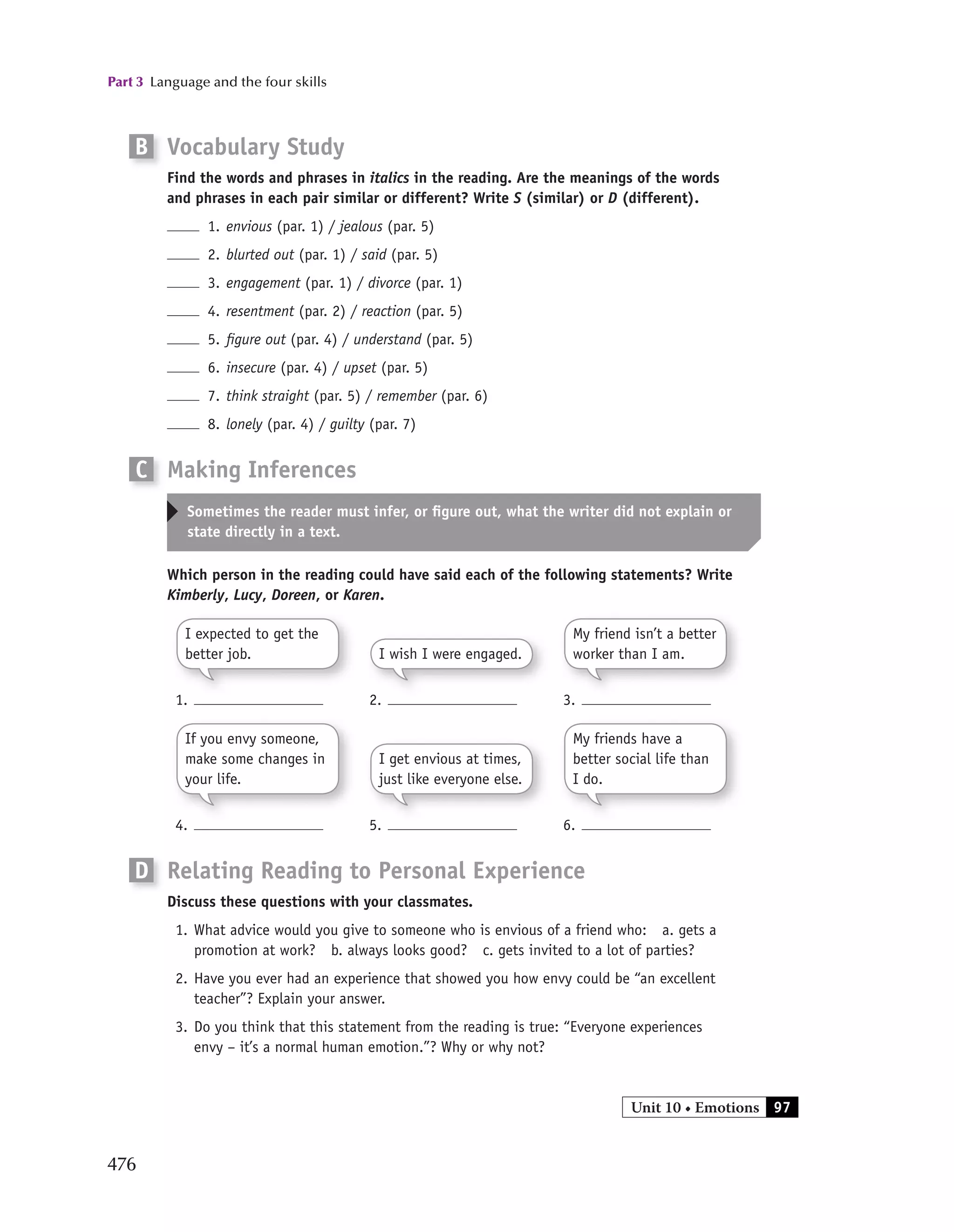
●
● Did I perform the task well? (evaluating)
●
● What caused me to misunderstand part of the text? (evaluating)
Social strategies are actions the learner initiates in order to increase the amount of
interaction and practice he or she can have with speakers of a language. For example,
a learner may deliberately avoid spending time with people who share his or her mother
tongue so that he or she has more opportunities to use English.
Affective strategies are actions the learner takes to control the emotional conditions
involved in language learning, i.e. to reduce anxiety or stress when trying to use the
language. For example, a learner may find it helps to listen to music while he or she is
doing homework.
? Learners use different cognitive strategies in order to help them understand
and learn from materials they read. What strategies do you use for this purpose?
Chapter 2 Second language learning
53
Teaching learners to use effective strategies is known as learner training or strategy
training. Strategy training raises a number of issues:
●
● Are strategies the same across different cultures?
●
● Are strategies consciously employed or implicit?
●
● Does successful strategy use depend on which strategies are used, how often they are
used or how well they are used?
●
● How can strategies be taught?
Oxford (1990) suggests an approach that can be used:
●
● Learners do a task without any strategy training.
●
● They discuss how they did it, and the teacher asks them to reflect on how their strategies
may have facilitated their learning.
●
● The teacher demonstrates other helpful strategies, stressing their potential benefits.
●
● Learners are provided with opportunities to practise the new strategies.
●
● Learners are shown how the strategies can be applied to other tasks.
●
● Learners are provided with further tasks and asked to make choices about which
strategies they will use.
●
● The teacher helps learners to understand the success of their strategy use and assess
their progress toward more self-directed learning.
Approaches to strategy training generally have these characteristics. Dörnyei (2005)
argues that, to develop learners’ awareness of what strategies are and what their role is
in language learning, strategy training must provide activities that link these strategies to
classroom tasks, to offer examples of many different types of strategies, to provide practice
in the use of strategies, and to provide opportunities for learners to reflect on their use of
strategies.
In teaching strategies, Cohen (2011: 683) suggests that four issues are involved:
1 Raising awareness of the strategies learners are already using.
2 Presenting and modelling strategies so that learners become increasingly aware of their
own thinking and learning processes.
3 Providing multiple practice opportunities to help learners move toward autonomous
use of the strategies, through gradual withdrawal of teacher scaffolding.
4 Getting learners to evaluate the effectiveness of the strategies used and any efforts that
they have made to transfer these strategies to new tasks.
? What are some ways in which the strategies used by successful language
learners can be identified?
Part 1 English language teaching today
54
Both explicit teaching of strategies (known as direct instruction) and indirect strategy
instruction (by providing opportunities to practise strategies without explicit instruction)
can be used to help develop awareness and use of strategies; however, many people
recommend a direct approach in which strategy training is incorporated into a regular
language lesson. Chamot (2005) described five stages: preparation, presentation,
practice, evaluation and expansion. Gu (2012) illustrates these in similar terms of a
series of stages a teacher can use in teaching strategies. Firstly, the teacher begins by
introducing and modeling a strategy, following which the students practice using it. This
stage is followed by a period of reflection in which the students review their experience of
using the strategy. Lastly, the students try out the strategy with different learning tasks.
Gu (2012) suggests then that the overall goal of these stages is for learners to become
independent strategy users and to take responsibility for their own choice and use of
strategies.
Much of what teachers do focuses on strategy development, since teachers typically guide
students towards effective ways of learning and of completing learning activities. However,
perhaps the most important outcome of strategy research is the emphasis it gives to
learner autonomy and learner responsibility. It reminds us that learners can take a great
deal of responsibility for their own learning, and that learning is not simply the mirror
image of teaching. It also reminds us that language teaching is not simply concerned with
teaching language; it includes teaching how to learn a language. Through an awareness of
strategies, learners can influence and manage their own learning, and conversations with
learners about what strategies they use, how they use them and when can be a focus of
journal writing and other activities in which learners discuss and share their experiences
with effective, and also less effective, strategies. Awareness of the strategies that can be
used with different kinds of classroom tasks and in dealing with real-life uses of English
outside the classroom can be a regular component of teaching.
Learners also use strategies outside of the classroom. I experienced a good example
of a learner using communication strategies recently, when a student in Guatemala
was asked to drive me to my hotel after an event. He was anxious to make use of the
opportunity to talk to me and entered readily into conversation. However, once I started
speaking at my normal rapid speech rate, he interjected several times, saying, ‘Sorry, I
didn’t get what you said?’ ‘Sorry, do you mean...?’ ‘Could you say that again, please?’
He was using me like a tape recorder, rewinding me to listen again and thus making
use of the opportunity to practise communicating, rather than simply abandoning the
attempt to do so.
2.3 Conclusion
This chapter has explored major learning theories that have contributed to language
teaching as we understand it today. The theories complement each other since they each
focus on different dimensions of second language learning. The main implications of these
theories for language teaching can be summarized here:
Chapter 2 Second language learning
55
●
● Language learning involves extensive practice in order to develop fluent language use.
●
● Second language learning makes use of both implicit and explicit learning, and conscious
awareness of language through ‘noticing’ can facilitate language development.
●
● Learners expand their language skills through taking part in collaborative learning
activities in which the teacher or other learners guide them through the completion
of tasks. Gradually, the learners learn to complete complex tasks with less guidance.
●
● Learning depends on the kinds of input learners receive, both in the classroom and
beyond it. In order to provide input that is accessible to learners and, therefore, can
support language learning, input needs to be made comprehensible, by reducing the
complexity of the language that students work with and by using communication
strategies to help clarify meanings.
●
● Activities that involve interaction and negotiation of meaning provide opportunities
for learners to expand and refine their language resources and to learn through the
feedback such opportunities provide.
●
● Effective language learning involves developing awareness of strategies that can be
used to plan, monitor and evaluate language use, as well as to repair trouble spots in
communication.
Discussion questions
1 Learning through repetition is a key feature of behaviourism. Examine a recent
coursebook. Does it make use of activities that involve repetition of items that have
been presented? What kinds of repetition activities does it make use of?
2 Do you think it is sometimes useful to compare grammatical items or patterns in
English with features of the learner’s first language? Why? What learning theory would
this activity reflect?
3 If possible, collect a sample of errors in the use of the past tense from students with
different first languages. Are the errors similar or do some appear to reflect first
language interference? If not, what could account for the similarities of the errors?
4 Schemas sometimes differ across languages. Compare the activity of ‘the evening meal’,
which is cited as reflecting a schema, and how it might differ in two cultures.
5 Can you think of examples of other tasks that can facilitate restructuring? Compare
with Swain’s example.
6 Can you suggest a classroom listening activity that would involve noticing differences
between use of the present and past tense?
7 Examine a coursebook that teaches spoken communication skills. What acts of
performance does it include?
8 Choose an activity that could be carried out in groups of three and that involves some
form of information gap (see Chapter 3). As the activity is carried out, assign the first
Part 1 English language teaching today
56
person to observe the interactions that take place and to note examples of the following
if they occur: negotiation of meaning, repairing misunderstanding, modifying input.
9 Observe a lesson or a video of a lesson. Can you find examples of how the teacher
provides scaffolding to enable learners to complete a task?
10 Choose any of the strategies that are discussed in the section Language learning as
a strategic process. Can you suggest a way in which this strategy could be taught to
learners?
Further reading
Atkinson, D. (ed.) (2011a) Alternative Approaches to Second Language Acquisition, London:
Routledge.
Cook, V. (2008) Second Language Learning and Language teaching, 4th
edition, London:
Hodder Education.
Ingold, T. (2000), The Perception of the Environment: Essays on Livelihood, Dwelling and
Skill, London: Routledge.
Lightbown P. and Spada N. (2006) How Languages are Learned, 3rd edition, Oxford: Oxford
University Press.
Nunan, D. and Richards, J. C. (eds.) (2014) Language Learning Beyond the Classroom,
New York: Routledge.
Ortega, L. (2009) Understanding Second Language Acquisition, London: Hodder Education.
Saville-Troike, M. (2006) Introducing Second Language Acquisition, New York: Cambridge
University Press.
Skehan, P. (1998) A Cognitive Approach to Language Learning, Oxford: Oxford University
Press.
Swain, M., Kinnear, P. and Steinman, L. (2010) Sociocultural Theory in Second Language
Education, Bristol: Multilingual Matters.
57
Overview
This chapter includes the following key issues:
●
● What are the global teaching approaches and methods?
• The difference between an approach and a method.
• The grammar-translation method.
• The direct method.
• Audiolingualism.
• Situational language teaching.
• Communicative language teaching (CLT).
●
● What special-purpose approaches and methods are there?
• English for specific purposes (ESP).
• Competency-based language teaching (CBLT).
• Content-based instruction (CBI and CLIL).
• Text-based instruction (TBI).
• Task-based language teaching (TBLT).
3
Approaches and
methods
Part 1 English language teaching today
58
3.1 Introduction
The teaching and learning of foreign or second languages has been the subject of debate
for centuries, and, throughout history, many different ideas about how best to teach
languages have been proposed. In the nineteenth century, the grammar-translation
method was widely used up until the end of the century. In the first half of the twentieth
century, the major teaching methods that will be described in this chapter were the direct
method, the structural-situational method, audiolingualism and communicative language
teaching (Richards and Rodgers, 2014). These methods were widely implemented at
different times in different parts of the world. However, by the latter half of the twentieth
century, the nature of language teaching had changed. There was a great diversity of
contexts and needs for the teaching of English, and global methods gave way to a variety
of different approaches more suited to different kinds of learners and for use in different
kinds of teaching situations. Rather than a focus on ‘general English’ that would be
suitable for all types of learner, specially developed courses were needed for immigrants,
for refugees, for learners needing English for occupational or educational purposes and
for international business or travel, and for learners needing English for professional
or academic reading or writing. In this chapter, we will review global language-teaching
approaches and methods, as well those that have been developed for more restricted or
specific purposes. But first it will be necessary to clarify the distinction that is often made
between an approach and a method.
3.2 Global teaching approaches
and methods
The difference between an approach and a method
All instructional designs for the teaching of a second or foreign language draw on a number
of sources for the principles and practices they advocate. For example, they generally
make explicit or implicit use of:
●
● A theory of language: An account of what the essential components of language are and
what proficiency or competence in a language entails.
●
● A theory of learning: An account of the psycholinguistic, cognitive and social processes
involved in learning a language and the conditions that need to be present for these
processes to be activated.
Theories of learning were discussed in Chapter 2, where we saw that some theories of
learning view language learning mainly as a cognitive process, others as an interactive
process and others as a social process. The theory of language and language learning
underlying an instructional design results in the development of principles that can serve
Chapter 3 Approaches and methods
59
When an instructional design is quite explicit at the level of theory of language and learning,
but can be applied in many different ways at the level of syllabus design and classroom
procedures, it is usually referred to as an approach. Communicative language teaching
and the natural approach, which are discussed below, are described as approaches,
because the principles underlying them can be applied in many different ways. Teachers
adopting an approach have considerable flexibility in how they apply the principles to
their own contexts. When an instructional design includes a specific level of application
in terms of objectives, teacher and learner roles and classroom activities, it is referred
to as a method. With a method, there are prescribed objectives, roles for teacher and
learners and guidelines for activities, and, consequently, little flexibility for teachers in
how the method is used. The teacher’s role is to implement the method. Audiolingualism
and situational language teaching (described below) are examples of methods in this
sense. The ‘methods era’, in this sense, is often said to have lasted until the 1990s, by
which time researchers and applied linguists had shifted the focus to teachers and the
process of teaching, rather than methods. The researchers suggested that while teachers
may draw on principles and practices from approaches and methods they have studied or
been trained in, once they enter the classrooms and develop experience in teaching, their
practice is much more likely to reflect an interaction between training-based knowledge,
knowledge and beliefs derived from the practical experience of teaching, and their own
teaching philosophy and principles. This theorization of practice will be described in
Chapter 4.
The following methods discussed below – grammar-translation, the direct method,
audiolingualism and situational language teaching – can all be considered early global-
teaching methods.
to guide the process of teaching and learning. Different instructional designs in language
teaching often reflect very different understandings of the nature of language and of
language learning, as we will see below. The particular theory of language and language
learning underlying an instructional design in turn leads to further levels of specification.
For example:
●
● Learning objectives: What the goals of teaching and learning will be.
●
● The syllabus: What the primary units of organization for a language course will
consist of.
●
● Teacher and learner roles: What roles teachers and learners are expected to play in the
classroom.
●
● Activities: The kinds of classroom activities and techniques that are recommended.
? What languages have you studied? What methods were employed in the classes
you took?
Part 1 English language teaching today
60
Grammar-translation
Grammar-translation was a teaching method that was used for centuries and is probably
still used in some parts of the world today. It was based on a detailed analysis of the
grammar of the language, followed by exercises involving translating sentences and texts
from the mother tongue into the target language. (Although in many parts of the world
today, teachers often make use of the students’ mother tongue when they teach, in order
to present or explain new language, this practice may be called ‘mother-tongue facilitated
teaching’, and has nothing to do with what we refer to as the grammar-translation
method.) The emphasis in the grammar-translation method was primarily on reading and
writing skills and sentence-level practice, and little use was made of spoken language
in the classroom, since in times before globalization there was little practical need for
oral fluency. Jin and Cortazzi (2011: 558) describe grammar-translation as referring to
‘a cluster of practices, including explicit grammatical explanations, detailed examples
illustrating grammatical rules, bilingual vocabulary lists and translation exercises, and
perhaps a focus on reading literary texts’. Consequently, students who studied with this
method often developed a good understanding of the grammar of the language, but little
fluency in speaking. Translation texts typically bore little relation to the way language
is used in the real world, and for many students, language classes meant a tedious
experience of memorizing lists of obscure grammar rules and vocabulary and trying to
produce translations of stilted or literary prose. However, for a more recent view of the
value of translation, see Cook (2010).
Towards the end of the nineteenth century, as cross-border travel became more common,
there was growing recognition in Europe of the need for people to have a spoken command
of other languages. There was, consequently, a need for teaching methods that gave more
attention to speaking, and this led to a movement away from grammar-translation and the
introduction of oral-based methods (although we noted above that grammar-translation
continues to be used in some parts of the world). These oral-based methods did not make
use of translation. The primacy of the spoken language and the need to teach a language
through its spoken, rather than written form was also emphasized by linguists of the time,
and it was during this period that the discipline of phonetics was developed. A teacher
educator points out, however, the possible value of grammar-translation in some contexts:
A case for grammar-translation
For Chinese EFL learners, the main purpose for learning English is to pass exams in order
to further their education or for social mobility, rather than for daily communication.
Therefore, grammar-translation may, to some extent, be helpful for students to achieve
their purpose, though most Chinese scholars are advocating CLT. In my personal
experience as a middle-school student, both grammar and translation were the major
focuses of English textbooks. In order to pass the exams, middle- school students had
to work hard on the grammar items required in the syllabus. As for translation, students
Chapter 3 Approaches and methods
61
Perhaps the reason for the continued use of grammar-translation in countries such as
China, reflects a) the limited command of spoken English of many language teachers,
b) the fact that this was the method their teachers used, c) the sense of control and
authority in the classroom that it gives teachers and d) the fact that it works well in large
classes. Jin and Cortazzi (2011: 558–9) offer the following explanation for the continued
use of grammar-translation, and other traditional teaching approaches, in some parts of
the world:
TAs (traditional approaches) have persisted for longer in most developing parts of the world than
in more economically developed ones, due to the slower development of educational systems
and language teacher training, cultural perceptions and different ways of change, limited learning
resources and finance.
The direct method
One of the first oral-based methods to be developed was known as the direct method, since
it was based on the idea that the meaning of new language items could be communicated
directly through careful presentation techniques and without recourse to translation. The
following procedures were typically used:
were required to translate Chinese sentences into English (and less frequently from
English into Chinese) using phrases, expressions and sentence patterns learnt in the
text. I experienced, in university, a similar format for the grammar-translation method,
though the level of difficulty was much higher. Besides sentence translation, there was
also passage translation in the university textbook.
Viewed from my own English language-learning experience, I think grammar-
translation should not be regarded as a method to be avoided by EFL teachers. There is
no reason why deep understanding of grammar, and good ability to translate, cannot
help students improve their writing or lay a solid foundation for their speaking and
communicative competence, for that matter. On the contrary, a good command of
grammar will give an EFL learner more confidence, among other advantages, to hone
his/her communicative competence. Through translation, EFL learners can also better
understand language items, such as grammar or vocabulary (words and phrases), and
better comprehend the original text. It may, therefore, be said that grammar-translation
certainly has a role to play in the Chinese EFL context, where most students do not
have exposure to an English-speaking environment.
Ao Ran, teacher and teacher educator, Yunnan, China; research associate, Singapore
? Have you ever studied a language using the grammar-translation method? How
useful was it? Why do you think some teachers still feel comfortable using the
grammar-translation method?
Part 1 English language teaching today
62
1 Classroom instruction was conducted exclusively in the target language.
2 Only everyday vocabulary and sentences were taught.
3 Oral-communication skills were built up in a carefully graded progression around
question-and-answer exchanges between teachers and students in small, intensive
classes.
4 Grammar was taught inductively (i.e. without direct explanation or presentation of
grammar).
5 New teaching points were introduced orally.
6 Concrete vocabulary was taught through demonstration, objects and pictures; abstract
vocabulary was taught by association of ideas.
7 Both speech and listening comprehension were taught.
8 Correct pronunciation and grammar were emphasized.
A teacher describes her early teaching experiences with the direct method:
The direct method – my experience
When I began teaching English in Spain over 25 years ago, I worked at a school which
was part of an international chain of language schools, and where we had to follow
the ‘direct method’. As a language learner myself, I had been taught Spanish mainly
through the audiolingual method, which, in my case, involved spending three hours
a day in a language laboratory, using a book specially written by my tutor and aptly
named Sangre, Sudor y Lágrimas or ‘Blood, Sweat and Tears’.
When I discovered the direct method, I remember how excited I felt. First of all, I
attended a special training course, where I was given very specific instructions on how
to apply the principles of the method. What particularly appealed to me, at that time,
was the fact that we would be teaching English only through English – no translation
or lengthy grammar explanations or coursebook, not even any writing as such, at
least during the first year with my elementary group. I had to be quite inventive and
constantly think of how I could build up my students’ communication skills little by
little, through a question and answer routine. It certainly wasn’t always easy to adhere
to the principles of the method.
My students were highly motivated, enjoyed this experience, and, in fact, they did
learn a lot. In hindsight, with more experience and knowledge, I can see that this
method was by no means perfect and does have its drawbacks. However, the point I
would like to make is that before dismissing it out of hand, we can still adapt and use
those techniques which work for us in our own teaching context.
Diana Croucher, teacher, Barcelona, Spain
Chapter 3 Approaches and methods
63
Audiolingualism
Prior to the Second World War, foreign languages were often taught using a reading-based
approach, in which vocabulary study and reading comprehension were the primary focus
(Richards and Rodgers, 2014). During the Second World War, the need for a different
approach to language teaching was recognized in the United States, and the US army
worked with linguists on ways of teaching languages that seldom had been studied
seriously up to that time – languages such as Japanese and Chinese, for example. An
intensive oral-based method was developed (referred to as the ‘army method’) that was
grammatically based, but that required extended oral practice, and that often produced
learners with good oral skills in a relatively short time. As a result, after the Second World
War, the need for more effective language-teaching methods than the reading approach was
recognized, and applied linguists drew on what had been learned from the army method,
and developments in linguistics and psychology, to the development of audiolingualism.
Audiolingualism takes its name from the belief that language learning should be based on
the spoken language, through the medium of audio input (hearing) and spoken output.
Language teaching focused on teaching the basic structures of the language through a
process of drilling and repetition. For example, the following exercise occurs in a widely
used text, published in the United States in the 1950s (Lado and Fries, 1957):
The direct method is sometimes still used in teaching English to young children and there
are good examples of teachers using the direct method on the internet. And we probably owe
to the direct method the fact that the use of the mother tongue and translation have been
ignored, or downplayed, in language teaching ever since – something that many language
learners find counter-intuitive. The direct method was used in many private language
institutes, such as those of the Berlitz chain (where it is still used today), where teaching
was often one-to-one and the teachers were native speakers of the language. However, it
was difficult to implement on a large scale (e.g. in schools), since it demanded a high level
of both teaching skill and language fluency on the part of the teacher, and there were few
published resources to support it. By the 1920s, it had significantly declined, and in the
United States, a reading-based approach that was predicated on the gradual introduction
of words and structures in simple reading texts was used for foreign-language teaching
(Richards and Rodgers, 2014).
? Why do you think the direct method is sometimes used to teach children?
Listen to the statements with here or there. Use this or these to indicate objects here. Use that
or those to indicate objects there. For example:
The water here is fresh. This water is fresh.
The water there is clear. That water is clear.
Part 1 English language teaching today
64
It was assumed that language learning meant building up a large repertoire of sentences
and grammatical patterns, and learning to produce these accurately and quickly in the
appropriate situation. Once a basic command of the language was established through
oral drilling and controlled practice, other uses of language were introduced, usually in
the sequence of speaking, listening, reading and writing.
Techniques that were often employed included memorization of dialogues, question and
answer practice, substitution drills and various forms of guided speaking and writing
practice. Great attention to accurate pronunciation and accurate mastery of grammar was
stressed from the very beginning stages of language learning, since it was assumed that
if students made errors, these would quickly become a permanent part of the learner’s
speech. And much of this practice could be carried out in a language laboratory, where
little input from the teacher was required, rather than in a classroom. A teacher comments
on his experiences studying Indonesian in the late 1970s:
The houses there are old. Those houses are old.
The houses here are new. These houses are new.
1 The trees there are pine trees.
2 The problem here is difficult.
3 The apples here are ripe.
4 The man there is my cousin.
5 The student here is from Nicaragua.
6 The lady there is a teacher.
7 The light here is bright.
8 The men there are engineers.
9 The books here belong to Mary.
10 The house there is fifty years old.
11 The boys there are my nephews.
12 The flower here is a violet.
Memories of audiolingualism
I studied Indonesian (Bahasa Indonesia) at university in the late 1970s. Many of the
classes were in the language laboratory, using classic audiolingual techniques, such as
repetition and substitution drills and question and answer practice. I was on my own in
Chapter 3 Approaches and methods
65
a booth, with enormous headphones and a clunky tape recorder. Sometimes the teacher
would listen in, comment on and correct my production of single sentences practising
certain grammatical patterns. It is fashionable today to dismiss these techniques as
uncommunicative, mechanical, mind-numbing. Although today I certainly would not
choose to learn a foreign language using these techniques exclusively, at the time
I found them very useful and not at all mind-numbing. I value accuracy and loved
being able to take my time to achieve a sense of near perfection in the production of
an utterance.
Neil England, teacher, teacher educator and materials writer, Sydney, Australia
As Neil England observes above, not all aspects of audiolingualism need to be rejected
since it can help develop automaticity in language use, and it still accounts for the way
many teachers conduct some or part of their lessons. Williams and Burden offer the
following explanation for the dominance audiolingualism achieved (1997: 12):
There are a number of possible practical reasons for this. In many countries, teachers are not
provided with professional training; in some contexts the prerequisite for teaching is a primary
education. It can be quicker and easier to teach teachers to use the steps involved in an
audiolingual approach: presentation, practice, repetition and drills. Teachers can also follow the
steps provided in their coursebook in a fairly mechanical way. Teachers who lack confidence
tend to be less frightened of these techniques, whereas allowing language to develop through
meaningful interaction in the classroom can be considerably daunting, and requires teachers
with some professional knowledge. An audiolingual methodology can also be used by teachers
whose own knowledge of the target language is limited.
The same explanation, offered above, also accounts for the success of two widely used
textbook series based on the audiolingual methodology – English 900 (originally published
1964), and Side by Side (originally published 1980–3).
? What sort of skills do you think teachers need to master when using the
audiolingual method?
Situational Language Teaching
Although audiolingualism was developed in the United States, a similar methodology
based on similar principles was developed in the United Kingdom and was known as the
structural–situational method, the oral method, or situational language teaching. This
approach grew out of the work of British TESOL specialists in the first half of the twentieth
century, who took the direct method as their starting point, but developed a vocabulary
and grammatical syllabus to provide the basis for a general English course. By the 1950s, it
was the standard British method and was used in textbooks and teacher-training courses
Part 1 English language teaching today
66
in areas of British ELT influence worldwide. The main characteristics of the method were
(Richards and Rodgers, 2014: 47):
1 Language teaching begins with the spoken language. Material is taught orally before it
is presented in written form.
2 The target language is the language of the classroom.
3 New language points are introduced in situations, rather than as isolated items of
grammar.
4 Vocabulary-selection procedures are followed to ensure that an essential general-
English vocabulary is covered.
5 Items of grammar are graded, following the principle that simple forms should be
taught before complex ones.
6 Reading and writing are introduced once a sufficient lexical and grammatical basis is
established.
In a typical lesson, according to the situational method, a three-phase sequence was
often employed, known as the P – P – P cycle – Presentation, Practice, Production – a
procedure that will be familiar to many teachers who have completed certificate-level
training courses:
●
● Presentation: The new grammar structure is presented, often by means of a conversa-
tion or short text. The teacher explains the new structure and checks students’ com-
prehension of it. Alternatively, the students may be asked to infer a grammar rule from
its use in a text or conversation.
●
● Practice: Students practise using the new structure in a controlled context, through
drills or substitution exercises.
●
● Production: Students practise using the new structure in different contexts, often using
their own content or information, in order to develop fluency with the new pattern.
The P – P – P lesson structure has been widely used in language-teaching materials and
continues, in modified form, to be used today. Many speaking or grammar-based lessons
in contemporary materials, for example, begin with an introductory phase in which
new teaching points are presented and illustrated in some way, and where the focus
is on comprehension and recognition. Examples of the new teaching point are given in
a context that clarifies the meaning of a new form. This is often followed by a second
phase where the students practise using the new teaching point in a controlled context,
using content often provided by the teacher. The third phase is a free-practice period,
during which students try out the teaching point in a free context, and in which real
or simulated communication is the focus. Lessons thus move from a focus on accuracy
(or skill-getting) to fluency (or skill-using), a format which many teachers and materials
developers continue to find useful. A textbook series based on the situational approach
and which was widely used in the 1980s and 1990s was the Streamline series. However,
Chapter 3 Approaches and methods
67
growing dissatisfaction with P-P-P began to develop as early as the 1960s. A common
observation was (Shehadeh, 2005: 14):
Apart from highly gifted and motivated students, most learners working within a structure-based
approach fail to attain a usable level of fluency and proficiency in the second language, even
after years of instruction. In India, [the applied linguist] Prahbu notes that the structure-based
courses required ‘a good deal of remedial teaching, which, in turn, led to similarly unsatisfactory
results’, with school leavers unable to deploy the English they had been taught, even though
many could form grammatically correct sentences in the classroom.
Others criticized the view of language implicit in P – P – P: it suggests that grammar is
learned incrementally – one structure at a time, through mechanical practice rather than
communicative language use – an issue that is addressed by advocates of communicative
language teaching and task-based teaching, which are discussed below. However, since
there is little published research on how teachers actually implemented P – P – P, it
is difficult to know if the unsatisfactory results, frequently cited for the method, were
attributable to the method itself, poor levels of application of it, poor teaching, or were
due to unfavourable classroom-learning conditions that would make learning difficult, no
matter what method was used.
? Do you think a P – P – P lesson format (or a modification of it) still has its place
in language teaching?
Both audiolingualism and situational language teaching began to fall out of favour in
the 1970s, as the theories on which they were based became discredited, due to the
emergence of new paradigms in both language theory and language-learning theory. The
behaviourist model of learning, based on imitation and repetition, was being challenged
by cognitive and interactive views of language and language learning (see Chapter 2).
Language was no longer viewed as a set of fixed patterns and rules to be learned by
exposure and imitation, but was seen to draw on cognitive processing that enabled learners
to build up their linguistic competence through exposure and interaction. Both cognitive
and interactive theories of learning offered alternative accounts of learning (Chapter 2).
Suddenly, drills, pattern practice, substitution tables, memorization of dialogues and
other practices associated with audiolingualism and situational language teaching were
no longer popular, as a new ‘communicative’ paradigm in language teaching emerged. This
came to be known as communicative language teaching – the next global method – and
was a dominant paradigm in language teaching for the next 20 years.
? Do you think some of the techniques associated with the audiolingual and
situational methods, such as the memorization of short dialogues, choral and
substitution drills and teacher-led question and answer practice, have a place
in language teaching? If so, why?
Part 1 English language teaching today
68
Communicative language teaching
Just as the direct method was a response to the need for a greater emphasis on fluency
in spoken second-language communication towards the end of the nineteenth century, a
similar change in needs together with changes in language learning theories prompted a
rethink of approaches to language teaching in Europe in the 1960s and 1970s. This was
the period when the process we now refer to as globalization was beginning to have an
impact on travel, communications, education, commerce and industry. The world was
becoming smaller, and proficiency in English was becoming a more urgent priority for
countries in many parts of the world. The language-teaching profession was challenged to
provide a response. In reviewing the status of language teaching at that time, educators
concluded that the assumptions underlying audiolingualism and similar methods needed
to be reviewed, resulting in what eventually became a paradigm shift in approaches to
language teaching.
In reviewing teaching practices and the assumptions they were based on at the time,
applied linguists argued that grammar-based methods such as audiolingualism and
situational language teaching only focused on grammatical competence as the underlying
basis for second language proficiency. Researchers felt that what was needed in order
to use language communicatively was communicative competence, a construct proposed
by Hymes (1973) to describe a person’s knowledge of how to use language appropriately
as a communicative resource. Communicative competence was said to include the
ability to use language for different communicative purposes (e.g. description, narration,
exposition, complaints, apologies, suggestions) and the ability to use language that is
appropriate to the context of its use, i.e. the setting, the participants and the activity
being accomplished. This view seemed to provide a new approach to language teaching.
It could also draw on interactive and learner-centred philosophies of learning to support
its teaching practices.
The result was communicative language teaching or CLT. CLT created a great deal of
enthusiasm and excitement when it first appeared, and language teachers and teaching
institutions all around the world soon began to rethink their teaching, syllabuses and
classroom materials (Hymes, 1973; Canale and Swain, 1980; Widdowson, 1979; Paulston,
1974). The support CLT received from prominent academics at the time as well as from
organizations like the British Council, in addition to the fact that it provided a basis for a
new generation of textbooks, meant that it soon became widely known and accepted. In
planning language courses within a communicative approach, grammar was no longer
the starting point. New approaches to language teaching syllabuses were needed, and
different syllabus options were proposed, as well as a different focus for classroom
activities. The concept of functional syllabuses (organized around communicative
functions, or speech acts, such as making requests, giving advice, making suggestions,
describing wishes and needs and so on) appeared during this period, and the European
regional organization, The Council of Europe, developed a series of new syllabus
frameworks organized around topics, functions and situations, as well as vocabulary
and grammar covering the basic, intermediate and advanced proficiency levels (van Ek
and Alexander, 1980).
Chapter 3 Approaches and methods
69
Since the language classroom is intended as preparation for survival in the real world,
and since real communication is a defining characteristic of CLT, an issue which soon
emerged was the relationship between classroom activities and real life. Some argued that
classroom activities should, as far as possible, mirror the real world and use real-world,
or ‘authentic’, sources as the basis for classroom learning. Clarke and Silberstein (1977:
151) thus argued:
Classroom activities should parallel the ‘real world’ as closely as possible. Since language is a
tool of communication, methods and materials should concentrate on the message and not the
medium. The purposes of reading should be the same in class as they are in real life.
Others (e.g. Widdowson, 1987) argued that it is not important if classroom materials
themselves are derived from specially created texts and other forms of input, as long
as the learning processes they facilitate are authentic. Negotiation of meaning, noticing
and the movement from controlled to automatic processing (see Chapter 2) are examples
of authentic learning processes, and these can be facilitated by classroom materials
and activities that are specially designed with these processes in mind. However, since
the advent of CLT, textbooks and other teaching materials have taken on a much more
‘authentic’ look, reading passages are designed to look like magazine articles (if they
are not, in fact, adapted from magazine articles), and textbooks are designed to similar
standards of production as real-world sources, such as popular magazines. Chapter 18
covers, in depth, the question of authenticity in textbooks.
? Widdowson discusses the importance of authentic learning processes. What
would be an example of an authentic and an inauthentic process?
The communicative syllabus
Traditional language syllabuses usually specified the vocabulary students needed to
learn and the grammatical items they should master, normally graded across levels from
beginner to advanced. (Syllabus design is discussed in Chapter 17.) Several new syllabus
types were proposed by advocates of CLT. The first widely adopted communicative syllabus,
developed within the framework of classic CLT, was termed the threshold level (van Ek and
Alexander, 1980). It described the level of proficiency learners needed to attain to ‘cross
the threshold’ and begin real communication. The threshold syllabus hence specifies
topics, functions, notions and situations, as well as grammar and vocabulary.
As well as rethinking the nature of the syllabus, the new communicative approach to
teaching prompted a rethinking of the nature of classroom-based language teaching. It
was argued that learners learn a language through the process of communicating in it,
and that communication that is meaningful to the learner provides a better opportunity
for learning than a grammar-based approach. Under the influence of CLT theory, it
was argued that grammar-based methodologies should be replaced by functional and
interaction-based teaching: accuracy activities, such as drill and grammar practice, were
Part 1 English language teaching today
70
replaced by fluency activities, based on interactive small-group work. Some proposed
a ‘fluency-first’ pedagogy (Brumfit, 1984), in which students’ grammar needs would be
determined on the basis of performance on fluency tasks, rather than predetermined by a
grammatical syllabus. However, in practice, grammar syllabuses were rarely abandoned,
and language courses have continued to reflect a communicative approach, such as my
Interchange series (4th edition, Richards et al., 2012) and my Four Corners series (Richards
and Bohlke, 2011). The difference between more traditional approaches and CLT courses
is that grammar is integrated with communicative practice and linked to communicative
outcomes. Jin and Cortazzi comment (2011: 569):
Grammar after being in a bypass in audiolingual and early communicative periods is widely
reinstated to a more central position in TESOL theories. This is evident in streams of corpus-based
reference and pedagogic grammars. It is clear from the steady flow of research-based rationales
and considerations for applying grammar in L2 classrooms. Questions remain about attention
to grammar (when and how, at which language levels); about whether to integrate grammar
with other skills or have some separate treatment, about deductive or inductive treatment or
both, and about the use of descriptive terms in grammar teaching. In mainstream textbooks,
grammar is usually a focus in specific sections of explanations followed by limited practice
after considerable work with language in texts and classroom interaction, so that grammatical
patterns under consideration will have already been exemplified in meaningful contexts.
Nevertheless, the communicative syllabus may have limitations in some environments, as
one teacher points out:
The limitations of communicative language teaching
From the theoretical perspective, CLT seems to be a better teaching method for
the Chinese context, because the learning outcomes it defines are mostly what
Chinese learners of English lack and need. In reality, however, there are practicalities
which may render the implementation of CLT quite daunting, or may even hinder
the reception of this method in China. For example, from the teacher’s standpoint,
adhering to the principles of CLT may mean sticking to a set of ideals that are hardly
achievable in real-life situations. If the focus of English language teaching in China
is real communication, then students may not be able to have good exam results, in
exams such as the National College Entrance Examination. Nationwide, adoption of
CLT may require a radical overhaul of the whole national testing system. Predictably,
more human and financial resources would have to be committed to the overhaul.
While it is true that English language teachers in China should provide opportunities
for learners to experiment and try out what they have learnt, the opportunities they
can provide for their students to put what they have learned into practice, through
communicative activities, are, in fact, very limited. There used to be an ‘English
Corner’, where students could go and practise their English at least once a week.
But not any more. ‘English Corner’, as it were, has given way to virtual chat rooms,
such as QQ. Teachers should simulate as many communicative activities in class as
Chapter 3 Approaches and methods
71
class time permits, but, then again, this is not quite practicable because of the large
size of Chinese classes ([smaller classes] of English majors in some universities, of
course, [are] an exception). Teachers who are tolerant of students’ errors may, in some
cases, either be considered by their students to be too incompetent to identify their
errors (especially in universities), or be blamed by students for mistakes they make in
the exams, because it is generally deemed to be a teacher’s responsibility to correct
students’ mistakes, or errors, in the English language-learning process. If Chinese EFL
students are left to induce and discover grammar rules, they would have to receive
substantial exposure to English in order for the induction and discovery to take place.
However, students’ heavy study load (especially for middle-school students and non-
major university students) does not always allow them to spend much time on English.
To put it in a nutshell, the feasibility of CLT in China may be questionable if students
lack an English-speaking environment.
Ao Ran, teacher and teacher educator, Yunnan, China; Singapore
Ao Ran’s comments remind us that methods developed from one context cannot always
be transported to a very different context and expected to work in the same way. In China,
the examination system, class size and an overcrowded curriculum often do not provide
conditions favourable for learning through communicative interaction.
Communicative practice
The essence of CLT is the assumption that learners learn a language through using it
for authentic communication. Drawing on both interactive and constructivist views of
language learning (see Chapter 2), it was assumed that learning would be an outcome of
engaging in meaningful communication. This called for the use of classroom techniques
and activities that required learners to use their communicative resources and engage
in negotiation of meaning (Breen and Candlin, 1980). Activities of this kind made use of
collaborative learning in pairs or small groups, and included:
●
● Information-gap activities: Activities that require learners to communicate in order to
get information they do not possess.
●
● Jigsaw activities: Activities in which the class is divided into groups, and each group
has part of the information needed to complete the activity.
●
● Task-completion activities: Puzzles, games, map-reading and other kinds of classroom
tasks in which the focus is on using one’s language resources to complete a task.
●
● Information-gathering activities: Student-conducted surveys, interviews and searches
in which students are required to use their linguistic resources to collect information.
●
● Opinion-sharing activities: Activities where students compare values, opinions and
beliefs, such as a ranking task in which students list six qualities, in order of importance,
which they might consider when choosing a date or spouse.
Part 1 English language teaching today
72
●
● Information-transfer activities: These require learners to take information that is
presented in one form and represent it in a different form. For example, they may read
instructions on how to get from A to B and then draw a map showing the sequence, or
they may read information about a subject and then represent it as a graph.
●
● Reasoning-gap activities: These involve deriving some new information from given
information, through the process of inference, practical reasoning, etc. – for example,
working out a teacher’s timetable on the basis of given class timetables.
●
● Role plays: Activities in which students are assigned roles and improvise a scene or
exchange, based on given information or clues.
A lesson plan for a communicative lesson is given in Appendix 1.
? What kinds of interaction and language use do you think the activities listed
above are likely to facilitate?
An issue that arises with activities of this kind, however, is whether fluency work develops
fluency at the expense of accuracy. In doing communicative tasks, the focus is on getting
meanings across, using any available communicative resources. This often involves a heavy
dependence on vocabulary and communication strategies, and there is little motivation to
use accurate grammar or pronunciation. It was soon found that communicative practice
thus requires extra attention on the part of the teacher, in terms of preparing students
for a task or follow-up activities that provide feedback on language use. The promise
that communicative classroom activities would help learners develop both communicative
competence as well as linguistic competence did not always happen. Programmes where
there was an extensive use of ‘authentic communication’, particularly in the early stages
of learning, reported that students often developed fluency but not accuracy, resulting in
learners with good communication skills, but a poor command of grammar and a high
level of fossilization (Higgs and Clifford, 1982). In this case, many teachers find the need
to build more accuracy-focused activities into their lessons, ensuring that learners have
opportunities to notice errors in their own production, as well as activities that involve
students’ monitoring their own language development over time (Lightbown and Spada,
1990). Technology offers a useful means of doing this, if learners keep a video record of
their performance at different stages during a course (see Chapter 19). However, like all
approaches, communicative-practice activities may work more effectively in some contexts
than in others, as this teacher notes:
Second thoughts on CLT
Several years ago, in Singapore, I taught on a course for a group of Cambodian primary
and secondary school teachers of English. The objectives of the course were to develop
the teachers’ proficiency in English and their confidence in using communicative
activities. In one lesson, I was showing the teachers examples of information-gap
Chapter 3 Approaches and methods
73
Krashen and the ‘natural approach’
An alternative interpretation of communicative language teaching was developed by two
American language teaching specialists in the 1980s – Tracy Terrell and Steven Krashen –
which they termed the natural approach – and which had a considerable impact on
language teaching particularly in the United States in the 1980s and 1990s. It was
described as an attempt to incorporate the ‘naturalistic’ principles observed in studies
of second language acquisition. Krashen and Terrell’s account of their theories appeared
in their book The Natural Approach (Krashen and Terrell, 1983). Central to the natural
approach is Krashen’s language acquisition theory, the central features of which are as
follows:
The acquisition/learning hypothesis: This contrasts two distinctive ways of second language
development. Acquisition refers to an unconscious process that involves the naturalistic
development of language proficiency through understanding language and through using
language for meaningful communication. Learning, by contrast, refers to a process in
which conscious rules about a language are developed. It results in explicit knowledge
about the forms of a language and the ability to verbalize this knowledge. Formal teaching
is necessary for ‘learning’ to occur, and correction of errors helps with the development of
learned rules.
The monitor hypothesis: This states that conscious learning can function only as a monitor
or editor that checks and repairs the output of the acquired system. Three conditions limit
the successful use of the monitor:
1 Time. There must be sufficient time for a learner to choose and apply a learned rule.
2 Focus on form. The language user must be focused on correctness or on the form of the
output.
3 Knowledge of rules. The performer must know the rules. The monitor does best with
rules that are simple in two ways. They must be simple to describe and they must not
require complex movements and rearrangements.
activities taken from different published materials. I got them to take on student roles
and do one of the activities. It was one of those ‘Spot the ten differences between the
two pictures’ tasks. The teacher ignored my ‘Don’t show your picture to your partner’
instructions, immediately placed both pictures on the desk and circled the differences.
We talked about why, from my perspective, the activity was a failure. The teachers
told me they found it a bit strange to deliberately create artificial communication
barriers, when the task of identifying the differences between the pictures could be
much more efficiently achieved by working in a no-nonsense cooperative way. It was
a bit of a critical incident for me, reminding me that some of the principles underlying
communicative approaches may not make cultural sense in some contexts.
Neil England, teacher, teacher educator and materials writer, Sydney, Australia
Part 1 English language teaching today
74
The natural order hypothesis: This states that grammatical structures are acquired in
a predictable order. Errors are often signs of naturalistic developmental processes, and
during acquisition (but not during learning), similar developmental errors occur in learners
no matter what their native language is.
The input hypothesis: This seeks to explain the relationship between what the learner is
exposed to of a language (the input) and language acquisition. It involves four main issues:
1 The hypothesis relates to acquisition, and not to learning.
2 People acquire language best by understanding input that is slightly beyond their cur-
rent level of competence. This is referred to as I + 1 (i.e. input plus one).
3 The ability to speak fluently cannot be taught directly; rather, it ‘emerges’ independently
in time, after the acquirer has built up linguistic competence by understanding input.
4 If there is a sufficient quantity of comprehensible input, I + 1 will usually be provided
automatically. Comprehensible input refers to utterances that the learner understands
based on the context in which they are used as well as the language in which they are
phrased. When a speaker uses language so that the acquirer understands the mes-
sage, the speaker ‘casts a net’ of structure around the acquirer’s current level of com-
petence, and this will include many instances of I + 1.
The affective filter hypothesis: This describes the learner’s emotional state or attitudes as
an adjustable filter that freely passes, impedes, or blocks input necessary to acquisition.
A low affective filter is desirable, since it impedes or blocks less of this necessary input.
These five hypotheses have obvious implications for language teaching. In sum, these are:
1 As much comprehensible input as possible must be presented.
2 A pre-determined language syllabus is not needed. Language knowledge and aware-
ness should arise out of meaningful and communicative language use.
3 Whatever helps comprehension is important. Visual aids are useful, as is exposure to
a wide range of vocabulary rather than the study of syntactic structure.
4 The focus in the classroom should initially be on listening and reading; speaking should
be allowed to ‘emerge’.
5 In order to lower the affective filter, student work should centre on meaningful com-
munication rather than on form; input should be interesting and so contribute to a
relaxed classroom atmosphere.
? What kinds of classroom activities do you think can help lower a learner’s
‘affective filter’?
The natural approach was very much a product of the 1980s and attracted a great deal
of interest at that time. It reflects an approach or philosophy that could be applied in
different ways according to the teaching context. It was particularly influential in
Chapter 3 Approaches and methods
75
Krashen’s home state of California, where it helped frame an approach to the teaching of
language minority students (Krashen, 1981). In practice, it rejected the need to develop
language courses around a pre-planned grammatical syllabus and advocated instead an
experiential approach to learning based on providing learners with content-rich activities
and materials. In view of the interest Krashen and Terrell’s somewhat radical proposal
attracted, numerous articles as well as full-length books were devoted to debating it,
some rejecting both the theory and research Krashen used in support of the principles
of the natural approach (e.g. Gregg, 1984; McGlaughlin, 1978), as well as its practical
applications. However, in California at least, policy changes in recent years have made
the natural approach unsuited to the needs of teachers in public schools. As with public
education in many other countries, teachers are now required to teach to standards
that specify the language skills learners need to develop at different stages in the school
curriculum.
? What do you think are some ways in which the right kind of comprehensible
input can be provided in teaching?
CLT and the local teaching environment
One of the most positive outcomes of CLT was the generation of a new wave of enthusiasm
in language teaching and a transformation of the resources available to teach English.
The constraints imposed on teachers and materials designers by the somewhat rigid
methodologies of audiolingualism and situational language teaching were removed, as
the focus shifted to learner-focused materials and activities which drew on authentic or
semi-authentic texts, role play and other communicative classroom activities. At the same
time, some critics posed a note of caution, as alluded to in the discussion above on the
communicative syllabus and practice activities.
In an important book, Holliday (1994a) argued that the communicative orthodoxy taught
to teachers who are native-speakers of English reflects a view of teaching and learning
that closely reflects culturally bound assumptions, derived from the cultures of origin –
the United Kingdom, Australasia and North America – which Holliday refers to as BANA
entities. The teaching methods developed in BANA centres reflect the kinds of learners
who study in institutes and universities serving students who generally have instrumental
reasons for learning English, namely for academic or professional purposes or as new
settlers. Their needs, however, may be very different from students learning English in
state-based educational programmes (e.g. public schools) in other parts of the world –
studying in tertiary, secondary or primary settings – and hence referred to by Holliday
as TESEP contexts. Holliday describes these two learning environments as creating very
differentcontextsforlearningandcontainingverydifferentparameters.Methodsdeveloped
in one context (e.g. BANA settings) will not necessarily transfer to others (TESEP settings),
and, as Holliday points out, most of the literature on English language teaching reflects a
primarily BANA understanding of teaching, learning, teachers, learners and classrooms.
In these contexts, ‘English language teaching tends to be instrumentally oriented, in
Part 1 English language teaching today
76
that it has grown up within a private language school ethos where there has been a
considerable freedom to develop classroom methodology as a sophisticated instrument
to suit the precise needs of language learners’ (Holliday, 1994a: 4). In TESEP settings,
by comparison, ‘English in these institutions is taught as part of a wider curriculum
and is, therefore, influenced and constrained by wider educational, institutional and
community forces, quite different from those in the BANA sector’ (ibid.).
A more radical critique of the influence of communicative language teaching and
similar Western or ‘centre-based’ methods is given by Kumaravadivelu (2012). He
argues that ‘centre-based’ methods are by their nature developed for very general
situations, reflecting idealized contexts for teachers and learners. However, the
contexts in which teachers work are very varied and situation specific. No general
teaching method can hope to match the everyday realities teachers have to deal with
in their practice. General methods, Kumaravadivelu (2012) suggests, reflect a ‘one-
size-fits-all’ approach to teaching, one that assumes that teachers and learners are
all very similar.
Textbook authors, however, generally respond with the claim that they do not intend
their books to be used as coursebooks, but rather as ‘sourcebooks’ – as a springboard for
teachers to adapt and supplement to meet the needs of their local contexts, i.e. as support
for improvisational teaching (see Chapter 4).
Despite these criticisms, communicative language teaching had become the global solution
to language teaching by the 1970s and 1980s. It was adopted worldwide as the basis for
global ESL/ELT textbooks (see Chapter 18) – courses that typically covered all four skills,
as well as grammar, but which were organized around a communicative syllabus and
a communicative methodology. Through expanded teacher training, most programmes
found a way to make the new methodology work for them, and to customize it as needed to
their local teaching situations. An example of a communicative lesson plan can be found
in Appendix 1.
So had the language-teaching problem been solved once and for all? Not really. Not
everyone who wanted to learn English aimed to learn ‘general English’. The need to develop
approaches suitable for learners with particular learning needs led to the development
of a number of other approaches to teaching. We will refer to these as special-purpose
approaches and methods, since they were generally a response to particular learning
needs and circumstances.
3.3 Special-purpose approaches and
methods
Among the factors prompting the need for approaches that went beyond CLT were the
following:
Chapter 3 Approaches and methods
77
●
● The internationalization of education: Growing numbers of international students in
English-speaking countries, such as Canada, the United States and the United King-
dom, were studying in colleges, universities and other tertiary institutions. They need-
ed to acquire the language skills to pursue their studies in English.
●
● Resettlement: Following the Vietnam War and conflicts in other parts of the world, large
numbers of refugees were admitted to the United States, Australia and other countries.
Many had no knowledge of English and needed intensive instruction to prepare them
for life in their new countries.
●
● Immigration: Large numbers of immigrants also settled in English-speaking countries,
and schools had to provide support that would enable school-age learners to follow
mainstream education.
●
● Globalization: As English took on a greater role in international trade, business,
commerce and travel, millions of learners needed language skills for these purposes.
●
● Science and technology: English was now the main language used for publications
in the fields of science and technology, requiring advanced reading skills for many
learners.
●
● The privatization of English language teaching: The growing demand for English language
skills has led to the private sector taking a greater responsibility for the provision of
language teaching, through private institutes of different kinds that offer learners of all
ages an opportunity to develop communicative skills in English – something they may
not be able to acquire in a school exam-based curriculum. In such schools, although
many learners may simply want to improve their ‘general English’, others may be
studying English for work or study-related purposes and hence need a different kind
of course.
The issues above prompted the need for language courses designed to address issues that
were often specific to particular teaching/learning situations. We will consider these next.
English for specific purposes
The language teaching profession from the 1950s and 60s recognized that many learners
needed English in order to use it in specific occupational or educational settings. For
these learners, it would be more efficient to teach them the specific kinds of language and
communicative skills needed for particular roles (e.g. that of an engineering student, nurse,
engineer, flight attendant, pilot or biologist), rather than just to concentrate on more and
more general English. This led to the approach known as English for specific purposes, or
ESP. ESP is not a method, but rather an approach to designing a curriculum that is built
around learners’ communicative needs. (Curriculum design is the focus of Chapter 17.) In
ESP courses, the communicative approach is generally used but the materials themselves
are tailored to specific needs. It makes use of needs analysis – the use of observation,
surveys, interviews, situation analysis and analysis of language samples collected in
different settings – in order to determine the kinds of communication learners would
Part 1 English language teaching today
78
need to master and the language features of particular settings, if they were in specific
occupational or educational roles. The focus of needs analysis was to determine the
characteristics of a language when it is used for specific, rather than general, purposes.
Such differences might include:
●
● Differences in vocabulary choice.
●
● Differences in grammar.
●
● Differences in the kinds of texts commonly occurring.
●
● Differences in functions.
●
● Differences in the need for particular skills.
ESP courses soon began to appear addressing the language needs of university students,
nurses, engineers, restaurant staff, doctors, hotel staff, airline pilots and so on. The
methodology used to teach these courses was not prescribed, although often it was generally
based on CLT and also reflected the skill-based and performance-based approaches
which were described in Chapter 2. Clark (1987: 197) suggests that the influence of these
approaches was reflected in the design of courses like these, since they first identify a
set of target behaviours to be acquired (skills, functional ability, etc.), which are broken
down into smaller units – that is, small elements of knowledge and part-skills. A teacher
educator describes ESP in practice at a university:
Developing an ESP course
In my most recent place of work, most of our language teaching is done in what
we call an ‘embedded’ form. All decisions relating to the role of English in the
curriculum are made jointly by a subject [lecturer] and an English lecturer.
Different levels and types of embedding are offered. In some cases, the English
lecturer teaches classes as part of the course, using materials and examples from
that subject. In others, we teach classes together, alternating between content and
language. The key for us is to increase the relevance of our instruction for the
students; rather than offering classes or support independent from students’ study
(which many of them have no time for, anyway), we always try to predict what type
of help students will need and when. By planning ahead with the subject lecturers,
we can, for example, give a class to law students on drafting a letter, a few weeks
before they have to hand in a letter to a client, as part of their course assessment.
This ensures that the students see English as an integral part of their degree, not
simply as a time-consuming add-on.
Hayo Reinders, teacher educator, Auckland, New Zealand
? Do you think teachers who teach ESP courses need different kinds of knowledge
and skills from teachers who teach general English courses?
Chapter 3 Approaches and methods
79
Competency-based language teaching (CBLT)
Competency-based instruction is an approach to the planning and delivery of courses
that has been in widespread use since the 1970s. What characterizes a competency-
based approach is the focus on the outcomes of learning, as the driving force of teaching
and the curriculum. The application of its principles to language teaching is called
competency-based language teaching. See Appendix 2 for an example of a competency-
based lesson. Because this approach seeks to teach the skills needed to perform real-
world tasks, it became widely used, from the 1980s, as the basis for many English
language programmes for immigrants and refugees, as well as for work-related courses
of many different kinds. It is an approach that has been the foundation for the design of
work-related and survival-oriented language teaching programmes for adults. It seeks
to teach students the basic skills they need in order to prepare them for situations they
commonly encounter in everyday life. Recently, competency-based frameworks have
become adopted in many countries, particularly for vocational and technical education.
They are also increasingly being adopted in national language curriculums. Auerbach
(1986) identified eight features involved in the implementation of CBLT programmes
in language teaching, in its early days, and which are true of many such programmes
today:
1 A focus on successful functioning in society: The goal is to enable students to become
autonomous individuals capable of coping with the demands of the world.
2 A focus on life skills: Rather than teaching language in isolation, CBLT teaches language
as a function of communication about concrete tasks. Students are only taught those
language forms/skills required by the situations in which they will function. These
forms are normally determined by needs analysis.
3 Task, or performance-oriented, instruction: What counts is what students can do as a
result of instruction. The emphasis is on overt behaviours, rather than on knowledge
or the ability to talk about language and skills.
4 Modularized instruction: Language learning is broken down into meaningful chunks.
Objectives are broken down into narrowly focused sub-objectives so that both teachers
and students can get a clear sense of progress.
5 Outcomes are made explicit: Outcomes are public knowledge, known and agreed upon
by both learner and teacher. They are specified in terms of behavioural objectives so
that students know what behaviours are expected of them.
6 Continuous and ongoing assessment: Students are pre-tested to determine what
skills they lack, and post-tested after instruction on that skill. If they do not
achieve the desired level of mastery, they continue to work on the objective and are
retested.
7 Demonstrated mastery of performance objectives: Rather than in the traditional paper-
and-pencil tests, assessment is based on the ability to demonstrate pre-specified
behaviours.
Part 1 English language teaching today
80
8 Individualized, student-centred instruction: In content, level and pace, objectives
are defined in terms of individual needs; prior learning and achievement are taken
into account in developing curriculums. Instruction is not time-based; students
progress at their own rates and concentrate on just those areas in which they lack
competence.
Therefore, CBLT is often used in programmes that focus on learners with very specific
language needs. In such cases, rather than seeking to teach general English, the specific
language skills needed to function in a specific context is the focus. This is similar, then,
to an ESP approach. There, too, the starting point in course planning is an identification
of the tasks the learner will need to carry out within a specific setting and the language
demands of those tasks. (The Common European Framework of Reference also describes
learning outcomes in terms of competencies – see Chapter 17.) The competencies needed
for successful task performance are then identified and used as the basis for course
planning. The teaching methods used may vary, but typically are skill-based, since the
focus is on developing the ability to use language to carry out real-world activities. An
example of a lesson from a competency-based textbook is given in Appendix 2.
? Identify some of the competencies you think students would need to master in
English in order to function in the following situations:
●
● As a tour guide.
●
● As a nurse.
●
● As an English teacher.
Content-based instruction (CBI) and content and
language integrated learning (CLIL)
Another need that emerged from the 1950s was a growing demand for courses that
prepared students to study in English-speaking countries. In many English-speaking
countries, such as the United States, Canada, Britain and Australia, large numbers of
students whose mother tongue is not English (international students, immigrants) need
English in order to enter schools, colleges and universities, and to follow content courses
in English. This provided the motivation for an approach to language teaching known
initially as content-based instruction (CBI) and, more recently, referred to in Europe as
content and language integrated learning, or CLIL. Richards and Rodgers (2014) compare
CBI and CLIL as follows:
Both CBI and CLIL are part of a growing trend in many parts of the world to use English as
a medium of instruction (Graddol, 2006). They have features in common, however they are
not identical. CBI often involves a language teacher teaching through English, working with a
content teacher to co-teach a course, or a content teacher designing and teaching a course
for ESL learners. CLIL often involves a content teacher teaching content through a second
or foreign language, as does CBI, but also may involve content from subjects being used in
language classes. That is, the CLIL curriculum may originate in the language class, whereas
Chapter 3 Approaches and methods
81
CBI tends to have as its starting point the goals of a content class. CBI emerged somewhat
organically advocated by a number of academics and educators, supported by an extensive
literature extending over a considerable period of time but without official sanction. CLIL, on the
other hand, was officially proposed in a European Commission policy paper in which member
states were encouraged to develop teaching in schools through the medium of more than one
language. The acronym ‘CLIL’ has been widely circulated within members of the European
community since 1994 and has become, by decree ‘the core instrument for achieving policy
aims directed at creating a multilingual population in Europe’ (Dalton-Puffer and Smith, 2007).
And unlike CBI, CLIL aims at not only stimulating multilingualism of all citizens in the European
community but strives as well to ‘preserve the independence and health of local languages’
(www.eurydice.org/index.shmtl). This is because CLIL does not represent an immersion program
in an ESL setting, but rather the development of English-language skills in those who will use it
as a lingua franca.
With both CBI and CLIL, content, or information, provides the main organizing principle
for a course, and language is taught through its integration with content, rather than
being taught separately. Of course, any language lesson involves content, whether a
grammar lesson, a reading lesson or any other kind of lesson. Content of some sort has
to be the vehicle that holds the lesson or the exercise together, but in traditional teaching
methods, content is selected after other planning decisions have been made. In other
words, grammar, vocabulary, texts, skills, functions, etc. are the starting point in planning
the lesson or the coursebook. Once these decisions have been made, content is selected.
Content refers to the information or subject matter that learners learn or communicate
through language, rather than the language used to convey it. A teacher describes how
she used content effectively as the organizing principle of a unit of study:
Create your own religion: a content-based project
Teaching a third-year oral and written English language class for English majors at
Bukhara State University in Uzbekistan, I was tasked with covering an odd list of topics
that the National Ministry of Education had deemed necessary for all students to know.
One such theme, which corresponded to a chapter in a book written by the country’s
president, was called ‘High spirituality is the foundation of our future’. The only
requirement for the unit was to have students read the chapter and discuss it; beyond
that, I had complete freedom to select additional readings and activities to encourage
language development, while supporting students’ learning about spirituality and
world religions.
Rather than ask students to research a particular world religion, which would have
been difficult, given the limited resources available in Central Asia at the time (1999),
I, instead, assigned my class a few readings on spirituality and religion, in general, and
then gave them a small-group project to create their own imaginary religions. During
class time, we discussed various factors that made a religion different from a cultural
practice – such as core beliefs, deities, rites and holy texts – as well as factors that
Part 1 English language teaching today
82
CBI was also promoted on the basis that it better supported language learning than
traditional approaches. The assumption was that people learn a language more
successfully when they use the language as a means of acquiring information, rather
than as an end in itself, and because CBI better reflects learners’ needs for learning a
second language. In addition, content provides a coherent framework that can be used to
link and develop all of the language skills. CBI can be used as the framework for a unit
of work, as the guiding principle for an entire course, as a course that prepares students
for mainstreaming or as the rationale for the use of English as a medium to teach some
are similar to cultural practices, but may cross cultures that share a religion – such
as ethical behaviours, holidays and food practices. Using the religions with which
my Uzbek students were most familiar, Islam and Christianity, we identified which
practices were tied to the different religions, and which were shared by the students’
common Uzbek culture.
The final project for the unit challenged students to use their new knowledge of cultural
and spiritual practices to make up a new religion. I reminded them that I was not
asking them to believe in this religion, but, rather, to use their imaginations to make
up a fictional religion that demonstrated their understanding of the core concepts we
had discussed in class, and that would show their ability to use English in a variety of
modes. They identified the core tenets of their religion and determined central values
that shaped the religion. They named and described the qualities of the deities their
religion’s followers believed in, identified ethical practices such as dress and behaviour
and selected meaningful imagery. They wrote poetic prayers and hymns and scripted
rituals for worship.
On the last day of the unit, each group took about 15 minutes to present their
imaginary religion. These presentations challenged students to draw on multiple forms
of English, as they acted out the rituals and sang the songs they had written. Most of the
groups chose to don costumes and share foods that were important to their religion’s
followers.The most memorable included a religion focused on nature, where followers
wore green and conducted their rites outdoors, and a religion based on courtly love,
where followers ate heart-shaped chocolates and sang romantic songs as part of their
worship ritual. The students reported that while they were initially suspicious of the
assignment, in the end, they appreciated the way it challenged them to be creative
while demonstrating their understanding of the concepts of religions and spirituality,
as well as to make use of both oral and written language in the final presentation and
documents.
Betsy Gilliland, teacher and teacher educator, Honolulu, HI, US
? What type of content is most likely to be of interest or relevance to your learners
or to a group of learners you are familiar with? How could relevant content be
chosen for these learners?
Chapter 3 Approaches and methods
83
school subjects in an ESL/ELT setting – as well as provide the framework for commercial
ESL/ELT materials (Adamson, 1993; Ballman, 1997; Benesch, 1988; Cantoni-Harvey,
1987). CBI/CLIL today is an important and widely used approach to teaching English and
other foreign languages, from primary to tertiary levels, and in many different programme
formats, which will be discussed below.
? The assumption mentioned above is that ‘CBI better reflects learners’ needs for
learning a second language’. If you have learned a second or foreign language,
think back to your own reasons for learning it. What were they, and were
your needs and expectations met in the courses you took? If not, how did the
outcome differ from what you expected?
In North America, a number of different versions of content-based instruction have been
developed: Theme-based language instruction, sheltered subject-matter instruction and
adjunct instruction (Brinton et al., 1989).
Theme-based language instruction
Theme-based language instruction involves organizing a course around a theme or topic,
such as sport or pop art, rather than around a language syllabus. The topics and themes
are selected based on the students’ interests, and can cover either a range of different
topics or deal with one or two topics in depth. The teacher uses the topic or theme as a
means of developing language and language skills. Although the course is content-based,
language development is still the main goal of teaching and assessment, rather than the
content itself. This approach is more common in contexts where English is a foreign
language and is not widely used in the surrounding community. The course could be
taught by a language teacher or, in a team-teaching situation, with a content specialist.
Sheltered subject-matter instruction
Sheltered subject-matter instruction refers to situations where students study content
through a second language, but the class is taught by a content instructor, rather than
a language instructor. Instruction is ‘sheltered’ because students are given special
assistance to help them understand the content of the course. The content instructor
adjusts his or her teaching to take account of the students’ language-proficiency levels so
that the lessons are pitched to the students’ proficiency capabilities. The content itself,
however, is not changed or made easier, on the assumption that language learning will
be facilitated by the focus on content learning. Sheltered CBI is more usual at university
level in English-medium universities. The goal is to help ESL/ELT students study the
same content material as regular English L1 students. Two teachers often work together
to give instruction in a specific subject. The content specialist might give a short lecture,
and then the English teacher later checks students understanding and deals with any
language-learning issues.
Part 1 English language teaching today
84
Adjunct instruction
Adjunct instruction describes situations where students are enrolled in ‘linked’ or
concurrently-offered content and language classes that are taught by content and language
instructors, respectively. In the content course, the purpose is mastery of the course
content, and in the language course, the purpose is second language learning. However,
the syllabuses of the two classes are developed in collaboration by the two instructors.
Typically, the content course provides a point of departure for the language classes, so
cooperation and coordination between content and ESL/ELT teachers is essential, with
the adjunct classes usually taught by the ESL/ELT teacher. The aim of these classes,
sometimes English for specific purposes or English for academic purposes classes, is to
prepare students for ‘mainstream’ classes, where they will join English L1 learners.
However, CBI need not necessarily be the framework for an entire curriculum, but
can be used in conjunction with any type of curriculum. For example, in a business
communications course, a teacher may prepare a unit of work on the theme of sales
and marketing. The teacher, in conjunction with a sales-and-marketing specialist,
first identifies key topics and issues in the area of sales and marketing, to provide the
framework for the course. A variety of lessons are then developed, focusing on reading,
oral presentation skills, group discussion, grammar and report writing, all of which are
developed out of the themes and topics which form the basis of the course.
Many courses for immigrant children in English-speaking countries are organized around
an adjunct-based CBI framework. For example, non-English-background children in
schools in Australia and New Zealand are usually offered an intensive language course to
prepare them to follow the regular school curriculum with other children. Such a course
might be organized around a CBI approach.
? Have you ever had a teaching or learning experience involving theme-based
language instruction, sheltered subject-matter instruction or adjunct instru­
ction? If so, what were some of the pros and cons of this experience?
A logical extension of the CBI philosophy is to teach some school subjects entirely in
English. When the entire school curriculum is taught through a foreign language, this
is sometimes known as immersion education, a practice that has been used for many
years in parts of English-speaking Canada. Parents from English-speaking families in
some parts of Canada can thus opt to send their children to schools where French is the
medium of instruction. The goal is to produce children who are bilingual in French and
English, since they acquire English both at home and in the community.
Content and language integrated learning
Content and language integrated learning (CLIL) is used increasingly in Europe,
particularly when only some subjects in the curriculum are taught through a second or
Chapter 3 Approaches and methods
85
foreign language (Coyle et al., 2010). In Europe, the substantial increase in CLIL-based
programmes of different kinds is part of a policy to promote bilingualism, as reflected
in the European Commission’s (1995) white paper Teaching and learning: towards the
learning society, ‘in which a stated objective was the ‘‘1 + 2 policy’’ – that is, for EU citizens
to have competence in their mother tongue, plus two Community foreign languages’
(Llinares et al., 2012: 1).
CLIL in Europe has been described as a response to globalization and the need for
knowledge-driven economies and societies. According to Coyle et al. (2010: 5–6):
Much CLIL classroom practice involves the learners being active participants in developing their
potential for acquiring knowledge and skills (education) through a process of inquiry (research)
and by using complex processes and means for problem solving (innovation).
Coyle et al. (2010: 8) cite four reasons for the spread of CLIL in Europe:
Families wanting their children to have some competence in at least one foreign language;
governments wanting to improve languages education for socio-economic advantage; at the
supranational level, the European Commission wanting to lay the foundation for greater inclusion
and economic strength; and finally, at the educational level, language experts seeing the potential
for further integrating languages education with other subjects.
As a consequence of the factors above, different kinds of content-based, or CLIL, courses
are now common in many parts of the world and differ significantly from traditional
approaches to second and foreign-language instruction. Content-based, or CLIL courses,
are generally subjects in the humanities and social sciences, such as history, geography
and social studies. But sometimes subjects in the areas of natural sciences and the arts
may also be taught in the foreign language. Examples of CLIL programmes in Europe
include:
●
● A vocational school in Germany teaching a catering course in Italian.
●
● A module on the theme of ‘Where we live’ comparing houses and homes in Africa and
Europe.
●
● A unit on ‘water’ taught both through the mother tongue and a foreign language, in a
primary school.
●
● Students in different countries carry out a science-based project in a foreign language
and then compare results.
●
● Geography teachers choose a human-geography unit on Senegal and teach it in French,
rather than the mother tongue.
CLIL is believed to help achieve both individual as well as educational, social and
intercultural goals for language learning. Coyle et al. (2010: 42) describe these goals as
follows:
1 Content matter is not only about acquiring knowledge and skills; it is about the learner
creating their own knowledge and understanding, and developing skills (personalized
learning).
Part 1 English language teaching today
86
2 Content is related to learning and thinking (cognition). To enable the learner to create
their own interpretation of content, it must be analyzed for its linguistic demands.
3 Thinking processes (cognition) need to be analyzed for their linguistic demands.
4 Language needs to be learned, which is related to the learning context, to learning
through that language, to reconstructing the content and to related cognitive processes.
This language needs to be transparent and accessible.
5 Interaction in the learning context is fundamental to learning. This has implications
when the learning context operates through the medium of a foreign language.
6 The relationship between languages and cultures is complex. Intercultural awareness
is fundamental to CLIL.
7 CLIL is embedded in the wider educational context in which it is developed and,
therefore, must take account of contextual variables in order to be effectively
realized.
CLIL is often accompanied by regular (and sometimes expanded) foreign-language
instruction. CLIL programmes are now widely used at all levels in many European schools,
from primary to tertiary. Its use in Europe is prompted both by the diversity of languages
spoken in Europe and, as noted above, by the European Commission’s efforts to develop a
multilingual Europe, where people can communicate in two or three different languages.
As with CBI, successful implementation of CLIL often depends upon cooperation between
content and language teachers. However it raises a number of issues, such as how to
balance language and content, who should be teaching CBI, are CLIL teachers language
or content teachers, what the focus of assessment should be, the role of the first language
in CBI/CLIL classrooms, and the level of English subjects teachers need to teach CBI/
CLIL classes.
Text-based instruction (TBI)
Text-based instruction (also known as genre-based teaching) involves explicit teaching of
the structure of different text types, and an instructional strategy in which the teacher
introduces the text, its purpose and features, and guides students through the production
of texts, through the process of scaffolding. This involves assisting the learners in the
creation of texts and gradually withdrawing teacher support until the learners can create
their own texts (see Chapter 16). Teaching is organized around a sequence of text-types
related to the learners’ needs, and learners are given practice in performing different
kinds of texts until they can produce them without the teacher’s support and guidance.
TBI is an approach that draws on the field of discourse analysis and genre theory (see
Chapter 16). Like most methods and approaches, it aims to prepare learners for real-world
uses of English by focusing on how language is used to achieve different purposes, such
as reporting a scientific experiment, telling a story or explaining how something works.
‘Genre’ refers to an area of activity where there are norms of language usage in such fields
Chapter 3 Approaches and methods
87
as science, business, medicine or literature. Texts are the units of discourse that occur in
different genres. Burns (2012: 142) comments:
For example, a doctor’s consultation genre will have a typical beginning, middle, and end in
which various grammar features and patterns of language will be used at different stages of the
interaction. The genre of a consultation may vary among different cultures and over time, but
members of that culture will generally have a shared knowledge of how things typically proceed.
What actually gets said during any one consultation is the specific text that emerges on that
occasion.
And Paltridge (2006: 180) adds:
Genre-based teaching focuses on the abilities, knowledge, and skills that learners need in order
to perform particular spoken and written genres. A genre-based syllabus is made up of a list
of genres learners need to acquire, such as academic essays, case-study reports, or business
presentations, including relevant discourse-level features and contextual information in relation
to them.
In language teaching, the text-based approach owes much to the work of the Australian
school of applied linguistics, drawing on the work of Halliday, Christie, Feez and
others, and has had a considerable impact on both first and second language teaching
in Australia and New Zealand. The model of language a text-based approach draws on
is known as systemic functional linguistics, and the main concepts of this functional
model of language are that a) language can be understood as a resource we use to create
meaning; b) language makes use of a series of interrelated systems that users draw on
each time they use language; c) texts are the basic units of communication; d) texts reflect
the contexts in which they are used, their purposes, and the participants involved (Feez
and Joyce, 1998: 5).
The text-based approach has had an impact on both the teaching of English for specific
purposes as well as English for academic purposes (Paltridge, 2006), and has been used as
an approach in national curriculums, for teaching at primary and secondary education,
in countries such as Singapore and Sweden. It also forms part of the pedagogy of CLIL
programmes, where students may be studying science, geography or other disciplines
through English and will need familiarity with the text-types used in those disciplines or
subjects (Llinares et al., 2012: 109):
Students need to understand and participate in the activities which build and extend the
store of knowledge that make up the disciplines they study, activities which, to a large extent,
are carried out through language. While the most obvious difference between disciplines is
that of vocabulary – and this is the one usually mentioned in a CLIL syllabus – research in
educational linguistics has also shown a major difference to reside in the functional structuring
of discourse.
‘Text’ in this approach is hence used in a special sense to refer to structured sequences of
language that are used in specific contexts in specific ways (see Chapter 16). For example,
Part 1 English language teaching today
88
in the course of a day, a speaker of English may use spoken English in many different
ways, including the following:
●
● Casual conversational exchange with a friend.
●
● Conversational exchange with a stranger in a lift.
●
● A telephone call to arrange an appointment at a hair salon.
●
● An account to friends of an unusual experience.
●
● Discussion of a personal problem with a friend, to seek advice.
In the case of writing, common texts may include:
●
● Sending email messages.
●
● Updating a blog.
●
● Writing a note to a teacher.
Each of these can be regarded as a text. According to a text-based approach, learners in
different contexts have to master the use of the text types occurring most frequently in
specific study or work contexts. According to proponents of TBI, it is an approach that
is based upon explicit modelling of texts and analysis of their features, a focus on the
relationship between texts and the contexts of their use, designing units of work that lead
students through the understanding and use of whole texts – both spoken and written.
Feez and Joyce (1998, 28–31) describe how this can be applied in terms of a five-stage
process for working with texts. Students first examine a text and consider the context
in which such a text is used. Then with the teacher’s help they analyze it in terms of its
organization, language and discourse features. Following this they work with the teacher
to create a similar kind of text. This prepares them to write a text on their own. Finally
they may consider the text in relation to texts used in other contexts.
As its name implies, the core units of planning in TBI are spoken and written text types.
These are identified through needs analysis and through the analysis of language as it is
used in different settings. However, the syllabus also usually specifies other components
of texts, such as grammar, vocabulary, topics and functions; hence, it is a type of mixed
syllabus, one which integrates reading, writing and oral communication, and which
teaches grammar through the mastery of texts, rather than in isolation. A text-based
approach also reflects the notion of scaffolded learning in which the teacher has the role
of an expert who provides the scaffolding, or support, that is necessary for learners to
master the use of different types of texts (see Chapter 2). As Burns (2012: 145) comments:
Based on the concepts of scaffolding and support built up over time, it follows that the texts and
tasks presented to learners need to be logically sequenced with both short-term and long-term
learning goals in mind.
? Think of learners studying English for a specific purpose. What text types do
you think they will encounter?
Chapter 3 Approaches and methods
89
The Singapore English language syllabus (Singapore Ministry of Education, 2010) specified
the following text types:
●
● Conversations.
●
● Short functional texts.
●
● Explanations.
●
● Expositions.
●
● Information reports.
●
● Narratives.
●
● Procedures.
●
● Recounts (personal, factual, historical).
Today’s learners may also encounter new types of texts, such as blogposts and scam
messages (Viswamohan et al., 2010).
As can be seen from the above summary, text-based teaching focuses primarily on the
products of learning, rather than the processes involved. Critics have pointed out that an
emphasis on individual creativity and personal expression is missing from the TBI model,
which is heavily wedded to a methodology based on the study of model texts and the
creation of texts based on models. Likewise, critics point out that there is a danger that
teaching within this framework can become repetitive and boring over time, since the five-
phase cycle described above is applied to the teaching of all four skills.
Task-based language teaching (TBLT)
Task-based language teaching (also known as task-based instruction) builds teaching
and learning around tasks, particularly real-life tasks (Prabhu, 1987; Skehan, 1996a,
1996b; Van den Branden, 2012). Rather than employ a conventional syllabus, particularly
a grammar-based one, advocates of TBLT argue that grammar and other dimensions
of communicative language use can be developed by engaging learners in tasks that
require them to focus both on language form as well as language use. TBLT is usually
characterized as an approach, rather than a method, and exists in both ‘strong’ and ‘weak’
forms, the former advocating a task-driven syllabus, and the latter a task-supported
syllabus incorporating a focus on form. According to Leaver and Willis (2004: 3): ‘[TBLT]
is not monolithic; it does not constitute one single methodology. It is a multifaceted
approach, which can be used creatively with different syllabus types and for different
purposes.’ Thus, it can be linked with other approaches and methods, such as content-
based and text-based teaching (Leaver and Willis, 2004). Proponents of TBLT contrast
it with earlier grammar-focused approaches to teaching, such as audiolingualism, that
they characterize as ‘teacher-dominated, form-oriented classroom practice’ (Van den
Branden, 2006).
Part 1 English language teaching today
90
Of course, most teachers make use of different kinds of tasks as part of their regular
teaching. TBLT, however, makes strong claims for the use of tasks and sees them as the
primary unit to be used, both in planning teaching (i.e. in developing a syllabus) and also
in classroom teaching. Task work is seen as the primary focus on classroom learning, and
language development is an outcome of task-performance and not a condition for it. The
key assumptions of task-based language teaching are:
●
● language is learned through engagement in interactive processes that involve purposeful
and meaningful communication
●
● tasks are a vehicle that can be used to create their processes in the classroom
●
● tasks can be specially designed pedagogic tasks or tasks drawn from the real world
outside of the classroom
●
● tasks can be sequenced according to difficulty and in terms of their language demands
and characteristics
●
● a conventional grammar syllabus is not needed since grammar can be addressed as it
arises in relation to task performance.
Because of its links to communicative language teaching methodology and support from
some prominent SLA theorists, TBLT has gained considerable attention within applied
linguistics. In recent years, it has moved beyond a small scale research setting and seen
a number of applications in mainstream education, particularly in the Benelux countries
(Van den Branden, 2006). Its success is cited in many different contexts. For example,
Shehadeh (2005: 14) reports:
American government language institutions found that with task-based instruction and authentic
materials, learners made far more rapid progress and were able to use their new foreign language
in real-world circumstances with a reasonable level of efficiency after quite short courses. They
were able to operate an effective meaning system, i.e. to express what they wanted to say, even
though their grammar and lexis were often far from perfect.
Leaver and Kaplan (2004: 61) reported that when US State Department programmes
shifted to a task-based approach, a number of benefits were reported:
●
● Greater motivation.
●
● Opportunity for repetition without boredom.
●
● Greater curricular flexibility.
●
● Promotion of ‘learning how to learn’.
●
● An opportunity for natural error correction.
●
● Promotion of risk-taking.
●
● Higher proficiency results.
●
● Increased student satisfaction and better programme-evaluation results.
Chapter 3 Approaches and methods
91
However the notion of task is a somewhat fuzzy one, though various attempts have been
made to define it, such as the following (Council of Europe, 2001: 57):
Tasks are a feature of everyday life in the personal, public, educational domains. Task
accomplishment by an individual involves the strategic activation of specific competencies in
order to carry out a set of purposeful actions in a particular domain with a clearly defined goal
and specific outcome.
Examples of tasks of this nature are:
●
● Interacting with a public-service official.
●
● Taking part in a job interview.
●
● Purchasing something in a store.
●
● Describing a medical problem to a doctor.
●
● Completing a form to apply for a driver’s licence.
●
● Following written instructions to assemble something.
●
● Reading a report and discussing its recommendations.
●
● Replying to an email message.
Some of the key characteristics of a task are:
●
● It is something that learners do, or carry out, using their existing language resources
or those that have been provided in pre-task work.
●
● It has an outcome which is not simply linked to learning language, though language
acquisition may occur as the learner carries out the task.
●
● It is relevant to learners’ needs.
●
● It involves a focus on meaning.
●
● In the case of tasks involving two or more learners, it calls upon the learners’ use of
communication strategies and interactional skills.
●
● It provides opportunities for reflection on language use.
? According to the definitions above, can you give examples of classroom
activities in your teaching situations that can be regarded as tasks? What are
some activities that cannot be regarded as tasks? What role do the latter kinds
of activities have?
In proposing the use of tasks as core units in syllabus planning and instruction, advocates
of TBLT draw both on SLA and sociocultural theory. From SLA theory, they refer to
the concepts of negotiation of meaning, noticing and restructuring (Chapter 2). When
Part 1 English language teaching today
92
learners are engaged in tasks, they have to make efforts to ensure that their messages are
communicated and engage in negotiation of meaning, often with a more advanced learner.
This enables them to notice the gap between their productions and those of proficient
speakers, thus fostering second-language development. This is the ‘notice-the-gap’
hypothesis. Carefully structured and managed ‘output’, created in this way, is essential if
learners are to acquire new language. Managed output here refers to tasks and activities
that require the use of certain target-language forms, i.e. ones which ‘stretch’ the learner’s
language knowledge and that consequently require a ‘restructuring’ of that knowledge.
Van Gorp and Bogaert (2006: 89) comment:
In task-based language education...learners learn by confronting the gaps in their linguistic
repertoire while performing tasks and being interactionally supported....In fact, for each individual
pupil who is performing a task, the actual ‘gap’ will probably be different. This implies that each
learner will run into different difficulties when dealing with the same task and consequently may
learn different things.
Van Gorp and Bogaert (2006: 101–2) describe how TBLT also draws on sociocultural
theory:
The cognitive and interactional activity that the students develop at this stage is crucial in terms of
intended learning outcomes. After all, task-based language learning is highly dependent on the
basic premises of social-constructivism, stating that learners acquire complex skills by actively
tackling holistic tasks, calling for an integrated use of the target skills, and by collaborating with
peers and more knowledgeable partners while doing so.
Several different versions of TBLT have been proposed (Long and Crookes, 1992). In
some, tasks are pedagogical units, designed by the instructor to facilitate interaction
and negotiation of meaning. Many of the activities proposed in the early days of CLT
(as described above) can be described as tasks of this kind, i.e. information-gap
and information-sharing activities that we find in many coursebooks and ESL/ELT
materials. For others, tasks are based on real-world tasks the learners encounter.
Once identified through needs analysis, they are used as the basis for the design of
classroom tasks.
? Can you give examples of real-world tasks that your learners, or learners you
are familiar with, need to use English to accomplish? What are some of the
linguistic demands of the tasks you identify?
Task-based language teaching makes heavy demands on teachers, since it tends not
to rely on the use of published courses and materials but requires teachers to develop
tasks based on their students’ language level and needs. There are no general task-
syllabuses for teachers to refer to and for this reason, TBLT has not been used as the
basis for commercial materials. Likewise, TBLT does not readily relate to the needs of
students studying English in order to take standardized tests. However, it has attracted
some level of interest in Europe, and has also been strongly promoted by some second
Chapter 3 Approaches and methods
93
language acquisition researchers, due to the fact that it seeks to apply particular
theories of language learning (see Chapter 2) to classroom teaching. In practice,
implementation of TBLT shows a great deal of variation from context to context, leading
some advocates to distinguish between strong and weak forms of TBLT (e.g. Skehan,
1998) or between ‘task-supported language teaching’ versus ‘task-referenced language
teaching’ (e.g. Ellis, 2003). Hence, in some TBLT classrooms, the role of tasks is mainly
to practise communicative language use (as with conventional CLT), while in others,
task performance is followed by activities that draw attention to language form, which is
the principal classroom activity.
Although methods and approaches such as those described above often appear to reflect
different theories and principles, in practice, many teachers draw on principles and
techniques from different approaches and methods, as this teacher describes:
An eclectic approach to methods
I teach at a private language school, where learners from all over the world come to study
five days a week, for anything from two weeks to two years. In order to keep learners
engaged for that many hours, one methodology simply doesn’t cut the mustard. I’ve lived
through quite a few briefly fashionable movements and gleefully looted whatever I could
from each. With more experience, one blends them all and develops a best practice
which utilizes anything that works with one’s own particular learners.
For example:
Audiolingualism: I drill new vocabulary and grammar so that learners get the
opportunity to try out the new sounds. I believe that pronunciation is a very physical
act, and the muscles of the lips, jaw and tongue need practice to develop the strength
necessary to produce sounds that don’t exist in L1. Developing a sense memory is
important.
Text-based learning: What we teach is not what they learn. Often learners will pick
up totally different information/skills than what we intend when we are planning our
lessons. Therefore, it is very helpful to have plenty of real language surrounding the
target language. That way, you improve the odds of learners finding the language items
that they have been processing, of which you are unaware. One very useful source for
this language is unabridged, authentic listening and reading texts.
Communicative language teaching: It is really useful to encourage learners to express
what they are interested in and what they know about. These days, that’s what most
of them are learning the language for. Rather than getting them to parrot meaningless
sentences that I give them, I make sure there is plenty of time, in each lesson, for
learners to communicate genuinely with each other and exchange their own thoughts
and opinions. What I can provide and help them with is a slightly more sophisticated
way of expressing those opinions.
Part 1 English language teaching today
94
3.4 Conclusion
This chapter has considered many different approaches and methods that have been
adopted at different times in language teaching. Perhaps the quest for more effective
methods in language teaching reflects the fact that large-scale language programmes
seldom meet the expectations of learners, employers and educational planners. Hence
new language teaching proposals typically claim to be more effective than the ones they
replace. However the adoption of new curriculum innovations in teaching is dependent
upon a number of factors. These include:
●
● The extent to which an approach or method is officially adopted by educational au-
thorities and educational organizations.
●
● The support it receives by authority figures or experts, such as academics and
educational specialists.
●
● The extent to which it can provide the basis for educational resources, such as textbooks
and educational software.
●
● The ease with which it can be understood and used by teachers.
●
● The extent to which it aligns with national curriculum and assessment guidelines.
During their initial teacher training, teachers are often introduced to different teaching
methods and approaches, such as the ones described above. It is sometimes suggested
that they should pick and choose, or blend different methods, when they start teaching.
In fact, method decisions are often made for them. If they teach in a private institute
and are teaching courses in general English, it is likely that they will teach from a
commercial textbook series based on the communicative approach. If they are teaching
English for specific purposes (ESP) or English for academic purposes (EAP), they may
find that the course is organized around skills, text types or project work – in which
case, they will need to learn how to teach within the chosen framework. If they are
preparing students for content classes taught in English, a content-based approach is
likely to be recommended. And if they teach a course in a particular skill area, such
as a reading course or a conversation course, they will need to familiarize themselves
with the approaches and methods that are typically used in these types of courses (see
Chapters 12–15).
The one constant in any lesson is that learners need language input (in its broadest
definition). A very formative experience for me was during a ‘speaking’ lesson. The
classroom dynamics were excellent. Everyone was engaged and talking freely for an
hour and a half. At the end of the lesson, a learner came up to me and said, ‘That was
nice, but I can do that at the hostel I’m staying at. Tomorrow, can we learn some more
words?’ It’s not enough to keep them amused; we need to teach them stuff.
Peter Nicoll, teacher and teacher educator, Auckland, New Zealand
Chapter 3 Approaches and methods
95
Despite the differences in how course designers, materials writers and teachers
approach the planning and organization of their teaching, once lessons begin, plans
are transformed through the interactions between teachers and students during the
lesson (see Chapter 6). Through these processes, teachers create lessons that are right
for the moment, but which might not be right for the next lesson they teach. Allwright
(1988) previously argued this point of view, pointing out that classroom interaction
and communication is complex and dynamic and is not simply a result of the teacher’s
methods. He explains that in order to understand classroom learning, it is insufficient
simply to consider the method the teacher is using in isolation; the focus should be
on the kinds of interactions that actually occur between teacher and students and
among students themselves. Allwright’s argument (1988), one which was supported
by subsequent research in classroom interactional processes, was that the method
didn’t really matter very much considered within the broader context of classroom
interaction.
As we noted in Chapter 1, teaching is ‘situated’; that is, it reflects the contexts in which it
occurs, and, for this reason, there can be no ‘best method’ of teaching. Dogancay-Aktuna
and Hardman (2012: 113) thus conclude:
One cannot identify a ‘best practice’, even for a given context. The situatedness of language
teaching involves not just the matching of particular pedagogies with particular settings, but
seeing good pedagogy as emergent from those settings.
The next chapter will examine the knowledge and skills teachers need to develop, in order
to both match appropriate approaches to their settings and to reflect on and refine their
pedagogy as they teach.
Discussion questions
1 What is the difference between an approach and a method? Why do you think com-
municative language teaching and task-based language teaching are often referred to
as approaches, whereas audiolingualism and situational language teaching are consid-
ered methods?
2 Despite the ascendancy of CLT, the grammar-translation method remains in use
in some parts of the world. Why might some teachers feel comfortable using the
method?
3 What role do you think translation can play in teaching English? Suggest some differ-
ent kinds of translation activities and what their goals would be.
4 What are the features of the direct method? What lasting impact has it had in language
teaching?
5 Do you think some of the techniques associated with the audiolingual method, such as
the memorization of short dialogues, choral and substitution drills and teacher-led ques-
tion and answer practice, have a place in more communicative approaches? If so, why?
Part 1 English language teaching today
96
6 CLT has questioned the centrality of grammar in language learning and teaching.
How should teachers using communicative approaches respond to learners who feel
most comfortable with grammar-based approaches?
7 Choose one of the student’s books from an internationally used coursebook series.
See if you can find an example of the following:
• An information-gap activity.
• A jigsaw activity.
• A task-completion activity.
• An information-gathering activity.
• An opinion-sharing activity.
• A role play.
8 Look at the same coursebook again. Do you see evidence of a grammatical syllabus,
along with a communicative approach? How are the two combined?
9 In Krashen’s terms, what are examples of activities that promote a) acquisition
b) learning?
10 What do English for specific purposes (ESP) and competency-based language
teaching (CBLT) have in common? In what kinds of teaching situations would each be
appropriate?
11 Theme-based language instruction, adjunct instruction, sheltered subject-matter
instruction and content and language integrated learning are all types of content-
based instruction. In what types of teaching situations might each be used?
12 Why has CLIL become popular in Europe and how is it generally implemented?
13 What are some examples of task-based language activities? How can a focus on form
be addressed with task-work?
14 Peter Nicoll describes his own teaching style as ‘eclectic’. If you are teaching, how
would you describe your own teaching style? What principles is it based on? If you
are not yet teaching, which of the approaches and methods presented are ones you
would be most likely to try? In what sort of teaching environments do you imagine
they would work best?
Chapter 3 Approaches and methods
97
Appendix 1:
Communicative language teaching
lesson plan
Look at the lesson plan developed by Diana Croucher, a teacher in Barcelona, Spain, who
makes use of a communicative approach. To what degree does she also focus on accuracy
in the lesson? Which of the beliefs about the communicative approach, presented in this
chapter, do you think this teacher adheres to?
LESSON PLAN
Level: Elementary / pre-intermediate (CEFR A2/B1)
Length of lesson: 55 minutes
AIMS
Communicative aims
Students tell each other about an important event in their lives and see if they can agree
on whose story is the most exciting/interesting.
Linguistic aims
To use and practise the language they already know and to learn new language in the
context of storytelling.
Timetable fit
In previous lessons, students have already done substantial work on listening and oral
fluency. They have also studied the present simple, the present continuous, the past
simple, comparatives and superlatives and question formation, among other things.
LESSON PROCEDURE
Stage Time Focus Procedure Aim
Pre-task
speaking
10 minutes Open class Teacher projects
relevant picture onto
board (e.g. two girls at
graduation ceremony).
Asks students what they
can see. Asks if this is
a normal day or special
occasion. Introduces
theme, ‘An important
event in my life’.
To generate interest,
activate top-down
knowledge, activate
vocabulary and
establish the context.
Part 1 English language teaching today
98
Stage Time Focus Procedure Aim
Pairs Teacher hands out
pictures of other
important events.
In pairs, students
talk about different
pictures/events.
Introduce new
vocabulary.
Interactive personal
response to the
theme.
Teacher monitors
activity. Feeds in
vocabulary.
Open
class
Check task. To clarify any
problems.
Listening 10
minutes
Individually Teacher explains she’s
going to tell students
about an important
event in her life.
Puts questions on
board. (See below.)
To focus students’
attention, give
them a purpose for
listening. Provides
useful exposure to
target language.
Open
class
Teacher tells students
about an important
event in her life (trip to
Costa Rica). Students
listen and answer
questions.
Check answers to
questions.
Speaking 5 minutes In pairs Teacher writes
prompts on board.
(See below.)
Students have to
reconstruct her story.
To give students
the opportunity to
put meanings into
words.
Fluency practice.
Teacher monitors
activity.
Open
class
Check answers. To clarify any
problems.
Chapter 3 Approaches and methods
99
Stage Time Focus Procedure Aim
Language
focus
15
minutes
Individually Teacher gives students
worksheet with a
copy of her text. (See
below.)
To practise accuracy
as well as fluency.
Teacher asks first
question and models
answer.
Students complete the
remaining questions.
To highlight and
focus on form –
promote noticing.
Pairs
Open
class
Students compare
answers.
Check answers.
To clarify any
problems, check
understanding, give
corrective feedback.
Teacher asks students
if her trip to Costa Rica
was a good or bad
experience. (good =
exciting, a lovely time)
To recycle /
introduce new
vocabulary.
Teacher elicits the
opposite of exciting
and lovely.
Teacher gives students
more adjectives. (See
below.)
In pairs, students
decide if the words are
positive or negative.
Teacher checks task in
open class.
Personalized
practice
5 minutes In pairs Students tell each
other about an
important event in their
lives and ask follow-
up questions. They
decide whose story
is the most exciting/
interesting.
Students express
and understand
meanings. Try to
achieve an outcome.
Check students stay
on task.
Part 1 English language teaching today
100
Stage Time Focus Procedure Aim
Teacher mediates. Provide help if
necessary.
5 minutes In pairs Students change
partners and repeat
the task.
Gives them a
chance to give
a more polished
performance.
5 minutes Open
class
Teacher opens up the
activity to the whole
class – invites students
to ask each other
questions across the
classroom.
Develop a good
class dynamic
and an interactive,
personal response
to theme.
Teacher comments on
task achievement and
invites students to ask
any questions they
may have.
Clarify problems.
Give feedback.
TEACHING MATERIALS
Live listening – teacher writes these questions on board for students to answer while
listening.
Where did I go?
Who did I go with?
Was it a good or a bad experience? How do you know?
Post-listening – teacher writes these prompts on board.
What can you remember? EXAMPLE: Five – I went to Costa Rica five years ago.
In pairs – what can you remember? Here are some words to help you.
Madrid / San José
11 hours
Beautiful
Big
Birds and animals
Exciting
Chapter 3 Approaches and methods
101
WORKSHEET
An important event in my life
My husband and I went to Costa Rica on holiday five years ago. First, we flew to
Madrid and then to the capital, San José. I remember that the flight was very long –
eleven hours in total. Costa Rica is a very beautiful country. Everything is really big –
the trees, the plants and the flowers. We saw lots of birds and animals – monkeys,
crocodiles and parrots. It was really exciting, and we had a lovely time.
Complete the questions
1. When ________ ________ ________ to Costa Rica?
Five years ago.
2. Where ________ ________ ________ to ?
We flew to Madrid and then to San José.
3. What ________ ________ ________ ?
We saw lots of trees, plants and flowers.
4. How _____ _____?
It was exciting. I had a lovely time.
exciting
boring
interesting
wonderful
lovely
difficult
terrible
horrible
Part 1 English language teaching today
102
Appendix 2:
Accident report
Look at the lesson below from the textbook Ventures (Savage et al., 2007). How does the
lesson reflect the principles of competency-based language teaching?
52 Unit 4
Lesson
n
n
n
n
n
n
E Writing
1 Before you write
A Talk with a partner. What happened to this woman?
B Read the accident report.
C Write. Answer the questions about the accident report.
1. Who had an accident? Komiko Yanaka.
2. When did the accident happen?
3. What was the injury?
4. How did the injury happen?
5. When did she complete the form?
1 2 3
3010_Vs_SB2_repr_U04_P02.01 52 1/31/08 5:39:10 PM
Chapter 3 Approaches and methods
103
53
Health
D Write. Work with a partner. Read the sentences. Number the sentences
in the correct order.
1. Yesterday, I cut my foot.
It fell on my foot.
The knife slipped.
1 I was in the kitchen.
2. Yesterday, I sprained my ankle.
There was water on the floor.
I have to fill out an accident report.
I slipped.
3. Yesterday, I broke my leg.
I fell.
I went to the hospital.
I was at the top of a ladder.
4. Yesterday, I hurt my back.
I felt a terrible pain in my back.
I picked up a heavy box.
I have to see a doctor tomorrow.
2 Write
Complete the accident report form. Use your imagination or write about a real
accident. Use Exercises 1B and 1D to help you.
ACCIDENT REPORT FORM
Employee name:
Date of accident: Time:
Type of injury:
How did the accident happen?
Signature: Date:
3 After you write
A Read your form to a partner.
B Check your partner’s form.
• What was the injury?
• What was the date of the accident?
• Is there a signature on the form?
Your signature on a form makes it official.
For a signature, use cursive writing.
Don’t print.
Carl Staley
Carl Staley
9734_Vs_SB2_U04_P05.05 53 9/13/07 4:47:50 PM
Part 1 English language teaching today
104
Further reading
Burns, A. and Richards, J. C. (eds.) (2012) The Cambridge Guide to Pedagogy and Practice
in Language Teaching, New York: Cambridge University Press.
Coyle, D., Hood, P. and Marsh, D. (2010) Content and Language Integrated Learning,
Cambridge: Cambridge University Press.
Dalton-Puffer, C. (2007) Discourse in Content and Language Integrated Learning (CLIL)
Classrooms, Amsterdam/Philadelphia: John Benjamins.
Dalton-Puffer, C. and Smith, U. (2007) Empirical perspectives on CLIL classroom discourse,
Frankfurt, Vienna: Peter Lang.
Feez, S. and Joyce, H. (1998) Text-based syllabus design, Sydney: National Centre for
English Language Teaching and Research.
Gregg, K. (1984) Krashen’s monitor and Occam’s razor. Applied Linguistics 5(2): 79–100.
Howatt, A. P. R. and Widdowson, H. (2004) A History of English Language Teaching, 2nd
edition, Oxford: Oxford University Press.
Knight, P. (2001) ‘The development of EFL methodologies’, In C. Candlin and N. Mercer
(eds.), English Language Teaching in its Social Context, London: Routledge, pp. 147–66.
Krashen, S. (1981) Second Language Acquisition and Second Language Learning. Oxford:
Pergamon.
Krashen, S. (1982) Principles and Practices in Second Language Acquisition, Oxford: Pergamon.
Krashen. S. (1985) The Input Hypothesis: Issues and Implications. London: Longman.
Krashen, S. and Terrell, T. (1983) The Natural Approach: Language Acquisition in the
Classroom. Oxford: Pergamon.
McLaughlin, B. (1978) ‘The Monitor Model: Some methodological considerations’, Language
Learning, 28(2): 309–32.
Richards, J. C. and Rodgers, T. (2014) Approaches and Methods in Language Teaching, 3rd
edition, New York: Cambridge University Press.
Terrell, T. D. (1977) ‘A natural approach to second language acquisition and learning’,
Modern Language Journal, 61: 325–36.
Terrell, T. D. (1981) The Natural Approach in Bilingual Education, California Office of
Bilingual Education.
Thomas, M. and Reinders, H. (eds.) (2015) Contemporary Task-Based Language Teaching
in Asia, London: Bloomsbury.
Van den Branden, K. (ed.) (2006), Task-Based Language Education: From Theory to Practice,
New York: Cambridge University Press.
Willis, D. and Willis, J. (2007) Doing Task-Based Language Teaching, Oxford: Oxford
University Press.
Willis, J. (1996) A Framework for Task-Based Learning, Harlow: Longman.
105
Overview
This chapter includes the following key issues:
●
● What are the skills that define the competence of a professional language teacher?
• Acquiring practical classroom skills.
• Improvisational performance.
• English-language proficiency.
●
● What areas form part of the process of teacher development?
• The knowledge base of language teaching.
• The language teacher’s identity.
• Moving from teacher-centred to learner-centred teaching.
4
Developing
knowledge, skills
and awareness
in teaching
Part 1 English language teaching today
106
4.1 Introduction
The expansion of English language teaching, as a consequence of the role of English
as an international language, has created increasing demand worldwide for competent
English teachers, and for more effective approaches to their preparation and professional
development. Being an effective English language teacher involves mastering practical
classroom skills, as well as acquiring the specialized knowledge that teachers make use
of in their teaching. It also involves developing a deeper understanding of teaching, over
time, through the experience of teaching. At the same time, teaching is, to some extent,
an activity that draws on the teacher’s personal beliefs, values and individual teaching
style. The ESL/ELT profession has developed and continues to refine the professional
knowledge base expected of language teachers, as reflected in the standards set for them,
and the professional and academic qualifications available for them. However, teacher
development is also dependent upon the teacher’s individual initiatives and efforts,
and in their willingness to participate in activities that involve reflection, monitoring
and evaluation of one’s own professional growth. In this chapter, we will examine the
knowledge, skills and understanding that teachers make use of, and which provide the
basis for their practice.
The nature of what we mean by competence, or skill, in teaching is not always easy to
define because conceptions of good teaching differ from culture to culture (Tsui, 2009). In
some cultures, a good teacher is one who controls and directs learners and who maintains
a respectful distance between the teacher and the learners. Learners are more or less the
passive recipients of the teacher’s expertise. Teaching is viewed as a teacher-controlled
and directed process. In other cultures, the teacher may be viewed more as a facilitator.
The ability to form close interpersonal relations with students is highly valued, and there
is a strong emphasis on individual learner creativity and independent learning. Students
may even be encouraged to question and challenge what the teacher says. The way a
person teaches, and his or her view of what good teaching is, will, therefore, reflect his or
her cultural background and personal history, the context in which he or she is working,
and the kind of students in his or her class. For this reason, teaching is sometimes said
to be ‘situated’ and can only be understood within a particular context. This is reflected
in a comment by an Australian student studying Chinese in China and reacting to the
‘Chinese approach’ to teaching (Brick, 1991: 153):
The trouble with Chinese teachers is that they’ve never done any real teacher-training courses, so
they don’t know how to teach. All they do is follow the book. They never give us any opportunity
to talk. How in the world do they expect us to learn?
• Realizing the need for learner-centred teaching.
• The role of teachers’ beliefs.
• Theorizing from practice.
• Teachers’ changes in their approach to teaching.
Chapter 4 Developing knowledge, skills and awareness in teaching
107
A teacher educator reflects on the notion of a ‘born teacher’:
We may compare this with the comments of a Chinese student studying in Australia
(Brick, 1991):
Australian teachers are very friendly, but they can’t teach very well. I never know where they’re
going – there’s no system, and I just get lost. Also, they’re often very badly trained and don’t
have a thorough grasp of their subject.
? What might some typical characteristics be of teachers in the context in which
you completed your schooling?
The idea of a ‘born’ teacher
When people speak of ‘a born teacher’, what do they mean? Does one mould fit all? I
recall a group of teachers in training for polytechnic institutes who had been recruited,
following successful careers in various fields. They were almost all of the same culture
and yet differed hugely in the qualities they believed important for teachers. I had
noticed that some who were lively, engaging and sociable during meal breaks became
wooden during teaching practice. At first, I put this down to nervousness, but when I
raised the topic, the truth came out. Many believed that there was a particular image
they should show, now that they were going to be teachers. To depersonalize the
discussion, we built up a list of qualities they had admired once in their own teachers.
Soon the board was filled with antonyms: fun/serious, theatrical/quiet, predictable/
unpredictable and so on. Maybe there is such a thing as a born musician or a born
painter, but we had difficulty saying the same thing about teachers. It seems as if one
key is being oneself. Skills can be learned, but not those good qualities that are already
part of one’s personality.
Marilyn Lewis, teacher and teacher educator, Auckland, New Zealand
4.2 The skills and competence of a skilled
language teacher
Acquiring practical classroom skills
Learning to teach English initially means mastering a core set of basic skills, or
competencies, that teachers make regular use of in the classroom. These skills have to do
with managing different aspects of lessons, and include:
Part 1 English language teaching today
108
In order to be able to improve on teaching, an ability to review and reflect on one’s teaching
is important as we see in the following example:
●
● Planning and delivering lessons to address specific language skills and systems
(e.g. grammar, vocabulary, reading, speaking and writing).
●
● Using effective learning arrangements (e.g. whole class, group work and pair work).
●
● Giving learners feedback on their learning.
●
● Checking learners’ understanding.
●
● Guiding learners’ practice.
●
● Monitoring learners’ language use.
●
● Making transitions from one task to another.
●
● Using teaching resources effectively (e.g. textbooks, DVDs, whiteboards and computer
software).
The initial challenge in becoming an English teacher is to acquire the basic classroom
skills needed to present and navigate lessons, and to be able to access and implement
such skills confidently and fluently. Teaching from the perspective of skills is an act
of performance, and, for teachers to be able to carry themselves through the lesson,
a repertoire of techniques and routines needs to be familiar and accessible. What
we normally mean by the term ‘teacher training’ (see Chapter 21) generally refers to
instruction in these basic classroom skills, often linked to a specific teaching context.
During training, this repertoire of teaching skills is acquired through observing
experienced teachers and often through practice-teaching in a controlled setting, using
activities such as micro-teaching or peer-teaching (Richards and Farrell, 2011). Good
teaching from a training perspective is viewed as the mastery of this set of skills or
competencies. Experiencing teaching in a variety of different situations, with different
kinds of learners and teaching different kinds of content, is how a repertoire of basic
teaching skills is acquired. Barr and Dreeben (1983) argued that experience is the
primary source of the practical knowledge teachers acquire. As they add to their teaching
experience they acquire knowledge and skills related to the grouping of students, the
different kinds of content they are required to teach, methods of teaching and the use
of teaching materials, and how to manage a class effectively. Barr and Dreeben (1983)
further identify how the first year or two of teaching is crucial in a teacher’s development
and the primary period in which teaching skills are developed, since this period marks
the break between having no experience and the point at which the teacher assumes
responsibility for teaching a class.
? What are some aspects of teaching that can be learned from experience? What
are some that you think are not easy to learn from experience alone?
Chapter 4 Developing knowledge, skills and awareness in teaching
109
Improvisational performance
When one observes experienced teachers in their classrooms, one is struck by their apparent
effortless management of the different dimensions of lessons. They may not need to refer
to a lesson plan, because they are able to create effective lessons through monitoring
Teacher development and confidence-building
Perhaps it was because I was born and raised in a family of primary-school teachers
that I had a teaching spirit inside me. I started teaching English when I was in my
second year [of my BA in teaching English], just about three years after I first started
learning, even though I had not had any formal training on teaching methodology at
all. I learned to teach by observing the way I was taught and by concentrating on what I
thought to be ‘effective ways of teaching’. I first started as a part-time teacher, teaching
a one-hour class, every day, of 15 students at a beginners’ level. The instruction was
almost all in Khmer – my mother tongue – except for an occasional English phrase.
I was so scared of my class getting out of control, since my students were all young
teenagers; no one was above 15. And I did not remember using any handouts or
extra activities, since I had to bear my own cost of the photocopies if I wanted to
use any materials. Therefore, I chose to stick totally to the coursebook. However,
I started reflecting on my teaching, and how I could make my class more fun and
more beneficial for my students. Eventually, even though it was not a great teaching
situation, I did learn how to become a better teacher while working there.
However, it was not until I was in my final year of my BA in teaching English, in which
teaching pedagogy and teaching practice were heavily focused on, that I realized how
different my teaching was from what were considered best practices. I started to do
less talking, instead, and pay more attention to my instructions. Rather than just being
obsessive with absolute control of my class, I started working more as a facilitator
and a guide for language learning. Most of the time, I also tried to emphasize study
skills, as part of my teaching. I am now more confident in adding extra resources to
my lessons, localizing some part of the coursebook and rearranging the order of the
content of the coursebook.
Adapting new techniques or skills into my teaching was not easy at first. I normally
gave up during the first try if it did not work out. I was basically so scared of applying
new ideas into my teaching. However, I started going to English-teaching conferences
in Cambodia, talking to my colleagues about techniques that have been successful
in their classes, attending professional development workshops and observing other
instructors teaching. All of these activities gave me more confidence and helped to
shape a new teaching methodology. Now I understand that if I apply the new technique
for the first time and it is not completely successful, I will adapt my strategy and try
again.
Theara Chea, teacher and teacher educator, Phnom Penh, Cambodia
Part 1 English language teaching today
110
their learners’ response to teaching activities and can create learning opportunities
around important teaching moments (see Chapter 6). Their teaching can be viewed as a
kind of skilled improvisation. Over time, experience leads to the development of routines
that enable classroom activities to be performed fluently, automatically and with little
conscious thought and attention, enabling the teacher to focus on other dimensions of the
lesson (Tsui, 2009; Borg, 2006). Experienced teachers engage in sophisticated processes
of observation, reflection and assessment, and make ‘online’ decisions about which course
of action to take from a range of alternatives that are available. These interactive decisions
often prompt teachers to change course during a lesson, based on critical incidents and
other unanticipated aspects of the lesson. For example, Bailey and Nunan (1996) and
Richards (1996) both report studies of how teachers depart from their lesson plans. Bailey
and Nunan described the principles which prompted their improvisations as follows:
1 Serving the common good: Change focus to a problem that many learners experienced
in the class.
2 Teach to the moment: React to immediate opportunities that arise during lessons.
3 Furthering the lesson: Move the lesson on when possibilities are exhausted.
4 Accommodating different individual learning styles: Improvise with different teaching
strategies.
5 Promoting student involvement: Allow space for students to participate.
6 Distribute the wealth: Stop particular students from dominating the class, and
encourage other students to take turns.
As teachers accumulate experience and knowledge, there is, therefore, a move towards a
degree of flexibility in teaching and the development of the ability to improvise. Research
reviewed by Borg (2006), Tsui (2003) and others hence describes some of the following
characteristics of expert teachers:
●
● They have a wide repertoire of routines and strategies that they can call upon.
●
● They are willing to depart from established procedures and use their own solutions and
are more willing to improvise.
●
● They learn to automatize the routines associated with managing the class; this skill
leaves them free to focus on content.
●
● They improvise more than novice teachers. They make greater use of interactive
decision-making as a source of their improvisational performance.
●
● They have more carefully developed schemas of teaching on which to base their practical
classroom decisions.
●
● They pay more attention to language issues than novice teachers (who worry more
about classroom management).
●
● They are able to anticipate problems and have procedures available to deal with them.
Chapter 4 Developing knowledge, skills and awareness in teaching
111
We see these differences between novice and expert teachers summarized in the following
set of stages (Berliner, 1998, cited in Wright, 2005: 279):
●
● They carry out needed phases more efficiently, spending less time on them.
●
● They relate things that happen to the bigger picture, seeing them not in the context of
a particular lesson.
●
● They distinguish between significant and unimportant issues that arise.
? In what ways does experience help develop skill and expertise in teaching?
Stages in development of expertise in teaching
Stage 1 (novice): Teacher labels and learns each element of the classroom task. Set of context-
free rules of performance acquired. Performance is rational, inflexible and needs purposeful
concentration.
Stage 2 (advanced beginner): Similarities across contexts are recognized and episodic
knowledge acquired. Strategic knowledge gained; knows when to ignore or ‘break’ rules. Prior
classroom experiences begin to guide behaviour.
Stage 3 (competent): Teacher able to make conscious choices about actions, to set priorities
and plan. Teacher knows, from experience, what is important and not important. Teacher now
knows how to deal with errors.
Stage 4 (proficient): Intuition and knowledge begin to guide performance. Recognition of
similarities across contexts acquired. Teacher picks up information from classroom and can
predict events with precision.
Stage 5 (expert): Has an intuitive grasp of situations, and non-analytic sense of appropriate
behaviour. Teaching apparently effortless and fluid. Automatic, standardized routines for
management and instruction now operate. Teachers are likely to have difficulty in describing
their thinking.
So while learning to teach, from the perspective of skill development, can be thought of
as the mastery of specific teaching competencies, at the same time, these skills reflect
complex levels of thinking and decision-making, and it is these cognitive processes that
also need to be the focus of teacher training. From the perspective of teacher cognition,
teaching is not simply the application of knowledge and learned skills. It is viewed as a
much more complex process, affected by the classroom context, the teacher’s general and
specific instructional goals, the teacher’s beliefs and values, the learners’ motivations
and reactions to the lesson and the teacher’s management of critical moments during a
lesson (Borg, 2006; 2009). It is these cognitive processes that enable teachers to engage in
Part 1 English language teaching today
112
English-language proficiency
English-language teachers may be speakers of English as a first language or may have
learned English as a second or foreign language. The majority of the world’s English
teachers are second-language speakers of English and many are outstanding teachers.
Unfortunately, in many countries where English is taught, native-speaker teachers of
English have a privileged position. They may be less well-trained than their local colleagues,
yet receive a higher salary by virtue of the fact that they are native speakers of English.
In addition, others tend to attribute to them skills and expertise that they do not have –
a phenomenon sometimes referred to as ‘nativespeakerism’. Vodopija-Krstanovic (2011:
207) comments:
In English language teaching, the native speaker has been held up as a benchmark for knowledge
about language, and represents an ideal in ELT methodology. The native speaker / non-native
speaker dichotomy is said to divide the TESOL world, in which native English-speaker teachers
are often privileged over non-native English-speaker teachers, who are regarded as inferior in
knowledge and performance, a notion that has influenced employment policy, teaching methods
and language use.
improvisational teaching, a skill that comes from knowledge and experience. The ability to
make appropriate decisions while teaching depends upon the teacher’s ability to assess the
learners’ responses to the lesson and make modifications if needed. It involves observing
the lesson as it proceeds and asking questions like the following:
●
● Do the students understand this? Are my instructions clear?
●
● Do I need to increase student involvement in this activity?
●
● Is this too difficult or not sufficiently challenging for the students?
●
● Should I try teaching this in a different way?
●
● Is this taking too much time?
●
● Is the activity going as planned?
●
● How can I get the students’ attention?
●
● Do I need to improve accuracy on the task?
●
● Is this relevant to the aims of the lesson?
●
● Do the students need more vocabulary or grammatical support for the activity?
●
● Am I providing too much support and guidance, rather than letting the students have
more responsibility for their learning?
? Borg (2006) talks about ‘critical moments during a lesson’. What are some
examples of these?
Chapter 4 Developing knowledge, skills and awareness in teaching
113
However, language proficiency does affect how well a teacher can teach a second language.
I speak French and Indonesian and could teach both these languages to beginner-level
students; however, due to limitations in my language proficiency, I would be dependent
upon coursebooks and other resources and would not be capable of moving much beyond
the language of the textbook. So the issue is, how much of a language does a teacher
need to know to be able to teach it effectively, and how does proficiency in a language
interact with other aspects of teaching (Khamhi-Stein, 2009; Medgyes, 2001)? To answer
these questions, we need to consider the language-specific competencies that a language
teacher needs in order to teach effectively. These include the ability to do the following
kinds of things:
●
● Provide good language models.
●
● Maintain use of English in the classroom.
●
● Give explanations and instructions in English.
●
● Be able to provide examples of words and grammatical structures.
●
● Give accurate explanations of meanings of English words and grammatical items.
●
● Be able to use and adapt authentic English-language resources in teaching
(e.g. newspapers, magazines or the internet).
●
● Monitor one’s own speech and writing for accuracy.
●
● Give correct feedback on learner language use.
●
● Provide input at an appropriate level of difficulty.
●
● Be able to engage in improvisational teaching.
Learning how to carry out these aspects of a lesson fluently, in English, is an important
dimension of teaching skill, and teachers with limited English proficiency may tend to
overuse the students’ mother tongue in teaching, may be unable to provide suitable
language input for learning and may become over-dependent upon the textbook and audio
player. However, teachers who are second language speakers of English bring a number of
skills to the classroom. They are familiar with the difficulties involved in learning English
and are usually able to communicate well with learners of limited language proficiency.
And, conversely, as noted above, the mere fact that a teacher speaks English well is no
indication that he or she is an excellent English teacher. Language proficiency is one
component of teaching English, but it is only one factor involved.
The type of English a non-native speaker teacher seeks to acquire may also be related to
the teacher’s sense of professional identity. Vodopija-Krstanovic (2011: 216) comments
on the attitudes of student-teachers in Croatia towards their teachers’ pronunciation,
criticizing their non-native pronunciation and raising questions about their professional
identity, expertise and qualifications. One student comments:
It’s the pronunciation. It’s the British accent that’s some kind of prestige...Some of our teachers
here have awful pronunciation. The idea that those professors have a doctoral degree in English...
and they talk like that...I know they didn’t have TV back then...We will be school language
Part 1 English language teaching today
114
teachers one day, so if you are going to teach others, then you have to know how to speak
English, and pronunciation is part of that.
On the other hand, native-speaker teachers in the same institution found the native-
speaker based pronunciation of some of the Croatian professors to sound quaint and
stilted:
Some of the professors here speak a sort of very snobbish English, like X. I mean, terribly posh …
and a lot of other people I met. So, obviously, they’d internalized some sort of model of their
stays in England, which carries a slightly old-fashioned sense of prestige.
4.3 The process of teacher development
The knowledge base of language teaching
English language teaching requires a specialized knowledge base, obtained through both
academic study and practical experience. The professional knowledge base of teachers is
known as content knowledge. Content knowledge refers to what teachers need to know
about what they teach (including what they know about language teaching itself), and
constitutes knowledge that would not be shared with teachers of other subject areas.
Content knowledge can be thought of as constituting the ‘theoretical foundations’ of ESL/
ELT, in comparison with the practical, teaching-skills aspects of teaching, which were
discussed above. Content knowledge, however, is of many different kinds. One important
distinction is between disciplinary knowledge and pedagogical content knowledge
(Shulman, 1987; Crookes, 2009). Disciplinary knowledge refers to a circumscribed body
of knowledge that is considered by the language-teaching profession to be essential
to gaining membership in the profession. For example, it could include the history of
language teaching methods, second language acquisition, sociolinguistics, phonology and
syntax, discourse analysis, theories of language, critical applied linguistics and so on. It is
important to stress here that disciplinary knowledge is part of professional education and
does not translate directly into practical teaching skills. As a result, teachers in training
may not immediately grasp its relevance, as this teacher explains:
Finding relevance in disciplinary knowledge
My initial teacher-training course consisted of a four-year programme, comprising
33 different modules, many of which were directly relevant to a teacher’s work –
for example, methodology, the practicum, English language, etc. Other modules
had a more theoretical basis, and for young novices itching to start teaching,
like my fellow trainees and myself, it was difficult at the time to understand the
relevance and usefulness of being required to acquire what we felt was unnecessary
knowledge.
Chapter 4 Developing knowledge, skills and awareness in teaching
115
Pedagogical content knowledge, on the other hand, refers to knowledge that provides a
basis for language teaching. It is knowledge which is drawn from the study of language
teaching and language learning itself, and which can be applied in different ways to the
resolution of practical issues in language teaching. It could include coursework in areas
such as curriculum planning, assessment, reflective teaching, classroom management,
teaching children, teaching the four skills and so on (this book covers both kinds of
knowledge, although it focuses mainly on pedagogical content knowledge). Professional
courses for ESL/ELT typically include a mix of disciplinary knowledge and pedagogical
content knowledge. A case study of a teacher in Iran who reflects on both kinds of
knowledge can be found in the appendix of this chapter.
Introductory courses generally spend more time on pedagogical content knowledge. A
sound grounding in both disciplinary and pedagogical content knowledge prepares
teachers to be able to do things such as the following:
●
● Understand learners’ needs.
●
● Diagnose learners’ learning problems.
●
● Plan suitable instructional goals for lessons.
●
● Select and design learning tasks.
●
● Evaluate students’ learning.
●
● Design and adapt tests.
●
● Evaluate and choose published materials.
●
● Read the professional literature.
One morning, as we were faced with hours of case-grammar lectures, one of my
classmates – the brave spokesperson of our collective frustration – asked the lecturer
to explain to us the use of engaging with the study of grammar in such depth, when,
in practice, we would be very unlikely to have to teach it at that level. I remember
our lecturer’s shock and dismay at being asked to justify the need for us to learn his
subject, and I also recall thinking that his explanation was not convincing enough to
motivate us to want to engage enthusiastically with semantics and pragmatics for the
rest of the academic year.
As the years went by, however, I have learned not just to appreciate the sound and
broad-ranging knowledge base that studying such subjects has given me, but I am also
aware that such knowledge has contributed significantly to developing my confidence
as a teacher – an unexpected and valuable outcome. As I became a teacher of teachers
later on in my career, I have found myself drawing and building on that knowledge,
and I am now thankful for the solid foundations that the disciplinary knowledge I was
required to acquire during my initial teacher training have provided me with to build
my professional identity.
Silvana Richardson, teacher and teacher educator, Cambridge, UK
Part 1 English language teaching today
116
●
● Adapt commercial materials.
●
● Make use of authentic materials.
●
● Make appropriate use of technology.
●
● Evaluate their own lessons.
Here, a teacher describes the important link between disciplinary knowledge and
pedagogical content knowledge:
Surviving as a beginning teacher
One of the ways I survived as a beginning teacher was to use my bilingual Spanish/
English dictionary. As a native speaker [of English], I could not understand how to
explain the grammar I was teaching, and the use of a dictionary was a strategy I used.
I remember looking up the word do for the question: What do you do? I literally
translated each word in the question and thought I had the answer for my students.
What I did not realize is that the word do was a verb and also an auxiliary. Of course,
I did not understand what the function of an auxiliary was. I finally looked up the
word do in a grammar book, and, bit by bit, I began to understand the function of the
auxiliary do. More importantly, I started to understand the complexities of my own
native language.
Martha Lengeling, teacher and teacher educator, Guanajuato, Mexico
The role of pedagogical content knowledge is demonstrated in a study by Tang (cited in
Richards, 1998a), in which she compared two groups of English teachers in Hong Kong –
one with training in literature and the teaching of literature and one without such training –
and how they would exploit literary texts in their teaching. Each group was given a set
of literary texts (poems, short stories or extracts from novels) and asked to assess the
potential of these texts for teaching English. Some of the differences between these two
groups of teachers are seen in the following summary of the research findings:
Literature majors / undergraduates Non-literature majors / undergraduates
• Saw ways of dealing with any difficulties
the texts posed.
• Saw a wide variety of teaching possibilities
with the texts.
• Addressed literary aspects of the texts.
• A variety of strategies were used to help
students explore the meanings of the texts.
• Worried about how to deal with the
difficulties the texts posed.
• Planned to use the texts mainly for reading
comprehension.
• Did not address literary aspects of the texts.
• Mainly used questions to check
comprehension of the texts.
Chapter 4 Developing knowledge, skills and awareness in teaching
117
So, as we see in this study, possessing both relevant disciplinary knowledge and pedagogical
content knowledge made a substantial difference to how teachers planned their lessons.
Consequently, teachers with this relevant knowledge should be able to make better and
more appropriate decisions about teaching and learning, and arrive at more appropriate
solutions to problems, than a teacher without such knowledge. However, the central
issue of what constitutes appropriate disciplinary knowledge and pedagogical content
knowledge remains an unresolved issue, and studies that have sought to investigate the
impact of both types of knowledge on teachers’ practices have produced very mixed results
(Bartels, 2005).
? What areas of disciplinary and pedagogical knowledge would you like to learn
more about?
A further important component of professional knowledge required of language teachers in
today’s classrooms has been termed technological pedagogical content knowledge, or TPCK
(Mishra and Koehler, 2006) – that is, the ability to incorporate and integrate technology
into teaching. Reinders (2009: 231) points out that, depending on the teacher’s level of
technological expertise, this could involve ‘being able to, first, use a certain technology;
second, being able to create materials and activities using that technology; and, third,
being able to teach with technology’. Reinders (2009: 236) suggests that ‘the challenge for
teachers will be more one of helping learners develop the skills to deal successfully with
the increased control and independence that technology demands’. Increasingly, teachers
are expected to develop these skills – and standards have been developed to specify what
these skills are and to what level teachers should have them (see TESOL Technology
Standards, Healey et al., 2011). But as Kajder (2007) comments:
As integral as these emergent technologies are becoming to the field of literacy, it is still new to
think about using new tools for new purposes. The purpose is not to do familiar things in the
same familiar ways, like moving an essay to PowerPoint. Instead, it is about doing new things
with new tools, alongside our students – and valuing the multimodal knowledge they already are
bringing into our classroom.
The language teacher’s identity
A language teacher has several different roles in the second-language classroom. These
can include:
●
● A model: Providing examples of how language is used and giving feedback on students’
language use.
●
● A planner: Selecting and organizing learning materials for lessons.
●
● A resource: Providing information about English.
●
● A performer: Creating lessons that reflect careful planning and execution.
Part 1 English language teaching today
118
●
● A manager: Controlling and managing learner behaviour to maximize learning
opportunities and to minimize disruptions.
●
● A motivator: Providing experiences that motivate and engage learners.
●
● An inquirer: Learning more about the nature of second language learning through
teaching different kinds of learners and reflecting on observations they make.
●
● A mentor: Guiding learners towards successful learning strategies and approaches.
●
● A learner: Learning more about teaching through the experience of teaching.
●
● A theorizer: Developing a deeper understanding of language teaching by developing
explanations and theories to account for things the teacher observes in the classroom.
? Most teachers play different roles in class at different times. Which role from
the list above do you see yourself adopting most often?
Language teachers develop different roles as they gain experience in teaching, and
constantly negotiate between these different roles. One of the things a person has to learn
when he or she becomes a language teacher is what it means to be a language teacher;
that is, what the identity of an English teacher is (Miller, 2009). Identity refers to the
differing social and cultural roles teacher-learners enact through their interactions with
their students, during the process of learning. These roles are not static, but emerge
through the social processes of the classroom. Identity may be shaped by many factors,
including personal biography, gender, culture, working conditions, age, and the school and
classroom culture. The concept of identity thus reflects how individuals see themselves
and how they enact their roles within different settings (Norton, 2001). Teacher identity
includes how teachers recognize their roles within their world, and involves their beliefs,
values and assumptions about teaching and being a teacher. For some ESL/ELT teachers
working in English-speaking countries, their identity may partly reflect their wish to
empower immigrants, refugees and others for whom English is a way out of their current
circumstances (Cooke and Simpson, 2008). In other countries, the satisfaction of helping
learners acquire something they need and want is a motivation for many other teachers.
Teacher-learning thus involves not only discovering more about the skills and knowledge
of language teaching but also what it means to be a language teacher. Vodopija-Krstanovic
(2011: 220) describes how the identity of a native-speaker English teacher in Croatia
changes from being that of a representative of a foreign culture (the US) to that of a
language-teaching professional during the course of her initial contact with her students:
I would describe students’ perception of me, as both an individual and a professor, as proceeding
through three general phases...The first phase lasts for the first two or three classes, wherein I
am perceived as an object of curiosity, in the sense that I am a real foreigner from the legendary
Wild West of the US, and that there is much that is unknown and mysterious about me...
Following about the second or third class, students get a sense that I am not all that much
unlike them...By the fourth class...students seem resolved, above all else, to determine what
Chapter 4 Developing knowledge, skills and awareness in teaching
119
We see a learner-centred view of lessons in the response two teachers gave to the question,
‘What constitutes an effective language lesson from your perspective?’ (author data):
To me, the most important thing is that the students enjoyed themselves and had useful practice.
And that the lesson was at the right level for them – not too easy or too difficult – so that they felt
it was really worthwhile coming to class today.
I believe every child in my class has got the capacity to learn, even if he or she is not aware of it.
Every learner is a winner. I try to encourage each student to discover what he or she is good at,
and to help them be successful at it.
It is natural, when one first starts teaching, to be preoccupied with one’s own
performance as a teacher, to try to communicate a sense of confidence, competence
it is exactly that I expect of them in class and what elements are to be the most important in
determining their grades. Finally...students make a final judgement surrounding my ethos and
the overall impression that I have left upon them.
Moving from teacher-centred to learner-centred
teaching
An important transition that occurs in teacher development is a shift from approaching
a lesson in terms of its content and the demands the lesson places on the teacher to
an approach in which the lesson is tailored to the learners’ needs and understandings
(Benson, 2001). A learner-centred approach to teaching has some of the principles of
communicative language teaching (see Chapter 3), and is reflected in the following aspects
of lessons:
●
● The degree of engagement learners have with the lesson.
●
● The extent to which learners’ responses shape the lesson.
●
● The quantity of student participation and interaction that occurs.
●
● The learning outcomes the lesson produces.
●
● The ability to present subject matter from a learner’s perspective.
●
● How the teacher is able to reshape the lesson based on learner feedback.
●
● How the lesson reflects learners’ needs and preferences.
●
● How the lesson connects with the learners’ life experiences.
●
● How the teacher responds to learners’ difficulties.
? Can you give examples of some of the features on the list above?
Part 1 English language teaching today
120
and skill, and to try to create lessons that reflect purpose, order and planning. It is a
period when ideas are being tried out and tested, when the teacher’s role and identity
are being developed and when many new challenges have to be overcome. Hence,
studies of teachers in their first year of teaching have revealed a transition from a
survival and mastery stage, where the teacher’s performance is a central concern, to
a later stage where teachers become more focused on their students’ learning and the
impact of their teaching on learning (Farrell, 2009). The challenge is to make sure that
such a transition occurs, and that one’s initial teaching experiences do not lead to a
style of teaching that sticks – one that provides a comfort zone for the teacher, but that
fails to provide learners with the opportunity to achieve their full potential as learners
(Benson, 2001).
Learner-centredness, as a characteristic of expert teachers, is seen in some of the research
Borg reviews (2006), where the characteristics of expert teachers include:
●
● They are familiar with typical student behaviours.
●
● They use their knowledge of learners to make predictions about what might happen in
the classroom.
●
● They build their lessons around students’ difficulties.
●
● They maintain active student involvement.
Senior (2006: 200) suggests that a central aspect of learner-focused teaching is creating a
classroom that functions as a community of learners.
It is sometimes forgotten that language classes operate as communities, each with its own
collection of shared understandings that have been built up over time. The overall character of
each language class is created, developed and maintained by everyone in the room.
Effective teachers use different strategies to develop a sense of community among their
learners, including using group-based activities, addressing common student interests
and concerns, regularly changing seating arrangements so that students experience
working with different classmates, using humour and other ways of creating a warm
and friendly classroom atmosphere and recognizing that students have social, as well as
learning, needs in the classroom.
Realizing the need for learner-centred teaching
Below, a teacher recounts how she realized the need for learner-centred teaching:
Relating activities to students’ lives
As a beginning teacher, I was given the lower levels of English, and they tended to
be large, about 30 students. I enjoyed the dynamics of a large class and prepared my
Chapter 4 Developing knowledge, skills and awareness in teaching
121
The ability to personalize one’s teaching is also an important aspect of learner-focused
teaching. Personalizing teaching means focusing one’s teaching, wherever possible, on
one’s students and their lives, concerns, goals and interests. This can be achieved
by linking the content of lessons to the students’ lives and by involving students in
developing or choosing the content of lessons (Dörnyei, 2001). For example, in teaching
narratives, while the textbook might provide examples of what narratives are and
describe their linguistic and textual features, having students share personal stories
among themselves can be a powerful way of promoting genuine communication among
them. In sharing accounts of their childhoods and discussing significant events or
experiences in their lives, students will be prompted to practise and develop their
communicative resources by asking questions, asking for clarification, responding with
their experiences and so on.
Students can also be involved in generating lesson content. For example, they can work
in groups to choose suitable topics for essay writing. Instead of using examples from the
textbook to present a lesson on idioms, students might compile lists of idioms they have
encountered out of class and bring these to class for discussion. Learner-centredness
in teaching thus reflects the view that ‘language teaching is an educational endeavour
which should seek to empower learners by enabling them to assume an informed and
self-directive role in the pursuance of their language-related life goals’ (Tudor, 1996: xii).
As we will see in Chapter 5, learner-focused teaching encourages autonomy and raises
motivation in the language classroom.
classes thinking of how I could get across the grammar I was teaching. I looked at the
textbook and planned how to get through each activity of the unit I was planning. I felt
if I could go through every textbook and workbook activity, students would learn. Of
course, this type of thinking was somewhat top down because I assumed that giving
out the information of these activities would be the way for my students to learn the
language. In essence, I controlled these activities, beginning with the first activity and
continuing on with each one. These activities seemed to be rushed. In one of these
classes, I was teaching questions in the present simple tense, such as What do you do?
Where do you live? etc. I ran through the activities, and at the end of the class, two
of my students asked me if they could use the grammar related to their lives. It was
a wake-up call for me, and I learned two things. I realized my way of thinking was
not tapping into my students’ lives, and I also realized that completing all the book
activities was not the way for learning.
Martha Lengeling, teacher and teacher educator, Guanajuato, Mexico
? Tudor talks about ‘self-direction’. What techniques do you use to encourage
learners in your class to take responsibility for their own learning and develop
self-directed learning skills?
Part 1 English language teaching today
122
A teacher educator describes how experienced teachers conduct self-directed classes:
Differences between novice and experienced
teachers
In my role as teacher educator, I have to observe a good number of teachers a year,
some still in training, others novices and others more experienced. What definitely
sets novice and experienced teachers apart is that while the former tend to focus
primarily on teaching the lesson, the latter focus on teaching the learner. In directing
their attention primarily to the lesson, less experienced teachers are concerned
about whether they are able to follow their lesson plan, to put into practice a number
of recently learned techniques, to manage the group effectively. If they planned to
carry out an activity in a certain way, by way of a specific interaction pattern, they
will stick to it even if students’ reactions and behaviours, during preceding activities,
indicate a change of direction. They may be more concerned about the questions
they will ask their learners than the answers that their learners will provide. Because
the basic lesson and classroom routines are not automatized yet, a lot of these
teachers’ focal attention is on them, with little working memory left to effectively
sense the students.
More experienced teachers, on the other hand, are able to gauge the classroom
atmosphere and change direction, when needed, in order to reach the students.
They are also sensitive to affective situations that call for special attention. For
example, I remember once when I was observing a novice teacher, and she began
her class by reviewing what had been taught the previous class – talking about
past activities – and personalizing the topic by asking students what they had done
during the recent holiday. As students spoke, she wrote the verbs used on the board,
as a review of past forms. She was also keen on providing corrective feedback
when necessary. One by one, students started reporting that they had gone to the
movies, studied, read a good book, etc., and the teacher reacted, saying, ‘Good’,
‘Nice’, ‘OK’. Suddenly, the next student called upon said, ‘Oh, I goed to Paris’. The
other students looked at the peer with surprise, but the teacher just went on with
her planned strategy, and said, ‘You went to Paris; repeat: I went to Paris’, which the
student diligently repeated. The teacher turned to the next student and said, ‘And
you, what did you do?’ Considering that it is very uncommon for a person to travel
from Brazil to France during a four-day holiday, this learner’s endeavour deserved
more attention, and attention to meaning, not only form! In fact, the teacher could
have used it to her advantage to review the simple past even further, by having the
classmates ask the student why he had gone to Paris, what he had done there, eaten
there, the places he had visited, etc. However, since she had not planned this, she
didn’t do it!
Isabela Villas Boas, teacher and teacher educator, Brasilia, Brazil
Chapter 4 Developing knowledge, skills and awareness in teaching
123
The role of teachers’ beliefs
The study of teachers’ beliefs is central to the process of understanding how teachers
conceptualize their work, since teachers’ beliefs play a central role in the process of teacher
development, and changes in teachers’ practices are the result of changes in their beliefs.
In order to understand how teachers approach their work, it is necessary to understand
the beliefs and principles they operate from. The construction of personal theories and
an understanding of teaching are a central task for teachers (Golombek, 2009). Such
theories are often resistant to change and serve as a core reference point for teachers as
they process new information and theories. Clark and Peterson (1986) (summarized and
discussed in Breen, undated: 47–8) proposed that:
●
● The most resilient, or ‘core’, teacher beliefs are formed on the basis of teachers’
own schooling as young students, where they observed teachers who taught them.
Subsequent teacher education appears not to disturb these early beliefs, at least,
perhaps, because it rarely addresses them.
●
● If teachers actually try out a particular innovation which does not initially conform to
their prior beliefs or principles, and the innovation proves helpful or successful, then
accommodation of an alternative belief or principle is more possible than in other
circumstances.
●
● For the novice teacher, classroom experience and day-to-day interaction with colleagues
have the potential to influence particular relationships among beliefs and principles
and, over time, consolidate the individual’s permutation of them. Nevertheless, it seems
that greater experience does not lead to greater adaptability in our beliefs and, thereby,
the abandonment of strongly held pedagogic principles. Quite the contrary, in fact. The
more experience we have, the more reliant on our ‘core’ principles we have become, and
the less conscious we are of doing so.
●
● Professional development which engages teachers in direct exploration of their beliefs
and principles may provide the opportunity for greater self-awareness through reflection
and critical questioning, as starting points for later adaptation.
●
● The teacher’s conceptualizations of, for example, language, learning, and teaching, are
situated within that person’s wider belief system concerning such issues as human
nature, culture, society, education and so on.
A teacher describes how a professional-development course led her to reflect on her own
beliefs and teaching practices:
The role of teachers’ beliefs
One of the most important turning points in my career as a teacher was at the beginning
of the Cambridge DELTA course, when we had to write about our ‘personal theory of
Part 1 English language teaching today
124
Other researchers (e.g. Bailey, 1992; Golombek, 1998; 2009) affirm the notion that changes
in teachers’ beliefs precede changes in their teaching practices. Similarly, Hampton (1994)
notes that teachers’ beliefs or ‘personal constructs’ determine how they approach their
teaching. These beliefs may be quite general or very specific. For example, Harste et al.
(1984) identified nineteen separate beliefs about teaching and learning that were built into
a simple activity for Year 1 learners at primary school. Teachers’ beliefs strongly affect
the goals, materials and activities they choose for the classroom. Hampton suggests that
some of these core beliefs are changeable, but others are ‘impermeable and difficult, or
impossible, to change’ (Harste et al., 1984: 120). Breen (undated) describes the core beliefs
of a group of 167 teachers who participated in a language-learning experience, and who
reported on the practices they thought facilitated the learning of the language. These are
summarized in terms of nine principles:
1 Selectively focus on the form of the language.
2 Selectively focus on vocabulary or meaning.
3 Enable learners to use the language / be appropriate.
4 Address learners’ mental processing capabilities.
5 Take account of learners’ affective involvement.
6 Directly address learners’ needs or interests.
7 Monitor learner progress and provide feedback.
8 Facilitate learner responsibility or autonomy.
9 Manage the lesson and the group.
practice’, i.e. our beliefs as a teacher. I remember thinking, ‘Oh, this is really easy. It’ll
only take half an hour, at the most’. However, it was when I started to put my thoughts
down on paper that my doubts began. Little by little, I began to question all of my
previously held beliefs and assumptions – Are my lessons really learner-centred? Are
they genuinely communicative? Do I respond to my students’ needs and preferences,
or do I tend to follow my own pre-planned agenda? Initially, this experience was
uncomfortable for me, and I started to feel very insecure. On the other hand, it was also
extremely enlightening and gave me the opportunity to really explore my strengths and
weaknesses as a teacher. We are often resistant to change and prefer to stay in our own
comfort zones – after all, change is never easy and involves time, effort and emotion.
However, only by critically reflecting on our own teaching practices and implementing
changes, when necessary, can we become better, more confident professionals.
Diana Croucher, teacher, Barcelona, Spain
? What is an example of one of your core beliefs that affects the way you teach?
Chapter 4 Developing knowledge, skills and awareness in teaching
125
Theorizing from practice
Mastery of teaching skills and the specialized thinking skills expert teachers make use
of are essential aspects of teacher development. But teacher-learning also involves
developing a deeper understanding of what teaching is; it involves developing ideas,
concepts, theories and principles based on our experience of teaching (Borg, 2006). The
development of a personal system of knowledge, beliefs and understanding, drawn from
our practical experience of teaching, is known as theorizing from practice. The belief
system and understanding we build up, through practice, help us make sense of our
experience and also serve as the source of the practical actions we take in the classroom.
To better understand the concept of theorizing from practice, it will be useful to contrast
two ways of thinking about the relationship between theory and practice. The first is the
application of theory. This involves making connections between the concepts, information
and theories from our teacher-education courses and our classroom practices; it involves
putting theories into practice. So after studying the principles of task-based instruction or
collaborative learning, for example, we might try to find ways of applying these principles
in our teaching.
Theorizing from practice, on the other hand, involves reflecting on our practices in order
to better understand the nature of language teaching and learning and to arrive at
explanations or hypotheses about them. The information we make use of is the experience
of teaching, observations of how our learners learn, or fail to learn, and our reflections on
things that happen during our lessons. The theorizing that results from these reflections
may take several different forms. It may lead to explanations as to why things happen in
the way they do, to generalizations about the nature of things, to principles that can form
the basis of subsequent actions and to the development of a personal teaching philosophy
(Richards, 1998a). The following examples, taken from teachers’ narratives and journals,
illustrate teachers beginning to theorize from practice:
Learners learn more when they work in groups, because they can learn from each other,
and they get more opportunities to talk than when the teacher is conducting the class. Error
correction works best when you ask students to monitor their own language, rather than having
them depend on the teacher all the time.
A further stage in theorizing from practice is when teachers formulate principles that they
refer to when planning and evaluating their teaching, and when they develop the personal
philosophy which guides their decision-making, as noted above (Bailey, 1996). Here is
an example of a teacher describing some of the beliefs and principles she brings to her
teaching (cited in Richards, 1998a):
I think it’s important to be positive, as a personality. I think the teacher has to be a positive
person. I think you have to show a tremendous amount of patience. And I think if you have a
? What do you think sometimes prompts teachers to change their core beliefs?
Part 1 English language teaching today
126
Teachers’ changes in their approach to teaching
Change is regarded as a major dimension of teachers’ professional lives. Both pre-
service and in-service teacher education is normally predicated around the need to
provide opportunities for thoughtful, positive change (Richards, 2008; Borg, 2006).
Pennington describes positive change as central to the professional life of a language
teacher. She comments that ‘a distinguishing characteristic of the notion of teaching,
good attitude, you can project this to the students and, hopefully, establish a relaxed atmosphere
in your classroom, so that the students won’t dread to come to class, but have a good class.
I feel that it’s important to have a lesson plan of some sort...because you need to know what
you want to teach and how you are going to go from the beginning to the end. And also taking
into consideration the students, what their ability is, what their background is and so on. I have
been in situations where I did not understand what was being taught, or what was being said,
and how frustrating it is, and so when I approach it, I say, ‘How can I make it the easiest way for
them to understand what they need to learn?’
This teacher’s philosophy emphasizes the teacher’s attitude and the need to create a
supportive environment for learning in the classroom. She stresses the need for lesson
planning, but her justification for lesson planning is based on helping the students, rather
than helping the teacher. Other examples of principles which teachers have described in
journals and conversations include:
●
● Follow the learners’ interests to maintain their involvement.
●
● Always teach to the whole class – not just to the best students.
●
● Seek ways to encourage independent student learning.
●
● Make learning fun.
●
● Build take-away value in every lesson.
●
● Address learners’ mental processing capacities.
●
● Facilitate learner responsibility, or autonomy.
Activities in which teachers articulate their theories, beliefs and principles are an important
component of professional development, and journal writing, narratives, discussion and
critical reflection can all be used for this purpose. The theorizing that results from these
procedures often provides the basis for interpreting and evaluating one’s own teaching,
as well as the teaching of others. It also makes one’s theories available for scrutiny by
others.
? What principles do you make use of in teaching a) grammar b) spoken English?
Chapter 4 Developing knowledge, skills and awareness in teaching
127
as a profession, is the centrality of career growth as an ongoing goal’ (Pennington, 1990:
132). In addition, Freeman (1989: 29–30) highlights a number of aspects of the notion
of change:
●
● Change does not necessarily mean doing something differently; it can mean a change
in awareness. Change can be an affirmation of current practice.
●
● Change is not necessarily immediate or complete. Indeed, some changes occur over
time, with the collaborator serving only to initiate the process.
●
● Some changes are directly accessible and quantifiable, while others are not.
●
● Some types of change can come to closure, and others are open ended.
Change may be a consequence of interactions with supervisors, colleagues, teachers and
students. In addition, it may be a result of the following (Bailey, 1992):
●
● Dissatisfaction with the current situation.
●
● The connection of a new idea to the teacher’s own situation.
●
● A change in teaching context.
●
● Life changes and personal growth, which led to professional development.
●
● A realization of something, based on the teacher’s experiences as a learner.
●
● A conflict between the teacher’s new belief and current practices.
In a study of 60 teachers’ reported changes in their practices since they first entered the
language-teaching profession (Richards et al., 2001), the teachers reported the following
major changes:
●
● They now adopted a more learner-centred approach to teaching – more focused on
students’ interests and daily lives, more respect for students’ ideas and opinions and
more use of autonomous learning.
●
● They had changed their teaching philosophy – more flexible teaching methods, teaching
of strategies and more use of tasks and activities.
●
● They relied less on textbooks – more use of authentic materials and teacher-created
materials.
●
● They used more communicative activities in the classroom – more use of group work,
pair work, role play and games.
●
● They had moved away from grammar-based teaching – more focus on fluency and
communication.
●
● They were more confident and had greater enthusiasm for teaching – better rapport
and interaction with colleagues.
Below, a teacher educator reflects on changes she has experienced in language
teaching:
Part 1 English language teaching today
128
Ten years down the line
In 2003, I moved to the UK and put my teaching career on hold for ten years. Before
that, I had been teaching English to adult students in Barcelona for a number of years.
I am a highly motivated teacher with a passion for the English language and culture.
Having had to learn the language myself has always provided me with that extra inside
knowledge of how best to help and encourage my students to master the intricacies of
the language. Or so I thought.
Two key elements I tried to put forward were passion and hard work. I used the image
of the language student as a sponge, not missing any chance to learn and practise the
target language. Another important message I tried to convey was that there is never an
end to language learning. It is the labour of a lifetime, more so as language is a living
thing which changes, evolves and grows with every passing day.
I used every opportunity to draw from my own experience as a learner, in order to
make my students realize that if I had managed to reach a fairly acceptable level of
proficiency in English, it was within their reach to do so, too.
When I resumed my teaching in 2011, I expected to find better, and more prepared,
learners than ten years before, mainly because the ten years I spent away from the
classroom coincided with the huge boom of the internet and of the new technologies
applied to language teaching and learning. Let’s face it: today English is a click away
for everyone with access to the internet, from a PC or any hand-held electronic device.
Long gone are the days of my youth when the opportunities to be exposed to spoken
English were few and far between – music, next-day newspapers and the odd film in
the original version with Spanish subtitles.
In 2011, I came back to a classroom equipped with a PC with internet access, an
interactive whiteboard, interactive coursebooks, the works! All this made my teaching
easier in some respects, mainly as it meant I could use very fresh materials in class,
and I no longer needed to spend hours recording from satellite TV, and then viewing
four-hour long tapes, in order to spot that news item or report which would be suitable
for exploitation in class. The same applied to reading materials, as today we can have
all the world’s newspapers at our disposal instantly, and in all languages. So, from
this point of view, class preparation and materials production and exploitation had
become much easier. Hurray!
With regard to students today, the majority have internet access from their phones,
with electronic dictionaries and translating apps that they use all the time. All this
technology, but what for? Today’s students are not better than the ones I left behind in
2003. If anything, they are worse in some areas. With so much exposure to spoken
English – most of the younger generation watch American series online on a regular
basis, to mention an example – I had expected their pronunciation and intonation
to have improved. Much to my amazement, they were making the same mistakes as
those belonging to the pre-internet generations. What are we doing wrong?
Chapter 4 Developing knowledge, skills and awareness in teaching
129
4.4 Conclusion
In this chapter, we have seen that there are many different dimensions to being an
effective language teacher. A specialized knowledge base is required, command of a
range of teaching skills and classroom routines, the ability to engage in improvisational
teaching, a high level of proficiency and fluency in English, the development of a sense
of teacher identity and the ability to engage in learner-centred teaching. How a teacher’s
knowledge and skill base and belief system change over time is also fundamental to our
understanding of effective teaching, and to approaches to language-teacher education.
Learning to teach is not simply a process of translating knowledge and theories into
practice, but involves constructing new knowledge, theory and practice, through engaging
in the process of language teaching. An important professional goal for teachers is to
develop an understanding and awareness of their own beliefs and practices, and to find
ways to explore and review their own assumptions about language teaching and learning.
Discussion questions
1 In the section Acquiring practical classroom skills, a number of basic classroom skills
are identified. In your experience, what skills have you found most difficult to develop?
What skills do you still feel you need to develop?
2 If a teacher with a different cultural and educational background was coming to teach
in your country for the first time, how would you orient him or her to the norms of
classroom culture and behaviour he or she might be unfamiliar with?
3 What are some ways in which improvisational performance can lead to a better lesson?
Are there also disadvantages to using improvisation as a regular teaching style?
It made me wonder whether we should go back to basics. After all, I learned English
with the help of books, the occasional cassette recording, lots of drills...nothing fancy,
really. What I did have was a dedicated teacher who inspired me and a passion for
the language, originally sparked by music. My love for the language drove me to learn
more about the culture, the literature, the people...And that is how my love story
with English evolved and made me embark on a fascinating journey of discovery and
enjoyment which continues to this day, almost 40 years on.
The problem is that learning English today has become a means to an end, rather than
an end in itself. The promise of better job prospects is what drives most people to learn
English. There is nothing wrong with that, but this should not be the sole objective.
We live in a society driven by figures and efficiency rates. Business, productivity levels
and finance govern all spheres of our lives, whether we like it or not. We need to
recover the pleasure of learning for the sake of it. We need more emphasis on the ‘soft’
advantages of learning a foreign language, and only then may we have more motivated
students in our classrooms.
Maite San Juan, teacher and teacher educator, Barcelona, Spain
Part 1 English language teaching today
130
4 What advice would you give to an English teacher who said: ‘English is not my first
language and I need to improve my English in order to become a better teacher’?
5 Have you developed your disciplinary and pedagogical knowledge through independent
or self-directed learning? What did you learn and how?
6 Compare two books that aim to present teachers with basic knowledge and skills for
teaching English. How similar is the content they include?
7 Choose a lesson from a textbook and suggest ways in which you could build personalized
activities around the lesson to make it more learner-centred.
8 Theorizing from teaching was mentioned as an important part of professional
development. Compare the understanding you and another teacher have developed
in relation to one or more of these topics: What is its value? How can it be of help to
teachers in their daily classroom experiences?
9 If you are teaching, what are some ways in which you have changed your approach
to teaching since you started teaching? What do you think was the source of the
changes?
Appendix:
Case study: teacher knowledge
Read the case study below, provided by Danial Sadeqi, a teacher in Tehran, Iran. He
shows both disciplinary knowledge and pedagogical content knowledge. Make a list of the
topics he mentions that reflect each type of knowledge.
How would you characterize your philosophy of teaching?
I believe the teacher sets the bar for the students under his [or her] tutelage by his [or her]
own example, as well as his [or her] expectation of them, both as individuals and as a class.
The students will become what the teacher wants them to be, they will perform as well
as the teacher expects them to and, essentially, it is this attitude towards the class that
determines which lesson plan the teacher develops and which method he [or she] adopts.
I have seen many students whose performance changed dramatically, either for better or
for worse, as soon as their teacher changed. When asked why, most of them referred to
the teacher’s attitude towards students as the most contributing factor. The energy and
enthusiasm that I show as a teacher, regarding the subject I teach, will go a long way in
making the learners interested, motivated and inspired. This is really important because
the key to teaching effectively lies in loving your job, as well as the subject matter, and
thus making the students feel the same way about it. By doing so, their learning curve will
surge remarkably, as they will enjoy what they are learning.
What did you find most difficult when you first started teaching?
Time management and keeping up with the lesson plan are inevitable challenges for
any inexperienced teacher, and I was no exception. Moreover, dealing with people from
Chapter 4 Developing knowledge, skills and awareness in teaching
131
different educational and cultural backgrounds was another problem which was also a
contributing factor to the first two challenges.
What sources did you draw upon in developing your understanding of teaching?
I believe the best place to deepen our understanding of teaching is the classroom. The students’
reactions, feedback, facial expressions and their eagerness towards the subject, on the one
hand, and the teacher’s own impression towards the learners – how much they are learning,
how successful the method and the approach he or she has adopted are – on the other, provide
the teacher with the necessary tools to gain more insight into teaching and hence enhance his
or her quality of teaching. Each time we teach a certain lesson, we learn something new and
will know how to do it better next time. However, in the long run, this process will wear out
the teacher and fossilize him or her. The other problem is that there are times when we are
lulled into the false sense of getting better, when, in actuality, we are getting worse or staying
where we were before, without any improvement, because we do not make the right decision!
So the question is: how can we make sure that we are making informed decisions and sound
judgments? Are we really getting better, or do we just think we are?
The only way we can accomplish this objective is to have a wide knowledge of theory.
Admittedly, teaching will become a routine job, and it is the theoretical research that
gives our mind some way to breathe, a way to refresh our spirit. Therefore, to avoid
being fossilized, I mostly turned to books and journals, both online and otherwise,
for the theoretical aspect of teaching. I also attended workshops and seminars and
participated in teacher-training courses, which offered a great opportunity to get
some hands-on experience of teaching. And there were always peer observation,
team-teaching and consulting with other colleagues and supervisors to get feedback
in order to improve my teaching method. By so doing, we will be able to manipulate
the theory and whatever we know about teaching, in our classes, and the combination
of the two will give us the opportunity to make better decisions and teach more
effectively.
Did you have good teachers when you learned English? What did you learn from them?
Yes. I learned the importance of building a good rapport with the students, the necessity
of engaging the learners and having them contribute as much as possible to the class
and the significance of the role testing plays in teaching. I also learned that the teacher’s
most important responsibility is to guide the students, show them the right path and help
them face the challenges themselves. I came to realize that good teachers are good leaders,
managers, consultants and facilitators.
Have you changed your approach to teaching since you began teaching? What prompted
any changes you may have made?
Yes, definitely. When I started teaching, I mostly relied on what I had learned at the
university and in teacher-training courses. But, after a while, I realized the need to read
more and more to gain further insight into teaching and also learn a lot more English
to be able to cope with the challenges I faced in real classes. I had to adopt a special
approach, tailored to the needs of each class, depending on their level, age range, cultural
Part 1 English language teaching today
132
background, etc. Teaching methods, I realized, were not a set of hard and fast rules to be
followed religiously, without any consideration of the needs of the students.
How important is research and theory to you?
Without constant research and regular reading, one cannot keep abreast of the new
developments in the field and would end up being just another teacher, ill-equipped to address
the new challenges which arise in the class. Another advantage it gives us is that we would
not have to learn everything through trial and error. That is, researching and drawing on
other people’s experience not only open new horizons before us but also save us much time
and, therefore, are of utmost importance for any teacher who wants to make a difference.
How well do you think a person needs to speak English, in order to be an effective English
teacher?
Since the teacher is the major source of input for the students and is considered a model for
them, he or she needs to speak very good English, in order to do his part well as a teacher.
There are various reasons for this. Firstly, the more the teacher knows about the language,
the more the students will learn from him or her. He or she will be able to use authentic
language in all contexts, even when he or she is not actually teaching. Secondly, the teacher
who is not proficient in using the language will expose the students to language which is not
authentic or to the incorrect usage of different grammatical structures, and so they will learn
and pick up expressions, pronunciations and intonations which are incorrect. Sometimes it
takes months to help them unlearn these. After all, if the teacher himself or herself has not
yet learned the language well, how will he [or she] be able to help others do so?
Further reading
Bartels, N. (ed.) (2005) Applied Linguistics and Language Teacher Education, New York:
Springer.
Borg, S. (2006) Teacher Cognition and Language Education, London: Continuum.
Burns, A. and Richards, J. C. (eds.) (2009) The Cambridge Guide to Second Language
Teacher Education, New York: Cambridge University Press.
Gebhard, J. and Oprandy, R. (1999) Language Teaching Awareness: A Guide to Developing
Beliefs and Practices, New York: Cambridge University Press.
Senior, R. (2006) The Experience of Language Teaching, Cambridge: Cambridge University
Press.
Woods, D. (1996) Teacher Cognition in Language Teaching, New York: Cambridge University
Press.
133
Part
2
Facilitating student
learning
135
Overview
This chapter includes the following key issues:
●
● What kind of diversity exists in language learners’ beliefs and learning styles?
• The role of learner beliefs.
• Styles of classroom participation.
• The influence of learning styles.
●
● What other areas of diversity are important?
• Learner autonomy.
• The age factor in language learning.
• The role of language-learning aptitude.
• The role of motivation.
• The role of identity.
• The role of affective factors.
• Willingness to communicate.
5
The second
language learner
Part 2 Facilitating student learning
136
5.1 Introduction
As we noted in Chapter 4, in traditional approaches to language teaching, learners were
often viewed as being somewhat passively involved in the language-learning process. They
were viewed as the recipients of the teacher’s expertise, and their role was to follow the
instructional process as it was guided and directed by the teacher. The assumption was
that language learning was the more or less automatic result of good teaching (Breen,
2001b; Benson, 2005). The learner’s role was often limited to listening to and repeating
what the teacher (or audio programme) said, and learning through mechanical repetition.
This was very much the case when I studied French, using what was called the audiovisual
method. At the beginning of the course, we were instructed as to what we must and must
not do (e.g. no translation; accurate imitation of the model phrases and dialogues), and
the course was predicated on the assumption that all the students needed to do was to
passively absorb the language through repetition. This is a very different view of learners
from the current understanding of the learner’s role in second language learning. As
we saw in Chapter 4, effective teaching acknowledges that successful language learning
depends upon active participation and involvement by learners, and that learners bring a
variety of different motivations, levels of understanding, beliefs and approaches to language
learning. A recent summary of research on the ability to achieve near-native competence
in language learning suggests that it is ‘a function of many, and varied, factors, such
as aptitude, intelligence, motivation, personality characteristics, learning experience,
learning strategies and social environment’ (Biedron, 2011: 99). In this chapter, we will
examine the kinds of learners we encounter in ESL/ELT classes and the nature of the
learner’s contribution to language learning.
Encouraging diversity
A recurring feature of many second language classrooms is the diversity of learners who
may be studying in the same class. Diversity has many facets and is reflected in such areas
as the degree of learner autonomy, learning styles, the student’s age, language-learning
aptitude, the role of motivation, identity and affective factors. Therefore, in any one class,
there may be students who are not only of different ages but also have different cultural
and linguistic backgrounds – as well as those with very different learning experiences
and approaches to learning. In these circumstances, teaching approaches and activities
that work well with one group of learners, or with some learners in a class, may not be as
effective or successful with others. This was emphasized by Holliday, quoted in Chapter 3,
in the distinction between learners in BANA and TESEP contexts.
Even in fairly homogeneous classes, students may have very different interests, needs,
learning styles and reasons for learning English. Learners do not always share the same
language-learning goals. Since their aptitude or talent for language learning also differs,
some master new sounds without difficulty and remember things they have studied
relatively easily. For others, these areas are a struggle. Language learning may create
anxiety for some learners, while for others, it is something they enjoy. Like me, you have
Chapter 5 The second language learner
137
probably observed, in classes in which you have been a student, that each student often
appears to follow his or her own learning trajectory.
Effective language lessons are sensitive to individual needs and preferences; they draw
on and integrate language learning with students’ life experiences; they generate student
participation and target language output; they support authentic communication; and
they encourage students to take more personal responsibility for their learning. In other
words, diversity is seen as a resource, rather than an obstacle to be overcome.
? What kinds of diversity exist among the students in your class (or in a class
you have observed)?
5.2 Diversity of language learners: beliefs
and learning styles
The role of learner beliefs
Learner beliefs are defined as the preconceived ideas or notions about different aspects
of language and language learning (Dörnyei, 2005). These include ideas concerning the
relative importance or value of different languages; the roles of teachers and students in
the classroom; the relative ease or difficulty of learning particular languages or aspects
of language (such as grammar or pronunciation); the opinions learners have about the
strategies that work best for them, and about the advantages and disadvantages of different
teaching techniques and classroom activities (Bernat, 2006). The beliefs learners hold
about language and language learning are assumed to influence how learners approach
the task of language learning and to affect their styles of classroom participation, their
strategic choices and their motivation (Altan, 2006). Victori and Lockhart (1995: 225)
report that ‘the way learners perceive language learning may have a significant impact on
their learning outcomes’. Cortazzi and Jin (1996: 169) suggest that classroom behaviours
are ‘set within taken-for-granted frameworks of expectations, attitudes, values and beliefs
about what constitutes good learning, about how to teach or learn, and whether and
how to ask questions’, all of which are linked to their specific culture. Yu (2001) points
out that Chinese students may resist activities such as role play, because they believe
that teachers are expected to transmit knowledge, and that ‘playing games’ would not
be perceived as promoting learning. Hu (2002, cited in Peng and Woodrow, 2010: 841)
observes that in the perceptions of Chinese students and teachers, education is ‘a serious
undertaking that is least likely to be associated with light-heartedness, but requires deep
commitment and painstaking effort’.
Learners from different cultural backgrounds may thus have different beliefs about respect
and submission to the teacher, and whether to take risks in interpersonal communication.
Learners who believe grammar is the most important aspect of a language, for example,
Part 2 Facilitating student learning
138
are likely to give priority to this, while those who believe the goal in learning a language is
to be understood might be expected to devote more time to developing fluency and less to
achieving accuracy in grammar or pronunciation (Richards and Gravatt, 1998).
? What are some ways in which diversity in the classroom can be a resource for
teaching? What are some ways in which it may pose challenges for teachers?
Most people who have had some experience of language learning have developed beliefs
about learning languages. They may have formed ideas about how best to learn vocabulary
or grammar; what kinds of people do best at language learning; the importance of
translation; the significance of a foreign accent; the importance of practice, repetition,
error correction, the value of group work and so on. Learners may also have fixed ideas
about the language they are studying and (in the case of English) believe, for example,
that some varieties of English are superior to others, or that English has more grammar (or
less) than other languages they have studied. Learners’ beliefs are often studied by giving
students statements about language or language learning and asking them to respond to
them. For example:
●
● Some people have a special ability to learn a language.
●
● People in my country are very good at language learning.
●
● Learning a foreign language is not very difficult.
●
● Vocabulary is the most important thing to learn in language learning.
●
● It is important not to speak with a foreign accent.
●
● You shouldn’t try to say something in English unless you are sure you won’t make
mistakes.
? Can you suggest different ways of identifying learners’ beliefs about language
learning?
Learners’ beliefs may be shaped by past learning experiences and the context in which
learners have studied or learned a language, as well as personal factors. Teachers and
learners, however, do not necessarily share the same beliefs about language learning,
and some of the beliefs learners hold may affect their classroom behaviours. In general,
it has been found that students with positive beliefs about language learning tend to
have stronger motivation, use a wider range of learning strategies, are less anxious about
learning and achieve better results. In order to understand learners’ beliefs, classroom
activities can be used in which students discuss and compare their beliefs on a range
of language-learning issues. These activities can provide an opportunity for the teacher
to clarify any misconceptions students may have, based on their limited experience and
knowledge, particularly those that might hinder their participation in planned classroom
activities.
Chapter 5 The second language learner
139
Styles of classroom participation
Classroom second language learning involves many different kinds of changes, including
changes in ideas, beliefs, skills and ways of handling classroom events, and can arouse
different kinds of emotional responses, such as exhilaration and excitement, as well as
anger and frustration. Wright (2005: 156) observes that within a single lesson an activity
could prompt all of these emotions as the learners first struggle with a new concept and
then experience pleasure when they succeed in mastering it.
Learners differ in a number of ways that may influence their styles of classroom
participation at different times. For example:
●
● Relaxed or anxious: Some learners may find the language class an opportunity to relax
and enjoy themselves. For others, it may arouse anxiety, and they may be reluctant to
participate (see Wright’s comment above).
●
● Risk-taking or risk-avoiding: Some students are not afraid to try new things, even if they
may not be very successful. Others avoid activities that involve risks.
●
● Playful or serious: Some students enjoy activities that have a playful and fun element.
Others think learning is a serious business and may dislike such activities.
●
● Fuzzy focused or black and white: Some learners don’t need clear outcomes for activities.
Others prefer an unambiguous ‘black-and-white’ outcome.
●
● Confident or insecure: Some students have confidence in their abilities, while some may
be less sure of their abilities.
An early, but still relevant, account of the different participation styles found in many
classrooms was given by Good and Power (1976) (cited in Richards and Lockhart, 1994),
who identify six different types of students, each of which favour a different style of
classroom interaction and participation:
●
● Task-oriented students: They are generally highly competent and successful in
completing tasks. They enjoy learning, are active learners, aim for high levels of
performance, are cooperative and create few discipline problems.
●
● Social students: They place a high value on personal interaction and, although
competent in accomplishing tasks, tend to place a higher value on socializing. They
enjoy working with others, may be talkative and outgoing and do not hesitate to ask for
assistance from the teacher or others when needed.
●
● Dependent students: These students need constant support and guidance to complete
tasks. They tend not to favour group work and often depend on the teacher or other
students to tell them if their learning has been successful.
●
● Phantom students: These students do not draw attention to themselves, although they
generally work steadily on tasks. They rarely initiate conversation or ask for help.
Because they do not disrupt the class or other students, the teacher may not know
them well.
Part 2 Facilitating student learning
140
●
● Isolated students: They set themselves apart from others and withdraw from classroom
interactions. They may avoid learning by turning away from activities such as peer or
group work. They are reluctant to share their work with others.
●
● Alienated students: They react against teaching and learning and may be hostile and
aggressive. They create discipline problems and make it difficult for those around them
to work. They require close supervision, and their learning problems may be related to
personal problems.
? What sort of student do you think you were most often like in your school
classes? Did it differ from teacher to teacher or from subject to subject?
Categorizations such as those above represent broad generalizations, of course, and should
not be applied uncritically. When teachers are confronted with students who seem isolated
or alienated, information obtained from needs analysis may throw light on the causes (see
Chapter 17). At times, adjustments in classroom management can also help, by having
more social students, for example, work with more isolated students. At other times, it
may be the teacher who, unaware of underlying cultural differences, needs to adjust his or
her beliefs and understanding. As we saw earlier, what seems to be a lack of willingness to
communicate may, in fact, simply be a matter of different expectations. Foreign teachers
in Japan realize, for example, that students are far more willing to communicate when
given tasks with a clear beginning, middle and end – that is, problems to solve – than when
asked open-ended questions. Once students are focused together on a task, their desire to
formulate the perfect response before speaking can be somewhat minimized.
Teachers sometimes recognize differences of this kind and may have names they use to
describe the different kinds of students they encounter in their classes, although, as we
see in these examples from teachers, the labels are only useful to teachers if they are then
prompted to focus on solutions (author data):
The back-row distracter
In my last class, I had a student who always sat at the back and tried to distract other students.
I decided to talk to him after class to discuss the problem. And I moved him closer to the front of
the class for the rest of the course.
The non-participant
Recently, I had one or two students who did not want to participate in activities. I decided to ask
the class to draw up some rules for classroom behaviour, and for responding to students who
preferred to sleep during class, rather than participate.
The over-exuberant student
I have a student who always shouts out answers, without waiting for others to participate, and
who generally tries to dominate the class. I tried to deal with her in a fun way, by making a gentle
joke to remind her that others also needed to practise their English in class.
Chapter 5 The second language learner
141
However, although teachers may recognize these traits in some of their learners, a learner’s
participation in the classroom will vary according to many factors – such as the task he
or she is assigned, the learner’s relationship with the teacher and with other students
in the class and his or her level of language proficiency – and will also be influenced
by motivational and cultural factors, as we’ve seen above. Hopefully, most language
classes will contain a majority of students who have a positive attitude towards learning.
Experienced teachers develop an awareness of the kinds of learners who make up their
classes and develop strategies for interacting with students who may pose difficulties.
Chapter 7 is devoted to effective classroom management and addresses issues of this kind.
Teachers vary in how they respond to the differences they find among the students in
their classes. Some find that seating arrangements – who sits where in the classroom –
can have an important influence on how the class functions as a community. Some
teachers feel that allowing students to sit in the same place throughout the class does
not help develop a sense of community, because students sometimes form ‘cliques’. Other
teachers feel that students are often more comfortable working with other students whose
behaviour and styles they are familiar with. These are important considerations in pair
work and group work, a topic explored in Chapter 7.
? Do you think isolated students should be encouraged to work more with others,
for example, by pairing them with social learners? Similarly, do you think it is
useful to group alienated learners with task-oriented learners?
The influence of learning styles
The concept of learning styles has had a chequered history in language-learning research.
Griffiths (2012: 151) observes that although the concept of learning styles is intuitively
appealing and helps clarify how learner differences can influence learning, in the literature
on learning styles there is a ‘quagmire’ of different definitions and explanations of what
learning styles are.
To keep our discussion to a manageable level, we will follow Reid’s (1995) definition of
learning styles as ‘an individual’s natural, habitual and preferred way(s) of absorbing,
processing, and retaining new information and skills’ (Reid, 1995: viii). Learning styles
are stable attributes that may influence a learner’s preference for particular ways of
approaching learning. They are different from strategies (discussed in Chapter 2), which
are activities that learners consciously choose to regulate and manage their own learning.
The following learning styles have often been referred to when discussing learning styles,
and may also lead to different styles of classroom participation (Reid, 1995), as discussed
earlier:
●
● Visual learners: Visual learners, as the name implies, respond to new information in
a visual fashion and prefer visual, pictorial and graphic representations of experience.
They benefit most from reading and learn well by seeing words in books, workbooks
Part 2 Facilitating student learning
142
You may like to take a learning-styles quiz in Appendix 2 at the end of this chapter to see
what kind of learner you are.
These six styles, however, are not rigid categories, and several may combine in any one
learner. As such, Dörnyei (2005) emphasizes that these different learning styles are not
to be understood as fixed categories, since any one learner may reflect a combination of
styles. He argues that the styles are tools which enable the creation of a profile of how
a learner approaches learning in general, of how he or she understands, reacts to and
manages a learning situation.
Dörnyei and others (e.g. Griffiths, 2008) have emphasized the uncertain state of knowledge
and understanding about learning styles; however, they agree that some learning-style
dimensions seem to correlate with preferred approaches to language learning. This may
be reflected in different ways. For example:
●
● Preferences for particular kinds of classroom activities.
●
● Preferences for particular styles of teaching.
●
● Preferences for particular classroom arrangements.
●
● Preferences for studying particular aspects of language.
●
● Preferences for a particular mode of learning.
and on the board. They can often learn on their own with a book, and they take notes
of lectures to remember the new information.
●
● Auditory learners: Auditory learners learn best from oral explanation and from hearing
words spoken. They benefit from listening to recordings, from teaching other students
and by conversing with their classmates and teachers.
●
● Kinaesthetic learners: Learners of this type learn best when they are physically involved
in the experience. They remember new information when they actively participate in
activities, such as through field trips or role plays.
●
● Tactile learners: These learners learn best when engaged in ‘hands on’ activities. They
like to manipulate materials and like to build, fix or make things, or put things together.
●
● Group learners: These learners prefer group interaction and classwork with other
students and learn best when working with others. Group interaction helps them to
learn and understand new material better.
●
● Individual learners: Learners of this type prefer to work on their own. They are capable
of learning new information by themselves, and remember the material better if they
learned it alone.
? Do you think you have a favoured learning style?
Chapter 5 The second language learner
143
So, while some students enjoy games and role plays, others may prefer more structured
activities that focus on the mastery of specific grammatical points. Some students may
like the teacher to correct any mistakes in their pronunciation, while others may feel
pronunciation is less important than fluency. Some students may feel more comfortable
when the teacher is engaging in whole-class teaching, while others may prefer group-
based learning. And some students may prefer learning from technology and media-
based resources to learning from books and other print-based materials. So while
teachers have their own assumptions about what and how to teach, so do students,
and students’ assumptions may reflect preferred teaching approaches from their own
culture. One of the motivations for research on learning styles in language teaching has
been prompted by the possibility of conflicts between students’ learning styles and those
of the teacher.
While students, of course, may not have the means to say they like role plays because they
are ‘kinaesthetic learners’, or to say they like pair work and group work because they are
‘group learners’, they can express their reactions to different types of classroom activities.
Activities in which students write about or discuss their successful and not so successful
language-learning experiences can help the teacher learn about the students’ preferred
learning styles and their preferences for the kinds of teaching they expect or prefer. It’s
important to keep in mind, however, that some students may not have thought about
these topics previously, so the teacher may need to experiment and first form some basic
opinions by trial and error.
Reviewing research on learning styles, Nel (2008: 57) concludes:
Itappearsthateverylearnerdoeshavealearningstyle,consistingofauniqueblendofinstructional
and environmental preferences, of information-processing preferences, and of preferences
related to personality. Stylistic preferences seem to be relatively stable; however, successful
learners seem to be able to adapt their learning styles to accommodate the requirements of a
particular learning task or situation. And no one style which typifies good language learners has
been identified.
One area of research on learning styles has explored how people perceive, remember,
organize and represent information (this is sometimes referred to as cognitive style).
Some people are said to have a predominantly verbal way of representing information
in thought, where others utilize a more visual, or image-based, mode. This has lead to
a distinction between field dependence (FD) and field independence (FI), a characteristic
that is generally measured by people’s responses on questionnaires. Field dependence
is a learning approach in which a learner tends to look at the whole of a learning task
containing many items. The learner has difficulty in studying a particular item when
it occurs within a ‘field’ of other items. A field-independent approach is one in which a
learner is able to identify or focus on particular items and is not distracted by other items
in the background or context.
The implications of this distinction for language learning are many and have received
quite an amount of research attention, some of the results of which are summarized by
Nel (2008: 51):
Part 2 Facilitating student learning
144
A review of the literature seems to indicate that field independence correlates positively, and
significantly, with success in the language classroom...[It has been found that] language
learners with FI styles were more successful in deductive lessons (that is, principles are given,
consequences and applications are deduced), while those with FD styles performed better in
inductive lessons (that is, facts and observations are given and underlying principles are inferred).
[It has been found] in a study of English-speaking students learning French in Toronto that FI
correlated positively and significantly with imitation and listening comprehension tasks. [Another
study] found a positive and statistically significant relationship between FI and proficiency as
measured by the TOEFL test.
5.3 Other areas of diversity
Learner autonomy
Closely related to learner beliefs and learning styles is the concept of learner autonomy,
and an emphasis on learner autonomy has been an important trend in language
teaching in recent years. Learner autonomy refers to the principle that learners should
take an increasing amount of responsibility for what they learn and how they learn
it (Benson, 2001). Autonomous learning is said to make learning more personal and
focused and, consequently, is said to achieve better learning outcomes, since learning
is based on learners’ needs and preferences (Victori and Lockhart, 1995). It contrasts
with the traditional teacher-led approach in which most decisions are made by the
teacher.
Benson (2003) outlines five principles for achieving autonomous learning:
1 Active involvement in student learning.
2 Providing options and resources.
3 Offering choices and decision-making opportunities.
4 Supporting learners.
5 Encouraging reflection.
In classes that encourage autonomous learning:
●
● The teacher becomes less of an instructor and more of a facilitator.
●
● Students are discouraged from relying on the teacher as the main source of knowledge.
●
● Students’ capacity to learn for themselves is encouraged.
●
● Students’ awareness of their own learning styles is encouraged.
●
● Students are encouraged to develop their own learning strategies.
Chapter 5 The second language learner
145
Another example of the application of the principles of learner autonomy is the Council
of Europe’s European Language Portfolio (Little, 2002), which is intended to help support
autonomous learning on a wide scale. The ELP has three components: a language
passport, which summarizes the owner’s linguistic identity; a language biography, which
provides for a reflective account of the learner’s experience in learning and using the
foreign language; and a dossier, in which the learner collects evidence of his or her
developing proficiency in the language. The ELP involves regular goal setting and self-
assessment.
Critics of learner autonomy, however, point out that not all learners may wish to learn in
this way, or be capable of doing so, and that it reflects a western conception of learning
that may be inappropriate in non-western cultures (Holliday, 2003). However, for many
teachers, learner autonomy is an important facet of their teaching, which they seek to
realize in a number of different ways – for example, through careful analysis of their
learners’ needs, through introducing and modelling strategies for independent learning,
through giving learners techniques they can use to monitor their own learning, through
regular consultation with students to help learners plan for their own learning and
through the use of a self-access centre where a variety of self-directed learning resources
are available.
Recollections of autonomous learning
Benson’s principles for autonomous learning remind me of two experiences of
‘penfriends’. My first was as a schoolgirl student of French in New Zealand, when we
were encouraged to correspond with French-speaking contemporaries. My ‘penpal’
was a Belgian girl whose family had once met one of our teacher’s relatives. Letters
and photos went to and fro by sea. Our teacher seemed to be following Benson’s
advice to involve us actively in our learning by providing the means of communication
in the target language.
Fast forward many decades, and I have recently been part of a similar exchange,
organized by a university teacher in China. This time, the medium was email, and the
teacher gave the class cultural topics, which they were to question us about as part
of an assignment. One of the fascinating things to me was the students’ difficulty in
grasping that I couldn’t always provide a definite answer to questions starting, ‘Do all
foreigners...?’ ‘Are people in your country...?’ and similar openers. I’d recommend
email correspondences as one way of encouraging the principles of Benson and others
for learner autonomy.
Marilyn Lewis, teacher and teacher educator, Auckland, New Zealand
A teacher educator reflects on her own experiences, both as an autonomous learner and
as a teacher encouraging autonomous learning:
Part 2 Facilitating student learning
146
Here, a teacher educator comments on his growing awareness of the issue of learner
autonomy:
The age factor in language learning
It is a common observation that children seem to learn new languages relatively easily,
while older learners, particularly adults, are often not so successful. Nevertheless, there
is also evidence that adults have the advantage in several important areas, such as those
involving cognitive skills, making them more adept, for example, at learner autonomy.
In terms of children’s apparent success, a reason that was offered in the 1970s (reviewed
in Scovel, 1988) was that there was a critical period for second language learning (before
puberty), and that once learners had passed this period, changes in the brain and in
cognitive processes made language learning more difficult. This was the critical period
hypothesis that led some educationists to argue for an earlier start for second and foreign
language instruction, in order to capitalize on the special language-learning capacities of
young learners. Unfortunately, the considerable amount of research devoted to this issue
has not confirmed the theory that younger learners = better language learners (Ortega,
2009; Dörnyei, 2009). It is true that there are some aspects of language learning (such
as pronunciation) where younger learners appear to have an advantage; learners who
start learning at an older age often retain a ‘foreign accent’ in their English, which is not
the case with young learners (Scovel, 2000) (see Chapter 11). However, there are many
factors, aside from age-related ability, that account for the apparent ease with which
Learners’ vs. teachers’ perceptions
I vividly remember teaching one of my first classes with mainly students from East Asia.
Starry-eyed and naively confident, I assumed all students would be eager to decide
what they should work on and how. I had them draw up needs analysis, plan their
own learning, select materials from the self-access centre and work independently
on whatever they fancied. The busy-work taking place gave me the false impression
all was well. Until, after class, one student, who had been particularly quiet all
throughout, came to me and said, ‘Why do you not teach us anything? Isn’t that your
job?’ Looking back I realize that, in my attempt to be learner-centred in my teaching, I
had completely ignored the students’ wishes, backgrounds and expectations. Over the
years, I have learned to take more time to discuss the rationale, and to give much more
preparation and ongoing support, for self-directed learning.
Hayo Reinders, teacher educator, Auckland, New Zealand
? To what extent do you agree with the principles of learner autonomy? Is it
something you would wish to encourage in your class?
Chapter 5 The second language learner
147
young children often appear to ‘pick up’ a new language relatively easily. In the case of
naturalistic language learning of their first language, young learners are typically highly
motivated to do so; they receive large amounts of input geared to their level of learning, as
well as copious amounts of practice. They also receive rewards and benefits for their efforts,
since learning the new language is the key to peer acceptance and to the satisfaction of
basic needs. These factors are often not the same for adult learners studying English
in classroom settings. Dörnyei (2009) points out that, in any given situation, there are
invariably a multitude of factors involved, and age is often only one of them and not
necessarily the most important one. There are also documented examples of unsuccessful
child language learning, as well as of successful adult language learning (Dörnyei, 2009:
242).
Adults, however, may have the advantage in some respects, because there is evidence for
differences in the ways younger and older learners approach language learning. Older
learners are particularly good at vocabulary learning, for example (Cook, 2008), and they
make use of different cognitive and learning skills from children, since adults use more
abstract reasoning and thinking and can often learn more analytically and reflectively. I
myself did not start learning a foreign language until I was in my twenties, but, at one
stage, I was sufficiently fluent in French to use it as a medium of instruction in an applied
linguistics programme in Quebec. Consequently, methods used to teach young learners
and older learners employ different teaching strategies, reflecting the different age-related
processes and strategies these learners can make use of, as well as their very different
learning needs (see Chapter 8). The educational implications of the second language
acquisition debate about the age issue in language teaching, however, are somewhat
minimal, since decisions on when to commence the teaching of English in public education
are often made largely on other grounds. They often simply reflect worldwide educational
trends or fashions, or they may be linked to the need to prepare students for the use of
English as a medium of instruction in secondary school, or to better prepare them for
national or school examinations.
? Which would you prefer to teach if you had to make a choice: adults or young
learners? Why?
A teacher comments on his own ability to learn English as an adult:
An advantage for older learners
I did not start learning English until the age of 19 and, then, with a non-native teacher
of English. Even though I have not reached a native-like level of pronunciation and
accuracy, I have an upper-intermediate command of functional English, which very
well serves the purpose of both formal and informal communication, inside and
outside my workplace. I learned English a lot faster than young learners because I
had the advantage of maturity, so my level of critical thinking was higher. I also had
Part 2 Facilitating student learning
148
The role of language-learning aptitude
Language aptitude – a natural ability to learn a second language – has also been proposed
as a factor that could account for individual differences in how well people learn a
language as well as the fact that people differ with respect to the aspects of language
they have difficulty with such as pronunciation or grammar. While the majority of people
manage to learn their first language without much apparent difficulty, it is obvious that
not all second language learners are equally effective in their language-learning efforts.
Some people seem to be better at learning languages than others, or learn a language
more quickly than others. Because of this, aptitude has been proposed as a factor in
second language learning. Aptitude, however, is a difficult concept to define and measure.
Attempts to research it, in the past, have focused on such factors as the ability to
recognize and discriminate sound contrasts and patterns in a language, the ability to
master pronunciation, to infer language rules, to recognize grammatical relationships
and categories, and to learn words and meanings rapidly and efficiently. Special tests
have been developed to measure people’s aptitude for language learning, such as the
Modern Language Aptitude Test and the Pimsleur Language Aptitude Battery. Both tests
have been used to identify learners who would appear to benefit from foreign-language
instruction (Johnson, 2001).
Tests of language aptitude emerged during the period when audiolingualism was a popular
teaching method and have declined in popularity since then. Researchers have been
unable to agree whether aptitude is a valid construct, or whether aptitude tests measure
little more than general intelligence and memory capacity (Dörnyei, 2009). While learners
may differ in their performance on tests measuring aptitude, most researchers appear to
concede that aptitude seems to determine the rate at which learners learn a language.
Hence, some people seem to progress more quickly than others. This is not something a
teacher can do much about. However, aptitude may also be linked to motivation. Students
the desire to apply the language I had learned to my real-life practice and a clearer
goal of English language learning, i.e. to get a well-paid job. Now that I’m a teacher
of English to different groups of students, I can reflect on the advantages for various
age groups learning English. While youngsters in my young-learners classes, between
11 and 15 years old, tend to learn new language faster, they are more likely to forget
what they were taught previously. However, adult students tend to present quite an
opposite talent. Most of the time, they take their language learning more seriously, and
they need to discuss the root of language problems before they accept them and [they]
register in their long-term memory.
Theara Chea, teacher and teacher educator, Phnom Penh, Cambodia
? If you started learning a foreign language at a very young age, think back on
how you learned it. If you had to start learning a new language from tomorrow,
how would you approach the process differently?
Chapter 5 The second language learner
149
who are more highly motivated to learn a language are willing to put more time and effort
into it, and motivation can be influenced by teaching. Thus, motivation is a more useful
construct in terms of its practical implications.
? How would you rate your own aptitude for learning languages? What do you
base this on?
The role of motivation in second language learning
Motivation refers to the learner’s attitude, desire, interest and willingness to invest effort
in learning a second language. It fuels the investment of time and effort learners need
to commit to language learning. Some learners have a very strong interest in learning
a second language and succeeding in doing so, and their level of interest may reflect a
number of different factors. For example:
●
● Their interest in the language or the foreign culture.
●
● Attitudes towards the people or community who speak it.
●
● Their attitude towards the teaching/learning situation (e.g. the course, their teacher
or their class).
●
● Their practical need for the language.
Learners with a strong sense of commitment to success are more likely to study seriously
and to commit extra time and attention to their studies. From my experience, the effect
of motivation is often very evident on visiting language institutes in some countries
and observing the different levels of proficiency in the local language shown by foreign
instructors. Some may have lived in the country for a year and already have a working
command of the language; others may have been there for ten years, but have developed
very little ability in the language. Conversation with teachers soon reveals how important
motivation is for successful learners. Motivation affects both the actions people choose to
achieve their goals, as well as the effort they commit to attaining their goals, and how long
they are likely to persist with this effort (Dörnyei, 2001). A teacher comments on some
unusual methods learners have used that show motivation:
Motivation and adult learners
One thing that fascinates me is the range of motivation which adults bring to language
learning, not all of it in classrooms. Here are two highly motivated people I have met,
both of whom used the radio to fulfil their goals.
The first learner arrived in my country as a refugee. Along with others in his group, he
had escaped a regime where foreign languages (and radios) were banned. Unlike the
others, he had quite good English, and I wondered why. It turned out he had secretly
Part 2 Facilitating student learning
150
As the anecdotes above illustrate, motivation to succeed in language prompts learners
to make use of any avenues or resources available to them. Attempts to study the role of
motivation in language learning have examined the attitudes of learners towards speakers
of the target language and their culture (Gardner, 1985; 2010). Two types of motivation
have been identified:
1 Integrative motivation, which reflects a positive attitude towards the target language
and culture, and a desire to interact with it and assume some of its values.
2 Instrumental motivation, which reflects a primarily practical reason for learning a
language, such as to pass a test or get a promotion.
The differences between these two kinds of motivation have been used to account for the
fact that some learners may be satisfied to learn a comprehensible level of English, but
have little concern for accuracy of grammar or pronunciation, as long as they succeed
in making themselves understood, while other learners may seek to acquire an expert,
error-free level of proficiency in English. Gardner’s concept of motivation, however, was
developed to account for the situation in bilingual Canada, where many learners aim for
native-like proficiency in French or English, and have plenty of opportunities for immersion
in the target language – which is not the goal of many learners of English in other parts of
the world (Gardner, 1985; 2010).
An alternative view of motivation draws on self-determination theory (SDT) (Dörnyei and
Ushioda, 2011). Self-determination is the process of utilizing one’s will. In this framework,
a distinction is made between extrinsic and intrinsic motivation. An extrinsic orientation
reflects a utilitarian or pragmatic reason for learning the language, while an intrinsic
orientation refers to pleasure derived from engaging in the activity. Some learners have a
very urgent practical reason to learn a language. Others may simply enjoy the experience
of language learning, as is the case of some polyglots – who may develop fluency in 20 or
more languages, without having any practical need to do so.
Dörnyei (2005) proposed an additional dimension to motivation that focuses on the
role of ‘possible selves’. This suggests learners can be motivated by an imagined view
of themselves – a view of the person they would like to become – and that mastery of
English is a core component of this possible self and functions as a powerful motivational
listened to foreign-language broadcasts on a hidden radio. He was not discovered and
made considerable progress.
The second person was serving tea at a street stall. She gestured that I needn’t pay
for my tea if I would help her pronounce some English words. She then produced a
booklet of pop songs, which I was to sing along with her. It was a great relief not to
be overheard by anyone I knew while I worked my way through the ridiculous words.
With help from a succession of tea-drinking English speakers, her only goal seemed to
be joining in radio pop songs.
Marilyn Lewis, teacher and teacher educator, Auckland, New Zealand
Chapter 5 The second language learner
151
tool. Yashima (2009: 156–9) describes a study of Japanese learners of English in which
identification with English-using selves can lead to higher proficiency and more frequent
communication through educational efforts towards creating an imagined international
community: ‘...students expand their self by creating new images of themselves linked to
global concerns and, through the process, find meaning in learning English while learning
to use the language’.
Other recent theories of motivation have emphasized that motivation is dynamic and
fluctuates according to contextual factors. For example, Dörnyei has examined the role of
motivation in the language classroom (2001: 23) and proposes a model of motivation that
has three aspects:
1 Creating motivation, which has to do with setting goals, forming plans and choosing a
way of reaching a goal.
2 Maintaining motivation, which has to do with managing a task or activity in such a way
that the learner wants to continue with the effort.
3 Reviewing motivation, which has to do with evaluating how things went and deciding
what kinds of things will be done in the future.
? Are the above three aspects of motivation a process teachers could engage in,
or are they mainly areas learners have to attend to themselves?
Dörnyei’s model highlights many of the motivational aspects of learning English that
teachers and learners confront on a daily basis. For example, learners sometimes
commence a language course with unrealistic expectations of what they will learn and
how quickly they will reach their goals. To address this issue, the teacher may need to set
short-term goals for learners, and encourage them to review their success in achieving
specific attainable learning targets. In terms of task management, learners, similarly,
may lose interest in learning because tasks are too difficult, do not appear to have clear
goals or are not engaging. And in reviewing learning, learners need to have successful
experiences when opportunities to use English arise, and be given positive encouragement
when they use English.
Classroom learning conditions can do a great deal to help maintain learners’ motivation to
learn. Lessons that are motivating for students contain purposeful activities that are at an
appropriate level; they are not overloaded with content; they promote learner involvement
and engagement; and they give learners a sense of success, rather than of failure. In
Chapter 6, we examine these aspects of lessons in more detail.
The role of identity
In Chapter 4, we considered identity as an important component of a teacher’s professional
development. The role of identity is also an important aspect of second language learning.
Part 2 Facilitating student learning
152
An interest in identity reflects a shift from a cognitive view of learning, discussed in
Chapter 2, to a socially-oriented understanding of learning (Norton, 1997, 2001; Morita,
2012). Identity refers to a person’s sense of themselves as a discrete, separate individual,
including their self-image and their awareness of self. Morita (2012: 27) defines identity
as, ‘an individual’s sense of who they are in relation to the particular social context
and community of practice in which they participate’. As was mentioned in Chapter 4,
another way of thinking of identity is as the stories we tell or express about ourselves. An
individual’s sense of identity reflects the role a learner enacts in a particular situation,
how he or she sees that role both as an individual and in relation to other people, and the
kind of power the person has in the situation. When a learner develops the ability to speak
English, he or she now acquires a new identity as a member of the community of English
users. The learner and the community now have shared ownership of English, and this
new status influences the learner’s view of English, and also of themselves. Norton and
McKinney (2011) emphasize that when learners speak a second language, they are not
simply exchanging information with others but are also communicating a sense of who
they are and what their role is within the social context. Learners are hence not only
engaged in mastering the language but also involved in developing an identity through the
use of the second language, an identity that is subject to ongoing change.
Identity theory focuses on how the individual language learner relates to his or her social
world, whether in the classroom, the workplace or the community. However, in some
contexts (such as adult immigrants settling into a new English-speaking environment),
learners may find their identity options restricted, due to restrictions they encounter as a
consequence of their class, gender, race or religion. Learners bring particular identities to
the classroom (e.g. as a mother, an engineer, a teenager, a businessperson, a European, an
Asian, etc.), but in the language classroom, their identity is redefined – e.g. as a beginning,
intermediate or advanced-level learner. Learning is seen to involve identity construction
or negotiation, and the learner’s identity is defined in relation to their interaction with the
teacher and others, in and outside the class.
Morita (2012: 31) cites an interesting (but hopefully unusual) example in which the
identity assigned to a student in his class restricted his ability to learn, whereas use of
English on the internet created a different identity for him and different opportunities for
learning English:
An ethnographic case study [...] documented an interesting identity transformation of a Chinese
immigrant teenager, through his electronic textual experiences. Whereas Almon was largely
stigmatized as a low-achieving English as a second language student and struggled to develop
English literacy in his school environment, his engagement with written English on the Internet
with a transnational peer group in English allowed him to construct a more confident identity
in this web-based context and to develop a sense of belonging to a global-English-speaking
community.
A teacher comments on how assuming a professional identity influenced a learner’s
mastery of English:
Chapter 5 The second language learner
153
For some, the classroom may represent a site of struggle (Norton, 1997). Remaining
silent is one way of protecting the learner’s identity. Norton and McKinney (2011)
highlight that although a learner may be strongly motivated to learn a language, he or
she may become discouraged by the language practices he or she experiences in the
classroom, if these at times become sexist, racist or homophobic. In that context, the
learner may be judged to be a poor language learner despite being highly motivated to
learn.
Since English has traditionally been identified with western and Christian-majority
English-speaking countries, identity issues also arise as English becomes an
international language (EIL) (see Chapter 1), and is ‘appropriated’ by learners from
other cultures. Alsagoff (2012) points out that in learning English, some learners may
also have to confront the fact that English often brings with it particular ideologies and
practices that do not accord with those of the learners’ own culture. She describes a
study of the use of English by Muslim women in Malaysia, where the women did not
always feel free to publicly demonstrate their knowledge of English. They felt that to do
so could clash with their interlocutors’ expectations about their identities as Muslim
women.
Identity and an adult language learner
One of my adult students in the UK was a Hong Kong Chinese man with a PhD, who,
although having lived in the UK for several years, has been unable to find satisfactory
employment – a source of considerable frustration. During the time I taught him, his
English was marked by frequent and obvious grammatical errors that he was aware of,
but had little interest in addressing. Recently, I encountered him again in Hong Kong,
where he has been spending time as a visiting lecturer at one of the local universities.
The class he teaches has both international, as well as Hong Kong students, who
address him as Dr. X. I noticed, during several extended discussions with him, that
now that his status has changed, he is a much more confident user of English, and also
makes more effort to use a standard variety of English.
Dino Mahoney, teacher, teacher educator and writer, London, UK
? How do you think teachers can arrive at an understanding of the identity issues
learners may be facing?
The role of affective factors
Affect refers to a number of emotional factors that may influence language learning and
language use. These include basic personality traits, such as shyness, and long-term
Part 2 Facilitating student learning
154
factors, such as attitudes towards learning, as well as constantly fluctuating states, such
as anxiety, boredom, enthusiasm, apathy and so on. Emotions are often a feature of
language classes. In some classes, one senses a feeling of positive interest and enthusiasm
for learning. In others, there may be negative feelings of disinterest and boredom. And
many classroom activities, such as tests, evoke stress and anxiety.
Researchers are interested in how affective factors influence cognition or learning. And
since language learning is primarily a social activity – it involves interaction with others –
it is bound to arouse emotions, some of which may be obstacles to successful learning and
teaching (Larsen-Freeman, 2001). Here a teacher discusses the importance of confidence
as an affective factor:
The importance of confidence
Self-assurance and confidence are the keys to successful language learning. To help
boost my learners’ confidence, I try to set goals that are specific and challenging,
but attainable. I try to help my learners visualize the steps they need to take to reach
their goal. I try to encourage them and make them aware of their progress, and help
them realize that they are capable of learning. Once my learners develop confidence,
the atmosphere of the class changes. Volunteering answers or questions becomes
contagious. Their participation in group work and pair work changes; they no longer
speak in a monotone, but the tone of their voices reflects their change in attitude. The
message I try to give my learners is that confidence has nothing to do with other people –
it comes from within.
Efren García Huerta, teacher, Izúcar de Matamoros, Puebla, Mexico
Anxiety
One of the most important affective factors is the presence of anxiety. Anxiety is a product
of many language-learning and language-using situations, and has been shown to have an
impact on learners’ learning and/or production of a second language (Horwitz, 2010). For
example, when a learner tries to use English with a native speaker or advanced speaker,
issues of face are involved: How will I appear to them? Will I come across as awkward?
What will they think of my English? These are often the questions that flash through my
mind, too, when I am in situations that provide an opportunity to use foreign languages
I know. In lessons, the learner may also be concerned about his or her understanding of
how the class functions, how typical classroom tasks (such as group work) unfold, what
his or her role should be in the class and whether he or she has correctly understood the
teachers’ intentions. And when the learner has to answer a question or perform an activity
in front of the class, he or she may be worried about how well he or she may respond: Will
I do it correctly? Can I give the correct answer? Anxiety can thus influence how willing a
learner is to use his or her English, to take risks or to speak up in class. And sometimes
learners may shy away from opportunities to practise their English with native speakers
because they feel anxious about their ability to express themselves well.
Chapter 5 The second language learner
155
Anxiety is thus a factor that can affect a learner’s willingness to use English, both inside
the classroom and outside it (Woodrow, 2006). It may make it difficult for a learner to
recall things he or she studied quite recently, and cause difficulty in producing language.
Woodrow (2006: 22) quotes a student’s reaction:
When I speak to my teacher and ask some questions to my teacher, I usually feel very anxious.
And when I [ask my teacher questions] in front of the class and speak some questions, I usually
feel very anxious. I can’t remember anything. I just ‘ah ah ah’.
Some forms of anxiety are related to the classroom setting. Others relate to contexts where
the learner tries to use English outside of the classroom, and whether the student is trying
to use English with a native speaker or a non-native speaker.
These other contexts are reflected in these comments from a student who feels anxious
when speaking to native speakers, except when she is very familiar with them (her teacher),
or in situations when the language is likely to be highly predictable (e.g. in a store) (ibid.):
Talking with my teacher is OK, and with some people I know, but with other native speakers
is the most stressful for me. But I am not afraid to speak to the storekeeper or something. I
can speak to them. Just people on the street or on the train. But other situations I am afraid of
speaking to them because I worry about my grammar mistakes.
A similar issue is reported in the following comment (author’s data):
When I first started to try to use my French as a student in a French-language university, I
avoided trying to use it with native speakers as far as possible and sought out situations where
I could use it with other second-language speakers of French – international students from
Vietnam, Laos and Africa. It took me another year before I began to feel comfortable using
French with native speakers.
In a study of learner anxiety, Woodrow found that the five most stressful situations the
learners (international students in an Australian university) reported were (ranked):
●
● Performing in front of classmates. (most stressful)
●
● Giving an oral presentation.
●
● Speaking in English to native speakers.
●
● Speaking in English in classroom activities.
●
● Speaking in English to strangers.
Woodrow found that learners tried to cope with anxiety in different ways. Some learners
reported the need for perseverance:
I think to try speaking again and again is the best way to solve anxiety. Keep or let my mind to
calm down, be natural – [like when I am speaking to Japanese people].
Others reported the need to improve one’s language knowledge and skills, to think
positively and to make use of compensation and relaxation techniques. Wright (2005:
357) reports a number of anxiety-management strategies which teachers can use to help
reduce their learners’ anxiety level:
Part 2 Facilitating student learning
156
Here, a teacher encourages his students to write about affective factors influencing their
learning:
●
● Increasing the wait time after asking questions and accepting the ‘right to silence’.
●
● Moving to increased numbers of referential and open-ended questions with written
answers.
●
● Acceptance of a variety of answers.
●
● Increasing peer support and group work.
●
● Focusing on content, not on form.
●
● Establishment of good relationships with learners – involving students in discussions
of learning, and group counselling to examine students’ self-perceptions.
●
● Using low-stress, positive classroom activities – role play, drama and oral interpretation
of texts.
●
● More opportunities for student self-management of activities, plus learner training.
●
● Focusing on potential anxiety in all skills areas, as well as speaking – change the
balance of perception.
In teaching English, it is, therefore, important to consider the emotional demands that
learning a language involves – both in class and out of class – and to help students develop
the emotional skills needed to use English in both these situations. Some teachers use
songs, games and other activities to lower the anxiety level of lessons. Developing an
awareness of the causes of negative emotions that language learning involves can also be
achieved through activities in which students talk or write about how they deal with the
affective dimensions of language learning.
? Can you suggest ways in which teachers can help lower learners’ anxiety about
using English, both in and out of the classroom?
Exploring affective factors through reflective writing
In a programme I taught in for first-year university students in Hong Kong, we
introduced a module on reflective learning. One of the tasks students had to complete
for this module was to keep a journal in which they wrote accounts of experiences
they had using English outside of the classroom, how successful their experiences
were, what problems they confronted and how they dealt with them. The anxiety
they experienced, as they tried to use English outside of class, was a recurring topic
students wrote about. During fortnightly tutorial, students and the instructor would
meet to discuss the experiences they had written about and to share the strategies they
used to deal with problematic situations.
Dino Mahoney, teacher, teacher educator and writer, London, UK
Chapter 5 The second language learner
157
Willingness to communicate
Another aspect of diversity that can affect students’ classroom participation, closely related
both to learning styles and affective factors, is their willingness to attempt to use English
in the classroom (also referred to as WTC) (MacIntyre, 2007; Peng and Woodrow, 2010).
WTC is a factor that has been linked to variables such as personality, self-confidence,
attitudes and motivation, and is linked to anxiety, as well as learners’ views of their own
communicative competence. As Peng and Woodrow (2010: 836) state: ‘Learners who have
higher perceptions of their communication competence and experience a lower level of
communication anxiety tend to be more willing to initiate communication.’ However,
other situational factors are also involved, such as topic, task, group size and cultural
background (Cao, 2009). For example, in some cultures, students may be more willing
to communicate in front of their peers in the classroom than in other cultures. Wen and
Clement (2003) suggest that in China, group cohesiveness and attachment to group
members influence Chinese students’ WTC in the classroom. A student may believe that if
he or she speaks up in class, this may not be valued by other students, since it is judged
as ‘showing off’ and an attempt to make other students look weak. And if students are
very exam-oriented and do not see that communicative activities will help them pass
an exam, they may have little motivation to communicate in a communication-oriented
class. In other countries, such as Japan, willingness to communicate may be influenced
by traditional student–teacher relationships, peer pressure and a desire for error-free
responses, as this teacher comments:
Willingness to communicate and Japanese learners
ESL teachers new to Japan sometimes become discouraged. Teachers get frustrated
with students who do not react, talk among themselves, do not volunteer to answer –
in short, do not seem interested or motivated.
This is not a lack of motivation or willingness to learn. It is a combination of peer
pressure, the traditional teacher–student relationship and a fear of making mistakes.
Peer pressure, to be one of the pack, to not think ‘out of the box’, is an implicit rule
among students in a class. Even with students who have studied abroad and are more
advanced in their English skills, you will see an unwillingness to show their prowess in
English, as this would distinguish them from their classmates.
Traditional student–teacher relationships are listen and learn. Students are not
accustomed to questioning a teacher during a class. More often, you will have a student
come to you at the end of a class and ask their question(s) – if they do this at all.
Underlying the above two factors is the fear of making a mistake. Japanese students
prefer to formulate the perfect response, grammatically, according to the rules they
have learned. This detracts from spontaneity and immediate feedback. Once you
understand and recognize this, you can work around it to draw them out.
Hiroko Nishikage, teacher and materials writer, Tokyo, Japan
Part 2 Facilitating student learning
158
5.4 Conclusion
In this chapter, then, we have examined some of the many different areas of diversity
among language learners, from learning styles to affective factors. Language teaching
today attributes a much greater role to learners in the language-learning process, as
opposed to traditional approaches, which often assumed that learners were very much
alike in their reasons for wanting to learn English, as well as the ways in which they
learned a language. It was assumed that good language teaching meant controlling the
learner, and that a good teaching method would lead the reluctant learner through the
learning process. The emergence of learner factors as a focus of second-language research
drew attention to the role of motivation and affect in learning, and also emphasized the
importance of the individual differences among learners that we have considered. A
different strand to the focus on the learner theme emerged with the learner-autonomy
movement, which refers to the belief that attention to the nature of learners should be
central to all aspects of language teaching, including planning, teaching and evaluation.
Effective teaching strategies in language teaching thus need to be ‘learner-centred’; that
is, they need to reflect an understanding of the powerful contribution of learner factors to
successful language learning.
Discussion questions
1 Examine an ESL/ELT coursebook. In what ways is the diversity of learners reflected
in the book? If you are teaching, is this diversity appropriate for your teaching
environment?
2 Review the six learning-style preferences. In which category, or categories, would you
place yourself? Reflect on the influence of your own learning-style preference on the
way you normally teach (or plan to teach).
3 Autonomy emphasizes the need for learners to take more responsibility for their
learning. What are some examples of how this might be applied in the classroom?
4 One advantage adults have over children is their analytical reasoning skills. In what
areas of language learning might analytical reasoning be helpful?
5 In some contexts learners may have either an integrative or instrumental motivation
for learning a language. In your own language-learning experiences, which type of
motivation do you think you possessed?
6 What are some steps a teacher can take to lower learners’ anxiety in a language class?
7 Styles of communication in class may be affected by cultural differences. What steps
might you take to encourage participation in a class where students don’t seem to want
to talk?
8 Work with a partner and compare your beliefs about the following issues: a) differences
between boys and girls as language learners; and b) the reasons why some learners do
not like to participate in classroom activities.
Chapter 5 The second language learner
159
9 Discuss some strategies teachers can use to help learners recognize their learning
styles, and if necessary, make changes in their learning styles.
10 Learners sometimes become demotivated because they don’t feel they are making
sufficient progress in their learning. Suggest some ways in which teachers can help
improve learners’ motivation to learn.
Appendix 1:
Three case studies of successful language
learners
Review the three case studies below. What similarities and differences do you find among
the way these three successful language learners managed their learning of English?
Consider the following areas:
1 Age.
2 Learner autonomy.
3 Instrumental and integrative motivation.
4 Affective factors, especially confidence.
1. Husai Ching, teacher and teacher educator, Morelia, Mexico
Tell me a little about your background.
I was born in Mexico City in 1977. My family on my father’s side is originally from China;
I am the first male in my family line born out of China. My family on my mother’s side
is from the south-eastern Mexican state of Chiapas. I was raised in Mexico City, in a
multicultural environment.
When did you first start learning English?
As a young child, I was sent to a bilingual school, where half of my classes were in English.
I didn’t receive any formal language instruction during my preschool days, but picked
up English through a kind of TPR (total physical response). English was the language
my teachers used when we were taught to carry out before-school activities, like drawing
or decorating, and basic hygiene routines, such as washing hands and tidying up our
classroom. I didn’t receive any formal instruction in English until I started the elementary
programme. I completed my basic education there, all the way from preschool to middle
school, and learned English through being immersed in an English-medium environment
for many of my classes. I regard myself as a proficient and independent reader, both in
English and Spanish, and have been since I was eight, so by the time I finished middle
school, my actual knowledge regarding the school subjects in the programme was probably
well above the standard. When it came to high school, I tried a standard high-school
Part 2 Facilitating student learning
160
programme for a year, but I found it very demotivating, so I continued my high-school
education in distance education mode, but this was all in Spanish.
The only things that kept me attending high school before I switched to distant learning
were my parents’ discipline and my English classes, which I enjoyed, not because of the
actual learning that took place, but simply because I got a chance to communicate in a
foreign language.
How did you maintain your English during this time?
I managed to maintain my level of English because I was always looking for practical uses
for it. I volunteered at the hostel, I had penpals and I was doing independent reading in
English on a whole range of topics, including linguistics, pedagogy, philosophy, psychology,
theology, literature and many others. It was also helpful to charge my friends and relatives
for translations related to their majors or jobs. A few years later, I realized that I wanted to
learn about English, and I developed an interest in the language itself.
What made you want to learn English?
This is a very difficult question to answer. I do remember that from a very young age I
wanted to master English, but, actually, I don’t really remember what it was like before I
started being able to communicate in English.
When did you decide to become an English teacher?
I decided to become an English teacher when I was 20 years old, mainly because one of my
English teachers from elementary school became a personal friend and a very influential
figure in my life, and she helped me realize that I was very competent at English and that
I had the right personality for the job. I completed my initial TEFL training 15 years ago,
as a part of the process needed to obtain a teaching position at one of the most renowned
English schools nationwide.
Did you experience any plateaus in your learning?
Yes, I did. After middle school, I lost contact with most of my schoolmates, and it was hard
to find other fluent users of English to spend time with. As a result of that, I ended up just
knowing that I knew English, but having no actual use for the language.
What do you think accounts for your success in learning English?
I think the most important factor was being in an environment where I really had to use
English for meaningful real-time communication needs (regardless of my assigned level as
a learner of English). I came to develop a sense of enjoyment in being able to use English,
a realization that real communication in English was actually taking place and that I was
an active participant in it.
Do you still feel you need to continue your learning of English?
Yes, I do, though I believe that now, it is not so much about learning English as it is about
enjoying communication in a foreign language.
Chapter 5 The second language learner
161
What resources do you make use of to help you maintain your fluency in English?
I immerse myself in popular culture in English (movies, internet, magazines, etc.), as well
as as much professional literature that I can find. I enjoy the fact that I am able to read
as much as I like in English.
Do you feel it is necessary for learners to master the level of English of a native speaker?
I believe that language levels are a matter of the communicative needs they enable us
to satisfy. I have met native speakers of English who were not able to succeed at certain
writing tasks that I passed with flying colours. And I have failed in other tasks that were
beyond my writing ability in Spanish, which is my native language.
What advice do you give to your students who want to achieve the same level of success
that you have achieved?
I encourage them to try to move from being students of English to being users of English.
I also try to help develop their confidence – to help them feel that they will be able to
communicate in English and to understand it, as well. I want them to focus more on their
success in communication, rather than worrying about things that didn’t go so well. I
also encourage them to surf the web, trying to do as many interesting and fun things as
possible in English. Whatever they like learning about in their own language should feel
right learning about in English. I am an active promoter of reading formal literature for
pleasure on a daily basis, too. And, of course, I recommend singing along their favourite
tunes in English, taking advantage of the great amount of music videos, with lyrics on
screen, available on the internet.
2. 
Theara Chea, teacher and teacher educator, Phnom Penh,
Cambodia
Tell me a little about your background.
I come from a small village in a remote area of Kampong Cham Province, about
120 kilometres east of Phnom Penh, the capital city of Cambodia. I went to an elementary
school in my village and later to a high school about four kilometres away. Throughout
my whole six years in my high school, French was taught as the only foreign language, of
which I later could hardly recall more than two or three words.
When did you first start learning English?
I started learning English in early October 1999, at the age of 19, a few months after I
moved to Phnom Penh for the first time, to do my university study. I attended a small
language centre in which there were not many classes. As a student, I never had a chance
to learn English from a native speaker. My two Khmer teachers, I later found out, did not
have a degree in English teaching, and their levels of English were not as high as mine is
now.
Part 2 Facilitating student learning
162
What methods did the teachers use?
My teachers used a traditional way of teaching, by getting us to read English sentences
and then translate them into Khmer. Then they explained to us the grammar points and
got us to complete exercises on the language we had just learned. Occasionally, we worked
in pairs, sitting face-to-face with our classmate and taking turns to read the conversation
scripts from the book. We did not do much listening, since it was not easy to access the
materials.
What made you want to learn English?
I wanted a ‘good job’, even though I didn’t know what the job would be. Cambodians, in
general, believe that those who speak good English and get some computer skills will be
able to get a job easily. But I later fell in love with the language and now benefit financially
from being a teacher.
Did you experience any plateaus in your learning (e.g. when you felt you were not making
sufficient progress)?
While my English has improved overall, it is not obvious that I have made an equal
progress in all four skills. For example, my speaking has kept improving a lot since I
started working at my current workplace, which is a multinational working environment.
However, my writing has plateaued, because I am not required to produce any long pieces
of academic writing.
How did you motivate yourself to keep learning?
Ten months after I first started learning English at that small language centre, my friends
encouraged me to go to a university where English would be more seriously taught. I
applied for admission, but failed the first time because my grammar was so poor. It was the
fact that I did not pass the entrance exam to that university that kept me going. I went to
get extra classes, in which I focused only on improving grammar and sentence structures.
I finally passed the entrance exam two years after I first started learning English.
What do you think accounts for your success in learning English?
I’m highly motivated, and I use it every day. I read, listen and speak all the time in English.
Apart from classroom instruction, what other resources did you make use of to help you
improve your English?
The BBC radio and English newspapers.
Do you still feel you need to continue your learning of English?
Yes. My goal is to reach 9.0 on IELTS; thus, continuing to learn English is still my
homework.
Do you feel it is necessary to master the level of English of a native speaker?
To be admired by my students, I believe that I must demonstrate an excellent, native-like
accent when speaking.
Chapter 5 The second language learner
163
What advice do you give to your students who want to achieve the same level of success
that you have achieved?
Develop self-study habits, and try to access English as much as possible.
3. Jesús David Flórez Villa, teacher, Barranquilla, Colombia
Tell me a little about your background.
I’m 22 years old. I was born and raised in the industrial city of Barranquilla in Colombia, in
South America. I live in a middle-class dwelling with my parents, sister and grandmother.
I attended elementary, middle and high school at a parochial school run by the Brothers of
the Sacred Heart. I graduated with honours in the year 2006. I began attending college in
2008 and am currently in my senior year. I’m an education major; the name of the degree
I’m pursuing is (in Spanish) Licenciatura en Idiomas Extranjeros, which could be roughly
translated as ‘bachelor’s degree in teaching foreign languages’ (English and French). It
goes without saying that I have decided to focus on teaching the former.
When did you first start learning English?
I first started learning English in primary school, as I assume most people around the
world have. I should add, by the way, that when I was an elementary-school student, I
utterly disliked our English-language class. When I reminisce about those times, it still
amazes me, at times, that my relationship with the English language underwent such a
drastic change. There is such a stark contrast between how the me of then viewed the
language and how the me of today does so that sometimes people just can’t believe that
such a change of heart ever took place.
How did you maintain your English during this time?
I try to listen to spoken English, as much as I possibly can, and take note of any new
lexical item, phrase or idiomatic expression that I come across. I started compiling
a list of the aforementioned elements back in the year 2009, and, thus far, the list
currently numbers 46 pages. I go over three pages every day to make sure I keep that
knowledge fresh in my head. A great deal of all the vocabulary I have collected over
the past three years I owe to English-dubbed anime (Japanese animated shows that
are dubbed in the United States). Most of those shows are dubbed by the following
three entertainment companies: Funimation Entertainment, located in Dallas, Texas;
Seraphim Digital, located in Houston, Texas; and Bang Zoom entertainment, located
in Los Angeles, California. I started watching these series in 2008, but didn’t start
compiling the list I mentioned until the following year, when I realized how much
potential they actually had). These dubbed TV shows have been an invaluable source
of information and practice; the language used is as authentic and contemporary as it
can be, the accents portrayed are, in general, standard American English, although, at
times, British, Australian and even European accents are used. In fact, I owe a lot of
my strong listening skills to constantly watching these TV shows. If anyone happens
Part 2 Facilitating student learning
164
to be interested in doing this and, in a manner of speaking, follow in my footsteps, the
websites from which I have had access to these TV series are: www.animeratio.com [and
several others].
I have also found literature to be an excellent source of practice and a way to improve
vocabulary. Having said that, I only recommend doing this if you have achieved an
advanced level of proficiency. All the novels and short stories I have read, to this very
day, are the complete and unabridged versions. I basically do the same as what I do with
anime; I read and look up any word or expression that catches my attention. A smaller
portion of the vocabulary list I mentioned earlier has had its additions from the works
of literature I have had the pleasure of reading. (I began doing this, reading literature,
that is, in September 2011). Among what I have read, I include: A Tale of Two Cities by
Charles Dickens; Heart of Darkness by Joseph Conrad; Animal Farm and 1984 by George
Orwell; Of Mice and Men and The Grapes of Wrath by John Steinbeck; White Fang by Jack
London, and several of his short stories; several short stories by Edgar Allan Poe and
many others.
What made you want to learn English?
I believe that it was mostly American movies from the 90s. Yes, I know that may sound
odd, but it’s true, at least in my case it is. One such movie, which I believe made me want
to learn English more than any other, was Independence Day.
When did you decide to become an English teacher?
I decided to become an English teacher back in 2006, during my senior year in high
school. It was my high-school English teacher that inspired me to become one.
Did you experience any plateaus in your learning?
I believe the closest thing to a plateau that I have experienced so far has been when it comes
to punctuation. I learned how to write and organize my ideas effectively in English, but
there were times when I felt that my punctuation was just not ‘up to scratch’. Fortunately,
beginning last year (mostly thanks to my reading), I have begun to slowly but surely
improve my punctuation. I still have some work to do, but I know I’m on the right track.
What do you think accounts for your success in learning English?
It is really hard to tell. As we all know, there is a plethora of factors that are at play when
we learn a second language. In my particular case, there is one thing that I think I can
attribute most of my success to: my very strong and very personal motivation for learning
English. Suffice it to say that such motivation has its roots in one of my lifelong dreams:
to live and work in the United States of America.
Do you still feel you need to continue your learning of English?
Yes, I do. Changes in language take place every day; words and expressions come and go;
idioms fall out of use or into abeyance; alternative grammar gains ground among younger
speakers and so on, ad infinitum. And, besides, a committed NNEST [non-native English
student] will never let his/her skills dampen.
Chapter 5 The second language learner
165
What resources do you make use of to help you maintain your fluency in English?
As I mentioned earlier, unabridged literature and English-dubbed anime. I would like to
add to this American TV shows that one can easily find and watch on YouTube and some
Americans I have become friends with. In sum, every resource I have at my disposal I use
to maintain my fluency. (Skype has been the most recent one, as of today.)
Do you feel it is necessary for learners to master the level of English of a native speaker?
This is another question which is really difficult to answer. Most teachers would say it
is not imperative that students have a native-like command of the language. There are,
however, some who would disagree. I feel that this is something that is ultimately up to
each individual learner to decide. For my part, such a decision should come from how
much they need English in their particular life circumstances and how willing they are to
let English be a source of change in their lives.
What advice do you give to your students who want to achieve the same level of success
that you have achieved?
I would tell them: Don’t be afraid to make mistakes; don’t let other people discourage you;
make good use of the internet – it can help you in a lot of different ways; be patient and
perseverant; but, above all, believe in yourself – believe you can do it, and you will move
mountains.
Part 2 Facilitating student learning
166
Appendix 2:
Learning styles
Take the learning-styles quiz by Griffiths, published in Mercer et al., Psychology for
Language Learning: Insights from Research, Theory and Practice (2012: 165).
An inventory of language-learning styles
Please rate each of the following learning style preferences according to the scale:
5 = strongly agree; 4= agree; 3 = neutral; 2 = disagree; 1 = strongly disagree
I like to learn language ... 5 4 3 2 1
1. By reading.
2. By writing things down.
3. By speaking in the target language.
4. By hearing the target language spoken.
5. By seeing, e.g. diagrams, pictures, etc.
6. By moving around.
7. By manipulating, e.g. models, cards, etc.
8. By being corrected.
9. With others.
10. In an environment I find pleasant.
11. By memorizing.
12. By having what I need to learn clear and unambiguous.
13. By concentrating on details.
14. By thinking before speaking or writing.
15. In order.
16. By playing games.
For every item where you answered 4 or 5, give yourself one point next to the type of
learner on the next page that you think is described. When you finish, add up the points.
What type of learner are you?
Chapter 5 The second language learner
167
●
● Visual learner.
●
● Auditory learner.
●
● Kinaesthetic learner.
●
● Tactile learner.
●
● Group learner.
●
● Individual learner.
●
● Task-oriented learner.
●
● Social learner.
●
● Dependent learner.
Do you have any other preferences regarding how you learn languages?
Further reading
Benson, P. (2001) Teaching and Researching Autonomy in Language Learning, London:
Longman.
Cohen, A. (2012) ‘Strategies: The interface of styles, strategies and motivations on tasks’,
In S. Mercer et al., Psychology for Language Learning: Insights from Research, Theory
and Practice, Basingstoke: Palgrave Macmillan, pp. 136–50.
Dörnyei, Z. (2001) Motivational Strategies in the Language Classroom, Cambridge:
Cambridge University Press.
Dörnyei, Z. (2005) The Psychology of the Language Learner: Individual Differences in
Second Language Acquisition, Mahwah, NJ: Lawrence Erlbaum Associates.
Dörnyei, Z. and Ushioda, E. (eds.) (2009) Motivation, Language Identity and the L2 Self,
Bristol: Multilingual Matters.
Griffiths, C. (2012) ‘Learning styles: traversing the quagmire’, In S. Mercer et al., Psychology
for Language Learning: Insights from Research, Theory and Practice, Basingstoke:
Palgrave Macmillan, pp. 151–68.
Griffiths, C. (2013) The Strategy Factor in Successful Language Learning, Bristol:
Multilingual Matters.
MacIntyre, P. D. (2007) ‘Willingness to communicate in the second language: Understanding
the decision to speak as a volitional process’, Modern Language Journal, 91(4), pp. 564–
76.
168
Overview
This chapter includes the following key issues:
●
● What is the teacher’s role in the lesson?
• Views of successful lessons.
• Cognitive dimensions of lesson planning.
• The lesson’s learning outcomes.
• The role of lesson plans.
●
● What is the structure of a lesson?
• Opening.
• Instruction.
• Pacing.
• Closure.
●
● How can the effectiveness of lessons be increased?
• Adjusting the lesson plan during teaching.
• Reviewing lessons.
6
The language
lesson
Chapter 6 The language lesson
169
6.1 Introduction
In teacher-training programmes, teachers are taught to plan lessons as graded sequences
of activities that reflect recognized formats, such as the presentation–practice–production
sequence found in many traditional coursebooks. There are, of course, many different
dimensions to an effective language lesson, and teachers have their own ways of creating
effective lessons. If the teacher has planned his or her own lesson, he or she will generally
have chosen content that links to previous learning, that is appropriate to the level of the
class, that addresses something the learners need to learn or practise and that, hopefully,
is also engaging and motivating for the learners. If the teacher is teaching from a textbook,
he or she will typically do more than simply present the material in the unit. The teacher
will look for ways to make the content of the lesson relevant to the learners’ needs and
interests and will build additional learning support around the lesson, as needed. But
the notion of an effective lesson is difficult to characterize. Two teachers may both teach
the same lesson from a textbook or teach from an identical lesson plan and teach it
very differently; yet both lessons may be regarded as very effective. And are success and
effectiveness the same? Learners may enjoy a lesson a great deal, even though it fails to
achieve its goals. On the other hand, a teacher may feel that he or she covered the lesson
plan very effectively, but the students did not appear to learn very much from it. And while
a teacher may feel that he or she did a great job in teaching a difficult lesson, a colleague
who observed the lesson may have felt that it was not entirely successful. As Medgyes
(2001) states, ‘All outstanding teachers are ideal in their own ways, and as such, are
different from each other’ (2001: 440).
6.2 The teacher’s role in the lesson
Views of successful lessons
Teachers generally have a clear understanding of what they mean by an effective lesson,
views that often reflect their teaching experience. You probably have a core set of principles
that help shape the way you teach a lesson, as I do. One of my most important principles
is, ‘A lesson is serious work, but it can also be fun’. Here is how a teacher describes her
approach to lessons (cited in Richards, 1998a: 110–11):
? Why might two teachers teach the same unit from a book in very
different ways?
I feel that I need to create a relaxed classroom environment in which the students will participate
and learn. I feel that if a teacher has a positive and enthusiastic attitude toward the class, the
Part 2 Facilitating student learning
170
Another teacher describes her student-centred philosophy of teaching (ibid.):
students will feel the same. I try to prepare lessons that take their previous knowledge and
expand on it. By using simple instructions, encouraging group participation and spontaneity,
the students can develop more self-confidence. In Asian cultures, spontaneity is difficult to
achieve because of ‘losing face’; therefore, praise is essential to encourage the students to try.
At the same time, the teacher must tactfully correct, and also have students correct each other
in group activities.
By using a variety of activities in a lesson, students remain interested, and when the class is
over, they can take what they have learned and use it in real life. I feel the class is successful
when the students are actively participating and using the target language in free activities,
games, etc.
I see my role in the classroom as an instructor and resource person. I’m able to present a
language point and, being culturally sensitive, show them how they can use it effectively
when necessary. I would, and do, encourage them to ask questions to better understand. In
each class, I strive to help the student to use what they know and expand that knowledge,
overcoming the obstacle of peer pressure or acceptance – losing face among their
classmates. By encouragement and praise, I help them to verbalize what they already know
or are learning.
As the years go by, I feel less a ‘teacher’ and more a ‘guide’ or ‘conductor’ trying to extract what
is inside my students; trying to give them the courage and develop a trust between themselves,
so that their learning experience will be faster and easier and fun in the process! With that
philosophy or a more humanistic approach behind me, I always try and create a lesson which
enhances communication and cooperation between the learners where I take a back seat and
they depend on each other more – a more student-centred lesson. So naturally a successful
lesson would have incorporated all of this – me as a guide, an example, initially someone
they can rely on for help and where slowly I can dissolve into the background while they are
discussing in English the task they are doing – and where I reappear only to help, encourage
and apologize for the lesson being over.
As the comments above illustrate, teachers approach lessons with a particular set of beliefs
or principles that they seek to realize in their lessons. These result from their theorizing
from practice (see Chapter 4). Some of these beliefs or principles may reflect ideas they
were introduced to during their training, since, during their teacher training and academic
studies, they will have been introduced to a variety of teaching principles, as we see in the
reference to humanistic approaches and learner-centredness in the comments of one of
the teachers above. Kumaravadivelu (1994: 32) discusses ten such principles that reflect
a current understanding of good practice in language teaching:
1 Maximize learning opportunities.
2 Facilitate negotiated interaction.
Chapter 6 The language lesson
171
3 Minimizeperceptualmismatchesbetweenteacherintentionandlearnerinterpretation.
4 Activate intuitive heuristic processes (for example, by providing enough textual data
for learners to infer underlying grammatical rules).
5 Foster language awareness.
6 Contextualize linguistic input.
7 Integrate language skills.
8 Promote learner autonomy.
9 Raise cultural consciousness.
10 Ensure social relevance.
? For one or more of the principles above, can you give an example of how
you have addressed this principle in a lesson you have taught or observed
recently?
However, the experience of teaching also enables teachers to develop their own personal
theories and principles that they try to reflect in their teaching. For example, a teacher
may arrive at two important principles that relate to how to motivate reluctant learners,
such as:
●
● Make lessons learner-centred.
●
● Make learning relaxing, rather than stressful.
As the teacher plans and delivers lessons, he or she then looks for opportunities to build
these principles into his or her teaching. Breen (2001a) proposed that teachers use a set
of core principles which are reflected in the kinds of teaching practices of which they make
use. These principles are based on background knowledge and experiences so principles
can shape practice, but practice can also lead to new principles. A particular practice (e.g.
the principle ‘make learning fun’) may shape a number of different forms of classroom
practice.
Cognitive dimensions of lesson planning
An important dimension of teaching depends upon the specialized cognitive skills teachers
use to plan their lessons – skills that draw both on content knowledge as well as experience.
The following example (author data) illustrates the nature of these skills.
Part 2 Facilitating student learning
172
This is a good example of a teacher’s specialized thinking skills (see Chapter 4), sometimes
known as pedagogical reasoning skills. These are the special skills that enable English
teachers to do the following:
●
● To analyze potential lesson content (e.g. a piece of realia – as in the example above – a
text, an advertisement, a poem, a photo, etc.) and identify ways in which it could be
used as a teaching resource.
●
● To identify specific linguistic goals (e.g. in the areas of speaking, vocabulary, reading,
writing, etc.) that could be developed from the chosen content.
●
● To anticipate any problems that might occur and ways of resolving them.
●
● To make appropriate decisions about time, sequencing and grouping arrangements.
? How do you think you would teach the lesson?
An experienced teacher was given the following task:
A teacher has just called in sick. You are going to teach her 50-minute spoken English class,
lower intermediate level, in five minutes. Your only teaching aid is an empty glass. What will your
lesson look like?
The teacher thought about it for less than a minute and then elaborated her idea for the
lesson.
1 I would start by showing the glass and asking students to form groups and brainstorm
for five minutes, to come up with the names of as many different kinds of containers
as possible. They would then group them, according to their functions. For example,
things that contain food, things that are used to carry things, things that are used to
store things in and so on. I would model how they should do this and suggest the kind
of language they could use. (10 minutes).
2 Students would present their findings to the class to see who had come up with the
longest list. (10 minutes).
3 For a change of pace, and to practise functional language, I would do some dialogue
work, practising asking to borrow a container from a neighbour. First, I would model
the kind of exchange I want them to practise. Then students would plan their dialogue
following this outline:

a) Apologize for bothering your neighbour.

b) Explain what you want and why you need it.

c) Your neighbour offers to lend you what you want.

d) Thank your neighbour and promise to return it on the weekend.
Students would then perform their dialogues.
Chapter 6 The language lesson
173
We saw in Chapter 4 how teachers draw on their subject-matter knowledge, their theories
and principles, as well as their teaching experience, in making decisions of this kind.
Shulman (1987) described this ability as a process of transformation in which the teacher
turns the subject matter of instruction into forms that are pedagogically powerful and that
are appropriate to the level and ability of the students. Experienced teachers use these
skills every day when they plan their lessons, when they decide how to adapt lessons from
their coursebook and when they search the internet and other sources for materials and
content that they can use in their classes. It is one of the most fundamental dimensions of
teaching, one that is acquired through experience, through accessing content knowledge
and through knowing what learners need to know and how to help them acquire it. When
I work with novice teachers, this is one of the crucial skills I try to help teachers develop.
While experience is crucial in developing pedagogical reasoning skills, working with more
experienced teachers through shared planning, team teaching, observation and other
forms of collaboration can also play an important role in helping less experienced teachers
understand the thinking processes employed by other more experienced teachers, as they
plan and deliver their lessons.
? What or who do you think have been the main sources of your pedagogical
reasoning skills?
The lesson’s learning outcomes
In planning lessons, the starting point is the description of the course aims and objectives.
For example, the aim of a course on English for travel and tourism was described as
follows:
‘To prepare students to communicate in English, at a basic level, for purposes of travel
and tourism.’
The course objectives include statements such as the following:
●
● The student can understand simple questions, statements, greetings and directions.
●
● The student can get the gist of simple conversations in spoken English.
●
● The student can use 50 useful survival phrases, questions, statements and responses.
But the learning outcomes of lessons are not limited to covering the language skills and
content described in the course objectives. For example, the teacher’s goals for a class he
or she is teaching may include:
●
● To help develop a positive attitude towards language learning.
●
● To have a successful experience in language learning.
●
● To encourage students to work productively and cooperatively.
●
● To give students control over their own learning.
Part 2 Facilitating student learning
174
These goals may be the unstated assumptions or principles that guide the teacher’s
actions during a lesson. A teacher describes the difference between a teacher’s objectives
and the learning outcomes of the lesson, as follows:
Planning for learning outcomes
When teaching methodology, or when working with a novice teacher in my school, I
always emphasize the difference between a teacher’s objectives and the lesson’s learning
outcomes. While the teacher’s objective may be to encourage student participation
or to minimize teacher talking-time, for example, the learning outcomes have to do
with what students will be able to do at the end of the lesson that they couldn’t do
before it. Learning outcomes have to be observable, so to describe them, we need to
use observable behaviour, such as: ‘Students will be able to produce ...’, ‘Students will
state the difference between ...’, ‘Students will identify the main idea and the supporting
details of the text’, etc. Behaviours such as ‘understand’, or ‘think about’, for instance,
are not observable, so they have to be operationalized in ways such as: ‘Students will
show that they understood the text by ...’. ‘Cover page 10’ or ‘Teach the present perfect’
are definitely not learning outcomes! Learning outcomes also have to be lesson-specific,
not generic ones, such as: ‘Students will work in pairs and small groups’ or ‘Students will
talk a lot’. These are classroom procedures or techniques that a good teacher following
a communicative curriculum probably follows every lesson! Another common pitfall is
for outcomes to be too broad or ambitious: ‘By the end of the lesson, students will be
able to use the simple past.’ How? In free communication? Planned or unplanned? In
controlled exercises or open-ended ones? Orally or in writing? A more realistic outcome
for a lesson at the A2 level, for instance, would be: ‘Students will be able to describe
what they did the previous day, using the verbs wake up, take, eat, go, and watch in their
correct past tense forms.’
Isabela Villas Boas, teacher and teacher educator, Brasilia, Brazil
Learner-focused teaching also involves developing learner-centred lesson outcomes, in
addition to those that focus on linguistic dimensions of lessons (Dörnyei, 2001). One way
to do this is to include activities that involve public display of the learning outcome. Here
is how one teacher does this:
Learner-centred lessons
I always look for activities in which the students can present something they have learned
to the rest of the class. For example, at the end of a speaking lesson, students might work in
groups to plan a little role play. The groups will act them out and vote on which one they
liked best. Or if we have been working on descriptive writing at the end of the lesson, I
might have groups develop a short description together and put it on a poster.Then we will
put the posters up around the walls of the classroom for everyone to read and compare.
Dino Mahoney, teacher, teacher educator and writer, London, UK
Chapter 6 The language lesson
175
Another teacher describes another way in which he addresses learner-centred outcomes:
Building motivation into the lesson
The high-school students I teach in Thailand have very little contact with English in
their daily lives, since both in and out of school, Thai and the local-language variety
– Esarn – are the only languages they encounter. So it’s hard to create a sense that
English is something that they will benefit from studying. In order to create motivation
for using English, I try to build as much fun as I can into lessons and to link learning
English to activities my students enjoy participating in. Games and songs are an
obvious example. I provide readers and magazines for the school library. I establish
‘English day’ once a week in my class – a day when only English can be used, and I
use student monitors to make sure everyone is doing their best to use English. Drama
activities (skits and role plays) are also motivating, both for performers and audience.
Sometimes good ideas come from students themselves, such as an English singing
contest or a crossword competition.
Anuwat Kaewma, teacher and teacher educator, Sakon Nakhon province, Thailand
Lessons may thus have different kinds of objectives embedded in them, but whatever their
goals, these objectives should be areas the teacher can identify, that he or she has thought
about and, in some way, planned for. And the goals can be shared with the students, so
that they come to realize that the teacher’s lessons are planned and purposeful.
The role of lesson plans
Planning a lesson before teaching it is generally considered essential in order to teach an
effective lesson and often receives considerable emphasis in teacher-training programmes,
although teachers vary in the nature of the planning they do and the kinds of information
they include in lesson plans. Experienced teachers generally make use of less-detailed
lesson plans than novice teachers and often teach from a mental plan, rather than a
detailed written lesson plan (Richards, 1998a) or description of aims and objectives. Tsui
(2003: 187) observes:
Studies of teachers’ planning processes and planning thoughts observe that experienced
teachers seldom start with aims and objectives when they plan a lesson. Rather, they will start
with materials or content, and think about students’ interests and activities that may be required.
They are more efficient in lesson planning, and they often plan their lessons mentally with only
brief notes as reminders. Their planning thoughts are much richer and more elaborate than
novice teachers. Novice teachers, on the other hand, tend to start with aims and objectives, and
to stick closely to the prescribed curriculum guide. They tend to spend a long time preparing
for lessons and have detailed lesson plans, which may include what they are going to say, what
actions they intend to take, and even what they will put on the blackboard. The differences
Part 2 Facilitating student learning
176
observed between expert and novice teachers have been attributed to the fact that expert
teachers have rich experience on which to rely, and they have mastered a repertoire of routines
from which they can draw, whereas novice teachers have not.
? What role does lesson planning play in your teaching? What kind of planning
do you normally do?
And lesson plans often differ from the lessons teachers using them actually teach, since
there are sometimes good reasons for departing from a lesson plan, depending on the way a
lesson proceeds and develops. However, lesson planning is an administrative requirement of
many schools, and teachers are often required to prepare yearly, term, unit, weekly and daily
lesson plans. Senior (2006: 142) comments on the fact that while teacher-preparation courses
usually emphasize the importance of preparing detailed lesson plans, student teachers find
that experienced teachers often make different use of planning in their teaching:
They notice that few teachers around them spend time writing detailed lesson plans – and
certainly not ones containing formal aims and objectives. They notice that it is far more common
for teachers to be making lists of items in the order to teach them, or jotting down rough notes
or reminders to themselves about what they intend to cover.
Senior (2006) suggests that the reason for this is because (as Tsui comments above)
experienced teachers have a substantial knowledge and experiential base to draw upon
in their teaching and are generally familiar with the specific needs and interests of the
students in their class. Conversely, novice teachers, without such an experiential base, will
make greater use of lesson plans and use more detailed lesson plans during their initial
teaching experiences (Richards, 1998a). A teacher educator presents some metaphors for
lesson planning:
Using lesson metaphors
As a teacher trainer, I find that both novice and experienced teachers greatly benefit
from a discussion of lesson planning. There are so many ways to actually write and
prepare a lesson, but what I find interesting is to ask teachers to consider what a
lesson means to them on a more philosophical level. Ur (1996: 213) discusses raising
awareness of the characteristics of a lesson by using metaphors. She asks which
metaphor best expresses the essence of a lesson, such as a wedding, a TV variety show
or a symphony. I have expanded this idea to include others, such as a cake, garden,
painting, soccer match, marathon race, novel, multi-course meal, jigsaw puzzle or
computer program. There is, of course, no right or wrong answer, but interestingly,
every one of these has been chosen by students, with solid reasons to support their
choices.
David Bohlke, teacher, teacher educator and materials writer, Singapore
Chapter 6 The language lesson
177
Lesson planning serves a variety of purposes. One important purpose is to help the
teacher think through the lesson in advance. Here, the teacher makes use of his or her
pedagogic reasoning skills, referred to above – those specialized skills that enable teachers
to transform potential lesson content into effective means of learning:
Justifying lesson planning
In my practicum courses, there are always students who complain and ask: ‘Why
should we plan a lesson with all the rigour, and you “teachers” don’t even have a
lesson plan for these courses?’ My answer is: ‘Well, it is an advantage to become
experienced. At some point, I was novice, like you, and needed to write down a
very detailed plan for the lesson. Otherwise, I could have forgotten or missed my
way. It is a matter of developing an ability to do so, a discipline. For example, look
at this bit of the movie Karate Kid (we watch the scene where Daniel-san complains
about cleaning and polishing Mr. Miyagi’s car, instead of actually practising karate
movements). I ask my students: ‘You see, why do you think Mr. Miyagi keeps Daniel
cleaning and polishing?’ Students answer: ‘To learn the fine movements before the
actual karate movements’, ‘To develop precise karate movements’, ‘To develop karate
abilities’, etc. I continue: ‘Exactly, we first need to practise systematically, under
certain rigour, in order to develop abilities or a discipline. That’s why you are required
to write lesson plans again and again and again. Once you develop certain abilities
and become experienced, you will manage a simpler, or more general, lesson plan,
because you will know the area more, and you will become more aware of the
students’ needs, etc.’
Verónica Sánchez Hernández, teacher and teacher educator, Puebla, Mexico
In training programmes such as the CELTA (the Certificate in Teaching English to
Speakers of Other Languages, formerly the Certificate in English Language Teaching to
Adults) and the more advanced Delta (the Diploma in Teaching English to Speakers of
Other Languages, formerly the Diploma in English Language Teaching for Adults) – courses
offered by Cambridge English Language Assessment for novice and experienced teachers –
the lesson plan also provides evidence of having researched and analyzed language for
teaching purposes. But in addition to the conceptual and cognitive processes activated
through lesson planning, planning also serves a number of other functions. These include:
●
● To provide a framework or a ‘road map’ for the lesson.
●
● To help think through and rehearse the teaching process.
●
● To provide security.
●
● To determine the sequence and timing of activities.
●
● To help realize the teacher’s principles and beliefs.
●
● To provide a record of what has been taught.
A teacher educator discusses the value to novice teachers of the lesson plan:
Part 2 Facilitating student learning
178
A lesson plan reflects decisions that have been made about the following aspects of a
lesson:
●
● Goals: What the general goals of the lesson are.
●
● Activities: What kinds of things students will do during the lesson, such as dialogue
work, free writing or brainstorming.
●
● Sequencing: The order in which activities will be used, including opening and closing
activities.
●
● Timing: How much time will be spent on different activities.
●
● Grouping: When the class will be taught as a whole and when they will work in pairs or
groups (see Chapter 7).
●
● Resources: What materials will be used, such as the textbook, worksheets or DVDs.
Richard-Amato (2009) suggests that language lessons can generally be divided into five
different phases:
Opening: Links are made to previous learning, or the lesson is previewed.
Simulation: A lead-in to the main activity is provided to create interest in the lesson.
Instruction: The main activity of the lesson.
Closure: The lesson may be reviewed and future learning previewed.
Follow-up: Independent work or homework is assigned.
Planning and the novice teacher
Writing down a detailed lesson plan, preferably using a set template, helps novice
teachers visualize their lesson elements and revise the plan. For example, by writing
out the interaction patterns for each activity, the teacher will then be able to identify
whether he or she is alternating between teacher–students, teacher–student and
student–student types of interactions. Another important function of a written lesson
plan is to help the teacher organize the materials that need to be taken to class, such
as flashcards, CDs, props, felt pens, construction paper, etc. It is not uncommon
for teachers to forget materials in the teachers’ room or in their locker. Leaving the
classroom to pick up materials or asking a student to do so may disrupt the flow
of the class or lead to classroom-management problems. Writing out a lesson plan
and explicitly stating the time to be spent on each activity is also a great exercise
in learning how to estimate the duration of activities. More often than not, novice
teachers will over-plan their lessons and actually manage to accomplish only half or
perhaps 75% of what they had planned. The result is that the lesson will probably lack
an appropriate closure.
Isabela Villas Boas, teacher and teacher educator, Brasilia, Brazil
Chapter 6 The language lesson
179
6.3 The structure of a lesson
Opening
The opening of a lesson consists of the procedures the teacher uses to focus the students’
attention on the learning aims of the lessons. Openings generally occupy the first five
minutes of a lesson and can have an important influence on how much students learn
from a lesson. They can serve a variety of purposes. For example:
●
● To help learners relate the content of the new lesson to that of the last lesson or
previous lessons (cognitive contribution).
●
● To assess relevant knowledge (cognitive contribution).
●
● To establish an appropriate ‘set’ in learners: i.e. to prepare them for what is to follow
(cognitive or affective contribution).
●
● To allow tuning-in time – which may be especially important in situations where
learners have come directly from a very different environment (e.g. a sports class).
●
● To reduce the disruption caused by late-arriving students (pragmatic contribution).
? What are some other purposes of lesson openings?
The way a lesson opens reflects a number of decisions that a teacher makes, either
consciously or unconsciously. A number of options are available. For example, a teacher
could choose to:
●
● Describe the goals of the lesson by stating the information or skills the students will
learn.
●
● Describe the relationship between the lesson or activities and the students’ needs.
●
● Describe what students are expected to do in the lesson.
●
● Describe the relationship between the lesson or activities and a forthcoming test or
exam.
●
● Begin an activity without any explanation.
●
● Point out links between the lesson and previous lessons.
●
● State that the activity the students will do is something they will enjoy.
●
● Do something in order to capture the students’ interest and motivation, such as playing
a song.
●
● Review learning from a previous lesson.
●
● Preview the lesson.
Part 2 Facilitating student learning
180
The kind of activity or procedure the teacher uses will depend upon the purpose of the
lesson opening. For example, the teacher may choose to begin the lesson with a short
review because they want to provide additional opportunities to learn previously taught
materials and to correct areas that students are having difficulty with. This could be
accomplished by:
●
● Asking questions about concepts or skills taught in the previous lessons.
●
● Asking students to demonstrate something they have learned.
●
● Giving a short quiz at the beginning of class on material from previous lessons or
homework assignments.
●
● Having students meet in small groups to review homework.
●
● Having students prepare questions about previous lessons or homework. They can ask
questions to each other, or the teacher can ask them to the class.
●
● Having students prepare a written summary of the previous lesson, if appropriate.
●
● Having the students ask the teacher about problems on homework, and having the
teacher review, reteach or provide additional practice.
Instruction
This refers to the sequence of activities that constitute the body of the lesson. In language
lessons, the lesson sequence or lesson structure may reflect general learning principles,
the type of lesson content (e.g. a reading lesson or a writing lesson) or the method the
teacher is using, such as communicative language teaching, a text-based approach or
task-based approach. Examples of general learning principles affecting the shape of
lesson are:
●
● Receptive skills should precede productive skills.
●
● Language awareness activities should precede task-work
●
● Model texts should be analyzed before students create their own texts.
●
● Accuracy-focused activities should come before fluency activities.
●
● Activities should prepare students for personalized language use.
●
● Listening and reading lessons should have a pre- and post-comprehension phase.
●
● Guided practice should be followed by freer practice.
An example of one of these principles is shown in this sequence of activities in a listening
lesson:
? Which of the strategies above do you usually use to open a lesson?
Chapter 6 The language lesson
181
●
● Pre-listening: Activities that prepare the students for listening, e.g. by activating
background knowledge or having them predict topics that might occur in the text.
●
● While listening: Activities that focus on identifying information in the text.
●
● Post-listening: Activities that involve reviewing comprehension and dealing with any
difficulties the text posed.
An example of where the teaching method determines the lesson sequence would be
the sequence of activities typically found in lessons based on the structural–situational
method – the P–P–P lesson sequence (see Chapter 3):
1 Presentation: The new structure is introduced and presented.
2 Controlled practice: Learners are given intensive practice in the structure under the
teacher’s guidance and control.
3 Free practice: The students practise using the structure without any control by the
teacher.
4 Checking: The teacher elicits use of the new structure to check that it has been learned.
5 Further practice: The structure is now practised in new situations or in combination
with other structures.
In communicative language teaching, the following sequence of activities is often used:
1 Pre-communicative activities: Accuracy-based activities which focus on presentation of
structures, functions and vocabulary.
2 Communication activities: Fluency-based activities which focus on information-sharing
and information-exchange.
In task-based teaching, a three-part lesson sequence is often used (Willis 1996):
1 Pre-task: introduction to topic and task.
2 Task cycle: task, planning, report.
3 Language focus: analysis, practice.
Over time, teachers develop their own formats for lessons, and students are often able to
predict the kinds of lessons to expect from their teachers.
Another feature of lessons is the transitions that occur between the different phases of
a lesson. Experienced teachers indicate transition points clearly, manage transitions
efficiently and minimize the loss of momentum that can occur during changes in activities.
Less effective teachers, on the other hand, tend to blend activities together, fail to monitor
events during transitions and take excessively long to complete the movement between
segments of a lesson. Effective teachers support learning by maintaining students’ attention
during transition times. They do this in a number of different ways: they might list the
lesson activities on the board before the lesson starts so students can see how activities
are connected, or establish routines for setting up groups to minimize disruption caused
by transition between activities.
Part 2 Facilitating student learning
182
Pacing
The pacing of a lesson refers to the extent to which a lesson maintains its momentum
and communicates a sense of development. How much time to allocate to each part
of the lesson is thus an important decision which teachers must make while planning
and teaching a lesson. Strategies teachers use to help maintain pacing during a lesson
include:
●
● Avoiding needless or lengthy explanations and instructions, and letting students get
on with the job of learning.
●
● Using a variety of activities within a lesson, rather than spending a whole lesson on
one activity.
●
● Avoiding predictable and repetitive activities.
●
● Selecting activities at an appropriate level of difficulty.
●
● Setting a goal and timeline for activities: activities that have no obvious conclusion or
in which no time frame is set tend to have little momentum.
●
● Monitoring students’ performance on activities to ensure that students have had
sufficient, but not too much, time.
Over time, teachers develop a sense of when to speed things up or slow them down.
Closure
Another important phase of the lesson is the way the teacher brings the lesson to a close.
Closure refers to those concluding parts of a lesson which serve to a) reinforce what
has been learned in a lesson, b) integrate and review the content of a lesson and
c) prepare the students for further learning. Strategies which teachers use to achieve
closure include:
●
● Summarizing what has been covered in the lesson.
●
● Reviewing the key points of a lesson.
●
● Asking students to demonstrate something they have learned from the lesson.
●
● Relating the lesson to the course or lesson goals.
●
● Pointing out links between the lesson and previous lessons.
●
● Showing how the lesson relates to students’ needs.
●
● Making links to future lessons.
●
● Praising students for what they have accomplished during the lesson.
Examples of teachers’ lesson plans are given at the end of Chapter 3 and at the end of
most of the chapters in Part 3 of this book, ‘Language and the four skills’.
Chapter 6 The language lesson
183
Managing the parts of the lesson requires careful planning, as one teacher educator
describes:
Planning and managing lessons effectively
The process of learning a language is like building a house.You need good foundations
on which to lay the solid walls so that when we place the roof, the house stands still
and does not collapse ... Likewise, learning a language requires time and skill to place
each brick on the one underneath in a stable and robust way.
Students may be unsure as to where their teacher is leading them to, but as long as they
have confidence that their teacher knows where they’re going, they’ll be fine. A lesson
should be self-contained and work well as a stand-alone teaching unit, but needs to
be coherently connected to the rest of the lessons in the course for the students to
follow and be aware that everything they do fits in a bigger picture. Therefore, the
teacher should make the link between units clear to the students so that they can see
the relevance of each lesson within a whole. At the beginning of each lesson, it is
convenient to recap on the contents of the previous one, preferably by eliciting them
from the students. It is surprising how quickly they forget what was done during the
previous session. Homework can serve this connecting purpose, too, so going over the
tasks set as homework at the start of the session can help.
I find that it gives the students confidence to know what the lesson will be about. I
tend to give them an overview of the session before I start, without revealing too many
details which they don’t need to know at that stage. Sometimes I may outline what I
will expect from them at the end of the session. Other times, it is better to keep an
element of surprise for an activity or session to work.
Another important element of the lesson is to set a time for each activity or task and
let the students know this time so they can gauge the pace at which they need to
work. The teacher needs to be prepared to alter these times, and even the order of
the activities, as the lesson progresses. When planning a lesson, the teacher sets some
objectives, tasks and times, but sticking to them regardless of the students’ needs and
reactions is a recipe for failure.
A good balance between skills in a lesson is advisable, but, again, we need to allow
some flexibility.
Finally, I try not to do anything in class that students could do anywhere else in their
own time. People’s time is very valuable, and you don’t want students to walk away
from your lesson feeling that they have been wasting their time.
Maite San Juan, teacher and teacher educator, Barcelona, Spain
? Can you recall some effective closing strategies you have used or observed in
lessons?
Part 2 Facilitating student learning
184
6.4 Increasing the effectiveness of
lessons
Adjusting the lesson plan during teaching
Lessons are complex events, and lessons reflect the complexity of the processes involved.
A successful language lesson is not necessarily one that realizes its lesson plan. During
the lesson, unanticipated things happen, and teachers often have to revise their plans
as the lesson progresses. Wright (2005: 89) (drawing on the work of Doyle and others)
describes classroom life as involving multidimensional activities that often involve events
that are immediate and unpredictable: they also occur in a public arena and may reflect
knowledge of experiences and activities that have been experienced over long periods.
The following are some of the unplanned decisions (known as interactive decisions)
teachers reported they made during lessons and their reasons for the departures they
made from their plans (Richards, 1998a: 115):
●
● Timing factors:
• Dropped activity because of time.
• Added activity to fill out time.
●
● Affective factors:
• Added activity to liven up class.
• Modified activity to increase interest level.
●
● Pedagogical factors:
• Changed sequence of activities.
• Elaborated an activity.
• Changed grouping arrangements.
• Changed or dropped an activity because of difficulty.
• Dropped activities that didn’t seem necessary.
• Added activities to strengthen lesson.
●
● Language focus:
• Modified activity to change the language focus.
• Added activity to provide more language work.
A teacher describes how these unplanned moments can be an opportunity to teach
vocabulary:
Using unplanned moments in the lesson
While having a clear lesson plan that encompasses goals, learning outcomes,
activities, sequencing, etc. is fundamental for effective learning to take place,
Chapter 6 The language lesson
185
These examples illustrate the notion of teaching as improvisational performance (see
Chapter 4). No matter how brief or detailed a lesson plan the teacher has, during a lesson,
the teacher monitors students’ performance and makes many individual decisions, based
on how the lesson is proceeding. These decisions may involve providing an explanation of
a concept or language item, clarifying procedures to carry out a task, questioning students
about language knowledge or changing the focus of an activity, as this teacher describes
(cited in Richards, 1998a):
I realized that they were having difficulty with the vocabulary, so I decided to add extra vocabulary
work and spent more time eliciting vocabulary than I’d planned. By building in an extra vocab
activity, they were able to do the writing task more successfully.
Teaching can, therefore, be viewed not so much as the process of realizing plans, but as
a creative interaction between plans, student responses and teacher improvisation. One
teacher expresses it this way (ibid.):
I always think of lesson plans as a kind of springboard. I never write them out in full and usually
just work from a few points I want to cover. But I am always ready to drop my plan if something
comes up that I see the students want to spend more time on. Or perhaps they are having
a difficulty with language that I had not anticipated so I might need to spend more time on
vocabulary or grammar or something.
Another teacher reports after a lesson (ibid.):
I changed my mind twice during my last lesson, sensing that what I’d planned was too much for
the students. I think I must have taken into account their body language, subconsciously almost.
I’d been going to get them to complete worksheets individually as homework for the next class,
but then I decided to get the class as a whole to collaborate and do it as a whole-class activity,
pooling their knowledge. It worked really well.
incidental teaching is also of utmost importance. Teachers have to be sensitive
to unplanned but rich learning opportunities that arise during a class and let
go of their lesson plan, even if for a short while, to take advantage of students’
interest and motivation. Incidental teaching of vocabulary, for example, occurs
frequently in a communicative classroom, where the teacher focuses not only
on the vocabulary in the lesson plan but also on the words that come up during
the discussions. In this case, teachers should seize the opportunity to write the
words and expressions up on the board and perhaps review them at the end of
the class. This is vocabulary that students will be more likely to learn because it
is meaningful to them. Teachers who cling to their lesson plans have a hard time
dealing with this type of incidental teaching. On the other hand, there’s a fine
line between seizing an opportunity for incidental teaching and letting students
digress from the lesson with questions that are out of context or comments that
are too tangential.
Isabela Villas Boas, teacher and teacher educator, Brasilia, Brazil
Part 2 Facilitating student learning
186
Two teachers may create two very different lessons from identical lesson content, through
the unique elaborations each teacher creates while teaching a lesson.
? In your own teaching, or experiences studying a second language, can you
recall some unplanned lesson moments that turned out to be productive for
the lesson?
Reviewing lessons
Improvement in one’s understanding and practice of teaching can take place through
using the experience of teaching to reflect on and review one’s teaching practices. The
purposes of reviewing one’s teaching are various. For example, the teacher may wish to
assess the effectiveness of lessons. This involves answering questions such as these:
●
● What kind of language learning opportunities did the lesson provide?
●
● How many opportunities were there for students to practise using the language?
●
● Were the activities they took part in sufficiently challenging to increase their skill in
using what they already know as well as to expand their awareness of things that were
new?
●
● Did the lesson create a motivation to learn and provide opportunities for success?
The teacher may also want to explore other issues related to his or her teaching. For
example:
●
● Identifying strengths and weaknesses in his or her teaching.
●
● Understanding the students’ response to his or her teaching.
●
● Collecting information on his or her teaching for personal or institutional purposes.
Reviewing and evaluating one’s teaching can be accomplished individually or through
collaboration with others. Self-review can take different forms. These include:
●
● Audio or video recording of lessons.
●
● Making a written report of lessons, for example, using a checklist.
●
● Reflecting on lessons using electronic or other forms of journal writing.
●
● Documenting teaching events and incidents through narratives, case studies or
accounts of critical incidents in teaching.
Other types of review can involve the following:
●
● Student evaluations.
●
● Observations of lessons by other teachers, using checklists or observation forms.
Chapter 6 The language lesson
187
An example of an observation form for reviewing the effectiveness of a lesson is given in
Appendix 2.
6.5 Conclusion
Lessons are complex and dynamic events, and in a successful lesson, the teacher is
engaged in many different kinds of monitoring – attending to learners’ responses to the
lesson to ensure that issues such as pacing, development, task difficulty, motivation,
learner understanding and language focus are addressed, and making adjustments where
necessary to ensure a successful outcome. For that reason, a lesson plan is just that,
and the fact that a lesson realizes its lesson plan is no guarantee that it was a good
lesson. The success of a lesson is based on the extent to which it contains worthwhile
and appropriate learning experiences and engages the learners in meaningful learning.
This may sometimes mean departing from the lesson plan to ensure the principles of
good teaching are realized. Improvisational teaching, discussed in Chapter 4, is often at
work in the effective execution of lesson plans. In Chapter 7, we will consider a variety of
classroom-management issues that arise in teaching.
Discussion questions
1 Do you make use of descriptions of aims and objectives when planning lessons? What
do you think are the advantages and limitations of using these in lesson planning?
2 Review the lesson-planning template given in Appendix 1. Would this template work for
classes you teach? If not, how would you revise it?
3 Review a unit from a textbook. What sequence of activities occurs in the unit and what
do you think is the justification for the sequencing that occurs? Do you think you
would depart from the sequencing if you taught the unit?
4 Imagine you are planning a discussion class (intermediate level) that will involve
discussing the impact of technology on people’s daily lives. What activities would you
suggest for opening the lesson?
5 Do you sometimes plan lessons together with another teacher or teachers? What might
some benefits be of shared lesson-planning?
6 Teachers and learners sometimes have different views of the effectiveness of lessons.
What criteria do you think students often use when deciding on the effectiveness of
lessons?
7 How useful do you think it is to observe other teachers’ lessons? How do you think it is
best to prepare for observation of another teacher’s lesson?
8 Read the lesson-observation form from a language institute in Brasilia, Brazil, in
Appendix 2. Would you focus on the same aspects of lessons if you observed another
teacher’s class?
Part 2 Facilitating student learning
188
Appendix 1:

Sample lesson-plan template
Type of lesson: ______________________________________________________________
Course: ______________________________________________________________
Class: ______________________________________________________________
Level of students: ______________________________________________________________
Duration of lesson: ______________________________________________________________
Lesson aims: ______________________________________________________________
______________________________________________________________
______________________________________________________________
Materials used: ______________________________________________________________
Groupings: ______________________________________________________________
Anticipated problems: ______________________________________________________________
LESSON PROCEDURES: What the teacher
will do
What the learners
will do
1 OPENING:
a) Links to previous learning
Time:
Steps: 1
2
etc.
1 _____________
_____________
1 _____________
_____________
2 _____________
_____________
2 _____________
_____________
b) 
Lead-in to the main activity to create interest in the lesson
Time:
Steps: 1
2
etc.
1 _____________
_____________
2 _____________
1 _____________
_____________
2 _____________
Chapter 6 The language lesson
189
2 INSTRUCTION:
The main activities of the lesson
Time:
Steps: 1
2
etc.
1 _____________
_____________
2 _____________
1 _____________
_____________
2 _____________
3 CLOSURE:
Review and preview of future learning
Time:
Steps: 1
2
etc.
1 _____________
_____________
2 _____________
1 _____________
_____________
2 _____________
4 FOLLOW UP:
Assign independent work or homework
Time:
Steps: 1
2
etc.
1 _____________
_____________
2 _____________
1 _____________
_____________
2 _____________
SELF-EVALUATION AND COMMENTS AFTER THE LESSON
_____________________________________________________________________________________
_____________________________________________________________________________________
_____________________________________________________________________________________
_____________________________________________________________________________________
_____________________________________________________________________________________
_____________________________________________________________________________________
_____________________________________________________________________________________
_____________________________________________________________________________________
_____________________________________________________________________________________
_____________________________________________________________________________________
Part 2 Facilitating student learning
190
Appendix 2:
Lesson-observation form
casa thomas jefferson
Teacher Observation Report
Name of teacher: Class: Hour:
Name of observer: Branch:
Date: Number of students:
To the observer: for each of the criteria below, check the appropriate column.
F- Fully; M- Most of the time; P- Partially; NA- Non applicable
A Planning – Evidence of effective lesson
planning and preparation
F M P No NA
1. 
The lesson was logically sequenced.
2. 
The activities were suitable for the age, level and needs
of the group.
3. 
The activities were directly related to the aims and
objectives of the lesson.
4. 
The class contained a variety of activities appropriate
for the different learning styles (visual-receptive, audio-
receptive, and motor-receptive).
5. Practice in different language skills was provided.
6. The teacher designed student-centred activities.
B Instructing – Effective language and lesson
objective scaffolding
F M P No NA
1. 
The teacher made the aims and objectives of the
lesson clear to the learner and provided linguistic
scaffolding.
2. The lesson was well paced.
Chapter 6 The language lesson
191
Instructing – Effective language and lesson
objective scaffolding
F M P No NA
3. Instructions and explanations were brief and clear.
4. 
The textbook and materials were effectively integrated
into the class (realia, flashcards, games and a variety
of media skills, such as Internet access, audiovisual
aids, broadcast communications, etc).
5. 
The teacher was able to adjust instruction when the
lesson was not working.
6. 
The teacher used resources and strategies that build
on learners’ reasoning, problem solving and critical
thinking skills, helping them become independent
learners.
7. The board was effectively used as a teaching tool.
C Learning F M P No NA
1. 
Genuine communicative interaction took place.
2. 
The teacher encouraged the students to use the target
language all the time. / The teacher spoke in the target
language all the time.
3. 
Student participation was encouraged through
questions, examples, definitions, explanations,
comments and peer correction.
4. 
Student talk was maximized and teacher’s was
minimized, when possible.
5. 
The teacher fostered collaborative learning by means
of effective pair-work / group-work activities.
Part 2 Facilitating student learning
192
D Assessing F M P No NA
1. 
Students’ errors were monitored and corrected
effectively.
2. 
Student performance was effectively monitored,
throughout the class, to check if the lesson objectives
were being reached.
E Interpersonal Dynamics – Supportive
environment that engages all learners
F M P No NA
1. 
The teacher demonstrated awareness of individual
students’ needs.
2. 
The teacher made a conscious effort to pay attention
to all students equally.
3. The teacher praised and encouraged the students.
4. 
The teacher used gestures, body language and/or
humour to enliven the class.
5. 
The teacher modelled and promoted respectful,
caring interactions which helped maintain a classroom
atmosphere that was conducive to learning.
6. 
The seating arrangement was appropriate for each
activity and allowed accessibility to the teacher.
7. 
The teacher made an effort to keep students attentive,
engaged and interested throughout the class.
F Language, content, culture and digital literacy F M P No NA
1. 
The teacher spoke clearly and loudly enough for all
to hear. / The teacher adjusted his/her speech to the
English-language level of the learner.
2. 
The teacher used correct English grammar and
pronunciation.
Chapter 6 The language lesson
193
Language, content, culture and digital literacy F M P No NA
3. 
The teacher developed the student’s awareness of
the L2 culture. / The teacher maintained/modelled an
impartial attitude towards cultural differences and/or
conflicts.
4. 
The teacher was able to use the technological
resources available in the classroom, coherently
integrating them to enhance learning through the
careful design and management of the activities and
tasks to meet curricular goals and objectives.
G Attentiveness to institutional regulations F M P No NA
1. 
The class started / ended on time.
2. 
The teacher adopted an exemplary posture in class
(e.g. dress code, physical decorum, etc.)
3. 
Teacher enforced institutional regulations and
expectations regarding students’ attitudes (e.g. gum
chewing, slouching, using the cell phone, etc.)
H The Learners – Learners’ performance and
attitude in class
F M P No NA
1. 
The learners were motivated and participated in
all activities.
2. 
The learners used the target language among
themselves and with the teacher.
3. 
The learners related very well with the group
and the teacher.
4. 
The learners consistently used relatively
correct English and demonstrated ability
in self-correction.
Part 2 Facilitating student learning
194
I Commitment to Professionalism: Pre- and Post-
conferences – Engagement in the observation
process
F M P No
1. 
During the pre-observation conference, the teacher
was able to clearly describe the lesson objectives and
establish expectations for student behaviour.
2. 
During the post-observation conference, the teacher
demonstrated ability to reflect on his/her teaching
practice and awareness of how stated objectives were
accomplished.
Observer’s comments and recommendations
Further reading
Dörnyei, Z. (2001) Motivational Strategies in the Language Classroom, Cambridge:
Cambridge University Press.
Ellis, R. (2012) Language Teaching Research and Language Pedagogy, London: Wiley-
Blackwell.
Richards, J. C. (1998a), Beyond Training, New York: Cambridge University Press.
Richards, J. C. and Lockhart, C. (1994) Reflective Teaching in Second Language Classrooms,
New York: Cambridge University Press.
Senior, R. (2006) The Experience of Language Teaching, Cambridge: Cambridge University
Press.
Woodward, T. (2001) Planning Lessons and Courses, Cambridge: Cambridge University
Press.
Wright, T. (2005) Classroom Management in Language Education, New York: Palgrave
Macmillan.
195
Overview
This chapter includes the following key issues:
●
● What are the basics of classroom management in language teaching?
• Creating a supportive classroom climate.
• Establishing an understanding of acceptable classroom behaviour.
●
● How can grouping arrangements be used effectively?
• Whole-class teaching.
• Individual work.
• Pair work
• Group work.
●
● What does classroom management during the lesson involve?
• Giving instructions.
• The teacher’s discourse.
• Engaging with all students in the class.
• Managing time and pace.
7
Managing
classroom learning
Part 2 Facilitating student learning
196
7.1 Introduction
A crucial aspect of a successful lesson is the extent to which the teacher is able to create
a positive environment for learning. Classroom management refers to ways in which both
the physical and the affective dimensions of the class are arranged in order to provide
an environment that promotes successful teaching and learning. In an ideal classroom,
students pay attention to what the teacher is trying to achieve; they behave with respect
towards the teacher and other students in the class; they participate actively in activities
the teacher has assigned; and the class functions as a cohesive group that collaborates to
help make the lesson a positive learning experience. When classes function in this way, the
teacher is able to focus on achieving the instructional goals he or she has set for the lesson.
In some classes, however, the teacher may have to work hard and use specific strategies
and procedures to maintain a productive classroom learning environment. These aspects
of teaching relate to issues of classroom management, which is concerned with creating an
effective classroom climate, using the time and space available in the classroom efficiently
and effectively, and establishing a shared understanding of appropriate norms for classroom
interaction and behaviour. Classroom management is concerned with more than discipline,
since it relates to how teachers and learners see their roles in the classroom and the kind of
learning community that develops in the classroom. Wright (2005: 3) describes the central
issues involved in classroom management as responses to three issues:
●
● The importance of human relations and the emotional dimensions of teaching and
learning in classroom management (see Chapter 5).
●
● The concept of participation in classroom life, and how management practices
contribute to participation patterns.
●
● How the ever-present factors of time and space, which define formal education,
influence management practices.
Although classroom management is an aspect of the teaching of any subject, language
classes present their own issues in relation to classroom management. The subject has
received relatively little serious attention within applied linguistics (with the exception of
Wright’s exceptional book on the topic), but it is an issue that novice and experienced
language teachers deal with on a daily basis. Two trends have led, in recent years, to
a rethinking of the role of classroom management in language teaching. One was the
emergence of communicative language teaching and learner-centred philosophies, such as
the learner-autonomy movement (see Chapter 5) and cooperative learning, which prompted
a rethinking of traditional teacher-fronted teaching, as well as the roles of teachers and
learners in the classroom. A focus on learner-centredness in the classroom led to new
learning arrangements, such as pair and group-based activities, which require different
styles of participation and management from traditional teacher-directed teaching. The
second trend was the emergence of what has been termed post-method teaching. This
refers to teaching which is not based on the prescriptions and procedures of a particular
method, or which follows a predetermined syllabus, but which draws on the teacher’s
individual conceptualizations of language, language learning and teaching. That is, the
practical knowledge and skills teachers develop from training and experience and the
Chapter 7 Managing classroom learning
197
teacher’s knowledge of the learners’ needs, interests and learning styles, as well as the
teacher’s understanding of the teaching context (Kumaravadivelu, 1994). The teacher’s
‘method’ is constructed from these sources, rather than being an application of an external
set of principles and practices. The classroom becomes a learning community in which
the teacher and the learners collaborate to achieve shared goals. The teacher is a resource
person or facilitator, guiding the learners, based on their emergent needs, and providing
opportunities for scaffolded and mediated learning (see Chapter 2). This approach,
likewise, creates new roles for teachers and learners, new possibilities for language learning
experiences in the classroom and a new approach to classroom management.
? Before reading the next section, what factors do you think are important in
creating a positive and supportive environment for learning in the language
classroom?
7.2 Basics of classroom management
in language teaching
Creating a supportive classroom climate
When you observe different classes in a school, sometimes you are struck by differences in
the atmosphere of different classes. Sometimes one visits a class in which there is a very
supportive and positive atmosphere. As Dörnyei (2001: 41) puts it, there is a:
...pleasant and supportive classroom atmosphere...you can sense it after only a few minutes’
stay in the particular class. There is no tension in the air; students are at ease; there are no sharp –
let alone hostile – comments made to ridicule each other. There are no put-downs or sarcasm.
Instead, there is mutual trust and respect. No need for anyone to feel anxious or insecure.
These dimensions of a lesson have to do with the classroom ethos, or climate of the
class, and achieving such an atmosphere depends on how both the teacher and students
build up a sense of mutual trust and rapport. Obviously, this is not something that a
teacher ‘learns’ from a teacher-education course, since it depends to a great extent on the
personal qualities of the teacher and the dynamics of an individual class. Climate refers to
the atmosphere of the classroom, and results from the nature of the relationships between
the students and the teacher, the kinds of communication that take place between them,
and the enthusiasm the teacher has for teaching and his or her skills in managing the
students’ learning. A good climate shows that the teacher is concerned with the emotional
dimension to learning, as well as the pedagogical side. In considering the emotional aspects
of language learning, it is important to recognize that classroom language learning can, at
times, create anxiety for learners. Learners may also be frustrated at their apparent lack
of progress or the difficulties of a task, and some learners may fear loss of face and be
reluctant to speak out or participate actively in activities. By not being able to communicate
in their mother tongue, their sense of identity or self-worth may be challenged. Several
factors that contribute to a positive classroom climate are considered below.
Part 2 Facilitating student learning
198
A personal relationship between the teacher
and the students
Good relations with students mean that respect and trust is shared between teacher
and students. Students have confidence in the teacher, and they are aware that the
teacher cares about them and wants them to have a successful learning experience.
Maintaining a friendly relationship with students, however, still requires that the teacher
maintains his or her role as a teacher and that students are willing to listen and pay
attention to him or her. If this level of trust and respect is not maintained, problems
of control and order can soon emerge, and it can be difficult for a teacher to regain the
students’ confidence, as I observed recently with a student teacher I supervised. She
made the decision that, in order to be taken seriously by her class of teenage boys, she
should try to be ‘cool’ and to be like them. Unfortunately, this meant that they did not
respect her as a teacher, and she soon lost control of the class. So there can sometimes
be a tension involved when the teacher is enacting different identities in the classroom –
that of ‘teacher’, which involves distance or unequal power, and that of an ‘older friend’,
which suggests a more equal relationship. A teacher gives advice on maintaining good
relationships, even with ‘problem’ students:
Dealing with discipline problems
I only teach adults, so there are generally fewer ‘discipline’ issues than with high-
school students, for instance. But it is still very easy to get angry with one’s learners
when they don’t do what you want. Unfortunately, it is often not the learners who are
the problem.
I had one teacher trainee (ex-army), on a CELTA course, who had a big issue with a young
Brazilian guy who wouldn’t follow the trainee’s instructions. The learner kept getting
sidetracked and talking to his partners about things completely divorced from the ‘topic
of the lesson’. In feedback on his lesson, the trainee said that this guy ‘needed sorting out’
and that he wasn’t a ‘team player’. In fact, he was a very normal elementary-level student
who was very happy to improvise when the trainee gave instructions that were vague,
incomprehensible or irrelevant, which was most of the time.
It may seem obvious, but no matter what the provocation is, never lose your temper
with your students.They are usually doing the best they can, and the problem is usually
with your lesson planning or your instructions. Also, it simply doesn’t work. Whenever
you lose your temper, you not only alienate the learner you are yelling at, but also the
rest of the class, as well. If you genuinely think the student is being a lazy, disruptive
waste of space, take a deep breath, count to ten and continue. Talk to them after the
class, and try to find out what the real problem is. I take the ‘deeply concerned / am I
doing something wrong’ approach. It doesn’t always work, but is better for both of you
than losing your temper.
Peter Nicoll, teacher and teacher educator, Auckland, New Zealand
Chapter 7 Managing classroom learning
199
Even such a basic thing as remembering students’ names can have a powerful influence
on how the teacher builds rapport with the class and establishes a positive classroom
climate. Dörnyei and Murphey (2003: 28–9) give the following suggestions:
●
● You may want your students to sit in the same seats for the first few classes to use that
place memory. Then, get them to change seats, and learn their faces divorced from a
place.
●
● Photograph or videotape students. You can look at the picture or tape and test yourself
away from the classroom, and just before you go to class.
●
● Make students learn each other’s names. Use games and fun activities for this purpose.
●
● Make students quiz you outside of class. Get them to ask, ‘What’s my name?’ when
they meet you outside of class.
Enthusiasm for teaching
Among the factors that account for the qualities of exceptional language teachers is
their enthusiasm for teaching, the high expectations they set for their learners and the
relationships they have with them (Dörnyei, 2001). Enthusiasm can be communicated in
many different ways, such as by showing interest in the students and the activities being
used. If students sense that the teacher is positive and enthusiastic about the coursebook or
materials that he or she is using, they are likely to share the teacher’s enthusiasm. You can
communicate expectations for student success through praising students’ performance, by
giving help to weaker students when needed and, generally, by demonstrating the belief
that (as one teacher expressed it) ‘Every student in my class is a winner!’ Establishing a
warm and caring attitude towards students also contributes to building a positive class
atmosphere. This means treating the students as people and not just as numbers, through
showing an interest in their lives, their interests and problems, without going further than
the boundaries set by the teacher’s professional relationship. Dörnyei (2001) lists a number
of ways in which a teacher can convey personal attention to his or her students:
●
● Greet students, and smile at them.
●
● Notice interesting features of their appearance (e.g. a new haircut).
●
● Learn something unique about each student, and occasionally mention it to them.
●
● Ask them about their lives outside of school.
●
● Show interest in their hobbies.
●
● Express, in your comments, that you’ve thought about them and their individual effort
is recognized.
●
● Refer back to what you have talked about before.
●
● Recognize birthdays.
●
● Move around in class.
●
● Include personal topics and examples about students in discussing content matters.
●
● Send notes/homework to absent students.
Part 2 Facilitating student learning
200
? What are some ways in which you try to build rapport with a new class of
students?
Students collaborating to help achieve their shared goals
Establishing good relationships among students in the class is also important. This
involves working towards a sense of cooperation, rather than competition, among
students, using group consensus-building activities and avoiding activities that could
lead to strong disagreement or tension. Students also need to feel that they are in a
safe learning environment where they can take risks and try things out, without feeling
inhibited or having other students make fun of them. They should feel comfortable working
with other students who may be stronger or weaker than they are in certain areas and
should support each other in their learning. And all of the members of the class need to
feel that they are valued members of the group and have equal opportunities to benefit
from lessons. A teacher comments on the value of collaborating:
The comfort of the group
My learners’ interest level picks up when activities involve their personal thoughts
and feelings, as well as when they share ideas and feelings with their peers. They
enjoy collaborating and helping each other and, for this reason, mixed-ability groups
work well. With mixed-ability levels, the students create a community of trust and
cooperation and enjoy learning from each other’s differences. They share ideas and
responsibilities, and I love to see this happening in my class. I can see that they often
feel more comfortable learning within a group than from teacher-directed teaching.
So this requires a shift in my role as a teacher – more to that of a facilitator than a
presenter.
Anuwat Kaewma, teacher and teacher educator, Sakon Nakhon province, Thailand
? Do you have any particular strategies you use, or know of, to help students feel
comfortable working in groups?
Establishing an understanding of acceptable
classroom behaviour
Nobody can learn effectively in a class that is rowdy; where students come and go as
they please; where the teacher sometimes arrives late; where students pay little attention
during the lesson to what the teacher is trying to say or do, use their cell phones or send
Chapter 7 Managing classroom learning
201
text messages; or where students insist on using their mother tongue in class, as much
as possible, rather than making any attempt to use English among themselves. A well-
behaved class respects an understanding of the spoken and unspoken rules that govern
the norms of acceptable classroom behaviour. These ‘rules’ may differ with students
from different cultural backgrounds, so it is important that the teacher and students
agree on what the rules for acceptable behaviour are early in a course. Senior (2006:
98) recommends that, with a new group of students, norms for acceptable classroom
behaviour need to be established early on. In this way, an atmosphere of mutual trust can
be established and maintained. When a disruptive form of behaviour does occur (such
as when a student continues to speak to another student while the teacher is talking),
experienced teachers often respond in a humorous way (e.g. with a humorous gesture),
rather than by expressing anger. In some classes, there may be one or two students
whose behaviour is sometimes disruptive. An over-enthusiastic student may dominate
questions or answers, a student may not cooperate during group work, or there may be a
student who distracts those around him or her. Dörnyei (2001) recommends that group
pressure is the best response in these situations. If norms of acceptable behaviour have
been agreed upon, the teacher can gesture to another student to remind the disruptive
person of appropriate classroom behaviour.
Scrivener (2012: 232) suggests that students can be invited to devise class rules and
decide how behaviour can be managed:
1 Choose or agree a method by which students can work out what the class rules should
be. This could perhaps be done by starting with group brainstorms and then having a
whole-class meeting to agree and finalize them.
2 Once the rules have been agreed, students also need to discuss and agree how they
should be enforced.
3 Write up a final version as a contract and display it prominently on a poster or
notice. You may want to ask students to formally show their acceptance of
rules or sanctions by signing the document or adding their thumbprint or personal
seal.
4 Go back to the rules occasionally, maybe once a month, and get the class to review
whether they are working and if they need to be added to or revised at all.
A teacher educator describes how he agrees on class rules with students:
The value of class rules
My students really appreciate having a set of class rules, and it’s one of the first things
we do in class. We collaborate on what these rules are for both teacher and students.
I like to then draw up a class contract that is written on poster paper and put on the
wall. A simple and serious-looking contract works fine, but I do keep the discussion
light-hearted. After we all agree on the class rules, we then discuss and agree on what
Part 2 Facilitating student learning
202
7.3 Using effective grouping
arrangements
A key factor in creating a classroom community is the use of classroom space. Most
classrooms have furniture consisting of a combination of the following: desks, tables, a
‘teacher’s desk’, blackboard/whiteboard or some writing space, ‘visual aids’, such as an
overhead projector, and teaching aids, such as computers. Teachers and students, in
many cases, position themselves relative to the furniture and other parts of the classroom.
The students are usually seated in different configurations such as in rows or pairs or
groups, again in relation to the furniture. The ‘horseshoe’ configuration remains popular
when there are chairs with a writing tablet. In order to create a community of learners,
seating arrangements should allow for students to make eye contact with others and to
interact with others either in pairs, small groups or with the whole class.
the consequences of breaking the rules will be, such as contributing a few coins to our
end-of-class party. I try to avoid English as punishment, as in requiring a student to sing
a song if he or she breaks a rule. Once we all agree on the rules and consequences,
we all sign the poster. What’s absolutely imperative is that the teacher adheres to the
contract fairly and consistently.
David Bohlke, teacher, teacher educator and materials writer, Singapore
? What are some of the rules you establish in your classroom?
? What do you think are the advantages and disadvantages of a) the teacher
choosing the seating arrangements, or b) the students choosing their own
seating arrangements?
Effective grouping arrangements seek to maximize opportunities for interactions between
the teacher and the class, as well as interactions among the students themselves. Senior
(2002: 402) emphasizes the importance of group-sensitive teaching in language classes:
Language learning is, by its very nature, a collective endeavor, and learning takes place most
effectively when language classes pull together as unified groups. [My research shows] that
experienced language teachers set up learning tasks to accommodate not only the learning but
also the social needs of their students. Such teachers, it seems, have an intuitive understanding
of the fact that all language classes are composed of individuals who, with careful handling,
can be melded into cohesive learning groups. The evidence suggests that skilful teachers
regularly take steps to reinforce the feeling that everyone in the class is progressing along a
Chapter 7 Managing classroom learning
203
collaborative learning path, rather than learning in isolation from one another. It therefore seems
that experienced teachers have adopted a class-centred approach to their teaching.
There are four possible ways for students to work, and each offers different learning
potentials: whole-class teaching, individual work, group work and pair work.
Whole-class teaching
This mode of teaching involves teaching all of the students together, and the extent to which
lessons are taught in this way will depend on the type of lesson the teacher is teaching
and the particular stage of the lesson (Cross, 1995). A lesson may begin with a whole-class
activity and then move to pair, group or individual work. Whole-class, teacher-fronted
teaching can serve to focus students’ attention quickly on a learning task. When carefully
carried out, it can lead to the achievement of lesson objectives quickly and effectively,
since time management is maximally under the teacher’s control. Additionally, although
whole-class teaching has often been criticized for reflecting a teacher-dominated teaching
style, if teaching is viewed as a jointly constructed activity in which the teacher mediates,
assists and ‘scaffolds’ learning tasks for students (see Chapter 2 for further discussion of
scaffolding), we can identify a more positive role for whole-class teaching. Scaffolding, as
we noted earlier, means providing the temporary support students need as they develop
their language skills, support that can gradually be reduced as their language learning
progresses. Activities that provide scaffolding (National Research Council, National
Academy of Sciences and Bransford et al., 2000):
●
● Motivate or enlist the learner’s interest related to the task.
●
● Simplify the task to make it more manageable and achievable for learners.
●
● Provide some direction in order to help learners focus on achieving the goal.
●
● Clearly indicate differences between learners’ work and the standard or desired solution.
●
● Seek to reduce frustration and risk.
●
● Model and clearly define the expectations of the activity to be performed.
When used appropriately, the scaffolding and support provided by whole-class teaching
can serve to enrich the learning opportunities provided in the lesson. For example,
Verplaetse (2000, cited in Johnson, 2009: 72) analyzed teacher-fronted discussions in a
high-school science class and found that these in fact were successful in creating active
levels of interaction among both native and non-native speaking students. A variety of
strategies were used by the teacher to elicit communication and interaction, such as asking
questions, guiding students’ comments and participation, giving feedback, repeating what
students’ had said and giving positive responses. These strategies all contributed to the
students’ successful negotiation and understanding of content.
When planning a lesson, it is important to consider when whole-class teaching is appropriate
and when the transition to other types of learning will occur in order to promote student-
to-student interaction and to allow students to work on tasks at their own pace.
Part 2 Facilitating student learning
204
Individual work
There will also be points in a lesson where students will best work individually, such as when
they are reading or listening to a text or completing exercises in a textbook or workbook.
Individual work allows students to work at their own pace and to work on activities suited
to their proficiency level or interests. It also allows the teacher to provide individual support
or assistance to learners. To quote Anthony Seow (personal communication): ‘In terms of
effective use of time, individual work also allows students to be on-task quickly, especially
if the teacher’s instructions are clear and precise. Individual work often presents fewer
discipline problems, since social interaction is temporarily suspended. It also allows for
personal reflection and for individual students to set targets for their own learning.’
In planning individual work, it is important to consider how well students understand
what is expected of them and whether the task provides adequate challenge, support and
motivation to sustain their interest.
Pair work
Pair work provides opportunities for sustained interaction and has long been advocated
as a key means of promoting both linguistic and communicative competence. Grouping
students in pairs needs to take into consideration the ability level of the students, their
language and cultural background, and other factors that will facilitate a positive approach
to learning, although students who are not familiar with this learning arrangement may
need careful orientation and preparation for pair-work activities. Pair work has a number
of advantages:
●
● Students can learn from more capable peers.
●
● There is increased opportunity for individual practice.
●
● Learning becomes a social, rather than an individual, activity.
●
● Students’ motivation to learn can improve since the difficulty of tasks is reduced if
students work together.
●
● Students receive more input.
●
● Opportunities for negotiation of meaning.
●
● Students are exposed to other viewpoints and cultures.
●
● It makes large-class teaching easier for the teacher.
Some activities lend themselves readily to pair work, such as interviews, dialogue practice
and discussion tasks. Many activities that are usually completed individually can also be
completed in pairs, such as guided writing tasks, gap-fill exercises and many vocabulary
and grammar-focused activities. However, students from some cultural backgrounds may
be more comfortable with pair work (and group work) than others. Some students may
feel that it is the teacher’s job to teach, and that they are unlikely to benefit from learner-
to-learner practice. Kuo (2011: 288) comments:
Chapter 7 Managing classroom learning
205
The increase of student speaking time and the opportunity for interpersonal and intercultural
communication constitute major pedagogical strengths of classroom student−student
interaction, as learners engage in using/practicing their L2, thereby developing fluency and a
variety of communication strategies. The unintelligibility, however, or linguistic inaccuracy of
learner language represents a major setback to the positive effects of learner interaction on
second language learning. Learners’ apparent need for corrective feedback ... (but the lack of
it) then further diminishes the perceived usefulness of classroom student-to-student interaction.
The case for pair work needs to be made to learners who may be reluctant to participate
in it and clear guidelines established for how pair activities operate. A teacher describes
how he structures pair work carefully for students:
Planning for pair work
I find pair work to be a very effective teaching strategy; however, it needs to be
carefully planned for. I always try to make sure students are adequately prepared for
a pair-work task (e.g. by dealing with potential pronunciation problems that might
occur). For example, if students are practising a two-person dialogue, I indicate the
number of times they should practise the dialogue, when they should change roles
and when they should practise the same activity in different pairs. I also monitor
the formation of pairs to make sure that students are not always practising with the
same partner. Sometimes I ask students to modify a dialogue they have practised
(e.g. by extending it or by changing the content in some way), and this introduces a
fun element as they read out their adapted dialogues and compare them. Sometimes
I have pairs write their own dialogues, using grammar, vocabulary or functions we
have practised. At the end of a course, I ask them to evaluate the kinds of pair-work
tasks they have practised.
José Lema, teacher and teacher educator, Quito, Ecuador
One internet teacher-training resource offers the following guidelines for the use of pair
work (www.usingenglish.com/articles/wellbalanced-use-pairwork.html):
1 Check your lesson plan for a good mix of pair work, group work, students working on
their own, team games, whole class student-led activities and whole class teacher-led
activities. You can do this by number of activities or by percentage of class time.
2 Calculate an estimated average student talking time (STT) for your lesson plan, and
see if you can raise the figure by using more or less pair work, making sure you
include realistic estimates for how long it will take to explain activities and rearrange
the class.
3 Have a space at the top of your lesson plan to list the pair-work stages, group-work
stages, etc., so that how many there are of each [grouping arrangement] becomes
obvious.
Part 2 Facilitating student learning
206
4 Find out about how much pair work has been used in classes your students have been
in before (e.g. classes with a different teacher in your school), and what kind of things
they are used to doing in pairs, so that you know whether you should introduce it to
them slowly or not.
5 Find out how much pair work is used in the school system your students went
through.
6 Find out if there are any cultural factors that could make pair work popular or
unpopular.
7 Ask the school manager what the student reaction to pair work has been in end-of-
course feedback questionnaires.
8 Ask for your school’s student feedback questionnaires to be changed to get more
information on what they think about how pair work is being used.
9 At each pair-work stage, tell your students, ‘Now I want you to work in pairs so
that ...’, so [you are] also making the reasons clear to yourself.
10 Write the reasons for each stage on your lesson plan.
11 Go through your lesson plan one more time to see if you could usefully add pair work.
12 Go through your lesson plan one more time to see if you could miss out any of the
pair-work stages or usefully change them to group work, individual work or whole-
class activities.
Once teachers familiarize themselves with the kind of procedures suggested above,
they will be employed more or less automatically. A teacher comments on the value of
encouraging pair work:
The value of pair work
I find that students are sometimes afraid to speak in front of their peers. To provide
a safe environment for them to speak, pair-work activities provide a chance to try
out their English without the feeling of being observed, just as one does in a natural
conversational exchange outside of the classroom. In pair work, when mistakes do
occur, peer correction allows them to get feedback from an equal, rather than from
an authoritative figure (the teacher). It takes time for students to learn the techniques
needed for peer correction, but I find it works well. Sometimes students work in groups
of four. Each pair first develops a role play, and then the pairs perform their role plays.The
pair who observe give suggestions for improvement before taking their turn. A similar
process can be used for writing activities. By providing a safe environment for them
to practise, students develop confidence, enabling them to practise communication
without fears or barriers.
Jorge Luis Beltrán, teacher, Tuxtla Gutiérrez, Chiapas, Mexico
Chapter 7 Managing classroom learning
207
Group work
Group-based learning is widely used in all forms of teaching and significantly changes
the interactional dynamics of the classroom (Dörnyei and Murphey, 2003). In language
classes, it can help promote self-esteem; it increases student talking-time; and it can also
increase student motivation by providing a risk-free environment for language practice.
However, setting up group activities poses a number of challenges. These include:
●
● Time: The logistics of putting students into groups can be time consuming.
●
● Cliques: Students often seat themselves in cliques by age, language group, friendship
and so on.
●
● Limited language proficiency: Low-level students may have difficulty following
instructions and be intimidated if working in a group with stronger students, leading
them to remain silent.
●
● Control: Some teachers may feel that they are no longer in control of the class.
When groups are set up, students may also feel nervous about working with others for the
first time. Ehrman and Dörnyei (1998, cited in Dörnyei and Murphey, 2003: 14) describe
how a Hungarian university student first felt in a language course:
At the beginning, when I didn’t know the group, I was always nervous – when nobody knows
the others yet and doesn’t even dare to approach and start getting to know them. Everybody is
alone and so very shy; you don’t know what you can joke about and what you can say to others
without offending them; you don’t even know if they are good people or bad ones ... It’s all so
uncertain. You don’t know how other people’s minds work.
A teacher educator explains the importance, however, in preparing students adequately
for group work:
Learners’ attitudes to group work
Group work is a staple feature of the language lesson. How else can we provide
opportunities for talking, particularly in large classes? When group work is first
introduced to students accustomed to up-front teaching, there can be resistance.
Sometimes this is because they don’t see the point of it. Perhaps their teacher says,
implicitly at least, ‘Trust me. I know what I’m doing.’ Once, during a classroom
observation, I was introduced by the teacher as the lecturer in a course she was taking.
This gave one student the chance to say something that was bothering him:
‘Are you the person who invented group work?’
‘No. Why?’
‘We hate group work around here.’
Part 2 Facilitating student learning
208
For groups to function productively, an emotional bond needs to develop among group
members. They need to respect each other, develop shared understanding and goals and
support each other’s learning and learning difficulties. Successful implementation of
group work involves a number of considerations:
●
● Group size: Groups of four are easiest in terms of classroom management.
●
● Group formation: Group members can be selected by the teacher or by the students
themselves. The goal is to establish groups of students who can work comfortably and
productively together.
●
● Shared understanding of the role and value of group work: If students are not convinced
of the value of group work, the teacher may need to discuss the goals and purpose of
group work and deal with any concerns students have about it.
●
● Mixed proficiency levels: One way is to mix the groups with learners of different
proficiency levels, as they can help each other with different tasks. Higher proficiency
students can be given more challenging tasks, such as acting as the group reporter, or
they can be asked to take notes about the group’s discussion.
●
● Noise levels: One student in each group can be appointed as a noise monitor, to keep
the noise at acceptable levels.
●
● Non-participants: Students who are unfamiliar with group work may not value group-
based learning work. In this case, gentle persuasion may be needed. Alternatively,
group members can be given different roles, such as scribe, facilitator, reporter, etc.,
to best suit their needs.
●
● Unequal completion times: Have a back-up plan to limit the amount of disruption from
groups who may finish early (e.g. an additional task for students to complete, or early-
finishing groups could be asked to discuss their work with other early groups).
●
● Monitoring group performance: Silver (2008) suggests that teachers:
• Pause regularly to visually survey the class as a whole, each group and individual
students.
In a later discussion with the teacher, it turned out that whenever she had run out
of her prepared lesson material, she would say, ‘Get into groups and talk about ...’
Apparently, the students had come to see this as a time filler, with no outcome and no
purpose. Like many other organizational options, groups are useful provided they are
not used as a default option when other ideas have run out.
Marilyn Lewis, teacher and teacher educator, Auckland, New Zealand
? If you are teaching students whose educational background or experience does
not lead them to value group work, how would you make a case for group work
with them?
Chapter 7 Managing classroom learning
209
• Keep visits to each group short so you can continuously observe all in class.
• Give students feedback to note when they are on track, as well as off track.
• When students seem to be going in the wrong direction, look and listen to see what
they are doing before jumping in.
• When you do intervene, comments should be intended to guide students back to the
point at which they could do the work themselves.
? What are the pros and cons of grouping students a) by proficiency level b) by
mixed proficiency levels?
When using a particular grouping arrangement, such as pair work or group work, it
is important to make the purpose of the grouping arrangement clear to the students.
Having students work in pairs or groups does not serve any useful purpose if the teacher
continues to teach to the whole class, despite the fact that students are in pairs or groups.
Two frequent group-based learning activities are project work and problem-based learning.
Projects can take many forms and can last anywhere from 30 minutes to several class
periods, or longer. Group-investigation tasks involve the class choosing an overall theme,
such as sport, with each group deciding to study one sport, such as tennis, or one aspect
of sport, such as how to promote a particular sport. Members of the group carry out
research and present their findings to the class. With problem-based learning, students
focus on solving a real-world problem and collect information or carry out research to
investigate the problem, and give suggestions or an action plan to resolve the problem.
Choosing grouping arrangements is not simply an issue of pedagogic appropriateness. It
can also be a sensitive issue, since some students may prefer to work individually; some
may not wish to cooperate with particular students; and some may not see the value of
learning in groups. I remember one student saying to me when I was setting up a group
activity, ‘Do we really have to?’ The role and value of pair and group work can itself be a
topic for group discussion, enabling the teacher to get a sense of what students think about
it and providing a chance to clarify what these learning arrangements seek to achieve and
how they can benefit learners. Learning styles (see Chapter 5) can be an important factor in
deciding under which conditions each of these grouping arrangements is most appropriate.
7.4 Classroom management during
the lesson
Good class management continues throughout all phases of the lesson. Below, we consider
how teachers give instructions, what sort of discourse they use with students, how they
engage with all students in the class and, finally, the important issues of how they manage
the timing and pace of the lesson.
Part 2 Facilitating student learning
210
Giving instructions
We saw in Chapter 6 that the opening phase of a lesson serves an important function
in focusing the students on what they will do during the lesson and what the aims
of the lesson are. The teacher’s skill in giving instructions is an important aspect of
this phase of the lesson, as well as at other times during the lesson when instructions
are given. Thornbury (2005b) describes a number of features of lesson instructions,
many of which will typically be used by teachers as they explain different learning
activities. For example, teachers usually say something to indicate that one activity
has finished and a new one will begin (e.g. by saying ‘OK, so now let’s move on to …’);
they may also briefly explain what an activity consists if and what its purpose is (e.g. ‘so
now what we are going to do is listen to a story in order to practice …’); they will usually
explain what grouping arrangement is to be used (e.g. ‘for this activity I want you all
to work in pairs’); they will clarify what the learners will be doing during the activity
(e.g. ‘in this activity you will hear a story, and then you will …’); they may clarify what
language skills the activity will involve (e.g. ‘this will be mainly a listening activity but
it will also involve …’); they may need to explain what the learners will be required to
do at the end of the activity (e.g. ‘... and after you have completed your worksheet I will
ask you to …’); the teacher may also suggest how best to complete the activity (e.g. ‘…
the strategy I want you to use when you first listen to the story is just to focus on …’);
the teacher will suggest the amount of time the class will spend on the activity (e.g.
‘... we will spend about 20 minutes on this activity ...’; the teacher will signal that the
students should begin the activity (e.g. ‘... let’s start now please everybody’).
Scrivener (2012: 128–9) describes many features of effective instructions, many of which
are basic common sense (these may be found in the appendix). Yet, it is not uncommon
to observe teachers giving instructions that are too long, too short or too difficult to
understand. Similarly, it is not uncommon to observe teachers having to stop an activity
to clarify instructions that were not well communicated at the beginning of the activity.
A teacher educator explains that teachers may be entirely unaware of the complexity of
their instructions:
Giving clear instructions
As part of their initial teacher training, most teachers become aware of how to give
clear and comprehensible instructions and have opportunities to pre-plan, script and
practise giving instructions, and to get feedback on the quality of their instructions.
With further practice and feedback, many teachers become very good at giving
instructions that enable their students to get on with the planned tasks efficiently and
effectively. Instruction-giving then becomes one more skill in a teacher’s repertoire
Chapter 7 Managing classroom learning
211
For familiar activities, of course, instructions may sometimes be unnecessary. I recently
visited a school to observe a teacher’s class and was intrigued by how well the students
were able to carry out a fairly complex activity, despite rather vague instructions from
the teacher. When I remarked on this to a colleague, she commented: ‘Oh, well, they had
probably been rehearsing for a week in preparation for your visit!’
The teacher’s discourse
The nature of the discourse teachers provide during lessons is also an important aspect
of teaching. One aspect of teacher discourse is the adjustments teachers make to their
language in order to facilitate the communication process. For example, teachers will often
use these strategies:
●
● Repeating requests and instructions.
●
● Speaking more slowly.
●
● Using pauses to give learners more time to process the teacher’s speech.
●
● Modifying pronunciation towards a more standard speech style.
●
● Modifying vocabulary, replacing infrequent words with more commonly used words.
that may be performed almost automatically, unconsciously, without much thought or
effort on the teacher’s part.
However, just as proficient drivers sometimes fall into bad habits, once teachers stop
paying attention to how they deliver instructions, the quality of their instructions may
suffer without their realizing. And just as an experienced driver who got caught speeding
may benefit from a refresher speed-awareness course, so can teachers benefit greatly
from analyzing and evaluating their own instruction-giving from time to time.
With the widespread availability of smartphones and tablets, teachers can record
their instructions very easily and inconspicuously at the touch of a button. I asked a
group of experienced teachers to do this recently and to bring their voice recordings
along to an in-service training session. During the session, we analyzed a video
recording of a teacher giving instructions and did a number of awareness and
analysis activities aimed at reminding participants of how instructions can become
complex and difficult to understand if teachers do not monitor and grade their
own language use (for example, some of the authentic instructions we analyzed
had four clauses, embedded and cleft sentences, and a high incidence of phrasal
verbs and colloquialisms). Then the teachers listened to their own instructions and
evaluated them. Many were shocked at the realization that there was a significant
gap between their idea of how they gave instructions and their actual delivery, as
evidenced by their voice recordings.
Silvana Richardson, teacher and teacher educator, Cambridge, UK
Part 2 Facilitating student learning
212
●
● Modifying grammar, such as avoiding using complex syntax when simpler syntax can
be used.
●
● Avoiding the use of colloquialisms and idioms.
●
● Modifying discourse, for example, by making meanings more explicit.
Another feature of teacher discourse is the teacher’s use of questions. Questioning is one
of the most common classroom techniques and often constitutes a large portion of teacher-
talk during lessons. Questions serve many different functions, such as to stimulate and
maintain students’ interest, to organize classroom procedures, to introduce new content,
to check students’ understanding of the instructions themselves or of an item of grammar
or vocabulary (concept checking), and to provide feedback. Teachers often use a succession
of questions to help develop oral skills and to teach vocabulary. Effective use of questions
can enhance the kind and quality of input learners receive during lessons. Questions also
serve to scaffold instructions, since they can be used to guide students through a task by
breaking the task down into manageable sections and by providing any support needed
to complete a task.
The types of questions used in language lessons are sometimes grouped into convergent
questions (those that elicit a single answer such as, ‘Where is the city of Osaka?’) and
divergent questions (those that can be answered in different ways, such as ‘Why do you
think people migrate to Australia?’). Another distinction is sometimes made between display
questions (questions that ask learners to display what they have learned) and referential
questions (those that seek real information). The following example shows a teacher using
a display question:
T: What day was yesterday?
S: It … Sunday.
T: It was Sunday. Repeat.
S: It was Sunday.
Engaging with all the students in the class
Despite teachers’ best intentions, they often unintentionally interact with some students in
the class more frequently than with others. This creates what is referred to as the teacher’s
action zone. This is seen by the following comments from a supervisor on a teacher’s class:
When you were speaking to the whole class, the students in the middle front-row seats answered
most of your questions. When you moved around the class, you spent much more time with
some groups than with others.
The action zone in a lesson is indicated by:
●
● Those students with whom the teacher regularly enters into eye contact.
●
● Those students who questions are addressed to.
●
● Those students who are nominated to take an active part in the lesson.
Chapter 7 Managing classroom learning
213
So the action zone of a lesson may look like this:
The action zone reflects the fact that the teacher may look more often to one side of the
class than the other, may call on girls more often than boys or vice versa, may call on
students whose names are easiest to remember or may call on brighter students more
often than others. In order to develop a more inclusive action zone, a teacher can:
●
● Invite a colleague to observe his or her lessons, from time to time, to see how inclusive
they are.
●
● Rearrange the class seating (e.g. in a circle) to provide more opportunities for
interaction.
●
● Change students’ seating regularly so the same students are not always at the front or
back of the class.
●
● Teach lessons from different places, e.g. not always from the front of the class.
Managing time and pace
As mentioned in Chapter 6, time is an important constraint on how lessons develop, and
use of time plays a central role in the lives of teachers. Wright (2005: 79) comments:
Part 2 Facilitating student learning
214
Teachers have to manage time at several levels at any one time: from the multi-dimensional
‘moment’ in a lesson, to the daily and weekly rhythms of working with groups and juggling
non-contact time for reading students’ work and preparing lessons, to the institutional rhythms
and to their own lives.
Use of time in lessons is an important aspect of teaching and plays a role in ensuring
a lesson flows smoothly. A useful way of understanding the use of time in a lesson is
through thinking of classroom time as consisting of four different categories:
●
● Allocated time is the time allotted for teaching a class in the timetable, such as the
typical 40- or 50-minute class period.
●
● Instructional time is the time actually available for teaching after you have completed
non-instructional activities, such as taking attendance, returning homework and so on.
Perhaps in a 40-minute class period, 30 minutes of instructional time might be available.
●
● Engaged time is that portion of time in which the students are actively involved in learning
activities (also known as time on task). Perhaps it took some time for students to start
assigned activities, since they spent some time chatting, organizing their desk or computer
and so on. Perhaps 25 minutes of the instructional time was actually engaged time.
●
● Academic learning time is the amount of time during which students are actively engaged
and participating in an activity and learning successfully from it. If an activity was too
difficult or not well set up, students may spend some time on ineffective learning routines
and strategies before they finally find a successful way of completing the activity.
Many teachers find that they do not manage to spend more than 80% of their allocated
time on actual teaching, since non-curricular activities are often time consuming. Wright
(2005) suggests that teachers manage time in two main ways – through planning for
use of time in a lesson plan and through monitoring their use of time, during lessons,
when teaching. Teaching manuals accompanying textbooks normally suggest how much
time should be allocated to particular activities in a lesson, although so many things
can happen during a lesson that timing decisions made prior to teaching can only be
approximate. If teachers engage in improvisational teaching (see Chapter 4), they may use
time in unplanned and unpredictable ways. A teacher comments on how he conveys to
students the planned part of the lesson:
Managing class time
Before each lesson, I usually note, on a corner of the whiteboard, the activities the
lesson will involve and how much time will be spent on each activity. This not only
sends a message to the students that I have planned my lesson, but also gives both the
students and myself a sense of where the lesson is going and how time will be spent
during the lesson. If a student arrives late to class, I can also point to the board and let
him or her know where we are up to in the lesson.
José Lema, teacher and teacher educator, Quito, Ecuador
Chapter 7 Managing classroom learning
215
The pace of a lesson is a subjective issue, since what appears fast to some learners may
appear to be slow to others. And it is often difficult for a teacher to judge the pace of
a lesson, since he or she is often occupied with other aspects of the lesson. Scrivener
(2012: 262–3) recommends inviting a colleague to observe a teacher’s lesson (or a part of
a lesson), particularly one where the teacher is working with the whole class, and to ask
the colleague to consider questions such as the following:
●
● Compared to your own teaching, do you feel that my lesson moves faster or slower or
about the same pace as your own lesson?
●
● Can you name some bits of the lesson that seemed to be done faster than you would
have done them yourself?
●
● Can you name some bits of the lesson that seemed to be done slower than you would
have done them yourself?
●
● Choose one strong student and one weaker one. How do you think the pace of the
lesson seemed to them?
The students themselves can also provide feedback on the pace of a lesson. Scrivener
suggests asking questions such as the following:
●
● Did the work in this lesson seem too fast, too slow or about right for you?
●
● Name one part of the lesson that you would have liked to go faster.
●
● Name one part of the lesson that you would have liked to go slower.
? Do you sometimes invite a colleague to observe your class? What are some
other questions you could ask colleagues during peer observation?
The areas considered in this section involve planning, strategizing and reflection, but they
are not an exact science. Good classroom management techniques can only be learned
through experience.
7.5 Conclusion
The discussion above might suggest that effective classroom management means learning
a vast array of techniques and selecting a technique that is appropriate for addressing
particular issues. In fact, the way teachers deal with classroom management often reflects
their individual teaching style and a teacher’s personality. How teachers create a supportive
classroom atmosphere, bond with students and create a motivation to learn and succeed
in engaging students in the content of lessons and learning activities will not be the same
for every teacher. A teacher’s identity and role in the classroom, the relationship that
the teacher has with his or her students and the type of students in the class all impact
Part 2 Facilitating student learning
216
classroom management. Management issues will be very different depending on whether
the teacher is teaching children, teenagers or adults, whether the class size is large or small
and whether it is a heterogeneous or homogeneous class. What works well for one teacher
may not necessarily do so for another. Similarly, what works in one culture or with learners
from one cultural background may not necessarily work in a different culture or with
different learners. However, providing opportunities for teachers to share and compare their
approach to classroom management is an important component of teacher development
and can often lead to more effective classroom management practices in a school.
Discussion questions
1 We have said that the students’ confidence in the teacher is one of the factors which
shapes good relations between the teacher and the class. What specific behaviours
develop students’ confidence in a language teacher?
2 What other factors contribute to a supportive classroom climate? What are some
strategies that could be used to turn an unmotivated, unresponsive class into a more
productive learning community?
3 With reference to a specific teaching–learning context you are familiar with, what
topics should be avoided for classroom discussion because they are likely to cause
division and tension among learners? How would you manage a situation where a
student raises one of these topics?
4 In determining a code of classroom conduct, what are some behaviours you consider
completely unacceptable?
5 Have you observed or experienced any seriously disruptive incidents or problems in a
language class? Share your ideas on how to respond to them.
6 We mentioned that students may feel their self-worth is challenged when they are
unable to communicate in their mother tongue. Under what circumstances could you
make a case for allowing students to use their L1 in a) a monolingual classroom and
b) a multilingual classroom? Under what circumstances is the teacher’s use of the
L1 valid in a monolingual classroom?
7 What grouping arrangements are possible in classes? Some teachers teach classes
of 50 or more students. Which of these arrangements do you think would work best
under these circumstances?
8 If students resist pair work and express a desire to work on their own, how would you
respond to their concerns?
9 What kinds of difficulties have you experienced in using group work? How do you
usually deal with them?
10 What are some features of lesson instructions? What strategies do teachers use to
clarify meaning when giving instructions? If possible, observe a class and note down
which of these strategies the teacher used.
Chapter 7 Managing classroom learning
217
11 What is meant by the term ‘action zone’? What are some strategies teachers can use
to ensure that they interact with all of the students in the class?
12 One critique of communicative approaches to language teaching is that there is
often interaction for interaction’s sake. Do you agree? What are some limitations of
communicative interaction?
13 Using the suggestions in this chapter, design an observation instrument (e.g. a checklist)
that could be used to observe how a teacher deals with classroom management issues
in teaching. If possible, observe a teacher’s class and evaluate how successful you
think classroom management was, according to the areas in your list.
Part 2 Facilitating student learning
218
Appendix:

Good classroom management techniques
Below are techniques that demonstrate how to achieve the important goal of giving clear
instructions to learners, from Classroom Management Techniques by Jim Scrivener, a
teacher educator and materials writer in Hastings, UK (2012). Which, if any, of these
techniques have you tried? Which do you feel are the most important?
128
To give clear, effective instructions.
Introduction
Even though they may sometimes only last as little as five or ten seconds, the times when
you give instructions are critical moments in any lesson. Get them wrong, and they will
cause problems that ripple through the following activity and on into the rest of the
lesson. In many classes that I’ve observed, a whole activity has failed because of student
misunderstanding about what it is they were expected to do. Sadly, it’s very often the
learners who get blamed for doing things wrongly, when the real problem was actually
the original instruction.
This unit looks at the instructions themselves. Remember that for an instruction to be
heard and understood, you will first need to make sure that students are listening to you
and paying attention. (See Chapter 4 Unit 2.)
Techniques: Giving instructions to lower-level classes
The reason that some instructions are unclear or misunderstood is often because they are too
long, too complex or delivered too fast.Try some of these techniques:
1 Use grammar and vocabulary that is at or below the learners’current level.
2 Use short sentences. Don’t put more than one instruction in one sentence. Chunk your
instructions: one piece of information at a time.
3 ‘The least that is enough.’Don’t ramble. Keep instructions simple, concise and to the point.
Avoid digressions.
4 Speak a little more slowly and clearly than you would normally do.
5 Pause after each instruction to allow understanding: processing time.
6 Sequence the instructions. Deliver them in the order that you want students to follow
them.
7 Use signposting language, e.g.‘First ... ’,‘Then ... ’,‘Finally ... ’.
8 Where practical, get students to immediately do each separate part of the instruction, step
by step, rather than waiting until they have heard the whole sequence.
9 If students can see your lips as you speak, this can aid comprehension.
4.3 Giving instructions
10 Write a few key words on the board as you speak to help listening, understanding and
memory of the instructions. Alternatively, use little sketched icons (for example, a pen and
paper) to help students.
11 Use gestures and facial expressions to support your instructions.
12 ‘Punch’ the keywords, i.e. say the essential words in a sentence with a little more stress
and separation from other words than you might typically give it. For example,‘Write your
answers on the ... other ... side of the paper’.
13 It’s often worth checking if an instruction has been understood. Rather than asking‘Do
you understand?’ask a question that checks if they caught specific points, for example,
‘How many questions are you going to answer?’
14 Choose the best moment to give out any materials, or tell students to open books,
exercises, etc. Once they are staring at a text, they will lose concentration on what you are
saying. It’s often best to keep books closed and materials undistributed until after the key
instructions have been delivered. Having said that, with some activities, students will need
to have materials to hand, in order to clearly follow the detail of an instruction.
15 Don’t let students start doing the task before you have finished giving and checking
instructions with the whole class. Having some people rushing into the work distracts
others and adds to the noise level. And, of course, they may well not have fully understood
what to do anyway. Say,‘Wait – don’t start yet’, and make sure everyone really knows what
to do before you say,‘OK – start now’.
16 Until you are comfortable with giving good clear instructions, plan them before the
lesson.
Technique: Recognising elements of an instruction
Scott Thornbury categorises a number of possible features of an instruction in his A-Z of
Chapter 7 Managing classroom learning
219
130
the board (though it sometimes helps), but it’s often a good idea to write up the key details in
shorthand, e.g:
• Qs 1 to 8 ONLY
• Write whole sentences.
Techniques: Showing materials, doing worked examples and giving
demonstrations
The clearest way to help learners understand what they have to do is usually to show them.
1 Indicate the tasks
Hold up any documents or books they need to work with. Point clearly at the exercise or text.
Don’t take your hand away too quickly.
2 Show materials
If learners will need to use any materials in a task (e.g. word cards), hold these up, and read
out what is on one or two examples. If you have an interactive whiteboard, you could show a
zoomed-in version on it. Otherwise, you could make an enlarged photocopy.
3 Do worked examples
When you set an exercise, do one or two worked examples on the board before students start
to work on it themselves.When you show example questions, allow a little thinking time for
the whole class to work out possible answers and suggest them to you. It may be useful to
write up a wrong suggestion and elicit reactions and reasons why it is incorrect – all before
filling in the correct answer.
4 Demonstrate the task yourself
You can deliver a monologue of yourself doing the task, making your actions and thought
process explicit. For example,‘So, now I’m looking at the photographs of different notices.
I want to find any words that are wrong. Ah ...“Do not walk in the grass”– That sounds wrong.
I’m crossing out “in”and writing “on”.’
5 Role play the task with a student
For pair work or group tasks, get a volunteer student or students up front with you to do a
live role-play demonstration of the task.You do not need to do the whole thing. Usually, it’s
sufficient to show how to start the activity.
Further reading
Arnold, J. (ed.) (1999) Affect in Language Learning, Cambridge: Cambridge University Press.
Dörnyei, Z. (2001) Motivational Strategies in the Language Classroom, Cambridge:
Cambridge University Press.
Dörnyei, Z. and Murphey, T. (2003) Group Dynamics in the Language Classroom, Cambridge:
Cambridge University Press.
Scrivener, J. (2012) Classroom Management Techniques, Cambridge: Cambridge University
Press.
Senior, R. (2006) The Experience of Language Teaching, Cambridge: Cambridge University
Press.
Wedell, M. and Malderez, A. (2013) Understanding Language Classroom Contexts: The
Starting Point for Change, London: Bloomsbury.
Wright, T. (2005) Classroom Management in Language Education, New York: Palgrave
Macmillan.
220
Overview
This chapter includes the following key issues:
●
● What pedagogy is appropriate in English courses for young learners?
• Characteristics of young language learners.
• Course-design options for young learners.
• Principles of teaching English to young learners.
●
● What pedagogy is appropriate in English courses for teenagers?
• Characteristics of teenage language learners.
• Course-design options for teenage learners.
• Principles of teaching English to teenagers.
●
● What pedagogy is appropriate in English courses for adults?
• Characteristics of adult language learners.
• Course-design options for adult learners.
• Principles for teaching English to adults.
8
Age-appropriate
pedagogy
Chapter 8 Age-appropriate pedagogy
221
8.1 Introduction
Second language learning is an age-sensitive process. Young learners, teenagers and adults
bring very different approaches and understandings to language learning. They have very
different needs, goals and interests; they bring different beliefs, attitudes and motivations
to second language learning and make use of different learning styles and strategies.
These differences determine the design and delivery of courses and materials for learners
of different ages. This chapter examines the different needs and dispositions that young
learners, teenagers and adults bring to second language learning and seeks to identify the
key issues involved in designing courses and materials for learners of different ages. For
each age group, three areas are identified and compared: the essential characteristics of
the age group, the course-design options available and the basic principles for teaching
students.
8.2 English courses for young learners
For the purposes of this chapter, ‘young learners’ refers to children who learn English in
grade school, i.e. generally up to the age of 12. In many parts of the world today, the teaching
of English now starts when children are as young as seven, or even earlier, a reflection of
the importance governments attach to English language education and the need to improve
standards of English language learning for their citizens. As Graddol (2006: 10) observes:
Despite the extraordinary changes of the last few years, one thing appears to remain the same.
More people than ever want to learn English ... English learners are increasing in numbers and
decreasing in age. We’ve become used to the idea of English growing in popularity across the
world. Far from being news, it has become one of the few enduring facts of global modern life.
Two factors account for the expansion of courses for young learners worldwide. Education
planners argue that the earlier children are introduced to learning English, the better
the learning outcomes will be. Introducing English earlier in the curriculum is believed
to improve the levels of English that learners will attain by the end of their schooling. In
addition, some suggest that children are natural language learners. They are willing to take
risks, are not worried about making mistakes, and learning English is part of their natural
curiosity about the world at large. In many countries, there is also pressure from parents
to see their children begin studying English at an early age ‘because of perceived social
and economic benefits, for example, as a symbol of a better life, or as providing increased
social mobility and enhanced status’ (Enever and Moon, 2009: 6). Consequently, in many
countries, curriculum reforms in education have included the teaching of English as either
a required or optional subject, often starting at Grade 3 (between ages eight and nine).
Teacher training organizations now offer specialized courses in teaching English to young
learners, and publishers provide a growing range of materials for the same audience. If
English instruction is not available in primary or grade school, parents in many countries
now send their children to private institutes to ensure that they have an advantage when
they begin learning English in secondary school.
Part 2 Facilitating student learning
222
Characteristics of young language learners
While there is a great amount of research into first language learning in children and
the learning of second languages through naturalistic exposure and use outside of
the school setting, our interest here is in the learning of a second language by young
children through instruction in a classroom setting. Young children arrive at school with
many characteristics that make them ideal second language learners. They have lively
imaginations. They are curious about the world about them. They learn fast from their
peers, their siblings, their parents and the media. They are talkative. They enjoy play and
games. They watch and imitate what others do. However, a number of factors make their
learning experiences different from those of older learners. For some aspects of language
learning, younger learners have advantages over older learners. For others, older learners
may have an advantage. The following are some of the most important characteristics of
young learners, factors which influence approaches to teaching English to learners of this
age (Pinter, 2002; Wood, 1998; Cohen, 2002).
Experiential learning
Young learners are more likely to learn through the experience of using the language,
rather than through studying rules and practising them. This means that their learning
will be based on activities and using language that is linked to behaviour, actions and the
classroom context. They learn language as it occurs, as a part of doing things.
? Do children start learning English at primary / grade school in your country? Is
this an optional or required course?
? What are some teaching methods that focus on learning through experience,
rather than through studying and practising rules?
Attention
Young learners have short attention spans. Their attention span is closely linked to their
interest in things around them. They enjoy short activities and tasks that reinforce new
language. These activities and tasks need to be repeated and reinforced often in enjoyable,
yet challenging, learning environments.
Active learning
Young learners are active. They are mentally active, such as when they are totally engaged
and focused when listening to a story the teacher is reading to them. They are also often
Chapter 8 Age-appropriate pedagogy
223
physically active, learning through play, through manipulating objects or through playing
with toys and other objects that may keep them occupied for hours. One consequence of
this high level of activity is that teaching young learners requires a huge amount of energy
on the part of the teacher.
? Which kinds of physical activities do you think are useful in teaching young
learners?
Phrase-based learning
Young learners enjoy learning socially useful language, including phrases and longer
utterances, without understanding exactly what they mean. They learn language in
chunks, or whole phrases, and may have little interest in knowing how the phrases are
constructed and what their grammatical components are. A teacher comments on this
process:
Phrase-based learning in children
In my experience with young learners, I have noticed that they rely initially on phrase-
based learning. Unlike older learners, whom we expect to acquire language through
internalizing rules and using them to create new sentences, young learners seem to
delight in using phrases and fixed expressions. Their brains appear to come with a
built-in tape-recorder, enabling them to easily pick up new words and phrases. They
enjoy play situations where they can demonstrate their use of the phrases they have
learned. So I make the most of games, skits, dialogues, songs and other activities that
provide repeated opportunities to practise new expressions. Sometimes expressions
are those that occur in our coursebook – others are those that arise from situations
we are practising in the lesson. Of course, the children sometimes confuse new
expressions if left too much on their own, so I provide as much support as possible to
help fix the phrases in their minds. The walls of my classroom are covered in pictures
and drawings showing the new phrases we have been practising, and each week
some come down and new ones go up. My challenge as a teacher is to provide a
context which both reduces the risks of misinterpretation and is interesting enough
to attract all the learners’ attention. So what I try to do is plan lessons which provide
learners with as many instances of language usage as possible, as well as reduce risks
of misinterpretation.
Danial Sadeqi, teacher, Tehran, Iran
Interaction
Young learners learn through interacting and using language in context, rather than
through learning abstract language. They are not interested in studying language as a
Part 2 Facilitating student learning
224
system, but rather in using it as a means of communicating and interacting with others.
What this means is that they want to see results here and now – something that they can
demonstrate or show to their parents when they go home.
Language ego
Young learners are less likely to be inhibited than older learners about speaking English
and making mistakes in front of their peers. They are willing to take risks and try out
unfamiliar things. This is usually a benefit for the teacher, since it means they don’t need
much persuasion to take part in activities.
Motivation
Young learners are less likely to be motivated by longer-term goals than older learners
(e.g. obtaining a grade in a school exam) and are likely to seek motivation through the
tasks and activities they accomplish in the classroom.
Self-monitoring
Young learners lack the awareness of learning strategies that typifies older learners. In
other words, they do not have available study strategies, mnemonic devices, literacy skills
and other learning resources.
Course-design options for young learners
English courses for young learners at primary level vary from country to country. They
may involve as little as one or two class periods a week initially, to as much as one or
more class periods a day. Such courses often provide a gradual preparation for more
traditional or intensive language teaching, beginning at upper primary or secondary level.
In some contexts the primary or grade school course may be regarded as a preparation
for the introduction of English at secondary school. Where a minimal amount of time is
provided, courses initially focus on games, songs and action-based activities, and the
gradual introduction of the English alphabet (if the children’s mother tongue makes use of
a different writing system), vocabulary and expressions. There is often no formal language-
based syllabus at this stage. The following aims are often found in English courses for
young learners (Pinter, 2002: 38):
●
● To develop children’s basic communication abilities in English.
●
● To encourage enjoyment and motivation.
●
● To promote learning about other cultures.
●
● To develop children’s cognitive skills.
●
● To develop children’s metalinguistic awareness.
●
● To encourage ‘learning to learn’.
Chapter 8 Age-appropriate pedagogy
225
Vale and Feunteun (1998:33) suggest that the goals of teaching English to young learners
are:
●
● building confidence;
●
● providing the motivation to learn English;
●
● encouraging ownership of language;
●
● encouraging children to communicate with whatever language they have at their
disposal (mime, gesture, key word, drawings, etc.);
●
● encouraging children to treat English as a communication tool, not as an end product;
●
● showing children that English is fun;
●
● establishing a trusting relationship with the children, and encouraging them to do the
same with their classmates;
●
● giving children an experience of a wide range of English language in a non-threatening
environment.
In Taiwan, English has been taught for two periods a week (80 minutes) since 2005. The
three main goals are described as (Her, 2007):
●
● To cultivate students’ basic communicative capacity in English.
●
● To cultivate students’ motivation for, and interest in, learning English.
●
● To increase students’ multicultural knowledge and awareness.
The curriculum guidelines are described as follows (Her, 2007):
They are made up of a set of core competencies/attitudes ... and competency indicators
(listed under the three headings: ‘Language skills’, ‘Interests and learning strategies’
and ‘Cultures and customs’). These are followed by a section headed ‘Teaching materials
guide’, which is subdivided into sections dealing with ‘Topics and themes’, ‘Communicative
functions’ and ‘Language components’. The language-components subcategory is further
divided as follows: ‘Alphabet’, ‘Pronunciation’, ‘Vocabulary’ and ‘Sentence structure’. This
is followed by sections headed ‘Teaching and materials guidelines’, ‘Principles of materials
compilation’, ‘Teaching methods’, ‘Assessment’ and ‘Teaching resources’. Finally, there
are appendices. The first appendix contains a reference list of ‘Topics’, ‘Themes’ and ‘Text
types’; the second contains a ‘Functional communication reference list’; the third contains
a ‘Vocabulary reference list’ and an ‘Essential language-structure reference list’.
Another example of how primary courses can be organized is a theme-based primary ESL/
ELT curriculum, developed in Medellin, Colombia (Cadavid, 2003). It has as its goals to
? What do English courses for young learners look like in your country (or a
country you are familiar with)? How intensive are they, and what teaching
methods are used?
Part 2 Facilitating student learning
226
successfully start the process of learning a foreign language, to reinforce some topics in
other content areas, to increase the children’s motivation towards language learning and
to help children begin to develop language-learning strategies. The curriculum contains
five themes: ‘This is me’; ‘My school and neighbourhood’; ‘Exploring my body’; ‘My country’;
‘My world’. The curriculum is described as a spiral curriculum as it gradually begins to
expand in terms of the themes it deals with. As the course progresses, there is a stronger
connection between English and one of the content subjects, natural science.
In some countries, a CLIL-based approach (see Chapter 3) to teaching young learners is
being introduced (Coyle et al., 2010). This may include theme-based modules, involving
class-based communication with learners in another country, or subject-based learning
(e.g. drawn from the regular curriculum), using bilingual materials where subject and
English teachers work together, or it may involve an interdisciplinary approach, where
the English course prepares students for a subject they will encounter in their content
classes. This approach involves subject and language teachers working together following
an integrated curriculum.
Principles of teaching English to young learners
The features described above suggest a number of principles that can inform the following
approaches to teaching young learners (Slattery and Willis, 2001; Shin, 2006; Kirsch,
2008; Paul, 2003).
1. Build teaching around activities and physical movement
Link language learning to physical activities by having children use and hear English for
making things, drawing pictures, completing puzzles, labelling pictures, matching words
and pictures, playing games, acting out movements in response to instructions and other
activities that involve hands, eyes and ears. Teachers often make use of TPR activities
(activities based on linking language with actions, drawing on the method known as total
physical response). Many listening activities for young children use this principle, such
as activities in which children listen and respond to commands (e.g. ‘sit down’, ‘turn
around’, ‘touch your nose’), listen and choose a picture, listen and draw a picture or listen
and number a sequence of actions in a picture. Similarly, speaking activities with young
learners may involve use of songs, dialogues, chants and fixed expressions that students
can practise in different situations. Vale and Feunteun (1998: 35) explain these activities
as follows:
Course materials should encourage children to do a range of practical activities or tasks that
require dexterous as well as intellectual skills. These tasks will give the language a practical
context that has obvious meaning to children. The results of the tasks – whether a chart, a
badge, a beetle, or a collection of bottles – form a natural language text, created and owned by
the children themselves. The teacher can then go on to exploit and practise selected aspects
of this language text.
Chapter 8 Age-appropriate pedagogy
227
2. Build lessons around linked activities
Since young learners have limited attention spans, it is important to include several short
activities in a lesson and to move quickly from one activity to another. Activities of five
to ten minutes in length are most successful. A balance between the following kinds of
activities is often useful (Scott and Ytreberg, 1990):
●
● Quiet/noisy activities.
●
● Different skills: listening, talking, reading/writing.
●
● Individual work / pair work / group work / whole-class activities.
●
● Teacher–pupil / pupil–pupil activities.
3. Build lessons around tasks
Cameron (2001) recommends using tasks as a framework for teaching young learners.
While teaching older learners often involves choosing ways of teaching a predetermined
language syllabus, with young learners the opposite approach is often used. Activities are
selected that are engaging and purposeful, and the teacher finds ways of linking language
to activities. A task is a meaning-focused activity that requires learners to draw on and
use their existing linguistic resources to complete a task, such as drawing a picture from
oral instructions, or working in pairs or groups and sequencing a series of pictures to
complete a story. Cameron (2001: 31) suggests that the key features of classroom tasks
for young language learners are:
●
● They have coherence and unity for learners (from topic, activity and/or outcome).
●
● They have meaning and purpose for learners.
●
● They have clear language-learning goals.
●
● They involve the learner actively.
? What other kinds of tasks and activities do you think are likely to be motivating
for young learners?
? Can you give examples of tasks for young language learners that have the
features referred to above?
Vale and Feunteun (1998: 18) give this example:
If nine-year-old pupils carry out a survey on the colour of eyes and hair among children in their
class (and their parents), the language point could centre on have/has:
‘Ten children have brown eyes.’
‘How many children have green eyes?’
Part 2 Facilitating student learning
228
Here, the activity-based approach offers the opportunity for children to work on a practical task,
and succeed at their own level, incorporating their own abilities and experience. The results,
created by the children, of this practical task can be used as the context within which language
practice can take place. This contrasts strongly with language-based starting points, such as
‘This is a pencil.’ ‘Is the pencil green or red?’
4. Provide scaffolding
The notion of scaffolding, covered in Chapters 2 and 7, is especially important with
younger learners. Scaffolding refers to how a child learns through collaboration with
a more knowledgeable partner (a parent, a classmate, a teacher) when working within
the zone of proximal development (see Chapter 2 for more detail). The ZPD is the area
between the level at which the learner is currently able to perform and the next level
of performance he or she is able to achieve when working with a more advanced learner
or partner. It is the area where learning takes place. Pinter (2002: 11) gives this
example:
... think of a four-year-old boy who is sitting down to share a storybook with a parent, when he
notices that the cover of the storybook is full of colorful stars. He is eager to start counting the
stars and he is able to count up to about 15 or 16 but beyond that he gets confused with the
counting.... Left to his own devices, he will probably abandon the task of counting. However, a
parent or teacher, or even an older brother or sister, can help him to continue. They can prompt
him by inserting the next correct number or by giving a visual clue.
When children work collaboratively on tasks (such as sequencing pictures in a story,
completing a puzzle or completing an information-gap task), more proficient learners can
often provide the scaffolding less proficient learners need.
5. Involve students in creating resources that support
their learning
Learners can draw pictures of the characters they hear in a story or create puppets to
help retell a story. They can colour pictures of items and characters from stories. They
can find pictures in magazines, related to a theme or topic in a lesson, and bring them to
class. When I taught primary classes in Quebec, we did not use a textbook. The children
created their own coursebook, as the course developed, using the resources that formed
the basis of the course.
6. Build lessons around themes
Lessons can be built around topics or themes, such as animals, friends, food or family,
for very young learners; and for older learners, themes can be drawn from subjects in
their other classes and the community, such as transport, country life, travel and famous
people. Theme-based lessons provide continuity across activities and enable English
learning to be connected to the children’s lives.
Chapter 8 Age-appropriate pedagogy
229
7. Choose content children are familiar with
Teaching can also be built around familiar content from the children’s culture, such as
stories and events (e.g. national holidays or cultural practices). Since the learners will be
familiar with talking about these topics in their native language, it will be easier for them
to connect with how they can talk about them in English. A teacher (cited by Cadavid,
2003) comments:
It’s really possible and even more effective, introducing content, avoiding explicit grammar. The
students don’t care so much about structure, but about what they are saying.
Storytelling is also often recommended as a useful activity for young children (Vale and
Feunteun, 1998: 40):
Reading and listening to stories provides one of the richest sources of language and creative
thought input for children and adults alike. For children, fantasy, magic, adventure, beauty are all
introduced in a way that they can identify with – and understand. Stories play a key role in the
language development of children and are a constant source of enjoyment.
8. Use activities that involve collaboration
Children enjoy socializing with other children, and activities that work best with
young learners are those in which children are working with others in pairs or groups,
rather than remaining in their seats, listening to the teacher. Activities that involve
collaboration require careful preparation to ensure that children have the words and
expressions they need in order to carry out an activity. Moon (2000: 59) suggests the
following checklist in planning collaborative activities, such as those involving pair
work and group work:
●
● Prepare children carefully for the activity.
●
● Organize them in ways appropriate to the goal of the language-learning activity. The
best person to teach English at this level is often the children’s regular class teacher,
who is familiar with what the children already know and what they are capable of.
However, such teachers often do not have a sufficient level of proficiency in English to
teach English.
●
● Structure the activity carefully so there are clear working procedures and outcomes.
●
● Show them how to do the activity.
●
● Involve them in your demonstrations.
●
● Be positive about their efforts.
? What kinds of topics or themes do you think are suitable for young learners?
What kinds are not likely to be suitable?
Part 2 Facilitating student learning
230
●
● Loosen your control of the activity gradually.
●
● Engage their interest through having a clear and meaningful purpose for the activity.
9. Create a supportive learning community in the classroom
A class of young learners needs to become a community of learners – that is, a group
of learners with shared goals, needs and concerns. Thinking of a class as a community
means seeing it as a place where each child in the class cooperates and collaborates
to achieve the class’s common goals. This leads to more productive learning. Children
who interact and collaborate with other learners develop a more positive attitude towards
learning and a greater sense of self-confidence than those in other learning arrangements.
There are many benefits to learning through cooperation:
●
● Learners develop a sense of solidarity and shared interests and concerns.
●
● Learners have higher expectations for success.
●
● Motivation increases because each person is seen to make a contribution to the
collective outcome.
●
● Satisfaction is increased when all members of a group share in the success of their
efforts.
? What are some ways in which a sense of community can be established in a
classroom of young learners?
10. Use enjoyable activities that children can accomplish
without frustration
Young learners enjoy taking part in activities that they can successfully achieve, but which
also offer some kind of challenge. Activities of this kind depend on the teacher providing
language input and modelling for young language learners, where the teacher and the
materials are the primary source of language. Moon (2000: 11–12) gives the following
example of a lesson on prepositions for eight to nine-year-olds, which seeks to reflect the
following principles:
●
● Children need to understand the meaning of new language.
●
● Children need a variety of activities.
●
● Children need activities that are enjoyable and stimulating.
●
● Children learn through using English for a communicative purpose.
●
● Children benefit from being actively involved.
●
● Children benefit from practising together, independently of the teacher.
Consider the sample reference below in regard to Moon’s principles listed above:
Chapter 8 Age-appropriate pedagogy
231
11. Provide rich language support
Since the learners will have little knowledge of English to call upon, they need careful
language support for learning activities. Success will depend on the teacher providing
language models, demonstrating the way the activities can be carried out in English and
providing the language support an activity depends upon. For example, reading and
writing might include reading a story aloud, providing pictures or graphic organizers to
help children understand and discuss the language patterns and structure of a story, and
shared writing tasks in which the teacher and the children collaborate on producing a
simple piece of writing.
12. Give clear goals and feedback
Children like to be successful at things they do in class. In order to achieve this, it is
important to set clear goals for children and to let them know when they have been
successful, or if not, why not. Praise for success is very important for young learners, for
example, by using stars, stickers, points or smiley faces.
13. Use English for classroom management
Use English for instructions, for routines such as forming groups, for introducing activities,
for giving feedback and for other teaching processes. Shin (2006) suggests using familiar
songs and chants to begin lessons.
A sample lesson
Warm-up game / revision
The teacher calls out six children (in pairs) to the front of the class to carry out some
instructions, e.g. ‘Stand in front of your partner.’, ‘Stand behind your partner.’, etc. The rest
of the class have to guess which pair will be fastest in carrying out the instructions.
Dialogue
The teacher draws pictures of two girls and builds up a dialogue on the board with the
children’s help. One of the girls has to draw a plan of a classroom for homework and needs
help from her friend to find out where pupils are sitting. With the pupils’ help, the teacher
elicits questions and answers, e.g. ‘Where is Asna sitting?’ ‘She is sitting on the left of
Aishah.’ Children practise the dialogue in pairs.
Communication game
Children work in pairs to fill in the missing names of children on a picture of a birthday party.
There are two versions of the picture, so Pupil A has names that Pupil B does not have, and
vice versa.
Part 2 Facilitating student learning
232
14. Use the mother tongue when needed
While the goal of teaching young learners is to use as much English in class as possible,
when teaching homogeneous classes, it is quite appropriate to use the mother tongue
when necessary to explain the meaning of words and expressions and to help explain
activities. Occasional use of the mother tongue provides a comfort zone for young learners,
though the teacher and students should not become over-dependent on it. For example,
a teacher cited in Cadavid (2003: 88) describes how she tells stories in English and has
children respond to them in Spanish:
They told me in Spanish what happened in the story. They enjoyed the activity and did a drawing
according to the story in their notebooks taking into account everything they remembered about
the story.
? What policy for the use of the mother tongue in teaching is in place in your
school? Do you agree with it?
Activities that work with younger learners
Teaching young EFL learners is no easy task. It can sometimes take more brain, as well
as brawn, than teaching adult EFL learners. However, careful planning and thorough
preparation can certainly make the task easier. Here are some of the ideas for teaching
English to young EFL learners (based on my experience in the Chinese context):
●
● Activities: Young learners normally don’t buy ‘chalk and talk’! Activities can be
built around small games, various competitions, action songs, etc. Activities must
be carefully planned and engage each and every student (otherwise, those who are
not engaged may become ‘troublemakers’). And activities must have the learning
objectives incorporated in them. In other words, successful activities are the ones that
make students learn English unconsciously while having fun. In the final analysis, it’s
imperative to be activity or task-conscious when preparing materials for, and teaching,
young learners.
15. Bring speakers of English to class
Where possible, it is useful to invite speakers of English to class to meet the learners. These
could be children from an international school or older children who are now quite advanced
in English. They can ask and answer simple questions, take part in a role play and do other
activities that will interest and motivate the learners. A teacher educator comments on the
value of inviting English speakers to class, as well as the value of task-oriented activities,
as previously mentioned:
Chapter 8 Age-appropriate pedagogy
233
16. Choose appropriate forms of assessment
Assessment approaches need to be used that are appropriate with young learners. These
can include a) profiling: monitoring children’s progress in different areas and building up a
written profile of what they have learned, b) a portfolio: keeping samples of children’s work in
a folder to share with parents and c) setting targets: discussing with children what they hope
to learn and setting targets for learning, such as key words, question patterns or phrases.
The goal of assessment for young learners is often ongoing (or formative) assessment (see
Chapter 20); that is, to gather information that is useful to both children and teachers
through building up a day-to-day picture of children’s learning progress (Moon, 2000).
8.3 English courses for teenagers
Teenagers are defined as learners between the ages of 12 and 17. The majority of this
age group study English at secondary school, either in state or private school systems.
Teaching teenagers poses different problems from teaching young children or teaching
adults. As any adult familiar with teenagers knows, the teenage years are a time when
young people are maturing and forming their own identities, identities that sometimes
clash with the roles expected of them by adults and teachers. Lewis (2007) comments
on the reactions many teachers have when faced with the challenge of meeting a class of
teenagers. Typical images come to mind of bored and disruptive students, some asleep in
their chairs, others playing practical jokes, things which create anxiety and apprehension
on the part of the teacher. As a result, teenagers have the worst reputation of any age
group within ELT.
●
● Picture stories: It is a good teaching activity in which young learners are asked to draw
a series of pictures (not necessarily good pictures) which tell mini stories. Then they
are asked to add sentences to these stories. The sentences need not be long or full
sentences. They can even be single words or phrases. Learners are encouraged to ask
the teacher or classmates for help if they want to use certain words they do not know.
●
● Speakers of English and scaffolding: Where speakers of English are available, it would
be best to bring them to class so young learners can try out what they have learned by
talking to speakers of English. However, the problem may be that while young learners
in the EFL context tend to be eager to take this kind of opportunity to learn something
new, they may, at the same time, lack the confidence and courage to talk to speakers
of English. It is, in fact, possible for the teacher to make the best use of this opportunity
by carefully planning activities in which scaffolding can take place when speakers of
English are brought to class. For example, it can be planned that, through taking part
in the activities, young learners are encouraged (or required) to communicate with the
speakers of English for the purpose of learning some new content.
Ao Ran, teacher and teacher educator, Yunnan, China; Singapore
Part 2 Facilitating student learning
234
The mind of some teenagers is well captured in these words from Mark Twain (cited in
Lewis, 2007: 5):
When I was a boy of fourteen, my father was so ignorant I could hardly stand to have the old
man around. But when I got to be twenty-one, I was astonished at how much he had learned
in seven years.
Teenagers constitute one of the largest groups of English language learners worldwide,
and teaching school-aged learners is now a field of specialization itself within ESL/ELT
(Legutke, 2012). However, teenagers may represent two very different populations. One
group are those attending high school in EFL countries and for whom English is a subject
they are required to study at school, a subject toward which their attitudes may be quite
ambivalent. A quite different group are those whose families have moved to an English-
speaking country and who now need to cope with learning their school subjects through
the medium of English.
? What do you think are some of the problems that might be anticipated in
teaching English to teenagers?
Characteristics of teenage language learners
Teenagers bring different dispositions and potential to language learning than younger
learners or adults, and these factors have a considerable impact on how they approach
learning, and the teaching strategies that they respond to. Teenagers are going through
physical changes that may affect their appearance, as well as their emotions. They may be
sensitive about how they appear and how people perceive them, and becoming confident
in their changing identity may pose challenges and cause mood shifts. Legutke (2012)
comments:
The emotional turmoil of the teen years – coming to grips with insecurity and vulnerability,
and at the same time finding appropriate ways of expressing their new selves, is played out
in secondary school. For these crucial years the classroom becomes a focal point where the
creativity unleashed by puberty and adolescence can both inspire learning, but where also
the ambiguities and the turbulence of these phases can render learning quite difficult or even
problematic.
Basic characteristics
Some of the characteristics that can influence teenagers’ participation in language classes
are (Arnett, 2001; Caissy, 1994):
●
● They prefer interacting with peers during learning activities.
●
● They are often preoccupied with self.
●
● They have a strong need for approval and may be easily discouraged.
Chapter 8 Age-appropriate pedagogy
235
●
● They often challenge the authority of adults.
●
● They need regular activity because of increased energy levels.
●
● They seek to become increasingly independent.
●
● They have a strong need to belong to a group and seek peer approval.
●
● In their search for identity, they may model behaviour after older, valued students or
non-parent adults.
●
● They are often very sensitive to ridicule or embarrassment.
? What do you think are some of the implications of the features above for
teaching?
Prior language-learning experience
Increasingly, when children arrive at secondary school today, they have already had some
previous English language learning experiences. They may have had several years of
English instruction at primary school – an experience that may have already established
attitudes towards English and towards learning English. They may also have had
considerable contact with English outside of the school context, through travel, the media
and the internet. Legutke (2012) observes:
Although the classroom has never been the only space for encounters with English, no past
generation has had such wide out-of-school exposure to English. Three main sources have
been identified: media, personal networks (family and friends), and intercultural contacts through
travelling.
Sometimes this prior exposure may result in classes with very mixed levels. A few students
may have lived or studied abroad, while others may not have had such opportunities
and may still be struggling with language learning. Hence, English learning at secondary
school should acknowledge (and build on) the learner’s pre-existing knowledge base. It
may be necessary for the teacher to negotiate learning targets for the class and to develop
different goals and different activities for some students than others, depending on the
extent of their previous learning.
Technologically sophisticated
Teenagers have grown up with computers, the internet, multimedia and social networking,
and in a world full of huge amounts of rapidly changing information. They can be
characterized as digital natives (Palfrey and Gasser, 2008; Rosen, 2007). They know how
to explore the internet to find things they need. More than 80% of Americans aged 12 to
17 use the internet and nearly half log on every day (Louge, 2006). They spend hours
every day in front of computers, text messaging, playing video games and watching video
clips. They use the internet as a means for socialization, and many adolescents prefer
Part 2 Facilitating student learning
236
being online to using other media, including the phone, TV and radio. The internet is
transforming the social world of adolescents, allowing them to connect and interact with
teenagers anywhere in the world. Their learning is built around rich forms of multimodal
input and heavily driven by visual images. Lewis (2007) points out that many teenagers
enjoy the opportunity technology affords for them to produce their own materials. They can
prepare reports and other documents that look as if they have been made by professionals.
Teenagers can use mobile and other technologies to make video or audio files. Using a
computer also makes it possible to engage multiple senses – oral, visual and auditory –
and this can make working with the different language skills – either individually or in
integrated mode – much more engaging and authentic.
Language teachers and students today have access to many forms of internet-based learning,
and teenagers generally expect their language classes and their language learning experiences
to reflect the kinds of technology they are familiar with. Legutke (2012) comments:
These teenagers have not only learned to expand their social relations in the real world to virtual
communities, maintaining friendships through online networks, but also succeeded in recreating
their real selves through multiple representations on the net (e.g. in Facebook or MySpace
communities). Digital natives can easily both access vast amounts of multi-modal texts [i.e. texts
that make use of different forms of printed and visual media] and construct them by collating
written with visual and audio-visual text elements.
? Can you suggest uses of technology that are useful for learning a) listening,
b) pronunciation and c) speaking?
Enjoy learning through social interaction
Teenagers generally enjoy activities that involve interacting with their peers. While group
work has long been promoted as a useful activity to foster language development, it has
additional benefits for teenagers, since they depend upon friends and peers for emotional
support and self-validation. Some of the benefits of group work in classes for teenagers are:
●
● It enables learners to interact in a structured environment that is managed by other
teenagers, instead of the teacher.
●
● It increases motivation, since they share in the outcome and the process.
●
● It builds on, and develops, interpersonal relations.
●
● It involves fewer opportunities for embarrassment than teacher-directed activities.
●
● It helps learners become more confident about using English, since they are interacting
with their peers.
Have out-of-class learning opportunities
Teenagers also have many opportunities for learning English outside of the classroom.
For example, in countries where English-language movies and television programmes are
Chapter 8 Age-appropriate pedagogy
237
shown in English, such as in Northern Europe, and make use of subtitles, rather than
dubbing the original into the viewers’ language, teenagers often report that they ‘pick up’
much of their English through watching movies and television. A teacher comments on
the importance of giving teenagers enough autonomy so that they take responsibility for
their own learning:
Reflections on teaching teenagers
The biggest difficulty I faced when I started teaching teenagers was to shift from a
style of teaching where I made most of the decisions to one where I gave as much
autonomy as possible to my learners. This meant the maximum use of group activities
and techniques, drawing from the repertoire of cooperative learning. I find it essential
to build on opportunities for teenagers to showcase their talents. Teenagers often know
a lot more than we realize and have vast amounts of information they enjoy sharing
about their special interests. It’s important to let them take responsibility for what and
how they learn, whenever possible. Sometimes this means leaving the classroom
entirely for activities that take place elsewhere in the school or neighbourhood. When
the students have the opportunity to bond with peers, they are also more willing to
take risks and not be afraid of feeling awkward when they try to use their English.
Group work is good for this. In class, sometimes the brighter students are afraid to
outperform their peers, in case they are thought to be showing off. It’s good to make
as much use as possible of materials that come from their world, rather than from
published materials. For example, I ask them to find YouTube clips that they want to
watch and react to. They also enjoy writing skits and short documentaries that they
can film and share in class. They are drawn to things that have strong visual content,
as well as pop songs, developments in IT and technology, entertainment, celebrities,
sports and so on. I let them use their mother tongue, when necessary, and try to use
humour as a way of making them feel relaxed.
Dino Mahoney, teacher, teacher educator and writer, London, UK
Independent learners
Teenagers often enjoy independent, or self-directed, learning. They like to take the initiative
in deciding what to learn and how to learn it. Independent learning for teenagers involves:
●
● Doing activities they want to do.
●
● Working on activities they feel have a personal benefit to them.
●
● Being actively involved in tasks.
●
● Getting helpful feedback and direction.
●
● Having opportunities to reflect on what has been learned.
●
● Working at their own pace.
Part 2 Facilitating student learning
238
●
● Having choice in where and when they work.
●
● Working in company with others.
●
● Having a feeling of being in control of the situation.
Teenagers want to take more responsibility for their own learning, as mentioned, and
they want to be treated as intelligent and responsible young people. They may feel they
have the right to question authority figures and voice their own ideas and opinions. This
may create classroom-management issues, at times, which require spontaneous solutions
from teachers (see Chapter 7).
? Can you give an example of an activity that has some of the characteristics
mentioned above?
Lack of specific language-learning goals
Unlike adults, who often study English by choice, and who may have very specific needs for
learning English, teenage learners may have had no choice in the fact that they are studying
English. The benefits of knowing English in the future may not be apparent to them at
this point in their lives. They may not see the purpose of some learning activities, because
unlike older learners, they do not look ahead to consider what the skills they are practising
will lead to. Teenage learners tend to evaluate activities according to how intrinsically
interesting or motivating they are, rather than in terms of how well these activities prepare
them for something external to the classroom. So they may get bored easily, and the teacher
may soon find classroom discipline is a problem – a situation student-teachers sometimes
encounter when they are assigned a teenage class as part of their practicum.
Value a humanistic learning environment
The affective dimensions of the classroom (see Chapter 5) are important to teenagers,
such as the feelings the students have towards the lesson, to the teacher and to other
students, and the learning atmosphere of the classroom. As Duncan (2010) observes:
Learners will respond to a teacher that cares, especially teenage learners who carry a romantic
spirit and crave authenticity, personality and presence over content. Establishing an appropriate
teacher–student relationship with teenagers is crucial, one where the teacher ‘connects’ with
the learners and is valued and respected but not viewed as an authority figure.
For the teacher, a challenge is finding ways of helping teenagers develop a positive view of
themselves and of the class so that they have positive expectations for the teacher and his
or her lessons. Senior (2006: 81) suggests the following ways of achieving this:
●
● Communicate acceptance or respect for, and caring about, students as human beings.
●
● Establish a business-like yet non-threatening atmosphere.
Chapter 8 Age-appropriate pedagogy
239
●
● Communicate appropriate messages about school subject matter.
●
● Give students some sense of control with regard to classroom activities.
●
● Create a sense of community among the students.
Course-design options for teenage learners
Teenagers studying English may be learning in very different circumstances. Some may be
studying English at state schools, in countries like Spain, South Korea or Colombia, using
books based on a syllabus designed by the local ministry of education. At lower levels in the
secondary school, the books may respond to the specific interests of teenagers. However,
at upper levels in the school, the English programme is often targeted at school-leaving
or university-entrance examinations, with a strong focus on reading and grammar and
often providing few opportunities to address the interests of teenagers. In many countries
where this happens, some students take additional classes in private institutes, where
more flexibility and choice in teaching approaches and materials is allowed. Teachers in
private institutes often develop their own materials for teaching teenagers or use textbooks
specially prepared for this market by international publishers. Many institutions also
offer intensive courses for teenagers (e.g. during summer vacations), designed to offer
an alternative learning experience for teenagers to the one they might have experienced
in their regular school classes. In the case of learners whose families have moved to an
English-speaking country, their English course may be preparing them for mainstreaming
(to enter a regular school programme where all courses are taught in English), in which
case a content-based or CLIL approach is often used (see below and Chapter 3).
? Did you study English or another language as a teenager? What approach was
used?
Theme-based approaches
With a theme-based or topic-based approach, an overall theme provides a framework for
organizing content and for developing a variety of activities based on grammar, vocabulary
and the four skills. For example, a course may be organized around student-centred
activities, based on the news, culture, festival and cities. The advantages of such an
approach include:
●
● Teenagers get to work in groups helping and teaching each other.
●
● They choose what to read.
●
● They get to set their own questions and goals.
●
● The teacher acts as a facilitator and co-learner.
●
● Teenagers get to feel good about what they do know, rather than feeling bad about what
they don’t know.
Part 2 Facilitating student learning
240
Content and language integrated learning (CLIL)
CLIL is a learning approach in which another subject from the school curriculum (the
content) is studied through the medium of English or another foreign language. Coyle et al.
(2010: 21–2) give the following examples of CLIL approaches for teenagers (see Chapter 3):
●
● Dual-school education: Schools in different countries share the teaching of a specific
course, or module, using VoIP (Voice over Internet Protocol, e.g. Skype) technologies,
where the CLIL language is an additional language in both contexts.
●
● Bilingual education: Learners study a significant part of the curriculum through the
CLIL language for a number of years, with the intention of developing required content-
learning goals and advanced language skills.
●
● Interdisciplinary module approach: A specific module, for example, environmental
science or citizenship, is taught through CLIL, involving teachers of different disciplines.
●
● Language-based projects: In this case, the language teacher takes primary responsibility
for the CLIL module. This may be done through international partnerships and is an
extension of both content-based and communicative language teaching. The module
involves authentic content learning and communication, through the CLIL language,
and is scaffolded through language-teacher input.
Principles of teaching English to teenage learners
Courses for teenagers seek to motivate learners, to make connections to their lives and
interests, and to develop language skills through participation in activities in which the
learners have choices over what and how to learn and what the goals of learning will be.
The following principles underlie the methods used to teach teenagers.
1. Choose activities that motivate learners
Lindstromberg (2004: 607) suggests that activities for teenagers should have the following
characteristics:
●
● Variety: A lesson should contain a number of different activities – perhaps four to six,
depending on the length of the lesson.
●
● Achievable goals: Activities should have clearly understood and achievable goals, as
well as a tangible or observable outcome, such as a student text or a performance.
●
● High interest: Activities should generate interest. Game-like activities are good for this
purpose. Elements of activities of this kind are:
• A degree of competition.
• Goals other than simply practising language.
●
● Foster use of English: Activities serve as the basis for communicating interesting
messages.
Chapter 8 Age-appropriate pedagogy
241
●
● Use non-language stimuli: Pictures, objects, mime, music and sound effects can be
used to motivate students.
●
● Personal relevance: Activities connect with the students’ lives.
●
● Current relevance: Topics are of current interest to learners of their age.
●
● Active: Activities involve movement, rather than prolonged periods of seat-work.
●
● Humour: Activities allow for humour and thus create a positive atmosphere for learning.
●
● Unpredictability: Novel and unpredictable activities are used to maintain interest and
prevent boredom.
? Can you suggest some activities that have these characteristics?
2. Create a positive classroom climate
Senior (2006) suggests a number of ways in which a positive classroom climate can be
created, such as by using humour to create an informal class atmosphere, by building
rapport with the students through discussing common interests and concerns and by
teachers showing that they are friendly and approachable, and are there to help their
students. Other factors Senior discusses include creating a safe learning environment for
students, where they are not afraid to take risks or make mistakes, establishing professional
credibility and a sense of purpose in lessons, as well as establishing appropriate norms of
classroom behaviour. As this teacher educator points out, high expectations on the part of
the teacher can be very important in creating a positive classroom climate:
The value of high expectations
In addition to a good understanding of how learners of a particular age learn and
what age-appropriate methods, approaches and techniques can be implemented, my
experience teaching EFL to teenagers has taught me that teachers need to have certain
dispositions and qualities that help create conditions for their learners of specific age
groups to learn.
For me, the beauty of working with teenagers is that my job is not just limited to teaching
a language, but that it is mainly concerned with educating people. The teacher’s role
is, therefore, crucial, and who the teacher is and how the teacher behaves is just as
important as what the teacher teaches and how he or she teaches it. One of the most
critical lessons that my teenage students have taught me is the importance of high
expectations, role-modelling behaviours and consistency, together with what Rogers
(1969) called unconditional positive regard – accepting them as people, irrespective
of what they do.
Part 2 Facilitating student learning
242
3. Establish appropriate rules for classroom behaviour
In order to teach a successful lesson, there needs to be an atmosphere of respect and
trust between teachers and students and a shared understanding of appropriate forms
of classroom behaviour. As with young learners, the class needs to develop a sense of
community, of people working together cooperatively to achieve shared goals. Norms for
appropriate classroom behaviour need to be established so that the students develop
a sense of responsible and cooperative behaviour during lessons. This can be done in
several ways. For example:
●
● By asking the students to discuss what they feel appropriate rules for classroom
behaviour should be.
●
● By proposing different ways of dealing with classroom issues and by asking students
to discuss them.
Lindstromberg (2004) suggests a number of strategies for addressing classroom
management with teenage learners, some of them similar to those suggested earlier for
younger learners. These include:
●
● Remember students’ names, and use their names when addressing them.
●
● Use efficient ways of seating students at the beginning of lessons, and assign seating
in ways which promote positive interaction among students.
●
● Change activities or the pace of the lesson when students’ concentration begins to sag.
●
● Find effective ways of getting students’ attention and giving instructions and directions.
●
● Interact positively and respectfully with students at all times.
●
● Keep students busy and occupied during the lesson.
●
● Demonstrate fairness at all times in dealing with students.
●
● Be punctual, and expect students to be so as well.
●
● Avoid displays of anger, and avoid situations where students might lose face.
I spell out at the beginning of the year that I expect the best and not just ‘whatever.
com’ of them; and that by ‘the best’, I mean best behaviour towards everybody
in the classroom and the school, and that they perform to the best of their ability.
In turn, I try hard to prepare engaging, varied, motivating lessons, to listen and
value them and to be fair at all times, which is particularly challenging when they
repeatedly test boundaries, something that comes naturally with ‘teenage territory’!
But once they realize that I mean what I say, I do as I say, and that I try to the best of
my ability to support them and encourage them to be the best they can be, together
we create a purposeful and enjoyable environment, in which learning does take
place.
Silvana Richardson, teacher and teacher educator, Cambridge, UK
Chapter 8 Age-appropriate pedagogy
243
4. Personalize the students’ learning
Teenagers’ lives centre around themselves. They look for connections between classroom
learning and their own lives. Teenagers are interested and knowledgeable about things
that are current and newsworthy in their world. To connect to the world of teenagers, it is
necessary to find relevant topics by surveying students and asking for their suggestions,
or by locating materials on the internet that are current and engaging and then build
lessons around them. One activity that allows students to explore topics of interest to
them is blogging. Blogging allows children to follow different areas of interest. Popular
blogging topics with teenagers are:
●
● Books, movies and TV programmes: Students can write reviews of books that they have
read, or TV programmes and movies they have seen.
●
● Nature: Students may choose to write about topics such as how to conserve fuel, how
to plant trees to protect the environment or how to protect endangered species.
●
● Gadgets: New products and technology and multimedia products and their uses.
●
● Travel: Places students have visited and how they feel about particular places.
●
● Celebrities: The lives of pop stars, actors and other celebrities are always of interest to
teenagers.
●
● Social issues: Students may like to write about the problems of drugs, alcohol addiction,
gambling, smoking or other social issues that the teacher feels are appropriate.
●
● Social media: Students may enjoy writing about software or blog interfaces or may
enjoy discussing the advantages of socializing interfaces such as Facebook or Twitter.
However, Lewis (2007) recommends that teachers should avoid trying to guess what is
‘in’ or ‘cool’ for teenagers and should, wherever possible, choose activities that allow
students to choose their own topics. For example, students could choose a favourite
sport or game and describe its rules; they can find things they would like to complain
about in their school or class and write a letter of complaint; they can write reviews of
recent movies they have seen; or they could prepare biographies of their favourite actors
or singers.
5. Give students choices over what to learn
Teenage learners like to exercise choice over what and how they learn, so it is important
to find ways of involving students in deciding on the content of lessons. For example, for
a discussion activity, they can work in groups and each group prepares a short general-
knowledge quiz on a topic of their choice, using the internet as a source of information.
Each group can then take turns testing another group’s general knowledge. Students
can also be encouraged to bring in books they would like to read for extensive reading
exercises, rather than having the teacher decide these for them. For listening activities,
the students can be encouraged to move away from audio recordings provided with books
and listen to their favourite songs, or watch TV shows or DVDs.
Part 2 Facilitating student learning
244
6. Allow students to showcase their talents
Teenagers enjoy having the opportunity to demonstrate their creativity and individuality
and also enjoy activities that involve a healthy level of competition. Projects in which
students collaborate to produce a class magazine or newspaper, or organize a photo
competition with English-captioned photos, provide opportunities to use English in a
motivating and enjoyable context. Students can prepare a skit based on a situation of
their choice, perform it in front of their peers and have the class decide which skit was the
most fun or the most unusual.
7. Choose appropriate forms of assessment
In assessing students’ learning on teenage courses, possible forms of assessment should
be used that reflect the teaching strategies used in teenage courses, as well as the ways in
which teenagers like to learn English. These include:
●
● Portfolios, in which students assemble examples of their work over a period of time, and
that allow students choice over what to include and the opportunity to demonstrate
their individual achievements.
●
● Project work, such as surveys and other activities that draw on real-world and out-of-
class information and that allow for the demonstration of individual creativity, as well
as language skills.
●
● Creative tasks, such as poems, stories, fiction and skits.
●
● Performance in group activities, such as role plays, interviews and group discussions.
In each case, students themselves can be involved in selecting assessment activities and
deciding on criteria for assessment. However, when teenagers are working towards high-
stakes tests, other forms of assessments that prepare them for such tests will also be
required. These are discussed in Chapter 20.
8.4 English courses for adults
Teaching English to adults raises different issues from teaching younger learners, and
approaches that were successful with younger learners may be less so with older learners.
The fact that teaching adults is a specialized field of teaching is reflected in professional
qualifications offered by organizations such as Cambridge English Language Assessment
(see Chapter 1) – for example, the CELTA (Certificate in Teaching English to Speakers of
Other Languages).
? Can you suggest other ways in which students can be involved in choosing the
content of lessons?
Chapter 8 Age-appropriate pedagogy
245
Characteristics of adult language learners
Adult language learners benefit from previous experience and established styles of
learning. As such, they share a number of characteristics.
Basic characteristics
A classic account of the characteristics of adult learners summarized the principles of
adult learning in the following way (Brundage and MacKeracher, 1980: 21–31):
●
● Adults who value their own experience as a resource for further learning, or whose
experience is valued by others, are better learners.
●
● Adults learn best when they are involved in developing learning objectives for themselves
which are congruent with their current and idealized self-concept.
●
● Adults have already developed organized ways of focusing on taking in and processing
information. These are referred to as cognitive style.
●
● The adult learner reacts to all experience as he or she perceives it, not as the teacher
presents it.
●
● Adults enter into learning activities with an organized set of descriptions and feelings
about themselves which influence the learning process.
●
● Adults are more concerned with whether they are changing in the direction of their own
idealized self-concept than whether they are meeting standards and objectives set for
them by others.
●
● Adults do not learn when overstimulated or when experiencing stress or anxiety.
●
● Those adults who can process information through multiple channels and have learned
‘how to learn’ are the most productive learners (see Chapter 5 on learning styles).
●
● Adults learn best when the content is relevant to past experience or present concerns,
and the learning process is relevant to life experiences.
●
● Adults learn best when novel information is presented through a variety of sensory
modes and experiences, with sufficient repetition and variations on themes to allow
distinctions in patterns to emerge.
These principles are reflected in the characteristics of adult learners of English (Knowles,
1998; Orem, 2005, 2012). A teacher comments on the kinds of learners encountered in
adult classes:
Age-appropriate methods
In my teaching experience with English classes for immigrants, two groups of adults
illustrate the difficulty of treating ‘adults’ as a homogeneous category.
Part 2 Facilitating student learning
246
Value previous experience
Adult language learners can draw on a wide variety of previous learning experiences and
knowledge that may include work-related experiences, as well as family responsibilities
if they are parents. A class of adult learners often contains people of very different
educational, linguistic and cultural backgrounds. There may be great differences in life
experiences, education and social background. This can often provide a rich resource to
draw upon in teaching.
One group were people who had arrived in a third country via refugee camps. When
they joined classes with other immigrants who had arrived independently and by
choice, they would show considerable resistance to anything that smacked of ‘fun’. It
was as if, having been deprived of independence for some time, they couldn’t bear to
do anything that seemed better suited to children.
Because the other students in the classes enjoyed and benefited from communicative
tasks, I developed one or two strategies to overcome their resistance. One was to
avoid using words like ‘games’, and not to suggest that they would have fun doing
something. A word like ‘exercise’ seemed to be acceptable. Also I chose pictures
from authentic sources, such as newspapers, rather than pictures of humorous or
cartoon-like characters. Another strategy was to spell out the purpose of whatever we
were doing, in terms of out-of-class needs. (‘You will find you have to ...’) Asking an
interpreter to make this application clear reinforced the point.
Other adults were at the opposite end of the spectrum in their attitude towards
materials, contradicting the advice to avoid English-language materials designed
for young children. These were preliterate adults with young children at school or
kindergarten. They said (sometimes through interpreters) that they were very happy to
be shown how to read the materials their children were bringing home. In this case,
they were using the readers by proxy, as it were, on behalf of their own children.
As with so many teaching decisions, it was a case of finding what motivated each
group.
Marilyn Lewis, teacher and teacher educator, Auckland, New Zealand
? What are some activities that allow adult learners to draw on their own
experience?
Manage their own learning
Adults like to be involved in managing their own learning and are more autonomous
and self-directed than younger learners. They may wish to decide what topics and skills
they want to study in class, and what kinds of materials they wish to use. They will have
Chapter 8 Age-appropriate pedagogy
247
opinions about what works best for them. They may prefer the teacher to be a facilitator,
rather than a manager or controller of their learning. They are able to take responsibility
for many aspects of the class, such as deciding on grouping arrangements. As a facilitator,
the teacher’s role is to guide the learners.
Have well-established learning styles
Adult language learners may have particular learning style preferences. These may be
seen in preferences for:
●
● Specific kinds of classroom activities.
●
● A more teacher-fronted teaching approach.
●
● Handouts and other learning aids.
●
● Instructions in both oral and written form.
Have specific goals in mind
Most often, adult language learners are in class for a specific reason. They know what they
want from a course and expect a course to be well planned, with clear learning outcomes.
They may have preferences for particular aspects of language that they wish to study.
They often have busy lives and are strongly motivated to acquire skills and knowledge that
will empower their lives and that they see an immediate relevance for.
? If you were to learn a new language, what specific goals would you have in
mind?
In addition, adults generally expect to see a good reason for learning and for completing
the activities the teacher assigns them and want to see clear practical results, especially
results that they can apply – at work and in daily life.
A teacher educator comments on tailoring courses to students’ practical needs:
Planning courses for adults
I was often involved in teaching intensive reading courses to some classes of Chinese
in-service teacher trainees during summer and winter holidays. Those trainees were
all junior high school teachers of English who would receive their first degrees upon
successful completion of the courses. They were varied both in terms of age (ranging
from approximately 24 to 30) and teaching experience (ranging from about 3 to 8
years). But one thing was common – they were all mature, motivated and practical, and
knew clearly why they attended the course and what the learning outcomes should be.
Part 2 Facilitating student learning
248
Have a high level of maturity
Adults have their own opinions about things and expect these to be respected. As mentioned,
they expect to see their maturity and life knowledge respected in the classroom. They may
come from cultures where there is a high degree of respect for older people, and young
language teachers need to recognize this.
Some attended the course because they did want to learn more things so they would
be better equipped in their future teaching. There were others who mainly wanted to
pass the exams and get the degree so they could be promoted to a higher rank. There
was, in addition, the daunting challenge that they, as is the case with all other learners,
had quite diversified learning styles and strategies, which I as a teacher had to be fully
aware of and constructively respond to. So the following were the typical homework I
had to do before and in the course of teaching:
●
● Needs analysis: It was carefully conducted before I started to prepare for the course by
consulting the teacher who had been in charge before I took over, as well as some of
my former students who were teaching in similar contexts.
●
● Supplementary reading materials: Since I had to adhere to the prescribed textbook, I was
only in a position to choose, based on needs analysis, a small number of supplementary
reading materials to suit different learning purposes of students. This was usually done
a few days before teaching each lesson.
●
● Learning styles and strategies: Questionnaires were administered at the very beginning of
the course to find out what students’ learning styles and strategies were. The information
collected was used as important guidelines for the methods and techniques I should
adopt in teaching.
Ao Ran, teacher and teacher educator, Yunnan, China; Singapore
? What are some ways in which a young teacher can acknowledge the experience
and wisdom that adult learners bring to the classroom?
Use first language as a reference point
Adult learners often make sense of learning a new language by referring back to their
understanding of their first language and other languages they know. Their experiences
of learning other languages may have established preferences for particular kinds of
classroom language learning. They may often feel comfortable with activities that involve
comparison with their first language. Their mother tongue is an important part of their
identity and may play an important role in their culture, so the English teacher needs to
acknowledge it as a positive resource and find ways of affirming and recognizing its role
in the learners’ lives.
Chapter 8 Age-appropriate pedagogy
249
Benefit from regular encouragement
Many adult learners may not have taken part in formal instruction for many years and
some may never have experienced formal instruction at all. Attending a class can be an
intimidating experience for such learners. For them, encouragement and positive feedback
on their learning is essential, without such feedback appearing patronizing.
Course-design options for adult learners
There are a number of different ways of organizing adult courses (Marshall, 2002; Murray,
2005; Orem, 2005). In additional to general English courses focusing on a single skill or
integrated skills, there are some more specific ways to organize courses. (See Chapter
3 for a discussion of approaches and methods.) The following have much in common, but
differ in terms of how a course is planned and what the units of organization are:
Competency-based courses
In view of the fact that many adults require practical language skills that will enable
them to cope with real situations related to work and social survival, many adult courses
are organized around competencies (see Chapter 3). The starting point in planning
courses for adults is, therefore, an identification of the tasks the learner will need to
carry out within a specific setting (e.g. such as in the role of factory worker, restaurant
employee or nurse) and the language demands of those tasks. The competencies needed
for successful task performance are then identified and used as the basis for course
planning.
Theme-based approach
Adult courses also may be organized around themes (McKay and Tom, 1999: 17):
Organizing instruction around themes ensures the learners’ interest and motivation because
these topics are related directly to their lives. Within each theme the class builds a body of
common knowledge, vocabulary, structures and functions, which provide a sense of security
and continuity over time. Gains in fluency and accuracy occur while the students focus on
content. Different themes elicit different functions, vocabulary and structures, and within a theme
these recur, providing an opportunity for recycling of material.
Task or activity-based approach
Tasks are defined as activities resembling/mirroring situations the learner uses English
for in real-life settings. (See Chapter 3 for an account of how this approach is used in task-
based language teaching.) The tasks or activities the learners will use English for are first
identified and used as the basis for planning a syllabus, as well as for designing classroom
activities (Beglar and Hunt, 2002). The procedures involved are:
Part 2 Facilitating student learning
250
1 Conduct a needs analysis to obtain an inventory of target tasks or activities.
2 Classify these into different task types.
3 From the task types, derive pedagogical tasks (classroom activities that can be used as
the basis for practice).
4 Select and sequence the pedagogical tasks to form a task syllabus.
An example of a task-based syllabus is Astika (2004), which describes the use of a task-
based approach in developing a course for tour guides. Needs analysis made use of
observation of tour guides at work, interviews with guides and interviews with experts
and teachers of tour guides.
Principles of teaching English to adult learners
1. Start with needs analysis
An analysis of adults’ needs involves use of a variety of procedures, such as questionnaires,
interviews and observations, to find out in what situations the learners need to use English,
what activities they use English for, what skills they need to focus on (e.g. listening,
speaking, writing), what their goals are and what they expect to gain from the course
(see Chapter 17). Depending on the learners’ proficiency in English, if questionnaires are
used, these could be in English or the learners’ native language. Some information can be
collected before a course begins, but other information can be collected as a component of
classroom activities. McKay and Tom (1999: 8) suggest:
Once the students are placed and classes begin, the teacher will need to combine information
about what the students know, what they want to know, and what the programme would like
them to know, in order to determine what to teach. Because students are now in the language
classroom with the teacher, this information can be collected through language learning activities
that are integrated into the curriculum.
It is also useful to find out as much as possible about learning-style preferences. What
kinds of teaching and learning do they feel most comfortable with? How do they expect
the teacher to conduct the classes? Will they feel comfortable if the teacher corrects errors
in front of other students, or would they rather be informed of these after class? Are
they comfortable with group work and with groups made up of both men and women?
In the appendix, you will find a case study with sample questions used to assess learner
expectations. These particular questions were developed for a younger audience, but may
be adapted for learners of different ages.
2. Develop clear statements of learning outcomes
It is important to develop clear statements of course aims and outcomes. Sometimes one
set of aims can be prepared for teachers and another set prepared for learners. The latter
Chapter 8 Age-appropriate pedagogy
251
Learning outcomes can be categorized by particular areas that the teacher or learning
institution wants to develop in their learners. For example, one set of aims could
relate to the development of independent study skills. Nunan (1988: 3) suggests the
following:
●
● To provide learners with efficient learning strategies.
●
● To assist learners in identifying their own preferred ways of learning.
●
● To develop skills needed to negotiate the curriculum.
●
● To encourage learners to set their own objectives.
●
● To encourage learners to adopt realistic goals and time frames.
●
● To develop learners’ skills in self-evaluation.
Other aims will relate to the teaching of specific aspects of language proficiency. These
will reflect the needs identified in the needs analysis and can be described in terms of
skills and competencies. They should reflect goals that are attainable, within the time
frame of the course and are at an appropriate level. The Common European Framework
of Reference (see Chapter 17) is a useful model to describe outcomes, but there are many
other descriptions of outcomes for adult courses, available online.
Maryland adult ESL program standards
The following are key objectives for adult ESL programs:
• Develop the learner’s English literacy skills, including speaking, reading, writing and
understanding the English language.
• Reflect on the learner’s goals, while considering their roles as family members, community
participants, workers and lifelong learners.
• Provide learners with the skills to apply English accurately and appropriately in a variety of
home, community, workplace and academic settings.
• Use assessment activities to document the learner’s progress toward advancement to other
training programs, employment, post-secondary education, self-sufficiency, attainment of a
secondary school diploma and other goals.
• Integrate second language acquisition with relevant life experiences by emphasizing
development of critical thinking, problem solving and other culturally specific skills necessary
for self-sufficiency.
• Provide a non-threatening learning environment that respects adult ESL learners and
integrates their cultural backgrounds and experiences into the instructional process (www.
dllr.state.md.us/gedmd/eslstandards.pdf).
set will be expressed in language the students can understand. An example of the former
is the following:
Part 2 Facilitating student learning
252
3. Prepare students to use English in real-life situations
Adult learners are generally learning English for a particular purpose. Beginner-level learners
will expect their classes to prepare them to cope with situations they encounter, such as a
doctor’s appointment, an interview with an immigration official, talking to a child’s teacher in
English or having a telephone conversation with an overseas business client. More advanced
learners may have other more specific needs, such as passing a test required for citizenship
or immigration purposes or in order to complete an adult education course.
4. Use materials from the learners’ world
Bring materials to class that will help learners make links to real-life language use, such as
magazines, brochures, advertisements, sections from magazines, video clips and anything
that can be used to link classroom teaching to the learners’ lives.
5. Provide a safe learning environment
Learning a language in a classroom with other adults involves taking risks, and there
are issues of face and confidence involved. Over-correction of students’ errors should be
avoided, as well as any activities that could cause embarrassment or discomfort. Adult
learners are generally fluent language speakers in their mother tongue and will frequently
feel frustrated by their inability to remember a word or to be able to express what they
want to say in English. It is important to establish a classroom environment in which
learners feel comfortable and where they are willing to try things out and take risks. A
teacher comments on how she helps students to feel comfortable in the first week of class:
Providing a safe environment for adult learners
When teaching adult learners, especially in group classes, I have always taken the
time to address issues such as embarrassment and frustration. Since I dealt mostly with
EFL, and learners shared the same native language, I developed my own ‘affective-
filter-lowering’ activity. It is simple and quite effective, and frequently resulted in
establishing a bond or stronger tolerance in the group. Usually, in the first week, I
started a class by writing key words on the board. These words were in the learners’
native language, and all related to the learning process they were embarking on. I
invited learners to either choose one word they identified with or to simply share what
those words meant to them. The second step was to ask them to split the words into
two groups: obstacles to learning and facilitators to learning. This activity allowed me
to gather more information on the group and the individual issues in that class, as well
as encourage them to consider not the problems they may encounter but the possible
strategies to be used to overcome those issues. For the learners, the activity offered
awareness that their personal issues with foreign language learning were very likely
Chapter 8 Age-appropriate pedagogy
253
6. Use the learners’ first language as a resource
Rather than trying to eradicate use of the students’ first language, it can be used as a
resource. Bilingual word cards, translation tasks and activities where learners compare
how things are said in English and their mother tongue can be motivating for older language
learners and can help validate their own culture and background.
7. Encourage learning outside of class time
Adult learners may have limited time available for class study. Learners need to focus on how
they can improve their learning outside of the classroom and how they can find opportunities
for additional contact with English and practice in using it (such as by watching TV or using
the internet). Students can bring examples of situations where they used English outside of
class, and discuss their experiences and what they learned from them.
8. Be prepared for mixed-ability levels
Many adult classes contain learners with very different ability levels. In any one class,
learners may differ in how well they can speak, read, write or understand English. If the
teacher aims at the middle level, some students may not be sufficiently challenged, while
others may find the activities too difficult. The ideal solution is to use activities in which all
students can participate, but which they can perform at their own level. McKay and Tom
(1999: 210) point out that, in any activity, there are three elements: materials or input,
task and performance level. They suggest that in mixed-ability classes, the difficulty level
can be adjusted by modifying any of these elements. The choices are:
●
● Same input, same task.
●
● Same input, modified task.
●
● Different input, same task.
●
● Same task, different performance level.
For example, although students might receive the same input (e.g. an advertisement of a
kitchen product in a magazine), they can process the text in different ways (same input,
different task). Some students (the more advanced ones) might prepare a different text to
shared by many other members of the group. This reduced isolation and encouraged
tolerance, while helping us to build a list of strategies to focus on.
Here is my list of words: imprecision, explain, paraphrase, distortion, ambiguity,
misuse, simplify, courage, misunderstanding, guess, anticipate, breakdown, uncertainty,
attempt, discomfort, error, adventure, embarrassment, purpose, tolerance, block and
smile.
Priscilla Brooking, teacher and teacher educator, Rio de Janeiro, Brazil; Sydney, Australia
Part 2 Facilitating student learning
254
go with the pictures in the advertisement; some might choose words from a list provided to
describe the product; others might make a list of similar items they have in their kitchens.
9. Choose appropriate forms of assessment
In view of the fact that courses for adults are generally designed to prepare students with
the skills needed to use English in real situations, outside of the classroom, the ability to
perform representative activities that have been the focus of classroom instruction should
form the primary focus of assessment of what has been learned. Checklists are often
used in which the students’ performance on tasks is rated on a scale (e.g. 3 = very well;
2 = fairly well; 1 = not very well). The Common European Framework of Reference provides
sets of descriptors (the can-do statements) in the different domains of listening, speaking,
reading and writing, which can be adapted to match the demands of different types of
performance (such as I can describe my skills and abilities; I can talk about my hobbies
and interests).
Self-assessment is also an appropriate strategy for adult learners. Nunan (1995) suggests
that self-assessment helps adults become autonomous learners:
Self-assessment techniques also help learners identify preferred materials and ways of learning.
They can be involved in evaluating most aspects of the curriculum, including their own progress,
the objectives of the course, the materials and learning activities used, and so on ...
Nunan also recommends the use of learner diaries in which students monitor their
language use. For example, they might complete a weekly entry of the following kind:
This week I studied: _____________
This week I learned: _____________
This week I used my English in these places: _____________
This week I spoke with these people in English: ___________
This week I made these mistakes: _____________
My difficulties are: __________________
I would like to know: ________________
My learning and practising plans for next week are: ____________
8.5 Conclusion
This chapter has highlighted the important differences between young, teenage and adult
language learners by comparing characteristics of learners, course-design options and
principles of teaching for each age group. Young learners are active and experiential. Course
options range from no formal syllabus to an integration of language and content. Teenagers
Chapter 8 Age-appropriate pedagogy
255
are maturing and forming their own ideas. Course options range from exam-focused
curriculums to programmes catering to student interests to ones preparing students for
mainstreaming through content-based approaches. Adults have well-established learning
styles and specific objectives. Programmes may be task-based, theme-based or competency-
based, or offer more general skill development, and may be aimed at students with different
educational levels and real-world goals. Each teaching circumstance – that of young
learners, teenagers and adults – is unique, and teachers working in these situations for
the first time often find that they have to rethink some of their assumptions and practices
in order to develop a pedagogy appropriate to learners of particular ages.
Discussion questions
1 In ESL/ELT contexts, do you think it is more beneficial to commence the teaching of
English at primary/grade school or to delay teaching English until secondary school
and to teach it more intensively at this stage? What are the advantages or limitations
of each choice?
2 Choose one age group. What topics would you include in a short teacher training course
for teachers who wished to learn more about teaching learners of this age group?
3 Choose a theme such as animals or clothing. How might a lesson on the theme differ if
it was for a) young learners, b) teenagers or c) adults?
4 Choose a coursebook for young learners, teenagers or adults. To what extent does the
organization and pedagogy of the book reflect the principles discussed in the relevant
sections of this chapter?
5 Suggest themes that would be suitable for a course for teenagers in your culture or
teaching context.
6 How do you think error-correction strategies might differ in teaching young learners,
teenagers and adults?
7 What are the benefits of using project work with young learners, teenagers and adults?
Suggest projects that would be suitable for each age group.
8 Do you agree that learners can improve their learning through watching television and
movies? If so, how can these resources be used effectively with teenage learners?
9 Adults often present mixed-ability levels. What options are available for having students
work at their own level?
Part 2 Facilitating student learning
256
Appendix:
Investigating learner strategies in a
primary school ESL/ELT class
Look at the journal questions below, which were given to students, adapted from a case
study that appears in Richards and Lockhart (1994). Which, if any, would you change if
you were teaching adult learners? Teenage learners? How can you apply this case study
to your own teaching context?
INITIAL REFLECTION
We were interested in learning more about the learning strategies used by our pupils. We felt that we
needed to know more about the strategies used by successful learners in our classes. We also wanted
to find out how the children were responding to our teaching. The following questions were used to
guide out the investigation:
1 What learning strategies are used by good language learners in our classes?
2 Do our learners use English outside of the classroom?
3 Do they feel good about learning English?
PLANNING
We identified two children, both aged seven, who we believed were good language learners. We chose
these two learners because they seemed to be learning English more successfully in the class. We
decided to collect information on the learners by the following means:
●
● Classroom observation.
●
● Learner journals.
●
● Interviews.
We planned to observe the learners over a term.
ACTION
From classroom observation, we built up examples of our learners doing things such as the following:
●
● Listening attentively.
●
● Asking questions.
●
● Using the target language both in and outside of the classroom.
●
● Interacting with others in English.
●
● Volunteering answers.
●
● Using resources such as dictionaries.
We also interviewed the students to find out what they found easy, enjoyable, interesting or difficult in
particular activities, and why. The learners also kept journals, in which they wrote about their feelings
Chapter 8 Age-appropriate pedagogy
257
and attitudes towards language learning. They were given the following questions to stimulate their
journal writing:
●
● What are some of the things you learned in today’s lesson?
●
● Are you learning enough language in the classroom?
●
● Are you using the language you learned outside of the classroom? Where are you using it? Do you
look forward to language lessons?
●
● What are some of the things you don’t like about language lessons?
●
● How do you remember what you have learned?
●
● Who do you practise with?
●
● How much time do you spend on homework?
●
● Do you often do extra homework not assigned by the teacher?
●
● Do you feel you are good at language learning?
●
● Do you sometimes read books in English?
●
● Which parts of language learning do you like best and why?
●
● Did you learn anything new this week?
●
● Do you enjoy being tested on your knowledge?
●
● How can you learn more?
●
● Do your parents or other family members help and support you with your language learning?
OBSERVATION
In looking over our data, we found that our students used a variety of strategies to help them become
successful language learners. For example, we asked, ‘How do you remember what you’ve learned?’
Answers included:
It’s easy to remember when you listen.
I do it over and over again.
I practise with friends and family.
I write things down I want to remember.
I stick sentences on my wall in my room.
I spend lots of time going over my book, because I like it and I learn. I would still study if my teacher
didn’t see or mark it.
REFLECTION
Even though we didn’t learn anything particularly surprising from our investigation, it was useful to
confirm and make explicit some things we knew intuitively. We have learned a useful strategy to use
Part 2 Facilitating student learning
258
in order to more effectively facilitate our students’ learning. The strategy involves asking the following
questions:
●
● How did you go about doing this?
●
● Which way of doing this works best for you?
Further reading
Cameron, L. (2001) Teaching Languages to Young Learners, Cambridge: Cambridge
University Press.
Heinzmann, S. (2013) Young Language Learners’ Motivation and Attitudes: Longitudinal,
Comparative, and Explanatory Perspectives, London: Bloomsbury.
Kirsch, C. (2008) Teaching Foreign Languages in the Primary School, London: Continuum.
Legutke, M. (2012) ‘Teaching teenagers’, In A. Burns and J. C. Richards (eds.), The
Cambridge Guide to Pedagogy and Practice in Language Teaching, New York: Cambridge
University Press.
Lewis, G. (2007) Teenagers, Oxford: Oxford University Press.
Lindstromberg, S. (2004) Language Activities for Teenagers, Cambridge: Cambridge
University Press.
Marshall, B. (2002) Preparing for Success: A guide for Teaching Adult English Language
Learners, McHenry, IL: Delta Systems, Inc. and Washington, DC: Center for Applied
Linguistics.
Murphy, V. (2014) Second Language Learning in the Early School Years: Trends and
Contexts, Oxford: Oxford University Press.
Murray, D. E. (2005) ‘ESL in adult education’, In E. Hinkel (ed.), Handbook of Research in
Second Language Teaching and Learning, Mahwah, NJ: Lawrence Erlbaum Associates,
pp. 65–84.
Orem, R. A. (2012) ‘Teaching adults’, In A. Burns and J. C Richards (eds.), The Cambridge
Guide to Pedagogy and Practice in Language Teaching, New York: Cambridge University
Press.
259
Part
3
Language and the
four skills
261
Overview
This chapter includes the following key issues:
●
● What is the nature of grammar?
• Sentence and text grammar.
• Accuracy, fluency and complexity.
●
● What is the role of grammar in a syllabus?
• Criteria for choosing syllabus items.
●
● What is meant by spoken grammar?
• Some characteristics of spoken grammar.
●
● How does grammar affect language learning?
• Features of learner language.
●
● What affects learners’ accessing and use of grammar?
• Factors affecting use of grammar.
• Focus on form.
●
● What approaches are used to teach grammar?
• Inductive learning vs. deductive learning.
• Developing accuracy, fluency and complexity.
●
● How should grammatical knowledge be assessed?
• Choice of task types.
9
Grammar
Part 3 Language and the four skills
262
9.1 Introduction
Grammar has traditionally played a central role in language teaching, but a definition
of what grammar really is and how it should be taught has been a topic of controversy
throughout the history of English language teaching. As we noted in Chapter 3, older
traditions of language teaching saw knowledge of grammar – or grammatical competence –
as providing the key to successful language learning and language use. In the nineteenth
century, the grammar-translation approach made extensive use of grammar-based
translation exercises – activities that are still used in some places today. Later methods
used grammar-based oral and written drills to develop language skills, and language
syllabuses were built around graded sequences of grammatical patterns and structures.
In the 1980s, the discipline of second language acquisition, as well as the communicative
approach, prompted a reassessment of the role of grammar in language teaching, as the
focus moved to communicative interaction, rather than grammatical knowledge, as the
essential condition for second language learning.
More recent approaches to language teaching such as task-based, text-based teaching
and content-based teaching focus on the role of grammatical knowledge in carrying out
tasks, in creating texts and in understanding content and information. Language teaching
today also draws on the findings of corpus linguistics, discourse analysis and conversation
analysis and acknowledge interrelationships between grammatical and lexical knowledge.
This chapter will consider the nature of the grammar and its role in language teaching
today and issues that are involved in teaching and assessing grammatical knowledge and
use.
9.2 The nature of grammar
Sentence and text grammar
It is useful to consider the role of grammar at two levels – the level of the sentence and
the level of extended discourse or texts. Sentence grammar refers to knowledge of parts of
speech, tenses, phrases, clauses and syntactic structures used to create grammatically
well-formed sentences in English. Knowledge of this kind tells us which of the sentences
below are grammatically correct and which are not:
●
● When I will arrive, I SMS you.
●
● I will SMS you when I arrive.
●
● I learning French for three years.
●
● I have not been feeling well lately.
●
● Spanish spoken a lot in my family.
●
● Computers are used in almost every industry today.
Chapter 9 Grammar
263
This is the kind of grammar that is the focus of many grammar-reference books and
grammar-practice books for students. For example, here is information about the past
simple tense in a grammar-reference text (Carter and McCarthy 2006: 608–9):
Past time is seen as a time before the moment of speaking or writing, or as ‘time around a point
before the moment of speaking’. References to past time are most typically indicated in the verb
phrase through the simple and progressive forms of the past tense.
The past simple: definite time reference:
References to definite past time, clearly separated from the moment of speaking, are normally
made using the past simple. The most common type of reference to the past is through definite
time adjuncts and definite time adverbial clauses.
• Did you watch that film yesterday?
• He went at the end of November.
• My grandfather died about four weeks ago.
• When I was a lad, I lived on a farm.
? Many students have access to a grammar book that presents the rules of
sentence grammar. When do you think they use such a book? Do you think
they are effective?
Traditional approaches to grammar teaching and the design of coursebooks reflected a
view of language that saw the sentence and sentence grammar as forming the building
blocks of language, language learning and language use (McCarthy, 2001) as seen in
coursebooks based on the audiolingual method or situational language teaching. The
goal of language teaching was to enable learners to understand how sentences are used
to create different kinds of meaning, to help them to master the underlying rules for
forming sentences from lower-level grammatical units, such as phrases and clauses, and
to provide practice in using them as the basis for written and spoken communication.
Correct language use was achieved through a drill-and-practice methodology, and
through controlled speaking and writing exercises that sought to prevent or minimize
opportunities for errors (see Chapter 3). Practice in producing grammatically correct
sentences was viewed as the key to learning, embedded within a methodology with the
following features (Ellis, 2002: 168):
1 A specific grammatical feature is isolated for focused attention.
2 The learners are required to produce sentences containing the targeted feature.
3 The learners are provided with opportunities for repetition of the targeted feature.
4 There is an expectancy that the learners will perform the grammatical feature correctly;
therefore, practice activities are success oriented.
Part 3 Language and the four skills
264
5 The learners receive feedback on whether their performance of the grammatical
structure is correct or not. This feedback may be immediate or delayed.
? Are coursebooks with these features still used in your country?
We can see an example of classroom practice that reflects this focus on accurate mastery
of sentence grammar (Richards and Lockhart, 1994: 155–6):
[The students are looking at materials which have phonetic spellings of two characters, Benny
and Penny, and drawings of two items, shirts and shorts.]
T: OK...Who can make the first sentence here?...Who wants to make a sentence about
Penny...or about...Abdullah?...Make a sentence about Penny, please.
S1: What does Benn...
T: No, no questions yet...just make a sentence.
S2: Which one?
T: No...no questions.
S2: Ah...it’s Benny?
T: Yes, tell me something about Benny.
S2: Benny washing...
S3: IS washing. Benny IS washing.
S2: Uh, shirt...er...on the last day...on the last day...no.
T: Yesterday?
S2: Yes.
T: OK...What did he wash yesterday?
S2: He was wash...er,...He washing.
T: Mohammed, can you help him?
S3: Benny washed his short...shirt.
T: Hmm...we don’t say washed though, do we?
S3: WashED.
T: No, just one syllable...we say washt.
S4: Wash.
S3: Washt.
S2. Washt.
T: And we say ‘tuh’...we write ‘ed’, but we don’t say washED...we say washT...
Ss: washT...washT...washT...washT.
T: Yes, good, now Khalid, what did Benny do yesterday?
S2: He washt his shirt.
Chapter 9 Grammar
265
T: Good...Mohammed, can you make a sentence about Benny?
S3: He washed his shirt.
T: No, look at the picture.
S3: Oh, shorts, he washed his shorts.
T: That’s right. Good.
? What was the role of grammar in languages you have studied? Did it move
beyond sentence grammar?
The importance of moving beyond the sentence level is now recognized in current
approaches to grammar. Learners also need to know how grammar is used when
sentences are connected in longer stretches of discourse to create texts (see Chapter 16).
This can be called text grammar. For example, here is information about the past tense
and other grammatical features that are used in a frequently used text type known as
a recount text:
Recounts are either personal recounts, factual recounts or imaginative recounts. Personal
recounts usually retell an event that the writer was personally involved in. Factual recounts
record an incident, e.g. a science experiment or a police report. Imaginative recounts describe
an imaginary role and give details of imaginary events, e.g. a day in the life of a pirate.
Grammatical features of recounts:
• Written in the past tense.
• Frequent use made of adverbs which link events in time, such as when, next, later, after,
before, first, at the same time, as soon as.
• Recounts describe events and so make frequent use of verbs (action words) and adverbs
(which describe and add more detail to verbs).
• Use of personal pronouns (personal recount).
• Passive voice may be used (factual recount).
The following example of student writing is an example of a factual recount (author data):
A trip to Bali
There were so many places to see in Bali that my friend decided to join the tours to see as much
as possible. My friend stayed in Kuta on arrival. He spent the first three days swimming and
surfing on Kuta beach. He visited some tour agents and selected two tours. The first one was
to Singaraja; the second was to Ubud.
On the day of the tour, he was ready. My friend and his group drove on through mountains.
Singaraja is a city of about 90 thousands people. It is a busy but quiet town. The street are lined
Part 3 Language and the four skills
266
Accuracy, fluency and complexity
Another dimension to grammatical knowledge involves the distinction between accuracy,
fluency and complexity.
Accuracy
Accuracy refers to the learner’s ability to produce discourse that is free of grammatical
errors. While grammatical errors may reflect gaps in the learner’s knowledge of grammar,
they may also be related to the amount of planning or reviewing time available (e.g. in
writing an essay), the extent to which the learner is focusing primarily on meaning as
opposed to grammatical form when using language, or the extent to which the learner is
using controlled or automatic processing (see Chapter 2).
Fluency
Fluency refers to the ability to produce continuous speech without causing comprehension
difficulties or a breakdown of communication. Pawley and Syder, (1983) in a well-known
paper, suggested that fluency depends on having available a large number of fixed
sequences or chunks that can be accessed quickly (see Chapter 13) so that the speaker
does not have to start constructing an utterance from scratch.
Communicative language teaching generally emphasizes the importance of a focus on both
accuracy and fluency in language teaching. Other methods such as the natural approach
(see Chapter 3) suggest that accuracy will take care of itself once the learner has developed
the capacity to monitor his or her language use. The differences between accuracy-focused
and fluency-focused teaching can be summarized in the following table:
with trees, and there are many old Dutch houses. Then they returned very late in the evening
to Kuta.
The second tour to Ubud was a very different tour. It was not to see the scenery, but to see the
art and the craft of the island. The first stop was at Batubulan, a center of stone sculpture. There
my friend watched young boys were carving away at big blocks of stone. The next stop was
Celuk, a center for silversmiths and goldensmiths. After that he stopped a little while for lunch at
Sukawati and on to Mas. Mas is a tourist center.
My friend ten-day-stay ended very quickly beside his two tour, all his day was spent on the
beach. He went sailing or surfboarding every day. He was quiet satisfied.
? Can you find examples of text grammar in the text above?
Chapter 9 Grammar
267
Accuracy-focused teaching Fluency-focused teaching
• Reflects typical classroom use of language.
• Focuses on the formation of correct
examples of language use.
• Produces language for display (i.e. as
evidence of learning), calling on explicit
knowledge.
• Elicits a careful (monitored) speech style.
• Reflects controlled performance.
• Practises language out of context.
• Practises small samples of language.
• Does not require authentic communication.
• Reflects natural language use.
• Calls on implicit knowledge.
• Elicits a vernacular speech style.
• Reflects automatic performance.
• Requires the use of improvising,
paraphrasing, repair and reorganization.
• Produces language that is not always
predictable.
• Allows students to select the language
they use.
• Requires real communication.
Complexity
The development of fluency in language use may mean greater and more accurate use of
known language forms, but it does not necessarily imply development in the complexity
of the learner’s language. For the learner’s linguistic system to take on new and more
complex linguistic items, the restructuring or reorganization of mental representations
is required, as well as opportunities to practise these new forms. Van Patten (1993: 436)
suggests that restructuring involves processes:
...that mediate the incorporation of intake into the developing system. Since the internalization
of intake is not a mere accumulation of discrete bits of data, data have to ‘fit in’ in some way
and sometimes the accommodation of a particular set of data causes changes in the rest of the
system. In some cases, the data may not fit in at all and are not accommodated by the system.
They simply do not make it into the long-term store.
Several factors can facilitate restructuring, most notably change in communicative needs.
As the range of topics and contexts for language use changes, different grammatical
resources are needed. Describing daily routines will require less complex grammar than
discussing hypothetical situations, for example. Learners whose use of English is restricted
to a very limited range of contexts, situations and activities are unlikely to have the need
to develop a more complex knowledge of grammar.
? Can you suggest three examples of activities that practise accuracy and three
that practise fluency?
Part 3 Language and the four skills
268
9.3 Grammar in a language syllabus
Criteria for choosing syllabus items
Language courses generally contain a grammar strand, and a number of criteria can
determine which items of grammar will be included and in what order they will be
sequenced.
Importance
While a language may contain a large range of grammatical distinctions and constructions,
not all of these are necessarily useful to second language learners. A grammar syllabus
in a course will typically focus on what are considered core features of English grammar.
Core items are those that are simple and more central to the basic structure of English
than items that are complex and peripheral. By these criteria, the following items would
be taught early on in a course:
●
● Subject–verb (The train arrived.)
●
● Subject–verb–complement (She is a journalist.)
●
● Subject–verb–adverb (The children are in the bedroom.)
●
● Subject–verb–object (We ate the fruit.)
●
● Subject–verb–object–adverb (I put the fruit in the bag.)
Other features of core grammar include articles, adjectives, present simple tense, past
simple, present continuous, prepositions of time and place, be, have got, can, should,
would, will, yes/no and Wh- questions.
Difficulty
Grammar items may be selected based on the difficulty they present to students in tests
or on lists of common errors made by second language learners. Contrastive analysis was
used to predict difficulty in earlier periods of language teaching (see Chapter 2); however,
this would only be an option in teaching monolingual classes.
Differences between languages
This also relates to contrastive analysis and involves selecting items that are most different
from the grammar of the learner’s mother tongue. Adverb positions often differ significantly
between languages and, for this reason, may require greater attention than items that are
similar among languages. For example, in French, adverbs can occur between the verb
and the direct object, unlike in English, where they occur after the direct object (compare
Chapter 9 Grammar
269
the French word order of John opened suddenly the door with the English word order:
John opened the door suddenly).
Usefulness and frequency
A grammar item may be useful because learners will encounter it very frequently (such as
irregular forms of verbs or the subject–verb–object sentence pattern), or because they will
need it in the situations where they will be using English (such as the use of the passive
voice in scientific writing or items that are typically tested on a university-entrance test).
Corpus research has provided a great deal of information on the frequency of grammar
items in different kinds of discourse, information that can inform the design of grammar
syllabuses. (A corpus is a set of texts and language samples in a particular area, e.g.
newspaper articles, casual conversations or lectures, that can be analyzed using computer
concordancing programs in order to identify patterns of usage. It is a principled collection
of texts, such as business letters, classroom language, learner writing or telephone
conversations that can be used for different kinds of analysis). For example, Reppen (2010:
23) comments:
From corpus research, we know that academic reading relies heavily on nouns. From corpus
studies of academic texts, we know that the ratio of nouns to verbs is heavily tipped towards
nouns. In contrast, we find that in spoken language, conversation and even academic lectures,
the use of nouns and verbs is fairly evenly distributed.
Corpus research is increasingly being used in the design of syllabuses for coursebooks.
However, in language teaching teachers often have their own beliefs about what grammatical
items they expect to see in a course and when they should be introduced – perhaps
based on their own experience as language learners. For example, the progressive is often
introduced very early in English coursebooks, although corpus research suggests the
present tense is much more frequent than the progressive in spoken English. According to
corpus research therefore the progressive should appear much later in the syllabus than
is found in most courses.(Biber and Reppen, 2002).
? Why do you think the progressive is introduced very early in the syllabus of
many coursebooks?
9.4 Spoken grammar
Decisions about the choice of items to include in a grammar syllabus traditionally reflected
information that was based on the study of written language. But the vast amount of
research into spoken language found in corpus research as well as in disciplines such as
Part 3 Language and the four skills
270
discourse analysis has revealed many differences between the grammar of written and
spoken language. It will be useful to consider a few examples from research on spoken
grammar and its implication for teaching grammar.
Characteristics of spoken grammar
McCarthy and Carter (2001: 51–75) present a number of criteria for spoken grammar,
including the following:
Establishing core units
Spoken grammar raises the question of what a ‘core unit’ of grammar really is. In spoken
language, the sentence is not the basis for a typical ‘turn’ or utterance. Conversational
turns often consist just of phrases or of incomplete clauses or of clauses with subordinate
clause characteristics, but which are apparently not attached to any main clause, as this
partial transcript shows:
[Speakers are sitting at the dinner table talking about a car accident that happened to the father
of one of the speakers.]
Speaker 1: I’ll just take that off. Take that off.
Speaker 2: All looks great.
Speaker 3: [laughs]
Speaker 2: Mm.
Speaker 3: Mm.
Speaker 2: I think your dad was amazed, wasn’t he, at the damage.
Speaker 4: Mm.
Speaker 2: It’s not so much the parts. It’s the labour charges for...
Speaker 4: Oh that. For a car.
Structures that are incomplete, interrupted or whose grammatical form is unclear such
as Take that off are common features of speech, and this example is not actually an
imperative in this conversation, but rather an elliptical form, a shortening of I’ll take that
off [the insurance claim].
Phrasal complexity
Students are routinely taught the order of adjectives before nouns in English (e.g. size
before colour), and that there is considerable potential to have a large string of adjectives
before the noun. While this could be appropriate in certain kinds of academic discourse,
in conversation the number of adjectives tends to be limited. McCarthy and Carter (2001)
provide these spoken and written examples:
Chapter 9 Grammar
271
Spoken:
●
● Yeah, it’s a big house, six bedrooms.
●
● It’s a large house, lovely, just right.
Written:
●
● Living in a big, dirty communal house, eating rubbish...
●
● The cosy lace-curtained house...
As they point out, ‘it is not a question of what can be said, but what is routinely said’.
Tense, voice, aspect, and interpersonal/textual meaning
Learners are usually taught that certain verbs such as want, like and have to aren’t used
in the progressive form. However, they may be used in the progressive form in conversation
to show an indirect or polite stance toward the listener:
[Telephone enquiry to travel agent]
Customer:  Oh, hello, my husband and I are wanting to go to the Hook of Holland next weekend.
As McCarthy and Carter (ibid) indicate: ‘Here, once again, we have a case for separating
spoken and written grammar, and for making sure that our spoken grammar reflects the
range of tense and aspect choices open to speakers to create appropriate interpersonal
meanings.’
Position of clause elements
Grammar books tend to give fixed rules on the positioning of elements in the sentence and
teach learners to avoid common learner errors, such as, ‘He speaks very well English’.
However, in casual conversation, positioning may be very flexible, as shown by these
examples:
●
● I was worried I was going to lose it and I did almost.
●
● You know which one I mean probably.
Even more notable in conversation are elements placed entirely outside of the clause
position, in what is known as left (or right) dislocation:
●
● A friend of mine, his uncle had the taxi firm when we had the wedding.
Clause-complexes
Corpus evidence strongly argues for a re-examination of the types of clause-complexes
found in spoken and written language and the need for rethinking the accepted
Part 3 Language and the four skills
272
9.5 Grammar and the language learner
Learning how to draw on grammatical knowledge in creating both sentences and texts is
a central issue in second language learning and has been the focus of extensive research
in applied linguistics. The language that learners produce when they are learning English
reflects many different factors, such as their stage of grammatical development, the kind of
descriptions of main and subordinate clauses. For example, non-restrictive which-clauses
may carry important evaluative information or be a response to feedback. McCarthy and
Tao (1999) provide the first example and McCarthy and Carter (2001), the second (as cited
in McCarthy and Carter, ibid):
●
● Example 1:

I can’t angle it to shine on the music stand, and the bulb’s gone, which doesn’t help.
●
● Example 2:
Speaker 1: Well, actually one person has applied.
Speaker 2: Mm.
Speaker 1: Which is great.
While examples such as those above illustrate some of the differences between spoken and
written grammar, the implications for teaching are not necessarily immediate, for a number
of reasons. Firstly, differences in spoken grammar reflect features of casual conversation
among native speakers. For advanced learners it may be useful to draw their attention to
features such as these when they occur in authentic speech (e.g. on videos or the internet),
although it is unlikely that they will need to use them productively. Secondly, some may reflect
features of regional speech or of particular age groups. Despite these limitations, however, in
the future we can expect to see grammatical syllabuses and resources for language teaching
increasingly give more attention to the most frequent and distinctive features of spoken
grammar. The following example from the Touchstone course (McCarthy et al., 2005), shows
how information about not and isn’t in spoken English is presented in a coursebook:
Chapter 9 Grammar
273
Understanding the learners’ perspective
Living in Mexico, I learned Spanish. Some aspects of Spanish did not seem to cause
problems, but other aspects did, such as the use of the subjunctive in Spanish. I tried to
use the subjunctive, yet never really understood that it was a completely different tense
in Spanish and that it required a way of thinking that was not part of my native language.
I often used strategies to compensate for not knowing how to use the subjunctive
correctly. These strategies helped me to get across my ideas. They seemed to work
until I myself understood how to use the subjunctive. This mental process has helped
me understand how students may be approaching learning English. Learning another
language has given me empathy with my English students. While it is not necessary
to know another foreign language if your native language is English, it does help the
teacher understand and perhaps appreciate what our students are experiencing in the
learning process.
Martha Lengeling, teacher and teacher educator, Guanajuato, Mexico
communication they are engaged in and the learner’s first language, as well as the strategies
the learner is making use of in communication (see Chapter 2). A number of processes are
often involved, although it is not always possible to assign a feature of learner English
unambiguously to a specific cause. In the example below a teacher describes how learning
a foreign language can give a better understanding of learners’ problems with grammar:
Features of learner language
Language transfer
Transfer is the effect of one language on the learning of another. Positive transfer occurs
when both the native language and English have the same form or linguistic feature.
Languages may share aspects of grammar, such as some patterns of word order and the
use of adverbs, and these may allow for positive transfer. Negative transfer or interference
is the use of a native-language pattern or rule that leads to an error or inappropriate form
in the target language. For example, a French learner of English may produce I am here
since Thursday, instead of I have been here since Thursday, because of the transfer of the
French pattern, Je suis ici depuis jeudi, and I like very much coffee, instead of I like coffee
very much, transferring the pattern J’aime beaucoup le café. The following sentences show
the result of transfer from Spanish:
●
● What understand the children?
●
● Can the director to speak with me now?
●
● Will not to watch TV the boys tonight?
Learners with some language backgrounds, such as German, are likely to have fewer
difficulties learning how to use definite and indefinite articles in English, because German
Part 3 Language and the four skills
274
has an article system. Japanese learners, on the other hand, find the English article
system difficult, because Japanese does not have a similar article system to English.
An attempt to predict the linguistic difficulties of English by comparing the grammar
of English with the grammar of other languages resulted, in the 1970s, in an activity
known as contrastive analysis (see above and Chapter 2). A teacher comments on how she
addresses the issue of language transfer:
Teachers as learners, too
Being a native speaker of Portuguese and having worked with Brazilian learners for
nearly two decades, predicting difficulties and language-transfer issues had been
quite easy. Since I started teaching multicultural classes in Australia, I have always
found it useful to learn grammar features of my students’ native languages. This
knowledge, however basic, has enabled me to better predict language-transfer issues
and subsequent difficulties, when introducing new language features to learners. As a
result, I make more informed decisions regarding how to present, explain and practise
language items, which result in classes that are tailored to the groups in question.
On top of that, as learners become aware of my efforts to ‘walk in their shoes’ and
tend to their difficulties, a feeling of camaraderie is established, which contributes
to a more successful learning atmosphere. In multicultural groups, where cultural
awareness plays an important role, this kind of effort on the teacher’s part helps build
error tolerance and empathy among learners.
Priscilla Brooking, teacher and teacher educator, Rio de Janeiro, Brazil; Sydney, Australia
? Have you ever attempted to learn about the grammar features of your students’
native language(s)? If so, has it helped you to predict potential grammatical
difficulties?
Overgeneralization
The process of overgeneralization refers to extending the use of a form, by analogy, to
an inappropriate context. This is a normal and natural process, and both learners of
English as a second language as well as children learning English as a first language
often extend the use of grammatical rules to contexts where they do not occur, as in I
breaked the vase or We goes to the beach. Other examples of overgeneralization are seen
in the following:
●
● Under no circumstances, we will accept these terms.
●
● They didn’t like it; not I liked it.
●
● She was unhappy at the development; so I was.
●
● Now I see why did they behave like that.
Chapter 9 Grammar
275
Sometimes overgeneralization may mean over-using a grammatical form, such as the -ing
form, as with these examples:
●
● I don’t know why people always talking me.
●
● Yesterday, I didn’t working.
A common form of overgeneralization is seen when learners attempt to make irregular
verbs fit regular patterns, as with break, above, and also with cases such as seened (for
saw), ated (for ate) and wented (for went). Ortega (2009: 117) comments:
This process typically manifests itself after a certain level of development has been reached,
in that it presupposes that learners have at least partially figured out some regularity. After
systematically overgeneralizing, the learning task is to retreat from the overgeneralization and to
adjust the application of the form or rule to increasingly more relevant contexts.
Simplification
Simplification occurs when learners reduce a complex aspect of grammar to a much simpler
set of rules, and reflects a process that is used when messages need to be conveyed with
limited language resources. For example, instead of making the distinction between he
and she, the learner may use the masculine pronoun, or instead of distinguishing between
first and third person in verbs (I like; she likes), the learner may use the first person rule
for all persons (I like; he/she like). Ortega notes (ibid.) that simplification is common in
the early stages of language learning and particularly in naturalistic learning situations.
Simplification of aspects of grammar such as question tags occurs in some varieties of
English. In colloquial Singapore English, for example, one encounters:
●
● That was your sister, is it?
●
● You are from the States, is it?
Underuse
Sometimes learners may underuse a form they have studied and practised many times.
For example, the learner may avoid using some constructions with if, such as If I had
known, I would have told her about it, and use, instead, I didn’t know so I didn’t tell her,
because it appears to them as more direct and easier to understand.
Overuse
At other times, a learner may become over-dependent on certain grammatically correct
forms and use them in preference to other forms that might be known and available. For
example, the learner may become dependent on a phrase such as last time to refer to past
events and use it when other ways of referring to past time could have been used:
●
● I like Thai food. I tried it last time.
●
● I know her. We met last time.
Part 3 Language and the four skills
276
Fossilization
Sometimes a learner’s grammatical development appears to have stopped at a certain
level, and recurring errors of both grammar and pronunciation have become permanent
features of a learner’s speech. This is referred to as fossilization. Fossilization refers to
the persistence of errors in a learner’s speech, despite progress in other areas of language
development (Lightbown and Spada, 2006). For example, here are a few examples
of fossilized errors in an adult, fluent speaker of English who uses English regularly
and effectively, though often with a high frequency of what we might regard as basic
grammatical and other errors:
●
● I doesn’t understand what she wanted.
●
● He never ask me for help.
●
● Last night, I watch TV till 2 a.m.
●
● She say she meeting me after work.
Fossilized errors, such as those above, tend not to affect comprehension, although they
might be stigmatized, due to the fact that they often reflect errors that are typical of very
basic-level learners (such as omission of third person -s). Since fossilized errors do not
generally trigger misunderstanding and hence do not prompt a clarification request from
the listener, the learner may simply never notice them or be aware that they are there. The
noticing hypothesis (see below) suggests that unless the speaker notices such errors, it is
unlikely that he or she will correct them. A teacher educator comments on his experiences
encountering fossilization among students:
The fossilization problem
Fossilization, I am sure, is not an uncommon phenomenon in the ESL/EFL context. And
it was often a common topic for me and my Chinese colleagues at the university. We
were actually shocked at the fact that fossilization should exist in such young learners
as freshmen or sophomores. For example, there were a few students who didn’t seem to
be able to use the correct subject-verb agreement and some others who refused to say
good-bye to their incorrect pronunciation, though we as teachers repeatedly took turns
to raise their awareness. It may be true that some types of fossilizations do not hinder
communication, but my experience tells me that they may erode students’ confidence
in writing and speaking English, once they realize that they have fallen victim to these
chronic complications, i.e. fossilizations of both grammar and pronunciation.
Ao Ran, teacher and teacher educator, Yunnan, China; Singapore
? If fossilized errors do not cause a communication breakdown, do you think
they need to be corrected?
Chapter 9 Grammar
277
9.6 Accessing and using learned grammar
A common concern for teachers is helping learners access and use grammar that has been
learned. Failure to use previously taught or learned grammar may result from several
factors.
Factors affecting use of grammar
Performance factors
The learner may be focusing on formulating an idea and, due to other factors in the
situation, may not produce error-free discourse. These factors include time pressure, the
setting and the degree to which the learner has the opportunity to control the channels of
communication.
Automatic processing
The distinction between controlled and automatic processing (see Chapter 2) suggests
that learning involves development from a stage where tasks require considerable
control, management and planning to a stage where they can be performed under
automatic processing – a level where little conscious effort is required. The context for
communication may influence the degree of automatic processing and hence the level of
accuracy involved. A learner may speak relatively fluently, using automatic processing
with good control of grammar, when carrying out a task with a partner. The same learner,
when making an oral presentation in front of the class, may now be more conscious of his
or her language (controlled processing comes into effect), and this may actually interfere
with accuracy, resulting in more grammatical errors than were seen in the pair work
task.
Task factors
The distinction between the two kinds of processing above suggests that use of grammar
may also depend on the kind of task the learner is engaged in, since the amount of
attention to accuracy may differ according to whether the task is reading a story aloud,
telling a story, free conversation, an interview, a discussion, a written task and so on.
Some tasks may require little attention to accuracy (such as free conversation), whereas
others require much more (e.g. a written task). For some tasks, such as telling a story,
the speaker may have access to available plans or schemas, from previous knowledge,
that reduce planning time and effort. The result may be discourse that is linguistically
different from discourse used during conversational interaction. It may be less hesitant,
and the speaker may be able to employ more complex forms than were found in unplanned
conversational interaction. Accuracy of performance on tasks may also depend on the
amount of planning time that the task involves (Skehan, 1998).
Part 3 Language and the four skills
278
As with accuracy, the degree of fluency a person achieves may also depend on the context
(e.g. speaking in public before an audience, rather than face to face), the kind of task the
learner is attempting and the amount of time involved. Other factors that can influence
fluency include the following:
Familiarity
If an activity is familiar because it has been frequently encountered previously, it is likely
to be performed more fluently – hence, the importance of practice in developing fluency.
Practice can lead to the development of routines and strategies for managing the processes
of communication, and as these processes become automatized, more fluent output may
result. Nation (2011) points out that with fluency-focused activities, there is a focus on
the message, including relatively easy content, the need to increase speed and to generate
substantial amounts of language.
Difficulty
It follows from the above that tasks that are difficult either because of the nature of the
task or the lexical load of the task are likely to involve more cognitive efforts than simple
tasks, and this can influence how fluently they are performed.
Focus on form
Research suggests that acquisition of grammar is facilitated if learners have opportunities
to focus on form (i.e. to ‘notice’ aspects of grammar) at some stage during the performance
of an activity – either before, during or after carrying out an activity. Harmer comments
(2007: 54):
Students acquire language best when they have focused on it, either because they need it or
have come across it in a meaning-focused communicative task or because in some other way,
they have noticed language which is relevant to them at a particular time.
The nature of the output learners are engaged in has also been identified as an
important factor in promoting complexification of the learners’ grammatical knowledge
(Swain, 1999; Skehan, 1998). The notion of stretched output refers to learners
engaging in classroom tasks that call upon them to ‘stretch’ their language resources
and to use more complex syntactic structures. Swain describes the use of dictogloss
? If you speak English (or another language) as a second language, what kinds
of activities pose the most and the least difficulty for you in terms of using
grammatically accurate language?
Chapter 9 Grammar
279
activities, in which the teacher reads a short passage, at normal speed, containing
specific grammatical structures. Students take notes and then work in small groups
to attempt to reconstruct the passage, using the correct grammatical structures.
(Dictogloss targets the use of written language.) Skehan (1998: 58) suggests that from
these activities there emerges a mismatch between what the learner knows and what he
or she needs to complete the task. The pressure to express meaning prompts the learner
to search for the syntax needed to do so. As a result there is a restructuring of the existing
language system. This can be seen as a co-construction resulting from collaborative
consciousness-raising and the sharing of grammatical and analytic resources.
Activities in which students notice the difference between their language and that of more
advanced learners (referred to as ‘notice the gap’ activities) can also promote restructuring.
For example, students might complete a task and then watch a video of more advanced
learners carrying out the same task.
The role of feedback
The development of grammatical competence is a gradual and lengthy process, during
which learners make use of a variety of sources of input about the nature of English
and their use of English. Some of this is the feedback learners receive about their
performance. Two important issues are: (1) How can the learner become aware of errors
in his or her own production, and (2) What kind of instructional techniques are likely to
be most effective in helping remove fossilized errors? Suggestions for addressing the first
question involve learners becoming active monitors of their own language production
through listening or viewing recordings of their own speech or through having others
monitor their speech for fossilized errors in focused listening sessions. The second
question raises the issue of error correction: What kinds of errors should be corrected,
when and how?
9.7 Approaches to teaching grammar
Inductive learning vs. deductive learning
Current approaches to grammar in language teaching today vary from those that can
be referred to as ‘grammar first’ to those that can be characterized as ‘grammar last’,
as well as a range of positions in between. Approaches in the first category represent
traditional views of the status of grammar in language learning. The assumption is that
learners should build up knowledge and use of grammar step by step through activities
involving presentation of grammar and controlled practice in using the grammar, then
leading to more open-ended use of the grammar in simple, guided oral and written tasks.
With this approach, teaching follows a predetermined, carefully graded grammatical
Part 3 Language and the four skills
280
syllabus. Texts, dialogues and other forms of input serve as vehicles for presenting
grammar.
An example of the latter category may involve using content, texts or tasks as the framework
for selecting and practising language use, where grammar is only taught as it is needed to
discuss the content, create the texts or carry out the tasks. This approach is seen in text-
based teaching, task-based teaching, content-based teaching and CLIL (see Chapter 3).
Less radical approaches involve including both a grammatical syllabus and communicative
tasks, which together form the basis for teaching activities. This approach is typically seen
in global ESL/ELT coursebooks such as Headway, Interchange and Four Corners.
Regardless of approach, teachers have a choice whether to teach grammar inductively
or deductively. In an inductive approach, students are encouraged to ‘discover’ the rules
themselves, based on the input presented to them. In a deductive approach, the rules are
given to the students, along with language exemplifying them. There is no single ‘right’ way
to teach or learn grammar. Many teachers use a combination of these two approaches,
based on their students’ learning styles. Here, a teacher describes the advantages of using
corpora to help students discover grammatical patterns:
Corpora as a tool for guided discovery
I’m a big believer in guided-discovery learning and fostering an environment where
learners are cognitively active. When students discover information themselves,
deeper learning transpires, the information is more memorable, students tend to be
engaged, and other skills are encouraged, as well, such as problem-solving. Online
corpora are one tool I use for this type of teaching. I also like the fact that if students
get comfortable with using a corpus and concordancer, it becomes a tool they can use
autonomously.
I use corpora in the classroom in a variety of ways. They are great for learning about
many facets of language, including vocabulary, lexico-grammatical patterns and
collocations. I personally like to use the Corpus of Contemporary American English
(COCA).
One way to utilize COCA with advanced or upper-intermediate students is to help them
discover the difference between hope and wish. Using the KWIC (keyword in context)
feature, students can see each word in a natural context. The parts of speech are color
coded, so students can easily look for the words in their verb forms only. I provide
some guiding questions before they begin in order to facilitate their understanding. I
want them to see that hope is used when something is still possible and wish is used
when something is no longer possible/likely, so my questions are designed to make
that difference salient. Going further, students investigate which verb tenses occur with
each word by answering more guiding questions. They find that hope often occurs
with present tense discussing future possibility, whereas wish occurs with past tense,
in reference to the present, or past perfect, in reference to the past. If students have
Chapter 9 Grammar
281
Developing accuracy, fluency and complexity
There are several ways in which classroom activities can help learners develop the use of
grammatically appropriate language, acquire more complex forms and also improve their
fluency. These involve providing support at three different stages: prior to the activity,
during the activity and after completing an activity.
Providing support prior to the activity
Here there are two goals: (1) to provide language support that can be used in completing
a task, and (2) to clarify the nature of the task so that students can give less attention
to procedural aspects of the task and hence monitor their language use during their
performance, while carrying out a task. Skehan notes (1996a: 53): ‘Pre-task activities
can aim to teach or mobilize or make salient language which will be relevant to task
performance.’ This can be accomplished in several ways.
By pre-teaching certain linguistic forms
These forms can then be used while completing the task. For example, prior to completing a
role-play task which practises calling an apartment owner to discuss renting an apartment,
students can first read advertisements for apartments and learn key vocabulary they will
use in a role play. They could also listen to and practise a dialogue in which a prospective
tenant calls an apartment owner for information. The dialogue serves both to display
different questioning strategies and to model the kind of task the students will perform.
By reducing the cognitive complexity of the activity
If an activity is difficult to carry out, learners’ attention may be diverted to the structure and
management of the task, leaving little opportunity for them to monitor the language they
use on the task. One way of reducing the cognitive complexity of the activity is to provide
students with a chance for prior rehearsal. Dialogue work prior to carrying out the role play
referred to above might serve the function of introducing students to the relevant structures.
studied conditionals, I try to help them make the connection that the meaning–tense
connection follows the pattern of unreal conditionals, where past tense refers to the
present and past perfect refers to the past.
Marcella Caprario, teacher, New York, NY, US
? Learners sometimes have strong preferences for either inductive or deductive
grammar work. What is your own preference? Do you use both techniques in
class?
Part 3 Language and the four skills
282
By giving time to plan the activity
Time allocated to planning, prior to carrying out an activity, can likewise provide learners
with schemas, vocabulary and language forms that they can call upon while completing
the task. Brainstorming activities fall into this area.
? What kind of support would be useful to provide to learners prior to their
practising an interview task?
Providing support during an activity
A focus on language and skill in performance can be facilitated during the completion of
an activity by choosing how the activity is to be carried out. The way it is implemented
can determine whether it is carried out fluently, with a focus on target-language forms, or
disfluently, with excessive dependence on communication strategies and with employment
of lexicalized, rather than grammaticalized, discourse as well as the overuse of ellipsis and
non-linguistic resources. Factors which can be varied in order to increase or decrease the
level of fluency include:
●
● Participation: Whether the activity is completed individually or with other learners.
●
● Procedures: The number of procedures involved in completing an activity.
●
● Resources: The materials and other resources provided for the learners to use while
completing an activity.
●
● Order: The sequencing of an activity in relation to previous tasks.
●
● Product: The outcome or outcomes students produce, such as a written product or an
oral one.
For example, in conducting a survey task, the design of the resources students use could
have a crucial impact on the appropriateness of the language used in carrying out the task.
If the survey form or questionnaire students use provides models of the types of questions
they should ask, it may result in a better level of language use during questioning and
make other aspects of the task easier and hence more fluent, since less planning will need
to be devoted to formulating appropriate questions.
Similarly, the order of an activity in relation to other tasks may influence the use of target
structures. For example, if students are to carry out an activity that requires the use of
sequence markers, a prior activity which models how sequence markers are used may
result in more frequent use of sequence markers during the performance of the target task
(see Swain, 1999).
? What kind of support to help students during the ‘carrying-out phase’ would be
useful in a group discussion task with intermediate-level students?
Chapter 9 Grammar
283
Providing support after the activity
Grammatical appropriateness can also be addressed after a task has been completed.
There are several activities of this type:
Public performance: After completing an activity in small groups, students carry out the
same task in front of the class or another group. This can have the effect of prompting
them to perform the activity using more accurate language, as well as more fluently, and
can lead to stretched output as noted above.
Repeat performance: The same activity might be repeated with some elements modified, such
as the amount of time available. Nation (1989), for example, reports improvements in fluency,
control of content and, to a lesser extent, accuracy when learners repeat an oral task under
time constraints.
Performance by others: The students might listen to more advanced learners (or even
native speakers) completing the same task and focus on some of the linguistic and
communicative resources employed in the process.
? What kind of post-performance support could be provided for a role play?
9.8 Assessing grammatical knowledge
Assessment of grammar reflects the philosophy or approach that provides the framework
for a language course. Grammar has a different status in communicative language
teaching, task-based teaching and text-based teaching, for example, and each approach
or method consequently involves a different strategy for assessing grammar. Traditionally,
grammar was seen as the major contributor to second language development, and a
student’s performance on a grammar test was often seen as a measure of his or her overall
language proficiency. Grammar was tested as an independent component of language
ability. However, while this approach is still common today, increasingly grammar is
assessed as a component of communicative ability and performance – particularly in
relation to the productive skills of either writing or speaking. Jones (2012) comments:
At the lower end of Cambridge English Language Assessment’s range of exams, both the Key
English Test (KET) and the Preliminary English Test (PET) assess the four main skill areas and do
not incorporate a separate grammar component. On the other hand, the higher-level exams do
contain a separate ‘Use of English’ paper that, according to the First Certificate in English (FCE)
Handbook, ‘focuses on the language knowledge of structures and system(s) that underpin a
user’s communicative language ability in the written medium’.
And as Hughes (2003: 172) observes:
Control of grammatical structures was seen as the very core of language ability, and it would
have been unthinkable not to test it. But times have changed. As far as proficiency tests are
Part 3 Language and the four skills
284
concerned, there has been a shift towards the view that since it is language skills that are
usually of interest, then it is these which should be tested directly, not the abilities that seem to
underlie them.
Hughes suggests that grammar continues to be tested as a component of either a
proficiency test or an achievement test, i.e. with a focus on grammatical knowledge,
rather than grammatical ability, since a) grammar tests are relatively easy to
administer and score, and b) grammar continues to be a separate component of many
language courses. Here, we will consider the testing of grammar when it is a separate
component of a course of study. Grammatical accuracy as a feature of other skills is
discussed in other chapters (e.g. Chapters 13 and 15), and issues related to scoring
in Chapter 20.
Choice of task types
Jones (2012) distinguishes three task types that commonly occur in grammar tests.
Selected response
A multiple-choice question is an example of this task-type, where students select one
appropriate response from choices provided:
The building _______ in 1906.
a. built c. had built
b. was built d. has built
A matching task is another version of a selected-response question. For example, the
student is required to match each question with an appropriate response:
Question
1. Going to see a film tonight?
2. How was the film?
3. I can’t stand war films. Can you?
4. So you went to the cinema?
Response
A. No, I didn’t.
B. Yes, I probably will.
C. Actually, I quite like them.
D. All right, nothing special.
Questions such as the above test students’ recognition of grammatical items, rather than
their ability to use them.
Chapter 9 Grammar
285
Rearranging:
Make a sentence out of these words.
like   movies   American   lot   I   a
Gap-filling:
Fill in the gaps in these sentences.
A. What are you doing tonight?
B. I _________ (study) for tomorrow’s test.
A. What kind of test?
B. We ______ (have) a grammar test.
Hughes (2003: 175) gives examples of using a longer passage for gap filling, and a rewriting
task, where a set of related structures can be tested.
Gap-filling:
In England, children go to ______ school from Monday to Friday. _____ school that Mary
goes to is very small. She walks there each morning with _____ friend. One morning they
saw ______ man throwing ___ stones and _____ pieces of wood at ____ dog. ___ dog was
afraid of ___ man.
Rewriting:
Say the same thing in a different way.
1. Tony is good at tennis.
Tony plays __________.
2. I saw Sara six years ago.
It’s been six years ___________.
3. When we arrived, a policeman was questioning the bank clerk.
When we arrived, the bank clerk _____________.
However, commenting on tests of this kind, Purpura (2004) states:
Since the early 1960s, language educators have associated grammar tests with discrete-
point, multiple-choice tests of grammatical form. These and other ‘traditional’ test tasks
Limited-production tasks
These require some production of grammatical items, but in a controlled manner. Examples
are:
Part 3 Language and the four skills
286
(e.g., grammaticality judgments) have been severely criticized for lacking in authenticity, for
not engaging test-takers in language use and for promoting behaviours that are not readily
consistent with communicative language teaching. Discrete-point testing methods may have
even led some teachers to have reservations about testing grammar or to have uncertainties
about how to test it communicatively. While there is a place for discrete-point tasks in grammar
assessment, language educators have long used a wide range of simple and complex tasks in
which to assess test-takers’ explicit and implicit knowledge of grammar.
Purpura goes on to say that discrete-point items lack construct validity, i.e. they don’t test
the ability that they are designed to test:
For example, if we wished to make claims about test-takers’ ability to use grammar to argue
for or against some public policy, a selected-response task would not be likely to provide the
type of evidence needed to support this claim, since a selected-response task does not require
students to understand and respond to an interlocutor’s opinions, express a coherent set of
opinions, provide support for opinions and work collaboratively to resolve policy implications.
The challenge, then, is to specify the characteristics of a task that will, in fact, provide a consistent
measurement of the construct we are trying to get at in this particular situation.
Extended-production tasks
According to Jones (2012: 254), ‘these tasks measure an examinee’s ability to use
grammatical forms and structures to convey meaning at discourse level, through writing
and speaking…and could include essays and report writing and speaking tasks involving
information and problem solving, simulation and role-play activities’.
9.9 Conclusion
The role of grammar in language learning, language use, and language teaching, is one of the
most complex issues in language teaching and one which continues to attract controversy
and debate. Issues related to grammar are often framed as simple choices. Should one use
a deductive or inductive approach? Should a focus on form occur before or after students
complete a task? Should feedback on errors occur when an error is made or at a later
time? The overview provided in this chapter has, hopefully, highlighted the fact that a
number of factors need to be considered before issues such as these can be addressed,
such as the stage of development the learner is at, the context in which language is being
used, the learner’s preferred learning style, the learner’s first language, the type of task
or text involved and so on. One point on which agreement is more certain however is the
fact that grammar does not exist in isolation: it is always part of something else, evident
in both sentences and texts, and is also an important component of each of the four skills.
However, grammar should not simply be left to chance. A well-planned language course
should reflect the central role grammar plays in both written and spoken language and
provide learners with opportunities to develop grammar as a communicative resource.
Chapter 9 Grammar
287
Discussion questions
1 Examine two coursebooks of a similar level and compare the range of grammatical
items they include and the way they are taught.
2 Select a reading text from a coursebook. What features of text grammar does it contain?
3 What kinds of accuracy-focused and fluency-focused activities do you use in your
teaching?
4 Take a text from a low-level coursebook and rewrite it so that it would be suitable for
learners of a higher level. Then examine the kinds of changes you made. In what ways
is the language of the revised text more complex?
5 Some learners are not very concerned with the accuracy of their grammar and are
satisfied if they can make themselves understood. What arguments could you offer to
suggest they take the issue of accuracy more seriously, if you believe it is important?
6 What are some other beliefs you think your learners hold about the role of grammar in
language learning? How might these beliefs influence their approach to learning?
7 Collect some samples of written errors from your learners. Do you find examples of a)
language transfer, and b) overgeneralization?
8 Select a grammatical item from a coursebook. Suggest ways of teaching the item a)
inductively, and b) deductively.
Part 3 Language and the four skills
288
Appendix 1:
Teaching the passive voice
Look at the sample lesson plan for teaching the passive voice and the handouts prepared
for students, submitted by Marcella Caprario, a teacher in New York. What stages does the
lesson consist of? What approach to teaching grammar does the lesson reflect?
Sample lesson plan for teaching passive voice with newspaper
articles
1 Goals
• To raise students’ awareness of the passive voice, to encourage noticing of this structure.
• Students will be able to identify the basic formal structure of the passive voice.
• Students will be able to articulate some of the reasons for using the passive voice.
• Students will work together communicatively, using linguistic problem-solving skills.
2 Resources
• Two short newspaper articles of appropriate level, containing examples of the passive voice. It is
best if the articles have a variety of tenses and/or a mix of singular and plural.
• Comprehension questions for reading.
• Guided-discovery worksheet.
• Gap-fill or other controlled-practice activity.
• Video recording device (optional).
3 Timing
• 
90 minutes (the length of the performance portion depends on the size of your class).

4 Grouping
• Solo, pairs, small groups (three to five), whole class.

5 Activities
• Reading.
• Grammar tasks.
• Dialogue writing.
• Role-play / dialogue performance.

6 Sequencing
• Lead in.
1. Teacher distributes a brief high-interest newspaper article of appropriate level that has at least
a few examples of the passive voice, with some general comprehension questions.
2. Students answer the comprehension questions and briefly discuss the article in pairs.
3. Teacher checks comprehension.
Chapter 9 Grammar
289
• Once students comprehend the article well, teacher shifts to a language focus by writing
the passive-voice examples from the text on the board and distributes the guided-discovery
worksheet.
1. Make sure all students are familiar with the metalanguage on the worksheet, particularly doer
and receiver of a verb. Teacher can put a chart on the board showing the metalanguage next
to an example, if the students need more scaffolding:
present tense go/goes
base verb go
V3 gone
2. Students copy the sample sentences from the board onto the worksheet.
3. Students complete Section A (form focus). I recommend using a think–pair–share model
where students work alone first, then with a partner and, finally, the teacher elicits the correct
answers from the whole class.
4. Students complete Section B (meaning/use focus) in the same manner.
5. Students complete Section C (structure formula and consolidation of previous sections) in the
same manner again.
There are several reasons for using passive voice, all of which are probably not exemplified in one brief
article. The teacher may wish to make students aware of this fact, but highlight that the general reason
behind any use of passive is to draw focus onto the receiver of the action and/or away from the doer.
• Teacher distributes the second brief article.
1. Students scan for examples of the passive voice and underline them.
2. In pairs or small groups, students discuss why the writer has used the passive voice in each
case.
3. Teacher goes over the answers when groups have finished.
• Practice.
1. Teacher distributes a gap-fill or other controlled-practice activity.
2. Teacher checks answers.
• In small groups of three to five, students create their own news stories, which they will perform
for the class as a news-broadcast role play. Students should try to use the passive voice in
appropriate places, but also to be creative. Video-recording these can be fun if the students are
up for it. (I use my Android to record.) Teacher takes note of any errors in the passive voice.
• Closure.
1. Teacher writes errors on the board when performances are finished, and students use the
guided-discovery worksheet to help them make corrections in pairs or small groups.
2. Students come up to the board to write corrections. (If time is an issue, teacher can elicit the
corrections and write them him/herself.)
Part 3 Language and the four skills
290
3. Teacher reviews the lesson and assigns homework:
a Students look for an article with at least one example of the passive voice. They should
underline all examples of the passive and write down why they think it was used. Collect this
assignment next class.
b Students choose one of the stories their group came up with for the news role play and
write up a brief news article, using appropriate examples of the passive voice. Collect this
assignment next class.
Handout
Passive Voice
Sample Sentences (copied from the board):
Sentence 1:
Sentence 2:
Sentence 3:
Sentence 4:
Section A – Form
1 Circle the verb be in each sample sentence.
2 Underline the main verb (the one with be) in each sample sentence.
3 What form is the main verb in? Circle a choice below.
past       present       base       V3
4 What time periods are the sentences talking about? Circle all correct choices below.
past       present       future
5 How do you know the time period in each sentence?
6 What is in the subject position (before the verb), the doer of the verb
or receiver?
7 If the doer of the verb is included, what word appears directly before it (we can call this
the ‘doer phrase’)?
8 If the ‘doer phrase’ is included in the sentence, where does
it occur?
*** stop here ***
Chapter 9 Grammar
291
Section B – Why Use It?
1 What is the action (verb) in each sentence? (List them all.)
2 Who or what is the doer of the action in each sentence? (List them all.)
3	
In these sentences, which is the speaker or writer more focused on, the doer of the action or
the receiver?
4 Do we have to include the doer in each sentence?
5	
Can you guess why the speaker or writer put the focus on the receiver of the action in each
example? (There may be different reasons for different sentences.)
*** stop here ***
Part 3 Language and the four skills
292
Section C – Put It All Together
What’s the form? Use your answers from Section A to help you.
___Subject____ + ______________ + ______________
(+ ________ _________).
What are some reasons for using this form?
Do you think it is more common to include the doer of the verb or leave it out when using this
grammar structure? Why do you think so?
Chapter 9 Grammar
293
Appendix 2:
A secret
Look at Activity 4 below from the textbook English Unlimited (Clementson et al., 2010).
How do the activities address the differences between spoken and written grammar?
11.1
87
WRITING AND
SPEAKING
LISTENING
VOCABULARY
Relating a
conversation
PRONUNCIATION
Quoting
A secret
1 3.2 Listen to part of a conversation
between Suresh and Meninda.
1 Who has a secret? Who are they
keeping the secret from?
2 What do you think it might be
about?
2 3.3 Listen to a conversation
between Meninda and her sister
Indra about Suresh, their cousin.
Were your ideas in 1 correct?
3 a What can you remember? Who:
1 wants Suresh to take the job? 4 has turned down a job?
2 wants to go travelling for a year? 5 is going to be upset?
3 tells Suresh to talk to his parents? 6 is going to talk to Suresh?
3.3 Listen again to check.
b What do you think about Suresh’s plan? Do you think he should tell his parents?
4 Look at the sentences from the conversation and discuss the questions.
Say is the most
common word used to
report direct speech.
1 He said, “You know I’ve been offered this great job …”
2 Then I said to him, “Have you found something better?”
3 He says, “Look, I want to tell you something, …”
4 … and then he says to me, “Well, I said no!”
Meninda also uses
these very informal
expressions to report
direct speech.
5 And he goes, “No, I’ve got a more interesting plan.”
6 I went, “You can’t do that! You’ve got to tell them!”
7 So I’m like, “Yeah! So what are you going to do?”
8 I was like, “When are you going to tell them?”
1 Do the highlighted words and expressions report:
• the exact words people say? • a summary of what they say?
2 Do they introduce:
• only statements? • only questions? • both statements and questions?
3 When the speakers use the present tense, is this:
• to show when something happened? • to make a story more dramatic?
5 a When you quote someone’s exact words, you pause and your voice goes up.
3.4 Listen to these extracts from Meninda and Indra’s conversation:
MENINDA So then he said, // ↑ “You know I’ve been offered this great job by that law firm?”
So of course I say yeah, and then he says to me, // ↑ “Well, I said no!”
I said, // ↑ “You’re mad!” Then I said to him, // ↑ “Have you found something
better?” And he goes, // ↑ “No, I’ve got a more interesting plan!”
b 3.4 Listen again, then practise saying the sentences.
6 a Meninda and Indra persuade Suresh to tell his father about his plans. In pairs,
discuss these questions.
1 How do you think Suresh and his father will feel?
2 What do you think the result of the conversation will be?
b Write the conversation between Suresh and his father.
Suresh: “Dad, there’s something I need to tell you.” …
c Imagine you’re Suresh. Work with a new partner and relate the conversation to
Meninda. Use some of the highlighted expressions in 4.
7 3.5 Listen to the actual conversation between Suresh and his father. Were your
conversations similar or different?
So, I say, “Dad, there’s
something I need to
tell you.” So he goes, …
Meninda
Suresh Indra
Jhulan and Rahul,
Suresh’s parents
Part 3 Language and the four skills
294
Appendix 3:
Adding information
Look at Activity 2 below from the textbook Viewpoint (McCarthy et al., 2012). Which of the
characteristics of spoken grammar, discussed in this chapter, does this activity include?
The media 21
2 Grammar Adding information
A Check (✔) the sentence that has a complete meaning if you remove the words in bold. Then read
the grammar chart.
1. We love to read about celebrities’ problems, which the media will often invent.
2. There are even shows that pay for plastic surgery.
Unit 2: The media 21
2
2
2 Grammar
Grammar Adding information
A Check (✔) the sentence that has a complete meaning if you remove the words in bold. Then read
the grammar chart.
1. We love to read about celebrities’ problems, which the media will often invent.
2. There are even shows that pay for plastic surgery.
Unit 2: The media 21
Grammar extra
See page 146.
B Complete the interview extracts with who, that, or which. If you can leave them out, write
parentheses ( ) around them. Sometimes there is more than one correct answer.
1. Miki I like to read about the problems (that) celebrities are having, makes me
feel better about my problems. I don’t want to know all the details of their marriages,
should be private, but . . . just a few things.
2. Tariq I’m interested in celebrities can do other things. For example, there’s Natalie
Portman, ’s a scientist. She’s published in journals, is interesting.
3. Miguel Well, I’ll occasionally read the gossip in magazines, is probably all untrue anyway.
It’s a distraction from work, I think we all need. And it gives me something to
talk about with my co-worker Jo, ’s really into celebrity gossip and stuff.
4. Salwa Actually, I’m not interested in celebrities, I feel set a bad example. You know, they
often think they can do anything just because they’re famous, is ridiculous, really.
3 Viewpoint Who’s into celebrity gossip?
Class activity Ask your classmates the questions. Are you a celebrity-obsessed class?
• Are you interested in celebrities? If so, what interests you about them?
• How closely do you follow celebrity gossip? Which celebrities are in the news at the moment?
• What other celebrity gossip have you heard about in the last year?
“I’m interested in the clothes that celebrities wear. I mean, they wear some weird
things, which is always fun.”
4 Speaking naturally which clauses See page 138.
Figure
it out
Defining and non-defining relative clauses
Defining relative clauses define, identify, or give essential information about a noun.
There are shows that/which pay for plastic surgery.
We love to read about the people (who/that) celebrities date and the clothes (that) they wear.
Non-defining relative clauses give extra information about a noun.
They do not begin with that. Notice the use of commas.
Celebrity magazines, which outnumber news magazines, are everywhere.
It’s natural to talk about celebrities, who we see as successful people.
A which clause can add information or a comment to the clause before it.
This obsession is normal, which is reassuring.
Celebrities come into our homes, which almost makes them family.
In conversation . . .
That is more common than which in
defining relative clauses.
Non-defining and which clauses often
give opinions as well as information.
In conversation . . .
Use I mean, . . . to repeat
your ideas or say more.
Common errors
Do not use which for people, or
what in relative clauses.
9780521131865u02_p020-029.indd 21 12/13/11 12:00 PM
Chapter 9 Grammar
295
Further reading
Ellis, R. (2006) ‘Current issues in the teaching of grammar: An SLA perspective’, TESOL
Quarterly, 40(1), 83–107.
Larsen-Freeman, D. (2003) Teaching Language: From Grammar to Grammaring, Boston:
Thomson/Heinle.
Purpura, J. (2004) Assessing Grammar, Cambridge: Cambridge University Press.
Richards, J. C. and Reppen, R. (2014) ‘Towards a pedagogy of grammar instruction’, RELC
Journal, 45 (1), London: Sage, pp. 5–25.
Swan, M. (2005a) Grammar, Oxford: Oxford University Press.
Thornbury, S. (1999) How to Teach Grammar, Harlow: Pearson Education/Longman.
Thornbury, S. (2005a) Uncovering Grammar, Oxford: Macmillan.
Yule, G. (1998) Explaining English Grammar, Oxford: Oxford University Press.
296
Overview
This chapter includes the following key issues:
●
● What is the nature of vocabulary knowledge?
• Dimensions of knowing a word.
●
● What are the main targets for vocabulary learning?
• Core vocabulary.
• Academic vocabulary.
• Technical vocabulary.
●
● How can vocabulary be learned effectively?
• The gradual nature of vocabulary acquisition.
• Direct or indirect vocabulary learning.
• The role of memory.
• The role of learning strategies.
●
● What are the principles for vocabulary instruction?
• Planning vocabulary teaching.
• Integrating vocabulary teaching into the lesson.
●
● How can vocabulary be assessed?
10
Vocabulary
Chapter 10 Vocabulary
297
10.1 Introduction
Words and grammar are often thought of as the building blocks of language proficiency. A
learner with a large vocabulary is well equipped to develop skills in reading, writing, listening
and speaking. And since vocabulary (or lexis as it is referred to in applied linguistics) plays
a role in all of the four skills, every English lesson is, at least in part, a vocabulary lesson.
The learning of vocabulary often appears to be a daunting task for learners, since all
languages contain large numbers of words. Many English dictionaries, for example, list
over 100,000 words. However, learners often have restricted needs for vocabulary learning.
Vocabulary development in a second language involves developing a core vocabulary which
is common to many different domains, genres and text types, as well as building up more
specialized vocabulary related to the learner’s own interests and needs, whether these
are academic, occupational or social. Learning vocabulary is an incremental process that
involves frequent encounters with words and their uses over time. The task learners and
teachers face is to answer the following questions: How many words do students need to
know, and how can words best be taught and, more importantly, remembered? And to
what extent is the learning of vocabulary the teacher or the learner’s responsibility? This
chapter explores these and other issues in the domain of vocabulary learning and teaching.
Goals for vocabulary teaching
Vocabulary does not normally constitute the focus of an entire language course. It is a
component of every course, but the emphasis it receives will vary according to which skills
the course addresses, the level of the course and the learner’s background. Learners with
romance-language backgrounds will find that they already ‘know’ many words in English,
since English contains thousands of words of French or Latin origin. However, students with
Chinese or Russian as a first language have no such advantage. And since every language
contains more words than anyone could master in a lifetime, the goals of vocabulary
instruction are not to ‘teach’ vocabulary, but rather to provide opportunities for learners
to improve their knowledge and use of vocabulary related to their specific needs. This
means that the teacher’s role is to identify learners’ vocabulary knowledge and vocabulary
needs; to select materials that can be used as a vocabulary-learning resource; to design
activities within a course that focus on vocabulary development and retention of words
that have been encountered; and to help learners develop strategies for managing their
own vocabulary learning. In order to achieve these goals, it is necessary to understand the
nature of vocabulary and vocabulary learning and to consider the different instructional
options that can be used to facilitate second language vocabulary development.
10.2 The nature of vocabulary knowledge
There are many aspects to knowing a word, as is illustrated in Nation’s description of
dimensions of word knowledge (Nation, 2001):
Part 3 Language and the four skills
298
Form
Spoken
Written
Word parts
R What does the word sound like?
P How is the word pronounced?
R What does the word sound like?
P How is the word written and spelled?
R What parts are recognizable in this word?
P What word parts are needed to express this meaning?
Meaning
Form and meaning
Concepts and referents
Associations
R What meaning does this word form signal?
P What word form can be used to express this meaning?
R What is included in the concept?
P What items can the concept refer to?
R What other words does this make us think of?
P What other words could we use, instead of this one?
Use
Grammatical functions
Collocations
Constraints on use
R In what patterns does the word occur?
P In what patterns must we use this word?
R What words or types of words occur with this one?
P What types of words must we use with this one?
R Where, when and how often would we expect to meet this word?
P Where, when and how often can we use this word?
R = receptive knowledge
P = productive knowledge
We generally think of words as single lexical items, although words often occur in multi-
word groups, which are discussed below. And research using corpus analysis has
revealed a great deal about the kinds of word groupings that occur in natural language
use and how words are used in both spoken and written English. O’Keeffe et al. comment
(2007: 60):
And what corpora reveal is that much of our linguistic output consists of repeated multi-word
units, rather than single words. Language is available for use in ready-made chunks to a far
greater extent than could ever be accommodated by a theory of language which rested upon
the primacy of syntax.
O’Keeffe et al. (ibid.: 65–7) give examples of the most frequent two- to five-word chunks in
a five-million word corpus, which include:
Chapter 10 Vocabulary
299
Two-word chunks: I mean, sort of, and then, do you, if you, don’t know.
Three-word chunks: I don’t know, do you think, you know what, but I mean.
Four-word chunks: At the end of, I don’t know if, or something like that.
Five-word chunks: You know what I mean, all the rest of it, and all that sort of.
? Do you include multi-word units like these in your teaching? What resources
are useful for introducing learners to these kinds of expressions?
Dimensions of knowing a word
Word relations
The meaning of a word depends not only on its core meaning but also on its relationship
to other words. For example, start is linked to finish (an antonym), to begin and commence
(synonyms) and to other words having the same core or root: restart, starter, starting. Some
words exist in a hierarchical relationship to other words. Seat, for example, refers to a
category of words that includes chair, bench, stool and so on. Learning words, therefore,
involves learning a network of relations among words, and these are important in teaching
and learning vocabulary. It is easier to learn words if they are presented in connected
groups, rather than as a list of unrelated items.
Multiple meanings
Many words have multiple meanings, and the more meanings a word has, the more likely
a learner is to encounter the word. A learner may first learn hold, in the sense of gripping
something in the hand, and later encounter it in many other uses, such as hold on, hold
up, hold an idea, hold a position or hold a meeting. The first meaning of hold above can
be regarded as its ‘core’ meaning and often would be the meaning taught first, although
it might be possible to learn a fixed expression, such as hold on – said, for example, on
the telephone – without knowing the core meaning. Other less central meanings generally
would be acquired later. Vocabulary learning is not simply about learning new words, but
also about learning new uses of previously encountered words.
Register
Register refers to the kind of vocabulary that normally occurs in a particular kind of
discourse (e.g. teacher talk, children’s talk, men’s talk), in a particular subject area (legal
talk, business talk, medical talk) or in a particular social situation (public talk, private
talk), in a particular mode of discourse (spoken language vs. written language) or even
in a particular location (e.g. the capital compared to a regional area). Some words have
very general usage (e.g. laugh), compared to others that are found in particular registers
(e.g. chuckle, giggle, guffaw); some are used in more formal than informal contexts
Part 3 Language and the four skills
300
(e.g. boss, kid vs. employer, child); and some may be more typical of everyday, as opposed
to literary, usage (e.g. face vs. visage). A doctor talking to an adult patient might speak of
acute abdominal pain, but to a child, the same condition might be referred to as a tummy
ache. I was once on a panel interviewing applicants for a university teaching position.
One applicant on entering the room greeted the panel with ‘Hi everyone’. Her choice of
hi as opposed to the more formal good afternoon nearly cost her the position she was
applying for.
Collocations
The term collocations refers to restrictions on how words can be used together, such as
which prepositions are used with particular verbs or which verbs and nouns are used
together. Knowledge of collocations is vital for effective language use, and a sentence
that is grammatically correct will look or sound ‘awkward’ if collocational preferences are
not used. For example, we can say blond hair, but not blond car; lean meat, but not slim
meat; perform a play, but not perform a meeting. We say bitterly disappointed, rather than
sourly disappointed. Many common verbs collocate with particular nouns. We do our hair,
make our bed, do the dishes and make a noise. Things turn or go grey, brown or white.
But people go mad, rather than turn mad. Similarly we catch a cold, we take a photo, we
have a meeting, we take a phone call, we make progress, we lose track of something and so
on. Vocabulary development, therefore, involves expanding knowledge of the collocational
patterns that known words can enter into. The most common verbs in English collocate
with particular nouns, and the permitted combinations that occur are unpredictable,
creating an important aspect of vocabulary learning. O’Keeffe et al. (2007: 53) comment:
One may conclude that collocations, along with semantically transparent and opaque idiomatic
chunks, form the main component of the multi-word lexicon and that the multi-word lexicon is at
the heart of advanced-level lexical knowledge, given that the challenge, at this level, is as much
to do with grappling with observing recurrent collocations and chunks (which will most often
consist of words already known individually), as it is with simply pushing for a (never-ending)
linear increase in the vocabulary size based on single words never seen before.
Multi-word expressions
Much use of language involves the use of words in multi-word expressions. These are
items made up of two or more words, and whose meaning can often not be understood
from knowing the meanings of the individual words in the expression, making them
particularly problematic for second language learners. For example, knowing hold does
not help in understanding hold up, and knowing the meaning of face does not necessarily
mean the learner will understand the following idiomatic expressions: let’s face it, on the
face of it, keep a straight face, face up to or fall flat on one’s face. Multi-word expressions
in English include idioms, such as those above; phrasal verbs, such as turn off the light,
take out the garbage; phrasal prepositional verbs, such as put up with, look forward to; as
well as fixed expressions made of as many as five words, such as as far as I know or in a
manner of speaking.
Chapter 10 Vocabulary
301
A marked feature of conversational discourse is also the use of a subset of the multi-word
units – conversational routines – which often have specific functions in conversation, and
which give conversational discourse the quality of naturalness (Nattinger and DeCarrico,
1992). These perform a variety of functions in spoken English, and the teaching of these
and other multi-word units is a feature of some recent English courses, such as the
Touchstone series (McCarthy et al., 2005). Hence, when a learner uses English, in order
for his or her usage to sound natural, utterances need to be expressed in the way they
are conventionally said in English, and this is something that it is often not possible to
predict. For example, why do we say, when we meet someone for the first time, ‘Nice to
meet you’ and not ‘To meet you is nice’? Both have the same meaning, but the former is
said and not the latter. Our linguistic, or grammatical, competence provides the basis for
creating many different ways of saying things; however, only a small subset of possible
utterances is ever actually said. Nation (2001: 343) recommends the use of activities, such
as the one below, to help learners memorize multi-word units, particularly with low-level
learners:
1 Write each chunk on a small card, with its translation on the other side so that there
has to be active retrieval of its form or meaning.
2 Repeat the chunk aloud, while memorizing it.
3 Space the repetitions so that there is an increasingly greater interval between learning
sessions.
4 Use mnemonic tricks like the keyword technique, putting the chunk into a sentence,
visualizing examples of the meaning of the chunk, and analyzing its parts. This
increases the quality of the mental processing and helps learning.
5 Don’t learn chunks with similar words or meanings together. They will interfere with
each other.
6 Keep changing the order of the word cards to avoid serial learning.
? Can you think of other ways of helping learners remember multi-word units?
Grammatical properties of words
Although grammar and vocabulary are often presented separately, the boundary between
them is not rigid. In fact, it is sometimes difficult to separate the two. To use vocabulary
effectively, learners need to be able to learn the main grammatical categories of words,
such as nouns, verbs, adjectives and adverbs, and to know what grammatical patterns
words fit into, such as which verbs can be used with the present continuous and which
normally cannot, which nouns are countable and which are uncountable, which verbs
are transitive and which are intransitive, which adjectives can be used predicatively and
which cannot and what the normal order of adjectives is when more than one occurs. For
Part 3 Language and the four skills
302
example, many different kinds of adjectives can occur before a noun in English, including
those describing opinion, dimension, age, shape, colour, origin or material. Normally,
no more than three adjectives occur before a noun, and when they do so, the order of
adjectives follows a regular sequence (although we noted in Chapter 9 that use of more
than two adjectives before the noun is more common in written than in spoken English):
●
● A beautiful old French house (opinion–age–origin).
●
● A huge round red cushion (dimension–shape–colour).
●
● A hideous brown plastic ornament (opinion–colour–material).
●
● A tiny old Italian ring (dimension–age–origin).
Learners also have to learn the many different prefixes and affixes that can change the
grammatical function of words, turning happy into derived forms such as unhappy,
happiness, happily and so on. Knowing the meanings of the most frequent affixes and
what their grammatical functions are can help learners learn the meanings of many words
they encounter in texts, and using knowledge of prefixes and suffixes to recognize new
words is an important way in which learners expand their vocabulary knowledge. (See
Appendices 1 and 3 for two different lesson plans for teaching affixes and word families.)
Cross-linguistic differences
The way languages categorize meanings often appears arbitrary, and there are often
considerable differences between languages. English, for example, distinguishes between
peas and beans, a distinction that appears obvious to speakers of English, but not
necessarily to Koreans, who make no such distinction. Family in English refers to what
people in some languages mean by immediate family, and for whom family is closer to
relations in English. Words that appear similar in two languages, but which have different
meanings are sometimes referred to as false friends, such as demand in English and
French. In English demand refers to a forceful request, whereas demander in French
simply means to request. A teacher comments on an amusing confusion of two such false
friends:
Words with different meanings in the L2
While quite pregnant with my first child in Mexico, I was waiting for a city bus to go
by, and a student of mine stopped and greeted me. We chatted for a few minutes, and
he asked me in Spanish, ‘How long have you been waiting?’ I looked at my watch and
said, ‘Not long.’ He looked at me again and asked, again, the same question. It finally
dawned on me that he was asking me how long I was pregnant – how far along was I
in my pregnancy, and not how long I had been waiting for the bus. The verb in Spanish
could be used for two actions [and means wait or expect]. One could be waiting for
a bus or a person, but also the word could be used for expecting a baby. We started
Chapter 10 Vocabulary
303
Nation (2001: 56) suggests that the grammatical learning burden of words depends on
similarities or differences between English and the learner’s first language:
If a second language word takes the same grammatical patterns as its rough equivalent in the
first language, then the learning burden will be light. If words of related meaning, like hate and
like, take similar patterns, then the learning burden of one of them will be lighter because the
previous learning of the other will act as a guide.
10.3 Targets for vocabulary learning
How many words does a learner need? And how many words do native speakers know? The
latter issue is difficult to measure since one could hardly devise a test of the 100,000 or so
words in a dictionary to see how many words native speakers ‘know’. Usually, estimates of
the size of people’s vocabulary are based on how many words they recognize from a sample
of the words in a dictionary, with an estimate of their knowledge of the total number of
words in the dictionary done from there. Studies suggest that English native-speaking
university graduate students have a vocabulary size of about 20,000 ‘word families’ – a
head word and all its related words, such as democracy, democratic, democraticize, etc.
(Schmitt, 2000). However, most second language learners will know or need far fewer
words, unless they plan to do advanced academic work in English.
laughing, because he and I realized our misunderstanding with a simple word. I finally
said I was eight months pregnant. This is an example of how confusion can be part
of a simple conversation and how we solved this miscommunication in two different
languages.
Martha Lengeling, teacher and teacher educator, Guanajuato, Mexico
Identifying the number of words learners need to learn was a major focus of early
research in applied linguistics, an area of research that focused on vocabulary control,
or procedures for limiting the number of words to be taught. This was a principle that
was used in the 1930s to develop a basic vocabulary syllabus for teaching English as a
foreign language and for the preparation of graded readers. The aim as stated by Jeffery
(in West, 1953: v) was:
? The following are 25 words that commence entries for words beginning with the
letter ‘C’ in a dictionary. How many of these words do you know? How many of
them do you think learners need to know?
cab, cabal, cabaret, cabbage, cabbie, caber, cabin, cabinet, cable, caboose,
cache, cachet, cack-handed, cackle, cacophony, cactus, cad, cadaver, caddie,
cadence, cadet, cadge, cadre, caesarean, café
Part 3 Language and the four skills
304
To find the minimum number of words that could operate together in constructions capable of
entering into the greatest varieties of contexts has, therefore, been the chief aim of those trying
to simplify English for the learner.
Using available information on word frequencies in written texts, as well as other practical
criteria such as usefulness in the classroom and coverage of common topics and concepts,
the result was a list of some 2,000 words, which was published in 1953 as the General
Service List of English Words (GSL – West, 1953), and which had a huge impact on the
design of teaching materials and coursebooks. The GSL also included the frequency of the
different meanings of words.
In discussing knowledge of words, an important distinction is usually made between a
person’s active, or productive, vocabulary and their passive, or receptive, vocabulary, since
our passive vocabulary is generally much larger than our active vocabulary. In spoken
English, for example, native speakers may use a relatively small number of words in daily
conversation – as few as 1,500 different words – though they recognize far more words
than they use. For passive vocabulary knowledge, researchers suggest that knowing a
minimum vocabulary of 3,000 word families (which equals some 5,000 words) is required
to enable a person to understand a high percentage of words on an average page of a
text, and that 5,000 word families (some 8,000 words) is required to be able to read
for pleasure (Laufer, 1998). Hazenberg and Hulstijn (1996) found that twice as many
words as that were needed to read first-year university materials. It is also important
to distinguish between knowledge of content words (those that carry the main meaning
of sentences, such as nouns, main verbs, adverbs, adjectives and question words, e.g.
why, when, what), demonstratives (this, that, these, those) and function words (those that
express grammatical relationships, such as articles, prepositions, auxiliaries, pronouns,
conjunctions and relative pronouns). There is a small, finite list of function words in
English, but a very large set of content words. When people expand their vocabulary
knowledge, they add to their knowledge of content words.
Core vocabulary
O’Keeffe et al. (2007: 37–47) suggest that based on their research on the frequency of
items in spoken English, a basic or core spoken English vocabulary for second language
learners contains several different categories of words:
●
● Modal items: These describe degrees of certainty or necessity and include modal verbs,
such as can, must, should, may, etc.; lexical modals, such as look, seem, sound; and
adverbs, such as probably, definitely and apparently.
●
● Delexical verbs: These are words with little lexical content but high frequency, such
as do, make, take, get, and their collocations with nouns, prepositional phrases and
particles.
●
● Stance words: These communicate the speaker’s attitude towards something and
include words such as just, whatever, actually, really, basically, clearly, honestly and
unfortunately.
Chapter 10 Vocabulary
305
●
● Discourse markers: These are words that are used to organize talk and monitor its
progress, such as you know, I mean, right, well, good and anyway.
●
● Basic nouns: These are nouns referring to common activities, events, situations,
places and people, such as person, problem, trouble, birthday; days of the week; family
members; and colours.
●
● General deictics: These are words that relate the speaker to the world in terms of time
and space, such as here, there, now, then and ago.
●
● Basic adjectives: These are words that communicate everyday positive and negative
evaluations of situations, people, events and things, such as lovely, nice, horrible,
brilliant, terrible and great.
●
● Basic adverbs: These are adverbs of high frequency referring to time, frequency and
habituality, such as today, tomorrow, always, usually, suddenly and quickly.
●
● Basic verbs for actions and events: These are verbs describing everyday activities, such
as give, leave, feel, put and say.
Some of these types of words are not found in vocabulary lists for ESL/ELT learners
because such lists have often been based on frequency counts of written language, rather
than spoken English, which, as mentioned in Chapter 9, highlights the importance of
corpus research in language teaching.
Beyond the core vocabulary, O’Keeffe et al. (2007: 48–9) suggest the following targets for
vocabulary learning:
A receptive vocabulary of some 5,000 to 6,000 words would appear to be a good threshold at
which to consider learners at the top of the intermediate level and ready to take on an advanced
programme. Such a programme would ideally have the following aims:
• 
To increase the receptive vocabulary size to enable comprehension targets above 90% (e.g.
up to 95%) for typical texts to be reached.
• 
To expose the learner to a range of vocabulary at frequency levels beyond the first 5,000–
6,000 word band, but which is not so rare or obscure as to be of little practical use.
• 
To inculcate the kinds of knowledge required for using words at this level, given their often
highly specific lexical meanings and connotations.
• 
To train awareness, skills and strategies that will help the learner become an independent
vocabulary learner, and one who can continue the task for as long as he or she desires.
However, once learners reach the intermediate level, they often fail to make sufficient
gains in their vocabulary knowledge. A study of college students’ vocabulary
development in China found that during their first two years of university study, an
English major’s vocabulary increased by 1,500 words on average each year; but in the
later two years, their vocabulary increased only by 250 words on average each year
(Fan, 2007).
Part 3 Language and the four skills
306
Academic vocabulary
In addition to core vocabulary, there is another set of words common to academic
disciplines, sometimes referred to as the basis for an academic vocabulary (see below).
Coxhead’s Academic Word List (Coxhead, 2000; 2010) refers to 570 word families that
have high frequency in a wide range of academic texts and which are important words
for students to know if they are pursuing academic studies. The words do not occur in
the 2,000 most frequent words in general English and are grouped into ten sub-lists that
reflect word frequency and range. The most frequent words on the list are:
analyse, approach, area, assess, assume, authority, available, benefit, concept, consist, context,
constitute, contract, data, define, derive, distribute, economy, environment, establish, estimate,
evident, factor, finance, formula, function, income, indicate, individual, interpret, involve, issue,
labour, legal, legislate, major, method, occur, percent, period, principle, proceed, process, policy,
require, research, respond, role, section, sector, significant, similar, source, specific, structure,
theory, vary
A website that enables a teacher to determine the number of academic vocabulary items
in a text is the Compleat Lexical Tutor (www.lextutor.ca/vp/bnc/). By pasting a text there,
the percentage of academic vocabulary it contains is calculated.
Technical vocabulary
Learners may also need to acquire a technical vocabulary; that is, the words that are
most frequent in a particular subject area, such as computer science, law or medicine. A
medical text, for example, may contain technical words such as microbe, gene, organism
or cell.
? Think of a class you teach. Which of these categories of words are important
to your learners?
10.4 Learning vocabulary
The gradual nature of vocabulary acquisition
As we have seen above, there are many different dimensions involved in ‘knowing’ a word,
and not all aspects of the meaning and usage of a word are acquired at once (Nation and
Gu, 2007). Vocabulary acquisition is a gradual process as different aspects of vocabulary
knowledge are learned. For example, a sequence of order of acquisition for words might
(hypothetically) look like this:
Chapter 10 Vocabulary
307
Knowing:
1 how to spell the word.
2 how to pronounce the word.
3 the core meaning of the word.
4 the word receptively.
5 related words (antonyms, synonyms).
6 the grammatical function of the word.
7 the word productively.
8 other meanings of the word.
9 the affixes the word is used with.
10 the collocations the word occurs with.
However, learners differ in terms of how they build up their lexical knowledge and which
aspects of vocabulary they acquire first, depending on their exposure to words and their
first language. Schmitt (2000: 120) summarizes vocabulary learning in this way:
[Vocabulary acquisition] is incremental in a variety of ways. First, lexical knowledge is made up
of different kinds of word knowledge and not all can be learned simultaneously. Second, each
word-knowledge type may develop along a cline, which means that not only is word learning
incremental, in general, but learning of the individual word knowledge is, as well. Third, each
word-knowledge type may be receptively or productively known, regardless of the degree of
mastery of the others. Taken together, this means that word learning is a complicated, but
gradual, process.
Direct or indirect vocabulary learning
Vocabulary instruction is not generally the focus of a specific course, but is usually
integrated into the teaching of other skills, such as a component of a reading or writing
course, where it may either be taught directly or indirectly. However, general English
coursebooks now often feature vocabulary input and practice as a syllabus strand. Direct
vocabulary instruction (also referred to as explicit learning) refers to activities that seek
to teach students particular words, or word groups, and to help them remember words
they have already encountered. Incidental vocabulary learning is learning that takes place
without specific vocabulary instruction. It is learning that is a by-product of engaging in
other activities, such as reading or listening, and depends upon the frequency with which
learners encounter words. Any form of reading is a good source of incidental vocabulary
learning, since it involves learning words from context, and graded readers are a useful way
of providing spaced repetition of core vocabulary (see below). Researchers have sought to
determine the amount of vocabulary learners can acquire through learning from context.
Grabe (2009: 272), reporting research by Nation (2001), comments:
Part 3 Language and the four skills
308
If a student reads 100 wpm for 45 minutes per day for 222 days in the year, that student would
read just under one million words in a year. If students learn one word in ten through context,
they will learn somewhere between 2,000 and 4,000 new words, through extensive reading, in
a year.
Extensive reading allows students to read for pleasure, where the reading is its own
reward, and will be covered more fully in Chapter 14.
? Extensive reading can clearly be of benefit to learners. How much extensive
reading do your learners engage in? How do you encourage them to read more?
A teacher educator and researcher comments on the value of incidental vocabulary
learning, through context:
Incidental vocabulary learning
In my EFL teaching experience in China, I found there wasn’t a single student who
didn’t attach great importance to vocabulary learning (or, to put it more accurately,
vocabulary memorization). However, the majority of students were apt to spend most
of their time memorizing only the word lists from their textbooks, not caring much
about the contexts in which these words were used. This, I found, was not very fruitful,
and the words so remembered slipped the mind of the students easily, being isolated
from their contexts. In exceptional cases, I observed that those who had not only larger
vocabulary (both passive and active) but also [were] able to know how to use this
vocabulary in the proper contexts were oftentimes among the top students. I talked to
them and found that about 30% of their vocabulary was not from direct teaching, but
from incidental reading (e.g. simplified readers and novels) and listening (e.g. to pop
songs and news). Incidental vocabulary learning is helpful, probably because students
who use this method are normally those highly motivated ones who often learn self-
imposedly through different channels.
Ao Ran, teacher and teacher educator, Yunnan, China; Singapore
Advocates of direct instruction argue that it provides better support for learning because it
involves a greater depth or level of mental processing. Stated simply, ‘the more one engages
with a word (deep processing), the more likely the word will be remembered for later use’
(Schmitt, 2000: 121). Vocabulary techniques that require a surface-level of processing
of word meanings (such as writing down a word many times on a page) are less likely to
result in learning than techniques that require relatively deep processing. An example
of a technique that promotes deep processing is the keyword method (Hulstijn, 1997).
This technique divides the learning of a vocabulary item into two stages. The first stage
requires the learner to associate a new word with a keyword in the mother tongue that
sounds like some part of the English word; the second stage requires the learner to form
Chapter 10 Vocabulary
309
a mental image of the keyword, interacting with the mother-tongue translation. Thus, the
keyword method can be described as a chain of two links connecting a new word to its
first-language translation, through the mediation of a keyword; the new word is linked
to the keyword by a similarity in sound (acoustic link), and the keyword is linked to the
mother-tongue translation by a mental image (imagery link). For example, if an English-
speaking learner was studying Indonesian and wanted to remember the Indonesian word
for sport (olahraga), the learner could first make a connection with rugby, which sounds a
little like raga – part of the Indonesian word. The learner could then make a mental image
of a rugby player kicking a ball. Recalling this image would prompt the word olahraga.
? What techniques have you used to help you remember new vocabulary in a
language you have studied?
Nevertheless, as mentioned above, students who read extensively in English generally
expand their vocabulary knowledge without explicit instruction, demonstrating that the
extent of meaningful exposure to vocabulary is a valuable source of learning (Elley, 1991).
Both direct instruction and incidental learning are, therefore, important sources of second
language vocabulary development, and both processes support and complement each
other. The teacher below describes his process for exposing students, in an incidental
way, to additional vocabulary during the lesson:
Going beyond the book
When teaching vocabulary, I try to find extra words related to the topic that students
find relevant and interesting. For example, when the book introduces price expressions,
such as that’s cheap, that’s expensive, it’s not bad, etc., I also introduce related
expressions that could be used in conversation, such as that’s a rip off, that’s a bargain,
that’s (not) worth it, that’s way too much. Since students are often familiar with the
common expressions found in the book, the new expressions expand their vocabulary
repertoire and also provide the basis for further practice. Asking students to come up
with examples of things that they think are a bargain or a rip off adds interest and
motivation to the lesson.
José Lema, teacher and teacher educator, Quito, Ecuador
The role of memory
A recurring issue in vocabulary learning is the difficulty in remembering words that have
been encountered. Learning a new word is not instantaneous. A word may be encountered
in a text, understood and then forgotten the next time it is encountered, and several
encounters will be needed before it can be considered ‘learned’. Memory is normally
conceived as involving two different processes – short-term memory (holding memory for
a short period, while it is being processed) and long-term memory (retaining information
Part 3 Language and the four skills
310
for future use). Short-term memory is fast, while long-term memory takes a relatively long
time. The goal of vocabulary learning is to establish new words in long-term memory. This
involves, on the one hand, meeting the word repeatedly over an extended period of time and,
on the other, connecting new words to known words through different forms of links and
associations, such as word families or words with similar or dissimilar meanings. Baddeley
(1997) suggests that when an item is successfully recalled, the likelihood increases that
it will subsequently be remembered, and that the process involved in retrieving the item
long term appears to be made stronger when it is used successfully.
Schmitt (2000) points out that productive vocabulary is more likely to be remembered than
receptive vocabulary. Several conditions, considered below, have been proposed which
increase the quality of learning and remembering (Nation, 2001; Laufer and Hulstijn, 2001).
Noticing
This refers to conscious focus on vocabulary as a learning goal and paying attention to
aspects of words that might facilitate understanding and learning, such as similarities and
differences between words, how the word is pronounced and the grammatical function of
the word. Nation (2001: 64) suggests that noticing involves decontextualizing, a process
that occurs ‘when learners give attention to a language item as a part of the language,
rather than as part of the message’. Nation suggests that noticing occurs in a variety of
ways:
●
● While listening or reading, the learner notices that a word is new, or thinks, ‘I have
seen that word before’, or thinks, ‘That word is used differently from the ways I have
seen it used before’.
●
● The teacher highlights a word while writing it on the board.
●
● The learners negotiate the meaning of a word with each other or with the teacher.
●
● The teacher explains a word for the learners by giving a definition, a synonym or a first-
language translation.
? Can you think of ways in which new words can become more noticeable to
learners, for example, in a reading text?
Spaced repetition
This refers to meeting a word at a later time and emphasizes that a single encounter of a
word is unlikely to lead to learning and that spaced, meaningful repetition over a period
of time is needed. Research on learning suggests that repetition that is spaced over time
is more effective than massed repetition over a short time period (e.g. a lesson) (Nation
2001).
Chapter 10 Vocabulary
311
A simple technique that provides for spaced repetition is for learners to write words on
cards and to review them regularly over time, gradually removing the learned words and
adding new ones. Flashcards can be very useful for memorizing vocabulary, especially
if they are based on the principle of ‘spaced learning’ (a type of spaced repetition, also
known as the ‘Leitner system’); this holds that vocabulary memorization is most efficient
if the length of time between practising new vocabulary is gradually increased, but only
for those items that were successfully recalled. For example, let us say a learner is trying
to memorize two new words or expressions. On day one, the learner takes each card
but only remembers Card 1 correctly. Card 2, the learner looks at again later in the day
until he or she gets it right. The following day, both cards are checked again. Card 1 is
memorized correctly and, therefore, will now be practised again two days after that, but
Card 2 will be practised again the next day, and so on. The purpose is to minimize the
number of times each card is checked: Words that are easy are memorized and checked
at increasing intervals; difficult words more often. Computer software and mobile apps
(SuperMemo is one example) are particularly useful for this, as they take the work out of
remembering which card was memorized correctly and which one wasn’t, etc. They help
learners to practise vocabulary only as often as necessary, while leaving more time for
difficult words. Vocabulary recycling can also be turned into a game, as suggested by this
teacher educator:
Vocabulary games for recycling
One popular idea for recycling vocabulary is the use of a vocabulary box/bag/jar. A
teacher I observed recently used this effectively for vocabulary revision. One student
was given a large jar and several slips of card and was assigned the job of ‘secretary’ for
that lesson. Every time a new word came up which the students wanted to remember,
they asked the secretary to write the word down and put it in the jar. This empowered
the learners, giving them responsibility for choosing the words they wanted to recall.
The teacher helped by pointing out if a word was not in frequent use or not particularly
useful for their active vocabulary, but the students had the final decision about what
went into the jar.
The vocabulary can then be recycled at an appropriate stage in the course – perhaps at
the end of the week, or even as a warmer or filler activity. Students who arrive early can
be encouraged to use the vocabulary jar to see how many words they can remember.
Competitions and team games are often a fun and effective way of reviewing lexis and
are usually popular with all ages of learners. Some activities I have found successful
for revising vocabulary are: a ‘hot-seat’ game, where one student has to try and guess
which word is being defined by his/her teammates or, alternatively, one student defines
the word for the team; miming games, where one student mimes the word to the rest of
the team; and ‘pictionary’ – one student draws the word for the team to guess. Learners
could also group the words from the jar into groups or write gap-fill tests for their
classmates. Another task would be to try and invent a story, incorporating some of the
Part 3 Language and the four skills
312
Zimmerman (2009: 10) suggests that repetition of words can be achieved by recycling
important words, by including words from earlier lessons in homework and classroom
practice, by compiling a list of key words from past units and placing them on a visible
location in the classroom, and using activities in which students are encouraged to use
newly learned words as often as possible – such as in a ‘words-of-the-week’ activity.
The diagram below shows the effect of reviewing on the recall of information.
Generative use
This refers to the use of a word actively and productively in speech or writing, as opposed
to a passive encounter with the word; that is, it involves active practice in word use.
Nation (2001: 68) suggests ‘Generative processing occurs when previously met words are
subsequently met or used in ways that differ from the previous meeting with the word’.
words. This would show whether they are able to use the vocabulary appropriately. All
these tasks also help the teacher informally assess learning.
Many students are not disciplined enough to keep a well-organized and effective
vocabulary journal. However, by doing it as a class activity initially, they may be
motivated to keep better records and learn to recycle vocabulary for themselves.
Tina Appleton, teacher and teacher educator, Bath, UK
? Can you suggest activities that encourage generative processing of new words
that were encountered in a reading or listening text?
Learner involvement
Tasks with higher levels of learner involvement, e.g. because they are motivating,
memorable or challenging, are more likely to lead to vocabulary retention. A list of words
Chapter 10 Vocabulary
313
the teacher has prepared for learners to review is less likely to be remembered than a
list of words students bring to class, based on words that are linked to experiences the
students had out of class or words that the students had selected themselves from their
coursebook and organized in ways the learners themselves have determined. The New
Zealand educator Sylvia Ashton Warner wrote about this in her famous book Teacher
(Ashton Warner, 1963). The book described how she developed powerful reading materials
for young Maori children in rural schools in New Zealand, drawing on words they brought
to school from their lives outside of the school.
? What kinds of links or associations could be made to help learners remember
these words: repulsive, spicy, restore and reprimand?
The role of learning strategies
Elsewhere, we described learning strategies as specific actions and behaviours that
learners use to improve their skill in learning or using a second language (see Chapter 2).
Learning strategies would appear to be particularly relevant to vocabulary learning, since
words are items that are easy to recognize and focus on, so, in theory, they should be
amenable to the use of specific techniques and procedures to facilitate learning. Schmitt
(2000) distinguishes two kinds of vocabulary-learning strategies: strategies for discovering
the meaning of words and strategies for remembering words that have been encountered.
Strategies for discovering the meaning of words
A number of strategies can be used to help understand the meanings of new words (Nation,
2001):
●
● Analyzing word parts: Using knowledge of affixes to identify or clarify meaning.
●
● Using context: Using information provided by the topic or by the preceding or subsequent
words or sentences.
●
● Comparisons with the mother tongue: Where possible, comparison with similar first-
language words.
●
● Using resources: Consulting dictionaries, glossaries or other sources. Electronic
dictionaries, both monolingual and bilingual, provide convenient and quick access to
word meanings.
Strategies for remembering words that have been encountered
The following are strategies that can help students remember words:
●
● Recording: Noting the word in a notebook, or in any other way, to allow later review,
together with information about the word, such as examples of usage and a translation
of the word.
Part 3 Language and the four skills
314
●
● Organizing: Organizing words into groups, such as by word families or as part of a
spidergram or semantic map.
●
● Practising and producing: Trying out the word several times in a sentence, either spoken
or written, or finding other ways of using words.
Nation (2002) suggests a number of ways in which teachers can help learners revisit
words they have previously encountered:
1 Spend time on a word by dealing with two or three aspects of the word, such as its
spelling, its pronunciation, its parts, related derived forms, its meaning, its collocations,
its grammar or restrictions on its use.
2 Get learners to do graded reading and listening to stories at the appropriate level.
3 Get learners to do speaking and writing activities, based on written input that contains
the words.
4 Get learners to do prepared activities that involve testing and teaching vocabulary,
such as ‘Same or different?’, ‘Find the difference’ and ‘Word and picture matching’.
5 Set aside a time each week for word by word revision of the vocabulary that occurred
previously. List the words on the board, and do the following activities:
a Go round the class, getting each learner to say one of the words.
b Break the words into parts, and label the meanings of the parts.
c Suggest collocations for the words.
d Recall the sentence where the word occurred, and suggest another context.
e Look at derived forms of the words.
See Appendix 2 for one teacher’s lesson plan for how to revisit words that have been taught.
? What strategies do you recommend to your students to help them remember
words they encounter?
10.5 Principles for vocabulary instruction
A number of general principles have been identified for teaching vocabulary (Nation, 2001;
Grabe, 2009; Gu and Johnson, 1996). These divide roughly into the areas of planning
vocabulary teaching and integrating vocabulary teaching into the lesson.
Planning vocabulary teaching
Planning effective vocabulary teaching involves determining learners’ vocabulary level,
setting vocabulary-learning targets, reviewing the vocabulary content of coursebooks and
including a vocabulary strand in skills lessons.
Chapter 10 Vocabulary
315
1 The baby is wet. Her dia____ needs changing.
2 Second-year university students in the US are called soph_____.
3 The deac____ helped with the care of the poor of the parish.
4 The hurricane whi____ along the coast.
5 Some coal was still smol____ among the ashes.
6 She was sitting on a balcony and bas____ in the sun.
7 Computers have made typewriters old-fashioned and obs____.
8 Watch out for his wil___ tricks.
9 If your lips are sore, try sal___, not medicine.
10 The new vic___ was appointed by the bishop.
11 The actors exchanged ban____ with the reporters.
12 A thro____ controls the flow of gas into an engine.
13 Anyone found loo___ bombed houses and shops will be severely punished.
14 The wounded man squi___ on the floor in agony.
15 The dog crin____ when it saw the snake.
16 The approaching storm stam____ the cattle into running widely.
17 The problem is beginning to assume mam____ proportions.
18 The rescue attempt could not proceed quickly. It was imp____ by bad weather.
The website www.lextutor.ca lets students do this themselves. As mentioned earlier,
10,000 word families, roughly, are needed to read first-year university texts. It’s
important to remember, however, that since the gap-filling format tests productive recall
of vocabulary, students may score higher on a multiple-choice test, which tests receptive
familiarity.
Determine learners’ vocabulary level
Knowing the students’ current vocabulary level can help the teacher select reading and
other materials that are at an appropriate level of difficulty. A number of simple vocabulary
tests have been developed that enable a teacher to estimate whether a learner’s vocabulary
is at the 1,000, 2,000, 3,000 word level or higher (Beglar, 2000). These tests generally
make use either of a multiple-choice test or gap-filling format. For example, the following
test items (from Nation, 1999) assess students’ knowledge of words from the 5,000 to
10,000-word range:
Part 3 Language and the four skills
316
Set vocabulary-learning targets
As discussed earlier, it is useful to determine realistic vocabulary-learning targets for
students, perhaps by lesson, by unit or by week. However, the targets set should not
overload students’ capacities. For example, five to ten new words per lesson would be
a realistic target, but the learning targets set will depend on the intensity and level of
the course. It is better to teach a limited set of words and teach them in depth, with
multiple encounters, rather than introduce a large number of words that may never be
seen again.
? How many new words do you think your learners should try to learn each week?
Review the vocabulary content of coursebooks
Commercial textbooks vary in terms of their vocabulary content and how the words
they contain were selected. Hedge (2000: 133) contains a checklist for reviewing the
vocabulary content of coursebooks, which includes: questions that address the adequacy
of the selection of vocabulary items in the book; the aspects of vocabulary usage that
are taught; the ways in which vocabulary is presented and practised; the ways in which
vocabulary retention is addressed; and the support given in the teacher’s book for
vocabulary teaching.
See Appendix 4 for two sample vocabulary lessons in a current textbook.
Include a vocabulary strand in skill lessons
Any lesson can contain a vocabulary strand. Useful words should be identified that occur
in listening, reading and other skill lessons and can be used as the focus for a class or
homework activity. For example, Zimmerman (2009: 70) suggests that listening to a news
report can be used to focus on countable and uncountable nouns by having students
listen to a news report and first list as many nouns as they can. To do this they can
focus on clues such as pronunciation and article usage. Later in pairs or groups they can
compare lists, clarify meanings and classify the nouns as countable or uncountable.
Integrating vocabulary teaching into the lesson
Teach high-frequency and high-utility words
When students ask for assistance with words they encounter in a coursebook or reading
passage, it is important to assess whether the words are of high frequency and value and
which of them will be important words for student to know, as opposed to words that
may only have incidental value and that are not worth spending too much class time on.
Chapter 10 Vocabulary
317
Teach words in meaningful groups
One of the key problems in helping learners improve their vocabulary is finding effective
ways for them to help remember words they have encountered. Gairns and Redman
(1986) point out that our mental lexicon is highly organized and efficient, and that items
that are related semantically are stored together. This is why it is much easier to recall a
list of words that are grouped or organized in a meaningful way, as compared with trying
to recall a set of words that are simply organized alphabetically. This could be by grouping
them according to topic or in semantic groupings, such as opposites or synonyms.
Use graded readers
Graded readers (see Chapter 14) are prepared to controlled vocabulary levels and enable
learners to consolidate known vocabulary, as well as expand their vocabulary knowledge
The mere fact that a student asks about a word does not necessarily mean it is worth a
lot of class time. It is useful to become familiar with word lists that contain vocabulary
targets for the first 3,000 words. Students should be encouraged to consider if words they
encounter are worth memorizing and to ask about the frequency of new words they are
exposed to.
Deal with vocabulary systematically
Nation (2001: 93–4) argues that teachers should deal with vocabulary in a systematic and
principled way. In considering the vocabulary learners will encounter in a reading text,
for example, he looks at a number of different ways of dealing with words, with the option
chosen depending on the word in question and its importance in the text, or potential
usefulness for the learners:
●
● Pre-teach.
●
● Replace the unknown word in the text before giving the text to the learners.
●
● Put the unknown word in a glossary.
●
● Put the unknown word in an exercise after the text.
●
● Quickly give the meaning.
●
● Do nothing about the word.
●
● Help the learners use context to guess, use a dictionary or break the word into parts.
●
● Spend time looking at the range of meanings and collocations of the word.
? Which of the strategies above do you usually use?
Part 3 Language and the four skills
318
and develop their fluency in reading (Allan, 2008). If readers are chosen that are appropriate
to the learners’ vocabulary level, learners can typically understand 95% of the words in a
reader and learn the remaining words through guessing from context or with the help of a
dictionary. Nation (2001: 163) gives the following figures for a commercial graded-reading
series:
Level New words Cumulative words
1
2
3
4
5
6
400
300
300
400
400
700
400
700
1000
1400
1800
2500
Graded readers are often assigned for reading out of class as an extensive reading
activity.
Use the learners’ mother tongue as a resource
If students in the class have the same mother tongue, it is the most obvious point of
reference in studying vocabulary. Bilingual word lists, glosses in texts of mother-tongue
equivalents of words and flashcards with an English word on one side and the translation
equivalent on the other are all simple techniques many students find helpful in learning
new vocabulary.
? There is a debate about the role of the L1 in the language classroom, and this
includes the area of vocabulary, with some teachers arguing that only English–
English dictionaries should be used and others suggesting that translation
dictionaries can play a role. What is your stance?
Teach students to guess words from context
Teaching students to guess the meaning of words from the context in which they occur
has long being advocated as a useful strategy, although not all contexts allow the meaning
of words to be inferred. The words in the context of the unknown word also need to be
known if a student is to be able to guess a word from context. There are various ways in
which context can help identify the meaning of words, however:
Chapter 10 Vocabulary
319
●
● Contrast: The word means the opposite of another word or expression in the text.
Example: ‘A frugal boss will never give a generous bonus at the end of the year.’ [frugal:
generous]
●
● Cause: The word is the cause of something described in the text. Example: ‘Anorexia is
a disease attributed to many deaths in young girls because they want to lose too much
weight.’ [anorexia: lose too much weight = death]
●
● Consequence: The word is used to describe the result of something. Example: ‘Lung
cancer can result from too much smoking.’ [smoking: cancer]
●
● Explanation: The meaning of the word is explained, a definition is given or an example
is given. Example: ‘Kimchee, a Korean fermented cabbage, is a very delicious food.’
[Kimchee: fermented cabbage]
●
● Hyponyms: A reader may be able to see the relationship between a familiar and
unfamiliar word by looking at the general word class, such as boat, ship, tanker, where
tanker is used as a hyponym of ship, the broader category. Example: ‘We must prevent
oil spills from supertankers. An example took place in 1970 near Spain, when an oil
spill from a wrecked tanker exploded into fire. These types of ships are difficult to
control in busy waters.’ [supertanker: tanker: ship]
●
● Definition: Definitions of words may sometimes be found in the text. Example: ‘Neuralgia,
a sharp, violent pain along a nerve pathway, can be treated with aspirin.’ [neuralgia:
nerve pain]
●
● Punctuation: Readers can use the punctuation in the sentence to figure out the
meaning of the word they do not know. For example, readers can use such clues as
italics (showing how a word is defined), quotation marks (showing the word has special
meaning), dashes (showing apposition, definitions) and/or brackets (enclosing a
definition). Example: ‘Taekwondo – a Korean martial art – is very good for self-defence.’
[meaning between two dashes]
●
● Inference: Contexts give examples from which a reader can infer the meaning of a term.
Example: ‘The misogynist manager disliked all the women in his office, so they all
resigned.’ [misogynist: woman hater]
Nation and Coady (1988) recommend that in order to guess the meaning of new words
the learner should first examine the new word to determine what part of speech the
word is from. Then he or she should look at the context in which the word is used,
both at the clause level and the sentence level. This will help eliminate some possible
wrong inferences. Following a consideration of these two points, the learner should then
attempt to identify the meaning of the word and then check to see if his or her guess is
correct.
Part 3 Language and the four skills
320
Teaching students to guess words from context
The more I teach vocabulary in the classroom, whether it be direct or incidental,
the more I value the strategy of guessing word meanings from context. Even though
a simple search in a dictionary is quick and easy for a student to find the correct
definition of an unknown word, I often find my students forgetting the target word
days or even minutes later, without deep or critical thinking of the word. If the focus
of a lesson is to teach vocabulary, then having the students take time to analyze a
word is much more beneficial for a deeper understanding, by having them use their
critical-thinking skills. The overall goal when I teach vocabulary in the classroom is
not only to have students learn new vocabulary words but to also teach them ways
of learning on their own, without always relying on a dictionary. This strategy may be
time-consuming and difficult at first, but repeated practice and critical thinking can
help make this L2 skill of guessing meaning from context as natural as the way most
people guess the meaning of words in their L1.
Brandon Narasaki, teacher, Tokyo, Japan
Encourage active learning
Students can become actively involved in their own vocabulary learning. For example:
●
● Students bring words and lexical items they have encountered out of class into class
for discussion.
●
● Students keep a vocabulary journal in which they enter words they want to remember.
The words can be organized by theme or category and examples included of the words
in context, as well as other useful information.
●
● Students build up lists of words in different categories and their equivalents in the
mother tongue and review these regularly.
A teacher comments on how he tries to encourage autonomous learning:
Helping learners remember words
One of the most difficult aspects of vocabulary learning for my students is remembering
words that have been encountered or presented previously. Learning new words
and remembering them requires effort, both on the part of the teacher as well as the
learner. I review lessons my students have studied in the textbook and develop word
sets with simple activities to go with them. I try to find other sources of input that use
some of the words they have encountered (e.g. songs and games, or extracts from
A teacher comments on the strategy of guessing words from context:
Chapter 10 Vocabulary
321
movies or sitcoms). I also make use of graded readers where new words are recycled.
I want my learners to become autonomous learners, to develop their own ways of
understanding and remembering vocabulary, to share new words they have learned
with other learners in group discussion and to compare different ways of remembering
words. Hence, I believe both direct and indirect vocabulary teaching are needed
to support vocabulary learning, to maintain knowledge of words and how they are
used, to promote autonomous learning – in order to help students discover their own
vocabulary-learning techniques.
Anuwat Kaewma, teacher and teacher educator, Sakon Nakhon province, Thailand
? The teacher above argues for using both ‘direct and indirect vocabulary
teaching’. What is your view on this? What would make for a good balance
between the two?
Moras (2007) recommends as effective teaching and learning strategies the use of guided
discovery and, like Nation and Coady earlier, contextual guesswork, as well as mastering
effective dictionary use. Guided discovery involves asking questions or offering examples
that guide students to guess meanings correctly. In this way, learners get involved in a
process of semantic processing that helps learning and retention.
? Some teachers are not in favour of students using a dictionary during tests.
What is your view on this? Would there be cases when it would be best not to let
students use dictionaries, either during tests or even during regular classroom
hours?
Teach word-analysis strategies
Teaching students the skill of analyzing words can be part of regular instruction. Aebersold
and Field (1997: 144) suggest the following procedures for analyzing parts of words:
1 Ask the students to look at a certain word and divide it into its parts. Tell them to look
for familiar prefixes (word parts that precede the base and add semantic meaning),
bases and suffixes (word parts that follow the base and add syntactic as well as
semantic meaning).
2 Ask them what the base is and what it means. If they are uncertain about whether a
part is a base or not, ask them to think of other words they know that have the same
part.
3 If there is a prefix, ask them what it means.
Part 3 Language and the four skills
322
4 If there is a suffix, ask what its grammar function is.
5 Have students check the meaning they have come up with to see if it fits the context of
the sentence(s) they are reading. Can they think of a synonym for the meaning?
Use the resources of technology
Computers and the internet provide for an approach known as data-driven learning (DDL),
in which a corpus of texts with concordancing software can be used to explore how words
are used. As described by Allan (2008: 23):
The learner inputs the target word or words into the software and all examples from the corpus
are returned, usually in a keyword in context (KWIC) format, with the target word in the middle of
the line. These lines can be sorted in a variety of ways that may help to reveal patterns in meaning
and usage...Learners then interact with the concordance and find answers to their questions
about the target words by looking for patterns in [them], categorizing them and deriving their
own hypothesis, rather than relying on a teacher’s intuition or research.
An example of a useful corpus is the Cambridge English Corpus, a multi-billion word
collection of written and spoken texts. If a learner wanted to find out how the word agree
is used in English, he or she could look at examples in the corpus, such as those below.
From the examples, the learner can see you can agree on something, agree with somebody
and agree to something (www.cambridge.org/corpus):
...only time will tell. One thing scientists agree on: In 7.6 billion years, the sun will shrink...
...cutting costs won’t be easy. VW last month agreed to guarantee jobs for 103,000
German employees...
...Knowledge is power, especially when agreeing to terms with a publisher...
...first bird. Today, ornithologists agree that penguins evolved from flying ancestors...
...stay active. Health professionals couldn’t agree more. Many elderly still work in the...
...matters as much as you got it. I couldn’t agree more. Here it seems the matter of getting
him...
...most famous divas, the audience couldn’t agree more. One thundering ovation after
another followed...
...the hip-hop community. Even though I don’t agree with all of your choices, I appreciate
the consideration...
...She showed the document to him and he agreed it was inflammatory and should be
destroyed...
You can try the above for yourself. Go to the British National Corpus (BNC) corpus website
at www.natcorp.ox.ac.uk, and see if you can find out the difference between scared and
afraid.
Chapter 10 Vocabulary
323
10.6 Assessing vocabulary
Vocabulary tests may be developed in a number of ways. Vocabulary placement or
proficiency tests usually include a range of words representing different levels of difficulty
so that the test will distinguish between learners with basic-, intermediate- or advanced-
level vocabulary knowledge. Commercial proficiency tests are often designed this way.
Achievement tests are based on a sampling of the words from materials the students have
studied. An example of a diagnostic test is Nation’s Vocabulary Levels Test, which measures
the learner’s knowledge of words at the 2,000, 3,000, 5,000 and 10,000 word levels. These
sorts of diagnostic tests may also be used for placement purposes. A vocabulary test for
placement purposes in a language course should include a sample of words from different
levels of the course to determine the students’ level.
Here a teacher comments on the appropriateness of guessing during a vocabulary test:
Assessing vocabulary during the course
Oftentimes in assessing vocabulary knowledge, students feel the need to guess if they
do not know an answer when given any kind of ‘test’ in a classroom (believing that the
higher their score, the better). However, it is often the case that when students guess
a word, and if they guess correctly, their vocabulary assessment becomes inaccurate.
A word they guess the answer to may show, in the results, that the student knows the
word, but to the student, they did not know and simply guessed. Even though assessing
a student’s vocabulary knowledge in the classroom may seem a simple enough task,
I believe it is very important to explain to the students that their grade is not affected
by the results of their assessment. The ‘test’ is simply a measurement of their current
vocabulary knowledge, and the more honestly they answer the questions, the better
it is for the students’ learning. So, for this kind of assessment, I always explain and
reiterate to my students to not guess if they are not sure of an answer.
Brandon Narasaki, teacher, Tokyo, Japan
Nation (2001) suggests that vocabulary tests should contain about 30 items. A number of
different item types can be used in vocabulary tests, depending on the kind of vocabulary
knowledge being tested (e.g. receptive or productive knowledge). Testing procedures reflect
two perspectives on vocabulary assessment. One approach is to test sets of words to
measure students’ lexical knowledge, perhaps referenced to a word-frequency list, in order
to measure gaps in a learner’s lexical knowledge. The other is to assess vocabulary in the
context of a language-use task (Read, 2000). Each approach requires the use of different
testing procedures. A test of the first kind might be one in which the learner is given
words and selects the correct meaning from choices given. The other could involve testing
understanding of the meaning of a word as it appears in a text. The following are examples
of test items commonly used in vocabulary tests:
Part 3 Language and the four skills
324
●
● Multiple choice: These are common in vocabulary tests, though are difficult to construct
and only allow a small number of items to be tested.
●
● Matching: Words are matched with synonyms or definitions or with an L1 equivalent.
●
● Sentence completion: A sentence is given with a target word replaced by a blank.
●
● Sentence writing: Students are given a word and asked to use it in a sentence.
●
● Gap-fill (or cloze) test: The learner supplies a word to fill in a missing word in a text.
●
● Self-rating: The learner rates how well he or she knows a word.
While we have addressed the testing of vocabulary in isolation, vocabulary testing is
frequently combined with the testing of other skills, such as grammar.
10.7 Conclusion
Vocabulary knowledge is a core component of all language skills; good language learners
have large vocabularies and look for ways to expand their vocabulary knowledge. They use
a variety of different strategies to help themselves understand words they encounter in
spoken and written texts, as well as to help themselves remember them. While reading is a
major source of vocabulary learning for students, all lessons contain vocabulary and need
to be reviewed for their potential in learning vocabulary. Vocabulary instruction should
aim to help expand and consolidate students’ vocabularies, to help students develop
strategies to manage their own vocabulary learning and to familiarize students with ways
of approaching new words they encounter in reading and other contexts. Targets for
vocabulary learning will depend on the learners’ needs and the purposes for which they
use English. The goal of vocabulary instruction is not simply to teach knowledge of words,
but to help learners to become independent learners. Both direct and indirect approaches
to vocabulary learning are helpful; however, direct support for vocabulary development
is essential if learners are to acquire the words they need to become effective users of
English.
Discussion questions
1 Examine a coursebook and look at exercises designed specifically to develop vocabulary.
What aspects of vocabulary use do they teach?
2 Look again at the exercises you identified in question 1. What kinds of exercises are
used to teach and practise vocabulary?
3 Choose a text that would be suitable for a particular group of learners you are familiar
with but that contains a number of words they might not know. Which of the new words
do you think are useful for receptive knowledge and which for productive knowledge?
4 Examine the first page of a local English language newspaper. How many examples of
collocations and multi-word units does it contain?
Chapter 10 Vocabulary
325
5 If possible, interview two or three learners and find out how they try to remember
words they encounter.
6 Examine a few pages from a textbook used in an academic course, such as engineering
or agriculture. Check the vocabulary in the texts using the Compleat Lexical Tutor.
How much academic vocabulary does it contain? How many words in the text would
you classify as technical vocabulary?
7 With a partner, see if you can describe a vocabulary game for practising the names of
fruit and vegetables.
8 Review the various ways that context can help identify the meaning of a word.
9 Using five low-frequency words from an authentic reading text, assume a learner role
and apply Nation and Coady’s (1988) five-step strategy for guessing the meaning of
unknown words. How well does the strategy work? Were any of the specific suggestions
for guessing meaning helpful?
10 Examine a coursebook, and use the checklist suggested by Hedge to review the
treatment of vocabulary in the book. Did you find the treatment adequate?
11 Choose a reading text from a general English coursebook at a particular level, or
choose an authentic reading text suitable for this level. Select five words you would
focus on to allow the students to process the text in a meaningful way. What principles
of instruction for teaching vocabulary did you apply to select these words?
12 Choose five words that appear in this chapter. How could you test someone’s knowledge
of these words?
Part 3 Language and the four skills
326
Appendix 1:
Teaching affixes and word families
Review the lesson plan below, prepared by Ao Ran, a teacher and teacher educator in
Yunnan, China, and in Singapore. What principles of vocabulary teaching does it reflect?
Complete the sample exercise (Handout 3) for practising word families. Did you experience
difficulty with any of the items in the test? What strategies did you use to provide an
answer? What other formats could be used to test knowledge of these words?
1 Goals
• To learn some common English affixes: un-, in-, be-, -ly, -ive, -ible, -less, -ful, -ness, -er.
• To learn some word families containing the above affixes: sense, friend, use, do, etc.
• To raise students’ awareness of word families as a way to expand their vocabulary.
2 Resources
A. Handout 1: List of some commonly-used English affixes, with explanations: un-, non-, in-, be-,
mis-, re-; -ly, -ive, -ible, -less, -ful, -er, -ness, etc.
B. Handout 2: List of word families of the words sense, friend, use and do prepared in the following
way:
— SENSE
Verb: sense
Adjective: sensible – senseless – sensitive – insensitive
Adverb: sensibly – sensitively – insensitively
Nouns: sense – nonsense – sensibility – sensitivity – insensitivity
— FRIEND
Noun: friend – friendliness – friendship
Adjective: friendly – unfriendly – friendless
Verb: befriend
— USE
Verb: use – misuse – reuse
Noun: use – usage – user – disuse – misuse – usefulness – uselessness
Adjective: usable – unusable – reusable – useful – useless – used – disused – unused
Adverb: usefully – uselessly
— DO
Verb: do – outdo – overdo – redo – undo
Noun: do – doing
Adjective: doable – done – overdone – undone

(Word families based on Cambridge Advanced Learner’s Dictionary, 3rd
edition, CD-ROM;
Cambridge University Press, 1995)
Chapter 10 Vocabulary
327
C. Handout 3: Hard copies of blank-filling exercises for practising word families, which are prepared
in the following way:
do (v. and n.), outdo, overdo, redo, undo, doing, doable, done, overdone, undone, dos
a) The roast lamb was dry and __________.
b) He always tries to __________ everybody else in the class.
c) It’s a global problem – what can individuals __________ about it?
d) Damn, my shoelaces have come __________ again.
e) After a heart attack, you have to be careful not to __________ things.
f) This project may be difficult, but I still think it’s __________.
g)	
There are no special privileges for the managers – we believe in fair __________ all round in
this company.
h) These new measurements mean that I’ll have to __________ the calculations.
i) Can someone help me to __________ my seat belt?
j) Running a marathon takes a lot of __________.
k) The washing-up’s __________, but I’ve left the drying for you.
	
(Example sentences from Cambridge Advanced Learner’s Dictionary, 3rd edition, CD-ROM;
Cambridge University Press, 1995)
D. Handout 4: Hard copies of more blank-filling exercises to be used for homework.
E. Cambridge Advanced Learner’s Dictionary, 3rd edition (CALD3) CD-ROM (1st and 2nd editions
will also do) for the teacher to prepare word families (through the ‘word-building’ function), and
example sentences for use during class and as homework.
3 Timing 50 minutes
4 Grouping No grouping needed.
5 Activities
• Question and answer (Q and A)
• In-class written exercises
6 Sequencing
• Opening
1. Q and A: Teacher asks four or five questions as a lead-in activity, for example:
– What is the word that means ‘not happy’?
– What is the word that means ‘not kind’?
– What is the word that means ‘not selfish’?
–	
Is the word ‘sad’ a noun or an adjective? How can we turn it into a noun? An adverb? A
verb?
		
(It does not matter whether students have the right or wrong answers to these questions
because the purpose is to steer them towards the theme of the lesson. In fact, it may
produce a more beneficial effect if students do not know the correct answers to some or
all questions.)
Part 3 Language and the four skills
328
2. Teacher provides the answers to the questions and naturally transitions into the lesson.
3. Teacher describes the goals of the lesson.
4. Teacher states the activities students will do.
• Main activity
5. Teacher gives students Handouts 1 and 2, and explains the affixes and the word families.
6. Students are given a few minutes to digest and memorize the word families on Handout 2.
7. Teacher then gives students Handout 3 for them to complete the blank-filling exercises.
8. Teacher checks the answers after students finish the exercises.
• Closure
9. Teacher reviews and summarizes what has been learned.
10. Homework. Teacher gives students homework, which consists of the following:
a) Building word families, following the format in Handout 2 for the words able, break,
know, possible, learn, live, speak and believe.
b) Handout 4.
11. Teacher dismisses the class.
Appendix 2:
Word race
Look at the activity for reviewing vocabulary, prepared by Brandon Narasaki, a teacher
in Tokyo, Japan. Compare it to the suggestions in the chapter for revisiting words. Would
this activity be suitable for students you teach?
Activity objective: An activity to help students review a set of words taught in a class. Since this is
purely a review activity, the word set should have already been taught before proceeding.
Required materials:
1 A PowerPoint or other presentation software document including the learning objective(s), rules and
questions for the activity.
2 Projector, screen or any other way of displaying the presentation, so that all students can easily see.
3 One desk per group of students.
4 A review sheet for each group that includes at least a list of the target vocabulary used for
the activity. This review sheet may include exercises students completed to learn the different
aspects of the target vocabulary (e.g. word definitions, synonyms, parts of speech – example
sentences with the way each word can be used, etc.).
Activity process:
1 Students will be placed into groups of no more than four (two to three is ideal to ensure each
student has enough time to actively participate).
Chapter 10 Vocabulary
329
2 Once the groups have been decided, set up one desk for each group in a place where they are able
to clearly see the presentation.
3 Explain the directions and reason for activity:
Directions:
1 Each group will elect one person to start by sitting in the group chair. Only one person per group
is allowed to sit at a time, but after every three questions, a new member will sit (the frequency of
changing the person who sits can be decided by the instructor).
2 The instructor will show slides of the preselected categories (e.g. definition, synonyms and word
use), and the first person sitting down to raise their hand is allowed to guess the correct answer.
EXAMPLE: A slide shows the definition ‘feeling or showing pleasure or contentment’. The first person
to guess the word happy wins. Each word that is used as an answer must be from the target vocabulary
set.
3 Even though the student sitting down is NOT allowed to use any notes, his or her group members
standing up behind the chair are allowed to. The person sitting down may not look at her group-
members’ notes, but group members are allowed to verbally give the answer.
4 Once the person sitting down raises her hand to answer, his or her group members are not allowed
to help any more.
5 If a student guesses incorrectly, another group may guess. Each student is only allowed to guess
one time, so students should think about their answer before raising their hand.
NOTE: If pronunciation is a focus of the target vocabulary, students should be warned that pronunciation
also counts (so improper pronunciation of a word may make an answer incorrect, even if the correct
word is given).
6 For every correct answer, that group is awarded a point.
7 At the end of the activity, the group with the most points wins. To help motivate students to study for
this activity or participate more actively, some sort of prize is useful (e.g. extra credit, less homework,
snack, etc.).
The main categories I use for this activity include:
• Word definition (The definition of a word will be shown. Choose the vocabulary word that is being
defined.)
• Synonyms (A word will be shown, and students must decide which of the target words from the unit
has a similar meaning.)
• Word use (A sentence will be shown with a blank, and groups must decide which target word fits.)
• Word parts (A target word will be shown, along with several multiple-choice affix answers. Students
must choose the correct affix that goes with the word. OR, a target vocabulary word will be shown,
with its part of speech. Then, students must say the target word in a different form, based on what
the question asks for, such as a verb.)
Part 3 Language and the four skills
330
Appendix 3:
‘Slap the affix’
Look at the activity below, prepared by Brandon Narasaki, a teacher in Tokyo, Japan, and
compare it with the activity for teaching affixes in Appendix 1. With what type of students
might each activity be most effective? What reasons might you have for choosing one
activity over the other?
Activity objective: An activity to help review word families and the uses of English affixes (for this
example, the focus will be on suffixes) and to help students become aware of the relationship of words
in a word family.
Materials needed:
1 A preselected set of vocabulary items that students have studied and for which they have learned
the different suffixes used to change a word’s part of speech (e.g. noun → verb).
2 Before conducting the game, the instructor should create a set of words and suffixes to use in the
game. I usually try to have about twenty questions each time I do this activity, to give the students
enough practice to become comfortable with the rules and process of the activity (e.g. ‘Change
happy (adj.) into a noun’ → happiness).
3 One set of index cards for each group (if more than one group is formed). Each set of index cards
should have several different types of affixes.
4 I also always use a blank index card, with no suffix written, since oftentimes a word can be used as
a verb, noun or adjective, without changing its form.
Activity process:
1 Depending on the size of the class, break the students up into groups of two to four. (I prefer at
least three in each group, but any larger than four may demotivate some students from wanting to
participate.)
2 Have each group of students stand around a separate table or large desk.
3 Give each group a deck of index cards, and have them spread the cards out on the table/desk.
4 Make sure the students read each index card to see the different suffixes on each one.
5 Explain the rules of the activity:
a The teacher will show the students one of the target words being learned (either write on the
board [the word] say, or use a software presentation such as PowerPoint).
b The teacher asks the entire class what part of speech the word is (e.g. write happy on the
board, and students should know this word is an adjective).
c Once the students know the original part of speech, tell them to ‘slap the affix’ that changes
the word into a chosen part of speech (e.g. happy (adj.) → noun = happiness). The instructor
should already have predetermined words to help avoid any unwanted surprises.
Chapter 10 Vocabulary
331
d Inform the students that they only have one chance to choose a card, so once they ‘slap’ a
card, they must leave their hand down. Depending on the level of the students and the difficulty
of the word, the instructor may need to wait until each student in each group has chosen a card
to ‘slap’.
e This activity is called ‘Slap the affix’ because the students have to race to slap the affix they
believe to be correct, as quickly as possible (adapted from the common card game slapjack, a
variant on snap). If two students slap the same correct affix, the fastest one wins.
f This may need to be demonstrated with an example, at least one time, so that students
understand how to play.
g One person from each group should keep track of the score to see who has the most points at
the end.
h At the end of the game, the person from each group with the most points wins.
Optional variations:
• I find it more entertaining and motivating to give the winners a prize. This could be in the form of extra
credit, a snack, a gift card, less homework or anything the instructor feels would be appropriate.
• Another fun option is to save the last several questions of the game as ‘betting rounds’, where
students can bet the points they accumulated in the game to increase their points. It is simpler
mathematically if the betting is kept simple. For example, if a student bets two of his other points,
he or she will get two extra points for winning the round or lose two points if he or she does not win
in his or her group for that round. It is also useful for the students to know how many rounds are left
near the end so they can strategize how to bet for each round.
Part 3 Language and the four skills
332
Appendix 4:
Recognizing problems; A good
night’s sleep
Look at the two pages below from the textbook Passages, 2nd
edition (Richards and Sandy,
2008). What kind of vocabulary knowledge is taught in each activity? Are these examples
of direct or indirect vocabulary instruction?
12 Unit 2 Mistakes and mysteries
aggravate
avoid
cause
deal with
identify
ignore
run into
solve
a problem
Recognizing problems
A These verbs are often used to talk about problems. Use the verbs to replace
the boldfaced words and phrases in the sentences below.
1. My friend never does anything about his problems.
My friend always ignores his problems.
2. Maria can look at a broken bicycle and find the problem right away.
3. My sister is never afraid to try to take care of a difficult problem.
4. Gil Dong always makes his problems worse.
5. Ruby always follows the recipe closely to prevent problems when she cooks.
6. Ming always unexpectedly encounters problems when he tries to fix things.
7. Carla is great at completely fixing any kind of problem at work.
8. Al is the kind of student who always makes problems for teachers.
B Pair work Do you know anyone similar to the people in the sentences above?
Tell your partner.
“My cousin always ignores her problems. Her car is always making strange noises, but she
never does anything about it.”
Dealing with problems
A Listen to Ray (R ), Felipe (F ), and Jennifer ( J ) talk about a problem that
they each had. What did each person finally do about the problem? Write the
correct letter.
ignore it deal with it aggravate it
B Listen again. Briefly describe each person’s problem.
Ray:
Felipe:
Jennifer:
vocabulary
b
Recognizin
A These verb
the boldfac
ulary
R
A
l
5
listening
t
Dealing wit
A Listen
they each h
t l tt
ning
D
A
i
6
2500_Pass_SB1_U02_P05.2f 12 12/4/07 5:39:35 PM
Chapter 10 Vocabulary
333
32 Unit 4 Early birds and night owls
vocabulary
bulary
l
2
I sometimes lie awake at night, even if I’m really tired.
I’m lucky I can get by on six hours of sleep,
considering that most people need eight.
I’m a light sleeper, so any little noise wakes
me up unless I’m really tired.
I can manage on five hours of sleep,
as long as I take a nap during the day.
Unless I get a good night’s sleep, I can easily fall
asleep at school, at work, or even while driving.
I always set two alarm clocks just in case
one of them doesn’t go off.
I only wake up early if I have somewhere
to be in the morning.
I never have any trouble sleeping.
I’m exhausted every morning, even if I
slept great all night.
A good night’s sleep
A Read the statements about sleep habits. Check (✓) the statements that are
true for you.
B Pair work Compare your answers. Which statements did you check?
“I definitely lie awake at night, even if I’m really tired. I can’t help it. I replay everything
that happened during the day.”
“You’re not the only one. I do the same thing, especially when I’m feeling stressed.”
Expressions related to sleep
A Put these expressions about sleep in the columns. Then compare answers.
be fast asleep be wide awake feel drowsy nod off take a power nap
be sound asleep drift off have a sleepless night sleep like a log toss and turn
Having trouble sleeping Falling asleep Sleeping a short time Sleeping deeply
be fast asleep
B Pair work Use the expressions to ask and answer questions.
“Do you ever take a power nap during the day?”
“Not really. Whenever I try to take a nap, I end up sleeping until the next morning. But let me
ask you something. What do you do when you feel drowsy after lunch?”
LESSON B • Tossing and turning
starting
point
t t
A good nigh
A Read the sta
true for you
ting
oint
A
A
ti
1
2500_Pass_SB1_U04_P05.2f 32 12/4/07 5:15:25 PM
Part 3 Language and the four skills
334
Further reading
Gardner, D. (2013) Exploring Vocabulary: Language in Action, New York: Routledge.
McCarthy, M. (1990) Vocabulary, Oxford: Oxford University Press.
Nation, I. S. P. (2001) Learning Vocabulary in a Second Language, Cambridge: Cambridge
University Press.
Nation, I. S. P. (2007) Teaching Vocabulary: Strategies and Techniques, New York: Thomson/
Heinle.
Nattinger, J. and DeCarrico, J. D. (1992) Lexical Phrases and Language teaching, Oxford:
Oxford University Press.
O’Keeffe, A., McCarthy, M. and Carter, R. (2007) From Corpus to Classroom, Cambridge:
Cambridge University Press.
Schmitt, N. (2000) Vocabulary in Language Teaching, Cambridge: Cambridge University
Press.
Thornbury, S. (2002) How to Teach Vocabulary, Harlow: Pearson Education / Longman.
Zimmerman, C. B. (2009) Word Knowledge: A Vocabulary Teacher’s Handbook, New York:
Oxford University Press.
335
Overview
This chapter includes the following key issues:
●
● What is the role of pronunciation as a component of English language teaching?
●
● What is the nature of pronunciation in English?
• Segmental features.
• Suprasegmental features.
●
● What are the goals of pronunciation teaching?
• Are native-speaker targets realistic?
• Pronunciation as a component of intelligibility.
• Pronunciation as a component of fluent communication.
●
● How can pronunciation be learned effectively?
• Factors in learning pronunciation.
●
● How should pronunciation be taught?
• Planning for pronunciation teaching.
• The pronunciation lesson.
●
● How can pronunciation be tested?
11
Pronunciation
Part 3 Language and the four skills
336
11.1 Introduction
Pronunciation plays an important role in communication. A person’s pronunciation may
tell the listener a great deal about his or her age, social class, regional and educational
background and gender. When someone speaks English as a second or a foreign language,
their pronunciation is often one of the first things one notices. Many second language users
of English aim to learn how to speak it with an accent close to or indistinguishable from those
of native speakers of English. Others may feel comfortable speaking English with an accent
that reflects features of their first language, speaking with a Chinese, German or Mexican
accent, for example. They may have no wish to change their accent in English, since they
feel it reflects their cultural identity. However, sometimes a learner’s pronunciation may
make comprehension difficult, and teaching strategies are needed to address aspects of the
learner’s pronunciation that impede successful communication. Learning pronunciation
in a new language is something that has many different dimensions. Some aspects of it
are largely physical: the learner may have to acquire unfamiliar sounds and unfamiliar
articulatory positions for sounds. Others are more social in nature, since pronunciation is
linked to the expression of both personal as well as cultural identity. While comprehensibility
and fluency may be a primary goal for many second language learners, their pronunciation
of English is also an important aspect of learning English, since pronunciation may affect
both how easy they are to understand as well as people’s perceptions of them. Second
language learners of English have to make decisions about the kind of pronunciation they
wish to acquire – British, American, Australian or mother-tongue influenced pronunciation –
and the messages they want to send through the way they speak English.
11.2 Pronunciation as a component of
English language teaching
We saw in Chapter 3 that towards the end of the nineteenth century, the teaching of spoken
English emerged as a priority in language teaching, rather than the study of language
through grammar-translation which did not give priority to spoken language. The discipline
of phonetics (the scientific analysis and description of the sound system of languages) was
also established during this period, and with the development of the International Phonetic
Alphabet in 1888 by the International Phonetic Association, techniques were available to
enable the sounds of a language to be correctly transcribed. The association sought to
improve the quality of instruction in spoken languages and emphasized the importance of
phonetic training to establish good pronunciation habits. Teachers now needed training in
phonetics, and learners, likewise, were trained in the accurate production of sound contrasts
in English. The importance of pronunciation was emphasized in the oral-based methods
that were adopted in English language teaching, in both the US and the UK (see Chapter 3),
during the first half of the twentieth century. From that tradition, by the latter part of
the twentieth century, an approach to teaching pronunciation had become established
that involved an emphasis on accurate pronunciation from the earliest stages in language
Chapter 11 Pronunciation
337
teaching, through a focus on the distinctive sound features of a language (phonemes) as
the core focus of a pronunciation syllabus. The discipline of contrastive analysis predicted
pronunciation difficulties for learners, based on a comparison of pronunciation features of
English and the learner’s first language. Drills – particularly minimal-pair exercises – and
guided pronunciation exercises that focused on individual sounds, as well as features of
rhythm and intonation, appeared in classroom materials and in the recorded materials
that supported pronunciation teaching in the language laboratory or classroom.
From the 1960s, there was a changed orientation to pronunciation, which was now
understood from the perspective of communicative competence, rather than linguistic
competence. Minimal pairs and similar exercises focused on individual sounds, but now
attention shifted to the nature of pronunciation in discourse and to its role in casual and
formal speech and in face-to-face communication. The scope of pronunciation teaching
also expanded to consider its role within the interactional dynamics of the communication
process and how it reflects the speaker’s sense of identity. For example, an immigrant may
identify largely with his or her own ethnic community and seek to retain features of the first-
language pronunciation to signal this identity. Alternatively, an immigrant may seek to be
seen as part of the larger community and aim to acquire the phonological features of that
community’s speech (Gatbonton et al., 2005). Communicative competence also questioned
the positioning of phonological accuracy as a target in learning English, and contrasted this
emphasis with the ability to participate in fluent language use without necessarily using
target-language phonological norms.
A more recent paradigm shift in assumptions about the role of pronunciation was introduced
with the emergence of the notion of English as an international language (EIL) or as a lingua
franca (ELF) (see Chapter 1). This has led, on the one hand, to the recognition of local
varieties of English with their own distinctive phonological features and, on the other, to
recognition of the fact that in situations where second language speakers communicate in
English, a native English speaker pronunciation may be irrelevant, and that this very large
community of users of English may have very different goals for learning English than those
reflected in traditional pronunciation courses (Walker, 2010). This topic will be discussed
further below. The notion of EIL/ELF thus raises many issues for teachers and materials
developers, since decisions need to be made concerning which pronunciation models to
present to learners, what standard of pronunciation is aimed at and which varieties of
spoken English students should most usefully be introduced to through listening materials.
11.3 The nature of pronunciation in
English
Languages make use of many different features of sounds to communicate meanings. As
well as the different sound units or phonemes that languages make use of, pitch (the
relative highness or lowness of the speaker’s voice), intonation (the pattern of pitch changes
that occur across an utterance), vowel length, stress and rhythm are also basic features
Part 3 Language and the four skills
338
of speech. The vowels and consonant system of a language are often referred to as the
segmental level, and features which stretch over more than one segment, such as length,
intonation and stress, as the suprasegmental level. From the total range of available sound
possibilities, different languages choose resources in many different ways, and moving
from a language with one set of features (the learner’s mother tongue) to the sound system
of English can be very difficult. Some languages may be relatively close to English in
many of their phonological features, while others may be very different and hence pose
considerable learning difficulty. These difficulties may be both those of perception and of
production. The learner may not notice some of the distinctive sound features of English
(such as the difference between /b/ and /p/, or /l/ and /r/), because the two sounds
are not distinguished in his or her own language, or may not notice final consonants and
consonant clusters in English (as in beach, ask, lend) because these sounds do not occur
at the end of words in the learner’s mother tongue. And some sounds may be difficult
(such as /q and /ð/, as in think and this) because they do not occur in the learner’s mother
tongue. Sometimes there may be a similar sound in the learner’s mother tongue, but it is
pronounced a little differently in English (such as the difference between /r/ in French and
English).
? What are some of the differences between the sound features of English and
those of other languages you know?
Segmental features
Vowels
English makes use of a larger set of vowel contrasts than some languages, and there is a
great deal of variety in the way native speakers of English use vowels, accounting for the
recognizable differences between, say, a speaker of British, American or Australian English.
American English has 15 vowels, while standard British English has some 20 vowels. New
Englishes, such as Indian English and Singapore English (see Chapter 1), also differ in the
vowel contrasts they employ. Learners will encounter English spoken with many different
accents, and it is important for them to become familiar with some of the accents they will
hear, both native and non-native. The fact that English has more vowel distinctions than
are used in many other languages poses special difficulties for second language learners.
Differences between vowels are due to the differences in the height of the body of the main
part of the tongue (high, mid or low), whether the tongue is towards the front or the back
of the mouth, the degree of muscular tension involved (tense or lax) and the extent to
which the lips are rounded or unrounded. Jaw position also influences vowels. Vowels in
words like cat are produced with the jaw in an open position (open vowels), and words with
a vowel like seat are produced with the jaw in a closed-jaw position (close vowels). Some
vowel contrasts in English (such as the difference between live and leave, or between bad
and bed) may be difficult for students to hear if the contrast does not exist in their mother
tongue.
Chapter 11 Pronunciation
339
Many second language learners have difficulty recognizing and producing the difference
between the vowel contrasts in leave and live, late and let, and boot and book – i.e. the
difference between tense vowels and lax vowels.
English also makes use of diphthongs and triphthongs, which consist of a glide from one
vowel sound to another, as in the diphthongs in the words day, buy and rain, and the
triphthongs in the words fire, lower and flower.
Consonants
Learning to produce English consonants is greatly influenced by the learner’s mother
tongue. Research suggests that mispronunciation of consonants, as well as of some
core vowel contrasts, is one of the most common causes of communication breakdowns
(Jenkins, 2000; 2002). Some difficulties may be due to consonants that do not occur in
the learner’s first language, such as /θ/. This may lead to the substitution of familiar
consonants such as /s/ or /f/. Or the learner’s mother tongue may have a similar
consonant to English (e.g. /p/, /t/ and /k/), but whereas these consonants, when
they occur at the beginning of words in English (as in pen, time, and can) before a
stressed vowel, occur with a slight puff of air (known as aspiration), the same sound
in the same position may not be pronounced with aspiration in the learner’s native
language. (The aspiration used with these sounds in initial position in English can be
seen by holding a piece of paper in front of the mouth when saying the sounds). The
presence or absence of aspiration with these consonants in English has no effect on
comprehension, so both the teacher and the learners need to decide if this is something
they consider important.
? What vowel sounds in English are most difficult for your learners?
? Do you think it is necessary to correct learners who do not use aspiration as it
is used in English in words beginning with p, t, or k?
The difference between some consonants in English is due to voicing (the vibration of the
vocal cords), which accounts for the differences between the voiceless and voiced pairs
/f/ and /v/, /p/ and /b/, /t/ and /d/, and /k/ and /g/. A learner’s mother tongue
may have one of the consonants in the pair (such as the voiceless one), but not its voiced
equivalent.
Differences in syllable structure between English and other languages are also the cause of
many of the pronunciation problems encountered by learners of English. Languages differ
in how they group sounds into syllables and the kinds of combinations that are possible.
English allows a greater range of sounds at the end of syllables than some languages.
Part 3 Language and the four skills
340
In Cantonese and Vietnamese, the only consonants that can occur in final position in
syllables are /n/, /m/, and /ŋ / (as in sing), and /p/, /t/ and /k/, so learners from
these language backgrounds would find words like bad and doll difficult to pronounce,
producing ‘bat’ and ‘don’, instead (Rogerson-Revell, 2011: 118).
Consonants in English may occur in different positions in words from their distribution in
the learner’s first language and may also occur in groupings (consonant clusters) that do
not occur in the first language. This may lead learners to omit some or all of the sounds
in a final consonant or consonant cluster or to insert a vowel into a consonant cluster or
after a final consonant, producing ‘beacha’, instead of beach, referred to as epenthesis.
Consonants in English are also often blended or reduced in spoken English, depending
on their position in words. In natural speech, the placement of stress and rhythm, as
well as the rapid nature of spoken speech, result in several processes of modification.
The most common are assimilation, elision and linking. Assimilation is the process by
which a speech sound changes and becomes more like, or identical to, another sound that
precedes or follows it. For example, that person becomes ‘thap person’, good boy becomes
‘goob boy’ or in public becomes ‘im public’. Elision refers to the omission of a sound that
would normally be pronounced if the word occurred on its own. For example, want to
becomes ‘wanna’, and don’t know becomes ‘dono’. Linking refers to the blending together
of words in fluent speech, such as when a final consonant joins the beginning of the next
word if the word begins with a vowel. For example, turn it on becomes ‘tur ni ton’, or fire
exit becomes ‘fi rexit’.
Final consonants in English are not strongly pronounced (e.g. stop, break, make), unless
the following word begins with a vowel. This may differ from the learner’s first language
(e.g. Russian), where final consonants are pronounced. If this feature is transferred to
English, it often appears that the speaker is adding a vowel (e.g. ‘stopa’).
? Some teachers feel it is important for learners to recognize that blended and
reduced sounds occur in English, but it is not necessary for students to try to
produce them, or not at the elementary level, at least. What is your view?
Consonant clusters also pose problems for many learners. Consonant clusters consist of
a sequence of two or more consonants at the beginning or end of a syllable, as in space,
try, sketched or smashed. Clusters of two or three consonants are common in English,
and these can cause problems for learners whose languages do not make a similar use
of consonant clusters. In attempting to pronounce clusters, learners may insert vowels
before or between consonants, saying ‘iscream’ instead of scream, or ‘sucrew’ instead of
screw, or they may delete some of the consonants in a cluster, saying ‘oder’ for older, ‘hol’
for hold or ‘bother’ for brother.
? What problems do English consonants pose for your learners?
Chapter 11 Pronunciation
341
Suprasegmental features
Word stress
Words in English may contain one or more syllables, as we see in car, carpet and carpenter.
In words of more than one syllable, one syllable carries greater stress and is lengthened,
while the other syllables may be unstressed or have secondary stress. In carpet, the
second syllable is unstressed. In representative, the third syllable has primary stress,
and the first and last syllables have secondary stress. The majority of two-syllable nouns
have primary stress on the first syllable, as in father, mother and brother. More than 60%
of two-syllable verbs are stressed on the second syllable, as in accept, deny and review.
Compound nouns like carport or chequebook have primary stress on the first syllable and
secondary stress on the second. Unstressed vowels are often dropped in English, as when
family becomes ‘famly’, interesting becomes ‘intresting’ and evening becomes ‘evning’.
Placing the primary stress on the wrong syllable in a word can cause misunderstanding,
such as when American is pronounced ‘AmeriCAN’, with the primary stress on the last
syllable. Another example from Thailand illustrates this point, as well (author’s data):
Stressing the wrong syllable
I was discussing movies with a Thai friend recently and asked him what one of his
favourite movies was. He said it was a movie called ‘DESSindents’. I struggled for a
while to catch the name of the movie he was referring to. ‘It’s called “DESSindents”?’
I asked. ‘That’s right’, he replied. I still could not make any sense of the word. So I
asked him to spell it. ‘I think it’s D E S C E N D A N T S’, he replied. ‘Oh you mean
“DescENDants”’, I replied, stressing the second syllable of the word. ‘Yes, that’s it’, he
confirmed, reminding me how stress on the wrong syllable of a word can easily lead to
a breakdown in communication.
Intonation and rhythm
Two important suprasegmental features are intonation and rhythm. Intonation refers
to variations in pitch when speaking – that is, the raising and lowering of pitch during
an utterance. Intonation is used to carry meaning over and above the meaning of the
utterance itself, and the meanings carried by changes in intonation are an important part
of the meaning of an utterance. Wennerstrom (2006: 72) comments:
Intonational meaning plays its role at the discourse level, involving the cohesion of a text as
information is presented as new, given or contrastive, and as one phrase is linked to the next. In
? Try reading a few sentences in English, and try to give all the syllables in the
words more or less the same stress. Did you find this difficult to do?
Part 3 Language and the four skills
342
interactive genres, intonation is central to turn-taking as each participant indicates the intention to
retain or relinquish the floor. Topic shifts are also indicated intonationally, as are many matters of
attitude and self-expression. Thus, in any speech event, participants are continuously providing
meaningful cues about the discourse, through their own intonation, while attending to those in
others’ speech.
The patterns or ‘melody’ of an utterance, or unit of information, is known as an intonation
contour. As was noted above, intonation contours have many different functions in
discourse. For example, the word ready – said with rising intonation – is a question, while
the same word with falling intonation is a statement. The utterance I TOLD you so – with
stress and a noticeable pitch rise on the word told, followed by a falling pitch over the end of
the sentence – indicates annoyance. Some intonation contours are associated with specific
sentence types. Generally speaking, falling intonation can be associated with certainty,
and rising intonation with uncertainty. Declarative sentences in English typically have an
abrupt pitch rise on the last stressed word of a sentence, followed by a fall. For example,
the sentence Dyslexia is a reading disorder has an intonation contour consisting of a rise
on the first syllable of reading, followed by a gradual fall over the remaining syllables of
the sentence. Yes/no questions, such as Is dyslexia a reading disorder?, typically have a
long gradual rise in pitch from the beginning to the end of the sentence. Wh- questions
usually have the same intonation contour as declarative sentences. For example, in the
question What kind of disorder is dyslexia?, the abrupt pitch rise is usually on the second
syllable of dyslexia.
Rhythm refers to the pattern that the distribution of stressed syllables gives to speech.
English has a rhythm in which stressed syllables occur at regular intervals, and the
length of an utterance depends on the number of stresses, rather than the number of
syllables. So, for example, the sentence Jean likes air travel takes roughly the same
amount of time to say as Jean is travelling to Italy in November, since both contain four
stressed syllables. For this reason, English is termed a stress-timed language, as are
Dutch, German and Mandarin Chinese. In languages like Spanish, Italian and Korean,
on the other hand, syllables tend to occur at more or less regular intervals, and the
length of an utterance depends on the number of syllables, rather than the number of
stresses. For this reason, these are called syllable-timed languages. Transferring the
rhythm of a syllable-timed language to English produces a staccato-like effect, though it
has little effect on comprehension. It may, in fact, even facilitate understanding, making
words easier to identify. The stressed words in English are normally content words, and
the other words in an utterance (function words) are reduced and contracted. So the
sentence We shouldn’t have arrived until later is pronounced ‘We SHOULDintuv arrIVEd
until LAter’.
Voice quality
Another feature of spoken language is the general articulatory characteristics used by
speakers of a language, known as voice-setting features. When speaking, people adopt the
typical voice-setting features of their language, giving a distinctive quality or ‘colour’ to the
Chapter 11 Pronunciation
343
speech. This phenomenon was described in an important paper by Laver (1980: 2), who
gives the following examples of voice-setting:
… a quasi-permanent tendency to keep the lips in a rounder position throughout speech. Another
would be a habitual tendency to keep the body of the tongue slightly retracted into the pharynx
while speaking. Another would be the persistent choice of a characteristically ‘whispery’ mode
of phonation. Settings give a background ‘colouring’ running through sequences of shorter-term
segmental articulations.
Voice-quality setting is the phenomenon which accounts for our impressions of, for
example, certain male speakers of some languages as speaking their language or English
with a hoarse or husky-sounding voice, or female speakers from some cultures as speaking
with a high-pitched quality to their voices. Similarly, some learners observe that native
speakers of some varieties of English appear to overuse their lips when speaking, while
speakers of French use more lip rounding than speakers of English. The concept of voice
quality reminds us that voice-quality settings may differ from one language to another and
may influence a speaker’s accent; however, there are no practical applications to be drawn
from research or data on this phenomenon (Celce-Murcia et al., 2010: 32).
11.4 The goals of pronunciation teaching
Are native-speaker targets realistic?
The role of English as an international language has refocused interest in the role of
pronunciation in teaching English, as we noted above. In the 1970s, the target for learning
was assumed to be a native-speaker variety of English, and it was the native speaker’s
culture, perceptions and speech that were crucial in setting goals for English teaching
(see Chapter 1). Native speakers had a privileged status as ‘owners of the language,
guardians of its standards and arbiters of acceptable pedagogic norms’ (Jenkins, 2000:
5). Today, local varieties of English, such as Filipino English and Singapore English,
are firmly established as a result of indigenization, and, in contexts where English is
a foreign language, there is less pressure to turn foreign-language speakers of English
(e.g. Koreans, Mexicans or Germans) into mimics of native-speaker English, whether an
American, British or Australian variety. The extent to which a learner seeks to speak with
a native-like accent and sets this as his or her goal is a personal one. It is not necessary to
try to eradicate the phonological influences of the mother tongue, nor to seek to speak like
a native speaker. Jenkins argues that Received Pronunciation (RP), the standard British
accent, is both an unattainable and an unnecessary target for second language learners,
and she proposes a phonological syllabus that maintains core phonological distinctions,
but is a reduced inventory from RP (see below). In addition, RP has very few speakers
today, as we see in this observation:
RP is probably the most widely studied and most frequently described variety of spoken English
in the world, yet recent estimates suggest only 2% of the UK population speak it. It has a
Part 3 Language and the four skills
344
negligible presence in Scotland and Northern Ireland and is arguably losing its prestige status
in Wales. It should properly, therefore, be described as an English, rather than a British, accent.
As well as being a living accent, RP is also a theoretical linguistic concept. It is the accent on
which phonemic transcriptions in dictionaries are based, and it is widely used (in competition
with General American) for teaching English as a foreign language. RP [however] provides us
with an extremely familiar model against which comparisons with other accents may be made
(www.bl.uk/learning/langlit/sounds/find-out-more/received-pronunciation/).
Setting a native-speaker target for the learning of pronunciation has also been criticized
on other grounds:
●
● Because it is largely unattainable: Unless learners commence learning English at a very
young age, are exposed to very large amounts of native-speaker input and are strongly
motivated to acquire a native-speaker accent, it is unlikely that they will acquire a
native-speaker accent.
●
● Because it is unnecessary: Effective comprehension is not dependent upon the speaker
having a native-speaker accent. What is more important is intelligibility and fluency,
which depend upon a good control of grammar, vocabulary, a level of pronunciation
which does not impede communication, and effective communication strategies,
as well as the ability to communicate with ease and without excessive pauses and
interruptions (see Chapter 9). The speaker’s pronunciation should not arouse negative
reactions or interfere with understanding, but variance in pronunciation is a normal
feature of communication.
●
● Because the learner may not seek it: Many students prioritize fluency and comprehensi­
bility over a native-like pronunciation. Waniek-Klimczak (2011: 118) reports:
Studies conducted among students in Poland prove that students majoring in English tend
to aim at native-like pronunciation. In contrast, students with a similar proficiency level not
planning to use English as their main professional interest seem less likely to make this choice.
Interestingly, even in the English-majoring group, it is the fluency, ease of communication and
confidence in speech that are mentioned as more important than a native-like accent.
? Do you think your learners aim to master a native-speaker pronunciation?
Pronunciation as a component of intelligibility
There are several features of intelligibility. A person’s English is intelligible if the listener
can recognize the words and utterances he or she uses and can readily understand the
meaning the speaker intends to communicate. Both pronunciation and word choice
contribute to intelligibility. Research suggests that for more advanced learners, accurate
use of stress, rhythm and intonation in English have a greater impact on intelligibility
than accurate pronunciation of vowels and consonants, although this has not been
Chapter 11 Pronunciation
345
confirmed for basic-level learners (Lane, 2010). Zelinksi (2008) reports that accurate word
stress and accurate production of sounds in the stressed syllables are the two features
that contribute most to intelligibility. Celce-Murcia et al. (2010: 283) paraphrase Zelinski
(2008) who observes:
... because native listeners rely on both the word-stress patterns in the speech signal, the
interaction between the two is important, so it makes little sense for the learner to focus just
on the production of sounds or just the production of word-stress patterns. Special attention
needs to be given to the accuracy of segments within strong syllables, as they provide a source
of information upon which native listeners depend.
However, intelligibility also depends upon how familiar the listener is with the speaker’s
accent. An American visiting New Zealand or Singapore for the first time, for example,
may have initial difficulty in understanding some aspects of the local varieties of English;
however, it quickly becomes intelligible with familiarization. Pronunciation is hence just
one factor influencing intelligibility. Intelligibility is also influenced by word choice, rate of
speaking and use of grammar, as well as the general coherence of the speaker’s discourse.
As noted above, Jenkins (2000) has suggested that some features of standard English
are very difficult to master and do not play a crucial role in intelligibility. These include
vowel quality, weak forms, connected speech, word stress, rhythm and pitch movement.
These features are often included in traditional pronunciation courses and materials,
but Jenkins, based on her research on interactions between non-native speakers, has
described them as non-core. She suggests that, in teaching pronunciation, the focus
should be on an ‘international core for phonological intelligibility: a set of unifying features
which, at the very least, has the potential to guarantee that pronunciation will not impede
successful communication in EIL settings’ (2000: 95). The core would consist of those
features of pronunciation that are central to mutual intelligibility in contexts of cross-
cultural communication. These would be a more realistic target for teaching and learning
than the full inventory of features of standard native-speaker pronunciation.
The core features identified by Jenkins are:
●
● Aspiration after word-initial /p/, /t/ and /k/, e.g. pen /pen/, not /ben/.
●
● Vowel-length distinctions, e.g. beans /bi:nz/, not /bɪnz/.
●
● RP (not general American, or GA) pronunciation of the intervocalic -nt when it occurs
before an unstressed syllable, e.g. winter /wɪntə(r)/, not /wɪnə(r)/.
●
● Full articulation of consonants in word initial clusters, e.g. strong /strɒŋ/, not /srɒŋ/.
●
● Epenthesis (i.e. insertion of a sound into a word in consonant clusters) is preferable to
consonant deletion, e.g. street /sətə’ri:t/, not /sri:t/.
●
● Nuclear (tonic) stress production and placement within tone units.
●
● Adoption of the rhotic variant /r/, e.g. here pronounced /hi:r/, not /hɪə/.
Jenkins identifies the following as non-core features:
●
● Substitutions of /θ/, as in think /θɪŋk/, resulting in ‘tink, ‘sink’ or ‘fink’, and of /ð/,
as in this /ðɪs/, resulting in ‘dis’, ‘zis’ or ‘vis’.
Part 3 Language and the four skills
346
●
● Pitch movement on the nuclear syllable.
●
● Weak forms, e.g. to pronounced /tu:/, not /tə/.
●
● Vowel quality, e.g. cake /keɪk/ pronounced /kaɪk/.
●
● Word stress, e.g. perfectionist, ‘per FEC tionist’, pronounced ‘PER fectionist’.
●
● Features of connected speech, such as absence of elision, e.g. facts /fæks/ pronounced
/fækts/, and assimilation, e.g. good girl /gʊg gɜ:l/ pronounced /gʊd gɜ:l/.
? Jenkins argues for what could be considered to be a reduced set of goals for
language learners. Some have suggested this would encourage the study of a
‘degraded’ form of English. Do you agree?
Reducing features that might distract from the speaker’s message
Most errors of pronunciation result from substitutions or omission of sounds, due to
differences between English and the learner’s mother tongue and to misplacement of stress
in words (such as pronouncing democracy as ‘DEMocracy’). Pronunciation can distract from
the speaker’s message and confuse the listener if words are mispronounced. Using glow,
instead of grow or pact, instead of fact can, at times, cause confusion, although the context or
situation in which words are used often makes comprehension possible, despite what might
seem to be serious errors of pronunciation. Likewise, simplification of consonant clusters
(e.g. ‘damish’, instead of damaged) can sometimes make for difficulty in understanding.
Mispronunciations should be addressed earlier, rather than later, since once they have
become established, they are often difficult to change, as fossilization may have occurred.
Mispronounced words also may elicit a negative reaction. Some mispronunciations may
suggest a stereotype of the speaker’s cultural background, such as the /l/ and /r/ confusion
in ‘velly nice’ or ‘flied lice’. It is important to remember that the goal of pronunciation teaching
is not necessarily to remove a learner’s accent, but to address those features of pronunciation
that the learner may wish to change and which can interfere with his or her message.
Pronunciation as a component of fluent communication
Familiarity with the stress and rhythm of spoken English, as well as knowing how to
pronounce the words a speaker wants to use, can help students develop both fluency
and confidence in speaking. A speaker who is uncertain or confused about how words
are pronounced is likely to speak haltingly and to have difficulty grouping words into the
chunks that characterize fluent speech.
The teacher’s role as a model
A further issue is the models of pronunciation that have been provided by English
teachers, many of whom have acquired English as a second or foreign language and
may not have fully mastered many features of English pronunciation. If both the teacher
Chapter 11 Pronunciation
347
and the students omit many final consonants and consonant clusters or regularly
mispronounce common vowels or consonants due to the influence of the first language,
it is not surprising if these characteristics are unlikely to disappear from the learners’
English. Teachers clearly need to be able to provide good models of pronunciation for their
learners, particularly if the teacher’s speech is the learner’s primary source of contact
with spoken English. Where the teacher has not fully mastered the features of English
pronunciation, greater use should be made of recorded texts and other sources of non-
teacher generated input, such as videos and electronic resources. A teacher comments
on pronunciation issues affecting teachers of English with a regional or local accent:
The teacher’s pronunciation
Teachers who have a very strong accent of their own face some difficult issues. There
are often specific sounds, stresses and intonations that are specific to that accent and
cause difficulties for those not familiar with it. When drilling, for instance, this can
lead to problems for those learners who accurately copy the sounds of their teacher’s
accent, only to find that they have even more difficulty than usual being understood
outside the classroom.
In general, I advise my trainee teachers to use their own accent, in order to avoid a kind
of phoney hybrid that often occurs when one attempts an accent that is foreign. However,
some compromises can be made, in order to help learners reach a middle ground between
their own accent and that of the teacher. I think it is possible for us, as teachers, to smooth
off the more extreme edges of our own accents in the classroom, without sacrificing our
personal identity. This middle ground I hope will enable the learners to speak in such a
way that they will be easily understood by a larger number of other English speakers of
whatever accent group. For my own accent, I have found that it is useful to make a clearer
distinction between some sounds than perhaps I would if I wasn’t thinking about it. For
example, in my accent, the words ‘bear’ and ‘beer’ are often indistinguishable, and that’s
fine for people familiar with a New Zealand accent. But for a learner, saying the two
words the same way often leads to confusion. I, therefore, try, especially when drilling,
to make a clearer distinction between the two. Perhaps in the future this ‘middle ground’
will become a more homogenous ‘international English’ accent.
NB: Obviously, a hugely significant factor here is the teaching context. For instance, I
know that in some East-Asian contexts it is compulsory for teachers to use an ‘American’
accent, again without defining which one. These institutional constraints have to be
dealt with by working teachers, as and when they are encountered.
Peter Nicoll, teacher and teacher educator, Auckland, New Zealand
11.5 Learning pronunciation
Learning the phonology of a second language involves processes that share some features
with other aspects of language learning – for example, ‘noticing’ (see Chapter 9) appears
Part 3 Language and the four skills
348
to play an important role, as discussed below – and others that are specific to the nature
of pronunciation. As we noted earlier, some aspects of learning pronunciation are largely
physical. The learner may have to acquire unfamiliar sounds and new articulatory positions
for the lips, the jaw and tongue, as well as new rhythmic patterns in speech. The articulatory
positions, sound contrasts and patterns of stress and intonation in the learner’s first
language will have typically been established automatically, as a result of many thousands
of hours of use and practice. This view of learning was proposed in information-processing,
or cognitive, theory (see Chapter 2), which is summarized as follows by Celce-Murcia et al.
(2010: 28), based on their personal communication with Barbara Baptista:
Information-processing theory predicts that, in the acquisition of second language phonology,
learners will exhibit a distinct tendency to interpret sounds in the second language in terms of
the set of sounds they control as part of their first language system. In addition, they will tend
to process information automatically, even in the early stages of second language acquisition,
since the higher-level tasks of conceptualizing and formulating utterances in the second
language require controlled processing. This automatic processing of phonology, especially
prevalent in adults, helps to account for the fossilized nature of much of second language
pronunciation.
Factors in pronunciation learning
Incremental learning
New sound patterns do not emerge all at once. For example, a consonant such as the /θ/
consonant in thanks, which is difficult for many learners, occurs in a number of different
positions in English words:
●
● Initially, as in thanks.
●
● Medially, as in author.
●
● Finally, as in bath.
●
● In initial consonant clusters, as in throat.
●
● In medial consonant clusters, as in arthritis.
●
● In final consonant clusters, as in faiths.
A list like this may constitute a hierarchy of difficulty or an order of acquisition for features
of a sound, depending on the learner’s mother tongue. (However, following Jenkins’ views
above, the teacher will need to decide if mastering /θ/ in all its positions is worth extended
attention.) A new sound contrast may be acquired first in one location and later in other
locations, but some locations may not be acquired at all.
Differences among learners
Some learners strive to achieve a high level of accuracy in pronunciation, while others
may not feel that accuracy is especially important. Some learners appreciate immediate
Chapter 11 Pronunciation
349
correction of their errors, while others may not like to be corrected in public. And
personality also plays a role. Avery and Ehrlich (1992) suggest that some learners are
more outgoing and confident, and are less worried about taking risks than others, and
this provides them with more opportunities to interact with native speakers, resulting
at the same time in more opportunities to practise and improve their pronunciation. On
the other hand, some learners might be inhibited and less outgoing, and this means
they have fewer opportunities to practise using their English. It should also be noted
that some learners may be reluctant to adopt a native-speaker target for pronunciation
in the classroom because they do not wish to appear different from their peers, an
aspect of the phenomenon known as willingness to communicate (see Chapter 5). A
marked Mexican, Chinese or Korean accent may hence be used as a marker of group
affiliation and identity. Group affiliation, seen in the learners’ preference for an accent,
may reflect their negotiation of identity among their classroom peers (Gatbonton et al.,
2005).
Awareness of the physical aspects of pronunciation
It is useful for students to have a good understanding of the role the different parts of the
mouth and other organs play in speaking (the tongue, the jaw, the lips, the vocal cords).
The position of the tongue and lips during the articulation of some sounds can be shown
through demonstration or through the use of diagrams. Many pronunciation manuals
contain useful information of this kind, and the internet is also a source of helpful video
demonstrations of tongue and lip positions for certain problematic sounds. Diagrams can
be used to illustrate patterns of stress and intonation. Many automatic speech recognition
(ASR) programs include this type of visual information.
Noticing pronunciation features before learning them
Learning is facilitated if learners notice features of English pronunciation in the
language they hear, as well as in their own speech production (see Chapter 2). In
addition, learners are often not aware of pronunciation errors in their own speech. An
important first step in teaching pronunciation, therefore, is to make use of techniques
that draw learners’ attention to features of English and to errors. Minimal-pair
recognition drills are one such technique, where students receive pairs of words (or
pictures of word pairs), with and without final consonants, and tick which word from
the pair they hear the teacher read (e.g. choose/chew; buy/bite; fly/flight). Technology
can also play a role in teaching pronunciation (see Chapter 19). As mentioned above,
automatic speech recognition, or ASR, can be helpful in making students notice
differences in pronunciation among sounds and between their own and target-
like production. ASR recognizes learners’ speech and, in some cases, displays this
graphically, usually alongside a model. The computer can be useful at times for the
repetitive practice that students engage in. Many students like being able to practise
privately and to get feedback immediately. A teacher comments on helping students
notice final consonants:
Part 3 Language and the four skills
350
Techniques that focus on noticing features of pronunciation include:
●
● Marking a text: Students listen to a text and circle words containing specific sounds
(e.g. final consonants, as in the example from the teacher above).
●
● Same or different: Students listen to pairs or sets of words or sentences which may or
may not contain one different item (e.g. a feature the teacher wants them to notice).
They check off whether the items they hear are the same or different.
●
● Focused listening: Students listen to a text which contains a number of highlighted
words. As they listen, they mark the stressed syllable on the highlighted words.
●
● Following a script: When listening to an audio recording, students can read the script
and try to identify examples of features such as blended and linked sounds.
●
● Intonation signals: Students listen to a text and mark with an arrow if sentences end
with rising or falling intonation.
A simple solution for final consonants
My Cambodian and Lao students have great difficulty with final consonants and
consonant clusters, so they will constantly say things like, ‘Oh, that’s very “ni”...’ [and]
‘I “li” it a lot’. They simply don’t seem to be aware of the existence of final sounds. One
thing I do regularly to draw their attention to them is to give them each a short passage
to read, and I ask them to circle in red all the words that have a final consonant.
Then I ask them to practise reading their passage aloud, paying attention to the final
consonants, first to the whole class and then to each other.
Dino Mahoney, teacher, teacher educator and writer, London, UK
? Do you think the internet is a good source of noticing activities? What kinds of
internet sources do you think can be used to promote noticing?
Modelling features of English pronunciation
Learning can be improved by giving students a range of different sources of exposure to
natural speech and using such input to draw attention to specific features of pronunciation.
This can include both audio and video examples of rapid speech, as well as slower speech.
Many audio programs now include speech-slowdown software and voice-recognition
software. Speech-slowdown software is software that allows speech to be slowed down
without changing its pitch, thus enabling learners to notice sounds they may not have
recognized in rapid speech. Voice-recognition software gives learners feedback on their
pronunciation. Several tools are available:
1 Voice-recognition software, which does not give any feedback directly, but does so indirectly
by telling you that you’re not very good if it doesn’t understand you! However, the software
gets used to you, so, potentially, this could lead to fossilization of bad pronunciation.
Chapter 11 Pronunciation
351
2 Pronunciation software, such as Tell Me More and Pronunciation Power, which include
automatic speech recognition. They include models of native speakers’ speech in
graphical form, as well as students’ own recordings that they can compare with the
native-speaker model. Such software is more useful than voice recognition software,
especially for remedial practice.
Both controlled and communicative practice
Controlled-practice activities of the type presented earlier in this chapter typically focus
on both recognition and production of specific features of pronunciation and may not
require much input in terms of ideas or content from the students themselves. Examples
include drills, dialogues, minimal pairs and reading aloud. Communicative activities
focus on interaction and meaningful communication (e.g. role plays, information-gap
tasks, games). Following on from noticing and discriminating, there should normally be
a progression from controlled to communicative practice in a pronunciation lesson, in an
attempt to have learners use what they have practised in a more natural context. In some
controlled-practice activities, students normally perform more slowly than they would
during a communicative activity, making fewer errors than they do in the communicative
activity. Gradually increasing the speed at which students carry out some controlled
activities (e.g. dialogue practice, reading aloud), can help students better manage the
transition from controlled to free practice. Often, however, learners may perform well on a
controlled task, but fail to use what they have practised during a communicative activity.
Repeated opportunities to move from controlled to communicative practice seem to be
the only way to address this problem. A teacher suggests some games that are helpful as
controlled pronunciation activities:
Pronunciation games
In class, I often use tongue-twisters and word games to practise difficult sounds, and my
students enjoy them. This is how I use them. During a warm-up session, the students
form groups of seven to eight, and each of them gets a flashcard containing a word or a
short phrase, such as ‘a big black bug bit a big black bear, and the big black bear bit the
big black bug back’. The flashcards are placed face down. Then the teacher presents
the phrase on the board, and students practise it a few times before the teacher erases
it. Once they are ready, the teacher asks each student in the first group to pick up the
card in front of each of them. Students have to say the phrase correctly and as fast as
possible, while the teacher watches the time. The group that has the fewest mistakes
and takes the least time is the winner. As a follow up, the teacher may give some
feedback – for example, asking students whether they have noticed the difference in
pronunciation between black and back, bit and big – and give further practice with
sounds students might have difficulty with. My students enjoy tongue-twisters so much
that I often hear them repeating them when I pass them in the corridor.
Anuwat Kaewma, teacher and teacher educator, Sakon Nakhon province, Thailand
Part 3 Language and the four skills
352
Learners monitoring their own pronunciation
Students need to be encouraged to monitor their own speech and to self-correct when
they notice errors. This can be facilitated by activities that involve public performance
(e.g. reading a dialogue aloud or performing skits in front of the class) and by requiring
students to self-correct any errors they make. Peer-correction techniques in which students
perform a task in pairs and note errors in each other’s performance (e.g. a reading aloud
task) can also help students become more aware of their own errors. Self-monitoring can
also be assisted by giving students a diagnostic profile of their pronunciation problems
and reviewing it from time to time to identify progress. Students can also make an audio
recording of themselves on a regular basis, either on their own or with another student,
completing different kinds of tasks (e.g. reading aloud or interviews) and monitoring their
performance over time. Information can be noted in an ongoing learning journal. Software
for mobile phones (e.g. Evernote) that includes the ability to record audio is particularly
useful for note taking. Small microphones can be bought for a few dollars that will greatly
enhance the recording ability of most phones (Levis, 2007). A teacher comments on the
value of self-recording in monitoring pronunciation:
? Do you use tongue-twisters or similar activities to teach pronunciation? What
is your view of their usefulness?
Monitoring through self-recording
Students’ self-recording of their own speech is a very useful way for students to monitor
their pronunciation. More often than not, students may find it easier to pick up speech
errors they make by listening to their own recordings than through teacher or peer
correction. It may be more effective if teachers prepare some recording materials,
based on the students’ frequently occurring errors, for students to read aloud and
record. However, there were a few cases in my experience in which students couldn’t
discern the differences between their errors and the correct sample recordings. In
such cases, I often encouraged students to practise using minimal pairs, through
extensive listening and by familiarizing themselves with how these certain sounds are
phonetically produced.
Ao Ran, teacher and teacher educator, Yunnan, China; Singapore
Firth (1992) suggests a number of self-monitoring techniques, including a) giving
students a reference point to use in assessing their own pronunciation (e.g. by asking
themselves: ‘Have I used both lips in making the sound /w/?’; b) having students decide
on specific aspects of their speech that they wish to monitor, making an audio recording
Chapter 11 Pronunciation
353
of themselves reading a text, then checking to see how well they pronounced the sounds;
c) selecting specific sounds or sound contrasts to focus on during a communicative
activity, then judging their own performance or asking a classmate to do so; d) self-
monitoring their performance outside of class, selecting one sound feature at a time to
try to improve.
Providing feedback
Both teacher and peer feedback can help learners improve their pronunciation, though
the former will be more important. Teacher feedback may involve helping the student
understand how to produce a target sound correctly (e.g. by showing them the correct
placement of the tongue for certain sounds) or pointing out an incorrect substitution
a learner has made for a sound. Since not every pronunciation error can or need be
corrected, those that are causing greater problems should be the focus. Sometimes a
hand signal can be used to signal a particular type of error. Peer feedback can be useful
during group activities, where one group member is assigned the task of monitoring
group members’ use of particular problematic sounds. A teacher points out how he gives
pronunciation feedback in class:
Targeting key sounds
I identify key pronunciation features that are problematic at different times, such as
word stress, final consonants, intonation or consonant clusters, and I write these on
the top-left corner of the whiteboard. If, during a class activity, students use one of the
targeted features incorrectly, I simply point to the feature they have mispronounced to
encourage them to self-correct.
Dino Mahoney, teacher, teacher educator and writer, London, UK
Linking pronunciation to other lessons
Pronunciation can receive a focus in any lesson. Speaking lessons are the obvious place
to work on different aspects of pronunciation that occur in dialogues, for example, but in
other kinds of lessons, such as reading, listening or grammar, there are also opportunities
to revise pronunciation work that might have occurred elsewhere. For example, a
grammar lesson can include practice of such features as -ed endings for the past simple,
third person -s of the present simple or intonation of tag questions. In a listening lesson,
after a listening text has been used to practise listening skills, the students can receive
the text of the listening and, as they listen to the text again, examine different features
of pronunciation that occur in the text (e.g. linking sounds, unstressed words, blended
sounds).
Part 3 Language and the four skills
354
11.6 Teaching pronunciation
Planning for pronunciation teaching
Celce-Murcia et al. (2010: 284–9) suggest a six-stage process in developing a pronunciation
course for a specific group of learners:
1 Find out who your learners are and what they need.
2 Find language that is relevant to your learners to use as practice material.
3 Use these samples of authentic language to illustrate and practise specific pronunciation
features.
4 Provide frequent and sustained choral repetition with body movement (e.g. tapping,
clapping, gesturing).
5 Give learners a chance to practise similar language in less-controlled activities.
6 Record learners’ speech for feedback and review.
To achieve the first stage in this process, a diagnostic profile is needed, which can provide
the basis for a pronunciation syllabus. Sample diagnostic-profile questions to consider
may be found in Appendix 2.
Preparing a diagnostic profile
At the beginning of a course that will include a pronunciation strand (e.g. a speaking
course), it is useful to carry out some form of diagnostic assessment of the learners’
pronunciation problems. This should involve giving students several different oral-
production tasks (both controlled tasks and communicative tasks) and identifying the
pronunciation problems that occur. Tasks could include reading from a word list, reading
a short passage aloud, an interview or free conversation. In the case of students who all
have the same language background, similar pronunciation issues can be identified. In
the case of students with different language backgrounds, the problems that emerge will
be less predictable. Descriptions are available of pronunciation problems for students of
particular language backgrounds (e.g. Lane, 2010).
Developing a pronunciation syllabus
The teaching of pronunciation poses challenges for many teachers and generally requires
a multi-pronged, long term and systematic approach, rather than a hit-and- miss strategy
in which pronunciation is dealt with only incidentally and occasionally, if at all. An initial
decision will need to be made on the variety of pronunciation that will be used as the
basis for the teaching. Generally, particular accents are favoured in particular parts of the
world, such as British English in Europe, North American English in Mexico, Central and
South America (except for Chile and Argentina) and mainly North American English in
Asia. Course materials for these regions normally reflect the variety of English and accent
Chapter 11 Pronunciation
355
preferred there; however, it is important to distinguish between targets for production and
targets for reception or understanding. While students in a particular region may seek to
approximate a particular variety of English (e.g. North American) in their pronunciation,
they should also be exposed to other accents to prepare them for the fact that they are
likely to hear English spoken with many different accents, both native and second-
language varieties. The status of English as an international language, as mentioned,
also means that they should become accustomed to English spoken as a lingua franca,
e.g. with Russian, Chinese, Indian and Mexican accents (see Chapter 1).
Some aspects of pronunciation, such as blending and assimilation, may be taught for
reception initially and not necessarily taught for production. Many textbooks draw learners’
attention to blended and linked sounds. However, the issue is whether these features
actually need to be taught productively to students or whether their attention can be drawn
to them for receptive purposes only – assuming that they may develop naturally as the
student’s proficiency advances, and if they don’t, it may not matter much to the student.
? What is your personal view on this? Do you explicitly teach these aspects
of English pronunciation, and if so, do you focus on reception or also on
production?
Lane (2010: 10) suggests that the following features are likely to be useful for students of
any language background:
Consonants:
●
● /θ/ sound in think and /ð/ sound in then.
Contrasts involving the first sounds in pet, bet, fête, vet and wet.
●
● Retroflexed /r/: red, drive (/r/ produced with the tip of the tongue turned or curled up
and back).
●
● Final consonants and consonant clusters: bed, belt.
●
● Grammatical endings.
Vowels:
●
● The vowels in leave and live.
●
● The vowels in net, nat, nut and not.
●
● r-coloured vowels in beard, hard and hoard (vowels followed by r).
Word stress:
●
● Vowel length in stressed and unstressed syllables.
●
● Vowel reduction in unstressed syllables.
●
● Stress patterns of classes of words.
Part 3 Language and the four skills
356
Rhythm and intonation:
●
● Highlighting important words with stress and pitch.
●
● Thought groups (grouping words into meaningful phrases).
●
● Linking adjacent words.
●
● Intonation to mark utterance boundaries.
Beyond these general areas, the syllabus is likely to reflect the particular problems students
have as revealed in a diagnostic test, problems identified by the students themselves and
features covered in a coursebook that students may be studying from, as well as areas
that the teacher feels more confident with. Acquiring the phonological system of a new
language takes time. As we saw earlier, many features emerge gradually. It is important to
decide which features of the learner’s pronunciation affect intelligibility and give greater
attention to features which are most disruptive.
The pronunciation lesson
Classroom techniques for teaching pronunciation involve activities that focus on
recognizing features of pronunciation, using new features in guided repetition and practice
activities, monitoring one’s own pronunciation and expanding the contexts in which
features are practised. These activities often follow a sequence that moves from mechanical
to meaningful to communicative practice. Celce-Murcia et al. (2010) propose a five-stage
cycle of activities, moving from controlled to guided to free practice:
1 Description and analysis: Oral and written illustrations of how the feature is produced
and when it occurs within spoken discourse: videos or animations of the position of the
tongue and mouth can be effective here.
2 Listening discrimination: Focused listening practice, with feedback on learners’ ability
to correctly discriminate the feature.
3 Controlled practice: Oral reading of minimal-pair sentences, short dialogues, etc., with
special attention paid to the highlighted feature in order to raise learner consciousness
(Hewings, 2004).
4 Guided practice: Structured communication exercises such as information-gap
activities or cued dialogues that enable the learner to monitor for the specified feature.
5 Communicative practice: Less structured, fluency-building activities (e.g. role play,
problem solving) that require the learner to attend to both form and content of
utterances.
? Doyouthinkateachershouldcorrectpronunciationerrorsduringcommunicative
practice? If so, at what stage in the activity?
The following concrete activities can be helpful in teaching various features of pronunciation:
Chapter 11 Pronunciation
357
Teaching vowel distinctions
Avery and Ehrlich (1992) recommend that to help learners learn the difference between
tense and lax vowels one can a) first focus on the four tense vowels of English (e.g. in
meet, make, boot and boat); b) provide examples of words that contain tense vowels, and
exaggerate the pronunciation of the tense vowels by stretching them out (e.g. with words
like free, breathe, key); c) have students practise saying phrases where a word with a tense
vowel is followed by one beginning with another vowel (e.g. I buy it; I owe it); d) practise
with words of more than one syllable where the stressed syllable is a tense vowel (e.g.
beehive, fireproof, daytime).
To practise lax vowels, Avery and Ehrlich suggest a) showing how the mouth is relaxed
when producing lax vowels; b) demonstrating the shortness of lax vowels using the hands
in a quick clapping motion; c) having students practise saying words with lax vowels,
such as head, bend, push, would, did, sit; d) having students practise minimal pairs that
contrast tense and lax vowels, such as dip/deep, slip/sleep.
Teaching consonant distinctions
Avery and Ehrlich (1992) suggest a number of useful techniques for teaching consonants,
including a) practising the use of aspiration with the consonants /p/, /t/ and /k/ (i.e.
so that paper sounds different from baber, or time from dime), by holding a small piece
of paper in front of the mouth when saying words that begin with these consonants.
The puff of air will move the paper; b) to practise voicing: students can first feel voicing
by placing their fingers lightly against their throat when making a voiced sound. They
can then practise minimal pairs with a voiced and voiceless contrast, such as bet/bed,
set/said, safe/save. If students find voicing final consonants difficult, practise minimal
pairs (as in back/bag) and point out the longer vowel in the voiced final consonants; c) to
help students produce consonant clusters in initial positions in words (e.g. as in break,
drive) show them that they can insert a short vowel between the consonants (e.g bireak)
and then repeat the word several times with increasing speed until the inserted vowel
disappears; d) to help students produce difficult final consonants (as in build), practise
them with another word (e.g. build up) and then gradually remove more and more of the
second word: bill — dup … bill —du … build.
A teacher comments on teaching consonant clusters to Japanese learners:
Consonants for Japanese learners
In order to teach students proper pronunciation of the English language, a teacher
must understand the different features of that student’s mother tongue. One important
feature of English pronunciation is consonant clusters. If we use the example spring, it
will highlight the issue that Japanese students and teachers experience.
Part 3 Language and the four skills
358
Spring, pronounced in English, has an initial consonant cluster, one vowel, a final
consonant and contains one syllable. Japanese students would pronounce this as
su pu rin gu. This becomes five consonants with four vowels and four syllables. The
Japanese language is based on syllables, consisting of a consonant followed by a
vowel. Japanese students would add in each vowel and stress these syllables, as in
their native language.
Hiroko Nishikage, teacher and materials writer, Tokyo, Japan
Celce-Murcia et al. (2010: 73) suggest that in teaching consonants:
1 Identify students’ problem areas (different groups have different problems).
2 Find lexical/grammatical contexts with many natural occurrences of the problem
sounds. Identify contexts for all the positions in which the sounds occur.
3 Draw on these contexts to develop activities for analysis and listening that will assist
students in understanding and recognizing the target sounds.
4 Using the contexts chosen, develop a progression of controlled, guided and communicative
tasks that incorporate the sounds for practice.
5 For each stage of practice (controlled, guided, communicative), develop two or three
activities so that target sound(s) can be recycled and practised again in new contexts.
Appendix 3 gives an example of a textbook lesson for teaching consonants that was
developed with Spanish speakers in mind.
Teaching word stress
1 In introducing new words, it is important to be sure that students know how to stress
them properly. Teachers have different preferences for indicating stress, including
underlining stressed syllables or putting circles above them. The conventions used
in learner dictionaries for students are probably the simplest option. Lane (2010) has
several recommendations including the use of (2010: 20) word lists and emphasizing
the length of stressed vowels followed by practice with words containing stressed
vowels; practising sets of words containing the same patterns of word stress; when
new words are encountered, reading them out to point out the stressed syllables;
using spelling pronunciation (e.g. mijishin for magician) to help students recognize the
stressed syllable.
See Appendix 1 for a sample lesson plan showing how one teacher approaches the teaching
of word stress.
A teacher trainer offers some additional suggestions:
Chapter 11 Pronunciation
359
Practising syllable stress
Sometimes after students have completed a reading activity, I choose 15 (or so) words
from the reading that have different stress patterns and ask the students to group them
into categories, such as those stressed on the first, second or third syllable. I check
their groupings, correcting them if necessary, and students practise saying the words.
They then take turns reading the text (or part of it) aloud in groups and monitoring each
other’s pronunciation of the words they have studied.
Dino Mahoney, teacher, teacher educator and writer, London, UK
Teaching intonation and rhythm
Intonation and rhythm can be taught by modelling and practising different intonation
patterns. Students first need to recognize that in spoken English, content words are
stressed rather than function words. Students can highlight the content words in a short
text and then practise reading the text with stress on the content words. Some teachers
use hand claps or sounds (e.g Da de Da Da de Da) to model rhythm and intonation. It’s
also useful to model the intonation and rhythm of commonly used fixed expressions and
routines (e.g. ‘See you later’; ‘I’d better get going because it’s getting late’). Students should
also practise linking final consonants to words beginning with a vowel, as in find it and
break off.
11.7 Testing pronunciation
An important part of a speaking course is to help learners improve their pronunciation;
however, pronunciation is not often formally assessed. In developing assessment procedures
for pronunciation a number of issues initially need to be considered. For example:
●
● What is the purpose of the assessment? (e.g. to identify difficulties or assess
improvement?)
●
● Will both recognition and production be assessed?
●
● What aspects of pronunciation will the test include? (e.g. both segmental and
suprasegmental features?)
●
● What kinds of tasks will be used? (e.g. both controlled and open-ended tasks?)
●
● How many tasks will be used?
●
● Will all tasks be rated equally?
●
● What criteria will be used to assess performance on tasks?
●
● How will performance be rated and scored?
Part 3 Language and the four skills
360
In assessing pronunciation, depending on the purpose of assessment, a choice is possible
between a focus on individual sounds (an atomistic approach) or to base an assessment
on the overall impression of the speaker’s pronunciation (a holistic approach). Assessment
tasks include the following:
Recognition tasks
●
● Students have a list of sentences or a short text and listen and mark particular sound
features (e.g. stressed syllables).
●
● Students listen and tick a word from a minimal pair (e.g. ‘What sort of book/books are
you looking for?’).
●
● Students listen and mark if a sentence ends with rising or falling intonation.
Production tasks
These range from those that require reading aloud to tasks that prompt more natural
communication.
●
● Reading words from a list.
●
● Reading a short text aloud.
●
● Reading a dialogue.
●
● Summarizing a story.
●
● Describing a picture.
●
● Answering questions.
●
● Role play
A range of both controlled and less-controlled tasks are preferred since students might
perform well in a reading task but differently in a task that involves more natural
communication. Tasks that measure performance on particular sounds or sound features
may be assessed as either correct or incorrect, while performance on communicative tasks
are usually rated on a scale (e.g. 1 = good fluent pronunciation with few pronunciation
errors; 5 = comprehension very difficult because of serious pronunciation problems).
To measure the extent to which students’ pronunciation of specific sound features
improves throughout the course, information from a diagnostic test provides a reference
point and enables the teacher to identify targets for improvement. The targets will depend
on the specific problems of individual learners or groups of learners. Regular assessment of
progress towards these targets can be carried out throughout the course, using observation
and self-assessment, as well as production tasks of the type noted above. At the end of the
course, a final assessment may be made (using the same types of production tasks) and
the learners’ pronunciation assessed according to performance of the features identified on
the pronunciation profile at the beginning of the course. However, in light of the emphasis
on intelligibility as a goal in the teaching of pronunciation, assessment should not give
Chapter 11 Pronunciation
361
undue attention to accuracy as the principal criterion for assessment, but should focus
on the extent to which the learner’s pronunciation affects intelligibility. Intelligibility, of
course, depends on other features apart from pronunciation, so it is important for the
teacher to identify features that make comprehension difficult. In terms of pronunciation,
these could include misplaced words or syllable stress and the inappropriate use of
intonation, as well as mispronounced sounds that impede comprehension.
11.8 Conclusion
Pronunciation, like other areas of language teaching, has followed the general direction
of the field, moving from a focus on individual sounds to a more complex understanding
of communication and intelligibility. In comparison to the teaching of other aspects of
language, the methodology of teaching pronunciation has not changed substantially in
recent years, and pronunciation activities in current teaching materials and courses
continue to focus on both controlled and communicative practice of segmental and
suprasegmental aspects of pronunciation. A growing range of technological resources
is now available to support the learning of pronunciation, providing support for both
learners and teachers. What has changed, however, is our understanding of the goal of
pronunciation teaching, with recognition that mimicry of native-speaker pronunciation is
not always a feasible or desired outcome. The goal is, rather, to help learners develop fluent
and intelligible speech, and to help learners overcome pronunciation problems that affect
comprehension or that elicit negative attitudes. Pronunciation does not always receive
the attention it needs in English courses, due to the perception that it is difficult to teach
and that, in heterogeneous classes, it is difficult to determine priorities. However, well-
developed pronunciation activities can have a considerable impact on students’ abilities to
communicate effectively in English and to become confident and fluent speakers.
Discussion questions
1 It was mentioned that ‘The status of English as an international language also
means that [learners] should become accustomed to English spoken as a lingua
franca, e.g. with Russian, Chinese, Indian and Mexican accents’. Do you think this
is important for your learners? If so, how would you accomplish this goal? Do you
feel this might distract students from learning a standard pronunciation, and if so,
does this matter?
2 In your opinion, is it ever important for some learners to aim for native-speaker
standards of pronunciation? What reasons can you give?
3 Consider the following areas of English pronunciation: vowels, consonants, word
stress, intonation and rhythm. Which of these do you think are easy to teach and
which are more difficult? Why?
4 What are some ways in which teachers can give feedback to learners on their
pronunciation problems?
Part 3 Language and the four skills
362
5 Review a coursebook for teaching English. What aspects of pronunciation does it
teach? What exercise types does it make use of?
6 Minimal-pairs recognition drills are common noticing activities for sounds. What
noticing activities are possible for word stress and for intonation?
7 Peer feedback can be useful in pronunciation practice. What points would you include
on a peer-feedback sheet that students could use when listening to each other?
8 Pronunciation work is often linked to other lessons. One important link is to grammar
lessons. Why is a pronunciation focus important in lessons which present and provide
oral practice of the following grammar points?
• The past simple (‘We played tennis’ / ‘We invited friends over’ / ‘We cooked dinner’).
• The present simple (‘He plays the piano’ / ‘She talks fast’ / ‘Tim watches a lot of
television’).
• Tag questions (‘It’s a lovely day, isn’t it?’/ ‘You’re from New Zealand, aren’t you?’).
9 Review the section on teaching pronunciation. If you had minimal class time for the
teaching of pronunciation (no more than 10 minutes in a given class, once a week),
make a list of ten specific pronunciation points that you might cover in a twelve-week
course.
10 Learners who are normally amenable to peer correction in the case of their writing
might be less amenable to peer correction of their pronunciation. Why might this be
the case?
Chapter 11 Pronunciation
363
Appendix 1:
Teaching word stress
Study the sample lesson plan, prepared by Ao Ran, a teacher and teacher educator in
Yunnan, China and in Singapore. What level class do you think it would be appropriate
for? Can you think of ways to adapt the lesson plan for a lower-level class?
1 Goals
• To teach students some rules of word stress in English.
• To raise students’ awareness of word stress in English.
2 Resources
A. Handout 1: Hard copies of 25 disyllabic words and another 25 polysyllabic words, listed in two
separate groups. For both groups of words, sub-group together the words which share the
same rules for stress. So there are five sub-groups of five words under each of the two groups.
For example:
Disyllabic words:
– ago, about, among, again, around
– worker, teacher, doer, actor, later
– contact (n.), contract (n.), converse (n.), desert (n.), conduct (n.)
– contact (v.), contract (v.), converse (v.), desert (v.), conduct (v.)
– ......
Polysyllabic words:
– pronunciation, administration, destination, exaggeration, articulation
– conclusion, exclusion, inclusion, revision, cohesion
– attendee, interviewee, absentee, addressee, appointee
– ……
– ……
B. Handout 2: Separate hard copies of the above list, with stress marks on the stressed syllable of
each word.
C. Handout 3: Separate hard copies of another 25 randomly selected words, with a varied number
of syllables and stress patterns.
D. Handout 4: Word stress blank-filling table, containing ten stress patterns, each of which has five
blanks where words will be filled in by students.
Part 3 Language and the four skills
364
For example:
Please fill in words after each stress pattern.
Stress
Pattern Word 1 Word 2 Word 3 Word 4 Word 5
_ ′__
_ ′__ _
_ _ ′__ _
……
E. Recordings of all the words in Handout 1, either made by the teacher or taken from dictionary
CD-ROMs, such as Cambridge Advanced Learner’s Dictionary, 3rd Edition (1995).
F. Language lab or a classroom with multimedia equipment. Where neither of these is available,
the teacher may choose to use a cassette/CD player or read aloud all the words.
3 Timing 50 minutes.
4 Grouping No grouping needed.
5 Activities
• Listening activity.
• Question and answer (Q and A).
6 Sequencing
• Opening
1. Teacher explains briefly and clearly the concept and types of stress in English with the help of
a few PowerPoint or other presentation software slides.
2. Teacher describes the goals of the lesson.
3. Teacher states the activities students will do.
• Main activity
4. Teacher gives students Handout 1. Then teacher plays the recording of the disyllabic words
for students to underline the stressed syllables.
5. Teacher checks students’ answer by chorus or nominating individual students.
6. Teacher then goes on to play the recording of the polysyllabic words for students to underline
the stressed syllables.
7. Repeat (5).
8. Teacher gives students Handout 2 for them to double-check their answers.
Chapter 11 Pronunciation
365
9. Students having some level of awareness of word stress: Teacher continues by briefly
summarizing the rules of stress and, at the same time, pointing out that there are exceptions
to the rules they have just learned. In this way, teacher naturally leads to the next activity.
10. Teacher gives students Handout 3 and reads aloud all the words for students to underline
the stressed syllables. Each word is read twice.
11. Repeat (5).
• Closure
12. Teacher summarizes what has been learned in this lesson.
13. Homework. Teacher gives students Handout 4 and briefly explains the requirements.
14. Teacher dismisses the class.
Appendix 2:
Diagnostic profile
Review the diagnostic pronunciation profile (Herbert, 2002; adapted from Firth, 1987). If
possible, assess the pronunciation of a student who is willing or that of a colleague who
is a non-native speaker. Give the speaker a score in each area from 1 to 5 (5 being the
highest).
Objective: Students are assessed on a diagnostic reading and speaking task and a profile of their
pronunciation features prepared, with as much information as possible identified for each aspect.
Suprasegmental level:
General speaking habits
Clarity: How easy is it to follow the learner’s speech?
Speed: Is the speed of his/her speech appropriate?
Fluency: Is the learner’s speech fluent, or are there frequent pauses and hesitations?
Intonation
How appropriate are the learner’s intonation patterns in utterances? Is the learner using appropriate
intonation for statements, wh- questions and yes/no questions?
Stress and rhythm
1 Word-level stress: Does the learner use schwa in unstressed syllables? Does the learner distinguish
between stressed and unstressed syllables?
2 Sentence-level stress: Does the learner stress key words (lexical words) and unstress grammatical
words?
3 Linking: Does the learner link words appropriately?
Part 3 Language and the four skills
366
Segmental level:
Consonants
1 Substitution: Is the learner replacing phonemes with other sounds?
2 Omission: Are some consonants omitted?
3 Articulation: Are sounds being articulated properly?
4 Clusters: Are consonant clusters pronounced in initial, medial and final position?
5 Linking: Are consonants being linked?
Vowels
1 Substitution: Are correct vowels being used?
2 Articulation: Is the learner articulating vowels correctly (e.g. lip rounding)?
3 Length: Are vowels being given their appropriate length?
4 Reduction: Are vowels reduced in unstressed syllables?
5 Linking: Are vowels being linked to other vowels across word boundaries?
6 Nasalization: Is excessive nasalization being used?
Other features:
[as needed]
Chapter 11 Pronunciation
367
Appendix 3:
Help with pronunciation
Look at the lesson below from the textbook face2face (Redston et al., 2010). This particular
lesson has been designed for a version of the course aimed at Spanish speakers. How does
the lesson help students to notice the pronunciation feature being taught?
Help with Pronunciation
71
b) Listen again. Complete the
questionnaire for Patricia and
Gunter.
c) Who do these sentences
refer to, Patricia or Gunter?
1 She/He says readers are easy.
Patricia
2 She/He needs English for work.
3 She/He usually reads when
travelling home after work.
4 She/He changes books a lot.
5 She/He reads at the weekend
to relax.
6 She/He says using a dictionary
helps to remember words.
Look at R7.13, p168 and
underline the words/phrases
Patricia and Gunter use to
change subject in the
conversation.
Work in pairs. Do the
questionnaire.
5
6
// and //
In English, it’s important to distinguish clearly
between the sounds  and .
● To make the  sound, our top and bottom
lips come together.
● To make the  sound, we put our top teeth
on our bottom lip.
TIP!
R7.14 Listen to these words. Notice the difference between the
 and  sounds.
1 busy visit
2 baker very
3 builder village
4 banana Vanessa
R7.15 Listen and fill in the gaps with b or v.
1 pu_ 4 _ox
2 _oth 5 gi_e
3 _ideo 6 _ottle
a) Look at these sentences. Are the words in bold spelt correctly?
Correct the incorrect words.
b
1 I’m a vus driver.
2 He’s in a jov interview.
3 It was a very boring conbersation.
4 I bisit every day.
5 She’s got seven vags.
6 She’s a bery busy boss.
7 They libe in a big billage.
8 How many double vedrooms have you got?
b) R7.16 Listen and check your answers.
c) P Listen again and practise.
a) Make sentences with these words.
1 and / Vicky / her / visited / bar / the / husband .
Vicky and her husband visited the bar.
2 bread / butter / I / and / love .
3 November / arrive / in / birds / The .
4 She’s / eleven / in / bed / never / before .
5 seventy-five / favourite / My / is / number .
6 breakfast / We / biscuits / for / have / usually .
7 I / beach / to / the / evening / every / drive .
8 was / terrible / because / the / We / service / left .
b) R7.17 Listen and check your answers.
c) P Listen again and practise.
1
2
3
4
1 What do you read in English?
Patricia Gunter
Nothing
Readers/Books
Magazines/Newspapers
Emails at work
Articles on the Internet
Other
2 How often do you read in English?
Never
Once a week
Everyday
Other
3 How do you choose a book?
Picture on cover/Title
Topic
Level of English
A recommendation
Other
4 When you read, do you use a
dictionary?
Yes
No
5 How does reading in English help you
learn English?
Patricia:
Gunter:


b
Part 3 Language and the four skills
368
Further reading
Avery, P. and Ehrlich, S. (1992) Teaching American English Pronunciation, Oxford: Oxford
University Press.
Celce-Murcia, M. et al. (2010) Teaching Pronunciation: A Reference and Course Text, 2nd
edition, New York: Cambridge University Press.
Herbert, J. (2002) ‘It’s not what you say, but how you say it!’, in J. C. Richards and
W. Renandya, Methodology in Language Teaching: An Anthology of Current Practice,
New York: Cambridge University Press, pp. 191–2.
Hewings, M. (2004) Pronunciation Practice Activities: A Resource Book for Teaching English
Pronunciation, Cambridge: Cambridge University Press.
Jenkins, J. (2000) The Phonology of English as an International Language, Oxford: Oxford
University Press.
Jenkins, J. (2002) ‘A sociolinguistically based, empirically researched pronunciation
syllabus for English as an International Language’, Applied Linguistics, 23, pp. 83–103.
Lane, L. (2010) Tips for Teaching Pronunciation, White Plains, NY: Pearson Education/
Longman.
Levis, J. (2005) ‘Changing contexts and shifting paradigms in pronunciation teaching’,
TESOL Quarterly, 39(3), pp. 369–78.
Levis, J. (2007) ‘Computer technology on teaching and research pronunciation’, Annual
Review of Applied Linguistics, 27, pp. 184–202.
Low, E. (2014) Pronunciation for English as an International Language, New York: Routledge.
McKean, E. (2010) ‘Pithy’, International Herald Tribune, 8 November.
Pennington, M. C. and Richards, J. C. (1986) ‘Pronunciation revisited’, TESOL Quarterly,
20(2), 207–25.
Pennington, M. C. (1994) ‘Recent research in L2 phonology: implications for practice’, In
J. Morley (ed.) Pronunciation Pedagogy and Theory, Alexandra, VA: TESOL, pp. 94–108.
Rogerson-Revell, P. (2011) English Phonology and Pronunciation Teaching, London:
Continuum.
Walker, R. (2010) Teaching the Pronunciation of English as a Lingua Franca, Oxford: Oxford
University Press.
369
Overview
This chapter includes the following key issues:
●
● What are some approaches to teaching listening?
●
● What does listening to spoken discourse entail?
• How we listen: one-way and two-way listening.
• Features of spoken discourse causing difficulty.
●
● What cognitive processes are involved in listening?
• Decoding the message.
• Interpreting the message.
●
● How should listening be taught?
• Listening skills.
• The role of listening strategies.
• Planning a listening course.
• Sources of listening materials.
• The listening lesson.
●
● How can listening be assessed?
• Summative assessment.
• Formative assessment.
12
Listening
Part 3 Language and the four skills
370
12.1 Introduction
Effective listening comprehension skills are the basis of second language learning. A person
may be exposed to hundreds of hours of a second or foreign language, but will not learn
anything from this exposure unless he or she is able to understand what is being said.
Learning to speak a language begins with comprehension. Depending on their learning
situation and needs, learners need to be able to process different kinds of listening input,
including casual conversations, instructions, discussions, messages and the many kinds
of discourse they will encounter at school, at work, in their daily lives and through the
internet and other forms of technology. Listening in a second language is a challenge for
many learners, as we see in these typical comments from students:
●
● ‘People seem to speak so fast I can’t catch what they are saying half the time.’
●
● ‘I can understand my teacher most of the time, but people outside of class seem to
speak very differently.’
●
● ‘It takes me a while to catch the point of what people are saying.’
●
● ‘I don’t recognize a lot of the expressions people use and sometimes completely
misunderstand what they are saying. For example, the other day someone asked me,
‘What brings you to this school?’ I thought she was asking about transport, but she
actually meant, “Why did you choose this school?”’
And listening outside of the classroom is often very different from listening in the classroom,
on YouTube or in the media lab. Accents may be unfamiliar; previously familiar words may
seem to disappear in the stream of speech; the discourse may appear to be disorganized;
and focusing on what people are trying to say may be tiring or demotivating.
The teaching of listening is often an important component of English programmes and
particularly of high-stakes tests such as TOEFL and IELTS. University entrance exams,
school-leaving and other examinations often include a listening component, prompting a
renewed interest in second language listening and how to teach it. In this chapter, we will
examine the nature of listening and approaches to the teaching of second language listening.
12.2 Approaches to the teaching of
listening
Early language-teaching methods, such as the direct method and audiolingualism (see
Chapter 3), did not recognize listening as a separate skill in language learning. Listening
? When learning another language, how did you experience listening to native
speakers? How did you deal with situations where you were not able to
understand everything said?
Chapter 12 Listening
371
was assumed to be the mirror image of speaking and everything the learner could speak,
he or she would surely be able to understand. Listening activities focused on recognizing
structures and vocabulary that had been taught for oral production. By the middle of
the twentieth century, however, a view of listening as a process that depended on the
mastery of individual part-skills or microskills was introduced, and these increasingly
became the focus of teaching and testing. A skills approach focused on such areas as
discriminating sounds in words, especially phonemic contrasts, deducing the meaning of
unfamiliar words and predicting the content of a passage. By the 1980s, a renewed interest
in listening emerged. The changed status of listening was partly prompted by Krashen’s
emphasis on the role of comprehension and comprehensible input in triggering language
development, which lies at the heart of his natural approach, a theory that supported the
notion that language acquisition would occur automatically if learners were given rich,
meaningful input (see Chapter 2). In the 1980s and 1990s, applied linguists also began to
borrow new theoretical models of comprehension from the field of cognitive psychology. It
was from this source that the distinction was derived between bottom-up processing and
top-down processing (concepts discussed later in this chapter), a distinction that lead to
an awareness of the importance of background knowledge and schemas in comprehension
(see Chapter 2).
At the same time, the fields of conversation analysis and discourse analysis, as well as
corpus research, were revealing a great deal about the organization of spoken discourse
and led to a realization that written texts read aloud could not provide a suitable
basis for developing the abilities needed to process real-time authentic discourse.
Authenticity in materials became a catchword and part of a pedagogy of teaching
listening that is now well established in ESL/ELT. Today, listening has assumed a
much more prominent role in teaching and learning English and is often tested on
standardized exams – an acknowledgement that listening proficiency is an important
aspect of second language learning and use, and if it isn’t tested, teachers won’t pay
attention to it.
12.3 What does listening to spoken
discourse entail?
How we listen: one-way or two-way?
Listening comprehension is basic to much language use and human interaction.
In daily life, people are expected to understand what other people say, as well as
to respond or react accordingly; they need to be able to do the hundred and one
things that depend on listening, such as following directions and instructions,
sharing anecdotes and experiences, taking phone calls and understanding advice
and suggestions. Some common listening purposes are summarized below (adapted
from Field, 2008):
Part 3 Language and the four skills
372
Type of listening Purpose Listener role
• Casual
conversations.
• To exchange social and
personal information.
• Listen and respond.
• Telephone
conversations.
• To exchange
information.
• To take a message.
• To obtain goods and
services.
• Listen and respond.
• Listen for specific details.
• Listen and give specific details.
• Lectures. • To expand knowledge.
• To learn about various
topics.
• Listen for main points and details.
• Listen and make inferences.
• Follow the development of a topic
and take notes.
• Class lessons. • To expand knowledge.
• To learn about various
topics.
• To interact with others.
• Listen for instructions.
• Listen for key content and main
points.
• Listen and respond.
• Movies, drama,
songs.
• To entertain and to
gain pleasure.
• Listen to follow plot.
• Listen to get gist of song.
• Listen to learn the words of the song.
• Announcements. • To gain information.
• To act on information.
• Listen for specific items.
• Listen to do something.
• Instructions. • To carry out a task. • Listen for steps in task.
• Listen to do something.
The table above illustrates two different kinds of listening, which are referred to as one-
way listening, or non-interactive listening, and two-way listening, or interactive listening.
In one-way listening, such as listening to the radio, listening to a lecture or watching a
movie, the listener is required to process what is heard, but is generally not able to interact
with the speaker or speakers in order to facilitate comprehension. In two-way listening
situations, such as those involving face-to-face interaction with speakers, the listener is
able to interact with the speaker and use a variety of strategies to clarify the speaker’s
meaning. One-way and two-way listening make very different demands on listeners, which
we will discuss below.
Chapter 12 Listening
373
? What kinds of one-way and two-way listening situations do your learners (or
learners you are familiar with) encounter in English? Which situations are
most difficult for them?
The ability to follow natural speech in a second language for purposes like those in the
table above is a skill that takes a long time to master. The learner needs to learn how
to process spoken language – a form of discourse that has very different features from
written discourse.
Features of spoken discourse causing difficulty
The features of spoken discourse that make L2 listening difficult include speed, the
unplanned nature of spoken discourse, accents, and blends and reductions.
Speed
One of the most common observations second language learners make is that fluent
speakers, particularly native-speakers, seem to speak very fast. Speech rates used by
fluent speakers, in fact, vary considerably. Radio monologues may contain 160 words
per minute, while conversation can consist of up to 220 words per minute. However, the
impression of faster or slower speech generally results from the amount of intra-clausal
pausing that speakers make use of.
Many learners may have had little exposure to authentic speech, if their exposure to
English has been confined to the teacher’s language (which is often carefully monitored
or simplified) or to recordings accompanying their textbooks (which may make use of
professional actors reading carefully from prepared scripts); hence, when they encounter
natural ‘unscripted’ discourse, they may have difficulty following it. Several responses to
this situation are possible that may be of help to students:
●
● Read a text aloud several times. On first reading, build in plenty of pauses between
clauses and sentences. On subsequent readings, gradually remove the amount of
pausing.
●
● Play recordings of natural or fluent speech several times, and on first listening, stop
the recording briefly at intervals to give students more processing time. On subsequent
plays, make fewer stops. Gradually increase the length of texts you use in this way.
●
● Give the students the text of a listening script, but delete every second word. Read the
text, or play a recording of it, and have students follow the text and try to identify the
missing words.
? Listen to the audio or video recordings that accompany textbooks you use, or
are familiar with. To what extent do they reflect natural speech?
Part 3 Language and the four skills
374
The unplanned nature of spoken discourse
While the discourse learners hear often reflects planning and attention to comprehensibility
(e.g. the prepared scripts often used in teaching materials), two-way spoken discourse is
usually unplanned and often reflects the processes of construction, such as hesitations,
reduced forms, fillers, false starts and repeats. Spoken texts, too, are often context-
dependent and personal, often assuming shared background knowledge (Brown and
Yule, 1983; Lynch, 2009: 16). Some of the features of natural discourse are seen in the
following example of a woman describing a fancy dress costume her friend wore to a party
(Thornbury and Slade, 2006: 127):
Jenny: 
And then she had ... I can’t think what else, I know ... eye shadow and the whole
bit and then she had this old stick with a star on it. Um, and she had this stick
thing ... this stick thing that had a star on it, and then she had a cape around
her shoulder or something, and went ‘poof’ or something to people and then
started ... laughing.
Brenda: Yeah, here’s something. You’d just go and break off a tree and stick a star on it.
Judy: 
Reminds me of my mum with a Christmas tree every year. We’ve got pine trees
along the back fence. Mum gets up the barbie or whatever she can stand on, she
just yanks off a branch and there’s the tree.
Some of the features of this exchange can be classified as follows:
Grammar
• Chaining, rather than subordination.
• Ellipsis (omission).
• Unfinished utterances; false starts.
• And then ... and then ... and she had ...
• (That/It) reminds me of ...
• And then she had ... I can’t think what else.
Vocabulary
• General words rather than specific terms.
• Idioms.
• Colloquialisms.
• Fillers.
• Fixed expressions.
• Vague language.
• This stick thing.
• The whole bit.
• Barbie.
• Um.
• Here’s something.
• Her shoulder or something.
Information
Looser information structure. • And then she had ... I can’t think what else,
I know ... eye shadow and the whole bit
and then she had this old stick with a star
on it. Um, and she had this stick thing ...
this stick thing that had a star on it.
Chapter 12 Listening
375
A teacher in Japan offers advice on helping students to understand spoken discourse,
particularly challenging to Japanese learners because of the many differences between
Japanese and English:
Difficulties encountered by Japanese learners
Most Japanese students of English cannot ‘follow’ spoken English because of the speed
in which it is spoken and because of the many idiomatic expressions that exist in
spoken English. In most cases, Japanese will not interrupt a person while speaking to
ask them to speak slower.
When teaching listening in English in Japan, it is most important to concentrate on the
rules of sound changes, such as reduction, linking, contraction and others. Once the
students learn these rules, they will have a better chance of following the natural speed
of English with the associated sound changes. Teaching the rules is the best way to give
them the necessary start needed for listening.
Japanese students learn rules easily, and the grammar rules they learned in elementary
school do not contain the idioms that are used in everyday speech. Basic idioms should
be used, and explained, throughout teaching listening.
Hiroko Nishikage, teacher and materials writer, Tokyo, Japan
There are several ways in which learners can be introduced to the features of authentic
spoken discourse (see Field, 2008: 281–2):
●
● Listening and comparing a ‘cleaned up’ version of a spoken exchange with the authentic
exchange on which it is based.
●
● Focusing on a short section of an authentic text, transcribing it and analyzing what
makes it distinctive.
●
● Reading a transcript of authentic speech and identifying such features as reduced
forms; then listening to the recorded text.
●
● Providing a gapped transcript for completion, with features omitted which appear to
characterize authentic informal speech.
●
● At a higher level, turning a piece of authentic conversational English into an
appropriately constructed written text.
Accents
Learners of English will typically encounter many different English accents, including
those of their teacher(s) and other learners, as well as other speakers of English they hear –
either in face-to-face contexts or through technology and the media (see Chapter 11).
Some unfamiliar accents may initially make comprehension difficult (as is sometimes
Part 3 Language and the four skills
376
the case when university lectures in English are delivered by teachers speaking many
different varieties of English). Field (2008) points out that when we encounter people
for the first time, after a short time, we normally adjust our listening to reflect their
individual speech rate, pitch and speed of speaking, as well as accent, and that second
language learners would normally take a longer time ‘to get used to a voice that employs
the unfamiliar sounds, rhythm patterns and intonation of a foreign language’ (Field,
2008: 158). Learners may initially have little difficulty understanding their teacher, but
encounter more difficulty understanding English spoken, for example, with a marked
French, German, Chinese or Indian accent. To prepare students to make the transition
from the classroom to the real world, learners need opportunities to develop awareness
of differences in accents. Field (2008: 160) suggests several ways in which this can be
achieved, including:
●
● Comparing speakers: Students listen to a recording containing speakers with different
accents, and students listen to identify any distinctive features of the speakers’ English,
such as speech rate, accent and pitch.
●
● Same text, different voices: Students listen to the same text recorded by speakers with
different accents.
Field also recommends a gradual introduction to different accents:
1 An emphasis on the voice of the teacher, supported by occasional recordings.
2 A range of voices (male and female) in one standard national variety; initially, older
speakers, who tend to speak more slowly; later, more rapid speakers.
3 The gradual introduction of one or two other varieties, ideally widespread or standard
ones, each exemplified in a range of voices.
4 An expansion of the range of accents covered to include a greater number of native-
speaker varieties.
5 Exposure to a range of non-native varieties – recognizing that a great deal of
communication today takes place between individuals who speak the target language
as a lingua franca.
? What kinds of accents do your learners hear outside class? Do any of these
pose problems for your learners? Why?
Blends and reductions
Words in spoken discourse often sound very different from the way learners expect to
hear them, due to the fact that words are often reduced to accommodate to the rhythms
of spoken English and are also blended together, sometimes leading to problems of
recognition. (These are discussed in Chapter 11.) Activities that draw students’ attention
to the blends and reductions that occur in natural speech include:
Chapter 12 Listening
377
●
● Dictation: The teacher reads short sentences with natural blends and reductions.
●
● Noticing: The teacher plays a recording of natural speech, and students mark blends
and reductions on the transcript. They then compare with others.
●
● Gap filling: The teacher plays a text containing chunks that contain blended or ‘missing’
sounds and syllables (e.g. should have gone, need to go, must have been, saw her leave).
Students have a transcript with the chunks omitted. They listen and complete the
missing chunks.
12.4 Listening processes: bottom-up
and top-down processing
Two different kinds of processes are involved in understanding spoken discourse. These
are often referred to as bottom-up and top-down processing. Bottom-up processing refers
to using the incoming input as the basis for understanding the message. Comprehension
begins with the data that has been received which is analyzed until the meaning is arrived
at. Comprehension is viewed as a process of decoding. Top-down processing, on the
other hand, refers to the use of background knowledge in understanding the meaning
of a message. Whereas bottom-up processing goes from language to meaning, top-down
processing (discussed further below) goes from meaning to language.
Decoding the message: bottom-up processing
An important phase in understanding spoken discourse is extracting meaning from the
stream of sounds the listener hears. For example, a listener may hear the following:
wunivthifirsthingsimgunnadownigetometoniteischeckmyemailmesagis ...
But understand it as follows:
One of the first things I’m going to do when I get home tonight is check my email messages.
Decoding is the process by which the listener extracts sounds, words and meanings from
the rapidly flowing stream of speech. Bottom-up processing refers to using the incoming
input as the basis for understanding the message. As noted above, comprehension
begins with the data that has been received, which is analyzed as successive levels of
organization – sounds, words, clauses, sentences, texts – until meaning is arrived at. The
listener’s lexical and grammatical competence in a language provides the basis for bottom-
up processing (Field, 2003). The input is scanned for familiar words, and grammatical
knowledge is used to work out the relationship between elements of sentences. Clark and
Clark (1977: 49) summarize this traditional view of listening in the following way:
1 They [listeners] take in raw speech and hold a phonological representation of it in
working memory.
Part 3 Language and the four skills
378
2 They immediately attempt to organize the phonological representation into constituents,
identifying their content and function.
3 They identify each constituent and then construct underlying propositions, building
continually onto a hierarchical representation of propositions.
4 Once they have identified the propositions for a constituent, they retain them in working
memory and, at some point, purge memory of the phonological representation. In doing
this, they forget the exact wording and retain the meaning.
Field (2008) suggests that a focus on decoding is often neglected in teaching listening.
Decoding has a number of dimensions.
Lexical knowledge
Much of the meaning of a message is communicated by vocabulary or, to be more specific,
by content words that function as key words in an utterance. They tend to carry greater
stress than function words, such as prepositions and articles or auxiliary verbs. In the
following sentence, the key words are never, been, India, wanted and go:
I’ve never been to India, but I’ve always wanted to go there.
As we saw above, comprehension is sometimes made more difficult due to the fact that
words are often blended with surrounding words. And if a key word is mispronounced
(e.g. through placing stress on the wrong syllable – DEMocracy, rather than deMOCracy;
DEpendency, rather than dePENdency) or not known, comprehension can break down (see
Chapter 11). Training students to recognize key words can be achieved in several ways:
●
● Give students a list of content words, and ask them to listen to a text and number the
words as they occur in the text.
●
● Give students a list of content words that could be used to make a sentence. Ask them
to make sentences from the words. Then read the sentences containing the words.
●
● Give students a list of content words, and ask them to listen to a text and check which
of the words on the list occur in the text.
●
● Give students a list containing pairs of similar sounding words, and ask them to listen
to a text and check which words occur in the text.
●
● Give students the topic of a listening text, and ask them to list words they think might
occur in the text. Then have them listen to the text and check their predictions.
●
● Give students a transcript of a text with key words deleted. Have them guess the
missing words and then listen to the text to check their guesses.
Grammatical knowledge
Decoding also draws on the listener’s knowledge of grammar (see Chapter 9). Such
knowledge includes using knowledge of word order, tense distinctions, syntax (e.g.
Chapter 12 Listening
379
recognizing signals of subordination and coordination) and parts of speech. A learner may
not recognize the difference between similar sounding tenses and, consequently, may
misunderstand the difference between I’ve lived in Paris for a year and I lived in Paris for
a year, due to unfamiliarity with the English tense system. Other aspects of grammar that
listeners need to recognize include:
●
● Recognizing if a sentence is in the active or passive voice.
●
● Distinguishing between sentences containing causative and non-causative verbs.
●
● Distinguishing between positive and negative statements.
●
● Recognizing sequence markers in spoken texts.
●
● Distinguishing between direct and indirect speech.
●
● Distinguishing between yes/no and wh- questions.
Field (2008: 88) offers a solution to how problems such as these can be addressed:
The answer is to expose learners to spoken material that contains multiple examples of the
feature they have trouble with. There is absolutely no reason why a remedial exercise of this kind
should involve a lengthy listening passage; instead, it might take the form of a micro-listening
task, lasting as little as five or ten minutes. It might involve a set of (say) ten sentences, all of them
exemplifying the problem in question.
Activities of this type include:
●
● Dictate sets of sentences with a particular grammatical feature.
●
● Read sentences containing tense differences, and have students tick the time reference
on a chart.
●
● Read sentences containing a grammatical feature, and have students tick the intended
meaning from pairs of given sentences.
●
● Read the beginning of sentence, and have students anticipate the type of information
that will follow, based on the type of clause used (e.g. cause–effect).
●
● Play the first two or three sentences of a text, stop at different places and ask students
to guess the type of word or word class that will follow (e.g. an adjective, a conjunction,
a noun, an adverb).
? What are some other classroom activities that can help learners develop
decoding skills?
Interpreting the message: top-down processing
A bottom-up view of listening offers only a partial view of listening, since it does not
account for how learners bring background knowledge and situational knowledge to
Part 3 Language and the four skills
380
? Can you recall an example where you misunderstood a word, due to the context
in which you heard it used?
comprehension. Gee (2010) compares a bottom-up view of comprehension with a ‘conveyer-
belt’ image of how understanding occurs. He argues that with focusing only on what is said
rather than what is done, the meaning is something that exists as concepts or messages
in the mind of the speaker. These messages have to be unpacked and expressed as words
and phrases and then sent in containers on the ‘conveyer-belt’ to the listener. The listener
then receives the container, takes out the content and stores it in his or her head. Hence,
Gee (2010) identifies the image of a conveyer-belt with speakers and listeners sending and
receiving messages in containers.
Several other factors apart from decoding are involved in arriving at what the speaker
meant by saying something. For example, someone may say, ‘It’s hot inside this room’,
and we have decoded the sentence when we understand the speaker is referring to the
temperature of the room. However, what the speaker means could actually be, ‘Let’s go
outside’, ‘Could you turn on the air conditioner?’ or ‘Can you get me a cool drink?’ How
do listeners arrive at the interpretation of messages? To do so, they make use of different
dimensions of top-down processing.
Context
The surrounding context of a text, including what was said before it, where the speaker
and listener are, and what activities they are engaged in, provide a basis for assigning
meaning to an utterance and can also, at times, account for misunderstanding, as the
following example illustrates (author’s data):
A couple of years ago, I was giving a workshop for teachers of English in China on
teaching listening comprehension. During the coffee break, one of the teachers said, in
fairly accented English, what I thought was, ‘Have you always been interested in tape
recorders?’ I tried to make sense of her question and began to talk about the use of audio
recording in teaching, which prompted a puzzled look on her part. After some confusion,
I realized what she had actually said was something like, ‘Are you interested in seeing the
terracotta warriors?’
This example illustrates how listeners normally assume that something that is said is
relevant to the situation they are currently in and will try to assign meaning to it on the
basis of its assumed relevance. The topic of a conversation also provides a context (or a
co-text) for what might be said later. As Field comments (2008: 130):
A listener who identifies the word knickers during a radio program about the Church might
conclude that the word she actually heard was vicars. A listener who hears the word dessert in
a talk about camels might assume that the speaker mispronounced desert.
Chapter 12 Listening
381
Field further suggests how skilled and unskilled listeners make use of context (ibid.:132):
●
● Skilled listeners make use of context to enrich their understanding of the message.
Less skilled listeners are not always able to achieve this wider understanding because
their attention is so heavily focused upon details of the signal.
●
● Less skilled listeners make greater use of context and co-text to compensate for parts
of the message that they have not understood ... The failure may be due to problems
of decoding, problems of word and grammar knowledge or problems in recognizing the
relationships that link ideas.
Background knowledge
Background knowledge refers to different kinds of knowledge listeners make use of in
interpreting texts. This may be knowledge of the world and common situations and
events, general knowledge or knowledge of how different kinds of texts are organized (e.g.
narratives, descriptions, reports). Whereas bottom-up processing goes from language to
meaning, top-down processing goes from meaning to language. For example, consider how
we respond to the following utterance:
I heard on the news, there was a big earthquake in Turkey last night.
On recognizing the word earthquake, the listener generates a set of questions he or she
wants to hear or obtain responses to:
●
● Where exactly was the earthquake?
●
● How big was it?
●
● Did it cause a lot of damage?
●
● Were many people killed or injured?
●
● What rescue efforts are under way?
These questions guide the listener through the understanding of any subsequent
discourse that is heard and focus listening on what is said about the questions.
Knowledge of this kind, about particular concepts and events, calls upon knowledge of
what are termed schemas, a concept defined in Chapter 2. Because speaker and hearer
share understanding of the ‘going to the dentist schema’, the details of the visit need
not be spelled out. Only a minimum amount of information needs to be given to enable
the participants to understand the scenario. This is another example of the use of top-
down processing. Cultures may make use of different schematic knowledge for familiar
situations and events, and students expecting a certain kind of information to occur in
relation to a specific event based on their cultural background may be puzzled or confused
when such information is different in another culture. (Issues of this kind are discussed
further in Chapter 16 on discourse pragmatics.)
? Can you think of examples where the schemas in two different cultures differ
significantly? For example, compare the routines and procedure associated
with a wedding ceremony in two cultures you are familiar with.
Part 3 Language and the four skills
382
A teacher explains how he uses news broadcasts to teach listening skills:
Preparing students for listening
I always try, where possible, to make the focus of my English language classes
both general and specific, a window on the world and current events, as well as a
window on the language itself – for example, I use current radio news broadcasts for
listening comprehension. Public news broadcasts, such as the hourly news coverage
on the BBC World Service, begin with a brief introduction to the five or six news
items to be covered in more detail later in the broadcast. I use the opening summary
for global listening and topic identification, e.g. I give my students a jumbled list
of the news topics mentioned at the start of the broadcast and ask them to listen
and rearrange the news items in the order of presentation. As well as developing
listening skills, this activity keeps my students in touch with what is happening in
the world.
Dino Mahoney, teacher, teacher educator and writer, London, UK
Much of our knowledge of the world consists of knowledge about specific situations, the
people one might expect to encounter in such situations, what their goals and purposes
are and how they typically accomplish them. This is all part of schematic knowledge.
We have knowledge of thousands of topics and concepts, and their associated meanings
and links to other topics and concepts. In applying this prior knowledge about things,
concepts, people and events to a particular utterance about a specific topic, comprehension
can often proceed from the top down. The actual discourse heard is used to confirm
expectations and to fill out details. Thus bottom-up and top-down processing can be seen
as complementing each other.
Consider the meaning of the expression Good luck! and how its meaning would differ if
said as a response to the following statements:
a I’m going to the casino.
b I’m going to the dentist.
c I’m going to a job interview.
The meaning of good luck differs according to the situation we mentally refer it to, according
to the background knowledge we bring to each situation when it is used.
If the listener is unable to make use of top-down processing, an utterance or discourse
may be incomprehensible. Bottom-up processing alone often provides an insufficient basis
for comprehension, so both forms of processing are involved in normal comprehension.
In teaching listening, contextual knowledge and background knowledge can be activated,
both before and during a listening activity. Depending on the type of text students will
listen to, pre-listening activities include:
Chapter 12 Listening
383
●
● Discussing what is known about a topic.
●
● Predicting what might be said about a topic.
●
● Predicting some of the words a speaker may use.
●
● Predicting the order in which information might be presented.
●
● Posing questions the text might answer.
While-listening tasks include:
●
● Comparing predictions with what was said in a text.
●
● Elaborating information that was gathered during the pre-listening phase.
? What kind of background information would you bring to the topic breakfast?
Inferencing
An important aspect of the use of context and background knowledge in listening is
inferencing – arriving at ideas, judgements or hypotheses on the basis of other ideas,
judgements or hypotheses. Several processes are involved in inferencing:
●
● Extracting relevant information which is not stated explicitly.
●
● Reconstructing relevant information from both linguistic and non-linguistic clues.
●
● Arriving at an understanding on the basis of what follows on logically, and necessarily,
from a given statement.
●
● Making connections between events, such as cause–effect, problem–solution and
problem–explanation.
●
● Providing extra information that expands on the meaning of a text.
●
● Understanding what a speaker really means at the level of practical action.
? What inferences are involved in the following exchanges?
1 A: I have two tickets for tonight’s concert.
B: I have an exam tomorrow.
A: Pity.
2 A: Where’s Bill?
B: There’s a yellow Volkswagen outside Sue’s house.
3 Johnny: Hey, Sally, let’s play a video game.
Mother: How is your homework coming along, Johnny?
Part 3 Language and the four skills
384
? Look at the following exchange between two students (author data). Can you
find examples of the conversational adjustments from the list above?
A: What’s new?
B: Not so much. How about you?
A: I slept until, ah, 15 yesterday.
B: Huh? 15?
A: 15 is 3 p.m.
B: Pardon?
A: Yeah, uh, I slept until  ...
B. Until  ... ?
To practise inferencing, listening tasks can be used which have the following features:
●
● They focus not only on the decoding of surface meaning but also on interpretations.
●
● They make use of authentic, or authentic-like, texts and avoid exposing learners only
to texts where meaning is expressed explicitly.
●
● They require learners to draw on background knowledge, context and experience in
arriving at understanding.
Interactive listening processes
The processes listeners engage in with speakers as they seek to achieve understanding
are also crucial in many listening situations. As mentioned earlier, two-way listening is
interactive, whereas one-way listening is not. In one-way listening situations, the listener
has to depend on decoding and interpretation to understand a message and often does not
have the opportunity for repeated listening; in two-way listening situations, both speaker
and listener can negotiate meaning – by modifying information, interaction or information.
Lynch (2009: 63) gives the following examples of these processes:
●
● Confirmation check: Listener makes sure he or she has understood what the speaker
means.
●
● Comprehension check: Speaker makes sure the listener has understood.
●
● Clarification request: Listener asks the speaker to explain, or rephrases.
●
● Repetition: Listener or speaker repeats his or her own or the other’s words.
●
● Reformulation: Speaker rephrases the content of what he or she has said.
●
● Completion: Listener completes the speaker’s utterances.
●
● Backtracking: Speaker returns to a point in the conversation, up to which they believe
the listener has understood them.
Chapter 12 Listening
385
Students need to be taught to use conversational modifications as a preparation for real-
world two-way listening. This can be done in several ways:
●
● By providing conversations to practise models of different forms of modification.
●
● By giving students examples of conversations where misunderstandings occur and
asking them to suggest suitable modifications.
●
● By giving examples of different modification strategies and asking students to prepare
dialogues using the strategies. They then compare and practise.
12.5 Teaching listening: skills and
strategies
Listening skills
The teaching of listening is often organized around the different skills that are believed
to be involved in listening, such as listening for key words, listening and making
inferences, listening for topics, listening for main ideas and listening for details. I
attempted a detailed description of these skills in an early and still often-cited paper
(Richards, 1983). These have more recently been reclassified by Brown (2003) into two
levels: microskills, those that involve processing at the linguistic level as a bottom-up
process; and macroskills, those that focus on the larger elements involved in a top-down
approach to a listening task (Brown, 2003, adapted from Richards, 1983). Brown’s list
of microskills includes such things as: distinguishing between the distinctive sounds
of English; recognizing reduced forms of words; recognizing stressed words; following
rapid speech; following disfluent speech containing pauses and hesitations; recognizing
different parts of speech; and recognizing linking words. What he refers to as macroskills
includes: recognizing the communicative function of utterances; using information from
the context and situation to work out intended meanings; inferring sequences and
implied meanings and predicting outcomes; using listening strategies; and using real
world knowledge and background information.
A: 15 o’clock.
B: 15 o’clock?
A: Yes, my body is  ...
B: 15?
A: Yes. It’s afternoon.
B: Oh, I see. Why?
A: I don’t know.
Part 3 Language and the four skills
386
? If you are learning or have studied a foreign language or if English is a second
language for you, which of the skills of the advanced-level listener, on the list
above, are most problematic for you?
Listening strategies
Listening can also be considered in terms of the strategies listeners make use of while
listening (Goh, 1998, 2000, 2005; Mendelsohn, 1995; Vandergrift, 2007). Strategies
can be thought of as the ways in which a learner approaches and manages a listening
situation. Research in listening strategies has identified three different types of strategies
(O’Malley and Chamot, 1990): cognitive strategies, those that are used to try to understand
messages we hear; metacognitive strategies, those that are used to plan, monitor and
evaluate our understanding; and socioaffective strategies, strategies which either involve
Descriptions of this kind are useful as guidelines, both for teaching and assessment.
The notion of skills is also reflected in the descriptions of listening abilities found in the
Common European Framework of Reference, or CEFR (see Chapter 17). For example, the
performance of a learner at the basic level (A1 and A2 of the framework) is described as
follows:
●
● Can understand phrases and expressions related to areas of immediate priority (e.g.
very basic personal and family information, shopping, local geography, employment),
provided speech is clearly and slowly articulated. (A1)
●
● Can understand enough to be able to meet needs of a concrete type, provided speech
is clearly and slowly articulated. (A2)
●
● Can follow speech which is very slow and carefully articulated. (A2)
We can compare this with the ability of an advanced-level listener (C1 and C2 on the CEFR):
●
● Has no difficulty in understanding any kind of spoken language, whether live or
broadcast, delivered at fast native speed. (C1)
●
● Can understand enough to follow extended speech on abstract and complex topics
beyond his/her own field, though may need to confirm occasional details, especially if
the accent is unfamiliar. (C2)
●
● Can recognize a wide range of idiomatic expressions and colloquialisms, appreciating
register shifts. (C2)
●
● Can follow an extended speech event when it is not clearly structured and when
relationships are only implied and not signalled explicitly. (C2)
The starting point in planning a listening course or in developing listening materials is to
develop a profile of the learners’ listening abilities and the skills they need to acquire. This
can be based on information from tests, observation, interviews with learners and from
information on the listening demands the learners encounter (see Chapter 17).
Chapter 12 Listening
387
other people in our efforts to understand or which we use to encourage ourselves to
understand (Lynch, 2009: 79). A taxonomy of potential listening strategies is provided
in Appendix 1. While the distinction between skills and strategies is a fuzzy one and the
subject of debate among researchers, for practical purposes, strategies can be thought of
as involving three levels of thinking about and responding to listening:
1 How can I prepare for listening?
2 How can I manage the process of listening?
3 How can I evaluate my success in listening?
Preparing for listening involves questions such as these:
●
● What kind of listening text is it?
●
● What is my purpose in listening?
●
● What kind of information will I listen for?
●
● What are some of the words I might expect to hear?
Managing the process of listening involves these questions:
●
● How can I match what I understand to what I expected to hear?
●
● What key words and ideas does the message contain?
●
● How can I remember the information I have understood?
●
● How can I signal comprehension or misunderstanding?
Evaluating success in listening involves these kinds of questions:
●
● Did I approach listening in the right way?
●
● What caused any misunderstandings I may have had?
●
● Should I change my approach to listening to this kind of text?
In the teaching of listening, students can be shown how to use strategies such as these
when they are engaged in either in-class or out-of-class listening. Field (2008: 287)
suggests that strategies can be incorporated into a listening programme in different ways.
Teachers can:
●
● Draw upon knowledge of strategy use to interpret the decisions made by learners about
the recorded material they hear.
●
● Raise learner awareness of listening strategies, both their potential value and their
possible dangers.
●
● Include specific instruction that aims to increase strategy use and to ensure that
learners match their strategies more effectively to the problems they seek to resolve.
A teacher comments on how students can draw on listening skills and strategies to improve
their ability to understand authentic exchanges at natural speed. They then record their
experiences in listening logs:
Part 3 Language and the four skills
388
Listening logs
International students in intermediate and advanced oral-communications classes in
English-speaking countries often complain that they do not hear the ‘real’ English
that they travelled overseas to experience. My students in California told me that
they could understand the teachers at our intensive English programme with little
difficulty, but when they went to McDonald’s, they could not make sense of what the
clerks were asking, even though they knew that these were simple transactions they
should be able to follow easily. To build their opportunities to hear naturally occurring
spoken English, I decided to assign my students an ongoing homework project I called
‘listening logs’.
To introduce this extensive-listening activity, I played a video of a popular TV show
during class, without subtitles and without pausing the video. I asked the students to
focus on getting the main ideas, not listening for details, and to note any new words
that seemed important to the dialogue. After watching the show, I asked the students to
summarize what they had seen in about a paragraph. They compared their summaries
with classmates, and we discussed what the main ideas were and how to select the
appropriate points for writing a brief summary. Then I asked the students to write a
response to the content of the show – what they thought about the plot, characters
and the issues raised during the show. I next directed them to write a few sentences
reflecting, instead, on the experience of listening to the show without subtitles or
pauses. We discussed what they felt and how they had needed to draw on different
listening strategies than they were used to using when they had the opportunity to
use supports. Finally, I asked the students to call out the new words they had noted
while watching the show. The class, as a whole, came up with a wide range of words,
indicating that individual students had caught different words from their classmates.
Having completed this viewing and reflection activity during class, the students were
familiar with the various practices they would need to use as they pursued a range
of listening activities outside of class time. I provided a list of potential events and
shows that they could watch (see list below) and maintained a bulletin board in the
classroom, with announcements of upcoming events at local bookstores and on the
university campus. I also added a few stipulations: that the students were required
to attend at least one live or unrecorded event (to ensure that they did not pause the
recording or use subtitles) and that they must watch a range of genres of TV shows (to
prevent them from watching ten episodes of a show that they had already watched in
their first language). I collected the logs every four weeks, checking for completion of
all the required tasks (summary, response, reflection and vocabulary) and for a range
of events.
I found that the students had much less difficulty writing the summaries than they did
responding personally or reflecting on the strategies they used, so I had to build in
more instructional time on these topics and to scaffold the process more with some
potential sentence starters they could use. Although the oral-communication class
Chapter 12 Listening
389
included a textbook that introduced a long list of listening strategies, the students had
not recognized that they could draw on these as they wrote their reflections. In a
survey at the end of the class, the majority of students said they appreciated having
to do the listening-logs activities and expressed surprise at how much better they had
become at using listening strategies in their daily lives outside of the classroom.
Possible listening events:
●
● Author reading at a local bookstore.
●
● Visiting scholar/expert lecture at university.
●
● 
College class (but be sure to check first with the professor if you can sit in on the
class).
●
● Craft or cooking demonstration at a store.
●
● Guided tour of historical site.
●
● Movie in the theatre.
●
● 
TV shows: choose different types of shows (documentary, mystery, science fiction,
drama, competition, cartoon, comedy, sports, reality).
●
● TED talks (online).
●
● 
iTunes U lectures.
Betsy Gilliland, teacher and teacher educator, Honolulu, HI, US
? Can you recall strategies you use when you are trying to understand something
in a foreign language?
In teaching strategies, the following sequence is generally recommended (Field, 2008):
●
● Strategies are introduced individually.
●
● Strategies are explained explicitly to learners and even sometimes named.
●
● Strategies are modelled for learners to emulate.
●
● Strategies are practised in controlled tasks.
●
● Learners evaluate their own use of the strategies in less-focused listening tasks.
Goh and Yusnita (2006) describe the effectiveness of strategy instruction among a group
of 11 and 12 year old ESL/ELT learners in Singapore:
Eight listening lessons which combined guided reflection and teacher-led process-based
discussions were conducted. At the end of the period of metacognitive instruction, the children
reported in their written diaries a deeper understanding of the nature and the demands of
listening, increased confidence in completing listening tasks, and better strategic knowledge for
Part 3 Language and the four skills
390
coping with comprehension difficulties. There was also an increase in the scores in the listening
examinations of the majority of the students, particularly the weaker listeners, suggesting that
metacognitive instruction also had a direct impact on listening performance.
Appendix 2 gives an example of a listening lesson found in a current textbook.
Planning a listening course
Teachers new to teaching listening may wonder how all of these skills and strategies
are incorporated into a listening course. A number of steps are involved in planning a
listening course, beginning with determining the kinds of listening skills the learners
need to develop, developing the goals and objectives for the course and selecting suitable
listening materials.
Finding out what listening skills and strategies students need
Learners’ needs for specific listening skills and strategies will differ, according to whether
their reasons for learning English are social, academic or work related, and according to
their current level of listening proficiency. Determining learners’ needs requires getting
information from a variety of sources (see Chapter 17): from the learners themselves, from
those who are in contact with the learners (e.g. teachers, employers), from studying the
contexts in which the learners find themselves and from studying the language demands
of those contexts, i.e. what types of discourse learners will be exposed to and what the
characteristics of such discourse are (e.g. casual conversation, interviews, discussions,
lectures, etc.). Sources of information include:
●
● Tests: Scores from a proficiency test, if available, can identify areas of listening difficulty.
●
● Questionnaires: A questionnaire can be used to collect information on the situations
in which learners most often use English and what some of their common listening
problems are.
●
● Interviews: Interviews with students and other teachers will complement information
from a questionnaire.
●
● Other sources: Available coursebooks for teaching listening skills at different levels
should be reviewed (e.g. books on conversational listening, academic listening, business
communication) to see what skills are typically covered in commercial materials.
Developing course goals and outcomes
Information from needs analysis can be used to develop a statement of what the goals
and outcomes of the listening course are (see Chapter 17). The goal statements should
reflect the types of texts students will listen to and the kinds of skills and strategies these
texts involve. Depending on the learners, text types could include casual conversation,
recounts, narratives, information reports, explanations, expositions, informal discussion,
debate, interview or negotiation.
Chapter 12 Listening
391
The listening skills or competencies students in the course will address for each text type
can also be described. For example:
Text type Skills
• Casual
conversation.
• Identifying topics.
• Following a topic.
• Following conversational
discourse.
• Following rapid speech.
• Personal recount. • Identifying events.
• Following a sequence of events.
• Identifying attitudes.
An example of this approach in planning a course on academic listening skills is given in
Lin (2005). The teacher first developed some general course objectives related to the need
to understand lectures on general academic topics, to use a range of listening strategies
as well as to take notes while listening, and then developed more specific communicative
outcomes to address these objectives.
Sources of listening materials
A wide variety of sources for listening practice can be considered for classroom use,
including materials created by teachers and learners and commercial materials, as well
as audio and video sources taken from the media. A teacher comments on the value of
using DVDs:
Using DVDs for listening practice
I find watching movies on DVD provides both good language practice as well as a
welcome change from the regular classroom activities. However, students need good
preparation for watching movies. First, I ask students to choose a movie they would
like to watch in class. I give them a list of movies to think about, ones that are not
too difficult and where the language is not too difficult. Movies with a clear action
sequence and humour, such as the Mr. Bean movies, are good. Once the students
have decided on a movie, I ask them what they know about it and why they want to
watch it. I also prepare a very short summary or review of the movie for them to read.
To help them follow the movie, I prepare a storyline for them to match to the action as
Part 3 Language and the four skills
392
they watch the movie. I also use fairly detailed questionnaires, depending on the level,
with questions students can think about as they watch. I also turn on the subtitles in
English that come with the movie so that students can read and listen to the movie in
English. After watching the movie, I may ask them to write summaries or reviews or to
summarize the movie orally in groups. Or groups prepare questions and see if others
in the class can answer them.
José Lema, teacher and teacher educator, Quito, Ecuador
Both authentic materials (e.g. listening texts taken from the real world and without
modification) and created materials (e.g. listening texts adapted from real-world sources or
specially written for classroom use) can be used. A mix of both is often needed. Authentic
texts often reflect the nature of real spoken English and provide preparation for real-
world listening. Some authentic materials, however, are too difficult for classroom use,
so created materials also have a role to play. What is more important is that students
experience authentic listening experiences and processes, those that prepare them to
listen to real-world texts. At the same time, listening texts should reflect the same features
as authentic texts and engage learners in authentic listening processes. In choosing
materials, a number of factors need to be considered:
●
● Linguistic difficulty: This will depend on rate of speaking, the lexical and grammatical
content of a text, accents, and amount and length of pausing.
●
● Length: Initially, texts of two (or so) minutes’ duration can be used, with text length
gradually increasing as the learners’ proficiency develops.
●
● Text types: Texts can be selected according to the learners’ needs, such as narratives,
conversations, announcements, discussions, etc.
●
● Task type: The type of tasks learners will carry out with a text, since with a difficult text
a simpler task-type can be used to make the text more accessible.
●
● Content: Texts on familiar content with concrete, rather than abstract, vocabulary will
be used at the initial stages.
●
● Organization: Texts with a clear sequence and organization of content should be used
before texts with less transparent organization.
●
● Context: Texts that depend only on auditory input will be more difficult to follow than
those accompanied by visual or other support.
Sources for texts include:
●
● Teacher made: The teacher may prepare materials addressing specific listening
problems that have emerged during a course.
●
● Student made: Intermediate to advanced-level students can be invited to record
or video role plays, discussions, interviews, etc., which can be used with other
learners.
Chapter 12 Listening
393
●
● Media-based: Extracts taken from radio, television or the internet can often provide a
good basis for a listening class.
●
● DVD and video: Extracts taken from DVDs or videos can often be used as part of a
listening course, provided that they are at a suitable level.
●
● Commercial materials: Published listening courses are available for every kind of
listening situation – from beginning to advanced – and for learners with specific needs.
●
● Class visitors: It may be possible to invite people to class to make a presentation or take
part in an interview or discussion.
●
● Audiobooks: (either graded or original readers) – These are easy to download and listen
to on mobile phones / MP3 players and good for extensive listening.
A teacher trainer suggests how teachers can prepare their own authentic recordings:
Making your own recordings
Authentic listening texts are great, but sometimes they’re not so easy to find and may
not be able to do exactly what you want. That’s when you need to record your own.
These days, it’s easy to get technically high-quality recordings. The content, however,
is another question. One key point to remember is never to script your text. Actors get
paid an enormous amount of money to interpret texts in a natural and believable way.
They are not always successful, as anyone who has had to sit through EFL coursebook
recordings will testify. Language teachers are usually even less successful at reading
from a script. The thing to do is decide what you want the speakers to talk about and
then let them choose whatever language they want. That way, you will get a close
approximation of ‘natural’ language.
For example, you may think the coursebook text on London restaurants is too culturally
specific for your learners who are not studying in the UK. So get two of your colleagues
to discuss the restaurants in the city where you are teaching. You can use the same
frameworks, but use prompts that guide the speakers without putting words in their
mouths, e.g. tell each other about your favourite restaurant at the moment, talk about
the service, the food and the decor, etc., etc. This can also work for language-focused
lessons. For example, you may want to use a listening text to provide a context to
focus on narrative tenses. Get two or three friends together, and ask them to tell each
other about a very clear memory they have from their childhood. This can also be a
very useful way of evaluating the language you are teaching. Say you want to teach -er
endings for comparison, but when you ask your friends to compare two different cities
they’ve lived in, they use one or two -er endings at the beginning and then just use
the present simple. What does this tell you about what proficient users of English do,
compared with what some coursebooks say they do?
Peter Nicoll, teacher and teacher educator, Auckland, New Zealand
Part 3 Language and the four skills
394
The listening lesson
A typical sequence in a listening lesson involves a three-part lesson sequence consisting
of pre-listening, while-listening and post-listening activities:
The pre-listening phase
The purpose of pre-listening activities is to prepare the student for a listening activity by
providing essential background information, by presenting any unknown vocabulary that
is central to the listening task, and which cannot be guessed from context, and by helping
the student select a suitable purpose and strategy for listening.
Pre-listening activities normally take no more than a few minutes to complete and should
not become a lesson in themselves. Here are some examples:
●
● Choosing a strategy: The teacher introduces the kind of text the students will listen to
and asks them to think about how they will listen to the text. What kind of information
do they think it will contain? Should they listen for main ideas or for details?
●
● Brainstorming: Before listening to a text about a traffic accident, students try to come
up with as many words as they can related to the topic.
●
● Predicting: Before listening to an account of a singing competition, students predict
some of the things they may hear based on the topic of the story, e.g. ‘The competition
where everything went wrong’.
●
● Picture description: Students discuss a picture or pictures related to a text they will
hear.
●
● Questioning: Students generate a list of questions they think might be discussed in a
text they will listen to.
●
● Story building: To prepare students for key words, students are given a list of eight to
ten action verbs from a text and try to put them in the form of a story.
The while-listening phase
This is the main focus of a listening lesson. It is the period during which students process
texts for meaning and respond in different ways, according to the type of text they are
listening to and their purpose in listening. It provides an opportunity for intensive listening
practice and also helps students develop strategies they can use to improve their listening,
such as focusing on key parts of a text and guessing words from the context. It’s important
that the activities teachers choose help the students process the meaning of the text, rather
than distracting them because of the nature of the task – for example, by giving them a
task that requires too much reading or writing. Often students complete a series of tasks
at the while-listening phase, perhaps listening first with one focus (e.g. identifying main
ideas), followed by a follow-up task with a different focus (such as listening for details).
In developing tasks for use during the while-listening phase, it is important to keep in
Chapter 12 Listening
395
mind the purpose of such tasks. Their primary purpose is to guide students through the
listening process and to help them improve their understanding and use of listening skills
and strategies. Tasks that have this aim should be ones that can be completed during the
process of listening. The following are examples of tasks of this kind:
●
● Predicting: Students listen to the first part of a story and predict what happens next.
They then listen to the next part of the text to compare their predictions.
●
● Sequencing: Students number, in sequence, a series of events that occur in a text.
●
● True–false: While they listen, students tick if statements are true or false.
●
● Matching: Students match pictures to things that are described.
●
● Key words: The teacher stops the audio just before a key word occurs and asks students
what word they think they will hear. They then listen to compare.
●
● Gap-fill (cloze) dialogue: Students receive a dialogue with one speaker’s part deleted.
They try to guess the missing parts and then listen and compare.
●
● Check predictions: Students listen and check to see if predictions they made about a
text are correct.
●
● Chart filling: Students complete a chart as they listen, based on information in a text.
? Which of the tasks above do you use in your teaching? What other kinds of
while-listening tasks do you use?
Listening classes sometimes contain learners of mixed ability levels. In these situations it
may be useful to develop tasks of different difficulty levels that can be used with the same
listening text. The vignette below describes how a while-listening task can be used when
students may be of different ability levels:
An effective while-listening task
On a purely practical note, it’s useful to get students to compare their answers to tasks
between listenings, but often less experienced teachers gloss over this stage.
Imagine a detailed listening task with eight comprehension questions. The learners
listen once and get a few answers right. The teacher says, ‘Do you want to listen again?’
Naturally, they say ‘yes’, so the teacher plays the tape again, and the learners aren’t
much further on.
A more effective method is to play the tape once; then ask learners to check with their
partners. As they discuss, the teacher monitors carefully and decides, based on the
number of answers the learners have got right, to play the tape again. By allowing the
learners to pair-check, you are giving them the opportunity to eliminate the answers
Part 3 Language and the four skills
396
they both have. This allows them to focus on the ones they disagreed on or both missed
first time around, which moves them forward. After the next listening, students pair-
check again and feed back.
Peter Nicoll, teacher and teacher educator, Auckland, New Zealand
The post-listening phase
The post-listening phase is an opportunity to check students’ understanding of a text, and
where errors in understanding occurred, to explore what caused them and what follow-up
is appropriate. This may involve a microanalysis of sections of the text, to enable students
to recognize such features as blends, reduced words, ellipsis, etc., and other features of
spoken discourse that they were unable to process or recognize. It is also an opportunity
for students to respond to the content of the text in different ways and to make links to
other skills, such as writing or discussion. And it can also be used to return to the text
and examine some of its structure, grammar and vocabulary, and to expand students’
language awareness, using activities based on some of the features of the texts (Richards,
2005). Here are examples:
●
● Analyze problems: The teacher checks comprehension problems with a text and replays
the part of the text that caused difficulty, to identify the problem.
●
● Extension activities: Students carry out an activity as a response to what they heard.
For example, they may prepare a letter to a newspaper after listening to a discussion
of a problem in their city.
●
● Language study: The students examine a transcript of a text and review some of the
language that occurred in the text. There may be follow-up written activities to practise
new language.
●
● Read and compare: Students read a text on the same topic they listened to and compare
information in the two texts.
●
● Vocabulary development: Students use some of the words that occurred in a text to
complete a gap-fill (cloze) passage.
●
● Summary: Students prepare a summary of a text they heard and compare summaries
in groups.
12.6 Assessing listening
Assessment of listening (and other skills) involves both summative assessment, designed
to test achievement, and formative assessment, designed to encourage students to
monitor their progress for further development. Fulcher (2010: 94) describes some very
basic principles of testing that apply to the testing of all of the skills covered in this
chapter and the other skills chapters to follow (see Chapters 13, 14 and 15). For example,
Chapter 12 Listening
397
Fulcher (2010) suggests that if a test sets out to assess whether certain material has been
taught over a two month period, then a test would have to be designed that reflected and
identified what had been taught in the course. This could be done in several ways, such
as by basing the test on a sample of items from the syllabus or on the kinds of skills and
processes that had been taught during the course. Alternatively the test could be based
on the course objectives rather than what was included in the syllabus or a combination
of these two different approaches could be used within the test design.
In assessing learners’ listening abilities based on the approach above (summative
assessment), we first have to identify the kinds of listening performance we want to assess
and the kinds of skills the performance involves, using either of the approaches referred
to directly above. Then we have to find or create sample texts at an appropriate level and
length that reflect the performance we want to measure (Hughes, 2003). Finally, we need to
develop test items to use with the text, as well as scoring procedures. However, assessment
can also be used to help students improve their learning and not simply to measure what
they have learned (formative assessment); it can give learners a better understanding of
how they approach listening tasks, whether the strategies they choose are effective and
how they can monitor and regulate their own learning processes. Assessment is discussed
further in Chapte
Key Issues In Language Teaching.pdf

Key Issues In Language Teaching.pdf

  • 1.
    KEY ISSUES IN LANGUAGETEACHING JACK C. RICHARDS JACK C. RICHARDS KEY ISSUES IN LANGUAGE TEACHING KEY ISSUES IN LANGUAGE TEACHING JACK C. RICHARDS Key Issues in Language Teaching provides a comprehensive overview of the field of English language teaching. Informed by theory, research and practice, it is an essential resource for student-teachers at graduate and post-graduate level as well as for classroom teachers and teacher educators. Written in a clear and accessible style, the book links theory to practice and includes reflections from classroom teachers in many parts of the world. Key Issues in Language Teaching surveys a broad range of core topics that are important in understanding approaches to teaching English as a second or international language, and which form the content of many professional development courses for language teachers. Among the issues that are examined are second language learning, approaches and methods, classroom management, grammar, pronunciation, vocabulary, the four skills, technology, textbooks, course design and professional development. Discussion questions, illustrative examples and follow-up activities throughout provide practical application to the teacher’s context and help establish the relevance of theory and research to classroom issues. KEY ISSUES IN LANGUAGE TEACHING JACK C.RICHARDS 978-1-107-45610-5 CMYK CambridgeEnglishTeacher.org ISBN 978 1107 675964 ISBN 978 1107 684676 Cambridge English Teacher Continuous development for every teacher This text is also available to purchase separately as an enhanced eBook, with the additional feature of embedded video introducing each topic. Download the ‘Cambridge Bookshelf’ app to find out more.
  • 2.
    Key Issues in LanguageTeaching Jack C. Richards
  • 3.
    University Printing House,Cambridge CB2 8BS, United Kingdom Cambridge University Press is part of the University of Cambridge. It furthers the University’s mission by disseminating knowledge in the pursuit of education, learning and research at the highest international levels of excellence. www.cambridge.org Information on this title: www.cambridge.org/9781107456105 © Cambridge University Press 2015 This publication is in copyright. Subject to statutory exception and to the provisions of relevant collective licensing agreements, no reproduction of any part may take place without the written permission of Cambridge University Press. First published 2015 Printed in A catalogue record for this publication is available from the British Library Library of Congress Cataloguing-in-Publication Data Richards, Jack C. Key issues in language teaching / Jack C. Richards.    pages cm. Includes bibliographical references and index. ISBN 978-1-107-45610-5 (pbk.) -- ISBN 978-1-107-66329-9 (Vitalsource eBook) -- ISBN 978-1-107-66906-2 (Apple iBook) 1. Language and languages -- Study and teaching -- Methodology. 2. Language teachers -- Methodology. I. Title. P53.R494 2015 418.0071 -- dc23             2014036802 ISBN 978-1-107-45610-5 Paperback ISBN 978-1-107-66329-9 Vitalsource eBook ISBN 978-1-107-66906-2 Apple iBook Cambridge University Press has no responsibility for the persistence or accuracy of URLs for external or third-party internet websites referred to in this publication, and does not guarantee that any content on such websites is, or will remain, accurate or appropriate.
  • 4.
    iii Contents Acknowledgements v Introduction xix Part1 English language teaching today 1 1 The scope of English and English language teaching 3 2 Second language learning 30 3 Approaches and methods 57 4 Developing knowledge, skills and awareness in teaching 105 Part 2 Facilitating student learning 133 5 The second language learner 135 6 The language lesson 168 7 Managing classroom learning 195 8 Age-appropriate pedagogy 220 Part 3 Language and the four skills 259 9 Grammar 261 10 Vocabulary 296 11 Pronunciation 335 12 Listening 369 13 Speaking 406 14 Reading 442
  • 5.
    iv 15 Writing 478 16Discourse and pragmatics 516 Part 4 The teacher’s environment 555 17 The language course 557 18 Textbooks 593 19 Technology 634 20 Testing and assessment 665 21 Professional development 694 Glossary 730 About the author 753 List of contributors 754 References 760 Index 804 Contents
  • 6.
    v Acknowledgements The authors andpublishers acknowledge the following sources of copyright material and are grateful for the permissions granted. While every effort has been made, it has not always been possible to identify the sources of all the material used, or to trace all copyright holders. If any omissions are brought to our notice, we will be happy to include the appropriate acknowledgements on reprinting and in the next update to the digital edition, as applicable. Pusat Data and Analisa Tempo for the text on p. 9 excerpted from ‘Translator’s introduction’ by Jennifer Lindsay, Goenawan Mohamad from Sharp Times: Selections from Sidelines, Jakarta. Copyright © 2011 by Pusat Data and Analisa Tempo. Reproduced with permission of Pusat Data and Analisa Tempo; Multilingual Matters for the text on pp. 10–11 excerpted from The Idea of English in Japan: Ideology and the Evolution of a Global Language by Philip Seargeant. Copyright © 2009 by Multilingual Matters. Reproduced with permission of Multilingual Matters; Text on p. 14 excerpted from ‘The discursive accomplishment of normality: On “lingua franca” English and conversation analysis’ by Alan Firth, Journal of Pragmatics, Vol. 26, Iss. 2, 1996; Text on p. 14 adapted from ‘Misunderstanding in intercultural communication: Interactions in English as a lingua franca and the myth of mutual intelligibility’ by J. House from Teaching and Learning English as a Global Language edited by Claus Gnutzmann, Tübingen: Stauffenburg Verlag, 1999; Multilingual Matters for the text on p. 19 excerpted from ‘Situating the L2 self: two Indonesian school learners of English’ by Martin Lamb from Motivation, Language Identity and the L2 Self, edited by Zoltán Dörnyei, Ema Ushioda. Copyright © 2009 by Multilingual Matters. Reproduced with permission of Multilingual Matters; Text on p. 33 excerpted from Curriculum Renewal in School Foreign Language Learning by John L. Clark, Oxford University Press, 1987; Basic Books for the text on p. 34 excerpted from ‘The Science and Psychology of Second Language Acquisition’ by Ellen Bialystok and Kenji Hakuta. Copyright © 1994 by Basic Books. Reproduced with permission of Basic Books; Sage Publications for the text on p. 36 excerpted from Effective Teaching with Internet Technologies: Pedagogy and Practice by Alan Pritchard. Copyright © 2007 by Sage Publications. Reproduced with permission of Sage Publications; SEAMEO Regional Language Centre for the text on pp. 36–37 excerpted from ‘Integrating language and content teaching through collaborative tasks’ by M. Swain from Language Teaching: New Insights for the Teacher, edited by C. Ward and W. Renandya. Copyright © 1999 by SEAMEO Regional Language Centre. Reproduced with permission of SEAMEO Regional Language Centre; Palgrave Macmillan for the text on p. 42 excerpted from Optimizing a Lexical Approach to Instructed Second Language Acquisition by F. Boers and S. Lindstromberg 2009. Copyright © 2009 by Palgrave Macmillan. Reproduced with permission of Palgrave Macmillan; Text on pp. 49–50 adapted from Sociocultural Theory and the Genesis of Second Language Development by James For Moon Won Gyu and Gillian Armstrong
  • 7.
    vi Acknowledgements P. Lantolf andSteven L. Thorne, Oxford University Press, 2006; Cambridge University Press for the text on p. 51 excerpted from ‘Learner Centred Teaching’ by Phil Benson from The Cambridge Guide to Pedagogy and Practice in Language Teaching, edited by A. Burns and J. C. Richards. Copyright © 2012 by Cambridge University Press. Reproduced with the permission of Cambridge University Press; Text on p. 51 adapted from ‘What the good language learner can teach us’ by Joan Rubin from TESOL Quarterly, Vol. 9, Iss. 1, John Wiley Sons, 1975; Cambridge University Press for the text on p. 52 excerpted from Learning Strategies in Second Language Acquisition by J. Michael, O’Malley, Anna Uhl Chamot. Copyright © 1990 by Cambridge University Press. Reproduced with the permission of Cambridge University Press; Text on p. 52 adapted from Language Learning Strategies: What Every Teacher Should Know by Rebecca L. Oxford, Newbury House Publishers, 1990; Text on pp. 61 and 70 excerpted from ‘Cultures of learning: Language classrooms in Asia’ by M. Cortazzi and L. Jin, from Society and the Language Classroom edited by H. Coleman, Cambridge University Press, 1996; Text on pp. 63–64 excerpted from English Sentence Patterns: Understanding and Producing English Grammatical Structures – An Oral Approach by Robert Lado and Charles C. Fries, University of Michigan Press, 1957; Cambridge University Press for the text on p. 65 excerpted from Psychology for Language Teachers: A Social Constructivist Approach by Marion Williams and Robert L. Burden. Copyright © 1997 by Cambridge University Press. Reproduced with the permission of Cambridge University Press; Palgrave Macmillan for the text on pp. 67 and 90 excerpted from ‘Task- based language learning and teaching: Theories and applications’ by Ali Shehadeh. From Teachers Exploring Tasks in English Language Teaching edited by C. Edwards and J. Willis. Copyright © 2005 by Palgrave Macmillan. Reproduced with permission of Palgrave Macmillan; Text on p. 69 excerpted from ‘Toward a realization of psycholinguistic principles in the ESL reading class’ by Mark A. Clarke and Sandra Silberstein from Language Learning, Vol. 27, Iss. 1. Language Learning Research Club, University of Michigan, 1996; John Wiley and Sons for the text on pp. 79–80 adapted from ‘Competency-based ESL: One step forward or two steps back?’ by Elisa Roberts Auerbach from TESOL Quarterly Vol. 20, Iss. 3. Copyright © 1986 TESOL International Association. Reproduced with permission of John Wiley and Sons; Cambridge University Press for the text on pp. 85 and 240 excerpted from CLIL: Content and Language Integrated Learning by Do Coyle, Philip Hood and David Marsh. Copyright © 2010 Cambridge University Press. Reproduced with permission of Cambridge University Press; University of Michigan Press for the text on p. 87 excerpted from Genre and the Language Learning Classroom by Brian Paltridge. Copyright © 2001 by University of Michigan Press. Reproduced with permission of University of Michigan Press; Cambridge University Press for the text on p. 87 excerpted from The Roles of Languages in CLIL by Ana Llinares, Tom Morton, Rachel Whittaker. Copyright © 2012 by Cambridge University Press. Reproduced with the permission of Cambridge University Press; Council of Europe for the text on p. 91 adapted from Common European Framework of Reference for Languages: Learning, Teaching, Assessment. Copyright © 2001 by Council of Europe. Reproduced with permission of Council of Europe; Cambridge University Press for the text on p. 92 excerpted from ‘Developing language tasks for primary and secondary education’ by Katrien Van Gorp and Nora Bogaert from Task-Based Language Education: From Theory to Practice edited by Kris Van den Branden. Copyright © 2006 by Cambridge University Press. Reproduced with the permission of Cambridge University Press; Multilingual
  • 8.
    vii Matters for thetext on p. 95 excerpted from ‘Teacher education for EIL: Working toward a situated meta-praxis’ by Dogancay-Aktuna and J. Hardman from Principles and Practices of Teaching English as an International Language edited by Aya Matsuda. Copyright © 2012 by Multilingual Matters. Reproduced with the permission of Multilingual Matters; Cambridge University Press for the text and illustrations on pp. 102–103 excerpted from Ventures by K. Lynn Savage, Sylvia Ramirez, Donna Price, Dennis Johnson and Gretchen Bitterlin. Copyright © 2007 by Cambridge University Press. Reproduced with permission of Cambridge University Press; National Centre for English Language Teaching and Research for the text on p. 106–107 excerpted from China: a Handbook in Intercultural Communication by Jean Brick. Copyright © 1991 by National Centre for English Language Teaching and Research. Reproduced with the permission of National Centre for English Language Teaching and Research; Cambridge University Press for the text on p. 110 excerpted from Voices From the Language Classroom edited by Kathleen M. Bailey and David Nunan. Copyright © 1996 by Cambridge University Press. Reproduced with permission of Cambridge University Press; Palgrave Macmillan for the text on p. 111 excerpted from Classroom Management in Language Education by Tony Wright 2005, Palgrave Macmillan. Copyright © 2005 by Palgrave Macmillan. Reproduced by permission of Palgrave Macmillan; Multilingual Matters for the text on p. 112, 113 and pp. 118–119 excerpted from ‘NESTs versus Non-NESTs: Rethinking English-language teacher identities’ by Vodopija-Krstanovic from Theory and Practice in EFL Teacher Education: Bridging the Gap edited by Julia Hüttner, B. Mehlmauer-Larcher, S. Reichl and B. Schiftner. Copyright © 2011 by Multilingual Matters. Reproduced with the permission of Multilingual Matters; Cambridge University Press for the text and illustrations on pp. 116, 169–170, 184 and 185 excerpted from Beyond Training by Jack C. Richards. Copyright © 1998 by Cambridge University Press. Reproduced with permission of Cambridge University Press; Center for Technology and Teacher Education for the text on p. 117 and 445 excerpted from Bringing new literacies into the content area literacy methods course, Contemporary Issues in Technology and Education by Sara B. Kajder. Copyright © 2007 by Center for Technology and Teacher Education. Reproduced with the permission of Center for Technology and Teacher Education; Text on p. 123 adapted from ‘A pragmatics of language teaching: From practice to principles’ by M. P. Breen. Manuscript; Cambridge University Press for the text and illustrations on pp. 139–140, 256–258, 264–265 excerpted and adapted from Reflective Teaching in Second Language Classrooms by Jack C. Richards and Charles Lockhart. Copyright © 1994 by Cambridge University Press. Reproduced with permission of Cambridge University Press; Cengage Learning for the text on pp. 141–142 excerpted from Reid. Learning Styles in the ESL /EFL Classroom, 1E. © 1995 Heinle/ELT, a part of Cengage Learning, Inc. Reproduced by permission. www.cengage.com/permissions; Cambridge University Press for the text on p. 143 excerpted from ‘Learning style and good language learners’ by Carisma Nel from Lessons from Good Language Learners edited by C. Griffiths. Copyright © 2008 by Cambridge University Press. Reproduced with the permission of Cambridge University Press; Palgrave Macmillan for the text on p. 152 excerpted from ‘Identity: The situated construction of identity and positionality in multilingual classrooms’ by Naoko Morita from Psychology for Language Learning: Insights from Research, Theory, and Practice edited by Sarah Mercer, S. Ryan and Marion Williams. Copyright © 2012 by Palgrave Macmillan. Reproduced with the permission of Palgrave Macmillan; Sage Acknowledgements
  • 9.
    viii Publications for thetext on p. 155 excerpted from ‘Anxiety and speaking English as a second language’ by L. Woodrow in RELC Journal, Vol. 37, Iss. 3. Copyright © 2006 by Sage Publications. Reproduced with the permission of Sage Publications; Text on p. 171 excerpted from ‘Making sense of language teaching: Teachers’ principles and classroom practice’ by Michael Breen, et al. from Applied Linguistics, Vol. 22, Iss. 4, Cambridge University Press, 2001; Cambridge University Press for the text on pp. 175–176 excerpted from Understanding Expertise in Teaching by Amy B. M. Tsui. Copyright © 2003 by Cambridge University Press. Reproduced with permission of Cambridge University Press; Cambridge University Press for the text on p. 197 excerpted from Motivational Strategies in the Language Classroom by Zoltan Dörnyei. Copyright © 2001 by Cambridge University Press. Reproduced with permission of Cambridge University Press; Text on p. 199 adapted from Group Dynamics in the Language Classroom by Zoltan Dörnyei and Tim Murphey, Cambridge University Press, 2003; Cambridge University Press for the text on pp. 201, 215 and 218–219 excerpted from Classroom Management Techniques by Jim Scrivener. Copyright © 2012 by Cambridge University Press. Reproduced with permission of Cambridge University Press; Oxford University Press Journals for the text on pp. 202– 203 from ‘A Class-Centered Approach to Language Teaching’ by Rose M. Senior, ELT Journal, Vol. 56, No. 4. Copyright © Oxford University Press 2002. Reproduced with permission of Oxford University Press; The National Academies Press for the text on p. 203 from How People Learn: Brain, Mind, Experience and School by John D. Bransford, Ann L. Brown, and Rodney R. Cocking. Reprinted with permission from the National Academies Press, Copyright © 2000, National Academy of Sciences; Oxford University Press for the text on p. 205 excerpted from ‘Student perceptions of student interaction in a British EFL’ by I-Chun Kuo from ELT Journal, Vol. 65, Iss. 3. Copyright © 2011 by Oxford University Press. Reproduced with the permission of Oxford University Press; Adam Case and UsingEnglish.com for the text on pp. 205–206 from ‘A Well-Balanced Use of Pairwork’ by Adam Case, www.usingenglish.com/articles/wellbalanced-use-pairwork. html. Copyright © 2011 Alex Case. All Rights Reserved; British Council for the text on p. 221 excerpted from English Next by David Graddol. Copyright © 2006 by British Council. Reproduced with the permission of British Council; Text on p. 225 from ‘The globalization of English: its impact on the tertiary education sector in Taiwan’ by J. H. Her, Unpublished PhD dissertation, University of Waikato: New Zealand, 2007; Cambridge University Press for the text on pp. 225 and 226 excerpted from Teaching Children English: A Training Course for Teachers of English by David Vale and Anne Feunteun. Copyright © 1998 by Cambridge University Press. Reproduced with permission of Cambridge University Press; Cambridge University Press for the text on p. 227 excerpted from Teaching Languages to Young Children by Lynne Cameron. Copyright © 2001 by Cambridge University Press. Reproduced by the permission of Cambridge University Press; Text on pp. 229–230 and 230–231 excerpted and adapted from Children Learning English, by J. Moon, Macmillan, 2000; Cambridge University Press for the text on pp. 234, 235 and 236 excerpted from ‘Teaching teenagers’ by Michael Legutke from The Cambridge Guide to Pedagogy and Practice in Language Teaching edited by Anne Burns and Jack C. Richards. Copyright © 2012 by Cambridge University Press 2012. Reproduced with the permission of Cambridge University Press; Text on p. 238 from ‘The Teenaged Language Learner.’ http://ddeubel. edublogs.org/2010/08/02/the-teenaged-language-learner/. Copyright © 2010 by Acknowledgements
  • 10.
    ix Raymond Duncan; Texton pp. 238–239 adapted from The Experience of Language Teaching by Rose Senior, Cambridge University Press, 2006; Cambridge University Press for the text on pp. 240–241 and 242 excerpted from Language Activities for Teenagers by Seth Lindstromberg. Copyright © 2004 by Cambridge University Press. Reproduced with permission of Cambridge University Press; For the text on p. 245: Brundage, D. and MacKeracher, D. (1980), Adult Learning Principles and Their Application to Program Planning. Toronto: Ontario Institute for Studies in Education © Queen’s Printer for Ontario, 1980. Reproduced with permission; Cambridge University Press for the text on p. 250 excerpted from Teaching Adult Second Language Learners by Heather McKay and Abigail Tom. Copyright © 1999 by Cambridge University Press. Reproduced with the permission of Cambridge University Press; Text on p. 251 excerpted from ‘Maryland Adult ESL Program Standards,’ Maryland Department of Labor, Licensing and Regulation; Cambridge University Press for the text on p. 251 excerpted from The Learner Centred Curriculum by David Nunan. Copyright © 1998 by Cambridge University Press. Reproduced with permission of Cambridge University Press; John Wiley Sons for the text on p. 254 excerpted from ‘Closing the gap between learning and instruction’ by Nunan David in TESOL Quarterly, Vol. 29, Iss. 1. Copyright © 1995 by John Wiley Sons. Reproduced with permission of John Wiley Sons; Cambridge University Press for the text on p. 263 excerpted from Cambridge Grammar of English by Ronald Carter and Michael McCarthy. Copyright © 2006 by Cambridge University Press. Reproduced with permission of Cambridge University Press; John Wiley Sons for the text on p. 267 excerpted from ‘Grammar teaching for the Acquisition-Rich Classroom’ from Foreign Language Annals, Volume 26, Issue 4 by Van Patten, 1993. Copyright © 1993 by John Wiley Sons. Reproduced with permission of John Wiley Sons; Cambridge University Press for the text on p. 269 excerpted from Using Corpora in the Language Classroom by Randi Reppen. Copyright © 2010 by Cambridge University Press. Reproduced with the permission of Cambridge University Press; Text on p. 272 adapted from ‘Understanding non-restrictive which-clauses in spoken English, which is not an easy thing’ by Michael McCarthy and HongyinTao in Language Science, Vol. 23, No. 6, 2001; Cambridge University Press for the text on p. 272 excerpted from Touchstone: Student Book 1 by Michael McCarthy and Jeanne McCarten. Copyright © 2005 by Cambridge University Press. Reproduced with permission of Cambridge University Press; Text on p. 278 excerpted from The Practice of English Language Teaching by Jeremy Harmer, Longman Pearson, 2007; Text on p. 279 adapted from A Cognitive Approach to Language Learning by Peter Skehan, Oxford University Press, 1998; Text on p. 280 adapted from Four Corners, Student’s Book 1 by Jack C. Richards and D. Bohike, Cambridge University Press, 2011; Text on pp. 283, 284–285, 286 excerpted from Discourse Analysis: A Resource Book for Students by Rodney Jones, Routledge, 2012; Cambridge University Press for the text on pp. 283–284 from Testing for Language Teachers by Arthur Hughes. Copyright © 2003 by Cambridge University Press. Reprinted by permission of Cambridge University Press; Cambridge University Press for the text on pp. 285–286 excerpted from Assessing Grammar by James E. Purpura. Copyright © 2004 by Cambridge University Press. Reproduced with permission of Cambridge University Press; Cambridge University Press for the text on p. 293 excerpted from English Unlimited by David Rea, Theresa Clementson, with Alex Tilbury, Acknowledgements
  • 11.
    Leslie Anne Hendra.Copyright © 2010 by Cambridge University Press. Reproduced with permission of Cambridge University Press; Cambridge University Press for the text on p. 294 excerpted from Viewpoint, Student’s Book 1 by Michael McCarthy and Jeanne McCarten. Copyright © 2012 by Cambridge University Press. Reproduced with permission of Cambridge University Press; Cambridge University Press for the text on pp. 298, 301, 303, 308, 310, 313–314, 318 and 570 excerpted and adapted from Learning Vocabulary in a Second Language by I. S. P. Nation. Copyright © 2001 by Cambridge University Press. Reproduced with permission of Cambridge University Press; Cambridge University Press for the text on pp. 298, 299, 300, and 304–305 excerpted from From Corpus to Classroom by Anne O’Keeffe and Michael McCarthy. Copyright © 2007 by Cambridge University Press. Reproduced with permission of Cambridge University Press; University of London, Institute of Education for the text on p. 304 excerpted from A General Service List of English Words by Michael West. Copyright © 1953 by University of London, Institute of Education. Reproduced by the permission of University of London, Institute of Education; John Wiley and Sons for the text on p. 306 excerpted from ‘A New Academic Word List’ by Averil Coxhead from TESOL Quarterly, Vol. 34, No. 2. Copyright © 2000 by TESOL International Association. Reproduced with permission of John Wiley and Sons; Text on p. 307 adapted from Focus on Vocabulary by I. S. P. Nation and P. Y. Gu, Macquarie University, 2007; Cambridge University Press for the text on p. 307 excerpted from ‘Vocabulary in Language Teaching’ by Norbert Schmitt. Copyright © 2000 by Cambridge University Press. Reproduced with the permission of Cambridge University Press; Text on p. 314 adapted from Managing Vocabulary Learning by I. S. P. Nation, Regional Language Center: Singapore, 2002; Text on p. 315 excerpted from Vocabulary Levels Test by I. S. P. Nation, http://www.er.uqam.ca/nobel/r21270/levels/, Laufer and Nation, 1999; Sage Publications for the text on p. 315 adapted from Language Testing by Paul Nation and Batia Laufer. Copyright © 1999 by Sage Publications. Reproduced by the permission of Sage Publications; Text on p. 316 adapted from Teaching and Learning in the Language Classroom by Tricia Hedge, Oxford University Press, 2000; Text on p. 319 from ‘Vocabulary and reading’ by I. S. P. Nation and J. Coady in Vocabulary and Language Teaching edited by R. Carter and M. McCarthy, Longman, 1988; Text on p. 321 adapted from ‘Teaching vocabulary to advanced students: a lexical approach’ by S. Moras, http://www3.telus. net/linguisticsissues/teachingvocabulary.html, 2007; Cambridge University Press for the text on pp. 321–322 and 448 excerpted and adapted from From Reader to Reading Teacher by Jo Ann Aebersold and Mary Lee Field. Copyright © 1997 by Cambridge University Press. Reproduced with permission of Cambridge University Press; Text on p. 322 excerpted from COBUILD dictionaries’ entry on “agree,” by Bank of English, www.mycobuild.com/about-collins-corpus.aspx; Oxford University Press for the text on p. 322 excerpted from ‘Can a graded reader corpus provides authentic input?’ by R. Allan, ELT Journal, Vol. 63, Iss. 1. Copyright © 2008 by Oxford University Press. Reproduced with the permission of Oxford University Press; Cambridge University Press for the text and illustrations on pp. 332–333 excerpted from Passages, Student’s Book 1, 2nd ed. by Jack C. Richards and Chuck Sandy. Copyright © 2008 by Cambridge University Press. Reproduced with permission of Cambridge University Press; Palgrave Macmillan for the text on p. 341 excerpted from ‘Intonational meaning Acknowledgements x
  • 12.
    xi starting from talk’ by A. Wennerstrom in Spoken English, TESOL, and Applied Linguistics edited by Rebecca Hughes. Copyright © 2009 by Palgrave Macmillan. Reproduced by the permission of Palgrave Macmillan; Cambridge University Press for the text on p. 343 excerpted from The Phonetic Description of Voice Quality by James Laver. Copyright © 1980 by Cambridge University Press. Reproduced with the permission of Cambridge University Press; The British Library Board for the text on pp. 343–344 from www.bl.uk/learning/ langlit/sounds/find-out-more/received-pronunciation/. Copyright by British Library Board. Reproduced with the permission of British Library Board; Multilingual Matters for the text on p. 344 excerpted from I am good at speaking, but I failed my phonetics class, – pronunciation and speaking in advanced learners of English by Waniek-Klimczak. Copyright © 2011 by Multilingual Matters. Reproduced by the permission of Multilingual Matters; Cambridge University Press for the text on p. 348 excerpted from Teaching Pronunciation: A Course Book and Reference Guide, 2nd ed. by Marianne Celce-Murcia, Donna M. Brinton, Janet M. Goodwin, with Barry Griner. Copyright © 2010 by Cambridge University Press. Reproduced with permission of Cambridge University Press; Cambridge University Press for the text on pp. 348 and 354 excerpted from Teaching Pronunciation: A Course Book and Reference Guide, 2nd ed. by Marianne Celce-Murcia, Donna M. Brinton, Janet M. Goodwin, with Barry Griner. Copyright © 2010 by Cambridge University Press. Reproduced with permission of Cambridge University Press; Text on pp. 349 and 357 adapted from Teaching American English Pronunciation by P. Avery and S. Ehrlich, Oxford University Press; Text on pp. 355–356 and 358 adapted from Tips for Teaching Pronunciation by L. Lane, Pearson Longman, 2010; Cambridge University Press for the text on pp. 365–366 excerpted from ‘It’s not what you say, but how you say it!’ by J. Herbert in Methodology in Language Teaching: An Anthology of Current Practice edited by Jack C. Richards and Willy A. Renandya. Copyright © 2002 by Cambridge University Press. Reproduced with permission of Cambridge University Press; Cambridge University Press for the text and illustrations on p. 367 excerpted from face2face, Elementary Student’s Book by Chris Redston and Gillie Cunningham. Copyright © 2010 by Cambridge University Press. Reproduced with permission of Cambridge University Press; Cambridge University Press for the text on pp. 372, 375, 376, 379, 380–381 excerpted from Listening in the Language Classroom by John Field. Copyright © 2008 by Cambridge University Press. Reproduced with permission of Cambridge University Press; Cambridge University Press for the text on p. 374 excerpted from Conversation: From Description to Pedagogy by Scott Thornbury and Diane Slade. Copyright © 2006 by Cambridge University Press. Reproduced with permission of Cambridge University Press; Herbert H. Clark for the text on pp. 377–378 excerpted from Section TK from Psychology and Language: An Introduction to Psycholinguistics by Herbert H. Clark and E. V. Clark, New York: Harcourt Brace Jovanovich, 1977. Copyright © Herbert H. Clark 1977. Reproduced with permission; Council of Europe for the text on p. 386 adapted from “Overall Listening Comprehension, A1 and A2” in ‘Language use and the language user/learner’ in Common European Framework of Reference for Languages: Learning, teaching, assessment. Copyright © 2001 Council of Europe. Reproduce by permission of the Council of Europe; Oxford University Press for the text on p. 389 excerpted from ‘Metacognitive instruction in listening for young learners’ by C. Goh and T. Yusnita in ELT Journal, Vol. 60, Iss. 3. Copyright © 2006 by Oxford University Press. Reproduced with the permission of Oxford University Press; Text on pp. 389–390 and Acknowledgements
  • 13.
    xii 398–399 excerpted andadapted from Teaching Listening in the Language Classroom by C. Goh, Regional Language Center: Singapore, 2006; Taylor and Francis Group for the text on pp. 401–402 excerpted from Teaching and Learning Second Language Listening: Metacognition in Action by Larry Vandergrift and Christine C. M. Goh. Copyright © 2012 by Routledge. Reproduce with permission of Taylor and Francis Group; Cambridge University Press for the text and illustrations on pp. 403–404 excerpted from Real Listening and Speaking 1 by Miles Craven. Copyright © 2008 by Cambridge University Press. Reproduced with permission of Cambridge University Press; Text on pp. 410–411 excerpted from ‘Responding to learners’ language needs in an oral EFL class’ by J. McAndrew in Planning and Teaching Creatively with a Required Curriculum from TESOL Quarterly, John Wiley Sons, 2007; SEAMEO Regional Language Centre and Dr. Alvin Pang for the text on pp. 411 and 413–415 excerpted from ‘Small-talk: the passport to internationalization’ by A. Wajasath in New Dimensions in the Teaching of Oral Communication edited by J. Foley. Copyright © 2005 by SEAMEO Regional Language Centre. Reproduced with permission of SEAMEO Regional Language Centre and Dr. Alvin Pang; Council of Europe for the text on p. 412 adapted from “Conversation” in ‘Language use and the language user/learner’ in Common European Framework of Reference for Languages: Learning, teaching, assessment. Copyright © 2001 Council of Europe. Reproduced by permission of the Council of Europe; Cambridge University Press for the text on pp. 412–413, 431–432, 434–435 adapted from Teaching Speaking: A Holistic Approach by Christine C. M. Goh and Anne Burns. Copyright © 2012 by Cambridge University Press. Reproduced with permission of Cambridge University Press; Text on p. 413 adapted from The Language of Conversation by F. Pridham, Routledge, 2001; Primary English Teaching Association Australia (PETAA) for the text on p. 424 excerpted from ‘Planning an oral language program’ from Talking to Learn by Pauline Jones. Copyright © 1996 by Primary English Teaching Association Australia. Reproduced with the permission of Primary English Teaching Association Australia; SEAMEO Regional Language Centre for the text on p. 426 excerpted from ‘Structuring learning with the flux of communication: A role for constructive repetition in oral language pedagogy’ by M. Bygate from New Dimensions in the Teaching of Oral Communication edited by J. A. Foley. Copyright © 2005 by SEAMEO Regional Language Centre. Reproduced with permission of SEAMEO Regional Language Centre; Council of Europe for the text on pp. 421–422 adapted from “Formal Discussion and Meetings” in ‘Language use and the language user/learner’ in Common European Framework of Reference for Languages: Learning, teaching, assessment. Copyright © 2001 Council of Europe. Reproduced by permission of the Council of Europe; Applied Linguistics Association of Australia for the text on p. 423 excerpted from ‘Discourse analysis and language teaching’ by A. Tabensky in Australian Review of Applied Linguistics: Series S. Copyright © 2000 by Applied Linguistics Association of Australia. Reproduced by permission of Applied Linguistics Association of Australia; Oxford University Press for the text on pp. 426 and 437–438 excerpted from ‘Preparing ESP Learners for workplace placement’ by David Wood from ELT Journal, Vol. 63, No. 4. Copyright © 2009 by Oxford University Press. Reproduced by permission of Oxford University Press; IELTS Australia for the text on p. 445 from IELTS Research Reports, Vol. 11 by Moore, Morton and Price, and the University of Melbourne. Copyright © 2007 by the University of Melbourne. Reproduced by the permission of IELTS Australia; Cambridge University Press for the text on pp. 447, 467 and 579 excerpted from Acknowledgements
  • 14.
    xiii Reading in aSecond Language by William Grabe. Copyright © 2009 by Cambridge University Press. Reproduced with the permission of Cambridge University Press; Text on pp. 451–452 adapted from Teaching Second Language Reading by T. Hudson, Oxford University Press, 2007; Cambridge University Press for the text on pp. 453–454 from Communicative Syllabus Design by John Munby. Copyright © 1978 by Cambridge University Press. Reproduced with permission of Cambridge University Press; Text on pp. 455–456 and 466 excerpted and adapted from Teaching Reading by F. Rohim, The Indonesian Ministry of Education, 2009; JoAnn Crandall for the text on pp. 459–460, 461–462 and 463 adapted from ‘The why, what, and how of ESL reading instruction: some guidelines for writers of ESL reading textbooks’ in Material Writer’s Guide by P. Bird, New York: Heinle and Heinle. Copyright © 1995 JoAnn Crandall. Reproduced with permission of JoAnn Crandall; Macmillan Education for the text on p. 461 excerpted from Beyond the Sentence: Introducing Discourse Analysis by Scott Thornbury. Copyright © 2005 by Macmillan Education. Reproduced with the permission of Macmillan Education; Cambridge University Press for the text on pp. 464–465 adapted from Extensive Reading Activities for Teaching Language by Richard R. Day and Julian Bamford. Copyright © 2004 by Cambridge University Press. Reproduced with permission of Cambridge University Press; Cambridge University Press for the text and images on pp. 474–476 excerpted from Strategic Reading, Level 1 Student’s Book, 2nd Edition by Jack C. Richards and Samuela Eckstut-Didier. Copyright © 2012 by Cambridge University Press. Reproduced with permission of Cambridge University Press; Pearson Education for the text on p. 480 excerpted from Teaching ESL Writing by Joy M. Reid. Copyright © 1993 by Pearson Education. Reproduced with the permission of Pearson Education; Text on p. 483 excerpted from Discourse Analysis by B. Paltridge, Continuum, 2006; Cambridge University Press for the text on p. 485 excerpted from ‘Ten steps in planning a writing course and training teachers of writing’ by Ann Raimes in Methodology in Language Teaching edited by Jack C. Richards and Willy A. Renandya. Copyright © 2002 by Cambridge University Press. Reproduced with permission of Cambridge University Press; Cambridge University Press for the text on pp. 483 and 491–492 excerpted and adapted from Second Language Writing by Ken Hyland. Copyright © 2003 by Cambridge University Press. Reproduced with permission of Cambridge University Press; Text on pp. 487–488 adapted from Cohesion in English by M. A. K. Halliday and R. Hasan, Pearson Longman, 1976; Text on p. 489 excerpted from Developing Reading Skills by F. Grellet, Cambridge University Press, 1983; Janet Holst for the text on pp. 491–492 from Writ 101 – Writing English by Janet Holst. Published by Victoria University of Wellington. Copyright © 1993 Janet Holst. Reproduced by permission of Janet Holst; Cambridge University Press for the text on p. 498 excerpted from ‘Second language composition instruction: developments, issues and directions’ by Tony Silva from Second Language Writing edited by Barbara Kroll. Copyright © 1990 by Cambridge University Press. Reproduced with the permission of Cambridge University Press; Text on pp. 498–499 adapted from ‘Creative writing: Taking risks with words’ by A. Green in Unlocking Creativity: Teaching Across the Curriculum edited by R. Fisher and M. Williams, Routledge, 2004; University of Michigan Press for the text on p. 501 excerpted from Discourse Analysis in the Language Classroom: Volume 2: Genres of Writing by Ann Wennerstrom. Copyright © 2003 by University of Acknowledgements
  • 15.
    xiv Michigan Press. Reproducedwith the permission of University of Michigan Press; Oxford University Press for the text on pp. 503–504 from ‘Using online corpora to develop students’ writing skills’ by Alex Gilmore from ELT Journal, Vol. 63, No. 4. Copyright © 2009 by Oxford University Press. Reproduced by permission of Oxford University Press; Oxford University Press for the text on p. 505 excerpted from ‘Tech-era L2 writing: towards a new kind of process’ by P. Stapleton and P. Radia in ELT Journal, Vol. 64, Iss. 2, 2009. Copyright © 2009 by Oxford University Press. Reproduced with the permission of Oxford University Press; Cambridge University Press for the text on pp. 513–514 excerpted from Academic Encounters, Level 4 Student’s Book, Reading and Writing: Human Behavior 2nd edition by Bernard Seal. Copyright © 2012 by Cambridge University Press. Reproduced with permission of Cambridge University Press; Text on p. 517 adapted from ‘Acquiring French norms through instruction’ by A. J. Liddicoat in Pragmatics in Langauge Teaching by K. R. Rose and G. Kaspar, Cambridge University Press, 2001; Text on pp. 517, 532, 534, and 535 excerpted and adapted from Discourse Analysis: A Resource Book for Students by R. Jones, Routledge, 2012; Text on pp. 518 and 527–528 excerpted and adapted from ‘Discourse analysis for language teachers’ by D. Demo, http://www.cal.org.ericLL/ digest/0107demo.html, 2001; Council of Europe for the text p. 520 adapted from “4.6.3 Text-Types,” from ‘Language use and the language user/learner’ in Common European Framework of Reference for Languages: Learning, teaching, assessment. Copyright © 2001 Council of Europe. Reproduced by permission of the Council of Europe; Text on pp. 524–525 adapted from Conversation: From Description to Pedagogy by S. Thornbury and D. Slade, Cambridge University Press, 2006; Cambridge University Press for the text on pp. 526–527 adapted from Understanding Communication in Second Language Classrooms by Karen E. Johnson. Copyright © 1995 by Cambridge University Press. Reproduced with permission of Cambridge University Press; Text on p. 528 from Exploring Classroom Discourse by S. Walsh, Routledge, 2011; Text on pp. 530, 547 excerpted and adapted from Exploring How Texts Work by B. Derewianka, Primary English Teachers’ Association: Sydney, 1991; Cambridge University Press for the text on p. 531 excerpted from Discourse Analysis for Language Teachers by Michael McCarthy. Copyright © 1991 by Cambridge University Press. Reproduced with permission of Cambridge University Press; SAGE Publications for the text on p. 533 excerpted from ‘Frameworks for Comprehending Discourse’ by Richard C. Anderson, Ralph E. Reynolds, Diane L. Schallert and Ernest T. Goetz in American Educational Research Journal, Vol. 14, No. 4. Copyright © 1977 by SAGE Publications. Reprinted with permission of SAGE Publications; Text on p. 537 adapted from Teaching and Learning Pragmatics by N. Ishihara and A. D. Cohen, Pearson/Harlow, 2010; Cambridge University Press for the text on p. 543 adapted from ‘Research perspectives on teaching English as a lingua franca’ by Barbara Seidlhofer from Annual Review of Applied Linguistics, Vol. 24. Copyright © 2004 by Cambridge University Press. Reproduced with permission of Cambridge University Press; Multilingual Matters for the text on pp. 544–545 adapted from ‘Pragmatics and EIL pedagogy’ by Sandra Lee McKay in English as an International Language: Theoretical Framework and Application edited by F. Sharifian. Copyright © 2009 Multilingual Matters. Reproduced with permission of Multilingual Matters; Better At English for the text on pp. 548–550 excerpted from ‘Real English Conversations: Perfectionism and procrastination 3’ by Lori Linstruth, 6 May 2010, www.betteratenglish.com. Copyright © 2010 Better At English. Reproduced by Acknowledgements
  • 16.
    xv permission of BetterAt English; Cambridge University Press for the text on p. 553 excerpted from Touchstone: Student Book 2 by Michael McCarthy and Jeanne McCarten. Copyright © 2005 by Cambridge University Press. Reproduced with permission of Cambridge University Press; Text on p. 563 adapted from Developing Courses in English for Specific Purposes by H. Basturkmen, Palgrave Macmillan, 2010; Cambridge University Press for the text on p. 564 excerpted from ‘Outcomes-based language teaching’ by C. Leung from The Cambridge Guide to Pedagogy and Practice in Language Teaching edited by Anne Burns and Jack C. Richards. Copyright © 2012 by Cambridge University Press. Reproduced with the permission of Cambridge University Press; Text on p. 568 adapted from ‘Designing a pre-EAP reading course: practical problems’ by M. A. Frankel in Case Studies in ELT edited by R. R. Jordan, HarperCollins, 1983; Center for Applied Linguistics for the text on p. 574–575 excerpted from Approaches to Syllabus Design for Foreign Language Teaching by Karl Krahnke. Copyright © 1987 by Center for Applied Linguistics. Reproduced with the permission of Center for Applied Linguistics; Adult Migrant Education Service, N. S. W for the text on p. 578 excerpted from Needs Analysis and Objective Setting in the Adult Migrant Education Program by G. Brindley. Copyright © 1984 by Adult Migrant Education Service, N. S. W. Reproduced with the permission of Adult Migration Education Service; Text on pp. 580, 581, 584 excerpted and adapted from Understanding by Design: A Framework for Effecting Curriculum Developmernt and Assessment by G. Wiggins and J. McTighe, Association for Supervision and Curriculum Development, 2006; Text on p. 582 adapted from Curriculum Renewal in School Foreign Language Learning by J. L. Clark, Oxford University Press, 1987; Cambridge University Press for the text on pp. 583– 584 from ‘The language curriculum: a social contextual perspective’ by Kathleen Graves from Language Teaching, Vol. 41, Iss. 02. Copyright © 2008 by Cambridge University Press. Reproduced with permission of Cambridge University Press; Cambridge University Press for the text on p. 586 excerpted from ‘Standards and second language teacher education’ by Anne Katz and Marguerite Ann Snow from The Cambridge Guide to Second Language Teacher Education edited by Anne Burns and Jack C. Richards. Copyright © 2009 by Cambridge University Press. Reproduced with the permission of Cambridge University Press; Cambridge University Press for the text on p. 594 excerpted from ‘The role of materials in the language classroom’ by J. Crawford from Methodology in Language Teaching edited by Jack C. Richards. Copyright © 2002 by Cambridge University Press. Reproduced with the permission of Cambridge University Press; Cambridge University Press for the text on p. 595 excerpted from ‘Materials development for language learning and teaching’ by B. Tomlinson in Language Teaching, Vol. 45, Iss. 2. Copyright © 2012 by Cambridge University Press. Reproduced with the permission of Cambridge University Press; Text on pp. 596–597 adapted from New English 900 by Edwin T. Collier, Macmillan International, 1977; Oxford University Press for the text on p. 598 excerpted from ‘What is communicative?’ by Jeremy Harmer from ELT Journal, Vol. 36, No. 3. Copyright © 1982 by Oxford University Press. Reproduced by permission of Oxford University Press. Text on p. 609 excerpted from ‘Real language – the vitamin for the student studying English outside the English-speaking world’ by Joan Saslow; Edinburgh University Press for the text on pp. 609, 612 adapted from Materials Evaluation and Design for Language Teaching, First Edition by I. McGrath. Copyright © 2002 by Edinburgh University Press. Reproduced with permission of Edinburgh University Press; Edinburgh University Press for the text on Acknowledgements
  • 17.
    xvi p. 611 adaptedfrom ‘Corpora and course books: destined to be strangers forever?’ by G. Burton in Corpora, Vol. 7, Iss. 1. Copyright © 2012 by Edinburgh University Press. Reproduced with permission of Edinburgh University Press; Palgrave Macmillan for the text on p. 614 adapted from The Construction of English: Culture, Consumerism and Promotion in the ELT Global Coursebook by John Gray. Copyright © 2010 by Palgrave Macmillan. Reproduced by the permission of Palgrave Macmillan; Text on pp. 615–616 excerpted from ‘Language learning through communication practice’ by Richard Allwright, ELT Documents (76/3), 1976; Text on pp. 618–619 excerpted and adapted from ‘What do textbook evaluation schemes tell us? A study of the textbook evaluation schemes of the three decades’ by M. Riazi in Methodology and Materials Design in Language Teaching edited by W. Renandya, Regional Language Centre: Singapore, 2003; Cambridge University Press for the text and illustrations on pp. 628–629 excerpted from Interchange, Student’s Book 2, 4th edition by Jack C. Richards. Copyright © 2012 by Cambridge University Press. Reproduced with permission of Cambridge University Press; Cambridge University Press for the text and images on pp. 630–631 excerpted from Four Corners, Student’s Book 3 by Jack C. Richards and D. Bohike. Copyright © 2011 by Cambridge University Press. Reproduced with permission of Cambridge University Press; Cambridge University Press for the text on p. 632 excerpted from face2face, Intermediate Workbook, Spanish edition, by Nicholas Tims, Chris Redston with Gillie Cunningham. Copyright © 2009 by Cambridge University Press. Reproduced with permission of Cambridge University Press; Text on p. 610 credited from ‘Thinking out of the textbook: Toward authenticity and politeness awareness’ by C. S. C. Chan in Using Textbooks Effectively edited by L. Savova, TESOL Quarterly, 2009; SEAMEO Regional Language Centre for the text on p. 639 adapted from ‘Synchronizing language pedagogy and language software’ by D. Healey from The Impact of Technology on Language Learning and Teaching: What, How, and Why edited by C. War, 2010. Copyright © 2010 by SEAMEO Regional Language Centre. Reproduced with permission of SEAMEO Regional Language Centre; Taylor and Francis Group for the text on p. 641 adapted from ‘Teaching English language learners through technology’ by T. Erben, R. Ben and M. Castaneda from Professional Development in Education, Vol. 35, Iss. 4. Copyright © 2009 by Routledge. Reproduced by permission of Taylor and Francis Group; Cambridge University Press for the text on pp. 662–663 excerpted from Language Learning with Technology by Graham Stanley. Copyright © 2013 by Cambridge University Press. Reproduced with permission of Cambridge University Press; Council of Europe for the text on p. 671 adapted from “Overall Listening Comprehension, B1” in ‘Language use and the language user/learner’ in Common European Framework of Reference for Languages: Learning, teaching, assessment. Copyright © 2001 Council of Europe. Reproduce by permission of the Council of Europe; Cambridge University Press for the text on p. 672 excerpted from The Common European Framework of Reference by Spiros Papa Georgiou and Elif Kantarcioglu. Copyright © 2012 by Cambridge University Press. Reproduced with the permission of Cambridge University Press; Cambridge University Press for the text on pp. 672–673 excerpted from ‘Outcomes-based language teaching’ by Constant Leung in The Cambridge Guide to Pedagogy and Practice in Language Teaching edited by Anne Burns and Jack C. Richards. Copyright © 2012 by Cambridge University Press. Reproduced with permission of Cambridge University Press; Cambridge University Acknowledgements
  • 18.
    xvii Press for thetext on pp. 674–675 excerpted from ‘Choosing the right type of assessment’ by J. D. Brown in The Cambridge Guide to Second Language Assessment edited by Christine Coombe, Peter Davidson, Barry O’Sullivan and Stephen Stoynoff. Copyright © 2012 by Cambridge University Press. Reproduced with permission of Cambridge University Press; John Wiley and Sons for the text on pp. 677, 681 adapted from ‘Current issues in English language teacher-based assessment’ by Constant Leung and Chris Davison from TESOL Quarterly, Vol. 43, Iss. 3. Copyright © 1986 TESOL International Association. Reproduced with permission of John Wiley and Sons; John Wiley and Sons for the text on pp. 680–681 excerpted from ‘The alternatives in language assessment’ by James D. Brown and Thom Hudson from TESOL Quarterly, Vol. 32, Iss. 4. Copyright © 1998 TESOL International Association. Reproduced with permission of John Wiley and Sons; Cambridge University Press for the text on p. 683 excerpted from ‘The assessment development process’ by B. O’Sullivan in The Cambridge Guide to Second Language Assessment edited by Christine Coombe, Peter Davidson, Barry O’Sullivan and Stephen Stoynoff. Copyright © 2012 by Cambridge University Press. Reproduced with permission of Cambridge University Press; For the text on pp. 684–685: POPHAM, CRITERION-REFERENCED MEASUREMENT., 1st, © 1978. Printed and electronically reproduced by permission of Pearson Education, Inc., Upper Saddle River, New Jersey; Daphne van Weijen for the text on pp. 691–693 excerpted from Writing Processes, Text Quality, and Task Effects by Daphne van Weijen. Published by Netherlands Graduate School of Linguistics, 2008. Copyright © 2008 by Daphne van Weijen. Reproduced by permission of Daphne van Weijen; John Wiley and Sons for the text on p. 699 excerpted from ‘Observing teachers: three approaches to in-service training and development’ by Donald Freeman from TESOL Quarterly, Vol. 16, Iss. 1. Copyright © 1982 TESOL International Association. Reproduced with permission of John Wiley and Sons; Association for Supervision and Curriculum Development for the text on p. 704 adapted from ‘The doors to school improvement’ by Bruce Joyce in Education Leadership, Vol. 48, No. 8. Copyright © 1991 by the Association for Supervision and Curriculum Development. Reproduced by permission of the Association for Supervision and Curriculum Development. University of Guanajuato for the text in p. 708 from Becoming an English teacher: Participants Voices and Identities in an In-Service Teacher Training Course in Central Mexico by M. Martha Lengeling, Guanajuato, Mexico: University of Guanajuato. Copyright © University of Guanajuato 2010. Reproduced with permission of University of Guanajuato; IATEFL for the text on p. 708 adapted from ‘Fulfilling the promise of professional development’ in IATEFL Issues (August-September) by Diaz Maggioli, 2003. Copyright © 2003 by IATEFL. Reproduced with permission of IATEFL; For the text on p. 709: Reprinted by permission of the Publisher. From Thomas R. Guskey and Michael Huberman, eds., Professional Development in Education: New Paradigms Practices, New York: Teachers College Press. Copyright © 1995 by Teachers College, Columbia University. All rights reserved; National Council of Teachers and English for the text on p. 713 adapted from ‘Youth in the middle: Our guides to improved literacy instruction’ by Donna Alvermann in Voices from the Middle, Vol. 14, Iss. 2. Copyright © 2006 by National Council of Teachers of English. Reproduced with permission of National Council of Teachers of English; Text on pp. 713,715 excerpted and adapted from ‘Bringing new literacies into the content area literacy methods course’ by S. B. Kadjer Acknowledgements
  • 19.
    xviii in Contemporary Issuesin Technology and Education, Vol. 7, Iss. 2, Center for Technology and Teacher Education, 2007, (http://www.citejournal.org/vol7/iss2/general/article3. cfm); SUNY Press for the text on p. 716 adapted from Teaching Selves: Identity, Pedagogy, and Teacher Education by Michael J. Danielewicz. Copyright © 2001 by SUNY Press. Reproduced with permission of SUNY Press; Text on p. 723 adapted from Reflective Teaching in Second Language Classrooms by Jack C. Richard and C. Lockhart, Cambridge University Press, 1994. Acknowledgements
  • 20.
    xix Introduction This book isa response to the need for a comprehensive text that explores key issues in English language teaching today. The current status of English as an international language has enormous implications for people worldwide. English is not only the language of international communication, commerce and trade, and of media and pop culture, but increasingly, in countries where it was taught in the past as a second or foreign language, a medium of instruction for some or all subjects in schools, colleges and universities. English is no longer viewed as the property of countries where it is the mother tongue of much of the population such as the United States, Australia or the United Kingdom, or of countries such as Nigeria, India, Singapore and the Philippines where it is used alongside other local languages; it is an international language that reflects many new contexts and purposes for its use, as well as the different identities of its users. Parallel to the changes we have witnessed in the status of English in the last 30 or more years have been new developments in the language-teaching profession itself. The spread of English has brought with it the demand by national educational authorities for new language-teaching policies: for the development of standards for English teaching as well as teacher preparation, for new approaches to curriculum design, teaching and assessment and for greater central control over teaching and teacher education. The discipline of teaching English to speakers of other languages, variously referred to as TESOL, ESOL, ELT (English language teaching), ESL (English as a second language) and EFL (English as a foreign language) continually revises its theories, principles and practices, through the efforts of applied linguists and specialists in the field of second language acquisition, advancements in language-teaching methodology and enhancements in language-teacher education, as well as through the practices of creative and skilled classroom practitioners. This knowledge base has expanded enormously in both breadth and depth in recent years, as research and theory add to what we know or understand about the teaching and learning of English. It is important for teachers to understand these developments so that they can review their own understanding of language teaching and learning and consider innovations and developments in classroom practices that may be relevant to their own teaching contexts. Factors such as these require a rethinking of many of our assumptions about the teaching of English. Because of the changing needs for English-language skills among today’s learners and the many different motivations that learners bring to the learning of English, English teachers today need both a broad and flexible range of teaching skills, as well as an understanding of the complex and developing knowledge base that supports the language-teaching profession. Key Issues in Language Teaching thus provides an account of the issues that are involved in the teaching of English as a second or foreign language and describes approaches to the teaching of English, in light of the issues mentioned above. The book covers a wide
  • 21.
    xx Introduction range of territory,but aims to address the most important issues and topics that teachers in training generally encounter in their teacher-education courses or that practising teachers will find useful if they wish to review their own understanding and approaches. My goal has been to cover the issues in an accessible style, with key points in each chapter summarized after every section. The book does not assume a prior background in applied linguistics. It is accessible to those undertaking courses in TESOL and applied linguistics at both the graduate and undergraduate levels. It is designed to be used as a core text in TESOL teacher-education programmes, as well as a reference for the many practising teachers interested in accounts of contemporary issues involved in teaching English today. The issues covered are those that, in my experience, are of concern to all teachers and teacher educators, and include such diverse areas as language-learning theories and methodology, the language learner and lesson planning, the teaching of the four skills, testing and assessment, and the role of technology. Throughout the book, I have tried to keep the focus on practical classroom issues, although where relevant, I have linked these issues to theory and research that can inform them. The chapters may be read in any order, and cross-references direct the reader to other chapters offering more background on selected topics. This book puts each classroom issue into context and considers the implications that current understanding has on the decisions made in the classroom. The book is equally appropriate for readers new to a given topic, as well as those who wish to refresh their understanding, and seeks to present a broad and in-depth overview of the issues. Reflective questions throughout each chapter, vignettes provided by practicing teachers in different parts of the world and discussion questions following the chapter are designed to help make connections to the reader’s experience. Also offered are case studies, lesson plans and textbook lessons, with guided tasks that allow readers to apply the knowledge gained in a given chapter. Suggestions for further reading are also given at the end of each chapter. The chapters are grouped into four parts, each addressing major themes of importance to teachers today and exploring the key issues within these areas. The first part, ‘English language teaching today’, serves as an introduction to the book as a whole. Its chapters provide an overview of the role of English in the world, theories of second language learning, an account of the main teaching approaches that are in current or recent use, and an account of the knowledge and skills base experienced teachers make use of in teaching. This section, with its overview of both second language learning and methodology, is equally useful to those wishing to review or expand their knowledge of the research on these topics, and to those encountering these topics for the first time. The second part, ‘Facilitating student learning’, deals with the critical role learners play in language learning. It covers the attributes that influence their approach to learning, the structure of a language lesson and how to increase its effectiveness, the nature and function of classroom management strategies and the differences between teaching learners of different age groups. Each chapter seeks to provide the background knowledge as well as the conceptual tools that teachers can make use of in order to develop a learner- centred approach to teaching.
  • 22.
    xxi Introduction Part three, ‘Languageand the four skills’, covers the systems and skills of English, with chapters on grammar, vocabulary, pronunciation, listening, speaking, reading and writing, as well as the important role of discourse and pragmatics in both speech and writing. These chapters are equally relevant to those teaching single-skills courses, integrated- skills courses or any combination of skills that an institution may offer. In the final part, ‘The teacher’s environment’, the focus is on the resources teachers use. The section begins with an overview of curriculum planning and course design and then examines the nature and use of textbooks, the integration of technology in language courses, testing and assessment, and the nature of professional development and how teachers can continue their teacher education. Taken together, the four sections of this book aim to provide teachers and teachers in training with a foundation of essential knowledge and skills to support their teaching and ongoing career development. This book is also available as an e-book. This is one of the first teacher’s reference books from Cambridge University Press to be offered in an innovative electronic format. This format has a number of advantages. In addition to ease of access from computers, tablets and mobile phones, the e-book format allows readers to access short videos, where I summarize each of the chapters and the major sections of the book. Readers can also access a variety of links offering additional information, including brief biographies of the many teachers and teacher educators who have contributed their personal experiences.
  • 24.
  • 26.
    3 Overview This chapter includesthe following key issues: ● ● What characterizes the global spread of English? • Factors promoting the use of English around the world. ● ● What do we mean by English as an international language? • Learners’ views of English. • Varieties of English. • Using English as a lingua franca. ● ● What are the implications for English language teaching curriculums? • The status of English in the school curriculum. • English language teaching in English-speaking countries. • The role of the private sector in English instruction. • The impact of technology. 1 The scope of English and English language teaching
  • 27.
    Part 1 Englishlanguage teaching today 4 1.1 Introduction In recent years, there has been a dramatic change in the scope of English language teaching worldwide and an increasing demand for competent English language teachers, as well as for language programmes that can deliver the English language skills and competencies needed by today’s global citizens. The teaching of English consumes a considerable portion of available educational resources in many countries, and English is not necessarily a neutral commodity offering equal opportunities for all. English teachers, therefore, need to appreciate the special status English has in modern life, what its costs and benefits are to those who seek to learn it, the different motivations learners may have for learning English and the different circumstances in which they learn it. This chapter seeks to clarify some of these issues and to describe how English language teaching is realized in different parts of the world. 1.2 The global spread of English The English language has a complex status in today’s world. For some people, it is acquired as a first language. For some, it may be learned at school, and be essential for academic and professional success. For others, it may represent a subject that they are required to study in school, but for which they have no immediate need. And English means different things to people in different parts of the world. For some, it may arouse positive feelings – as the language of pop culture, the media and social networking. For others, it may have associations with colonialism, elitism or social and economic inequality. English today has a unique status, as a consequence of the role it plays around the world and its function as an ‘international’ or ‘world language’. It has been described as the world’s lingua franca. Although some 380 million people are said to speak it as a first language in countries like Australia, Canada, the United States and Great Britain, a further 600 million people use it, alongside other languages, as a ‘second language’ – in countries like Nigeria, India and the Philippines. And another one billion people are said to be studying it, at any one time, as a ‘foreign language’, in countries like China, South Korea, France, Germany, Russia and Spain. English is learned for many different reasons. It may be an essential tool for education and business for some learners; it may be the language of travel and related activities of sightseeing for others; and it may be needed for social survival and employment for new immigrants in English-speaking countries. For some, it may be a popular language for the media, entertainment, the internet and other forms of electronic communication. For many, however, it may merely be a language that they are obliged to study, but which they may never really have any obvious need for. Despite the emphasis on learning English in many parts of the world, it is worth remembering that many people can survive perfectly well in their own countries without ever having to use English (Seargeant, 2009), and that fluency in English does not
  • 28.
    Chapter 1 Thescope of English and English language teaching 5 necessarily offer learners any social or economic advantages. And as some have pointed out (e.g. Pennycook, 1994: Lin, 2001), the spread of English does not necessarily promote social equality. Lin (2001) argued that ability in English and access to adequate opportunities to learn it has a considerable impact on the lives of many learners worldwide, including both children and adult learners. She suggests that the classroom is a site in which learners experience a power asymmetry due to the social identities that all learners and teachers adopt. As a consequence, learners may develop a ‘want-hate’ relationship with English, one in which they struggle to acquire a language that may eventually put them at a disadvantage within the classroom context. ? To what extent do you think mastery of English affects your learners’ social mobility? What other benefits do you think your learners perceive in learning English? Factors promoting the use of English around the world The status of English in the world today has nothing to do with its intrinsic characteristics as a language. It did not become the world’s second language because it has some special features that gave it that status or because it is superior in some way to other languages that might have assumed this role. Rather, the spread of English is the result of a number of historical and pragmatic factors (McCrum, 2010). Historical factors Primary among the factors that account for the spread of English is the fact that it was the language of the British Empire, and later, that of American expansion. One of the legacies of the British Empire was the use of English as the primary language needed for government, communication, commerce and education in those parts of the world under British colonial administration. And the countries in the Empire were located in many different parts of the world, from Africa to Asia and the Pacific. When colonial administrations were replaced by national ones, through independence, English remained as a major working language, facilitating communication among peoples speaking different languages (i.e. functioning as a link language or lingua franca) and providing a primary language for administration, education and the media. The English that became established in these vast territories took on local characteristics, giving rise to the ‘new Englishes’ that we recognize today, such as Indian English, Malaysian English or Nigerian English. Globalization The spread of English is often linked to globalization, since it provides for high levels of interconnectedness among nation states and local economies and cultures. The fact that English has become the primary language for communication within international
  • 29.
    Part 1 Englishlanguage teaching today 6 organizations such as the United Nations, the Council of Europe and the European Union is an example of such globalization. However, as Seargeant observes (2009: 63), globalization has contributed as much to the ‘idea’ of English as it has to its actual role in communication. In other words, in many parts of the world, English represents an image in popular imagination, established through the media, advertising and so on, rather than a practical necessity or reality for many people. Scholars and educationists differ in their attitudes towards the global spread of English. Some (e.g. Graddol, 2006) think this spread is natural, inevitable, neutral and beneficial, and have been accused of ‘English triumphalism’. Crystal (1997: 32) suggests that English ‘fosters cultural opportunity and promotes a climate of international intelligibility’. Others see the spread of English as threatening local cultures, languages and identities. Phillipson (1992) used the phrase ‘linguistic imperialism’ to explain how English has come to play a leading role in maintaining the economic and political dominance of some societies over others. Because of the role of English as the dominant international language, the theory of linguistic imperialism asserts that other languages have been prevented from going through processes of development and expansion, and have been allocated a secondary status, along with the cultures they represent. Proponents of the theory of linguistic imperialism view the English language teaching industry as contributing to the propagation of the economic, cultural or religious values of dominant world powers. Economic development Many countries see English as important to their economic development. A recent report suggested that countries with poor English-language skills also have lower levels of trade, innovation and income. The report ranked 54 countries where English is not a first language and claimed that English is key to innovation and competitiveness. The top five were Sweden, Denmark, the Netherlands, Finland and Norway. The lowest were Colombia, Panama, Saudi Arabia, Thailand and Libya. The report also suggested that Italy, Spain and Portugal were held back as a result of poor English-language skills (New York Times, 28 October 2012). Communication Since English is widely taught and used around the world, it is a convenient language for communication across national boundaries and in a wide range of professions. In many cases, the speakers (or writers) involved both may be using English as a foreign or second language (see section 1.3 below). Nerrier (2006), reporting as observer of communication in situations like these, noted that non-native English speakers are often better able to communicate with business clients in Korea and Japan than native speakers of English, due to the fact that their English is not likely to contain the kind of unfamiliar idioms and colloquial expressions used by native speakers of English.
  • 30.
    Chapter 1 Thescope of English and English language teaching 7 Business and entrepreneurship As the United States emerged as a global economic power after World War II, international trade and commerce became increasingly dependent on the use of English. Today, large business organizations are increasingly multinational in their operations, and English is increasingly the most frequent language used for both written and spoken communication within such organizations. Many of the world’s English language learners require knowledge of English in order to enter the workforce in their countries and in order to advance professionally. Similarly, for many young IT graduates in countries like India, China, Singapore, Malaysia and Thailand, knowledge of English provides a chance to market their expertise outside of their countries. Their fluency in English, together with their creative and innovative thinking, is part of the driving force of thousands of successful businesses and companies worldwide. Education In many parts of the world where English has traditionally had the status of a school subject, it is now becoming the medium of instruction, particularly at university level. For example, since 2014 the Politecnico di Milano – a premium university in Italy – has been teaching its graduate courses in English (www.bbc.co.uk/news/business-17958520). The motivation for teaching subjects through English is partially to improve the English language skills of graduates (as with universities in Turkey, where many courses are taught in English). This trend also reflects the growing need for European universities to offer programmes in English to attract an international body of students and raise their international profiles – an aspect of the internationalization of higher education through English. There are now more than 2,000 such programmes in European universities. It is often assumed that these courses will be taught by younger lecturers who have themselves spent part of their education abroad. However, the kind of teaching observed in these situations is reported to be similar to what is observed at international academic conferences where few people are native speakers of English: discussion tends to settle around what is described as the ‘lowest common denominator’. In subjects like mathematics, this may not be a major problem, but in disciplines where language is more central to intellectual debate, there is a risk that meaningful scholarly discourse could be compromised. (Aisha Labi, 2011: Europe’s Push to Teach in English Creates Barriers in the Classroom (http://chronicle. com/article/article-content/126326/). Another factor likely to further consolidate the spread of English is the growing popularity of content-based teaching, or CLIL, as it is referred to in Europe – that is, the use of English to teach some school subjects (see Chapter 3). (This is referred to as bilingual education in Central and South America.) The teaching of school subjects in English may start at secondary school and continue at university. And just as English-medium education was crucial in establishing local varieties of English in countries like India, Nigeria and Singapore (see section 1.3 below), we can assume that the teaching of content subjects through English is likely to produce students who speak English fluently, but with marked local features.
  • 31.
    Part 1 Englishlanguage teaching today 8 Travel Today’s citizens are often mobile, either moving to a new location for tourism or to seek employment. The development of tourism within a country is often dependent upon providing resources in English for visitors, and international travellers generally find that they need some knowledge of English in order to travel abroad. This provides a reason for many people to acquire some mastery of the language. Popular culture English today is an important language for the expression of western popular culture, as seen in movies, television and music. It is visible everywhere in sport, in advertising and in packaging and labelling of consumer items, particularly those aimed at younger buyers. In some parts of Europe (e.g. Finland), English-language movies and television programmes are broadcast in English (usually with subtitles), rather than in dubbed versions, providing young learners with increased opportunities to learn English. The media English is the language used in newspapers intended for an international readership, such as the Bangkok Post or China Daily, and in international magazines like Time and Newsweek. Similarly, it is used by international television networks, such as CNN and Al-Jazeera, and for television channels, such as RT, an English-language news channel which presents the Russian view on global news for an international audience, or CCTV, which presents the Chinese view of China and the world through English. A global English language teaching industry The spread of English is also supported by a global industry that involves publishers, private and public language-teaching institutions, and testing organizations, such as those offering international examinations. Two examples from the private language school industry are illustrative. The Swedish language-teaching company EF (Education First) is the world’s largest private educator, with over 25,000 teachers and 15 million students worldwide, with headquarters in Lucerne, Switzerland. In China, supplementary English classes for preschool and primary school age learners is a multibillion-dollar industry that is expected to grow by 30% per year. The Walt Disney Company has schools in major cities there, and China’s biggest private-education organization – New Oriental Education and Technology Group – has some 500 schools and earns over US$60 million a year from children’s English classes. Symbolism Although mastery of English is a practical goal for many learners, as noted earlier, in many parts of the world English has also accrued a value and status that transcends its role as a communicative resource. It is seen as a symbol of globalization, modernization,
  • 32.
    Chapter 1 Thescope of English and English language teaching 9 technical innovation and progress. Therefore, educational planners believe that English should have a significant role in a national curriculum, because not to do so would be to opt out of contemporary views of progressivism. As one writer puts it, English is sometimes ‘ensnared by an ideology that positions English as a language which everyone must know’ (Cozy, 2010: 738), a language that everyone must study for the sake of the few. In an interesting study, Sayer (2010) examined the social meanings of English in the Mexican city of Oaxaca, as reflected in the use of English in street signs, shop names and product brands. He identified six themes or ‘ideas’ that English represents in that context: ● ● English is advanced and sophisticated. ● ● English is fashion. ● ● English is being cool. ● ● English is sex(y). ● ● English is for expressions of love. ● ● English is for expressing subversive identities. Some describe the attraction of English as representing imagined communities of English speakers that the learner may wish to join (McKay Bokhorst-Heng, 2008). This was the focus of an interesting study by Lamb (2004), who explored the idea of what English represents in the minds of a group of Indonesian learners of English. For them, it was not linked to any particular geographical area (such as the United States, Australia or Great Britain) nor with any particular cultural community (e.g. such as Canadians, New Zealanders or Singaporeans) but rather was linked in their minds to international culture. This included international business, the spread of technology, consumerism and materialism, democracy, tourism and world travel as well as the worlds of fashion, sport and popular music. The status of English also impacts negatively on people’s views of their own language in some countries. An observer of the impact of English in Indonesia (Lindsay, 2011: xi) comments: A quick glance at Indonesian newspapers, advertisements or television shows the extent to which English is infiltrating and even replacing Indonesian, but more significantly, the extent to which pride in speaking and writing Indonesian is declining. There was a time when speaking Indonesian was a sign of modernity, a symbol of the adoption of a broad identity beyond one’s regional self expressed in one’s regional language. Even twenty years ago, characters in Indonesian films and advertisements speaking regional languages or heavily regional language inflected-Indonesian were inevitably portrayed as ‘traditional’ (i.e. of the past), or as lower class, country hicks. By now, this same image is shifting to Indonesian. To be trendy is to speak English, or more commonly, heavily English-inflected Indonesian. There seems to be no longer any pride in speaking or writing Indonesian well. ? Among the factors in this chapter that have promoted the spread of English, can you suggest the five which you think are most important in establishing the role of English in the country where you teach (or a country where English is a second or foreign language)?
  • 33.
    Part 1 Englishlanguage teaching today 10 1.3 English as an international language Learners’ views of English Learners study English for many different reasons, and many have no choice in doing so. Their reasons for studying English relate to how English impacts on their present or future lives, and how they understand and perceive the nature and role of English. The ‘idea’ of English – what it means in the minds of teachers and students – is shaped by the efforts of applied linguists, educational planners and policy makers, as well as by the culture of a particular country. The English language teaching profession, as well as government policy makers, normally articulate the idea of English through reference to communicative needs, authentic language use and the functional or instrumental value of English for learners, as opposed to a language that the learner has an emotional and personal identification with. For many learners, whether they like it or not, English is a language they must learn. It can be regarded as a form of linguistic and economic capital. In the twenty-first century, for many people, competence in English adds greatly to an individual’s capital, a fact that justifies the large amounts of money spent on teaching and learning it. Learners’ motivations for learning English often reflect this instrumental perspective (Canagarajah, 2001). Critical educators have also drawn attention to learners’ often ambivalent attitudes towards learning English (Lin, 1999; Canagarajah, 2001). Many learners need English, but they don’t necessarily want it (Lin, 1999: 394). For some learners, it is an obstacle that they may resent. Teachers, therefore, need to be sensitive to their learners’ perceptions of English and not simply assume that they share the teacher’s views of the value of English. ? What are the main reasons your students are studying English? Do your students want to learn English, or need to learn it? The situation in Japan, as described by Seargeant (2009), is perhaps unique. Seargeant suggests that many people in Japan have an intense fascination with English, as is seen in acts of cultural display like advertising, and thousands of people devote huge amounts of time to studying it; yet, the English language has no official status in Japan, nor do most of the citizens have any real need for it in their everyday lives. Instrumental ambition for learning English in Japan is much less important than the ‘idea’ of English, that is, its symbolic meaning. Some observers have suggested that the continued use of grammar- translation in Japan, the use of ‘decorative English’ in advertisements and popular culture, and the notion that English is too difficult for Japanese students to master reflect a particular ‘idea’ of the nature of English in Japan. Seargeant (2009: 56) suggests that one consequence of relating the concept of Japanese ethnocentrism to foreign-language learning is that it prioritizes the role of culture in English language teaching, rather than mastery of spoken English: The language becomes not so much a tool for international communication, but a living artifact belonging to a foreign culture. Likewise, native-speaker teachers become specimens of that
  • 34.
    Chapter 1 Thescope of English and English language teaching 11 foreign culture, their role as instructors of specialized knowledge overshadowed by their status as foreign nationals, so it is the emblematic presence of a foreign culture in the classroom that is the defining factor of their appointment in schools, their status as language informants being overshadowed by their status as foreign nationals. Varieties of English But when we talk about teaching English, what exactly do we mean by ‘English’? Whose English are we talking about, and what kind of English? The concept of ‘English’ is really an abstraction since it refers to a whole range of speech varieties and speech styles, used differently by people in many parts of the world. In a sense, there is no such thing as ‘English’: there are only ‘Englishes’ – or different ways of using English. Different ways of using English reflect the different identities people express through their use of English. Identity may be shaped by many factors, including personal biography, nationality, culture, working conditions, age and gender. Due to the complex and diverse functions of English around the world, as well as the changing status of English in today’s world, finding a convenient way to describe the different roles English plays is difficult. In some countries, English is the majority language and the mother tongue, or first language, of the majority of its population, such as in Australia, Canada, the United States and the United Kingdom. The applied linguist Kachru refers to these countries as ‘the traditional cultural and linguistic bases of English’ (1992: 356) or the ‘inner circle’. The terms English as a native language (ENL) or English as a mother tongue have been used to refer to the status of English in these countries. In countries where English is the dominant first language for most of the population, it is the main language used in government, education, the media, business, etc. The way English is spoken in these countries has traditionally been a reference point in teaching English to speakers of other languages, and these are the countries where the major approaches to teaching English have also been developed. However, there are many other parts of the world where English has a different status. These are multilingual countries where widespread use of English – particularly in education, government, commerce and the media – is a legacy of colonialism. This refers to the status of English in many parts of Africa, in Pakistan and India, in Singapore, Malaysia, the Philippines, Fiji and elsewhere, as noted earlier in this chapter. Kachru referred to these countries as the ‘outer circle’ and worldwide there are greater numbers of English speakers in outer circle than inner circle countries. A feature of outer circle countries is that local varieties of English have emerged there, reflecting the need for English to accommodate to the cultures of the contexts where it is used. People speak these newer varieties of English (just as people do when speaking other varieties of English, such as Australian or South African English) because they express their cultural and national identity. Older varieties of English, such as American or British English, are not considered targets for learning in countries where new Englishes have become established (Foley, 1988). The status of English in these countries has traditionally been referred to as a second language, and the countries where English has this status as ESL countries.
  • 35.
    Part 1 Englishlanguage teaching today 12 Many educators, including myself, object to the use of these terms since they suggest a secondary status for users of English in these contexts, but a satisfactory alternative term has not yet emerged. The varieties of English that have developed in these contexts (largely as a result of English-medium education) have been called new Englishes (Platt et al., 1984). And since many learners may encounter these new varieties of English, they need to be represented in materials for teaching listening comprehension. There is one group of new Englishes in India, Pakistan, Sri Lanka and Bangladesh, sometimes referred to as South Asian Englishes. There is another group in the former British colonies in East and West Africa. Another group is found in the Caribbean, and there is the group found in South-East Asia – Malaysia, Singapore and the Philippines. Then there is a Pacific group, such as Fiji. ? To what extent do you think learners should be exposed to many different varieties of pronunciation – including examples of the new Englishes referred to above? In contexts where English is used alongside local languages, but for high domains – such as education – there is a tendency for speakers of the local language to incorporate English lexical items into their use of the local language as a sign of social status or to mark their identity in other ways. For example, in Chennai, in the south Indian state of Tamil Nadu, and where Tamil is the local language, anglicized Tamil – sometimes referred to as Tanglish – is fashionable among young people, particularly the English educated. Some advocates of Tamil complain that the language is being threatened by the influx of English words. Young people in Hong Kong, similarly, find it natural to mix English words into their everyday Cantonese. The mixed code, it has been suggested, plays an important role in marking out the Hong Kong identity, serving as a distinctive linguistic and cultural marker of ‘Hong Kongness’. In post-apartheid South Africa, many black South Africans have adopted a local variety of English, laced with words from local languages, as a sign of freedom – in contrast to Afrikaans, which they may view as the language of oppression (http://medienportal.univie.ac.at/uniview/detail/artikel/the-image-of-afrikaans-in- south-africa-part-2/). ? Language is an important way in which our identity is expressed. What are some ways in which personal identity can be expressed through language? In many other parts of the world, English is taught as a subject in school, and that may be necessary for certain practical purposes, but it is not widely used within the country. Kachru referred to these countries as the ‘expanding circle’. English in expanding circle countries like China, Japan, Spain and Russia has usually been described as a foreign language, another term which it is difficult to find a convenient replacement for. In contexts
  • 36.
    Chapter 1 Thescope of English and English language teaching 13 where English is a foreign language, local varieties of English are less likely to emerge, and the target for learning has traditionally been an external variety of English, such as British or North American English. However, there is evidence that, for many learners in these contexts in recent years, speaking English with an accent that reflects features of the learner’s mother tongue (e.g. a French accent, a Dutch accent, a Korean accent) is no longer considered a sign of inadequate language mastery, but is instead a valid expression of cultural identity (Kirkpatrick, 2007). Nevertheless, a teacher educator notes that learners often have an unsophisticated understanding of accents: Learners’ views of accents New teachers are often confused when interrogated by their students about accents. My first teaching job was in France where my classes divided themselves into two groups. Group A decided that they only wanted to learn an ‘American accent’; Group B only wanted to acquire a ‘British accent’. Both were actually more anti- the other than pro- their own choice. I come from New Zealand so it was easy for me to placate Group A by telling them that the New Zealand accent is nearly the same as the ‘American’ accent and Group B by telling them that the New Zealand accent was nearly the same as the ‘British’ accent. The nonsense of the whole thing was which American or which British accent did they mean, and could or should they even be bothering? It seems that, for all but a very few people, the accent you end up with, no matter how high your proficiency level, will be that of your L1, and why should it be any different? Learners do have a strange perception of the importance of accents. One low-intermediate Korean learner once told me that I couldn’t understand him because he had an American accent. Actually, it was because he had a very strong Korean accent, and his knowledge of vocabulary and grammar was only that of a low-intermediate learner. Peter Nicoll, teacher and teacher educator, Auckland, New Zealand ? Do your students have a preference for a particular accent in English, such as British or North American? What do you think are the reasons for their preference? Using English as a lingua franca One of the major functions English fulfils in today’s world is as a ‘link language’ or ‘lingua franca’, that is, as a means of communication between people who have no other shared language. This, of course, is the case for Germans using English to communicate with Russians or Japanese speakers, or for Italians learning English to communicate mainly
  • 37.
    Part 1 Englishlanguage teaching today 14 with people who speak another European language, such as Polish or Dutch. Increasingly, around the world, English is used for communicating in circumstances like these, where it functions as a ‘common language’ between people who do not share a language. The terms English as an international language (EIL) and English as a lingua franca (ELF) have been used to describe the use of English in these situations. ELF has been defined as follows (Firth, 1996: 240): [ELF] is a contact language between persons who share neither a common native tongue nor a common (national) culture, and for whom English is the chosen foreign language of communication. Another definition offers the following (House, 1999: 74): ELF interactions are defined as interactions between members of two or more different linguacultures in English, for none of whom English is the mother tongue. The concept of English as an international language (or lingua franca) has a number of important implications for English teaching. Learning English as an international language As mentioned previously, in the past, English was often regarded as the property of ‘native speakers of English’ and of countries where it has the status of a mother tongue, or first language, for the majority of the population. It was these varieties of English (and particularly the standard accents within these varieties) that were considered legitimate models to teach to second or foreign language learners. And it was also assumed that English had to be taught in relation to the culture(s) of English-speaking countries. This picture has changed somewhat today. Now that English is the language of globalization, international communication, commerce, the media and pop culture, different motivations for learning it come into play. English is no longer viewed as the property of the English- speaking world, but is an international commodity. New goals for the learning of English have emerged, which include ‘interest in foreign or international affairs, willingness to go overseas to study or work, readiness to interact with intercultural partners...and a non-ethnocentric attitude toward different cultures’ (Yashima, 2002: 57), as well as other goals, such as friendship, travel and knowledge orientations (Clement and Kruidenier, 1983). The cultural values of the United Kingdom and the United States are often seen as irrelevant to language teaching, except in situations where the learner has a pragmatic need for such information. The language teacher no longer needs to be an expert on British and American culture, or a literature specialist either. Therefore, new varieties of English reflect the pragmatic needs of using English as a lingua franca. For example, Bisong (1995) says that in Nigeria, English is simply one of a number of languages that form the speech repertoire of Nigerians, a language which they learn ‘for pragmatic reasons to do with maximizing their chances of success in a multilingual and multicultural society’. English is still promoted as a tool that will assist with educational and economic advancement, but is viewed in many parts of the world as one that can be
  • 38.
    Chapter 1 Thescope of English and English language teaching 15 acquired without any of the cultural trappings that go with it. Proficiency in English is needed for employees to advance in international companies and improve their technical knowledge and skills. It provides a foundation for what has been called ‘process skills’ – those problem-solving and critical-thinking skills that are needed to cope with the rapidly changing environment of the workplace, one where English plays an increasingly important role. When it was taken for granted that the variety of English which learners needed to master was a native-speaker one, the choice was often determined by proximity. In Europe, due to its proximity to the United Kingdom, British English was usually the model presented in teaching materials. In many other parts of the world, North American English was normally the target. In some places (e.g. Indonesia), learners are more likely to encounter Australian English, and this may be the variety of English they feel most comfortable learning. However, in recent years, there has been a growing demand for North American English in places where British English was the traditional model, particularly among young people for whom American English is ‘cool’. It seems, perhaps, that it more closely resembles their ‘idea’ of English. The two schools of thought concerning how closely learners should try to approximate native-speaker usage can be summarized as follows: The traditional view is that mastery of English means mastering a native-speaker variety of English. The presence of a foreign accent, influenced by the learner’s mother tongue, was considered a sign of incomplete learning. Teaching materials presented exclusively native-speaker models – usually spoken with a standard or prestige accent – as learning targets. The second school of thought is that when English is regarded as an international language, speakers may wish to preserve markers of their cultural identity through the way they speak English. In such cases, learners may regard a French, Italian, Russian or Spanish accent in their English as something valid – something they do not want to lose. This is a question of personal choice for learners, and teachers, therefore, should not assume that learners always want to master a native-speaker accent when they learn English. As one learner puts it, ‘I am Korean, so why should I try to sound like an American?’ This issue has important implications for the design of textbooks and is discussed in Chapter 18. ? To what extent do your learners want to master a native-like pronunciation? How do you think they would respond if it was suggested to them that this wasn’t necessary? Cosmopolitan English Another concept that can be used to account for the way English is used in some newly- established contexts is cosmopolitan English, which can also be regarded as a European manifestation of English as an international language (Seidlhofer, 2004). Increasingly, in many European cities English serves as a lingua franca in the workplace, in particular within multicultural organizations. Many younger people in large cosmopolitan cities these
  • 39.
    Part 1 Englishlanguage teaching today 16 days are comfortable and confident using English and speak it with reasonable fluency. The English these young people learn to speak, however, often is not clearly British, nor American, though it frequently has more characteristics of American English, perhaps due to the influence of American pop culture, than the type of English they learned in school Their accent may reflect their mother tongue, and they may not make a strong effort to lose it. The people with whom they interact could have five or six different mother tongues. There may be native speakers of English among them, but not always. Their vocabulary may have its limitations, and their sentence grammar, likewise, may not always conform to standard English. They speak cosmopolitan English – a variety of English that has not yet stabilized and whose characteristics have not yet been fully described. A teacher comments on cosmopolitan English in practice: Cosmopolitan English The concept of cosmopolitan English is a good characterization of the way many young Europeans use English. Take the case of the children of a family I know who moved to Finland from Brazil. They were raised by a Finnish mother and a Brazilian father, speaking Portuguese as their principal language, but also developed reasonable fluency in spoken English, prior to moving back to Finland. The two young-adult sons speak minimal Finnish and are more comfortable speaking English. Their peer group are mainly Finnish, but they use English almost exclusively among themselves. Their Finnish friends have no objection to using English – they regard it as ‘cool’ and see it as giving them an edge. Their English is cosmopolitan English. I think cosmopolitan English is a phenomenon more common in certain parts of Europe than in other parts of the world. It explains why young people in the northern European countries, such as Sweden and Finland, speak English so well when they leave school, and why students in countries like Spain, Italy, Korea and Japan, of the same age, have such difficulties with English. It isn’t because the teaching is much better in some parts of Europe. Talk to young people from Finland, Sweden, Denmark and Holland, and they typically tell you that they learned most of their English from the media, from watching TV programmes and movies in English. Some 80% of the films shown in Western Europe are imported either from Britain or the US. But the important fact about the media in these countries is that foreign movies are not usually dubbed: subtitles in the mother tongue are provided, giving students a bilingual mode of developing their comprehension and, to some extent, their oral skills, something which doesn’t happen in those countries like Spain, Italy and Japan, where English learning is much less successful. Movies and other English-language based visual media there are almost always dubbed, and students go through the educational system rarely encountering a word of English outside of their English lessons. Dino Mahoney, teacher, teacher educator and writer, London, United Kingdom
  • 40.
    Chapter 1 Thescope of English and English language teaching 17 Some European linguists, such as Seidlhofer (2004), believe that the increased use of English in Europe as a lingua franca will lead to a variety of cosmopolitan Englishes, or ‘Euro Englishes’, and that there are already clear signs of the emergence of European English. Other new Englishes, such as Japanese English, are also the focus of description (e.g. Hino, 2012). Seidlhofer believes it will be possible to provide descriptions of these varieties of English as they stabilize, and that eventually these descriptions will be codified in grammars and dictionaries. Others, such as Jenkins (2007), believe a core of Euro English will emerge, but there will be different varieties of Euro English, each with its own distinctive features, depending on the learner’s mother tongue (Kirkpatrick, 2007). So as English becomes one of the primary languages of the European Union, British English may eventually become merely one sub-variety of it, along with French English, Dutch English, Danish English and so on. Widdowson (in Howatt and Widdowson, 2004: 361) commented on this situation and suggested that by acknowledging the different types of lingua-francas used, there was no intention to propose a reduced form of English. Rather it was simply to recognize that the modified varieties of English which are being used should be accepted as legitimate varieties that develop through the use of English as an international language. He argued that the functional capacity of the language is not in fact being restricted, but it is actually being enhanced, giving its users the opportunity to express their own identities through English rather than the socio-cultural identity of others. ? Is the notion of cosmopolitan English relevant to your teaching context? Why, or why not? Impact on native speakers of English In the past, native speakers of English tended to assume that when they spoke English to non-native speakers, it was the responsibility of the other person to do their best to understand native-speaker English. Today, this might be regarded as a sign of what has been termed ‘cultural imperialism’ and that it is in fact the responsibility of native speakers to make themselves understood when they use English with non-native speakers. Native speakers of English who use English daily as an international language, and particularly English language teachers and teacher educators, need to develop the ability to use a type of English that makes use of high-frequency vocabulary and that avoids colloquialisms, vague language, obscure syntax or a marked regional accent or dialect – particularly when teaching students with limited proficiency in English. Some have termed this variety of English Globish (Nerrier, 2006). In Europe, meetings of the European Union are increasingly carried out in English, since it is argued that English is the language that excludes the fewest people present. However, this comes at a cost, since many native speakers of English are notoriously hard for colleagues in Brussels to understand, and it is often observed that they talk too quickly and use obscure idioms. When dealing with global business, native speakers are often at a disadvantage when it comes to brokering deals in their mother tongue. In 2005, Korean Airlines chose a
  • 41.
    Part 1 Englishlanguage teaching today 18 French supplier for its flight simulators, rather than a simulator made by a British manufacturer, because the ‘offshore’ international English of the French manufacturer was more comprehensible and clearer than the English spoken by the manufacturer from the United Kingdom. Consequently, some language schools are now offering courses in offshore English to help CEOs develop a more comprehensible way of using English when working abroad. Offshore English is said to consist of 1,500 or so of the most common English words and a syntax that is stripped of unnecessary complexity and vagueness. In classes in offshore English, native speakers are taught to speak core English, to avoid idioms (e.g. to say make every effort instead of pull out all the stops), to use Latin-based words like obtain instead of those with Germanic roots such as get, to avoid colloquial usage and strong regional accents, and to use a slower rate of speaking. ? Can you suggest ways in which teachers who are native speakers of English often modify their English when teaching to make it more comprehensible to learners? 1.4 Implications for English language teaching The growing demand for English worldwide and the changing nature of English itself as it assumes the role of the world’s second language have had an important impact on policies and practices in English language teaching. The status of English in the school curriculum In view of the role of English worldwide, it is not surprising that, in most countries, English language teaching is a major educational priority and financial commitment. Due to the importance governments attribute to the learning of English, in most countries today, learners in state as well as private schools are required to take English courses at some stage in their school careers. The form in which English instruction is provided, however, may differ considerably. For example, it may be a required or optional subject at grade school / elementary school and a required subject at middle school / junior high or high school / senior high. If English is taught at grade school, a gradual introduction to English is normally provided, the nature of the course sometimes depending on whether the children’s mother tongue uses a Roman alphabet or a different writing system, such as Chinese or Arabic. English may be taught as a subject in its own right, or it may be used as a medium of instruction for some or most school subjects. The intensity with which English instruction is provided may range from a few hours per week, at grade school, to one or more hours per day, at middle school and high school. In many parts of Asia and
  • 42.
    Chapter 1 Thescope of English and English language teaching 19 Latin America, English is generally a required subject in state schools. However, the time devoted to it is very limited, large class sizes make teaching difficult and the curriculum often fosters an exam-oriented or grammar-based approach to teaching. In China, more than 100 million people are currently studying English. In France, 96% of school children are studying English as an elective subject at school. ? What is the official status of English in the country where you teach (or a country you are familiar with), and what is its status in the national curriculum? Countries regularly evaluate their curriculums, as shown by this information provided by a teacher in Japan: In Japan, English language policy is determined by the Ministry of Education, Culture, Sports, Science and Technology, [known as] MEXT (2008), and disseminated to local school administrators and teachers. The focus of the policy for foreign-language education is on ‘communicative English’, but content coverage and entrance-exam preparation are in reality the main focus of practising teachers. However, the 2013 curriculum aims to improve the content and delivery of English education, with an emphasis on language across the curriculum. Central to the 2013 curriculum guidelines is the concept of gengo ryoku (language ability), implying a coordinated focus on expression in Japanese across the curriculum. It is assumed that skills learned in the first language will transfer more easily to foreign-language instruction. For example, for senior-high-school English, more emphasis will be placed on speaking and listening, in an integrated-skills approach, and less of a focus on the grammar-translation approach of previous years. In many countries, courses at secondary level typically focus on grammar, vocabulary and the four skills, but also reflect teaching trends in local contexts, where in some places, approaches such as content and language integrated learning (CLIL) may be used (see Chapter 3). Doubtless, the styles of teaching that occur around the world vary considerably; however, for many students, the following approach, observed in English classes in Indonesia (Lamb, 2009: 240), would be familiar: My observation notes report teacher-dominated lessons based on a standard textbook with a grammatico-lexical syllabus and offering a set of traditional activities, including teacher explanations of language, reading-comprehension tasks, reading texts aloud, grammar and vocabulary exercises, and feedback sessions involving pupils writing their answers up on the blackboard. Oral work consisted mainly of teacher questions, plus some choral chanting. Many students may have to take a local or national examination in English, as part of their school studies. The students’ English teacher may be someone from their own country, or the teacher may be someone from another country. In the former case, the teacher’s English proficiency may vary from minimal to advanced. In some countries (e.g. Japan,
  • 43.
    Part 1 Englishlanguage teaching today 20 South Korea, China), young graduates from English-speaking countries (‘native speakers’) are often employed to work, sometimes alongside local teachers, as conversation teachers. In many countries, English is a required subject for entry into university and is also a required subject for freshman/first-year university students. In some contexts (e.g. China), a pass in an English examination may be a requirement for university graduation. The kinds of English courses offered at university level may vary considerably. They may be general-English courses, based on the assumption that the students did not master enough basic communication skills during their school English programme, or, in some cases, they may be courses that prepare students for English-medium instruction (if some of their university courses will be taught in English). The use of English to teach graduate, and even undergraduate, courses is now a growing trend in many parts of the world. When this occurs, students entering university may be required to take an intensive English course to prepare them to follow courses taught in English, particularly if they are majoring in science or technology. These are called Foundation or Pre-sessional courses in the United Kingdom, and are sometimes referred to as Preparatory courses or simply Prep courses in other countries (e.g. Turkey). English language teaching in English-speaking countries While English language teaching is a major educational enterprise in countries where English has the status of a foreign language, it also plays an important role in ‘English- speaking’ countries such as Australia, Canada, the United States and the United Kingdom. In 2010, there were 40 million foreign-born residents in the United States, some 17% of whom arrived between 2005 and 2010, and many of whom would be described as having limited English proficiency (LEP). The growth in numbers of LEP students in recent years has major implications for state/public schools in the United States. English-teaching programmes in countries like these serve a variety of different kinds of learners, including refugees and immigrants as well as students from different parts of the world seeking to improve their English. Such programmes involve both the public and private sector. For example, in Australia, the Adult Migrant Education Programme (AMEP) is a nationally administered language programme and one of the largest programmes of its kind in the world (www.immi.gov.au/living-in-australia/help-with-english/amep/ facts-figures/amep-overview.htm). The programme reflects the government’s commitment to long-term sustainable settlement outcomes for newly arrived migrants, through integrated, targeted and well-designed programmes that support clients in their transition to life in Australia. Gaining English language proficiency is key to successfully settling in Australia...The number of hours of free English courses offered depends on the individual client’s circumstances. All AMEP clients have access to up to 510 hours of English courses for five years from their visa commencement date or the number of hours it takes to reach functional English (whichever comes first). Similarly, in Canada, the Language Instruction for Newcomers to Canada (LINC) programme provides English (and French) language courses for adult permanent residents. Immigrants who wish to take a course contact the nearest LINC assessment centre, or
  • 44.
    Chapter 1 Thescope of English and English language teaching 21 immigrant-services organization, for an assessment of their language needs and are referred to LINC course providers in their community. The content of these courses follows the standardized descriptions of an individual’s language proficiency at 12 benchmark levels (www.servicecanada.gc.ca/eng/goc/linc.shtml). In the United States, ESOL (English for speakers of other languages) curriculums are developed by education departments in individual states, based on the specific needs of each state, and are often framed around descriptions of competencies linked to state standards for English as a second language instruction. The kinds of English courses offered in these contexts depend on the learners’ individual needs. For example, ‘mainstreaming’ courses seek to prepare school-age learners to study in primary and secondary schools and to participate in the mainstream curriculum, and are often content-based (see Chapter 3). Some schools have procedures in place to recruit international students at high school or college level, since they can be an important source of revenue for the school. If students have limited English-language skills on arrival, they are often given intensive English-language support prior to entering regular classes (or sometimes parallel with them), to assist them with the language skills needed to master content and tasks in English, i.e. to enter the mainstream. Outside of school-related courses, social-survival courses prepare learners to participate in the communities in which they live. These courses aim to meet students’ basic daily communicative needs and are generally competency based (see Chapter 3). Occupational or work-related courses seek to develop the English language skills or competencies needed in different fields of employment. Tertiary institutions provide English language support for students in a variety of ways. Students may be tested on entry to determine if they need support for academic courses (such as support offered through courses in academic reading, writing, listening or speaking), and courses will typically be provided through a language centre or ESL department. Drop-in centres may also be available, where students can get individual assistance in essay writing, etc. Approaches used in such courses are often skill-based (i.e. based on a set of common skills that can be applied across many different disciplines) or text-based (see Chapters 3 and 16). General English may be delivered as a short, intensive course and, in some countries, may be linked to Cambridge English Language Assessment exams (described below). ? What is your teaching context? What kinds of students do you teach or plan to teach? What are their goals in learning English? The role of the private sector in English instruction In many countries where the state school system provides limited English instruction (e.g. Central and South America, Japan, Korea and China), parents may send their children to private institutes for extra English instruction after school – sometimes for up to ten hours a week. Many teachers from English-speaking countries find employment in private
  • 45.
    Part 1 Englishlanguage teaching today 22 institutes when they work overseas. Whereas in the state school system local textbooks are generally used, sometimes prepared by the ministry of education, private institutes generally use commercial materials published by the major international publishers. Private language schools often represent a response to a recurring problem in many countries – the ‘false-beginner syndrome’. Children may commence studying English at state primary schools, but receive only one or two hours of instruction a week. By the time they enter secondary school they have retained very little of the language they had learned, so instruction starts again at beginner level. But due to the limited exposure to English they often receive at secondary school, and the grammar and exam-based focus of teaching, when they leave secondary school their English is still rudimentary. If they enter college or university, they then recommence learning English, often again at beginner level. Learning English can be a source of frustration for such learners who find that despite several years of attempting to learn English, they have to keep starting again. As a response to the limited opportunities for learning English in state/public schools in many countries, a parallel system of private language schools exists to cater for those students who can afford to take additional English-language courses. The provision of English courses to fee-paying private students is a major industry worldwide. Students in such courses may simply want to improve their general English communication skills, since these may not have been emphasized in their school English programme. Some may have specific needs, such as English for business or travel, and some may want to enter local or overseas colleges and universities for tertiary studies. ? How significant is the private language school industry in your country? What kinds of students do the schools cater for? In addition to offering general English, private language schools often prepare students for international examinations, such as TOEFL, IELTS or TOEIC1. In some countries, schools may offer courses linked to the ‘Cambridge Exams’ – a set of examinations developed by Cambridge English Language Assessment which place students according to five levels of proficiency, from basic (1) to advanced (5): 1 Cambridge English: Key (KET) 2 Cambridge English: Preliminary (PET) 3 Cambridge English: First (FCE) 4 Cambridge English: Advanced (CAE) 5 Cambridge English: Proficiency (CPE) Private institutes may use their own school-based teaching materials, commercial textbooks or a mixture of both. Teachers may be native speakers or trained local teachers. 1 TOEFL and TOEIC are registered trademarks of Educational Testing Service (ETS). This product is not endorsed or approved by ETS.
  • 46.
    Chapter 1 Thescope of English and English language teaching 23 In recent years, too, there has been a rapid expansion in private-language institute courses directed at young learners and teens. A teacher educator comments on teachers who teach at both state and private institutions: Teachers’ roles Pre-service teacher training is usually geared towards employment in a particular sector: primary schools, middle schools, secondary schools or universities. The curriculum and teaching methods presented point to this goal. Overseas ‘experts’ running in-service courses in Southeast Asia are usually asked to work with teachers from the state system, although, in my experience, many teachers actually have two roles. By day, they teach at the state institution from which they have been sent on the course, but in the evenings, they teach at private language schools. One can only admire people who move between the state textbook, with its culturally appropriate content, to one of the commercial textbooks with scenarios about flying overseas and booking into international hotels. (The popular preparation classes for international examinations are another story.) Teachers are remarkably adaptable. They will take ideas that they think are realistic and apply them, as well as they can, to both their classrooms. But international trainers need to keep in mind that spare time is one thing missing. An activity taking hours of preparation is unlikely to be acted on. After all, like teachers everywhere, they do have responsibilities beyond the classroom. Marilyn Lewis, teacher and teacher educator, Auckland, New Zealand The impact of technology In recent years, there has been a substantial change in where and how learning takes place. 40 or 50 years ago, teaching mainly took place in the classroom and in the language laboratory. The teacher used ‘chalk and talk’ and the textbook. Technology amounted to the tape recorder and overhead projector. However, with the emergence of communicative language teaching in the 1970s and, more recently, with the emergence of the internet, learning began to move away from the teacher’s direct control and into the hands of learners, through the use of individualized learning, group work and project work, as well as online learning. The physical contexts for learning have also seen many changes. Learning is not confined to the classroom: it can take place at home, or in other places, as well as at school, using the computer and other forms of technology. Today’s teachers and learners live in a technology-enhanced learning environment. Videos, computers, interactive whiteboards and the internet are accessible to almost all teachers and learners, and the language laboratory has been turned into a multimedia centre that supports online learning. Technology has facilitated the shift from teacher-centred to learner- centred learning, advocated by proponents of communicative language teaching. The role of technology is discussed in Chapter 19.
  • 47.
    Part 1 Englishlanguage teaching today 24 1.5 Conclusion The status of English in today’s world raises many issues for teachers and learners of English. The themes we have covered in this chapter, including the contexts where English is spoken, perceptions of English as a lingua franca and implications for English language teaching curriculums, can perhaps best be summarized through a set of principles, or considerations, that teachers need to keep in mind. 1. English means different things to different people Learners associate English with a variety of values and roles, and these may influence their attitudes towards learning English and the kinds of learning experiences they prefer. Some may associate English with things they enjoy, such as pop culture, entertainment or the internet. For some, English may be viewed as something that will have economic value for them in the future, but this may not be the case for others. And not all learners may be seeking to acquire an overall general communicative ability in English, nor be aiming to acquire a native-like mastery of a particular variety of English. Teachers will need to realize that many learners may be satisfied with making themselves intelligible in English and speaking English in a way that reflects their cultural identity. All learners are different, as a Taiwanese learner cited by Holliday (2009b: 22) comments: Although I did feel comfortable to be told that I did not have to be native-speaker like, I would definitely feel upset if I could not reach my own expectation in pronunciation...I just wanted to draw attention to the psychological part, the feeling, how people feel about themselves in terms of speaking...If we take Jenkins’ view and tell them to stay where they are – you don’t need to twist your tongue this way and that, and it’s perfectly all right to keep your accent – at some point, we would terribly upset the learners because they might want to...I prefer to speak for myself. The complex roles that English plays in different situations suggests that a ‘balanced approach’ to teaching English is appropriate (Farrell Martin, 2009). This requires teachers ‘to be culturally sensitive to the diversity of contexts in which English is taught and used’ (McKay, 2002: 128). Thus, the variety of English emphasized should be based on the teaching context, the teacher’s abilities and style, as well as their learners’ needs and goals, both educationally and culturally. In such an approach, there is no single correct choice for all contexts (Christenson, 1992). Thus, choosing to teach standard British English in Doha can be just as appropriate as choosing to teach ‘Chinese English’ in Beijing. 2. Language teaching is a localized activity Despite the global nature of English language teaching, each language-teaching situation is unique, and global solutions to local conditions are seldom effective. Language-teaching programmes need to reflect the individual contexts in which they operate. As Clark (1987: 11) comments: A language curriculum is a function of the interrelationships that hold between subject-specific concerns and other broader factors embracing socio-political and philosophical matters,
  • 48.
    Chapter 1 Thescope of English and English language teaching 25 educational value systems, theory and practice in curriculum design, teacher experiential wisdom and learner motivation. In order to understand the foreign language curriculum in any particular context, it is, therefore, necessary to attempt to understand how all the various influences interrelate to give a particular shape to the planning and execution of the teacher/ learning process. Seidlhofer (2004: 227–8) reflects a similar perspective, when she comments on the implications of English as a lingua franca (ELF): Rather than just being trained in a restricted set of pre-formulated techniques for specific teaching contexts, teachers will need a more comprehensive education which enables them to judge the implications of the ELF phenomenon for their own teaching contexts, and to adapt their teaching to the particular requirements of their learners. Such teacher education would foster an understanding of the processes of language variation and change, the relationship between language and identity, the importance of social-psychological factors in intercultural communication and the suspect nature of any supposedly universal solutions to pedagogical problems. 3.  Learners need to appreciate the diversity of English and the varieties of English that exist in the world Learners should have the opportunity to hear different varieties of English, including ‘new Englishes’, as well as more familiar varieties of English (and perhaps to appreciate that English is not ‘owned’ by users of English in English-dominant countries, such as the United States, Canada and the United Kingdom). The internet provides a rich resource for illustrating how English is used around the world. A teacher comments on the use of Singapore English, or Singlish: Learners’ views of varieties of English Outside the ESL classroom, our foreign students are exposed to a colloquial form of English, broadly known as Singlish. What might be a more constructive way of helping our students think through issues concerning Singlish in our linguistic environment so that they do not simply see themselves in an adverse situation, where they must swim against the tide of ‘deviant’ language? I was pleasantly surprised by a group of Vietnamese students I was interviewing. As they were aware of the different regional varieties of Vietnamese spoken in their own country, they told me it was acceptable that Singaporeans spoke English the way they did, even though it was not the variety they would want to acquire themselves. These students were also able to identify salient features of Singlish. As teachers who are ourselves users of non-native forms of English, we need to be proficient, informed and confident enough to discuss these issues with our students, be aware of how they view our local variety and also encourage them to build a realistic set of expectations as regards their own accents.
  • 49.
    Part 1 Englishlanguage teaching today 26 4. Interlocutors may not be native speakers of English Traditional views of English teaching often seek to prepare students to be able to manage interactions with native speakers of English. This may still be a relevant aim for learners who are studying English in an English-speaking environment. However, for many learners, their uses of English may mainly be with other speakers of English as an ‘international language’. With globalization, English language learners need to be prepared for future encounters with speakers of varieties of English that differ from their own. One way to prepare learners is to expose them to different varieties of English (Matsuda, 2003). There are many examples of English varieties available on the internet, radio and television, and in different newspapers from around the world (Cook, 1999). For example, on the internet, teachers and learners can access the International Corpus of English (ICE) (www.ucl. ac.uk/english-usage/ice), which provides samples of many national and regional varieties of English, and they can also access World Newspapers and Magazines (www.world- newspapers.com), which provides links to English newspapers from around the world. On the internet, it is also possible to view English television channels from around the world, such as New Delhi television (www.ndtv.com) from India, in which the broadcasters use Indian English. 5. Learners’ English should be valued Regardless of the English variety that teachers may choose to teach, learners should be reminded that the chosen model is an example of just one type of English, and that the learners’ own English is valuable, even though it may differ significantly from the model presented in class. Some educators argue that teachers can encourage learners to ‘refer to idiomatic expressions of their own language and enrich the communicative dialect of English with exotic and poetic elements’ (El-Sayed, 1991: 166). For example, Dutch speakers of English might say, ‘If you need help, just pull on the bell’, which is a word-for-word translation of a Dutch expression. Although this expression is not one that a native speaker of English would use, the message is clear, so there is perhaps no need to ‘correct’ the speakers or to provide an alternative English expression. Thus, rather than being thought of as unsuccessful speakers of standard English, learners will be considered successful English-language users who make contributions to their speech community. This change in perspective, it is suggested, can increase learners’ confidence and willingness to communicate in English (Cook, 1999). Hence, Kramsch (1993: 28) argues that learners can start using the foreign language ‘not merely as imperfect native speakers, but as speakers in their own right’. How do we set the stage for learning so that they can ultimately understand that in the reality of English language learning today, what truly exist [as stated by Kachru] are ‘nativized webs of language structure and functional appropriateness’? Chee Soo Lian, teacher and teacher educator, Singapore
  • 50.
    Chapter 1 Thescope of English and English language teaching 27 6.  Native speakers need to use English in ways that facilitate communication Native-speaker teachers of English need to recognize that the way they use English with other native speakers, and with people from their own linguistic and cultural backgrounds, is not necessarily helpful in contexts where English is an international language. They should learn how to monitor their speech to avoid the use of obscure idioms and expressions and endeavour to use English in a way that facilitates cross- cultural communication. 7.  Learners need to develop intercultural communicative competence From the viewpoint of English as an international language, the goal of English teaching is not merely to develop communicative skills in English. Byram (1988: 15) argues that language learning provides ‘the opportunity for emancipation from the confines of learners’ native habits and culture, with the development of new perceptions into foreign and native cultures alike’. Learning English thus becomes an opportunity to compare cultures, and for learners to validate their own cultural and linguistic heritages. In sum, no monolithic standard of English exists as a target for English learning worldwide. Learners in different parts of the world have very different motivations for learning English, for the kind of English they seek to acquire and for the level of proficiency they need – and language-teaching policies and practices in different parts of the world reflect these differences. The expanding role of English in many countries prompts regular review of curriculum policies and associated teaching practices. The need for citizens with better English skills feeds the demand by national educational authorities for new language- teaching policies, for greater central control over teaching and teacher education, for new and more effective approaches to teaching English, and for standards and other forms of accountability. Yet despite the resources expended on English language teaching worldwide, in almost every country results normally do not match expectations – hence, the constant pressure to adopt ever-changing curriculums, teaching methods, materials and forms of assessment. As a consequence, the language-teaching profession is obliged to continually review its knowledge base and instructional practices through the efforts of applied linguists, researchers, teachers and teacher educators. Throughout this book, we will focus on the process of reflection and review of issues, approaches and practices in English language teaching. Discussion questions 1 Technology (particularly the internet) has had a major impact on the role of English in the world. How has the ubiquity of the internet impacted English language education in your country?
  • 51.
    Part 1 Englishlanguage teaching today 28 2 Listen to an English language news broadcast available in your country. To what extent would the voices heard in this material expose students to different varieties of English? Consider both the programme announcers and those interviewed. 3 What examples of English being used as a lingua franca have you encountered – that is, as a means of communication between people who have no other shared language? 4 Consider this quote (Bruthiaux, 2010: 367): ‘In developing, resource-poor EFL settings especially, the top priority for students must be to acquire some English (for whatever purpose), with little time available and minimal resources from teachers who often lack proficiency and may have little awareness of the outside world. As a general principle, given the difficulties inherent in learning any L2 beyond early adolescence, models should be kept constant, with variation minimized or even artificially excluded.’ Do you agree? Why, or why not? 5 Do you think the ‘core English’ which is currently featured in ‘offshore-English’ courses should provide the model for all users of English as an international language – native speakers/writers and non-native speakers/writers of English alike? 6 Employing young native-speaker graduates to work as English conversation teachers, in public schools in places such as Japan, China and South Korea and in private institutes worldwide, suggests that the ideal teacher of a foreign language is a native speaker of that language. What advantages do a) native speakers, and b) non-native speakers, bring to language teaching? 7 Look at principles/considerations 1–7 presented in the Conclusion part of this chapter. Can you think of ways you could implement these principles/considerations in your teaching? Further reading Alsagoff, L., Mackay, S. L., Hu, G. and Renandya, W. A. (eds.) (2012) Principles and Practices for Teaching English as an International Language, New York: Routledge. Cooke, M. and Simpson, J. (2008) ESOL: A Critical Guide, Oxford: Oxford University Press. Crystal, D. (1997) English as a Global Language, New York: Cambridge University Press. Crystal, D. (2001) ‘The future of Englishes’, in A. Burns and C. Coffin (eds.), Analyzing English in a Global Context, London: Routledge, pp. 53–64. Graddol, D. (2001) ‘English in the Future’, in A. Burns and C. Coffin (eds.), Analyzing English in a Global Context, London: Routledge, pp. 26–37. Graddol, D. (2006) English Next, London: British Council. Jenkins, J. (2007) English as a Lingua Franca: Attitude and Identity, Oxford: Oxford University Press.
  • 52.
    Chapter 1 Thescope of English and English language teaching 29 Kohn, K. (2011) ‘English as a lingua franca and the standard English misunderstanding’, In A. De Hower and A. Wilton (eds.) English in Europe Today: Sociocultural and Educational Perspectives, Amsterdam/Philadelphia: John Benjamins Publishing Company, pp. 71– 94. McKay, S. L. (1992) Teaching English Overseas: An Introduction, Oxford: Oxford University Press. McKay, S. L. and Bokhorst-Heng, W. (2008) International English in its Sociolinguistic Contexts, New York: Routledge. Saxena, M. and Omoniyi, T. (eds.) (2010) Contending with Globalization in World Englishes, Bristol: Multilingual Matters. Seargeant, P. (2012) Exploring World Englishes: Language in a Global Context, New York: Routledge. Sharifian, F. (ed.) (2009) English as an International Language: Perspectives and Pedagogical Issues, Bristol: Multilingual Matters.
  • 53.
    30 Overview This chapter includesthe following key issue: ● ● What are the key theories of language learning? • Early history: behaviourism. • Language learning as a cognitive process. • Skill-based and performance-based learning. • Language learning as an interactive process. • Language learning as a social process. • Language learning as a strategic process. 2 Second language learning
  • 54.
    Chapter 2 Secondlanguage learning 31 2.1 Introduction Any approach to language teaching needs to be firmly grounded in what we know about the nature of second language learning. Every classroom activity we make use of reflects knowledge and assumptions about how pupils learn and how we can best make use of this knowledge in teaching. Second language learning is a very complex phenomenon and is studied from many different perspectives, which means that there are a number of complementary – and sometimes competing – theories of second language learning. Language learning theories draw on learning theory from other fields, such as psychology and cognitive science, as well as from the findings of second language research. (This field of research is generally referred to as second language acquisition, or SLA. SLA includes a broader range of issues than those covered in this chapter, not all of them with practical applications – hence, the title of this chapter.) It is important to recognize that there are theories of second language learning, rather than a single theory of how second language learning takes place. No single theory of learning can account for the learning of something as complex as language, since learning a second language involves many different dimensions of knowledge and behaviour. Atkinson (2011b) has emphasized that second language acquisition is a very complex phenomenon with many different dimensions, and for this reason no single theory of second language acquisition can be expected to provide a complete understanding of it. Van Patten (2010: 29–30) points out: although research ‘cannot speak to the day-to-day issues that confront teachers’, it can help them ‘understand acquisition and thus inform instruction’ by offering ‘insight into what the learning problems are’. Here, a teacher educator reflects on the importance of making SLA research accessible and relevant to teachers: Teachers’ views of research As a teacher trainer, I am always interested in how experienced language teachers respond differently to SLA research. On the Cambridge DELTA course [Diploma in English Language Teaching to Adults], for example, we have a couple of sessions on SLA and the implications for teaching, concentrating on issues such as L1 interference, interlanguage, the role of input and interaction, and individual differences. I notice that some teachers are very interested in the formal research perspective of SLA – how researchers go about collecting data on a particular problem, how the data is analyzed, what conclusions are drawn – and generally feel that, despite inconclusive findings in many cases, teachers need to pay attention to this research, seeing SLA as an important part of the knowledge base of a professional teacher. Other teachers, on the other hand, can react quite negatively, claiming that SLA research has little to offer practising teachers. I think it is largely a matter of how the research is often
  • 55.
    Part 1 Englishlanguage teaching today 32 Behaviourism and teaching methods Clark (1987) sees a behaviourist learning approach in many language-teaching methods, which first identify a set of target behaviours to be acquired (skills, functional ability, etc.) that are broken down into smaller units – that is, small elements of knowledge presented in the literature – in highly theoretical terms, using quantitative methods, and often without considering the complex classroom variables that teachers, quite rightly, feel matter. Neil England, teacher, teacher educator and materials writer, Sydney, Australia In this chapter we will examine a number of theories of second language learning which have been applied in different ways in language teaching. These are behaviourism, learning as a cognitive process, skill and performance-based learning, learning through interaction, and learning strategies. 2.2 Theories of language learning Behaviourism A learning theory that had an important impact on many fields of teaching including language teaching is known as behaviourism – a theory which states that human and animal behaviour can and should be studied only in terms of physical processes, without reference to the mind. Behaviourism was based on the view that learning is a process in which specific responses are acquired in response to specific stimuli. Correct responses are reinforced and increase the chance of the behaviour becoming learned. Behaviourist learning principles have been successfully used for many years in training animals to perform the complex routines audiences enjoy watching in circuses and other public entertainments. According to the American psychologist Skinner (1957), an advocate of behaviourist views of learning that had been developed earlier by Watson (1913) and others, the learning of language was no different from the learning of any other kind of behaviour. Learning was said to involve habit formation, through repetition and reinforcement. This may sound familiar to many teachers, since it provided part of the theoretical support for the audiolingual method – a popular method in the 1950s and 1960s – which is discussed in Chapter 3. Language was taught through extensive drilling and repetition exercises, and through making use of activities that minimized the chances of producing mistakes. ? Do you think there is any value in drills and similar repetition-based exercises in language teaching?
  • 56.
    Chapter 2 Secondlanguage learning 33 and part-skills. These units are then sequenced from simple to more complex and build towards the desired outcomes. Thus, Clark (1987: 23) states: [Behaviourism] has had a powerful influence in recent years on the design of foreign-language curriculums. It has given rise to the audiolingual, audiovisual / situational, topic-based and functional-notional approach to foreign language learning … All of these approaches have sought to bring about an effective communicative ability in learners as their ultimate goal, but have conceptualized this ability and the way to bring it about in different ways, adopting different organizing principles in the design of the foreign-language curriculum, The audiolingual approach conceptualized a communicative ability in terms of good grammatical habits. The audiovisual / situational approach focused on the ability to understand and produce appropriate phrases related to particular situations. Topic-based approaches emphasized the ability to cope with certain topics. The functional-notional approach has focused on mastery of formal means to interpret and express certain predetermined meanings. While the specifics of these approaches are the topic of Chapter 3, it is worth noting that the concept of breaking the whole down into small units and sequencing them for mastery based on practice is still at the core of most current approaches to syllabus development (see Chapter 17). Contrastive analysis and language transfer Lightbown and Spada (2006: 33) point out that behaviourism is reflected in the contrastive analysis hypothesis (CA), which states that where the first language and the target language are similar, learners will generally acquire structures with ease, and where they are different, learners will have difficulty. CA was based on the related theory of language transfer: difficulty in second language learning results from transfer of features of the first language to the second language. Transfer (also known as interference) was considered the main explanation for learners’ errors. Teachers were encouraged to spend time on features of English that were most likely to be affected by first-language transfer. Today, transfer is considered only one of many possible causes of learners’ errors. Since grammar is one of the main areas of language that is influenced by transfer, transfer is discussed more fully in relation to the learning of grammar (see Chapter 9). However, in the 1960s the contrastive analysis hypothesis was criticized, as research began to reveal that second language learners use simple structures ‘that are very similar across learners from a variety of backgrounds, even if their respective first languages are different from each other and different from the target languages’ (Lightbown and Spada, ibid.). My early work on error analysis supported this view (Richards, 1974). Behaviourism as an explanation for language learning was subsequently rejected by advocates of more cognitive theories of language and of language learning that appeared in the 1960s and 1970s. One of the first people to develop a cognitive perspective on language was the prominent American linguist Noam Chomsky. His critique of Skinner’s views (Chomsky, 1959) was extremely influential and introduced the view that language learning should be seen not simply as something that comes from outside but is determined by internal processes of the mind, i.e. by cognitive processes.
  • 57.
    Part 1 Englishlanguage teaching today 34 Language learning as a cognitive process To view language learning as a cognitive process, learning is understood as a mental activity, one in which the learner is a lone scientist or explorer, building up his or her understanding of language from exposure to and experience of it. Cognitive approaches to learning are an established approach in psychology and are based on the view that learning reflects properties of the mind: ‘Cognition is an overall term that includes all of the mental activities that facilitate the acquisition, storage, retrieval and use of knowledge’ (Pritchard, 2007: 8). Here is a good description of this model of learning (Bialystock and Hakuta, 1994: 119–21): Mind is an indispensable part of the system involved in learning a second language. It is the source of the cognitive operations that process the stream of language, make sense of it, and extract from it knowledge of a linguistic system. Mind is also the repository of the knowledge that the learner brings to the task: knowledge of the world, knowledge of social relations, knowledge of context and meanings, and knowledge of other languages...Second-language learners do not begin from scratch. The fact that the mind has already taken part in the process of discovery for one language prepares it to learn a second. The goal of research from this perspective is to understand how changes in linguistic knowledge occur, what kinds of mental representations are constructed and the nature of the information-processing systems learners make use of. Atkinson (2011a: 4–5) identifies a number of core features and assumptions of a cognitive view of language learning, or cognitivism: 1 Mind as a computer: A set of operations that take in input, process it and produce output, as with a computer. 2 Representationalism: Processesthatthemindengagesintostoreinternalrepresentations of external events (in this case, language input). 3 Learning as abstract knowledge acquisition: Abstracting the rules of the competence that underlies linguistic performance, as Chomsky put it. A cognitive view of language learning is seen in the theories of universal grammar, schema theory, restructuring, explicit and implicit learning and noticing. Universal grammar This theory was proposed by Chomsky (1968) and suggested that learners come to language learning with an innate faculty for language learning that is activated by exposure to ? Can you give examples from your own language learning, or that of your learners, of errors that reflect transfer from the first language?
  • 58.
    Chapter 2 Secondlanguage learning 35 Schema theory The notion of schemas is another way of capturing cognitive aspects of learning. Schemas are mental models, or frameworks, which organize information in the mind and represent generalized knowledge about events, situations, objects, actions and feelings. They are part of prior knowledge that learners bring to new experience. For example, the schema of ‘the evening meal’, for some people, will consist of information about the time of the meal, where it takes place, the sequence of activities involved, the food items eaten and utensils used, and the participants and their roles and actions. Such a schema may differ language and that accounts for the rapid development of language in children. Universal grammar consists of innate ‘principles’ for the organization of language – particularly its grammar – that children apply to the input they receive. Some second language researchers, since the 1970s, have sought to apply this theory to explain features of grammatical development in second language learning, and to account for some of the features of learners’ developing language systems (Ellis, 1994). The theory of universal grammar suggests that learners apply innate and universal cognitive processes when they seek to learn a language, and these may account for similarities often observed in the language learners produce. This view was reflected in the creative-construction hypothesis, a view that emerged in the 1970s, which held that language learners develop an interlanguage system – one not directly reflecting the input they have received – through abstracting rules and principles and through making use of an internal mechanism – the language acquisition device – to create a developing learner’s grammar. This hypothesis accounted for the similarity observed among learners in the order of acquisition of grammatical items in a second language and offered a contrasting view of learning to the (then current) notion of language transfer, which attributed learners’ errors to interference from the first language. Now, errors were not viewed as signs of faulty learning, but were an indication of a creative-construction process at work as learners tested out hypotheses and abstracted the underlying rules and principles that accounted for language knowledge. Provided learners were exposed to the right kinds of input, learning would automatically occur. Teachers were encouraged to spend less time on correcting errors and trying to elicit error-free production, and more time on providing rich, meaningful input for learning (Dulay et al., 1982; Lightbown and Spada, 2006). Although more general psychological and social theories have emerged to add to our understanding of language acquisition, the original focus of the creative-construction hypothesis, as a creative process drawing on different cognitive processes, is still part of contemporary SLA theory. ? The following learner sentences can be regarded as evidence of the creative- construction hypothesis. What language learning process do you think they illustrate? ● ● ‘I don’t know how do I pronounce this word.’ ● ● ‘We are usually walk to school.’
  • 59.
    Part 1 Englishlanguage teaching today 36 In second language learning, the process that results when new learning builds on existing knowledge is known as restructuring. Restructuring Restructuring refers to adjusting what has been learned in order to accommodate new information. For example, if a learner has acquired the present simple tense and the past tense, when he or she encounters the present perfect – a form that involves a perspective on both the past and the present – the learner will have to restructure what has been learned in order to accommodate the new meanings communicated by the perfect tense. Language learning is believed to involve an ongoing process of restructuring previous knowledge in this way, whether a schema, words or grammatical knowledge. Swain (1999: 60) gives the following example of a restructuring task: Students, working together in pairs, are each given a different set of numbered pictures that tell a story. Together, the pair of students must jointly construct the storyline. After they have worked considerably from one culture to another and may need to be revised as new experience is encountered, described by Pritchard (2007: 4) as follows: An existing schema represents the sum of an individual’s current state of knowledge and understanding of the topic in question. New learning concerned with the topic will involve the process of assimilation (adding new information) and accommodation (adding new information and altering existing structures) and the expansion of and an increase in complexity, of the schema in question. Schema theory has had a significant influence on our understanding of the nature of listening comprehension and reading in a second language, and on approaches to teaching both of these skills (see Chapters 12 and 14). It has emphasized the role of prior knowledge in comprehension, and the importance of pre-listening and pre-reading activities in preparing students to understand spoken and written texts. Teaching schemas involves helping students develop the interconnected meanings and relationships that make up schemas, and an understanding of the hierarchies of meanings and connections that underlie many concepts. The role of prior knowledge in learning is a core feature of constructivist theories of learning – one kind of cognitive approach to learning. Constructivist theory emphasizes that new learning is built upon existing knowledge and understanding. As Pritchard (ibid) describes it: Prior knowledge has a crucial part to play in constructivist learning. An existing schema represents the sum of an individual’s current state of knowledge and understanding of the topic in question. New learning concerned with the topic will involve the process of assimilation (adding new information) and accommodation (adding new information and altering existing structures) and the expansion of and increase in complexity of the schema in question. ? What prior knowledge do you think you would draw on when reading a text called ‘A visit to the dentist’?
  • 60.
    Chapter 2 Secondlanguage learning 37 out what the story is, they write it down. In so doing, students encounter linguistic problems they need to solve to continue with the task. These problems include how best to say what they want to say; problems of lexical choice; which morphological endings to use; the best syntactic structures to use; and problems about the language needed to sequence the story correctly. These problems arise as the students try to ‘make meaning’, that is, as they construct and write out the story, as they understand it. And as they encounter these linguistic problems, they focus on linguistic form – the form that is needed to express the meaning in the way they want to convey it. Restructuring is a central process in the learning of grammar and is discussed more fully in Chapter 9. Explicit and implicit learning An important distinction that originated in the field of cognitive psychology is the distinction between two kinds of learning. Explicit learning is conscious learning and results in knowledge that can be described and explained. Implicit learning is learning that takes place without conscious awareness and results in knowledge that the learner may not be able to verbalize or explain. For example, in teaching English, we often present students with information about different aspects of language and language use. They may study grammar rules and learn the features of a good cause–effect composition, and they may be able to describe and explain some of the rules underlying correct language use – such as the difference between the past simple tense and the present perfect. However, often learners (and also teachers) may be asked to explain things that we ‘know’, but which are difficult to explain, such as when we use a definite article in English and when we do not need to use one, or when we use will and when we use shall. People are also often consciously aware that something may be wrong about the way someone says something, but may not be able to explain exactly what it is. The ability to use either explicit or implicit language knowledge in communication is sometimes called procedural knowledge. So when a learner can use the past tense appropriately in conversation, when referring to past events, and structure an account of a past event in the form of a narrative, he or she makes use of procedural knowledge. A learner demonstrates procedural knowledge when he or she participates naturally and fluently in a conversation, using appropriate expressions for opening a conversation; introducing and elaborating topics and information; and using strategies for turn taking, for responding to listener feedback and for bringing the conversation to a close. Researchers suggest that second language performance makes use of both explicit and implicit knowledge, and that explicit knowledge may be used to monitor or evaluate language production in situations where learners have time available for online planning (e.g. when composing an essay). In other situations involving spontaneous language use (e.g. conversation), speakers may not be able to access explicit knowledge (Ellis, 1994). The distinction between explicit, implicit and procedural knowledge clarifies a number of questions that often arise in language teaching. For example: Does knowing ‘about’ language improve the learner’s ability to use such knowledge? Not necessarily. This
  • 61.
    Part 1 Englishlanguage teaching today 38 The role of explicit and implicit knowledge is illustrated in this description of an adult learner’s experience: knowledge has to become procedural knowledge, through practice. Over time, this knowledge becomes implicit knowledge and the basis for fluent language use. And can one master a language without necessarily knowing anything about its rules? Some would say, yes. Many first and second language users do so, making use of implicit knowledge. However, many would say that a focus on form was necessary to take learners beyond a plateau they would reach through purely implicit knowledge. The implications of the distinction between explicit and implicit learning can be summarized as: ● ● Presentation of explicit knowledge facilitates understanding and awareness of the nature of language and how language is used. ● ● Some aspects of language may also be acquired implicitly. ● ● Explicit knowledge can become implicit knowledge, through practice. ● ● Procedural knowledge is based on practice in using both explicit and implicit knowledge. ? Can you think of examples of language knowledge that people generally acquire as implicit knowledge? Explicit and implicit knowledge Teachers wanting to explore the differences between implicit and explicit language knowledge sometimes call on their own experiences of language learning at school or university, where the emphasis was often on the explicit. By contrast, teachers who have been bilingual since childhood have an implicit knowledge of two or more languages. My own experience fell somewhere between these two. As an adult, my goal was to learn (partly relearn) the childhood language of my family, which, in my early years, had been banned in favour of an English-only policy. Therefore, my attempt to learn Welsh was more of a start than a review. My two sources of learning were commercial books and tapes, as well as an elderly bilingual tutor to whom time was unimportant and who loved talking, singing and baking. She made no attempts to explain the language which she had acquired implicitly; to her, that was simply the way the language was. However, she was an excellent speaker and listener. I would recommend this dual explicit/implicit approach of formal materials with their explanations about language, plus a native-speaking informant who is willing to use the language socially. Marilyn Lewis, teacher and teacher educator, Auckland, New Zealand
  • 62.
    Chapter 2 Secondlanguage learning 39 The teaching of many aspects of language use reflects a difference between implicit and explicit knowledge, particularly in relation to the ways speaking and writing are sometimes taught. An example is in the way that different text types such as recounts, descriptions and reports are taught (see Chapters 15 and 16). Initially, learners study examples of texts and study how they are organized. This information is typically provided as ‘rules’ and presented explicitly. Students then ‘practise’ applying the rules in creating texts of their own that reflect the rules. It is assumed that, over time, these will become part of implicit knowledge. However, the ‘rules’ can also be accessed if necessary during the process of constructing or revising texts. Noticing The distinction between explicit and implicit learning introduces the role of conscious awareness of features of language in learning. It has been proposed that some aspects of language are learned more easily if the learner is consciously aware of them in the language he or she hears – i.e. the learner ‘notices’ them (Schmidt, 1990; Cross, 2002). This is known as the noticing hypothesis. Schmidt (1990, with Frota, 1986) proposed that for learners to acquire new forms from input (language they hear) it is necessary for them to notice such forms in the input. Consciousness of features of the input can serve as a trigger that activates the first stage in the process of incorporating new linguistic features into one’s language competence. As Slobin (1985: 1164) remarked of first language learning: The only linguistic materials that can figure in language-making are stretches of speech that attract the child’s attention to a sufficient degree to be noticed and held in memory. Schmidt (1990: 139) further clarifies this point in distinguishing between input (what the learner hears) and intake (that part of the input that the learner notices). Only intake can serve as the basis for language development. In his own study of his acquisition of Portuguese (Schmidt and Frota, 1986), Schmidt found that there was a close connection between noticing features of the input, and their later emergence in his own speech. The extent to which a learner notices new features of language in the input (for example, the use of the past perfect tense in a narrative) may depend upon how frequently the item is encountered, how salient or ‘noticeable’ it is, whether the teacher has drawn attention to it or the nature of the activity the learner is taking part in. Schmidt found from a detailed longitudinal study of his own acquisition of Portuguese that new forms appeared in his Portuguese only after he had become aware of them in the Portuguese he was exposed to. On the other hand, forms that were frequent in the input he was exposed to, but that he was not consciously aware of (i.e. that he had not noticed) did not appear in his use of Portuguese (Schmidt and Frota, 1986). The noticing hypothesis emphasizes the role of ? Teachers provide models for learners, but so do other learners. If the language that learners hear from other learners is not accurate, do you think such modelling can have a negative effect, and if so, how do you minimize it?
  • 63.
    Part 1 Englishlanguage teaching today 40 A teacher educator comments on how he came to incorporate noticing in his teaching: awareness in language learning and has implications both for the teaching of grammar as well as the teaching of listening. It is more fully discussed in the chapters on those topics (see Chapters 9 and 12). Language learning as skill-based and performance-based learning Some aspects of language learning can also be regarded as examples of skill-based and performance-based learning. Skill-acquisition theory emerged in the 1980s as an alternative to cognitive views of learning (Ortega, 2009). Skill-based learning Skills can be understood as integrated sets of behaviours that are learned through practice. They are made up of individual components or sub-skills that may be learned separately and that come together, as a whole, to constitute skilled performance. One thinks of learning to ride a bicycle or to play the piano as consisting of skill-based learning of this kind. DeKeyser (2007b: 97) describes this process as follows: ? Some aspects of language use may be easier to notice than others. Can you give examples of features of English which are a) easy and b) difficult to notice? Noticing in teacher training I did my pre-service language-teacher education course in the early 80s and clearly remember a session titled, ‘Highlighting new language on the whiteboard’. In this session, we were taught to highlight the form and pronunciation features of a grammatical structure, such as the third person s and the use of do vs. does in the question form of the present simple. We were told to use underlining, enlarged letters, a red board marker – anything to draw the students’ attention to tricky form features, ‘to hit them in the eye’, so to speak. Long before the noticing hypothesis came along in the 1990s to provide theoretical support for this practice, it seemed to make very good sense to me when I tried to see things from a learner’s perspective. This almost certainly explains why I was quick to adopt this practice in my own teaching. Neil England, teacher, teacher educator and materials writer, Sydney, Australia
  • 64.
    Chapter 2 Secondlanguage learning 41 Many aspects of second language learning can similarly be understood from a skill-based perspective, such as the ability to compose complex written texts, the ability to understand spoken and written texts, and the ability to speak fluently and coherently. And central to the notion of skill-based learning is the notion of practice. Practice refers to repeated opportunities to use language over time. Practice is normally accompanied by feedback, allowing the learner to gradually improve his or her performance (DeKeyser, 2007a). Cook (2008) discusses this view of language learning in terms of ‘processing models’, whereby language learning is viewed as the gradual development of familiar classroom practices, an idea that has been central to many language teaching methods. Methods such as audiolingualism as well as techniques from communicative language teaching, such as information-gap tasks, depend on the idea that practice makes perfect. Cook’s processing models (2008) therefore remind us that language development involves knowledge, behaviour and skills developed through practice. The basic claim of skill-acquisition theory is that the learning of a wide variety of skills shows a remarkable similarity in development, from initial representation of knowledge through initial changes in behaviour to eventual fluent [and] largely spontaneous, and highly skilled behaviour, and that this set of phenomenon [sic] can be accounted for by a set of basic principles common to the acquisition of all skills. Skill-based learning theory suggests that complex behaviours are made up of a hierarchy of skills. Complex skills, such as how to take part in conversation or how to read a newspaper, can be broken down into individual component skills. These exist in a hierarchy from lower-level skills (e.g. in reading a text, recognizing key words in a text) to higher-level skills (e.g. recognizing the writer’s attitude to the topic of a text), and the lower-level skills need to be acquired before the higher-level skills can be used. Initially, skills are often consciously managed and directed by the learner. This is called controlled processing (Ellis, 1994). Over time, skills can become automatic and do not require conscious attention. This is called automatic processing. Learning involves development from controlled to automatic processing, i.e. the cumulative learning of lower-level skills. For example, when pianists learn to play a new piece of music, they often initially study the score to make decisions about fingering, phrasing and so on. They then learn the piece, usually in sections, often starting with a very slow performance of the piece, as they master difficult sections using controlled processing, and gradually moving towards faster performance. Eventually, they learn to play it from memory, without using the printed score as a guide. Many of the decisions they had to make while learning the piece are now made automatically, as the piece is performed using automatic processing. Sometimes, however, as part of their regular practice sessions, they may return to the use of controlled processing and practise the piece again very slowly, and in shorter sections, until they pick up fluent performance of the piece again. ? Can you think of other examples of things you have learned and where you have moved from controlled to automatic processing in building a complex skill?
  • 65.
    Part 1 Englishlanguage teaching today 42 This view is supported by Boers and Lindstromberg (2009: 28), who observe: It is now believed by many, especially in the paradigm of Cognitive Linguistics (CL), that children acquire their mother tongue ‘bottom-up’ or, more precisely, ‘from chunks up’. In this view of the matter, a large portion of the acquisition process is simply a matter of imitation and generalization of what is encountered time and again in the input...Again, it follows that it is the highest-frequency elements that stand the best chance of being noticed, understood, learned, remembered, and employed as exemplars. Performance-based learning The notion of language learning as skill-based learning can be extended to describe how we use skills as the basis for communicative performance: we develop our ability to use language through participation in social activities that can be understood as acts of performance, such as using the telephone, taking part in a discussion or ordering food in a restaurant. Skill-based learning is thus complemented by viewing language learning as performance-based learning. From this perspective – sometimes referred to as a sociocognitive approach (Atkinson, 2011a) – learning involves acquiring repertories of performance for use in specific contexts. As mentioned, as we practise, our performance becomes more skilful over time. We become more effective users of language, and more skilled at using it for the variety of communicative purposes it serves. The performance-based view of learning focuses on language as a means of achieving social goals and actions. We use spoken language to buy things, order food, make telephone calls, invite someone for dinner and so on; we use written language to write letters, essays, reports, and to send email or text messages and so on. In other words, we use language to perform, or carry out, different functions. We learn language for real-world use and not as an abstract system in the mind, as implied by a cognitive approach to learning. And when these activities are performed, we call upon knowledge of specific conventions for the use of spoken and written language – conventionalized forms of discourse that are embedded in specific social activities (see Chapter 16). Learning is successful to the extent that we achieve our goals and that we employ recognized conventions of discourse organization for doing so. We learn how to use language, in this way, through repeated opportunities to practise doing so, and presumably, our performance becomes more skilful over time. The focus in performance-based learning is hence on the social aspects of learning, rather than the ‘systems’ dimensions. By performing the activities repeatedly over time, the learner becomes more proficient in them. Many aspects of language as performance can be acquired through observing examples or ‘models’ of how language is used for particular purposes, and the ‘rules’ that account for how they are used. Teachers incorporate these principles into activities they plan in order to present language and then to facilitate student practice, such as activities that use dialogues and role plays to simulate authentic situations. For example, learning how to answer telephone calls, to order food in a restaurant, to ask for the bill in a café or to give instructions to a taxi driver can be learned through watching people perform
  • 66.
    Chapter 2 Secondlanguage learning 43 Below a teacher describes how she has used performance-based learning in an activity where students ask for directions and information about their neighbourhood: these activities, understanding the means they used and then using the same procedures repeatedly, on other occasions, until they can be performed automatically (Nguyen, 2011). My own experience bears this out (author’s data): I recently observed four young Swedish teenagers in a café in Prague, giving their orders to a waiter (who was Egyptian). The first student to give his order expressed it using will: ‘I will have the hamburger and coke’. Each of the other students used exactly the same strategy for ordering their meals (‘I will have...And I will also have...’), modelling their requests on the expression used by the first speaker. Similarly, in a recent stay at a hotel in Ecuador, during a daily visit to the coffee shop to purchase a cappuccino, an exchange that I observed took place each time between the clerk and customers after ordering a coffee, and consisted of Para aquí o para llevar? (‘For here or to take away?’), the meaning of which was clear from the context and from the customer’s response. The routine was added to my Spanish speech repertoire. In the same way, through sharing meals in restaurants with Spanish-speaking friends and colleagues over several weeks, I was able to quickly master the language and routines needed to order in Spanish from a menu. ? Can you think of other examples of where language routines are learned through participation in social or real-world activities? Neighbourhood scavenger hunt One of the best things about teaching in New York City is the ability to use the city in my instruction. I often require my students to go out and use the language from our class lessons in ‘real life’. One activity that I’ve used many times is the neighbourhood scavenger hunt. When I was working with beginners at a language institute in the city, we had a unit on neighbourhoods and giving and getting directions. (Unit 8 of Interchange 1, plus supplementary vocabulary.) Towards the end of the unit, I divided the class into pairs and gave each pair one copy of a handout, with eight questions highlighting the vocabulary and structures we had studied. (See the worksheet below, ‘What’s around here?’) We did this as a race, and I usually offered a small prize to the first pair to correctly complete the handout (including correct grammar). When all pairs had returned, we went over the answers. This was a practice run for the task that would occur the next day. The next day, we did a similar activity in Union Square, a popular neighbourhood in the city. We met at school, where I gave each
  • 67.
    Part 1 Englishlanguage teaching today 44 pair a map of the neighbourhood with my cell-phone number on it, in case someone got lost, and a copy of the worksheet, ‘Union Square: What’s around here?’ We took the subway to Union Square, where I oriented them to the map, showing them which way was north, etc. Students had one hour to walk around and complete the handout. They were encouraged to ask people on the street where things were. At the end of the hour, we met at a local restaurant, where students would share what they had found out and have something to eat. What’s around here? 1 What classroom is next to room 1617? 2 What is across from our school? 3 What’s between the bathrooms and the classrooms? 4 Is room 1601 near our classroom? 5 What’s on the corner of 45th Street and 3rd Avenue? 6 What’s in front of the windows in the computer lab? 7 Is there a drugstore near our school? If yes, where? 8 Are there any grocery stores around here? If yes, where? The first pair to answer all questions correctly wins! Union Square: What’s around here? 1 What are the names of three restaurants on 14th Street? 2 Is there a movie theater around here? If yes, where? 3 There’s a bookstore on 17th Street across from the park. What’s the name of it? 4 What’s next to the bookstore? 5 Are there any drugstores near here? If yes, where? 6 How many grocery stores are there on 14th Street between University Place and 3rd Avenue? 7 Is there a post office near here? If yes, where? 8 What’s on the corner of 12th Street and Broadway? 9 Are there any laundromats around here? If yes, where? 10 Look for Max Brenner chocolate restaurant on Broadway. It is between 13th Street and 14th Street. What’s across from Max Brenner? 11 Go inside Max Brenner, find Marcella, check your answers and eat something delicious! Marcella Caprario, teacher, New York, NY, US
  • 68.
    Chapter 2 Secondlanguage learning 45 Language learning as an interactive process A learning theory that has had considerable influence on language teaching is interactional theory – a social view of language acquisition that focuses on the nature of the interaction that occurs between a language learner and others he or she interacts with, and how such communication facilitates second language acquisition. Communicative language teaching and task-based teaching both reflect this view of learning. Modification of input At the core of the theory of language learning as an interactive process is the view that communication can be achieved between a second language learner and a more proficient language user (e.g. a native speaker) only if the more proficient user modifies the difficulty of the language he or she uses. Lightbown and Spada (2006: 43) mention that in the original (1983) formulation of the interaction hypothesis, Long postulates that ‘there are no cases of beginner-level learners acquiring a second language from native-speaker talk that has not been modified in some way’. If the input is too difficult or complex, of course, it may lead to communication breakdown. Therefore, when communicating with learners with limited English proficiency, speakers will typically modify their input by using known vocabulary, speaking more slowly, saying things in different ways, adjusting the topic, avoiding idioms, using a slower rate of speech, using stress on key words, repeating key elements, using simpler grammatical structures, paraphrasing and elaborating. In this way, the input better facilitates both understanding as well as learning. The applied linguist Steven Krashen drew on these theories in developing the natural approach (Krashen, 1981; 1982), which emphasized the role of comprehensible input in facilitating second language learning (see Chapter 3). The following are strategies that can be used to facilitate comprehension: Negotiation of meaning This refers to meaning that is arrived at through the collaboration of both people involved. This negotiation may take several forms: ● ● The meaning may be realized through several exchanges, or turns, rather than in a single exchange. ● ● One speaker may expand on what the other has said. ● ● One speaker may provide words or expressions the other needs. ● ● One person may ask questions to clarify what the other has said. Interactions of this kind are believed to facilitate language acquisition, evidence for which may be seen both in short term as well as longer-term improvements in grammatical accuracy (Ortega, 2009).
  • 69.
    Part 1 Englishlanguage teaching today 46 Repairing misunderstanding If the learner is to succeed in communicating with others, despite limitations in his or her language proficiency, he or she needs to be able to manage the process of communication in a way that deals with communication difficulties. This can be achieved through the use of communication strategies such as the following: ● ● Indicating that he or she has misunderstood something. ● ● Repeating something the other person has said, to confirm understanding. ● ● Restating something, to clarify meaning. ● ● Asking the other person to repeat. ● ● Asking the other person for clarification. ● ● Repeating a word or phrase that was misunderstood. In interactional theory, the learner’s ability to pay attention and request feedback is considered an essential feature of successful second language learning. Clarifying input A feature of interactions between native speakers (or advanced language users) and second language learners is modification of the native speaker’s language to facilitate comprehension. Clarification of ‘input’ is often seen in interactions like these: ● ● Clerk to customer: You need to fill in the form. The form. You need to fill it in. Write here, please. ● ● Adult to visitor: Which part of Japan are you from? Are you from Tokyo? ● ● Supervisor to factory worker: You start this one first. Finish. Then you see me. ● ● Advanced-level learner to lower-level learner: You need to review your essay before you hand it in – you know, go through and check the spelling and the organization carefully. When people communicate with learners who have a very limited level of proficiency in a second language, they often use strategies of this kind, using a form of communication sometimes referred to as ‘foreigner talk’. Other examples of this kind of modified talk are known as ‘teacher talk’, and ‘caretaker talk’ (e.g. the interaction between a parent and a very young child). Similarly, when a learner interacts with a person who is a more advanced language user, the input the advanced user provides often helps the learner expand his or her language resources. For example, the reformulation of the learner’s utterance may draw attention to, or help the learner notice, features of the language, as we see in these exchanges between a student and a teacher (author data): S: I’m going away for weekend. T: You’re going away for the weekend? S: Yes, away for the weekend.
  • 70.
    Chapter 2 Secondlanguage learning 47 Negotiation of meaning often occurs spontaneously as well. For example, the following negotiation of meaning was observed between a learner and a native speaker: the learner wished to express that she lived in a shared apartment near the campus with two other students. S1: So, where are you staying now? S2: Staying an apartment. Together some friends. S1: That’s nice. How many of you? S2: Staying with three friend. Sharing with Nada and Anna. Very near. S1: It’s near here? Near the campus? S2: Yes, it’s near the campus. On Forbes Street. Repeated opportunities to communicate in this way are said to provide opportunities for learners to expand their language resources and are often used with communicative approaches to teaching. Language learning as a social process Beginning in the 1990s, another influential view of learning was developed that draws on an approach known as sociocultural theory – a theory developed by the Russian psychologist Vygotsky in the 1930s, and whose work became known in the West from translations that appeared in the 1960s. In the 1980s and 1990s the notions of scaffolding and the zone of proximal development were introduced to language teachers by researchers seeking to apply Vygotsky’s theories to second language teaching and can be regarded as an expansion of interactional views of learning (Lightbown and Spada, 2006). Scaffolding Sociocultural theory views language learning as a social process in which meaning and understanding is constructed through dialogue between a learner and a more T: What did you buy at the sale? S: I bought it. This bag. T: Oh, you bought this bag? It’s nice. S: Yes, I bought this bag. S: Last week, I go away. T: Oh, you went away last week? S: Yes, I went away. ? Do you think reformulations of learners’ utterances as in the example above are likely to lead to learning? What other forms of feedback do you think would be useful?
  • 71.
    Part 1 Englishlanguage teaching today 48 Zone of proximal development (ZPD) Central to the notion of mediated learning is a concept referred to as the zone of proximal development, which focuses on the gap between what the learner can currently do and knowledgeable other person. The term sociocultural means that learning takes place in a particular social setting (e.g. a classroom), in which there is interaction between people (teachers and students), objects (texts, books and images) and culturally organized activities and events (instructional acts and sequences). In order for the experienced knower to communicate with the learner, a process of mediation occurs. Learning is a process of guided participation, mediated through the guidance of a more knowledgeable other. Through repeated participation in a variety of joint activities, the novice gradually develops new knowledge and skills (Rogoff, 1990). The term mediation emphasizes the external social process that is taking place and extends the theory of language learning as interaction, as well as the concept of modified input. Scaffolding refers to this process of mediation. Initially, learners depend on others with more experience than themselves and gradually take on more responsibility, over time, for their own learning, in joint activity (Lave and Wenger, 1991). In the classroom, scaffolding is the process of interaction between two or more people as they carry out a classroom activity, and where one person (e.g. the teacher or another learner) has more advanced knowledge than the other (the learner) (Swain et al., 2010). During the process, discourse is jointly created through the process of assisted or mediated performance, and interaction proceeds as a kind of joint problem-solving between teacher and student. For example, in a classroom setting, the teacher assists the learners in completing learning activities by observing what they are capable of and providing a series of guided stages through the task. Collaborative dialogue ‘scaffolds’ the learning process by initially providing support (the ‘scaffold’) and gradually removing support as learning develops. Learning is initially mediated and directed by the teacher, or other more advanced learners, and is gradually appropriated by the individual learner. Throughout, the teacher provides opportunities for noticing how language is used, experimenting with language use, practising new modes of discourse and restructuring existing language knowledge – all essential aspects of teaching, and an account of teaching that many find conforms to a common-sense understanding of the process of teaching. Wells (1999: 221), drawing on Mercer and Fisher (1993: 343), identifies three qualities for a learning event to qualify as an example of scaffolding: ● ● Learners should be enabled to do something they could not do before the event. ● ● Learners should be brought to a state of competence which enables them to complete the task on their own. ● ● The learning event should be followed by evidence of learners having achieved a greater level of independent competence, as a result of the scaffolding experience. ? Scaffolding can take place between teacher and learner, and between two or more learners. Do you think scaffolding also occurs between learners of roughly the same level when they carry out an activity?
  • 72.
    Chapter 2 Secondlanguage learning 49 what needs to be achieved to reach the next stage in learning – the level of potential development. Vygotsky defined it as ‘the distance between the actual developmental level as determined by independent problem-solving and the level of potential development as determined through problem-solving and adult guidance or in collaboration with more capable peers’ (1978: 86). Teaching is optimally effective, the theory goes, when it ‘awakens and rouses into life those functions which are in the stage of maturing, which lie in the zone of proximal development’ (Vygotsky, 1934, quoted in Wertsch, 1985: 71). During the interaction between learner and teacher, the learner is guided through the process of scaffolding until he or she is gradually able to function independently. To participate in mediated learning, the learner must develop interactional competence, the ability to manage exchanges despite limited language development. Personality, motivation and cognitive style may all play a role in influencing the learner’s willingness to take risks, his or her openness to social interaction, and attitudes towards the target language and users of the target language. The sociocultural theory of learning and the notions of mediated learning, scaffolding and the ZPD provide an explanation for things that teachers normally do when they teach, but also provide a different way of conceptualizing and understanding these processes. The following example of how this process takes place shows the interactions between an ESL/ELT tutor in a US college programme and a student during feedback sessions on the student’s essay writing, and is described by Lantolf and Thorne (2006: 278–80). The strategies the tutor uses in responding to grammatical errors in the student’s composition are summarized as follows, and arranged according to whether they reflect independent functioning on the part of the learner (0) or different degrees of collaborative interaction between the tutor and the learner (stages 1–12): 0 Tutor asks the learner to read, find the errors and correct them independently, prior to the tutorial. 1 Construction of a ‘collaborative frame’, prompted by the presence of the tutor as a potential dialogic partner. 2 Prompted or focused reading of the sentence that contains the error by the learner or the tutor. 3 Tutor indicates that something may be wrong in the segment (for example, sentence, clause, line): ‘Is there anything wrong in this sentence?’ 4 Tutor rejects unsuccessful attempts at recognizing the error. 5 Tutor narrows down the location of the error (for example, tutor repeats or points to the specific segment which contains the error). 6 Tutor indicates the nature of the error, but does not identify the error (for example, ‘There is something wrong with the tense here’). 7 Tutor identifies error (for example, ‘You can’t use an auxiliary here’). 8 Tutor rejects learner’s unsuccessful attempts at correcting error.
  • 73.
    Part 1 Englishlanguage teaching today 50 Language learning as a strategic process Another approach to understanding second language learning is through the study of learner strategies. A focus on learner strategies was part of a movement known as ‘learner-centredness’ that originated in the 1970s and 1980s, in both general education and language teaching, and has led to a great deal of research since then. Benson (2012: 31) comments: 9 Tutor provides clues to help the learner arrive at the correct form (for example, ‘It is not really past, but something that is still going on’). 10 Tutor provides the correct form. 11 Tutor provides some explanation for the use of the correct form. 12 Tutor provides examples of the correct pattern when other forms of help fail to produce an appropriate responsive action. In the following example a teacher describes the importance of scaffolding: Providing appropriate scaffolding for classroom tasks Student failure to produce as expected is often the result of lack of, or ineffective, scaffolding.Take writing, for example. With effective scaffolding, students can produce texts that they would never be able to produce by themselves. In the ELT institute I work for, writing assignments typically follow this structure: a Students are presented with a model that they read, discuss and subsequently analyze so as to identify relevant rhetorical features, such as what genre or type of text it is, the types of discourse markers used, how the text is organized into introduction, development and conclusion, etc. b Students are given a topic to develop in the same genre as the model text. c Students engage in activities to generate ideas, such as free writing, debating, etc. d Students organize the ideas generated in an outline or diagram. e Students write their first draft. f Teacher and/or peers give feedback on the content and form of the first draft. g Students rewrite their text. The end product is the result of the scaffolding provided and the social construction that took place among students and between students and teacher. Isabela Villas Boas, teacher and teacher educator, Brasilia, Brazil
  • 74.
    Chapter 2 Secondlanguage learning 51 The learner-centred approach involved a shift away from a subject-centred view of language education, which views language learning as the mastery of a fixed body of words and grammatical structures, toward a view that emphasized the acquisition of language skills, participation in communicative processes and the construction of language knowledge. The notion of learner strategies reflects the philosophy of learner-centredness because it addresses how learners can be actively involved in managing their own learning, through awareness of strategy use and through reflecting on their own learning processes. Learning strategies are defined as specific actions and behaviours that learners use to improve their skill in learning or using a second language, and that they believe will improve the effectiveness of their learning or language use (Chamot, 2001). A useful definition of strategies is ‘activities consciously chosen by learners for the purpose of regulating their own learning’ (Griffiths, 2008: 94). Strategies are normally identified through interviews with learners and through the use of self-report questionnaires, as well as through giving learners tasks to carry out (e.g. to read a difficult text) and reflect on, or report, how they go about it. The notion of strategies raises important questions about language learning. For example: ● ● Are some learners more successful than others because they are more aware of strategies and use them more often than other learners? ● ● What strategies do successful learners use? ● ● Can strategies be taught? Rubin (1975: 45–8) was one of the first to try to identify the strategies of successful language learners and identified seven characteristics of ‘good language learners’: ● ● They are willing and accurate guessers who are comfortable with uncertainty. ● ● They have a strong drive to communicate, or to learn from communication, and are willing to do many things to get their message across. ● ● They are often not inhibited and are willing to appear foolish if reasonable communication results. ● ● They are prepared to attend to form, constantly looking for patterns in the language. ● ● They practise, and also seek out opportunities to practise. ● ● They monitor their own speech and the speech of others, constantly attending to how well their speech is being received and whether their performance meets the standards they have learned. They attend to meaning, knowing that in order to understand a message, it is not sufficient to attend only to the grammar or surface form of a language. Hall (2011: 147) suggests that lists such as these reflect the principles of communicative language teaching – the dominant methodology of the time (see Chapter 3) – and need to be viewed with some degree of scepticism. There has been a great deal of research and theorizing related to the nature of learning strategies since that time. A useful classification (adapted by Dörnyei, 2005, from O’Malley and Chamot, 1990) identifies the following types of strategies used by second language learners: cognitive strategies, metacognitive strategies, social strategies, and affective strategies.
  • 75.
    Part 1 Englishlanguage teaching today 52 The motivation for much of the research on strategies has been to determine what the most effective strategies are for particular kinds of learning tasks and to teach students to use effective strategies (Oxford, 2011). This was prompted by O’Malley and Chamot’s (1990: 140) finding that: In general, more effective students used a greater variety of strategies and used them in ways that helped the students complete the language task successfully. Less effective students not only had few strategy types in their repertoire but also frequently used strategies that were inappropriate to the task. Cognitive strategies are ways in which we try to better understand or remember learning materials or input, such as by making mental associations, underlining key phrases in a text, making word lists to review following a lesson and so on. The following is an example (author’s data): When I was learning Indonesian, I had a great deal of difficulty trying to distinguish kanan (right) and kiri (left) and always got the two confused, until I used the strategy of mentally reminding myself that kanan does NOT contain the letter ‘r’ for ‘right’. Metacognitive strategies are ways in which learners analyze, prepare for, monitor and organize their own learning. They can involve the planning a learner does before a classroom activity, monitoring performance during an activity and evaluating how he or she carries out an activity. For example, a student might focus on the following kinds of questions in relation to a reading text he or she has been asked to read during a reading lesson: ● ● How should I approach this reading task? (planning) ● ● What parts of the text should I pay more attention to? (planning) ● ● Am I focusing on the appropriate parts of the text? (monitoring) ● ● Did I understand correctly the words the writer used? (monitoring) ● ● Did I perform the task well? (evaluating) ● ● What caused me to misunderstand part of the text? (evaluating) Social strategies are actions the learner initiates in order to increase the amount of interaction and practice he or she can have with speakers of a language. For example, a learner may deliberately avoid spending time with people who share his or her mother tongue so that he or she has more opportunities to use English. Affective strategies are actions the learner takes to control the emotional conditions involved in language learning, i.e. to reduce anxiety or stress when trying to use the language. For example, a learner may find it helps to listen to music while he or she is doing homework. ? Learners use different cognitive strategies in order to help them understand and learn from materials they read. What strategies do you use for this purpose?
  • 76.
    Chapter 2 Secondlanguage learning 53 Teaching learners to use effective strategies is known as learner training or strategy training. Strategy training raises a number of issues: ● ● Are strategies the same across different cultures? ● ● Are strategies consciously employed or implicit? ● ● Does successful strategy use depend on which strategies are used, how often they are used or how well they are used? ● ● How can strategies be taught? Oxford (1990) suggests an approach that can be used: ● ● Learners do a task without any strategy training. ● ● They discuss how they did it, and the teacher asks them to reflect on how their strategies may have facilitated their learning. ● ● The teacher demonstrates other helpful strategies, stressing their potential benefits. ● ● Learners are provided with opportunities to practise the new strategies. ● ● Learners are shown how the strategies can be applied to other tasks. ● ● Learners are provided with further tasks and asked to make choices about which strategies they will use. ● ● The teacher helps learners to understand the success of their strategy use and assess their progress toward more self-directed learning. Approaches to strategy training generally have these characteristics. Dörnyei (2005) argues that, to develop learners’ awareness of what strategies are and what their role is in language learning, strategy training must provide activities that link these strategies to classroom tasks, to offer examples of many different types of strategies, to provide practice in the use of strategies, and to provide opportunities for learners to reflect on their use of strategies. In teaching strategies, Cohen (2011: 683) suggests that four issues are involved: 1 Raising awareness of the strategies learners are already using. 2 Presenting and modelling strategies so that learners become increasingly aware of their own thinking and learning processes. 3 Providing multiple practice opportunities to help learners move toward autonomous use of the strategies, through gradual withdrawal of teacher scaffolding. 4 Getting learners to evaluate the effectiveness of the strategies used and any efforts that they have made to transfer these strategies to new tasks. ? What are some ways in which the strategies used by successful language learners can be identified?
  • 77.
    Part 1 Englishlanguage teaching today 54 Both explicit teaching of strategies (known as direct instruction) and indirect strategy instruction (by providing opportunities to practise strategies without explicit instruction) can be used to help develop awareness and use of strategies; however, many people recommend a direct approach in which strategy training is incorporated into a regular language lesson. Chamot (2005) described five stages: preparation, presentation, practice, evaluation and expansion. Gu (2012) illustrates these in similar terms of a series of stages a teacher can use in teaching strategies. Firstly, the teacher begins by introducing and modeling a strategy, following which the students practice using it. This stage is followed by a period of reflection in which the students review their experience of using the strategy. Lastly, the students try out the strategy with different learning tasks. Gu (2012) suggests then that the overall goal of these stages is for learners to become independent strategy users and to take responsibility for their own choice and use of strategies. Much of what teachers do focuses on strategy development, since teachers typically guide students towards effective ways of learning and of completing learning activities. However, perhaps the most important outcome of strategy research is the emphasis it gives to learner autonomy and learner responsibility. It reminds us that learners can take a great deal of responsibility for their own learning, and that learning is not simply the mirror image of teaching. It also reminds us that language teaching is not simply concerned with teaching language; it includes teaching how to learn a language. Through an awareness of strategies, learners can influence and manage their own learning, and conversations with learners about what strategies they use, how they use them and when can be a focus of journal writing and other activities in which learners discuss and share their experiences with effective, and also less effective, strategies. Awareness of the strategies that can be used with different kinds of classroom tasks and in dealing with real-life uses of English outside the classroom can be a regular component of teaching. Learners also use strategies outside of the classroom. I experienced a good example of a learner using communication strategies recently, when a student in Guatemala was asked to drive me to my hotel after an event. He was anxious to make use of the opportunity to talk to me and entered readily into conversation. However, once I started speaking at my normal rapid speech rate, he interjected several times, saying, ‘Sorry, I didn’t get what you said?’ ‘Sorry, do you mean...?’ ‘Could you say that again, please?’ He was using me like a tape recorder, rewinding me to listen again and thus making use of the opportunity to practise communicating, rather than simply abandoning the attempt to do so. 2.3 Conclusion This chapter has explored major learning theories that have contributed to language teaching as we understand it today. The theories complement each other since they each focus on different dimensions of second language learning. The main implications of these theories for language teaching can be summarized here:
  • 78.
    Chapter 2 Secondlanguage learning 55 ● ● Language learning involves extensive practice in order to develop fluent language use. ● ● Second language learning makes use of both implicit and explicit learning, and conscious awareness of language through ‘noticing’ can facilitate language development. ● ● Learners expand their language skills through taking part in collaborative learning activities in which the teacher or other learners guide them through the completion of tasks. Gradually, the learners learn to complete complex tasks with less guidance. ● ● Learning depends on the kinds of input learners receive, both in the classroom and beyond it. In order to provide input that is accessible to learners and, therefore, can support language learning, input needs to be made comprehensible, by reducing the complexity of the language that students work with and by using communication strategies to help clarify meanings. ● ● Activities that involve interaction and negotiation of meaning provide opportunities for learners to expand and refine their language resources and to learn through the feedback such opportunities provide. ● ● Effective language learning involves developing awareness of strategies that can be used to plan, monitor and evaluate language use, as well as to repair trouble spots in communication. Discussion questions 1 Learning through repetition is a key feature of behaviourism. Examine a recent coursebook. Does it make use of activities that involve repetition of items that have been presented? What kinds of repetition activities does it make use of? 2 Do you think it is sometimes useful to compare grammatical items or patterns in English with features of the learner’s first language? Why? What learning theory would this activity reflect? 3 If possible, collect a sample of errors in the use of the past tense from students with different first languages. Are the errors similar or do some appear to reflect first language interference? If not, what could account for the similarities of the errors? 4 Schemas sometimes differ across languages. Compare the activity of ‘the evening meal’, which is cited as reflecting a schema, and how it might differ in two cultures. 5 Can you think of examples of other tasks that can facilitate restructuring? Compare with Swain’s example. 6 Can you suggest a classroom listening activity that would involve noticing differences between use of the present and past tense? 7 Examine a coursebook that teaches spoken communication skills. What acts of performance does it include? 8 Choose an activity that could be carried out in groups of three and that involves some form of information gap (see Chapter 3). As the activity is carried out, assign the first
  • 79.
    Part 1 Englishlanguage teaching today 56 person to observe the interactions that take place and to note examples of the following if they occur: negotiation of meaning, repairing misunderstanding, modifying input. 9 Observe a lesson or a video of a lesson. Can you find examples of how the teacher provides scaffolding to enable learners to complete a task? 10 Choose any of the strategies that are discussed in the section Language learning as a strategic process. Can you suggest a way in which this strategy could be taught to learners? Further reading Atkinson, D. (ed.) (2011a) Alternative Approaches to Second Language Acquisition, London: Routledge. Cook, V. (2008) Second Language Learning and Language teaching, 4th edition, London: Hodder Education. Ingold, T. (2000), The Perception of the Environment: Essays on Livelihood, Dwelling and Skill, London: Routledge. Lightbown P. and Spada N. (2006) How Languages are Learned, 3rd edition, Oxford: Oxford University Press. Nunan, D. and Richards, J. C. (eds.) (2014) Language Learning Beyond the Classroom, New York: Routledge. Ortega, L. (2009) Understanding Second Language Acquisition, London: Hodder Education. Saville-Troike, M. (2006) Introducing Second Language Acquisition, New York: Cambridge University Press. Skehan, P. (1998) A Cognitive Approach to Language Learning, Oxford: Oxford University Press. Swain, M., Kinnear, P. and Steinman, L. (2010) Sociocultural Theory in Second Language Education, Bristol: Multilingual Matters.
  • 80.
    57 Overview This chapter includesthe following key issues: ● ● What are the global teaching approaches and methods? • The difference between an approach and a method. • The grammar-translation method. • The direct method. • Audiolingualism. • Situational language teaching. • Communicative language teaching (CLT). ● ● What special-purpose approaches and methods are there? • English for specific purposes (ESP). • Competency-based language teaching (CBLT). • Content-based instruction (CBI and CLIL). • Text-based instruction (TBI). • Task-based language teaching (TBLT). 3 Approaches and methods
  • 81.
    Part 1 Englishlanguage teaching today 58 3.1 Introduction The teaching and learning of foreign or second languages has been the subject of debate for centuries, and, throughout history, many different ideas about how best to teach languages have been proposed. In the nineteenth century, the grammar-translation method was widely used up until the end of the century. In the first half of the twentieth century, the major teaching methods that will be described in this chapter were the direct method, the structural-situational method, audiolingualism and communicative language teaching (Richards and Rodgers, 2014). These methods were widely implemented at different times in different parts of the world. However, by the latter half of the twentieth century, the nature of language teaching had changed. There was a great diversity of contexts and needs for the teaching of English, and global methods gave way to a variety of different approaches more suited to different kinds of learners and for use in different kinds of teaching situations. Rather than a focus on ‘general English’ that would be suitable for all types of learner, specially developed courses were needed for immigrants, for refugees, for learners needing English for occupational or educational purposes and for international business or travel, and for learners needing English for professional or academic reading or writing. In this chapter, we will review global language-teaching approaches and methods, as well those that have been developed for more restricted or specific purposes. But first it will be necessary to clarify the distinction that is often made between an approach and a method. 3.2 Global teaching approaches and methods The difference between an approach and a method All instructional designs for the teaching of a second or foreign language draw on a number of sources for the principles and practices they advocate. For example, they generally make explicit or implicit use of: ● ● A theory of language: An account of what the essential components of language are and what proficiency or competence in a language entails. ● ● A theory of learning: An account of the psycholinguistic, cognitive and social processes involved in learning a language and the conditions that need to be present for these processes to be activated. Theories of learning were discussed in Chapter 2, where we saw that some theories of learning view language learning mainly as a cognitive process, others as an interactive process and others as a social process. The theory of language and language learning underlying an instructional design results in the development of principles that can serve
  • 82.
    Chapter 3 Approachesand methods 59 When an instructional design is quite explicit at the level of theory of language and learning, but can be applied in many different ways at the level of syllabus design and classroom procedures, it is usually referred to as an approach. Communicative language teaching and the natural approach, which are discussed below, are described as approaches, because the principles underlying them can be applied in many different ways. Teachers adopting an approach have considerable flexibility in how they apply the principles to their own contexts. When an instructional design includes a specific level of application in terms of objectives, teacher and learner roles and classroom activities, it is referred to as a method. With a method, there are prescribed objectives, roles for teacher and learners and guidelines for activities, and, consequently, little flexibility for teachers in how the method is used. The teacher’s role is to implement the method. Audiolingualism and situational language teaching (described below) are examples of methods in this sense. The ‘methods era’, in this sense, is often said to have lasted until the 1990s, by which time researchers and applied linguists had shifted the focus to teachers and the process of teaching, rather than methods. The researchers suggested that while teachers may draw on principles and practices from approaches and methods they have studied or been trained in, once they enter the classrooms and develop experience in teaching, their practice is much more likely to reflect an interaction between training-based knowledge, knowledge and beliefs derived from the practical experience of teaching, and their own teaching philosophy and principles. This theorization of practice will be described in Chapter 4. The following methods discussed below – grammar-translation, the direct method, audiolingualism and situational language teaching – can all be considered early global- teaching methods. to guide the process of teaching and learning. Different instructional designs in language teaching often reflect very different understandings of the nature of language and of language learning, as we will see below. The particular theory of language and language learning underlying an instructional design in turn leads to further levels of specification. For example: ● ● Learning objectives: What the goals of teaching and learning will be. ● ● The syllabus: What the primary units of organization for a language course will consist of. ● ● Teacher and learner roles: What roles teachers and learners are expected to play in the classroom. ● ● Activities: The kinds of classroom activities and techniques that are recommended. ? What languages have you studied? What methods were employed in the classes you took?
  • 83.
    Part 1 Englishlanguage teaching today 60 Grammar-translation Grammar-translation was a teaching method that was used for centuries and is probably still used in some parts of the world today. It was based on a detailed analysis of the grammar of the language, followed by exercises involving translating sentences and texts from the mother tongue into the target language. (Although in many parts of the world today, teachers often make use of the students’ mother tongue when they teach, in order to present or explain new language, this practice may be called ‘mother-tongue facilitated teaching’, and has nothing to do with what we refer to as the grammar-translation method.) The emphasis in the grammar-translation method was primarily on reading and writing skills and sentence-level practice, and little use was made of spoken language in the classroom, since in times before globalization there was little practical need for oral fluency. Jin and Cortazzi (2011: 558) describe grammar-translation as referring to ‘a cluster of practices, including explicit grammatical explanations, detailed examples illustrating grammatical rules, bilingual vocabulary lists and translation exercises, and perhaps a focus on reading literary texts’. Consequently, students who studied with this method often developed a good understanding of the grammar of the language, but little fluency in speaking. Translation texts typically bore little relation to the way language is used in the real world, and for many students, language classes meant a tedious experience of memorizing lists of obscure grammar rules and vocabulary and trying to produce translations of stilted or literary prose. However, for a more recent view of the value of translation, see Cook (2010). Towards the end of the nineteenth century, as cross-border travel became more common, there was growing recognition in Europe of the need for people to have a spoken command of other languages. There was, consequently, a need for teaching methods that gave more attention to speaking, and this led to a movement away from grammar-translation and the introduction of oral-based methods (although we noted above that grammar-translation continues to be used in some parts of the world). These oral-based methods did not make use of translation. The primacy of the spoken language and the need to teach a language through its spoken, rather than written form was also emphasized by linguists of the time, and it was during this period that the discipline of phonetics was developed. A teacher educator points out, however, the possible value of grammar-translation in some contexts: A case for grammar-translation For Chinese EFL learners, the main purpose for learning English is to pass exams in order to further their education or for social mobility, rather than for daily communication. Therefore, grammar-translation may, to some extent, be helpful for students to achieve their purpose, though most Chinese scholars are advocating CLT. In my personal experience as a middle-school student, both grammar and translation were the major focuses of English textbooks. In order to pass the exams, middle- school students had to work hard on the grammar items required in the syllabus. As for translation, students
  • 84.
    Chapter 3 Approachesand methods 61 Perhaps the reason for the continued use of grammar-translation in countries such as China, reflects a) the limited command of spoken English of many language teachers, b) the fact that this was the method their teachers used, c) the sense of control and authority in the classroom that it gives teachers and d) the fact that it works well in large classes. Jin and Cortazzi (2011: 558–9) offer the following explanation for the continued use of grammar-translation, and other traditional teaching approaches, in some parts of the world: TAs (traditional approaches) have persisted for longer in most developing parts of the world than in more economically developed ones, due to the slower development of educational systems and language teacher training, cultural perceptions and different ways of change, limited learning resources and finance. The direct method One of the first oral-based methods to be developed was known as the direct method, since it was based on the idea that the meaning of new language items could be communicated directly through careful presentation techniques and without recourse to translation. The following procedures were typically used: were required to translate Chinese sentences into English (and less frequently from English into Chinese) using phrases, expressions and sentence patterns learnt in the text. I experienced, in university, a similar format for the grammar-translation method, though the level of difficulty was much higher. Besides sentence translation, there was also passage translation in the university textbook. Viewed from my own English language-learning experience, I think grammar- translation should not be regarded as a method to be avoided by EFL teachers. There is no reason why deep understanding of grammar, and good ability to translate, cannot help students improve their writing or lay a solid foundation for their speaking and communicative competence, for that matter. On the contrary, a good command of grammar will give an EFL learner more confidence, among other advantages, to hone his/her communicative competence. Through translation, EFL learners can also better understand language items, such as grammar or vocabulary (words and phrases), and better comprehend the original text. It may, therefore, be said that grammar-translation certainly has a role to play in the Chinese EFL context, where most students do not have exposure to an English-speaking environment. Ao Ran, teacher and teacher educator, Yunnan, China; research associate, Singapore ? Have you ever studied a language using the grammar-translation method? How useful was it? Why do you think some teachers still feel comfortable using the grammar-translation method?
  • 85.
    Part 1 Englishlanguage teaching today 62 1 Classroom instruction was conducted exclusively in the target language. 2 Only everyday vocabulary and sentences were taught. 3 Oral-communication skills were built up in a carefully graded progression around question-and-answer exchanges between teachers and students in small, intensive classes. 4 Grammar was taught inductively (i.e. without direct explanation or presentation of grammar). 5 New teaching points were introduced orally. 6 Concrete vocabulary was taught through demonstration, objects and pictures; abstract vocabulary was taught by association of ideas. 7 Both speech and listening comprehension were taught. 8 Correct pronunciation and grammar were emphasized. A teacher describes her early teaching experiences with the direct method: The direct method – my experience When I began teaching English in Spain over 25 years ago, I worked at a school which was part of an international chain of language schools, and where we had to follow the ‘direct method’. As a language learner myself, I had been taught Spanish mainly through the audiolingual method, which, in my case, involved spending three hours a day in a language laboratory, using a book specially written by my tutor and aptly named Sangre, Sudor y Lágrimas or ‘Blood, Sweat and Tears’. When I discovered the direct method, I remember how excited I felt. First of all, I attended a special training course, where I was given very specific instructions on how to apply the principles of the method. What particularly appealed to me, at that time, was the fact that we would be teaching English only through English – no translation or lengthy grammar explanations or coursebook, not even any writing as such, at least during the first year with my elementary group. I had to be quite inventive and constantly think of how I could build up my students’ communication skills little by little, through a question and answer routine. It certainly wasn’t always easy to adhere to the principles of the method. My students were highly motivated, enjoyed this experience, and, in fact, they did learn a lot. In hindsight, with more experience and knowledge, I can see that this method was by no means perfect and does have its drawbacks. However, the point I would like to make is that before dismissing it out of hand, we can still adapt and use those techniques which work for us in our own teaching context. Diana Croucher, teacher, Barcelona, Spain
  • 86.
    Chapter 3 Approachesand methods 63 Audiolingualism Prior to the Second World War, foreign languages were often taught using a reading-based approach, in which vocabulary study and reading comprehension were the primary focus (Richards and Rodgers, 2014). During the Second World War, the need for a different approach to language teaching was recognized in the United States, and the US army worked with linguists on ways of teaching languages that seldom had been studied seriously up to that time – languages such as Japanese and Chinese, for example. An intensive oral-based method was developed (referred to as the ‘army method’) that was grammatically based, but that required extended oral practice, and that often produced learners with good oral skills in a relatively short time. As a result, after the Second World War, the need for more effective language-teaching methods than the reading approach was recognized, and applied linguists drew on what had been learned from the army method, and developments in linguistics and psychology, to the development of audiolingualism. Audiolingualism takes its name from the belief that language learning should be based on the spoken language, through the medium of audio input (hearing) and spoken output. Language teaching focused on teaching the basic structures of the language through a process of drilling and repetition. For example, the following exercise occurs in a widely used text, published in the United States in the 1950s (Lado and Fries, 1957): The direct method is sometimes still used in teaching English to young children and there are good examples of teachers using the direct method on the internet. And we probably owe to the direct method the fact that the use of the mother tongue and translation have been ignored, or downplayed, in language teaching ever since – something that many language learners find counter-intuitive. The direct method was used in many private language institutes, such as those of the Berlitz chain (where it is still used today), where teaching was often one-to-one and the teachers were native speakers of the language. However, it was difficult to implement on a large scale (e.g. in schools), since it demanded a high level of both teaching skill and language fluency on the part of the teacher, and there were few published resources to support it. By the 1920s, it had significantly declined, and in the United States, a reading-based approach that was predicated on the gradual introduction of words and structures in simple reading texts was used for foreign-language teaching (Richards and Rodgers, 2014). ? Why do you think the direct method is sometimes used to teach children? Listen to the statements with here or there. Use this or these to indicate objects here. Use that or those to indicate objects there. For example: The water here is fresh. This water is fresh. The water there is clear. That water is clear.
  • 87.
    Part 1 Englishlanguage teaching today 64 It was assumed that language learning meant building up a large repertoire of sentences and grammatical patterns, and learning to produce these accurately and quickly in the appropriate situation. Once a basic command of the language was established through oral drilling and controlled practice, other uses of language were introduced, usually in the sequence of speaking, listening, reading and writing. Techniques that were often employed included memorization of dialogues, question and answer practice, substitution drills and various forms of guided speaking and writing practice. Great attention to accurate pronunciation and accurate mastery of grammar was stressed from the very beginning stages of language learning, since it was assumed that if students made errors, these would quickly become a permanent part of the learner’s speech. And much of this practice could be carried out in a language laboratory, where little input from the teacher was required, rather than in a classroom. A teacher comments on his experiences studying Indonesian in the late 1970s: The houses there are old. Those houses are old. The houses here are new. These houses are new. 1 The trees there are pine trees. 2 The problem here is difficult. 3 The apples here are ripe. 4 The man there is my cousin. 5 The student here is from Nicaragua. 6 The lady there is a teacher. 7 The light here is bright. 8 The men there are engineers. 9 The books here belong to Mary. 10 The house there is fifty years old. 11 The boys there are my nephews. 12 The flower here is a violet. Memories of audiolingualism I studied Indonesian (Bahasa Indonesia) at university in the late 1970s. Many of the classes were in the language laboratory, using classic audiolingual techniques, such as repetition and substitution drills and question and answer practice. I was on my own in
  • 88.
    Chapter 3 Approachesand methods 65 a booth, with enormous headphones and a clunky tape recorder. Sometimes the teacher would listen in, comment on and correct my production of single sentences practising certain grammatical patterns. It is fashionable today to dismiss these techniques as uncommunicative, mechanical, mind-numbing. Although today I certainly would not choose to learn a foreign language using these techniques exclusively, at the time I found them very useful and not at all mind-numbing. I value accuracy and loved being able to take my time to achieve a sense of near perfection in the production of an utterance. Neil England, teacher, teacher educator and materials writer, Sydney, Australia As Neil England observes above, not all aspects of audiolingualism need to be rejected since it can help develop automaticity in language use, and it still accounts for the way many teachers conduct some or part of their lessons. Williams and Burden offer the following explanation for the dominance audiolingualism achieved (1997: 12): There are a number of possible practical reasons for this. In many countries, teachers are not provided with professional training; in some contexts the prerequisite for teaching is a primary education. It can be quicker and easier to teach teachers to use the steps involved in an audiolingual approach: presentation, practice, repetition and drills. Teachers can also follow the steps provided in their coursebook in a fairly mechanical way. Teachers who lack confidence tend to be less frightened of these techniques, whereas allowing language to develop through meaningful interaction in the classroom can be considerably daunting, and requires teachers with some professional knowledge. An audiolingual methodology can also be used by teachers whose own knowledge of the target language is limited. The same explanation, offered above, also accounts for the success of two widely used textbook series based on the audiolingual methodology – English 900 (originally published 1964), and Side by Side (originally published 1980–3). ? What sort of skills do you think teachers need to master when using the audiolingual method? Situational Language Teaching Although audiolingualism was developed in the United States, a similar methodology based on similar principles was developed in the United Kingdom and was known as the structural–situational method, the oral method, or situational language teaching. This approach grew out of the work of British TESOL specialists in the first half of the twentieth century, who took the direct method as their starting point, but developed a vocabulary and grammatical syllabus to provide the basis for a general English course. By the 1950s, it was the standard British method and was used in textbooks and teacher-training courses
  • 89.
    Part 1 Englishlanguage teaching today 66 in areas of British ELT influence worldwide. The main characteristics of the method were (Richards and Rodgers, 2014: 47): 1 Language teaching begins with the spoken language. Material is taught orally before it is presented in written form. 2 The target language is the language of the classroom. 3 New language points are introduced in situations, rather than as isolated items of grammar. 4 Vocabulary-selection procedures are followed to ensure that an essential general- English vocabulary is covered. 5 Items of grammar are graded, following the principle that simple forms should be taught before complex ones. 6 Reading and writing are introduced once a sufficient lexical and grammatical basis is established. In a typical lesson, according to the situational method, a three-phase sequence was often employed, known as the P – P – P cycle – Presentation, Practice, Production – a procedure that will be familiar to many teachers who have completed certificate-level training courses: ● ● Presentation: The new grammar structure is presented, often by means of a conversa- tion or short text. The teacher explains the new structure and checks students’ com- prehension of it. Alternatively, the students may be asked to infer a grammar rule from its use in a text or conversation. ● ● Practice: Students practise using the new structure in a controlled context, through drills or substitution exercises. ● ● Production: Students practise using the new structure in different contexts, often using their own content or information, in order to develop fluency with the new pattern. The P – P – P lesson structure has been widely used in language-teaching materials and continues, in modified form, to be used today. Many speaking or grammar-based lessons in contemporary materials, for example, begin with an introductory phase in which new teaching points are presented and illustrated in some way, and where the focus is on comprehension and recognition. Examples of the new teaching point are given in a context that clarifies the meaning of a new form. This is often followed by a second phase where the students practise using the new teaching point in a controlled context, using content often provided by the teacher. The third phase is a free-practice period, during which students try out the teaching point in a free context, and in which real or simulated communication is the focus. Lessons thus move from a focus on accuracy (or skill-getting) to fluency (or skill-using), a format which many teachers and materials developers continue to find useful. A textbook series based on the situational approach and which was widely used in the 1980s and 1990s was the Streamline series. However,
  • 90.
    Chapter 3 Approachesand methods 67 growing dissatisfaction with P-P-P began to develop as early as the 1960s. A common observation was (Shehadeh, 2005: 14): Apart from highly gifted and motivated students, most learners working within a structure-based approach fail to attain a usable level of fluency and proficiency in the second language, even after years of instruction. In India, [the applied linguist] Prahbu notes that the structure-based courses required ‘a good deal of remedial teaching, which, in turn, led to similarly unsatisfactory results’, with school leavers unable to deploy the English they had been taught, even though many could form grammatically correct sentences in the classroom. Others criticized the view of language implicit in P – P – P: it suggests that grammar is learned incrementally – one structure at a time, through mechanical practice rather than communicative language use – an issue that is addressed by advocates of communicative language teaching and task-based teaching, which are discussed below. However, since there is little published research on how teachers actually implemented P – P – P, it is difficult to know if the unsatisfactory results, frequently cited for the method, were attributable to the method itself, poor levels of application of it, poor teaching, or were due to unfavourable classroom-learning conditions that would make learning difficult, no matter what method was used. ? Do you think a P – P – P lesson format (or a modification of it) still has its place in language teaching? Both audiolingualism and situational language teaching began to fall out of favour in the 1970s, as the theories on which they were based became discredited, due to the emergence of new paradigms in both language theory and language-learning theory. The behaviourist model of learning, based on imitation and repetition, was being challenged by cognitive and interactive views of language and language learning (see Chapter 2). Language was no longer viewed as a set of fixed patterns and rules to be learned by exposure and imitation, but was seen to draw on cognitive processing that enabled learners to build up their linguistic competence through exposure and interaction. Both cognitive and interactive theories of learning offered alternative accounts of learning (Chapter 2). Suddenly, drills, pattern practice, substitution tables, memorization of dialogues and other practices associated with audiolingualism and situational language teaching were no longer popular, as a new ‘communicative’ paradigm in language teaching emerged. This came to be known as communicative language teaching – the next global method – and was a dominant paradigm in language teaching for the next 20 years. ? Do you think some of the techniques associated with the audiolingual and situational methods, such as the memorization of short dialogues, choral and substitution drills and teacher-led question and answer practice, have a place in language teaching? If so, why?
  • 91.
    Part 1 Englishlanguage teaching today 68 Communicative language teaching Just as the direct method was a response to the need for a greater emphasis on fluency in spoken second-language communication towards the end of the nineteenth century, a similar change in needs together with changes in language learning theories prompted a rethink of approaches to language teaching in Europe in the 1960s and 1970s. This was the period when the process we now refer to as globalization was beginning to have an impact on travel, communications, education, commerce and industry. The world was becoming smaller, and proficiency in English was becoming a more urgent priority for countries in many parts of the world. The language-teaching profession was challenged to provide a response. In reviewing the status of language teaching at that time, educators concluded that the assumptions underlying audiolingualism and similar methods needed to be reviewed, resulting in what eventually became a paradigm shift in approaches to language teaching. In reviewing teaching practices and the assumptions they were based on at the time, applied linguists argued that grammar-based methods such as audiolingualism and situational language teaching only focused on grammatical competence as the underlying basis for second language proficiency. Researchers felt that what was needed in order to use language communicatively was communicative competence, a construct proposed by Hymes (1973) to describe a person’s knowledge of how to use language appropriately as a communicative resource. Communicative competence was said to include the ability to use language for different communicative purposes (e.g. description, narration, exposition, complaints, apologies, suggestions) and the ability to use language that is appropriate to the context of its use, i.e. the setting, the participants and the activity being accomplished. This view seemed to provide a new approach to language teaching. It could also draw on interactive and learner-centred philosophies of learning to support its teaching practices. The result was communicative language teaching or CLT. CLT created a great deal of enthusiasm and excitement when it first appeared, and language teachers and teaching institutions all around the world soon began to rethink their teaching, syllabuses and classroom materials (Hymes, 1973; Canale and Swain, 1980; Widdowson, 1979; Paulston, 1974). The support CLT received from prominent academics at the time as well as from organizations like the British Council, in addition to the fact that it provided a basis for a new generation of textbooks, meant that it soon became widely known and accepted. In planning language courses within a communicative approach, grammar was no longer the starting point. New approaches to language teaching syllabuses were needed, and different syllabus options were proposed, as well as a different focus for classroom activities. The concept of functional syllabuses (organized around communicative functions, or speech acts, such as making requests, giving advice, making suggestions, describing wishes and needs and so on) appeared during this period, and the European regional organization, The Council of Europe, developed a series of new syllabus frameworks organized around topics, functions and situations, as well as vocabulary and grammar covering the basic, intermediate and advanced proficiency levels (van Ek and Alexander, 1980).
  • 92.
    Chapter 3 Approachesand methods 69 Since the language classroom is intended as preparation for survival in the real world, and since real communication is a defining characteristic of CLT, an issue which soon emerged was the relationship between classroom activities and real life. Some argued that classroom activities should, as far as possible, mirror the real world and use real-world, or ‘authentic’, sources as the basis for classroom learning. Clarke and Silberstein (1977: 151) thus argued: Classroom activities should parallel the ‘real world’ as closely as possible. Since language is a tool of communication, methods and materials should concentrate on the message and not the medium. The purposes of reading should be the same in class as they are in real life. Others (e.g. Widdowson, 1987) argued that it is not important if classroom materials themselves are derived from specially created texts and other forms of input, as long as the learning processes they facilitate are authentic. Negotiation of meaning, noticing and the movement from controlled to automatic processing (see Chapter 2) are examples of authentic learning processes, and these can be facilitated by classroom materials and activities that are specially designed with these processes in mind. However, since the advent of CLT, textbooks and other teaching materials have taken on a much more ‘authentic’ look, reading passages are designed to look like magazine articles (if they are not, in fact, adapted from magazine articles), and textbooks are designed to similar standards of production as real-world sources, such as popular magazines. Chapter 18 covers, in depth, the question of authenticity in textbooks. ? Widdowson discusses the importance of authentic learning processes. What would be an example of an authentic and an inauthentic process? The communicative syllabus Traditional language syllabuses usually specified the vocabulary students needed to learn and the grammatical items they should master, normally graded across levels from beginner to advanced. (Syllabus design is discussed in Chapter 17.) Several new syllabus types were proposed by advocates of CLT. The first widely adopted communicative syllabus, developed within the framework of classic CLT, was termed the threshold level (van Ek and Alexander, 1980). It described the level of proficiency learners needed to attain to ‘cross the threshold’ and begin real communication. The threshold syllabus hence specifies topics, functions, notions and situations, as well as grammar and vocabulary. As well as rethinking the nature of the syllabus, the new communicative approach to teaching prompted a rethinking of the nature of classroom-based language teaching. It was argued that learners learn a language through the process of communicating in it, and that communication that is meaningful to the learner provides a better opportunity for learning than a grammar-based approach. Under the influence of CLT theory, it was argued that grammar-based methodologies should be replaced by functional and interaction-based teaching: accuracy activities, such as drill and grammar practice, were
  • 93.
    Part 1 Englishlanguage teaching today 70 replaced by fluency activities, based on interactive small-group work. Some proposed a ‘fluency-first’ pedagogy (Brumfit, 1984), in which students’ grammar needs would be determined on the basis of performance on fluency tasks, rather than predetermined by a grammatical syllabus. However, in practice, grammar syllabuses were rarely abandoned, and language courses have continued to reflect a communicative approach, such as my Interchange series (4th edition, Richards et al., 2012) and my Four Corners series (Richards and Bohlke, 2011). The difference between more traditional approaches and CLT courses is that grammar is integrated with communicative practice and linked to communicative outcomes. Jin and Cortazzi comment (2011: 569): Grammar after being in a bypass in audiolingual and early communicative periods is widely reinstated to a more central position in TESOL theories. This is evident in streams of corpus-based reference and pedagogic grammars. It is clear from the steady flow of research-based rationales and considerations for applying grammar in L2 classrooms. Questions remain about attention to grammar (when and how, at which language levels); about whether to integrate grammar with other skills or have some separate treatment, about deductive or inductive treatment or both, and about the use of descriptive terms in grammar teaching. In mainstream textbooks, grammar is usually a focus in specific sections of explanations followed by limited practice after considerable work with language in texts and classroom interaction, so that grammatical patterns under consideration will have already been exemplified in meaningful contexts. Nevertheless, the communicative syllabus may have limitations in some environments, as one teacher points out: The limitations of communicative language teaching From the theoretical perspective, CLT seems to be a better teaching method for the Chinese context, because the learning outcomes it defines are mostly what Chinese learners of English lack and need. In reality, however, there are practicalities which may render the implementation of CLT quite daunting, or may even hinder the reception of this method in China. For example, from the teacher’s standpoint, adhering to the principles of CLT may mean sticking to a set of ideals that are hardly achievable in real-life situations. If the focus of English language teaching in China is real communication, then students may not be able to have good exam results, in exams such as the National College Entrance Examination. Nationwide, adoption of CLT may require a radical overhaul of the whole national testing system. Predictably, more human and financial resources would have to be committed to the overhaul. While it is true that English language teachers in China should provide opportunities for learners to experiment and try out what they have learnt, the opportunities they can provide for their students to put what they have learned into practice, through communicative activities, are, in fact, very limited. There used to be an ‘English Corner’, where students could go and practise their English at least once a week. But not any more. ‘English Corner’, as it were, has given way to virtual chat rooms, such as QQ. Teachers should simulate as many communicative activities in class as
  • 94.
    Chapter 3 Approachesand methods 71 class time permits, but, then again, this is not quite practicable because of the large size of Chinese classes ([smaller classes] of English majors in some universities, of course, [are] an exception). Teachers who are tolerant of students’ errors may, in some cases, either be considered by their students to be too incompetent to identify their errors (especially in universities), or be blamed by students for mistakes they make in the exams, because it is generally deemed to be a teacher’s responsibility to correct students’ mistakes, or errors, in the English language-learning process. If Chinese EFL students are left to induce and discover grammar rules, they would have to receive substantial exposure to English in order for the induction and discovery to take place. However, students’ heavy study load (especially for middle-school students and non- major university students) does not always allow them to spend much time on English. To put it in a nutshell, the feasibility of CLT in China may be questionable if students lack an English-speaking environment. Ao Ran, teacher and teacher educator, Yunnan, China; Singapore Ao Ran’s comments remind us that methods developed from one context cannot always be transported to a very different context and expected to work in the same way. In China, the examination system, class size and an overcrowded curriculum often do not provide conditions favourable for learning through communicative interaction. Communicative practice The essence of CLT is the assumption that learners learn a language through using it for authentic communication. Drawing on both interactive and constructivist views of language learning (see Chapter 2), it was assumed that learning would be an outcome of engaging in meaningful communication. This called for the use of classroom techniques and activities that required learners to use their communicative resources and engage in negotiation of meaning (Breen and Candlin, 1980). Activities of this kind made use of collaborative learning in pairs or small groups, and included: ● ● Information-gap activities: Activities that require learners to communicate in order to get information they do not possess. ● ● Jigsaw activities: Activities in which the class is divided into groups, and each group has part of the information needed to complete the activity. ● ● Task-completion activities: Puzzles, games, map-reading and other kinds of classroom tasks in which the focus is on using one’s language resources to complete a task. ● ● Information-gathering activities: Student-conducted surveys, interviews and searches in which students are required to use their linguistic resources to collect information. ● ● Opinion-sharing activities: Activities where students compare values, opinions and beliefs, such as a ranking task in which students list six qualities, in order of importance, which they might consider when choosing a date or spouse.
  • 95.
    Part 1 Englishlanguage teaching today 72 ● ● Information-transfer activities: These require learners to take information that is presented in one form and represent it in a different form. For example, they may read instructions on how to get from A to B and then draw a map showing the sequence, or they may read information about a subject and then represent it as a graph. ● ● Reasoning-gap activities: These involve deriving some new information from given information, through the process of inference, practical reasoning, etc. – for example, working out a teacher’s timetable on the basis of given class timetables. ● ● Role plays: Activities in which students are assigned roles and improvise a scene or exchange, based on given information or clues. A lesson plan for a communicative lesson is given in Appendix 1. ? What kinds of interaction and language use do you think the activities listed above are likely to facilitate? An issue that arises with activities of this kind, however, is whether fluency work develops fluency at the expense of accuracy. In doing communicative tasks, the focus is on getting meanings across, using any available communicative resources. This often involves a heavy dependence on vocabulary and communication strategies, and there is little motivation to use accurate grammar or pronunciation. It was soon found that communicative practice thus requires extra attention on the part of the teacher, in terms of preparing students for a task or follow-up activities that provide feedback on language use. The promise that communicative classroom activities would help learners develop both communicative competence as well as linguistic competence did not always happen. Programmes where there was an extensive use of ‘authentic communication’, particularly in the early stages of learning, reported that students often developed fluency but not accuracy, resulting in learners with good communication skills, but a poor command of grammar and a high level of fossilization (Higgs and Clifford, 1982). In this case, many teachers find the need to build more accuracy-focused activities into their lessons, ensuring that learners have opportunities to notice errors in their own production, as well as activities that involve students’ monitoring their own language development over time (Lightbown and Spada, 1990). Technology offers a useful means of doing this, if learners keep a video record of their performance at different stages during a course (see Chapter 19). However, like all approaches, communicative-practice activities may work more effectively in some contexts than in others, as this teacher notes: Second thoughts on CLT Several years ago, in Singapore, I taught on a course for a group of Cambodian primary and secondary school teachers of English. The objectives of the course were to develop the teachers’ proficiency in English and their confidence in using communicative activities. In one lesson, I was showing the teachers examples of information-gap
  • 96.
    Chapter 3 Approachesand methods 73 Krashen and the ‘natural approach’ An alternative interpretation of communicative language teaching was developed by two American language teaching specialists in the 1980s – Tracy Terrell and Steven Krashen – which they termed the natural approach – and which had a considerable impact on language teaching particularly in the United States in the 1980s and 1990s. It was described as an attempt to incorporate the ‘naturalistic’ principles observed in studies of second language acquisition. Krashen and Terrell’s account of their theories appeared in their book The Natural Approach (Krashen and Terrell, 1983). Central to the natural approach is Krashen’s language acquisition theory, the central features of which are as follows: The acquisition/learning hypothesis: This contrasts two distinctive ways of second language development. Acquisition refers to an unconscious process that involves the naturalistic development of language proficiency through understanding language and through using language for meaningful communication. Learning, by contrast, refers to a process in which conscious rules about a language are developed. It results in explicit knowledge about the forms of a language and the ability to verbalize this knowledge. Formal teaching is necessary for ‘learning’ to occur, and correction of errors helps with the development of learned rules. The monitor hypothesis: This states that conscious learning can function only as a monitor or editor that checks and repairs the output of the acquired system. Three conditions limit the successful use of the monitor: 1 Time. There must be sufficient time for a learner to choose and apply a learned rule. 2 Focus on form. The language user must be focused on correctness or on the form of the output. 3 Knowledge of rules. The performer must know the rules. The monitor does best with rules that are simple in two ways. They must be simple to describe and they must not require complex movements and rearrangements. activities taken from different published materials. I got them to take on student roles and do one of the activities. It was one of those ‘Spot the ten differences between the two pictures’ tasks. The teacher ignored my ‘Don’t show your picture to your partner’ instructions, immediately placed both pictures on the desk and circled the differences. We talked about why, from my perspective, the activity was a failure. The teachers told me they found it a bit strange to deliberately create artificial communication barriers, when the task of identifying the differences between the pictures could be much more efficiently achieved by working in a no-nonsense cooperative way. It was a bit of a critical incident for me, reminding me that some of the principles underlying communicative approaches may not make cultural sense in some contexts. Neil England, teacher, teacher educator and materials writer, Sydney, Australia
  • 97.
    Part 1 Englishlanguage teaching today 74 The natural order hypothesis: This states that grammatical structures are acquired in a predictable order. Errors are often signs of naturalistic developmental processes, and during acquisition (but not during learning), similar developmental errors occur in learners no matter what their native language is. The input hypothesis: This seeks to explain the relationship between what the learner is exposed to of a language (the input) and language acquisition. It involves four main issues: 1 The hypothesis relates to acquisition, and not to learning. 2 People acquire language best by understanding input that is slightly beyond their cur- rent level of competence. This is referred to as I + 1 (i.e. input plus one). 3 The ability to speak fluently cannot be taught directly; rather, it ‘emerges’ independently in time, after the acquirer has built up linguistic competence by understanding input. 4 If there is a sufficient quantity of comprehensible input, I + 1 will usually be provided automatically. Comprehensible input refers to utterances that the learner understands based on the context in which they are used as well as the language in which they are phrased. When a speaker uses language so that the acquirer understands the mes- sage, the speaker ‘casts a net’ of structure around the acquirer’s current level of com- petence, and this will include many instances of I + 1. The affective filter hypothesis: This describes the learner’s emotional state or attitudes as an adjustable filter that freely passes, impedes, or blocks input necessary to acquisition. A low affective filter is desirable, since it impedes or blocks less of this necessary input. These five hypotheses have obvious implications for language teaching. In sum, these are: 1 As much comprehensible input as possible must be presented. 2 A pre-determined language syllabus is not needed. Language knowledge and aware- ness should arise out of meaningful and communicative language use. 3 Whatever helps comprehension is important. Visual aids are useful, as is exposure to a wide range of vocabulary rather than the study of syntactic structure. 4 The focus in the classroom should initially be on listening and reading; speaking should be allowed to ‘emerge’. 5 In order to lower the affective filter, student work should centre on meaningful com- munication rather than on form; input should be interesting and so contribute to a relaxed classroom atmosphere. ? What kinds of classroom activities do you think can help lower a learner’s ‘affective filter’? The natural approach was very much a product of the 1980s and attracted a great deal of interest at that time. It reflects an approach or philosophy that could be applied in different ways according to the teaching context. It was particularly influential in
  • 98.
    Chapter 3 Approachesand methods 75 Krashen’s home state of California, where it helped frame an approach to the teaching of language minority students (Krashen, 1981). In practice, it rejected the need to develop language courses around a pre-planned grammatical syllabus and advocated instead an experiential approach to learning based on providing learners with content-rich activities and materials. In view of the interest Krashen and Terrell’s somewhat radical proposal attracted, numerous articles as well as full-length books were devoted to debating it, some rejecting both the theory and research Krashen used in support of the principles of the natural approach (e.g. Gregg, 1984; McGlaughlin, 1978), as well as its practical applications. However, in California at least, policy changes in recent years have made the natural approach unsuited to the needs of teachers in public schools. As with public education in many other countries, teachers are now required to teach to standards that specify the language skills learners need to develop at different stages in the school curriculum. ? What do you think are some ways in which the right kind of comprehensible input can be provided in teaching? CLT and the local teaching environment One of the most positive outcomes of CLT was the generation of a new wave of enthusiasm in language teaching and a transformation of the resources available to teach English. The constraints imposed on teachers and materials designers by the somewhat rigid methodologies of audiolingualism and situational language teaching were removed, as the focus shifted to learner-focused materials and activities which drew on authentic or semi-authentic texts, role play and other communicative classroom activities. At the same time, some critics posed a note of caution, as alluded to in the discussion above on the communicative syllabus and practice activities. In an important book, Holliday (1994a) argued that the communicative orthodoxy taught to teachers who are native-speakers of English reflects a view of teaching and learning that closely reflects culturally bound assumptions, derived from the cultures of origin – the United Kingdom, Australasia and North America – which Holliday refers to as BANA entities. The teaching methods developed in BANA centres reflect the kinds of learners who study in institutes and universities serving students who generally have instrumental reasons for learning English, namely for academic or professional purposes or as new settlers. Their needs, however, may be very different from students learning English in state-based educational programmes (e.g. public schools) in other parts of the world – studying in tertiary, secondary or primary settings – and hence referred to by Holliday as TESEP contexts. Holliday describes these two learning environments as creating very differentcontextsforlearningandcontainingverydifferentparameters.Methodsdeveloped in one context (e.g. BANA settings) will not necessarily transfer to others (TESEP settings), and, as Holliday points out, most of the literature on English language teaching reflects a primarily BANA understanding of teaching, learning, teachers, learners and classrooms. In these contexts, ‘English language teaching tends to be instrumentally oriented, in
  • 99.
    Part 1 Englishlanguage teaching today 76 that it has grown up within a private language school ethos where there has been a considerable freedom to develop classroom methodology as a sophisticated instrument to suit the precise needs of language learners’ (Holliday, 1994a: 4). In TESEP settings, by comparison, ‘English in these institutions is taught as part of a wider curriculum and is, therefore, influenced and constrained by wider educational, institutional and community forces, quite different from those in the BANA sector’ (ibid.). A more radical critique of the influence of communicative language teaching and similar Western or ‘centre-based’ methods is given by Kumaravadivelu (2012). He argues that ‘centre-based’ methods are by their nature developed for very general situations, reflecting idealized contexts for teachers and learners. However, the contexts in which teachers work are very varied and situation specific. No general teaching method can hope to match the everyday realities teachers have to deal with in their practice. General methods, Kumaravadivelu (2012) suggests, reflect a ‘one- size-fits-all’ approach to teaching, one that assumes that teachers and learners are all very similar. Textbook authors, however, generally respond with the claim that they do not intend their books to be used as coursebooks, but rather as ‘sourcebooks’ – as a springboard for teachers to adapt and supplement to meet the needs of their local contexts, i.e. as support for improvisational teaching (see Chapter 4). Despite these criticisms, communicative language teaching had become the global solution to language teaching by the 1970s and 1980s. It was adopted worldwide as the basis for global ESL/ELT textbooks (see Chapter 18) – courses that typically covered all four skills, as well as grammar, but which were organized around a communicative syllabus and a communicative methodology. Through expanded teacher training, most programmes found a way to make the new methodology work for them, and to customize it as needed to their local teaching situations. An example of a communicative lesson plan can be found in Appendix 1. So had the language-teaching problem been solved once and for all? Not really. Not everyone who wanted to learn English aimed to learn ‘general English’. The need to develop approaches suitable for learners with particular learning needs led to the development of a number of other approaches to teaching. We will refer to these as special-purpose approaches and methods, since they were generally a response to particular learning needs and circumstances. 3.3 Special-purpose approaches and methods Among the factors prompting the need for approaches that went beyond CLT were the following:
  • 100.
    Chapter 3 Approachesand methods 77 ● ● The internationalization of education: Growing numbers of international students in English-speaking countries, such as Canada, the United States and the United King- dom, were studying in colleges, universities and other tertiary institutions. They need- ed to acquire the language skills to pursue their studies in English. ● ● Resettlement: Following the Vietnam War and conflicts in other parts of the world, large numbers of refugees were admitted to the United States, Australia and other countries. Many had no knowledge of English and needed intensive instruction to prepare them for life in their new countries. ● ● Immigration: Large numbers of immigrants also settled in English-speaking countries, and schools had to provide support that would enable school-age learners to follow mainstream education. ● ● Globalization: As English took on a greater role in international trade, business, commerce and travel, millions of learners needed language skills for these purposes. ● ● Science and technology: English was now the main language used for publications in the fields of science and technology, requiring advanced reading skills for many learners. ● ● The privatization of English language teaching: The growing demand for English language skills has led to the private sector taking a greater responsibility for the provision of language teaching, through private institutes of different kinds that offer learners of all ages an opportunity to develop communicative skills in English – something they may not be able to acquire in a school exam-based curriculum. In such schools, although many learners may simply want to improve their ‘general English’, others may be studying English for work or study-related purposes and hence need a different kind of course. The issues above prompted the need for language courses designed to address issues that were often specific to particular teaching/learning situations. We will consider these next. English for specific purposes The language teaching profession from the 1950s and 60s recognized that many learners needed English in order to use it in specific occupational or educational settings. For these learners, it would be more efficient to teach them the specific kinds of language and communicative skills needed for particular roles (e.g. that of an engineering student, nurse, engineer, flight attendant, pilot or biologist), rather than just to concentrate on more and more general English. This led to the approach known as English for specific purposes, or ESP. ESP is not a method, but rather an approach to designing a curriculum that is built around learners’ communicative needs. (Curriculum design is the focus of Chapter 17.) In ESP courses, the communicative approach is generally used but the materials themselves are tailored to specific needs. It makes use of needs analysis – the use of observation, surveys, interviews, situation analysis and analysis of language samples collected in different settings – in order to determine the kinds of communication learners would
  • 101.
    Part 1 Englishlanguage teaching today 78 need to master and the language features of particular settings, if they were in specific occupational or educational roles. The focus of needs analysis was to determine the characteristics of a language when it is used for specific, rather than general, purposes. Such differences might include: ● ● Differences in vocabulary choice. ● ● Differences in grammar. ● ● Differences in the kinds of texts commonly occurring. ● ● Differences in functions. ● ● Differences in the need for particular skills. ESP courses soon began to appear addressing the language needs of university students, nurses, engineers, restaurant staff, doctors, hotel staff, airline pilots and so on. The methodology used to teach these courses was not prescribed, although often it was generally based on CLT and also reflected the skill-based and performance-based approaches which were described in Chapter 2. Clark (1987: 197) suggests that the influence of these approaches was reflected in the design of courses like these, since they first identify a set of target behaviours to be acquired (skills, functional ability, etc.), which are broken down into smaller units – that is, small elements of knowledge and part-skills. A teacher educator describes ESP in practice at a university: Developing an ESP course In my most recent place of work, most of our language teaching is done in what we call an ‘embedded’ form. All decisions relating to the role of English in the curriculum are made jointly by a subject [lecturer] and an English lecturer. Different levels and types of embedding are offered. In some cases, the English lecturer teaches classes as part of the course, using materials and examples from that subject. In others, we teach classes together, alternating between content and language. The key for us is to increase the relevance of our instruction for the students; rather than offering classes or support independent from students’ study (which many of them have no time for, anyway), we always try to predict what type of help students will need and when. By planning ahead with the subject lecturers, we can, for example, give a class to law students on drafting a letter, a few weeks before they have to hand in a letter to a client, as part of their course assessment. This ensures that the students see English as an integral part of their degree, not simply as a time-consuming add-on. Hayo Reinders, teacher educator, Auckland, New Zealand ? Do you think teachers who teach ESP courses need different kinds of knowledge and skills from teachers who teach general English courses?
  • 102.
    Chapter 3 Approachesand methods 79 Competency-based language teaching (CBLT) Competency-based instruction is an approach to the planning and delivery of courses that has been in widespread use since the 1970s. What characterizes a competency- based approach is the focus on the outcomes of learning, as the driving force of teaching and the curriculum. The application of its principles to language teaching is called competency-based language teaching. See Appendix 2 for an example of a competency- based lesson. Because this approach seeks to teach the skills needed to perform real- world tasks, it became widely used, from the 1980s, as the basis for many English language programmes for immigrants and refugees, as well as for work-related courses of many different kinds. It is an approach that has been the foundation for the design of work-related and survival-oriented language teaching programmes for adults. It seeks to teach students the basic skills they need in order to prepare them for situations they commonly encounter in everyday life. Recently, competency-based frameworks have become adopted in many countries, particularly for vocational and technical education. They are also increasingly being adopted in national language curriculums. Auerbach (1986) identified eight features involved in the implementation of CBLT programmes in language teaching, in its early days, and which are true of many such programmes today: 1 A focus on successful functioning in society: The goal is to enable students to become autonomous individuals capable of coping with the demands of the world. 2 A focus on life skills: Rather than teaching language in isolation, CBLT teaches language as a function of communication about concrete tasks. Students are only taught those language forms/skills required by the situations in which they will function. These forms are normally determined by needs analysis. 3 Task, or performance-oriented, instruction: What counts is what students can do as a result of instruction. The emphasis is on overt behaviours, rather than on knowledge or the ability to talk about language and skills. 4 Modularized instruction: Language learning is broken down into meaningful chunks. Objectives are broken down into narrowly focused sub-objectives so that both teachers and students can get a clear sense of progress. 5 Outcomes are made explicit: Outcomes are public knowledge, known and agreed upon by both learner and teacher. They are specified in terms of behavioural objectives so that students know what behaviours are expected of them. 6 Continuous and ongoing assessment: Students are pre-tested to determine what skills they lack, and post-tested after instruction on that skill. If they do not achieve the desired level of mastery, they continue to work on the objective and are retested. 7 Demonstrated mastery of performance objectives: Rather than in the traditional paper- and-pencil tests, assessment is based on the ability to demonstrate pre-specified behaviours.
  • 103.
    Part 1 Englishlanguage teaching today 80 8 Individualized, student-centred instruction: In content, level and pace, objectives are defined in terms of individual needs; prior learning and achievement are taken into account in developing curriculums. Instruction is not time-based; students progress at their own rates and concentrate on just those areas in which they lack competence. Therefore, CBLT is often used in programmes that focus on learners with very specific language needs. In such cases, rather than seeking to teach general English, the specific language skills needed to function in a specific context is the focus. This is similar, then, to an ESP approach. There, too, the starting point in course planning is an identification of the tasks the learner will need to carry out within a specific setting and the language demands of those tasks. (The Common European Framework of Reference also describes learning outcomes in terms of competencies – see Chapter 17.) The competencies needed for successful task performance are then identified and used as the basis for course planning. The teaching methods used may vary, but typically are skill-based, since the focus is on developing the ability to use language to carry out real-world activities. An example of a lesson from a competency-based textbook is given in Appendix 2. ? Identify some of the competencies you think students would need to master in English in order to function in the following situations: ● ● As a tour guide. ● ● As a nurse. ● ● As an English teacher. Content-based instruction (CBI) and content and language integrated learning (CLIL) Another need that emerged from the 1950s was a growing demand for courses that prepared students to study in English-speaking countries. In many English-speaking countries, such as the United States, Canada, Britain and Australia, large numbers of students whose mother tongue is not English (international students, immigrants) need English in order to enter schools, colleges and universities, and to follow content courses in English. This provided the motivation for an approach to language teaching known initially as content-based instruction (CBI) and, more recently, referred to in Europe as content and language integrated learning, or CLIL. Richards and Rodgers (2014) compare CBI and CLIL as follows: Both CBI and CLIL are part of a growing trend in many parts of the world to use English as a medium of instruction (Graddol, 2006). They have features in common, however they are not identical. CBI often involves a language teacher teaching through English, working with a content teacher to co-teach a course, or a content teacher designing and teaching a course for ESL learners. CLIL often involves a content teacher teaching content through a second or foreign language, as does CBI, but also may involve content from subjects being used in language classes. That is, the CLIL curriculum may originate in the language class, whereas
  • 104.
    Chapter 3 Approachesand methods 81 CBI tends to have as its starting point the goals of a content class. CBI emerged somewhat organically advocated by a number of academics and educators, supported by an extensive literature extending over a considerable period of time but without official sanction. CLIL, on the other hand, was officially proposed in a European Commission policy paper in which member states were encouraged to develop teaching in schools through the medium of more than one language. The acronym ‘CLIL’ has been widely circulated within members of the European community since 1994 and has become, by decree ‘the core instrument for achieving policy aims directed at creating a multilingual population in Europe’ (Dalton-Puffer and Smith, 2007). And unlike CBI, CLIL aims at not only stimulating multilingualism of all citizens in the European community but strives as well to ‘preserve the independence and health of local languages’ (www.eurydice.org/index.shmtl). This is because CLIL does not represent an immersion program in an ESL setting, but rather the development of English-language skills in those who will use it as a lingua franca. With both CBI and CLIL, content, or information, provides the main organizing principle for a course, and language is taught through its integration with content, rather than being taught separately. Of course, any language lesson involves content, whether a grammar lesson, a reading lesson or any other kind of lesson. Content of some sort has to be the vehicle that holds the lesson or the exercise together, but in traditional teaching methods, content is selected after other planning decisions have been made. In other words, grammar, vocabulary, texts, skills, functions, etc. are the starting point in planning the lesson or the coursebook. Once these decisions have been made, content is selected. Content refers to the information or subject matter that learners learn or communicate through language, rather than the language used to convey it. A teacher describes how she used content effectively as the organizing principle of a unit of study: Create your own religion: a content-based project Teaching a third-year oral and written English language class for English majors at Bukhara State University in Uzbekistan, I was tasked with covering an odd list of topics that the National Ministry of Education had deemed necessary for all students to know. One such theme, which corresponded to a chapter in a book written by the country’s president, was called ‘High spirituality is the foundation of our future’. The only requirement for the unit was to have students read the chapter and discuss it; beyond that, I had complete freedom to select additional readings and activities to encourage language development, while supporting students’ learning about spirituality and world religions. Rather than ask students to research a particular world religion, which would have been difficult, given the limited resources available in Central Asia at the time (1999), I, instead, assigned my class a few readings on spirituality and religion, in general, and then gave them a small-group project to create their own imaginary religions. During class time, we discussed various factors that made a religion different from a cultural practice – such as core beliefs, deities, rites and holy texts – as well as factors that
  • 105.
    Part 1 Englishlanguage teaching today 82 CBI was also promoted on the basis that it better supported language learning than traditional approaches. The assumption was that people learn a language more successfully when they use the language as a means of acquiring information, rather than as an end in itself, and because CBI better reflects learners’ needs for learning a second language. In addition, content provides a coherent framework that can be used to link and develop all of the language skills. CBI can be used as the framework for a unit of work, as the guiding principle for an entire course, as a course that prepares students for mainstreaming or as the rationale for the use of English as a medium to teach some are similar to cultural practices, but may cross cultures that share a religion – such as ethical behaviours, holidays and food practices. Using the religions with which my Uzbek students were most familiar, Islam and Christianity, we identified which practices were tied to the different religions, and which were shared by the students’ common Uzbek culture. The final project for the unit challenged students to use their new knowledge of cultural and spiritual practices to make up a new religion. I reminded them that I was not asking them to believe in this religion, but, rather, to use their imaginations to make up a fictional religion that demonstrated their understanding of the core concepts we had discussed in class, and that would show their ability to use English in a variety of modes. They identified the core tenets of their religion and determined central values that shaped the religion. They named and described the qualities of the deities their religion’s followers believed in, identified ethical practices such as dress and behaviour and selected meaningful imagery. They wrote poetic prayers and hymns and scripted rituals for worship. On the last day of the unit, each group took about 15 minutes to present their imaginary religion. These presentations challenged students to draw on multiple forms of English, as they acted out the rituals and sang the songs they had written. Most of the groups chose to don costumes and share foods that were important to their religion’s followers.The most memorable included a religion focused on nature, where followers wore green and conducted their rites outdoors, and a religion based on courtly love, where followers ate heart-shaped chocolates and sang romantic songs as part of their worship ritual. The students reported that while they were initially suspicious of the assignment, in the end, they appreciated the way it challenged them to be creative while demonstrating their understanding of the concepts of religions and spirituality, as well as to make use of both oral and written language in the final presentation and documents. Betsy Gilliland, teacher and teacher educator, Honolulu, HI, US ? What type of content is most likely to be of interest or relevance to your learners or to a group of learners you are familiar with? How could relevant content be chosen for these learners?
  • 106.
    Chapter 3 Approachesand methods 83 school subjects in an ESL/ELT setting – as well as provide the framework for commercial ESL/ELT materials (Adamson, 1993; Ballman, 1997; Benesch, 1988; Cantoni-Harvey, 1987). CBI/CLIL today is an important and widely used approach to teaching English and other foreign languages, from primary to tertiary levels, and in many different programme formats, which will be discussed below. ? The assumption mentioned above is that ‘CBI better reflects learners’ needs for learning a second language’. If you have learned a second or foreign language, think back to your own reasons for learning it. What were they, and were your needs and expectations met in the courses you took? If not, how did the outcome differ from what you expected? In North America, a number of different versions of content-based instruction have been developed: Theme-based language instruction, sheltered subject-matter instruction and adjunct instruction (Brinton et al., 1989). Theme-based language instruction Theme-based language instruction involves organizing a course around a theme or topic, such as sport or pop art, rather than around a language syllabus. The topics and themes are selected based on the students’ interests, and can cover either a range of different topics or deal with one or two topics in depth. The teacher uses the topic or theme as a means of developing language and language skills. Although the course is content-based, language development is still the main goal of teaching and assessment, rather than the content itself. This approach is more common in contexts where English is a foreign language and is not widely used in the surrounding community. The course could be taught by a language teacher or, in a team-teaching situation, with a content specialist. Sheltered subject-matter instruction Sheltered subject-matter instruction refers to situations where students study content through a second language, but the class is taught by a content instructor, rather than a language instructor. Instruction is ‘sheltered’ because students are given special assistance to help them understand the content of the course. The content instructor adjusts his or her teaching to take account of the students’ language-proficiency levels so that the lessons are pitched to the students’ proficiency capabilities. The content itself, however, is not changed or made easier, on the assumption that language learning will be facilitated by the focus on content learning. Sheltered CBI is more usual at university level in English-medium universities. The goal is to help ESL/ELT students study the same content material as regular English L1 students. Two teachers often work together to give instruction in a specific subject. The content specialist might give a short lecture, and then the English teacher later checks students understanding and deals with any language-learning issues.
  • 107.
    Part 1 Englishlanguage teaching today 84 Adjunct instruction Adjunct instruction describes situations where students are enrolled in ‘linked’ or concurrently-offered content and language classes that are taught by content and language instructors, respectively. In the content course, the purpose is mastery of the course content, and in the language course, the purpose is second language learning. However, the syllabuses of the two classes are developed in collaboration by the two instructors. Typically, the content course provides a point of departure for the language classes, so cooperation and coordination between content and ESL/ELT teachers is essential, with the adjunct classes usually taught by the ESL/ELT teacher. The aim of these classes, sometimes English for specific purposes or English for academic purposes classes, is to prepare students for ‘mainstream’ classes, where they will join English L1 learners. However, CBI need not necessarily be the framework for an entire curriculum, but can be used in conjunction with any type of curriculum. For example, in a business communications course, a teacher may prepare a unit of work on the theme of sales and marketing. The teacher, in conjunction with a sales-and-marketing specialist, first identifies key topics and issues in the area of sales and marketing, to provide the framework for the course. A variety of lessons are then developed, focusing on reading, oral presentation skills, group discussion, grammar and report writing, all of which are developed out of the themes and topics which form the basis of the course. Many courses for immigrant children in English-speaking countries are organized around an adjunct-based CBI framework. For example, non-English-background children in schools in Australia and New Zealand are usually offered an intensive language course to prepare them to follow the regular school curriculum with other children. Such a course might be organized around a CBI approach. ? Have you ever had a teaching or learning experience involving theme-based language instruction, sheltered subject-matter instruction or adjunct instru­ ction? If so, what were some of the pros and cons of this experience? A logical extension of the CBI philosophy is to teach some school subjects entirely in English. When the entire school curriculum is taught through a foreign language, this is sometimes known as immersion education, a practice that has been used for many years in parts of English-speaking Canada. Parents from English-speaking families in some parts of Canada can thus opt to send their children to schools where French is the medium of instruction. The goal is to produce children who are bilingual in French and English, since they acquire English both at home and in the community. Content and language integrated learning Content and language integrated learning (CLIL) is used increasingly in Europe, particularly when only some subjects in the curriculum are taught through a second or
  • 108.
    Chapter 3 Approachesand methods 85 foreign language (Coyle et al., 2010). In Europe, the substantial increase in CLIL-based programmes of different kinds is part of a policy to promote bilingualism, as reflected in the European Commission’s (1995) white paper Teaching and learning: towards the learning society, ‘in which a stated objective was the ‘‘1 + 2 policy’’ – that is, for EU citizens to have competence in their mother tongue, plus two Community foreign languages’ (Llinares et al., 2012: 1). CLIL in Europe has been described as a response to globalization and the need for knowledge-driven economies and societies. According to Coyle et al. (2010: 5–6): Much CLIL classroom practice involves the learners being active participants in developing their potential for acquiring knowledge and skills (education) through a process of inquiry (research) and by using complex processes and means for problem solving (innovation). Coyle et al. (2010: 8) cite four reasons for the spread of CLIL in Europe: Families wanting their children to have some competence in at least one foreign language; governments wanting to improve languages education for socio-economic advantage; at the supranational level, the European Commission wanting to lay the foundation for greater inclusion and economic strength; and finally, at the educational level, language experts seeing the potential for further integrating languages education with other subjects. As a consequence of the factors above, different kinds of content-based, or CLIL, courses are now common in many parts of the world and differ significantly from traditional approaches to second and foreign-language instruction. Content-based, or CLIL courses, are generally subjects in the humanities and social sciences, such as history, geography and social studies. But sometimes subjects in the areas of natural sciences and the arts may also be taught in the foreign language. Examples of CLIL programmes in Europe include: ● ● A vocational school in Germany teaching a catering course in Italian. ● ● A module on the theme of ‘Where we live’ comparing houses and homes in Africa and Europe. ● ● A unit on ‘water’ taught both through the mother tongue and a foreign language, in a primary school. ● ● Students in different countries carry out a science-based project in a foreign language and then compare results. ● ● Geography teachers choose a human-geography unit on Senegal and teach it in French, rather than the mother tongue. CLIL is believed to help achieve both individual as well as educational, social and intercultural goals for language learning. Coyle et al. (2010: 42) describe these goals as follows: 1 Content matter is not only about acquiring knowledge and skills; it is about the learner creating their own knowledge and understanding, and developing skills (personalized learning).
  • 109.
    Part 1 Englishlanguage teaching today 86 2 Content is related to learning and thinking (cognition). To enable the learner to create their own interpretation of content, it must be analyzed for its linguistic demands. 3 Thinking processes (cognition) need to be analyzed for their linguistic demands. 4 Language needs to be learned, which is related to the learning context, to learning through that language, to reconstructing the content and to related cognitive processes. This language needs to be transparent and accessible. 5 Interaction in the learning context is fundamental to learning. This has implications when the learning context operates through the medium of a foreign language. 6 The relationship between languages and cultures is complex. Intercultural awareness is fundamental to CLIL. 7 CLIL is embedded in the wider educational context in which it is developed and, therefore, must take account of contextual variables in order to be effectively realized. CLIL is often accompanied by regular (and sometimes expanded) foreign-language instruction. CLIL programmes are now widely used at all levels in many European schools, from primary to tertiary. Its use in Europe is prompted both by the diversity of languages spoken in Europe and, as noted above, by the European Commission’s efforts to develop a multilingual Europe, where people can communicate in two or three different languages. As with CBI, successful implementation of CLIL often depends upon cooperation between content and language teachers. However it raises a number of issues, such as how to balance language and content, who should be teaching CBI, are CLIL teachers language or content teachers, what the focus of assessment should be, the role of the first language in CBI/CLIL classrooms, and the level of English subjects teachers need to teach CBI/ CLIL classes. Text-based instruction (TBI) Text-based instruction (also known as genre-based teaching) involves explicit teaching of the structure of different text types, and an instructional strategy in which the teacher introduces the text, its purpose and features, and guides students through the production of texts, through the process of scaffolding. This involves assisting the learners in the creation of texts and gradually withdrawing teacher support until the learners can create their own texts (see Chapter 16). Teaching is organized around a sequence of text-types related to the learners’ needs, and learners are given practice in performing different kinds of texts until they can produce them without the teacher’s support and guidance. TBI is an approach that draws on the field of discourse analysis and genre theory (see Chapter 16). Like most methods and approaches, it aims to prepare learners for real-world uses of English by focusing on how language is used to achieve different purposes, such as reporting a scientific experiment, telling a story or explaining how something works. ‘Genre’ refers to an area of activity where there are norms of language usage in such fields
  • 110.
    Chapter 3 Approachesand methods 87 as science, business, medicine or literature. Texts are the units of discourse that occur in different genres. Burns (2012: 142) comments: For example, a doctor’s consultation genre will have a typical beginning, middle, and end in which various grammar features and patterns of language will be used at different stages of the interaction. The genre of a consultation may vary among different cultures and over time, but members of that culture will generally have a shared knowledge of how things typically proceed. What actually gets said during any one consultation is the specific text that emerges on that occasion. And Paltridge (2006: 180) adds: Genre-based teaching focuses on the abilities, knowledge, and skills that learners need in order to perform particular spoken and written genres. A genre-based syllabus is made up of a list of genres learners need to acquire, such as academic essays, case-study reports, or business presentations, including relevant discourse-level features and contextual information in relation to them. In language teaching, the text-based approach owes much to the work of the Australian school of applied linguistics, drawing on the work of Halliday, Christie, Feez and others, and has had a considerable impact on both first and second language teaching in Australia and New Zealand. The model of language a text-based approach draws on is known as systemic functional linguistics, and the main concepts of this functional model of language are that a) language can be understood as a resource we use to create meaning; b) language makes use of a series of interrelated systems that users draw on each time they use language; c) texts are the basic units of communication; d) texts reflect the contexts in which they are used, their purposes, and the participants involved (Feez and Joyce, 1998: 5). The text-based approach has had an impact on both the teaching of English for specific purposes as well as English for academic purposes (Paltridge, 2006), and has been used as an approach in national curriculums, for teaching at primary and secondary education, in countries such as Singapore and Sweden. It also forms part of the pedagogy of CLIL programmes, where students may be studying science, geography or other disciplines through English and will need familiarity with the text-types used in those disciplines or subjects (Llinares et al., 2012: 109): Students need to understand and participate in the activities which build and extend the store of knowledge that make up the disciplines they study, activities which, to a large extent, are carried out through language. While the most obvious difference between disciplines is that of vocabulary – and this is the one usually mentioned in a CLIL syllabus – research in educational linguistics has also shown a major difference to reside in the functional structuring of discourse. ‘Text’ in this approach is hence used in a special sense to refer to structured sequences of language that are used in specific contexts in specific ways (see Chapter 16). For example,
  • 111.
    Part 1 Englishlanguage teaching today 88 in the course of a day, a speaker of English may use spoken English in many different ways, including the following: ● ● Casual conversational exchange with a friend. ● ● Conversational exchange with a stranger in a lift. ● ● A telephone call to arrange an appointment at a hair salon. ● ● An account to friends of an unusual experience. ● ● Discussion of a personal problem with a friend, to seek advice. In the case of writing, common texts may include: ● ● Sending email messages. ● ● Updating a blog. ● ● Writing a note to a teacher. Each of these can be regarded as a text. According to a text-based approach, learners in different contexts have to master the use of the text types occurring most frequently in specific study or work contexts. According to proponents of TBI, it is an approach that is based upon explicit modelling of texts and analysis of their features, a focus on the relationship between texts and the contexts of their use, designing units of work that lead students through the understanding and use of whole texts – both spoken and written. Feez and Joyce (1998, 28–31) describe how this can be applied in terms of a five-stage process for working with texts. Students first examine a text and consider the context in which such a text is used. Then with the teacher’s help they analyze it in terms of its organization, language and discourse features. Following this they work with the teacher to create a similar kind of text. This prepares them to write a text on their own. Finally they may consider the text in relation to texts used in other contexts. As its name implies, the core units of planning in TBI are spoken and written text types. These are identified through needs analysis and through the analysis of language as it is used in different settings. However, the syllabus also usually specifies other components of texts, such as grammar, vocabulary, topics and functions; hence, it is a type of mixed syllabus, one which integrates reading, writing and oral communication, and which teaches grammar through the mastery of texts, rather than in isolation. A text-based approach also reflects the notion of scaffolded learning in which the teacher has the role of an expert who provides the scaffolding, or support, that is necessary for learners to master the use of different types of texts (see Chapter 2). As Burns (2012: 145) comments: Based on the concepts of scaffolding and support built up over time, it follows that the texts and tasks presented to learners need to be logically sequenced with both short-term and long-term learning goals in mind. ? Think of learners studying English for a specific purpose. What text types do you think they will encounter?
  • 112.
    Chapter 3 Approachesand methods 89 The Singapore English language syllabus (Singapore Ministry of Education, 2010) specified the following text types: ● ● Conversations. ● ● Short functional texts. ● ● Explanations. ● ● Expositions. ● ● Information reports. ● ● Narratives. ● ● Procedures. ● ● Recounts (personal, factual, historical). Today’s learners may also encounter new types of texts, such as blogposts and scam messages (Viswamohan et al., 2010). As can be seen from the above summary, text-based teaching focuses primarily on the products of learning, rather than the processes involved. Critics have pointed out that an emphasis on individual creativity and personal expression is missing from the TBI model, which is heavily wedded to a methodology based on the study of model texts and the creation of texts based on models. Likewise, critics point out that there is a danger that teaching within this framework can become repetitive and boring over time, since the five- phase cycle described above is applied to the teaching of all four skills. Task-based language teaching (TBLT) Task-based language teaching (also known as task-based instruction) builds teaching and learning around tasks, particularly real-life tasks (Prabhu, 1987; Skehan, 1996a, 1996b; Van den Branden, 2012). Rather than employ a conventional syllabus, particularly a grammar-based one, advocates of TBLT argue that grammar and other dimensions of communicative language use can be developed by engaging learners in tasks that require them to focus both on language form as well as language use. TBLT is usually characterized as an approach, rather than a method, and exists in both ‘strong’ and ‘weak’ forms, the former advocating a task-driven syllabus, and the latter a task-supported syllabus incorporating a focus on form. According to Leaver and Willis (2004: 3): ‘[TBLT] is not monolithic; it does not constitute one single methodology. It is a multifaceted approach, which can be used creatively with different syllabus types and for different purposes.’ Thus, it can be linked with other approaches and methods, such as content- based and text-based teaching (Leaver and Willis, 2004). Proponents of TBLT contrast it with earlier grammar-focused approaches to teaching, such as audiolingualism, that they characterize as ‘teacher-dominated, form-oriented classroom practice’ (Van den Branden, 2006).
  • 113.
    Part 1 Englishlanguage teaching today 90 Of course, most teachers make use of different kinds of tasks as part of their regular teaching. TBLT, however, makes strong claims for the use of tasks and sees them as the primary unit to be used, both in planning teaching (i.e. in developing a syllabus) and also in classroom teaching. Task work is seen as the primary focus on classroom learning, and language development is an outcome of task-performance and not a condition for it. The key assumptions of task-based language teaching are: ● ● language is learned through engagement in interactive processes that involve purposeful and meaningful communication ● ● tasks are a vehicle that can be used to create their processes in the classroom ● ● tasks can be specially designed pedagogic tasks or tasks drawn from the real world outside of the classroom ● ● tasks can be sequenced according to difficulty and in terms of their language demands and characteristics ● ● a conventional grammar syllabus is not needed since grammar can be addressed as it arises in relation to task performance. Because of its links to communicative language teaching methodology and support from some prominent SLA theorists, TBLT has gained considerable attention within applied linguistics. In recent years, it has moved beyond a small scale research setting and seen a number of applications in mainstream education, particularly in the Benelux countries (Van den Branden, 2006). Its success is cited in many different contexts. For example, Shehadeh (2005: 14) reports: American government language institutions found that with task-based instruction and authentic materials, learners made far more rapid progress and were able to use their new foreign language in real-world circumstances with a reasonable level of efficiency after quite short courses. They were able to operate an effective meaning system, i.e. to express what they wanted to say, even though their grammar and lexis were often far from perfect. Leaver and Kaplan (2004: 61) reported that when US State Department programmes shifted to a task-based approach, a number of benefits were reported: ● ● Greater motivation. ● ● Opportunity for repetition without boredom. ● ● Greater curricular flexibility. ● ● Promotion of ‘learning how to learn’. ● ● An opportunity for natural error correction. ● ● Promotion of risk-taking. ● ● Higher proficiency results. ● ● Increased student satisfaction and better programme-evaluation results.
  • 114.
    Chapter 3 Approachesand methods 91 However the notion of task is a somewhat fuzzy one, though various attempts have been made to define it, such as the following (Council of Europe, 2001: 57): Tasks are a feature of everyday life in the personal, public, educational domains. Task accomplishment by an individual involves the strategic activation of specific competencies in order to carry out a set of purposeful actions in a particular domain with a clearly defined goal and specific outcome. Examples of tasks of this nature are: ● ● Interacting with a public-service official. ● ● Taking part in a job interview. ● ● Purchasing something in a store. ● ● Describing a medical problem to a doctor. ● ● Completing a form to apply for a driver’s licence. ● ● Following written instructions to assemble something. ● ● Reading a report and discussing its recommendations. ● ● Replying to an email message. Some of the key characteristics of a task are: ● ● It is something that learners do, or carry out, using their existing language resources or those that have been provided in pre-task work. ● ● It has an outcome which is not simply linked to learning language, though language acquisition may occur as the learner carries out the task. ● ● It is relevant to learners’ needs. ● ● It involves a focus on meaning. ● ● In the case of tasks involving two or more learners, it calls upon the learners’ use of communication strategies and interactional skills. ● ● It provides opportunities for reflection on language use. ? According to the definitions above, can you give examples of classroom activities in your teaching situations that can be regarded as tasks? What are some activities that cannot be regarded as tasks? What role do the latter kinds of activities have? In proposing the use of tasks as core units in syllabus planning and instruction, advocates of TBLT draw both on SLA and sociocultural theory. From SLA theory, they refer to the concepts of negotiation of meaning, noticing and restructuring (Chapter 2). When
  • 115.
    Part 1 Englishlanguage teaching today 92 learners are engaged in tasks, they have to make efforts to ensure that their messages are communicated and engage in negotiation of meaning, often with a more advanced learner. This enables them to notice the gap between their productions and those of proficient speakers, thus fostering second-language development. This is the ‘notice-the-gap’ hypothesis. Carefully structured and managed ‘output’, created in this way, is essential if learners are to acquire new language. Managed output here refers to tasks and activities that require the use of certain target-language forms, i.e. ones which ‘stretch’ the learner’s language knowledge and that consequently require a ‘restructuring’ of that knowledge. Van Gorp and Bogaert (2006: 89) comment: In task-based language education...learners learn by confronting the gaps in their linguistic repertoire while performing tasks and being interactionally supported....In fact, for each individual pupil who is performing a task, the actual ‘gap’ will probably be different. This implies that each learner will run into different difficulties when dealing with the same task and consequently may learn different things. Van Gorp and Bogaert (2006: 101–2) describe how TBLT also draws on sociocultural theory: The cognitive and interactional activity that the students develop at this stage is crucial in terms of intended learning outcomes. After all, task-based language learning is highly dependent on the basic premises of social-constructivism, stating that learners acquire complex skills by actively tackling holistic tasks, calling for an integrated use of the target skills, and by collaborating with peers and more knowledgeable partners while doing so. Several different versions of TBLT have been proposed (Long and Crookes, 1992). In some, tasks are pedagogical units, designed by the instructor to facilitate interaction and negotiation of meaning. Many of the activities proposed in the early days of CLT (as described above) can be described as tasks of this kind, i.e. information-gap and information-sharing activities that we find in many coursebooks and ESL/ELT materials. For others, tasks are based on real-world tasks the learners encounter. Once identified through needs analysis, they are used as the basis for the design of classroom tasks. ? Can you give examples of real-world tasks that your learners, or learners you are familiar with, need to use English to accomplish? What are some of the linguistic demands of the tasks you identify? Task-based language teaching makes heavy demands on teachers, since it tends not to rely on the use of published courses and materials but requires teachers to develop tasks based on their students’ language level and needs. There are no general task- syllabuses for teachers to refer to and for this reason, TBLT has not been used as the basis for commercial materials. Likewise, TBLT does not readily relate to the needs of students studying English in order to take standardized tests. However, it has attracted some level of interest in Europe, and has also been strongly promoted by some second
  • 116.
    Chapter 3 Approachesand methods 93 language acquisition researchers, due to the fact that it seeks to apply particular theories of language learning (see Chapter 2) to classroom teaching. In practice, implementation of TBLT shows a great deal of variation from context to context, leading some advocates to distinguish between strong and weak forms of TBLT (e.g. Skehan, 1998) or between ‘task-supported language teaching’ versus ‘task-referenced language teaching’ (e.g. Ellis, 2003). Hence, in some TBLT classrooms, the role of tasks is mainly to practise communicative language use (as with conventional CLT), while in others, task performance is followed by activities that draw attention to language form, which is the principal classroom activity. Although methods and approaches such as those described above often appear to reflect different theories and principles, in practice, many teachers draw on principles and techniques from different approaches and methods, as this teacher describes: An eclectic approach to methods I teach at a private language school, where learners from all over the world come to study five days a week, for anything from two weeks to two years. In order to keep learners engaged for that many hours, one methodology simply doesn’t cut the mustard. I’ve lived through quite a few briefly fashionable movements and gleefully looted whatever I could from each. With more experience, one blends them all and develops a best practice which utilizes anything that works with one’s own particular learners. For example: Audiolingualism: I drill new vocabulary and grammar so that learners get the opportunity to try out the new sounds. I believe that pronunciation is a very physical act, and the muscles of the lips, jaw and tongue need practice to develop the strength necessary to produce sounds that don’t exist in L1. Developing a sense memory is important. Text-based learning: What we teach is not what they learn. Often learners will pick up totally different information/skills than what we intend when we are planning our lessons. Therefore, it is very helpful to have plenty of real language surrounding the target language. That way, you improve the odds of learners finding the language items that they have been processing, of which you are unaware. One very useful source for this language is unabridged, authentic listening and reading texts. Communicative language teaching: It is really useful to encourage learners to express what they are interested in and what they know about. These days, that’s what most of them are learning the language for. Rather than getting them to parrot meaningless sentences that I give them, I make sure there is plenty of time, in each lesson, for learners to communicate genuinely with each other and exchange their own thoughts and opinions. What I can provide and help them with is a slightly more sophisticated way of expressing those opinions.
  • 117.
    Part 1 Englishlanguage teaching today 94 3.4 Conclusion This chapter has considered many different approaches and methods that have been adopted at different times in language teaching. Perhaps the quest for more effective methods in language teaching reflects the fact that large-scale language programmes seldom meet the expectations of learners, employers and educational planners. Hence new language teaching proposals typically claim to be more effective than the ones they replace. However the adoption of new curriculum innovations in teaching is dependent upon a number of factors. These include: ● ● The extent to which an approach or method is officially adopted by educational au- thorities and educational organizations. ● ● The support it receives by authority figures or experts, such as academics and educational specialists. ● ● The extent to which it can provide the basis for educational resources, such as textbooks and educational software. ● ● The ease with which it can be understood and used by teachers. ● ● The extent to which it aligns with national curriculum and assessment guidelines. During their initial teacher training, teachers are often introduced to different teaching methods and approaches, such as the ones described above. It is sometimes suggested that they should pick and choose, or blend different methods, when they start teaching. In fact, method decisions are often made for them. If they teach in a private institute and are teaching courses in general English, it is likely that they will teach from a commercial textbook series based on the communicative approach. If they are teaching English for specific purposes (ESP) or English for academic purposes (EAP), they may find that the course is organized around skills, text types or project work – in which case, they will need to learn how to teach within the chosen framework. If they are preparing students for content classes taught in English, a content-based approach is likely to be recommended. And if they teach a course in a particular skill area, such as a reading course or a conversation course, they will need to familiarize themselves with the approaches and methods that are typically used in these types of courses (see Chapters 12–15). The one constant in any lesson is that learners need language input (in its broadest definition). A very formative experience for me was during a ‘speaking’ lesson. The classroom dynamics were excellent. Everyone was engaged and talking freely for an hour and a half. At the end of the lesson, a learner came up to me and said, ‘That was nice, but I can do that at the hostel I’m staying at. Tomorrow, can we learn some more words?’ It’s not enough to keep them amused; we need to teach them stuff. Peter Nicoll, teacher and teacher educator, Auckland, New Zealand
  • 118.
    Chapter 3 Approachesand methods 95 Despite the differences in how course designers, materials writers and teachers approach the planning and organization of their teaching, once lessons begin, plans are transformed through the interactions between teachers and students during the lesson (see Chapter 6). Through these processes, teachers create lessons that are right for the moment, but which might not be right for the next lesson they teach. Allwright (1988) previously argued this point of view, pointing out that classroom interaction and communication is complex and dynamic and is not simply a result of the teacher’s methods. He explains that in order to understand classroom learning, it is insufficient simply to consider the method the teacher is using in isolation; the focus should be on the kinds of interactions that actually occur between teacher and students and among students themselves. Allwright’s argument (1988), one which was supported by subsequent research in classroom interactional processes, was that the method didn’t really matter very much considered within the broader context of classroom interaction. As we noted in Chapter 1, teaching is ‘situated’; that is, it reflects the contexts in which it occurs, and, for this reason, there can be no ‘best method’ of teaching. Dogancay-Aktuna and Hardman (2012: 113) thus conclude: One cannot identify a ‘best practice’, even for a given context. The situatedness of language teaching involves not just the matching of particular pedagogies with particular settings, but seeing good pedagogy as emergent from those settings. The next chapter will examine the knowledge and skills teachers need to develop, in order to both match appropriate approaches to their settings and to reflect on and refine their pedagogy as they teach. Discussion questions 1 What is the difference between an approach and a method? Why do you think com- municative language teaching and task-based language teaching are often referred to as approaches, whereas audiolingualism and situational language teaching are consid- ered methods? 2 Despite the ascendancy of CLT, the grammar-translation method remains in use in some parts of the world. Why might some teachers feel comfortable using the method? 3 What role do you think translation can play in teaching English? Suggest some differ- ent kinds of translation activities and what their goals would be. 4 What are the features of the direct method? What lasting impact has it had in language teaching? 5 Do you think some of the techniques associated with the audiolingual method, such as the memorization of short dialogues, choral and substitution drills and teacher-led ques- tion and answer practice, have a place in more communicative approaches? If so, why?
  • 119.
    Part 1 Englishlanguage teaching today 96 6 CLT has questioned the centrality of grammar in language learning and teaching. How should teachers using communicative approaches respond to learners who feel most comfortable with grammar-based approaches? 7 Choose one of the student’s books from an internationally used coursebook series. See if you can find an example of the following: • An information-gap activity. • A jigsaw activity. • A task-completion activity. • An information-gathering activity. • An opinion-sharing activity. • A role play. 8 Look at the same coursebook again. Do you see evidence of a grammatical syllabus, along with a communicative approach? How are the two combined? 9 In Krashen’s terms, what are examples of activities that promote a) acquisition b) learning? 10 What do English for specific purposes (ESP) and competency-based language teaching (CBLT) have in common? In what kinds of teaching situations would each be appropriate? 11 Theme-based language instruction, adjunct instruction, sheltered subject-matter instruction and content and language integrated learning are all types of content- based instruction. In what types of teaching situations might each be used? 12 Why has CLIL become popular in Europe and how is it generally implemented? 13 What are some examples of task-based language activities? How can a focus on form be addressed with task-work? 14 Peter Nicoll describes his own teaching style as ‘eclectic’. If you are teaching, how would you describe your own teaching style? What principles is it based on? If you are not yet teaching, which of the approaches and methods presented are ones you would be most likely to try? In what sort of teaching environments do you imagine they would work best?
  • 120.
    Chapter 3 Approachesand methods 97 Appendix 1: Communicative language teaching lesson plan Look at the lesson plan developed by Diana Croucher, a teacher in Barcelona, Spain, who makes use of a communicative approach. To what degree does she also focus on accuracy in the lesson? Which of the beliefs about the communicative approach, presented in this chapter, do you think this teacher adheres to? LESSON PLAN Level: Elementary / pre-intermediate (CEFR A2/B1) Length of lesson: 55 minutes AIMS Communicative aims Students tell each other about an important event in their lives and see if they can agree on whose story is the most exciting/interesting. Linguistic aims To use and practise the language they already know and to learn new language in the context of storytelling. Timetable fit In previous lessons, students have already done substantial work on listening and oral fluency. They have also studied the present simple, the present continuous, the past simple, comparatives and superlatives and question formation, among other things. LESSON PROCEDURE Stage Time Focus Procedure Aim Pre-task speaking 10 minutes Open class Teacher projects relevant picture onto board (e.g. two girls at graduation ceremony). Asks students what they can see. Asks if this is a normal day or special occasion. Introduces theme, ‘An important event in my life’. To generate interest, activate top-down knowledge, activate vocabulary and establish the context.
  • 121.
    Part 1 Englishlanguage teaching today 98 Stage Time Focus Procedure Aim Pairs Teacher hands out pictures of other important events. In pairs, students talk about different pictures/events. Introduce new vocabulary. Interactive personal response to the theme. Teacher monitors activity. Feeds in vocabulary. Open class Check task. To clarify any problems. Listening 10 minutes Individually Teacher explains she’s going to tell students about an important event in her life. Puts questions on board. (See below.) To focus students’ attention, give them a purpose for listening. Provides useful exposure to target language. Open class Teacher tells students about an important event in her life (trip to Costa Rica). Students listen and answer questions. Check answers to questions. Speaking 5 minutes In pairs Teacher writes prompts on board. (See below.) Students have to reconstruct her story. To give students the opportunity to put meanings into words. Fluency practice. Teacher monitors activity. Open class Check answers. To clarify any problems.
  • 122.
    Chapter 3 Approachesand methods 99 Stage Time Focus Procedure Aim Language focus 15 minutes Individually Teacher gives students worksheet with a copy of her text. (See below.) To practise accuracy as well as fluency. Teacher asks first question and models answer. Students complete the remaining questions. To highlight and focus on form – promote noticing. Pairs Open class Students compare answers. Check answers. To clarify any problems, check understanding, give corrective feedback. Teacher asks students if her trip to Costa Rica was a good or bad experience. (good = exciting, a lovely time) To recycle / introduce new vocabulary. Teacher elicits the opposite of exciting and lovely. Teacher gives students more adjectives. (See below.) In pairs, students decide if the words are positive or negative. Teacher checks task in open class. Personalized practice 5 minutes In pairs Students tell each other about an important event in their lives and ask follow- up questions. They decide whose story is the most exciting/ interesting. Students express and understand meanings. Try to achieve an outcome. Check students stay on task.
  • 123.
    Part 1 Englishlanguage teaching today 100 Stage Time Focus Procedure Aim Teacher mediates. Provide help if necessary. 5 minutes In pairs Students change partners and repeat the task. Gives them a chance to give a more polished performance. 5 minutes Open class Teacher opens up the activity to the whole class – invites students to ask each other questions across the classroom. Develop a good class dynamic and an interactive, personal response to theme. Teacher comments on task achievement and invites students to ask any questions they may have. Clarify problems. Give feedback. TEACHING MATERIALS Live listening – teacher writes these questions on board for students to answer while listening. Where did I go? Who did I go with? Was it a good or a bad experience? How do you know? Post-listening – teacher writes these prompts on board. What can you remember? EXAMPLE: Five – I went to Costa Rica five years ago. In pairs – what can you remember? Here are some words to help you. Madrid / San José 11 hours Beautiful Big Birds and animals Exciting
  • 124.
    Chapter 3 Approachesand methods 101 WORKSHEET An important event in my life My husband and I went to Costa Rica on holiday five years ago. First, we flew to Madrid and then to the capital, San José. I remember that the flight was very long – eleven hours in total. Costa Rica is a very beautiful country. Everything is really big – the trees, the plants and the flowers. We saw lots of birds and animals – monkeys, crocodiles and parrots. It was really exciting, and we had a lovely time. Complete the questions 1. When ________ ________ ________ to Costa Rica? Five years ago. 2. Where ________ ________ ________ to ? We flew to Madrid and then to San José. 3. What ________ ________ ________ ? We saw lots of trees, plants and flowers. 4. How _____ _____? It was exciting. I had a lovely time. exciting boring interesting wonderful lovely difficult terrible horrible
  • 125.
    Part 1 Englishlanguage teaching today 102 Appendix 2: Accident report Look at the lesson below from the textbook Ventures (Savage et al., 2007). How does the lesson reflect the principles of competency-based language teaching? 52 Unit 4 Lesson n n n n n n E Writing 1 Before you write A Talk with a partner. What happened to this woman? B Read the accident report. B Read the accident report. C Write. Answer the questions about the accident report. 1. Who had an accident? Komiko Yanaka. 2. When did the accident happen? 3. What was the injury? 4. How did the injury happen? 5. When did she complete the form? 1 2 3 3010_Vs_SB2_repr_U04_P02.01 52 1/31/08 5:39:10 PM
  • 126.
    Chapter 3 Approachesand methods 103 53 Health D Write. Work with a partner. Read the sentences. Number the sentences in the correct order. 1. Yesterday, I cut my foot. It fell on my foot. The knife slipped. 1 I was in the kitchen. 2. Yesterday, I sprained my ankle. There was water on the floor. I have to fill out an accident report. I slipped. 3. Yesterday, I broke my leg. I fell. I went to the hospital. I was at the top of a ladder. 4. Yesterday, I hurt my back. I felt a terrible pain in my back. I picked up a heavy box. I have to see a doctor tomorrow. 2 Write Complete the accident report form. Use your imagination or write about a real accident. Use Exercises 1B and 1D to help you. ACCIDENT REPORT FORM Employee name: Date of accident: Time: Type of injury: How did the accident happen? Signature: Date: 3 After you write A Read your form to a partner. B Check your partner’s form. • What was the injury? • What was the date of the accident? • Is there a signature on the form? Your signature on a form makes it official. For a signature, use cursive writing. Don’t print. Carl Staley Carl Staley 9734_Vs_SB2_U04_P05.05 53 9/13/07 4:47:50 PM
  • 127.
    Part 1 Englishlanguage teaching today 104 Further reading Burns, A. and Richards, J. C. (eds.) (2012) The Cambridge Guide to Pedagogy and Practice in Language Teaching, New York: Cambridge University Press. Coyle, D., Hood, P. and Marsh, D. (2010) Content and Language Integrated Learning, Cambridge: Cambridge University Press. Dalton-Puffer, C. (2007) Discourse in Content and Language Integrated Learning (CLIL) Classrooms, Amsterdam/Philadelphia: John Benjamins. Dalton-Puffer, C. and Smith, U. (2007) Empirical perspectives on CLIL classroom discourse, Frankfurt, Vienna: Peter Lang. Feez, S. and Joyce, H. (1998) Text-based syllabus design, Sydney: National Centre for English Language Teaching and Research. Gregg, K. (1984) Krashen’s monitor and Occam’s razor. Applied Linguistics 5(2): 79–100. Howatt, A. P. R. and Widdowson, H. (2004) A History of English Language Teaching, 2nd edition, Oxford: Oxford University Press. Knight, P. (2001) ‘The development of EFL methodologies’, In C. Candlin and N. Mercer (eds.), English Language Teaching in its Social Context, London: Routledge, pp. 147–66. Krashen, S. (1981) Second Language Acquisition and Second Language Learning. Oxford: Pergamon. Krashen, S. (1982) Principles and Practices in Second Language Acquisition, Oxford: Pergamon. Krashen. S. (1985) The Input Hypothesis: Issues and Implications. London: Longman. Krashen, S. and Terrell, T. (1983) The Natural Approach: Language Acquisition in the Classroom. Oxford: Pergamon. McLaughlin, B. (1978) ‘The Monitor Model: Some methodological considerations’, Language Learning, 28(2): 309–32. Richards, J. C. and Rodgers, T. (2014) Approaches and Methods in Language Teaching, 3rd edition, New York: Cambridge University Press. Terrell, T. D. (1977) ‘A natural approach to second language acquisition and learning’, Modern Language Journal, 61: 325–36. Terrell, T. D. (1981) The Natural Approach in Bilingual Education, California Office of Bilingual Education. Thomas, M. and Reinders, H. (eds.) (2015) Contemporary Task-Based Language Teaching in Asia, London: Bloomsbury. Van den Branden, K. (ed.) (2006), Task-Based Language Education: From Theory to Practice, New York: Cambridge University Press. Willis, D. and Willis, J. (2007) Doing Task-Based Language Teaching, Oxford: Oxford University Press. Willis, J. (1996) A Framework for Task-Based Learning, Harlow: Longman.
  • 128.
    105 Overview This chapter includesthe following key issues: ● ● What are the skills that define the competence of a professional language teacher? • Acquiring practical classroom skills. • Improvisational performance. • English-language proficiency. ● ● What areas form part of the process of teacher development? • The knowledge base of language teaching. • The language teacher’s identity. • Moving from teacher-centred to learner-centred teaching. 4 Developing knowledge, skills and awareness in teaching
  • 129.
    Part 1 Englishlanguage teaching today 106 4.1 Introduction The expansion of English language teaching, as a consequence of the role of English as an international language, has created increasing demand worldwide for competent English teachers, and for more effective approaches to their preparation and professional development. Being an effective English language teacher involves mastering practical classroom skills, as well as acquiring the specialized knowledge that teachers make use of in their teaching. It also involves developing a deeper understanding of teaching, over time, through the experience of teaching. At the same time, teaching is, to some extent, an activity that draws on the teacher’s personal beliefs, values and individual teaching style. The ESL/ELT profession has developed and continues to refine the professional knowledge base expected of language teachers, as reflected in the standards set for them, and the professional and academic qualifications available for them. However, teacher development is also dependent upon the teacher’s individual initiatives and efforts, and in their willingness to participate in activities that involve reflection, monitoring and evaluation of one’s own professional growth. In this chapter, we will examine the knowledge, skills and understanding that teachers make use of, and which provide the basis for their practice. The nature of what we mean by competence, or skill, in teaching is not always easy to define because conceptions of good teaching differ from culture to culture (Tsui, 2009). In some cultures, a good teacher is one who controls and directs learners and who maintains a respectful distance between the teacher and the learners. Learners are more or less the passive recipients of the teacher’s expertise. Teaching is viewed as a teacher-controlled and directed process. In other cultures, the teacher may be viewed more as a facilitator. The ability to form close interpersonal relations with students is highly valued, and there is a strong emphasis on individual learner creativity and independent learning. Students may even be encouraged to question and challenge what the teacher says. The way a person teaches, and his or her view of what good teaching is, will, therefore, reflect his or her cultural background and personal history, the context in which he or she is working, and the kind of students in his or her class. For this reason, teaching is sometimes said to be ‘situated’ and can only be understood within a particular context. This is reflected in a comment by an Australian student studying Chinese in China and reacting to the ‘Chinese approach’ to teaching (Brick, 1991: 153): The trouble with Chinese teachers is that they’ve never done any real teacher-training courses, so they don’t know how to teach. All they do is follow the book. They never give us any opportunity to talk. How in the world do they expect us to learn? • Realizing the need for learner-centred teaching. • The role of teachers’ beliefs. • Theorizing from practice. • Teachers’ changes in their approach to teaching.
  • 130.
    Chapter 4 Developingknowledge, skills and awareness in teaching 107 A teacher educator reflects on the notion of a ‘born teacher’: We may compare this with the comments of a Chinese student studying in Australia (Brick, 1991): Australian teachers are very friendly, but they can’t teach very well. I never know where they’re going – there’s no system, and I just get lost. Also, they’re often very badly trained and don’t have a thorough grasp of their subject. ? What might some typical characteristics be of teachers in the context in which you completed your schooling? The idea of a ‘born’ teacher When people speak of ‘a born teacher’, what do they mean? Does one mould fit all? I recall a group of teachers in training for polytechnic institutes who had been recruited, following successful careers in various fields. They were almost all of the same culture and yet differed hugely in the qualities they believed important for teachers. I had noticed that some who were lively, engaging and sociable during meal breaks became wooden during teaching practice. At first, I put this down to nervousness, but when I raised the topic, the truth came out. Many believed that there was a particular image they should show, now that they were going to be teachers. To depersonalize the discussion, we built up a list of qualities they had admired once in their own teachers. Soon the board was filled with antonyms: fun/serious, theatrical/quiet, predictable/ unpredictable and so on. Maybe there is such a thing as a born musician or a born painter, but we had difficulty saying the same thing about teachers. It seems as if one key is being oneself. Skills can be learned, but not those good qualities that are already part of one’s personality. Marilyn Lewis, teacher and teacher educator, Auckland, New Zealand 4.2 The skills and competence of a skilled language teacher Acquiring practical classroom skills Learning to teach English initially means mastering a core set of basic skills, or competencies, that teachers make regular use of in the classroom. These skills have to do with managing different aspects of lessons, and include:
  • 131.
    Part 1 Englishlanguage teaching today 108 In order to be able to improve on teaching, an ability to review and reflect on one’s teaching is important as we see in the following example: ● ● Planning and delivering lessons to address specific language skills and systems (e.g. grammar, vocabulary, reading, speaking and writing). ● ● Using effective learning arrangements (e.g. whole class, group work and pair work). ● ● Giving learners feedback on their learning. ● ● Checking learners’ understanding. ● ● Guiding learners’ practice. ● ● Monitoring learners’ language use. ● ● Making transitions from one task to another. ● ● Using teaching resources effectively (e.g. textbooks, DVDs, whiteboards and computer software). The initial challenge in becoming an English teacher is to acquire the basic classroom skills needed to present and navigate lessons, and to be able to access and implement such skills confidently and fluently. Teaching from the perspective of skills is an act of performance, and, for teachers to be able to carry themselves through the lesson, a repertoire of techniques and routines needs to be familiar and accessible. What we normally mean by the term ‘teacher training’ (see Chapter 21) generally refers to instruction in these basic classroom skills, often linked to a specific teaching context. During training, this repertoire of teaching skills is acquired through observing experienced teachers and often through practice-teaching in a controlled setting, using activities such as micro-teaching or peer-teaching (Richards and Farrell, 2011). Good teaching from a training perspective is viewed as the mastery of this set of skills or competencies. Experiencing teaching in a variety of different situations, with different kinds of learners and teaching different kinds of content, is how a repertoire of basic teaching skills is acquired. Barr and Dreeben (1983) argued that experience is the primary source of the practical knowledge teachers acquire. As they add to their teaching experience they acquire knowledge and skills related to the grouping of students, the different kinds of content they are required to teach, methods of teaching and the use of teaching materials, and how to manage a class effectively. Barr and Dreeben (1983) further identify how the first year or two of teaching is crucial in a teacher’s development and the primary period in which teaching skills are developed, since this period marks the break between having no experience and the point at which the teacher assumes responsibility for teaching a class. ? What are some aspects of teaching that can be learned from experience? What are some that you think are not easy to learn from experience alone?
  • 132.
    Chapter 4 Developingknowledge, skills and awareness in teaching 109 Improvisational performance When one observes experienced teachers in their classrooms, one is struck by their apparent effortless management of the different dimensions of lessons. They may not need to refer to a lesson plan, because they are able to create effective lessons through monitoring Teacher development and confidence-building Perhaps it was because I was born and raised in a family of primary-school teachers that I had a teaching spirit inside me. I started teaching English when I was in my second year [of my BA in teaching English], just about three years after I first started learning, even though I had not had any formal training on teaching methodology at all. I learned to teach by observing the way I was taught and by concentrating on what I thought to be ‘effective ways of teaching’. I first started as a part-time teacher, teaching a one-hour class, every day, of 15 students at a beginners’ level. The instruction was almost all in Khmer – my mother tongue – except for an occasional English phrase. I was so scared of my class getting out of control, since my students were all young teenagers; no one was above 15. And I did not remember using any handouts or extra activities, since I had to bear my own cost of the photocopies if I wanted to use any materials. Therefore, I chose to stick totally to the coursebook. However, I started reflecting on my teaching, and how I could make my class more fun and more beneficial for my students. Eventually, even though it was not a great teaching situation, I did learn how to become a better teacher while working there. However, it was not until I was in my final year of my BA in teaching English, in which teaching pedagogy and teaching practice were heavily focused on, that I realized how different my teaching was from what were considered best practices. I started to do less talking, instead, and pay more attention to my instructions. Rather than just being obsessive with absolute control of my class, I started working more as a facilitator and a guide for language learning. Most of the time, I also tried to emphasize study skills, as part of my teaching. I am now more confident in adding extra resources to my lessons, localizing some part of the coursebook and rearranging the order of the content of the coursebook. Adapting new techniques or skills into my teaching was not easy at first. I normally gave up during the first try if it did not work out. I was basically so scared of applying new ideas into my teaching. However, I started going to English-teaching conferences in Cambodia, talking to my colleagues about techniques that have been successful in their classes, attending professional development workshops and observing other instructors teaching. All of these activities gave me more confidence and helped to shape a new teaching methodology. Now I understand that if I apply the new technique for the first time and it is not completely successful, I will adapt my strategy and try again. Theara Chea, teacher and teacher educator, Phnom Penh, Cambodia
  • 133.
    Part 1 Englishlanguage teaching today 110 their learners’ response to teaching activities and can create learning opportunities around important teaching moments (see Chapter 6). Their teaching can be viewed as a kind of skilled improvisation. Over time, experience leads to the development of routines that enable classroom activities to be performed fluently, automatically and with little conscious thought and attention, enabling the teacher to focus on other dimensions of the lesson (Tsui, 2009; Borg, 2006). Experienced teachers engage in sophisticated processes of observation, reflection and assessment, and make ‘online’ decisions about which course of action to take from a range of alternatives that are available. These interactive decisions often prompt teachers to change course during a lesson, based on critical incidents and other unanticipated aspects of the lesson. For example, Bailey and Nunan (1996) and Richards (1996) both report studies of how teachers depart from their lesson plans. Bailey and Nunan described the principles which prompted their improvisations as follows: 1 Serving the common good: Change focus to a problem that many learners experienced in the class. 2 Teach to the moment: React to immediate opportunities that arise during lessons. 3 Furthering the lesson: Move the lesson on when possibilities are exhausted. 4 Accommodating different individual learning styles: Improvise with different teaching strategies. 5 Promoting student involvement: Allow space for students to participate. 6 Distribute the wealth: Stop particular students from dominating the class, and encourage other students to take turns. As teachers accumulate experience and knowledge, there is, therefore, a move towards a degree of flexibility in teaching and the development of the ability to improvise. Research reviewed by Borg (2006), Tsui (2003) and others hence describes some of the following characteristics of expert teachers: ● ● They have a wide repertoire of routines and strategies that they can call upon. ● ● They are willing to depart from established procedures and use their own solutions and are more willing to improvise. ● ● They learn to automatize the routines associated with managing the class; this skill leaves them free to focus on content. ● ● They improvise more than novice teachers. They make greater use of interactive decision-making as a source of their improvisational performance. ● ● They have more carefully developed schemas of teaching on which to base their practical classroom decisions. ● ● They pay more attention to language issues than novice teachers (who worry more about classroom management). ● ● They are able to anticipate problems and have procedures available to deal with them.
  • 134.
    Chapter 4 Developingknowledge, skills and awareness in teaching 111 We see these differences between novice and expert teachers summarized in the following set of stages (Berliner, 1998, cited in Wright, 2005: 279): ● ● They carry out needed phases more efficiently, spending less time on them. ● ● They relate things that happen to the bigger picture, seeing them not in the context of a particular lesson. ● ● They distinguish between significant and unimportant issues that arise. ? In what ways does experience help develop skill and expertise in teaching? Stages in development of expertise in teaching Stage 1 (novice): Teacher labels and learns each element of the classroom task. Set of context- free rules of performance acquired. Performance is rational, inflexible and needs purposeful concentration. Stage 2 (advanced beginner): Similarities across contexts are recognized and episodic knowledge acquired. Strategic knowledge gained; knows when to ignore or ‘break’ rules. Prior classroom experiences begin to guide behaviour. Stage 3 (competent): Teacher able to make conscious choices about actions, to set priorities and plan. Teacher knows, from experience, what is important and not important. Teacher now knows how to deal with errors. Stage 4 (proficient): Intuition and knowledge begin to guide performance. Recognition of similarities across contexts acquired. Teacher picks up information from classroom and can predict events with precision. Stage 5 (expert): Has an intuitive grasp of situations, and non-analytic sense of appropriate behaviour. Teaching apparently effortless and fluid. Automatic, standardized routines for management and instruction now operate. Teachers are likely to have difficulty in describing their thinking. So while learning to teach, from the perspective of skill development, can be thought of as the mastery of specific teaching competencies, at the same time, these skills reflect complex levels of thinking and decision-making, and it is these cognitive processes that also need to be the focus of teacher training. From the perspective of teacher cognition, teaching is not simply the application of knowledge and learned skills. It is viewed as a much more complex process, affected by the classroom context, the teacher’s general and specific instructional goals, the teacher’s beliefs and values, the learners’ motivations and reactions to the lesson and the teacher’s management of critical moments during a lesson (Borg, 2006; 2009). It is these cognitive processes that enable teachers to engage in
  • 135.
    Part 1 Englishlanguage teaching today 112 English-language proficiency English-language teachers may be speakers of English as a first language or may have learned English as a second or foreign language. The majority of the world’s English teachers are second-language speakers of English and many are outstanding teachers. Unfortunately, in many countries where English is taught, native-speaker teachers of English have a privileged position. They may be less well-trained than their local colleagues, yet receive a higher salary by virtue of the fact that they are native speakers of English. In addition, others tend to attribute to them skills and expertise that they do not have – a phenomenon sometimes referred to as ‘nativespeakerism’. Vodopija-Krstanovic (2011: 207) comments: In English language teaching, the native speaker has been held up as a benchmark for knowledge about language, and represents an ideal in ELT methodology. The native speaker / non-native speaker dichotomy is said to divide the TESOL world, in which native English-speaker teachers are often privileged over non-native English-speaker teachers, who are regarded as inferior in knowledge and performance, a notion that has influenced employment policy, teaching methods and language use. improvisational teaching, a skill that comes from knowledge and experience. The ability to make appropriate decisions while teaching depends upon the teacher’s ability to assess the learners’ responses to the lesson and make modifications if needed. It involves observing the lesson as it proceeds and asking questions like the following: ● ● Do the students understand this? Are my instructions clear? ● ● Do I need to increase student involvement in this activity? ● ● Is this too difficult or not sufficiently challenging for the students? ● ● Should I try teaching this in a different way? ● ● Is this taking too much time? ● ● Is the activity going as planned? ● ● How can I get the students’ attention? ● ● Do I need to improve accuracy on the task? ● ● Is this relevant to the aims of the lesson? ● ● Do the students need more vocabulary or grammatical support for the activity? ● ● Am I providing too much support and guidance, rather than letting the students have more responsibility for their learning? ? Borg (2006) talks about ‘critical moments during a lesson’. What are some examples of these?
  • 136.
    Chapter 4 Developingknowledge, skills and awareness in teaching 113 However, language proficiency does affect how well a teacher can teach a second language. I speak French and Indonesian and could teach both these languages to beginner-level students; however, due to limitations in my language proficiency, I would be dependent upon coursebooks and other resources and would not be capable of moving much beyond the language of the textbook. So the issue is, how much of a language does a teacher need to know to be able to teach it effectively, and how does proficiency in a language interact with other aspects of teaching (Khamhi-Stein, 2009; Medgyes, 2001)? To answer these questions, we need to consider the language-specific competencies that a language teacher needs in order to teach effectively. These include the ability to do the following kinds of things: ● ● Provide good language models. ● ● Maintain use of English in the classroom. ● ● Give explanations and instructions in English. ● ● Be able to provide examples of words and grammatical structures. ● ● Give accurate explanations of meanings of English words and grammatical items. ● ● Be able to use and adapt authentic English-language resources in teaching (e.g. newspapers, magazines or the internet). ● ● Monitor one’s own speech and writing for accuracy. ● ● Give correct feedback on learner language use. ● ● Provide input at an appropriate level of difficulty. ● ● Be able to engage in improvisational teaching. Learning how to carry out these aspects of a lesson fluently, in English, is an important dimension of teaching skill, and teachers with limited English proficiency may tend to overuse the students’ mother tongue in teaching, may be unable to provide suitable language input for learning and may become over-dependent upon the textbook and audio player. However, teachers who are second language speakers of English bring a number of skills to the classroom. They are familiar with the difficulties involved in learning English and are usually able to communicate well with learners of limited language proficiency. And, conversely, as noted above, the mere fact that a teacher speaks English well is no indication that he or she is an excellent English teacher. Language proficiency is one component of teaching English, but it is only one factor involved. The type of English a non-native speaker teacher seeks to acquire may also be related to the teacher’s sense of professional identity. Vodopija-Krstanovic (2011: 216) comments on the attitudes of student-teachers in Croatia towards their teachers’ pronunciation, criticizing their non-native pronunciation and raising questions about their professional identity, expertise and qualifications. One student comments: It’s the pronunciation. It’s the British accent that’s some kind of prestige...Some of our teachers here have awful pronunciation. The idea that those professors have a doctoral degree in English... and they talk like that...I know they didn’t have TV back then...We will be school language
  • 137.
    Part 1 Englishlanguage teaching today 114 teachers one day, so if you are going to teach others, then you have to know how to speak English, and pronunciation is part of that. On the other hand, native-speaker teachers in the same institution found the native- speaker based pronunciation of some of the Croatian professors to sound quaint and stilted: Some of the professors here speak a sort of very snobbish English, like X. I mean, terribly posh … and a lot of other people I met. So, obviously, they’d internalized some sort of model of their stays in England, which carries a slightly old-fashioned sense of prestige. 4.3 The process of teacher development The knowledge base of language teaching English language teaching requires a specialized knowledge base, obtained through both academic study and practical experience. The professional knowledge base of teachers is known as content knowledge. Content knowledge refers to what teachers need to know about what they teach (including what they know about language teaching itself), and constitutes knowledge that would not be shared with teachers of other subject areas. Content knowledge can be thought of as constituting the ‘theoretical foundations’ of ESL/ ELT, in comparison with the practical, teaching-skills aspects of teaching, which were discussed above. Content knowledge, however, is of many different kinds. One important distinction is between disciplinary knowledge and pedagogical content knowledge (Shulman, 1987; Crookes, 2009). Disciplinary knowledge refers to a circumscribed body of knowledge that is considered by the language-teaching profession to be essential to gaining membership in the profession. For example, it could include the history of language teaching methods, second language acquisition, sociolinguistics, phonology and syntax, discourse analysis, theories of language, critical applied linguistics and so on. It is important to stress here that disciplinary knowledge is part of professional education and does not translate directly into practical teaching skills. As a result, teachers in training may not immediately grasp its relevance, as this teacher explains: Finding relevance in disciplinary knowledge My initial teacher-training course consisted of a four-year programme, comprising 33 different modules, many of which were directly relevant to a teacher’s work – for example, methodology, the practicum, English language, etc. Other modules had a more theoretical basis, and for young novices itching to start teaching, like my fellow trainees and myself, it was difficult at the time to understand the relevance and usefulness of being required to acquire what we felt was unnecessary knowledge.
  • 138.
    Chapter 4 Developingknowledge, skills and awareness in teaching 115 Pedagogical content knowledge, on the other hand, refers to knowledge that provides a basis for language teaching. It is knowledge which is drawn from the study of language teaching and language learning itself, and which can be applied in different ways to the resolution of practical issues in language teaching. It could include coursework in areas such as curriculum planning, assessment, reflective teaching, classroom management, teaching children, teaching the four skills and so on (this book covers both kinds of knowledge, although it focuses mainly on pedagogical content knowledge). Professional courses for ESL/ELT typically include a mix of disciplinary knowledge and pedagogical content knowledge. A case study of a teacher in Iran who reflects on both kinds of knowledge can be found in the appendix of this chapter. Introductory courses generally spend more time on pedagogical content knowledge. A sound grounding in both disciplinary and pedagogical content knowledge prepares teachers to be able to do things such as the following: ● ● Understand learners’ needs. ● ● Diagnose learners’ learning problems. ● ● Plan suitable instructional goals for lessons. ● ● Select and design learning tasks. ● ● Evaluate students’ learning. ● ● Design and adapt tests. ● ● Evaluate and choose published materials. ● ● Read the professional literature. One morning, as we were faced with hours of case-grammar lectures, one of my classmates – the brave spokesperson of our collective frustration – asked the lecturer to explain to us the use of engaging with the study of grammar in such depth, when, in practice, we would be very unlikely to have to teach it at that level. I remember our lecturer’s shock and dismay at being asked to justify the need for us to learn his subject, and I also recall thinking that his explanation was not convincing enough to motivate us to want to engage enthusiastically with semantics and pragmatics for the rest of the academic year. As the years went by, however, I have learned not just to appreciate the sound and broad-ranging knowledge base that studying such subjects has given me, but I am also aware that such knowledge has contributed significantly to developing my confidence as a teacher – an unexpected and valuable outcome. As I became a teacher of teachers later on in my career, I have found myself drawing and building on that knowledge, and I am now thankful for the solid foundations that the disciplinary knowledge I was required to acquire during my initial teacher training have provided me with to build my professional identity. Silvana Richardson, teacher and teacher educator, Cambridge, UK
  • 139.
    Part 1 Englishlanguage teaching today 116 ● ● Adapt commercial materials. ● ● Make use of authentic materials. ● ● Make appropriate use of technology. ● ● Evaluate their own lessons. Here, a teacher describes the important link between disciplinary knowledge and pedagogical content knowledge: Surviving as a beginning teacher One of the ways I survived as a beginning teacher was to use my bilingual Spanish/ English dictionary. As a native speaker [of English], I could not understand how to explain the grammar I was teaching, and the use of a dictionary was a strategy I used. I remember looking up the word do for the question: What do you do? I literally translated each word in the question and thought I had the answer for my students. What I did not realize is that the word do was a verb and also an auxiliary. Of course, I did not understand what the function of an auxiliary was. I finally looked up the word do in a grammar book, and, bit by bit, I began to understand the function of the auxiliary do. More importantly, I started to understand the complexities of my own native language. Martha Lengeling, teacher and teacher educator, Guanajuato, Mexico The role of pedagogical content knowledge is demonstrated in a study by Tang (cited in Richards, 1998a), in which she compared two groups of English teachers in Hong Kong – one with training in literature and the teaching of literature and one without such training – and how they would exploit literary texts in their teaching. Each group was given a set of literary texts (poems, short stories or extracts from novels) and asked to assess the potential of these texts for teaching English. Some of the differences between these two groups of teachers are seen in the following summary of the research findings: Literature majors / undergraduates Non-literature majors / undergraduates • Saw ways of dealing with any difficulties the texts posed. • Saw a wide variety of teaching possibilities with the texts. • Addressed literary aspects of the texts. • A variety of strategies were used to help students explore the meanings of the texts. • Worried about how to deal with the difficulties the texts posed. • Planned to use the texts mainly for reading comprehension. • Did not address literary aspects of the texts. • Mainly used questions to check comprehension of the texts.
  • 140.
    Chapter 4 Developingknowledge, skills and awareness in teaching 117 So, as we see in this study, possessing both relevant disciplinary knowledge and pedagogical content knowledge made a substantial difference to how teachers planned their lessons. Consequently, teachers with this relevant knowledge should be able to make better and more appropriate decisions about teaching and learning, and arrive at more appropriate solutions to problems, than a teacher without such knowledge. However, the central issue of what constitutes appropriate disciplinary knowledge and pedagogical content knowledge remains an unresolved issue, and studies that have sought to investigate the impact of both types of knowledge on teachers’ practices have produced very mixed results (Bartels, 2005). ? What areas of disciplinary and pedagogical knowledge would you like to learn more about? A further important component of professional knowledge required of language teachers in today’s classrooms has been termed technological pedagogical content knowledge, or TPCK (Mishra and Koehler, 2006) – that is, the ability to incorporate and integrate technology into teaching. Reinders (2009: 231) points out that, depending on the teacher’s level of technological expertise, this could involve ‘being able to, first, use a certain technology; second, being able to create materials and activities using that technology; and, third, being able to teach with technology’. Reinders (2009: 236) suggests that ‘the challenge for teachers will be more one of helping learners develop the skills to deal successfully with the increased control and independence that technology demands’. Increasingly, teachers are expected to develop these skills – and standards have been developed to specify what these skills are and to what level teachers should have them (see TESOL Technology Standards, Healey et al., 2011). But as Kajder (2007) comments: As integral as these emergent technologies are becoming to the field of literacy, it is still new to think about using new tools for new purposes. The purpose is not to do familiar things in the same familiar ways, like moving an essay to PowerPoint. Instead, it is about doing new things with new tools, alongside our students – and valuing the multimodal knowledge they already are bringing into our classroom. The language teacher’s identity A language teacher has several different roles in the second-language classroom. These can include: ● ● A model: Providing examples of how language is used and giving feedback on students’ language use. ● ● A planner: Selecting and organizing learning materials for lessons. ● ● A resource: Providing information about English. ● ● A performer: Creating lessons that reflect careful planning and execution.
  • 141.
    Part 1 Englishlanguage teaching today 118 ● ● A manager: Controlling and managing learner behaviour to maximize learning opportunities and to minimize disruptions. ● ● A motivator: Providing experiences that motivate and engage learners. ● ● An inquirer: Learning more about the nature of second language learning through teaching different kinds of learners and reflecting on observations they make. ● ● A mentor: Guiding learners towards successful learning strategies and approaches. ● ● A learner: Learning more about teaching through the experience of teaching. ● ● A theorizer: Developing a deeper understanding of language teaching by developing explanations and theories to account for things the teacher observes in the classroom. ? Most teachers play different roles in class at different times. Which role from the list above do you see yourself adopting most often? Language teachers develop different roles as they gain experience in teaching, and constantly negotiate between these different roles. One of the things a person has to learn when he or she becomes a language teacher is what it means to be a language teacher; that is, what the identity of an English teacher is (Miller, 2009). Identity refers to the differing social and cultural roles teacher-learners enact through their interactions with their students, during the process of learning. These roles are not static, but emerge through the social processes of the classroom. Identity may be shaped by many factors, including personal biography, gender, culture, working conditions, age, and the school and classroom culture. The concept of identity thus reflects how individuals see themselves and how they enact their roles within different settings (Norton, 2001). Teacher identity includes how teachers recognize their roles within their world, and involves their beliefs, values and assumptions about teaching and being a teacher. For some ESL/ELT teachers working in English-speaking countries, their identity may partly reflect their wish to empower immigrants, refugees and others for whom English is a way out of their current circumstances (Cooke and Simpson, 2008). In other countries, the satisfaction of helping learners acquire something they need and want is a motivation for many other teachers. Teacher-learning thus involves not only discovering more about the skills and knowledge of language teaching but also what it means to be a language teacher. Vodopija-Krstanovic (2011: 220) describes how the identity of a native-speaker English teacher in Croatia changes from being that of a representative of a foreign culture (the US) to that of a language-teaching professional during the course of her initial contact with her students: I would describe students’ perception of me, as both an individual and a professor, as proceeding through three general phases...The first phase lasts for the first two or three classes, wherein I am perceived as an object of curiosity, in the sense that I am a real foreigner from the legendary Wild West of the US, and that there is much that is unknown and mysterious about me... Following about the second or third class, students get a sense that I am not all that much unlike them...By the fourth class...students seem resolved, above all else, to determine what
  • 142.
    Chapter 4 Developingknowledge, skills and awareness in teaching 119 We see a learner-centred view of lessons in the response two teachers gave to the question, ‘What constitutes an effective language lesson from your perspective?’ (author data): To me, the most important thing is that the students enjoyed themselves and had useful practice. And that the lesson was at the right level for them – not too easy or too difficult – so that they felt it was really worthwhile coming to class today. I believe every child in my class has got the capacity to learn, even if he or she is not aware of it. Every learner is a winner. I try to encourage each student to discover what he or she is good at, and to help them be successful at it. It is natural, when one first starts teaching, to be preoccupied with one’s own performance as a teacher, to try to communicate a sense of confidence, competence it is exactly that I expect of them in class and what elements are to be the most important in determining their grades. Finally...students make a final judgement surrounding my ethos and the overall impression that I have left upon them. Moving from teacher-centred to learner-centred teaching An important transition that occurs in teacher development is a shift from approaching a lesson in terms of its content and the demands the lesson places on the teacher to an approach in which the lesson is tailored to the learners’ needs and understandings (Benson, 2001). A learner-centred approach to teaching has some of the principles of communicative language teaching (see Chapter 3), and is reflected in the following aspects of lessons: ● ● The degree of engagement learners have with the lesson. ● ● The extent to which learners’ responses shape the lesson. ● ● The quantity of student participation and interaction that occurs. ● ● The learning outcomes the lesson produces. ● ● The ability to present subject matter from a learner’s perspective. ● ● How the teacher is able to reshape the lesson based on learner feedback. ● ● How the lesson reflects learners’ needs and preferences. ● ● How the lesson connects with the learners’ life experiences. ● ● How the teacher responds to learners’ difficulties. ? Can you give examples of some of the features on the list above?
  • 143.
    Part 1 Englishlanguage teaching today 120 and skill, and to try to create lessons that reflect purpose, order and planning. It is a period when ideas are being tried out and tested, when the teacher’s role and identity are being developed and when many new challenges have to be overcome. Hence, studies of teachers in their first year of teaching have revealed a transition from a survival and mastery stage, where the teacher’s performance is a central concern, to a later stage where teachers become more focused on their students’ learning and the impact of their teaching on learning (Farrell, 2009). The challenge is to make sure that such a transition occurs, and that one’s initial teaching experiences do not lead to a style of teaching that sticks – one that provides a comfort zone for the teacher, but that fails to provide learners with the opportunity to achieve their full potential as learners (Benson, 2001). Learner-centredness, as a characteristic of expert teachers, is seen in some of the research Borg reviews (2006), where the characteristics of expert teachers include: ● ● They are familiar with typical student behaviours. ● ● They use their knowledge of learners to make predictions about what might happen in the classroom. ● ● They build their lessons around students’ difficulties. ● ● They maintain active student involvement. Senior (2006: 200) suggests that a central aspect of learner-focused teaching is creating a classroom that functions as a community of learners. It is sometimes forgotten that language classes operate as communities, each with its own collection of shared understandings that have been built up over time. The overall character of each language class is created, developed and maintained by everyone in the room. Effective teachers use different strategies to develop a sense of community among their learners, including using group-based activities, addressing common student interests and concerns, regularly changing seating arrangements so that students experience working with different classmates, using humour and other ways of creating a warm and friendly classroom atmosphere and recognizing that students have social, as well as learning, needs in the classroom. Realizing the need for learner-centred teaching Below, a teacher recounts how she realized the need for learner-centred teaching: Relating activities to students’ lives As a beginning teacher, I was given the lower levels of English, and they tended to be large, about 30 students. I enjoyed the dynamics of a large class and prepared my
  • 144.
    Chapter 4 Developingknowledge, skills and awareness in teaching 121 The ability to personalize one’s teaching is also an important aspect of learner-focused teaching. Personalizing teaching means focusing one’s teaching, wherever possible, on one’s students and their lives, concerns, goals and interests. This can be achieved by linking the content of lessons to the students’ lives and by involving students in developing or choosing the content of lessons (Dörnyei, 2001). For example, in teaching narratives, while the textbook might provide examples of what narratives are and describe their linguistic and textual features, having students share personal stories among themselves can be a powerful way of promoting genuine communication among them. In sharing accounts of their childhoods and discussing significant events or experiences in their lives, students will be prompted to practise and develop their communicative resources by asking questions, asking for clarification, responding with their experiences and so on. Students can also be involved in generating lesson content. For example, they can work in groups to choose suitable topics for essay writing. Instead of using examples from the textbook to present a lesson on idioms, students might compile lists of idioms they have encountered out of class and bring these to class for discussion. Learner-centredness in teaching thus reflects the view that ‘language teaching is an educational endeavour which should seek to empower learners by enabling them to assume an informed and self-directive role in the pursuance of their language-related life goals’ (Tudor, 1996: xii). As we will see in Chapter 5, learner-focused teaching encourages autonomy and raises motivation in the language classroom. classes thinking of how I could get across the grammar I was teaching. I looked at the textbook and planned how to get through each activity of the unit I was planning. I felt if I could go through every textbook and workbook activity, students would learn. Of course, this type of thinking was somewhat top down because I assumed that giving out the information of these activities would be the way for my students to learn the language. In essence, I controlled these activities, beginning with the first activity and continuing on with each one. These activities seemed to be rushed. In one of these classes, I was teaching questions in the present simple tense, such as What do you do? Where do you live? etc. I ran through the activities, and at the end of the class, two of my students asked me if they could use the grammar related to their lives. It was a wake-up call for me, and I learned two things. I realized my way of thinking was not tapping into my students’ lives, and I also realized that completing all the book activities was not the way for learning. Martha Lengeling, teacher and teacher educator, Guanajuato, Mexico ? Tudor talks about ‘self-direction’. What techniques do you use to encourage learners in your class to take responsibility for their own learning and develop self-directed learning skills?
  • 145.
    Part 1 Englishlanguage teaching today 122 A teacher educator describes how experienced teachers conduct self-directed classes: Differences between novice and experienced teachers In my role as teacher educator, I have to observe a good number of teachers a year, some still in training, others novices and others more experienced. What definitely sets novice and experienced teachers apart is that while the former tend to focus primarily on teaching the lesson, the latter focus on teaching the learner. In directing their attention primarily to the lesson, less experienced teachers are concerned about whether they are able to follow their lesson plan, to put into practice a number of recently learned techniques, to manage the group effectively. If they planned to carry out an activity in a certain way, by way of a specific interaction pattern, they will stick to it even if students’ reactions and behaviours, during preceding activities, indicate a change of direction. They may be more concerned about the questions they will ask their learners than the answers that their learners will provide. Because the basic lesson and classroom routines are not automatized yet, a lot of these teachers’ focal attention is on them, with little working memory left to effectively sense the students. More experienced teachers, on the other hand, are able to gauge the classroom atmosphere and change direction, when needed, in order to reach the students. They are also sensitive to affective situations that call for special attention. For example, I remember once when I was observing a novice teacher, and she began her class by reviewing what had been taught the previous class – talking about past activities – and personalizing the topic by asking students what they had done during the recent holiday. As students spoke, she wrote the verbs used on the board, as a review of past forms. She was also keen on providing corrective feedback when necessary. One by one, students started reporting that they had gone to the movies, studied, read a good book, etc., and the teacher reacted, saying, ‘Good’, ‘Nice’, ‘OK’. Suddenly, the next student called upon said, ‘Oh, I goed to Paris’. The other students looked at the peer with surprise, but the teacher just went on with her planned strategy, and said, ‘You went to Paris; repeat: I went to Paris’, which the student diligently repeated. The teacher turned to the next student and said, ‘And you, what did you do?’ Considering that it is very uncommon for a person to travel from Brazil to France during a four-day holiday, this learner’s endeavour deserved more attention, and attention to meaning, not only form! In fact, the teacher could have used it to her advantage to review the simple past even further, by having the classmates ask the student why he had gone to Paris, what he had done there, eaten there, the places he had visited, etc. However, since she had not planned this, she didn’t do it! Isabela Villas Boas, teacher and teacher educator, Brasilia, Brazil
  • 146.
    Chapter 4 Developingknowledge, skills and awareness in teaching 123 The role of teachers’ beliefs The study of teachers’ beliefs is central to the process of understanding how teachers conceptualize their work, since teachers’ beliefs play a central role in the process of teacher development, and changes in teachers’ practices are the result of changes in their beliefs. In order to understand how teachers approach their work, it is necessary to understand the beliefs and principles they operate from. The construction of personal theories and an understanding of teaching are a central task for teachers (Golombek, 2009). Such theories are often resistant to change and serve as a core reference point for teachers as they process new information and theories. Clark and Peterson (1986) (summarized and discussed in Breen, undated: 47–8) proposed that: ● ● The most resilient, or ‘core’, teacher beliefs are formed on the basis of teachers’ own schooling as young students, where they observed teachers who taught them. Subsequent teacher education appears not to disturb these early beliefs, at least, perhaps, because it rarely addresses them. ● ● If teachers actually try out a particular innovation which does not initially conform to their prior beliefs or principles, and the innovation proves helpful or successful, then accommodation of an alternative belief or principle is more possible than in other circumstances. ● ● For the novice teacher, classroom experience and day-to-day interaction with colleagues have the potential to influence particular relationships among beliefs and principles and, over time, consolidate the individual’s permutation of them. Nevertheless, it seems that greater experience does not lead to greater adaptability in our beliefs and, thereby, the abandonment of strongly held pedagogic principles. Quite the contrary, in fact. The more experience we have, the more reliant on our ‘core’ principles we have become, and the less conscious we are of doing so. ● ● Professional development which engages teachers in direct exploration of their beliefs and principles may provide the opportunity for greater self-awareness through reflection and critical questioning, as starting points for later adaptation. ● ● The teacher’s conceptualizations of, for example, language, learning, and teaching, are situated within that person’s wider belief system concerning such issues as human nature, culture, society, education and so on. A teacher describes how a professional-development course led her to reflect on her own beliefs and teaching practices: The role of teachers’ beliefs One of the most important turning points in my career as a teacher was at the beginning of the Cambridge DELTA course, when we had to write about our ‘personal theory of
  • 147.
    Part 1 Englishlanguage teaching today 124 Other researchers (e.g. Bailey, 1992; Golombek, 1998; 2009) affirm the notion that changes in teachers’ beliefs precede changes in their teaching practices. Similarly, Hampton (1994) notes that teachers’ beliefs or ‘personal constructs’ determine how they approach their teaching. These beliefs may be quite general or very specific. For example, Harste et al. (1984) identified nineteen separate beliefs about teaching and learning that were built into a simple activity for Year 1 learners at primary school. Teachers’ beliefs strongly affect the goals, materials and activities they choose for the classroom. Hampton suggests that some of these core beliefs are changeable, but others are ‘impermeable and difficult, or impossible, to change’ (Harste et al., 1984: 120). Breen (undated) describes the core beliefs of a group of 167 teachers who participated in a language-learning experience, and who reported on the practices they thought facilitated the learning of the language. These are summarized in terms of nine principles: 1 Selectively focus on the form of the language. 2 Selectively focus on vocabulary or meaning. 3 Enable learners to use the language / be appropriate. 4 Address learners’ mental processing capabilities. 5 Take account of learners’ affective involvement. 6 Directly address learners’ needs or interests. 7 Monitor learner progress and provide feedback. 8 Facilitate learner responsibility or autonomy. 9 Manage the lesson and the group. practice’, i.e. our beliefs as a teacher. I remember thinking, ‘Oh, this is really easy. It’ll only take half an hour, at the most’. However, it was when I started to put my thoughts down on paper that my doubts began. Little by little, I began to question all of my previously held beliefs and assumptions – Are my lessons really learner-centred? Are they genuinely communicative? Do I respond to my students’ needs and preferences, or do I tend to follow my own pre-planned agenda? Initially, this experience was uncomfortable for me, and I started to feel very insecure. On the other hand, it was also extremely enlightening and gave me the opportunity to really explore my strengths and weaknesses as a teacher. We are often resistant to change and prefer to stay in our own comfort zones – after all, change is never easy and involves time, effort and emotion. However, only by critically reflecting on our own teaching practices and implementing changes, when necessary, can we become better, more confident professionals. Diana Croucher, teacher, Barcelona, Spain ? What is an example of one of your core beliefs that affects the way you teach?
  • 148.
    Chapter 4 Developingknowledge, skills and awareness in teaching 125 Theorizing from practice Mastery of teaching skills and the specialized thinking skills expert teachers make use of are essential aspects of teacher development. But teacher-learning also involves developing a deeper understanding of what teaching is; it involves developing ideas, concepts, theories and principles based on our experience of teaching (Borg, 2006). The development of a personal system of knowledge, beliefs and understanding, drawn from our practical experience of teaching, is known as theorizing from practice. The belief system and understanding we build up, through practice, help us make sense of our experience and also serve as the source of the practical actions we take in the classroom. To better understand the concept of theorizing from practice, it will be useful to contrast two ways of thinking about the relationship between theory and practice. The first is the application of theory. This involves making connections between the concepts, information and theories from our teacher-education courses and our classroom practices; it involves putting theories into practice. So after studying the principles of task-based instruction or collaborative learning, for example, we might try to find ways of applying these principles in our teaching. Theorizing from practice, on the other hand, involves reflecting on our practices in order to better understand the nature of language teaching and learning and to arrive at explanations or hypotheses about them. The information we make use of is the experience of teaching, observations of how our learners learn, or fail to learn, and our reflections on things that happen during our lessons. The theorizing that results from these reflections may take several different forms. It may lead to explanations as to why things happen in the way they do, to generalizations about the nature of things, to principles that can form the basis of subsequent actions and to the development of a personal teaching philosophy (Richards, 1998a). The following examples, taken from teachers’ narratives and journals, illustrate teachers beginning to theorize from practice: Learners learn more when they work in groups, because they can learn from each other, and they get more opportunities to talk than when the teacher is conducting the class. Error correction works best when you ask students to monitor their own language, rather than having them depend on the teacher all the time. A further stage in theorizing from practice is when teachers formulate principles that they refer to when planning and evaluating their teaching, and when they develop the personal philosophy which guides their decision-making, as noted above (Bailey, 1996). Here is an example of a teacher describing some of the beliefs and principles she brings to her teaching (cited in Richards, 1998a): I think it’s important to be positive, as a personality. I think the teacher has to be a positive person. I think you have to show a tremendous amount of patience. And I think if you have a ? What do you think sometimes prompts teachers to change their core beliefs?
  • 149.
    Part 1 Englishlanguage teaching today 126 Teachers’ changes in their approach to teaching Change is regarded as a major dimension of teachers’ professional lives. Both pre- service and in-service teacher education is normally predicated around the need to provide opportunities for thoughtful, positive change (Richards, 2008; Borg, 2006). Pennington describes positive change as central to the professional life of a language teacher. She comments that ‘a distinguishing characteristic of the notion of teaching, good attitude, you can project this to the students and, hopefully, establish a relaxed atmosphere in your classroom, so that the students won’t dread to come to class, but have a good class. I feel that it’s important to have a lesson plan of some sort...because you need to know what you want to teach and how you are going to go from the beginning to the end. And also taking into consideration the students, what their ability is, what their background is and so on. I have been in situations where I did not understand what was being taught, or what was being said, and how frustrating it is, and so when I approach it, I say, ‘How can I make it the easiest way for them to understand what they need to learn?’ This teacher’s philosophy emphasizes the teacher’s attitude and the need to create a supportive environment for learning in the classroom. She stresses the need for lesson planning, but her justification for lesson planning is based on helping the students, rather than helping the teacher. Other examples of principles which teachers have described in journals and conversations include: ● ● Follow the learners’ interests to maintain their involvement. ● ● Always teach to the whole class – not just to the best students. ● ● Seek ways to encourage independent student learning. ● ● Make learning fun. ● ● Build take-away value in every lesson. ● ● Address learners’ mental processing capacities. ● ● Facilitate learner responsibility, or autonomy. Activities in which teachers articulate their theories, beliefs and principles are an important component of professional development, and journal writing, narratives, discussion and critical reflection can all be used for this purpose. The theorizing that results from these procedures often provides the basis for interpreting and evaluating one’s own teaching, as well as the teaching of others. It also makes one’s theories available for scrutiny by others. ? What principles do you make use of in teaching a) grammar b) spoken English?
  • 150.
    Chapter 4 Developingknowledge, skills and awareness in teaching 127 as a profession, is the centrality of career growth as an ongoing goal’ (Pennington, 1990: 132). In addition, Freeman (1989: 29–30) highlights a number of aspects of the notion of change: ● ● Change does not necessarily mean doing something differently; it can mean a change in awareness. Change can be an affirmation of current practice. ● ● Change is not necessarily immediate or complete. Indeed, some changes occur over time, with the collaborator serving only to initiate the process. ● ● Some changes are directly accessible and quantifiable, while others are not. ● ● Some types of change can come to closure, and others are open ended. Change may be a consequence of interactions with supervisors, colleagues, teachers and students. In addition, it may be a result of the following (Bailey, 1992): ● ● Dissatisfaction with the current situation. ● ● The connection of a new idea to the teacher’s own situation. ● ● A change in teaching context. ● ● Life changes and personal growth, which led to professional development. ● ● A realization of something, based on the teacher’s experiences as a learner. ● ● A conflict between the teacher’s new belief and current practices. In a study of 60 teachers’ reported changes in their practices since they first entered the language-teaching profession (Richards et al., 2001), the teachers reported the following major changes: ● ● They now adopted a more learner-centred approach to teaching – more focused on students’ interests and daily lives, more respect for students’ ideas and opinions and more use of autonomous learning. ● ● They had changed their teaching philosophy – more flexible teaching methods, teaching of strategies and more use of tasks and activities. ● ● They relied less on textbooks – more use of authentic materials and teacher-created materials. ● ● They used more communicative activities in the classroom – more use of group work, pair work, role play and games. ● ● They had moved away from grammar-based teaching – more focus on fluency and communication. ● ● They were more confident and had greater enthusiasm for teaching – better rapport and interaction with colleagues. Below, a teacher educator reflects on changes she has experienced in language teaching:
  • 151.
    Part 1 Englishlanguage teaching today 128 Ten years down the line In 2003, I moved to the UK and put my teaching career on hold for ten years. Before that, I had been teaching English to adult students in Barcelona for a number of years. I am a highly motivated teacher with a passion for the English language and culture. Having had to learn the language myself has always provided me with that extra inside knowledge of how best to help and encourage my students to master the intricacies of the language. Or so I thought. Two key elements I tried to put forward were passion and hard work. I used the image of the language student as a sponge, not missing any chance to learn and practise the target language. Another important message I tried to convey was that there is never an end to language learning. It is the labour of a lifetime, more so as language is a living thing which changes, evolves and grows with every passing day. I used every opportunity to draw from my own experience as a learner, in order to make my students realize that if I had managed to reach a fairly acceptable level of proficiency in English, it was within their reach to do so, too. When I resumed my teaching in 2011, I expected to find better, and more prepared, learners than ten years before, mainly because the ten years I spent away from the classroom coincided with the huge boom of the internet and of the new technologies applied to language teaching and learning. Let’s face it: today English is a click away for everyone with access to the internet, from a PC or any hand-held electronic device. Long gone are the days of my youth when the opportunities to be exposed to spoken English were few and far between – music, next-day newspapers and the odd film in the original version with Spanish subtitles. In 2011, I came back to a classroom equipped with a PC with internet access, an interactive whiteboard, interactive coursebooks, the works! All this made my teaching easier in some respects, mainly as it meant I could use very fresh materials in class, and I no longer needed to spend hours recording from satellite TV, and then viewing four-hour long tapes, in order to spot that news item or report which would be suitable for exploitation in class. The same applied to reading materials, as today we can have all the world’s newspapers at our disposal instantly, and in all languages. So, from this point of view, class preparation and materials production and exploitation had become much easier. Hurray! With regard to students today, the majority have internet access from their phones, with electronic dictionaries and translating apps that they use all the time. All this technology, but what for? Today’s students are not better than the ones I left behind in 2003. If anything, they are worse in some areas. With so much exposure to spoken English – most of the younger generation watch American series online on a regular basis, to mention an example – I had expected their pronunciation and intonation to have improved. Much to my amazement, they were making the same mistakes as those belonging to the pre-internet generations. What are we doing wrong?
  • 152.
    Chapter 4 Developingknowledge, skills and awareness in teaching 129 4.4 Conclusion In this chapter, we have seen that there are many different dimensions to being an effective language teacher. A specialized knowledge base is required, command of a range of teaching skills and classroom routines, the ability to engage in improvisational teaching, a high level of proficiency and fluency in English, the development of a sense of teacher identity and the ability to engage in learner-centred teaching. How a teacher’s knowledge and skill base and belief system change over time is also fundamental to our understanding of effective teaching, and to approaches to language-teacher education. Learning to teach is not simply a process of translating knowledge and theories into practice, but involves constructing new knowledge, theory and practice, through engaging in the process of language teaching. An important professional goal for teachers is to develop an understanding and awareness of their own beliefs and practices, and to find ways to explore and review their own assumptions about language teaching and learning. Discussion questions 1 In the section Acquiring practical classroom skills, a number of basic classroom skills are identified. In your experience, what skills have you found most difficult to develop? What skills do you still feel you need to develop? 2 If a teacher with a different cultural and educational background was coming to teach in your country for the first time, how would you orient him or her to the norms of classroom culture and behaviour he or she might be unfamiliar with? 3 What are some ways in which improvisational performance can lead to a better lesson? Are there also disadvantages to using improvisation as a regular teaching style? It made me wonder whether we should go back to basics. After all, I learned English with the help of books, the occasional cassette recording, lots of drills...nothing fancy, really. What I did have was a dedicated teacher who inspired me and a passion for the language, originally sparked by music. My love for the language drove me to learn more about the culture, the literature, the people...And that is how my love story with English evolved and made me embark on a fascinating journey of discovery and enjoyment which continues to this day, almost 40 years on. The problem is that learning English today has become a means to an end, rather than an end in itself. The promise of better job prospects is what drives most people to learn English. There is nothing wrong with that, but this should not be the sole objective. We live in a society driven by figures and efficiency rates. Business, productivity levels and finance govern all spheres of our lives, whether we like it or not. We need to recover the pleasure of learning for the sake of it. We need more emphasis on the ‘soft’ advantages of learning a foreign language, and only then may we have more motivated students in our classrooms. Maite San Juan, teacher and teacher educator, Barcelona, Spain
  • 153.
    Part 1 Englishlanguage teaching today 130 4 What advice would you give to an English teacher who said: ‘English is not my first language and I need to improve my English in order to become a better teacher’? 5 Have you developed your disciplinary and pedagogical knowledge through independent or self-directed learning? What did you learn and how? 6 Compare two books that aim to present teachers with basic knowledge and skills for teaching English. How similar is the content they include? 7 Choose a lesson from a textbook and suggest ways in which you could build personalized activities around the lesson to make it more learner-centred. 8 Theorizing from teaching was mentioned as an important part of professional development. Compare the understanding you and another teacher have developed in relation to one or more of these topics: What is its value? How can it be of help to teachers in their daily classroom experiences? 9 If you are teaching, what are some ways in which you have changed your approach to teaching since you started teaching? What do you think was the source of the changes? Appendix: Case study: teacher knowledge Read the case study below, provided by Danial Sadeqi, a teacher in Tehran, Iran. He shows both disciplinary knowledge and pedagogical content knowledge. Make a list of the topics he mentions that reflect each type of knowledge. How would you characterize your philosophy of teaching? I believe the teacher sets the bar for the students under his [or her] tutelage by his [or her] own example, as well as his [or her] expectation of them, both as individuals and as a class. The students will become what the teacher wants them to be, they will perform as well as the teacher expects them to and, essentially, it is this attitude towards the class that determines which lesson plan the teacher develops and which method he [or she] adopts. I have seen many students whose performance changed dramatically, either for better or for worse, as soon as their teacher changed. When asked why, most of them referred to the teacher’s attitude towards students as the most contributing factor. The energy and enthusiasm that I show as a teacher, regarding the subject I teach, will go a long way in making the learners interested, motivated and inspired. This is really important because the key to teaching effectively lies in loving your job, as well as the subject matter, and thus making the students feel the same way about it. By doing so, their learning curve will surge remarkably, as they will enjoy what they are learning. What did you find most difficult when you first started teaching? Time management and keeping up with the lesson plan are inevitable challenges for any inexperienced teacher, and I was no exception. Moreover, dealing with people from
  • 154.
    Chapter 4 Developingknowledge, skills and awareness in teaching 131 different educational and cultural backgrounds was another problem which was also a contributing factor to the first two challenges. What sources did you draw upon in developing your understanding of teaching? I believe the best place to deepen our understanding of teaching is the classroom. The students’ reactions, feedback, facial expressions and their eagerness towards the subject, on the one hand, and the teacher’s own impression towards the learners – how much they are learning, how successful the method and the approach he or she has adopted are – on the other, provide the teacher with the necessary tools to gain more insight into teaching and hence enhance his or her quality of teaching. Each time we teach a certain lesson, we learn something new and will know how to do it better next time. However, in the long run, this process will wear out the teacher and fossilize him or her. The other problem is that there are times when we are lulled into the false sense of getting better, when, in actuality, we are getting worse or staying where we were before, without any improvement, because we do not make the right decision! So the question is: how can we make sure that we are making informed decisions and sound judgments? Are we really getting better, or do we just think we are? The only way we can accomplish this objective is to have a wide knowledge of theory. Admittedly, teaching will become a routine job, and it is the theoretical research that gives our mind some way to breathe, a way to refresh our spirit. Therefore, to avoid being fossilized, I mostly turned to books and journals, both online and otherwise, for the theoretical aspect of teaching. I also attended workshops and seminars and participated in teacher-training courses, which offered a great opportunity to get some hands-on experience of teaching. And there were always peer observation, team-teaching and consulting with other colleagues and supervisors to get feedback in order to improve my teaching method. By so doing, we will be able to manipulate the theory and whatever we know about teaching, in our classes, and the combination of the two will give us the opportunity to make better decisions and teach more effectively. Did you have good teachers when you learned English? What did you learn from them? Yes. I learned the importance of building a good rapport with the students, the necessity of engaging the learners and having them contribute as much as possible to the class and the significance of the role testing plays in teaching. I also learned that the teacher’s most important responsibility is to guide the students, show them the right path and help them face the challenges themselves. I came to realize that good teachers are good leaders, managers, consultants and facilitators. Have you changed your approach to teaching since you began teaching? What prompted any changes you may have made? Yes, definitely. When I started teaching, I mostly relied on what I had learned at the university and in teacher-training courses. But, after a while, I realized the need to read more and more to gain further insight into teaching and also learn a lot more English to be able to cope with the challenges I faced in real classes. I had to adopt a special approach, tailored to the needs of each class, depending on their level, age range, cultural
  • 155.
    Part 1 Englishlanguage teaching today 132 background, etc. Teaching methods, I realized, were not a set of hard and fast rules to be followed religiously, without any consideration of the needs of the students. How important is research and theory to you? Without constant research and regular reading, one cannot keep abreast of the new developments in the field and would end up being just another teacher, ill-equipped to address the new challenges which arise in the class. Another advantage it gives us is that we would not have to learn everything through trial and error. That is, researching and drawing on other people’s experience not only open new horizons before us but also save us much time and, therefore, are of utmost importance for any teacher who wants to make a difference. How well do you think a person needs to speak English, in order to be an effective English teacher? Since the teacher is the major source of input for the students and is considered a model for them, he or she needs to speak very good English, in order to do his part well as a teacher. There are various reasons for this. Firstly, the more the teacher knows about the language, the more the students will learn from him or her. He or she will be able to use authentic language in all contexts, even when he or she is not actually teaching. Secondly, the teacher who is not proficient in using the language will expose the students to language which is not authentic or to the incorrect usage of different grammatical structures, and so they will learn and pick up expressions, pronunciations and intonations which are incorrect. Sometimes it takes months to help them unlearn these. After all, if the teacher himself or herself has not yet learned the language well, how will he [or she] be able to help others do so? Further reading Bartels, N. (ed.) (2005) Applied Linguistics and Language Teacher Education, New York: Springer. Borg, S. (2006) Teacher Cognition and Language Education, London: Continuum. Burns, A. and Richards, J. C. (eds.) (2009) The Cambridge Guide to Second Language Teacher Education, New York: Cambridge University Press. Gebhard, J. and Oprandy, R. (1999) Language Teaching Awareness: A Guide to Developing Beliefs and Practices, New York: Cambridge University Press. Senior, R. (2006) The Experience of Language Teaching, Cambridge: Cambridge University Press. Woods, D. (1996) Teacher Cognition in Language Teaching, New York: Cambridge University Press.
  • 156.
  • 158.
    135 Overview This chapter includesthe following key issues: ● ● What kind of diversity exists in language learners’ beliefs and learning styles? • The role of learner beliefs. • Styles of classroom participation. • The influence of learning styles. ● ● What other areas of diversity are important? • Learner autonomy. • The age factor in language learning. • The role of language-learning aptitude. • The role of motivation. • The role of identity. • The role of affective factors. • Willingness to communicate. 5 The second language learner
  • 159.
    Part 2 Facilitatingstudent learning 136 5.1 Introduction As we noted in Chapter 4, in traditional approaches to language teaching, learners were often viewed as being somewhat passively involved in the language-learning process. They were viewed as the recipients of the teacher’s expertise, and their role was to follow the instructional process as it was guided and directed by the teacher. The assumption was that language learning was the more or less automatic result of good teaching (Breen, 2001b; Benson, 2005). The learner’s role was often limited to listening to and repeating what the teacher (or audio programme) said, and learning through mechanical repetition. This was very much the case when I studied French, using what was called the audiovisual method. At the beginning of the course, we were instructed as to what we must and must not do (e.g. no translation; accurate imitation of the model phrases and dialogues), and the course was predicated on the assumption that all the students needed to do was to passively absorb the language through repetition. This is a very different view of learners from the current understanding of the learner’s role in second language learning. As we saw in Chapter 4, effective teaching acknowledges that successful language learning depends upon active participation and involvement by learners, and that learners bring a variety of different motivations, levels of understanding, beliefs and approaches to language learning. A recent summary of research on the ability to achieve near-native competence in language learning suggests that it is ‘a function of many, and varied, factors, such as aptitude, intelligence, motivation, personality characteristics, learning experience, learning strategies and social environment’ (Biedron, 2011: 99). In this chapter, we will examine the kinds of learners we encounter in ESL/ELT classes and the nature of the learner’s contribution to language learning. Encouraging diversity A recurring feature of many second language classrooms is the diversity of learners who may be studying in the same class. Diversity has many facets and is reflected in such areas as the degree of learner autonomy, learning styles, the student’s age, language-learning aptitude, the role of motivation, identity and affective factors. Therefore, in any one class, there may be students who are not only of different ages but also have different cultural and linguistic backgrounds – as well as those with very different learning experiences and approaches to learning. In these circumstances, teaching approaches and activities that work well with one group of learners, or with some learners in a class, may not be as effective or successful with others. This was emphasized by Holliday, quoted in Chapter 3, in the distinction between learners in BANA and TESEP contexts. Even in fairly homogeneous classes, students may have very different interests, needs, learning styles and reasons for learning English. Learners do not always share the same language-learning goals. Since their aptitude or talent for language learning also differs, some master new sounds without difficulty and remember things they have studied relatively easily. For others, these areas are a struggle. Language learning may create anxiety for some learners, while for others, it is something they enjoy. Like me, you have
  • 160.
    Chapter 5 Thesecond language learner 137 probably observed, in classes in which you have been a student, that each student often appears to follow his or her own learning trajectory. Effective language lessons are sensitive to individual needs and preferences; they draw on and integrate language learning with students’ life experiences; they generate student participation and target language output; they support authentic communication; and they encourage students to take more personal responsibility for their learning. In other words, diversity is seen as a resource, rather than an obstacle to be overcome. ? What kinds of diversity exist among the students in your class (or in a class you have observed)? 5.2 Diversity of language learners: beliefs and learning styles The role of learner beliefs Learner beliefs are defined as the preconceived ideas or notions about different aspects of language and language learning (Dörnyei, 2005). These include ideas concerning the relative importance or value of different languages; the roles of teachers and students in the classroom; the relative ease or difficulty of learning particular languages or aspects of language (such as grammar or pronunciation); the opinions learners have about the strategies that work best for them, and about the advantages and disadvantages of different teaching techniques and classroom activities (Bernat, 2006). The beliefs learners hold about language and language learning are assumed to influence how learners approach the task of language learning and to affect their styles of classroom participation, their strategic choices and their motivation (Altan, 2006). Victori and Lockhart (1995: 225) report that ‘the way learners perceive language learning may have a significant impact on their learning outcomes’. Cortazzi and Jin (1996: 169) suggest that classroom behaviours are ‘set within taken-for-granted frameworks of expectations, attitudes, values and beliefs about what constitutes good learning, about how to teach or learn, and whether and how to ask questions’, all of which are linked to their specific culture. Yu (2001) points out that Chinese students may resist activities such as role play, because they believe that teachers are expected to transmit knowledge, and that ‘playing games’ would not be perceived as promoting learning. Hu (2002, cited in Peng and Woodrow, 2010: 841) observes that in the perceptions of Chinese students and teachers, education is ‘a serious undertaking that is least likely to be associated with light-heartedness, but requires deep commitment and painstaking effort’. Learners from different cultural backgrounds may thus have different beliefs about respect and submission to the teacher, and whether to take risks in interpersonal communication. Learners who believe grammar is the most important aspect of a language, for example,
  • 161.
    Part 2 Facilitatingstudent learning 138 are likely to give priority to this, while those who believe the goal in learning a language is to be understood might be expected to devote more time to developing fluency and less to achieving accuracy in grammar or pronunciation (Richards and Gravatt, 1998). ? What are some ways in which diversity in the classroom can be a resource for teaching? What are some ways in which it may pose challenges for teachers? Most people who have had some experience of language learning have developed beliefs about learning languages. They may have formed ideas about how best to learn vocabulary or grammar; what kinds of people do best at language learning; the importance of translation; the significance of a foreign accent; the importance of practice, repetition, error correction, the value of group work and so on. Learners may also have fixed ideas about the language they are studying and (in the case of English) believe, for example, that some varieties of English are superior to others, or that English has more grammar (or less) than other languages they have studied. Learners’ beliefs are often studied by giving students statements about language or language learning and asking them to respond to them. For example: ● ● Some people have a special ability to learn a language. ● ● People in my country are very good at language learning. ● ● Learning a foreign language is not very difficult. ● ● Vocabulary is the most important thing to learn in language learning. ● ● It is important not to speak with a foreign accent. ● ● You shouldn’t try to say something in English unless you are sure you won’t make mistakes. ? Can you suggest different ways of identifying learners’ beliefs about language learning? Learners’ beliefs may be shaped by past learning experiences and the context in which learners have studied or learned a language, as well as personal factors. Teachers and learners, however, do not necessarily share the same beliefs about language learning, and some of the beliefs learners hold may affect their classroom behaviours. In general, it has been found that students with positive beliefs about language learning tend to have stronger motivation, use a wider range of learning strategies, are less anxious about learning and achieve better results. In order to understand learners’ beliefs, classroom activities can be used in which students discuss and compare their beliefs on a range of language-learning issues. These activities can provide an opportunity for the teacher to clarify any misconceptions students may have, based on their limited experience and knowledge, particularly those that might hinder their participation in planned classroom activities.
  • 162.
    Chapter 5 Thesecond language learner 139 Styles of classroom participation Classroom second language learning involves many different kinds of changes, including changes in ideas, beliefs, skills and ways of handling classroom events, and can arouse different kinds of emotional responses, such as exhilaration and excitement, as well as anger and frustration. Wright (2005: 156) observes that within a single lesson an activity could prompt all of these emotions as the learners first struggle with a new concept and then experience pleasure when they succeed in mastering it. Learners differ in a number of ways that may influence their styles of classroom participation at different times. For example: ● ● Relaxed or anxious: Some learners may find the language class an opportunity to relax and enjoy themselves. For others, it may arouse anxiety, and they may be reluctant to participate (see Wright’s comment above). ● ● Risk-taking or risk-avoiding: Some students are not afraid to try new things, even if they may not be very successful. Others avoid activities that involve risks. ● ● Playful or serious: Some students enjoy activities that have a playful and fun element. Others think learning is a serious business and may dislike such activities. ● ● Fuzzy focused or black and white: Some learners don’t need clear outcomes for activities. Others prefer an unambiguous ‘black-and-white’ outcome. ● ● Confident or insecure: Some students have confidence in their abilities, while some may be less sure of their abilities. An early, but still relevant, account of the different participation styles found in many classrooms was given by Good and Power (1976) (cited in Richards and Lockhart, 1994), who identify six different types of students, each of which favour a different style of classroom interaction and participation: ● ● Task-oriented students: They are generally highly competent and successful in completing tasks. They enjoy learning, are active learners, aim for high levels of performance, are cooperative and create few discipline problems. ● ● Social students: They place a high value on personal interaction and, although competent in accomplishing tasks, tend to place a higher value on socializing. They enjoy working with others, may be talkative and outgoing and do not hesitate to ask for assistance from the teacher or others when needed. ● ● Dependent students: These students need constant support and guidance to complete tasks. They tend not to favour group work and often depend on the teacher or other students to tell them if their learning has been successful. ● ● Phantom students: These students do not draw attention to themselves, although they generally work steadily on tasks. They rarely initiate conversation or ask for help. Because they do not disrupt the class or other students, the teacher may not know them well.
  • 163.
    Part 2 Facilitatingstudent learning 140 ● ● Isolated students: They set themselves apart from others and withdraw from classroom interactions. They may avoid learning by turning away from activities such as peer or group work. They are reluctant to share their work with others. ● ● Alienated students: They react against teaching and learning and may be hostile and aggressive. They create discipline problems and make it difficult for those around them to work. They require close supervision, and their learning problems may be related to personal problems. ? What sort of student do you think you were most often like in your school classes? Did it differ from teacher to teacher or from subject to subject? Categorizations such as those above represent broad generalizations, of course, and should not be applied uncritically. When teachers are confronted with students who seem isolated or alienated, information obtained from needs analysis may throw light on the causes (see Chapter 17). At times, adjustments in classroom management can also help, by having more social students, for example, work with more isolated students. At other times, it may be the teacher who, unaware of underlying cultural differences, needs to adjust his or her beliefs and understanding. As we saw earlier, what seems to be a lack of willingness to communicate may, in fact, simply be a matter of different expectations. Foreign teachers in Japan realize, for example, that students are far more willing to communicate when given tasks with a clear beginning, middle and end – that is, problems to solve – than when asked open-ended questions. Once students are focused together on a task, their desire to formulate the perfect response before speaking can be somewhat minimized. Teachers sometimes recognize differences of this kind and may have names they use to describe the different kinds of students they encounter in their classes, although, as we see in these examples from teachers, the labels are only useful to teachers if they are then prompted to focus on solutions (author data): The back-row distracter In my last class, I had a student who always sat at the back and tried to distract other students. I decided to talk to him after class to discuss the problem. And I moved him closer to the front of the class for the rest of the course. The non-participant Recently, I had one or two students who did not want to participate in activities. I decided to ask the class to draw up some rules for classroom behaviour, and for responding to students who preferred to sleep during class, rather than participate. The over-exuberant student I have a student who always shouts out answers, without waiting for others to participate, and who generally tries to dominate the class. I tried to deal with her in a fun way, by making a gentle joke to remind her that others also needed to practise their English in class.
  • 164.
    Chapter 5 Thesecond language learner 141 However, although teachers may recognize these traits in some of their learners, a learner’s participation in the classroom will vary according to many factors – such as the task he or she is assigned, the learner’s relationship with the teacher and with other students in the class and his or her level of language proficiency – and will also be influenced by motivational and cultural factors, as we’ve seen above. Hopefully, most language classes will contain a majority of students who have a positive attitude towards learning. Experienced teachers develop an awareness of the kinds of learners who make up their classes and develop strategies for interacting with students who may pose difficulties. Chapter 7 is devoted to effective classroom management and addresses issues of this kind. Teachers vary in how they respond to the differences they find among the students in their classes. Some find that seating arrangements – who sits where in the classroom – can have an important influence on how the class functions as a community. Some teachers feel that allowing students to sit in the same place throughout the class does not help develop a sense of community, because students sometimes form ‘cliques’. Other teachers feel that students are often more comfortable working with other students whose behaviour and styles they are familiar with. These are important considerations in pair work and group work, a topic explored in Chapter 7. ? Do you think isolated students should be encouraged to work more with others, for example, by pairing them with social learners? Similarly, do you think it is useful to group alienated learners with task-oriented learners? The influence of learning styles The concept of learning styles has had a chequered history in language-learning research. Griffiths (2012: 151) observes that although the concept of learning styles is intuitively appealing and helps clarify how learner differences can influence learning, in the literature on learning styles there is a ‘quagmire’ of different definitions and explanations of what learning styles are. To keep our discussion to a manageable level, we will follow Reid’s (1995) definition of learning styles as ‘an individual’s natural, habitual and preferred way(s) of absorbing, processing, and retaining new information and skills’ (Reid, 1995: viii). Learning styles are stable attributes that may influence a learner’s preference for particular ways of approaching learning. They are different from strategies (discussed in Chapter 2), which are activities that learners consciously choose to regulate and manage their own learning. The following learning styles have often been referred to when discussing learning styles, and may also lead to different styles of classroom participation (Reid, 1995), as discussed earlier: ● ● Visual learners: Visual learners, as the name implies, respond to new information in a visual fashion and prefer visual, pictorial and graphic representations of experience. They benefit most from reading and learn well by seeing words in books, workbooks
  • 165.
    Part 2 Facilitatingstudent learning 142 You may like to take a learning-styles quiz in Appendix 2 at the end of this chapter to see what kind of learner you are. These six styles, however, are not rigid categories, and several may combine in any one learner. As such, Dörnyei (2005) emphasizes that these different learning styles are not to be understood as fixed categories, since any one learner may reflect a combination of styles. He argues that the styles are tools which enable the creation of a profile of how a learner approaches learning in general, of how he or she understands, reacts to and manages a learning situation. Dörnyei and others (e.g. Griffiths, 2008) have emphasized the uncertain state of knowledge and understanding about learning styles; however, they agree that some learning-style dimensions seem to correlate with preferred approaches to language learning. This may be reflected in different ways. For example: ● ● Preferences for particular kinds of classroom activities. ● ● Preferences for particular styles of teaching. ● ● Preferences for particular classroom arrangements. ● ● Preferences for studying particular aspects of language. ● ● Preferences for a particular mode of learning. and on the board. They can often learn on their own with a book, and they take notes of lectures to remember the new information. ● ● Auditory learners: Auditory learners learn best from oral explanation and from hearing words spoken. They benefit from listening to recordings, from teaching other students and by conversing with their classmates and teachers. ● ● Kinaesthetic learners: Learners of this type learn best when they are physically involved in the experience. They remember new information when they actively participate in activities, such as through field trips or role plays. ● ● Tactile learners: These learners learn best when engaged in ‘hands on’ activities. They like to manipulate materials and like to build, fix or make things, or put things together. ● ● Group learners: These learners prefer group interaction and classwork with other students and learn best when working with others. Group interaction helps them to learn and understand new material better. ● ● Individual learners: Learners of this type prefer to work on their own. They are capable of learning new information by themselves, and remember the material better if they learned it alone. ? Do you think you have a favoured learning style?
  • 166.
    Chapter 5 Thesecond language learner 143 So, while some students enjoy games and role plays, others may prefer more structured activities that focus on the mastery of specific grammatical points. Some students may like the teacher to correct any mistakes in their pronunciation, while others may feel pronunciation is less important than fluency. Some students may feel more comfortable when the teacher is engaging in whole-class teaching, while others may prefer group- based learning. And some students may prefer learning from technology and media- based resources to learning from books and other print-based materials. So while teachers have their own assumptions about what and how to teach, so do students, and students’ assumptions may reflect preferred teaching approaches from their own culture. One of the motivations for research on learning styles in language teaching has been prompted by the possibility of conflicts between students’ learning styles and those of the teacher. While students, of course, may not have the means to say they like role plays because they are ‘kinaesthetic learners’, or to say they like pair work and group work because they are ‘group learners’, they can express their reactions to different types of classroom activities. Activities in which students write about or discuss their successful and not so successful language-learning experiences can help the teacher learn about the students’ preferred learning styles and their preferences for the kinds of teaching they expect or prefer. It’s important to keep in mind, however, that some students may not have thought about these topics previously, so the teacher may need to experiment and first form some basic opinions by trial and error. Reviewing research on learning styles, Nel (2008: 57) concludes: Itappearsthateverylearnerdoeshavealearningstyle,consistingofauniqueblendofinstructional and environmental preferences, of information-processing preferences, and of preferences related to personality. Stylistic preferences seem to be relatively stable; however, successful learners seem to be able to adapt their learning styles to accommodate the requirements of a particular learning task or situation. And no one style which typifies good language learners has been identified. One area of research on learning styles has explored how people perceive, remember, organize and represent information (this is sometimes referred to as cognitive style). Some people are said to have a predominantly verbal way of representing information in thought, where others utilize a more visual, or image-based, mode. This has lead to a distinction between field dependence (FD) and field independence (FI), a characteristic that is generally measured by people’s responses on questionnaires. Field dependence is a learning approach in which a learner tends to look at the whole of a learning task containing many items. The learner has difficulty in studying a particular item when it occurs within a ‘field’ of other items. A field-independent approach is one in which a learner is able to identify or focus on particular items and is not distracted by other items in the background or context. The implications of this distinction for language learning are many and have received quite an amount of research attention, some of the results of which are summarized by Nel (2008: 51):
  • 167.
    Part 2 Facilitatingstudent learning 144 A review of the literature seems to indicate that field independence correlates positively, and significantly, with success in the language classroom...[It has been found that] language learners with FI styles were more successful in deductive lessons (that is, principles are given, consequences and applications are deduced), while those with FD styles performed better in inductive lessons (that is, facts and observations are given and underlying principles are inferred). [It has been found] in a study of English-speaking students learning French in Toronto that FI correlated positively and significantly with imitation and listening comprehension tasks. [Another study] found a positive and statistically significant relationship between FI and proficiency as measured by the TOEFL test. 5.3 Other areas of diversity Learner autonomy Closely related to learner beliefs and learning styles is the concept of learner autonomy, and an emphasis on learner autonomy has been an important trend in language teaching in recent years. Learner autonomy refers to the principle that learners should take an increasing amount of responsibility for what they learn and how they learn it (Benson, 2001). Autonomous learning is said to make learning more personal and focused and, consequently, is said to achieve better learning outcomes, since learning is based on learners’ needs and preferences (Victori and Lockhart, 1995). It contrasts with the traditional teacher-led approach in which most decisions are made by the teacher. Benson (2003) outlines five principles for achieving autonomous learning: 1 Active involvement in student learning. 2 Providing options and resources. 3 Offering choices and decision-making opportunities. 4 Supporting learners. 5 Encouraging reflection. In classes that encourage autonomous learning: ● ● The teacher becomes less of an instructor and more of a facilitator. ● ● Students are discouraged from relying on the teacher as the main source of knowledge. ● ● Students’ capacity to learn for themselves is encouraged. ● ● Students’ awareness of their own learning styles is encouraged. ● ● Students are encouraged to develop their own learning strategies.
  • 168.
    Chapter 5 Thesecond language learner 145 Another example of the application of the principles of learner autonomy is the Council of Europe’s European Language Portfolio (Little, 2002), which is intended to help support autonomous learning on a wide scale. The ELP has three components: a language passport, which summarizes the owner’s linguistic identity; a language biography, which provides for a reflective account of the learner’s experience in learning and using the foreign language; and a dossier, in which the learner collects evidence of his or her developing proficiency in the language. The ELP involves regular goal setting and self- assessment. Critics of learner autonomy, however, point out that not all learners may wish to learn in this way, or be capable of doing so, and that it reflects a western conception of learning that may be inappropriate in non-western cultures (Holliday, 2003). However, for many teachers, learner autonomy is an important facet of their teaching, which they seek to realize in a number of different ways – for example, through careful analysis of their learners’ needs, through introducing and modelling strategies for independent learning, through giving learners techniques they can use to monitor their own learning, through regular consultation with students to help learners plan for their own learning and through the use of a self-access centre where a variety of self-directed learning resources are available. Recollections of autonomous learning Benson’s principles for autonomous learning remind me of two experiences of ‘penfriends’. My first was as a schoolgirl student of French in New Zealand, when we were encouraged to correspond with French-speaking contemporaries. My ‘penpal’ was a Belgian girl whose family had once met one of our teacher’s relatives. Letters and photos went to and fro by sea. Our teacher seemed to be following Benson’s advice to involve us actively in our learning by providing the means of communication in the target language. Fast forward many decades, and I have recently been part of a similar exchange, organized by a university teacher in China. This time, the medium was email, and the teacher gave the class cultural topics, which they were to question us about as part of an assignment. One of the fascinating things to me was the students’ difficulty in grasping that I couldn’t always provide a definite answer to questions starting, ‘Do all foreigners...?’ ‘Are people in your country...?’ and similar openers. I’d recommend email correspondences as one way of encouraging the principles of Benson and others for learner autonomy. Marilyn Lewis, teacher and teacher educator, Auckland, New Zealand A teacher educator reflects on her own experiences, both as an autonomous learner and as a teacher encouraging autonomous learning:
  • 169.
    Part 2 Facilitatingstudent learning 146 Here, a teacher educator comments on his growing awareness of the issue of learner autonomy: The age factor in language learning It is a common observation that children seem to learn new languages relatively easily, while older learners, particularly adults, are often not so successful. Nevertheless, there is also evidence that adults have the advantage in several important areas, such as those involving cognitive skills, making them more adept, for example, at learner autonomy. In terms of children’s apparent success, a reason that was offered in the 1970s (reviewed in Scovel, 1988) was that there was a critical period for second language learning (before puberty), and that once learners had passed this period, changes in the brain and in cognitive processes made language learning more difficult. This was the critical period hypothesis that led some educationists to argue for an earlier start for second and foreign language instruction, in order to capitalize on the special language-learning capacities of young learners. Unfortunately, the considerable amount of research devoted to this issue has not confirmed the theory that younger learners = better language learners (Ortega, 2009; Dörnyei, 2009). It is true that there are some aspects of language learning (such as pronunciation) where younger learners appear to have an advantage; learners who start learning at an older age often retain a ‘foreign accent’ in their English, which is not the case with young learners (Scovel, 2000) (see Chapter 11). However, there are many factors, aside from age-related ability, that account for the apparent ease with which Learners’ vs. teachers’ perceptions I vividly remember teaching one of my first classes with mainly students from East Asia. Starry-eyed and naively confident, I assumed all students would be eager to decide what they should work on and how. I had them draw up needs analysis, plan their own learning, select materials from the self-access centre and work independently on whatever they fancied. The busy-work taking place gave me the false impression all was well. Until, after class, one student, who had been particularly quiet all throughout, came to me and said, ‘Why do you not teach us anything? Isn’t that your job?’ Looking back I realize that, in my attempt to be learner-centred in my teaching, I had completely ignored the students’ wishes, backgrounds and expectations. Over the years, I have learned to take more time to discuss the rationale, and to give much more preparation and ongoing support, for self-directed learning. Hayo Reinders, teacher educator, Auckland, New Zealand ? To what extent do you agree with the principles of learner autonomy? Is it something you would wish to encourage in your class?
  • 170.
    Chapter 5 Thesecond language learner 147 young children often appear to ‘pick up’ a new language relatively easily. In the case of naturalistic language learning of their first language, young learners are typically highly motivated to do so; they receive large amounts of input geared to their level of learning, as well as copious amounts of practice. They also receive rewards and benefits for their efforts, since learning the new language is the key to peer acceptance and to the satisfaction of basic needs. These factors are often not the same for adult learners studying English in classroom settings. Dörnyei (2009) points out that, in any given situation, there are invariably a multitude of factors involved, and age is often only one of them and not necessarily the most important one. There are also documented examples of unsuccessful child language learning, as well as of successful adult language learning (Dörnyei, 2009: 242). Adults, however, may have the advantage in some respects, because there is evidence for differences in the ways younger and older learners approach language learning. Older learners are particularly good at vocabulary learning, for example (Cook, 2008), and they make use of different cognitive and learning skills from children, since adults use more abstract reasoning and thinking and can often learn more analytically and reflectively. I myself did not start learning a foreign language until I was in my twenties, but, at one stage, I was sufficiently fluent in French to use it as a medium of instruction in an applied linguistics programme in Quebec. Consequently, methods used to teach young learners and older learners employ different teaching strategies, reflecting the different age-related processes and strategies these learners can make use of, as well as their very different learning needs (see Chapter 8). The educational implications of the second language acquisition debate about the age issue in language teaching, however, are somewhat minimal, since decisions on when to commence the teaching of English in public education are often made largely on other grounds. They often simply reflect worldwide educational trends or fashions, or they may be linked to the need to prepare students for the use of English as a medium of instruction in secondary school, or to better prepare them for national or school examinations. ? Which would you prefer to teach if you had to make a choice: adults or young learners? Why? A teacher comments on his own ability to learn English as an adult: An advantage for older learners I did not start learning English until the age of 19 and, then, with a non-native teacher of English. Even though I have not reached a native-like level of pronunciation and accuracy, I have an upper-intermediate command of functional English, which very well serves the purpose of both formal and informal communication, inside and outside my workplace. I learned English a lot faster than young learners because I had the advantage of maturity, so my level of critical thinking was higher. I also had
  • 171.
    Part 2 Facilitatingstudent learning 148 The role of language-learning aptitude Language aptitude – a natural ability to learn a second language – has also been proposed as a factor that could account for individual differences in how well people learn a language as well as the fact that people differ with respect to the aspects of language they have difficulty with such as pronunciation or grammar. While the majority of people manage to learn their first language without much apparent difficulty, it is obvious that not all second language learners are equally effective in their language-learning efforts. Some people seem to be better at learning languages than others, or learn a language more quickly than others. Because of this, aptitude has been proposed as a factor in second language learning. Aptitude, however, is a difficult concept to define and measure. Attempts to research it, in the past, have focused on such factors as the ability to recognize and discriminate sound contrasts and patterns in a language, the ability to master pronunciation, to infer language rules, to recognize grammatical relationships and categories, and to learn words and meanings rapidly and efficiently. Special tests have been developed to measure people’s aptitude for language learning, such as the Modern Language Aptitude Test and the Pimsleur Language Aptitude Battery. Both tests have been used to identify learners who would appear to benefit from foreign-language instruction (Johnson, 2001). Tests of language aptitude emerged during the period when audiolingualism was a popular teaching method and have declined in popularity since then. Researchers have been unable to agree whether aptitude is a valid construct, or whether aptitude tests measure little more than general intelligence and memory capacity (Dörnyei, 2009). While learners may differ in their performance on tests measuring aptitude, most researchers appear to concede that aptitude seems to determine the rate at which learners learn a language. Hence, some people seem to progress more quickly than others. This is not something a teacher can do much about. However, aptitude may also be linked to motivation. Students the desire to apply the language I had learned to my real-life practice and a clearer goal of English language learning, i.e. to get a well-paid job. Now that I’m a teacher of English to different groups of students, I can reflect on the advantages for various age groups learning English. While youngsters in my young-learners classes, between 11 and 15 years old, tend to learn new language faster, they are more likely to forget what they were taught previously. However, adult students tend to present quite an opposite talent. Most of the time, they take their language learning more seriously, and they need to discuss the root of language problems before they accept them and [they] register in their long-term memory. Theara Chea, teacher and teacher educator, Phnom Penh, Cambodia ? If you started learning a foreign language at a very young age, think back on how you learned it. If you had to start learning a new language from tomorrow, how would you approach the process differently?
  • 172.
    Chapter 5 Thesecond language learner 149 who are more highly motivated to learn a language are willing to put more time and effort into it, and motivation can be influenced by teaching. Thus, motivation is a more useful construct in terms of its practical implications. ? How would you rate your own aptitude for learning languages? What do you base this on? The role of motivation in second language learning Motivation refers to the learner’s attitude, desire, interest and willingness to invest effort in learning a second language. It fuels the investment of time and effort learners need to commit to language learning. Some learners have a very strong interest in learning a second language and succeeding in doing so, and their level of interest may reflect a number of different factors. For example: ● ● Their interest in the language or the foreign culture. ● ● Attitudes towards the people or community who speak it. ● ● Their attitude towards the teaching/learning situation (e.g. the course, their teacher or their class). ● ● Their practical need for the language. Learners with a strong sense of commitment to success are more likely to study seriously and to commit extra time and attention to their studies. From my experience, the effect of motivation is often very evident on visiting language institutes in some countries and observing the different levels of proficiency in the local language shown by foreign instructors. Some may have lived in the country for a year and already have a working command of the language; others may have been there for ten years, but have developed very little ability in the language. Conversation with teachers soon reveals how important motivation is for successful learners. Motivation affects both the actions people choose to achieve their goals, as well as the effort they commit to attaining their goals, and how long they are likely to persist with this effort (Dörnyei, 2001). A teacher comments on some unusual methods learners have used that show motivation: Motivation and adult learners One thing that fascinates me is the range of motivation which adults bring to language learning, not all of it in classrooms. Here are two highly motivated people I have met, both of whom used the radio to fulfil their goals. The first learner arrived in my country as a refugee. Along with others in his group, he had escaped a regime where foreign languages (and radios) were banned. Unlike the others, he had quite good English, and I wondered why. It turned out he had secretly
  • 173.
    Part 2 Facilitatingstudent learning 150 As the anecdotes above illustrate, motivation to succeed in language prompts learners to make use of any avenues or resources available to them. Attempts to study the role of motivation in language learning have examined the attitudes of learners towards speakers of the target language and their culture (Gardner, 1985; 2010). Two types of motivation have been identified: 1 Integrative motivation, which reflects a positive attitude towards the target language and culture, and a desire to interact with it and assume some of its values. 2 Instrumental motivation, which reflects a primarily practical reason for learning a language, such as to pass a test or get a promotion. The differences between these two kinds of motivation have been used to account for the fact that some learners may be satisfied to learn a comprehensible level of English, but have little concern for accuracy of grammar or pronunciation, as long as they succeed in making themselves understood, while other learners may seek to acquire an expert, error-free level of proficiency in English. Gardner’s concept of motivation, however, was developed to account for the situation in bilingual Canada, where many learners aim for native-like proficiency in French or English, and have plenty of opportunities for immersion in the target language – which is not the goal of many learners of English in other parts of the world (Gardner, 1985; 2010). An alternative view of motivation draws on self-determination theory (SDT) (Dörnyei and Ushioda, 2011). Self-determination is the process of utilizing one’s will. In this framework, a distinction is made between extrinsic and intrinsic motivation. An extrinsic orientation reflects a utilitarian or pragmatic reason for learning the language, while an intrinsic orientation refers to pleasure derived from engaging in the activity. Some learners have a very urgent practical reason to learn a language. Others may simply enjoy the experience of language learning, as is the case of some polyglots – who may develop fluency in 20 or more languages, without having any practical need to do so. Dörnyei (2005) proposed an additional dimension to motivation that focuses on the role of ‘possible selves’. This suggests learners can be motivated by an imagined view of themselves – a view of the person they would like to become – and that mastery of English is a core component of this possible self and functions as a powerful motivational listened to foreign-language broadcasts on a hidden radio. He was not discovered and made considerable progress. The second person was serving tea at a street stall. She gestured that I needn’t pay for my tea if I would help her pronounce some English words. She then produced a booklet of pop songs, which I was to sing along with her. It was a great relief not to be overheard by anyone I knew while I worked my way through the ridiculous words. With help from a succession of tea-drinking English speakers, her only goal seemed to be joining in radio pop songs. Marilyn Lewis, teacher and teacher educator, Auckland, New Zealand
  • 174.
    Chapter 5 Thesecond language learner 151 tool. Yashima (2009: 156–9) describes a study of Japanese learners of English in which identification with English-using selves can lead to higher proficiency and more frequent communication through educational efforts towards creating an imagined international community: ‘...students expand their self by creating new images of themselves linked to global concerns and, through the process, find meaning in learning English while learning to use the language’. Other recent theories of motivation have emphasized that motivation is dynamic and fluctuates according to contextual factors. For example, Dörnyei has examined the role of motivation in the language classroom (2001: 23) and proposes a model of motivation that has three aspects: 1 Creating motivation, which has to do with setting goals, forming plans and choosing a way of reaching a goal. 2 Maintaining motivation, which has to do with managing a task or activity in such a way that the learner wants to continue with the effort. 3 Reviewing motivation, which has to do with evaluating how things went and deciding what kinds of things will be done in the future. ? Are the above three aspects of motivation a process teachers could engage in, or are they mainly areas learners have to attend to themselves? Dörnyei’s model highlights many of the motivational aspects of learning English that teachers and learners confront on a daily basis. For example, learners sometimes commence a language course with unrealistic expectations of what they will learn and how quickly they will reach their goals. To address this issue, the teacher may need to set short-term goals for learners, and encourage them to review their success in achieving specific attainable learning targets. In terms of task management, learners, similarly, may lose interest in learning because tasks are too difficult, do not appear to have clear goals or are not engaging. And in reviewing learning, learners need to have successful experiences when opportunities to use English arise, and be given positive encouragement when they use English. Classroom learning conditions can do a great deal to help maintain learners’ motivation to learn. Lessons that are motivating for students contain purposeful activities that are at an appropriate level; they are not overloaded with content; they promote learner involvement and engagement; and they give learners a sense of success, rather than of failure. In Chapter 6, we examine these aspects of lessons in more detail. The role of identity In Chapter 4, we considered identity as an important component of a teacher’s professional development. The role of identity is also an important aspect of second language learning.
  • 175.
    Part 2 Facilitatingstudent learning 152 An interest in identity reflects a shift from a cognitive view of learning, discussed in Chapter 2, to a socially-oriented understanding of learning (Norton, 1997, 2001; Morita, 2012). Identity refers to a person’s sense of themselves as a discrete, separate individual, including their self-image and their awareness of self. Morita (2012: 27) defines identity as, ‘an individual’s sense of who they are in relation to the particular social context and community of practice in which they participate’. As was mentioned in Chapter 4, another way of thinking of identity is as the stories we tell or express about ourselves. An individual’s sense of identity reflects the role a learner enacts in a particular situation, how he or she sees that role both as an individual and in relation to other people, and the kind of power the person has in the situation. When a learner develops the ability to speak English, he or she now acquires a new identity as a member of the community of English users. The learner and the community now have shared ownership of English, and this new status influences the learner’s view of English, and also of themselves. Norton and McKinney (2011) emphasize that when learners speak a second language, they are not simply exchanging information with others but are also communicating a sense of who they are and what their role is within the social context. Learners are hence not only engaged in mastering the language but also involved in developing an identity through the use of the second language, an identity that is subject to ongoing change. Identity theory focuses on how the individual language learner relates to his or her social world, whether in the classroom, the workplace or the community. However, in some contexts (such as adult immigrants settling into a new English-speaking environment), learners may find their identity options restricted, due to restrictions they encounter as a consequence of their class, gender, race or religion. Learners bring particular identities to the classroom (e.g. as a mother, an engineer, a teenager, a businessperson, a European, an Asian, etc.), but in the language classroom, their identity is redefined – e.g. as a beginning, intermediate or advanced-level learner. Learning is seen to involve identity construction or negotiation, and the learner’s identity is defined in relation to their interaction with the teacher and others, in and outside the class. Morita (2012: 31) cites an interesting (but hopefully unusual) example in which the identity assigned to a student in his class restricted his ability to learn, whereas use of English on the internet created a different identity for him and different opportunities for learning English: An ethnographic case study [...] documented an interesting identity transformation of a Chinese immigrant teenager, through his electronic textual experiences. Whereas Almon was largely stigmatized as a low-achieving English as a second language student and struggled to develop English literacy in his school environment, his engagement with written English on the Internet with a transnational peer group in English allowed him to construct a more confident identity in this web-based context and to develop a sense of belonging to a global-English-speaking community. A teacher comments on how assuming a professional identity influenced a learner’s mastery of English:
  • 176.
    Chapter 5 Thesecond language learner 153 For some, the classroom may represent a site of struggle (Norton, 1997). Remaining silent is one way of protecting the learner’s identity. Norton and McKinney (2011) highlight that although a learner may be strongly motivated to learn a language, he or she may become discouraged by the language practices he or she experiences in the classroom, if these at times become sexist, racist or homophobic. In that context, the learner may be judged to be a poor language learner despite being highly motivated to learn. Since English has traditionally been identified with western and Christian-majority English-speaking countries, identity issues also arise as English becomes an international language (EIL) (see Chapter 1), and is ‘appropriated’ by learners from other cultures. Alsagoff (2012) points out that in learning English, some learners may also have to confront the fact that English often brings with it particular ideologies and practices that do not accord with those of the learners’ own culture. She describes a study of the use of English by Muslim women in Malaysia, where the women did not always feel free to publicly demonstrate their knowledge of English. They felt that to do so could clash with their interlocutors’ expectations about their identities as Muslim women. Identity and an adult language learner One of my adult students in the UK was a Hong Kong Chinese man with a PhD, who, although having lived in the UK for several years, has been unable to find satisfactory employment – a source of considerable frustration. During the time I taught him, his English was marked by frequent and obvious grammatical errors that he was aware of, but had little interest in addressing. Recently, I encountered him again in Hong Kong, where he has been spending time as a visiting lecturer at one of the local universities. The class he teaches has both international, as well as Hong Kong students, who address him as Dr. X. I noticed, during several extended discussions with him, that now that his status has changed, he is a much more confident user of English, and also makes more effort to use a standard variety of English. Dino Mahoney, teacher, teacher educator and writer, London, UK ? How do you think teachers can arrive at an understanding of the identity issues learners may be facing? The role of affective factors Affect refers to a number of emotional factors that may influence language learning and language use. These include basic personality traits, such as shyness, and long-term
  • 177.
    Part 2 Facilitatingstudent learning 154 factors, such as attitudes towards learning, as well as constantly fluctuating states, such as anxiety, boredom, enthusiasm, apathy and so on. Emotions are often a feature of language classes. In some classes, one senses a feeling of positive interest and enthusiasm for learning. In others, there may be negative feelings of disinterest and boredom. And many classroom activities, such as tests, evoke stress and anxiety. Researchers are interested in how affective factors influence cognition or learning. And since language learning is primarily a social activity – it involves interaction with others – it is bound to arouse emotions, some of which may be obstacles to successful learning and teaching (Larsen-Freeman, 2001). Here a teacher discusses the importance of confidence as an affective factor: The importance of confidence Self-assurance and confidence are the keys to successful language learning. To help boost my learners’ confidence, I try to set goals that are specific and challenging, but attainable. I try to help my learners visualize the steps they need to take to reach their goal. I try to encourage them and make them aware of their progress, and help them realize that they are capable of learning. Once my learners develop confidence, the atmosphere of the class changes. Volunteering answers or questions becomes contagious. Their participation in group work and pair work changes; they no longer speak in a monotone, but the tone of their voices reflects their change in attitude. The message I try to give my learners is that confidence has nothing to do with other people – it comes from within. Efren García Huerta, teacher, Izúcar de Matamoros, Puebla, Mexico Anxiety One of the most important affective factors is the presence of anxiety. Anxiety is a product of many language-learning and language-using situations, and has been shown to have an impact on learners’ learning and/or production of a second language (Horwitz, 2010). For example, when a learner tries to use English with a native speaker or advanced speaker, issues of face are involved: How will I appear to them? Will I come across as awkward? What will they think of my English? These are often the questions that flash through my mind, too, when I am in situations that provide an opportunity to use foreign languages I know. In lessons, the learner may also be concerned about his or her understanding of how the class functions, how typical classroom tasks (such as group work) unfold, what his or her role should be in the class and whether he or she has correctly understood the teachers’ intentions. And when the learner has to answer a question or perform an activity in front of the class, he or she may be worried about how well he or she may respond: Will I do it correctly? Can I give the correct answer? Anxiety can thus influence how willing a learner is to use his or her English, to take risks or to speak up in class. And sometimes learners may shy away from opportunities to practise their English with native speakers because they feel anxious about their ability to express themselves well.
  • 178.
    Chapter 5 Thesecond language learner 155 Anxiety is thus a factor that can affect a learner’s willingness to use English, both inside the classroom and outside it (Woodrow, 2006). It may make it difficult for a learner to recall things he or she studied quite recently, and cause difficulty in producing language. Woodrow (2006: 22) quotes a student’s reaction: When I speak to my teacher and ask some questions to my teacher, I usually feel very anxious. And when I [ask my teacher questions] in front of the class and speak some questions, I usually feel very anxious. I can’t remember anything. I just ‘ah ah ah’. Some forms of anxiety are related to the classroom setting. Others relate to contexts where the learner tries to use English outside of the classroom, and whether the student is trying to use English with a native speaker or a non-native speaker. These other contexts are reflected in these comments from a student who feels anxious when speaking to native speakers, except when she is very familiar with them (her teacher), or in situations when the language is likely to be highly predictable (e.g. in a store) (ibid.): Talking with my teacher is OK, and with some people I know, but with other native speakers is the most stressful for me. But I am not afraid to speak to the storekeeper or something. I can speak to them. Just people on the street or on the train. But other situations I am afraid of speaking to them because I worry about my grammar mistakes. A similar issue is reported in the following comment (author’s data): When I first started to try to use my French as a student in a French-language university, I avoided trying to use it with native speakers as far as possible and sought out situations where I could use it with other second-language speakers of French – international students from Vietnam, Laos and Africa. It took me another year before I began to feel comfortable using French with native speakers. In a study of learner anxiety, Woodrow found that the five most stressful situations the learners (international students in an Australian university) reported were (ranked): ● ● Performing in front of classmates. (most stressful) ● ● Giving an oral presentation. ● ● Speaking in English to native speakers. ● ● Speaking in English in classroom activities. ● ● Speaking in English to strangers. Woodrow found that learners tried to cope with anxiety in different ways. Some learners reported the need for perseverance: I think to try speaking again and again is the best way to solve anxiety. Keep or let my mind to calm down, be natural – [like when I am speaking to Japanese people]. Others reported the need to improve one’s language knowledge and skills, to think positively and to make use of compensation and relaxation techniques. Wright (2005: 357) reports a number of anxiety-management strategies which teachers can use to help reduce their learners’ anxiety level:
  • 179.
    Part 2 Facilitatingstudent learning 156 Here, a teacher encourages his students to write about affective factors influencing their learning: ● ● Increasing the wait time after asking questions and accepting the ‘right to silence’. ● ● Moving to increased numbers of referential and open-ended questions with written answers. ● ● Acceptance of a variety of answers. ● ● Increasing peer support and group work. ● ● Focusing on content, not on form. ● ● Establishment of good relationships with learners – involving students in discussions of learning, and group counselling to examine students’ self-perceptions. ● ● Using low-stress, positive classroom activities – role play, drama and oral interpretation of texts. ● ● More opportunities for student self-management of activities, plus learner training. ● ● Focusing on potential anxiety in all skills areas, as well as speaking – change the balance of perception. In teaching English, it is, therefore, important to consider the emotional demands that learning a language involves – both in class and out of class – and to help students develop the emotional skills needed to use English in both these situations. Some teachers use songs, games and other activities to lower the anxiety level of lessons. Developing an awareness of the causes of negative emotions that language learning involves can also be achieved through activities in which students talk or write about how they deal with the affective dimensions of language learning. ? Can you suggest ways in which teachers can help lower learners’ anxiety about using English, both in and out of the classroom? Exploring affective factors through reflective writing In a programme I taught in for first-year university students in Hong Kong, we introduced a module on reflective learning. One of the tasks students had to complete for this module was to keep a journal in which they wrote accounts of experiences they had using English outside of the classroom, how successful their experiences were, what problems they confronted and how they dealt with them. The anxiety they experienced, as they tried to use English outside of class, was a recurring topic students wrote about. During fortnightly tutorial, students and the instructor would meet to discuss the experiences they had written about and to share the strategies they used to deal with problematic situations. Dino Mahoney, teacher, teacher educator and writer, London, UK
  • 180.
    Chapter 5 Thesecond language learner 157 Willingness to communicate Another aspect of diversity that can affect students’ classroom participation, closely related both to learning styles and affective factors, is their willingness to attempt to use English in the classroom (also referred to as WTC) (MacIntyre, 2007; Peng and Woodrow, 2010). WTC is a factor that has been linked to variables such as personality, self-confidence, attitudes and motivation, and is linked to anxiety, as well as learners’ views of their own communicative competence. As Peng and Woodrow (2010: 836) state: ‘Learners who have higher perceptions of their communication competence and experience a lower level of communication anxiety tend to be more willing to initiate communication.’ However, other situational factors are also involved, such as topic, task, group size and cultural background (Cao, 2009). For example, in some cultures, students may be more willing to communicate in front of their peers in the classroom than in other cultures. Wen and Clement (2003) suggest that in China, group cohesiveness and attachment to group members influence Chinese students’ WTC in the classroom. A student may believe that if he or she speaks up in class, this may not be valued by other students, since it is judged as ‘showing off’ and an attempt to make other students look weak. And if students are very exam-oriented and do not see that communicative activities will help them pass an exam, they may have little motivation to communicate in a communication-oriented class. In other countries, such as Japan, willingness to communicate may be influenced by traditional student–teacher relationships, peer pressure and a desire for error-free responses, as this teacher comments: Willingness to communicate and Japanese learners ESL teachers new to Japan sometimes become discouraged. Teachers get frustrated with students who do not react, talk among themselves, do not volunteer to answer – in short, do not seem interested or motivated. This is not a lack of motivation or willingness to learn. It is a combination of peer pressure, the traditional teacher–student relationship and a fear of making mistakes. Peer pressure, to be one of the pack, to not think ‘out of the box’, is an implicit rule among students in a class. Even with students who have studied abroad and are more advanced in their English skills, you will see an unwillingness to show their prowess in English, as this would distinguish them from their classmates. Traditional student–teacher relationships are listen and learn. Students are not accustomed to questioning a teacher during a class. More often, you will have a student come to you at the end of a class and ask their question(s) – if they do this at all. Underlying the above two factors is the fear of making a mistake. Japanese students prefer to formulate the perfect response, grammatically, according to the rules they have learned. This detracts from spontaneity and immediate feedback. Once you understand and recognize this, you can work around it to draw them out. Hiroko Nishikage, teacher and materials writer, Tokyo, Japan
  • 181.
    Part 2 Facilitatingstudent learning 158 5.4 Conclusion In this chapter, then, we have examined some of the many different areas of diversity among language learners, from learning styles to affective factors. Language teaching today attributes a much greater role to learners in the language-learning process, as opposed to traditional approaches, which often assumed that learners were very much alike in their reasons for wanting to learn English, as well as the ways in which they learned a language. It was assumed that good language teaching meant controlling the learner, and that a good teaching method would lead the reluctant learner through the learning process. The emergence of learner factors as a focus of second-language research drew attention to the role of motivation and affect in learning, and also emphasized the importance of the individual differences among learners that we have considered. A different strand to the focus on the learner theme emerged with the learner-autonomy movement, which refers to the belief that attention to the nature of learners should be central to all aspects of language teaching, including planning, teaching and evaluation. Effective teaching strategies in language teaching thus need to be ‘learner-centred’; that is, they need to reflect an understanding of the powerful contribution of learner factors to successful language learning. Discussion questions 1 Examine an ESL/ELT coursebook. In what ways is the diversity of learners reflected in the book? If you are teaching, is this diversity appropriate for your teaching environment? 2 Review the six learning-style preferences. In which category, or categories, would you place yourself? Reflect on the influence of your own learning-style preference on the way you normally teach (or plan to teach). 3 Autonomy emphasizes the need for learners to take more responsibility for their learning. What are some examples of how this might be applied in the classroom? 4 One advantage adults have over children is their analytical reasoning skills. In what areas of language learning might analytical reasoning be helpful? 5 In some contexts learners may have either an integrative or instrumental motivation for learning a language. In your own language-learning experiences, which type of motivation do you think you possessed? 6 What are some steps a teacher can take to lower learners’ anxiety in a language class? 7 Styles of communication in class may be affected by cultural differences. What steps might you take to encourage participation in a class where students don’t seem to want to talk? 8 Work with a partner and compare your beliefs about the following issues: a) differences between boys and girls as language learners; and b) the reasons why some learners do not like to participate in classroom activities.
  • 182.
    Chapter 5 Thesecond language learner 159 9 Discuss some strategies teachers can use to help learners recognize their learning styles, and if necessary, make changes in their learning styles. 10 Learners sometimes become demotivated because they don’t feel they are making sufficient progress in their learning. Suggest some ways in which teachers can help improve learners’ motivation to learn. Appendix 1: Three case studies of successful language learners Review the three case studies below. What similarities and differences do you find among the way these three successful language learners managed their learning of English? Consider the following areas: 1 Age. 2 Learner autonomy. 3 Instrumental and integrative motivation. 4 Affective factors, especially confidence. 1. Husai Ching, teacher and teacher educator, Morelia, Mexico Tell me a little about your background. I was born in Mexico City in 1977. My family on my father’s side is originally from China; I am the first male in my family line born out of China. My family on my mother’s side is from the south-eastern Mexican state of Chiapas. I was raised in Mexico City, in a multicultural environment. When did you first start learning English? As a young child, I was sent to a bilingual school, where half of my classes were in English. I didn’t receive any formal language instruction during my preschool days, but picked up English through a kind of TPR (total physical response). English was the language my teachers used when we were taught to carry out before-school activities, like drawing or decorating, and basic hygiene routines, such as washing hands and tidying up our classroom. I didn’t receive any formal instruction in English until I started the elementary programme. I completed my basic education there, all the way from preschool to middle school, and learned English through being immersed in an English-medium environment for many of my classes. I regard myself as a proficient and independent reader, both in English and Spanish, and have been since I was eight, so by the time I finished middle school, my actual knowledge regarding the school subjects in the programme was probably well above the standard. When it came to high school, I tried a standard high-school
  • 183.
    Part 2 Facilitatingstudent learning 160 programme for a year, but I found it very demotivating, so I continued my high-school education in distance education mode, but this was all in Spanish. The only things that kept me attending high school before I switched to distant learning were my parents’ discipline and my English classes, which I enjoyed, not because of the actual learning that took place, but simply because I got a chance to communicate in a foreign language. How did you maintain your English during this time? I managed to maintain my level of English because I was always looking for practical uses for it. I volunteered at the hostel, I had penpals and I was doing independent reading in English on a whole range of topics, including linguistics, pedagogy, philosophy, psychology, theology, literature and many others. It was also helpful to charge my friends and relatives for translations related to their majors or jobs. A few years later, I realized that I wanted to learn about English, and I developed an interest in the language itself. What made you want to learn English? This is a very difficult question to answer. I do remember that from a very young age I wanted to master English, but, actually, I don’t really remember what it was like before I started being able to communicate in English. When did you decide to become an English teacher? I decided to become an English teacher when I was 20 years old, mainly because one of my English teachers from elementary school became a personal friend and a very influential figure in my life, and she helped me realize that I was very competent at English and that I had the right personality for the job. I completed my initial TEFL training 15 years ago, as a part of the process needed to obtain a teaching position at one of the most renowned English schools nationwide. Did you experience any plateaus in your learning? Yes, I did. After middle school, I lost contact with most of my schoolmates, and it was hard to find other fluent users of English to spend time with. As a result of that, I ended up just knowing that I knew English, but having no actual use for the language. What do you think accounts for your success in learning English? I think the most important factor was being in an environment where I really had to use English for meaningful real-time communication needs (regardless of my assigned level as a learner of English). I came to develop a sense of enjoyment in being able to use English, a realization that real communication in English was actually taking place and that I was an active participant in it. Do you still feel you need to continue your learning of English? Yes, I do, though I believe that now, it is not so much about learning English as it is about enjoying communication in a foreign language.
  • 184.
    Chapter 5 Thesecond language learner 161 What resources do you make use of to help you maintain your fluency in English? I immerse myself in popular culture in English (movies, internet, magazines, etc.), as well as as much professional literature that I can find. I enjoy the fact that I am able to read as much as I like in English. Do you feel it is necessary for learners to master the level of English of a native speaker? I believe that language levels are a matter of the communicative needs they enable us to satisfy. I have met native speakers of English who were not able to succeed at certain writing tasks that I passed with flying colours. And I have failed in other tasks that were beyond my writing ability in Spanish, which is my native language. What advice do you give to your students who want to achieve the same level of success that you have achieved? I encourage them to try to move from being students of English to being users of English. I also try to help develop their confidence – to help them feel that they will be able to communicate in English and to understand it, as well. I want them to focus more on their success in communication, rather than worrying about things that didn’t go so well. I also encourage them to surf the web, trying to do as many interesting and fun things as possible in English. Whatever they like learning about in their own language should feel right learning about in English. I am an active promoter of reading formal literature for pleasure on a daily basis, too. And, of course, I recommend singing along their favourite tunes in English, taking advantage of the great amount of music videos, with lyrics on screen, available on the internet. 2. Theara Chea, teacher and teacher educator, Phnom Penh, Cambodia Tell me a little about your background. I come from a small village in a remote area of Kampong Cham Province, about 120 kilometres east of Phnom Penh, the capital city of Cambodia. I went to an elementary school in my village and later to a high school about four kilometres away. Throughout my whole six years in my high school, French was taught as the only foreign language, of which I later could hardly recall more than two or three words. When did you first start learning English? I started learning English in early October 1999, at the age of 19, a few months after I moved to Phnom Penh for the first time, to do my university study. I attended a small language centre in which there were not many classes. As a student, I never had a chance to learn English from a native speaker. My two Khmer teachers, I later found out, did not have a degree in English teaching, and their levels of English were not as high as mine is now.
  • 185.
    Part 2 Facilitatingstudent learning 162 What methods did the teachers use? My teachers used a traditional way of teaching, by getting us to read English sentences and then translate them into Khmer. Then they explained to us the grammar points and got us to complete exercises on the language we had just learned. Occasionally, we worked in pairs, sitting face-to-face with our classmate and taking turns to read the conversation scripts from the book. We did not do much listening, since it was not easy to access the materials. What made you want to learn English? I wanted a ‘good job’, even though I didn’t know what the job would be. Cambodians, in general, believe that those who speak good English and get some computer skills will be able to get a job easily. But I later fell in love with the language and now benefit financially from being a teacher. Did you experience any plateaus in your learning (e.g. when you felt you were not making sufficient progress)? While my English has improved overall, it is not obvious that I have made an equal progress in all four skills. For example, my speaking has kept improving a lot since I started working at my current workplace, which is a multinational working environment. However, my writing has plateaued, because I am not required to produce any long pieces of academic writing. How did you motivate yourself to keep learning? Ten months after I first started learning English at that small language centre, my friends encouraged me to go to a university where English would be more seriously taught. I applied for admission, but failed the first time because my grammar was so poor. It was the fact that I did not pass the entrance exam to that university that kept me going. I went to get extra classes, in which I focused only on improving grammar and sentence structures. I finally passed the entrance exam two years after I first started learning English. What do you think accounts for your success in learning English? I’m highly motivated, and I use it every day. I read, listen and speak all the time in English. Apart from classroom instruction, what other resources did you make use of to help you improve your English? The BBC radio and English newspapers. Do you still feel you need to continue your learning of English? Yes. My goal is to reach 9.0 on IELTS; thus, continuing to learn English is still my homework. Do you feel it is necessary to master the level of English of a native speaker? To be admired by my students, I believe that I must demonstrate an excellent, native-like accent when speaking.
  • 186.
    Chapter 5 Thesecond language learner 163 What advice do you give to your students who want to achieve the same level of success that you have achieved? Develop self-study habits, and try to access English as much as possible. 3. Jesús David Flórez Villa, teacher, Barranquilla, Colombia Tell me a little about your background. I’m 22 years old. I was born and raised in the industrial city of Barranquilla in Colombia, in South America. I live in a middle-class dwelling with my parents, sister and grandmother. I attended elementary, middle and high school at a parochial school run by the Brothers of the Sacred Heart. I graduated with honours in the year 2006. I began attending college in 2008 and am currently in my senior year. I’m an education major; the name of the degree I’m pursuing is (in Spanish) Licenciatura en Idiomas Extranjeros, which could be roughly translated as ‘bachelor’s degree in teaching foreign languages’ (English and French). It goes without saying that I have decided to focus on teaching the former. When did you first start learning English? I first started learning English in primary school, as I assume most people around the world have. I should add, by the way, that when I was an elementary-school student, I utterly disliked our English-language class. When I reminisce about those times, it still amazes me, at times, that my relationship with the English language underwent such a drastic change. There is such a stark contrast between how the me of then viewed the language and how the me of today does so that sometimes people just can’t believe that such a change of heart ever took place. How did you maintain your English during this time? I try to listen to spoken English, as much as I possibly can, and take note of any new lexical item, phrase or idiomatic expression that I come across. I started compiling a list of the aforementioned elements back in the year 2009, and, thus far, the list currently numbers 46 pages. I go over three pages every day to make sure I keep that knowledge fresh in my head. A great deal of all the vocabulary I have collected over the past three years I owe to English-dubbed anime (Japanese animated shows that are dubbed in the United States). Most of those shows are dubbed by the following three entertainment companies: Funimation Entertainment, located in Dallas, Texas; Seraphim Digital, located in Houston, Texas; and Bang Zoom entertainment, located in Los Angeles, California. I started watching these series in 2008, but didn’t start compiling the list I mentioned until the following year, when I realized how much potential they actually had). These dubbed TV shows have been an invaluable source of information and practice; the language used is as authentic and contemporary as it can be, the accents portrayed are, in general, standard American English, although, at times, British, Australian and even European accents are used. In fact, I owe a lot of my strong listening skills to constantly watching these TV shows. If anyone happens
  • 187.
    Part 2 Facilitatingstudent learning 164 to be interested in doing this and, in a manner of speaking, follow in my footsteps, the websites from which I have had access to these TV series are: www.animeratio.com [and several others]. I have also found literature to be an excellent source of practice and a way to improve vocabulary. Having said that, I only recommend doing this if you have achieved an advanced level of proficiency. All the novels and short stories I have read, to this very day, are the complete and unabridged versions. I basically do the same as what I do with anime; I read and look up any word or expression that catches my attention. A smaller portion of the vocabulary list I mentioned earlier has had its additions from the works of literature I have had the pleasure of reading. (I began doing this, reading literature, that is, in September 2011). Among what I have read, I include: A Tale of Two Cities by Charles Dickens; Heart of Darkness by Joseph Conrad; Animal Farm and 1984 by George Orwell; Of Mice and Men and The Grapes of Wrath by John Steinbeck; White Fang by Jack London, and several of his short stories; several short stories by Edgar Allan Poe and many others. What made you want to learn English? I believe that it was mostly American movies from the 90s. Yes, I know that may sound odd, but it’s true, at least in my case it is. One such movie, which I believe made me want to learn English more than any other, was Independence Day. When did you decide to become an English teacher? I decided to become an English teacher back in 2006, during my senior year in high school. It was my high-school English teacher that inspired me to become one. Did you experience any plateaus in your learning? I believe the closest thing to a plateau that I have experienced so far has been when it comes to punctuation. I learned how to write and organize my ideas effectively in English, but there were times when I felt that my punctuation was just not ‘up to scratch’. Fortunately, beginning last year (mostly thanks to my reading), I have begun to slowly but surely improve my punctuation. I still have some work to do, but I know I’m on the right track. What do you think accounts for your success in learning English? It is really hard to tell. As we all know, there is a plethora of factors that are at play when we learn a second language. In my particular case, there is one thing that I think I can attribute most of my success to: my very strong and very personal motivation for learning English. Suffice it to say that such motivation has its roots in one of my lifelong dreams: to live and work in the United States of America. Do you still feel you need to continue your learning of English? Yes, I do. Changes in language take place every day; words and expressions come and go; idioms fall out of use or into abeyance; alternative grammar gains ground among younger speakers and so on, ad infinitum. And, besides, a committed NNEST [non-native English student] will never let his/her skills dampen.
  • 188.
    Chapter 5 Thesecond language learner 165 What resources do you make use of to help you maintain your fluency in English? As I mentioned earlier, unabridged literature and English-dubbed anime. I would like to add to this American TV shows that one can easily find and watch on YouTube and some Americans I have become friends with. In sum, every resource I have at my disposal I use to maintain my fluency. (Skype has been the most recent one, as of today.) Do you feel it is necessary for learners to master the level of English of a native speaker? This is another question which is really difficult to answer. Most teachers would say it is not imperative that students have a native-like command of the language. There are, however, some who would disagree. I feel that this is something that is ultimately up to each individual learner to decide. For my part, such a decision should come from how much they need English in their particular life circumstances and how willing they are to let English be a source of change in their lives. What advice do you give to your students who want to achieve the same level of success that you have achieved? I would tell them: Don’t be afraid to make mistakes; don’t let other people discourage you; make good use of the internet – it can help you in a lot of different ways; be patient and perseverant; but, above all, believe in yourself – believe you can do it, and you will move mountains.
  • 189.
    Part 2 Facilitatingstudent learning 166 Appendix 2: Learning styles Take the learning-styles quiz by Griffiths, published in Mercer et al., Psychology for Language Learning: Insights from Research, Theory and Practice (2012: 165). An inventory of language-learning styles Please rate each of the following learning style preferences according to the scale: 5 = strongly agree; 4= agree; 3 = neutral; 2 = disagree; 1 = strongly disagree I like to learn language ... 5 4 3 2 1 1. By reading. 2. By writing things down. 3. By speaking in the target language. 4. By hearing the target language spoken. 5. By seeing, e.g. diagrams, pictures, etc. 6. By moving around. 7. By manipulating, e.g. models, cards, etc. 8. By being corrected. 9. With others. 10. In an environment I find pleasant. 11. By memorizing. 12. By having what I need to learn clear and unambiguous. 13. By concentrating on details. 14. By thinking before speaking or writing. 15. In order. 16. By playing games. For every item where you answered 4 or 5, give yourself one point next to the type of learner on the next page that you think is described. When you finish, add up the points. What type of learner are you?
  • 190.
    Chapter 5 Thesecond language learner 167 ● ● Visual learner. ● ● Auditory learner. ● ● Kinaesthetic learner. ● ● Tactile learner. ● ● Group learner. ● ● Individual learner. ● ● Task-oriented learner. ● ● Social learner. ● ● Dependent learner. Do you have any other preferences regarding how you learn languages? Further reading Benson, P. (2001) Teaching and Researching Autonomy in Language Learning, London: Longman. Cohen, A. (2012) ‘Strategies: The interface of styles, strategies and motivations on tasks’, In S. Mercer et al., Psychology for Language Learning: Insights from Research, Theory and Practice, Basingstoke: Palgrave Macmillan, pp. 136–50. Dörnyei, Z. (2001) Motivational Strategies in the Language Classroom, Cambridge: Cambridge University Press. Dörnyei, Z. (2005) The Psychology of the Language Learner: Individual Differences in Second Language Acquisition, Mahwah, NJ: Lawrence Erlbaum Associates. Dörnyei, Z. and Ushioda, E. (eds.) (2009) Motivation, Language Identity and the L2 Self, Bristol: Multilingual Matters. Griffiths, C. (2012) ‘Learning styles: traversing the quagmire’, In S. Mercer et al., Psychology for Language Learning: Insights from Research, Theory and Practice, Basingstoke: Palgrave Macmillan, pp. 151–68. Griffiths, C. (2013) The Strategy Factor in Successful Language Learning, Bristol: Multilingual Matters. MacIntyre, P. D. (2007) ‘Willingness to communicate in the second language: Understanding the decision to speak as a volitional process’, Modern Language Journal, 91(4), pp. 564– 76.
  • 191.
    168 Overview This chapter includesthe following key issues: ● ● What is the teacher’s role in the lesson? • Views of successful lessons. • Cognitive dimensions of lesson planning. • The lesson’s learning outcomes. • The role of lesson plans. ● ● What is the structure of a lesson? • Opening. • Instruction. • Pacing. • Closure. ● ● How can the effectiveness of lessons be increased? • Adjusting the lesson plan during teaching. • Reviewing lessons. 6 The language lesson
  • 192.
    Chapter 6 Thelanguage lesson 169 6.1 Introduction In teacher-training programmes, teachers are taught to plan lessons as graded sequences of activities that reflect recognized formats, such as the presentation–practice–production sequence found in many traditional coursebooks. There are, of course, many different dimensions to an effective language lesson, and teachers have their own ways of creating effective lessons. If the teacher has planned his or her own lesson, he or she will generally have chosen content that links to previous learning, that is appropriate to the level of the class, that addresses something the learners need to learn or practise and that, hopefully, is also engaging and motivating for the learners. If the teacher is teaching from a textbook, he or she will typically do more than simply present the material in the unit. The teacher will look for ways to make the content of the lesson relevant to the learners’ needs and interests and will build additional learning support around the lesson, as needed. But the notion of an effective lesson is difficult to characterize. Two teachers may both teach the same lesson from a textbook or teach from an identical lesson plan and teach it very differently; yet both lessons may be regarded as very effective. And are success and effectiveness the same? Learners may enjoy a lesson a great deal, even though it fails to achieve its goals. On the other hand, a teacher may feel that he or she covered the lesson plan very effectively, but the students did not appear to learn very much from it. And while a teacher may feel that he or she did a great job in teaching a difficult lesson, a colleague who observed the lesson may have felt that it was not entirely successful. As Medgyes (2001) states, ‘All outstanding teachers are ideal in their own ways, and as such, are different from each other’ (2001: 440). 6.2 The teacher’s role in the lesson Views of successful lessons Teachers generally have a clear understanding of what they mean by an effective lesson, views that often reflect their teaching experience. You probably have a core set of principles that help shape the way you teach a lesson, as I do. One of my most important principles is, ‘A lesson is serious work, but it can also be fun’. Here is how a teacher describes her approach to lessons (cited in Richards, 1998a: 110–11): ? Why might two teachers teach the same unit from a book in very different ways? I feel that I need to create a relaxed classroom environment in which the students will participate and learn. I feel that if a teacher has a positive and enthusiastic attitude toward the class, the
  • 193.
    Part 2 Facilitatingstudent learning 170 Another teacher describes her student-centred philosophy of teaching (ibid.): students will feel the same. I try to prepare lessons that take their previous knowledge and expand on it. By using simple instructions, encouraging group participation and spontaneity, the students can develop more self-confidence. In Asian cultures, spontaneity is difficult to achieve because of ‘losing face’; therefore, praise is essential to encourage the students to try. At the same time, the teacher must tactfully correct, and also have students correct each other in group activities. By using a variety of activities in a lesson, students remain interested, and when the class is over, they can take what they have learned and use it in real life. I feel the class is successful when the students are actively participating and using the target language in free activities, games, etc. I see my role in the classroom as an instructor and resource person. I’m able to present a language point and, being culturally sensitive, show them how they can use it effectively when necessary. I would, and do, encourage them to ask questions to better understand. In each class, I strive to help the student to use what they know and expand that knowledge, overcoming the obstacle of peer pressure or acceptance – losing face among their classmates. By encouragement and praise, I help them to verbalize what they already know or are learning. As the years go by, I feel less a ‘teacher’ and more a ‘guide’ or ‘conductor’ trying to extract what is inside my students; trying to give them the courage and develop a trust between themselves, so that their learning experience will be faster and easier and fun in the process! With that philosophy or a more humanistic approach behind me, I always try and create a lesson which enhances communication and cooperation between the learners where I take a back seat and they depend on each other more – a more student-centred lesson. So naturally a successful lesson would have incorporated all of this – me as a guide, an example, initially someone they can rely on for help and where slowly I can dissolve into the background while they are discussing in English the task they are doing – and where I reappear only to help, encourage and apologize for the lesson being over. As the comments above illustrate, teachers approach lessons with a particular set of beliefs or principles that they seek to realize in their lessons. These result from their theorizing from practice (see Chapter 4). Some of these beliefs or principles may reflect ideas they were introduced to during their training, since, during their teacher training and academic studies, they will have been introduced to a variety of teaching principles, as we see in the reference to humanistic approaches and learner-centredness in the comments of one of the teachers above. Kumaravadivelu (1994: 32) discusses ten such principles that reflect a current understanding of good practice in language teaching: 1 Maximize learning opportunities. 2 Facilitate negotiated interaction.
  • 194.
    Chapter 6 Thelanguage lesson 171 3 Minimizeperceptualmismatchesbetweenteacherintentionandlearnerinterpretation. 4 Activate intuitive heuristic processes (for example, by providing enough textual data for learners to infer underlying grammatical rules). 5 Foster language awareness. 6 Contextualize linguistic input. 7 Integrate language skills. 8 Promote learner autonomy. 9 Raise cultural consciousness. 10 Ensure social relevance. ? For one or more of the principles above, can you give an example of how you have addressed this principle in a lesson you have taught or observed recently? However, the experience of teaching also enables teachers to develop their own personal theories and principles that they try to reflect in their teaching. For example, a teacher may arrive at two important principles that relate to how to motivate reluctant learners, such as: ● ● Make lessons learner-centred. ● ● Make learning relaxing, rather than stressful. As the teacher plans and delivers lessons, he or she then looks for opportunities to build these principles into his or her teaching. Breen (2001a) proposed that teachers use a set of core principles which are reflected in the kinds of teaching practices of which they make use. These principles are based on background knowledge and experiences so principles can shape practice, but practice can also lead to new principles. A particular practice (e.g. the principle ‘make learning fun’) may shape a number of different forms of classroom practice. Cognitive dimensions of lesson planning An important dimension of teaching depends upon the specialized cognitive skills teachers use to plan their lessons – skills that draw both on content knowledge as well as experience. The following example (author data) illustrates the nature of these skills.
  • 195.
    Part 2 Facilitatingstudent learning 172 This is a good example of a teacher’s specialized thinking skills (see Chapter 4), sometimes known as pedagogical reasoning skills. These are the special skills that enable English teachers to do the following: ● ● To analyze potential lesson content (e.g. a piece of realia – as in the example above – a text, an advertisement, a poem, a photo, etc.) and identify ways in which it could be used as a teaching resource. ● ● To identify specific linguistic goals (e.g. in the areas of speaking, vocabulary, reading, writing, etc.) that could be developed from the chosen content. ● ● To anticipate any problems that might occur and ways of resolving them. ● ● To make appropriate decisions about time, sequencing and grouping arrangements. ? How do you think you would teach the lesson? An experienced teacher was given the following task: A teacher has just called in sick. You are going to teach her 50-minute spoken English class, lower intermediate level, in five minutes. Your only teaching aid is an empty glass. What will your lesson look like? The teacher thought about it for less than a minute and then elaborated her idea for the lesson. 1 I would start by showing the glass and asking students to form groups and brainstorm for five minutes, to come up with the names of as many different kinds of containers as possible. They would then group them, according to their functions. For example, things that contain food, things that are used to carry things, things that are used to store things in and so on. I would model how they should do this and suggest the kind of language they could use. (10 minutes). 2 Students would present their findings to the class to see who had come up with the longest list. (10 minutes). 3 For a change of pace, and to practise functional language, I would do some dialogue work, practising asking to borrow a container from a neighbour. First, I would model the kind of exchange I want them to practise. Then students would plan their dialogue following this outline: a) Apologize for bothering your neighbour. b) Explain what you want and why you need it. c) Your neighbour offers to lend you what you want. d) Thank your neighbour and promise to return it on the weekend. Students would then perform their dialogues.
  • 196.
    Chapter 6 Thelanguage lesson 173 We saw in Chapter 4 how teachers draw on their subject-matter knowledge, their theories and principles, as well as their teaching experience, in making decisions of this kind. Shulman (1987) described this ability as a process of transformation in which the teacher turns the subject matter of instruction into forms that are pedagogically powerful and that are appropriate to the level and ability of the students. Experienced teachers use these skills every day when they plan their lessons, when they decide how to adapt lessons from their coursebook and when they search the internet and other sources for materials and content that they can use in their classes. It is one of the most fundamental dimensions of teaching, one that is acquired through experience, through accessing content knowledge and through knowing what learners need to know and how to help them acquire it. When I work with novice teachers, this is one of the crucial skills I try to help teachers develop. While experience is crucial in developing pedagogical reasoning skills, working with more experienced teachers through shared planning, team teaching, observation and other forms of collaboration can also play an important role in helping less experienced teachers understand the thinking processes employed by other more experienced teachers, as they plan and deliver their lessons. ? What or who do you think have been the main sources of your pedagogical reasoning skills? The lesson’s learning outcomes In planning lessons, the starting point is the description of the course aims and objectives. For example, the aim of a course on English for travel and tourism was described as follows: ‘To prepare students to communicate in English, at a basic level, for purposes of travel and tourism.’ The course objectives include statements such as the following: ● ● The student can understand simple questions, statements, greetings and directions. ● ● The student can get the gist of simple conversations in spoken English. ● ● The student can use 50 useful survival phrases, questions, statements and responses. But the learning outcomes of lessons are not limited to covering the language skills and content described in the course objectives. For example, the teacher’s goals for a class he or she is teaching may include: ● ● To help develop a positive attitude towards language learning. ● ● To have a successful experience in language learning. ● ● To encourage students to work productively and cooperatively. ● ● To give students control over their own learning.
  • 197.
    Part 2 Facilitatingstudent learning 174 These goals may be the unstated assumptions or principles that guide the teacher’s actions during a lesson. A teacher describes the difference between a teacher’s objectives and the learning outcomes of the lesson, as follows: Planning for learning outcomes When teaching methodology, or when working with a novice teacher in my school, I always emphasize the difference between a teacher’s objectives and the lesson’s learning outcomes. While the teacher’s objective may be to encourage student participation or to minimize teacher talking-time, for example, the learning outcomes have to do with what students will be able to do at the end of the lesson that they couldn’t do before it. Learning outcomes have to be observable, so to describe them, we need to use observable behaviour, such as: ‘Students will be able to produce ...’, ‘Students will state the difference between ...’, ‘Students will identify the main idea and the supporting details of the text’, etc. Behaviours such as ‘understand’, or ‘think about’, for instance, are not observable, so they have to be operationalized in ways such as: ‘Students will show that they understood the text by ...’. ‘Cover page 10’ or ‘Teach the present perfect’ are definitely not learning outcomes! Learning outcomes also have to be lesson-specific, not generic ones, such as: ‘Students will work in pairs and small groups’ or ‘Students will talk a lot’. These are classroom procedures or techniques that a good teacher following a communicative curriculum probably follows every lesson! Another common pitfall is for outcomes to be too broad or ambitious: ‘By the end of the lesson, students will be able to use the simple past.’ How? In free communication? Planned or unplanned? In controlled exercises or open-ended ones? Orally or in writing? A more realistic outcome for a lesson at the A2 level, for instance, would be: ‘Students will be able to describe what they did the previous day, using the verbs wake up, take, eat, go, and watch in their correct past tense forms.’ Isabela Villas Boas, teacher and teacher educator, Brasilia, Brazil Learner-focused teaching also involves developing learner-centred lesson outcomes, in addition to those that focus on linguistic dimensions of lessons (Dörnyei, 2001). One way to do this is to include activities that involve public display of the learning outcome. Here is how one teacher does this: Learner-centred lessons I always look for activities in which the students can present something they have learned to the rest of the class. For example, at the end of a speaking lesson, students might work in groups to plan a little role play. The groups will act them out and vote on which one they liked best. Or if we have been working on descriptive writing at the end of the lesson, I might have groups develop a short description together and put it on a poster.Then we will put the posters up around the walls of the classroom for everyone to read and compare. Dino Mahoney, teacher, teacher educator and writer, London, UK
  • 198.
    Chapter 6 Thelanguage lesson 175 Another teacher describes another way in which he addresses learner-centred outcomes: Building motivation into the lesson The high-school students I teach in Thailand have very little contact with English in their daily lives, since both in and out of school, Thai and the local-language variety – Esarn – are the only languages they encounter. So it’s hard to create a sense that English is something that they will benefit from studying. In order to create motivation for using English, I try to build as much fun as I can into lessons and to link learning English to activities my students enjoy participating in. Games and songs are an obvious example. I provide readers and magazines for the school library. I establish ‘English day’ once a week in my class – a day when only English can be used, and I use student monitors to make sure everyone is doing their best to use English. Drama activities (skits and role plays) are also motivating, both for performers and audience. Sometimes good ideas come from students themselves, such as an English singing contest or a crossword competition. Anuwat Kaewma, teacher and teacher educator, Sakon Nakhon province, Thailand Lessons may thus have different kinds of objectives embedded in them, but whatever their goals, these objectives should be areas the teacher can identify, that he or she has thought about and, in some way, planned for. And the goals can be shared with the students, so that they come to realize that the teacher’s lessons are planned and purposeful. The role of lesson plans Planning a lesson before teaching it is generally considered essential in order to teach an effective lesson and often receives considerable emphasis in teacher-training programmes, although teachers vary in the nature of the planning they do and the kinds of information they include in lesson plans. Experienced teachers generally make use of less-detailed lesson plans than novice teachers and often teach from a mental plan, rather than a detailed written lesson plan (Richards, 1998a) or description of aims and objectives. Tsui (2003: 187) observes: Studies of teachers’ planning processes and planning thoughts observe that experienced teachers seldom start with aims and objectives when they plan a lesson. Rather, they will start with materials or content, and think about students’ interests and activities that may be required. They are more efficient in lesson planning, and they often plan their lessons mentally with only brief notes as reminders. Their planning thoughts are much richer and more elaborate than novice teachers. Novice teachers, on the other hand, tend to start with aims and objectives, and to stick closely to the prescribed curriculum guide. They tend to spend a long time preparing for lessons and have detailed lesson plans, which may include what they are going to say, what actions they intend to take, and even what they will put on the blackboard. The differences
  • 199.
    Part 2 Facilitatingstudent learning 176 observed between expert and novice teachers have been attributed to the fact that expert teachers have rich experience on which to rely, and they have mastered a repertoire of routines from which they can draw, whereas novice teachers have not. ? What role does lesson planning play in your teaching? What kind of planning do you normally do? And lesson plans often differ from the lessons teachers using them actually teach, since there are sometimes good reasons for departing from a lesson plan, depending on the way a lesson proceeds and develops. However, lesson planning is an administrative requirement of many schools, and teachers are often required to prepare yearly, term, unit, weekly and daily lesson plans. Senior (2006: 142) comments on the fact that while teacher-preparation courses usually emphasize the importance of preparing detailed lesson plans, student teachers find that experienced teachers often make different use of planning in their teaching: They notice that few teachers around them spend time writing detailed lesson plans – and certainly not ones containing formal aims and objectives. They notice that it is far more common for teachers to be making lists of items in the order to teach them, or jotting down rough notes or reminders to themselves about what they intend to cover. Senior (2006) suggests that the reason for this is because (as Tsui comments above) experienced teachers have a substantial knowledge and experiential base to draw upon in their teaching and are generally familiar with the specific needs and interests of the students in their class. Conversely, novice teachers, without such an experiential base, will make greater use of lesson plans and use more detailed lesson plans during their initial teaching experiences (Richards, 1998a). A teacher educator presents some metaphors for lesson planning: Using lesson metaphors As a teacher trainer, I find that both novice and experienced teachers greatly benefit from a discussion of lesson planning. There are so many ways to actually write and prepare a lesson, but what I find interesting is to ask teachers to consider what a lesson means to them on a more philosophical level. Ur (1996: 213) discusses raising awareness of the characteristics of a lesson by using metaphors. She asks which metaphor best expresses the essence of a lesson, such as a wedding, a TV variety show or a symphony. I have expanded this idea to include others, such as a cake, garden, painting, soccer match, marathon race, novel, multi-course meal, jigsaw puzzle or computer program. There is, of course, no right or wrong answer, but interestingly, every one of these has been chosen by students, with solid reasons to support their choices. David Bohlke, teacher, teacher educator and materials writer, Singapore
  • 200.
    Chapter 6 Thelanguage lesson 177 Lesson planning serves a variety of purposes. One important purpose is to help the teacher think through the lesson in advance. Here, the teacher makes use of his or her pedagogic reasoning skills, referred to above – those specialized skills that enable teachers to transform potential lesson content into effective means of learning: Justifying lesson planning In my practicum courses, there are always students who complain and ask: ‘Why should we plan a lesson with all the rigour, and you “teachers” don’t even have a lesson plan for these courses?’ My answer is: ‘Well, it is an advantage to become experienced. At some point, I was novice, like you, and needed to write down a very detailed plan for the lesson. Otherwise, I could have forgotten or missed my way. It is a matter of developing an ability to do so, a discipline. For example, look at this bit of the movie Karate Kid (we watch the scene where Daniel-san complains about cleaning and polishing Mr. Miyagi’s car, instead of actually practising karate movements). I ask my students: ‘You see, why do you think Mr. Miyagi keeps Daniel cleaning and polishing?’ Students answer: ‘To learn the fine movements before the actual karate movements’, ‘To develop precise karate movements’, ‘To develop karate abilities’, etc. I continue: ‘Exactly, we first need to practise systematically, under certain rigour, in order to develop abilities or a discipline. That’s why you are required to write lesson plans again and again and again. Once you develop certain abilities and become experienced, you will manage a simpler, or more general, lesson plan, because you will know the area more, and you will become more aware of the students’ needs, etc.’ Verónica Sánchez Hernández, teacher and teacher educator, Puebla, Mexico In training programmes such as the CELTA (the Certificate in Teaching English to Speakers of Other Languages, formerly the Certificate in English Language Teaching to Adults) and the more advanced Delta (the Diploma in Teaching English to Speakers of Other Languages, formerly the Diploma in English Language Teaching for Adults) – courses offered by Cambridge English Language Assessment for novice and experienced teachers – the lesson plan also provides evidence of having researched and analyzed language for teaching purposes. But in addition to the conceptual and cognitive processes activated through lesson planning, planning also serves a number of other functions. These include: ● ● To provide a framework or a ‘road map’ for the lesson. ● ● To help think through and rehearse the teaching process. ● ● To provide security. ● ● To determine the sequence and timing of activities. ● ● To help realize the teacher’s principles and beliefs. ● ● To provide a record of what has been taught. A teacher educator discusses the value to novice teachers of the lesson plan:
  • 201.
    Part 2 Facilitatingstudent learning 178 A lesson plan reflects decisions that have been made about the following aspects of a lesson: ● ● Goals: What the general goals of the lesson are. ● ● Activities: What kinds of things students will do during the lesson, such as dialogue work, free writing or brainstorming. ● ● Sequencing: The order in which activities will be used, including opening and closing activities. ● ● Timing: How much time will be spent on different activities. ● ● Grouping: When the class will be taught as a whole and when they will work in pairs or groups (see Chapter 7). ● ● Resources: What materials will be used, such as the textbook, worksheets or DVDs. Richard-Amato (2009) suggests that language lessons can generally be divided into five different phases: Opening: Links are made to previous learning, or the lesson is previewed. Simulation: A lead-in to the main activity is provided to create interest in the lesson. Instruction: The main activity of the lesson. Closure: The lesson may be reviewed and future learning previewed. Follow-up: Independent work or homework is assigned. Planning and the novice teacher Writing down a detailed lesson plan, preferably using a set template, helps novice teachers visualize their lesson elements and revise the plan. For example, by writing out the interaction patterns for each activity, the teacher will then be able to identify whether he or she is alternating between teacher–students, teacher–student and student–student types of interactions. Another important function of a written lesson plan is to help the teacher organize the materials that need to be taken to class, such as flashcards, CDs, props, felt pens, construction paper, etc. It is not uncommon for teachers to forget materials in the teachers’ room or in their locker. Leaving the classroom to pick up materials or asking a student to do so may disrupt the flow of the class or lead to classroom-management problems. Writing out a lesson plan and explicitly stating the time to be spent on each activity is also a great exercise in learning how to estimate the duration of activities. More often than not, novice teachers will over-plan their lessons and actually manage to accomplish only half or perhaps 75% of what they had planned. The result is that the lesson will probably lack an appropriate closure. Isabela Villas Boas, teacher and teacher educator, Brasilia, Brazil
  • 202.
    Chapter 6 Thelanguage lesson 179 6.3 The structure of a lesson Opening The opening of a lesson consists of the procedures the teacher uses to focus the students’ attention on the learning aims of the lessons. Openings generally occupy the first five minutes of a lesson and can have an important influence on how much students learn from a lesson. They can serve a variety of purposes. For example: ● ● To help learners relate the content of the new lesson to that of the last lesson or previous lessons (cognitive contribution). ● ● To assess relevant knowledge (cognitive contribution). ● ● To establish an appropriate ‘set’ in learners: i.e. to prepare them for what is to follow (cognitive or affective contribution). ● ● To allow tuning-in time – which may be especially important in situations where learners have come directly from a very different environment (e.g. a sports class). ● ● To reduce the disruption caused by late-arriving students (pragmatic contribution). ? What are some other purposes of lesson openings? The way a lesson opens reflects a number of decisions that a teacher makes, either consciously or unconsciously. A number of options are available. For example, a teacher could choose to: ● ● Describe the goals of the lesson by stating the information or skills the students will learn. ● ● Describe the relationship between the lesson or activities and the students’ needs. ● ● Describe what students are expected to do in the lesson. ● ● Describe the relationship between the lesson or activities and a forthcoming test or exam. ● ● Begin an activity without any explanation. ● ● Point out links between the lesson and previous lessons. ● ● State that the activity the students will do is something they will enjoy. ● ● Do something in order to capture the students’ interest and motivation, such as playing a song. ● ● Review learning from a previous lesson. ● ● Preview the lesson.
  • 203.
    Part 2 Facilitatingstudent learning 180 The kind of activity or procedure the teacher uses will depend upon the purpose of the lesson opening. For example, the teacher may choose to begin the lesson with a short review because they want to provide additional opportunities to learn previously taught materials and to correct areas that students are having difficulty with. This could be accomplished by: ● ● Asking questions about concepts or skills taught in the previous lessons. ● ● Asking students to demonstrate something they have learned. ● ● Giving a short quiz at the beginning of class on material from previous lessons or homework assignments. ● ● Having students meet in small groups to review homework. ● ● Having students prepare questions about previous lessons or homework. They can ask questions to each other, or the teacher can ask them to the class. ● ● Having students prepare a written summary of the previous lesson, if appropriate. ● ● Having the students ask the teacher about problems on homework, and having the teacher review, reteach or provide additional practice. Instruction This refers to the sequence of activities that constitute the body of the lesson. In language lessons, the lesson sequence or lesson structure may reflect general learning principles, the type of lesson content (e.g. a reading lesson or a writing lesson) or the method the teacher is using, such as communicative language teaching, a text-based approach or task-based approach. Examples of general learning principles affecting the shape of lesson are: ● ● Receptive skills should precede productive skills. ● ● Language awareness activities should precede task-work ● ● Model texts should be analyzed before students create their own texts. ● ● Accuracy-focused activities should come before fluency activities. ● ● Activities should prepare students for personalized language use. ● ● Listening and reading lessons should have a pre- and post-comprehension phase. ● ● Guided practice should be followed by freer practice. An example of one of these principles is shown in this sequence of activities in a listening lesson: ? Which of the strategies above do you usually use to open a lesson?
  • 204.
    Chapter 6 Thelanguage lesson 181 ● ● Pre-listening: Activities that prepare the students for listening, e.g. by activating background knowledge or having them predict topics that might occur in the text. ● ● While listening: Activities that focus on identifying information in the text. ● ● Post-listening: Activities that involve reviewing comprehension and dealing with any difficulties the text posed. An example of where the teaching method determines the lesson sequence would be the sequence of activities typically found in lessons based on the structural–situational method – the P–P–P lesson sequence (see Chapter 3): 1 Presentation: The new structure is introduced and presented. 2 Controlled practice: Learners are given intensive practice in the structure under the teacher’s guidance and control. 3 Free practice: The students practise using the structure without any control by the teacher. 4 Checking: The teacher elicits use of the new structure to check that it has been learned. 5 Further practice: The structure is now practised in new situations or in combination with other structures. In communicative language teaching, the following sequence of activities is often used: 1 Pre-communicative activities: Accuracy-based activities which focus on presentation of structures, functions and vocabulary. 2 Communication activities: Fluency-based activities which focus on information-sharing and information-exchange. In task-based teaching, a three-part lesson sequence is often used (Willis 1996): 1 Pre-task: introduction to topic and task. 2 Task cycle: task, planning, report. 3 Language focus: analysis, practice. Over time, teachers develop their own formats for lessons, and students are often able to predict the kinds of lessons to expect from their teachers. Another feature of lessons is the transitions that occur between the different phases of a lesson. Experienced teachers indicate transition points clearly, manage transitions efficiently and minimize the loss of momentum that can occur during changes in activities. Less effective teachers, on the other hand, tend to blend activities together, fail to monitor events during transitions and take excessively long to complete the movement between segments of a lesson. Effective teachers support learning by maintaining students’ attention during transition times. They do this in a number of different ways: they might list the lesson activities on the board before the lesson starts so students can see how activities are connected, or establish routines for setting up groups to minimize disruption caused by transition between activities.
  • 205.
    Part 2 Facilitatingstudent learning 182 Pacing The pacing of a lesson refers to the extent to which a lesson maintains its momentum and communicates a sense of development. How much time to allocate to each part of the lesson is thus an important decision which teachers must make while planning and teaching a lesson. Strategies teachers use to help maintain pacing during a lesson include: ● ● Avoiding needless or lengthy explanations and instructions, and letting students get on with the job of learning. ● ● Using a variety of activities within a lesson, rather than spending a whole lesson on one activity. ● ● Avoiding predictable and repetitive activities. ● ● Selecting activities at an appropriate level of difficulty. ● ● Setting a goal and timeline for activities: activities that have no obvious conclusion or in which no time frame is set tend to have little momentum. ● ● Monitoring students’ performance on activities to ensure that students have had sufficient, but not too much, time. Over time, teachers develop a sense of when to speed things up or slow them down. Closure Another important phase of the lesson is the way the teacher brings the lesson to a close. Closure refers to those concluding parts of a lesson which serve to a) reinforce what has been learned in a lesson, b) integrate and review the content of a lesson and c) prepare the students for further learning. Strategies which teachers use to achieve closure include: ● ● Summarizing what has been covered in the lesson. ● ● Reviewing the key points of a lesson. ● ● Asking students to demonstrate something they have learned from the lesson. ● ● Relating the lesson to the course or lesson goals. ● ● Pointing out links between the lesson and previous lessons. ● ● Showing how the lesson relates to students’ needs. ● ● Making links to future lessons. ● ● Praising students for what they have accomplished during the lesson. Examples of teachers’ lesson plans are given at the end of Chapter 3 and at the end of most of the chapters in Part 3 of this book, ‘Language and the four skills’.
  • 206.
    Chapter 6 Thelanguage lesson 183 Managing the parts of the lesson requires careful planning, as one teacher educator describes: Planning and managing lessons effectively The process of learning a language is like building a house.You need good foundations on which to lay the solid walls so that when we place the roof, the house stands still and does not collapse ... Likewise, learning a language requires time and skill to place each brick on the one underneath in a stable and robust way. Students may be unsure as to where their teacher is leading them to, but as long as they have confidence that their teacher knows where they’re going, they’ll be fine. A lesson should be self-contained and work well as a stand-alone teaching unit, but needs to be coherently connected to the rest of the lessons in the course for the students to follow and be aware that everything they do fits in a bigger picture. Therefore, the teacher should make the link between units clear to the students so that they can see the relevance of each lesson within a whole. At the beginning of each lesson, it is convenient to recap on the contents of the previous one, preferably by eliciting them from the students. It is surprising how quickly they forget what was done during the previous session. Homework can serve this connecting purpose, too, so going over the tasks set as homework at the start of the session can help. I find that it gives the students confidence to know what the lesson will be about. I tend to give them an overview of the session before I start, without revealing too many details which they don’t need to know at that stage. Sometimes I may outline what I will expect from them at the end of the session. Other times, it is better to keep an element of surprise for an activity or session to work. Another important element of the lesson is to set a time for each activity or task and let the students know this time so they can gauge the pace at which they need to work. The teacher needs to be prepared to alter these times, and even the order of the activities, as the lesson progresses. When planning a lesson, the teacher sets some objectives, tasks and times, but sticking to them regardless of the students’ needs and reactions is a recipe for failure. A good balance between skills in a lesson is advisable, but, again, we need to allow some flexibility. Finally, I try not to do anything in class that students could do anywhere else in their own time. People’s time is very valuable, and you don’t want students to walk away from your lesson feeling that they have been wasting their time. Maite San Juan, teacher and teacher educator, Barcelona, Spain ? Can you recall some effective closing strategies you have used or observed in lessons?
  • 207.
    Part 2 Facilitatingstudent learning 184 6.4 Increasing the effectiveness of lessons Adjusting the lesson plan during teaching Lessons are complex events, and lessons reflect the complexity of the processes involved. A successful language lesson is not necessarily one that realizes its lesson plan. During the lesson, unanticipated things happen, and teachers often have to revise their plans as the lesson progresses. Wright (2005: 89) (drawing on the work of Doyle and others) describes classroom life as involving multidimensional activities that often involve events that are immediate and unpredictable: they also occur in a public arena and may reflect knowledge of experiences and activities that have been experienced over long periods. The following are some of the unplanned decisions (known as interactive decisions) teachers reported they made during lessons and their reasons for the departures they made from their plans (Richards, 1998a: 115): ● ● Timing factors: • Dropped activity because of time. • Added activity to fill out time. ● ● Affective factors: • Added activity to liven up class. • Modified activity to increase interest level. ● ● Pedagogical factors: • Changed sequence of activities. • Elaborated an activity. • Changed grouping arrangements. • Changed or dropped an activity because of difficulty. • Dropped activities that didn’t seem necessary. • Added activities to strengthen lesson. ● ● Language focus: • Modified activity to change the language focus. • Added activity to provide more language work. A teacher describes how these unplanned moments can be an opportunity to teach vocabulary: Using unplanned moments in the lesson While having a clear lesson plan that encompasses goals, learning outcomes, activities, sequencing, etc. is fundamental for effective learning to take place,
  • 208.
    Chapter 6 Thelanguage lesson 185 These examples illustrate the notion of teaching as improvisational performance (see Chapter 4). No matter how brief or detailed a lesson plan the teacher has, during a lesson, the teacher monitors students’ performance and makes many individual decisions, based on how the lesson is proceeding. These decisions may involve providing an explanation of a concept or language item, clarifying procedures to carry out a task, questioning students about language knowledge or changing the focus of an activity, as this teacher describes (cited in Richards, 1998a): I realized that they were having difficulty with the vocabulary, so I decided to add extra vocabulary work and spent more time eliciting vocabulary than I’d planned. By building in an extra vocab activity, they were able to do the writing task more successfully. Teaching can, therefore, be viewed not so much as the process of realizing plans, but as a creative interaction between plans, student responses and teacher improvisation. One teacher expresses it this way (ibid.): I always think of lesson plans as a kind of springboard. I never write them out in full and usually just work from a few points I want to cover. But I am always ready to drop my plan if something comes up that I see the students want to spend more time on. Or perhaps they are having a difficulty with language that I had not anticipated so I might need to spend more time on vocabulary or grammar or something. Another teacher reports after a lesson (ibid.): I changed my mind twice during my last lesson, sensing that what I’d planned was too much for the students. I think I must have taken into account their body language, subconsciously almost. I’d been going to get them to complete worksheets individually as homework for the next class, but then I decided to get the class as a whole to collaborate and do it as a whole-class activity, pooling their knowledge. It worked really well. incidental teaching is also of utmost importance. Teachers have to be sensitive to unplanned but rich learning opportunities that arise during a class and let go of their lesson plan, even if for a short while, to take advantage of students’ interest and motivation. Incidental teaching of vocabulary, for example, occurs frequently in a communicative classroom, where the teacher focuses not only on the vocabulary in the lesson plan but also on the words that come up during the discussions. In this case, teachers should seize the opportunity to write the words and expressions up on the board and perhaps review them at the end of the class. This is vocabulary that students will be more likely to learn because it is meaningful to them. Teachers who cling to their lesson plans have a hard time dealing with this type of incidental teaching. On the other hand, there’s a fine line between seizing an opportunity for incidental teaching and letting students digress from the lesson with questions that are out of context or comments that are too tangential. Isabela Villas Boas, teacher and teacher educator, Brasilia, Brazil
  • 209.
    Part 2 Facilitatingstudent learning 186 Two teachers may create two very different lessons from identical lesson content, through the unique elaborations each teacher creates while teaching a lesson. ? In your own teaching, or experiences studying a second language, can you recall some unplanned lesson moments that turned out to be productive for the lesson? Reviewing lessons Improvement in one’s understanding and practice of teaching can take place through using the experience of teaching to reflect on and review one’s teaching practices. The purposes of reviewing one’s teaching are various. For example, the teacher may wish to assess the effectiveness of lessons. This involves answering questions such as these: ● ● What kind of language learning opportunities did the lesson provide? ● ● How many opportunities were there for students to practise using the language? ● ● Were the activities they took part in sufficiently challenging to increase their skill in using what they already know as well as to expand their awareness of things that were new? ● ● Did the lesson create a motivation to learn and provide opportunities for success? The teacher may also want to explore other issues related to his or her teaching. For example: ● ● Identifying strengths and weaknesses in his or her teaching. ● ● Understanding the students’ response to his or her teaching. ● ● Collecting information on his or her teaching for personal or institutional purposes. Reviewing and evaluating one’s teaching can be accomplished individually or through collaboration with others. Self-review can take different forms. These include: ● ● Audio or video recording of lessons. ● ● Making a written report of lessons, for example, using a checklist. ● ● Reflecting on lessons using electronic or other forms of journal writing. ● ● Documenting teaching events and incidents through narratives, case studies or accounts of critical incidents in teaching. Other types of review can involve the following: ● ● Student evaluations. ● ● Observations of lessons by other teachers, using checklists or observation forms.
  • 210.
    Chapter 6 Thelanguage lesson 187 An example of an observation form for reviewing the effectiveness of a lesson is given in Appendix 2. 6.5 Conclusion Lessons are complex and dynamic events, and in a successful lesson, the teacher is engaged in many different kinds of monitoring – attending to learners’ responses to the lesson to ensure that issues such as pacing, development, task difficulty, motivation, learner understanding and language focus are addressed, and making adjustments where necessary to ensure a successful outcome. For that reason, a lesson plan is just that, and the fact that a lesson realizes its lesson plan is no guarantee that it was a good lesson. The success of a lesson is based on the extent to which it contains worthwhile and appropriate learning experiences and engages the learners in meaningful learning. This may sometimes mean departing from the lesson plan to ensure the principles of good teaching are realized. Improvisational teaching, discussed in Chapter 4, is often at work in the effective execution of lesson plans. In Chapter 7, we will consider a variety of classroom-management issues that arise in teaching. Discussion questions 1 Do you make use of descriptions of aims and objectives when planning lessons? What do you think are the advantages and limitations of using these in lesson planning? 2 Review the lesson-planning template given in Appendix 1. Would this template work for classes you teach? If not, how would you revise it? 3 Review a unit from a textbook. What sequence of activities occurs in the unit and what do you think is the justification for the sequencing that occurs? Do you think you would depart from the sequencing if you taught the unit? 4 Imagine you are planning a discussion class (intermediate level) that will involve discussing the impact of technology on people’s daily lives. What activities would you suggest for opening the lesson? 5 Do you sometimes plan lessons together with another teacher or teachers? What might some benefits be of shared lesson-planning? 6 Teachers and learners sometimes have different views of the effectiveness of lessons. What criteria do you think students often use when deciding on the effectiveness of lessons? 7 How useful do you think it is to observe other teachers’ lessons? How do you think it is best to prepare for observation of another teacher’s lesson? 8 Read the lesson-observation form from a language institute in Brasilia, Brazil, in Appendix 2. Would you focus on the same aspects of lessons if you observed another teacher’s class?
  • 211.
    Part 2 Facilitatingstudent learning 188 Appendix 1: Sample lesson-plan template Type of lesson: ______________________________________________________________ Course: ______________________________________________________________ Class: ______________________________________________________________ Level of students: ______________________________________________________________ Duration of lesson: ______________________________________________________________ Lesson aims: ______________________________________________________________ ______________________________________________________________ ______________________________________________________________ Materials used: ______________________________________________________________ Groupings: ______________________________________________________________ Anticipated problems: ______________________________________________________________ LESSON PROCEDURES: What the teacher will do What the learners will do 1 OPENING: a) Links to previous learning Time: Steps: 1 2 etc. 1 _____________ _____________ 1 _____________ _____________ 2 _____________ _____________ 2 _____________ _____________ b) Lead-in to the main activity to create interest in the lesson Time: Steps: 1 2 etc. 1 _____________ _____________ 2 _____________ 1 _____________ _____________ 2 _____________
  • 212.
    Chapter 6 Thelanguage lesson 189 2 INSTRUCTION: The main activities of the lesson Time: Steps: 1 2 etc. 1 _____________ _____________ 2 _____________ 1 _____________ _____________ 2 _____________ 3 CLOSURE: Review and preview of future learning Time: Steps: 1 2 etc. 1 _____________ _____________ 2 _____________ 1 _____________ _____________ 2 _____________ 4 FOLLOW UP: Assign independent work or homework Time: Steps: 1 2 etc. 1 _____________ _____________ 2 _____________ 1 _____________ _____________ 2 _____________ SELF-EVALUATION AND COMMENTS AFTER THE LESSON _____________________________________________________________________________________ _____________________________________________________________________________________ _____________________________________________________________________________________ _____________________________________________________________________________________ _____________________________________________________________________________________ _____________________________________________________________________________________ _____________________________________________________________________________________ _____________________________________________________________________________________ _____________________________________________________________________________________ _____________________________________________________________________________________
  • 213.
    Part 2 Facilitatingstudent learning 190 Appendix 2: Lesson-observation form casa thomas jefferson Teacher Observation Report Name of teacher: Class: Hour: Name of observer: Branch: Date: Number of students: To the observer: for each of the criteria below, check the appropriate column. F- Fully; M- Most of the time; P- Partially; NA- Non applicable A Planning – Evidence of effective lesson planning and preparation F M P No NA 1. The lesson was logically sequenced. 2. The activities were suitable for the age, level and needs of the group. 3. The activities were directly related to the aims and objectives of the lesson. 4. The class contained a variety of activities appropriate for the different learning styles (visual-receptive, audio- receptive, and motor-receptive). 5. Practice in different language skills was provided. 6. The teacher designed student-centred activities. B Instructing – Effective language and lesson objective scaffolding F M P No NA 1. The teacher made the aims and objectives of the lesson clear to the learner and provided linguistic scaffolding. 2. The lesson was well paced.
  • 214.
    Chapter 6 Thelanguage lesson 191 Instructing – Effective language and lesson objective scaffolding F M P No NA 3. Instructions and explanations were brief and clear. 4. The textbook and materials were effectively integrated into the class (realia, flashcards, games and a variety of media skills, such as Internet access, audiovisual aids, broadcast communications, etc). 5. The teacher was able to adjust instruction when the lesson was not working. 6. The teacher used resources and strategies that build on learners’ reasoning, problem solving and critical thinking skills, helping them become independent learners. 7. The board was effectively used as a teaching tool. C Learning F M P No NA 1. Genuine communicative interaction took place. 2. The teacher encouraged the students to use the target language all the time. / The teacher spoke in the target language all the time. 3. Student participation was encouraged through questions, examples, definitions, explanations, comments and peer correction. 4. Student talk was maximized and teacher’s was minimized, when possible. 5. The teacher fostered collaborative learning by means of effective pair-work / group-work activities.
  • 215.
    Part 2 Facilitatingstudent learning 192 D Assessing F M P No NA 1. Students’ errors were monitored and corrected effectively. 2. Student performance was effectively monitored, throughout the class, to check if the lesson objectives were being reached. E Interpersonal Dynamics – Supportive environment that engages all learners F M P No NA 1. The teacher demonstrated awareness of individual students’ needs. 2. The teacher made a conscious effort to pay attention to all students equally. 3. The teacher praised and encouraged the students. 4. The teacher used gestures, body language and/or humour to enliven the class. 5. The teacher modelled and promoted respectful, caring interactions which helped maintain a classroom atmosphere that was conducive to learning. 6. The seating arrangement was appropriate for each activity and allowed accessibility to the teacher. 7. The teacher made an effort to keep students attentive, engaged and interested throughout the class. F Language, content, culture and digital literacy F M P No NA 1. The teacher spoke clearly and loudly enough for all to hear. / The teacher adjusted his/her speech to the English-language level of the learner. 2. The teacher used correct English grammar and pronunciation.
  • 216.
    Chapter 6 Thelanguage lesson 193 Language, content, culture and digital literacy F M P No NA 3. The teacher developed the student’s awareness of the L2 culture. / The teacher maintained/modelled an impartial attitude towards cultural differences and/or conflicts. 4. The teacher was able to use the technological resources available in the classroom, coherently integrating them to enhance learning through the careful design and management of the activities and tasks to meet curricular goals and objectives. G Attentiveness to institutional regulations F M P No NA 1. The class started / ended on time. 2. The teacher adopted an exemplary posture in class (e.g. dress code, physical decorum, etc.) 3. Teacher enforced institutional regulations and expectations regarding students’ attitudes (e.g. gum chewing, slouching, using the cell phone, etc.) H The Learners – Learners’ performance and attitude in class F M P No NA 1. The learners were motivated and participated in all activities. 2. The learners used the target language among themselves and with the teacher. 3. The learners related very well with the group and the teacher. 4. The learners consistently used relatively correct English and demonstrated ability in self-correction.
  • 217.
    Part 2 Facilitatingstudent learning 194 I Commitment to Professionalism: Pre- and Post- conferences – Engagement in the observation process F M P No 1. During the pre-observation conference, the teacher was able to clearly describe the lesson objectives and establish expectations for student behaviour. 2. During the post-observation conference, the teacher demonstrated ability to reflect on his/her teaching practice and awareness of how stated objectives were accomplished. Observer’s comments and recommendations Further reading Dörnyei, Z. (2001) Motivational Strategies in the Language Classroom, Cambridge: Cambridge University Press. Ellis, R. (2012) Language Teaching Research and Language Pedagogy, London: Wiley- Blackwell. Richards, J. C. (1998a), Beyond Training, New York: Cambridge University Press. Richards, J. C. and Lockhart, C. (1994) Reflective Teaching in Second Language Classrooms, New York: Cambridge University Press. Senior, R. (2006) The Experience of Language Teaching, Cambridge: Cambridge University Press. Woodward, T. (2001) Planning Lessons and Courses, Cambridge: Cambridge University Press. Wright, T. (2005) Classroom Management in Language Education, New York: Palgrave Macmillan.
  • 218.
    195 Overview This chapter includesthe following key issues: ● ● What are the basics of classroom management in language teaching? • Creating a supportive classroom climate. • Establishing an understanding of acceptable classroom behaviour. ● ● How can grouping arrangements be used effectively? • Whole-class teaching. • Individual work. • Pair work • Group work. ● ● What does classroom management during the lesson involve? • Giving instructions. • The teacher’s discourse. • Engaging with all students in the class. • Managing time and pace. 7 Managing classroom learning
  • 219.
    Part 2 Facilitatingstudent learning 196 7.1 Introduction A crucial aspect of a successful lesson is the extent to which the teacher is able to create a positive environment for learning. Classroom management refers to ways in which both the physical and the affective dimensions of the class are arranged in order to provide an environment that promotes successful teaching and learning. In an ideal classroom, students pay attention to what the teacher is trying to achieve; they behave with respect towards the teacher and other students in the class; they participate actively in activities the teacher has assigned; and the class functions as a cohesive group that collaborates to help make the lesson a positive learning experience. When classes function in this way, the teacher is able to focus on achieving the instructional goals he or she has set for the lesson. In some classes, however, the teacher may have to work hard and use specific strategies and procedures to maintain a productive classroom learning environment. These aspects of teaching relate to issues of classroom management, which is concerned with creating an effective classroom climate, using the time and space available in the classroom efficiently and effectively, and establishing a shared understanding of appropriate norms for classroom interaction and behaviour. Classroom management is concerned with more than discipline, since it relates to how teachers and learners see their roles in the classroom and the kind of learning community that develops in the classroom. Wright (2005: 3) describes the central issues involved in classroom management as responses to three issues: ● ● The importance of human relations and the emotional dimensions of teaching and learning in classroom management (see Chapter 5). ● ● The concept of participation in classroom life, and how management practices contribute to participation patterns. ● ● How the ever-present factors of time and space, which define formal education, influence management practices. Although classroom management is an aspect of the teaching of any subject, language classes present their own issues in relation to classroom management. The subject has received relatively little serious attention within applied linguistics (with the exception of Wright’s exceptional book on the topic), but it is an issue that novice and experienced language teachers deal with on a daily basis. Two trends have led, in recent years, to a rethinking of the role of classroom management in language teaching. One was the emergence of communicative language teaching and learner-centred philosophies, such as the learner-autonomy movement (see Chapter 5) and cooperative learning, which prompted a rethinking of traditional teacher-fronted teaching, as well as the roles of teachers and learners in the classroom. A focus on learner-centredness in the classroom led to new learning arrangements, such as pair and group-based activities, which require different styles of participation and management from traditional teacher-directed teaching. The second trend was the emergence of what has been termed post-method teaching. This refers to teaching which is not based on the prescriptions and procedures of a particular method, or which follows a predetermined syllabus, but which draws on the teacher’s individual conceptualizations of language, language learning and teaching. That is, the practical knowledge and skills teachers develop from training and experience and the
  • 220.
    Chapter 7 Managingclassroom learning 197 teacher’s knowledge of the learners’ needs, interests and learning styles, as well as the teacher’s understanding of the teaching context (Kumaravadivelu, 1994). The teacher’s ‘method’ is constructed from these sources, rather than being an application of an external set of principles and practices. The classroom becomes a learning community in which the teacher and the learners collaborate to achieve shared goals. The teacher is a resource person or facilitator, guiding the learners, based on their emergent needs, and providing opportunities for scaffolded and mediated learning (see Chapter 2). This approach, likewise, creates new roles for teachers and learners, new possibilities for language learning experiences in the classroom and a new approach to classroom management. ? Before reading the next section, what factors do you think are important in creating a positive and supportive environment for learning in the language classroom? 7.2 Basics of classroom management in language teaching Creating a supportive classroom climate When you observe different classes in a school, sometimes you are struck by differences in the atmosphere of different classes. Sometimes one visits a class in which there is a very supportive and positive atmosphere. As Dörnyei (2001: 41) puts it, there is a: ...pleasant and supportive classroom atmosphere...you can sense it after only a few minutes’ stay in the particular class. There is no tension in the air; students are at ease; there are no sharp – let alone hostile – comments made to ridicule each other. There are no put-downs or sarcasm. Instead, there is mutual trust and respect. No need for anyone to feel anxious or insecure. These dimensions of a lesson have to do with the classroom ethos, or climate of the class, and achieving such an atmosphere depends on how both the teacher and students build up a sense of mutual trust and rapport. Obviously, this is not something that a teacher ‘learns’ from a teacher-education course, since it depends to a great extent on the personal qualities of the teacher and the dynamics of an individual class. Climate refers to the atmosphere of the classroom, and results from the nature of the relationships between the students and the teacher, the kinds of communication that take place between them, and the enthusiasm the teacher has for teaching and his or her skills in managing the students’ learning. A good climate shows that the teacher is concerned with the emotional dimension to learning, as well as the pedagogical side. In considering the emotional aspects of language learning, it is important to recognize that classroom language learning can, at times, create anxiety for learners. Learners may also be frustrated at their apparent lack of progress or the difficulties of a task, and some learners may fear loss of face and be reluctant to speak out or participate actively in activities. By not being able to communicate in their mother tongue, their sense of identity or self-worth may be challenged. Several factors that contribute to a positive classroom climate are considered below.
  • 221.
    Part 2 Facilitatingstudent learning 198 A personal relationship between the teacher and the students Good relations with students mean that respect and trust is shared between teacher and students. Students have confidence in the teacher, and they are aware that the teacher cares about them and wants them to have a successful learning experience. Maintaining a friendly relationship with students, however, still requires that the teacher maintains his or her role as a teacher and that students are willing to listen and pay attention to him or her. If this level of trust and respect is not maintained, problems of control and order can soon emerge, and it can be difficult for a teacher to regain the students’ confidence, as I observed recently with a student teacher I supervised. She made the decision that, in order to be taken seriously by her class of teenage boys, she should try to be ‘cool’ and to be like them. Unfortunately, this meant that they did not respect her as a teacher, and she soon lost control of the class. So there can sometimes be a tension involved when the teacher is enacting different identities in the classroom – that of ‘teacher’, which involves distance or unequal power, and that of an ‘older friend’, which suggests a more equal relationship. A teacher gives advice on maintaining good relationships, even with ‘problem’ students: Dealing with discipline problems I only teach adults, so there are generally fewer ‘discipline’ issues than with high- school students, for instance. But it is still very easy to get angry with one’s learners when they don’t do what you want. Unfortunately, it is often not the learners who are the problem. I had one teacher trainee (ex-army), on a CELTA course, who had a big issue with a young Brazilian guy who wouldn’t follow the trainee’s instructions. The learner kept getting sidetracked and talking to his partners about things completely divorced from the ‘topic of the lesson’. In feedback on his lesson, the trainee said that this guy ‘needed sorting out’ and that he wasn’t a ‘team player’. In fact, he was a very normal elementary-level student who was very happy to improvise when the trainee gave instructions that were vague, incomprehensible or irrelevant, which was most of the time. It may seem obvious, but no matter what the provocation is, never lose your temper with your students.They are usually doing the best they can, and the problem is usually with your lesson planning or your instructions. Also, it simply doesn’t work. Whenever you lose your temper, you not only alienate the learner you are yelling at, but also the rest of the class, as well. If you genuinely think the student is being a lazy, disruptive waste of space, take a deep breath, count to ten and continue. Talk to them after the class, and try to find out what the real problem is. I take the ‘deeply concerned / am I doing something wrong’ approach. It doesn’t always work, but is better for both of you than losing your temper. Peter Nicoll, teacher and teacher educator, Auckland, New Zealand
  • 222.
    Chapter 7 Managingclassroom learning 199 Even such a basic thing as remembering students’ names can have a powerful influence on how the teacher builds rapport with the class and establishes a positive classroom climate. Dörnyei and Murphey (2003: 28–9) give the following suggestions: ● ● You may want your students to sit in the same seats for the first few classes to use that place memory. Then, get them to change seats, and learn their faces divorced from a place. ● ● Photograph or videotape students. You can look at the picture or tape and test yourself away from the classroom, and just before you go to class. ● ● Make students learn each other’s names. Use games and fun activities for this purpose. ● ● Make students quiz you outside of class. Get them to ask, ‘What’s my name?’ when they meet you outside of class. Enthusiasm for teaching Among the factors that account for the qualities of exceptional language teachers is their enthusiasm for teaching, the high expectations they set for their learners and the relationships they have with them (Dörnyei, 2001). Enthusiasm can be communicated in many different ways, such as by showing interest in the students and the activities being used. If students sense that the teacher is positive and enthusiastic about the coursebook or materials that he or she is using, they are likely to share the teacher’s enthusiasm. You can communicate expectations for student success through praising students’ performance, by giving help to weaker students when needed and, generally, by demonstrating the belief that (as one teacher expressed it) ‘Every student in my class is a winner!’ Establishing a warm and caring attitude towards students also contributes to building a positive class atmosphere. This means treating the students as people and not just as numbers, through showing an interest in their lives, their interests and problems, without going further than the boundaries set by the teacher’s professional relationship. Dörnyei (2001) lists a number of ways in which a teacher can convey personal attention to his or her students: ● ● Greet students, and smile at them. ● ● Notice interesting features of their appearance (e.g. a new haircut). ● ● Learn something unique about each student, and occasionally mention it to them. ● ● Ask them about their lives outside of school. ● ● Show interest in their hobbies. ● ● Express, in your comments, that you’ve thought about them and their individual effort is recognized. ● ● Refer back to what you have talked about before. ● ● Recognize birthdays. ● ● Move around in class. ● ● Include personal topics and examples about students in discussing content matters. ● ● Send notes/homework to absent students.
  • 223.
    Part 2 Facilitatingstudent learning 200 ? What are some ways in which you try to build rapport with a new class of students? Students collaborating to help achieve their shared goals Establishing good relationships among students in the class is also important. This involves working towards a sense of cooperation, rather than competition, among students, using group consensus-building activities and avoiding activities that could lead to strong disagreement or tension. Students also need to feel that they are in a safe learning environment where they can take risks and try things out, without feeling inhibited or having other students make fun of them. They should feel comfortable working with other students who may be stronger or weaker than they are in certain areas and should support each other in their learning. And all of the members of the class need to feel that they are valued members of the group and have equal opportunities to benefit from lessons. A teacher comments on the value of collaborating: The comfort of the group My learners’ interest level picks up when activities involve their personal thoughts and feelings, as well as when they share ideas and feelings with their peers. They enjoy collaborating and helping each other and, for this reason, mixed-ability groups work well. With mixed-ability levels, the students create a community of trust and cooperation and enjoy learning from each other’s differences. They share ideas and responsibilities, and I love to see this happening in my class. I can see that they often feel more comfortable learning within a group than from teacher-directed teaching. So this requires a shift in my role as a teacher – more to that of a facilitator than a presenter. Anuwat Kaewma, teacher and teacher educator, Sakon Nakhon province, Thailand ? Do you have any particular strategies you use, or know of, to help students feel comfortable working in groups? Establishing an understanding of acceptable classroom behaviour Nobody can learn effectively in a class that is rowdy; where students come and go as they please; where the teacher sometimes arrives late; where students pay little attention during the lesson to what the teacher is trying to say or do, use their cell phones or send
  • 224.
    Chapter 7 Managingclassroom learning 201 text messages; or where students insist on using their mother tongue in class, as much as possible, rather than making any attempt to use English among themselves. A well- behaved class respects an understanding of the spoken and unspoken rules that govern the norms of acceptable classroom behaviour. These ‘rules’ may differ with students from different cultural backgrounds, so it is important that the teacher and students agree on what the rules for acceptable behaviour are early in a course. Senior (2006: 98) recommends that, with a new group of students, norms for acceptable classroom behaviour need to be established early on. In this way, an atmosphere of mutual trust can be established and maintained. When a disruptive form of behaviour does occur (such as when a student continues to speak to another student while the teacher is talking), experienced teachers often respond in a humorous way (e.g. with a humorous gesture), rather than by expressing anger. In some classes, there may be one or two students whose behaviour is sometimes disruptive. An over-enthusiastic student may dominate questions or answers, a student may not cooperate during group work, or there may be a student who distracts those around him or her. Dörnyei (2001) recommends that group pressure is the best response in these situations. If norms of acceptable behaviour have been agreed upon, the teacher can gesture to another student to remind the disruptive person of appropriate classroom behaviour. Scrivener (2012: 232) suggests that students can be invited to devise class rules and decide how behaviour can be managed: 1 Choose or agree a method by which students can work out what the class rules should be. This could perhaps be done by starting with group brainstorms and then having a whole-class meeting to agree and finalize them. 2 Once the rules have been agreed, students also need to discuss and agree how they should be enforced. 3 Write up a final version as a contract and display it prominently on a poster or notice. You may want to ask students to formally show their acceptance of rules or sanctions by signing the document or adding their thumbprint or personal seal. 4 Go back to the rules occasionally, maybe once a month, and get the class to review whether they are working and if they need to be added to or revised at all. A teacher educator describes how he agrees on class rules with students: The value of class rules My students really appreciate having a set of class rules, and it’s one of the first things we do in class. We collaborate on what these rules are for both teacher and students. I like to then draw up a class contract that is written on poster paper and put on the wall. A simple and serious-looking contract works fine, but I do keep the discussion light-hearted. After we all agree on the class rules, we then discuss and agree on what
  • 225.
    Part 2 Facilitatingstudent learning 202 7.3 Using effective grouping arrangements A key factor in creating a classroom community is the use of classroom space. Most classrooms have furniture consisting of a combination of the following: desks, tables, a ‘teacher’s desk’, blackboard/whiteboard or some writing space, ‘visual aids’, such as an overhead projector, and teaching aids, such as computers. Teachers and students, in many cases, position themselves relative to the furniture and other parts of the classroom. The students are usually seated in different configurations such as in rows or pairs or groups, again in relation to the furniture. The ‘horseshoe’ configuration remains popular when there are chairs with a writing tablet. In order to create a community of learners, seating arrangements should allow for students to make eye contact with others and to interact with others either in pairs, small groups or with the whole class. the consequences of breaking the rules will be, such as contributing a few coins to our end-of-class party. I try to avoid English as punishment, as in requiring a student to sing a song if he or she breaks a rule. Once we all agree on the rules and consequences, we all sign the poster. What’s absolutely imperative is that the teacher adheres to the contract fairly and consistently. David Bohlke, teacher, teacher educator and materials writer, Singapore ? What are some of the rules you establish in your classroom? ? What do you think are the advantages and disadvantages of a) the teacher choosing the seating arrangements, or b) the students choosing their own seating arrangements? Effective grouping arrangements seek to maximize opportunities for interactions between the teacher and the class, as well as interactions among the students themselves. Senior (2002: 402) emphasizes the importance of group-sensitive teaching in language classes: Language learning is, by its very nature, a collective endeavor, and learning takes place most effectively when language classes pull together as unified groups. [My research shows] that experienced language teachers set up learning tasks to accommodate not only the learning but also the social needs of their students. Such teachers, it seems, have an intuitive understanding of the fact that all language classes are composed of individuals who, with careful handling, can be melded into cohesive learning groups. The evidence suggests that skilful teachers regularly take steps to reinforce the feeling that everyone in the class is progressing along a
  • 226.
    Chapter 7 Managingclassroom learning 203 collaborative learning path, rather than learning in isolation from one another. It therefore seems that experienced teachers have adopted a class-centred approach to their teaching. There are four possible ways for students to work, and each offers different learning potentials: whole-class teaching, individual work, group work and pair work. Whole-class teaching This mode of teaching involves teaching all of the students together, and the extent to which lessons are taught in this way will depend on the type of lesson the teacher is teaching and the particular stage of the lesson (Cross, 1995). A lesson may begin with a whole-class activity and then move to pair, group or individual work. Whole-class, teacher-fronted teaching can serve to focus students’ attention quickly on a learning task. When carefully carried out, it can lead to the achievement of lesson objectives quickly and effectively, since time management is maximally under the teacher’s control. Additionally, although whole-class teaching has often been criticized for reflecting a teacher-dominated teaching style, if teaching is viewed as a jointly constructed activity in which the teacher mediates, assists and ‘scaffolds’ learning tasks for students (see Chapter 2 for further discussion of scaffolding), we can identify a more positive role for whole-class teaching. Scaffolding, as we noted earlier, means providing the temporary support students need as they develop their language skills, support that can gradually be reduced as their language learning progresses. Activities that provide scaffolding (National Research Council, National Academy of Sciences and Bransford et al., 2000): ● ● Motivate or enlist the learner’s interest related to the task. ● ● Simplify the task to make it more manageable and achievable for learners. ● ● Provide some direction in order to help learners focus on achieving the goal. ● ● Clearly indicate differences between learners’ work and the standard or desired solution. ● ● Seek to reduce frustration and risk. ● ● Model and clearly define the expectations of the activity to be performed. When used appropriately, the scaffolding and support provided by whole-class teaching can serve to enrich the learning opportunities provided in the lesson. For example, Verplaetse (2000, cited in Johnson, 2009: 72) analyzed teacher-fronted discussions in a high-school science class and found that these in fact were successful in creating active levels of interaction among both native and non-native speaking students. A variety of strategies were used by the teacher to elicit communication and interaction, such as asking questions, guiding students’ comments and participation, giving feedback, repeating what students’ had said and giving positive responses. These strategies all contributed to the students’ successful negotiation and understanding of content. When planning a lesson, it is important to consider when whole-class teaching is appropriate and when the transition to other types of learning will occur in order to promote student- to-student interaction and to allow students to work on tasks at their own pace.
  • 227.
    Part 2 Facilitatingstudent learning 204 Individual work There will also be points in a lesson where students will best work individually, such as when they are reading or listening to a text or completing exercises in a textbook or workbook. Individual work allows students to work at their own pace and to work on activities suited to their proficiency level or interests. It also allows the teacher to provide individual support or assistance to learners. To quote Anthony Seow (personal communication): ‘In terms of effective use of time, individual work also allows students to be on-task quickly, especially if the teacher’s instructions are clear and precise. Individual work often presents fewer discipline problems, since social interaction is temporarily suspended. It also allows for personal reflection and for individual students to set targets for their own learning.’ In planning individual work, it is important to consider how well students understand what is expected of them and whether the task provides adequate challenge, support and motivation to sustain their interest. Pair work Pair work provides opportunities for sustained interaction and has long been advocated as a key means of promoting both linguistic and communicative competence. Grouping students in pairs needs to take into consideration the ability level of the students, their language and cultural background, and other factors that will facilitate a positive approach to learning, although students who are not familiar with this learning arrangement may need careful orientation and preparation for pair-work activities. Pair work has a number of advantages: ● ● Students can learn from more capable peers. ● ● There is increased opportunity for individual practice. ● ● Learning becomes a social, rather than an individual, activity. ● ● Students’ motivation to learn can improve since the difficulty of tasks is reduced if students work together. ● ● Students receive more input. ● ● Opportunities for negotiation of meaning. ● ● Students are exposed to other viewpoints and cultures. ● ● It makes large-class teaching easier for the teacher. Some activities lend themselves readily to pair work, such as interviews, dialogue practice and discussion tasks. Many activities that are usually completed individually can also be completed in pairs, such as guided writing tasks, gap-fill exercises and many vocabulary and grammar-focused activities. However, students from some cultural backgrounds may be more comfortable with pair work (and group work) than others. Some students may feel that it is the teacher’s job to teach, and that they are unlikely to benefit from learner- to-learner practice. Kuo (2011: 288) comments:
  • 228.
    Chapter 7 Managingclassroom learning 205 The increase of student speaking time and the opportunity for interpersonal and intercultural communication constitute major pedagogical strengths of classroom student−student interaction, as learners engage in using/practicing their L2, thereby developing fluency and a variety of communication strategies. The unintelligibility, however, or linguistic inaccuracy of learner language represents a major setback to the positive effects of learner interaction on second language learning. Learners’ apparent need for corrective feedback ... (but the lack of it) then further diminishes the perceived usefulness of classroom student-to-student interaction. The case for pair work needs to be made to learners who may be reluctant to participate in it and clear guidelines established for how pair activities operate. A teacher describes how he structures pair work carefully for students: Planning for pair work I find pair work to be a very effective teaching strategy; however, it needs to be carefully planned for. I always try to make sure students are adequately prepared for a pair-work task (e.g. by dealing with potential pronunciation problems that might occur). For example, if students are practising a two-person dialogue, I indicate the number of times they should practise the dialogue, when they should change roles and when they should practise the same activity in different pairs. I also monitor the formation of pairs to make sure that students are not always practising with the same partner. Sometimes I ask students to modify a dialogue they have practised (e.g. by extending it or by changing the content in some way), and this introduces a fun element as they read out their adapted dialogues and compare them. Sometimes I have pairs write their own dialogues, using grammar, vocabulary or functions we have practised. At the end of a course, I ask them to evaluate the kinds of pair-work tasks they have practised. José Lema, teacher and teacher educator, Quito, Ecuador One internet teacher-training resource offers the following guidelines for the use of pair work (www.usingenglish.com/articles/wellbalanced-use-pairwork.html): 1 Check your lesson plan for a good mix of pair work, group work, students working on their own, team games, whole class student-led activities and whole class teacher-led activities. You can do this by number of activities or by percentage of class time. 2 Calculate an estimated average student talking time (STT) for your lesson plan, and see if you can raise the figure by using more or less pair work, making sure you include realistic estimates for how long it will take to explain activities and rearrange the class. 3 Have a space at the top of your lesson plan to list the pair-work stages, group-work stages, etc., so that how many there are of each [grouping arrangement] becomes obvious.
  • 229.
    Part 2 Facilitatingstudent learning 206 4 Find out about how much pair work has been used in classes your students have been in before (e.g. classes with a different teacher in your school), and what kind of things they are used to doing in pairs, so that you know whether you should introduce it to them slowly or not. 5 Find out how much pair work is used in the school system your students went through. 6 Find out if there are any cultural factors that could make pair work popular or unpopular. 7 Ask the school manager what the student reaction to pair work has been in end-of- course feedback questionnaires. 8 Ask for your school’s student feedback questionnaires to be changed to get more information on what they think about how pair work is being used. 9 At each pair-work stage, tell your students, ‘Now I want you to work in pairs so that ...’, so [you are] also making the reasons clear to yourself. 10 Write the reasons for each stage on your lesson plan. 11 Go through your lesson plan one more time to see if you could usefully add pair work. 12 Go through your lesson plan one more time to see if you could miss out any of the pair-work stages or usefully change them to group work, individual work or whole- class activities. Once teachers familiarize themselves with the kind of procedures suggested above, they will be employed more or less automatically. A teacher comments on the value of encouraging pair work: The value of pair work I find that students are sometimes afraid to speak in front of their peers. To provide a safe environment for them to speak, pair-work activities provide a chance to try out their English without the feeling of being observed, just as one does in a natural conversational exchange outside of the classroom. In pair work, when mistakes do occur, peer correction allows them to get feedback from an equal, rather than from an authoritative figure (the teacher). It takes time for students to learn the techniques needed for peer correction, but I find it works well. Sometimes students work in groups of four. Each pair first develops a role play, and then the pairs perform their role plays.The pair who observe give suggestions for improvement before taking their turn. A similar process can be used for writing activities. By providing a safe environment for them to practise, students develop confidence, enabling them to practise communication without fears or barriers. Jorge Luis Beltrán, teacher, Tuxtla Gutiérrez, Chiapas, Mexico
  • 230.
    Chapter 7 Managingclassroom learning 207 Group work Group-based learning is widely used in all forms of teaching and significantly changes the interactional dynamics of the classroom (Dörnyei and Murphey, 2003). In language classes, it can help promote self-esteem; it increases student talking-time; and it can also increase student motivation by providing a risk-free environment for language practice. However, setting up group activities poses a number of challenges. These include: ● ● Time: The logistics of putting students into groups can be time consuming. ● ● Cliques: Students often seat themselves in cliques by age, language group, friendship and so on. ● ● Limited language proficiency: Low-level students may have difficulty following instructions and be intimidated if working in a group with stronger students, leading them to remain silent. ● ● Control: Some teachers may feel that they are no longer in control of the class. When groups are set up, students may also feel nervous about working with others for the first time. Ehrman and Dörnyei (1998, cited in Dörnyei and Murphey, 2003: 14) describe how a Hungarian university student first felt in a language course: At the beginning, when I didn’t know the group, I was always nervous – when nobody knows the others yet and doesn’t even dare to approach and start getting to know them. Everybody is alone and so very shy; you don’t know what you can joke about and what you can say to others without offending them; you don’t even know if they are good people or bad ones ... It’s all so uncertain. You don’t know how other people’s minds work. A teacher educator explains the importance, however, in preparing students adequately for group work: Learners’ attitudes to group work Group work is a staple feature of the language lesson. How else can we provide opportunities for talking, particularly in large classes? When group work is first introduced to students accustomed to up-front teaching, there can be resistance. Sometimes this is because they don’t see the point of it. Perhaps their teacher says, implicitly at least, ‘Trust me. I know what I’m doing.’ Once, during a classroom observation, I was introduced by the teacher as the lecturer in a course she was taking. This gave one student the chance to say something that was bothering him: ‘Are you the person who invented group work?’ ‘No. Why?’ ‘We hate group work around here.’
  • 231.
    Part 2 Facilitatingstudent learning 208 For groups to function productively, an emotional bond needs to develop among group members. They need to respect each other, develop shared understanding and goals and support each other’s learning and learning difficulties. Successful implementation of group work involves a number of considerations: ● ● Group size: Groups of four are easiest in terms of classroom management. ● ● Group formation: Group members can be selected by the teacher or by the students themselves. The goal is to establish groups of students who can work comfortably and productively together. ● ● Shared understanding of the role and value of group work: If students are not convinced of the value of group work, the teacher may need to discuss the goals and purpose of group work and deal with any concerns students have about it. ● ● Mixed proficiency levels: One way is to mix the groups with learners of different proficiency levels, as they can help each other with different tasks. Higher proficiency students can be given more challenging tasks, such as acting as the group reporter, or they can be asked to take notes about the group’s discussion. ● ● Noise levels: One student in each group can be appointed as a noise monitor, to keep the noise at acceptable levels. ● ● Non-participants: Students who are unfamiliar with group work may not value group- based learning work. In this case, gentle persuasion may be needed. Alternatively, group members can be given different roles, such as scribe, facilitator, reporter, etc., to best suit their needs. ● ● Unequal completion times: Have a back-up plan to limit the amount of disruption from groups who may finish early (e.g. an additional task for students to complete, or early- finishing groups could be asked to discuss their work with other early groups). ● ● Monitoring group performance: Silver (2008) suggests that teachers: • Pause regularly to visually survey the class as a whole, each group and individual students. In a later discussion with the teacher, it turned out that whenever she had run out of her prepared lesson material, she would say, ‘Get into groups and talk about ...’ Apparently, the students had come to see this as a time filler, with no outcome and no purpose. Like many other organizational options, groups are useful provided they are not used as a default option when other ideas have run out. Marilyn Lewis, teacher and teacher educator, Auckland, New Zealand ? If you are teaching students whose educational background or experience does not lead them to value group work, how would you make a case for group work with them?
  • 232.
    Chapter 7 Managingclassroom learning 209 • Keep visits to each group short so you can continuously observe all in class. • Give students feedback to note when they are on track, as well as off track. • When students seem to be going in the wrong direction, look and listen to see what they are doing before jumping in. • When you do intervene, comments should be intended to guide students back to the point at which they could do the work themselves. ? What are the pros and cons of grouping students a) by proficiency level b) by mixed proficiency levels? When using a particular grouping arrangement, such as pair work or group work, it is important to make the purpose of the grouping arrangement clear to the students. Having students work in pairs or groups does not serve any useful purpose if the teacher continues to teach to the whole class, despite the fact that students are in pairs or groups. Two frequent group-based learning activities are project work and problem-based learning. Projects can take many forms and can last anywhere from 30 minutes to several class periods, or longer. Group-investigation tasks involve the class choosing an overall theme, such as sport, with each group deciding to study one sport, such as tennis, or one aspect of sport, such as how to promote a particular sport. Members of the group carry out research and present their findings to the class. With problem-based learning, students focus on solving a real-world problem and collect information or carry out research to investigate the problem, and give suggestions or an action plan to resolve the problem. Choosing grouping arrangements is not simply an issue of pedagogic appropriateness. It can also be a sensitive issue, since some students may prefer to work individually; some may not wish to cooperate with particular students; and some may not see the value of learning in groups. I remember one student saying to me when I was setting up a group activity, ‘Do we really have to?’ The role and value of pair and group work can itself be a topic for group discussion, enabling the teacher to get a sense of what students think about it and providing a chance to clarify what these learning arrangements seek to achieve and how they can benefit learners. Learning styles (see Chapter 5) can be an important factor in deciding under which conditions each of these grouping arrangements is most appropriate. 7.4 Classroom management during the lesson Good class management continues throughout all phases of the lesson. Below, we consider how teachers give instructions, what sort of discourse they use with students, how they engage with all students in the class and, finally, the important issues of how they manage the timing and pace of the lesson.
  • 233.
    Part 2 Facilitatingstudent learning 210 Giving instructions We saw in Chapter 6 that the opening phase of a lesson serves an important function in focusing the students on what they will do during the lesson and what the aims of the lesson are. The teacher’s skill in giving instructions is an important aspect of this phase of the lesson, as well as at other times during the lesson when instructions are given. Thornbury (2005b) describes a number of features of lesson instructions, many of which will typically be used by teachers as they explain different learning activities. For example, teachers usually say something to indicate that one activity has finished and a new one will begin (e.g. by saying ‘OK, so now let’s move on to …’); they may also briefly explain what an activity consists if and what its purpose is (e.g. ‘so now what we are going to do is listen to a story in order to practice …’); they will usually explain what grouping arrangement is to be used (e.g. ‘for this activity I want you all to work in pairs’); they will clarify what the learners will be doing during the activity (e.g. ‘in this activity you will hear a story, and then you will …’); they may clarify what language skills the activity will involve (e.g. ‘this will be mainly a listening activity but it will also involve …’); they may need to explain what the learners will be required to do at the end of the activity (e.g. ‘... and after you have completed your worksheet I will ask you to …’); the teacher may also suggest how best to complete the activity (e.g. ‘… the strategy I want you to use when you first listen to the story is just to focus on …’); the teacher will suggest the amount of time the class will spend on the activity (e.g. ‘... we will spend about 20 minutes on this activity ...’; the teacher will signal that the students should begin the activity (e.g. ‘... let’s start now please everybody’). Scrivener (2012: 128–9) describes many features of effective instructions, many of which are basic common sense (these may be found in the appendix). Yet, it is not uncommon to observe teachers giving instructions that are too long, too short or too difficult to understand. Similarly, it is not uncommon to observe teachers having to stop an activity to clarify instructions that were not well communicated at the beginning of the activity. A teacher educator explains that teachers may be entirely unaware of the complexity of their instructions: Giving clear instructions As part of their initial teacher training, most teachers become aware of how to give clear and comprehensible instructions and have opportunities to pre-plan, script and practise giving instructions, and to get feedback on the quality of their instructions. With further practice and feedback, many teachers become very good at giving instructions that enable their students to get on with the planned tasks efficiently and effectively. Instruction-giving then becomes one more skill in a teacher’s repertoire
  • 234.
    Chapter 7 Managingclassroom learning 211 For familiar activities, of course, instructions may sometimes be unnecessary. I recently visited a school to observe a teacher’s class and was intrigued by how well the students were able to carry out a fairly complex activity, despite rather vague instructions from the teacher. When I remarked on this to a colleague, she commented: ‘Oh, well, they had probably been rehearsing for a week in preparation for your visit!’ The teacher’s discourse The nature of the discourse teachers provide during lessons is also an important aspect of teaching. One aspect of teacher discourse is the adjustments teachers make to their language in order to facilitate the communication process. For example, teachers will often use these strategies: ● ● Repeating requests and instructions. ● ● Speaking more slowly. ● ● Using pauses to give learners more time to process the teacher’s speech. ● ● Modifying pronunciation towards a more standard speech style. ● ● Modifying vocabulary, replacing infrequent words with more commonly used words. that may be performed almost automatically, unconsciously, without much thought or effort on the teacher’s part. However, just as proficient drivers sometimes fall into bad habits, once teachers stop paying attention to how they deliver instructions, the quality of their instructions may suffer without their realizing. And just as an experienced driver who got caught speeding may benefit from a refresher speed-awareness course, so can teachers benefit greatly from analyzing and evaluating their own instruction-giving from time to time. With the widespread availability of smartphones and tablets, teachers can record their instructions very easily and inconspicuously at the touch of a button. I asked a group of experienced teachers to do this recently and to bring their voice recordings along to an in-service training session. During the session, we analyzed a video recording of a teacher giving instructions and did a number of awareness and analysis activities aimed at reminding participants of how instructions can become complex and difficult to understand if teachers do not monitor and grade their own language use (for example, some of the authentic instructions we analyzed had four clauses, embedded and cleft sentences, and a high incidence of phrasal verbs and colloquialisms). Then the teachers listened to their own instructions and evaluated them. Many were shocked at the realization that there was a significant gap between their idea of how they gave instructions and their actual delivery, as evidenced by their voice recordings. Silvana Richardson, teacher and teacher educator, Cambridge, UK
  • 235.
    Part 2 Facilitatingstudent learning 212 ● ● Modifying grammar, such as avoiding using complex syntax when simpler syntax can be used. ● ● Avoiding the use of colloquialisms and idioms. ● ● Modifying discourse, for example, by making meanings more explicit. Another feature of teacher discourse is the teacher’s use of questions. Questioning is one of the most common classroom techniques and often constitutes a large portion of teacher- talk during lessons. Questions serve many different functions, such as to stimulate and maintain students’ interest, to organize classroom procedures, to introduce new content, to check students’ understanding of the instructions themselves or of an item of grammar or vocabulary (concept checking), and to provide feedback. Teachers often use a succession of questions to help develop oral skills and to teach vocabulary. Effective use of questions can enhance the kind and quality of input learners receive during lessons. Questions also serve to scaffold instructions, since they can be used to guide students through a task by breaking the task down into manageable sections and by providing any support needed to complete a task. The types of questions used in language lessons are sometimes grouped into convergent questions (those that elicit a single answer such as, ‘Where is the city of Osaka?’) and divergent questions (those that can be answered in different ways, such as ‘Why do you think people migrate to Australia?’). Another distinction is sometimes made between display questions (questions that ask learners to display what they have learned) and referential questions (those that seek real information). The following example shows a teacher using a display question: T: What day was yesterday? S: It … Sunday. T: It was Sunday. Repeat. S: It was Sunday. Engaging with all the students in the class Despite teachers’ best intentions, they often unintentionally interact with some students in the class more frequently than with others. This creates what is referred to as the teacher’s action zone. This is seen by the following comments from a supervisor on a teacher’s class: When you were speaking to the whole class, the students in the middle front-row seats answered most of your questions. When you moved around the class, you spent much more time with some groups than with others. The action zone in a lesson is indicated by: ● ● Those students with whom the teacher regularly enters into eye contact. ● ● Those students who questions are addressed to. ● ● Those students who are nominated to take an active part in the lesson.
  • 236.
    Chapter 7 Managingclassroom learning 213 So the action zone of a lesson may look like this: The action zone reflects the fact that the teacher may look more often to one side of the class than the other, may call on girls more often than boys or vice versa, may call on students whose names are easiest to remember or may call on brighter students more often than others. In order to develop a more inclusive action zone, a teacher can: ● ● Invite a colleague to observe his or her lessons, from time to time, to see how inclusive they are. ● ● Rearrange the class seating (e.g. in a circle) to provide more opportunities for interaction. ● ● Change students’ seating regularly so the same students are not always at the front or back of the class. ● ● Teach lessons from different places, e.g. not always from the front of the class. Managing time and pace As mentioned in Chapter 6, time is an important constraint on how lessons develop, and use of time plays a central role in the lives of teachers. Wright (2005: 79) comments:
  • 237.
    Part 2 Facilitatingstudent learning 214 Teachers have to manage time at several levels at any one time: from the multi-dimensional ‘moment’ in a lesson, to the daily and weekly rhythms of working with groups and juggling non-contact time for reading students’ work and preparing lessons, to the institutional rhythms and to their own lives. Use of time in lessons is an important aspect of teaching and plays a role in ensuring a lesson flows smoothly. A useful way of understanding the use of time in a lesson is through thinking of classroom time as consisting of four different categories: ● ● Allocated time is the time allotted for teaching a class in the timetable, such as the typical 40- or 50-minute class period. ● ● Instructional time is the time actually available for teaching after you have completed non-instructional activities, such as taking attendance, returning homework and so on. Perhaps in a 40-minute class period, 30 minutes of instructional time might be available. ● ● Engaged time is that portion of time in which the students are actively involved in learning activities (also known as time on task). Perhaps it took some time for students to start assigned activities, since they spent some time chatting, organizing their desk or computer and so on. Perhaps 25 minutes of the instructional time was actually engaged time. ● ● Academic learning time is the amount of time during which students are actively engaged and participating in an activity and learning successfully from it. If an activity was too difficult or not well set up, students may spend some time on ineffective learning routines and strategies before they finally find a successful way of completing the activity. Many teachers find that they do not manage to spend more than 80% of their allocated time on actual teaching, since non-curricular activities are often time consuming. Wright (2005) suggests that teachers manage time in two main ways – through planning for use of time in a lesson plan and through monitoring their use of time, during lessons, when teaching. Teaching manuals accompanying textbooks normally suggest how much time should be allocated to particular activities in a lesson, although so many things can happen during a lesson that timing decisions made prior to teaching can only be approximate. If teachers engage in improvisational teaching (see Chapter 4), they may use time in unplanned and unpredictable ways. A teacher comments on how he conveys to students the planned part of the lesson: Managing class time Before each lesson, I usually note, on a corner of the whiteboard, the activities the lesson will involve and how much time will be spent on each activity. This not only sends a message to the students that I have planned my lesson, but also gives both the students and myself a sense of where the lesson is going and how time will be spent during the lesson. If a student arrives late to class, I can also point to the board and let him or her know where we are up to in the lesson. José Lema, teacher and teacher educator, Quito, Ecuador
  • 238.
    Chapter 7 Managingclassroom learning 215 The pace of a lesson is a subjective issue, since what appears fast to some learners may appear to be slow to others. And it is often difficult for a teacher to judge the pace of a lesson, since he or she is often occupied with other aspects of the lesson. Scrivener (2012: 262–3) recommends inviting a colleague to observe a teacher’s lesson (or a part of a lesson), particularly one where the teacher is working with the whole class, and to ask the colleague to consider questions such as the following: ● ● Compared to your own teaching, do you feel that my lesson moves faster or slower or about the same pace as your own lesson? ● ● Can you name some bits of the lesson that seemed to be done faster than you would have done them yourself? ● ● Can you name some bits of the lesson that seemed to be done slower than you would have done them yourself? ● ● Choose one strong student and one weaker one. How do you think the pace of the lesson seemed to them? The students themselves can also provide feedback on the pace of a lesson. Scrivener suggests asking questions such as the following: ● ● Did the work in this lesson seem too fast, too slow or about right for you? ● ● Name one part of the lesson that you would have liked to go faster. ● ● Name one part of the lesson that you would have liked to go slower. ? Do you sometimes invite a colleague to observe your class? What are some other questions you could ask colleagues during peer observation? The areas considered in this section involve planning, strategizing and reflection, but they are not an exact science. Good classroom management techniques can only be learned through experience. 7.5 Conclusion The discussion above might suggest that effective classroom management means learning a vast array of techniques and selecting a technique that is appropriate for addressing particular issues. In fact, the way teachers deal with classroom management often reflects their individual teaching style and a teacher’s personality. How teachers create a supportive classroom atmosphere, bond with students and create a motivation to learn and succeed in engaging students in the content of lessons and learning activities will not be the same for every teacher. A teacher’s identity and role in the classroom, the relationship that the teacher has with his or her students and the type of students in the class all impact
  • 239.
    Part 2 Facilitatingstudent learning 216 classroom management. Management issues will be very different depending on whether the teacher is teaching children, teenagers or adults, whether the class size is large or small and whether it is a heterogeneous or homogeneous class. What works well for one teacher may not necessarily do so for another. Similarly, what works in one culture or with learners from one cultural background may not necessarily work in a different culture or with different learners. However, providing opportunities for teachers to share and compare their approach to classroom management is an important component of teacher development and can often lead to more effective classroom management practices in a school. Discussion questions 1 We have said that the students’ confidence in the teacher is one of the factors which shapes good relations between the teacher and the class. What specific behaviours develop students’ confidence in a language teacher? 2 What other factors contribute to a supportive classroom climate? What are some strategies that could be used to turn an unmotivated, unresponsive class into a more productive learning community? 3 With reference to a specific teaching–learning context you are familiar with, what topics should be avoided for classroom discussion because they are likely to cause division and tension among learners? How would you manage a situation where a student raises one of these topics? 4 In determining a code of classroom conduct, what are some behaviours you consider completely unacceptable? 5 Have you observed or experienced any seriously disruptive incidents or problems in a language class? Share your ideas on how to respond to them. 6 We mentioned that students may feel their self-worth is challenged when they are unable to communicate in their mother tongue. Under what circumstances could you make a case for allowing students to use their L1 in a) a monolingual classroom and b) a multilingual classroom? Under what circumstances is the teacher’s use of the L1 valid in a monolingual classroom? 7 What grouping arrangements are possible in classes? Some teachers teach classes of 50 or more students. Which of these arrangements do you think would work best under these circumstances? 8 If students resist pair work and express a desire to work on their own, how would you respond to their concerns? 9 What kinds of difficulties have you experienced in using group work? How do you usually deal with them? 10 What are some features of lesson instructions? What strategies do teachers use to clarify meaning when giving instructions? If possible, observe a class and note down which of these strategies the teacher used.
  • 240.
    Chapter 7 Managingclassroom learning 217 11 What is meant by the term ‘action zone’? What are some strategies teachers can use to ensure that they interact with all of the students in the class? 12 One critique of communicative approaches to language teaching is that there is often interaction for interaction’s sake. Do you agree? What are some limitations of communicative interaction? 13 Using the suggestions in this chapter, design an observation instrument (e.g. a checklist) that could be used to observe how a teacher deals with classroom management issues in teaching. If possible, observe a teacher’s class and evaluate how successful you think classroom management was, according to the areas in your list.
  • 241.
    Part 2 Facilitatingstudent learning 218 Appendix: Good classroom management techniques Below are techniques that demonstrate how to achieve the important goal of giving clear instructions to learners, from Classroom Management Techniques by Jim Scrivener, a teacher educator and materials writer in Hastings, UK (2012). Which, if any, of these techniques have you tried? Which do you feel are the most important? 128 To give clear, effective instructions. Introduction Even though they may sometimes only last as little as five or ten seconds, the times when you give instructions are critical moments in any lesson. Get them wrong, and they will cause problems that ripple through the following activity and on into the rest of the lesson. In many classes that I’ve observed, a whole activity has failed because of student misunderstanding about what it is they were expected to do. Sadly, it’s very often the learners who get blamed for doing things wrongly, when the real problem was actually the original instruction. This unit looks at the instructions themselves. Remember that for an instruction to be heard and understood, you will first need to make sure that students are listening to you and paying attention. (See Chapter 4 Unit 2.) Techniques: Giving instructions to lower-level classes The reason that some instructions are unclear or misunderstood is often because they are too long, too complex or delivered too fast.Try some of these techniques: 1 Use grammar and vocabulary that is at or below the learners’current level. 2 Use short sentences. Don’t put more than one instruction in one sentence. Chunk your instructions: one piece of information at a time. 3 ‘The least that is enough.’Don’t ramble. Keep instructions simple, concise and to the point. Avoid digressions. 4 Speak a little more slowly and clearly than you would normally do. 5 Pause after each instruction to allow understanding: processing time. 6 Sequence the instructions. Deliver them in the order that you want students to follow them. 7 Use signposting language, e.g.‘First ... ’,‘Then ... ’,‘Finally ... ’. 8 Where practical, get students to immediately do each separate part of the instruction, step by step, rather than waiting until they have heard the whole sequence. 9 If students can see your lips as you speak, this can aid comprehension. 4.3 Giving instructions 10 Write a few key words on the board as you speak to help listening, understanding and memory of the instructions. Alternatively, use little sketched icons (for example, a pen and paper) to help students. 11 Use gestures and facial expressions to support your instructions. 12 ‘Punch’ the keywords, i.e. say the essential words in a sentence with a little more stress and separation from other words than you might typically give it. For example,‘Write your answers on the ... other ... side of the paper’. 13 It’s often worth checking if an instruction has been understood. Rather than asking‘Do you understand?’ask a question that checks if they caught specific points, for example, ‘How many questions are you going to answer?’ 14 Choose the best moment to give out any materials, or tell students to open books, exercises, etc. Once they are staring at a text, they will lose concentration on what you are saying. It’s often best to keep books closed and materials undistributed until after the key instructions have been delivered. Having said that, with some activities, students will need to have materials to hand, in order to clearly follow the detail of an instruction. 15 Don’t let students start doing the task before you have finished giving and checking instructions with the whole class. Having some people rushing into the work distracts others and adds to the noise level. And, of course, they may well not have fully understood what to do anyway. Say,‘Wait – don’t start yet’, and make sure everyone really knows what to do before you say,‘OK – start now’. 16 Until you are comfortable with giving good clear instructions, plan them before the lesson. Technique: Recognising elements of an instruction Scott Thornbury categorises a number of possible features of an instruction in his A-Z of
  • 242.
    Chapter 7 Managingclassroom learning 219 130 the board (though it sometimes helps), but it’s often a good idea to write up the key details in shorthand, e.g: • Qs 1 to 8 ONLY • Write whole sentences. Techniques: Showing materials, doing worked examples and giving demonstrations The clearest way to help learners understand what they have to do is usually to show them. 1 Indicate the tasks Hold up any documents or books they need to work with. Point clearly at the exercise or text. Don’t take your hand away too quickly. 2 Show materials If learners will need to use any materials in a task (e.g. word cards), hold these up, and read out what is on one or two examples. If you have an interactive whiteboard, you could show a zoomed-in version on it. Otherwise, you could make an enlarged photocopy. 3 Do worked examples When you set an exercise, do one or two worked examples on the board before students start to work on it themselves.When you show example questions, allow a little thinking time for the whole class to work out possible answers and suggest them to you. It may be useful to write up a wrong suggestion and elicit reactions and reasons why it is incorrect – all before filling in the correct answer. 4 Demonstrate the task yourself You can deliver a monologue of yourself doing the task, making your actions and thought process explicit. For example,‘So, now I’m looking at the photographs of different notices. I want to find any words that are wrong. Ah ...“Do not walk in the grass”– That sounds wrong. I’m crossing out “in”and writing “on”.’ 5 Role play the task with a student For pair work or group tasks, get a volunteer student or students up front with you to do a live role-play demonstration of the task.You do not need to do the whole thing. Usually, it’s sufficient to show how to start the activity. Further reading Arnold, J. (ed.) (1999) Affect in Language Learning, Cambridge: Cambridge University Press. Dörnyei, Z. (2001) Motivational Strategies in the Language Classroom, Cambridge: Cambridge University Press. Dörnyei, Z. and Murphey, T. (2003) Group Dynamics in the Language Classroom, Cambridge: Cambridge University Press. Scrivener, J. (2012) Classroom Management Techniques, Cambridge: Cambridge University Press. Senior, R. (2006) The Experience of Language Teaching, Cambridge: Cambridge University Press. Wedell, M. and Malderez, A. (2013) Understanding Language Classroom Contexts: The Starting Point for Change, London: Bloomsbury. Wright, T. (2005) Classroom Management in Language Education, New York: Palgrave Macmillan.
  • 243.
    220 Overview This chapter includesthe following key issues: ● ● What pedagogy is appropriate in English courses for young learners? • Characteristics of young language learners. • Course-design options for young learners. • Principles of teaching English to young learners. ● ● What pedagogy is appropriate in English courses for teenagers? • Characteristics of teenage language learners. • Course-design options for teenage learners. • Principles of teaching English to teenagers. ● ● What pedagogy is appropriate in English courses for adults? • Characteristics of adult language learners. • Course-design options for adult learners. • Principles for teaching English to adults. 8 Age-appropriate pedagogy
  • 244.
    Chapter 8 Age-appropriatepedagogy 221 8.1 Introduction Second language learning is an age-sensitive process. Young learners, teenagers and adults bring very different approaches and understandings to language learning. They have very different needs, goals and interests; they bring different beliefs, attitudes and motivations to second language learning and make use of different learning styles and strategies. These differences determine the design and delivery of courses and materials for learners of different ages. This chapter examines the different needs and dispositions that young learners, teenagers and adults bring to second language learning and seeks to identify the key issues involved in designing courses and materials for learners of different ages. For each age group, three areas are identified and compared: the essential characteristics of the age group, the course-design options available and the basic principles for teaching students. 8.2 English courses for young learners For the purposes of this chapter, ‘young learners’ refers to children who learn English in grade school, i.e. generally up to the age of 12. In many parts of the world today, the teaching of English now starts when children are as young as seven, or even earlier, a reflection of the importance governments attach to English language education and the need to improve standards of English language learning for their citizens. As Graddol (2006: 10) observes: Despite the extraordinary changes of the last few years, one thing appears to remain the same. More people than ever want to learn English ... English learners are increasing in numbers and decreasing in age. We’ve become used to the idea of English growing in popularity across the world. Far from being news, it has become one of the few enduring facts of global modern life. Two factors account for the expansion of courses for young learners worldwide. Education planners argue that the earlier children are introduced to learning English, the better the learning outcomes will be. Introducing English earlier in the curriculum is believed to improve the levels of English that learners will attain by the end of their schooling. In addition, some suggest that children are natural language learners. They are willing to take risks, are not worried about making mistakes, and learning English is part of their natural curiosity about the world at large. In many countries, there is also pressure from parents to see their children begin studying English at an early age ‘because of perceived social and economic benefits, for example, as a symbol of a better life, or as providing increased social mobility and enhanced status’ (Enever and Moon, 2009: 6). Consequently, in many countries, curriculum reforms in education have included the teaching of English as either a required or optional subject, often starting at Grade 3 (between ages eight and nine). Teacher training organizations now offer specialized courses in teaching English to young learners, and publishers provide a growing range of materials for the same audience. If English instruction is not available in primary or grade school, parents in many countries now send their children to private institutes to ensure that they have an advantage when they begin learning English in secondary school.
  • 245.
    Part 2 Facilitatingstudent learning 222 Characteristics of young language learners While there is a great amount of research into first language learning in children and the learning of second languages through naturalistic exposure and use outside of the school setting, our interest here is in the learning of a second language by young children through instruction in a classroom setting. Young children arrive at school with many characteristics that make them ideal second language learners. They have lively imaginations. They are curious about the world about them. They learn fast from their peers, their siblings, their parents and the media. They are talkative. They enjoy play and games. They watch and imitate what others do. However, a number of factors make their learning experiences different from those of older learners. For some aspects of language learning, younger learners have advantages over older learners. For others, older learners may have an advantage. The following are some of the most important characteristics of young learners, factors which influence approaches to teaching English to learners of this age (Pinter, 2002; Wood, 1998; Cohen, 2002). Experiential learning Young learners are more likely to learn through the experience of using the language, rather than through studying rules and practising them. This means that their learning will be based on activities and using language that is linked to behaviour, actions and the classroom context. They learn language as it occurs, as a part of doing things. ? Do children start learning English at primary / grade school in your country? Is this an optional or required course? ? What are some teaching methods that focus on learning through experience, rather than through studying and practising rules? Attention Young learners have short attention spans. Their attention span is closely linked to their interest in things around them. They enjoy short activities and tasks that reinforce new language. These activities and tasks need to be repeated and reinforced often in enjoyable, yet challenging, learning environments. Active learning Young learners are active. They are mentally active, such as when they are totally engaged and focused when listening to a story the teacher is reading to them. They are also often
  • 246.
    Chapter 8 Age-appropriatepedagogy 223 physically active, learning through play, through manipulating objects or through playing with toys and other objects that may keep them occupied for hours. One consequence of this high level of activity is that teaching young learners requires a huge amount of energy on the part of the teacher. ? Which kinds of physical activities do you think are useful in teaching young learners? Phrase-based learning Young learners enjoy learning socially useful language, including phrases and longer utterances, without understanding exactly what they mean. They learn language in chunks, or whole phrases, and may have little interest in knowing how the phrases are constructed and what their grammatical components are. A teacher comments on this process: Phrase-based learning in children In my experience with young learners, I have noticed that they rely initially on phrase- based learning. Unlike older learners, whom we expect to acquire language through internalizing rules and using them to create new sentences, young learners seem to delight in using phrases and fixed expressions. Their brains appear to come with a built-in tape-recorder, enabling them to easily pick up new words and phrases. They enjoy play situations where they can demonstrate their use of the phrases they have learned. So I make the most of games, skits, dialogues, songs and other activities that provide repeated opportunities to practise new expressions. Sometimes expressions are those that occur in our coursebook – others are those that arise from situations we are practising in the lesson. Of course, the children sometimes confuse new expressions if left too much on their own, so I provide as much support as possible to help fix the phrases in their minds. The walls of my classroom are covered in pictures and drawings showing the new phrases we have been practising, and each week some come down and new ones go up. My challenge as a teacher is to provide a context which both reduces the risks of misinterpretation and is interesting enough to attract all the learners’ attention. So what I try to do is plan lessons which provide learners with as many instances of language usage as possible, as well as reduce risks of misinterpretation. Danial Sadeqi, teacher, Tehran, Iran Interaction Young learners learn through interacting and using language in context, rather than through learning abstract language. They are not interested in studying language as a
  • 247.
    Part 2 Facilitatingstudent learning 224 system, but rather in using it as a means of communicating and interacting with others. What this means is that they want to see results here and now – something that they can demonstrate or show to their parents when they go home. Language ego Young learners are less likely to be inhibited than older learners about speaking English and making mistakes in front of their peers. They are willing to take risks and try out unfamiliar things. This is usually a benefit for the teacher, since it means they don’t need much persuasion to take part in activities. Motivation Young learners are less likely to be motivated by longer-term goals than older learners (e.g. obtaining a grade in a school exam) and are likely to seek motivation through the tasks and activities they accomplish in the classroom. Self-monitoring Young learners lack the awareness of learning strategies that typifies older learners. In other words, they do not have available study strategies, mnemonic devices, literacy skills and other learning resources. Course-design options for young learners English courses for young learners at primary level vary from country to country. They may involve as little as one or two class periods a week initially, to as much as one or more class periods a day. Such courses often provide a gradual preparation for more traditional or intensive language teaching, beginning at upper primary or secondary level. In some contexts the primary or grade school course may be regarded as a preparation for the introduction of English at secondary school. Where a minimal amount of time is provided, courses initially focus on games, songs and action-based activities, and the gradual introduction of the English alphabet (if the children’s mother tongue makes use of a different writing system), vocabulary and expressions. There is often no formal language- based syllabus at this stage. The following aims are often found in English courses for young learners (Pinter, 2002: 38): ● ● To develop children’s basic communication abilities in English. ● ● To encourage enjoyment and motivation. ● ● To promote learning about other cultures. ● ● To develop children’s cognitive skills. ● ● To develop children’s metalinguistic awareness. ● ● To encourage ‘learning to learn’.
  • 248.
    Chapter 8 Age-appropriatepedagogy 225 Vale and Feunteun (1998:33) suggest that the goals of teaching English to young learners are: ● ● building confidence; ● ● providing the motivation to learn English; ● ● encouraging ownership of language; ● ● encouraging children to communicate with whatever language they have at their disposal (mime, gesture, key word, drawings, etc.); ● ● encouraging children to treat English as a communication tool, not as an end product; ● ● showing children that English is fun; ● ● establishing a trusting relationship with the children, and encouraging them to do the same with their classmates; ● ● giving children an experience of a wide range of English language in a non-threatening environment. In Taiwan, English has been taught for two periods a week (80 minutes) since 2005. The three main goals are described as (Her, 2007): ● ● To cultivate students’ basic communicative capacity in English. ● ● To cultivate students’ motivation for, and interest in, learning English. ● ● To increase students’ multicultural knowledge and awareness. The curriculum guidelines are described as follows (Her, 2007): They are made up of a set of core competencies/attitudes ... and competency indicators (listed under the three headings: ‘Language skills’, ‘Interests and learning strategies’ and ‘Cultures and customs’). These are followed by a section headed ‘Teaching materials guide’, which is subdivided into sections dealing with ‘Topics and themes’, ‘Communicative functions’ and ‘Language components’. The language-components subcategory is further divided as follows: ‘Alphabet’, ‘Pronunciation’, ‘Vocabulary’ and ‘Sentence structure’. This is followed by sections headed ‘Teaching and materials guidelines’, ‘Principles of materials compilation’, ‘Teaching methods’, ‘Assessment’ and ‘Teaching resources’. Finally, there are appendices. The first appendix contains a reference list of ‘Topics’, ‘Themes’ and ‘Text types’; the second contains a ‘Functional communication reference list’; the third contains a ‘Vocabulary reference list’ and an ‘Essential language-structure reference list’. Another example of how primary courses can be organized is a theme-based primary ESL/ ELT curriculum, developed in Medellin, Colombia (Cadavid, 2003). It has as its goals to ? What do English courses for young learners look like in your country (or a country you are familiar with)? How intensive are they, and what teaching methods are used?
  • 249.
    Part 2 Facilitatingstudent learning 226 successfully start the process of learning a foreign language, to reinforce some topics in other content areas, to increase the children’s motivation towards language learning and to help children begin to develop language-learning strategies. The curriculum contains five themes: ‘This is me’; ‘My school and neighbourhood’; ‘Exploring my body’; ‘My country’; ‘My world’. The curriculum is described as a spiral curriculum as it gradually begins to expand in terms of the themes it deals with. As the course progresses, there is a stronger connection between English and one of the content subjects, natural science. In some countries, a CLIL-based approach (see Chapter 3) to teaching young learners is being introduced (Coyle et al., 2010). This may include theme-based modules, involving class-based communication with learners in another country, or subject-based learning (e.g. drawn from the regular curriculum), using bilingual materials where subject and English teachers work together, or it may involve an interdisciplinary approach, where the English course prepares students for a subject they will encounter in their content classes. This approach involves subject and language teachers working together following an integrated curriculum. Principles of teaching English to young learners The features described above suggest a number of principles that can inform the following approaches to teaching young learners (Slattery and Willis, 2001; Shin, 2006; Kirsch, 2008; Paul, 2003). 1. Build teaching around activities and physical movement Link language learning to physical activities by having children use and hear English for making things, drawing pictures, completing puzzles, labelling pictures, matching words and pictures, playing games, acting out movements in response to instructions and other activities that involve hands, eyes and ears. Teachers often make use of TPR activities (activities based on linking language with actions, drawing on the method known as total physical response). Many listening activities for young children use this principle, such as activities in which children listen and respond to commands (e.g. ‘sit down’, ‘turn around’, ‘touch your nose’), listen and choose a picture, listen and draw a picture or listen and number a sequence of actions in a picture. Similarly, speaking activities with young learners may involve use of songs, dialogues, chants and fixed expressions that students can practise in different situations. Vale and Feunteun (1998: 35) explain these activities as follows: Course materials should encourage children to do a range of practical activities or tasks that require dexterous as well as intellectual skills. These tasks will give the language a practical context that has obvious meaning to children. The results of the tasks – whether a chart, a badge, a beetle, or a collection of bottles – form a natural language text, created and owned by the children themselves. The teacher can then go on to exploit and practise selected aspects of this language text.
  • 250.
    Chapter 8 Age-appropriatepedagogy 227 2. Build lessons around linked activities Since young learners have limited attention spans, it is important to include several short activities in a lesson and to move quickly from one activity to another. Activities of five to ten minutes in length are most successful. A balance between the following kinds of activities is often useful (Scott and Ytreberg, 1990): ● ● Quiet/noisy activities. ● ● Different skills: listening, talking, reading/writing. ● ● Individual work / pair work / group work / whole-class activities. ● ● Teacher–pupil / pupil–pupil activities. 3. Build lessons around tasks Cameron (2001) recommends using tasks as a framework for teaching young learners. While teaching older learners often involves choosing ways of teaching a predetermined language syllabus, with young learners the opposite approach is often used. Activities are selected that are engaging and purposeful, and the teacher finds ways of linking language to activities. A task is a meaning-focused activity that requires learners to draw on and use their existing linguistic resources to complete a task, such as drawing a picture from oral instructions, or working in pairs or groups and sequencing a series of pictures to complete a story. Cameron (2001: 31) suggests that the key features of classroom tasks for young language learners are: ● ● They have coherence and unity for learners (from topic, activity and/or outcome). ● ● They have meaning and purpose for learners. ● ● They have clear language-learning goals. ● ● They involve the learner actively. ? What other kinds of tasks and activities do you think are likely to be motivating for young learners? ? Can you give examples of tasks for young language learners that have the features referred to above? Vale and Feunteun (1998: 18) give this example: If nine-year-old pupils carry out a survey on the colour of eyes and hair among children in their class (and their parents), the language point could centre on have/has: ‘Ten children have brown eyes.’ ‘How many children have green eyes?’
  • 251.
    Part 2 Facilitatingstudent learning 228 Here, the activity-based approach offers the opportunity for children to work on a practical task, and succeed at their own level, incorporating their own abilities and experience. The results, created by the children, of this practical task can be used as the context within which language practice can take place. This contrasts strongly with language-based starting points, such as ‘This is a pencil.’ ‘Is the pencil green or red?’ 4. Provide scaffolding The notion of scaffolding, covered in Chapters 2 and 7, is especially important with younger learners. Scaffolding refers to how a child learns through collaboration with a more knowledgeable partner (a parent, a classmate, a teacher) when working within the zone of proximal development (see Chapter 2 for more detail). The ZPD is the area between the level at which the learner is currently able to perform and the next level of performance he or she is able to achieve when working with a more advanced learner or partner. It is the area where learning takes place. Pinter (2002: 11) gives this example: ... think of a four-year-old boy who is sitting down to share a storybook with a parent, when he notices that the cover of the storybook is full of colorful stars. He is eager to start counting the stars and he is able to count up to about 15 or 16 but beyond that he gets confused with the counting.... Left to his own devices, he will probably abandon the task of counting. However, a parent or teacher, or even an older brother or sister, can help him to continue. They can prompt him by inserting the next correct number or by giving a visual clue. When children work collaboratively on tasks (such as sequencing pictures in a story, completing a puzzle or completing an information-gap task), more proficient learners can often provide the scaffolding less proficient learners need. 5. Involve students in creating resources that support their learning Learners can draw pictures of the characters they hear in a story or create puppets to help retell a story. They can colour pictures of items and characters from stories. They can find pictures in magazines, related to a theme or topic in a lesson, and bring them to class. When I taught primary classes in Quebec, we did not use a textbook. The children created their own coursebook, as the course developed, using the resources that formed the basis of the course. 6. Build lessons around themes Lessons can be built around topics or themes, such as animals, friends, food or family, for very young learners; and for older learners, themes can be drawn from subjects in their other classes and the community, such as transport, country life, travel and famous people. Theme-based lessons provide continuity across activities and enable English learning to be connected to the children’s lives.
  • 252.
    Chapter 8 Age-appropriatepedagogy 229 7. Choose content children are familiar with Teaching can also be built around familiar content from the children’s culture, such as stories and events (e.g. national holidays or cultural practices). Since the learners will be familiar with talking about these topics in their native language, it will be easier for them to connect with how they can talk about them in English. A teacher (cited by Cadavid, 2003) comments: It’s really possible and even more effective, introducing content, avoiding explicit grammar. The students don’t care so much about structure, but about what they are saying. Storytelling is also often recommended as a useful activity for young children (Vale and Feunteun, 1998: 40): Reading and listening to stories provides one of the richest sources of language and creative thought input for children and adults alike. For children, fantasy, magic, adventure, beauty are all introduced in a way that they can identify with – and understand. Stories play a key role in the language development of children and are a constant source of enjoyment. 8. Use activities that involve collaboration Children enjoy socializing with other children, and activities that work best with young learners are those in which children are working with others in pairs or groups, rather than remaining in their seats, listening to the teacher. Activities that involve collaboration require careful preparation to ensure that children have the words and expressions they need in order to carry out an activity. Moon (2000: 59) suggests the following checklist in planning collaborative activities, such as those involving pair work and group work: ● ● Prepare children carefully for the activity. ● ● Organize them in ways appropriate to the goal of the language-learning activity. The best person to teach English at this level is often the children’s regular class teacher, who is familiar with what the children already know and what they are capable of. However, such teachers often do not have a sufficient level of proficiency in English to teach English. ● ● Structure the activity carefully so there are clear working procedures and outcomes. ● ● Show them how to do the activity. ● ● Involve them in your demonstrations. ● ● Be positive about their efforts. ? What kinds of topics or themes do you think are suitable for young learners? What kinds are not likely to be suitable?
  • 253.
    Part 2 Facilitatingstudent learning 230 ● ● Loosen your control of the activity gradually. ● ● Engage their interest through having a clear and meaningful purpose for the activity. 9. Create a supportive learning community in the classroom A class of young learners needs to become a community of learners – that is, a group of learners with shared goals, needs and concerns. Thinking of a class as a community means seeing it as a place where each child in the class cooperates and collaborates to achieve the class’s common goals. This leads to more productive learning. Children who interact and collaborate with other learners develop a more positive attitude towards learning and a greater sense of self-confidence than those in other learning arrangements. There are many benefits to learning through cooperation: ● ● Learners develop a sense of solidarity and shared interests and concerns. ● ● Learners have higher expectations for success. ● ● Motivation increases because each person is seen to make a contribution to the collective outcome. ● ● Satisfaction is increased when all members of a group share in the success of their efforts. ? What are some ways in which a sense of community can be established in a classroom of young learners? 10. Use enjoyable activities that children can accomplish without frustration Young learners enjoy taking part in activities that they can successfully achieve, but which also offer some kind of challenge. Activities of this kind depend on the teacher providing language input and modelling for young language learners, where the teacher and the materials are the primary source of language. Moon (2000: 11–12) gives the following example of a lesson on prepositions for eight to nine-year-olds, which seeks to reflect the following principles: ● ● Children need to understand the meaning of new language. ● ● Children need a variety of activities. ● ● Children need activities that are enjoyable and stimulating. ● ● Children learn through using English for a communicative purpose. ● ● Children benefit from being actively involved. ● ● Children benefit from practising together, independently of the teacher. Consider the sample reference below in regard to Moon’s principles listed above:
  • 254.
    Chapter 8 Age-appropriatepedagogy 231 11. Provide rich language support Since the learners will have little knowledge of English to call upon, they need careful language support for learning activities. Success will depend on the teacher providing language models, demonstrating the way the activities can be carried out in English and providing the language support an activity depends upon. For example, reading and writing might include reading a story aloud, providing pictures or graphic organizers to help children understand and discuss the language patterns and structure of a story, and shared writing tasks in which the teacher and the children collaborate on producing a simple piece of writing. 12. Give clear goals and feedback Children like to be successful at things they do in class. In order to achieve this, it is important to set clear goals for children and to let them know when they have been successful, or if not, why not. Praise for success is very important for young learners, for example, by using stars, stickers, points or smiley faces. 13. Use English for classroom management Use English for instructions, for routines such as forming groups, for introducing activities, for giving feedback and for other teaching processes. Shin (2006) suggests using familiar songs and chants to begin lessons. A sample lesson Warm-up game / revision The teacher calls out six children (in pairs) to the front of the class to carry out some instructions, e.g. ‘Stand in front of your partner.’, ‘Stand behind your partner.’, etc. The rest of the class have to guess which pair will be fastest in carrying out the instructions. Dialogue The teacher draws pictures of two girls and builds up a dialogue on the board with the children’s help. One of the girls has to draw a plan of a classroom for homework and needs help from her friend to find out where pupils are sitting. With the pupils’ help, the teacher elicits questions and answers, e.g. ‘Where is Asna sitting?’ ‘She is sitting on the left of Aishah.’ Children practise the dialogue in pairs. Communication game Children work in pairs to fill in the missing names of children on a picture of a birthday party. There are two versions of the picture, so Pupil A has names that Pupil B does not have, and vice versa.
  • 255.
    Part 2 Facilitatingstudent learning 232 14. Use the mother tongue when needed While the goal of teaching young learners is to use as much English in class as possible, when teaching homogeneous classes, it is quite appropriate to use the mother tongue when necessary to explain the meaning of words and expressions and to help explain activities. Occasional use of the mother tongue provides a comfort zone for young learners, though the teacher and students should not become over-dependent on it. For example, a teacher cited in Cadavid (2003: 88) describes how she tells stories in English and has children respond to them in Spanish: They told me in Spanish what happened in the story. They enjoyed the activity and did a drawing according to the story in their notebooks taking into account everything they remembered about the story. ? What policy for the use of the mother tongue in teaching is in place in your school? Do you agree with it? Activities that work with younger learners Teaching young EFL learners is no easy task. It can sometimes take more brain, as well as brawn, than teaching adult EFL learners. However, careful planning and thorough preparation can certainly make the task easier. Here are some of the ideas for teaching English to young EFL learners (based on my experience in the Chinese context): ● ● Activities: Young learners normally don’t buy ‘chalk and talk’! Activities can be built around small games, various competitions, action songs, etc. Activities must be carefully planned and engage each and every student (otherwise, those who are not engaged may become ‘troublemakers’). And activities must have the learning objectives incorporated in them. In other words, successful activities are the ones that make students learn English unconsciously while having fun. In the final analysis, it’s imperative to be activity or task-conscious when preparing materials for, and teaching, young learners. 15. Bring speakers of English to class Where possible, it is useful to invite speakers of English to class to meet the learners. These could be children from an international school or older children who are now quite advanced in English. They can ask and answer simple questions, take part in a role play and do other activities that will interest and motivate the learners. A teacher educator comments on the value of inviting English speakers to class, as well as the value of task-oriented activities, as previously mentioned:
  • 256.
    Chapter 8 Age-appropriatepedagogy 233 16. Choose appropriate forms of assessment Assessment approaches need to be used that are appropriate with young learners. These can include a) profiling: monitoring children’s progress in different areas and building up a written profile of what they have learned, b) a portfolio: keeping samples of children’s work in a folder to share with parents and c) setting targets: discussing with children what they hope to learn and setting targets for learning, such as key words, question patterns or phrases. The goal of assessment for young learners is often ongoing (or formative) assessment (see Chapter 20); that is, to gather information that is useful to both children and teachers through building up a day-to-day picture of children’s learning progress (Moon, 2000). 8.3 English courses for teenagers Teenagers are defined as learners between the ages of 12 and 17. The majority of this age group study English at secondary school, either in state or private school systems. Teaching teenagers poses different problems from teaching young children or teaching adults. As any adult familiar with teenagers knows, the teenage years are a time when young people are maturing and forming their own identities, identities that sometimes clash with the roles expected of them by adults and teachers. Lewis (2007) comments on the reactions many teachers have when faced with the challenge of meeting a class of teenagers. Typical images come to mind of bored and disruptive students, some asleep in their chairs, others playing practical jokes, things which create anxiety and apprehension on the part of the teacher. As a result, teenagers have the worst reputation of any age group within ELT. ● ● Picture stories: It is a good teaching activity in which young learners are asked to draw a series of pictures (not necessarily good pictures) which tell mini stories. Then they are asked to add sentences to these stories. The sentences need not be long or full sentences. They can even be single words or phrases. Learners are encouraged to ask the teacher or classmates for help if they want to use certain words they do not know. ● ● Speakers of English and scaffolding: Where speakers of English are available, it would be best to bring them to class so young learners can try out what they have learned by talking to speakers of English. However, the problem may be that while young learners in the EFL context tend to be eager to take this kind of opportunity to learn something new, they may, at the same time, lack the confidence and courage to talk to speakers of English. It is, in fact, possible for the teacher to make the best use of this opportunity by carefully planning activities in which scaffolding can take place when speakers of English are brought to class. For example, it can be planned that, through taking part in the activities, young learners are encouraged (or required) to communicate with the speakers of English for the purpose of learning some new content. Ao Ran, teacher and teacher educator, Yunnan, China; Singapore
  • 257.
    Part 2 Facilitatingstudent learning 234 The mind of some teenagers is well captured in these words from Mark Twain (cited in Lewis, 2007: 5): When I was a boy of fourteen, my father was so ignorant I could hardly stand to have the old man around. But when I got to be twenty-one, I was astonished at how much he had learned in seven years. Teenagers constitute one of the largest groups of English language learners worldwide, and teaching school-aged learners is now a field of specialization itself within ESL/ELT (Legutke, 2012). However, teenagers may represent two very different populations. One group are those attending high school in EFL countries and for whom English is a subject they are required to study at school, a subject toward which their attitudes may be quite ambivalent. A quite different group are those whose families have moved to an English- speaking country and who now need to cope with learning their school subjects through the medium of English. ? What do you think are some of the problems that might be anticipated in teaching English to teenagers? Characteristics of teenage language learners Teenagers bring different dispositions and potential to language learning than younger learners or adults, and these factors have a considerable impact on how they approach learning, and the teaching strategies that they respond to. Teenagers are going through physical changes that may affect their appearance, as well as their emotions. They may be sensitive about how they appear and how people perceive them, and becoming confident in their changing identity may pose challenges and cause mood shifts. Legutke (2012) comments: The emotional turmoil of the teen years – coming to grips with insecurity and vulnerability, and at the same time finding appropriate ways of expressing their new selves, is played out in secondary school. For these crucial years the classroom becomes a focal point where the creativity unleashed by puberty and adolescence can both inspire learning, but where also the ambiguities and the turbulence of these phases can render learning quite difficult or even problematic. Basic characteristics Some of the characteristics that can influence teenagers’ participation in language classes are (Arnett, 2001; Caissy, 1994): ● ● They prefer interacting with peers during learning activities. ● ● They are often preoccupied with self. ● ● They have a strong need for approval and may be easily discouraged.
  • 258.
    Chapter 8 Age-appropriatepedagogy 235 ● ● They often challenge the authority of adults. ● ● They need regular activity because of increased energy levels. ● ● They seek to become increasingly independent. ● ● They have a strong need to belong to a group and seek peer approval. ● ● In their search for identity, they may model behaviour after older, valued students or non-parent adults. ● ● They are often very sensitive to ridicule or embarrassment. ? What do you think are some of the implications of the features above for teaching? Prior language-learning experience Increasingly, when children arrive at secondary school today, they have already had some previous English language learning experiences. They may have had several years of English instruction at primary school – an experience that may have already established attitudes towards English and towards learning English. They may also have had considerable contact with English outside of the school context, through travel, the media and the internet. Legutke (2012) observes: Although the classroom has never been the only space for encounters with English, no past generation has had such wide out-of-school exposure to English. Three main sources have been identified: media, personal networks (family and friends), and intercultural contacts through travelling. Sometimes this prior exposure may result in classes with very mixed levels. A few students may have lived or studied abroad, while others may not have had such opportunities and may still be struggling with language learning. Hence, English learning at secondary school should acknowledge (and build on) the learner’s pre-existing knowledge base. It may be necessary for the teacher to negotiate learning targets for the class and to develop different goals and different activities for some students than others, depending on the extent of their previous learning. Technologically sophisticated Teenagers have grown up with computers, the internet, multimedia and social networking, and in a world full of huge amounts of rapidly changing information. They can be characterized as digital natives (Palfrey and Gasser, 2008; Rosen, 2007). They know how to explore the internet to find things they need. More than 80% of Americans aged 12 to 17 use the internet and nearly half log on every day (Louge, 2006). They spend hours every day in front of computers, text messaging, playing video games and watching video clips. They use the internet as a means for socialization, and many adolescents prefer
  • 259.
    Part 2 Facilitatingstudent learning 236 being online to using other media, including the phone, TV and radio. The internet is transforming the social world of adolescents, allowing them to connect and interact with teenagers anywhere in the world. Their learning is built around rich forms of multimodal input and heavily driven by visual images. Lewis (2007) points out that many teenagers enjoy the opportunity technology affords for them to produce their own materials. They can prepare reports and other documents that look as if they have been made by professionals. Teenagers can use mobile and other technologies to make video or audio files. Using a computer also makes it possible to engage multiple senses – oral, visual and auditory – and this can make working with the different language skills – either individually or in integrated mode – much more engaging and authentic. Language teachers and students today have access to many forms of internet-based learning, and teenagers generally expect their language classes and their language learning experiences to reflect the kinds of technology they are familiar with. Legutke (2012) comments: These teenagers have not only learned to expand their social relations in the real world to virtual communities, maintaining friendships through online networks, but also succeeded in recreating their real selves through multiple representations on the net (e.g. in Facebook or MySpace communities). Digital natives can easily both access vast amounts of multi-modal texts [i.e. texts that make use of different forms of printed and visual media] and construct them by collating written with visual and audio-visual text elements. ? Can you suggest uses of technology that are useful for learning a) listening, b) pronunciation and c) speaking? Enjoy learning through social interaction Teenagers generally enjoy activities that involve interacting with their peers. While group work has long been promoted as a useful activity to foster language development, it has additional benefits for teenagers, since they depend upon friends and peers for emotional support and self-validation. Some of the benefits of group work in classes for teenagers are: ● ● It enables learners to interact in a structured environment that is managed by other teenagers, instead of the teacher. ● ● It increases motivation, since they share in the outcome and the process. ● ● It builds on, and develops, interpersonal relations. ● ● It involves fewer opportunities for embarrassment than teacher-directed activities. ● ● It helps learners become more confident about using English, since they are interacting with their peers. Have out-of-class learning opportunities Teenagers also have many opportunities for learning English outside of the classroom. For example, in countries where English-language movies and television programmes are
  • 260.
    Chapter 8 Age-appropriatepedagogy 237 shown in English, such as in Northern Europe, and make use of subtitles, rather than dubbing the original into the viewers’ language, teenagers often report that they ‘pick up’ much of their English through watching movies and television. A teacher comments on the importance of giving teenagers enough autonomy so that they take responsibility for their own learning: Reflections on teaching teenagers The biggest difficulty I faced when I started teaching teenagers was to shift from a style of teaching where I made most of the decisions to one where I gave as much autonomy as possible to my learners. This meant the maximum use of group activities and techniques, drawing from the repertoire of cooperative learning. I find it essential to build on opportunities for teenagers to showcase their talents. Teenagers often know a lot more than we realize and have vast amounts of information they enjoy sharing about their special interests. It’s important to let them take responsibility for what and how they learn, whenever possible. Sometimes this means leaving the classroom entirely for activities that take place elsewhere in the school or neighbourhood. When the students have the opportunity to bond with peers, they are also more willing to take risks and not be afraid of feeling awkward when they try to use their English. Group work is good for this. In class, sometimes the brighter students are afraid to outperform their peers, in case they are thought to be showing off. It’s good to make as much use as possible of materials that come from their world, rather than from published materials. For example, I ask them to find YouTube clips that they want to watch and react to. They also enjoy writing skits and short documentaries that they can film and share in class. They are drawn to things that have strong visual content, as well as pop songs, developments in IT and technology, entertainment, celebrities, sports and so on. I let them use their mother tongue, when necessary, and try to use humour as a way of making them feel relaxed. Dino Mahoney, teacher, teacher educator and writer, London, UK Independent learners Teenagers often enjoy independent, or self-directed, learning. They like to take the initiative in deciding what to learn and how to learn it. Independent learning for teenagers involves: ● ● Doing activities they want to do. ● ● Working on activities they feel have a personal benefit to them. ● ● Being actively involved in tasks. ● ● Getting helpful feedback and direction. ● ● Having opportunities to reflect on what has been learned. ● ● Working at their own pace.
  • 261.
    Part 2 Facilitatingstudent learning 238 ● ● Having choice in where and when they work. ● ● Working in company with others. ● ● Having a feeling of being in control of the situation. Teenagers want to take more responsibility for their own learning, as mentioned, and they want to be treated as intelligent and responsible young people. They may feel they have the right to question authority figures and voice their own ideas and opinions. This may create classroom-management issues, at times, which require spontaneous solutions from teachers (see Chapter 7). ? Can you give an example of an activity that has some of the characteristics mentioned above? Lack of specific language-learning goals Unlike adults, who often study English by choice, and who may have very specific needs for learning English, teenage learners may have had no choice in the fact that they are studying English. The benefits of knowing English in the future may not be apparent to them at this point in their lives. They may not see the purpose of some learning activities, because unlike older learners, they do not look ahead to consider what the skills they are practising will lead to. Teenage learners tend to evaluate activities according to how intrinsically interesting or motivating they are, rather than in terms of how well these activities prepare them for something external to the classroom. So they may get bored easily, and the teacher may soon find classroom discipline is a problem – a situation student-teachers sometimes encounter when they are assigned a teenage class as part of their practicum. Value a humanistic learning environment The affective dimensions of the classroom (see Chapter 5) are important to teenagers, such as the feelings the students have towards the lesson, to the teacher and to other students, and the learning atmosphere of the classroom. As Duncan (2010) observes: Learners will respond to a teacher that cares, especially teenage learners who carry a romantic spirit and crave authenticity, personality and presence over content. Establishing an appropriate teacher–student relationship with teenagers is crucial, one where the teacher ‘connects’ with the learners and is valued and respected but not viewed as an authority figure. For the teacher, a challenge is finding ways of helping teenagers develop a positive view of themselves and of the class so that they have positive expectations for the teacher and his or her lessons. Senior (2006: 81) suggests the following ways of achieving this: ● ● Communicate acceptance or respect for, and caring about, students as human beings. ● ● Establish a business-like yet non-threatening atmosphere.
  • 262.
    Chapter 8 Age-appropriatepedagogy 239 ● ● Communicate appropriate messages about school subject matter. ● ● Give students some sense of control with regard to classroom activities. ● ● Create a sense of community among the students. Course-design options for teenage learners Teenagers studying English may be learning in very different circumstances. Some may be studying English at state schools, in countries like Spain, South Korea or Colombia, using books based on a syllabus designed by the local ministry of education. At lower levels in the secondary school, the books may respond to the specific interests of teenagers. However, at upper levels in the school, the English programme is often targeted at school-leaving or university-entrance examinations, with a strong focus on reading and grammar and often providing few opportunities to address the interests of teenagers. In many countries where this happens, some students take additional classes in private institutes, where more flexibility and choice in teaching approaches and materials is allowed. Teachers in private institutes often develop their own materials for teaching teenagers or use textbooks specially prepared for this market by international publishers. Many institutions also offer intensive courses for teenagers (e.g. during summer vacations), designed to offer an alternative learning experience for teenagers to the one they might have experienced in their regular school classes. In the case of learners whose families have moved to an English-speaking country, their English course may be preparing them for mainstreaming (to enter a regular school programme where all courses are taught in English), in which case a content-based or CLIL approach is often used (see below and Chapter 3). ? Did you study English or another language as a teenager? What approach was used? Theme-based approaches With a theme-based or topic-based approach, an overall theme provides a framework for organizing content and for developing a variety of activities based on grammar, vocabulary and the four skills. For example, a course may be organized around student-centred activities, based on the news, culture, festival and cities. The advantages of such an approach include: ● ● Teenagers get to work in groups helping and teaching each other. ● ● They choose what to read. ● ● They get to set their own questions and goals. ● ● The teacher acts as a facilitator and co-learner. ● ● Teenagers get to feel good about what they do know, rather than feeling bad about what they don’t know.
  • 263.
    Part 2 Facilitatingstudent learning 240 Content and language integrated learning (CLIL) CLIL is a learning approach in which another subject from the school curriculum (the content) is studied through the medium of English or another foreign language. Coyle et al. (2010: 21–2) give the following examples of CLIL approaches for teenagers (see Chapter 3): ● ● Dual-school education: Schools in different countries share the teaching of a specific course, or module, using VoIP (Voice over Internet Protocol, e.g. Skype) technologies, where the CLIL language is an additional language in both contexts. ● ● Bilingual education: Learners study a significant part of the curriculum through the CLIL language for a number of years, with the intention of developing required content- learning goals and advanced language skills. ● ● Interdisciplinary module approach: A specific module, for example, environmental science or citizenship, is taught through CLIL, involving teachers of different disciplines. ● ● Language-based projects: In this case, the language teacher takes primary responsibility for the CLIL module. This may be done through international partnerships and is an extension of both content-based and communicative language teaching. The module involves authentic content learning and communication, through the CLIL language, and is scaffolded through language-teacher input. Principles of teaching English to teenage learners Courses for teenagers seek to motivate learners, to make connections to their lives and interests, and to develop language skills through participation in activities in which the learners have choices over what and how to learn and what the goals of learning will be. The following principles underlie the methods used to teach teenagers. 1. Choose activities that motivate learners Lindstromberg (2004: 607) suggests that activities for teenagers should have the following characteristics: ● ● Variety: A lesson should contain a number of different activities – perhaps four to six, depending on the length of the lesson. ● ● Achievable goals: Activities should have clearly understood and achievable goals, as well as a tangible or observable outcome, such as a student text or a performance. ● ● High interest: Activities should generate interest. Game-like activities are good for this purpose. Elements of activities of this kind are: • A degree of competition. • Goals other than simply practising language. ● ● Foster use of English: Activities serve as the basis for communicating interesting messages.
  • 264.
    Chapter 8 Age-appropriatepedagogy 241 ● ● Use non-language stimuli: Pictures, objects, mime, music and sound effects can be used to motivate students. ● ● Personal relevance: Activities connect with the students’ lives. ● ● Current relevance: Topics are of current interest to learners of their age. ● ● Active: Activities involve movement, rather than prolonged periods of seat-work. ● ● Humour: Activities allow for humour and thus create a positive atmosphere for learning. ● ● Unpredictability: Novel and unpredictable activities are used to maintain interest and prevent boredom. ? Can you suggest some activities that have these characteristics? 2. Create a positive classroom climate Senior (2006) suggests a number of ways in which a positive classroom climate can be created, such as by using humour to create an informal class atmosphere, by building rapport with the students through discussing common interests and concerns and by teachers showing that they are friendly and approachable, and are there to help their students. Other factors Senior discusses include creating a safe learning environment for students, where they are not afraid to take risks or make mistakes, establishing professional credibility and a sense of purpose in lessons, as well as establishing appropriate norms of classroom behaviour. As this teacher educator points out, high expectations on the part of the teacher can be very important in creating a positive classroom climate: The value of high expectations In addition to a good understanding of how learners of a particular age learn and what age-appropriate methods, approaches and techniques can be implemented, my experience teaching EFL to teenagers has taught me that teachers need to have certain dispositions and qualities that help create conditions for their learners of specific age groups to learn. For me, the beauty of working with teenagers is that my job is not just limited to teaching a language, but that it is mainly concerned with educating people. The teacher’s role is, therefore, crucial, and who the teacher is and how the teacher behaves is just as important as what the teacher teaches and how he or she teaches it. One of the most critical lessons that my teenage students have taught me is the importance of high expectations, role-modelling behaviours and consistency, together with what Rogers (1969) called unconditional positive regard – accepting them as people, irrespective of what they do.
  • 265.
    Part 2 Facilitatingstudent learning 242 3. Establish appropriate rules for classroom behaviour In order to teach a successful lesson, there needs to be an atmosphere of respect and trust between teachers and students and a shared understanding of appropriate forms of classroom behaviour. As with young learners, the class needs to develop a sense of community, of people working together cooperatively to achieve shared goals. Norms for appropriate classroom behaviour need to be established so that the students develop a sense of responsible and cooperative behaviour during lessons. This can be done in several ways. For example: ● ● By asking the students to discuss what they feel appropriate rules for classroom behaviour should be. ● ● By proposing different ways of dealing with classroom issues and by asking students to discuss them. Lindstromberg (2004) suggests a number of strategies for addressing classroom management with teenage learners, some of them similar to those suggested earlier for younger learners. These include: ● ● Remember students’ names, and use their names when addressing them. ● ● Use efficient ways of seating students at the beginning of lessons, and assign seating in ways which promote positive interaction among students. ● ● Change activities or the pace of the lesson when students’ concentration begins to sag. ● ● Find effective ways of getting students’ attention and giving instructions and directions. ● ● Interact positively and respectfully with students at all times. ● ● Keep students busy and occupied during the lesson. ● ● Demonstrate fairness at all times in dealing with students. ● ● Be punctual, and expect students to be so as well. ● ● Avoid displays of anger, and avoid situations where students might lose face. I spell out at the beginning of the year that I expect the best and not just ‘whatever. com’ of them; and that by ‘the best’, I mean best behaviour towards everybody in the classroom and the school, and that they perform to the best of their ability. In turn, I try hard to prepare engaging, varied, motivating lessons, to listen and value them and to be fair at all times, which is particularly challenging when they repeatedly test boundaries, something that comes naturally with ‘teenage territory’! But once they realize that I mean what I say, I do as I say, and that I try to the best of my ability to support them and encourage them to be the best they can be, together we create a purposeful and enjoyable environment, in which learning does take place. Silvana Richardson, teacher and teacher educator, Cambridge, UK
  • 266.
    Chapter 8 Age-appropriatepedagogy 243 4. Personalize the students’ learning Teenagers’ lives centre around themselves. They look for connections between classroom learning and their own lives. Teenagers are interested and knowledgeable about things that are current and newsworthy in their world. To connect to the world of teenagers, it is necessary to find relevant topics by surveying students and asking for their suggestions, or by locating materials on the internet that are current and engaging and then build lessons around them. One activity that allows students to explore topics of interest to them is blogging. Blogging allows children to follow different areas of interest. Popular blogging topics with teenagers are: ● ● Books, movies and TV programmes: Students can write reviews of books that they have read, or TV programmes and movies they have seen. ● ● Nature: Students may choose to write about topics such as how to conserve fuel, how to plant trees to protect the environment or how to protect endangered species. ● ● Gadgets: New products and technology and multimedia products and their uses. ● ● Travel: Places students have visited and how they feel about particular places. ● ● Celebrities: The lives of pop stars, actors and other celebrities are always of interest to teenagers. ● ● Social issues: Students may like to write about the problems of drugs, alcohol addiction, gambling, smoking or other social issues that the teacher feels are appropriate. ● ● Social media: Students may enjoy writing about software or blog interfaces or may enjoy discussing the advantages of socializing interfaces such as Facebook or Twitter. However, Lewis (2007) recommends that teachers should avoid trying to guess what is ‘in’ or ‘cool’ for teenagers and should, wherever possible, choose activities that allow students to choose their own topics. For example, students could choose a favourite sport or game and describe its rules; they can find things they would like to complain about in their school or class and write a letter of complaint; they can write reviews of recent movies they have seen; or they could prepare biographies of their favourite actors or singers. 5. Give students choices over what to learn Teenage learners like to exercise choice over what and how they learn, so it is important to find ways of involving students in deciding on the content of lessons. For example, for a discussion activity, they can work in groups and each group prepares a short general- knowledge quiz on a topic of their choice, using the internet as a source of information. Each group can then take turns testing another group’s general knowledge. Students can also be encouraged to bring in books they would like to read for extensive reading exercises, rather than having the teacher decide these for them. For listening activities, the students can be encouraged to move away from audio recordings provided with books and listen to their favourite songs, or watch TV shows or DVDs.
  • 267.
    Part 2 Facilitatingstudent learning 244 6. Allow students to showcase their talents Teenagers enjoy having the opportunity to demonstrate their creativity and individuality and also enjoy activities that involve a healthy level of competition. Projects in which students collaborate to produce a class magazine or newspaper, or organize a photo competition with English-captioned photos, provide opportunities to use English in a motivating and enjoyable context. Students can prepare a skit based on a situation of their choice, perform it in front of their peers and have the class decide which skit was the most fun or the most unusual. 7. Choose appropriate forms of assessment In assessing students’ learning on teenage courses, possible forms of assessment should be used that reflect the teaching strategies used in teenage courses, as well as the ways in which teenagers like to learn English. These include: ● ● Portfolios, in which students assemble examples of their work over a period of time, and that allow students choice over what to include and the opportunity to demonstrate their individual achievements. ● ● Project work, such as surveys and other activities that draw on real-world and out-of- class information and that allow for the demonstration of individual creativity, as well as language skills. ● ● Creative tasks, such as poems, stories, fiction and skits. ● ● Performance in group activities, such as role plays, interviews and group discussions. In each case, students themselves can be involved in selecting assessment activities and deciding on criteria for assessment. However, when teenagers are working towards high- stakes tests, other forms of assessments that prepare them for such tests will also be required. These are discussed in Chapter 20. 8.4 English courses for adults Teaching English to adults raises different issues from teaching younger learners, and approaches that were successful with younger learners may be less so with older learners. The fact that teaching adults is a specialized field of teaching is reflected in professional qualifications offered by organizations such as Cambridge English Language Assessment (see Chapter 1) – for example, the CELTA (Certificate in Teaching English to Speakers of Other Languages). ? Can you suggest other ways in which students can be involved in choosing the content of lessons?
  • 268.
    Chapter 8 Age-appropriatepedagogy 245 Characteristics of adult language learners Adult language learners benefit from previous experience and established styles of learning. As such, they share a number of characteristics. Basic characteristics A classic account of the characteristics of adult learners summarized the principles of adult learning in the following way (Brundage and MacKeracher, 1980: 21–31): ● ● Adults who value their own experience as a resource for further learning, or whose experience is valued by others, are better learners. ● ● Adults learn best when they are involved in developing learning objectives for themselves which are congruent with their current and idealized self-concept. ● ● Adults have already developed organized ways of focusing on taking in and processing information. These are referred to as cognitive style. ● ● The adult learner reacts to all experience as he or she perceives it, not as the teacher presents it. ● ● Adults enter into learning activities with an organized set of descriptions and feelings about themselves which influence the learning process. ● ● Adults are more concerned with whether they are changing in the direction of their own idealized self-concept than whether they are meeting standards and objectives set for them by others. ● ● Adults do not learn when overstimulated or when experiencing stress or anxiety. ● ● Those adults who can process information through multiple channels and have learned ‘how to learn’ are the most productive learners (see Chapter 5 on learning styles). ● ● Adults learn best when the content is relevant to past experience or present concerns, and the learning process is relevant to life experiences. ● ● Adults learn best when novel information is presented through a variety of sensory modes and experiences, with sufficient repetition and variations on themes to allow distinctions in patterns to emerge. These principles are reflected in the characteristics of adult learners of English (Knowles, 1998; Orem, 2005, 2012). A teacher comments on the kinds of learners encountered in adult classes: Age-appropriate methods In my teaching experience with English classes for immigrants, two groups of adults illustrate the difficulty of treating ‘adults’ as a homogeneous category.
  • 269.
    Part 2 Facilitatingstudent learning 246 Value previous experience Adult language learners can draw on a wide variety of previous learning experiences and knowledge that may include work-related experiences, as well as family responsibilities if they are parents. A class of adult learners often contains people of very different educational, linguistic and cultural backgrounds. There may be great differences in life experiences, education and social background. This can often provide a rich resource to draw upon in teaching. One group were people who had arrived in a third country via refugee camps. When they joined classes with other immigrants who had arrived independently and by choice, they would show considerable resistance to anything that smacked of ‘fun’. It was as if, having been deprived of independence for some time, they couldn’t bear to do anything that seemed better suited to children. Because the other students in the classes enjoyed and benefited from communicative tasks, I developed one or two strategies to overcome their resistance. One was to avoid using words like ‘games’, and not to suggest that they would have fun doing something. A word like ‘exercise’ seemed to be acceptable. Also I chose pictures from authentic sources, such as newspapers, rather than pictures of humorous or cartoon-like characters. Another strategy was to spell out the purpose of whatever we were doing, in terms of out-of-class needs. (‘You will find you have to ...’) Asking an interpreter to make this application clear reinforced the point. Other adults were at the opposite end of the spectrum in their attitude towards materials, contradicting the advice to avoid English-language materials designed for young children. These were preliterate adults with young children at school or kindergarten. They said (sometimes through interpreters) that they were very happy to be shown how to read the materials their children were bringing home. In this case, they were using the readers by proxy, as it were, on behalf of their own children. As with so many teaching decisions, it was a case of finding what motivated each group. Marilyn Lewis, teacher and teacher educator, Auckland, New Zealand ? What are some activities that allow adult learners to draw on their own experience? Manage their own learning Adults like to be involved in managing their own learning and are more autonomous and self-directed than younger learners. They may wish to decide what topics and skills they want to study in class, and what kinds of materials they wish to use. They will have
  • 270.
    Chapter 8 Age-appropriatepedagogy 247 opinions about what works best for them. They may prefer the teacher to be a facilitator, rather than a manager or controller of their learning. They are able to take responsibility for many aspects of the class, such as deciding on grouping arrangements. As a facilitator, the teacher’s role is to guide the learners. Have well-established learning styles Adult language learners may have particular learning style preferences. These may be seen in preferences for: ● ● Specific kinds of classroom activities. ● ● A more teacher-fronted teaching approach. ● ● Handouts and other learning aids. ● ● Instructions in both oral and written form. Have specific goals in mind Most often, adult language learners are in class for a specific reason. They know what they want from a course and expect a course to be well planned, with clear learning outcomes. They may have preferences for particular aspects of language that they wish to study. They often have busy lives and are strongly motivated to acquire skills and knowledge that will empower their lives and that they see an immediate relevance for. ? If you were to learn a new language, what specific goals would you have in mind? In addition, adults generally expect to see a good reason for learning and for completing the activities the teacher assigns them and want to see clear practical results, especially results that they can apply – at work and in daily life. A teacher educator comments on tailoring courses to students’ practical needs: Planning courses for adults I was often involved in teaching intensive reading courses to some classes of Chinese in-service teacher trainees during summer and winter holidays. Those trainees were all junior high school teachers of English who would receive their first degrees upon successful completion of the courses. They were varied both in terms of age (ranging from approximately 24 to 30) and teaching experience (ranging from about 3 to 8 years). But one thing was common – they were all mature, motivated and practical, and knew clearly why they attended the course and what the learning outcomes should be.
  • 271.
    Part 2 Facilitatingstudent learning 248 Have a high level of maturity Adults have their own opinions about things and expect these to be respected. As mentioned, they expect to see their maturity and life knowledge respected in the classroom. They may come from cultures where there is a high degree of respect for older people, and young language teachers need to recognize this. Some attended the course because they did want to learn more things so they would be better equipped in their future teaching. There were others who mainly wanted to pass the exams and get the degree so they could be promoted to a higher rank. There was, in addition, the daunting challenge that they, as is the case with all other learners, had quite diversified learning styles and strategies, which I as a teacher had to be fully aware of and constructively respond to. So the following were the typical homework I had to do before and in the course of teaching: ● ● Needs analysis: It was carefully conducted before I started to prepare for the course by consulting the teacher who had been in charge before I took over, as well as some of my former students who were teaching in similar contexts. ● ● Supplementary reading materials: Since I had to adhere to the prescribed textbook, I was only in a position to choose, based on needs analysis, a small number of supplementary reading materials to suit different learning purposes of students. This was usually done a few days before teaching each lesson. ● ● Learning styles and strategies: Questionnaires were administered at the very beginning of the course to find out what students’ learning styles and strategies were. The information collected was used as important guidelines for the methods and techniques I should adopt in teaching. Ao Ran, teacher and teacher educator, Yunnan, China; Singapore ? What are some ways in which a young teacher can acknowledge the experience and wisdom that adult learners bring to the classroom? Use first language as a reference point Adult learners often make sense of learning a new language by referring back to their understanding of their first language and other languages they know. Their experiences of learning other languages may have established preferences for particular kinds of classroom language learning. They may often feel comfortable with activities that involve comparison with their first language. Their mother tongue is an important part of their identity and may play an important role in their culture, so the English teacher needs to acknowledge it as a positive resource and find ways of affirming and recognizing its role in the learners’ lives.
  • 272.
    Chapter 8 Age-appropriatepedagogy 249 Benefit from regular encouragement Many adult learners may not have taken part in formal instruction for many years and some may never have experienced formal instruction at all. Attending a class can be an intimidating experience for such learners. For them, encouragement and positive feedback on their learning is essential, without such feedback appearing patronizing. Course-design options for adult learners There are a number of different ways of organizing adult courses (Marshall, 2002; Murray, 2005; Orem, 2005). In additional to general English courses focusing on a single skill or integrated skills, there are some more specific ways to organize courses. (See Chapter 3 for a discussion of approaches and methods.) The following have much in common, but differ in terms of how a course is planned and what the units of organization are: Competency-based courses In view of the fact that many adults require practical language skills that will enable them to cope with real situations related to work and social survival, many adult courses are organized around competencies (see Chapter 3). The starting point in planning courses for adults is, therefore, an identification of the tasks the learner will need to carry out within a specific setting (e.g. such as in the role of factory worker, restaurant employee or nurse) and the language demands of those tasks. The competencies needed for successful task performance are then identified and used as the basis for course planning. Theme-based approach Adult courses also may be organized around themes (McKay and Tom, 1999: 17): Organizing instruction around themes ensures the learners’ interest and motivation because these topics are related directly to their lives. Within each theme the class builds a body of common knowledge, vocabulary, structures and functions, which provide a sense of security and continuity over time. Gains in fluency and accuracy occur while the students focus on content. Different themes elicit different functions, vocabulary and structures, and within a theme these recur, providing an opportunity for recycling of material. Task or activity-based approach Tasks are defined as activities resembling/mirroring situations the learner uses English for in real-life settings. (See Chapter 3 for an account of how this approach is used in task- based language teaching.) The tasks or activities the learners will use English for are first identified and used as the basis for planning a syllabus, as well as for designing classroom activities (Beglar and Hunt, 2002). The procedures involved are:
  • 273.
    Part 2 Facilitatingstudent learning 250 1 Conduct a needs analysis to obtain an inventory of target tasks or activities. 2 Classify these into different task types. 3 From the task types, derive pedagogical tasks (classroom activities that can be used as the basis for practice). 4 Select and sequence the pedagogical tasks to form a task syllabus. An example of a task-based syllabus is Astika (2004), which describes the use of a task- based approach in developing a course for tour guides. Needs analysis made use of observation of tour guides at work, interviews with guides and interviews with experts and teachers of tour guides. Principles of teaching English to adult learners 1. Start with needs analysis An analysis of adults’ needs involves use of a variety of procedures, such as questionnaires, interviews and observations, to find out in what situations the learners need to use English, what activities they use English for, what skills they need to focus on (e.g. listening, speaking, writing), what their goals are and what they expect to gain from the course (see Chapter 17). Depending on the learners’ proficiency in English, if questionnaires are used, these could be in English or the learners’ native language. Some information can be collected before a course begins, but other information can be collected as a component of classroom activities. McKay and Tom (1999: 8) suggest: Once the students are placed and classes begin, the teacher will need to combine information about what the students know, what they want to know, and what the programme would like them to know, in order to determine what to teach. Because students are now in the language classroom with the teacher, this information can be collected through language learning activities that are integrated into the curriculum. It is also useful to find out as much as possible about learning-style preferences. What kinds of teaching and learning do they feel most comfortable with? How do they expect the teacher to conduct the classes? Will they feel comfortable if the teacher corrects errors in front of other students, or would they rather be informed of these after class? Are they comfortable with group work and with groups made up of both men and women? In the appendix, you will find a case study with sample questions used to assess learner expectations. These particular questions were developed for a younger audience, but may be adapted for learners of different ages. 2. Develop clear statements of learning outcomes It is important to develop clear statements of course aims and outcomes. Sometimes one set of aims can be prepared for teachers and another set prepared for learners. The latter
  • 274.
    Chapter 8 Age-appropriatepedagogy 251 Learning outcomes can be categorized by particular areas that the teacher or learning institution wants to develop in their learners. For example, one set of aims could relate to the development of independent study skills. Nunan (1988: 3) suggests the following: ● ● To provide learners with efficient learning strategies. ● ● To assist learners in identifying their own preferred ways of learning. ● ● To develop skills needed to negotiate the curriculum. ● ● To encourage learners to set their own objectives. ● ● To encourage learners to adopt realistic goals and time frames. ● ● To develop learners’ skills in self-evaluation. Other aims will relate to the teaching of specific aspects of language proficiency. These will reflect the needs identified in the needs analysis and can be described in terms of skills and competencies. They should reflect goals that are attainable, within the time frame of the course and are at an appropriate level. The Common European Framework of Reference (see Chapter 17) is a useful model to describe outcomes, but there are many other descriptions of outcomes for adult courses, available online. Maryland adult ESL program standards The following are key objectives for adult ESL programs: • Develop the learner’s English literacy skills, including speaking, reading, writing and understanding the English language. • Reflect on the learner’s goals, while considering their roles as family members, community participants, workers and lifelong learners. • Provide learners with the skills to apply English accurately and appropriately in a variety of home, community, workplace and academic settings. • Use assessment activities to document the learner’s progress toward advancement to other training programs, employment, post-secondary education, self-sufficiency, attainment of a secondary school diploma and other goals. • Integrate second language acquisition with relevant life experiences by emphasizing development of critical thinking, problem solving and other culturally specific skills necessary for self-sufficiency. • Provide a non-threatening learning environment that respects adult ESL learners and integrates their cultural backgrounds and experiences into the instructional process (www. dllr.state.md.us/gedmd/eslstandards.pdf). set will be expressed in language the students can understand. An example of the former is the following:
  • 275.
    Part 2 Facilitatingstudent learning 252 3. Prepare students to use English in real-life situations Adult learners are generally learning English for a particular purpose. Beginner-level learners will expect their classes to prepare them to cope with situations they encounter, such as a doctor’s appointment, an interview with an immigration official, talking to a child’s teacher in English or having a telephone conversation with an overseas business client. More advanced learners may have other more specific needs, such as passing a test required for citizenship or immigration purposes or in order to complete an adult education course. 4. Use materials from the learners’ world Bring materials to class that will help learners make links to real-life language use, such as magazines, brochures, advertisements, sections from magazines, video clips and anything that can be used to link classroom teaching to the learners’ lives. 5. Provide a safe learning environment Learning a language in a classroom with other adults involves taking risks, and there are issues of face and confidence involved. Over-correction of students’ errors should be avoided, as well as any activities that could cause embarrassment or discomfort. Adult learners are generally fluent language speakers in their mother tongue and will frequently feel frustrated by their inability to remember a word or to be able to express what they want to say in English. It is important to establish a classroom environment in which learners feel comfortable and where they are willing to try things out and take risks. A teacher comments on how she helps students to feel comfortable in the first week of class: Providing a safe environment for adult learners When teaching adult learners, especially in group classes, I have always taken the time to address issues such as embarrassment and frustration. Since I dealt mostly with EFL, and learners shared the same native language, I developed my own ‘affective- filter-lowering’ activity. It is simple and quite effective, and frequently resulted in establishing a bond or stronger tolerance in the group. Usually, in the first week, I started a class by writing key words on the board. These words were in the learners’ native language, and all related to the learning process they were embarking on. I invited learners to either choose one word they identified with or to simply share what those words meant to them. The second step was to ask them to split the words into two groups: obstacles to learning and facilitators to learning. This activity allowed me to gather more information on the group and the individual issues in that class, as well as encourage them to consider not the problems they may encounter but the possible strategies to be used to overcome those issues. For the learners, the activity offered awareness that their personal issues with foreign language learning were very likely
  • 276.
    Chapter 8 Age-appropriatepedagogy 253 6. Use the learners’ first language as a resource Rather than trying to eradicate use of the students’ first language, it can be used as a resource. Bilingual word cards, translation tasks and activities where learners compare how things are said in English and their mother tongue can be motivating for older language learners and can help validate their own culture and background. 7. Encourage learning outside of class time Adult learners may have limited time available for class study. Learners need to focus on how they can improve their learning outside of the classroom and how they can find opportunities for additional contact with English and practice in using it (such as by watching TV or using the internet). Students can bring examples of situations where they used English outside of class, and discuss their experiences and what they learned from them. 8. Be prepared for mixed-ability levels Many adult classes contain learners with very different ability levels. In any one class, learners may differ in how well they can speak, read, write or understand English. If the teacher aims at the middle level, some students may not be sufficiently challenged, while others may find the activities too difficult. The ideal solution is to use activities in which all students can participate, but which they can perform at their own level. McKay and Tom (1999: 210) point out that, in any activity, there are three elements: materials or input, task and performance level. They suggest that in mixed-ability classes, the difficulty level can be adjusted by modifying any of these elements. The choices are: ● ● Same input, same task. ● ● Same input, modified task. ● ● Different input, same task. ● ● Same task, different performance level. For example, although students might receive the same input (e.g. an advertisement of a kitchen product in a magazine), they can process the text in different ways (same input, different task). Some students (the more advanced ones) might prepare a different text to shared by many other members of the group. This reduced isolation and encouraged tolerance, while helping us to build a list of strategies to focus on. Here is my list of words: imprecision, explain, paraphrase, distortion, ambiguity, misuse, simplify, courage, misunderstanding, guess, anticipate, breakdown, uncertainty, attempt, discomfort, error, adventure, embarrassment, purpose, tolerance, block and smile. Priscilla Brooking, teacher and teacher educator, Rio de Janeiro, Brazil; Sydney, Australia
  • 277.
    Part 2 Facilitatingstudent learning 254 go with the pictures in the advertisement; some might choose words from a list provided to describe the product; others might make a list of similar items they have in their kitchens. 9. Choose appropriate forms of assessment In view of the fact that courses for adults are generally designed to prepare students with the skills needed to use English in real situations, outside of the classroom, the ability to perform representative activities that have been the focus of classroom instruction should form the primary focus of assessment of what has been learned. Checklists are often used in which the students’ performance on tasks is rated on a scale (e.g. 3 = very well; 2 = fairly well; 1 = not very well). The Common European Framework of Reference provides sets of descriptors (the can-do statements) in the different domains of listening, speaking, reading and writing, which can be adapted to match the demands of different types of performance (such as I can describe my skills and abilities; I can talk about my hobbies and interests). Self-assessment is also an appropriate strategy for adult learners. Nunan (1995) suggests that self-assessment helps adults become autonomous learners: Self-assessment techniques also help learners identify preferred materials and ways of learning. They can be involved in evaluating most aspects of the curriculum, including their own progress, the objectives of the course, the materials and learning activities used, and so on ... Nunan also recommends the use of learner diaries in which students monitor their language use. For example, they might complete a weekly entry of the following kind: This week I studied: _____________ This week I learned: _____________ This week I used my English in these places: _____________ This week I spoke with these people in English: ___________ This week I made these mistakes: _____________ My difficulties are: __________________ I would like to know: ________________ My learning and practising plans for next week are: ____________ 8.5 Conclusion This chapter has highlighted the important differences between young, teenage and adult language learners by comparing characteristics of learners, course-design options and principles of teaching for each age group. Young learners are active and experiential. Course options range from no formal syllabus to an integration of language and content. Teenagers
  • 278.
    Chapter 8 Age-appropriatepedagogy 255 are maturing and forming their own ideas. Course options range from exam-focused curriculums to programmes catering to student interests to ones preparing students for mainstreaming through content-based approaches. Adults have well-established learning styles and specific objectives. Programmes may be task-based, theme-based or competency- based, or offer more general skill development, and may be aimed at students with different educational levels and real-world goals. Each teaching circumstance – that of young learners, teenagers and adults – is unique, and teachers working in these situations for the first time often find that they have to rethink some of their assumptions and practices in order to develop a pedagogy appropriate to learners of particular ages. Discussion questions 1 In ESL/ELT contexts, do you think it is more beneficial to commence the teaching of English at primary/grade school or to delay teaching English until secondary school and to teach it more intensively at this stage? What are the advantages or limitations of each choice? 2 Choose one age group. What topics would you include in a short teacher training course for teachers who wished to learn more about teaching learners of this age group? 3 Choose a theme such as animals or clothing. How might a lesson on the theme differ if it was for a) young learners, b) teenagers or c) adults? 4 Choose a coursebook for young learners, teenagers or adults. To what extent does the organization and pedagogy of the book reflect the principles discussed in the relevant sections of this chapter? 5 Suggest themes that would be suitable for a course for teenagers in your culture or teaching context. 6 How do you think error-correction strategies might differ in teaching young learners, teenagers and adults? 7 What are the benefits of using project work with young learners, teenagers and adults? Suggest projects that would be suitable for each age group. 8 Do you agree that learners can improve their learning through watching television and movies? If so, how can these resources be used effectively with teenage learners? 9 Adults often present mixed-ability levels. What options are available for having students work at their own level?
  • 279.
    Part 2 Facilitatingstudent learning 256 Appendix: Investigating learner strategies in a primary school ESL/ELT class Look at the journal questions below, which were given to students, adapted from a case study that appears in Richards and Lockhart (1994). Which, if any, would you change if you were teaching adult learners? Teenage learners? How can you apply this case study to your own teaching context? INITIAL REFLECTION We were interested in learning more about the learning strategies used by our pupils. We felt that we needed to know more about the strategies used by successful learners in our classes. We also wanted to find out how the children were responding to our teaching. The following questions were used to guide out the investigation: 1 What learning strategies are used by good language learners in our classes? 2 Do our learners use English outside of the classroom? 3 Do they feel good about learning English? PLANNING We identified two children, both aged seven, who we believed were good language learners. We chose these two learners because they seemed to be learning English more successfully in the class. We decided to collect information on the learners by the following means: ● ● Classroom observation. ● ● Learner journals. ● ● Interviews. We planned to observe the learners over a term. ACTION From classroom observation, we built up examples of our learners doing things such as the following: ● ● Listening attentively. ● ● Asking questions. ● ● Using the target language both in and outside of the classroom. ● ● Interacting with others in English. ● ● Volunteering answers. ● ● Using resources such as dictionaries. We also interviewed the students to find out what they found easy, enjoyable, interesting or difficult in particular activities, and why. The learners also kept journals, in which they wrote about their feelings
  • 280.
    Chapter 8 Age-appropriatepedagogy 257 and attitudes towards language learning. They were given the following questions to stimulate their journal writing: ● ● What are some of the things you learned in today’s lesson? ● ● Are you learning enough language in the classroom? ● ● Are you using the language you learned outside of the classroom? Where are you using it? Do you look forward to language lessons? ● ● What are some of the things you don’t like about language lessons? ● ● How do you remember what you have learned? ● ● Who do you practise with? ● ● How much time do you spend on homework? ● ● Do you often do extra homework not assigned by the teacher? ● ● Do you feel you are good at language learning? ● ● Do you sometimes read books in English? ● ● Which parts of language learning do you like best and why? ● ● Did you learn anything new this week? ● ● Do you enjoy being tested on your knowledge? ● ● How can you learn more? ● ● Do your parents or other family members help and support you with your language learning? OBSERVATION In looking over our data, we found that our students used a variety of strategies to help them become successful language learners. For example, we asked, ‘How do you remember what you’ve learned?’ Answers included: It’s easy to remember when you listen. I do it over and over again. I practise with friends and family. I write things down I want to remember. I stick sentences on my wall in my room. I spend lots of time going over my book, because I like it and I learn. I would still study if my teacher didn’t see or mark it. REFLECTION Even though we didn’t learn anything particularly surprising from our investigation, it was useful to confirm and make explicit some things we knew intuitively. We have learned a useful strategy to use
  • 281.
    Part 2 Facilitatingstudent learning 258 in order to more effectively facilitate our students’ learning. The strategy involves asking the following questions: ● ● How did you go about doing this? ● ● Which way of doing this works best for you? Further reading Cameron, L. (2001) Teaching Languages to Young Learners, Cambridge: Cambridge University Press. Heinzmann, S. (2013) Young Language Learners’ Motivation and Attitudes: Longitudinal, Comparative, and Explanatory Perspectives, London: Bloomsbury. Kirsch, C. (2008) Teaching Foreign Languages in the Primary School, London: Continuum. Legutke, M. (2012) ‘Teaching teenagers’, In A. Burns and J. C. Richards (eds.), The Cambridge Guide to Pedagogy and Practice in Language Teaching, New York: Cambridge University Press. Lewis, G. (2007) Teenagers, Oxford: Oxford University Press. Lindstromberg, S. (2004) Language Activities for Teenagers, Cambridge: Cambridge University Press. Marshall, B. (2002) Preparing for Success: A guide for Teaching Adult English Language Learners, McHenry, IL: Delta Systems, Inc. and Washington, DC: Center for Applied Linguistics. Murphy, V. (2014) Second Language Learning in the Early School Years: Trends and Contexts, Oxford: Oxford University Press. Murray, D. E. (2005) ‘ESL in adult education’, In E. Hinkel (ed.), Handbook of Research in Second Language Teaching and Learning, Mahwah, NJ: Lawrence Erlbaum Associates, pp. 65–84. Orem, R. A. (2012) ‘Teaching adults’, In A. Burns and J. C Richards (eds.), The Cambridge Guide to Pedagogy and Practice in Language Teaching, New York: Cambridge University Press.
  • 282.
  • 284.
    261 Overview This chapter includesthe following key issues: ● ● What is the nature of grammar? • Sentence and text grammar. • Accuracy, fluency and complexity. ● ● What is the role of grammar in a syllabus? • Criteria for choosing syllabus items. ● ● What is meant by spoken grammar? • Some characteristics of spoken grammar. ● ● How does grammar affect language learning? • Features of learner language. ● ● What affects learners’ accessing and use of grammar? • Factors affecting use of grammar. • Focus on form. ● ● What approaches are used to teach grammar? • Inductive learning vs. deductive learning. • Developing accuracy, fluency and complexity. ● ● How should grammatical knowledge be assessed? • Choice of task types. 9 Grammar
  • 285.
    Part 3 Languageand the four skills 262 9.1 Introduction Grammar has traditionally played a central role in language teaching, but a definition of what grammar really is and how it should be taught has been a topic of controversy throughout the history of English language teaching. As we noted in Chapter 3, older traditions of language teaching saw knowledge of grammar – or grammatical competence – as providing the key to successful language learning and language use. In the nineteenth century, the grammar-translation approach made extensive use of grammar-based translation exercises – activities that are still used in some places today. Later methods used grammar-based oral and written drills to develop language skills, and language syllabuses were built around graded sequences of grammatical patterns and structures. In the 1980s, the discipline of second language acquisition, as well as the communicative approach, prompted a reassessment of the role of grammar in language teaching, as the focus moved to communicative interaction, rather than grammatical knowledge, as the essential condition for second language learning. More recent approaches to language teaching such as task-based, text-based teaching and content-based teaching focus on the role of grammatical knowledge in carrying out tasks, in creating texts and in understanding content and information. Language teaching today also draws on the findings of corpus linguistics, discourse analysis and conversation analysis and acknowledge interrelationships between grammatical and lexical knowledge. This chapter will consider the nature of the grammar and its role in language teaching today and issues that are involved in teaching and assessing grammatical knowledge and use. 9.2 The nature of grammar Sentence and text grammar It is useful to consider the role of grammar at two levels – the level of the sentence and the level of extended discourse or texts. Sentence grammar refers to knowledge of parts of speech, tenses, phrases, clauses and syntactic structures used to create grammatically well-formed sentences in English. Knowledge of this kind tells us which of the sentences below are grammatically correct and which are not: ● ● When I will arrive, I SMS you. ● ● I will SMS you when I arrive. ● ● I learning French for three years. ● ● I have not been feeling well lately. ● ● Spanish spoken a lot in my family. ● ● Computers are used in almost every industry today.
  • 286.
    Chapter 9 Grammar 263 Thisis the kind of grammar that is the focus of many grammar-reference books and grammar-practice books for students. For example, here is information about the past simple tense in a grammar-reference text (Carter and McCarthy 2006: 608–9): Past time is seen as a time before the moment of speaking or writing, or as ‘time around a point before the moment of speaking’. References to past time are most typically indicated in the verb phrase through the simple and progressive forms of the past tense. The past simple: definite time reference: References to definite past time, clearly separated from the moment of speaking, are normally made using the past simple. The most common type of reference to the past is through definite time adjuncts and definite time adverbial clauses. • Did you watch that film yesterday? • He went at the end of November. • My grandfather died about four weeks ago. • When I was a lad, I lived on a farm. ? Many students have access to a grammar book that presents the rules of sentence grammar. When do you think they use such a book? Do you think they are effective? Traditional approaches to grammar teaching and the design of coursebooks reflected a view of language that saw the sentence and sentence grammar as forming the building blocks of language, language learning and language use (McCarthy, 2001) as seen in coursebooks based on the audiolingual method or situational language teaching. The goal of language teaching was to enable learners to understand how sentences are used to create different kinds of meaning, to help them to master the underlying rules for forming sentences from lower-level grammatical units, such as phrases and clauses, and to provide practice in using them as the basis for written and spoken communication. Correct language use was achieved through a drill-and-practice methodology, and through controlled speaking and writing exercises that sought to prevent or minimize opportunities for errors (see Chapter 3). Practice in producing grammatically correct sentences was viewed as the key to learning, embedded within a methodology with the following features (Ellis, 2002: 168): 1 A specific grammatical feature is isolated for focused attention. 2 The learners are required to produce sentences containing the targeted feature. 3 The learners are provided with opportunities for repetition of the targeted feature. 4 There is an expectancy that the learners will perform the grammatical feature correctly; therefore, practice activities are success oriented.
  • 287.
    Part 3 Languageand the four skills 264 5 The learners receive feedback on whether their performance of the grammatical structure is correct or not. This feedback may be immediate or delayed. ? Are coursebooks with these features still used in your country? We can see an example of classroom practice that reflects this focus on accurate mastery of sentence grammar (Richards and Lockhart, 1994: 155–6): [The students are looking at materials which have phonetic spellings of two characters, Benny and Penny, and drawings of two items, shirts and shorts.] T: OK...Who can make the first sentence here?...Who wants to make a sentence about Penny...or about...Abdullah?...Make a sentence about Penny, please. S1: What does Benn... T: No, no questions yet...just make a sentence. S2: Which one? T: No...no questions. S2: Ah...it’s Benny? T: Yes, tell me something about Benny. S2: Benny washing... S3: IS washing. Benny IS washing. S2: Uh, shirt...er...on the last day...on the last day...no. T: Yesterday? S2: Yes. T: OK...What did he wash yesterday? S2: He was wash...er,...He washing. T: Mohammed, can you help him? S3: Benny washed his short...shirt. T: Hmm...we don’t say washed though, do we? S3: WashED. T: No, just one syllable...we say washt. S4: Wash. S3: Washt. S2. Washt. T: And we say ‘tuh’...we write ‘ed’, but we don’t say washED...we say washT... Ss: washT...washT...washT...washT. T: Yes, good, now Khalid, what did Benny do yesterday? S2: He washt his shirt.
  • 288.
    Chapter 9 Grammar 265 T:Good...Mohammed, can you make a sentence about Benny? S3: He washed his shirt. T: No, look at the picture. S3: Oh, shorts, he washed his shorts. T: That’s right. Good. ? What was the role of grammar in languages you have studied? Did it move beyond sentence grammar? The importance of moving beyond the sentence level is now recognized in current approaches to grammar. Learners also need to know how grammar is used when sentences are connected in longer stretches of discourse to create texts (see Chapter 16). This can be called text grammar. For example, here is information about the past tense and other grammatical features that are used in a frequently used text type known as a recount text: Recounts are either personal recounts, factual recounts or imaginative recounts. Personal recounts usually retell an event that the writer was personally involved in. Factual recounts record an incident, e.g. a science experiment or a police report. Imaginative recounts describe an imaginary role and give details of imaginary events, e.g. a day in the life of a pirate. Grammatical features of recounts: • Written in the past tense. • Frequent use made of adverbs which link events in time, such as when, next, later, after, before, first, at the same time, as soon as. • Recounts describe events and so make frequent use of verbs (action words) and adverbs (which describe and add more detail to verbs). • Use of personal pronouns (personal recount). • Passive voice may be used (factual recount). The following example of student writing is an example of a factual recount (author data): A trip to Bali There were so many places to see in Bali that my friend decided to join the tours to see as much as possible. My friend stayed in Kuta on arrival. He spent the first three days swimming and surfing on Kuta beach. He visited some tour agents and selected two tours. The first one was to Singaraja; the second was to Ubud. On the day of the tour, he was ready. My friend and his group drove on through mountains. Singaraja is a city of about 90 thousands people. It is a busy but quiet town. The street are lined
  • 289.
    Part 3 Languageand the four skills 266 Accuracy, fluency and complexity Another dimension to grammatical knowledge involves the distinction between accuracy, fluency and complexity. Accuracy Accuracy refers to the learner’s ability to produce discourse that is free of grammatical errors. While grammatical errors may reflect gaps in the learner’s knowledge of grammar, they may also be related to the amount of planning or reviewing time available (e.g. in writing an essay), the extent to which the learner is focusing primarily on meaning as opposed to grammatical form when using language, or the extent to which the learner is using controlled or automatic processing (see Chapter 2). Fluency Fluency refers to the ability to produce continuous speech without causing comprehension difficulties or a breakdown of communication. Pawley and Syder, (1983) in a well-known paper, suggested that fluency depends on having available a large number of fixed sequences or chunks that can be accessed quickly (see Chapter 13) so that the speaker does not have to start constructing an utterance from scratch. Communicative language teaching generally emphasizes the importance of a focus on both accuracy and fluency in language teaching. Other methods such as the natural approach (see Chapter 3) suggest that accuracy will take care of itself once the learner has developed the capacity to monitor his or her language use. The differences between accuracy-focused and fluency-focused teaching can be summarized in the following table: with trees, and there are many old Dutch houses. Then they returned very late in the evening to Kuta. The second tour to Ubud was a very different tour. It was not to see the scenery, but to see the art and the craft of the island. The first stop was at Batubulan, a center of stone sculpture. There my friend watched young boys were carving away at big blocks of stone. The next stop was Celuk, a center for silversmiths and goldensmiths. After that he stopped a little while for lunch at Sukawati and on to Mas. Mas is a tourist center. My friend ten-day-stay ended very quickly beside his two tour, all his day was spent on the beach. He went sailing or surfboarding every day. He was quiet satisfied. ? Can you find examples of text grammar in the text above?
  • 290.
    Chapter 9 Grammar 267 Accuracy-focusedteaching Fluency-focused teaching • Reflects typical classroom use of language. • Focuses on the formation of correct examples of language use. • Produces language for display (i.e. as evidence of learning), calling on explicit knowledge. • Elicits a careful (monitored) speech style. • Reflects controlled performance. • Practises language out of context. • Practises small samples of language. • Does not require authentic communication. • Reflects natural language use. • Calls on implicit knowledge. • Elicits a vernacular speech style. • Reflects automatic performance. • Requires the use of improvising, paraphrasing, repair and reorganization. • Produces language that is not always predictable. • Allows students to select the language they use. • Requires real communication. Complexity The development of fluency in language use may mean greater and more accurate use of known language forms, but it does not necessarily imply development in the complexity of the learner’s language. For the learner’s linguistic system to take on new and more complex linguistic items, the restructuring or reorganization of mental representations is required, as well as opportunities to practise these new forms. Van Patten (1993: 436) suggests that restructuring involves processes: ...that mediate the incorporation of intake into the developing system. Since the internalization of intake is not a mere accumulation of discrete bits of data, data have to ‘fit in’ in some way and sometimes the accommodation of a particular set of data causes changes in the rest of the system. In some cases, the data may not fit in at all and are not accommodated by the system. They simply do not make it into the long-term store. Several factors can facilitate restructuring, most notably change in communicative needs. As the range of topics and contexts for language use changes, different grammatical resources are needed. Describing daily routines will require less complex grammar than discussing hypothetical situations, for example. Learners whose use of English is restricted to a very limited range of contexts, situations and activities are unlikely to have the need to develop a more complex knowledge of grammar. ? Can you suggest three examples of activities that practise accuracy and three that practise fluency?
  • 291.
    Part 3 Languageand the four skills 268 9.3 Grammar in a language syllabus Criteria for choosing syllabus items Language courses generally contain a grammar strand, and a number of criteria can determine which items of grammar will be included and in what order they will be sequenced. Importance While a language may contain a large range of grammatical distinctions and constructions, not all of these are necessarily useful to second language learners. A grammar syllabus in a course will typically focus on what are considered core features of English grammar. Core items are those that are simple and more central to the basic structure of English than items that are complex and peripheral. By these criteria, the following items would be taught early on in a course: ● ● Subject–verb (The train arrived.) ● ● Subject–verb–complement (She is a journalist.) ● ● Subject–verb–adverb (The children are in the bedroom.) ● ● Subject–verb–object (We ate the fruit.) ● ● Subject–verb–object–adverb (I put the fruit in the bag.) Other features of core grammar include articles, adjectives, present simple tense, past simple, present continuous, prepositions of time and place, be, have got, can, should, would, will, yes/no and Wh- questions. Difficulty Grammar items may be selected based on the difficulty they present to students in tests or on lists of common errors made by second language learners. Contrastive analysis was used to predict difficulty in earlier periods of language teaching (see Chapter 2); however, this would only be an option in teaching monolingual classes. Differences between languages This also relates to contrastive analysis and involves selecting items that are most different from the grammar of the learner’s mother tongue. Adverb positions often differ significantly between languages and, for this reason, may require greater attention than items that are similar among languages. For example, in French, adverbs can occur between the verb and the direct object, unlike in English, where they occur after the direct object (compare
  • 292.
    Chapter 9 Grammar 269 theFrench word order of John opened suddenly the door with the English word order: John opened the door suddenly). Usefulness and frequency A grammar item may be useful because learners will encounter it very frequently (such as irregular forms of verbs or the subject–verb–object sentence pattern), or because they will need it in the situations where they will be using English (such as the use of the passive voice in scientific writing or items that are typically tested on a university-entrance test). Corpus research has provided a great deal of information on the frequency of grammar items in different kinds of discourse, information that can inform the design of grammar syllabuses. (A corpus is a set of texts and language samples in a particular area, e.g. newspaper articles, casual conversations or lectures, that can be analyzed using computer concordancing programs in order to identify patterns of usage. It is a principled collection of texts, such as business letters, classroom language, learner writing or telephone conversations that can be used for different kinds of analysis). For example, Reppen (2010: 23) comments: From corpus research, we know that academic reading relies heavily on nouns. From corpus studies of academic texts, we know that the ratio of nouns to verbs is heavily tipped towards nouns. In contrast, we find that in spoken language, conversation and even academic lectures, the use of nouns and verbs is fairly evenly distributed. Corpus research is increasingly being used in the design of syllabuses for coursebooks. However, in language teaching teachers often have their own beliefs about what grammatical items they expect to see in a course and when they should be introduced – perhaps based on their own experience as language learners. For example, the progressive is often introduced very early in English coursebooks, although corpus research suggests the present tense is much more frequent than the progressive in spoken English. According to corpus research therefore the progressive should appear much later in the syllabus than is found in most courses.(Biber and Reppen, 2002). ? Why do you think the progressive is introduced very early in the syllabus of many coursebooks? 9.4 Spoken grammar Decisions about the choice of items to include in a grammar syllabus traditionally reflected information that was based on the study of written language. But the vast amount of research into spoken language found in corpus research as well as in disciplines such as
  • 293.
    Part 3 Languageand the four skills 270 discourse analysis has revealed many differences between the grammar of written and spoken language. It will be useful to consider a few examples from research on spoken grammar and its implication for teaching grammar. Characteristics of spoken grammar McCarthy and Carter (2001: 51–75) present a number of criteria for spoken grammar, including the following: Establishing core units Spoken grammar raises the question of what a ‘core unit’ of grammar really is. In spoken language, the sentence is not the basis for a typical ‘turn’ or utterance. Conversational turns often consist just of phrases or of incomplete clauses or of clauses with subordinate clause characteristics, but which are apparently not attached to any main clause, as this partial transcript shows: [Speakers are sitting at the dinner table talking about a car accident that happened to the father of one of the speakers.] Speaker 1: I’ll just take that off. Take that off. Speaker 2: All looks great. Speaker 3: [laughs] Speaker 2: Mm. Speaker 3: Mm. Speaker 2: I think your dad was amazed, wasn’t he, at the damage. Speaker 4: Mm. Speaker 2: It’s not so much the parts. It’s the labour charges for... Speaker 4: Oh that. For a car. Structures that are incomplete, interrupted or whose grammatical form is unclear such as Take that off are common features of speech, and this example is not actually an imperative in this conversation, but rather an elliptical form, a shortening of I’ll take that off [the insurance claim]. Phrasal complexity Students are routinely taught the order of adjectives before nouns in English (e.g. size before colour), and that there is considerable potential to have a large string of adjectives before the noun. While this could be appropriate in certain kinds of academic discourse, in conversation the number of adjectives tends to be limited. McCarthy and Carter (2001) provide these spoken and written examples:
  • 294.
    Chapter 9 Grammar 271 Spoken: ● ●Yeah, it’s a big house, six bedrooms. ● ● It’s a large house, lovely, just right. Written: ● ● Living in a big, dirty communal house, eating rubbish... ● ● The cosy lace-curtained house... As they point out, ‘it is not a question of what can be said, but what is routinely said’. Tense, voice, aspect, and interpersonal/textual meaning Learners are usually taught that certain verbs such as want, like and have to aren’t used in the progressive form. However, they may be used in the progressive form in conversation to show an indirect or polite stance toward the listener: [Telephone enquiry to travel agent] Customer:  Oh, hello, my husband and I are wanting to go to the Hook of Holland next weekend. As McCarthy and Carter (ibid) indicate: ‘Here, once again, we have a case for separating spoken and written grammar, and for making sure that our spoken grammar reflects the range of tense and aspect choices open to speakers to create appropriate interpersonal meanings.’ Position of clause elements Grammar books tend to give fixed rules on the positioning of elements in the sentence and teach learners to avoid common learner errors, such as, ‘He speaks very well English’. However, in casual conversation, positioning may be very flexible, as shown by these examples: ● ● I was worried I was going to lose it and I did almost. ● ● You know which one I mean probably. Even more notable in conversation are elements placed entirely outside of the clause position, in what is known as left (or right) dislocation: ● ● A friend of mine, his uncle had the taxi firm when we had the wedding. Clause-complexes Corpus evidence strongly argues for a re-examination of the types of clause-complexes found in spoken and written language and the need for rethinking the accepted
  • 295.
    Part 3 Languageand the four skills 272 9.5 Grammar and the language learner Learning how to draw on grammatical knowledge in creating both sentences and texts is a central issue in second language learning and has been the focus of extensive research in applied linguistics. The language that learners produce when they are learning English reflects many different factors, such as their stage of grammatical development, the kind of descriptions of main and subordinate clauses. For example, non-restrictive which-clauses may carry important evaluative information or be a response to feedback. McCarthy and Tao (1999) provide the first example and McCarthy and Carter (2001), the second (as cited in McCarthy and Carter, ibid): ● ● Example 1: I can’t angle it to shine on the music stand, and the bulb’s gone, which doesn’t help. ● ● Example 2: Speaker 1: Well, actually one person has applied. Speaker 2: Mm. Speaker 1: Which is great. While examples such as those above illustrate some of the differences between spoken and written grammar, the implications for teaching are not necessarily immediate, for a number of reasons. Firstly, differences in spoken grammar reflect features of casual conversation among native speakers. For advanced learners it may be useful to draw their attention to features such as these when they occur in authentic speech (e.g. on videos or the internet), although it is unlikely that they will need to use them productively. Secondly, some may reflect features of regional speech or of particular age groups. Despite these limitations, however, in the future we can expect to see grammatical syllabuses and resources for language teaching increasingly give more attention to the most frequent and distinctive features of spoken grammar. The following example from the Touchstone course (McCarthy et al., 2005), shows how information about not and isn’t in spoken English is presented in a coursebook:
  • 296.
    Chapter 9 Grammar 273 Understandingthe learners’ perspective Living in Mexico, I learned Spanish. Some aspects of Spanish did not seem to cause problems, but other aspects did, such as the use of the subjunctive in Spanish. I tried to use the subjunctive, yet never really understood that it was a completely different tense in Spanish and that it required a way of thinking that was not part of my native language. I often used strategies to compensate for not knowing how to use the subjunctive correctly. These strategies helped me to get across my ideas. They seemed to work until I myself understood how to use the subjunctive. This mental process has helped me understand how students may be approaching learning English. Learning another language has given me empathy with my English students. While it is not necessary to know another foreign language if your native language is English, it does help the teacher understand and perhaps appreciate what our students are experiencing in the learning process. Martha Lengeling, teacher and teacher educator, Guanajuato, Mexico communication they are engaged in and the learner’s first language, as well as the strategies the learner is making use of in communication (see Chapter 2). A number of processes are often involved, although it is not always possible to assign a feature of learner English unambiguously to a specific cause. In the example below a teacher describes how learning a foreign language can give a better understanding of learners’ problems with grammar: Features of learner language Language transfer Transfer is the effect of one language on the learning of another. Positive transfer occurs when both the native language and English have the same form or linguistic feature. Languages may share aspects of grammar, such as some patterns of word order and the use of adverbs, and these may allow for positive transfer. Negative transfer or interference is the use of a native-language pattern or rule that leads to an error or inappropriate form in the target language. For example, a French learner of English may produce I am here since Thursday, instead of I have been here since Thursday, because of the transfer of the French pattern, Je suis ici depuis jeudi, and I like very much coffee, instead of I like coffee very much, transferring the pattern J’aime beaucoup le café. The following sentences show the result of transfer from Spanish: ● ● What understand the children? ● ● Can the director to speak with me now? ● ● Will not to watch TV the boys tonight? Learners with some language backgrounds, such as German, are likely to have fewer difficulties learning how to use definite and indefinite articles in English, because German
  • 297.
    Part 3 Languageand the four skills 274 has an article system. Japanese learners, on the other hand, find the English article system difficult, because Japanese does not have a similar article system to English. An attempt to predict the linguistic difficulties of English by comparing the grammar of English with the grammar of other languages resulted, in the 1970s, in an activity known as contrastive analysis (see above and Chapter 2). A teacher comments on how she addresses the issue of language transfer: Teachers as learners, too Being a native speaker of Portuguese and having worked with Brazilian learners for nearly two decades, predicting difficulties and language-transfer issues had been quite easy. Since I started teaching multicultural classes in Australia, I have always found it useful to learn grammar features of my students’ native languages. This knowledge, however basic, has enabled me to better predict language-transfer issues and subsequent difficulties, when introducing new language features to learners. As a result, I make more informed decisions regarding how to present, explain and practise language items, which result in classes that are tailored to the groups in question. On top of that, as learners become aware of my efforts to ‘walk in their shoes’ and tend to their difficulties, a feeling of camaraderie is established, which contributes to a more successful learning atmosphere. In multicultural groups, where cultural awareness plays an important role, this kind of effort on the teacher’s part helps build error tolerance and empathy among learners. Priscilla Brooking, teacher and teacher educator, Rio de Janeiro, Brazil; Sydney, Australia ? Have you ever attempted to learn about the grammar features of your students’ native language(s)? If so, has it helped you to predict potential grammatical difficulties? Overgeneralization The process of overgeneralization refers to extending the use of a form, by analogy, to an inappropriate context. This is a normal and natural process, and both learners of English as a second language as well as children learning English as a first language often extend the use of grammatical rules to contexts where they do not occur, as in I breaked the vase or We goes to the beach. Other examples of overgeneralization are seen in the following: ● ● Under no circumstances, we will accept these terms. ● ● They didn’t like it; not I liked it. ● ● She was unhappy at the development; so I was. ● ● Now I see why did they behave like that.
  • 298.
    Chapter 9 Grammar 275 Sometimesovergeneralization may mean over-using a grammatical form, such as the -ing form, as with these examples: ● ● I don’t know why people always talking me. ● ● Yesterday, I didn’t working. A common form of overgeneralization is seen when learners attempt to make irregular verbs fit regular patterns, as with break, above, and also with cases such as seened (for saw), ated (for ate) and wented (for went). Ortega (2009: 117) comments: This process typically manifests itself after a certain level of development has been reached, in that it presupposes that learners have at least partially figured out some regularity. After systematically overgeneralizing, the learning task is to retreat from the overgeneralization and to adjust the application of the form or rule to increasingly more relevant contexts. Simplification Simplification occurs when learners reduce a complex aspect of grammar to a much simpler set of rules, and reflects a process that is used when messages need to be conveyed with limited language resources. For example, instead of making the distinction between he and she, the learner may use the masculine pronoun, or instead of distinguishing between first and third person in verbs (I like; she likes), the learner may use the first person rule for all persons (I like; he/she like). Ortega notes (ibid.) that simplification is common in the early stages of language learning and particularly in naturalistic learning situations. Simplification of aspects of grammar such as question tags occurs in some varieties of English. In colloquial Singapore English, for example, one encounters: ● ● That was your sister, is it? ● ● You are from the States, is it? Underuse Sometimes learners may underuse a form they have studied and practised many times. For example, the learner may avoid using some constructions with if, such as If I had known, I would have told her about it, and use, instead, I didn’t know so I didn’t tell her, because it appears to them as more direct and easier to understand. Overuse At other times, a learner may become over-dependent on certain grammatically correct forms and use them in preference to other forms that might be known and available. For example, the learner may become dependent on a phrase such as last time to refer to past events and use it when other ways of referring to past time could have been used: ● ● I like Thai food. I tried it last time. ● ● I know her. We met last time.
  • 299.
    Part 3 Languageand the four skills 276 Fossilization Sometimes a learner’s grammatical development appears to have stopped at a certain level, and recurring errors of both grammar and pronunciation have become permanent features of a learner’s speech. This is referred to as fossilization. Fossilization refers to the persistence of errors in a learner’s speech, despite progress in other areas of language development (Lightbown and Spada, 2006). For example, here are a few examples of fossilized errors in an adult, fluent speaker of English who uses English regularly and effectively, though often with a high frequency of what we might regard as basic grammatical and other errors: ● ● I doesn’t understand what she wanted. ● ● He never ask me for help. ● ● Last night, I watch TV till 2 a.m. ● ● She say she meeting me after work. Fossilized errors, such as those above, tend not to affect comprehension, although they might be stigmatized, due to the fact that they often reflect errors that are typical of very basic-level learners (such as omission of third person -s). Since fossilized errors do not generally trigger misunderstanding and hence do not prompt a clarification request from the listener, the learner may simply never notice them or be aware that they are there. The noticing hypothesis (see below) suggests that unless the speaker notices such errors, it is unlikely that he or she will correct them. A teacher educator comments on his experiences encountering fossilization among students: The fossilization problem Fossilization, I am sure, is not an uncommon phenomenon in the ESL/EFL context. And it was often a common topic for me and my Chinese colleagues at the university. We were actually shocked at the fact that fossilization should exist in such young learners as freshmen or sophomores. For example, there were a few students who didn’t seem to be able to use the correct subject-verb agreement and some others who refused to say good-bye to their incorrect pronunciation, though we as teachers repeatedly took turns to raise their awareness. It may be true that some types of fossilizations do not hinder communication, but my experience tells me that they may erode students’ confidence in writing and speaking English, once they realize that they have fallen victim to these chronic complications, i.e. fossilizations of both grammar and pronunciation. Ao Ran, teacher and teacher educator, Yunnan, China; Singapore ? If fossilized errors do not cause a communication breakdown, do you think they need to be corrected?
  • 300.
    Chapter 9 Grammar 277 9.6Accessing and using learned grammar A common concern for teachers is helping learners access and use grammar that has been learned. Failure to use previously taught or learned grammar may result from several factors. Factors affecting use of grammar Performance factors The learner may be focusing on formulating an idea and, due to other factors in the situation, may not produce error-free discourse. These factors include time pressure, the setting and the degree to which the learner has the opportunity to control the channels of communication. Automatic processing The distinction between controlled and automatic processing (see Chapter 2) suggests that learning involves development from a stage where tasks require considerable control, management and planning to a stage where they can be performed under automatic processing – a level where little conscious effort is required. The context for communication may influence the degree of automatic processing and hence the level of accuracy involved. A learner may speak relatively fluently, using automatic processing with good control of grammar, when carrying out a task with a partner. The same learner, when making an oral presentation in front of the class, may now be more conscious of his or her language (controlled processing comes into effect), and this may actually interfere with accuracy, resulting in more grammatical errors than were seen in the pair work task. Task factors The distinction between the two kinds of processing above suggests that use of grammar may also depend on the kind of task the learner is engaged in, since the amount of attention to accuracy may differ according to whether the task is reading a story aloud, telling a story, free conversation, an interview, a discussion, a written task and so on. Some tasks may require little attention to accuracy (such as free conversation), whereas others require much more (e.g. a written task). For some tasks, such as telling a story, the speaker may have access to available plans or schemas, from previous knowledge, that reduce planning time and effort. The result may be discourse that is linguistically different from discourse used during conversational interaction. It may be less hesitant, and the speaker may be able to employ more complex forms than were found in unplanned conversational interaction. Accuracy of performance on tasks may also depend on the amount of planning time that the task involves (Skehan, 1998).
  • 301.
    Part 3 Languageand the four skills 278 As with accuracy, the degree of fluency a person achieves may also depend on the context (e.g. speaking in public before an audience, rather than face to face), the kind of task the learner is attempting and the amount of time involved. Other factors that can influence fluency include the following: Familiarity If an activity is familiar because it has been frequently encountered previously, it is likely to be performed more fluently – hence, the importance of practice in developing fluency. Practice can lead to the development of routines and strategies for managing the processes of communication, and as these processes become automatized, more fluent output may result. Nation (2011) points out that with fluency-focused activities, there is a focus on the message, including relatively easy content, the need to increase speed and to generate substantial amounts of language. Difficulty It follows from the above that tasks that are difficult either because of the nature of the task or the lexical load of the task are likely to involve more cognitive efforts than simple tasks, and this can influence how fluently they are performed. Focus on form Research suggests that acquisition of grammar is facilitated if learners have opportunities to focus on form (i.e. to ‘notice’ aspects of grammar) at some stage during the performance of an activity – either before, during or after carrying out an activity. Harmer comments (2007: 54): Students acquire language best when they have focused on it, either because they need it or have come across it in a meaning-focused communicative task or because in some other way, they have noticed language which is relevant to them at a particular time. The nature of the output learners are engaged in has also been identified as an important factor in promoting complexification of the learners’ grammatical knowledge (Swain, 1999; Skehan, 1998). The notion of stretched output refers to learners engaging in classroom tasks that call upon them to ‘stretch’ their language resources and to use more complex syntactic structures. Swain describes the use of dictogloss ? If you speak English (or another language) as a second language, what kinds of activities pose the most and the least difficulty for you in terms of using grammatically accurate language?
  • 302.
    Chapter 9 Grammar 279 activities,in which the teacher reads a short passage, at normal speed, containing specific grammatical structures. Students take notes and then work in small groups to attempt to reconstruct the passage, using the correct grammatical structures. (Dictogloss targets the use of written language.) Skehan (1998: 58) suggests that from these activities there emerges a mismatch between what the learner knows and what he or she needs to complete the task. The pressure to express meaning prompts the learner to search for the syntax needed to do so. As a result there is a restructuring of the existing language system. This can be seen as a co-construction resulting from collaborative consciousness-raising and the sharing of grammatical and analytic resources. Activities in which students notice the difference between their language and that of more advanced learners (referred to as ‘notice the gap’ activities) can also promote restructuring. For example, students might complete a task and then watch a video of more advanced learners carrying out the same task. The role of feedback The development of grammatical competence is a gradual and lengthy process, during which learners make use of a variety of sources of input about the nature of English and their use of English. Some of this is the feedback learners receive about their performance. Two important issues are: (1) How can the learner become aware of errors in his or her own production, and (2) What kind of instructional techniques are likely to be most effective in helping remove fossilized errors? Suggestions for addressing the first question involve learners becoming active monitors of their own language production through listening or viewing recordings of their own speech or through having others monitor their speech for fossilized errors in focused listening sessions. The second question raises the issue of error correction: What kinds of errors should be corrected, when and how? 9.7 Approaches to teaching grammar Inductive learning vs. deductive learning Current approaches to grammar in language teaching today vary from those that can be referred to as ‘grammar first’ to those that can be characterized as ‘grammar last’, as well as a range of positions in between. Approaches in the first category represent traditional views of the status of grammar in language learning. The assumption is that learners should build up knowledge and use of grammar step by step through activities involving presentation of grammar and controlled practice in using the grammar, then leading to more open-ended use of the grammar in simple, guided oral and written tasks. With this approach, teaching follows a predetermined, carefully graded grammatical
  • 303.
    Part 3 Languageand the four skills 280 syllabus. Texts, dialogues and other forms of input serve as vehicles for presenting grammar. An example of the latter category may involve using content, texts or tasks as the framework for selecting and practising language use, where grammar is only taught as it is needed to discuss the content, create the texts or carry out the tasks. This approach is seen in text- based teaching, task-based teaching, content-based teaching and CLIL (see Chapter 3). Less radical approaches involve including both a grammatical syllabus and communicative tasks, which together form the basis for teaching activities. This approach is typically seen in global ESL/ELT coursebooks such as Headway, Interchange and Four Corners. Regardless of approach, teachers have a choice whether to teach grammar inductively or deductively. In an inductive approach, students are encouraged to ‘discover’ the rules themselves, based on the input presented to them. In a deductive approach, the rules are given to the students, along with language exemplifying them. There is no single ‘right’ way to teach or learn grammar. Many teachers use a combination of these two approaches, based on their students’ learning styles. Here, a teacher describes the advantages of using corpora to help students discover grammatical patterns: Corpora as a tool for guided discovery I’m a big believer in guided-discovery learning and fostering an environment where learners are cognitively active. When students discover information themselves, deeper learning transpires, the information is more memorable, students tend to be engaged, and other skills are encouraged, as well, such as problem-solving. Online corpora are one tool I use for this type of teaching. I also like the fact that if students get comfortable with using a corpus and concordancer, it becomes a tool they can use autonomously. I use corpora in the classroom in a variety of ways. They are great for learning about many facets of language, including vocabulary, lexico-grammatical patterns and collocations. I personally like to use the Corpus of Contemporary American English (COCA). One way to utilize COCA with advanced or upper-intermediate students is to help them discover the difference between hope and wish. Using the KWIC (keyword in context) feature, students can see each word in a natural context. The parts of speech are color coded, so students can easily look for the words in their verb forms only. I provide some guiding questions before they begin in order to facilitate their understanding. I want them to see that hope is used when something is still possible and wish is used when something is no longer possible/likely, so my questions are designed to make that difference salient. Going further, students investigate which verb tenses occur with each word by answering more guiding questions. They find that hope often occurs with present tense discussing future possibility, whereas wish occurs with past tense, in reference to the present, or past perfect, in reference to the past. If students have
  • 304.
    Chapter 9 Grammar 281 Developingaccuracy, fluency and complexity There are several ways in which classroom activities can help learners develop the use of grammatically appropriate language, acquire more complex forms and also improve their fluency. These involve providing support at three different stages: prior to the activity, during the activity and after completing an activity. Providing support prior to the activity Here there are two goals: (1) to provide language support that can be used in completing a task, and (2) to clarify the nature of the task so that students can give less attention to procedural aspects of the task and hence monitor their language use during their performance, while carrying out a task. Skehan notes (1996a: 53): ‘Pre-task activities can aim to teach or mobilize or make salient language which will be relevant to task performance.’ This can be accomplished in several ways. By pre-teaching certain linguistic forms These forms can then be used while completing the task. For example, prior to completing a role-play task which practises calling an apartment owner to discuss renting an apartment, students can first read advertisements for apartments and learn key vocabulary they will use in a role play. They could also listen to and practise a dialogue in which a prospective tenant calls an apartment owner for information. The dialogue serves both to display different questioning strategies and to model the kind of task the students will perform. By reducing the cognitive complexity of the activity If an activity is difficult to carry out, learners’ attention may be diverted to the structure and management of the task, leaving little opportunity for them to monitor the language they use on the task. One way of reducing the cognitive complexity of the activity is to provide students with a chance for prior rehearsal. Dialogue work prior to carrying out the role play referred to above might serve the function of introducing students to the relevant structures. studied conditionals, I try to help them make the connection that the meaning–tense connection follows the pattern of unreal conditionals, where past tense refers to the present and past perfect refers to the past. Marcella Caprario, teacher, New York, NY, US ? Learners sometimes have strong preferences for either inductive or deductive grammar work. What is your own preference? Do you use both techniques in class?
  • 305.
    Part 3 Languageand the four skills 282 By giving time to plan the activity Time allocated to planning, prior to carrying out an activity, can likewise provide learners with schemas, vocabulary and language forms that they can call upon while completing the task. Brainstorming activities fall into this area. ? What kind of support would be useful to provide to learners prior to their practising an interview task? Providing support during an activity A focus on language and skill in performance can be facilitated during the completion of an activity by choosing how the activity is to be carried out. The way it is implemented can determine whether it is carried out fluently, with a focus on target-language forms, or disfluently, with excessive dependence on communication strategies and with employment of lexicalized, rather than grammaticalized, discourse as well as the overuse of ellipsis and non-linguistic resources. Factors which can be varied in order to increase or decrease the level of fluency include: ● ● Participation: Whether the activity is completed individually or with other learners. ● ● Procedures: The number of procedures involved in completing an activity. ● ● Resources: The materials and other resources provided for the learners to use while completing an activity. ● ● Order: The sequencing of an activity in relation to previous tasks. ● ● Product: The outcome or outcomes students produce, such as a written product or an oral one. For example, in conducting a survey task, the design of the resources students use could have a crucial impact on the appropriateness of the language used in carrying out the task. If the survey form or questionnaire students use provides models of the types of questions they should ask, it may result in a better level of language use during questioning and make other aspects of the task easier and hence more fluent, since less planning will need to be devoted to formulating appropriate questions. Similarly, the order of an activity in relation to other tasks may influence the use of target structures. For example, if students are to carry out an activity that requires the use of sequence markers, a prior activity which models how sequence markers are used may result in more frequent use of sequence markers during the performance of the target task (see Swain, 1999). ? What kind of support to help students during the ‘carrying-out phase’ would be useful in a group discussion task with intermediate-level students?
  • 306.
    Chapter 9 Grammar 283 Providingsupport after the activity Grammatical appropriateness can also be addressed after a task has been completed. There are several activities of this type: Public performance: After completing an activity in small groups, students carry out the same task in front of the class or another group. This can have the effect of prompting them to perform the activity using more accurate language, as well as more fluently, and can lead to stretched output as noted above. Repeat performance: The same activity might be repeated with some elements modified, such as the amount of time available. Nation (1989), for example, reports improvements in fluency, control of content and, to a lesser extent, accuracy when learners repeat an oral task under time constraints. Performance by others: The students might listen to more advanced learners (or even native speakers) completing the same task and focus on some of the linguistic and communicative resources employed in the process. ? What kind of post-performance support could be provided for a role play? 9.8 Assessing grammatical knowledge Assessment of grammar reflects the philosophy or approach that provides the framework for a language course. Grammar has a different status in communicative language teaching, task-based teaching and text-based teaching, for example, and each approach or method consequently involves a different strategy for assessing grammar. Traditionally, grammar was seen as the major contributor to second language development, and a student’s performance on a grammar test was often seen as a measure of his or her overall language proficiency. Grammar was tested as an independent component of language ability. However, while this approach is still common today, increasingly grammar is assessed as a component of communicative ability and performance – particularly in relation to the productive skills of either writing or speaking. Jones (2012) comments: At the lower end of Cambridge English Language Assessment’s range of exams, both the Key English Test (KET) and the Preliminary English Test (PET) assess the four main skill areas and do not incorporate a separate grammar component. On the other hand, the higher-level exams do contain a separate ‘Use of English’ paper that, according to the First Certificate in English (FCE) Handbook, ‘focuses on the language knowledge of structures and system(s) that underpin a user’s communicative language ability in the written medium’. And as Hughes (2003: 172) observes: Control of grammatical structures was seen as the very core of language ability, and it would have been unthinkable not to test it. But times have changed. As far as proficiency tests are
  • 307.
    Part 3 Languageand the four skills 284 concerned, there has been a shift towards the view that since it is language skills that are usually of interest, then it is these which should be tested directly, not the abilities that seem to underlie them. Hughes suggests that grammar continues to be tested as a component of either a proficiency test or an achievement test, i.e. with a focus on grammatical knowledge, rather than grammatical ability, since a) grammar tests are relatively easy to administer and score, and b) grammar continues to be a separate component of many language courses. Here, we will consider the testing of grammar when it is a separate component of a course of study. Grammatical accuracy as a feature of other skills is discussed in other chapters (e.g. Chapters 13 and 15), and issues related to scoring in Chapter 20. Choice of task types Jones (2012) distinguishes three task types that commonly occur in grammar tests. Selected response A multiple-choice question is an example of this task-type, where students select one appropriate response from choices provided: The building _______ in 1906. a. built c. had built b. was built d. has built A matching task is another version of a selected-response question. For example, the student is required to match each question with an appropriate response: Question 1. Going to see a film tonight? 2. How was the film? 3. I can’t stand war films. Can you? 4. So you went to the cinema? Response A. No, I didn’t. B. Yes, I probably will. C. Actually, I quite like them. D. All right, nothing special. Questions such as the above test students’ recognition of grammatical items, rather than their ability to use them.
  • 308.
    Chapter 9 Grammar 285 Rearranging: Makea sentence out of these words. like   movies   American   lot   I   a Gap-filling: Fill in the gaps in these sentences. A. What are you doing tonight? B. I _________ (study) for tomorrow’s test. A. What kind of test? B. We ______ (have) a grammar test. Hughes (2003: 175) gives examples of using a longer passage for gap filling, and a rewriting task, where a set of related structures can be tested. Gap-filling: In England, children go to ______ school from Monday to Friday. _____ school that Mary goes to is very small. She walks there each morning with _____ friend. One morning they saw ______ man throwing ___ stones and _____ pieces of wood at ____ dog. ___ dog was afraid of ___ man. Rewriting: Say the same thing in a different way. 1. Tony is good at tennis. Tony plays __________. 2. I saw Sara six years ago. It’s been six years ___________. 3. When we arrived, a policeman was questioning the bank clerk. When we arrived, the bank clerk _____________. However, commenting on tests of this kind, Purpura (2004) states: Since the early 1960s, language educators have associated grammar tests with discrete- point, multiple-choice tests of grammatical form. These and other ‘traditional’ test tasks Limited-production tasks These require some production of grammatical items, but in a controlled manner. Examples are:
  • 309.
    Part 3 Languageand the four skills 286 (e.g., grammaticality judgments) have been severely criticized for lacking in authenticity, for not engaging test-takers in language use and for promoting behaviours that are not readily consistent with communicative language teaching. Discrete-point testing methods may have even led some teachers to have reservations about testing grammar or to have uncertainties about how to test it communicatively. While there is a place for discrete-point tasks in grammar assessment, language educators have long used a wide range of simple and complex tasks in which to assess test-takers’ explicit and implicit knowledge of grammar. Purpura goes on to say that discrete-point items lack construct validity, i.e. they don’t test the ability that they are designed to test: For example, if we wished to make claims about test-takers’ ability to use grammar to argue for or against some public policy, a selected-response task would not be likely to provide the type of evidence needed to support this claim, since a selected-response task does not require students to understand and respond to an interlocutor’s opinions, express a coherent set of opinions, provide support for opinions and work collaboratively to resolve policy implications. The challenge, then, is to specify the characteristics of a task that will, in fact, provide a consistent measurement of the construct we are trying to get at in this particular situation. Extended-production tasks According to Jones (2012: 254), ‘these tasks measure an examinee’s ability to use grammatical forms and structures to convey meaning at discourse level, through writing and speaking…and could include essays and report writing and speaking tasks involving information and problem solving, simulation and role-play activities’. 9.9 Conclusion The role of grammar in language learning, language use, and language teaching, is one of the most complex issues in language teaching and one which continues to attract controversy and debate. Issues related to grammar are often framed as simple choices. Should one use a deductive or inductive approach? Should a focus on form occur before or after students complete a task? Should feedback on errors occur when an error is made or at a later time? The overview provided in this chapter has, hopefully, highlighted the fact that a number of factors need to be considered before issues such as these can be addressed, such as the stage of development the learner is at, the context in which language is being used, the learner’s preferred learning style, the learner’s first language, the type of task or text involved and so on. One point on which agreement is more certain however is the fact that grammar does not exist in isolation: it is always part of something else, evident in both sentences and texts, and is also an important component of each of the four skills. However, grammar should not simply be left to chance. A well-planned language course should reflect the central role grammar plays in both written and spoken language and provide learners with opportunities to develop grammar as a communicative resource.
  • 310.
    Chapter 9 Grammar 287 Discussionquestions 1 Examine two coursebooks of a similar level and compare the range of grammatical items they include and the way they are taught. 2 Select a reading text from a coursebook. What features of text grammar does it contain? 3 What kinds of accuracy-focused and fluency-focused activities do you use in your teaching? 4 Take a text from a low-level coursebook and rewrite it so that it would be suitable for learners of a higher level. Then examine the kinds of changes you made. In what ways is the language of the revised text more complex? 5 Some learners are not very concerned with the accuracy of their grammar and are satisfied if they can make themselves understood. What arguments could you offer to suggest they take the issue of accuracy more seriously, if you believe it is important? 6 What are some other beliefs you think your learners hold about the role of grammar in language learning? How might these beliefs influence their approach to learning? 7 Collect some samples of written errors from your learners. Do you find examples of a) language transfer, and b) overgeneralization? 8 Select a grammatical item from a coursebook. Suggest ways of teaching the item a) inductively, and b) deductively.
  • 311.
    Part 3 Languageand the four skills 288 Appendix 1: Teaching the passive voice Look at the sample lesson plan for teaching the passive voice and the handouts prepared for students, submitted by Marcella Caprario, a teacher in New York. What stages does the lesson consist of? What approach to teaching grammar does the lesson reflect? Sample lesson plan for teaching passive voice with newspaper articles 1 Goals • To raise students’ awareness of the passive voice, to encourage noticing of this structure. • Students will be able to identify the basic formal structure of the passive voice. • Students will be able to articulate some of the reasons for using the passive voice. • Students will work together communicatively, using linguistic problem-solving skills. 2 Resources • Two short newspaper articles of appropriate level, containing examples of the passive voice. It is best if the articles have a variety of tenses and/or a mix of singular and plural. • Comprehension questions for reading. • Guided-discovery worksheet. • Gap-fill or other controlled-practice activity. • Video recording device (optional). 3 Timing • 90 minutes (the length of the performance portion depends on the size of your class). 4 Grouping • Solo, pairs, small groups (three to five), whole class. 5 Activities • Reading. • Grammar tasks. • Dialogue writing. • Role-play / dialogue performance. 6 Sequencing • Lead in. 1. Teacher distributes a brief high-interest newspaper article of appropriate level that has at least a few examples of the passive voice, with some general comprehension questions. 2. Students answer the comprehension questions and briefly discuss the article in pairs. 3. Teacher checks comprehension.
  • 312.
    Chapter 9 Grammar 289 •Once students comprehend the article well, teacher shifts to a language focus by writing the passive-voice examples from the text on the board and distributes the guided-discovery worksheet. 1. Make sure all students are familiar with the metalanguage on the worksheet, particularly doer and receiver of a verb. Teacher can put a chart on the board showing the metalanguage next to an example, if the students need more scaffolding: present tense go/goes base verb go V3 gone 2. Students copy the sample sentences from the board onto the worksheet. 3. Students complete Section A (form focus). I recommend using a think–pair–share model where students work alone first, then with a partner and, finally, the teacher elicits the correct answers from the whole class. 4. Students complete Section B (meaning/use focus) in the same manner. 5. Students complete Section C (structure formula and consolidation of previous sections) in the same manner again. There are several reasons for using passive voice, all of which are probably not exemplified in one brief article. The teacher may wish to make students aware of this fact, but highlight that the general reason behind any use of passive is to draw focus onto the receiver of the action and/or away from the doer. • Teacher distributes the second brief article. 1. Students scan for examples of the passive voice and underline them. 2. In pairs or small groups, students discuss why the writer has used the passive voice in each case. 3. Teacher goes over the answers when groups have finished. • Practice. 1. Teacher distributes a gap-fill or other controlled-practice activity. 2. Teacher checks answers. • In small groups of three to five, students create their own news stories, which they will perform for the class as a news-broadcast role play. Students should try to use the passive voice in appropriate places, but also to be creative. Video-recording these can be fun if the students are up for it. (I use my Android to record.) Teacher takes note of any errors in the passive voice. • Closure. 1. Teacher writes errors on the board when performances are finished, and students use the guided-discovery worksheet to help them make corrections in pairs or small groups. 2. Students come up to the board to write corrections. (If time is an issue, teacher can elicit the corrections and write them him/herself.)
  • 313.
    Part 3 Languageand the four skills 290 3. Teacher reviews the lesson and assigns homework: a Students look for an article with at least one example of the passive voice. They should underline all examples of the passive and write down why they think it was used. Collect this assignment next class. b Students choose one of the stories their group came up with for the news role play and write up a brief news article, using appropriate examples of the passive voice. Collect this assignment next class. Handout Passive Voice Sample Sentences (copied from the board): Sentence 1: Sentence 2: Sentence 3: Sentence 4: Section A – Form 1 Circle the verb be in each sample sentence. 2 Underline the main verb (the one with be) in each sample sentence. 3 What form is the main verb in? Circle a choice below. past       present       base       V3 4 What time periods are the sentences talking about? Circle all correct choices below. past       present       future 5 How do you know the time period in each sentence? 6 What is in the subject position (before the verb), the doer of the verb or receiver? 7 If the doer of the verb is included, what word appears directly before it (we can call this the ‘doer phrase’)? 8 If the ‘doer phrase’ is included in the sentence, where does it occur? *** stop here ***
  • 314.
    Chapter 9 Grammar 291 SectionB – Why Use It? 1 What is the action (verb) in each sentence? (List them all.) 2 Who or what is the doer of the action in each sentence? (List them all.) 3 In these sentences, which is the speaker or writer more focused on, the doer of the action or the receiver? 4 Do we have to include the doer in each sentence? 5 Can you guess why the speaker or writer put the focus on the receiver of the action in each example? (There may be different reasons for different sentences.) *** stop here ***
  • 315.
    Part 3 Languageand the four skills 292 Section C – Put It All Together What’s the form? Use your answers from Section A to help you. ___Subject____ + ______________ + ______________ (+ ________ _________). What are some reasons for using this form? Do you think it is more common to include the doer of the verb or leave it out when using this grammar structure? Why do you think so?
  • 316.
    Chapter 9 Grammar 293 Appendix2: A secret Look at Activity 4 below from the textbook English Unlimited (Clementson et al., 2010). How do the activities address the differences between spoken and written grammar? 11.1 87 WRITING AND SPEAKING LISTENING VOCABULARY Relating a conversation PRONUNCIATION Quoting A secret 1 3.2 Listen to part of a conversation between Suresh and Meninda. 1 Who has a secret? Who are they keeping the secret from? 2 What do you think it might be about? 2 3.3 Listen to a conversation between Meninda and her sister Indra about Suresh, their cousin. Were your ideas in 1 correct? 3 a What can you remember? Who: 1 wants Suresh to take the job? 4 has turned down a job? 2 wants to go travelling for a year? 5 is going to be upset? 3 tells Suresh to talk to his parents? 6 is going to talk to Suresh? 3.3 Listen again to check. b What do you think about Suresh’s plan? Do you think he should tell his parents? 4 Look at the sentences from the conversation and discuss the questions. Say is the most common word used to report direct speech. 1 He said, “You know I’ve been offered this great job …” 2 Then I said to him, “Have you found something better?” 3 He says, “Look, I want to tell you something, …” 4 … and then he says to me, “Well, I said no!” Meninda also uses these very informal expressions to report direct speech. 5 And he goes, “No, I’ve got a more interesting plan.” 6 I went, “You can’t do that! You’ve got to tell them!” 7 So I’m like, “Yeah! So what are you going to do?” 8 I was like, “When are you going to tell them?” 1 Do the highlighted words and expressions report: • the exact words people say? • a summary of what they say? 2 Do they introduce: • only statements? • only questions? • both statements and questions? 3 When the speakers use the present tense, is this: • to show when something happened? • to make a story more dramatic? 5 a When you quote someone’s exact words, you pause and your voice goes up. 3.4 Listen to these extracts from Meninda and Indra’s conversation: MENINDA So then he said, // ↑ “You know I’ve been offered this great job by that law firm?” So of course I say yeah, and then he says to me, // ↑ “Well, I said no!” I said, // ↑ “You’re mad!” Then I said to him, // ↑ “Have you found something better?” And he goes, // ↑ “No, I’ve got a more interesting plan!” b 3.4 Listen again, then practise saying the sentences. 6 a Meninda and Indra persuade Suresh to tell his father about his plans. In pairs, discuss these questions. 1 How do you think Suresh and his father will feel? 2 What do you think the result of the conversation will be? b Write the conversation between Suresh and his father. Suresh: “Dad, there’s something I need to tell you.” … c Imagine you’re Suresh. Work with a new partner and relate the conversation to Meninda. Use some of the highlighted expressions in 4. 7 3.5 Listen to the actual conversation between Suresh and his father. Were your conversations similar or different? So, I say, “Dad, there’s something I need to tell you.” So he goes, … Meninda Suresh Indra Jhulan and Rahul, Suresh’s parents
  • 317.
    Part 3 Languageand the four skills 294 Appendix 3: Adding information Look at Activity 2 below from the textbook Viewpoint (McCarthy et al., 2012). Which of the characteristics of spoken grammar, discussed in this chapter, does this activity include? The media 21 2 Grammar Adding information A Check (✔) the sentence that has a complete meaning if you remove the words in bold. Then read the grammar chart. 1. We love to read about celebrities’ problems, which the media will often invent. 2. There are even shows that pay for plastic surgery. Unit 2: The media 21 2 2 2 Grammar Grammar Adding information A Check (✔) the sentence that has a complete meaning if you remove the words in bold. Then read the grammar chart. 1. We love to read about celebrities’ problems, which the media will often invent. 2. There are even shows that pay for plastic surgery. Unit 2: The media 21 Grammar extra See page 146. B Complete the interview extracts with who, that, or which. If you can leave them out, write parentheses ( ) around them. Sometimes there is more than one correct answer. 1. Miki I like to read about the problems (that) celebrities are having, makes me feel better about my problems. I don’t want to know all the details of their marriages, should be private, but . . . just a few things. 2. Tariq I’m interested in celebrities can do other things. For example, there’s Natalie Portman, ’s a scientist. She’s published in journals, is interesting. 3. Miguel Well, I’ll occasionally read the gossip in magazines, is probably all untrue anyway. It’s a distraction from work, I think we all need. And it gives me something to talk about with my co-worker Jo, ’s really into celebrity gossip and stuff. 4. Salwa Actually, I’m not interested in celebrities, I feel set a bad example. You know, they often think they can do anything just because they’re famous, is ridiculous, really. 3 Viewpoint Who’s into celebrity gossip? Class activity Ask your classmates the questions. Are you a celebrity-obsessed class? • Are you interested in celebrities? If so, what interests you about them? • How closely do you follow celebrity gossip? Which celebrities are in the news at the moment? • What other celebrity gossip have you heard about in the last year? “I’m interested in the clothes that celebrities wear. I mean, they wear some weird things, which is always fun.” 4 Speaking naturally which clauses See page 138. Figure it out Defining and non-defining relative clauses Defining relative clauses define, identify, or give essential information about a noun. There are shows that/which pay for plastic surgery. We love to read about the people (who/that) celebrities date and the clothes (that) they wear. Non-defining relative clauses give extra information about a noun. They do not begin with that. Notice the use of commas. Celebrity magazines, which outnumber news magazines, are everywhere. It’s natural to talk about celebrities, who we see as successful people. A which clause can add information or a comment to the clause before it. This obsession is normal, which is reassuring. Celebrities come into our homes, which almost makes them family. In conversation . . . That is more common than which in defining relative clauses. Non-defining and which clauses often give opinions as well as information. In conversation . . . Use I mean, . . . to repeat your ideas or say more. Common errors Do not use which for people, or what in relative clauses. 9780521131865u02_p020-029.indd 21 12/13/11 12:00 PM
  • 318.
    Chapter 9 Grammar 295 Furtherreading Ellis, R. (2006) ‘Current issues in the teaching of grammar: An SLA perspective’, TESOL Quarterly, 40(1), 83–107. Larsen-Freeman, D. (2003) Teaching Language: From Grammar to Grammaring, Boston: Thomson/Heinle. Purpura, J. (2004) Assessing Grammar, Cambridge: Cambridge University Press. Richards, J. C. and Reppen, R. (2014) ‘Towards a pedagogy of grammar instruction’, RELC Journal, 45 (1), London: Sage, pp. 5–25. Swan, M. (2005a) Grammar, Oxford: Oxford University Press. Thornbury, S. (1999) How to Teach Grammar, Harlow: Pearson Education/Longman. Thornbury, S. (2005a) Uncovering Grammar, Oxford: Macmillan. Yule, G. (1998) Explaining English Grammar, Oxford: Oxford University Press.
  • 319.
    296 Overview This chapter includesthe following key issues: ● ● What is the nature of vocabulary knowledge? • Dimensions of knowing a word. ● ● What are the main targets for vocabulary learning? • Core vocabulary. • Academic vocabulary. • Technical vocabulary. ● ● How can vocabulary be learned effectively? • The gradual nature of vocabulary acquisition. • Direct or indirect vocabulary learning. • The role of memory. • The role of learning strategies. ● ● What are the principles for vocabulary instruction? • Planning vocabulary teaching. • Integrating vocabulary teaching into the lesson. ● ● How can vocabulary be assessed? 10 Vocabulary
  • 320.
    Chapter 10 Vocabulary 297 10.1Introduction Words and grammar are often thought of as the building blocks of language proficiency. A learner with a large vocabulary is well equipped to develop skills in reading, writing, listening and speaking. And since vocabulary (or lexis as it is referred to in applied linguistics) plays a role in all of the four skills, every English lesson is, at least in part, a vocabulary lesson. The learning of vocabulary often appears to be a daunting task for learners, since all languages contain large numbers of words. Many English dictionaries, for example, list over 100,000 words. However, learners often have restricted needs for vocabulary learning. Vocabulary development in a second language involves developing a core vocabulary which is common to many different domains, genres and text types, as well as building up more specialized vocabulary related to the learner’s own interests and needs, whether these are academic, occupational or social. Learning vocabulary is an incremental process that involves frequent encounters with words and their uses over time. The task learners and teachers face is to answer the following questions: How many words do students need to know, and how can words best be taught and, more importantly, remembered? And to what extent is the learning of vocabulary the teacher or the learner’s responsibility? This chapter explores these and other issues in the domain of vocabulary learning and teaching. Goals for vocabulary teaching Vocabulary does not normally constitute the focus of an entire language course. It is a component of every course, but the emphasis it receives will vary according to which skills the course addresses, the level of the course and the learner’s background. Learners with romance-language backgrounds will find that they already ‘know’ many words in English, since English contains thousands of words of French or Latin origin. However, students with Chinese or Russian as a first language have no such advantage. And since every language contains more words than anyone could master in a lifetime, the goals of vocabulary instruction are not to ‘teach’ vocabulary, but rather to provide opportunities for learners to improve their knowledge and use of vocabulary related to their specific needs. This means that the teacher’s role is to identify learners’ vocabulary knowledge and vocabulary needs; to select materials that can be used as a vocabulary-learning resource; to design activities within a course that focus on vocabulary development and retention of words that have been encountered; and to help learners develop strategies for managing their own vocabulary learning. In order to achieve these goals, it is necessary to understand the nature of vocabulary and vocabulary learning and to consider the different instructional options that can be used to facilitate second language vocabulary development. 10.2 The nature of vocabulary knowledge There are many aspects to knowing a word, as is illustrated in Nation’s description of dimensions of word knowledge (Nation, 2001):
  • 321.
    Part 3 Languageand the four skills 298 Form Spoken Written Word parts R What does the word sound like? P How is the word pronounced? R What does the word sound like? P How is the word written and spelled? R What parts are recognizable in this word? P What word parts are needed to express this meaning? Meaning Form and meaning Concepts and referents Associations R What meaning does this word form signal? P What word form can be used to express this meaning? R What is included in the concept? P What items can the concept refer to? R What other words does this make us think of? P What other words could we use, instead of this one? Use Grammatical functions Collocations Constraints on use R In what patterns does the word occur? P In what patterns must we use this word? R What words or types of words occur with this one? P What types of words must we use with this one? R Where, when and how often would we expect to meet this word? P Where, when and how often can we use this word? R = receptive knowledge P = productive knowledge We generally think of words as single lexical items, although words often occur in multi- word groups, which are discussed below. And research using corpus analysis has revealed a great deal about the kinds of word groupings that occur in natural language use and how words are used in both spoken and written English. O’Keeffe et al. comment (2007: 60): And what corpora reveal is that much of our linguistic output consists of repeated multi-word units, rather than single words. Language is available for use in ready-made chunks to a far greater extent than could ever be accommodated by a theory of language which rested upon the primacy of syntax. O’Keeffe et al. (ibid.: 65–7) give examples of the most frequent two- to five-word chunks in a five-million word corpus, which include:
  • 322.
    Chapter 10 Vocabulary 299 Two-wordchunks: I mean, sort of, and then, do you, if you, don’t know. Three-word chunks: I don’t know, do you think, you know what, but I mean. Four-word chunks: At the end of, I don’t know if, or something like that. Five-word chunks: You know what I mean, all the rest of it, and all that sort of. ? Do you include multi-word units like these in your teaching? What resources are useful for introducing learners to these kinds of expressions? Dimensions of knowing a word Word relations The meaning of a word depends not only on its core meaning but also on its relationship to other words. For example, start is linked to finish (an antonym), to begin and commence (synonyms) and to other words having the same core or root: restart, starter, starting. Some words exist in a hierarchical relationship to other words. Seat, for example, refers to a category of words that includes chair, bench, stool and so on. Learning words, therefore, involves learning a network of relations among words, and these are important in teaching and learning vocabulary. It is easier to learn words if they are presented in connected groups, rather than as a list of unrelated items. Multiple meanings Many words have multiple meanings, and the more meanings a word has, the more likely a learner is to encounter the word. A learner may first learn hold, in the sense of gripping something in the hand, and later encounter it in many other uses, such as hold on, hold up, hold an idea, hold a position or hold a meeting. The first meaning of hold above can be regarded as its ‘core’ meaning and often would be the meaning taught first, although it might be possible to learn a fixed expression, such as hold on – said, for example, on the telephone – without knowing the core meaning. Other less central meanings generally would be acquired later. Vocabulary learning is not simply about learning new words, but also about learning new uses of previously encountered words. Register Register refers to the kind of vocabulary that normally occurs in a particular kind of discourse (e.g. teacher talk, children’s talk, men’s talk), in a particular subject area (legal talk, business talk, medical talk) or in a particular social situation (public talk, private talk), in a particular mode of discourse (spoken language vs. written language) or even in a particular location (e.g. the capital compared to a regional area). Some words have very general usage (e.g. laugh), compared to others that are found in particular registers (e.g. chuckle, giggle, guffaw); some are used in more formal than informal contexts
  • 323.
    Part 3 Languageand the four skills 300 (e.g. boss, kid vs. employer, child); and some may be more typical of everyday, as opposed to literary, usage (e.g. face vs. visage). A doctor talking to an adult patient might speak of acute abdominal pain, but to a child, the same condition might be referred to as a tummy ache. I was once on a panel interviewing applicants for a university teaching position. One applicant on entering the room greeted the panel with ‘Hi everyone’. Her choice of hi as opposed to the more formal good afternoon nearly cost her the position she was applying for. Collocations The term collocations refers to restrictions on how words can be used together, such as which prepositions are used with particular verbs or which verbs and nouns are used together. Knowledge of collocations is vital for effective language use, and a sentence that is grammatically correct will look or sound ‘awkward’ if collocational preferences are not used. For example, we can say blond hair, but not blond car; lean meat, but not slim meat; perform a play, but not perform a meeting. We say bitterly disappointed, rather than sourly disappointed. Many common verbs collocate with particular nouns. We do our hair, make our bed, do the dishes and make a noise. Things turn or go grey, brown or white. But people go mad, rather than turn mad. Similarly we catch a cold, we take a photo, we have a meeting, we take a phone call, we make progress, we lose track of something and so on. Vocabulary development, therefore, involves expanding knowledge of the collocational patterns that known words can enter into. The most common verbs in English collocate with particular nouns, and the permitted combinations that occur are unpredictable, creating an important aspect of vocabulary learning. O’Keeffe et al. (2007: 53) comment: One may conclude that collocations, along with semantically transparent and opaque idiomatic chunks, form the main component of the multi-word lexicon and that the multi-word lexicon is at the heart of advanced-level lexical knowledge, given that the challenge, at this level, is as much to do with grappling with observing recurrent collocations and chunks (which will most often consist of words already known individually), as it is with simply pushing for a (never-ending) linear increase in the vocabulary size based on single words never seen before. Multi-word expressions Much use of language involves the use of words in multi-word expressions. These are items made up of two or more words, and whose meaning can often not be understood from knowing the meanings of the individual words in the expression, making them particularly problematic for second language learners. For example, knowing hold does not help in understanding hold up, and knowing the meaning of face does not necessarily mean the learner will understand the following idiomatic expressions: let’s face it, on the face of it, keep a straight face, face up to or fall flat on one’s face. Multi-word expressions in English include idioms, such as those above; phrasal verbs, such as turn off the light, take out the garbage; phrasal prepositional verbs, such as put up with, look forward to; as well as fixed expressions made of as many as five words, such as as far as I know or in a manner of speaking.
  • 324.
    Chapter 10 Vocabulary 301 Amarked feature of conversational discourse is also the use of a subset of the multi-word units – conversational routines – which often have specific functions in conversation, and which give conversational discourse the quality of naturalness (Nattinger and DeCarrico, 1992). These perform a variety of functions in spoken English, and the teaching of these and other multi-word units is a feature of some recent English courses, such as the Touchstone series (McCarthy et al., 2005). Hence, when a learner uses English, in order for his or her usage to sound natural, utterances need to be expressed in the way they are conventionally said in English, and this is something that it is often not possible to predict. For example, why do we say, when we meet someone for the first time, ‘Nice to meet you’ and not ‘To meet you is nice’? Both have the same meaning, but the former is said and not the latter. Our linguistic, or grammatical, competence provides the basis for creating many different ways of saying things; however, only a small subset of possible utterances is ever actually said. Nation (2001: 343) recommends the use of activities, such as the one below, to help learners memorize multi-word units, particularly with low-level learners: 1 Write each chunk on a small card, with its translation on the other side so that there has to be active retrieval of its form or meaning. 2 Repeat the chunk aloud, while memorizing it. 3 Space the repetitions so that there is an increasingly greater interval between learning sessions. 4 Use mnemonic tricks like the keyword technique, putting the chunk into a sentence, visualizing examples of the meaning of the chunk, and analyzing its parts. This increases the quality of the mental processing and helps learning. 5 Don’t learn chunks with similar words or meanings together. They will interfere with each other. 6 Keep changing the order of the word cards to avoid serial learning. ? Can you think of other ways of helping learners remember multi-word units? Grammatical properties of words Although grammar and vocabulary are often presented separately, the boundary between them is not rigid. In fact, it is sometimes difficult to separate the two. To use vocabulary effectively, learners need to be able to learn the main grammatical categories of words, such as nouns, verbs, adjectives and adverbs, and to know what grammatical patterns words fit into, such as which verbs can be used with the present continuous and which normally cannot, which nouns are countable and which are uncountable, which verbs are transitive and which are intransitive, which adjectives can be used predicatively and which cannot and what the normal order of adjectives is when more than one occurs. For
  • 325.
    Part 3 Languageand the four skills 302 example, many different kinds of adjectives can occur before a noun in English, including those describing opinion, dimension, age, shape, colour, origin or material. Normally, no more than three adjectives occur before a noun, and when they do so, the order of adjectives follows a regular sequence (although we noted in Chapter 9 that use of more than two adjectives before the noun is more common in written than in spoken English): ● ● A beautiful old French house (opinion–age–origin). ● ● A huge round red cushion (dimension–shape–colour). ● ● A hideous brown plastic ornament (opinion–colour–material). ● ● A tiny old Italian ring (dimension–age–origin). Learners also have to learn the many different prefixes and affixes that can change the grammatical function of words, turning happy into derived forms such as unhappy, happiness, happily and so on. Knowing the meanings of the most frequent affixes and what their grammatical functions are can help learners learn the meanings of many words they encounter in texts, and using knowledge of prefixes and suffixes to recognize new words is an important way in which learners expand their vocabulary knowledge. (See Appendices 1 and 3 for two different lesson plans for teaching affixes and word families.) Cross-linguistic differences The way languages categorize meanings often appears arbitrary, and there are often considerable differences between languages. English, for example, distinguishes between peas and beans, a distinction that appears obvious to speakers of English, but not necessarily to Koreans, who make no such distinction. Family in English refers to what people in some languages mean by immediate family, and for whom family is closer to relations in English. Words that appear similar in two languages, but which have different meanings are sometimes referred to as false friends, such as demand in English and French. In English demand refers to a forceful request, whereas demander in French simply means to request. A teacher comments on an amusing confusion of two such false friends: Words with different meanings in the L2 While quite pregnant with my first child in Mexico, I was waiting for a city bus to go by, and a student of mine stopped and greeted me. We chatted for a few minutes, and he asked me in Spanish, ‘How long have you been waiting?’ I looked at my watch and said, ‘Not long.’ He looked at me again and asked, again, the same question. It finally dawned on me that he was asking me how long I was pregnant – how far along was I in my pregnancy, and not how long I had been waiting for the bus. The verb in Spanish could be used for two actions [and means wait or expect]. One could be waiting for a bus or a person, but also the word could be used for expecting a baby. We started
  • 326.
    Chapter 10 Vocabulary 303 Nation(2001: 56) suggests that the grammatical learning burden of words depends on similarities or differences between English and the learner’s first language: If a second language word takes the same grammatical patterns as its rough equivalent in the first language, then the learning burden will be light. If words of related meaning, like hate and like, take similar patterns, then the learning burden of one of them will be lighter because the previous learning of the other will act as a guide. 10.3 Targets for vocabulary learning How many words does a learner need? And how many words do native speakers know? The latter issue is difficult to measure since one could hardly devise a test of the 100,000 or so words in a dictionary to see how many words native speakers ‘know’. Usually, estimates of the size of people’s vocabulary are based on how many words they recognize from a sample of the words in a dictionary, with an estimate of their knowledge of the total number of words in the dictionary done from there. Studies suggest that English native-speaking university graduate students have a vocabulary size of about 20,000 ‘word families’ – a head word and all its related words, such as democracy, democratic, democraticize, etc. (Schmitt, 2000). However, most second language learners will know or need far fewer words, unless they plan to do advanced academic work in English. laughing, because he and I realized our misunderstanding with a simple word. I finally said I was eight months pregnant. This is an example of how confusion can be part of a simple conversation and how we solved this miscommunication in two different languages. Martha Lengeling, teacher and teacher educator, Guanajuato, Mexico Identifying the number of words learners need to learn was a major focus of early research in applied linguistics, an area of research that focused on vocabulary control, or procedures for limiting the number of words to be taught. This was a principle that was used in the 1930s to develop a basic vocabulary syllabus for teaching English as a foreign language and for the preparation of graded readers. The aim as stated by Jeffery (in West, 1953: v) was: ? The following are 25 words that commence entries for words beginning with the letter ‘C’ in a dictionary. How many of these words do you know? How many of them do you think learners need to know? cab, cabal, cabaret, cabbage, cabbie, caber, cabin, cabinet, cable, caboose, cache, cachet, cack-handed, cackle, cacophony, cactus, cad, cadaver, caddie, cadence, cadet, cadge, cadre, caesarean, café
  • 327.
    Part 3 Languageand the four skills 304 To find the minimum number of words that could operate together in constructions capable of entering into the greatest varieties of contexts has, therefore, been the chief aim of those trying to simplify English for the learner. Using available information on word frequencies in written texts, as well as other practical criteria such as usefulness in the classroom and coverage of common topics and concepts, the result was a list of some 2,000 words, which was published in 1953 as the General Service List of English Words (GSL – West, 1953), and which had a huge impact on the design of teaching materials and coursebooks. The GSL also included the frequency of the different meanings of words. In discussing knowledge of words, an important distinction is usually made between a person’s active, or productive, vocabulary and their passive, or receptive, vocabulary, since our passive vocabulary is generally much larger than our active vocabulary. In spoken English, for example, native speakers may use a relatively small number of words in daily conversation – as few as 1,500 different words – though they recognize far more words than they use. For passive vocabulary knowledge, researchers suggest that knowing a minimum vocabulary of 3,000 word families (which equals some 5,000 words) is required to enable a person to understand a high percentage of words on an average page of a text, and that 5,000 word families (some 8,000 words) is required to be able to read for pleasure (Laufer, 1998). Hazenberg and Hulstijn (1996) found that twice as many words as that were needed to read first-year university materials. It is also important to distinguish between knowledge of content words (those that carry the main meaning of sentences, such as nouns, main verbs, adverbs, adjectives and question words, e.g. why, when, what), demonstratives (this, that, these, those) and function words (those that express grammatical relationships, such as articles, prepositions, auxiliaries, pronouns, conjunctions and relative pronouns). There is a small, finite list of function words in English, but a very large set of content words. When people expand their vocabulary knowledge, they add to their knowledge of content words. Core vocabulary O’Keeffe et al. (2007: 37–47) suggest that based on their research on the frequency of items in spoken English, a basic or core spoken English vocabulary for second language learners contains several different categories of words: ● ● Modal items: These describe degrees of certainty or necessity and include modal verbs, such as can, must, should, may, etc.; lexical modals, such as look, seem, sound; and adverbs, such as probably, definitely and apparently. ● ● Delexical verbs: These are words with little lexical content but high frequency, such as do, make, take, get, and their collocations with nouns, prepositional phrases and particles. ● ● Stance words: These communicate the speaker’s attitude towards something and include words such as just, whatever, actually, really, basically, clearly, honestly and unfortunately.
  • 328.
    Chapter 10 Vocabulary 305 ● ●Discourse markers: These are words that are used to organize talk and monitor its progress, such as you know, I mean, right, well, good and anyway. ● ● Basic nouns: These are nouns referring to common activities, events, situations, places and people, such as person, problem, trouble, birthday; days of the week; family members; and colours. ● ● General deictics: These are words that relate the speaker to the world in terms of time and space, such as here, there, now, then and ago. ● ● Basic adjectives: These are words that communicate everyday positive and negative evaluations of situations, people, events and things, such as lovely, nice, horrible, brilliant, terrible and great. ● ● Basic adverbs: These are adverbs of high frequency referring to time, frequency and habituality, such as today, tomorrow, always, usually, suddenly and quickly. ● ● Basic verbs for actions and events: These are verbs describing everyday activities, such as give, leave, feel, put and say. Some of these types of words are not found in vocabulary lists for ESL/ELT learners because such lists have often been based on frequency counts of written language, rather than spoken English, which, as mentioned in Chapter 9, highlights the importance of corpus research in language teaching. Beyond the core vocabulary, O’Keeffe et al. (2007: 48–9) suggest the following targets for vocabulary learning: A receptive vocabulary of some 5,000 to 6,000 words would appear to be a good threshold at which to consider learners at the top of the intermediate level and ready to take on an advanced programme. Such a programme would ideally have the following aims: • To increase the receptive vocabulary size to enable comprehension targets above 90% (e.g. up to 95%) for typical texts to be reached. • To expose the learner to a range of vocabulary at frequency levels beyond the first 5,000– 6,000 word band, but which is not so rare or obscure as to be of little practical use. • To inculcate the kinds of knowledge required for using words at this level, given their often highly specific lexical meanings and connotations. • To train awareness, skills and strategies that will help the learner become an independent vocabulary learner, and one who can continue the task for as long as he or she desires. However, once learners reach the intermediate level, they often fail to make sufficient gains in their vocabulary knowledge. A study of college students’ vocabulary development in China found that during their first two years of university study, an English major’s vocabulary increased by 1,500 words on average each year; but in the later two years, their vocabulary increased only by 250 words on average each year (Fan, 2007).
  • 329.
    Part 3 Languageand the four skills 306 Academic vocabulary In addition to core vocabulary, there is another set of words common to academic disciplines, sometimes referred to as the basis for an academic vocabulary (see below). Coxhead’s Academic Word List (Coxhead, 2000; 2010) refers to 570 word families that have high frequency in a wide range of academic texts and which are important words for students to know if they are pursuing academic studies. The words do not occur in the 2,000 most frequent words in general English and are grouped into ten sub-lists that reflect word frequency and range. The most frequent words on the list are: analyse, approach, area, assess, assume, authority, available, benefit, concept, consist, context, constitute, contract, data, define, derive, distribute, economy, environment, establish, estimate, evident, factor, finance, formula, function, income, indicate, individual, interpret, involve, issue, labour, legal, legislate, major, method, occur, percent, period, principle, proceed, process, policy, require, research, respond, role, section, sector, significant, similar, source, specific, structure, theory, vary A website that enables a teacher to determine the number of academic vocabulary items in a text is the Compleat Lexical Tutor (www.lextutor.ca/vp/bnc/). By pasting a text there, the percentage of academic vocabulary it contains is calculated. Technical vocabulary Learners may also need to acquire a technical vocabulary; that is, the words that are most frequent in a particular subject area, such as computer science, law or medicine. A medical text, for example, may contain technical words such as microbe, gene, organism or cell. ? Think of a class you teach. Which of these categories of words are important to your learners? 10.4 Learning vocabulary The gradual nature of vocabulary acquisition As we have seen above, there are many different dimensions involved in ‘knowing’ a word, and not all aspects of the meaning and usage of a word are acquired at once (Nation and Gu, 2007). Vocabulary acquisition is a gradual process as different aspects of vocabulary knowledge are learned. For example, a sequence of order of acquisition for words might (hypothetically) look like this:
  • 330.
    Chapter 10 Vocabulary 307 Knowing: 1how to spell the word. 2 how to pronounce the word. 3 the core meaning of the word. 4 the word receptively. 5 related words (antonyms, synonyms). 6 the grammatical function of the word. 7 the word productively. 8 other meanings of the word. 9 the affixes the word is used with. 10 the collocations the word occurs with. However, learners differ in terms of how they build up their lexical knowledge and which aspects of vocabulary they acquire first, depending on their exposure to words and their first language. Schmitt (2000: 120) summarizes vocabulary learning in this way: [Vocabulary acquisition] is incremental in a variety of ways. First, lexical knowledge is made up of different kinds of word knowledge and not all can be learned simultaneously. Second, each word-knowledge type may develop along a cline, which means that not only is word learning incremental, in general, but learning of the individual word knowledge is, as well. Third, each word-knowledge type may be receptively or productively known, regardless of the degree of mastery of the others. Taken together, this means that word learning is a complicated, but gradual, process. Direct or indirect vocabulary learning Vocabulary instruction is not generally the focus of a specific course, but is usually integrated into the teaching of other skills, such as a component of a reading or writing course, where it may either be taught directly or indirectly. However, general English coursebooks now often feature vocabulary input and practice as a syllabus strand. Direct vocabulary instruction (also referred to as explicit learning) refers to activities that seek to teach students particular words, or word groups, and to help them remember words they have already encountered. Incidental vocabulary learning is learning that takes place without specific vocabulary instruction. It is learning that is a by-product of engaging in other activities, such as reading or listening, and depends upon the frequency with which learners encounter words. Any form of reading is a good source of incidental vocabulary learning, since it involves learning words from context, and graded readers are a useful way of providing spaced repetition of core vocabulary (see below). Researchers have sought to determine the amount of vocabulary learners can acquire through learning from context. Grabe (2009: 272), reporting research by Nation (2001), comments:
  • 331.
    Part 3 Languageand the four skills 308 If a student reads 100 wpm for 45 minutes per day for 222 days in the year, that student would read just under one million words in a year. If students learn one word in ten through context, they will learn somewhere between 2,000 and 4,000 new words, through extensive reading, in a year. Extensive reading allows students to read for pleasure, where the reading is its own reward, and will be covered more fully in Chapter 14. ? Extensive reading can clearly be of benefit to learners. How much extensive reading do your learners engage in? How do you encourage them to read more? A teacher educator and researcher comments on the value of incidental vocabulary learning, through context: Incidental vocabulary learning In my EFL teaching experience in China, I found there wasn’t a single student who didn’t attach great importance to vocabulary learning (or, to put it more accurately, vocabulary memorization). However, the majority of students were apt to spend most of their time memorizing only the word lists from their textbooks, not caring much about the contexts in which these words were used. This, I found, was not very fruitful, and the words so remembered slipped the mind of the students easily, being isolated from their contexts. In exceptional cases, I observed that those who had not only larger vocabulary (both passive and active) but also [were] able to know how to use this vocabulary in the proper contexts were oftentimes among the top students. I talked to them and found that about 30% of their vocabulary was not from direct teaching, but from incidental reading (e.g. simplified readers and novels) and listening (e.g. to pop songs and news). Incidental vocabulary learning is helpful, probably because students who use this method are normally those highly motivated ones who often learn self- imposedly through different channels. Ao Ran, teacher and teacher educator, Yunnan, China; Singapore Advocates of direct instruction argue that it provides better support for learning because it involves a greater depth or level of mental processing. Stated simply, ‘the more one engages with a word (deep processing), the more likely the word will be remembered for later use’ (Schmitt, 2000: 121). Vocabulary techniques that require a surface-level of processing of word meanings (such as writing down a word many times on a page) are less likely to result in learning than techniques that require relatively deep processing. An example of a technique that promotes deep processing is the keyword method (Hulstijn, 1997). This technique divides the learning of a vocabulary item into two stages. The first stage requires the learner to associate a new word with a keyword in the mother tongue that sounds like some part of the English word; the second stage requires the learner to form
  • 332.
    Chapter 10 Vocabulary 309 amental image of the keyword, interacting with the mother-tongue translation. Thus, the keyword method can be described as a chain of two links connecting a new word to its first-language translation, through the mediation of a keyword; the new word is linked to the keyword by a similarity in sound (acoustic link), and the keyword is linked to the mother-tongue translation by a mental image (imagery link). For example, if an English- speaking learner was studying Indonesian and wanted to remember the Indonesian word for sport (olahraga), the learner could first make a connection with rugby, which sounds a little like raga – part of the Indonesian word. The learner could then make a mental image of a rugby player kicking a ball. Recalling this image would prompt the word olahraga. ? What techniques have you used to help you remember new vocabulary in a language you have studied? Nevertheless, as mentioned above, students who read extensively in English generally expand their vocabulary knowledge without explicit instruction, demonstrating that the extent of meaningful exposure to vocabulary is a valuable source of learning (Elley, 1991). Both direct instruction and incidental learning are, therefore, important sources of second language vocabulary development, and both processes support and complement each other. The teacher below describes his process for exposing students, in an incidental way, to additional vocabulary during the lesson: Going beyond the book When teaching vocabulary, I try to find extra words related to the topic that students find relevant and interesting. For example, when the book introduces price expressions, such as that’s cheap, that’s expensive, it’s not bad, etc., I also introduce related expressions that could be used in conversation, such as that’s a rip off, that’s a bargain, that’s (not) worth it, that’s way too much. Since students are often familiar with the common expressions found in the book, the new expressions expand their vocabulary repertoire and also provide the basis for further practice. Asking students to come up with examples of things that they think are a bargain or a rip off adds interest and motivation to the lesson. José Lema, teacher and teacher educator, Quito, Ecuador The role of memory A recurring issue in vocabulary learning is the difficulty in remembering words that have been encountered. Learning a new word is not instantaneous. A word may be encountered in a text, understood and then forgotten the next time it is encountered, and several encounters will be needed before it can be considered ‘learned’. Memory is normally conceived as involving two different processes – short-term memory (holding memory for a short period, while it is being processed) and long-term memory (retaining information
  • 333.
    Part 3 Languageand the four skills 310 for future use). Short-term memory is fast, while long-term memory takes a relatively long time. The goal of vocabulary learning is to establish new words in long-term memory. This involves, on the one hand, meeting the word repeatedly over an extended period of time and, on the other, connecting new words to known words through different forms of links and associations, such as word families or words with similar or dissimilar meanings. Baddeley (1997) suggests that when an item is successfully recalled, the likelihood increases that it will subsequently be remembered, and that the process involved in retrieving the item long term appears to be made stronger when it is used successfully. Schmitt (2000) points out that productive vocabulary is more likely to be remembered than receptive vocabulary. Several conditions, considered below, have been proposed which increase the quality of learning and remembering (Nation, 2001; Laufer and Hulstijn, 2001). Noticing This refers to conscious focus on vocabulary as a learning goal and paying attention to aspects of words that might facilitate understanding and learning, such as similarities and differences between words, how the word is pronounced and the grammatical function of the word. Nation (2001: 64) suggests that noticing involves decontextualizing, a process that occurs ‘when learners give attention to a language item as a part of the language, rather than as part of the message’. Nation suggests that noticing occurs in a variety of ways: ● ● While listening or reading, the learner notices that a word is new, or thinks, ‘I have seen that word before’, or thinks, ‘That word is used differently from the ways I have seen it used before’. ● ● The teacher highlights a word while writing it on the board. ● ● The learners negotiate the meaning of a word with each other or with the teacher. ● ● The teacher explains a word for the learners by giving a definition, a synonym or a first- language translation. ? Can you think of ways in which new words can become more noticeable to learners, for example, in a reading text? Spaced repetition This refers to meeting a word at a later time and emphasizes that a single encounter of a word is unlikely to lead to learning and that spaced, meaningful repetition over a period of time is needed. Research on learning suggests that repetition that is spaced over time is more effective than massed repetition over a short time period (e.g. a lesson) (Nation 2001).
  • 334.
    Chapter 10 Vocabulary 311 Asimple technique that provides for spaced repetition is for learners to write words on cards and to review them regularly over time, gradually removing the learned words and adding new ones. Flashcards can be very useful for memorizing vocabulary, especially if they are based on the principle of ‘spaced learning’ (a type of spaced repetition, also known as the ‘Leitner system’); this holds that vocabulary memorization is most efficient if the length of time between practising new vocabulary is gradually increased, but only for those items that were successfully recalled. For example, let us say a learner is trying to memorize two new words or expressions. On day one, the learner takes each card but only remembers Card 1 correctly. Card 2, the learner looks at again later in the day until he or she gets it right. The following day, both cards are checked again. Card 1 is memorized correctly and, therefore, will now be practised again two days after that, but Card 2 will be practised again the next day, and so on. The purpose is to minimize the number of times each card is checked: Words that are easy are memorized and checked at increasing intervals; difficult words more often. Computer software and mobile apps (SuperMemo is one example) are particularly useful for this, as they take the work out of remembering which card was memorized correctly and which one wasn’t, etc. They help learners to practise vocabulary only as often as necessary, while leaving more time for difficult words. Vocabulary recycling can also be turned into a game, as suggested by this teacher educator: Vocabulary games for recycling One popular idea for recycling vocabulary is the use of a vocabulary box/bag/jar. A teacher I observed recently used this effectively for vocabulary revision. One student was given a large jar and several slips of card and was assigned the job of ‘secretary’ for that lesson. Every time a new word came up which the students wanted to remember, they asked the secretary to write the word down and put it in the jar. This empowered the learners, giving them responsibility for choosing the words they wanted to recall. The teacher helped by pointing out if a word was not in frequent use or not particularly useful for their active vocabulary, but the students had the final decision about what went into the jar. The vocabulary can then be recycled at an appropriate stage in the course – perhaps at the end of the week, or even as a warmer or filler activity. Students who arrive early can be encouraged to use the vocabulary jar to see how many words they can remember. Competitions and team games are often a fun and effective way of reviewing lexis and are usually popular with all ages of learners. Some activities I have found successful for revising vocabulary are: a ‘hot-seat’ game, where one student has to try and guess which word is being defined by his/her teammates or, alternatively, one student defines the word for the team; miming games, where one student mimes the word to the rest of the team; and ‘pictionary’ – one student draws the word for the team to guess. Learners could also group the words from the jar into groups or write gap-fill tests for their classmates. Another task would be to try and invent a story, incorporating some of the
  • 335.
    Part 3 Languageand the four skills 312 Zimmerman (2009: 10) suggests that repetition of words can be achieved by recycling important words, by including words from earlier lessons in homework and classroom practice, by compiling a list of key words from past units and placing them on a visible location in the classroom, and using activities in which students are encouraged to use newly learned words as often as possible – such as in a ‘words-of-the-week’ activity. The diagram below shows the effect of reviewing on the recall of information. Generative use This refers to the use of a word actively and productively in speech or writing, as opposed to a passive encounter with the word; that is, it involves active practice in word use. Nation (2001: 68) suggests ‘Generative processing occurs when previously met words are subsequently met or used in ways that differ from the previous meeting with the word’. words. This would show whether they are able to use the vocabulary appropriately. All these tasks also help the teacher informally assess learning. Many students are not disciplined enough to keep a well-organized and effective vocabulary journal. However, by doing it as a class activity initially, they may be motivated to keep better records and learn to recycle vocabulary for themselves. Tina Appleton, teacher and teacher educator, Bath, UK ? Can you suggest activities that encourage generative processing of new words that were encountered in a reading or listening text? Learner involvement Tasks with higher levels of learner involvement, e.g. because they are motivating, memorable or challenging, are more likely to lead to vocabulary retention. A list of words
  • 336.
    Chapter 10 Vocabulary 313 theteacher has prepared for learners to review is less likely to be remembered than a list of words students bring to class, based on words that are linked to experiences the students had out of class or words that the students had selected themselves from their coursebook and organized in ways the learners themselves have determined. The New Zealand educator Sylvia Ashton Warner wrote about this in her famous book Teacher (Ashton Warner, 1963). The book described how she developed powerful reading materials for young Maori children in rural schools in New Zealand, drawing on words they brought to school from their lives outside of the school. ? What kinds of links or associations could be made to help learners remember these words: repulsive, spicy, restore and reprimand? The role of learning strategies Elsewhere, we described learning strategies as specific actions and behaviours that learners use to improve their skill in learning or using a second language (see Chapter 2). Learning strategies would appear to be particularly relevant to vocabulary learning, since words are items that are easy to recognize and focus on, so, in theory, they should be amenable to the use of specific techniques and procedures to facilitate learning. Schmitt (2000) distinguishes two kinds of vocabulary-learning strategies: strategies for discovering the meaning of words and strategies for remembering words that have been encountered. Strategies for discovering the meaning of words A number of strategies can be used to help understand the meanings of new words (Nation, 2001): ● ● Analyzing word parts: Using knowledge of affixes to identify or clarify meaning. ● ● Using context: Using information provided by the topic or by the preceding or subsequent words or sentences. ● ● Comparisons with the mother tongue: Where possible, comparison with similar first- language words. ● ● Using resources: Consulting dictionaries, glossaries or other sources. Electronic dictionaries, both monolingual and bilingual, provide convenient and quick access to word meanings. Strategies for remembering words that have been encountered The following are strategies that can help students remember words: ● ● Recording: Noting the word in a notebook, or in any other way, to allow later review, together with information about the word, such as examples of usage and a translation of the word.
  • 337.
    Part 3 Languageand the four skills 314 ● ● Organizing: Organizing words into groups, such as by word families or as part of a spidergram or semantic map. ● ● Practising and producing: Trying out the word several times in a sentence, either spoken or written, or finding other ways of using words. Nation (2002) suggests a number of ways in which teachers can help learners revisit words they have previously encountered: 1 Spend time on a word by dealing with two or three aspects of the word, such as its spelling, its pronunciation, its parts, related derived forms, its meaning, its collocations, its grammar or restrictions on its use. 2 Get learners to do graded reading and listening to stories at the appropriate level. 3 Get learners to do speaking and writing activities, based on written input that contains the words. 4 Get learners to do prepared activities that involve testing and teaching vocabulary, such as ‘Same or different?’, ‘Find the difference’ and ‘Word and picture matching’. 5 Set aside a time each week for word by word revision of the vocabulary that occurred previously. List the words on the board, and do the following activities: a Go round the class, getting each learner to say one of the words. b Break the words into parts, and label the meanings of the parts. c Suggest collocations for the words. d Recall the sentence where the word occurred, and suggest another context. e Look at derived forms of the words. See Appendix 2 for one teacher’s lesson plan for how to revisit words that have been taught. ? What strategies do you recommend to your students to help them remember words they encounter? 10.5 Principles for vocabulary instruction A number of general principles have been identified for teaching vocabulary (Nation, 2001; Grabe, 2009; Gu and Johnson, 1996). These divide roughly into the areas of planning vocabulary teaching and integrating vocabulary teaching into the lesson. Planning vocabulary teaching Planning effective vocabulary teaching involves determining learners’ vocabulary level, setting vocabulary-learning targets, reviewing the vocabulary content of coursebooks and including a vocabulary strand in skills lessons.
  • 338.
    Chapter 10 Vocabulary 315 1The baby is wet. Her dia____ needs changing. 2 Second-year university students in the US are called soph_____. 3 The deac____ helped with the care of the poor of the parish. 4 The hurricane whi____ along the coast. 5 Some coal was still smol____ among the ashes. 6 She was sitting on a balcony and bas____ in the sun. 7 Computers have made typewriters old-fashioned and obs____. 8 Watch out for his wil___ tricks. 9 If your lips are sore, try sal___, not medicine. 10 The new vic___ was appointed by the bishop. 11 The actors exchanged ban____ with the reporters. 12 A thro____ controls the flow of gas into an engine. 13 Anyone found loo___ bombed houses and shops will be severely punished. 14 The wounded man squi___ on the floor in agony. 15 The dog crin____ when it saw the snake. 16 The approaching storm stam____ the cattle into running widely. 17 The problem is beginning to assume mam____ proportions. 18 The rescue attempt could not proceed quickly. It was imp____ by bad weather. The website www.lextutor.ca lets students do this themselves. As mentioned earlier, 10,000 word families, roughly, are needed to read first-year university texts. It’s important to remember, however, that since the gap-filling format tests productive recall of vocabulary, students may score higher on a multiple-choice test, which tests receptive familiarity. Determine learners’ vocabulary level Knowing the students’ current vocabulary level can help the teacher select reading and other materials that are at an appropriate level of difficulty. A number of simple vocabulary tests have been developed that enable a teacher to estimate whether a learner’s vocabulary is at the 1,000, 2,000, 3,000 word level or higher (Beglar, 2000). These tests generally make use either of a multiple-choice test or gap-filling format. For example, the following test items (from Nation, 1999) assess students’ knowledge of words from the 5,000 to 10,000-word range:
  • 339.
    Part 3 Languageand the four skills 316 Set vocabulary-learning targets As discussed earlier, it is useful to determine realistic vocabulary-learning targets for students, perhaps by lesson, by unit or by week. However, the targets set should not overload students’ capacities. For example, five to ten new words per lesson would be a realistic target, but the learning targets set will depend on the intensity and level of the course. It is better to teach a limited set of words and teach them in depth, with multiple encounters, rather than introduce a large number of words that may never be seen again. ? How many new words do you think your learners should try to learn each week? Review the vocabulary content of coursebooks Commercial textbooks vary in terms of their vocabulary content and how the words they contain were selected. Hedge (2000: 133) contains a checklist for reviewing the vocabulary content of coursebooks, which includes: questions that address the adequacy of the selection of vocabulary items in the book; the aspects of vocabulary usage that are taught; the ways in which vocabulary is presented and practised; the ways in which vocabulary retention is addressed; and the support given in the teacher’s book for vocabulary teaching. See Appendix 4 for two sample vocabulary lessons in a current textbook. Include a vocabulary strand in skill lessons Any lesson can contain a vocabulary strand. Useful words should be identified that occur in listening, reading and other skill lessons and can be used as the focus for a class or homework activity. For example, Zimmerman (2009: 70) suggests that listening to a news report can be used to focus on countable and uncountable nouns by having students listen to a news report and first list as many nouns as they can. To do this they can focus on clues such as pronunciation and article usage. Later in pairs or groups they can compare lists, clarify meanings and classify the nouns as countable or uncountable. Integrating vocabulary teaching into the lesson Teach high-frequency and high-utility words When students ask for assistance with words they encounter in a coursebook or reading passage, it is important to assess whether the words are of high frequency and value and which of them will be important words for student to know, as opposed to words that may only have incidental value and that are not worth spending too much class time on.
  • 340.
    Chapter 10 Vocabulary 317 Teachwords in meaningful groups One of the key problems in helping learners improve their vocabulary is finding effective ways for them to help remember words they have encountered. Gairns and Redman (1986) point out that our mental lexicon is highly organized and efficient, and that items that are related semantically are stored together. This is why it is much easier to recall a list of words that are grouped or organized in a meaningful way, as compared with trying to recall a set of words that are simply organized alphabetically. This could be by grouping them according to topic or in semantic groupings, such as opposites or synonyms. Use graded readers Graded readers (see Chapter 14) are prepared to controlled vocabulary levels and enable learners to consolidate known vocabulary, as well as expand their vocabulary knowledge The mere fact that a student asks about a word does not necessarily mean it is worth a lot of class time. It is useful to become familiar with word lists that contain vocabulary targets for the first 3,000 words. Students should be encouraged to consider if words they encounter are worth memorizing and to ask about the frequency of new words they are exposed to. Deal with vocabulary systematically Nation (2001: 93–4) argues that teachers should deal with vocabulary in a systematic and principled way. In considering the vocabulary learners will encounter in a reading text, for example, he looks at a number of different ways of dealing with words, with the option chosen depending on the word in question and its importance in the text, or potential usefulness for the learners: ● ● Pre-teach. ● ● Replace the unknown word in the text before giving the text to the learners. ● ● Put the unknown word in a glossary. ● ● Put the unknown word in an exercise after the text. ● ● Quickly give the meaning. ● ● Do nothing about the word. ● ● Help the learners use context to guess, use a dictionary or break the word into parts. ● ● Spend time looking at the range of meanings and collocations of the word. ? Which of the strategies above do you usually use?
  • 341.
    Part 3 Languageand the four skills 318 and develop their fluency in reading (Allan, 2008). If readers are chosen that are appropriate to the learners’ vocabulary level, learners can typically understand 95% of the words in a reader and learn the remaining words through guessing from context or with the help of a dictionary. Nation (2001: 163) gives the following figures for a commercial graded-reading series: Level New words Cumulative words 1 2 3 4 5 6 400 300 300 400 400 700 400 700 1000 1400 1800 2500 Graded readers are often assigned for reading out of class as an extensive reading activity. Use the learners’ mother tongue as a resource If students in the class have the same mother tongue, it is the most obvious point of reference in studying vocabulary. Bilingual word lists, glosses in texts of mother-tongue equivalents of words and flashcards with an English word on one side and the translation equivalent on the other are all simple techniques many students find helpful in learning new vocabulary. ? There is a debate about the role of the L1 in the language classroom, and this includes the area of vocabulary, with some teachers arguing that only English– English dictionaries should be used and others suggesting that translation dictionaries can play a role. What is your stance? Teach students to guess words from context Teaching students to guess the meaning of words from the context in which they occur has long being advocated as a useful strategy, although not all contexts allow the meaning of words to be inferred. The words in the context of the unknown word also need to be known if a student is to be able to guess a word from context. There are various ways in which context can help identify the meaning of words, however:
  • 342.
    Chapter 10 Vocabulary 319 ● ●Contrast: The word means the opposite of another word or expression in the text. Example: ‘A frugal boss will never give a generous bonus at the end of the year.’ [frugal: generous] ● ● Cause: The word is the cause of something described in the text. Example: ‘Anorexia is a disease attributed to many deaths in young girls because they want to lose too much weight.’ [anorexia: lose too much weight = death] ● ● Consequence: The word is used to describe the result of something. Example: ‘Lung cancer can result from too much smoking.’ [smoking: cancer] ● ● Explanation: The meaning of the word is explained, a definition is given or an example is given. Example: ‘Kimchee, a Korean fermented cabbage, is a very delicious food.’ [Kimchee: fermented cabbage] ● ● Hyponyms: A reader may be able to see the relationship between a familiar and unfamiliar word by looking at the general word class, such as boat, ship, tanker, where tanker is used as a hyponym of ship, the broader category. Example: ‘We must prevent oil spills from supertankers. An example took place in 1970 near Spain, when an oil spill from a wrecked tanker exploded into fire. These types of ships are difficult to control in busy waters.’ [supertanker: tanker: ship] ● ● Definition: Definitions of words may sometimes be found in the text. Example: ‘Neuralgia, a sharp, violent pain along a nerve pathway, can be treated with aspirin.’ [neuralgia: nerve pain] ● ● Punctuation: Readers can use the punctuation in the sentence to figure out the meaning of the word they do not know. For example, readers can use such clues as italics (showing how a word is defined), quotation marks (showing the word has special meaning), dashes (showing apposition, definitions) and/or brackets (enclosing a definition). Example: ‘Taekwondo – a Korean martial art – is very good for self-defence.’ [meaning between two dashes] ● ● Inference: Contexts give examples from which a reader can infer the meaning of a term. Example: ‘The misogynist manager disliked all the women in his office, so they all resigned.’ [misogynist: woman hater] Nation and Coady (1988) recommend that in order to guess the meaning of new words the learner should first examine the new word to determine what part of speech the word is from. Then he or she should look at the context in which the word is used, both at the clause level and the sentence level. This will help eliminate some possible wrong inferences. Following a consideration of these two points, the learner should then attempt to identify the meaning of the word and then check to see if his or her guess is correct.
  • 343.
    Part 3 Languageand the four skills 320 Teaching students to guess words from context The more I teach vocabulary in the classroom, whether it be direct or incidental, the more I value the strategy of guessing word meanings from context. Even though a simple search in a dictionary is quick and easy for a student to find the correct definition of an unknown word, I often find my students forgetting the target word days or even minutes later, without deep or critical thinking of the word. If the focus of a lesson is to teach vocabulary, then having the students take time to analyze a word is much more beneficial for a deeper understanding, by having them use their critical-thinking skills. The overall goal when I teach vocabulary in the classroom is not only to have students learn new vocabulary words but to also teach them ways of learning on their own, without always relying on a dictionary. This strategy may be time-consuming and difficult at first, but repeated practice and critical thinking can help make this L2 skill of guessing meaning from context as natural as the way most people guess the meaning of words in their L1. Brandon Narasaki, teacher, Tokyo, Japan Encourage active learning Students can become actively involved in their own vocabulary learning. For example: ● ● Students bring words and lexical items they have encountered out of class into class for discussion. ● ● Students keep a vocabulary journal in which they enter words they want to remember. The words can be organized by theme or category and examples included of the words in context, as well as other useful information. ● ● Students build up lists of words in different categories and their equivalents in the mother tongue and review these regularly. A teacher comments on how he tries to encourage autonomous learning: Helping learners remember words One of the most difficult aspects of vocabulary learning for my students is remembering words that have been encountered or presented previously. Learning new words and remembering them requires effort, both on the part of the teacher as well as the learner. I review lessons my students have studied in the textbook and develop word sets with simple activities to go with them. I try to find other sources of input that use some of the words they have encountered (e.g. songs and games, or extracts from A teacher comments on the strategy of guessing words from context:
  • 344.
    Chapter 10 Vocabulary 321 moviesor sitcoms). I also make use of graded readers where new words are recycled. I want my learners to become autonomous learners, to develop their own ways of understanding and remembering vocabulary, to share new words they have learned with other learners in group discussion and to compare different ways of remembering words. Hence, I believe both direct and indirect vocabulary teaching are needed to support vocabulary learning, to maintain knowledge of words and how they are used, to promote autonomous learning – in order to help students discover their own vocabulary-learning techniques. Anuwat Kaewma, teacher and teacher educator, Sakon Nakhon province, Thailand ? The teacher above argues for using both ‘direct and indirect vocabulary teaching’. What is your view on this? What would make for a good balance between the two? Moras (2007) recommends as effective teaching and learning strategies the use of guided discovery and, like Nation and Coady earlier, contextual guesswork, as well as mastering effective dictionary use. Guided discovery involves asking questions or offering examples that guide students to guess meanings correctly. In this way, learners get involved in a process of semantic processing that helps learning and retention. ? Some teachers are not in favour of students using a dictionary during tests. What is your view on this? Would there be cases when it would be best not to let students use dictionaries, either during tests or even during regular classroom hours? Teach word-analysis strategies Teaching students the skill of analyzing words can be part of regular instruction. Aebersold and Field (1997: 144) suggest the following procedures for analyzing parts of words: 1 Ask the students to look at a certain word and divide it into its parts. Tell them to look for familiar prefixes (word parts that precede the base and add semantic meaning), bases and suffixes (word parts that follow the base and add syntactic as well as semantic meaning). 2 Ask them what the base is and what it means. If they are uncertain about whether a part is a base or not, ask them to think of other words they know that have the same part. 3 If there is a prefix, ask them what it means.
  • 345.
    Part 3 Languageand the four skills 322 4 If there is a suffix, ask what its grammar function is. 5 Have students check the meaning they have come up with to see if it fits the context of the sentence(s) they are reading. Can they think of a synonym for the meaning? Use the resources of technology Computers and the internet provide for an approach known as data-driven learning (DDL), in which a corpus of texts with concordancing software can be used to explore how words are used. As described by Allan (2008: 23): The learner inputs the target word or words into the software and all examples from the corpus are returned, usually in a keyword in context (KWIC) format, with the target word in the middle of the line. These lines can be sorted in a variety of ways that may help to reveal patterns in meaning and usage...Learners then interact with the concordance and find answers to their questions about the target words by looking for patterns in [them], categorizing them and deriving their own hypothesis, rather than relying on a teacher’s intuition or research. An example of a useful corpus is the Cambridge English Corpus, a multi-billion word collection of written and spoken texts. If a learner wanted to find out how the word agree is used in English, he or she could look at examples in the corpus, such as those below. From the examples, the learner can see you can agree on something, agree with somebody and agree to something (www.cambridge.org/corpus): ...only time will tell. One thing scientists agree on: In 7.6 billion years, the sun will shrink... ...cutting costs won’t be easy. VW last month agreed to guarantee jobs for 103,000 German employees... ...Knowledge is power, especially when agreeing to terms with a publisher... ...first bird. Today, ornithologists agree that penguins evolved from flying ancestors... ...stay active. Health professionals couldn’t agree more. Many elderly still work in the... ...matters as much as you got it. I couldn’t agree more. Here it seems the matter of getting him... ...most famous divas, the audience couldn’t agree more. One thundering ovation after another followed... ...the hip-hop community. Even though I don’t agree with all of your choices, I appreciate the consideration... ...She showed the document to him and he agreed it was inflammatory and should be destroyed... You can try the above for yourself. Go to the British National Corpus (BNC) corpus website at www.natcorp.ox.ac.uk, and see if you can find out the difference between scared and afraid.
  • 346.
    Chapter 10 Vocabulary 323 10.6Assessing vocabulary Vocabulary tests may be developed in a number of ways. Vocabulary placement or proficiency tests usually include a range of words representing different levels of difficulty so that the test will distinguish between learners with basic-, intermediate- or advanced- level vocabulary knowledge. Commercial proficiency tests are often designed this way. Achievement tests are based on a sampling of the words from materials the students have studied. An example of a diagnostic test is Nation’s Vocabulary Levels Test, which measures the learner’s knowledge of words at the 2,000, 3,000, 5,000 and 10,000 word levels. These sorts of diagnostic tests may also be used for placement purposes. A vocabulary test for placement purposes in a language course should include a sample of words from different levels of the course to determine the students’ level. Here a teacher comments on the appropriateness of guessing during a vocabulary test: Assessing vocabulary during the course Oftentimes in assessing vocabulary knowledge, students feel the need to guess if they do not know an answer when given any kind of ‘test’ in a classroom (believing that the higher their score, the better). However, it is often the case that when students guess a word, and if they guess correctly, their vocabulary assessment becomes inaccurate. A word they guess the answer to may show, in the results, that the student knows the word, but to the student, they did not know and simply guessed. Even though assessing a student’s vocabulary knowledge in the classroom may seem a simple enough task, I believe it is very important to explain to the students that their grade is not affected by the results of their assessment. The ‘test’ is simply a measurement of their current vocabulary knowledge, and the more honestly they answer the questions, the better it is for the students’ learning. So, for this kind of assessment, I always explain and reiterate to my students to not guess if they are not sure of an answer. Brandon Narasaki, teacher, Tokyo, Japan Nation (2001) suggests that vocabulary tests should contain about 30 items. A number of different item types can be used in vocabulary tests, depending on the kind of vocabulary knowledge being tested (e.g. receptive or productive knowledge). Testing procedures reflect two perspectives on vocabulary assessment. One approach is to test sets of words to measure students’ lexical knowledge, perhaps referenced to a word-frequency list, in order to measure gaps in a learner’s lexical knowledge. The other is to assess vocabulary in the context of a language-use task (Read, 2000). Each approach requires the use of different testing procedures. A test of the first kind might be one in which the learner is given words and selects the correct meaning from choices given. The other could involve testing understanding of the meaning of a word as it appears in a text. The following are examples of test items commonly used in vocabulary tests:
  • 347.
    Part 3 Languageand the four skills 324 ● ● Multiple choice: These are common in vocabulary tests, though are difficult to construct and only allow a small number of items to be tested. ● ● Matching: Words are matched with synonyms or definitions or with an L1 equivalent. ● ● Sentence completion: A sentence is given with a target word replaced by a blank. ● ● Sentence writing: Students are given a word and asked to use it in a sentence. ● ● Gap-fill (or cloze) test: The learner supplies a word to fill in a missing word in a text. ● ● Self-rating: The learner rates how well he or she knows a word. While we have addressed the testing of vocabulary in isolation, vocabulary testing is frequently combined with the testing of other skills, such as grammar. 10.7 Conclusion Vocabulary knowledge is a core component of all language skills; good language learners have large vocabularies and look for ways to expand their vocabulary knowledge. They use a variety of different strategies to help themselves understand words they encounter in spoken and written texts, as well as to help themselves remember them. While reading is a major source of vocabulary learning for students, all lessons contain vocabulary and need to be reviewed for their potential in learning vocabulary. Vocabulary instruction should aim to help expand and consolidate students’ vocabularies, to help students develop strategies to manage their own vocabulary learning and to familiarize students with ways of approaching new words they encounter in reading and other contexts. Targets for vocabulary learning will depend on the learners’ needs and the purposes for which they use English. The goal of vocabulary instruction is not simply to teach knowledge of words, but to help learners to become independent learners. Both direct and indirect approaches to vocabulary learning are helpful; however, direct support for vocabulary development is essential if learners are to acquire the words they need to become effective users of English. Discussion questions 1 Examine a coursebook and look at exercises designed specifically to develop vocabulary. What aspects of vocabulary use do they teach? 2 Look again at the exercises you identified in question 1. What kinds of exercises are used to teach and practise vocabulary? 3 Choose a text that would be suitable for a particular group of learners you are familiar with but that contains a number of words they might not know. Which of the new words do you think are useful for receptive knowledge and which for productive knowledge? 4 Examine the first page of a local English language newspaper. How many examples of collocations and multi-word units does it contain?
  • 348.
    Chapter 10 Vocabulary 325 5If possible, interview two or three learners and find out how they try to remember words they encounter. 6 Examine a few pages from a textbook used in an academic course, such as engineering or agriculture. Check the vocabulary in the texts using the Compleat Lexical Tutor. How much academic vocabulary does it contain? How many words in the text would you classify as technical vocabulary? 7 With a partner, see if you can describe a vocabulary game for practising the names of fruit and vegetables. 8 Review the various ways that context can help identify the meaning of a word. 9 Using five low-frequency words from an authentic reading text, assume a learner role and apply Nation and Coady’s (1988) five-step strategy for guessing the meaning of unknown words. How well does the strategy work? Were any of the specific suggestions for guessing meaning helpful? 10 Examine a coursebook, and use the checklist suggested by Hedge to review the treatment of vocabulary in the book. Did you find the treatment adequate? 11 Choose a reading text from a general English coursebook at a particular level, or choose an authentic reading text suitable for this level. Select five words you would focus on to allow the students to process the text in a meaningful way. What principles of instruction for teaching vocabulary did you apply to select these words? 12 Choose five words that appear in this chapter. How could you test someone’s knowledge of these words?
  • 349.
    Part 3 Languageand the four skills 326 Appendix 1: Teaching affixes and word families Review the lesson plan below, prepared by Ao Ran, a teacher and teacher educator in Yunnan, China, and in Singapore. What principles of vocabulary teaching does it reflect? Complete the sample exercise (Handout 3) for practising word families. Did you experience difficulty with any of the items in the test? What strategies did you use to provide an answer? What other formats could be used to test knowledge of these words? 1 Goals • To learn some common English affixes: un-, in-, be-, -ly, -ive, -ible, -less, -ful, -ness, -er. • To learn some word families containing the above affixes: sense, friend, use, do, etc. • To raise students’ awareness of word families as a way to expand their vocabulary. 2 Resources A. Handout 1: List of some commonly-used English affixes, with explanations: un-, non-, in-, be-, mis-, re-; -ly, -ive, -ible, -less, -ful, -er, -ness, etc. B. Handout 2: List of word families of the words sense, friend, use and do prepared in the following way: — SENSE Verb: sense Adjective: sensible – senseless – sensitive – insensitive Adverb: sensibly – sensitively – insensitively Nouns: sense – nonsense – sensibility – sensitivity – insensitivity — FRIEND Noun: friend – friendliness – friendship Adjective: friendly – unfriendly – friendless Verb: befriend — USE Verb: use – misuse – reuse Noun: use – usage – user – disuse – misuse – usefulness – uselessness Adjective: usable – unusable – reusable – useful – useless – used – disused – unused Adverb: usefully – uselessly — DO Verb: do – outdo – overdo – redo – undo Noun: do – doing Adjective: doable – done – overdone – undone (Word families based on Cambridge Advanced Learner’s Dictionary, 3rd edition, CD-ROM; Cambridge University Press, 1995)
  • 350.
    Chapter 10 Vocabulary 327 C.Handout 3: Hard copies of blank-filling exercises for practising word families, which are prepared in the following way: do (v. and n.), outdo, overdo, redo, undo, doing, doable, done, overdone, undone, dos a) The roast lamb was dry and __________. b) He always tries to __________ everybody else in the class. c) It’s a global problem – what can individuals __________ about it? d) Damn, my shoelaces have come __________ again. e) After a heart attack, you have to be careful not to __________ things. f) This project may be difficult, but I still think it’s __________. g) There are no special privileges for the managers – we believe in fair __________ all round in this company. h) These new measurements mean that I’ll have to __________ the calculations. i) Can someone help me to __________ my seat belt? j) Running a marathon takes a lot of __________. k) The washing-up’s __________, but I’ve left the drying for you. (Example sentences from Cambridge Advanced Learner’s Dictionary, 3rd edition, CD-ROM; Cambridge University Press, 1995) D. Handout 4: Hard copies of more blank-filling exercises to be used for homework. E. Cambridge Advanced Learner’s Dictionary, 3rd edition (CALD3) CD-ROM (1st and 2nd editions will also do) for the teacher to prepare word families (through the ‘word-building’ function), and example sentences for use during class and as homework. 3 Timing 50 minutes 4 Grouping No grouping needed. 5 Activities • Question and answer (Q and A) • In-class written exercises 6 Sequencing • Opening 1. Q and A: Teacher asks four or five questions as a lead-in activity, for example: – What is the word that means ‘not happy’? – What is the word that means ‘not kind’? – What is the word that means ‘not selfish’? – Is the word ‘sad’ a noun or an adjective? How can we turn it into a noun? An adverb? A verb? (It does not matter whether students have the right or wrong answers to these questions because the purpose is to steer them towards the theme of the lesson. In fact, it may produce a more beneficial effect if students do not know the correct answers to some or all questions.)
  • 351.
    Part 3 Languageand the four skills 328 2. Teacher provides the answers to the questions and naturally transitions into the lesson. 3. Teacher describes the goals of the lesson. 4. Teacher states the activities students will do. • Main activity 5. Teacher gives students Handouts 1 and 2, and explains the affixes and the word families. 6. Students are given a few minutes to digest and memorize the word families on Handout 2. 7. Teacher then gives students Handout 3 for them to complete the blank-filling exercises. 8. Teacher checks the answers after students finish the exercises. • Closure 9. Teacher reviews and summarizes what has been learned. 10. Homework. Teacher gives students homework, which consists of the following: a) Building word families, following the format in Handout 2 for the words able, break, know, possible, learn, live, speak and believe. b) Handout 4. 11. Teacher dismisses the class. Appendix 2: Word race Look at the activity for reviewing vocabulary, prepared by Brandon Narasaki, a teacher in Tokyo, Japan. Compare it to the suggestions in the chapter for revisiting words. Would this activity be suitable for students you teach? Activity objective: An activity to help students review a set of words taught in a class. Since this is purely a review activity, the word set should have already been taught before proceeding. Required materials: 1 A PowerPoint or other presentation software document including the learning objective(s), rules and questions for the activity. 2 Projector, screen or any other way of displaying the presentation, so that all students can easily see. 3 One desk per group of students. 4 A review sheet for each group that includes at least a list of the target vocabulary used for the activity. This review sheet may include exercises students completed to learn the different aspects of the target vocabulary (e.g. word definitions, synonyms, parts of speech – example sentences with the way each word can be used, etc.). Activity process: 1 Students will be placed into groups of no more than four (two to three is ideal to ensure each student has enough time to actively participate).
  • 352.
    Chapter 10 Vocabulary 329 2Once the groups have been decided, set up one desk for each group in a place where they are able to clearly see the presentation. 3 Explain the directions and reason for activity: Directions: 1 Each group will elect one person to start by sitting in the group chair. Only one person per group is allowed to sit at a time, but after every three questions, a new member will sit (the frequency of changing the person who sits can be decided by the instructor). 2 The instructor will show slides of the preselected categories (e.g. definition, synonyms and word use), and the first person sitting down to raise their hand is allowed to guess the correct answer. EXAMPLE: A slide shows the definition ‘feeling or showing pleasure or contentment’. The first person to guess the word happy wins. Each word that is used as an answer must be from the target vocabulary set. 3 Even though the student sitting down is NOT allowed to use any notes, his or her group members standing up behind the chair are allowed to. The person sitting down may not look at her group- members’ notes, but group members are allowed to verbally give the answer. 4 Once the person sitting down raises her hand to answer, his or her group members are not allowed to help any more. 5 If a student guesses incorrectly, another group may guess. Each student is only allowed to guess one time, so students should think about their answer before raising their hand. NOTE: If pronunciation is a focus of the target vocabulary, students should be warned that pronunciation also counts (so improper pronunciation of a word may make an answer incorrect, even if the correct word is given). 6 For every correct answer, that group is awarded a point. 7 At the end of the activity, the group with the most points wins. To help motivate students to study for this activity or participate more actively, some sort of prize is useful (e.g. extra credit, less homework, snack, etc.). The main categories I use for this activity include: • Word definition (The definition of a word will be shown. Choose the vocabulary word that is being defined.) • Synonyms (A word will be shown, and students must decide which of the target words from the unit has a similar meaning.) • Word use (A sentence will be shown with a blank, and groups must decide which target word fits.) • Word parts (A target word will be shown, along with several multiple-choice affix answers. Students must choose the correct affix that goes with the word. OR, a target vocabulary word will be shown, with its part of speech. Then, students must say the target word in a different form, based on what the question asks for, such as a verb.)
  • 353.
    Part 3 Languageand the four skills 330 Appendix 3: ‘Slap the affix’ Look at the activity below, prepared by Brandon Narasaki, a teacher in Tokyo, Japan, and compare it with the activity for teaching affixes in Appendix 1. With what type of students might each activity be most effective? What reasons might you have for choosing one activity over the other? Activity objective: An activity to help review word families and the uses of English affixes (for this example, the focus will be on suffixes) and to help students become aware of the relationship of words in a word family. Materials needed: 1 A preselected set of vocabulary items that students have studied and for which they have learned the different suffixes used to change a word’s part of speech (e.g. noun → verb). 2 Before conducting the game, the instructor should create a set of words and suffixes to use in the game. I usually try to have about twenty questions each time I do this activity, to give the students enough practice to become comfortable with the rules and process of the activity (e.g. ‘Change happy (adj.) into a noun’ → happiness). 3 One set of index cards for each group (if more than one group is formed). Each set of index cards should have several different types of affixes. 4 I also always use a blank index card, with no suffix written, since oftentimes a word can be used as a verb, noun or adjective, without changing its form. Activity process: 1 Depending on the size of the class, break the students up into groups of two to four. (I prefer at least three in each group, but any larger than four may demotivate some students from wanting to participate.) 2 Have each group of students stand around a separate table or large desk. 3 Give each group a deck of index cards, and have them spread the cards out on the table/desk. 4 Make sure the students read each index card to see the different suffixes on each one. 5 Explain the rules of the activity: a The teacher will show the students one of the target words being learned (either write on the board [the word] say, or use a software presentation such as PowerPoint). b The teacher asks the entire class what part of speech the word is (e.g. write happy on the board, and students should know this word is an adjective). c Once the students know the original part of speech, tell them to ‘slap the affix’ that changes the word into a chosen part of speech (e.g. happy (adj.) → noun = happiness). The instructor should already have predetermined words to help avoid any unwanted surprises.
  • 354.
    Chapter 10 Vocabulary 331 dInform the students that they only have one chance to choose a card, so once they ‘slap’ a card, they must leave their hand down. Depending on the level of the students and the difficulty of the word, the instructor may need to wait until each student in each group has chosen a card to ‘slap’. e This activity is called ‘Slap the affix’ because the students have to race to slap the affix they believe to be correct, as quickly as possible (adapted from the common card game slapjack, a variant on snap). If two students slap the same correct affix, the fastest one wins. f This may need to be demonstrated with an example, at least one time, so that students understand how to play. g One person from each group should keep track of the score to see who has the most points at the end. h At the end of the game, the person from each group with the most points wins. Optional variations: • I find it more entertaining and motivating to give the winners a prize. This could be in the form of extra credit, a snack, a gift card, less homework or anything the instructor feels would be appropriate. • Another fun option is to save the last several questions of the game as ‘betting rounds’, where students can bet the points they accumulated in the game to increase their points. It is simpler mathematically if the betting is kept simple. For example, if a student bets two of his other points, he or she will get two extra points for winning the round or lose two points if he or she does not win in his or her group for that round. It is also useful for the students to know how many rounds are left near the end so they can strategize how to bet for each round.
  • 355.
    Part 3 Languageand the four skills 332 Appendix 4: Recognizing problems; A good night’s sleep Look at the two pages below from the textbook Passages, 2nd edition (Richards and Sandy, 2008). What kind of vocabulary knowledge is taught in each activity? Are these examples of direct or indirect vocabulary instruction? 12 Unit 2 Mistakes and mysteries aggravate avoid cause deal with identify ignore run into solve a problem Recognizing problems A These verbs are often used to talk about problems. Use the verbs to replace the boldfaced words and phrases in the sentences below. 1. My friend never does anything about his problems. My friend always ignores his problems. 2. Maria can look at a broken bicycle and find the problem right away. 3. My sister is never afraid to try to take care of a difficult problem. 4. Gil Dong always makes his problems worse. 5. Ruby always follows the recipe closely to prevent problems when she cooks. 6. Ming always unexpectedly encounters problems when he tries to fix things. 7. Carla is great at completely fixing any kind of problem at work. 8. Al is the kind of student who always makes problems for teachers. B Pair work Do you know anyone similar to the people in the sentences above? Tell your partner. “My cousin always ignores her problems. Her car is always making strange noises, but she never does anything about it.” Dealing with problems A Listen to Ray (R ), Felipe (F ), and Jennifer ( J ) talk about a problem that they each had. What did each person finally do about the problem? Write the correct letter. ignore it deal with it aggravate it B Listen again. Briefly describe each person’s problem. Ray: Felipe: Jennifer: vocabulary b Recognizin A These verb the boldfac ulary R A l 5 listening t Dealing wit A Listen they each h t l tt ning D A i 6 2500_Pass_SB1_U02_P05.2f 12 12/4/07 5:39:35 PM
  • 356.
    Chapter 10 Vocabulary 333 32Unit 4 Early birds and night owls vocabulary bulary l 2 I sometimes lie awake at night, even if I’m really tired. I’m lucky I can get by on six hours of sleep, considering that most people need eight. I’m a light sleeper, so any little noise wakes me up unless I’m really tired. I can manage on five hours of sleep, as long as I take a nap during the day. Unless I get a good night’s sleep, I can easily fall asleep at school, at work, or even while driving. I always set two alarm clocks just in case one of them doesn’t go off. I only wake up early if I have somewhere to be in the morning. I never have any trouble sleeping. I’m exhausted every morning, even if I slept great all night. A good night’s sleep A Read the statements about sleep habits. Check (✓) the statements that are true for you. B Pair work Compare your answers. Which statements did you check? “I definitely lie awake at night, even if I’m really tired. I can’t help it. I replay everything that happened during the day.” “You’re not the only one. I do the same thing, especially when I’m feeling stressed.” Expressions related to sleep A Put these expressions about sleep in the columns. Then compare answers. be fast asleep be wide awake feel drowsy nod off take a power nap be sound asleep drift off have a sleepless night sleep like a log toss and turn Having trouble sleeping Falling asleep Sleeping a short time Sleeping deeply be fast asleep B Pair work Use the expressions to ask and answer questions. “Do you ever take a power nap during the day?” “Not really. Whenever I try to take a nap, I end up sleeping until the next morning. But let me ask you something. What do you do when you feel drowsy after lunch?” LESSON B • Tossing and turning starting point t t A good nigh A Read the sta true for you ting oint A A ti 1 2500_Pass_SB1_U04_P05.2f 32 12/4/07 5:15:25 PM
  • 357.
    Part 3 Languageand the four skills 334 Further reading Gardner, D. (2013) Exploring Vocabulary: Language in Action, New York: Routledge. McCarthy, M. (1990) Vocabulary, Oxford: Oxford University Press. Nation, I. S. P. (2001) Learning Vocabulary in a Second Language, Cambridge: Cambridge University Press. Nation, I. S. P. (2007) Teaching Vocabulary: Strategies and Techniques, New York: Thomson/ Heinle. Nattinger, J. and DeCarrico, J. D. (1992) Lexical Phrases and Language teaching, Oxford: Oxford University Press. O’Keeffe, A., McCarthy, M. and Carter, R. (2007) From Corpus to Classroom, Cambridge: Cambridge University Press. Schmitt, N. (2000) Vocabulary in Language Teaching, Cambridge: Cambridge University Press. Thornbury, S. (2002) How to Teach Vocabulary, Harlow: Pearson Education / Longman. Zimmerman, C. B. (2009) Word Knowledge: A Vocabulary Teacher’s Handbook, New York: Oxford University Press.
  • 358.
    335 Overview This chapter includesthe following key issues: ● ● What is the role of pronunciation as a component of English language teaching? ● ● What is the nature of pronunciation in English? • Segmental features. • Suprasegmental features. ● ● What are the goals of pronunciation teaching? • Are native-speaker targets realistic? • Pronunciation as a component of intelligibility. • Pronunciation as a component of fluent communication. ● ● How can pronunciation be learned effectively? • Factors in learning pronunciation. ● ● How should pronunciation be taught? • Planning for pronunciation teaching. • The pronunciation lesson. ● ● How can pronunciation be tested? 11 Pronunciation
  • 359.
    Part 3 Languageand the four skills 336 11.1 Introduction Pronunciation plays an important role in communication. A person’s pronunciation may tell the listener a great deal about his or her age, social class, regional and educational background and gender. When someone speaks English as a second or a foreign language, their pronunciation is often one of the first things one notices. Many second language users of English aim to learn how to speak it with an accent close to or indistinguishable from those of native speakers of English. Others may feel comfortable speaking English with an accent that reflects features of their first language, speaking with a Chinese, German or Mexican accent, for example. They may have no wish to change their accent in English, since they feel it reflects their cultural identity. However, sometimes a learner’s pronunciation may make comprehension difficult, and teaching strategies are needed to address aspects of the learner’s pronunciation that impede successful communication. Learning pronunciation in a new language is something that has many different dimensions. Some aspects of it are largely physical: the learner may have to acquire unfamiliar sounds and unfamiliar articulatory positions for sounds. Others are more social in nature, since pronunciation is linked to the expression of both personal as well as cultural identity. While comprehensibility and fluency may be a primary goal for many second language learners, their pronunciation of English is also an important aspect of learning English, since pronunciation may affect both how easy they are to understand as well as people’s perceptions of them. Second language learners of English have to make decisions about the kind of pronunciation they wish to acquire – British, American, Australian or mother-tongue influenced pronunciation – and the messages they want to send through the way they speak English. 11.2 Pronunciation as a component of English language teaching We saw in Chapter 3 that towards the end of the nineteenth century, the teaching of spoken English emerged as a priority in language teaching, rather than the study of language through grammar-translation which did not give priority to spoken language. The discipline of phonetics (the scientific analysis and description of the sound system of languages) was also established during this period, and with the development of the International Phonetic Alphabet in 1888 by the International Phonetic Association, techniques were available to enable the sounds of a language to be correctly transcribed. The association sought to improve the quality of instruction in spoken languages and emphasized the importance of phonetic training to establish good pronunciation habits. Teachers now needed training in phonetics, and learners, likewise, were trained in the accurate production of sound contrasts in English. The importance of pronunciation was emphasized in the oral-based methods that were adopted in English language teaching, in both the US and the UK (see Chapter 3), during the first half of the twentieth century. From that tradition, by the latter part of the twentieth century, an approach to teaching pronunciation had become established that involved an emphasis on accurate pronunciation from the earliest stages in language
  • 360.
    Chapter 11 Pronunciation 337 teaching,through a focus on the distinctive sound features of a language (phonemes) as the core focus of a pronunciation syllabus. The discipline of contrastive analysis predicted pronunciation difficulties for learners, based on a comparison of pronunciation features of English and the learner’s first language. Drills – particularly minimal-pair exercises – and guided pronunciation exercises that focused on individual sounds, as well as features of rhythm and intonation, appeared in classroom materials and in the recorded materials that supported pronunciation teaching in the language laboratory or classroom. From the 1960s, there was a changed orientation to pronunciation, which was now understood from the perspective of communicative competence, rather than linguistic competence. Minimal pairs and similar exercises focused on individual sounds, but now attention shifted to the nature of pronunciation in discourse and to its role in casual and formal speech and in face-to-face communication. The scope of pronunciation teaching also expanded to consider its role within the interactional dynamics of the communication process and how it reflects the speaker’s sense of identity. For example, an immigrant may identify largely with his or her own ethnic community and seek to retain features of the first- language pronunciation to signal this identity. Alternatively, an immigrant may seek to be seen as part of the larger community and aim to acquire the phonological features of that community’s speech (Gatbonton et al., 2005). Communicative competence also questioned the positioning of phonological accuracy as a target in learning English, and contrasted this emphasis with the ability to participate in fluent language use without necessarily using target-language phonological norms. A more recent paradigm shift in assumptions about the role of pronunciation was introduced with the emergence of the notion of English as an international language (EIL) or as a lingua franca (ELF) (see Chapter 1). This has led, on the one hand, to the recognition of local varieties of English with their own distinctive phonological features and, on the other, to recognition of the fact that in situations where second language speakers communicate in English, a native English speaker pronunciation may be irrelevant, and that this very large community of users of English may have very different goals for learning English than those reflected in traditional pronunciation courses (Walker, 2010). This topic will be discussed further below. The notion of EIL/ELF thus raises many issues for teachers and materials developers, since decisions need to be made concerning which pronunciation models to present to learners, what standard of pronunciation is aimed at and which varieties of spoken English students should most usefully be introduced to through listening materials. 11.3 The nature of pronunciation in English Languages make use of many different features of sounds to communicate meanings. As well as the different sound units or phonemes that languages make use of, pitch (the relative highness or lowness of the speaker’s voice), intonation (the pattern of pitch changes that occur across an utterance), vowel length, stress and rhythm are also basic features
  • 361.
    Part 3 Languageand the four skills 338 of speech. The vowels and consonant system of a language are often referred to as the segmental level, and features which stretch over more than one segment, such as length, intonation and stress, as the suprasegmental level. From the total range of available sound possibilities, different languages choose resources in many different ways, and moving from a language with one set of features (the learner’s mother tongue) to the sound system of English can be very difficult. Some languages may be relatively close to English in many of their phonological features, while others may be very different and hence pose considerable learning difficulty. These difficulties may be both those of perception and of production. The learner may not notice some of the distinctive sound features of English (such as the difference between /b/ and /p/, or /l/ and /r/), because the two sounds are not distinguished in his or her own language, or may not notice final consonants and consonant clusters in English (as in beach, ask, lend) because these sounds do not occur at the end of words in the learner’s mother tongue. And some sounds may be difficult (such as /q and /ð/, as in think and this) because they do not occur in the learner’s mother tongue. Sometimes there may be a similar sound in the learner’s mother tongue, but it is pronounced a little differently in English (such as the difference between /r/ in French and English). ? What are some of the differences between the sound features of English and those of other languages you know? Segmental features Vowels English makes use of a larger set of vowel contrasts than some languages, and there is a great deal of variety in the way native speakers of English use vowels, accounting for the recognizable differences between, say, a speaker of British, American or Australian English. American English has 15 vowels, while standard British English has some 20 vowels. New Englishes, such as Indian English and Singapore English (see Chapter 1), also differ in the vowel contrasts they employ. Learners will encounter English spoken with many different accents, and it is important for them to become familiar with some of the accents they will hear, both native and non-native. The fact that English has more vowel distinctions than are used in many other languages poses special difficulties for second language learners. Differences between vowels are due to the differences in the height of the body of the main part of the tongue (high, mid or low), whether the tongue is towards the front or the back of the mouth, the degree of muscular tension involved (tense or lax) and the extent to which the lips are rounded or unrounded. Jaw position also influences vowels. Vowels in words like cat are produced with the jaw in an open position (open vowels), and words with a vowel like seat are produced with the jaw in a closed-jaw position (close vowels). Some vowel contrasts in English (such as the difference between live and leave, or between bad and bed) may be difficult for students to hear if the contrast does not exist in their mother tongue.
  • 362.
    Chapter 11 Pronunciation 339 Manysecond language learners have difficulty recognizing and producing the difference between the vowel contrasts in leave and live, late and let, and boot and book – i.e. the difference between tense vowels and lax vowels. English also makes use of diphthongs and triphthongs, which consist of a glide from one vowel sound to another, as in the diphthongs in the words day, buy and rain, and the triphthongs in the words fire, lower and flower. Consonants Learning to produce English consonants is greatly influenced by the learner’s mother tongue. Research suggests that mispronunciation of consonants, as well as of some core vowel contrasts, is one of the most common causes of communication breakdowns (Jenkins, 2000; 2002). Some difficulties may be due to consonants that do not occur in the learner’s first language, such as /θ/. This may lead to the substitution of familiar consonants such as /s/ or /f/. Or the learner’s mother tongue may have a similar consonant to English (e.g. /p/, /t/ and /k/), but whereas these consonants, when they occur at the beginning of words in English (as in pen, time, and can) before a stressed vowel, occur with a slight puff of air (known as aspiration), the same sound in the same position may not be pronounced with aspiration in the learner’s native language. (The aspiration used with these sounds in initial position in English can be seen by holding a piece of paper in front of the mouth when saying the sounds). The presence or absence of aspiration with these consonants in English has no effect on comprehension, so both the teacher and the learners need to decide if this is something they consider important. ? What vowel sounds in English are most difficult for your learners? ? Do you think it is necessary to correct learners who do not use aspiration as it is used in English in words beginning with p, t, or k? The difference between some consonants in English is due to voicing (the vibration of the vocal cords), which accounts for the differences between the voiceless and voiced pairs /f/ and /v/, /p/ and /b/, /t/ and /d/, and /k/ and /g/. A learner’s mother tongue may have one of the consonants in the pair (such as the voiceless one), but not its voiced equivalent. Differences in syllable structure between English and other languages are also the cause of many of the pronunciation problems encountered by learners of English. Languages differ in how they group sounds into syllables and the kinds of combinations that are possible. English allows a greater range of sounds at the end of syllables than some languages.
  • 363.
    Part 3 Languageand the four skills 340 In Cantonese and Vietnamese, the only consonants that can occur in final position in syllables are /n/, /m/, and /ŋ / (as in sing), and /p/, /t/ and /k/, so learners from these language backgrounds would find words like bad and doll difficult to pronounce, producing ‘bat’ and ‘don’, instead (Rogerson-Revell, 2011: 118). Consonants in English may occur in different positions in words from their distribution in the learner’s first language and may also occur in groupings (consonant clusters) that do not occur in the first language. This may lead learners to omit some or all of the sounds in a final consonant or consonant cluster or to insert a vowel into a consonant cluster or after a final consonant, producing ‘beacha’, instead of beach, referred to as epenthesis. Consonants in English are also often blended or reduced in spoken English, depending on their position in words. In natural speech, the placement of stress and rhythm, as well as the rapid nature of spoken speech, result in several processes of modification. The most common are assimilation, elision and linking. Assimilation is the process by which a speech sound changes and becomes more like, or identical to, another sound that precedes or follows it. For example, that person becomes ‘thap person’, good boy becomes ‘goob boy’ or in public becomes ‘im public’. Elision refers to the omission of a sound that would normally be pronounced if the word occurred on its own. For example, want to becomes ‘wanna’, and don’t know becomes ‘dono’. Linking refers to the blending together of words in fluent speech, such as when a final consonant joins the beginning of the next word if the word begins with a vowel. For example, turn it on becomes ‘tur ni ton’, or fire exit becomes ‘fi rexit’. Final consonants in English are not strongly pronounced (e.g. stop, break, make), unless the following word begins with a vowel. This may differ from the learner’s first language (e.g. Russian), where final consonants are pronounced. If this feature is transferred to English, it often appears that the speaker is adding a vowel (e.g. ‘stopa’). ? Some teachers feel it is important for learners to recognize that blended and reduced sounds occur in English, but it is not necessary for students to try to produce them, or not at the elementary level, at least. What is your view? Consonant clusters also pose problems for many learners. Consonant clusters consist of a sequence of two or more consonants at the beginning or end of a syllable, as in space, try, sketched or smashed. Clusters of two or three consonants are common in English, and these can cause problems for learners whose languages do not make a similar use of consonant clusters. In attempting to pronounce clusters, learners may insert vowels before or between consonants, saying ‘iscream’ instead of scream, or ‘sucrew’ instead of screw, or they may delete some of the consonants in a cluster, saying ‘oder’ for older, ‘hol’ for hold or ‘bother’ for brother. ? What problems do English consonants pose for your learners?
  • 364.
    Chapter 11 Pronunciation 341 Suprasegmentalfeatures Word stress Words in English may contain one or more syllables, as we see in car, carpet and carpenter. In words of more than one syllable, one syllable carries greater stress and is lengthened, while the other syllables may be unstressed or have secondary stress. In carpet, the second syllable is unstressed. In representative, the third syllable has primary stress, and the first and last syllables have secondary stress. The majority of two-syllable nouns have primary stress on the first syllable, as in father, mother and brother. More than 60% of two-syllable verbs are stressed on the second syllable, as in accept, deny and review. Compound nouns like carport or chequebook have primary stress on the first syllable and secondary stress on the second. Unstressed vowels are often dropped in English, as when family becomes ‘famly’, interesting becomes ‘intresting’ and evening becomes ‘evning’. Placing the primary stress on the wrong syllable in a word can cause misunderstanding, such as when American is pronounced ‘AmeriCAN’, with the primary stress on the last syllable. Another example from Thailand illustrates this point, as well (author’s data): Stressing the wrong syllable I was discussing movies with a Thai friend recently and asked him what one of his favourite movies was. He said it was a movie called ‘DESSindents’. I struggled for a while to catch the name of the movie he was referring to. ‘It’s called “DESSindents”?’ I asked. ‘That’s right’, he replied. I still could not make any sense of the word. So I asked him to spell it. ‘I think it’s D E S C E N D A N T S’, he replied. ‘Oh you mean “DescENDants”’, I replied, stressing the second syllable of the word. ‘Yes, that’s it’, he confirmed, reminding me how stress on the wrong syllable of a word can easily lead to a breakdown in communication. Intonation and rhythm Two important suprasegmental features are intonation and rhythm. Intonation refers to variations in pitch when speaking – that is, the raising and lowering of pitch during an utterance. Intonation is used to carry meaning over and above the meaning of the utterance itself, and the meanings carried by changes in intonation are an important part of the meaning of an utterance. Wennerstrom (2006: 72) comments: Intonational meaning plays its role at the discourse level, involving the cohesion of a text as information is presented as new, given or contrastive, and as one phrase is linked to the next. In ? Try reading a few sentences in English, and try to give all the syllables in the words more or less the same stress. Did you find this difficult to do?
  • 365.
    Part 3 Languageand the four skills 342 interactive genres, intonation is central to turn-taking as each participant indicates the intention to retain or relinquish the floor. Topic shifts are also indicated intonationally, as are many matters of attitude and self-expression. Thus, in any speech event, participants are continuously providing meaningful cues about the discourse, through their own intonation, while attending to those in others’ speech. The patterns or ‘melody’ of an utterance, or unit of information, is known as an intonation contour. As was noted above, intonation contours have many different functions in discourse. For example, the word ready – said with rising intonation – is a question, while the same word with falling intonation is a statement. The utterance I TOLD you so – with stress and a noticeable pitch rise on the word told, followed by a falling pitch over the end of the sentence – indicates annoyance. Some intonation contours are associated with specific sentence types. Generally speaking, falling intonation can be associated with certainty, and rising intonation with uncertainty. Declarative sentences in English typically have an abrupt pitch rise on the last stressed word of a sentence, followed by a fall. For example, the sentence Dyslexia is a reading disorder has an intonation contour consisting of a rise on the first syllable of reading, followed by a gradual fall over the remaining syllables of the sentence. Yes/no questions, such as Is dyslexia a reading disorder?, typically have a long gradual rise in pitch from the beginning to the end of the sentence. Wh- questions usually have the same intonation contour as declarative sentences. For example, in the question What kind of disorder is dyslexia?, the abrupt pitch rise is usually on the second syllable of dyslexia. Rhythm refers to the pattern that the distribution of stressed syllables gives to speech. English has a rhythm in which stressed syllables occur at regular intervals, and the length of an utterance depends on the number of stresses, rather than the number of syllables. So, for example, the sentence Jean likes air travel takes roughly the same amount of time to say as Jean is travelling to Italy in November, since both contain four stressed syllables. For this reason, English is termed a stress-timed language, as are Dutch, German and Mandarin Chinese. In languages like Spanish, Italian and Korean, on the other hand, syllables tend to occur at more or less regular intervals, and the length of an utterance depends on the number of syllables, rather than the number of stresses. For this reason, these are called syllable-timed languages. Transferring the rhythm of a syllable-timed language to English produces a staccato-like effect, though it has little effect on comprehension. It may, in fact, even facilitate understanding, making words easier to identify. The stressed words in English are normally content words, and the other words in an utterance (function words) are reduced and contracted. So the sentence We shouldn’t have arrived until later is pronounced ‘We SHOULDintuv arrIVEd until LAter’. Voice quality Another feature of spoken language is the general articulatory characteristics used by speakers of a language, known as voice-setting features. When speaking, people adopt the typical voice-setting features of their language, giving a distinctive quality or ‘colour’ to the
  • 366.
    Chapter 11 Pronunciation 343 speech.This phenomenon was described in an important paper by Laver (1980: 2), who gives the following examples of voice-setting: … a quasi-permanent tendency to keep the lips in a rounder position throughout speech. Another would be a habitual tendency to keep the body of the tongue slightly retracted into the pharynx while speaking. Another would be the persistent choice of a characteristically ‘whispery’ mode of phonation. Settings give a background ‘colouring’ running through sequences of shorter-term segmental articulations. Voice-quality setting is the phenomenon which accounts for our impressions of, for example, certain male speakers of some languages as speaking their language or English with a hoarse or husky-sounding voice, or female speakers from some cultures as speaking with a high-pitched quality to their voices. Similarly, some learners observe that native speakers of some varieties of English appear to overuse their lips when speaking, while speakers of French use more lip rounding than speakers of English. The concept of voice quality reminds us that voice-quality settings may differ from one language to another and may influence a speaker’s accent; however, there are no practical applications to be drawn from research or data on this phenomenon (Celce-Murcia et al., 2010: 32). 11.4 The goals of pronunciation teaching Are native-speaker targets realistic? The role of English as an international language has refocused interest in the role of pronunciation in teaching English, as we noted above. In the 1970s, the target for learning was assumed to be a native-speaker variety of English, and it was the native speaker’s culture, perceptions and speech that were crucial in setting goals for English teaching (see Chapter 1). Native speakers had a privileged status as ‘owners of the language, guardians of its standards and arbiters of acceptable pedagogic norms’ (Jenkins, 2000: 5). Today, local varieties of English, such as Filipino English and Singapore English, are firmly established as a result of indigenization, and, in contexts where English is a foreign language, there is less pressure to turn foreign-language speakers of English (e.g. Koreans, Mexicans or Germans) into mimics of native-speaker English, whether an American, British or Australian variety. The extent to which a learner seeks to speak with a native-like accent and sets this as his or her goal is a personal one. It is not necessary to try to eradicate the phonological influences of the mother tongue, nor to seek to speak like a native speaker. Jenkins argues that Received Pronunciation (RP), the standard British accent, is both an unattainable and an unnecessary target for second language learners, and she proposes a phonological syllabus that maintains core phonological distinctions, but is a reduced inventory from RP (see below). In addition, RP has very few speakers today, as we see in this observation: RP is probably the most widely studied and most frequently described variety of spoken English in the world, yet recent estimates suggest only 2% of the UK population speak it. It has a
  • 367.
    Part 3 Languageand the four skills 344 negligible presence in Scotland and Northern Ireland and is arguably losing its prestige status in Wales. It should properly, therefore, be described as an English, rather than a British, accent. As well as being a living accent, RP is also a theoretical linguistic concept. It is the accent on which phonemic transcriptions in dictionaries are based, and it is widely used (in competition with General American) for teaching English as a foreign language. RP [however] provides us with an extremely familiar model against which comparisons with other accents may be made (www.bl.uk/learning/langlit/sounds/find-out-more/received-pronunciation/). Setting a native-speaker target for the learning of pronunciation has also been criticized on other grounds: ● ● Because it is largely unattainable: Unless learners commence learning English at a very young age, are exposed to very large amounts of native-speaker input and are strongly motivated to acquire a native-speaker accent, it is unlikely that they will acquire a native-speaker accent. ● ● Because it is unnecessary: Effective comprehension is not dependent upon the speaker having a native-speaker accent. What is more important is intelligibility and fluency, which depend upon a good control of grammar, vocabulary, a level of pronunciation which does not impede communication, and effective communication strategies, as well as the ability to communicate with ease and without excessive pauses and interruptions (see Chapter 9). The speaker’s pronunciation should not arouse negative reactions or interfere with understanding, but variance in pronunciation is a normal feature of communication. ● ● Because the learner may not seek it: Many students prioritize fluency and comprehensi­ bility over a native-like pronunciation. Waniek-Klimczak (2011: 118) reports: Studies conducted among students in Poland prove that students majoring in English tend to aim at native-like pronunciation. In contrast, students with a similar proficiency level not planning to use English as their main professional interest seem less likely to make this choice. Interestingly, even in the English-majoring group, it is the fluency, ease of communication and confidence in speech that are mentioned as more important than a native-like accent. ? Do you think your learners aim to master a native-speaker pronunciation? Pronunciation as a component of intelligibility There are several features of intelligibility. A person’s English is intelligible if the listener can recognize the words and utterances he or she uses and can readily understand the meaning the speaker intends to communicate. Both pronunciation and word choice contribute to intelligibility. Research suggests that for more advanced learners, accurate use of stress, rhythm and intonation in English have a greater impact on intelligibility than accurate pronunciation of vowels and consonants, although this has not been
  • 368.
    Chapter 11 Pronunciation 345 confirmedfor basic-level learners (Lane, 2010). Zelinksi (2008) reports that accurate word stress and accurate production of sounds in the stressed syllables are the two features that contribute most to intelligibility. Celce-Murcia et al. (2010: 283) paraphrase Zelinski (2008) who observes: ... because native listeners rely on both the word-stress patterns in the speech signal, the interaction between the two is important, so it makes little sense for the learner to focus just on the production of sounds or just the production of word-stress patterns. Special attention needs to be given to the accuracy of segments within strong syllables, as they provide a source of information upon which native listeners depend. However, intelligibility also depends upon how familiar the listener is with the speaker’s accent. An American visiting New Zealand or Singapore for the first time, for example, may have initial difficulty in understanding some aspects of the local varieties of English; however, it quickly becomes intelligible with familiarization. Pronunciation is hence just one factor influencing intelligibility. Intelligibility is also influenced by word choice, rate of speaking and use of grammar, as well as the general coherence of the speaker’s discourse. As noted above, Jenkins (2000) has suggested that some features of standard English are very difficult to master and do not play a crucial role in intelligibility. These include vowel quality, weak forms, connected speech, word stress, rhythm and pitch movement. These features are often included in traditional pronunciation courses and materials, but Jenkins, based on her research on interactions between non-native speakers, has described them as non-core. She suggests that, in teaching pronunciation, the focus should be on an ‘international core for phonological intelligibility: a set of unifying features which, at the very least, has the potential to guarantee that pronunciation will not impede successful communication in EIL settings’ (2000: 95). The core would consist of those features of pronunciation that are central to mutual intelligibility in contexts of cross- cultural communication. These would be a more realistic target for teaching and learning than the full inventory of features of standard native-speaker pronunciation. The core features identified by Jenkins are: ● ● Aspiration after word-initial /p/, /t/ and /k/, e.g. pen /pen/, not /ben/. ● ● Vowel-length distinctions, e.g. beans /bi:nz/, not /bɪnz/. ● ● RP (not general American, or GA) pronunciation of the intervocalic -nt when it occurs before an unstressed syllable, e.g. winter /wɪntə(r)/, not /wɪnə(r)/. ● ● Full articulation of consonants in word initial clusters, e.g. strong /strɒŋ/, not /srɒŋ/. ● ● Epenthesis (i.e. insertion of a sound into a word in consonant clusters) is preferable to consonant deletion, e.g. street /sətə’ri:t/, not /sri:t/. ● ● Nuclear (tonic) stress production and placement within tone units. ● ● Adoption of the rhotic variant /r/, e.g. here pronounced /hi:r/, not /hɪə/. Jenkins identifies the following as non-core features: ● ● Substitutions of /θ/, as in think /θɪŋk/, resulting in ‘tink, ‘sink’ or ‘fink’, and of /ð/, as in this /ðɪs/, resulting in ‘dis’, ‘zis’ or ‘vis’.
  • 369.
    Part 3 Languageand the four skills 346 ● ● Pitch movement on the nuclear syllable. ● ● Weak forms, e.g. to pronounced /tu:/, not /tə/. ● ● Vowel quality, e.g. cake /keɪk/ pronounced /kaɪk/. ● ● Word stress, e.g. perfectionist, ‘per FEC tionist’, pronounced ‘PER fectionist’. ● ● Features of connected speech, such as absence of elision, e.g. facts /fæks/ pronounced /fækts/, and assimilation, e.g. good girl /gʊg gɜ:l/ pronounced /gʊd gɜ:l/. ? Jenkins argues for what could be considered to be a reduced set of goals for language learners. Some have suggested this would encourage the study of a ‘degraded’ form of English. Do you agree? Reducing features that might distract from the speaker’s message Most errors of pronunciation result from substitutions or omission of sounds, due to differences between English and the learner’s mother tongue and to misplacement of stress in words (such as pronouncing democracy as ‘DEMocracy’). Pronunciation can distract from the speaker’s message and confuse the listener if words are mispronounced. Using glow, instead of grow or pact, instead of fact can, at times, cause confusion, although the context or situation in which words are used often makes comprehension possible, despite what might seem to be serious errors of pronunciation. Likewise, simplification of consonant clusters (e.g. ‘damish’, instead of damaged) can sometimes make for difficulty in understanding. Mispronunciations should be addressed earlier, rather than later, since once they have become established, they are often difficult to change, as fossilization may have occurred. Mispronounced words also may elicit a negative reaction. Some mispronunciations may suggest a stereotype of the speaker’s cultural background, such as the /l/ and /r/ confusion in ‘velly nice’ or ‘flied lice’. It is important to remember that the goal of pronunciation teaching is not necessarily to remove a learner’s accent, but to address those features of pronunciation that the learner may wish to change and which can interfere with his or her message. Pronunciation as a component of fluent communication Familiarity with the stress and rhythm of spoken English, as well as knowing how to pronounce the words a speaker wants to use, can help students develop both fluency and confidence in speaking. A speaker who is uncertain or confused about how words are pronounced is likely to speak haltingly and to have difficulty grouping words into the chunks that characterize fluent speech. The teacher’s role as a model A further issue is the models of pronunciation that have been provided by English teachers, many of whom have acquired English as a second or foreign language and may not have fully mastered many features of English pronunciation. If both the teacher
  • 370.
    Chapter 11 Pronunciation 347 andthe students omit many final consonants and consonant clusters or regularly mispronounce common vowels or consonants due to the influence of the first language, it is not surprising if these characteristics are unlikely to disappear from the learners’ English. Teachers clearly need to be able to provide good models of pronunciation for their learners, particularly if the teacher’s speech is the learner’s primary source of contact with spoken English. Where the teacher has not fully mastered the features of English pronunciation, greater use should be made of recorded texts and other sources of non- teacher generated input, such as videos and electronic resources. A teacher comments on pronunciation issues affecting teachers of English with a regional or local accent: The teacher’s pronunciation Teachers who have a very strong accent of their own face some difficult issues. There are often specific sounds, stresses and intonations that are specific to that accent and cause difficulties for those not familiar with it. When drilling, for instance, this can lead to problems for those learners who accurately copy the sounds of their teacher’s accent, only to find that they have even more difficulty than usual being understood outside the classroom. In general, I advise my trainee teachers to use their own accent, in order to avoid a kind of phoney hybrid that often occurs when one attempts an accent that is foreign. However, some compromises can be made, in order to help learners reach a middle ground between their own accent and that of the teacher. I think it is possible for us, as teachers, to smooth off the more extreme edges of our own accents in the classroom, without sacrificing our personal identity. This middle ground I hope will enable the learners to speak in such a way that they will be easily understood by a larger number of other English speakers of whatever accent group. For my own accent, I have found that it is useful to make a clearer distinction between some sounds than perhaps I would if I wasn’t thinking about it. For example, in my accent, the words ‘bear’ and ‘beer’ are often indistinguishable, and that’s fine for people familiar with a New Zealand accent. But for a learner, saying the two words the same way often leads to confusion. I, therefore, try, especially when drilling, to make a clearer distinction between the two. Perhaps in the future this ‘middle ground’ will become a more homogenous ‘international English’ accent. NB: Obviously, a hugely significant factor here is the teaching context. For instance, I know that in some East-Asian contexts it is compulsory for teachers to use an ‘American’ accent, again without defining which one. These institutional constraints have to be dealt with by working teachers, as and when they are encountered. Peter Nicoll, teacher and teacher educator, Auckland, New Zealand 11.5 Learning pronunciation Learning the phonology of a second language involves processes that share some features with other aspects of language learning – for example, ‘noticing’ (see Chapter 9) appears
  • 371.
    Part 3 Languageand the four skills 348 to play an important role, as discussed below – and others that are specific to the nature of pronunciation. As we noted earlier, some aspects of learning pronunciation are largely physical. The learner may have to acquire unfamiliar sounds and new articulatory positions for the lips, the jaw and tongue, as well as new rhythmic patterns in speech. The articulatory positions, sound contrasts and patterns of stress and intonation in the learner’s first language will have typically been established automatically, as a result of many thousands of hours of use and practice. This view of learning was proposed in information-processing, or cognitive, theory (see Chapter 2), which is summarized as follows by Celce-Murcia et al. (2010: 28), based on their personal communication with Barbara Baptista: Information-processing theory predicts that, in the acquisition of second language phonology, learners will exhibit a distinct tendency to interpret sounds in the second language in terms of the set of sounds they control as part of their first language system. In addition, they will tend to process information automatically, even in the early stages of second language acquisition, since the higher-level tasks of conceptualizing and formulating utterances in the second language require controlled processing. This automatic processing of phonology, especially prevalent in adults, helps to account for the fossilized nature of much of second language pronunciation. Factors in pronunciation learning Incremental learning New sound patterns do not emerge all at once. For example, a consonant such as the /θ/ consonant in thanks, which is difficult for many learners, occurs in a number of different positions in English words: ● ● Initially, as in thanks. ● ● Medially, as in author. ● ● Finally, as in bath. ● ● In initial consonant clusters, as in throat. ● ● In medial consonant clusters, as in arthritis. ● ● In final consonant clusters, as in faiths. A list like this may constitute a hierarchy of difficulty or an order of acquisition for features of a sound, depending on the learner’s mother tongue. (However, following Jenkins’ views above, the teacher will need to decide if mastering /θ/ in all its positions is worth extended attention.) A new sound contrast may be acquired first in one location and later in other locations, but some locations may not be acquired at all. Differences among learners Some learners strive to achieve a high level of accuracy in pronunciation, while others may not feel that accuracy is especially important. Some learners appreciate immediate
  • 372.
    Chapter 11 Pronunciation 349 correctionof their errors, while others may not like to be corrected in public. And personality also plays a role. Avery and Ehrlich (1992) suggest that some learners are more outgoing and confident, and are less worried about taking risks than others, and this provides them with more opportunities to interact with native speakers, resulting at the same time in more opportunities to practise and improve their pronunciation. On the other hand, some learners might be inhibited and less outgoing, and this means they have fewer opportunities to practise using their English. It should also be noted that some learners may be reluctant to adopt a native-speaker target for pronunciation in the classroom because they do not wish to appear different from their peers, an aspect of the phenomenon known as willingness to communicate (see Chapter 5). A marked Mexican, Chinese or Korean accent may hence be used as a marker of group affiliation and identity. Group affiliation, seen in the learners’ preference for an accent, may reflect their negotiation of identity among their classroom peers (Gatbonton et al., 2005). Awareness of the physical aspects of pronunciation It is useful for students to have a good understanding of the role the different parts of the mouth and other organs play in speaking (the tongue, the jaw, the lips, the vocal cords). The position of the tongue and lips during the articulation of some sounds can be shown through demonstration or through the use of diagrams. Many pronunciation manuals contain useful information of this kind, and the internet is also a source of helpful video demonstrations of tongue and lip positions for certain problematic sounds. Diagrams can be used to illustrate patterns of stress and intonation. Many automatic speech recognition (ASR) programs include this type of visual information. Noticing pronunciation features before learning them Learning is facilitated if learners notice features of English pronunciation in the language they hear, as well as in their own speech production (see Chapter 2). In addition, learners are often not aware of pronunciation errors in their own speech. An important first step in teaching pronunciation, therefore, is to make use of techniques that draw learners’ attention to features of English and to errors. Minimal-pair recognition drills are one such technique, where students receive pairs of words (or pictures of word pairs), with and without final consonants, and tick which word from the pair they hear the teacher read (e.g. choose/chew; buy/bite; fly/flight). Technology can also play a role in teaching pronunciation (see Chapter 19). As mentioned above, automatic speech recognition, or ASR, can be helpful in making students notice differences in pronunciation among sounds and between their own and target- like production. ASR recognizes learners’ speech and, in some cases, displays this graphically, usually alongside a model. The computer can be useful at times for the repetitive practice that students engage in. Many students like being able to practise privately and to get feedback immediately. A teacher comments on helping students notice final consonants:
  • 373.
    Part 3 Languageand the four skills 350 Techniques that focus on noticing features of pronunciation include: ● ● Marking a text: Students listen to a text and circle words containing specific sounds (e.g. final consonants, as in the example from the teacher above). ● ● Same or different: Students listen to pairs or sets of words or sentences which may or may not contain one different item (e.g. a feature the teacher wants them to notice). They check off whether the items they hear are the same or different. ● ● Focused listening: Students listen to a text which contains a number of highlighted words. As they listen, they mark the stressed syllable on the highlighted words. ● ● Following a script: When listening to an audio recording, students can read the script and try to identify examples of features such as blended and linked sounds. ● ● Intonation signals: Students listen to a text and mark with an arrow if sentences end with rising or falling intonation. A simple solution for final consonants My Cambodian and Lao students have great difficulty with final consonants and consonant clusters, so they will constantly say things like, ‘Oh, that’s very “ni”...’ [and] ‘I “li” it a lot’. They simply don’t seem to be aware of the existence of final sounds. One thing I do regularly to draw their attention to them is to give them each a short passage to read, and I ask them to circle in red all the words that have a final consonant. Then I ask them to practise reading their passage aloud, paying attention to the final consonants, first to the whole class and then to each other. Dino Mahoney, teacher, teacher educator and writer, London, UK ? Do you think the internet is a good source of noticing activities? What kinds of internet sources do you think can be used to promote noticing? Modelling features of English pronunciation Learning can be improved by giving students a range of different sources of exposure to natural speech and using such input to draw attention to specific features of pronunciation. This can include both audio and video examples of rapid speech, as well as slower speech. Many audio programs now include speech-slowdown software and voice-recognition software. Speech-slowdown software is software that allows speech to be slowed down without changing its pitch, thus enabling learners to notice sounds they may not have recognized in rapid speech. Voice-recognition software gives learners feedback on their pronunciation. Several tools are available: 1 Voice-recognition software, which does not give any feedback directly, but does so indirectly by telling you that you’re not very good if it doesn’t understand you! However, the software gets used to you, so, potentially, this could lead to fossilization of bad pronunciation.
  • 374.
    Chapter 11 Pronunciation 351 2Pronunciation software, such as Tell Me More and Pronunciation Power, which include automatic speech recognition. They include models of native speakers’ speech in graphical form, as well as students’ own recordings that they can compare with the native-speaker model. Such software is more useful than voice recognition software, especially for remedial practice. Both controlled and communicative practice Controlled-practice activities of the type presented earlier in this chapter typically focus on both recognition and production of specific features of pronunciation and may not require much input in terms of ideas or content from the students themselves. Examples include drills, dialogues, minimal pairs and reading aloud. Communicative activities focus on interaction and meaningful communication (e.g. role plays, information-gap tasks, games). Following on from noticing and discriminating, there should normally be a progression from controlled to communicative practice in a pronunciation lesson, in an attempt to have learners use what they have practised in a more natural context. In some controlled-practice activities, students normally perform more slowly than they would during a communicative activity, making fewer errors than they do in the communicative activity. Gradually increasing the speed at which students carry out some controlled activities (e.g. dialogue practice, reading aloud), can help students better manage the transition from controlled to free practice. Often, however, learners may perform well on a controlled task, but fail to use what they have practised during a communicative activity. Repeated opportunities to move from controlled to communicative practice seem to be the only way to address this problem. A teacher suggests some games that are helpful as controlled pronunciation activities: Pronunciation games In class, I often use tongue-twisters and word games to practise difficult sounds, and my students enjoy them. This is how I use them. During a warm-up session, the students form groups of seven to eight, and each of them gets a flashcard containing a word or a short phrase, such as ‘a big black bug bit a big black bear, and the big black bear bit the big black bug back’. The flashcards are placed face down. Then the teacher presents the phrase on the board, and students practise it a few times before the teacher erases it. Once they are ready, the teacher asks each student in the first group to pick up the card in front of each of them. Students have to say the phrase correctly and as fast as possible, while the teacher watches the time. The group that has the fewest mistakes and takes the least time is the winner. As a follow up, the teacher may give some feedback – for example, asking students whether they have noticed the difference in pronunciation between black and back, bit and big – and give further practice with sounds students might have difficulty with. My students enjoy tongue-twisters so much that I often hear them repeating them when I pass them in the corridor. Anuwat Kaewma, teacher and teacher educator, Sakon Nakhon province, Thailand
  • 375.
    Part 3 Languageand the four skills 352 Learners monitoring their own pronunciation Students need to be encouraged to monitor their own speech and to self-correct when they notice errors. This can be facilitated by activities that involve public performance (e.g. reading a dialogue aloud or performing skits in front of the class) and by requiring students to self-correct any errors they make. Peer-correction techniques in which students perform a task in pairs and note errors in each other’s performance (e.g. a reading aloud task) can also help students become more aware of their own errors. Self-monitoring can also be assisted by giving students a diagnostic profile of their pronunciation problems and reviewing it from time to time to identify progress. Students can also make an audio recording of themselves on a regular basis, either on their own or with another student, completing different kinds of tasks (e.g. reading aloud or interviews) and monitoring their performance over time. Information can be noted in an ongoing learning journal. Software for mobile phones (e.g. Evernote) that includes the ability to record audio is particularly useful for note taking. Small microphones can be bought for a few dollars that will greatly enhance the recording ability of most phones (Levis, 2007). A teacher comments on the value of self-recording in monitoring pronunciation: ? Do you use tongue-twisters or similar activities to teach pronunciation? What is your view of their usefulness? Monitoring through self-recording Students’ self-recording of their own speech is a very useful way for students to monitor their pronunciation. More often than not, students may find it easier to pick up speech errors they make by listening to their own recordings than through teacher or peer correction. It may be more effective if teachers prepare some recording materials, based on the students’ frequently occurring errors, for students to read aloud and record. However, there were a few cases in my experience in which students couldn’t discern the differences between their errors and the correct sample recordings. In such cases, I often encouraged students to practise using minimal pairs, through extensive listening and by familiarizing themselves with how these certain sounds are phonetically produced. Ao Ran, teacher and teacher educator, Yunnan, China; Singapore Firth (1992) suggests a number of self-monitoring techniques, including a) giving students a reference point to use in assessing their own pronunciation (e.g. by asking themselves: ‘Have I used both lips in making the sound /w/?’; b) having students decide on specific aspects of their speech that they wish to monitor, making an audio recording
  • 376.
    Chapter 11 Pronunciation 353 ofthemselves reading a text, then checking to see how well they pronounced the sounds; c) selecting specific sounds or sound contrasts to focus on during a communicative activity, then judging their own performance or asking a classmate to do so; d) self- monitoring their performance outside of class, selecting one sound feature at a time to try to improve. Providing feedback Both teacher and peer feedback can help learners improve their pronunciation, though the former will be more important. Teacher feedback may involve helping the student understand how to produce a target sound correctly (e.g. by showing them the correct placement of the tongue for certain sounds) or pointing out an incorrect substitution a learner has made for a sound. Since not every pronunciation error can or need be corrected, those that are causing greater problems should be the focus. Sometimes a hand signal can be used to signal a particular type of error. Peer feedback can be useful during group activities, where one group member is assigned the task of monitoring group members’ use of particular problematic sounds. A teacher points out how he gives pronunciation feedback in class: Targeting key sounds I identify key pronunciation features that are problematic at different times, such as word stress, final consonants, intonation or consonant clusters, and I write these on the top-left corner of the whiteboard. If, during a class activity, students use one of the targeted features incorrectly, I simply point to the feature they have mispronounced to encourage them to self-correct. Dino Mahoney, teacher, teacher educator and writer, London, UK Linking pronunciation to other lessons Pronunciation can receive a focus in any lesson. Speaking lessons are the obvious place to work on different aspects of pronunciation that occur in dialogues, for example, but in other kinds of lessons, such as reading, listening or grammar, there are also opportunities to revise pronunciation work that might have occurred elsewhere. For example, a grammar lesson can include practice of such features as -ed endings for the past simple, third person -s of the present simple or intonation of tag questions. In a listening lesson, after a listening text has been used to practise listening skills, the students can receive the text of the listening and, as they listen to the text again, examine different features of pronunciation that occur in the text (e.g. linking sounds, unstressed words, blended sounds).
  • 377.
    Part 3 Languageand the four skills 354 11.6 Teaching pronunciation Planning for pronunciation teaching Celce-Murcia et al. (2010: 284–9) suggest a six-stage process in developing a pronunciation course for a specific group of learners: 1 Find out who your learners are and what they need. 2 Find language that is relevant to your learners to use as practice material. 3 Use these samples of authentic language to illustrate and practise specific pronunciation features. 4 Provide frequent and sustained choral repetition with body movement (e.g. tapping, clapping, gesturing). 5 Give learners a chance to practise similar language in less-controlled activities. 6 Record learners’ speech for feedback and review. To achieve the first stage in this process, a diagnostic profile is needed, which can provide the basis for a pronunciation syllabus. Sample diagnostic-profile questions to consider may be found in Appendix 2. Preparing a diagnostic profile At the beginning of a course that will include a pronunciation strand (e.g. a speaking course), it is useful to carry out some form of diagnostic assessment of the learners’ pronunciation problems. This should involve giving students several different oral- production tasks (both controlled tasks and communicative tasks) and identifying the pronunciation problems that occur. Tasks could include reading from a word list, reading a short passage aloud, an interview or free conversation. In the case of students who all have the same language background, similar pronunciation issues can be identified. In the case of students with different language backgrounds, the problems that emerge will be less predictable. Descriptions are available of pronunciation problems for students of particular language backgrounds (e.g. Lane, 2010). Developing a pronunciation syllabus The teaching of pronunciation poses challenges for many teachers and generally requires a multi-pronged, long term and systematic approach, rather than a hit-and- miss strategy in which pronunciation is dealt with only incidentally and occasionally, if at all. An initial decision will need to be made on the variety of pronunciation that will be used as the basis for the teaching. Generally, particular accents are favoured in particular parts of the world, such as British English in Europe, North American English in Mexico, Central and South America (except for Chile and Argentina) and mainly North American English in Asia. Course materials for these regions normally reflect the variety of English and accent
  • 378.
    Chapter 11 Pronunciation 355 preferredthere; however, it is important to distinguish between targets for production and targets for reception or understanding. While students in a particular region may seek to approximate a particular variety of English (e.g. North American) in their pronunciation, they should also be exposed to other accents to prepare them for the fact that they are likely to hear English spoken with many different accents, both native and second- language varieties. The status of English as an international language, as mentioned, also means that they should become accustomed to English spoken as a lingua franca, e.g. with Russian, Chinese, Indian and Mexican accents (see Chapter 1). Some aspects of pronunciation, such as blending and assimilation, may be taught for reception initially and not necessarily taught for production. Many textbooks draw learners’ attention to blended and linked sounds. However, the issue is whether these features actually need to be taught productively to students or whether their attention can be drawn to them for receptive purposes only – assuming that they may develop naturally as the student’s proficiency advances, and if they don’t, it may not matter much to the student. ? What is your personal view on this? Do you explicitly teach these aspects of English pronunciation, and if so, do you focus on reception or also on production? Lane (2010: 10) suggests that the following features are likely to be useful for students of any language background: Consonants: ● ● /θ/ sound in think and /ð/ sound in then. Contrasts involving the first sounds in pet, bet, fête, vet and wet. ● ● Retroflexed /r/: red, drive (/r/ produced with the tip of the tongue turned or curled up and back). ● ● Final consonants and consonant clusters: bed, belt. ● ● Grammatical endings. Vowels: ● ● The vowels in leave and live. ● ● The vowels in net, nat, nut and not. ● ● r-coloured vowels in beard, hard and hoard (vowels followed by r). Word stress: ● ● Vowel length in stressed and unstressed syllables. ● ● Vowel reduction in unstressed syllables. ● ● Stress patterns of classes of words.
  • 379.
    Part 3 Languageand the four skills 356 Rhythm and intonation: ● ● Highlighting important words with stress and pitch. ● ● Thought groups (grouping words into meaningful phrases). ● ● Linking adjacent words. ● ● Intonation to mark utterance boundaries. Beyond these general areas, the syllabus is likely to reflect the particular problems students have as revealed in a diagnostic test, problems identified by the students themselves and features covered in a coursebook that students may be studying from, as well as areas that the teacher feels more confident with. Acquiring the phonological system of a new language takes time. As we saw earlier, many features emerge gradually. It is important to decide which features of the learner’s pronunciation affect intelligibility and give greater attention to features which are most disruptive. The pronunciation lesson Classroom techniques for teaching pronunciation involve activities that focus on recognizing features of pronunciation, using new features in guided repetition and practice activities, monitoring one’s own pronunciation and expanding the contexts in which features are practised. These activities often follow a sequence that moves from mechanical to meaningful to communicative practice. Celce-Murcia et al. (2010) propose a five-stage cycle of activities, moving from controlled to guided to free practice: 1 Description and analysis: Oral and written illustrations of how the feature is produced and when it occurs within spoken discourse: videos or animations of the position of the tongue and mouth can be effective here. 2 Listening discrimination: Focused listening practice, with feedback on learners’ ability to correctly discriminate the feature. 3 Controlled practice: Oral reading of minimal-pair sentences, short dialogues, etc., with special attention paid to the highlighted feature in order to raise learner consciousness (Hewings, 2004). 4 Guided practice: Structured communication exercises such as information-gap activities or cued dialogues that enable the learner to monitor for the specified feature. 5 Communicative practice: Less structured, fluency-building activities (e.g. role play, problem solving) that require the learner to attend to both form and content of utterances. ? Doyouthinkateachershouldcorrectpronunciationerrorsduringcommunicative practice? If so, at what stage in the activity? The following concrete activities can be helpful in teaching various features of pronunciation:
  • 380.
    Chapter 11 Pronunciation 357 Teachingvowel distinctions Avery and Ehrlich (1992) recommend that to help learners learn the difference between tense and lax vowels one can a) first focus on the four tense vowels of English (e.g. in meet, make, boot and boat); b) provide examples of words that contain tense vowels, and exaggerate the pronunciation of the tense vowels by stretching them out (e.g. with words like free, breathe, key); c) have students practise saying phrases where a word with a tense vowel is followed by one beginning with another vowel (e.g. I buy it; I owe it); d) practise with words of more than one syllable where the stressed syllable is a tense vowel (e.g. beehive, fireproof, daytime). To practise lax vowels, Avery and Ehrlich suggest a) showing how the mouth is relaxed when producing lax vowels; b) demonstrating the shortness of lax vowels using the hands in a quick clapping motion; c) having students practise saying words with lax vowels, such as head, bend, push, would, did, sit; d) having students practise minimal pairs that contrast tense and lax vowels, such as dip/deep, slip/sleep. Teaching consonant distinctions Avery and Ehrlich (1992) suggest a number of useful techniques for teaching consonants, including a) practising the use of aspiration with the consonants /p/, /t/ and /k/ (i.e. so that paper sounds different from baber, or time from dime), by holding a small piece of paper in front of the mouth when saying words that begin with these consonants. The puff of air will move the paper; b) to practise voicing: students can first feel voicing by placing their fingers lightly against their throat when making a voiced sound. They can then practise minimal pairs with a voiced and voiceless contrast, such as bet/bed, set/said, safe/save. If students find voicing final consonants difficult, practise minimal pairs (as in back/bag) and point out the longer vowel in the voiced final consonants; c) to help students produce consonant clusters in initial positions in words (e.g. as in break, drive) show them that they can insert a short vowel between the consonants (e.g bireak) and then repeat the word several times with increasing speed until the inserted vowel disappears; d) to help students produce difficult final consonants (as in build), practise them with another word (e.g. build up) and then gradually remove more and more of the second word: bill — dup … bill —du … build. A teacher comments on teaching consonant clusters to Japanese learners: Consonants for Japanese learners In order to teach students proper pronunciation of the English language, a teacher must understand the different features of that student’s mother tongue. One important feature of English pronunciation is consonant clusters. If we use the example spring, it will highlight the issue that Japanese students and teachers experience.
  • 381.
    Part 3 Languageand the four skills 358 Spring, pronounced in English, has an initial consonant cluster, one vowel, a final consonant and contains one syllable. Japanese students would pronounce this as su pu rin gu. This becomes five consonants with four vowels and four syllables. The Japanese language is based on syllables, consisting of a consonant followed by a vowel. Japanese students would add in each vowel and stress these syllables, as in their native language. Hiroko Nishikage, teacher and materials writer, Tokyo, Japan Celce-Murcia et al. (2010: 73) suggest that in teaching consonants: 1 Identify students’ problem areas (different groups have different problems). 2 Find lexical/grammatical contexts with many natural occurrences of the problem sounds. Identify contexts for all the positions in which the sounds occur. 3 Draw on these contexts to develop activities for analysis and listening that will assist students in understanding and recognizing the target sounds. 4 Using the contexts chosen, develop a progression of controlled, guided and communicative tasks that incorporate the sounds for practice. 5 For each stage of practice (controlled, guided, communicative), develop two or three activities so that target sound(s) can be recycled and practised again in new contexts. Appendix 3 gives an example of a textbook lesson for teaching consonants that was developed with Spanish speakers in mind. Teaching word stress 1 In introducing new words, it is important to be sure that students know how to stress them properly. Teachers have different preferences for indicating stress, including underlining stressed syllables or putting circles above them. The conventions used in learner dictionaries for students are probably the simplest option. Lane (2010) has several recommendations including the use of (2010: 20) word lists and emphasizing the length of stressed vowels followed by practice with words containing stressed vowels; practising sets of words containing the same patterns of word stress; when new words are encountered, reading them out to point out the stressed syllables; using spelling pronunciation (e.g. mijishin for magician) to help students recognize the stressed syllable. See Appendix 1 for a sample lesson plan showing how one teacher approaches the teaching of word stress. A teacher trainer offers some additional suggestions:
  • 382.
    Chapter 11 Pronunciation 359 Practisingsyllable stress Sometimes after students have completed a reading activity, I choose 15 (or so) words from the reading that have different stress patterns and ask the students to group them into categories, such as those stressed on the first, second or third syllable. I check their groupings, correcting them if necessary, and students practise saying the words. They then take turns reading the text (or part of it) aloud in groups and monitoring each other’s pronunciation of the words they have studied. Dino Mahoney, teacher, teacher educator and writer, London, UK Teaching intonation and rhythm Intonation and rhythm can be taught by modelling and practising different intonation patterns. Students first need to recognize that in spoken English, content words are stressed rather than function words. Students can highlight the content words in a short text and then practise reading the text with stress on the content words. Some teachers use hand claps or sounds (e.g Da de Da Da de Da) to model rhythm and intonation. It’s also useful to model the intonation and rhythm of commonly used fixed expressions and routines (e.g. ‘See you later’; ‘I’d better get going because it’s getting late’). Students should also practise linking final consonants to words beginning with a vowel, as in find it and break off. 11.7 Testing pronunciation An important part of a speaking course is to help learners improve their pronunciation; however, pronunciation is not often formally assessed. In developing assessment procedures for pronunciation a number of issues initially need to be considered. For example: ● ● What is the purpose of the assessment? (e.g. to identify difficulties or assess improvement?) ● ● Will both recognition and production be assessed? ● ● What aspects of pronunciation will the test include? (e.g. both segmental and suprasegmental features?) ● ● What kinds of tasks will be used? (e.g. both controlled and open-ended tasks?) ● ● How many tasks will be used? ● ● Will all tasks be rated equally? ● ● What criteria will be used to assess performance on tasks? ● ● How will performance be rated and scored?
  • 383.
    Part 3 Languageand the four skills 360 In assessing pronunciation, depending on the purpose of assessment, a choice is possible between a focus on individual sounds (an atomistic approach) or to base an assessment on the overall impression of the speaker’s pronunciation (a holistic approach). Assessment tasks include the following: Recognition tasks ● ● Students have a list of sentences or a short text and listen and mark particular sound features (e.g. stressed syllables). ● ● Students listen and tick a word from a minimal pair (e.g. ‘What sort of book/books are you looking for?’). ● ● Students listen and mark if a sentence ends with rising or falling intonation. Production tasks These range from those that require reading aloud to tasks that prompt more natural communication. ● ● Reading words from a list. ● ● Reading a short text aloud. ● ● Reading a dialogue. ● ● Summarizing a story. ● ● Describing a picture. ● ● Answering questions. ● ● Role play A range of both controlled and less-controlled tasks are preferred since students might perform well in a reading task but differently in a task that involves more natural communication. Tasks that measure performance on particular sounds or sound features may be assessed as either correct or incorrect, while performance on communicative tasks are usually rated on a scale (e.g. 1 = good fluent pronunciation with few pronunciation errors; 5 = comprehension very difficult because of serious pronunciation problems). To measure the extent to which students’ pronunciation of specific sound features improves throughout the course, information from a diagnostic test provides a reference point and enables the teacher to identify targets for improvement. The targets will depend on the specific problems of individual learners or groups of learners. Regular assessment of progress towards these targets can be carried out throughout the course, using observation and self-assessment, as well as production tasks of the type noted above. At the end of the course, a final assessment may be made (using the same types of production tasks) and the learners’ pronunciation assessed according to performance of the features identified on the pronunciation profile at the beginning of the course. However, in light of the emphasis on intelligibility as a goal in the teaching of pronunciation, assessment should not give
  • 384.
    Chapter 11 Pronunciation 361 undueattention to accuracy as the principal criterion for assessment, but should focus on the extent to which the learner’s pronunciation affects intelligibility. Intelligibility, of course, depends on other features apart from pronunciation, so it is important for the teacher to identify features that make comprehension difficult. In terms of pronunciation, these could include misplaced words or syllable stress and the inappropriate use of intonation, as well as mispronounced sounds that impede comprehension. 11.8 Conclusion Pronunciation, like other areas of language teaching, has followed the general direction of the field, moving from a focus on individual sounds to a more complex understanding of communication and intelligibility. In comparison to the teaching of other aspects of language, the methodology of teaching pronunciation has not changed substantially in recent years, and pronunciation activities in current teaching materials and courses continue to focus on both controlled and communicative practice of segmental and suprasegmental aspects of pronunciation. A growing range of technological resources is now available to support the learning of pronunciation, providing support for both learners and teachers. What has changed, however, is our understanding of the goal of pronunciation teaching, with recognition that mimicry of native-speaker pronunciation is not always a feasible or desired outcome. The goal is, rather, to help learners develop fluent and intelligible speech, and to help learners overcome pronunciation problems that affect comprehension or that elicit negative attitudes. Pronunciation does not always receive the attention it needs in English courses, due to the perception that it is difficult to teach and that, in heterogeneous classes, it is difficult to determine priorities. However, well- developed pronunciation activities can have a considerable impact on students’ abilities to communicate effectively in English and to become confident and fluent speakers. Discussion questions 1 It was mentioned that ‘The status of English as an international language also means that [learners] should become accustomed to English spoken as a lingua franca, e.g. with Russian, Chinese, Indian and Mexican accents’. Do you think this is important for your learners? If so, how would you accomplish this goal? Do you feel this might distract students from learning a standard pronunciation, and if so, does this matter? 2 In your opinion, is it ever important for some learners to aim for native-speaker standards of pronunciation? What reasons can you give? 3 Consider the following areas of English pronunciation: vowels, consonants, word stress, intonation and rhythm. Which of these do you think are easy to teach and which are more difficult? Why? 4 What are some ways in which teachers can give feedback to learners on their pronunciation problems?
  • 385.
    Part 3 Languageand the four skills 362 5 Review a coursebook for teaching English. What aspects of pronunciation does it teach? What exercise types does it make use of? 6 Minimal-pairs recognition drills are common noticing activities for sounds. What noticing activities are possible for word stress and for intonation? 7 Peer feedback can be useful in pronunciation practice. What points would you include on a peer-feedback sheet that students could use when listening to each other? 8 Pronunciation work is often linked to other lessons. One important link is to grammar lessons. Why is a pronunciation focus important in lessons which present and provide oral practice of the following grammar points? • The past simple (‘We played tennis’ / ‘We invited friends over’ / ‘We cooked dinner’). • The present simple (‘He plays the piano’ / ‘She talks fast’ / ‘Tim watches a lot of television’). • Tag questions (‘It’s a lovely day, isn’t it?’/ ‘You’re from New Zealand, aren’t you?’). 9 Review the section on teaching pronunciation. If you had minimal class time for the teaching of pronunciation (no more than 10 minutes in a given class, once a week), make a list of ten specific pronunciation points that you might cover in a twelve-week course. 10 Learners who are normally amenable to peer correction in the case of their writing might be less amenable to peer correction of their pronunciation. Why might this be the case?
  • 386.
    Chapter 11 Pronunciation 363 Appendix1: Teaching word stress Study the sample lesson plan, prepared by Ao Ran, a teacher and teacher educator in Yunnan, China and in Singapore. What level class do you think it would be appropriate for? Can you think of ways to adapt the lesson plan for a lower-level class? 1 Goals • To teach students some rules of word stress in English. • To raise students’ awareness of word stress in English. 2 Resources A. Handout 1: Hard copies of 25 disyllabic words and another 25 polysyllabic words, listed in two separate groups. For both groups of words, sub-group together the words which share the same rules for stress. So there are five sub-groups of five words under each of the two groups. For example: Disyllabic words: – ago, about, among, again, around – worker, teacher, doer, actor, later – contact (n.), contract (n.), converse (n.), desert (n.), conduct (n.) – contact (v.), contract (v.), converse (v.), desert (v.), conduct (v.) – ...... Polysyllabic words: – pronunciation, administration, destination, exaggeration, articulation – conclusion, exclusion, inclusion, revision, cohesion – attendee, interviewee, absentee, addressee, appointee – …… – …… B. Handout 2: Separate hard copies of the above list, with stress marks on the stressed syllable of each word. C. Handout 3: Separate hard copies of another 25 randomly selected words, with a varied number of syllables and stress patterns. D. Handout 4: Word stress blank-filling table, containing ten stress patterns, each of which has five blanks where words will be filled in by students.
  • 387.
    Part 3 Languageand the four skills 364 For example: Please fill in words after each stress pattern. Stress Pattern Word 1 Word 2 Word 3 Word 4 Word 5 _ ′__ _ ′__ _ _ _ ′__ _ …… E. Recordings of all the words in Handout 1, either made by the teacher or taken from dictionary CD-ROMs, such as Cambridge Advanced Learner’s Dictionary, 3rd Edition (1995). F. Language lab or a classroom with multimedia equipment. Where neither of these is available, the teacher may choose to use a cassette/CD player or read aloud all the words. 3 Timing 50 minutes. 4 Grouping No grouping needed. 5 Activities • Listening activity. • Question and answer (Q and A). 6 Sequencing • Opening 1. Teacher explains briefly and clearly the concept and types of stress in English with the help of a few PowerPoint or other presentation software slides. 2. Teacher describes the goals of the lesson. 3. Teacher states the activities students will do. • Main activity 4. Teacher gives students Handout 1. Then teacher plays the recording of the disyllabic words for students to underline the stressed syllables. 5. Teacher checks students’ answer by chorus or nominating individual students. 6. Teacher then goes on to play the recording of the polysyllabic words for students to underline the stressed syllables. 7. Repeat (5). 8. Teacher gives students Handout 2 for them to double-check their answers.
  • 388.
    Chapter 11 Pronunciation 365 9.Students having some level of awareness of word stress: Teacher continues by briefly summarizing the rules of stress and, at the same time, pointing out that there are exceptions to the rules they have just learned. In this way, teacher naturally leads to the next activity. 10. Teacher gives students Handout 3 and reads aloud all the words for students to underline the stressed syllables. Each word is read twice. 11. Repeat (5). • Closure 12. Teacher summarizes what has been learned in this lesson. 13. Homework. Teacher gives students Handout 4 and briefly explains the requirements. 14. Teacher dismisses the class. Appendix 2: Diagnostic profile Review the diagnostic pronunciation profile (Herbert, 2002; adapted from Firth, 1987). If possible, assess the pronunciation of a student who is willing or that of a colleague who is a non-native speaker. Give the speaker a score in each area from 1 to 5 (5 being the highest). Objective: Students are assessed on a diagnostic reading and speaking task and a profile of their pronunciation features prepared, with as much information as possible identified for each aspect. Suprasegmental level: General speaking habits Clarity: How easy is it to follow the learner’s speech? Speed: Is the speed of his/her speech appropriate? Fluency: Is the learner’s speech fluent, or are there frequent pauses and hesitations? Intonation How appropriate are the learner’s intonation patterns in utterances? Is the learner using appropriate intonation for statements, wh- questions and yes/no questions? Stress and rhythm 1 Word-level stress: Does the learner use schwa in unstressed syllables? Does the learner distinguish between stressed and unstressed syllables? 2 Sentence-level stress: Does the learner stress key words (lexical words) and unstress grammatical words? 3 Linking: Does the learner link words appropriately?
  • 389.
    Part 3 Languageand the four skills 366 Segmental level: Consonants 1 Substitution: Is the learner replacing phonemes with other sounds? 2 Omission: Are some consonants omitted? 3 Articulation: Are sounds being articulated properly? 4 Clusters: Are consonant clusters pronounced in initial, medial and final position? 5 Linking: Are consonants being linked? Vowels 1 Substitution: Are correct vowels being used? 2 Articulation: Is the learner articulating vowels correctly (e.g. lip rounding)? 3 Length: Are vowels being given their appropriate length? 4 Reduction: Are vowels reduced in unstressed syllables? 5 Linking: Are vowels being linked to other vowels across word boundaries? 6 Nasalization: Is excessive nasalization being used? Other features: [as needed]
  • 390.
    Chapter 11 Pronunciation 367 Appendix3: Help with pronunciation Look at the lesson below from the textbook face2face (Redston et al., 2010). This particular lesson has been designed for a version of the course aimed at Spanish speakers. How does the lesson help students to notice the pronunciation feature being taught? Help with Pronunciation 71 b) Listen again. Complete the questionnaire for Patricia and Gunter. c) Who do these sentences refer to, Patricia or Gunter? 1 She/He says readers are easy. Patricia 2 She/He needs English for work. 3 She/He usually reads when travelling home after work. 4 She/He changes books a lot. 5 She/He reads at the weekend to relax. 6 She/He says using a dictionary helps to remember words. Look at R7.13, p168 and underline the words/phrases Patricia and Gunter use to change subject in the conversation. Work in pairs. Do the questionnaire. 5 6 // and // In English, it’s important to distinguish clearly between the sounds  and . ● To make the  sound, our top and bottom lips come together. ● To make the  sound, we put our top teeth on our bottom lip. TIP! R7.14 Listen to these words. Notice the difference between the  and  sounds. 1 busy visit 2 baker very 3 builder village 4 banana Vanessa R7.15 Listen and fill in the gaps with b or v. 1 pu_ 4 _ox 2 _oth 5 gi_e 3 _ideo 6 _ottle a) Look at these sentences. Are the words in bold spelt correctly? Correct the incorrect words. b 1 I’m a vus driver. 2 He’s in a jov interview. 3 It was a very boring conbersation. 4 I bisit every day. 5 She’s got seven vags. 6 She’s a bery busy boss. 7 They libe in a big billage. 8 How many double vedrooms have you got? b) R7.16 Listen and check your answers. c) P Listen again and practise. a) Make sentences with these words. 1 and / Vicky / her / visited / bar / the / husband . Vicky and her husband visited the bar. 2 bread / butter / I / and / love . 3 November / arrive / in / birds / The . 4 She’s / eleven / in / bed / never / before . 5 seventy-five / favourite / My / is / number . 6 breakfast / We / biscuits / for / have / usually . 7 I / beach / to / the / evening / every / drive . 8 was / terrible / because / the / We / service / left . b) R7.17 Listen and check your answers. c) P Listen again and practise. 1 2 3 4 1 What do you read in English? Patricia Gunter Nothing Readers/Books Magazines/Newspapers Emails at work Articles on the Internet Other 2 How often do you read in English? Never Once a week Everyday Other 3 How do you choose a book? Picture on cover/Title Topic Level of English A recommendation Other 4 When you read, do you use a dictionary? Yes No 5 How does reading in English help you learn English? Patricia: Gunter:   b
  • 391.
    Part 3 Languageand the four skills 368 Further reading Avery, P. and Ehrlich, S. (1992) Teaching American English Pronunciation, Oxford: Oxford University Press. Celce-Murcia, M. et al. (2010) Teaching Pronunciation: A Reference and Course Text, 2nd edition, New York: Cambridge University Press. Herbert, J. (2002) ‘It’s not what you say, but how you say it!’, in J. C. Richards and W. Renandya, Methodology in Language Teaching: An Anthology of Current Practice, New York: Cambridge University Press, pp. 191–2. Hewings, M. (2004) Pronunciation Practice Activities: A Resource Book for Teaching English Pronunciation, Cambridge: Cambridge University Press. Jenkins, J. (2000) The Phonology of English as an International Language, Oxford: Oxford University Press. Jenkins, J. (2002) ‘A sociolinguistically based, empirically researched pronunciation syllabus for English as an International Language’, Applied Linguistics, 23, pp. 83–103. Lane, L. (2010) Tips for Teaching Pronunciation, White Plains, NY: Pearson Education/ Longman. Levis, J. (2005) ‘Changing contexts and shifting paradigms in pronunciation teaching’, TESOL Quarterly, 39(3), pp. 369–78. Levis, J. (2007) ‘Computer technology on teaching and research pronunciation’, Annual Review of Applied Linguistics, 27, pp. 184–202. Low, E. (2014) Pronunciation for English as an International Language, New York: Routledge. McKean, E. (2010) ‘Pithy’, International Herald Tribune, 8 November. Pennington, M. C. and Richards, J. C. (1986) ‘Pronunciation revisited’, TESOL Quarterly, 20(2), 207–25. Pennington, M. C. (1994) ‘Recent research in L2 phonology: implications for practice’, In J. Morley (ed.) Pronunciation Pedagogy and Theory, Alexandra, VA: TESOL, pp. 94–108. Rogerson-Revell, P. (2011) English Phonology and Pronunciation Teaching, London: Continuum. Walker, R. (2010) Teaching the Pronunciation of English as a Lingua Franca, Oxford: Oxford University Press.
  • 392.
    369 Overview This chapter includesthe following key issues: ● ● What are some approaches to teaching listening? ● ● What does listening to spoken discourse entail? • How we listen: one-way and two-way listening. • Features of spoken discourse causing difficulty. ● ● What cognitive processes are involved in listening? • Decoding the message. • Interpreting the message. ● ● How should listening be taught? • Listening skills. • The role of listening strategies. • Planning a listening course. • Sources of listening materials. • The listening lesson. ● ● How can listening be assessed? • Summative assessment. • Formative assessment. 12 Listening
  • 393.
    Part 3 Languageand the four skills 370 12.1 Introduction Effective listening comprehension skills are the basis of second language learning. A person may be exposed to hundreds of hours of a second or foreign language, but will not learn anything from this exposure unless he or she is able to understand what is being said. Learning to speak a language begins with comprehension. Depending on their learning situation and needs, learners need to be able to process different kinds of listening input, including casual conversations, instructions, discussions, messages and the many kinds of discourse they will encounter at school, at work, in their daily lives and through the internet and other forms of technology. Listening in a second language is a challenge for many learners, as we see in these typical comments from students: ● ● ‘People seem to speak so fast I can’t catch what they are saying half the time.’ ● ● ‘I can understand my teacher most of the time, but people outside of class seem to speak very differently.’ ● ● ‘It takes me a while to catch the point of what people are saying.’ ● ● ‘I don’t recognize a lot of the expressions people use and sometimes completely misunderstand what they are saying. For example, the other day someone asked me, ‘What brings you to this school?’ I thought she was asking about transport, but she actually meant, “Why did you choose this school?”’ And listening outside of the classroom is often very different from listening in the classroom, on YouTube or in the media lab. Accents may be unfamiliar; previously familiar words may seem to disappear in the stream of speech; the discourse may appear to be disorganized; and focusing on what people are trying to say may be tiring or demotivating. The teaching of listening is often an important component of English programmes and particularly of high-stakes tests such as TOEFL and IELTS. University entrance exams, school-leaving and other examinations often include a listening component, prompting a renewed interest in second language listening and how to teach it. In this chapter, we will examine the nature of listening and approaches to the teaching of second language listening. 12.2 Approaches to the teaching of listening Early language-teaching methods, such as the direct method and audiolingualism (see Chapter 3), did not recognize listening as a separate skill in language learning. Listening ? When learning another language, how did you experience listening to native speakers? How did you deal with situations where you were not able to understand everything said?
  • 394.
    Chapter 12 Listening 371 wasassumed to be the mirror image of speaking and everything the learner could speak, he or she would surely be able to understand. Listening activities focused on recognizing structures and vocabulary that had been taught for oral production. By the middle of the twentieth century, however, a view of listening as a process that depended on the mastery of individual part-skills or microskills was introduced, and these increasingly became the focus of teaching and testing. A skills approach focused on such areas as discriminating sounds in words, especially phonemic contrasts, deducing the meaning of unfamiliar words and predicting the content of a passage. By the 1980s, a renewed interest in listening emerged. The changed status of listening was partly prompted by Krashen’s emphasis on the role of comprehension and comprehensible input in triggering language development, which lies at the heart of his natural approach, a theory that supported the notion that language acquisition would occur automatically if learners were given rich, meaningful input (see Chapter 2). In the 1980s and 1990s, applied linguists also began to borrow new theoretical models of comprehension from the field of cognitive psychology. It was from this source that the distinction was derived between bottom-up processing and top-down processing (concepts discussed later in this chapter), a distinction that lead to an awareness of the importance of background knowledge and schemas in comprehension (see Chapter 2). At the same time, the fields of conversation analysis and discourse analysis, as well as corpus research, were revealing a great deal about the organization of spoken discourse and led to a realization that written texts read aloud could not provide a suitable basis for developing the abilities needed to process real-time authentic discourse. Authenticity in materials became a catchword and part of a pedagogy of teaching listening that is now well established in ESL/ELT. Today, listening has assumed a much more prominent role in teaching and learning English and is often tested on standardized exams – an acknowledgement that listening proficiency is an important aspect of second language learning and use, and if it isn’t tested, teachers won’t pay attention to it. 12.3 What does listening to spoken discourse entail? How we listen: one-way or two-way? Listening comprehension is basic to much language use and human interaction. In daily life, people are expected to understand what other people say, as well as to respond or react accordingly; they need to be able to do the hundred and one things that depend on listening, such as following directions and instructions, sharing anecdotes and experiences, taking phone calls and understanding advice and suggestions. Some common listening purposes are summarized below (adapted from Field, 2008):
  • 395.
    Part 3 Languageand the four skills 372 Type of listening Purpose Listener role • Casual conversations. • To exchange social and personal information. • Listen and respond. • Telephone conversations. • To exchange information. • To take a message. • To obtain goods and services. • Listen and respond. • Listen for specific details. • Listen and give specific details. • Lectures. • To expand knowledge. • To learn about various topics. • Listen for main points and details. • Listen and make inferences. • Follow the development of a topic and take notes. • Class lessons. • To expand knowledge. • To learn about various topics. • To interact with others. • Listen for instructions. • Listen for key content and main points. • Listen and respond. • Movies, drama, songs. • To entertain and to gain pleasure. • Listen to follow plot. • Listen to get gist of song. • Listen to learn the words of the song. • Announcements. • To gain information. • To act on information. • Listen for specific items. • Listen to do something. • Instructions. • To carry out a task. • Listen for steps in task. • Listen to do something. The table above illustrates two different kinds of listening, which are referred to as one- way listening, or non-interactive listening, and two-way listening, or interactive listening. In one-way listening, such as listening to the radio, listening to a lecture or watching a movie, the listener is required to process what is heard, but is generally not able to interact with the speaker or speakers in order to facilitate comprehension. In two-way listening situations, such as those involving face-to-face interaction with speakers, the listener is able to interact with the speaker and use a variety of strategies to clarify the speaker’s meaning. One-way and two-way listening make very different demands on listeners, which we will discuss below.
  • 396.
    Chapter 12 Listening 373 ?What kinds of one-way and two-way listening situations do your learners (or learners you are familiar with) encounter in English? Which situations are most difficult for them? The ability to follow natural speech in a second language for purposes like those in the table above is a skill that takes a long time to master. The learner needs to learn how to process spoken language – a form of discourse that has very different features from written discourse. Features of spoken discourse causing difficulty The features of spoken discourse that make L2 listening difficult include speed, the unplanned nature of spoken discourse, accents, and blends and reductions. Speed One of the most common observations second language learners make is that fluent speakers, particularly native-speakers, seem to speak very fast. Speech rates used by fluent speakers, in fact, vary considerably. Radio monologues may contain 160 words per minute, while conversation can consist of up to 220 words per minute. However, the impression of faster or slower speech generally results from the amount of intra-clausal pausing that speakers make use of. Many learners may have had little exposure to authentic speech, if their exposure to English has been confined to the teacher’s language (which is often carefully monitored or simplified) or to recordings accompanying their textbooks (which may make use of professional actors reading carefully from prepared scripts); hence, when they encounter natural ‘unscripted’ discourse, they may have difficulty following it. Several responses to this situation are possible that may be of help to students: ● ● Read a text aloud several times. On first reading, build in plenty of pauses between clauses and sentences. On subsequent readings, gradually remove the amount of pausing. ● ● Play recordings of natural or fluent speech several times, and on first listening, stop the recording briefly at intervals to give students more processing time. On subsequent plays, make fewer stops. Gradually increase the length of texts you use in this way. ● ● Give the students the text of a listening script, but delete every second word. Read the text, or play a recording of it, and have students follow the text and try to identify the missing words. ? Listen to the audio or video recordings that accompany textbooks you use, or are familiar with. To what extent do they reflect natural speech?
  • 397.
    Part 3 Languageand the four skills 374 The unplanned nature of spoken discourse While the discourse learners hear often reflects planning and attention to comprehensibility (e.g. the prepared scripts often used in teaching materials), two-way spoken discourse is usually unplanned and often reflects the processes of construction, such as hesitations, reduced forms, fillers, false starts and repeats. Spoken texts, too, are often context- dependent and personal, often assuming shared background knowledge (Brown and Yule, 1983; Lynch, 2009: 16). Some of the features of natural discourse are seen in the following example of a woman describing a fancy dress costume her friend wore to a party (Thornbury and Slade, 2006: 127): Jenny: And then she had ... I can’t think what else, I know ... eye shadow and the whole bit and then she had this old stick with a star on it. Um, and she had this stick thing ... this stick thing that had a star on it, and then she had a cape around her shoulder or something, and went ‘poof’ or something to people and then started ... laughing. Brenda: Yeah, here’s something. You’d just go and break off a tree and stick a star on it. Judy: Reminds me of my mum with a Christmas tree every year. We’ve got pine trees along the back fence. Mum gets up the barbie or whatever she can stand on, she just yanks off a branch and there’s the tree. Some of the features of this exchange can be classified as follows: Grammar • Chaining, rather than subordination. • Ellipsis (omission). • Unfinished utterances; false starts. • And then ... and then ... and she had ... • (That/It) reminds me of ... • And then she had ... I can’t think what else. Vocabulary • General words rather than specific terms. • Idioms. • Colloquialisms. • Fillers. • Fixed expressions. • Vague language. • This stick thing. • The whole bit. • Barbie. • Um. • Here’s something. • Her shoulder or something. Information Looser information structure. • And then she had ... I can’t think what else, I know ... eye shadow and the whole bit and then she had this old stick with a star on it. Um, and she had this stick thing ... this stick thing that had a star on it.
  • 398.
    Chapter 12 Listening 375 Ateacher in Japan offers advice on helping students to understand spoken discourse, particularly challenging to Japanese learners because of the many differences between Japanese and English: Difficulties encountered by Japanese learners Most Japanese students of English cannot ‘follow’ spoken English because of the speed in which it is spoken and because of the many idiomatic expressions that exist in spoken English. In most cases, Japanese will not interrupt a person while speaking to ask them to speak slower. When teaching listening in English in Japan, it is most important to concentrate on the rules of sound changes, such as reduction, linking, contraction and others. Once the students learn these rules, they will have a better chance of following the natural speed of English with the associated sound changes. Teaching the rules is the best way to give them the necessary start needed for listening. Japanese students learn rules easily, and the grammar rules they learned in elementary school do not contain the idioms that are used in everyday speech. Basic idioms should be used, and explained, throughout teaching listening. Hiroko Nishikage, teacher and materials writer, Tokyo, Japan There are several ways in which learners can be introduced to the features of authentic spoken discourse (see Field, 2008: 281–2): ● ● Listening and comparing a ‘cleaned up’ version of a spoken exchange with the authentic exchange on which it is based. ● ● Focusing on a short section of an authentic text, transcribing it and analyzing what makes it distinctive. ● ● Reading a transcript of authentic speech and identifying such features as reduced forms; then listening to the recorded text. ● ● Providing a gapped transcript for completion, with features omitted which appear to characterize authentic informal speech. ● ● At a higher level, turning a piece of authentic conversational English into an appropriately constructed written text. Accents Learners of English will typically encounter many different English accents, including those of their teacher(s) and other learners, as well as other speakers of English they hear – either in face-to-face contexts or through technology and the media (see Chapter 11). Some unfamiliar accents may initially make comprehension difficult (as is sometimes
  • 399.
    Part 3 Languageand the four skills 376 the case when university lectures in English are delivered by teachers speaking many different varieties of English). Field (2008) points out that when we encounter people for the first time, after a short time, we normally adjust our listening to reflect their individual speech rate, pitch and speed of speaking, as well as accent, and that second language learners would normally take a longer time ‘to get used to a voice that employs the unfamiliar sounds, rhythm patterns and intonation of a foreign language’ (Field, 2008: 158). Learners may initially have little difficulty understanding their teacher, but encounter more difficulty understanding English spoken, for example, with a marked French, German, Chinese or Indian accent. To prepare students to make the transition from the classroom to the real world, learners need opportunities to develop awareness of differences in accents. Field (2008: 160) suggests several ways in which this can be achieved, including: ● ● Comparing speakers: Students listen to a recording containing speakers with different accents, and students listen to identify any distinctive features of the speakers’ English, such as speech rate, accent and pitch. ● ● Same text, different voices: Students listen to the same text recorded by speakers with different accents. Field also recommends a gradual introduction to different accents: 1 An emphasis on the voice of the teacher, supported by occasional recordings. 2 A range of voices (male and female) in one standard national variety; initially, older speakers, who tend to speak more slowly; later, more rapid speakers. 3 The gradual introduction of one or two other varieties, ideally widespread or standard ones, each exemplified in a range of voices. 4 An expansion of the range of accents covered to include a greater number of native- speaker varieties. 5 Exposure to a range of non-native varieties – recognizing that a great deal of communication today takes place between individuals who speak the target language as a lingua franca. ? What kinds of accents do your learners hear outside class? Do any of these pose problems for your learners? Why? Blends and reductions Words in spoken discourse often sound very different from the way learners expect to hear them, due to the fact that words are often reduced to accommodate to the rhythms of spoken English and are also blended together, sometimes leading to problems of recognition. (These are discussed in Chapter 11.) Activities that draw students’ attention to the blends and reductions that occur in natural speech include:
  • 400.
    Chapter 12 Listening 377 ● ●Dictation: The teacher reads short sentences with natural blends and reductions. ● ● Noticing: The teacher plays a recording of natural speech, and students mark blends and reductions on the transcript. They then compare with others. ● ● Gap filling: The teacher plays a text containing chunks that contain blended or ‘missing’ sounds and syllables (e.g. should have gone, need to go, must have been, saw her leave). Students have a transcript with the chunks omitted. They listen and complete the missing chunks. 12.4 Listening processes: bottom-up and top-down processing Two different kinds of processes are involved in understanding spoken discourse. These are often referred to as bottom-up and top-down processing. Bottom-up processing refers to using the incoming input as the basis for understanding the message. Comprehension begins with the data that has been received which is analyzed until the meaning is arrived at. Comprehension is viewed as a process of decoding. Top-down processing, on the other hand, refers to the use of background knowledge in understanding the meaning of a message. Whereas bottom-up processing goes from language to meaning, top-down processing (discussed further below) goes from meaning to language. Decoding the message: bottom-up processing An important phase in understanding spoken discourse is extracting meaning from the stream of sounds the listener hears. For example, a listener may hear the following: wunivthifirsthingsimgunnadownigetometoniteischeckmyemailmesagis ... But understand it as follows: One of the first things I’m going to do when I get home tonight is check my email messages. Decoding is the process by which the listener extracts sounds, words and meanings from the rapidly flowing stream of speech. Bottom-up processing refers to using the incoming input as the basis for understanding the message. As noted above, comprehension begins with the data that has been received, which is analyzed as successive levels of organization – sounds, words, clauses, sentences, texts – until meaning is arrived at. The listener’s lexical and grammatical competence in a language provides the basis for bottom- up processing (Field, 2003). The input is scanned for familiar words, and grammatical knowledge is used to work out the relationship between elements of sentences. Clark and Clark (1977: 49) summarize this traditional view of listening in the following way: 1 They [listeners] take in raw speech and hold a phonological representation of it in working memory.
  • 401.
    Part 3 Languageand the four skills 378 2 They immediately attempt to organize the phonological representation into constituents, identifying their content and function. 3 They identify each constituent and then construct underlying propositions, building continually onto a hierarchical representation of propositions. 4 Once they have identified the propositions for a constituent, they retain them in working memory and, at some point, purge memory of the phonological representation. In doing this, they forget the exact wording and retain the meaning. Field (2008) suggests that a focus on decoding is often neglected in teaching listening. Decoding has a number of dimensions. Lexical knowledge Much of the meaning of a message is communicated by vocabulary or, to be more specific, by content words that function as key words in an utterance. They tend to carry greater stress than function words, such as prepositions and articles or auxiliary verbs. In the following sentence, the key words are never, been, India, wanted and go: I’ve never been to India, but I’ve always wanted to go there. As we saw above, comprehension is sometimes made more difficult due to the fact that words are often blended with surrounding words. And if a key word is mispronounced (e.g. through placing stress on the wrong syllable – DEMocracy, rather than deMOCracy; DEpendency, rather than dePENdency) or not known, comprehension can break down (see Chapter 11). Training students to recognize key words can be achieved in several ways: ● ● Give students a list of content words, and ask them to listen to a text and number the words as they occur in the text. ● ● Give students a list of content words that could be used to make a sentence. Ask them to make sentences from the words. Then read the sentences containing the words. ● ● Give students a list of content words, and ask them to listen to a text and check which of the words on the list occur in the text. ● ● Give students a list containing pairs of similar sounding words, and ask them to listen to a text and check which words occur in the text. ● ● Give students the topic of a listening text, and ask them to list words they think might occur in the text. Then have them listen to the text and check their predictions. ● ● Give students a transcript of a text with key words deleted. Have them guess the missing words and then listen to the text to check their guesses. Grammatical knowledge Decoding also draws on the listener’s knowledge of grammar (see Chapter 9). Such knowledge includes using knowledge of word order, tense distinctions, syntax (e.g.
  • 402.
    Chapter 12 Listening 379 recognizingsignals of subordination and coordination) and parts of speech. A learner may not recognize the difference between similar sounding tenses and, consequently, may misunderstand the difference between I’ve lived in Paris for a year and I lived in Paris for a year, due to unfamiliarity with the English tense system. Other aspects of grammar that listeners need to recognize include: ● ● Recognizing if a sentence is in the active or passive voice. ● ● Distinguishing between sentences containing causative and non-causative verbs. ● ● Distinguishing between positive and negative statements. ● ● Recognizing sequence markers in spoken texts. ● ● Distinguishing between direct and indirect speech. ● ● Distinguishing between yes/no and wh- questions. Field (2008: 88) offers a solution to how problems such as these can be addressed: The answer is to expose learners to spoken material that contains multiple examples of the feature they have trouble with. There is absolutely no reason why a remedial exercise of this kind should involve a lengthy listening passage; instead, it might take the form of a micro-listening task, lasting as little as five or ten minutes. It might involve a set of (say) ten sentences, all of them exemplifying the problem in question. Activities of this type include: ● ● Dictate sets of sentences with a particular grammatical feature. ● ● Read sentences containing tense differences, and have students tick the time reference on a chart. ● ● Read sentences containing a grammatical feature, and have students tick the intended meaning from pairs of given sentences. ● ● Read the beginning of sentence, and have students anticipate the type of information that will follow, based on the type of clause used (e.g. cause–effect). ● ● Play the first two or three sentences of a text, stop at different places and ask students to guess the type of word or word class that will follow (e.g. an adjective, a conjunction, a noun, an adverb). ? What are some other classroom activities that can help learners develop decoding skills? Interpreting the message: top-down processing A bottom-up view of listening offers only a partial view of listening, since it does not account for how learners bring background knowledge and situational knowledge to
  • 403.
    Part 3 Languageand the four skills 380 ? Can you recall an example where you misunderstood a word, due to the context in which you heard it used? comprehension. Gee (2010) compares a bottom-up view of comprehension with a ‘conveyer- belt’ image of how understanding occurs. He argues that with focusing only on what is said rather than what is done, the meaning is something that exists as concepts or messages in the mind of the speaker. These messages have to be unpacked and expressed as words and phrases and then sent in containers on the ‘conveyer-belt’ to the listener. The listener then receives the container, takes out the content and stores it in his or her head. Hence, Gee (2010) identifies the image of a conveyer-belt with speakers and listeners sending and receiving messages in containers. Several other factors apart from decoding are involved in arriving at what the speaker meant by saying something. For example, someone may say, ‘It’s hot inside this room’, and we have decoded the sentence when we understand the speaker is referring to the temperature of the room. However, what the speaker means could actually be, ‘Let’s go outside’, ‘Could you turn on the air conditioner?’ or ‘Can you get me a cool drink?’ How do listeners arrive at the interpretation of messages? To do so, they make use of different dimensions of top-down processing. Context The surrounding context of a text, including what was said before it, where the speaker and listener are, and what activities they are engaged in, provide a basis for assigning meaning to an utterance and can also, at times, account for misunderstanding, as the following example illustrates (author’s data): A couple of years ago, I was giving a workshop for teachers of English in China on teaching listening comprehension. During the coffee break, one of the teachers said, in fairly accented English, what I thought was, ‘Have you always been interested in tape recorders?’ I tried to make sense of her question and began to talk about the use of audio recording in teaching, which prompted a puzzled look on her part. After some confusion, I realized what she had actually said was something like, ‘Are you interested in seeing the terracotta warriors?’ This example illustrates how listeners normally assume that something that is said is relevant to the situation they are currently in and will try to assign meaning to it on the basis of its assumed relevance. The topic of a conversation also provides a context (or a co-text) for what might be said later. As Field comments (2008: 130): A listener who identifies the word knickers during a radio program about the Church might conclude that the word she actually heard was vicars. A listener who hears the word dessert in a talk about camels might assume that the speaker mispronounced desert.
  • 404.
    Chapter 12 Listening 381 Fieldfurther suggests how skilled and unskilled listeners make use of context (ibid.:132): ● ● Skilled listeners make use of context to enrich their understanding of the message. Less skilled listeners are not always able to achieve this wider understanding because their attention is so heavily focused upon details of the signal. ● ● Less skilled listeners make greater use of context and co-text to compensate for parts of the message that they have not understood ... The failure may be due to problems of decoding, problems of word and grammar knowledge or problems in recognizing the relationships that link ideas. Background knowledge Background knowledge refers to different kinds of knowledge listeners make use of in interpreting texts. This may be knowledge of the world and common situations and events, general knowledge or knowledge of how different kinds of texts are organized (e.g. narratives, descriptions, reports). Whereas bottom-up processing goes from language to meaning, top-down processing goes from meaning to language. For example, consider how we respond to the following utterance: I heard on the news, there was a big earthquake in Turkey last night. On recognizing the word earthquake, the listener generates a set of questions he or she wants to hear or obtain responses to: ● ● Where exactly was the earthquake? ● ● How big was it? ● ● Did it cause a lot of damage? ● ● Were many people killed or injured? ● ● What rescue efforts are under way? These questions guide the listener through the understanding of any subsequent discourse that is heard and focus listening on what is said about the questions. Knowledge of this kind, about particular concepts and events, calls upon knowledge of what are termed schemas, a concept defined in Chapter 2. Because speaker and hearer share understanding of the ‘going to the dentist schema’, the details of the visit need not be spelled out. Only a minimum amount of information needs to be given to enable the participants to understand the scenario. This is another example of the use of top- down processing. Cultures may make use of different schematic knowledge for familiar situations and events, and students expecting a certain kind of information to occur in relation to a specific event based on their cultural background may be puzzled or confused when such information is different in another culture. (Issues of this kind are discussed further in Chapter 16 on discourse pragmatics.) ? Can you think of examples where the schemas in two different cultures differ significantly? For example, compare the routines and procedure associated with a wedding ceremony in two cultures you are familiar with.
  • 405.
    Part 3 Languageand the four skills 382 A teacher explains how he uses news broadcasts to teach listening skills: Preparing students for listening I always try, where possible, to make the focus of my English language classes both general and specific, a window on the world and current events, as well as a window on the language itself – for example, I use current radio news broadcasts for listening comprehension. Public news broadcasts, such as the hourly news coverage on the BBC World Service, begin with a brief introduction to the five or six news items to be covered in more detail later in the broadcast. I use the opening summary for global listening and topic identification, e.g. I give my students a jumbled list of the news topics mentioned at the start of the broadcast and ask them to listen and rearrange the news items in the order of presentation. As well as developing listening skills, this activity keeps my students in touch with what is happening in the world. Dino Mahoney, teacher, teacher educator and writer, London, UK Much of our knowledge of the world consists of knowledge about specific situations, the people one might expect to encounter in such situations, what their goals and purposes are and how they typically accomplish them. This is all part of schematic knowledge. We have knowledge of thousands of topics and concepts, and their associated meanings and links to other topics and concepts. In applying this prior knowledge about things, concepts, people and events to a particular utterance about a specific topic, comprehension can often proceed from the top down. The actual discourse heard is used to confirm expectations and to fill out details. Thus bottom-up and top-down processing can be seen as complementing each other. Consider the meaning of the expression Good luck! and how its meaning would differ if said as a response to the following statements: a I’m going to the casino. b I’m going to the dentist. c I’m going to a job interview. The meaning of good luck differs according to the situation we mentally refer it to, according to the background knowledge we bring to each situation when it is used. If the listener is unable to make use of top-down processing, an utterance or discourse may be incomprehensible. Bottom-up processing alone often provides an insufficient basis for comprehension, so both forms of processing are involved in normal comprehension. In teaching listening, contextual knowledge and background knowledge can be activated, both before and during a listening activity. Depending on the type of text students will listen to, pre-listening activities include:
  • 406.
    Chapter 12 Listening 383 ● ●Discussing what is known about a topic. ● ● Predicting what might be said about a topic. ● ● Predicting some of the words a speaker may use. ● ● Predicting the order in which information might be presented. ● ● Posing questions the text might answer. While-listening tasks include: ● ● Comparing predictions with what was said in a text. ● ● Elaborating information that was gathered during the pre-listening phase. ? What kind of background information would you bring to the topic breakfast? Inferencing An important aspect of the use of context and background knowledge in listening is inferencing – arriving at ideas, judgements or hypotheses on the basis of other ideas, judgements or hypotheses. Several processes are involved in inferencing: ● ● Extracting relevant information which is not stated explicitly. ● ● Reconstructing relevant information from both linguistic and non-linguistic clues. ● ● Arriving at an understanding on the basis of what follows on logically, and necessarily, from a given statement. ● ● Making connections between events, such as cause–effect, problem–solution and problem–explanation. ● ● Providing extra information that expands on the meaning of a text. ● ● Understanding what a speaker really means at the level of practical action. ? What inferences are involved in the following exchanges? 1 A: I have two tickets for tonight’s concert. B: I have an exam tomorrow. A: Pity. 2 A: Where’s Bill? B: There’s a yellow Volkswagen outside Sue’s house. 3 Johnny: Hey, Sally, let’s play a video game. Mother: How is your homework coming along, Johnny?
  • 407.
    Part 3 Languageand the four skills 384 ? Look at the following exchange between two students (author data). Can you find examples of the conversational adjustments from the list above? A: What’s new? B: Not so much. How about you? A: I slept until, ah, 15 yesterday. B: Huh? 15? A: 15 is 3 p.m. B: Pardon? A: Yeah, uh, I slept until ... B. Until ... ? To practise inferencing, listening tasks can be used which have the following features: ● ● They focus not only on the decoding of surface meaning but also on interpretations. ● ● They make use of authentic, or authentic-like, texts and avoid exposing learners only to texts where meaning is expressed explicitly. ● ● They require learners to draw on background knowledge, context and experience in arriving at understanding. Interactive listening processes The processes listeners engage in with speakers as they seek to achieve understanding are also crucial in many listening situations. As mentioned earlier, two-way listening is interactive, whereas one-way listening is not. In one-way listening situations, the listener has to depend on decoding and interpretation to understand a message and often does not have the opportunity for repeated listening; in two-way listening situations, both speaker and listener can negotiate meaning – by modifying information, interaction or information. Lynch (2009: 63) gives the following examples of these processes: ● ● Confirmation check: Listener makes sure he or she has understood what the speaker means. ● ● Comprehension check: Speaker makes sure the listener has understood. ● ● Clarification request: Listener asks the speaker to explain, or rephrases. ● ● Repetition: Listener or speaker repeats his or her own or the other’s words. ● ● Reformulation: Speaker rephrases the content of what he or she has said. ● ● Completion: Listener completes the speaker’s utterances. ● ● Backtracking: Speaker returns to a point in the conversation, up to which they believe the listener has understood them.
  • 408.
    Chapter 12 Listening 385 Studentsneed to be taught to use conversational modifications as a preparation for real- world two-way listening. This can be done in several ways: ● ● By providing conversations to practise models of different forms of modification. ● ● By giving students examples of conversations where misunderstandings occur and asking them to suggest suitable modifications. ● ● By giving examples of different modification strategies and asking students to prepare dialogues using the strategies. They then compare and practise. 12.5 Teaching listening: skills and strategies Listening skills The teaching of listening is often organized around the different skills that are believed to be involved in listening, such as listening for key words, listening and making inferences, listening for topics, listening for main ideas and listening for details. I attempted a detailed description of these skills in an early and still often-cited paper (Richards, 1983). These have more recently been reclassified by Brown (2003) into two levels: microskills, those that involve processing at the linguistic level as a bottom-up process; and macroskills, those that focus on the larger elements involved in a top-down approach to a listening task (Brown, 2003, adapted from Richards, 1983). Brown’s list of microskills includes such things as: distinguishing between the distinctive sounds of English; recognizing reduced forms of words; recognizing stressed words; following rapid speech; following disfluent speech containing pauses and hesitations; recognizing different parts of speech; and recognizing linking words. What he refers to as macroskills includes: recognizing the communicative function of utterances; using information from the context and situation to work out intended meanings; inferring sequences and implied meanings and predicting outcomes; using listening strategies; and using real world knowledge and background information. A: 15 o’clock. B: 15 o’clock? A: Yes, my body is ... B: 15? A: Yes. It’s afternoon. B: Oh, I see. Why? A: I don’t know.
  • 409.
    Part 3 Languageand the four skills 386 ? If you are learning or have studied a foreign language or if English is a second language for you, which of the skills of the advanced-level listener, on the list above, are most problematic for you? Listening strategies Listening can also be considered in terms of the strategies listeners make use of while listening (Goh, 1998, 2000, 2005; Mendelsohn, 1995; Vandergrift, 2007). Strategies can be thought of as the ways in which a learner approaches and manages a listening situation. Research in listening strategies has identified three different types of strategies (O’Malley and Chamot, 1990): cognitive strategies, those that are used to try to understand messages we hear; metacognitive strategies, those that are used to plan, monitor and evaluate our understanding; and socioaffective strategies, strategies which either involve Descriptions of this kind are useful as guidelines, both for teaching and assessment. The notion of skills is also reflected in the descriptions of listening abilities found in the Common European Framework of Reference, or CEFR (see Chapter 17). For example, the performance of a learner at the basic level (A1 and A2 of the framework) is described as follows: ● ● Can understand phrases and expressions related to areas of immediate priority (e.g. very basic personal and family information, shopping, local geography, employment), provided speech is clearly and slowly articulated. (A1) ● ● Can understand enough to be able to meet needs of a concrete type, provided speech is clearly and slowly articulated. (A2) ● ● Can follow speech which is very slow and carefully articulated. (A2) We can compare this with the ability of an advanced-level listener (C1 and C2 on the CEFR): ● ● Has no difficulty in understanding any kind of spoken language, whether live or broadcast, delivered at fast native speed. (C1) ● ● Can understand enough to follow extended speech on abstract and complex topics beyond his/her own field, though may need to confirm occasional details, especially if the accent is unfamiliar. (C2) ● ● Can recognize a wide range of idiomatic expressions and colloquialisms, appreciating register shifts. (C2) ● ● Can follow an extended speech event when it is not clearly structured and when relationships are only implied and not signalled explicitly. (C2) The starting point in planning a listening course or in developing listening materials is to develop a profile of the learners’ listening abilities and the skills they need to acquire. This can be based on information from tests, observation, interviews with learners and from information on the listening demands the learners encounter (see Chapter 17).
  • 410.
    Chapter 12 Listening 387 otherpeople in our efforts to understand or which we use to encourage ourselves to understand (Lynch, 2009: 79). A taxonomy of potential listening strategies is provided in Appendix 1. While the distinction between skills and strategies is a fuzzy one and the subject of debate among researchers, for practical purposes, strategies can be thought of as involving three levels of thinking about and responding to listening: 1 How can I prepare for listening? 2 How can I manage the process of listening? 3 How can I evaluate my success in listening? Preparing for listening involves questions such as these: ● ● What kind of listening text is it? ● ● What is my purpose in listening? ● ● What kind of information will I listen for? ● ● What are some of the words I might expect to hear? Managing the process of listening involves these questions: ● ● How can I match what I understand to what I expected to hear? ● ● What key words and ideas does the message contain? ● ● How can I remember the information I have understood? ● ● How can I signal comprehension or misunderstanding? Evaluating success in listening involves these kinds of questions: ● ● Did I approach listening in the right way? ● ● What caused any misunderstandings I may have had? ● ● Should I change my approach to listening to this kind of text? In the teaching of listening, students can be shown how to use strategies such as these when they are engaged in either in-class or out-of-class listening. Field (2008: 287) suggests that strategies can be incorporated into a listening programme in different ways. Teachers can: ● ● Draw upon knowledge of strategy use to interpret the decisions made by learners about the recorded material they hear. ● ● Raise learner awareness of listening strategies, both their potential value and their possible dangers. ● ● Include specific instruction that aims to increase strategy use and to ensure that learners match their strategies more effectively to the problems they seek to resolve. A teacher comments on how students can draw on listening skills and strategies to improve their ability to understand authentic exchanges at natural speed. They then record their experiences in listening logs:
  • 411.
    Part 3 Languageand the four skills 388 Listening logs International students in intermediate and advanced oral-communications classes in English-speaking countries often complain that they do not hear the ‘real’ English that they travelled overseas to experience. My students in California told me that they could understand the teachers at our intensive English programme with little difficulty, but when they went to McDonald’s, they could not make sense of what the clerks were asking, even though they knew that these were simple transactions they should be able to follow easily. To build their opportunities to hear naturally occurring spoken English, I decided to assign my students an ongoing homework project I called ‘listening logs’. To introduce this extensive-listening activity, I played a video of a popular TV show during class, without subtitles and without pausing the video. I asked the students to focus on getting the main ideas, not listening for details, and to note any new words that seemed important to the dialogue. After watching the show, I asked the students to summarize what they had seen in about a paragraph. They compared their summaries with classmates, and we discussed what the main ideas were and how to select the appropriate points for writing a brief summary. Then I asked the students to write a response to the content of the show – what they thought about the plot, characters and the issues raised during the show. I next directed them to write a few sentences reflecting, instead, on the experience of listening to the show without subtitles or pauses. We discussed what they felt and how they had needed to draw on different listening strategies than they were used to using when they had the opportunity to use supports. Finally, I asked the students to call out the new words they had noted while watching the show. The class, as a whole, came up with a wide range of words, indicating that individual students had caught different words from their classmates. Having completed this viewing and reflection activity during class, the students were familiar with the various practices they would need to use as they pursued a range of listening activities outside of class time. I provided a list of potential events and shows that they could watch (see list below) and maintained a bulletin board in the classroom, with announcements of upcoming events at local bookstores and on the university campus. I also added a few stipulations: that the students were required to attend at least one live or unrecorded event (to ensure that they did not pause the recording or use subtitles) and that they must watch a range of genres of TV shows (to prevent them from watching ten episodes of a show that they had already watched in their first language). I collected the logs every four weeks, checking for completion of all the required tasks (summary, response, reflection and vocabulary) and for a range of events. I found that the students had much less difficulty writing the summaries than they did responding personally or reflecting on the strategies they used, so I had to build in more instructional time on these topics and to scaffold the process more with some potential sentence starters they could use. Although the oral-communication class
  • 412.
    Chapter 12 Listening 389 includeda textbook that introduced a long list of listening strategies, the students had not recognized that they could draw on these as they wrote their reflections. In a survey at the end of the class, the majority of students said they appreciated having to do the listening-logs activities and expressed surprise at how much better they had become at using listening strategies in their daily lives outside of the classroom. Possible listening events: ● ● Author reading at a local bookstore. ● ● Visiting scholar/expert lecture at university. ● ● College class (but be sure to check first with the professor if you can sit in on the class). ● ● Craft or cooking demonstration at a store. ● ● Guided tour of historical site. ● ● Movie in the theatre. ● ● TV shows: choose different types of shows (documentary, mystery, science fiction, drama, competition, cartoon, comedy, sports, reality). ● ● TED talks (online). ● ● iTunes U lectures. Betsy Gilliland, teacher and teacher educator, Honolulu, HI, US ? Can you recall strategies you use when you are trying to understand something in a foreign language? In teaching strategies, the following sequence is generally recommended (Field, 2008): ● ● Strategies are introduced individually. ● ● Strategies are explained explicitly to learners and even sometimes named. ● ● Strategies are modelled for learners to emulate. ● ● Strategies are practised in controlled tasks. ● ● Learners evaluate their own use of the strategies in less-focused listening tasks. Goh and Yusnita (2006) describe the effectiveness of strategy instruction among a group of 11 and 12 year old ESL/ELT learners in Singapore: Eight listening lessons which combined guided reflection and teacher-led process-based discussions were conducted. At the end of the period of metacognitive instruction, the children reported in their written diaries a deeper understanding of the nature and the demands of listening, increased confidence in completing listening tasks, and better strategic knowledge for
  • 413.
    Part 3 Languageand the four skills 390 coping with comprehension difficulties. There was also an increase in the scores in the listening examinations of the majority of the students, particularly the weaker listeners, suggesting that metacognitive instruction also had a direct impact on listening performance. Appendix 2 gives an example of a listening lesson found in a current textbook. Planning a listening course Teachers new to teaching listening may wonder how all of these skills and strategies are incorporated into a listening course. A number of steps are involved in planning a listening course, beginning with determining the kinds of listening skills the learners need to develop, developing the goals and objectives for the course and selecting suitable listening materials. Finding out what listening skills and strategies students need Learners’ needs for specific listening skills and strategies will differ, according to whether their reasons for learning English are social, academic or work related, and according to their current level of listening proficiency. Determining learners’ needs requires getting information from a variety of sources (see Chapter 17): from the learners themselves, from those who are in contact with the learners (e.g. teachers, employers), from studying the contexts in which the learners find themselves and from studying the language demands of those contexts, i.e. what types of discourse learners will be exposed to and what the characteristics of such discourse are (e.g. casual conversation, interviews, discussions, lectures, etc.). Sources of information include: ● ● Tests: Scores from a proficiency test, if available, can identify areas of listening difficulty. ● ● Questionnaires: A questionnaire can be used to collect information on the situations in which learners most often use English and what some of their common listening problems are. ● ● Interviews: Interviews with students and other teachers will complement information from a questionnaire. ● ● Other sources: Available coursebooks for teaching listening skills at different levels should be reviewed (e.g. books on conversational listening, academic listening, business communication) to see what skills are typically covered in commercial materials. Developing course goals and outcomes Information from needs analysis can be used to develop a statement of what the goals and outcomes of the listening course are (see Chapter 17). The goal statements should reflect the types of texts students will listen to and the kinds of skills and strategies these texts involve. Depending on the learners, text types could include casual conversation, recounts, narratives, information reports, explanations, expositions, informal discussion, debate, interview or negotiation.
  • 414.
    Chapter 12 Listening 391 Thelistening skills or competencies students in the course will address for each text type can also be described. For example: Text type Skills • Casual conversation. • Identifying topics. • Following a topic. • Following conversational discourse. • Following rapid speech. • Personal recount. • Identifying events. • Following a sequence of events. • Identifying attitudes. An example of this approach in planning a course on academic listening skills is given in Lin (2005). The teacher first developed some general course objectives related to the need to understand lectures on general academic topics, to use a range of listening strategies as well as to take notes while listening, and then developed more specific communicative outcomes to address these objectives. Sources of listening materials A wide variety of sources for listening practice can be considered for classroom use, including materials created by teachers and learners and commercial materials, as well as audio and video sources taken from the media. A teacher comments on the value of using DVDs: Using DVDs for listening practice I find watching movies on DVD provides both good language practice as well as a welcome change from the regular classroom activities. However, students need good preparation for watching movies. First, I ask students to choose a movie they would like to watch in class. I give them a list of movies to think about, ones that are not too difficult and where the language is not too difficult. Movies with a clear action sequence and humour, such as the Mr. Bean movies, are good. Once the students have decided on a movie, I ask them what they know about it and why they want to watch it. I also prepare a very short summary or review of the movie for them to read. To help them follow the movie, I prepare a storyline for them to match to the action as
  • 415.
    Part 3 Languageand the four skills 392 they watch the movie. I also use fairly detailed questionnaires, depending on the level, with questions students can think about as they watch. I also turn on the subtitles in English that come with the movie so that students can read and listen to the movie in English. After watching the movie, I may ask them to write summaries or reviews or to summarize the movie orally in groups. Or groups prepare questions and see if others in the class can answer them. José Lema, teacher and teacher educator, Quito, Ecuador Both authentic materials (e.g. listening texts taken from the real world and without modification) and created materials (e.g. listening texts adapted from real-world sources or specially written for classroom use) can be used. A mix of both is often needed. Authentic texts often reflect the nature of real spoken English and provide preparation for real- world listening. Some authentic materials, however, are too difficult for classroom use, so created materials also have a role to play. What is more important is that students experience authentic listening experiences and processes, those that prepare them to listen to real-world texts. At the same time, listening texts should reflect the same features as authentic texts and engage learners in authentic listening processes. In choosing materials, a number of factors need to be considered: ● ● Linguistic difficulty: This will depend on rate of speaking, the lexical and grammatical content of a text, accents, and amount and length of pausing. ● ● Length: Initially, texts of two (or so) minutes’ duration can be used, with text length gradually increasing as the learners’ proficiency develops. ● ● Text types: Texts can be selected according to the learners’ needs, such as narratives, conversations, announcements, discussions, etc. ● ● Task type: The type of tasks learners will carry out with a text, since with a difficult text a simpler task-type can be used to make the text more accessible. ● ● Content: Texts on familiar content with concrete, rather than abstract, vocabulary will be used at the initial stages. ● ● Organization: Texts with a clear sequence and organization of content should be used before texts with less transparent organization. ● ● Context: Texts that depend only on auditory input will be more difficult to follow than those accompanied by visual or other support. Sources for texts include: ● ● Teacher made: The teacher may prepare materials addressing specific listening problems that have emerged during a course. ● ● Student made: Intermediate to advanced-level students can be invited to record or video role plays, discussions, interviews, etc., which can be used with other learners.
  • 416.
    Chapter 12 Listening 393 ● ●Media-based: Extracts taken from radio, television or the internet can often provide a good basis for a listening class. ● ● DVD and video: Extracts taken from DVDs or videos can often be used as part of a listening course, provided that they are at a suitable level. ● ● Commercial materials: Published listening courses are available for every kind of listening situation – from beginning to advanced – and for learners with specific needs. ● ● Class visitors: It may be possible to invite people to class to make a presentation or take part in an interview or discussion. ● ● Audiobooks: (either graded or original readers) – These are easy to download and listen to on mobile phones / MP3 players and good for extensive listening. A teacher trainer suggests how teachers can prepare their own authentic recordings: Making your own recordings Authentic listening texts are great, but sometimes they’re not so easy to find and may not be able to do exactly what you want. That’s when you need to record your own. These days, it’s easy to get technically high-quality recordings. The content, however, is another question. One key point to remember is never to script your text. Actors get paid an enormous amount of money to interpret texts in a natural and believable way. They are not always successful, as anyone who has had to sit through EFL coursebook recordings will testify. Language teachers are usually even less successful at reading from a script. The thing to do is decide what you want the speakers to talk about and then let them choose whatever language they want. That way, you will get a close approximation of ‘natural’ language. For example, you may think the coursebook text on London restaurants is too culturally specific for your learners who are not studying in the UK. So get two of your colleagues to discuss the restaurants in the city where you are teaching. You can use the same frameworks, but use prompts that guide the speakers without putting words in their mouths, e.g. tell each other about your favourite restaurant at the moment, talk about the service, the food and the decor, etc., etc. This can also work for language-focused lessons. For example, you may want to use a listening text to provide a context to focus on narrative tenses. Get two or three friends together, and ask them to tell each other about a very clear memory they have from their childhood. This can also be a very useful way of evaluating the language you are teaching. Say you want to teach -er endings for comparison, but when you ask your friends to compare two different cities they’ve lived in, they use one or two -er endings at the beginning and then just use the present simple. What does this tell you about what proficient users of English do, compared with what some coursebooks say they do? Peter Nicoll, teacher and teacher educator, Auckland, New Zealand
  • 417.
    Part 3 Languageand the four skills 394 The listening lesson A typical sequence in a listening lesson involves a three-part lesson sequence consisting of pre-listening, while-listening and post-listening activities: The pre-listening phase The purpose of pre-listening activities is to prepare the student for a listening activity by providing essential background information, by presenting any unknown vocabulary that is central to the listening task, and which cannot be guessed from context, and by helping the student select a suitable purpose and strategy for listening. Pre-listening activities normally take no more than a few minutes to complete and should not become a lesson in themselves. Here are some examples: ● ● Choosing a strategy: The teacher introduces the kind of text the students will listen to and asks them to think about how they will listen to the text. What kind of information do they think it will contain? Should they listen for main ideas or for details? ● ● Brainstorming: Before listening to a text about a traffic accident, students try to come up with as many words as they can related to the topic. ● ● Predicting: Before listening to an account of a singing competition, students predict some of the things they may hear based on the topic of the story, e.g. ‘The competition where everything went wrong’. ● ● Picture description: Students discuss a picture or pictures related to a text they will hear. ● ● Questioning: Students generate a list of questions they think might be discussed in a text they will listen to. ● ● Story building: To prepare students for key words, students are given a list of eight to ten action verbs from a text and try to put them in the form of a story. The while-listening phase This is the main focus of a listening lesson. It is the period during which students process texts for meaning and respond in different ways, according to the type of text they are listening to and their purpose in listening. It provides an opportunity for intensive listening practice and also helps students develop strategies they can use to improve their listening, such as focusing on key parts of a text and guessing words from the context. It’s important that the activities teachers choose help the students process the meaning of the text, rather than distracting them because of the nature of the task – for example, by giving them a task that requires too much reading or writing. Often students complete a series of tasks at the while-listening phase, perhaps listening first with one focus (e.g. identifying main ideas), followed by a follow-up task with a different focus (such as listening for details). In developing tasks for use during the while-listening phase, it is important to keep in
  • 418.
    Chapter 12 Listening 395 mindthe purpose of such tasks. Their primary purpose is to guide students through the listening process and to help them improve their understanding and use of listening skills and strategies. Tasks that have this aim should be ones that can be completed during the process of listening. The following are examples of tasks of this kind: ● ● Predicting: Students listen to the first part of a story and predict what happens next. They then listen to the next part of the text to compare their predictions. ● ● Sequencing: Students number, in sequence, a series of events that occur in a text. ● ● True–false: While they listen, students tick if statements are true or false. ● ● Matching: Students match pictures to things that are described. ● ● Key words: The teacher stops the audio just before a key word occurs and asks students what word they think they will hear. They then listen to compare. ● ● Gap-fill (cloze) dialogue: Students receive a dialogue with one speaker’s part deleted. They try to guess the missing parts and then listen and compare. ● ● Check predictions: Students listen and check to see if predictions they made about a text are correct. ● ● Chart filling: Students complete a chart as they listen, based on information in a text. ? Which of the tasks above do you use in your teaching? What other kinds of while-listening tasks do you use? Listening classes sometimes contain learners of mixed ability levels. In these situations it may be useful to develop tasks of different difficulty levels that can be used with the same listening text. The vignette below describes how a while-listening task can be used when students may be of different ability levels: An effective while-listening task On a purely practical note, it’s useful to get students to compare their answers to tasks between listenings, but often less experienced teachers gloss over this stage. Imagine a detailed listening task with eight comprehension questions. The learners listen once and get a few answers right. The teacher says, ‘Do you want to listen again?’ Naturally, they say ‘yes’, so the teacher plays the tape again, and the learners aren’t much further on. A more effective method is to play the tape once; then ask learners to check with their partners. As they discuss, the teacher monitors carefully and decides, based on the number of answers the learners have got right, to play the tape again. By allowing the learners to pair-check, you are giving them the opportunity to eliminate the answers
  • 419.
    Part 3 Languageand the four skills 396 they both have. This allows them to focus on the ones they disagreed on or both missed first time around, which moves them forward. After the next listening, students pair- check again and feed back. Peter Nicoll, teacher and teacher educator, Auckland, New Zealand The post-listening phase The post-listening phase is an opportunity to check students’ understanding of a text, and where errors in understanding occurred, to explore what caused them and what follow-up is appropriate. This may involve a microanalysis of sections of the text, to enable students to recognize such features as blends, reduced words, ellipsis, etc., and other features of spoken discourse that they were unable to process or recognize. It is also an opportunity for students to respond to the content of the text in different ways and to make links to other skills, such as writing or discussion. And it can also be used to return to the text and examine some of its structure, grammar and vocabulary, and to expand students’ language awareness, using activities based on some of the features of the texts (Richards, 2005). Here are examples: ● ● Analyze problems: The teacher checks comprehension problems with a text and replays the part of the text that caused difficulty, to identify the problem. ● ● Extension activities: Students carry out an activity as a response to what they heard. For example, they may prepare a letter to a newspaper after listening to a discussion of a problem in their city. ● ● Language study: The students examine a transcript of a text and review some of the language that occurred in the text. There may be follow-up written activities to practise new language. ● ● Read and compare: Students read a text on the same topic they listened to and compare information in the two texts. ● ● Vocabulary development: Students use some of the words that occurred in a text to complete a gap-fill (cloze) passage. ● ● Summary: Students prepare a summary of a text they heard and compare summaries in groups. 12.6 Assessing listening Assessment of listening (and other skills) involves both summative assessment, designed to test achievement, and formative assessment, designed to encourage students to monitor their progress for further development. Fulcher (2010: 94) describes some very basic principles of testing that apply to the testing of all of the skills covered in this chapter and the other skills chapters to follow (see Chapters 13, 14 and 15). For example,
  • 420.
    Chapter 12 Listening 397 Fulcher(2010) suggests that if a test sets out to assess whether certain material has been taught over a two month period, then a test would have to be designed that reflected and identified what had been taught in the course. This could be done in several ways, such as by basing the test on a sample of items from the syllabus or on the kinds of skills and processes that had been taught during the course. Alternatively the test could be based on the course objectives rather than what was included in the syllabus or a combination of these two different approaches could be used within the test design. In assessing learners’ listening abilities based on the approach above (summative assessment), we first have to identify the kinds of listening performance we want to assess and the kinds of skills the performance involves, using either of the approaches referred to directly above. Then we have to find or create sample texts at an appropriate level and length that reflect the performance we want to measure (Hughes, 2003). Finally, we need to develop test items to use with the text, as well as scoring procedures. However, assessment can also be used to help students improve their learning and not simply to measure what they have learned (formative assessment); it can give learners a better understanding of how they approach listening tasks, whether the strategies they choose are effective and how they can monitor and regulate their own learning processes. Assessment is discussed further in Chapte