WP 4 -- Institutional Analysis


Institutions for pro-poor water access and
                     use
Questions to WP4
1. Who controls blue water?
2. How do institutions at multiple levels interact to
   facilitate or inhibit access to water?
3. What are the incentives for providing poor people
   with access to water? / How can water institutions
   help alleviate poverty?
4. How are institutions modified to cope with
   hydrology?
5. What institutions manage droughts or flood
   hazards?

INTERNATIONAL FOOD POLICY RESEARCH INSTITUTE   Page 2
Questions to WP4
1. Who controls blue water?
2. How do institutions at multiple levels interact to
   facilitate or inhibit access to water?
3. What are the incentives for providing poor people
   with access to water? / How can water institutions
   help alleviate poverty?
4. How are institutions modified to cope with
   hydrology?
5. What institutions manage droughts or flood
   hazards?

INTERNATIONAL FOOD POLICY RESEARCH INSTITUTE   Page 3
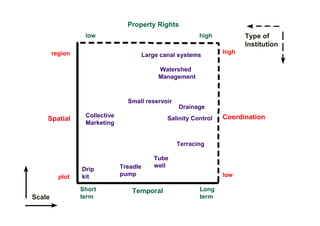
Property Rights
                  low                                       high           Type of
                                                                           Institution
        region                                                      high
                                         Large canal systems

                                              Watershed
                                              Management


                                 Small reservoir
                                                     Drainage
                  Collective                                        Coordination
    Spatial                                      Salinity Control
                  Marketing


                                                    Terracing

                                            Tube
                               Treadle      well
                 Drip
          plot   kit           pump                                 low

                 Short             Temporal                 Long
Scale            term                                       term
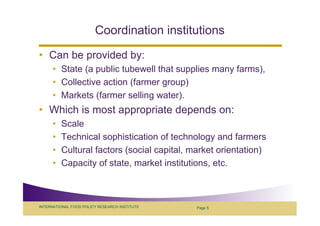
Coordination institutions
• Can be provided by:
      • State (a public tubewell that supplies many farms),
      • Collective action (farmer group)
      • Markets (farmer selling water).
• Which is most appropriate depends on:
      •   Scale
      •   Technical sophistication of technology and farmers
      •   Cultural factors (social capital, market orientation)
      •   Capacity of state, market institutions, etc.


INTERNATIONAL FOOD POLICY RESEARCH INSTITUTE   Page 5
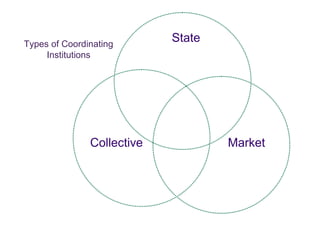
Types of Coordinating
                            State
     Institutions


               Collective           Market
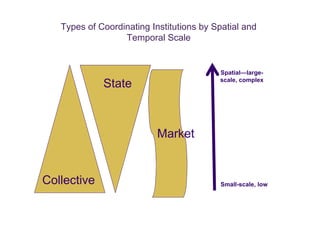
Types of Coordinating Institutions by Spatial and
                  Temporal Scale


                                          Spatial—large-
                                          scale, complex
             State


                           Market


Collective                                Small-scale, low
For group-based approaches

• Look beyond formal rules and membership roles
      • Is the group acting collectively
      • Who is included and excluded from active
        membership and decision-making.
          • Women/men
          • Land owners/ tenants
          • Farmers/ other water users (fishers, livestock
            keepers, home gardens, domestic users, other
            enterprises).
      • Formal and informal barriers to participation
      • Different motivations and returns


INTERNATIONAL FOOD POLICY RESEARCH INSTITUTE   Page 8
For group-based approaches

• Active participation of men and women can be more
  effective by drawing on skills, resources of both
• But costs of mixed organizations also greater, especially
  where high gender segregation
• Consider when identifying which groups to work with,
  particularly if that organization will gain stronger control
  over technology or water
• More than setting up the organizations-- need to become
  internalized and ‘institutionalized’


INTERNATIONAL FOOD POLICY RESEARCH INSTITUTE   Page 9
Water Rights

  • “the claims, entitlements and related obligations
    among people regarding the use and disposition
    of a scarce resource”
  • Rights accompanied by duties:
        • Duties of rights-holders
        • Duties of others to respect those rights
  • Rights vs. access


INTERNATIONAL FOOD POLICY RESEARCH INSTITUTE        Page 10
Why Do Water Rights Matter?
• Water is essential for life and livelihoods
     • Water rights are key assets
     • Determine distribution of benefits
• Rights clarify
     • Who can use, manage water
     • What responsibilities they have
• Increasing interaction between uses within basins
     •   Need better “rules of the game” to coordinate water use
     •   Secure rights can provide incentives for investment, conservation
     •   Projects often change property rights
     •   Recognized rights provide “seat at the table” for negotiations over
         changes in water use


INTERNATIONAL FOOD POLICY RESEARCH INSTITUTE      Page 11
Need to Go Beyond Simplistic Assumptions

 “There are no water rights here”
 or
 “The State owns all water”

 Careful analysis reveals multiple types and holders of
   water rights
 Important implications for water management—equity,
   efficiency, environment


INTERNATIONAL FOOD POLICY RESEARCH INSTITUTE   Page 12
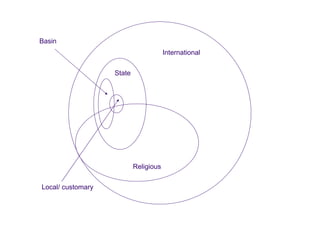
Property Rights

• All rights don’t derive from the state
  (government)—also from project regulations, local
  custom, religious law, etc.
• Rights are only as strong as the institution that
  stands behind them
• Customary rights may be stronger than those
  determined by the state


INTERNATIONAL FOOD POLICY RESEARCH INSTITUTE    Page 13
Basin
                                       International


                   State


                           Religious

Local/ customary
Some Critical Questions

  •   How are rights recognized?
  •   Who holds rights?
  •   For how long?
  •   To do what?
  •   From what source?
        • What about return flows and groundwater?
  • Transferable?
  • Environmental allocations?
     “sticks in the bundle of rights”


INTERNATIONAL FOOD POLICY RESEARCH INSTITUTE   Page 15
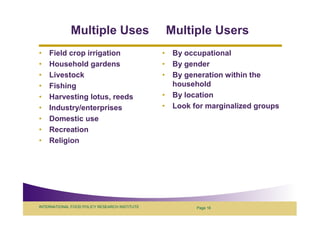
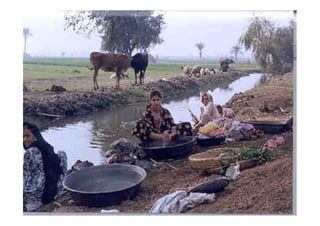
Multiple Uses                     Multiple Users
•   Field crop irrigation                      • By occupational
•   Household gardens                          • By gender
•   Livestock                                  • By generation within the
•   Fishing                                      household
•   Harvesting lotus, reeds                    • By location
•   Industry/enterprises                       • Look for marginalized groups
•   Domestic use
•   Recreation
•   Religion


INTERNATIONAL FOOD POLICY RESEARCH INSTITUTE           Page 16
INTERNATIONAL FOOD POLICY RESEARCH INSTITUTE   Page 17
Water Rights Reform

 • Acknowledge existing rights, esp. of
   marginalized groups
       • Participatory inventories
 • Avoid “cadastre disasters”
       • Gradual and selective licensing
 • Two-way education and communications
       • Interactive planning and modeling
       • Legal literacy
       • Strategically strengthen agencies and users


INTERNATIONAL FOOD POLICY RESEARCH INSTITUTE   Page 18
Water rights reforms

• Laws and policies are important, but not the sole
  determinant of water rights
• Reforms should be based on solid understanding
  of existing rights
• Rapid reforms can be counter-productive, unlikely
  to be fully implemented as planned
• Negotiation with stakeholders, looking for ways to
  compensate, leads to more legitimacy


INTERNATIONAL FOOD POLICY RESEARCH INSTITUTE   Page 19
Beyond panaceas

• Not social engineering—institutions are organic,
  path dependent
• Need range of technical and institutional options
• Understanding to be able to tailor them to their
  physical and institutional context


INTERNATIONAL FOOD POLICY RESEARCH INSTITUTE   Page 20
Questions to WP4
1. Who controls blue water? Urban-based power
   structures
2. How do institutions at multiple levels interact to
   facilitate or inhibit access to water? At higher
   levels more government and lower level more
   CA institutions; (irrigation) water-related
   organizations seldom have a mandate for
   poverty alleviation; once water becomes
   scarce, power structures tend to exclude
   weaker users, unless they have strong property
   rights
INTERNATIONAL FOOD POLICY RESEARCH INSTITUTE   Page 21
Questions to WP4
3. What are the incentives for providing poor
   people with access to water?/What water
   institutions can help alleviate poverty? National
   food security (irrigation), job creation, rural
   development (to avoid migration), health
   concerns
4. How are institutions modified to cope with
   hydrology? – Institutions following hydrologic
   boundaries, but often powerless, need to
   ensure that they are empowered


INTERNATIONAL FOOD POLICY RESEARCH INSTITUTE   Page 22
Questions to WP4
5. What institutions manage droughts or flood
   hazards?—Farmers tend to lose out first when
   droughts occur (national laws) or
   implementation; again strong property rights
   needed for farmers to have a share in water-
   scarce situations


INTERNATIONAL FOOD POLICY RESEARCH INSTITUTE   Page 23
Institutional Research for WP4
a) What is the link between water access, poverty
   and wellbeing?-- Is lack of access to water a
   contributor to poverty?
b) Look at existing power structures (administrative,
   political) and how they are linked to basins and
   water institutions
c) Identify institutions that fit the current power
   structures while helping the water-poor: Ex: pay
   farmers to use less water more water for
   domestic/industry—examine feasibility

 INTERNATIONAL FOOD POLICY RESEARCH INSTITUTE   Page 24
Institutional Research for WP4

d) Create a voice for the poor (India media,
   panchayat, Supreme Court; Andes, similar);
e) Possibility to transfer obligatory stakeholder
   consultation processes of developed countries
f) Alternatively, identify the possibility to generate
   alliances (Sabatier/Schlager); f.ex. Alliance with
   environmental organizations to protect
   biodiversity


INTERNATIONAL FOOD POLICY RESEARCH INSTITUTE   Page 25
Institutional Research for WP4
g) How can water institutions help alleviate
   poverty?—Recognition of traditional water
   rights (Andes) to obtain compensation when
   water is transferred out
h) When there is drought—identify mechanisms
   that support sharing of information, water, and
   compensation


INTERNATIONAL FOOD POLICY RESEARCH INSTITUTE   Page 26
Institutional Research for WP4
 High impact interventions can be on institutions
 High impact interventions require conducive
 institutions and infrastructure f.ex. Volumetric
 pricing at village level has lead to water savings in
 parts of China, but would not work in most of India,
 Adoptability can only be assured once institutional
 issues are taken into account


INTERNATIONAL FOOD POLICY RESEARCH INSTITUTE   Page 27

Institutional Analysis

  • 1.
    WP 4 --Institutional Analysis Institutions for pro-poor water access and use
  • 2.
    Questions to WP4 1.Who controls blue water? 2. How do institutions at multiple levels interact to facilitate or inhibit access to water? 3. What are the incentives for providing poor people with access to water? / How can water institutions help alleviate poverty? 4. How are institutions modified to cope with hydrology? 5. What institutions manage droughts or flood hazards? INTERNATIONAL FOOD POLICY RESEARCH INSTITUTE Page 2
  • 3.
    Questions to WP4 1.Who controls blue water? 2. How do institutions at multiple levels interact to facilitate or inhibit access to water? 3. What are the incentives for providing poor people with access to water? / How can water institutions help alleviate poverty? 4. How are institutions modified to cope with hydrology? 5. What institutions manage droughts or flood hazards? INTERNATIONAL FOOD POLICY RESEARCH INSTITUTE Page 3
  • 4.
    Property Rights low high Type of Institution region high Large canal systems Watershed Management Small reservoir Drainage Collective Coordination Spatial Salinity Control Marketing Terracing Tube Treadle well Drip plot kit pump low Short Temporal Long Scale term term
  • 5.
    Coordination institutions • Canbe provided by: • State (a public tubewell that supplies many farms), • Collective action (farmer group) • Markets (farmer selling water). • Which is most appropriate depends on: • Scale • Technical sophistication of technology and farmers • Cultural factors (social capital, market orientation) • Capacity of state, market institutions, etc. INTERNATIONAL FOOD POLICY RESEARCH INSTITUTE Page 5
  • 6.
    Types of Coordinating State Institutions Collective Market
  • 7.
    Types of CoordinatingInstitutions by Spatial and Temporal Scale Spatial—large- scale, complex State Market Collective Small-scale, low
  • 8.
    For group-based approaches •Look beyond formal rules and membership roles • Is the group acting collectively • Who is included and excluded from active membership and decision-making. • Women/men • Land owners/ tenants • Farmers/ other water users (fishers, livestock keepers, home gardens, domestic users, other enterprises). • Formal and informal barriers to participation • Different motivations and returns INTERNATIONAL FOOD POLICY RESEARCH INSTITUTE Page 8
  • 9.
    For group-based approaches •Active participation of men and women can be more effective by drawing on skills, resources of both • But costs of mixed organizations also greater, especially where high gender segregation • Consider when identifying which groups to work with, particularly if that organization will gain stronger control over technology or water • More than setting up the organizations-- need to become internalized and ‘institutionalized’ INTERNATIONAL FOOD POLICY RESEARCH INSTITUTE Page 9
  • 10.
    Water Rights • “the claims, entitlements and related obligations among people regarding the use and disposition of a scarce resource” • Rights accompanied by duties: • Duties of rights-holders • Duties of others to respect those rights • Rights vs. access INTERNATIONAL FOOD POLICY RESEARCH INSTITUTE Page 10
  • 11.
    Why Do WaterRights Matter? • Water is essential for life and livelihoods • Water rights are key assets • Determine distribution of benefits • Rights clarify • Who can use, manage water • What responsibilities they have • Increasing interaction between uses within basins • Need better “rules of the game” to coordinate water use • Secure rights can provide incentives for investment, conservation • Projects often change property rights • Recognized rights provide “seat at the table” for negotiations over changes in water use INTERNATIONAL FOOD POLICY RESEARCH INSTITUTE Page 11
  • 12.
    Need to GoBeyond Simplistic Assumptions “There are no water rights here” or “The State owns all water” Careful analysis reveals multiple types and holders of water rights Important implications for water management—equity, efficiency, environment INTERNATIONAL FOOD POLICY RESEARCH INSTITUTE Page 12
  • 13.
    Property Rights • Allrights don’t derive from the state (government)—also from project regulations, local custom, religious law, etc. • Rights are only as strong as the institution that stands behind them • Customary rights may be stronger than those determined by the state INTERNATIONAL FOOD POLICY RESEARCH INSTITUTE Page 13
  • 14.
    Basin International State Religious Local/ customary
  • 15.
    Some Critical Questions • How are rights recognized? • Who holds rights? • For how long? • To do what? • From what source? • What about return flows and groundwater? • Transferable? • Environmental allocations? “sticks in the bundle of rights” INTERNATIONAL FOOD POLICY RESEARCH INSTITUTE Page 15
  • 16.
    Multiple Uses Multiple Users • Field crop irrigation • By occupational • Household gardens • By gender • Livestock • By generation within the • Fishing household • Harvesting lotus, reeds • By location • Industry/enterprises • Look for marginalized groups • Domestic use • Recreation • Religion INTERNATIONAL FOOD POLICY RESEARCH INSTITUTE Page 16
  • 17.
    INTERNATIONAL FOOD POLICYRESEARCH INSTITUTE Page 17
  • 18.
    Water Rights Reform • Acknowledge existing rights, esp. of marginalized groups • Participatory inventories • Avoid “cadastre disasters” • Gradual and selective licensing • Two-way education and communications • Interactive planning and modeling • Legal literacy • Strategically strengthen agencies and users INTERNATIONAL FOOD POLICY RESEARCH INSTITUTE Page 18
  • 19.
    Water rights reforms •Laws and policies are important, but not the sole determinant of water rights • Reforms should be based on solid understanding of existing rights • Rapid reforms can be counter-productive, unlikely to be fully implemented as planned • Negotiation with stakeholders, looking for ways to compensate, leads to more legitimacy INTERNATIONAL FOOD POLICY RESEARCH INSTITUTE Page 19
  • 20.
    Beyond panaceas • Notsocial engineering—institutions are organic, path dependent • Need range of technical and institutional options • Understanding to be able to tailor them to their physical and institutional context INTERNATIONAL FOOD POLICY RESEARCH INSTITUTE Page 20
  • 21.
    Questions to WP4 1.Who controls blue water? Urban-based power structures 2. How do institutions at multiple levels interact to facilitate or inhibit access to water? At higher levels more government and lower level more CA institutions; (irrigation) water-related organizations seldom have a mandate for poverty alleviation; once water becomes scarce, power structures tend to exclude weaker users, unless they have strong property rights INTERNATIONAL FOOD POLICY RESEARCH INSTITUTE Page 21
  • 22.
    Questions to WP4 3.What are the incentives for providing poor people with access to water?/What water institutions can help alleviate poverty? National food security (irrigation), job creation, rural development (to avoid migration), health concerns 4. How are institutions modified to cope with hydrology? – Institutions following hydrologic boundaries, but often powerless, need to ensure that they are empowered INTERNATIONAL FOOD POLICY RESEARCH INSTITUTE Page 22
  • 23.
    Questions to WP4 5.What institutions manage droughts or flood hazards?—Farmers tend to lose out first when droughts occur (national laws) or implementation; again strong property rights needed for farmers to have a share in water- scarce situations INTERNATIONAL FOOD POLICY RESEARCH INSTITUTE Page 23
  • 24.
    Institutional Research forWP4 a) What is the link between water access, poverty and wellbeing?-- Is lack of access to water a contributor to poverty? b) Look at existing power structures (administrative, political) and how they are linked to basins and water institutions c) Identify institutions that fit the current power structures while helping the water-poor: Ex: pay farmers to use less water more water for domestic/industry—examine feasibility INTERNATIONAL FOOD POLICY RESEARCH INSTITUTE Page 24
  • 25.
    Institutional Research forWP4 d) Create a voice for the poor (India media, panchayat, Supreme Court; Andes, similar); e) Possibility to transfer obligatory stakeholder consultation processes of developed countries f) Alternatively, identify the possibility to generate alliances (Sabatier/Schlager); f.ex. Alliance with environmental organizations to protect biodiversity INTERNATIONAL FOOD POLICY RESEARCH INSTITUTE Page 25
  • 26.
    Institutional Research forWP4 g) How can water institutions help alleviate poverty?—Recognition of traditional water rights (Andes) to obtain compensation when water is transferred out h) When there is drought—identify mechanisms that support sharing of information, water, and compensation INTERNATIONAL FOOD POLICY RESEARCH INSTITUTE Page 26
  • 27.
    Institutional Research forWP4 High impact interventions can be on institutions High impact interventions require conducive institutions and infrastructure f.ex. Volumetric pricing at village level has lead to water savings in parts of China, but would not work in most of India, Adoptability can only be assured once institutional issues are taken into account INTERNATIONAL FOOD POLICY RESEARCH INSTITUTE Page 27