Peter Morville, Internet Librarian 2013

1
2
3
4
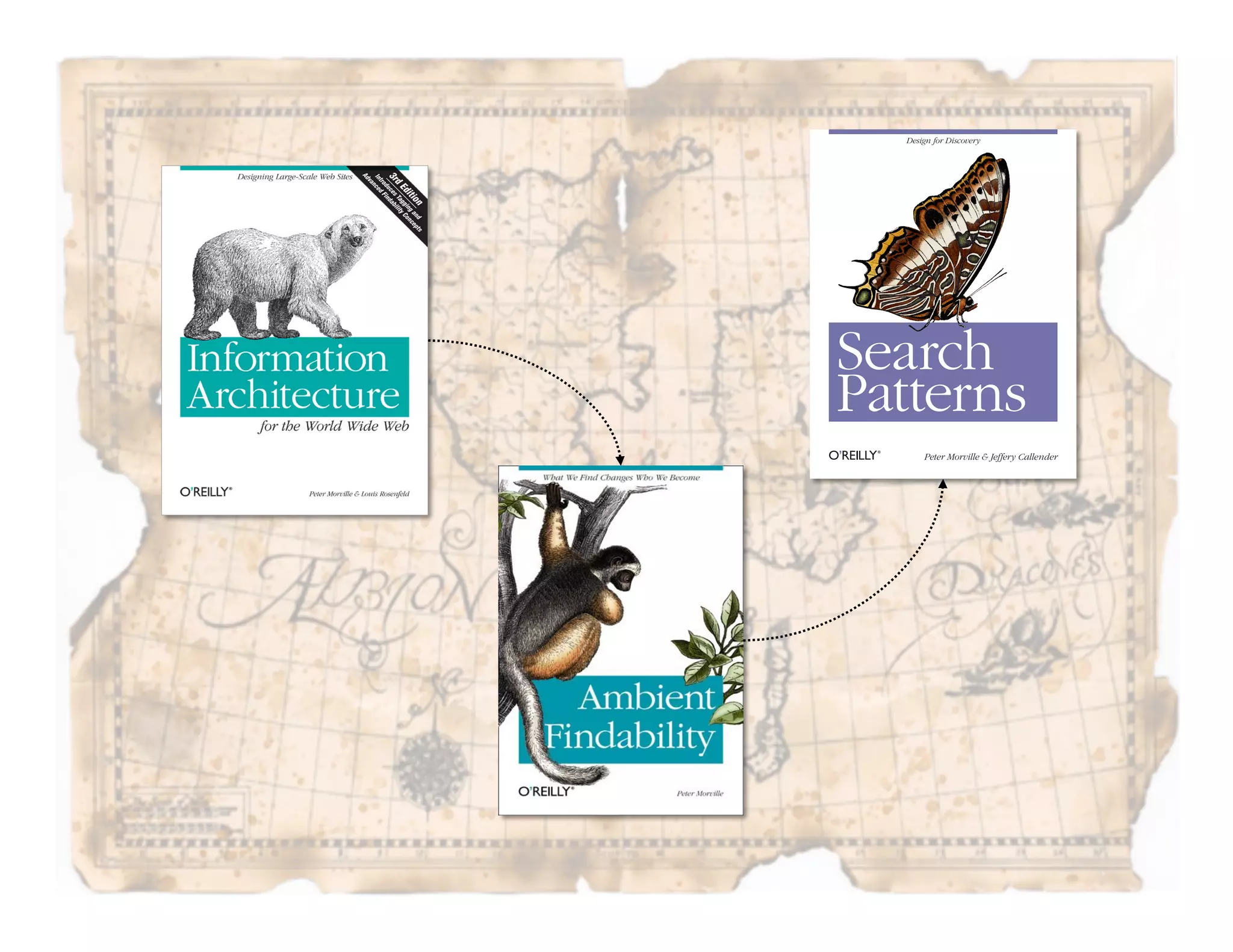
Design for Discovery

Search
Patterns
Peter Morville & Jeffery Callender

5
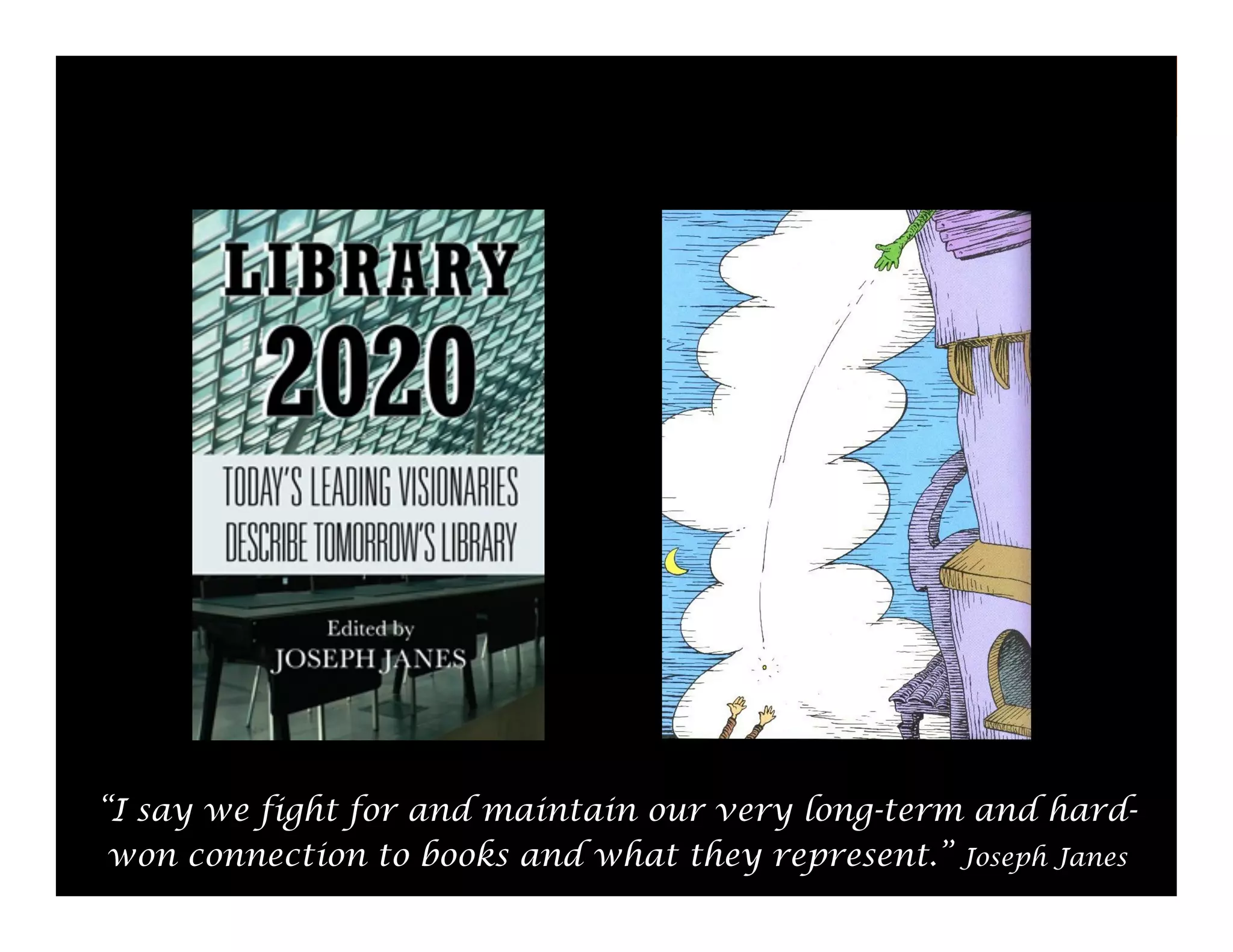
β€œI say we fight for and maintain our very long-term and hardwon connection to books and what they represent.” Joseph Janes
6
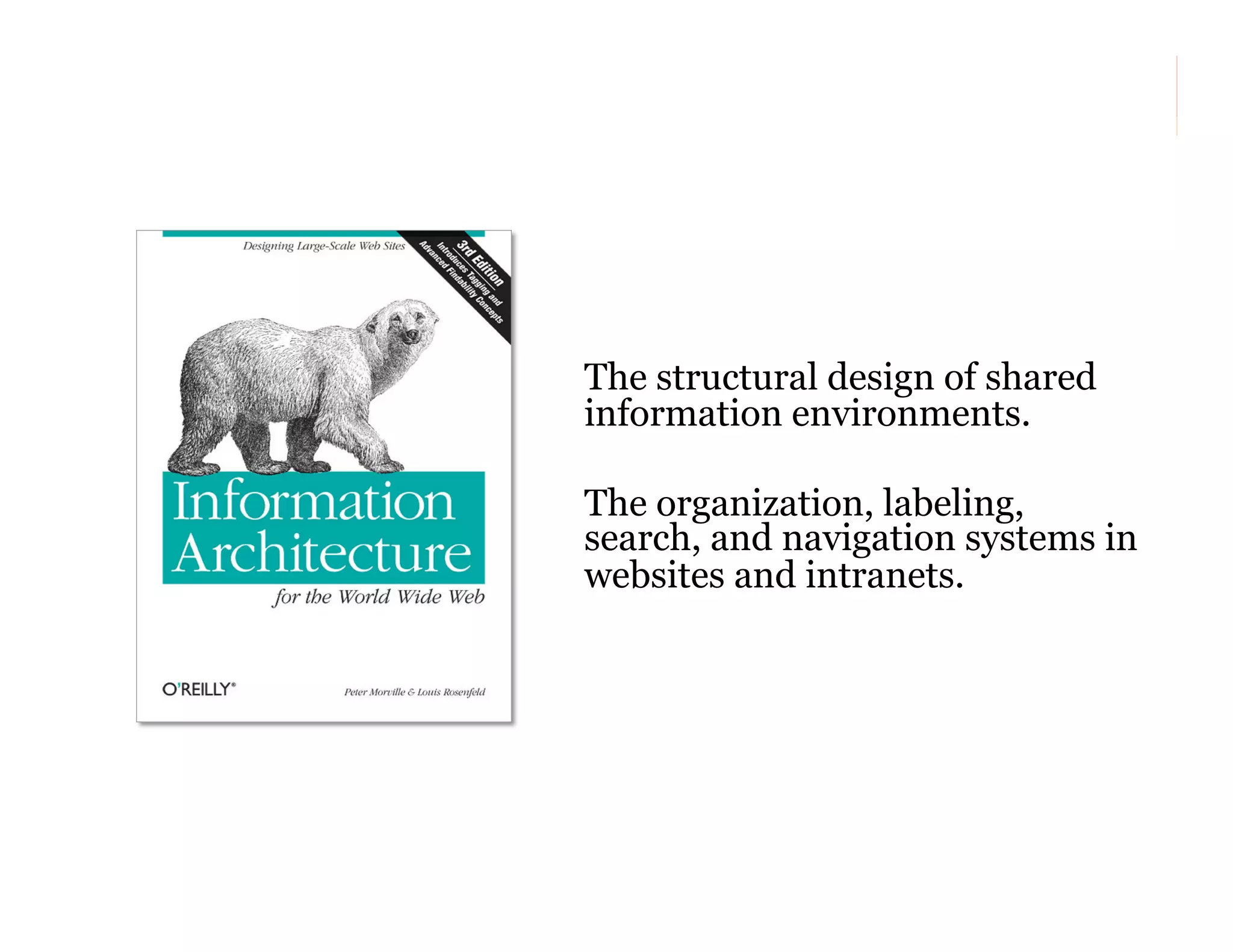
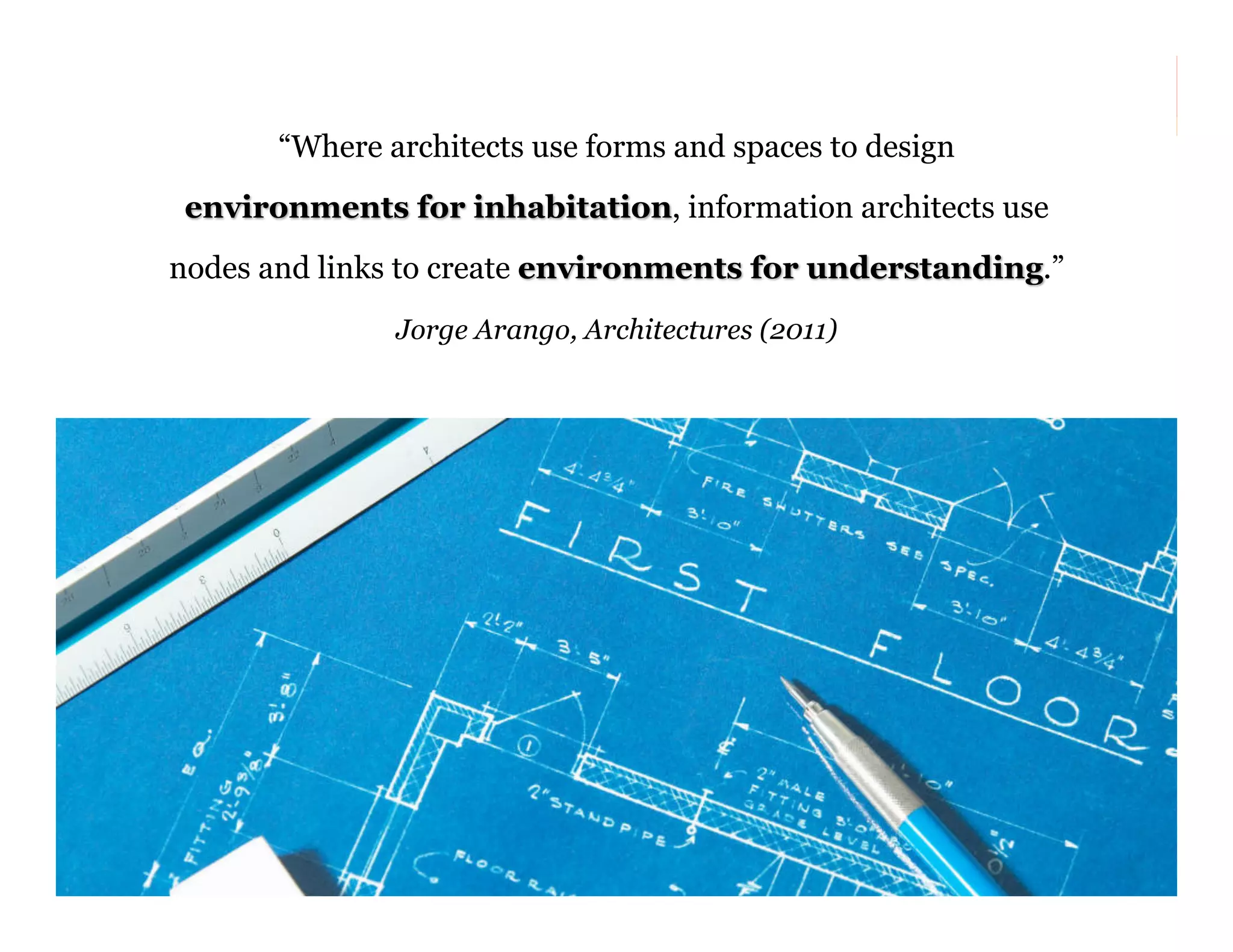
The structural design of shared
information environments.
The organization, labeling,
search, and navigation systems in
websites and intranets.

7
8
10
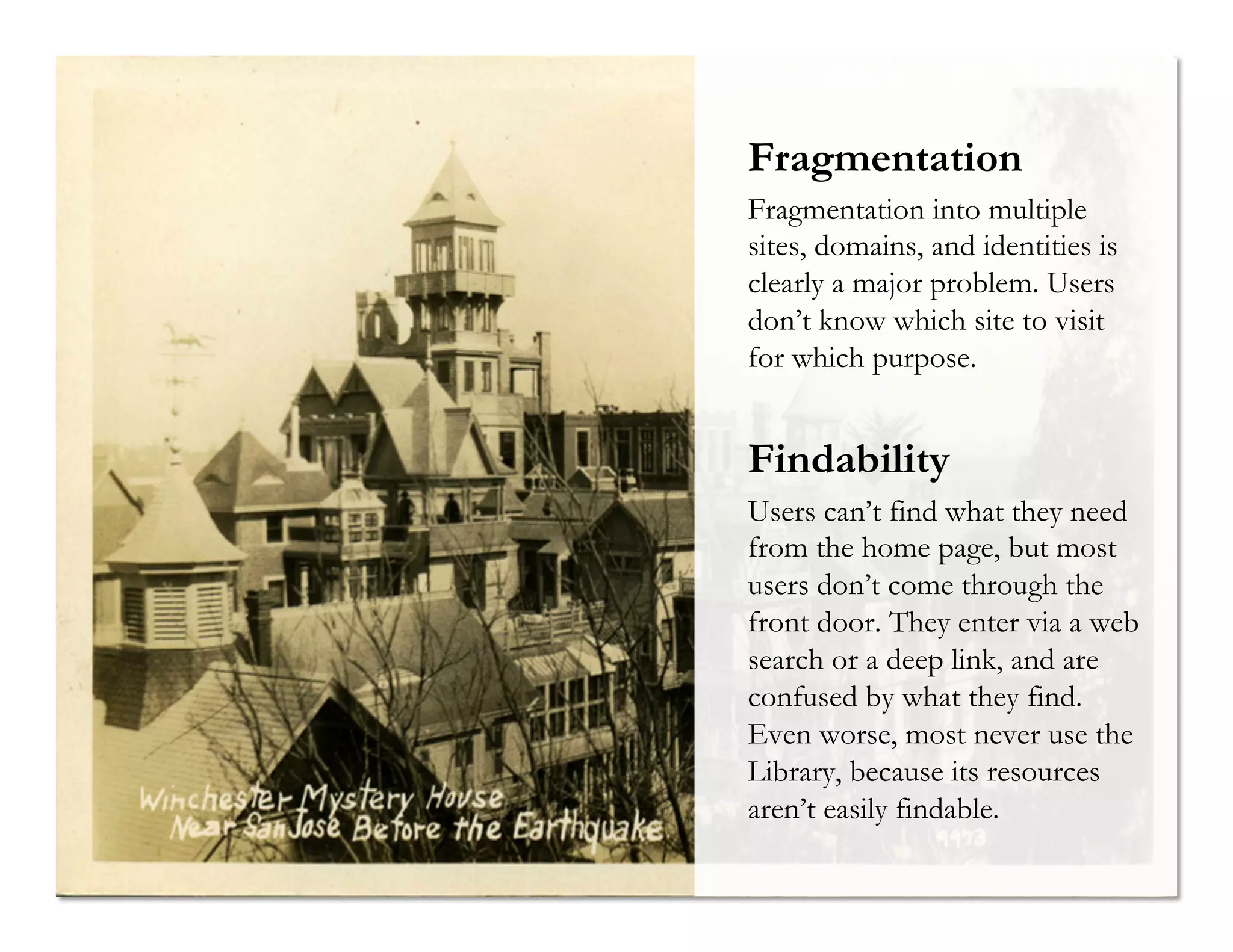
Fragmentation
Fragmentation into multiple
sites, domains, and identities is
clearly a major problem. Users
don’t know which site to visit
for which purpose.

Findability
Users can’t find what they need
from the home page, but most
users don’t come through the
front door. They enter via a web
search or a deep link, and are
confused by what they find.
Even worse, most never use the
Library, because its resources
aren’t easily findable.
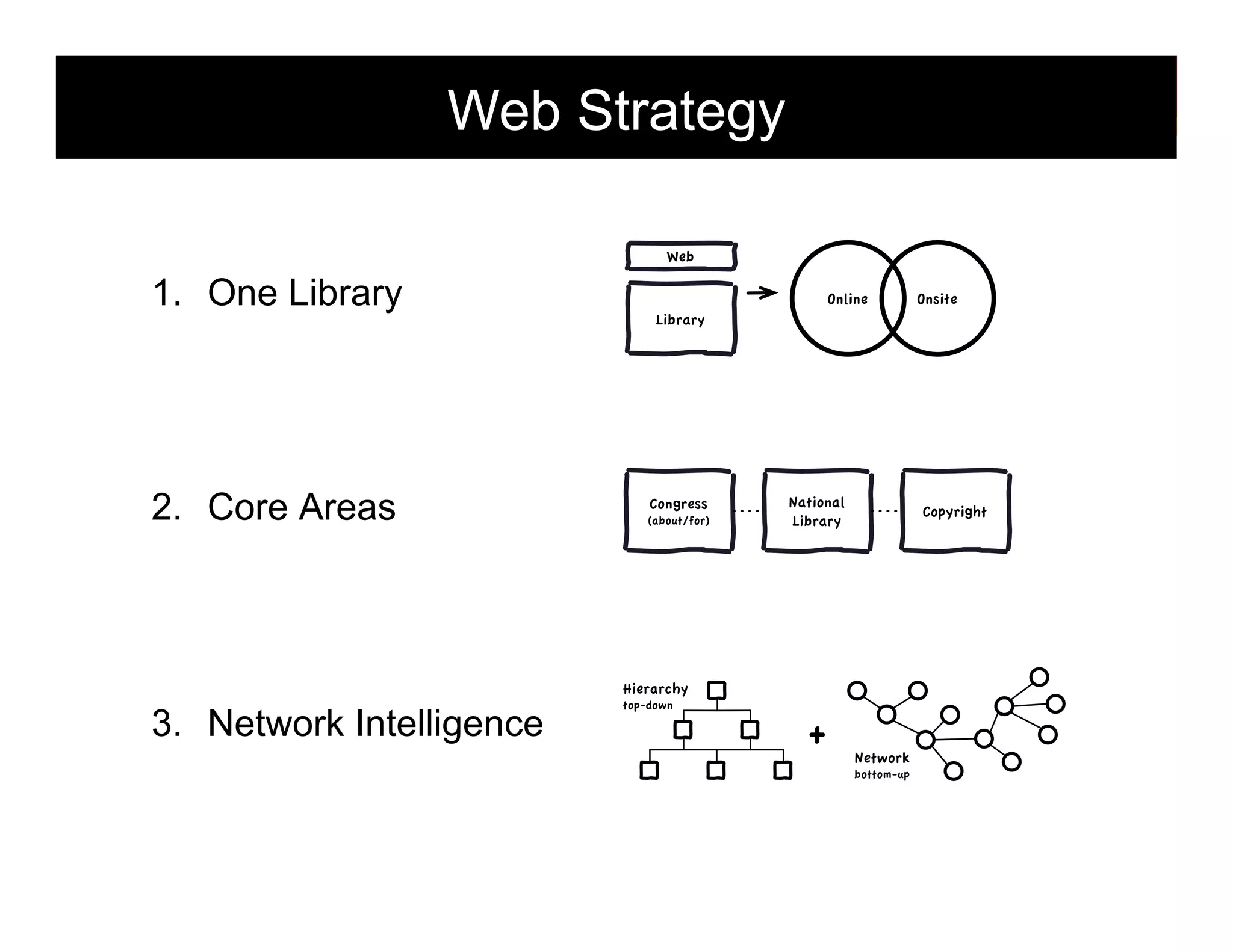
Web Strategy
Web

1.β€― One Library

2.β€― Core Areas

Online

Onsite

Library

Congress
(about/for)

National
Library

Copyright

Hierarchy

3.β€― Network Intelligence

top-down

+

Network
bottom-up

12
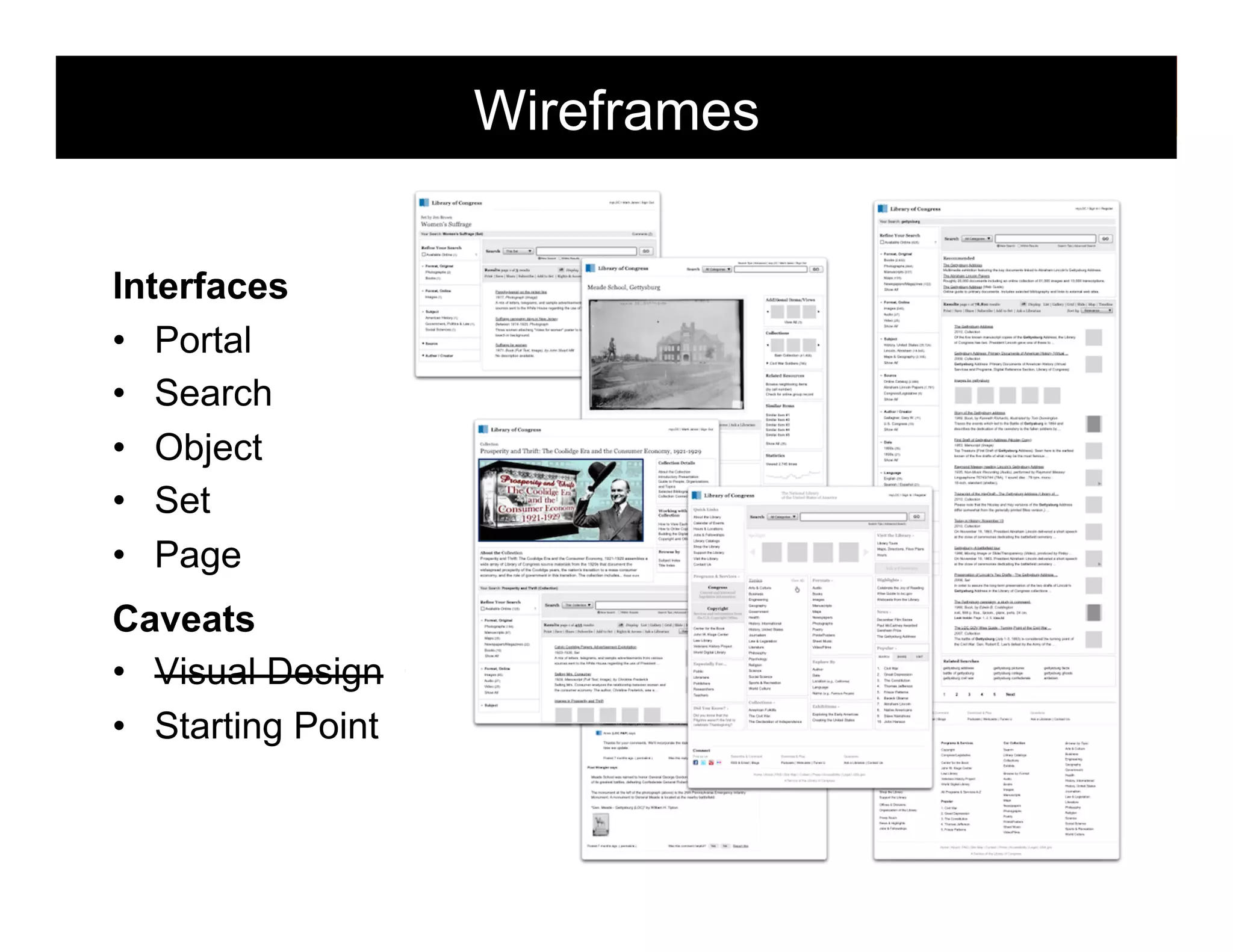
Wireframes
Interfaces
β€’β€― Portal
β€’β€― Search
β€’β€― Object
β€’β€― Set
β€’β€― Page
Caveats
β€’β€― Visual Design
β€’β€― Starting Point
13
14
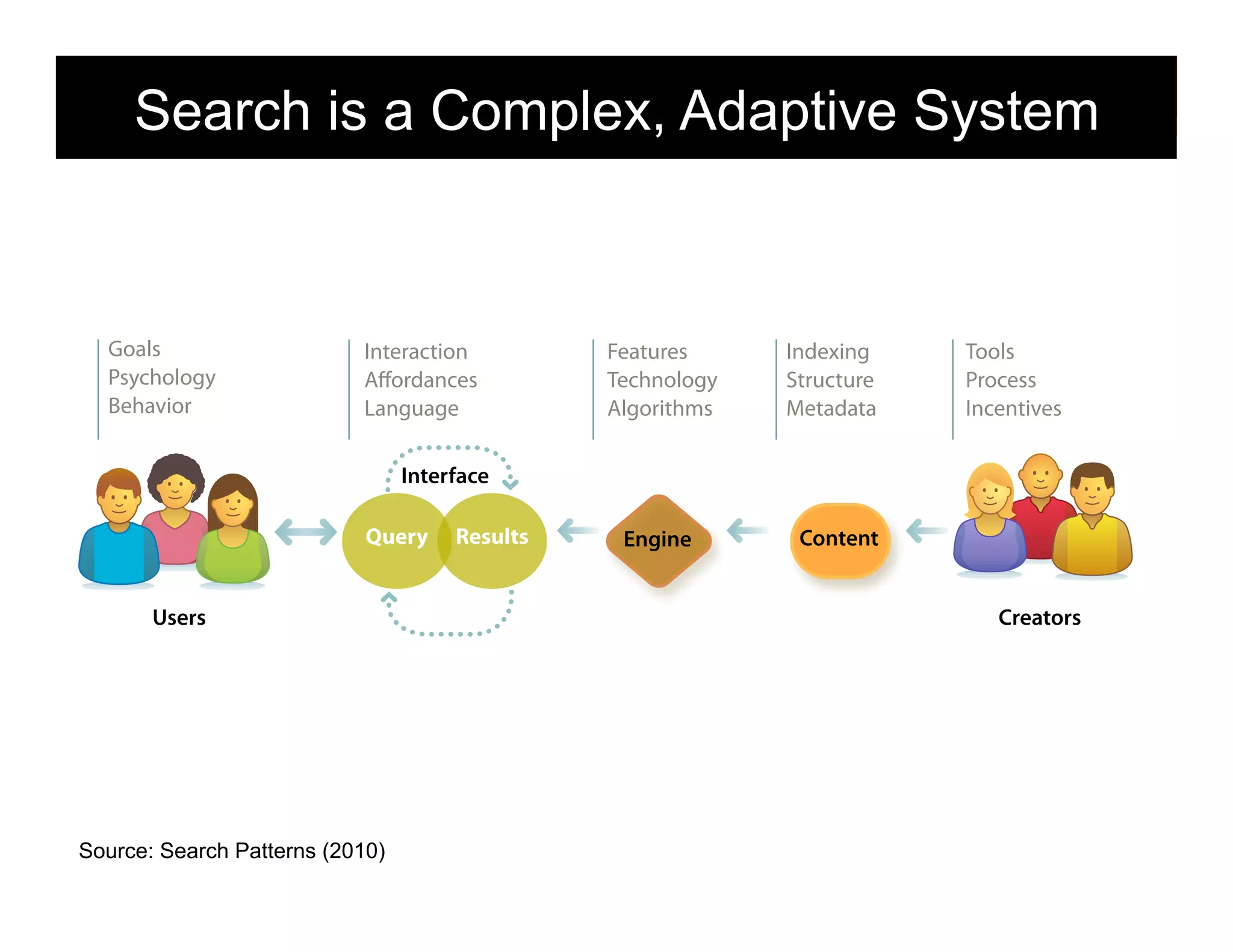
Search is a Complex, Adaptive System

Goals
Psychology
Behavior

Interaction
Affordances
Language

Features
Technology
Algorithms

Indexing
Structure
Metadata

Tools
Process
Incentives

Interface
Query

Results

Engine

Content

Users

Source: Search Patterns (2010)

Creators

15
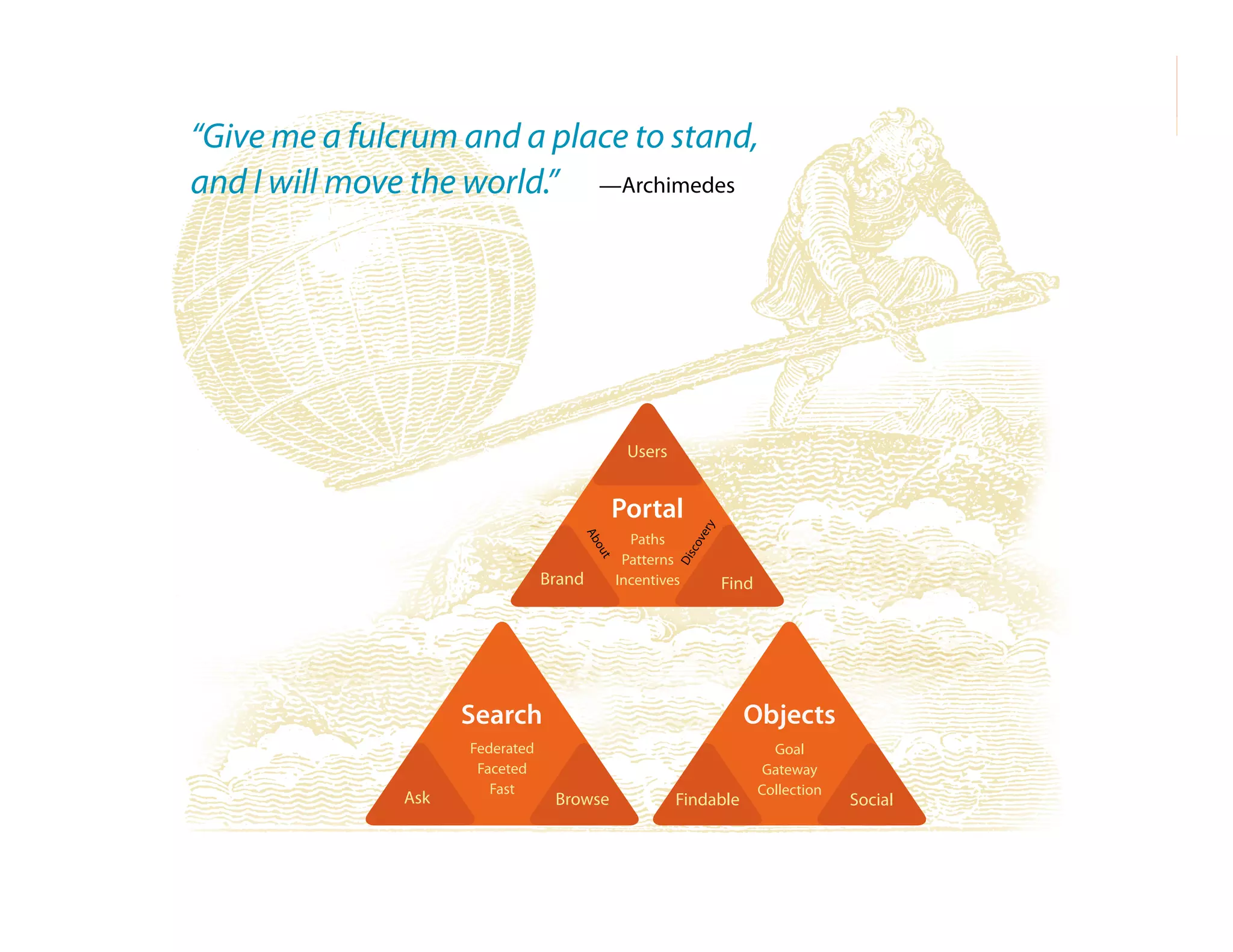
β€œGive me a fulcrum and a place to stand,
and I will move the world.” β€”Archimedes

Portal

Dis

t
ou

Ab

Brand

Paths
Patterns
Incentives

co
ve
ry

Users

Find

Search
Ask

Objects

Federated
Faceted
Fast

Goal
Gateway
Collection

Browse

Findable

Social

16
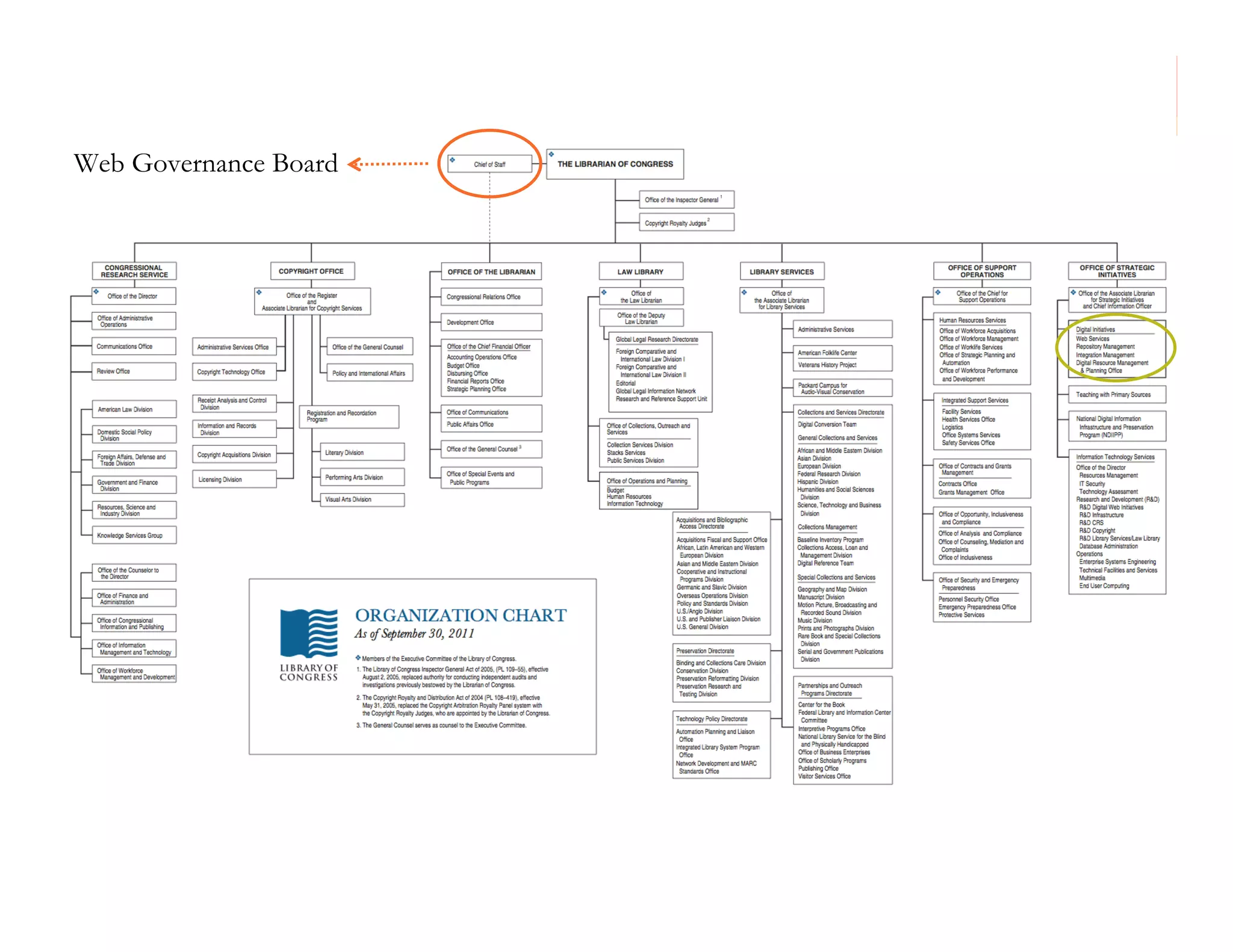
Web Governance Board

17
18
19
20
21
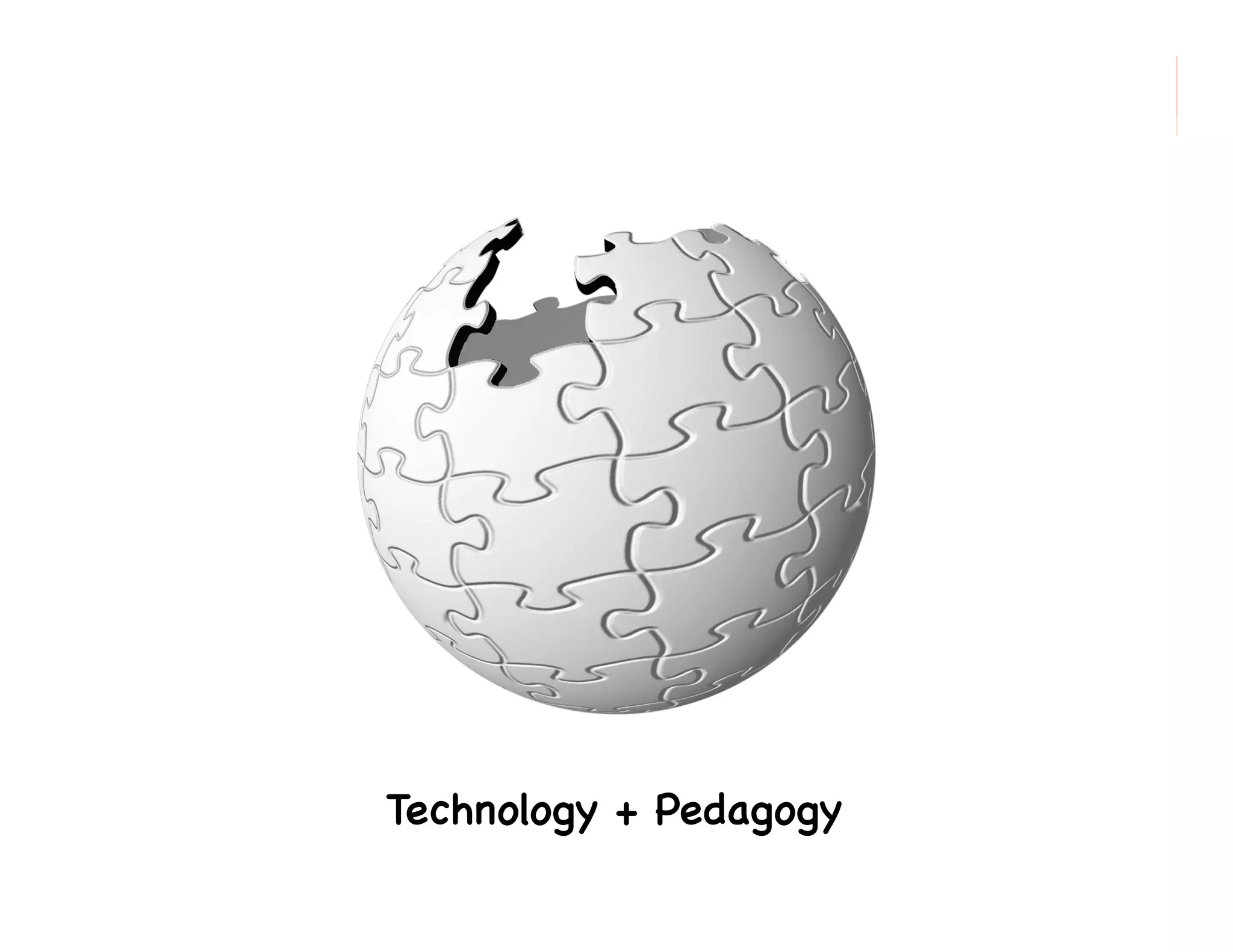
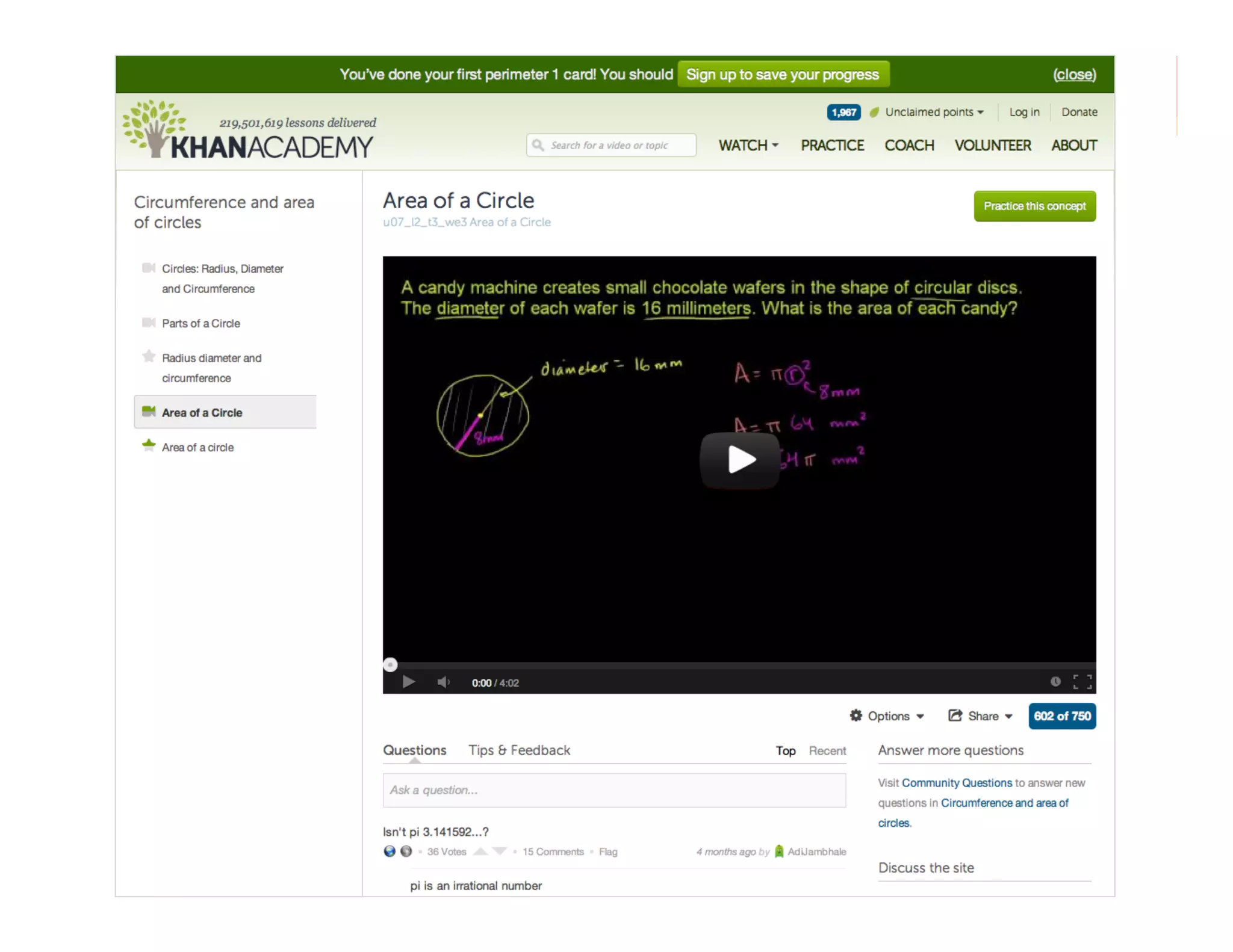
Technology + Pedagogy
22
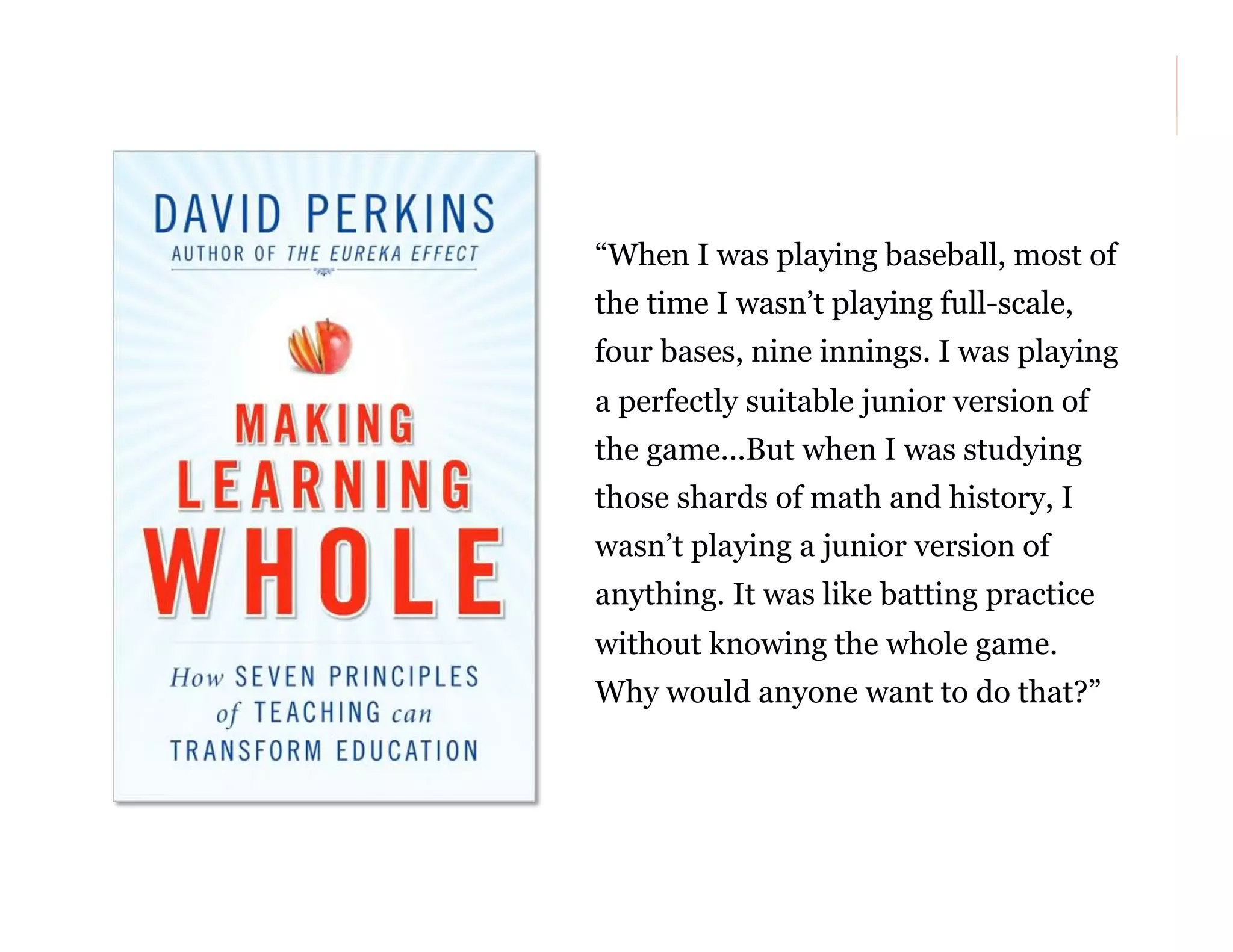
β€œWhen I was playing baseball, most of
the time I wasn’t playing full-scale,
four bases, nine innings. I was playing
a perfectly suitable junior version of
the game...But when I was studying
those shards of math and history, I
wasn’t playing a junior version of
anything. It was like batting practice
without knowing the whole game.
Why would anyone want to do that?”

23
24
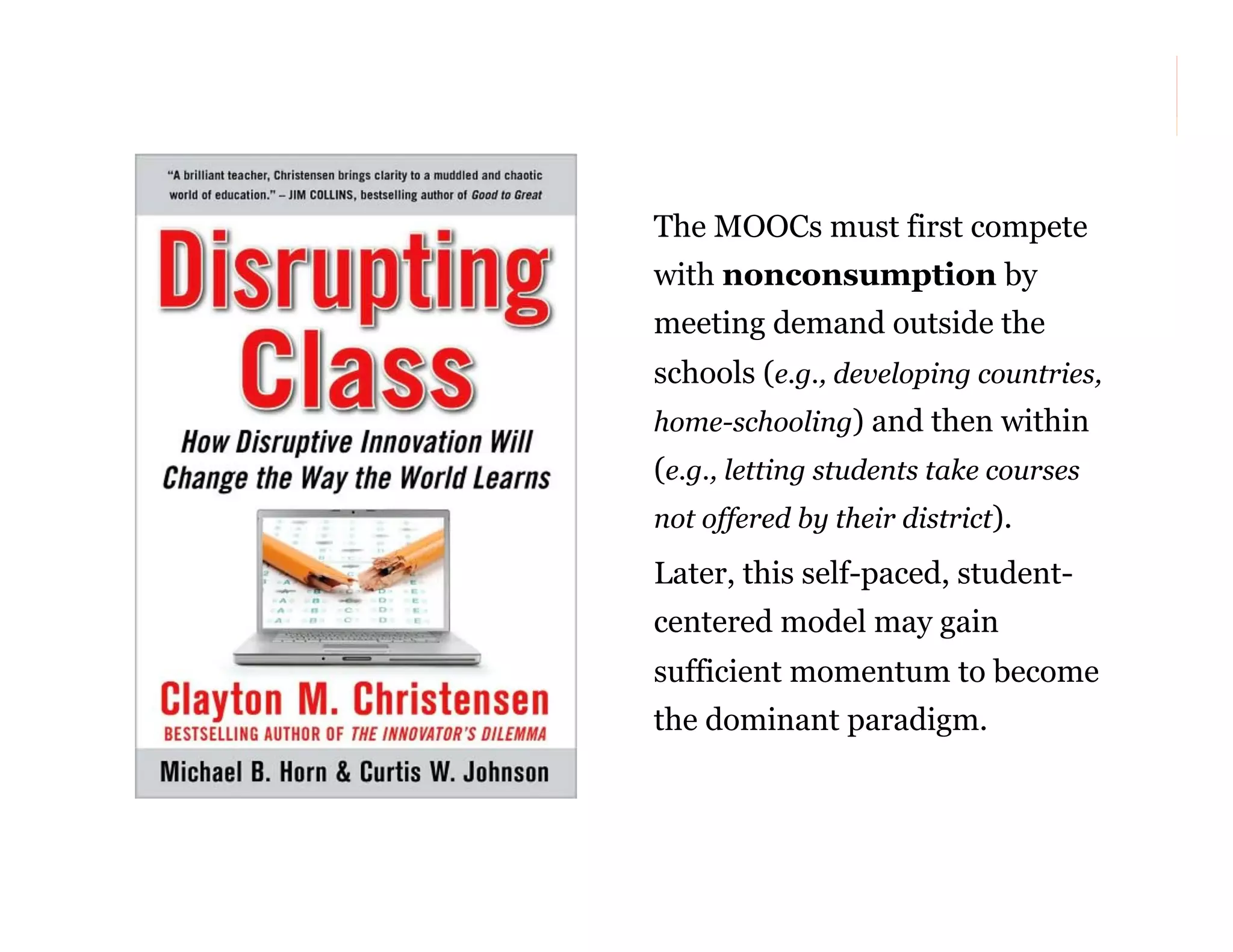
The MOOCs must first compete
with nonconsumption by
meeting demand outside the
schools (e.g., developing countries,
home-schooling) and then within

(e.g., letting students take courses
not offered by their district).

Later, this self-paced, studentcentered model may gain
sufficient momentum to become
the dominant paradigm.

25
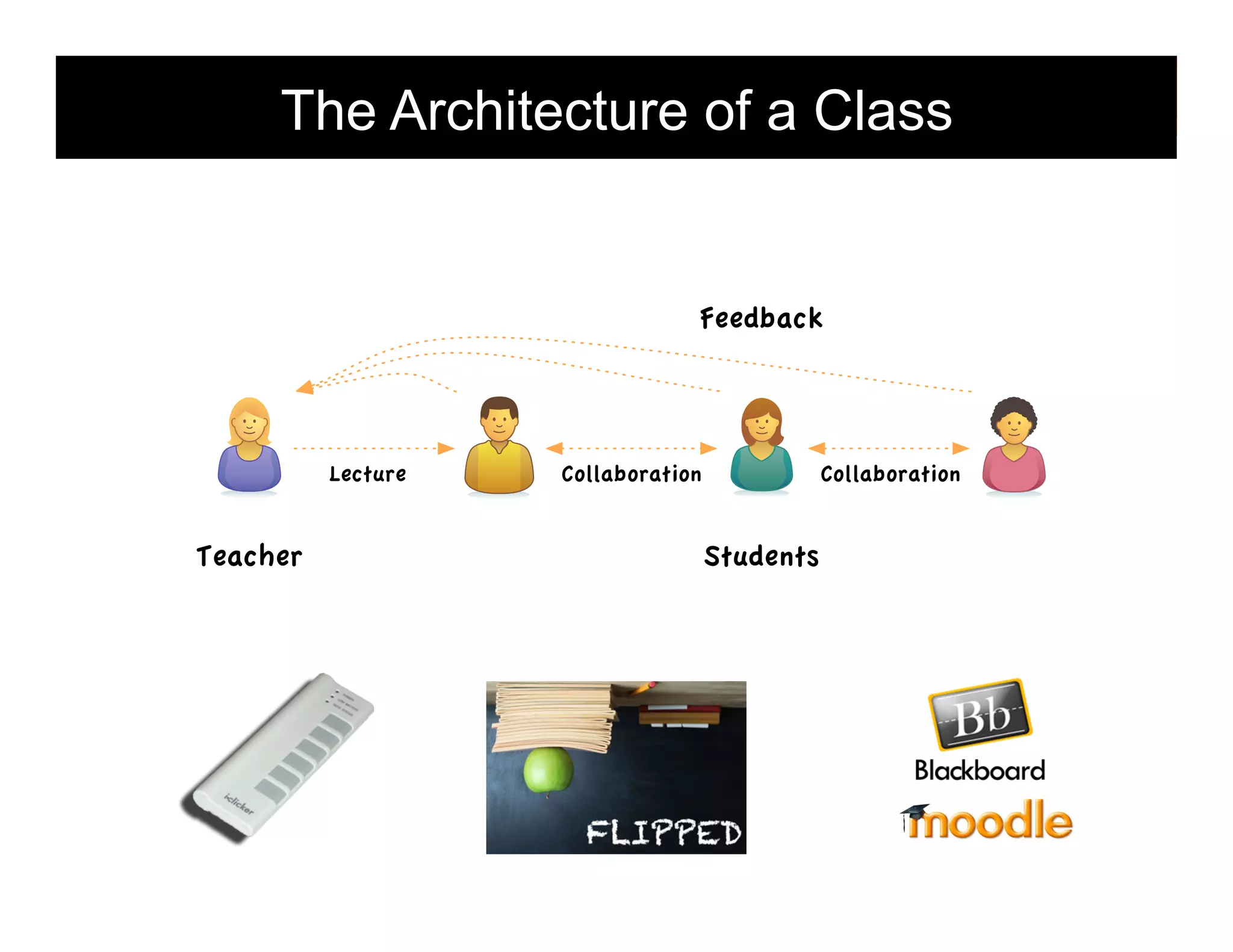
The Architecture of a Class

26
27
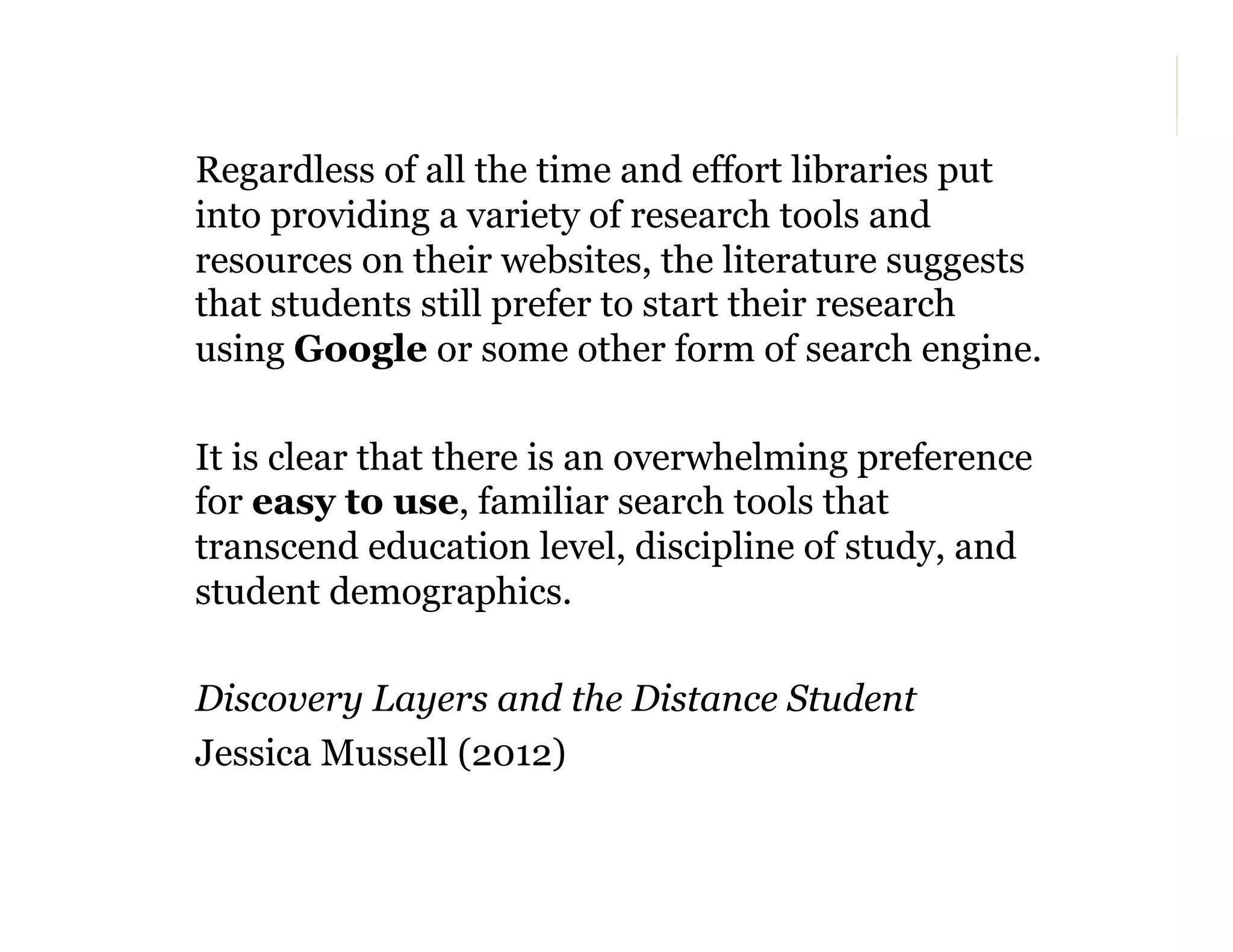
Regardless of all the time and effort libraries put
into providing a variety of research tools and
resources on their websites, the literature suggests
that students still prefer to start their research
using Google or some other form of search engine.
It is clear that there is an overwhelming preference
for easy to use, familiar search tools that
transcend education level, discipline of study, and
student demographics.
Discovery Layers and the Distance Student
Jessica Mussell (2012)
28
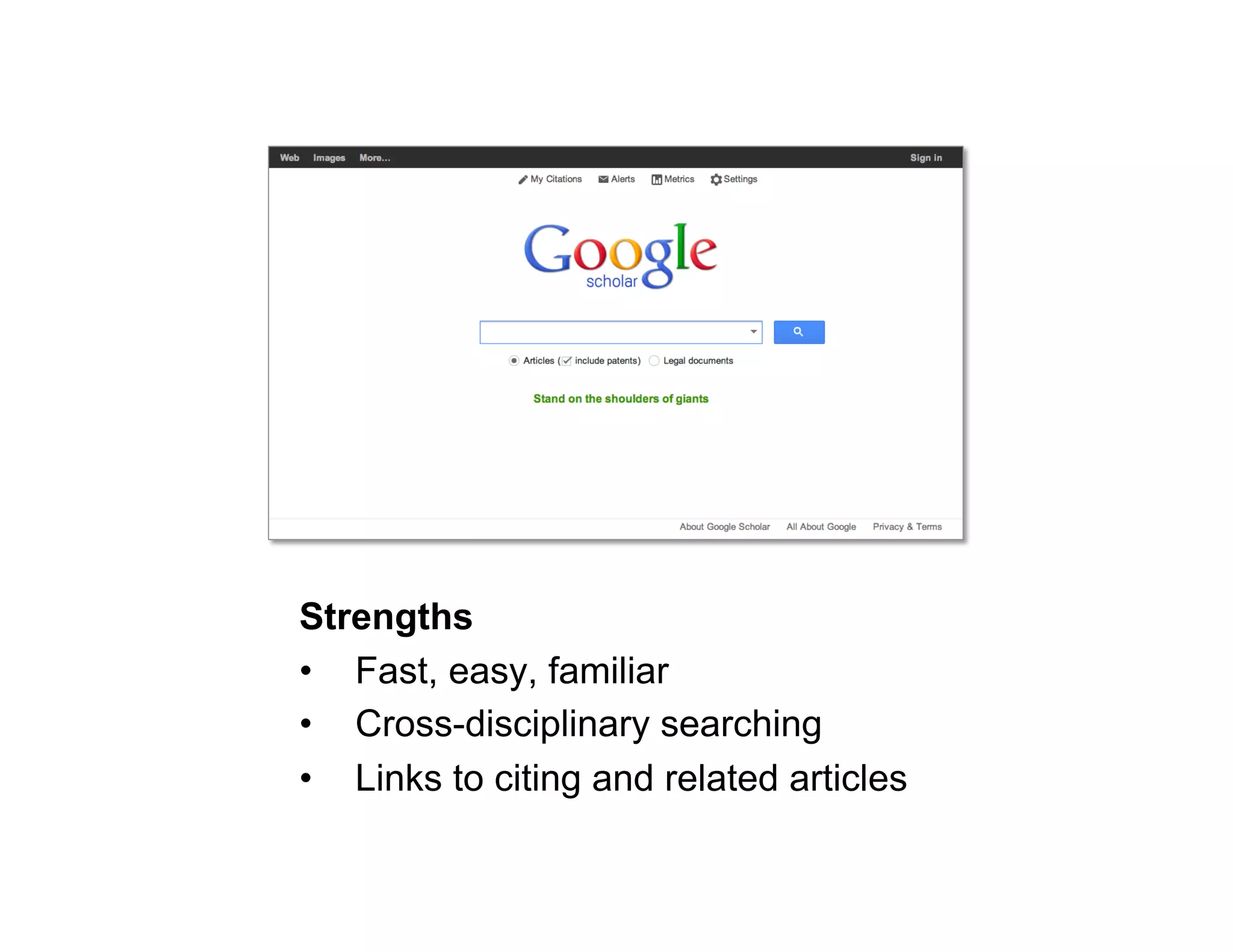
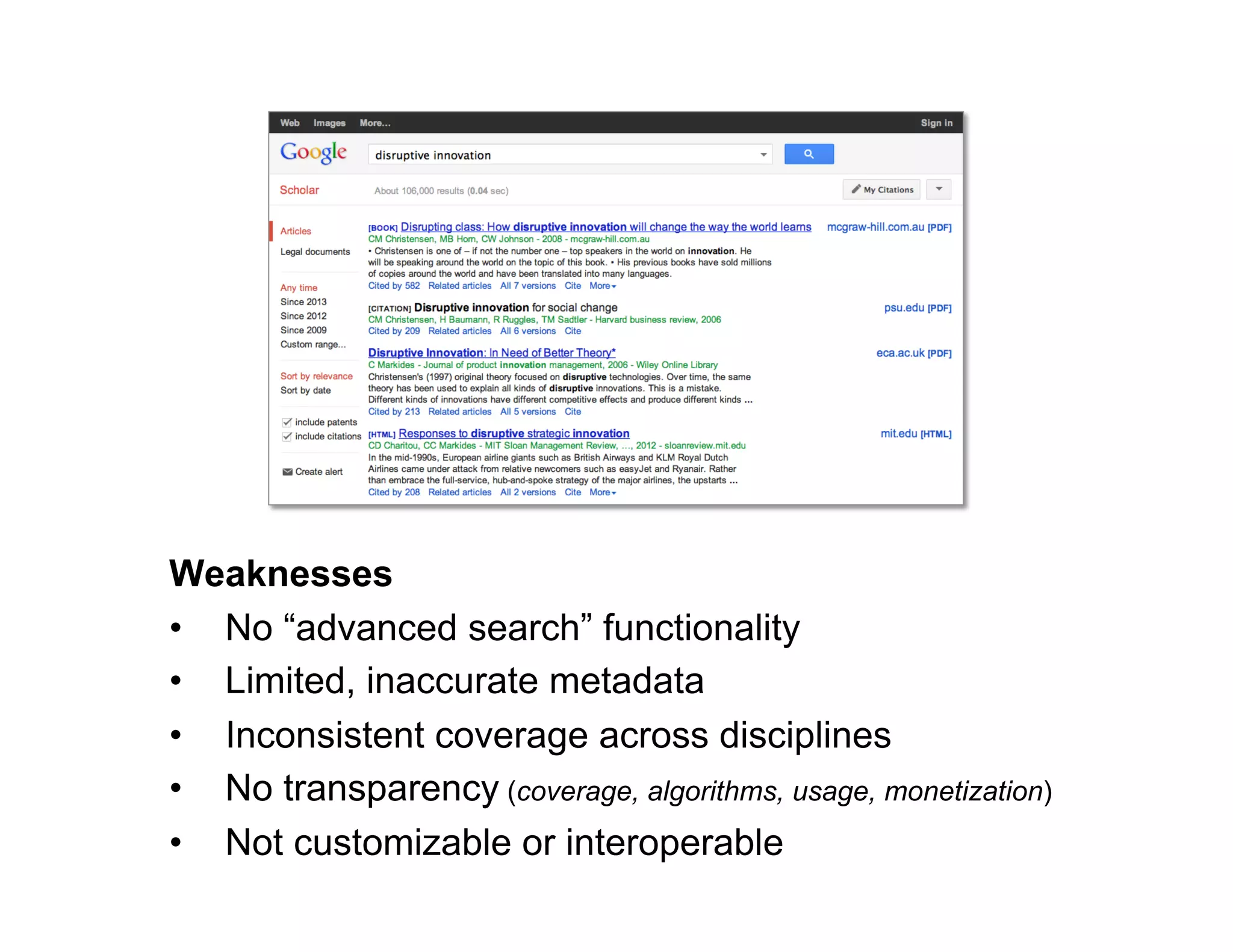
Strengths
β€’β€― Fast, easy, familiar
β€’β€― Cross-disciplinary searching
β€’β€― Links to citing and related articles
29
Weaknesses
β€’β€― No β€œadvanced search” functionality
β€’β€― Limited, inaccurate metadata
β€’β€― Inconsistent coverage across disciplines
β€’β€― No transparency (coverage, algorithms, usage, monetization)
β€’β€― Not customizable or interoperable
30
Information Literacy
Employers claimed that college hires rarely conducted the
thorough research required of them in the workplace.
At worst, some college hires solved problems with a
lightning quick Google search, a scan of the first couple of
pages of results, and a linear answer finding approach.
β€œI had a new graduate hire who only searched for papers
on Google. I said, you’re missing things, you need to use
PubMed, and he responded, β€˜Well, I did this quick search,
and that’s what I got.’ But that’s not good enough.”
Project Information Literacy: Learning Curve by Alison J. Head (2012)

31
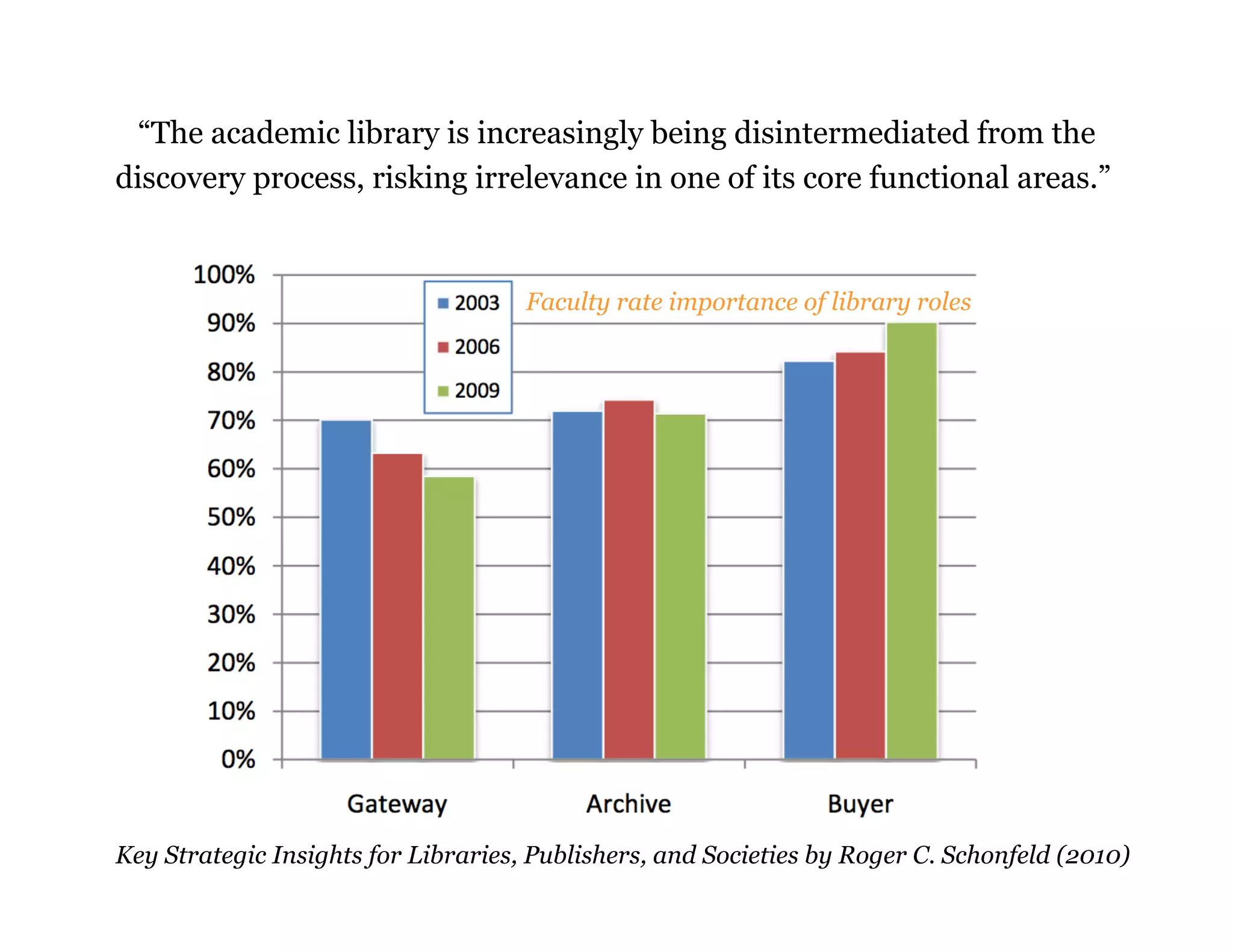
β€œThe academic library is increasingly being disintermediated from the
discovery process, risking irrelevance in one of its core functional areas.”

Faculty rate importance of library roles

Key Strategic Insights for Libraries, Publishers, and Societies by Roger C. Schonfeld (2010)
32
33
34

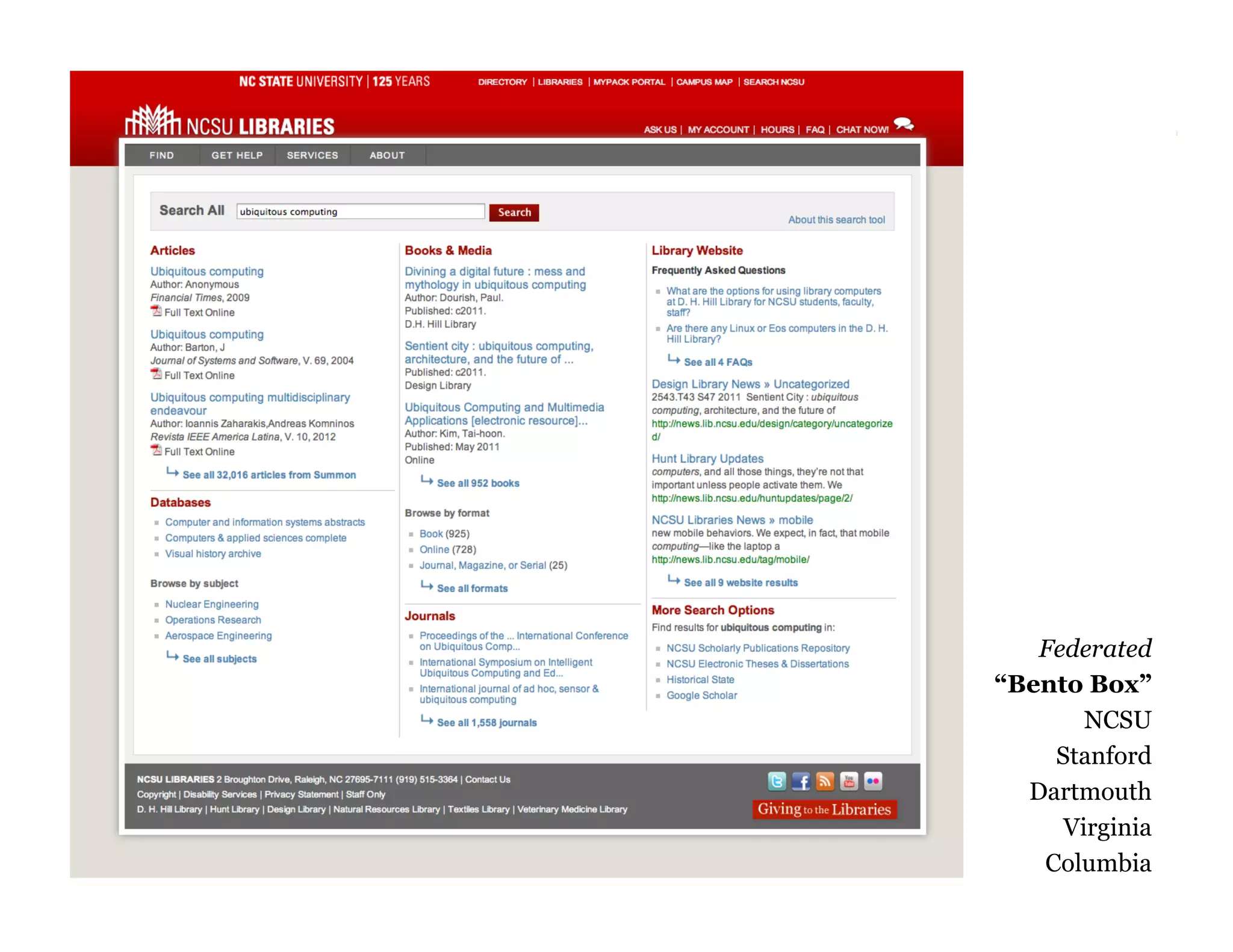
Federated
β€œBento Box”
NCSU
Stanford
Dartmouth
Virginia
Columbia
35

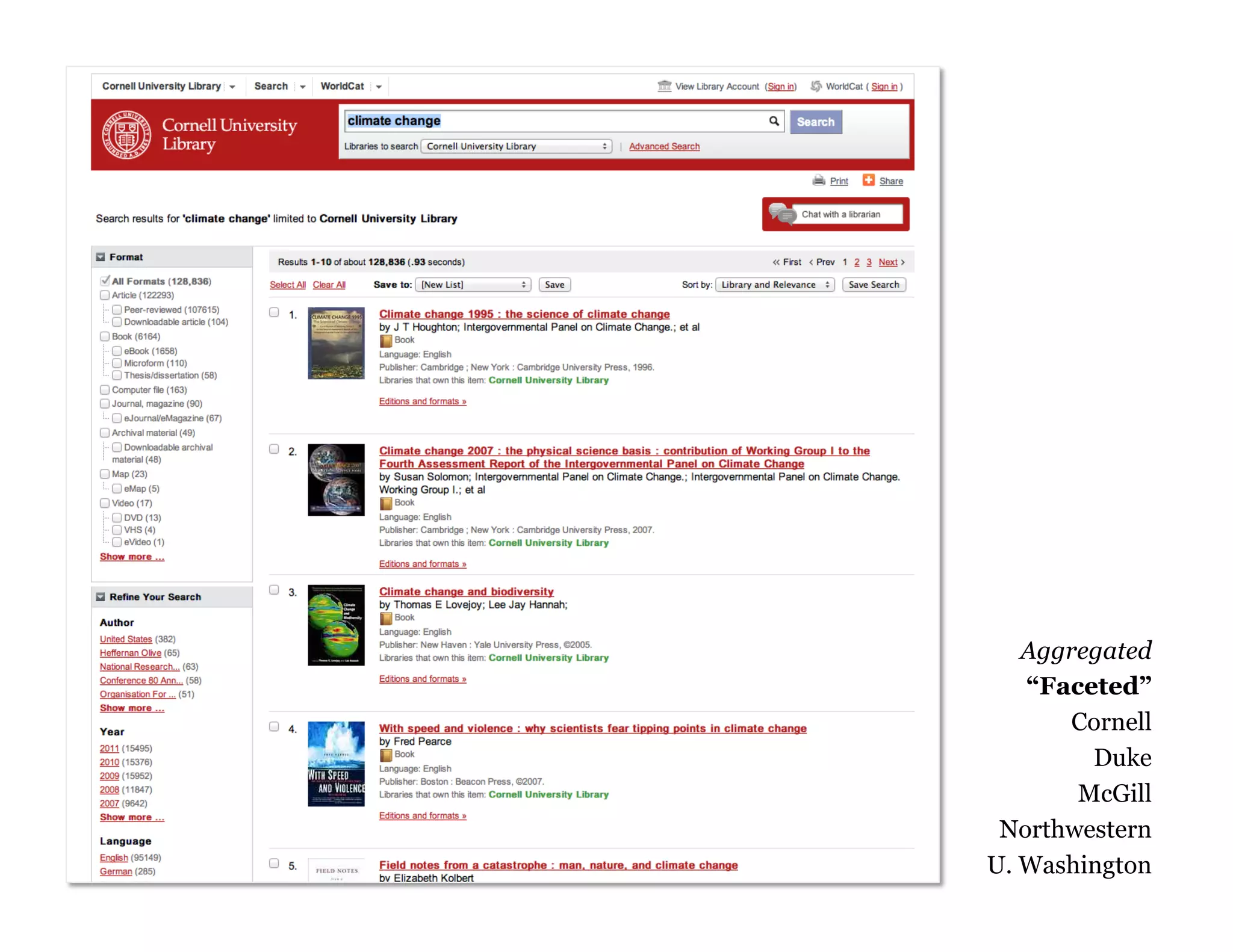
Aggregated
β€œFaceted”
Cornell
Duke
McGill
Northwestern
U. Washington
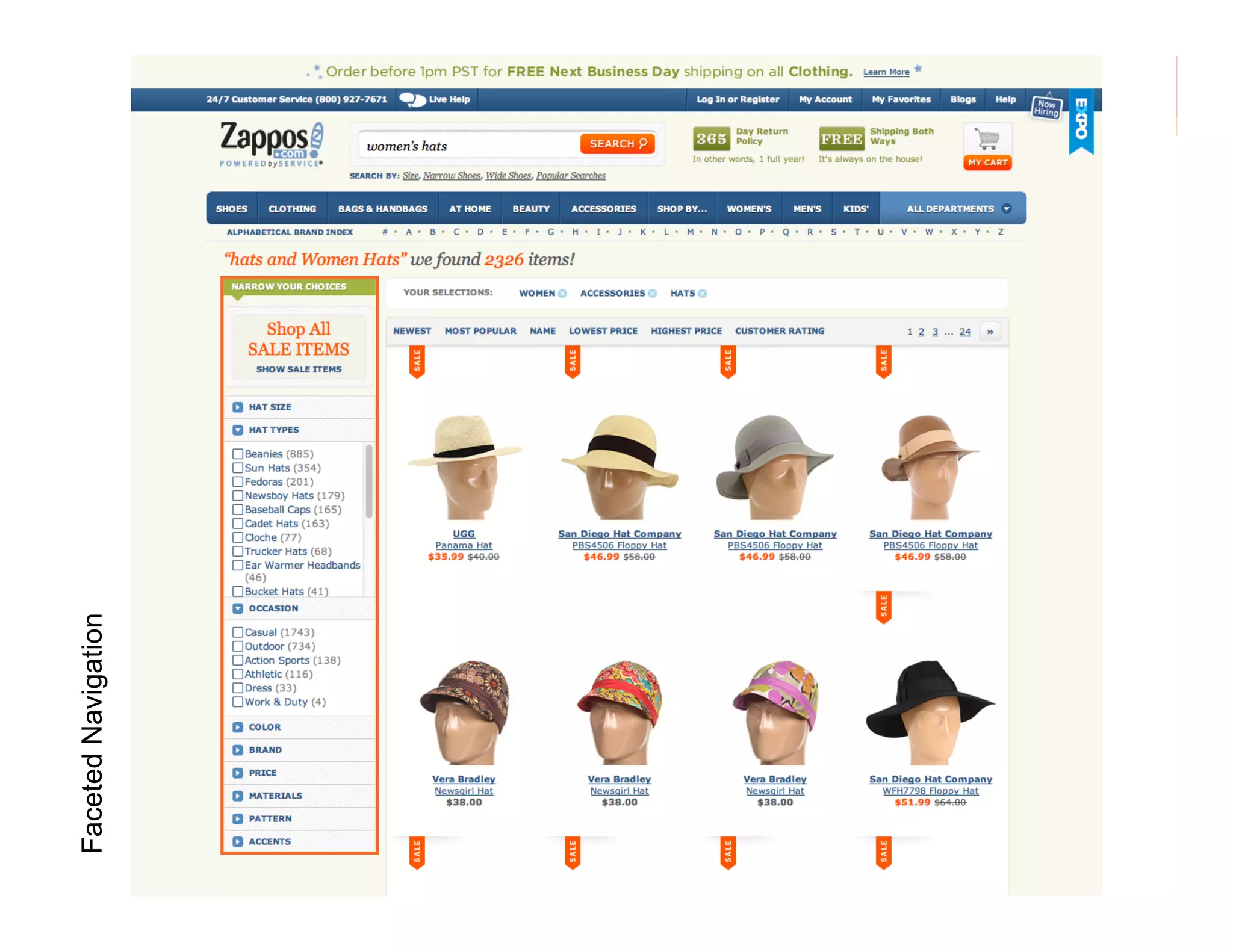
Faceted Navigation

36
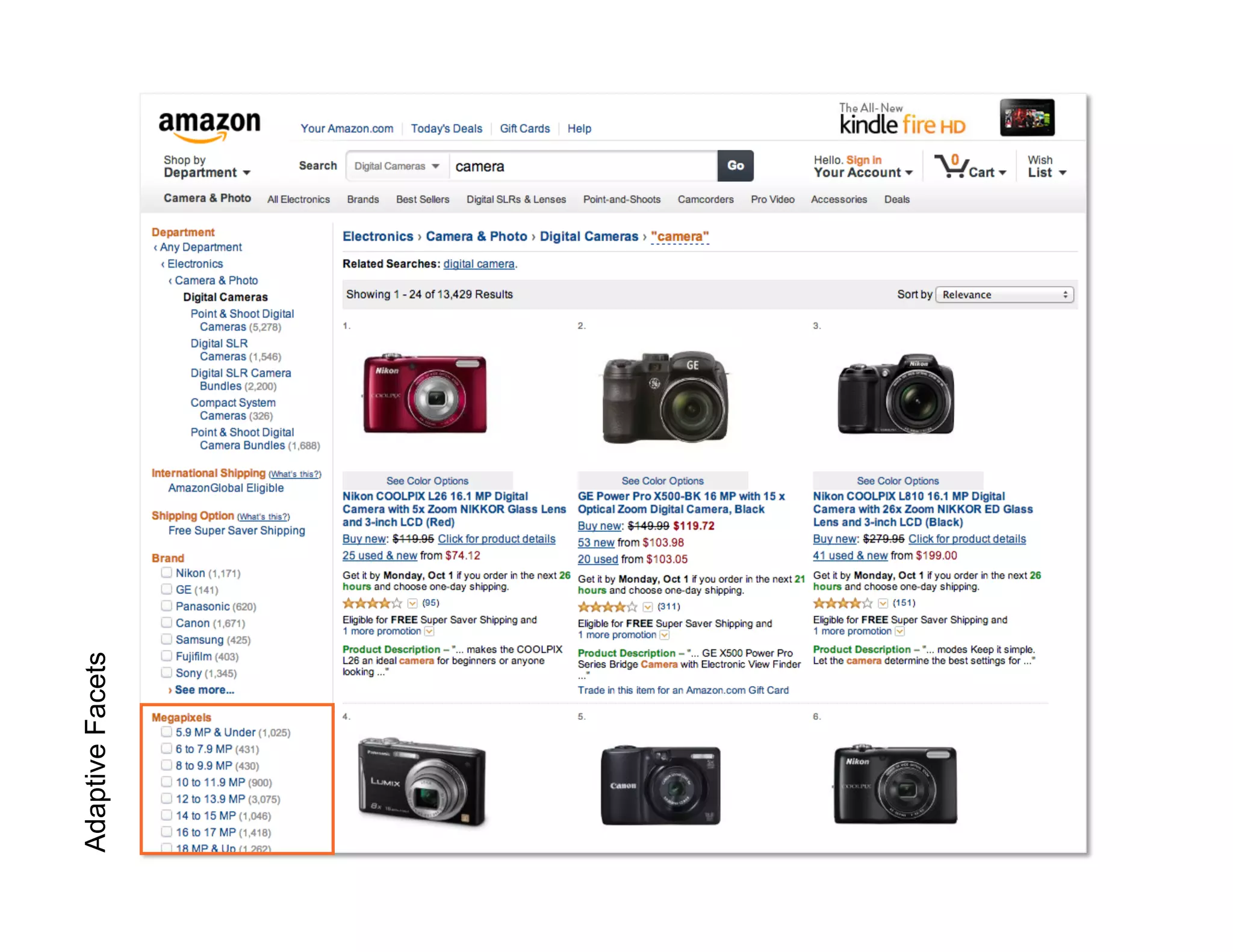
Adaptive Facets

37
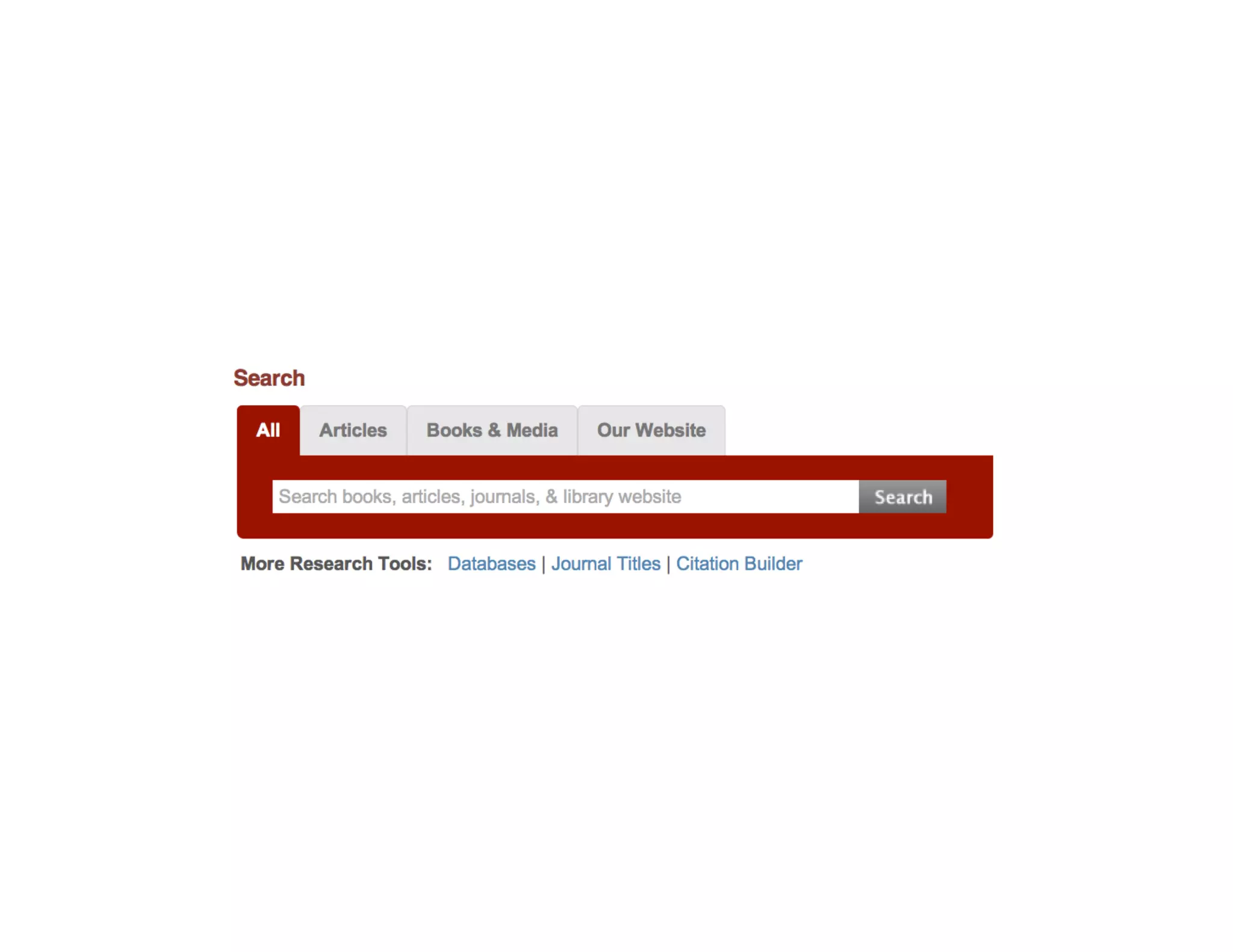
Gross and Sheridan conducted a usability study
that examined how Summon (β€œweb-scale discovery”)
was used for common library search tasks.
Summon was positioned as the primary search
box on the library’s home page for the study.
They found that the single search box was
employed for 80% of the assigned tasks.
How Users Search the Library from a Single Search Box
Lown, Sierra, Boyer (2013)

38
Use of full-text online content dramatically
increased in the year following implementation.
Librarians found they could focus instruction
less on choosing a database or catalog and more
on refining a search, research as an iterative
process, and other high level search skills.
The Impact of Serial Solutions’ Summon on
Information Literacy Instruction
Stephanie Buck and Margaret Mellinger (2011)

39
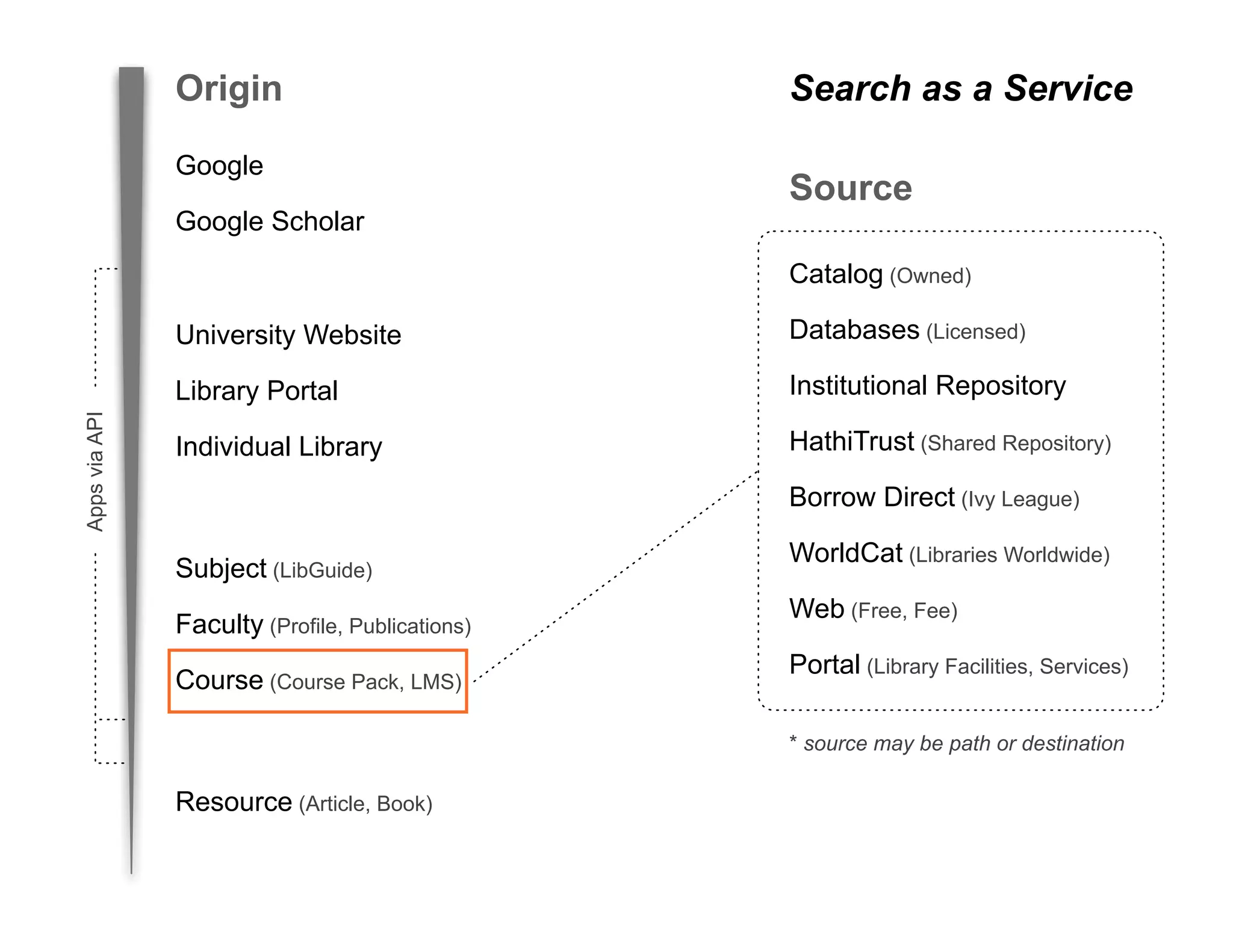
Origin
Google
Google Scholar

Search as a Service
Source
Catalog (Owned)
Databases (Licensed)

Library Portal
Apps via API

University Website

Institutional Repository

Individual Library

HathiTrust (Shared Repository)
Borrow Direct (Ivy League)

Subject (LibGuide)
Faculty (Profile, Publications)
Course (Course Pack, LMS)

WorldCat (Libraries Worldwide)
Web (Free, Fee)
Portal (Library Facilities, Services)
* source may be path or destination

Resource (Article, Book)

40
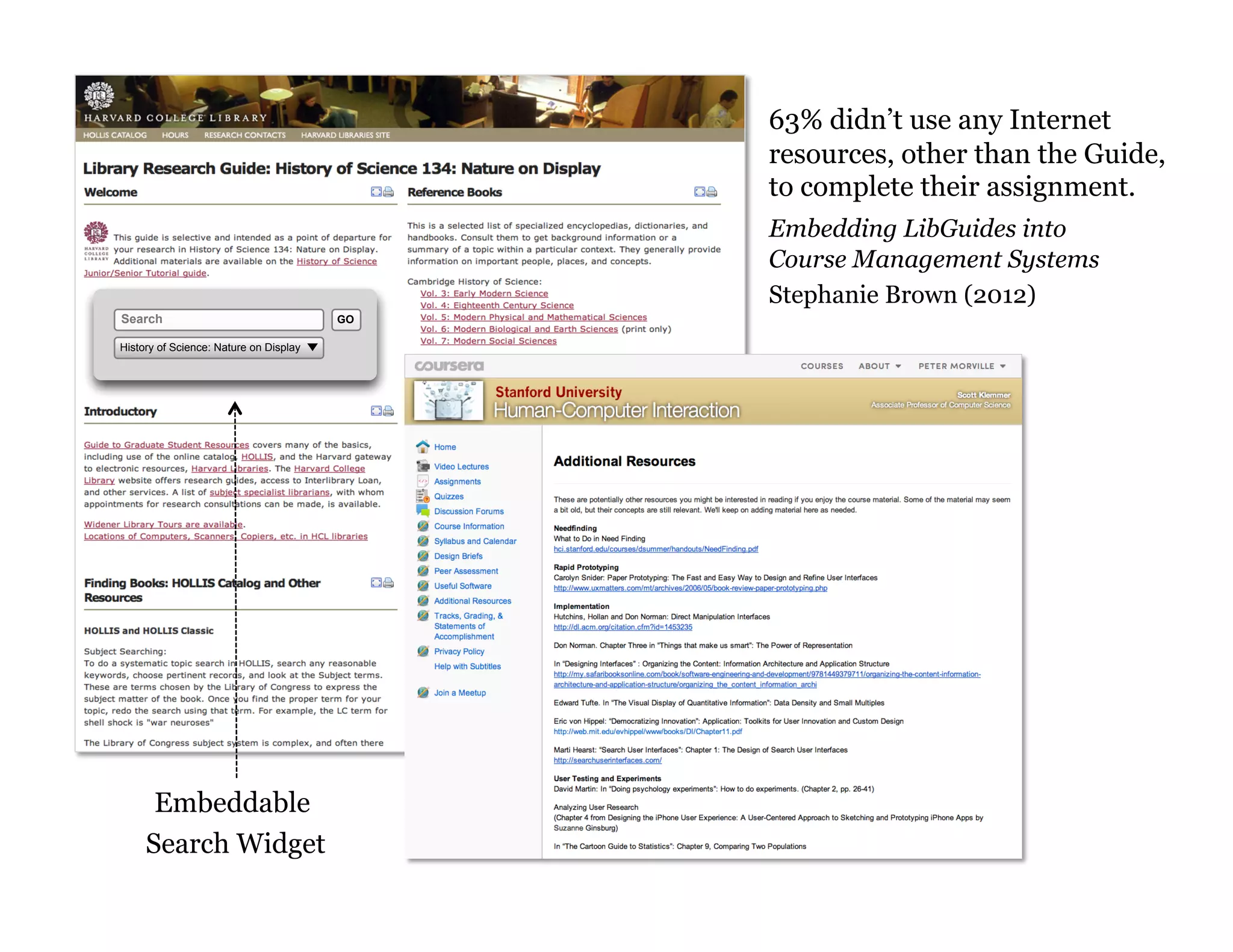
63% didn’t use any Internet
resources, other than the Guide,
to complete their assignment.
Embedding LibGuides into
Course Management Systems
Stephanie Brown (2012)
Search

GO

History of Science: Nature on Display

Embeddable
Search Widget

41
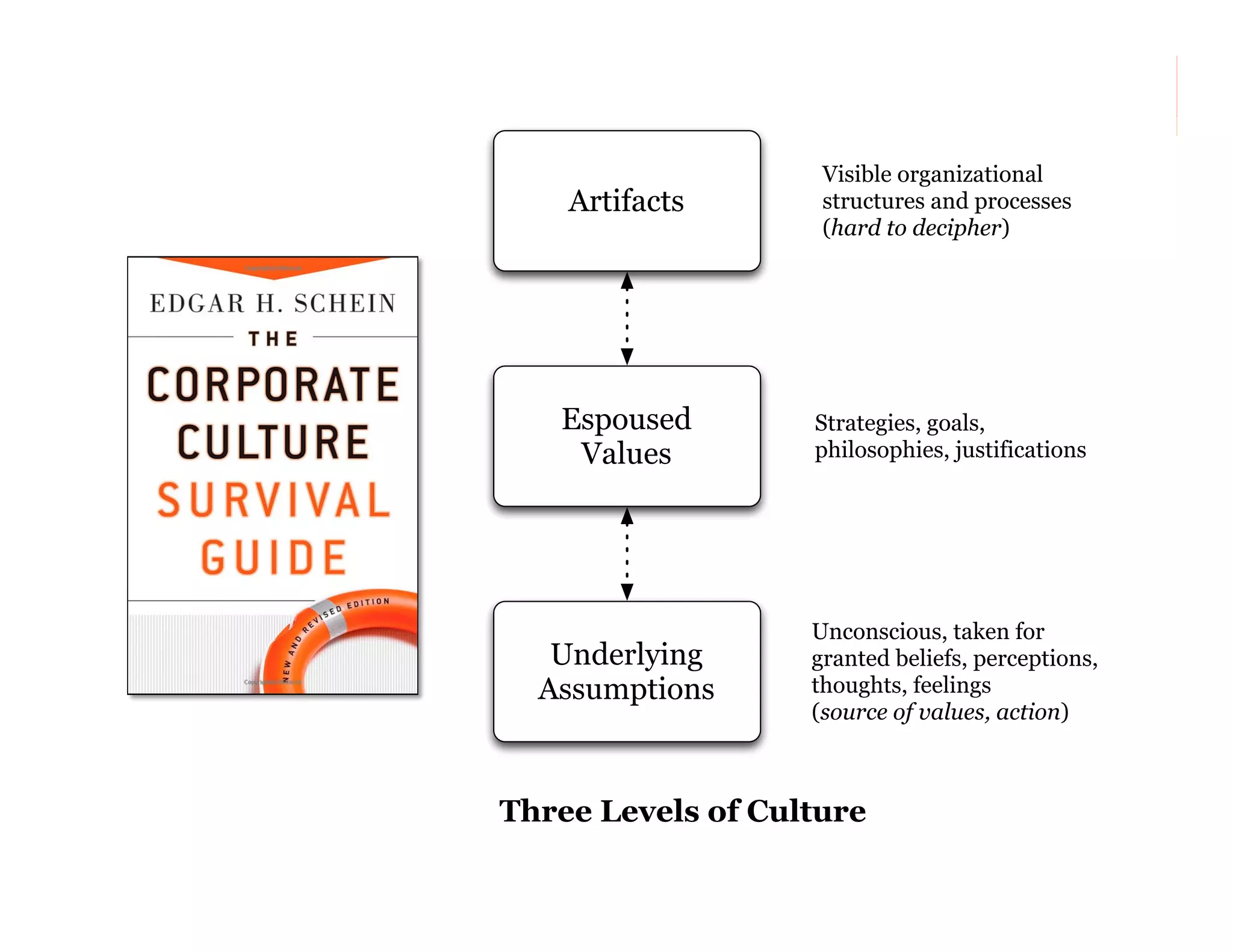
Artifacts

Visible organizational
structures and processes
(hard to decipher)

Espoused
Values

Strategies, goals,
philosophies, justifications

Underlying
Assumptions

Unconscious, taken for
granted beliefs, perceptions,
thoughts, feelings
(source of values, action)

Three Levels of Culture

42
Inquiry Learning

43
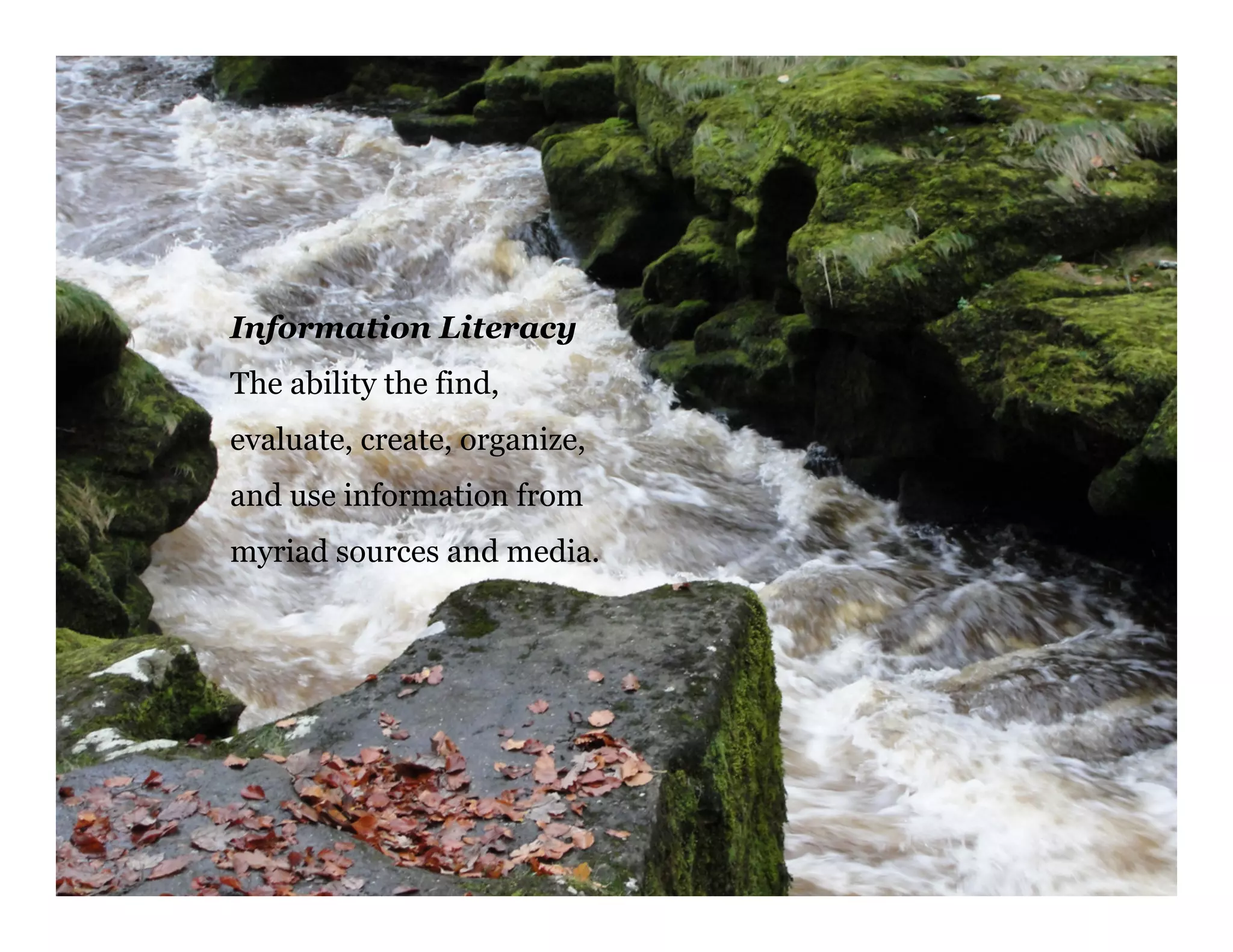
Information Literacy
The ability the find,
evaluate, create, organize,
and use information from
myriad sources and media.

44
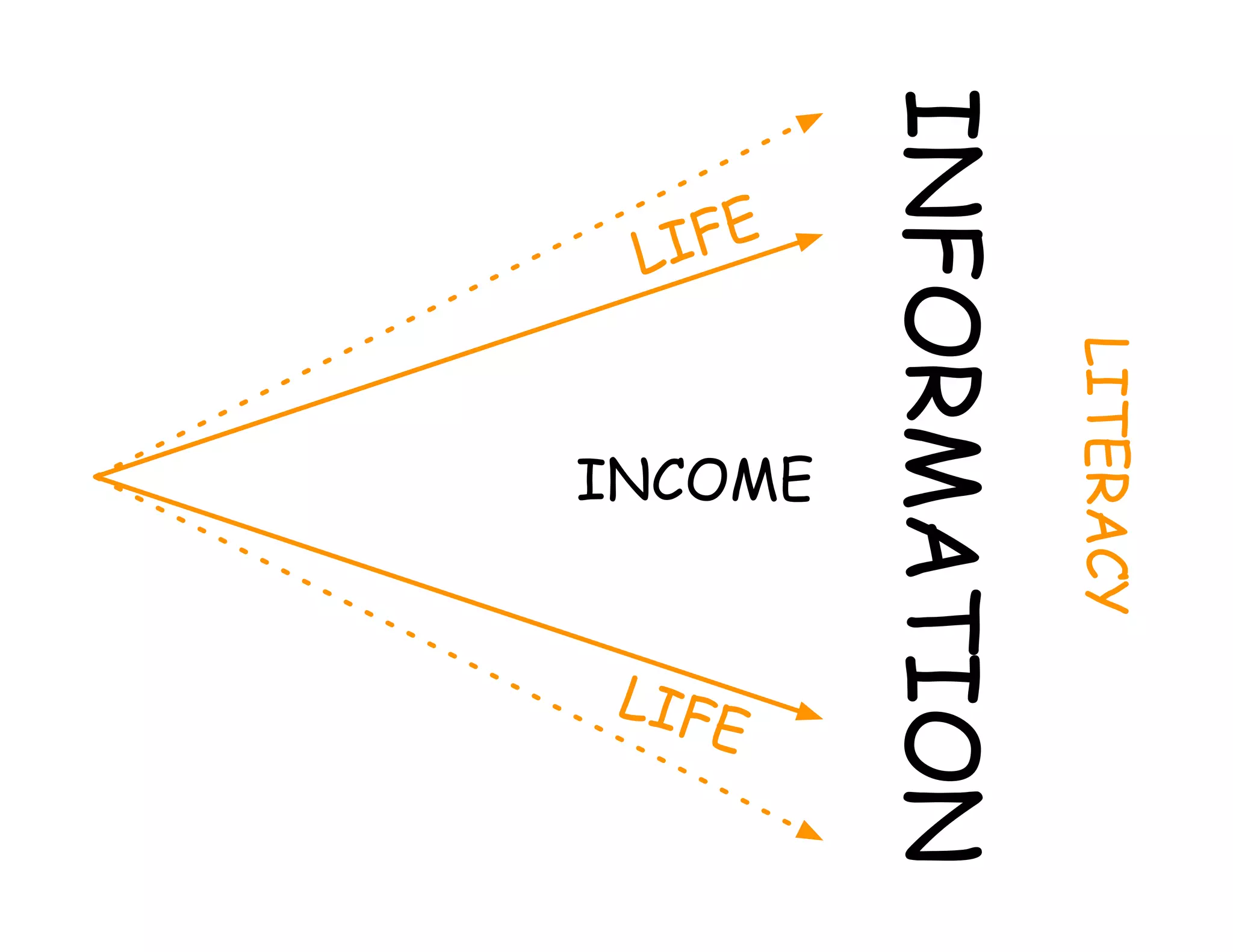
LITERACY

INCOME
LIF
E

INFORMATION
IFE
L

45
46
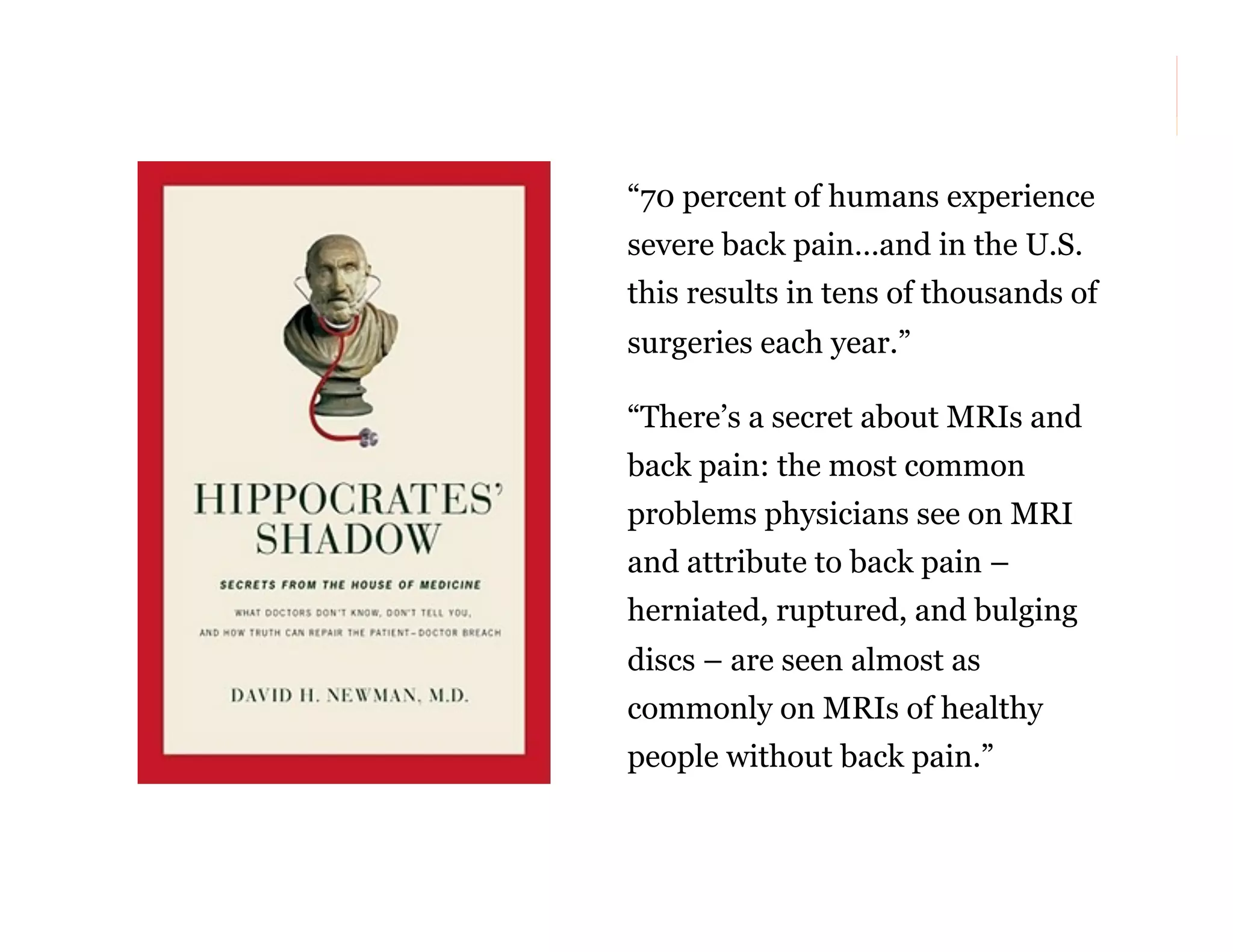
β€œ70 percent of humans experience
severe back pain…and in the U.S.
this results in tens of thousands of
surgeries each year.”
β€œThere’s a secret about MRIs and
back pain: the most common
problems physicians see on MRI
and attribute to back pain –
herniated, ruptured, and bulging
discs – are seen almost as
commonly on MRIs of healthy
people without back pain.”
47
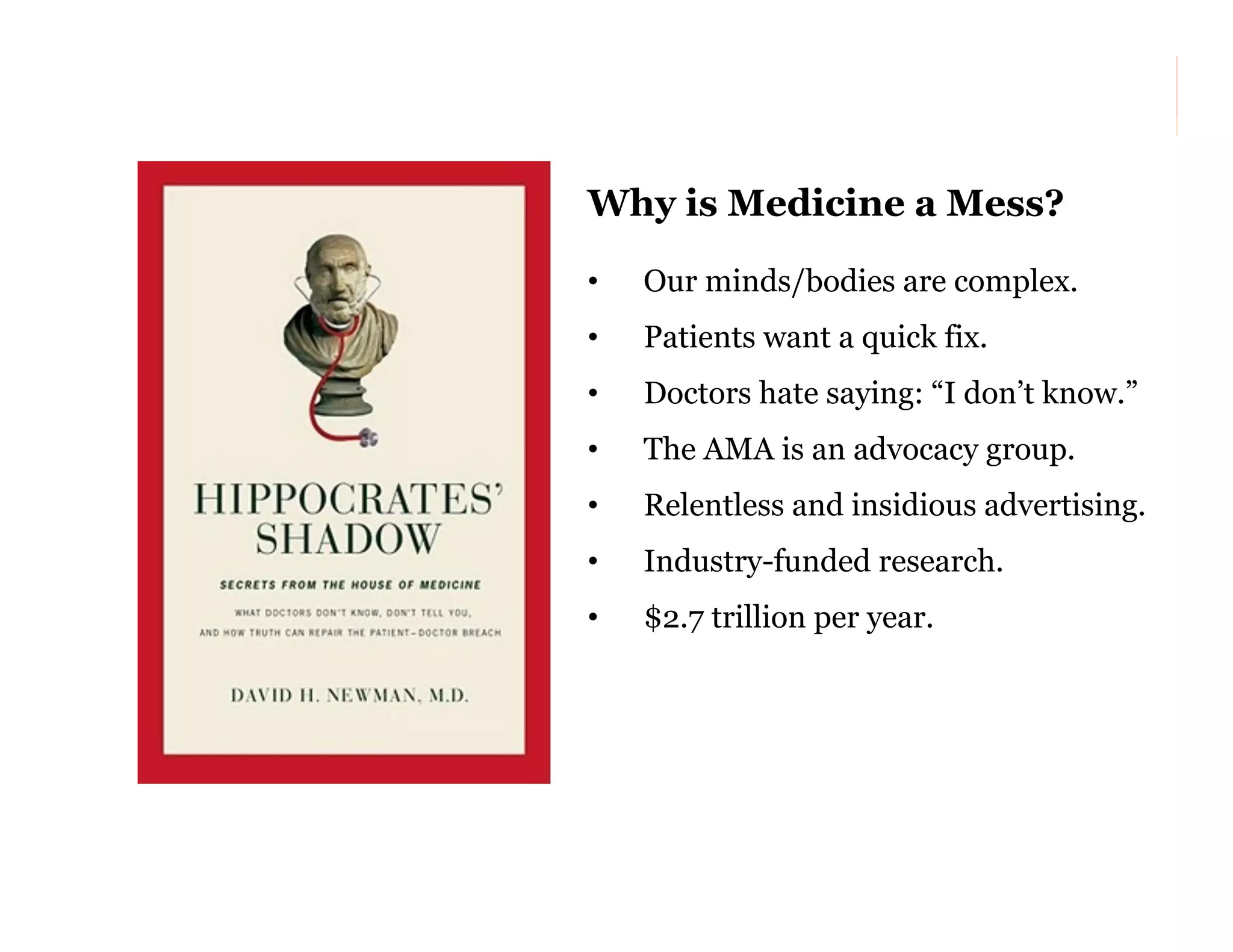
Why is Medicine a Mess?
β€’β€―

Our minds/bodies are complex.

β€’β€―

Patients want a quick fix.

β€’β€―

Doctors hate saying: β€œI don’t know.”

β€’β€―

The AMA is an advocacy group.

β€’β€―

Relentless and insidious advertising.

β€’β€―

Industry-funded research.

β€’β€―

$2.7 trillion per year.

48
β€œOur government is corrupt. Not
corrupt in any criminal sense.
But corrupt in a perfectly legal
sense: special interests bend the
levers of power to benefit them at
the expense of the rest of us.”

β€œThere are a thousand hacking at the branches of evil to
one who is striking at the root.” Henry David Thoreau
49
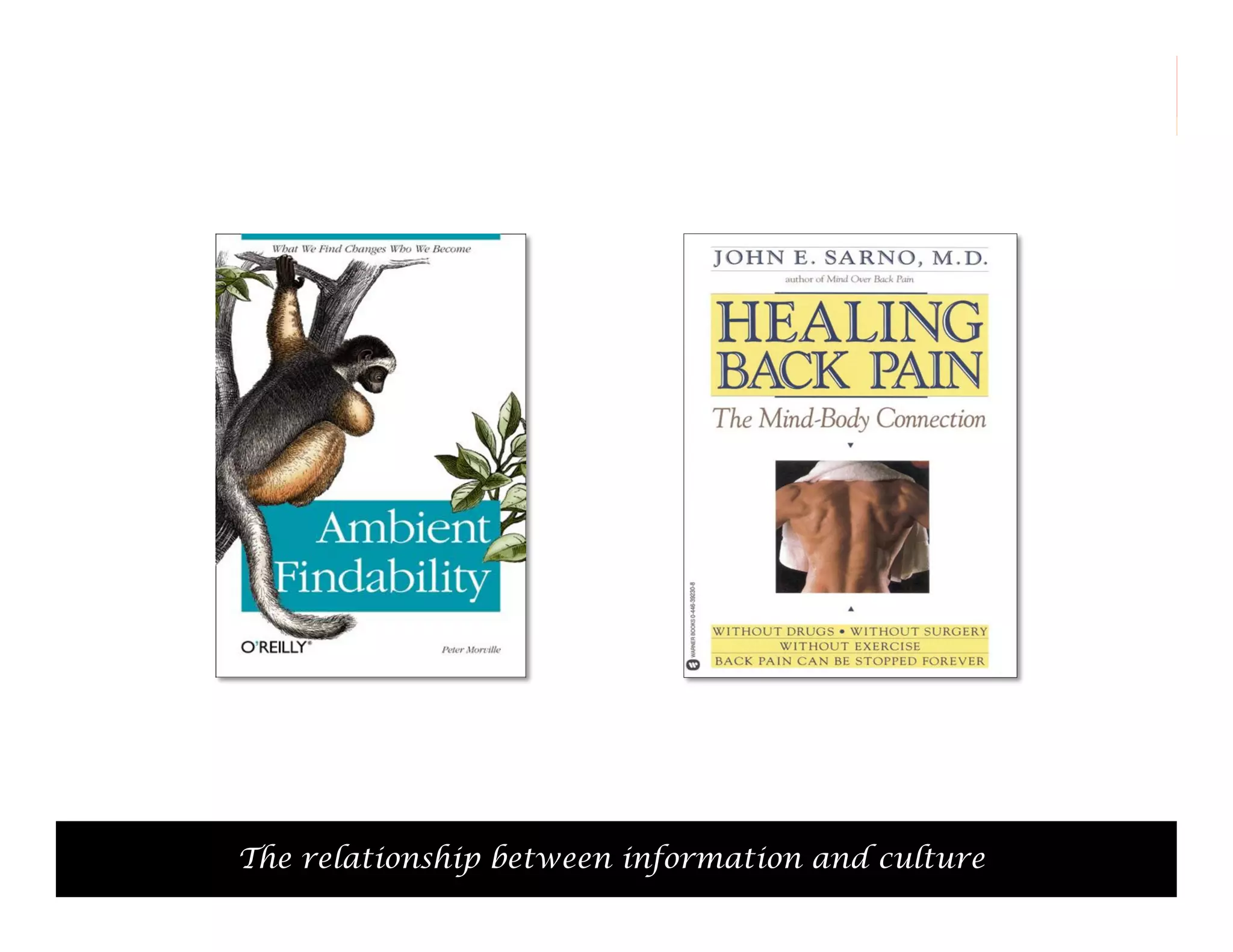
The relationship between information and 50
culture
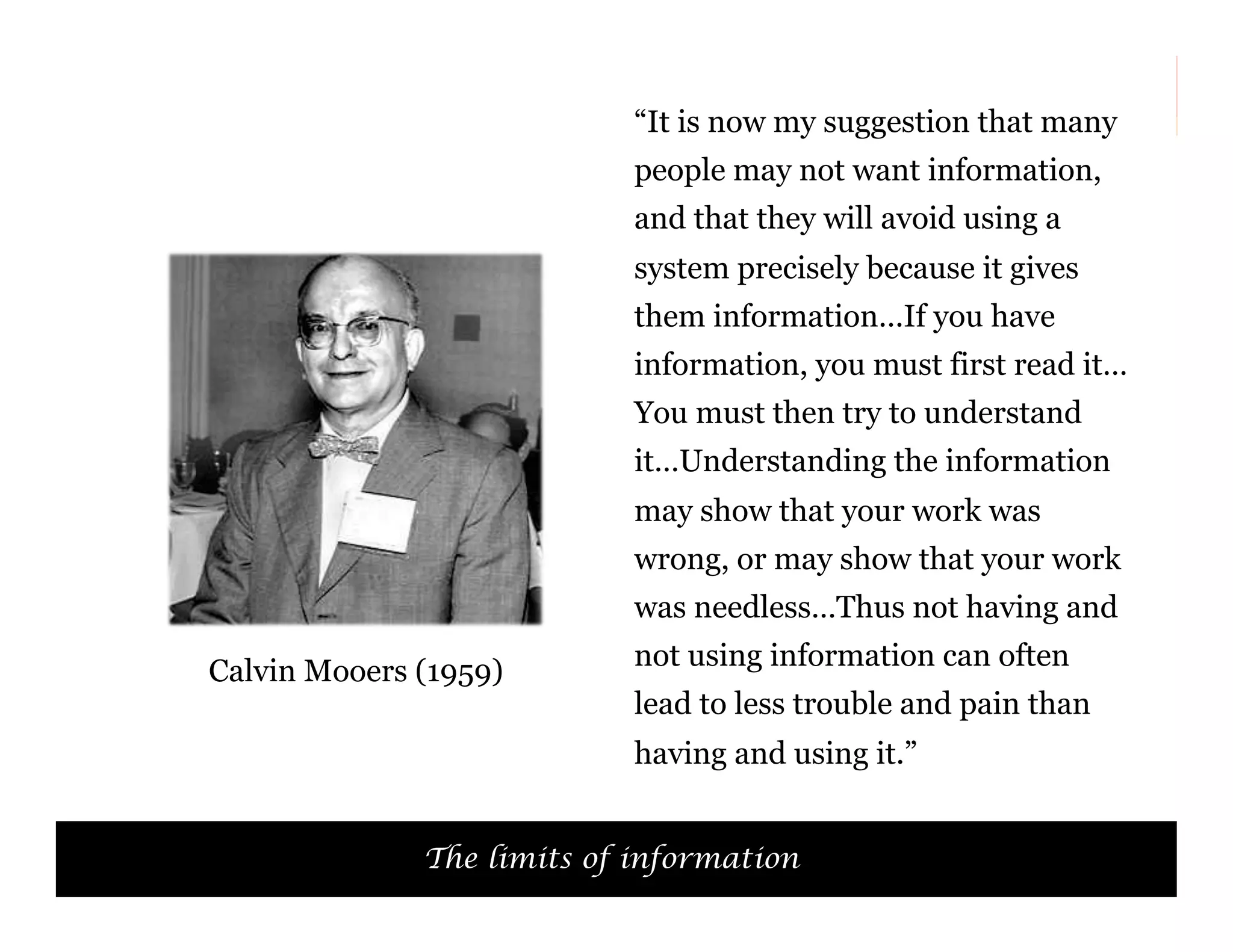
β€œIt is now my suggestion that many
people may not want information,
and that they will avoid using a
system precisely because it gives
them information…If you have
information, you must first read it…
You must then try to understand
it…Understanding the information
may show that your work was
wrong, or may show that your work
was needless…Thus not having and
Calvin Mooers (1959)

not using information can often
lead to less trouble and pain than
having and using it.”

The limits of information

51
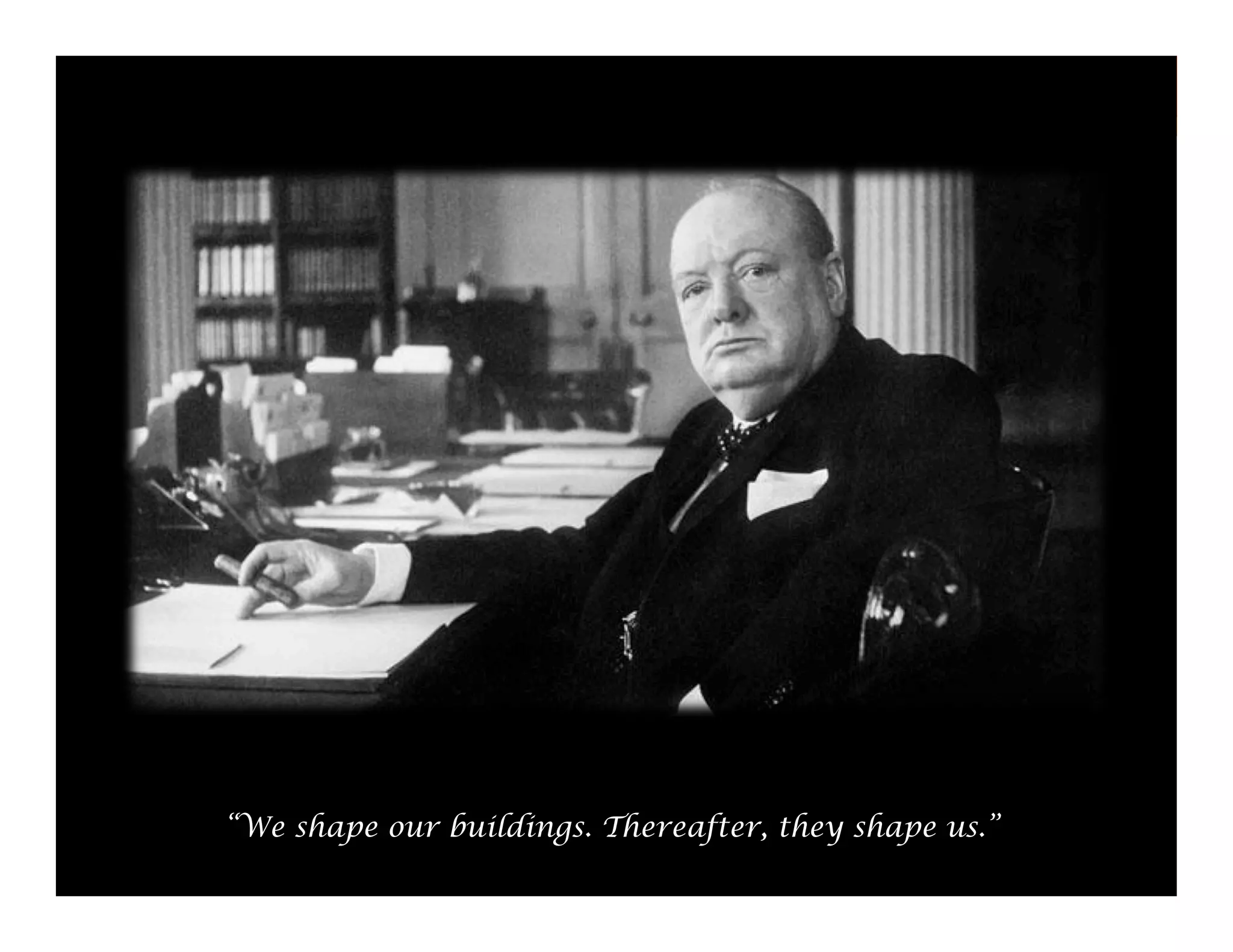
β€œWe shape our buildings. Thereafter, they shape us.”

52
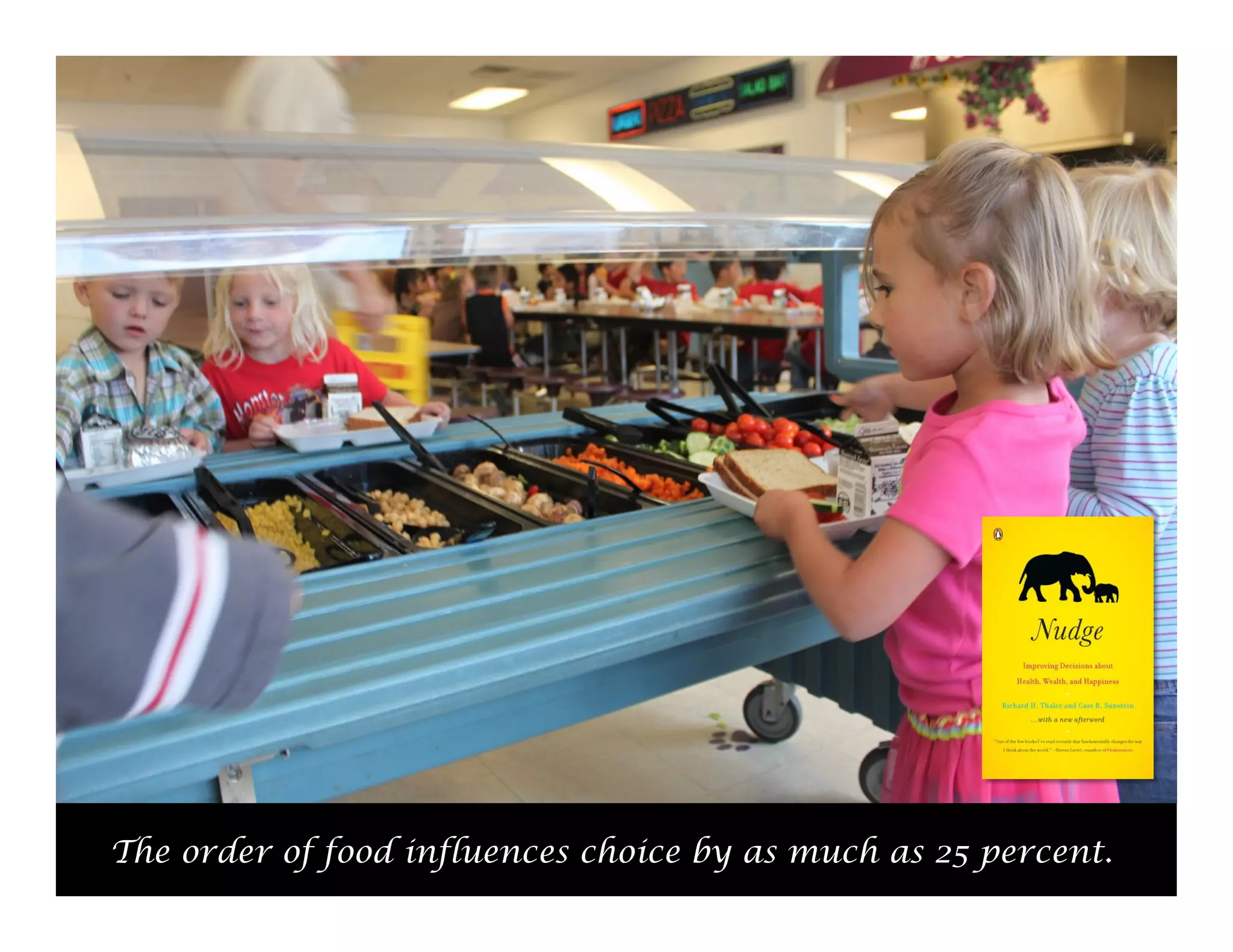
The order of food influences choice by as much as 25 percent.
53
54
Some habits have
the power to start
a chain reaction.
β€œSuccess doesn’t depend on
getting every single thing
right, but instead relies on
identifying a few key
priorities and fashioning
them into powerful levers.”

55
β€œWillpower is the single most
important keystone

habit for

individual success.”

56
Paul O’Neil as CEO of Alcoa

β€œI want to talk to you about worker
safety…I intend to make Alcoa the

safest company in America.
I intend to go for zero injuries.”
β€œWe killed this man. It’s my failure of
leadership. I

caused his death.

And it’s the failure of all of you in the
chain of command.”

57
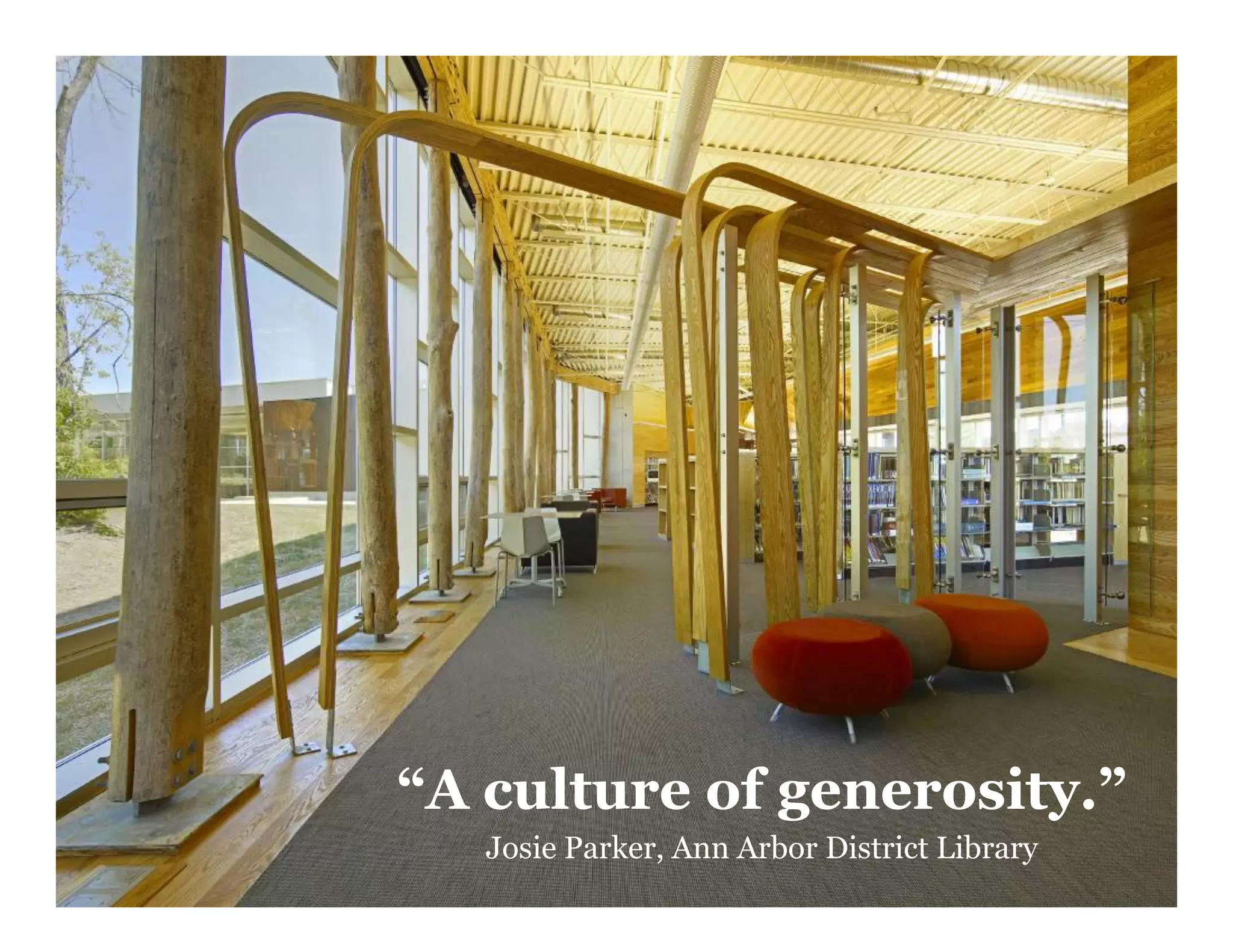
β€œA culture of generosity.”
Josie Parker, Ann Arbor District Library
58
59
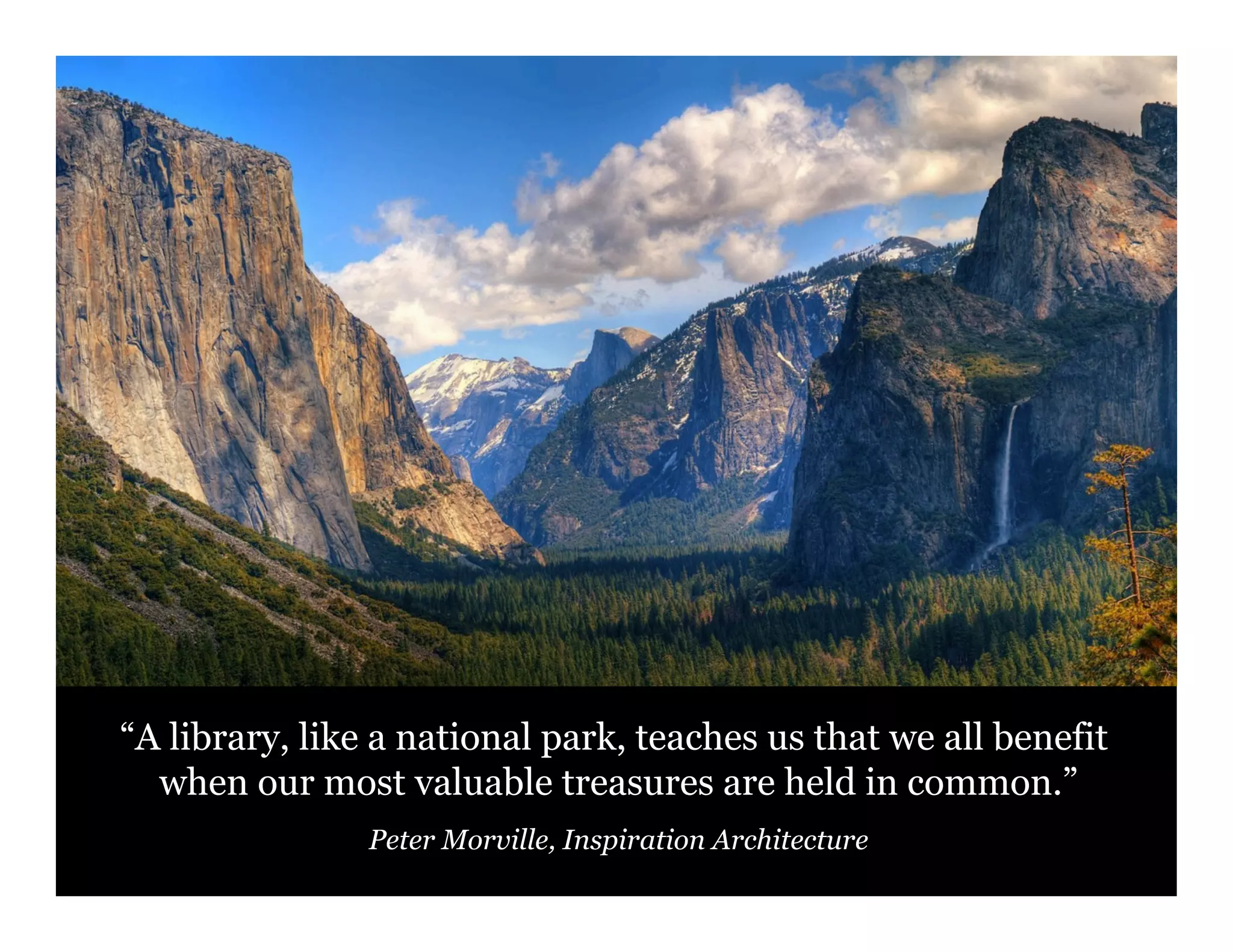
β€œA library, like a national park, teaches us that we all benefit
when our most valuable treasures are held in common.”
Peter Morville, Inspiration Architecture

60
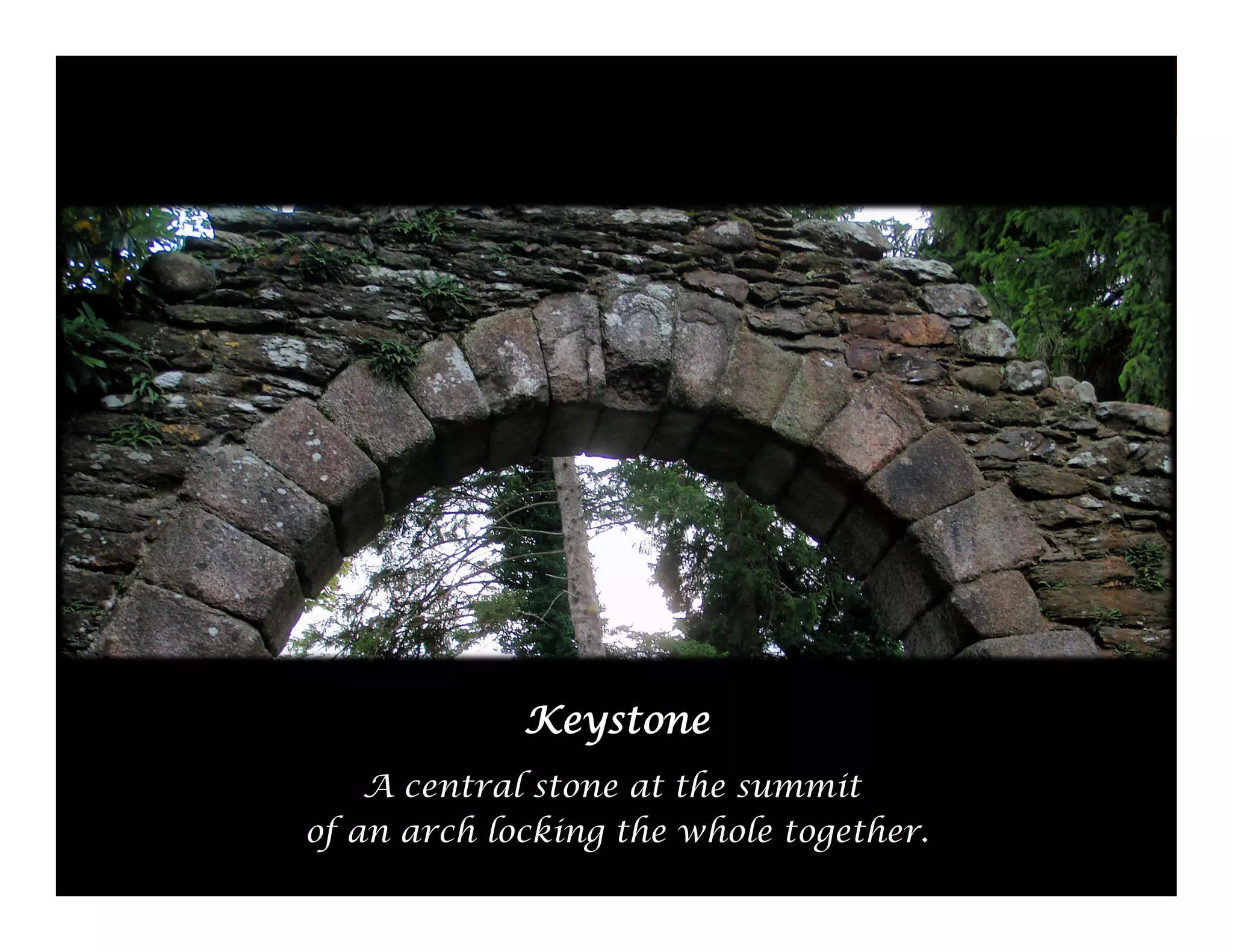
Keystone
A central stone at the summit
of an arch locking the whole together.
61
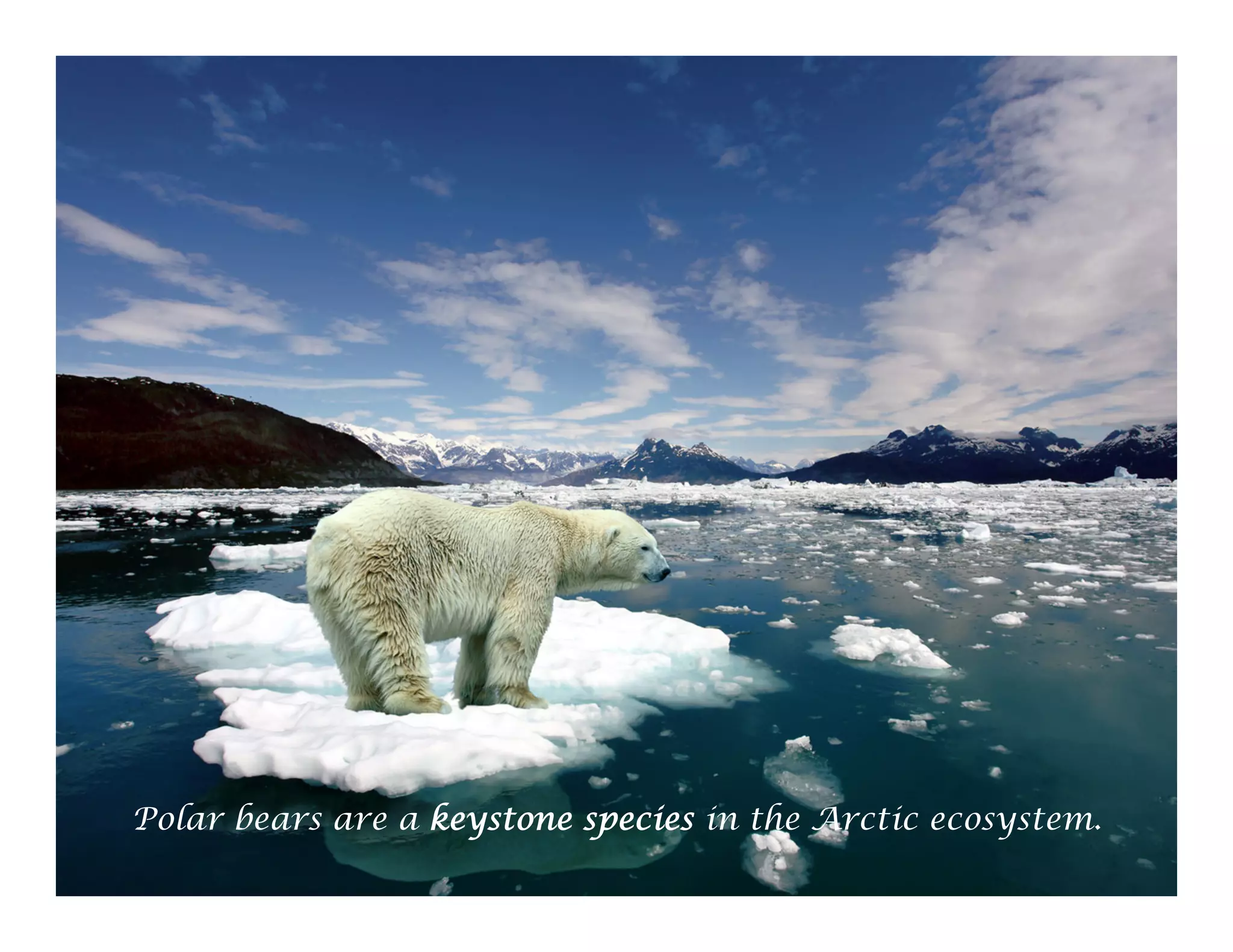
Polar bears are a keystone species in the Arctic ecosystem.
62
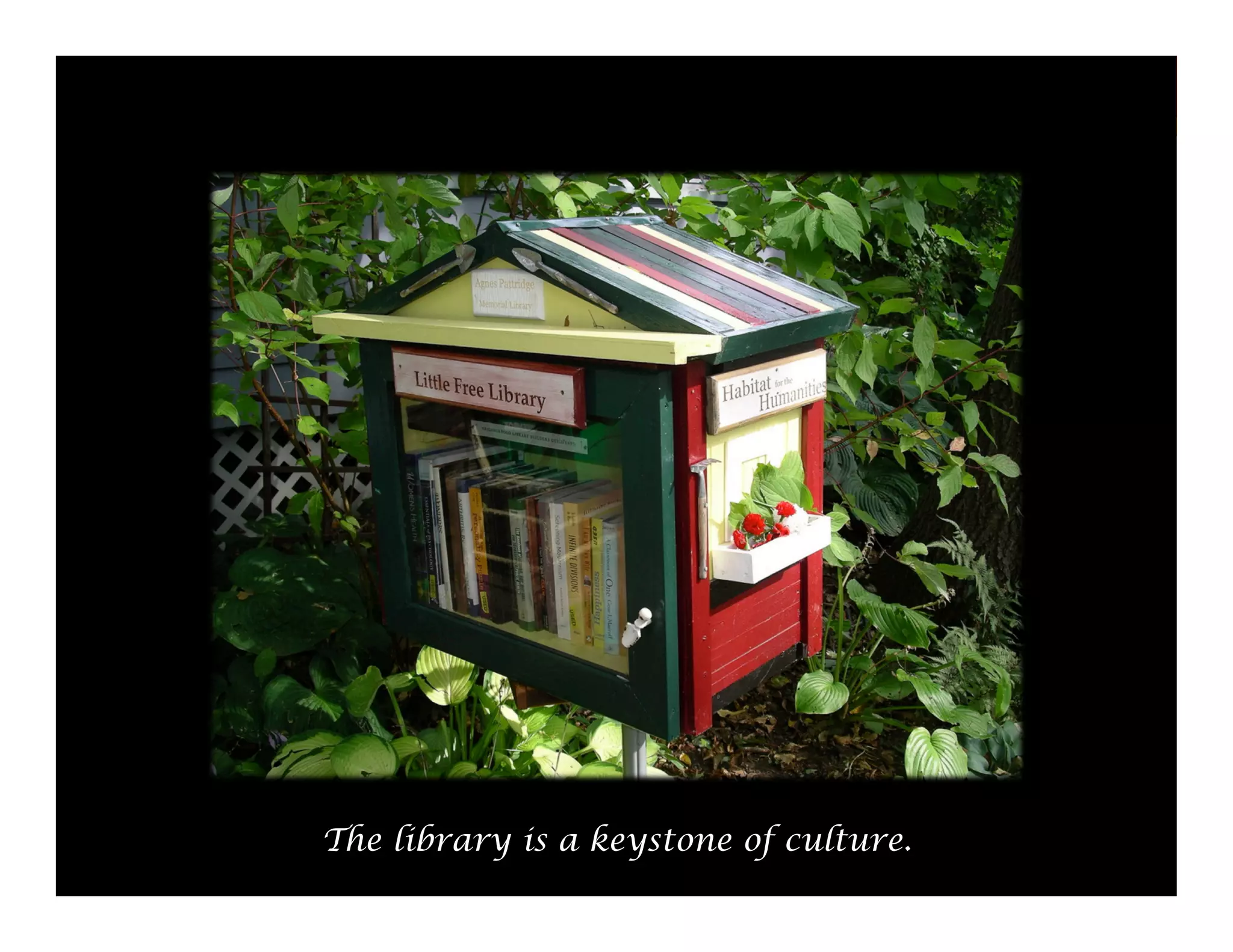
The library is a keystone of culture.
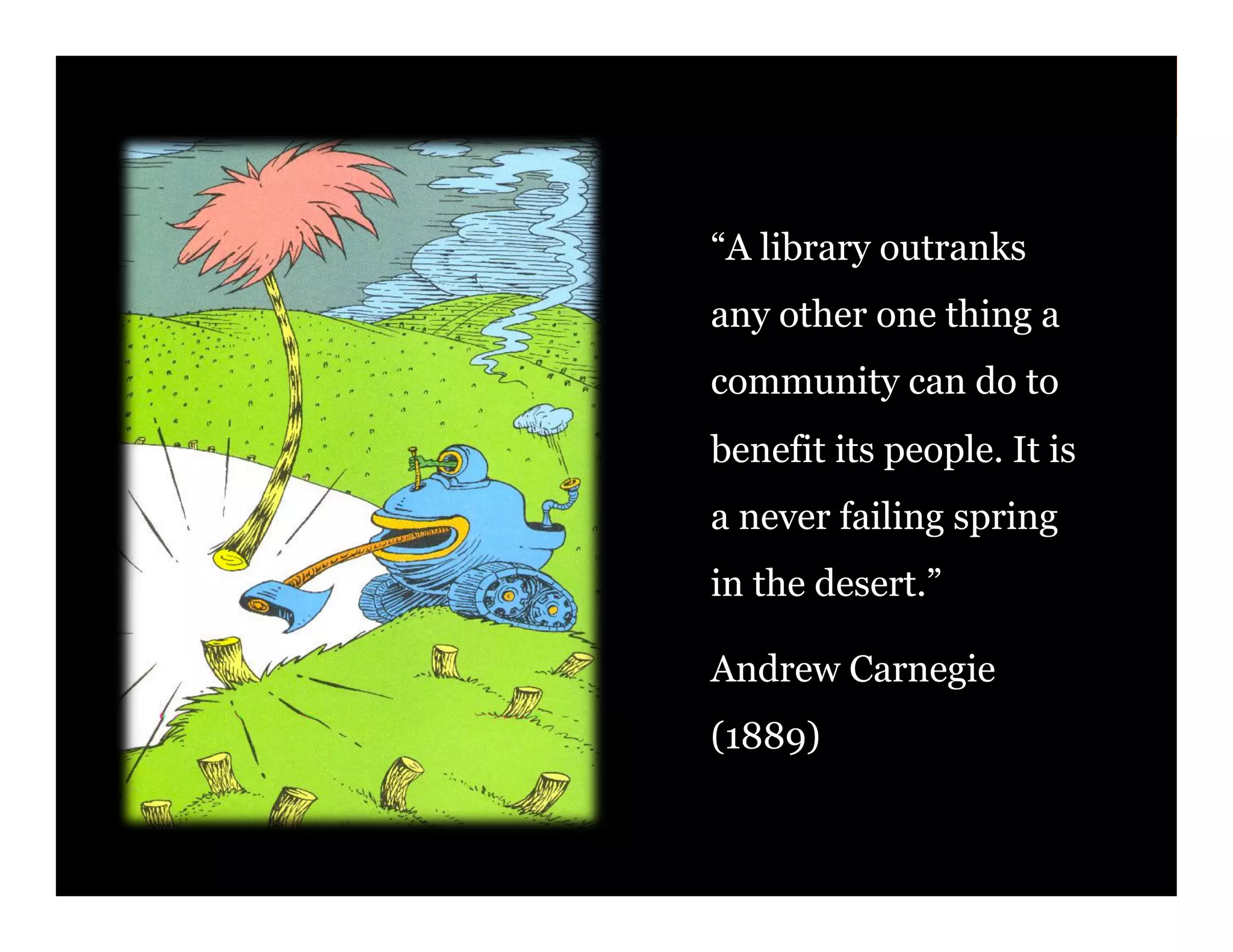
β€œA library outranks
any other one thing a
community can do to
benefit its people. It is
a never failing spring
in the desert.”
Andrew Carnegie
(1889)
64
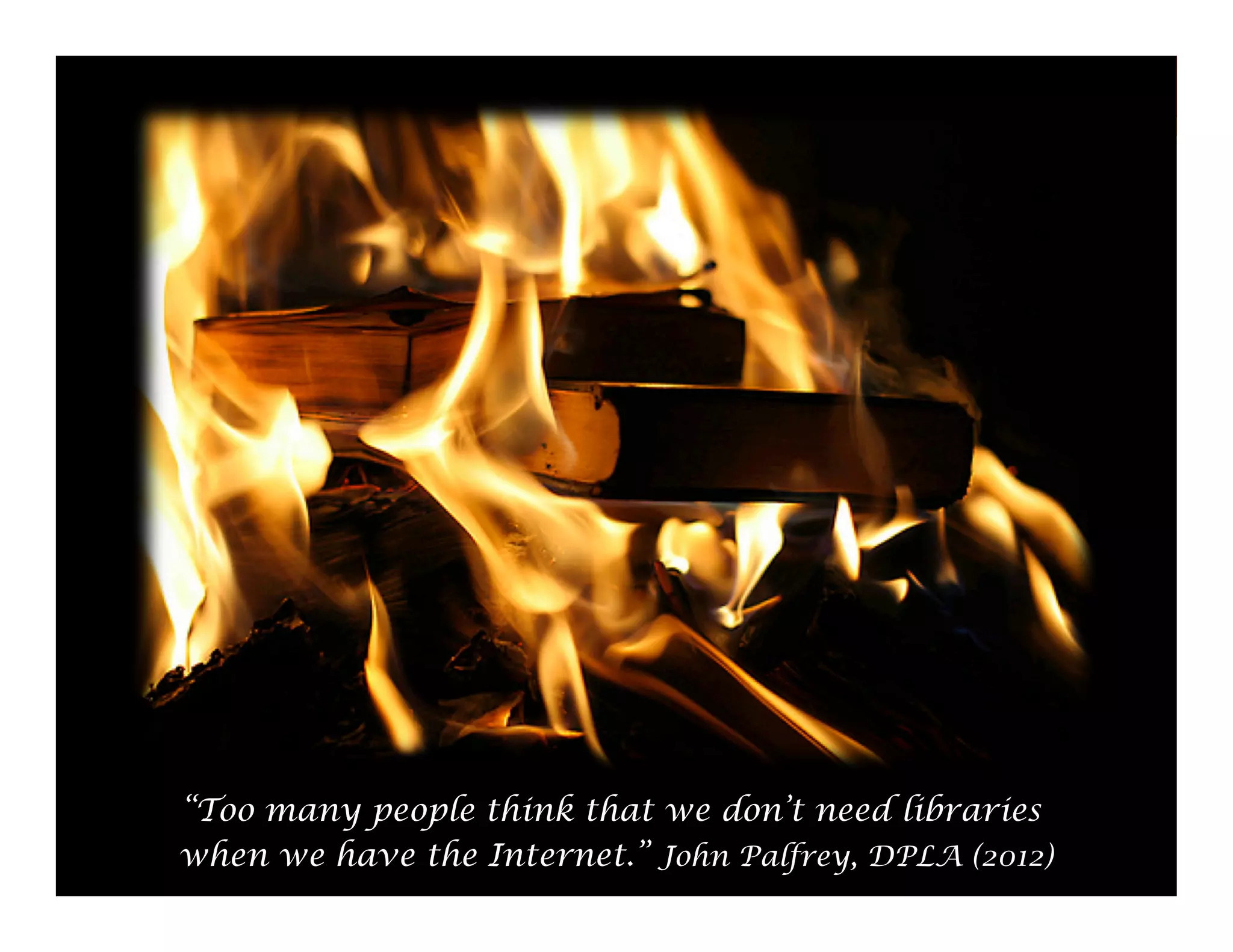
β€œToo many people think that we don’t need libraries
when we have the Internet.” John Palfrey, DPLA (2012)
65
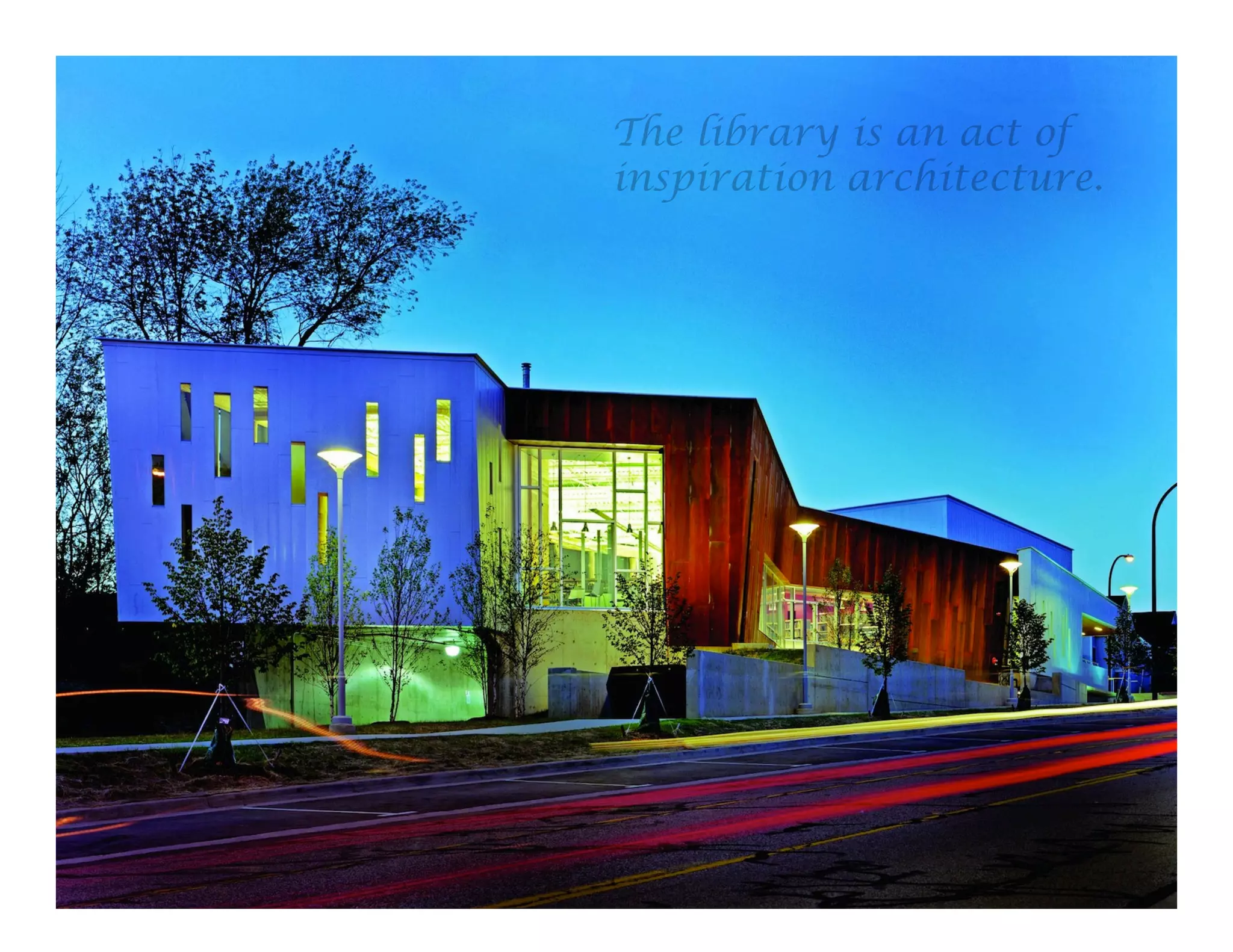
The library is an act of
inspiration architecture.

66
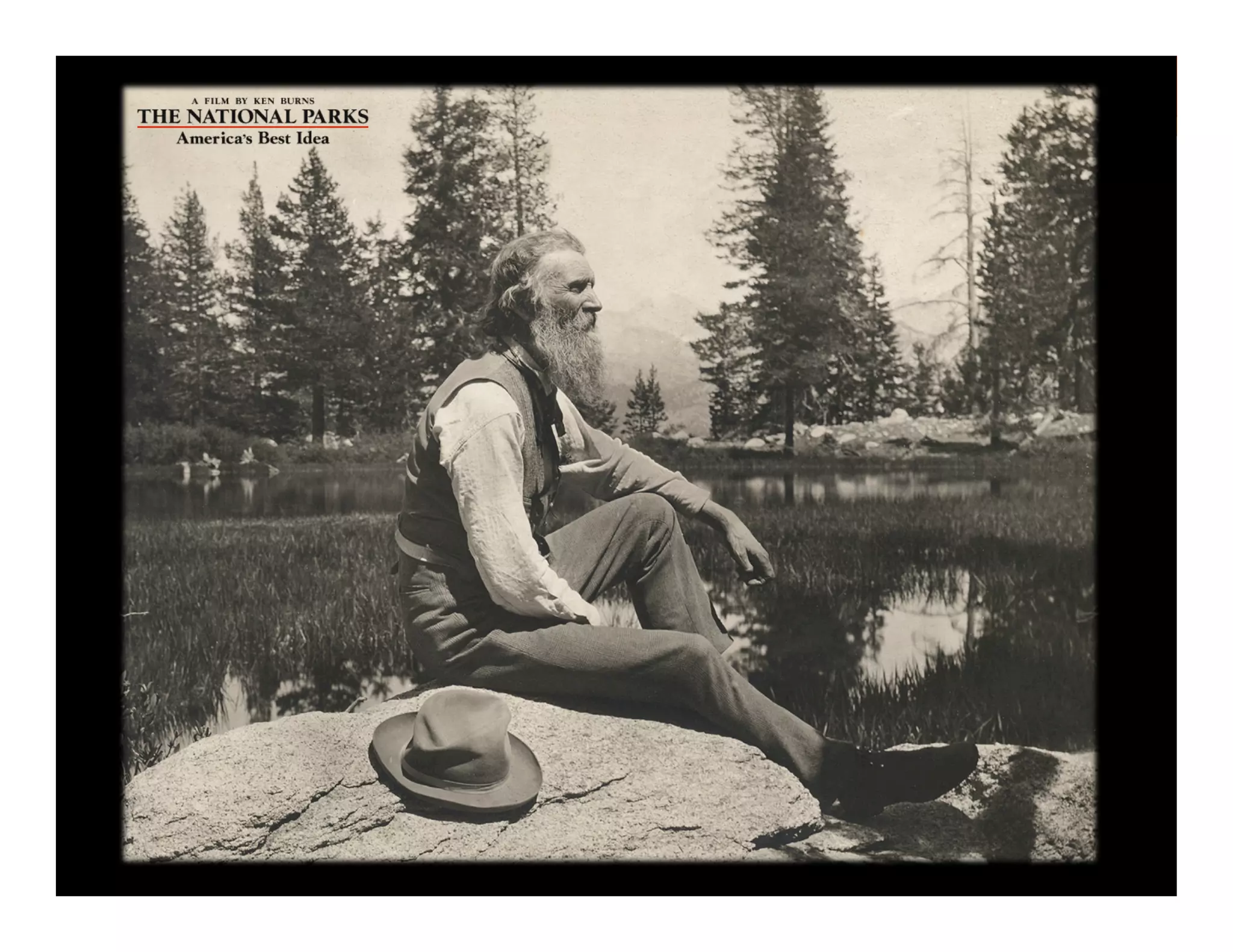
β€œWhen we try to pick out anything
by itself, we find it hitched to
everything else in the universe.”
John Muir

IA Therefore I Am

Inspiration Architecture by Peter Morville
67

Inspiration Architecture: The Future of Libraries (Internet Librarian 2013)

  • 1.
    Peter Morville, InternetLibrarian 2013 1
  • 2.
  • 3.
  • 4.
  • 5.
    Design for Discovery Search Patterns PeterMorville & Jeffery Callender 5
  • 6.
    β€œI say wefight for and maintain our very long-term and hardwon connection to books and what they represent.” Joseph Janes 6
  • 7.
    The structural designof shared information environments. The organization, labeling, search, and navigation systems in websites and intranets. 7
  • 8.
  • 10.
  • 11.
    Fragmentation Fragmentation into multiple sites,domains, and identities is clearly a major problem. Users don’t know which site to visit for which purpose. Findability Users can’t find what they need from the home page, but most users don’t come through the front door. They enter via a web search or a deep link, and are confused by what they find. Even worse, most never use the Library, because its resources aren’t easily findable.
  • 12.
    Web Strategy Web 1.β€― OneLibrary 2.β€― Core Areas Online Onsite Library Congress (about/for) National Library Copyright Hierarchy 3.β€― Network Intelligence top-down + Network bottom-up 12
  • 13.
    Wireframes Interfaces β€’β€― Portal β€’β€― Search β€’β€―Object β€’β€― Set β€’β€― Page Caveats β€’β€― Visual Design β€’β€― Starting Point 13
  • 14.
  • 15.
    Search is aComplex, Adaptive System Goals Psychology Behavior Interaction Affordances Language Features Technology Algorithms Indexing Structure Metadata Tools Process Incentives Interface Query Results Engine Content Users Source: Search Patterns (2010) Creators 15
  • 16.
    β€œGive me afulcrum and a place to stand, and I will move the world.” β€”Archimedes Portal Dis t ou Ab Brand Paths Patterns Incentives co ve ry Users Find Search Ask Objects Federated Faceted Fast Goal Gateway Collection Browse Findable Social 16
  • 17.
  • 18.
  • 19.
  • 20.
  • 21.
  • 22.
  • 23.
    β€œWhen I wasplaying baseball, most of the time I wasn’t playing full-scale, four bases, nine innings. I was playing a perfectly suitable junior version of the game...But when I was studying those shards of math and history, I wasn’t playing a junior version of anything. It was like batting practice without knowing the whole game. Why would anyone want to do that?” 23
  • 24.
  • 25.
    The MOOCs mustfirst compete with nonconsumption by meeting demand outside the schools (e.g., developing countries, home-schooling) and then within (e.g., letting students take courses not offered by their district). Later, this self-paced, studentcentered model may gain sufficient momentum to become the dominant paradigm. 25
  • 26.
  • 27.
  • 28.
    Regardless of allthe time and effort libraries put into providing a variety of research tools and resources on their websites, the literature suggests that students still prefer to start their research using Google or some other form of search engine. It is clear that there is an overwhelming preference for easy to use, familiar search tools that transcend education level, discipline of study, and student demographics. Discovery Layers and the Distance Student Jessica Mussell (2012) 28
  • 29.
    Strengths β€’β€― Fast, easy,familiar β€’β€― Cross-disciplinary searching β€’β€― Links to citing and related articles 29
  • 30.
    Weaknesses β€’β€― No β€œadvancedsearch” functionality β€’β€― Limited, inaccurate metadata β€’β€― Inconsistent coverage across disciplines β€’β€― No transparency (coverage, algorithms, usage, monetization) β€’β€― Not customizable or interoperable 30
  • 31.
    Information Literacy Employers claimedthat college hires rarely conducted the thorough research required of them in the workplace. At worst, some college hires solved problems with a lightning quick Google search, a scan of the first couple of pages of results, and a linear answer finding approach. β€œI had a new graduate hire who only searched for papers on Google. I said, you’re missing things, you need to use PubMed, and he responded, β€˜Well, I did this quick search, and that’s what I got.’ But that’s not good enough.” Project Information Literacy: Learning Curve by Alison J. Head (2012) 31
  • 32.
    β€œThe academic libraryis increasingly being disintermediated from the discovery process, risking irrelevance in one of its core functional areas.” Faculty rate importance of library roles Key Strategic Insights for Libraries, Publishers, and Societies by Roger C. Schonfeld (2010) 32
  • 33.
  • 34.
  • 35.
  • 36.
  • 37.
  • 38.
    Gross and Sheridanconducted a usability study that examined how Summon (β€œweb-scale discovery”) was used for common library search tasks. Summon was positioned as the primary search box on the library’s home page for the study. They found that the single search box was employed for 80% of the assigned tasks. How Users Search the Library from a Single Search Box Lown, Sierra, Boyer (2013) 38
  • 39.
    Use of full-textonline content dramatically increased in the year following implementation. Librarians found they could focus instruction less on choosing a database or catalog and more on refining a search, research as an iterative process, and other high level search skills. The Impact of Serial Solutions’ Summon on Information Literacy Instruction Stephanie Buck and Margaret Mellinger (2011) 39
  • 40.
    Origin Google Google Scholar Search asa Service Source Catalog (Owned) Databases (Licensed) Library Portal Apps via API University Website Institutional Repository Individual Library HathiTrust (Shared Repository) Borrow Direct (Ivy League) Subject (LibGuide) Faculty (Profile, Publications) Course (Course Pack, LMS) WorldCat (Libraries Worldwide) Web (Free, Fee) Portal (Library Facilities, Services) * source may be path or destination Resource (Article, Book) 40
  • 41.
    63% didn’t useany Internet resources, other than the Guide, to complete their assignment. Embedding LibGuides into Course Management Systems Stephanie Brown (2012) Search GO History of Science: Nature on Display Embeddable Search Widget 41
  • 42.
    Artifacts Visible organizational structures andprocesses (hard to decipher) Espoused Values Strategies, goals, philosophies, justifications Underlying Assumptions Unconscious, taken for granted beliefs, perceptions, thoughts, feelings (source of values, action) Three Levels of Culture 42
  • 43.
  • 44.
    Information Literacy The abilitythe find, evaluate, create, organize, and use information from myriad sources and media. 44
  • 45.
  • 46.
  • 47.
    β€œ70 percent ofhumans experience severe back pain…and in the U.S. this results in tens of thousands of surgeries each year.” β€œThere’s a secret about MRIs and back pain: the most common problems physicians see on MRI and attribute to back pain – herniated, ruptured, and bulging discs – are seen almost as commonly on MRIs of healthy people without back pain.” 47
  • 48.
    Why is Medicinea Mess? β€’β€― Our minds/bodies are complex. β€’β€― Patients want a quick fix. β€’β€― Doctors hate saying: β€œI don’t know.” β€’β€― The AMA is an advocacy group. β€’β€― Relentless and insidious advertising. β€’β€― Industry-funded research. β€’β€― $2.7 trillion per year. 48
  • 49.
    β€œOur government iscorrupt. Not corrupt in any criminal sense. But corrupt in a perfectly legal sense: special interests bend the levers of power to benefit them at the expense of the rest of us.” β€œThere are a thousand hacking at the branches of evil to one who is striking at the root.” Henry David Thoreau 49
  • 50.
    The relationship betweeninformation and 50 culture
  • 51.
    β€œIt is nowmy suggestion that many people may not want information, and that they will avoid using a system precisely because it gives them information…If you have information, you must first read it… You must then try to understand it…Understanding the information may show that your work was wrong, or may show that your work was needless…Thus not having and Calvin Mooers (1959) not using information can often lead to less trouble and pain than having and using it.” The limits of information 51
  • 52.
    β€œWe shape ourbuildings. Thereafter, they shape us.” 52
  • 53.
    The order offood influences choice by as much as 25 percent. 53
  • 54.
  • 55.
    Some habits have thepower to start a chain reaction. β€œSuccess doesn’t depend on getting every single thing right, but instead relies on identifying a few key priorities and fashioning them into powerful levers.” 55
  • 56.
    β€œWillpower is thesingle most important keystone habit for individual success.” 56
  • 57.
    Paul O’Neil asCEO of Alcoa β€œI want to talk to you about worker safety…I intend to make Alcoa the safest company in America. I intend to go for zero injuries.” β€œWe killed this man. It’s my failure of leadership. I caused his death. And it’s the failure of all of you in the chain of command.” 57
  • 58.
    β€œA culture ofgenerosity.” Josie Parker, Ann Arbor District Library 58
  • 59.
  • 60.
    β€œA library, likea national park, teaches us that we all benefit when our most valuable treasures are held in common.” Peter Morville, Inspiration Architecture 60
  • 61.
    Keystone A central stoneat the summit of an arch locking the whole together. 61
  • 62.
    Polar bears area keystone species in the Arctic ecosystem. 62
  • 63.
    The library isa keystone of culture.
  • 64.
    β€œA library outranks anyother one thing a community can do to benefit its people. It is a never failing spring in the desert.” Andrew Carnegie (1889) 64
  • 65.
    β€œToo many peoplethink that we don’t need libraries when we have the Internet.” John Palfrey, DPLA (2012) 65
  • 66.
    The library isan act of inspiration architecture. 66
  • 67.
    β€œWhen we tryto pick out anything by itself, we find it hitched to everything else in the universe.” John Muir IA Therefore I Am Inspiration Architecture by Peter Morville 67