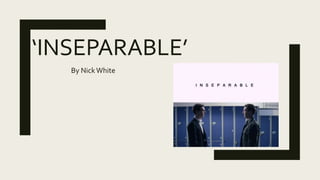
‘INSEPARABLE’
By NickWhite
General information:
■ Genre- drama
■ Reality based plot- common convention
■ Storyline/plot-When young dad, Joe, discovers he's dying, drifter Charlie is given a
unique opportunity to turn his life around.
■ It’s a story of family, identity and starting again which the audience could easily relate
to (uses and grats – katz and bloomer).
Narrative theory:
■ Film starts with a conflicting/confusing scene which creates both hermeneutic and proeretic code
(Barthes).
■ The opening scene is replayed/only makes sense half way through the short film which is also a
common convention seen in dramas and short films in general.
■ Binary opposition is shown by the two contrasting characters Charlie and Joe, which is intriguing
as essentially they are twins (intrigues the audience).
■ This storyline in non-linear and goes againstTodorov’s narrative theory of equilibrium, dis
equilibrium as the story starts off with a problem and finishes with one.
■ Stereotypical representations of gender are seen thought-out the film – wife is a stay at home
mum, Charlie is the provider (ie: goes to work).This scenario could be very relatable to many
adults watching the film.
■ The opening scene is repeated towards the end of the short film – common convention id dramas
and short films in general – fulfils audience’s cognitive needs as it resolves their confusion.
Mise-en-scene
■ Lighting- low key lighting but also a grey/dark blue filter used which makes the short film feel
a lot more cinematic which would attract people who are interested in cinema/film in general
(correct target audience).
■ Props/makeup- clothing is discrete/dark to reflect/symbolise the underlying message/vibe of
the film.
■ Actors/acting- minimal numbers of actors, mostly adult actors which would attract an older
audience as they could find the protagonist or other characters relatable (uses and grats).
■ Setting- set in urban areas which is a common convention in dramas and would also attract
the audience as it would feel more accessible/familiar and relatable to them (uses and grats).
■ Vibe/overall look- still, monotonous vibe which would attract audience who find indie short
films appealing as it’s often seen in these types of short films.
■ Sound- lots of diegetic sounds, not a lot of music which helps create this static and still
atmosphere which would attract an audience who enjoys watching dramas and short
films in general as this is a common convention.
■ Minimal dialogue, which is also a very common convention.
■ Shots/filming/editing- a lot of still shot and camera track is very slow, which is also
often seen in dramas/short films.
■ A lot of medium close ups.

Inseprable’ cc

  • 1.
  • 2.
    General information: ■ Genre-drama ■ Reality based plot- common convention ■ Storyline/plot-When young dad, Joe, discovers he's dying, drifter Charlie is given a unique opportunity to turn his life around. ■ It’s a story of family, identity and starting again which the audience could easily relate to (uses and grats – katz and bloomer).
  • 3.
    Narrative theory: ■ Filmstarts with a conflicting/confusing scene which creates both hermeneutic and proeretic code (Barthes). ■ The opening scene is replayed/only makes sense half way through the short film which is also a common convention seen in dramas and short films in general. ■ Binary opposition is shown by the two contrasting characters Charlie and Joe, which is intriguing as essentially they are twins (intrigues the audience). ■ This storyline in non-linear and goes againstTodorov’s narrative theory of equilibrium, dis equilibrium as the story starts off with a problem and finishes with one. ■ Stereotypical representations of gender are seen thought-out the film – wife is a stay at home mum, Charlie is the provider (ie: goes to work).This scenario could be very relatable to many adults watching the film. ■ The opening scene is repeated towards the end of the short film – common convention id dramas and short films in general – fulfils audience’s cognitive needs as it resolves their confusion.
  • 4.
    Mise-en-scene ■ Lighting- lowkey lighting but also a grey/dark blue filter used which makes the short film feel a lot more cinematic which would attract people who are interested in cinema/film in general (correct target audience). ■ Props/makeup- clothing is discrete/dark to reflect/symbolise the underlying message/vibe of the film. ■ Actors/acting- minimal numbers of actors, mostly adult actors which would attract an older audience as they could find the protagonist or other characters relatable (uses and grats). ■ Setting- set in urban areas which is a common convention in dramas and would also attract the audience as it would feel more accessible/familiar and relatable to them (uses and grats). ■ Vibe/overall look- still, monotonous vibe which would attract audience who find indie short films appealing as it’s often seen in these types of short films.
  • 5.
    ■ Sound- lotsof diegetic sounds, not a lot of music which helps create this static and still atmosphere which would attract an audience who enjoys watching dramas and short films in general as this is a common convention. ■ Minimal dialogue, which is also a very common convention. ■ Shots/filming/editing- a lot of still shot and camera track is very slow, which is also often seen in dramas/short films. ■ A lot of medium close ups.