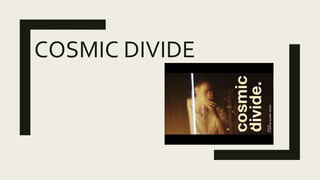
COSMIC DIVIDE
General information:
■ Director – Bertie Gilbert
■ 3 minutes long
■ Film’s key aspect is showing contrast between the two characters.This is doe via mise-
en-scene, sound, editing etc.
■ ‘Cosmic Divide’ follows the thoughts of a young male approaching the moment he
meets his twin brother for the first time in 5 years after having been separated for a
reason up to the viewer’s interpretation, which creates hermeneutic an proeretic code
– Barthes.
■ The fact that the protagonist of the story is a young male could make it really relatable
to part of the audience 9uses and grats.).
■ The narrative consciously leaves lots to the viewer’s imagination and lacks context.
This purposely done in order to allow the viewer to be less passive and decide what’s
happening or why for themselves. (No preffered reading – Stuart Hall).
Target audience 
■ Although the target audience isn’t clear. I think 15-25 years old would be the intended
target audience.This is also because the protagonist is around that age group.The actor
would be too young for 30nyear olds to watch this and identify with for instance.
■ Things like lack of exciting action or dialogue and somewhat abstract shots would bore a
younger audience. Also, the slow pace of the film could potentially easily lose a younger’
viewer’s attention.
Genre Conventions 
■ like many other dramas, this short film intentionally lacks in context. It also includes many
other common codes and conventions of other dramas/ short films in general. For example,
the fact that there are a large amount of enigma codes and also a lot of artistic shots
composed with great consideration for colour, lighting, framing, subtle camera movement
and creative angles clearly shows which genre the film belongs to without being to too
general or conventional.
(Narrative) theory:
■ The narrative structure of this short film in itself is very basic – it begins with a phone call
arranging to meet someone followed by walking to meet them and then the final bit of
actually meeting them.
■ This short films doesn’t followTodorv’s narrative theory of equilibrium, dis equilibrium.
Instead it’s ambiguous throughout the whole time. In other words, there is never nay clear
moment where we see a problem arise or a problem being resolved.
■ This strange and confusing structure creates further hermeneutic code (Barthes) as well as
proeretic code.
■ There is no intended way of understanding this film. Often the audience is left to make up
their own mind about what's going on at certain times.
■ Decoding this short film can’t be done easily by everyone due to its ambiguity, therefore
audience response isn’t meant to go a particular way.
Representation:
■ The way the twins are represented goes against the stereotypical positive view of the
relationship between twins. Instead, this short film highlights their tense relationship.
■ The twins have been presented differently through subtleties as opposed to distinct,
obvious behaviours and actions.
■ Ways contrast is created between the two is by things like; colour pallet and lighting.
The character shown walking is presented more often in high key lighting and natural
lighting as opposed to the duller orange glow of the flat.
■ Their behaviour is also key to show their contrast. the male in the flat seems to go
through no effort at all prior to his brother’s arrival – at his arrival, he leaves him
standing in the hallway and barely greets him, whilst the other twin is the one that
made the effort to get all the way there.
■ One of the twins is listening to music with headphones whilst the other owe simply
stands in a dead silent room – shows one could be more introverted than the other.
Mise-en-scene
■ Lighting – high key/low key with colours ‘infused’ in the lighting (yellow toned light and
blue toner light).
■ Props/makeup – simple everyday clothes to make the film seem casual.The two characters
are wearing opposite colours (white and black) to emphasize their contrast and differences.
■ Setting/location – filmed in city for various reasons. First because it’s simply a common
convention of dramas, as filming in a an urban area makes the whole story a lot more
relatable and casual. Secondly, its also done to create a binary opposition (strauss) between
the two people and where they are. Brigs up the concepts of isolation and loneliness (the
bare flat in the middle of a bustling city).
■ Vibe/overall look – the vibe of the film is created via different aspects of the film itself.
Things like colour palette, lighting, sound and mise-en-scene in general put together this
atmosphere/mood.
■ Sound -The monologue voice-over raises questions about the story– this deliberately leaves out
details that the audience naturally wants answers to as the character is already aware of the
context but is unaware of the audience.
■ Enigma codes play a crucial role in short films which allow the audience to decide upon the
backstory as they create gaps for them to actively fill, it prevents them from becoming passive
viewers. (Fulfils their cognitive needs – Maslow).
■ Cosmic Divide relies heavily on audio to be effective.
■ The protagonist’s voice over plays a key role in forming the audience about the storyline itself
since there is basically no dialogue (common convention in dramas).
■ The voice over is informative yet still leaves out enough detail to draw enigma codes.
■ Ambient sound is used frequently – this provides the effect of reinforcing the representation of
the characters being isolated or alone in the large city, which has been done especially well with
the sounds of traffic due to the connotations of rush and stress.
■ Actors/ acting – the ‘acting’ is almost none existent, as essentially the focus is on sound; sound
almost replaces the acting and interacting of the characters.
Shots/filming/composition –
■ Throughout the course of the film, the camera is never entirely static, even shots without
panning or zooming movement, there is still a slow, handheld movement to the shots which
provides character to prevent the shots being to bare or dull.This subtle technique captivates
the audience more than strictly static shots and provides a slight personal feel to the sequence.
This could also be reflective of the instability of the relationship of the brothers providing a very
slight tension.
■ Another effective camera technique used throughout is the focus pull.This plays a large role in
generating the ‘artsy’ feel to the shots but also directs the attention of the audience between
the characters and their surroundings which suits the topic of the short film being on their
current situation and where they are in their relationship which ties in with the character’s
voice-over being very reflective on the situation.
■ The longer shot takes create a slower pace while the camera movement and focus pulls prevent
them from feeling too slow and dull.

Cosmic divide cc

  • 1.
  • 2.
    General information: ■ Director– Bertie Gilbert ■ 3 minutes long ■ Film’s key aspect is showing contrast between the two characters.This is doe via mise- en-scene, sound, editing etc. ■ ‘Cosmic Divide’ follows the thoughts of a young male approaching the moment he meets his twin brother for the first time in 5 years after having been separated for a reason up to the viewer’s interpretation, which creates hermeneutic an proeretic code – Barthes. ■ The fact that the protagonist of the story is a young male could make it really relatable to part of the audience 9uses and grats.). ■ The narrative consciously leaves lots to the viewer’s imagination and lacks context. This purposely done in order to allow the viewer to be less passive and decide what’s happening or why for themselves. (No preffered reading – Stuart Hall).
  • 3.
    Target audience  ■Although the target audience isn’t clear. I think 15-25 years old would be the intended target audience.This is also because the protagonist is around that age group.The actor would be too young for 30nyear olds to watch this and identify with for instance. ■ Things like lack of exciting action or dialogue and somewhat abstract shots would bore a younger audience. Also, the slow pace of the film could potentially easily lose a younger’ viewer’s attention. Genre Conventions  ■ like many other dramas, this short film intentionally lacks in context. It also includes many other common codes and conventions of other dramas/ short films in general. For example, the fact that there are a large amount of enigma codes and also a lot of artistic shots composed with great consideration for colour, lighting, framing, subtle camera movement and creative angles clearly shows which genre the film belongs to without being to too general or conventional.
  • 4.
    (Narrative) theory: ■ Thenarrative structure of this short film in itself is very basic – it begins with a phone call arranging to meet someone followed by walking to meet them and then the final bit of actually meeting them. ■ This short films doesn’t followTodorv’s narrative theory of equilibrium, dis equilibrium. Instead it’s ambiguous throughout the whole time. In other words, there is never nay clear moment where we see a problem arise or a problem being resolved. ■ This strange and confusing structure creates further hermeneutic code (Barthes) as well as proeretic code. ■ There is no intended way of understanding this film. Often the audience is left to make up their own mind about what's going on at certain times. ■ Decoding this short film can’t be done easily by everyone due to its ambiguity, therefore audience response isn’t meant to go a particular way.
  • 5.
    Representation: ■ The waythe twins are represented goes against the stereotypical positive view of the relationship between twins. Instead, this short film highlights their tense relationship. ■ The twins have been presented differently through subtleties as opposed to distinct, obvious behaviours and actions. ■ Ways contrast is created between the two is by things like; colour pallet and lighting. The character shown walking is presented more often in high key lighting and natural lighting as opposed to the duller orange glow of the flat. ■ Their behaviour is also key to show their contrast. the male in the flat seems to go through no effort at all prior to his brother’s arrival – at his arrival, he leaves him standing in the hallway and barely greets him, whilst the other twin is the one that made the effort to get all the way there. ■ One of the twins is listening to music with headphones whilst the other owe simply stands in a dead silent room – shows one could be more introverted than the other.
  • 6.
    Mise-en-scene ■ Lighting –high key/low key with colours ‘infused’ in the lighting (yellow toned light and blue toner light). ■ Props/makeup – simple everyday clothes to make the film seem casual.The two characters are wearing opposite colours (white and black) to emphasize their contrast and differences. ■ Setting/location – filmed in city for various reasons. First because it’s simply a common convention of dramas, as filming in a an urban area makes the whole story a lot more relatable and casual. Secondly, its also done to create a binary opposition (strauss) between the two people and where they are. Brigs up the concepts of isolation and loneliness (the bare flat in the middle of a bustling city). ■ Vibe/overall look – the vibe of the film is created via different aspects of the film itself. Things like colour palette, lighting, sound and mise-en-scene in general put together this atmosphere/mood.
  • 7.
    ■ Sound -Themonologue voice-over raises questions about the story– this deliberately leaves out details that the audience naturally wants answers to as the character is already aware of the context but is unaware of the audience. ■ Enigma codes play a crucial role in short films which allow the audience to decide upon the backstory as they create gaps for them to actively fill, it prevents them from becoming passive viewers. (Fulfils their cognitive needs – Maslow). ■ Cosmic Divide relies heavily on audio to be effective. ■ The protagonist’s voice over plays a key role in forming the audience about the storyline itself since there is basically no dialogue (common convention in dramas). ■ The voice over is informative yet still leaves out enough detail to draw enigma codes. ■ Ambient sound is used frequently – this provides the effect of reinforcing the representation of the characters being isolated or alone in the large city, which has been done especially well with the sounds of traffic due to the connotations of rush and stress. ■ Actors/ acting – the ‘acting’ is almost none existent, as essentially the focus is on sound; sound almost replaces the acting and interacting of the characters.
  • 8.
    Shots/filming/composition – ■ Throughoutthe course of the film, the camera is never entirely static, even shots without panning or zooming movement, there is still a slow, handheld movement to the shots which provides character to prevent the shots being to bare or dull.This subtle technique captivates the audience more than strictly static shots and provides a slight personal feel to the sequence. This could also be reflective of the instability of the relationship of the brothers providing a very slight tension. ■ Another effective camera technique used throughout is the focus pull.This plays a large role in generating the ‘artsy’ feel to the shots but also directs the attention of the audience between the characters and their surroundings which suits the topic of the short film being on their current situation and where they are in their relationship which ties in with the character’s voice-over being very reflective on the situation. ■ The longer shot takes create a slower pace while the camera movement and focus pulls prevent them from feeling too slow and dull.