ART HOUSE FILMS
CODES AND
CONVENTIONS
Target audience:
■ An art film is typically a serious, independent film aimed at a niche market rather than
a mass market audience. An art film is "intended to be a serious artistic work, often
experimental and not designed for mass appeal"; they are "made primarily for
aesthetic reasons rather than commercial profit", and they contain "unconventional or
highly symbolic content".
Aspects of this genre:
■ These films are typically not shown in cinemas/theatres as they do not have large audiences
and do not make a lot of money as they have a niche audience and a small budget.
■ A lot of focus on destructive obsessions an distortion of reality.
■ Art films often have little or no advertising.
■ Focusing primary on beauty and meaning more than plot
■ The movie is a more personal statement by the director. Blockbusters are made for
commercial reasons whereas art films are made for personal reasons
■ Art house films follow the ‘Auteur theory’ (Auteur theory is a theory originally of filmmaking
that holds that a film reflects the director's personal creative vision).
Plot:
■ Art films are different from regular Hollywood movies. Regular Hollywood movies have a clear
story and plot. Art film often have much stranger stories. In an art film, the stories may be hard to
understand. As well, in an art film, the audience may have a hard time understanding what is going
on.They are often about people's feelings and thoughts and also often about big questions that a
person has to answer about who they are or what they should do in a situation.
■ Mostly based in character's head dreams (hallucination and inner drama).
■ Depicts a lot of emotion.
■ Many art films show controversial or sad stories (may be about people's feelings, thoughts, or
dreams).
■ Art movies usually use strange or unusual stories and characters that the audience may not have
seen before.
■ In art movies, there is often a sad ending.They can also have endings which are either hard to
understand or could mean many different things.These endings are used so that the audience will
have to think about what might have happened in the story.This structure goes againstTodorov’s
equilibrium, disequilibrium narrative theory. In addition to this it doesn’t fulfil the audience’s
cognitive needs and could perhaps frustrate some.
Mise-en-scene
■ Lighting – varies depending on the genre.
■ Makeup props - Bizarre costume and makeup
■ Setting/location -Abstract and beautiful locations
■ Vibe/overall look – abstract/unusual feel.
Sound:
■ Art house films usually include no dialogue this shows the creativity of the director
leaving the story told by the camera shots and the music solely.
■ If there is music it’s usually only instrumental and is used to create a mood.
■ Sound also depends on genre.
Length / budget
■ Art movies have small budgets as they are made for a niche audience and their goal
isn’t to make money.
■ Art house short films typically have the same length as short films in general, they can
vary form 4 minutes to 30 minutes.
Acting/actors
■ They usually have unknown or little-known actors. Some even use amateur actors.
Some art films will even use regular people with no experience as actors to work as the
actors. It is not uncommon forArt film directors to use friends and family members as
actors.
Composition/shots
■ Fast paced and time lapsed areas.
■ Use of aerial/XCU shots.
■ Strange filters and lenses
■ Repeated usage of certain footage
■ Seemingly unrelated scenes
■ Close up's are used a lot.
Examples/ references
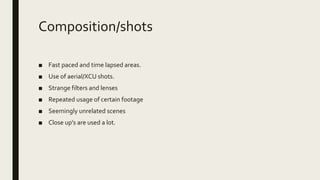
■ ‘Black swan’ by Darren Aronofsky  this psychological
thriller fits into the art house genre as it follows many of
its different codes an conventions. It’s shocking and
unordinary scenes showing imaginary visuals.The lack
of background music usually seen in films with a high
budget.The underlying message of the film is a
metaphor for achieving artistic perfection.
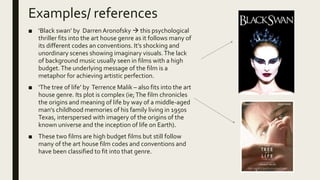
■ ‘The tree of life’ by Terrence Malik – also fits into the art
house genre. Its plot is complex (ie;The film chronicles
the origins and meaning of life by way of a middle-aged
man's childhood memories of his family living in 1950s
Texas, interspersed with imagery of the origins of the
known universe and the inception of life on Earth).
■ These two films are high budget films but still follow
many of the art house film codes and conventions and
have been classified to fit into that genre.
Examples / references
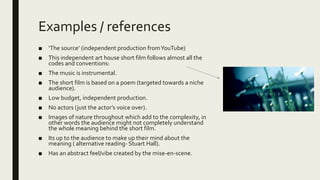
■ ‘The source’ (independent production fromYouTube)
■ This independent art house short film follows almost all the
codes and conventions:
■ The music is instrumental.
■ The short film is based on a poem (targeted towards a niche
audience).
■ Low budget, independent production.
■ No actors (just the actor’s voice over).
■ Images of nature throughout which add to the complexity, in
other words the audience might not completely understand
the whole meaning behind the short film.
■ Its up to the audience to make up their mind about the
meaning ( alternative reading- Stuart Hall).
■ Has an abstract feel/vibe created by the mise-en-scene.

Art ouse films codes and con

  • 1.
    ART HOUSE FILMS CODESAND CONVENTIONS
  • 2.
    Target audience: ■ Anart film is typically a serious, independent film aimed at a niche market rather than a mass market audience. An art film is "intended to be a serious artistic work, often experimental and not designed for mass appeal"; they are "made primarily for aesthetic reasons rather than commercial profit", and they contain "unconventional or highly symbolic content".
  • 3.
    Aspects of thisgenre: ■ These films are typically not shown in cinemas/theatres as they do not have large audiences and do not make a lot of money as they have a niche audience and a small budget. ■ A lot of focus on destructive obsessions an distortion of reality. ■ Art films often have little or no advertising. ■ Focusing primary on beauty and meaning more than plot ■ The movie is a more personal statement by the director. Blockbusters are made for commercial reasons whereas art films are made for personal reasons ■ Art house films follow the ‘Auteur theory’ (Auteur theory is a theory originally of filmmaking that holds that a film reflects the director's personal creative vision).
  • 4.
    Plot: ■ Art filmsare different from regular Hollywood movies. Regular Hollywood movies have a clear story and plot. Art film often have much stranger stories. In an art film, the stories may be hard to understand. As well, in an art film, the audience may have a hard time understanding what is going on.They are often about people's feelings and thoughts and also often about big questions that a person has to answer about who they are or what they should do in a situation. ■ Mostly based in character's head dreams (hallucination and inner drama). ■ Depicts a lot of emotion. ■ Many art films show controversial or sad stories (may be about people's feelings, thoughts, or dreams). ■ Art movies usually use strange or unusual stories and characters that the audience may not have seen before. ■ In art movies, there is often a sad ending.They can also have endings which are either hard to understand or could mean many different things.These endings are used so that the audience will have to think about what might have happened in the story.This structure goes againstTodorov’s equilibrium, disequilibrium narrative theory. In addition to this it doesn’t fulfil the audience’s cognitive needs and could perhaps frustrate some.
  • 5.
    Mise-en-scene ■ Lighting –varies depending on the genre. ■ Makeup props - Bizarre costume and makeup ■ Setting/location -Abstract and beautiful locations ■ Vibe/overall look – abstract/unusual feel.
  • 6.
    Sound: ■ Art housefilms usually include no dialogue this shows the creativity of the director leaving the story told by the camera shots and the music solely. ■ If there is music it’s usually only instrumental and is used to create a mood. ■ Sound also depends on genre.
  • 7.
    Length / budget ■Art movies have small budgets as they are made for a niche audience and their goal isn’t to make money. ■ Art house short films typically have the same length as short films in general, they can vary form 4 minutes to 30 minutes.
  • 8.
    Acting/actors ■ They usuallyhave unknown or little-known actors. Some even use amateur actors. Some art films will even use regular people with no experience as actors to work as the actors. It is not uncommon forArt film directors to use friends and family members as actors.
  • 9.
    Composition/shots ■ Fast pacedand time lapsed areas. ■ Use of aerial/XCU shots. ■ Strange filters and lenses ■ Repeated usage of certain footage ■ Seemingly unrelated scenes ■ Close up's are used a lot.
  • 10.
    Examples/ references ■ ‘Blackswan’ by Darren Aronofsky  this psychological thriller fits into the art house genre as it follows many of its different codes an conventions. It’s shocking and unordinary scenes showing imaginary visuals.The lack of background music usually seen in films with a high budget.The underlying message of the film is a metaphor for achieving artistic perfection. ■ ‘The tree of life’ by Terrence Malik – also fits into the art house genre. Its plot is complex (ie;The film chronicles the origins and meaning of life by way of a middle-aged man's childhood memories of his family living in 1950s Texas, interspersed with imagery of the origins of the known universe and the inception of life on Earth). ■ These two films are high budget films but still follow many of the art house film codes and conventions and have been classified to fit into that genre.
  • 11.
    Examples / references ■‘The source’ (independent production fromYouTube) ■ This independent art house short film follows almost all the codes and conventions: ■ The music is instrumental. ■ The short film is based on a poem (targeted towards a niche audience). ■ Low budget, independent production. ■ No actors (just the actor’s voice over). ■ Images of nature throughout which add to the complexity, in other words the audience might not completely understand the whole meaning behind the short film. ■ Its up to the audience to make up their mind about the meaning ( alternative reading- Stuart Hall). ■ Has an abstract feel/vibe created by the mise-en-scene.