Input Output Instructions
-23H51A66BG
CSM 04
Introduction to Input Output Instructions
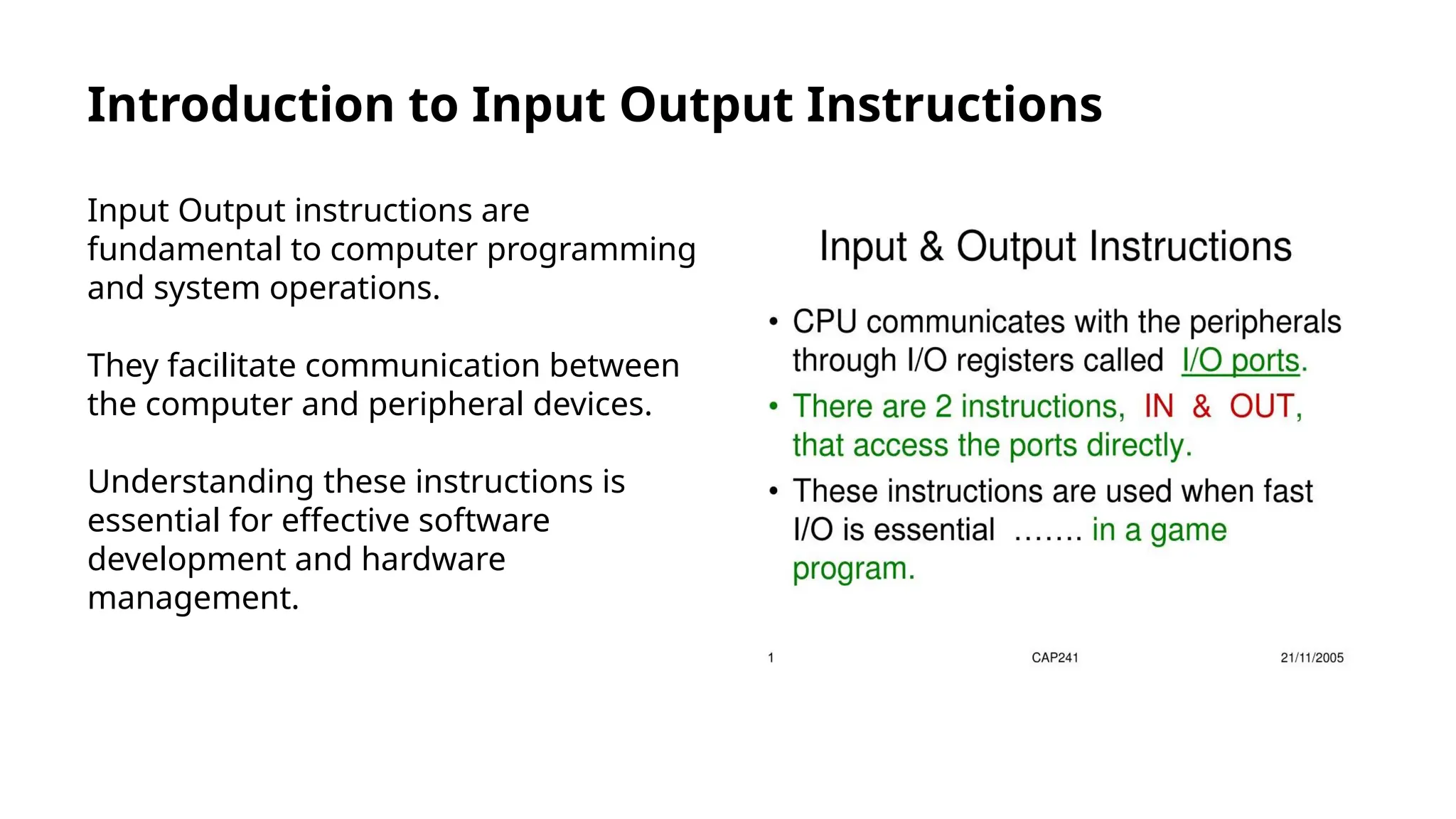
Input Output instructions are
fundamental to computer programming
and system operations.
They facilitate communication between
the computer and peripheral devices.
Understanding these instructions is
essential for effective software
development and hardware
management.
Types of Input Output Instructions
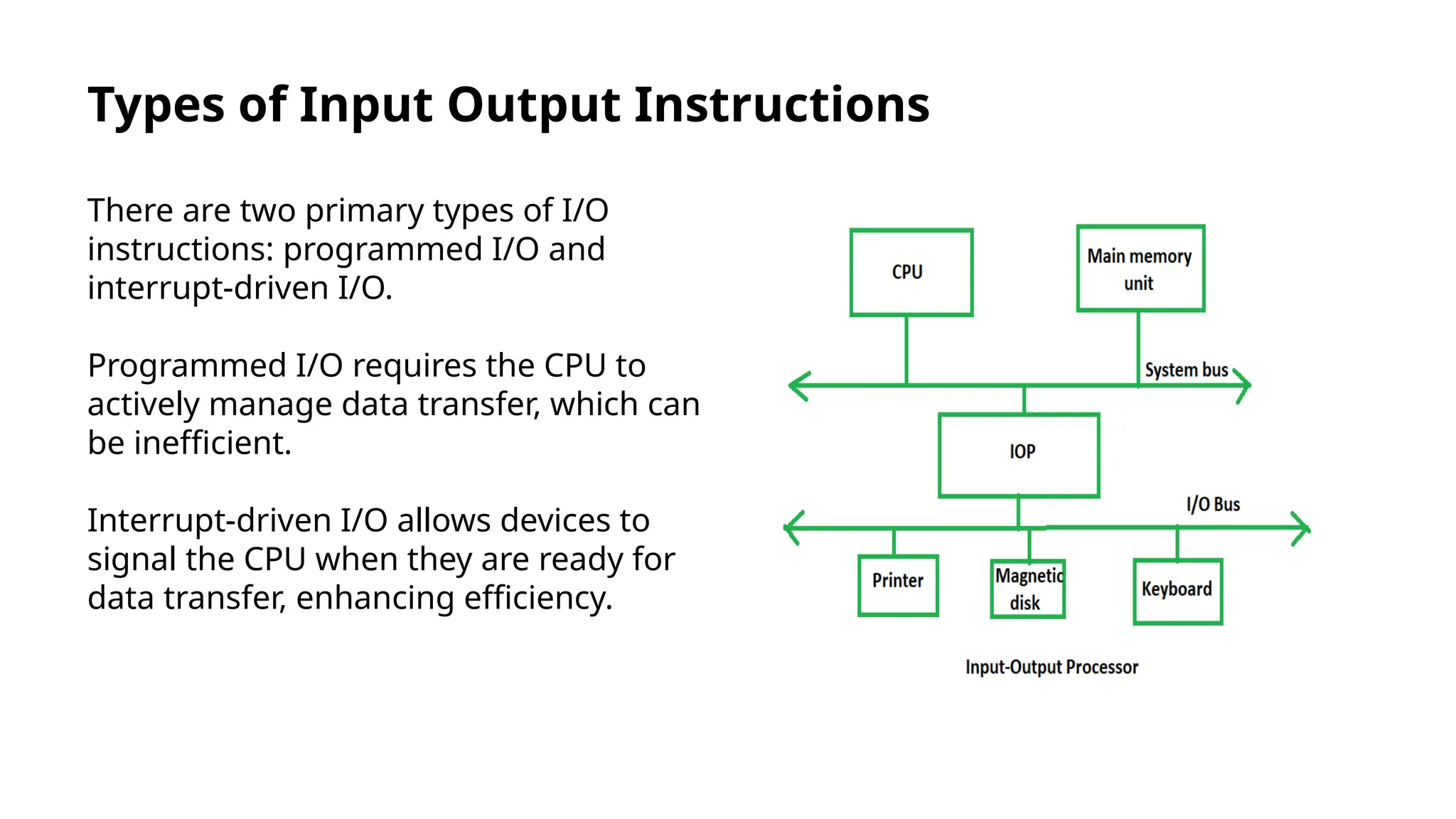
There are two primary types of I/O
instructions: programmed I/O and
interrupt-driven I/O.
Programmed I/O requires the CPU to
actively manage data transfer, which can
be inefficient.
Interrupt-driven I/O allows devices to
signal the CPU when they are ready for
data transfer, enhancing efficiency.
Programmed I/O
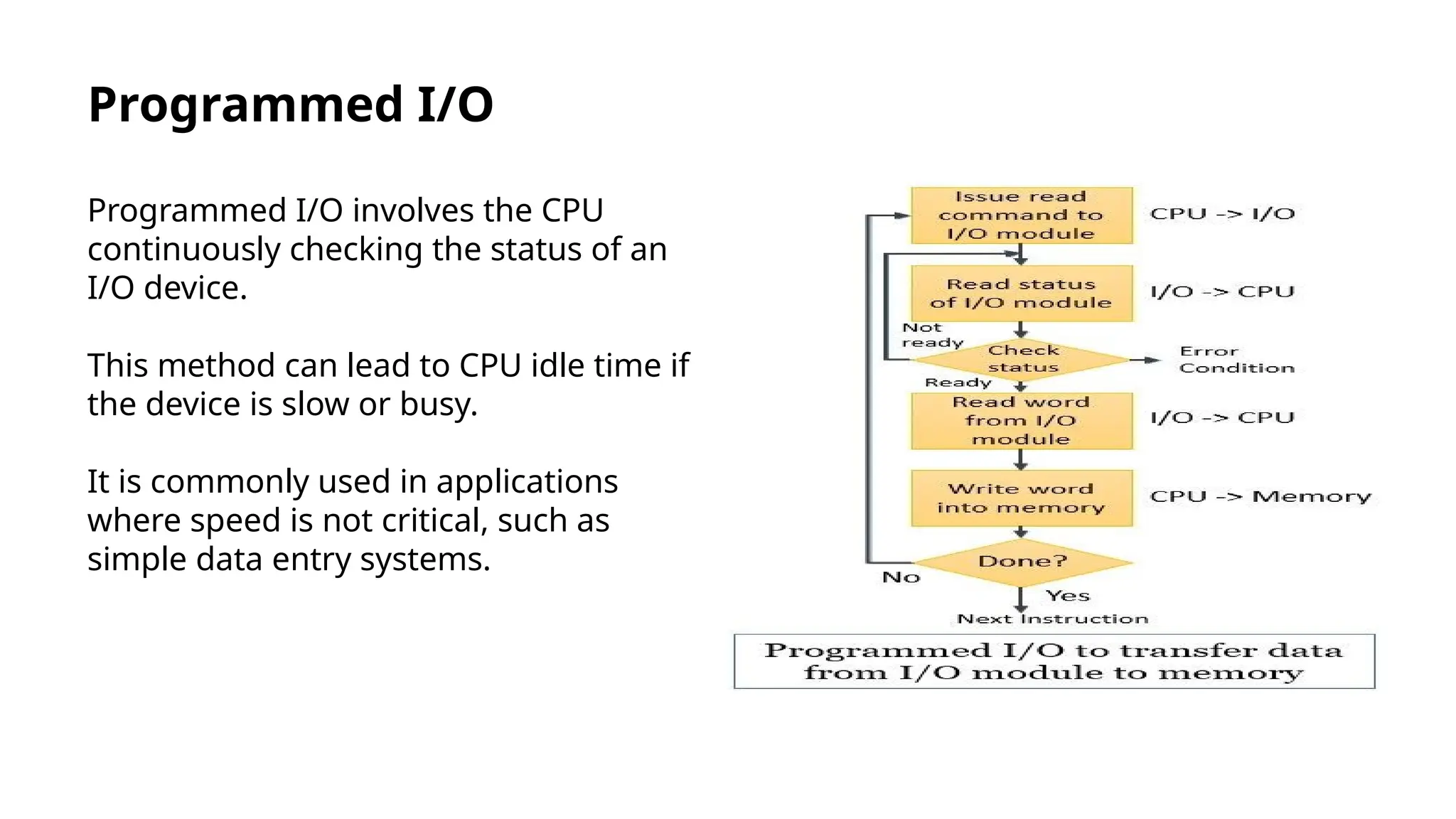
Programmed I/O involves the CPU
continuously checking the status of an
I/O device.
This method can lead to CPU idle time if
the device is slow or busy.
It is commonly used in applications
where speed is not critical, such as
simple data entry systems.
Interrupt-Driven I/O
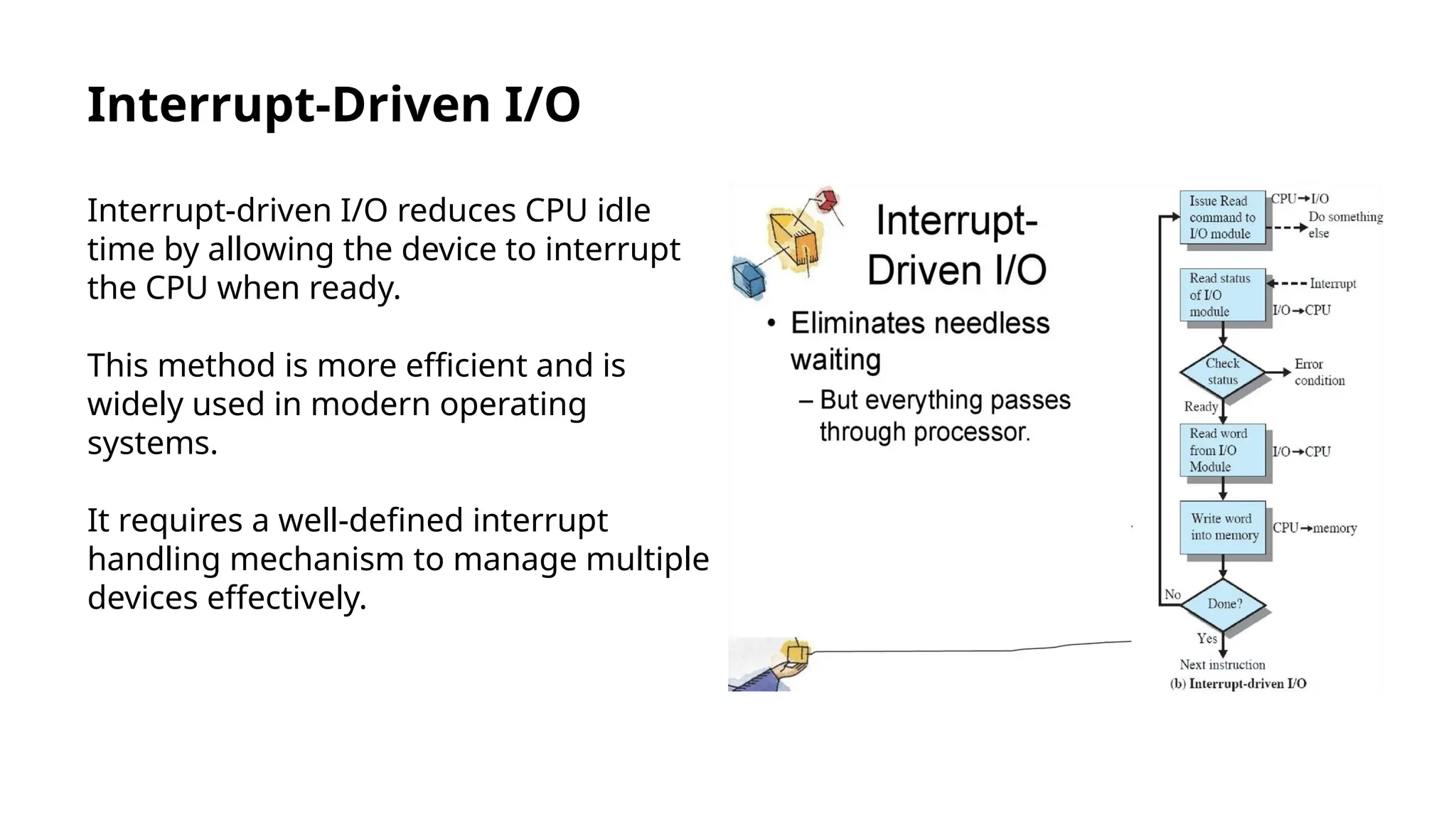
Interrupt-driven I/O reduces CPU idle
time by allowing the device to interrupt
the CPU when ready.
This method is more efficient and is
widely used in modern operating
systems.
It requires a well-defined interrupt
handling mechanism to manage multiple
devices effectively.
Direct Memory Access (DMA)
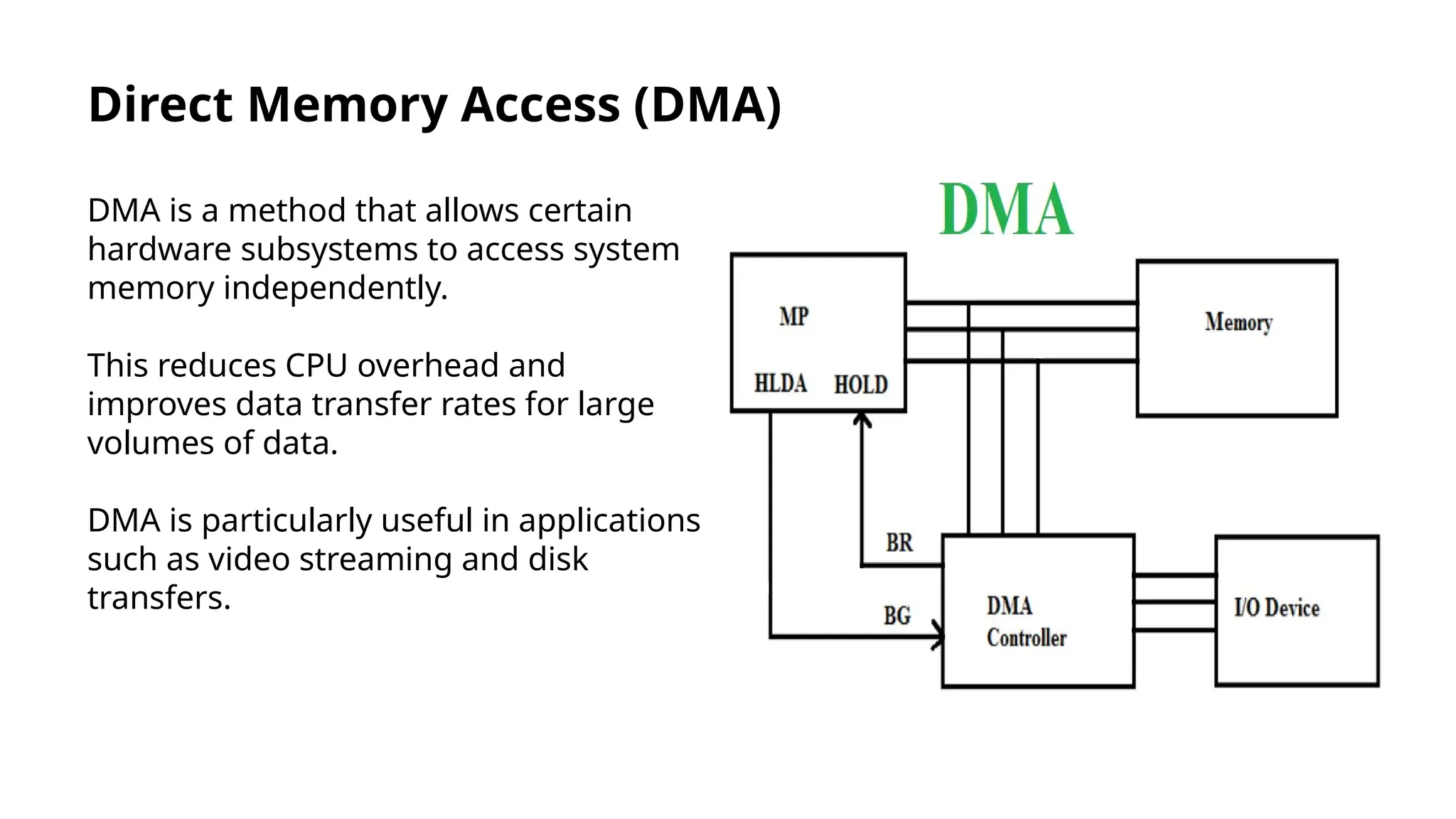
DMA is a method that allows certain
hardware subsystems to access system
memory independently.
This reduces CPU overhead and
improves data transfer rates for large
volumes of data.
DMA is particularly useful in applications
such as video streaming and disk
transfers.
Thanks

Input output instructions in coa btech 2nd year

  • 1.
  • 2.
    Introduction to InputOutput Instructions Input Output instructions are fundamental to computer programming and system operations. They facilitate communication between the computer and peripheral devices. Understanding these instructions is essential for effective software development and hardware management.
  • 3.
    Types of InputOutput Instructions There are two primary types of I/O instructions: programmed I/O and interrupt-driven I/O. Programmed I/O requires the CPU to actively manage data transfer, which can be inefficient. Interrupt-driven I/O allows devices to signal the CPU when they are ready for data transfer, enhancing efficiency.
  • 4.
    Programmed I/O Programmed I/Oinvolves the CPU continuously checking the status of an I/O device. This method can lead to CPU idle time if the device is slow or busy. It is commonly used in applications where speed is not critical, such as simple data entry systems.
  • 5.
    Interrupt-Driven I/O Interrupt-driven I/Oreduces CPU idle time by allowing the device to interrupt the CPU when ready. This method is more efficient and is widely used in modern operating systems. It requires a well-defined interrupt handling mechanism to manage multiple devices effectively.
  • 6.
    Direct Memory Access(DMA) DMA is a method that allows certain hardware subsystems to access system memory independently. This reduces CPU overhead and improves data transfer rates for large volumes of data. DMA is particularly useful in applications such as video streaming and disk transfers.
  • 7.

Editor's Notes

  • #2 Image source: https://www.slideserve.com/huyen/input-output-instructions
  • #3 Image source: https://www.goseeko.com/reader/notes/visvesvaraya-technological-university-karnataka/engineering/computer-engineering-1/second-year/sem-2/unit-2-machine-instructions-and-programs
  • #4 Image source: https://binaryterms.com/programmed-i-o.html
  • #5 Image source: https://en.ppt-online.org/205207
  • #6 Image source: https://leylatinbanks.blogspot.com/2022/09/direct-memory-access.html