Inotuzumab Ozogamicin
versus
Standard Therapy for
Acute Lymphoblastic Leukemia (ALL)
Oscar Kwan, PharmD. 2018 Candidate
St. John’s University
College of Pharmacy and Health Sciences
oscar.kwan11@stjohns.edu
Objectives
• Review general information on Acute Lymphoblastic Leukemia (ALL) and its current therapies
• Describe the rationale, objectives, endpoints, and design of the INO-VATE ALL study
• Provide an overview and summary of the mechanism of action of Inotuzumab Ozogamicin
• Define all clinical and statistical terms given by the authors in the Supplementary Appendix
• Identify measurement tools and discuss the biases, strengths, and limitations of the study
• Analyze all data obtained in tables/figures and assess the appropriateness of statistical tests used
• Summarize all valid conclusions obtained from the study and its clinical significance in practice
What is B-Cell
Acute
Lymphoblastic
Leukemia (ALL)?
B-Cell Acute Lymphoblastic Leukemia (ALL)
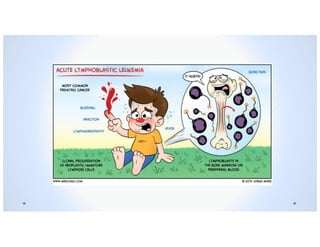
• Acute and Aggressive form of Leukemia (cancer of white blood cells)
• Overproduction and Accumulation of cancerous, immature white
blood cells, known as lymphoblasts1, in the bone marrow
• Lymphoblasts can spread to blood, and infiltrate the lymph nodes,
spleen, liver, central nervous system [CNS], and other organs2
• Reduced production of new, normal-functioning blood cells due to
bone marrow damage and resource depletion by lymphocytes1
• If left untreated within a matter of months11, ALL can be FATAL9
“Acute” “Chronic”
Acute Lymphocytic Leukemia
Defined by…
The World Health Organization 2008:
v “Acute” ALL: Greater than 20% of bone marrow cells are lymphoblasts
v “Chronic” ALL: Less than 20% of bone marrow cells are lymphoblasts
Pathophysiology of ALL
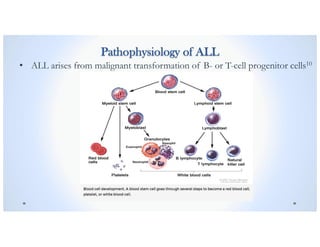
• ALL arises from malignant transformation of B- or T-cell progenitor cells10
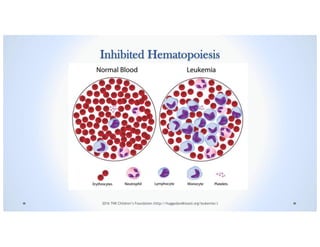
Inhibited Hematopoiesis
2016 TNK Children’s Foundation (http://huggedandkissed.org/leukemia/)
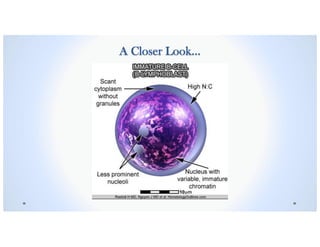
Microscopic Features
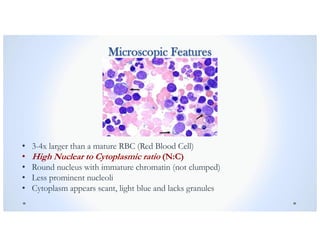
• 3-4x larger than a mature RBC (Red Blood Cell)
• High Nuclear to Cytoplasmic ratio (N:C)
• Round nucleus with immature chromatin (not clumped)
• Less prominent nucleoli
• Cytoplasm appears scant, light blue and lacks granules
A Closer Look...
Signs & Symptoms
Suppression of Normal Hematopoiesis causes:
o Weakness or Fatigue2
o Anemia (pallor, tachycardia, headache)8
o Fever or Night Sweats2
o Unexpected weight loss or anorexia2
o Pain in the bones or joints2
o Swelling or discomfort in the abdomen2
o Symptoms of an Infection2,8
:
v Shortness of breath
v Chest pain
v Cough
v Vomiting
v Swollen lymph nodes of the neck, armpit, or groin (usually painless)
o Increased risk and frequency of infections (especially bacterial infections like pneumonia due to neutropenia)8
o Thrombocytopenia2
:
v Increased tendency to bruise or bleed easily
Ø Bleeding gums
Ø Purplish patches in the skin
Ø Petechiae [flat, pinpoint spots under the skin]
Doctors Health Press
Consumer Health Digest
Incidence and Epidemiology
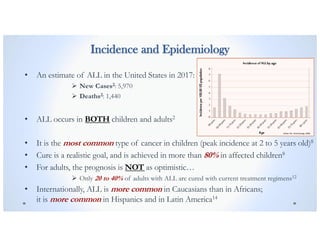
• An estimate of ALL in the United States in 2017:
Ø New Cases2: 5,970
Ø Deaths2: 1,440
• ALL occurs in BOTH children and adults2
• It is the most common type of cancer in children (peak incidence at 2 to 5 years old)8
• Cure is a realistic goal, and is achieved in more than 80% in affected children8
• For adults, the prognosis is NOT as optimistic…
Ø Only 20 to 40% of adults with ALL are cured with current treatment regimens12
• Internationally, ALL is more common in Caucasians than in Africans;
it is more common in Hispanics and in Latin America14
Sallan SE; Hematology 2006
Unmet Needs in Adult ALL
• Older patients with ALL may have other comorbidities, including heart, lung
or kidney disease or diabetes mellitus. If these are present, the doctor may
select less toxic drugs or decrease the dosage and frequency of treatment.15
• Approximately half of the 2,000 U.S. adults who learn they have ALL this
year will NOT respond to commonly used chemotherapy agents (refractory)
or will eventually see their disease return (relapse).13
• The outlook for adults with relapsed or refractory ALL is poor.16
These patients have already tried and failed commonly used treatments,
leaving very few treatment options available to them.16
• 9 out of 10 of these patients will NOT survive more than five years.16
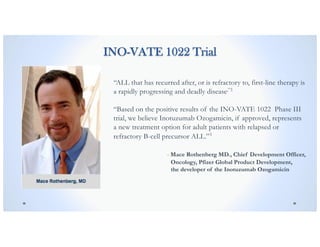
INO-VATE 1022 Trial
“ALL that has recurred after, or is refractory to, first-line therapy is
a rapidly progressing and deadly disease,”3
“Based on the positive results of the INO-VATE 1022 Phase III
trial, we believe Inotuzumab Ozogamicin, if approved, represents
a new treatment option for adult patients with relapsed or
refractory B-cell precursor ALL.”3
- Mace Rothenberg MD., Chief Development Officer,
Oncology, Pfizer Global Product Development,
the developer of the Inotuzumab Ozogamicin
Trial Oversight
• The protocol was approved by the independent ethics committee or the
Institutional Review Board at each trial center.1
• Written informed consent was obtained in accordance with the provisions of
the Declaration of Helsinki.1
• The trial was designed through a collaboration of the sponsor (Pfizer) and the
lead investigators. Pfizer collected and held the data included in this report.1
• Generated data tables were freely accessible to all the authors, who, together
with Pfizer representatives, were responsible for the analyses of the data.1
• All the authors contributed to the drafting and critical review of the
manuscript, approved the final draft, and made the decision to submit the
manuscript for publication.1
• All the authors vouch for the accuracy of the data and analysis and the
adherence of the trial.1
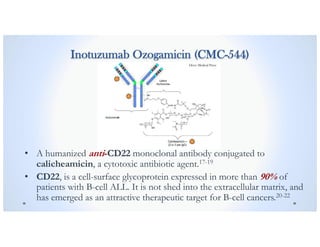
Inotuzumab Ozogamicin (CMC-544)
• A humanized anti-CD22 monoclonal antibody conjugated to
calicheamicin, a cytotoxic antibiotic agent.17-19
• CD22, is a cell-surface glycoprotein expressed in more than 90% of
patients with B-cell ALL. It is not shed into the extracellular matrix, and
has emerged as an attractive therapeutic target for B-cell cancers.20-22
Dove Medical Press
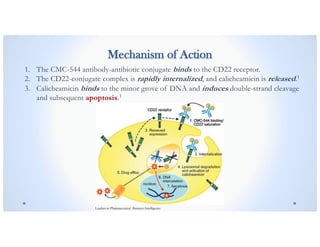
Mechanism of Action
1. The CMC-544 antibody-antibiotic conjugate binds to the CD22 receptor.
2. The CD22-conjugate complex is rapidly internalized, and calicheamicin is released.1
3. Calicheamicin binds to the minor grove of DNA and induces double-strand cleavage
and subsequent apoptosis.1
Leaders in Pharmaceutical Business Intelligence
Rationale of the Study
• While many potential treatments have been studied, only a limited number of
medicines for relapsed or refractory adults with ALL have been approved by the
FDA and other regulatory authorities in the past decade.
• The current standard treatment is intensive, lengthy chemotherapy with the goal
of halting the signs and symptoms of ALL (called hematologic remission) and
becoming eligible for a stem-cell transplant.11
• Allogeneic Stem-Cell Transplantation [SCT] is the main goal after salvage
treatment because it is the ONLY potentially curative treatment option for adults
with relapsed or refractory ALL.1
• A previous phase 2 study of Inotuzumab Ozogamcin, administered on either a
weekly or a monthly schedule, for the treatment of patients with relapsed or
refractory B-cell ALL showed antitumor activity.1
Allogeneic Stem Cell Transplantation [SCT]
Current Standard Chemotherapy Regimens
Complete Remission [CR] Rates1:
o Adults with Newly diagnosed B-cell ALL: 60 to 90 %
o However many patients relapse, and ONLY approximately 30 to 50% will have a disease-free
survival lasting 3 years or longer.
o Adults with Relapsed or Refractory ALL: 31 to 44% (if 1st salvage therapy)
18 to 25% (if 2nd salvage therapy)
o Complete Remission [CR] is typically a prerequisite for subsequent allogeneic stem-cell
transplantation, the low rates of complete remission associated with current chemotherapy regimens
mean that few adults with relapsed or refractory B-cell ALL, 5 to 30% proceed to transplantation.1
Intent of the Study
• To assess the clinical activity and safety of single-agent Inotuzumab Ozogamicin, as
compared with standard intensive chemotherapy, when it is administered as the first
or second salvage treatment in adults with relapsed or refractory B-cell ALL.1
• 1st Primary Objective:
o To show significantly higher rates of Complete Remission [CR] or Complete Remission
with Incomplete Hematologic Recovery [Cri] in the Inotozumab Ozogamacin group than
in the Standard-therapy group. 1
• 2nd Primary Objective:
o To show significantly longer Overall Survival in the Inotuzumab Ozogamicin group than in
the Standard-therapy group, at a pre-specified boundary of P=0.0208.1
Monitoring Parameters
Primary End Points1:
1. Complete Remission [CR]: The disappearance of leukemia as indicated by < 5% marrow blasts
and the absence of peripheral blasts, with recovery of hematopoiesis defined by ANC ≥ 1,000
cells/µL and platelets ≥ 100,000 cells/µL.1 C1 extramedullary disease status is required1; patients
were considered to have C1 extramedullary disease status if the following criteria were met:
q Complete disappearance of all measurable and non-measurable extramedullary disease with the
exception of lesions for which the following must be true: for patients with at least one measurable
lesion, all nodal masses > 1.5 cm in greatest transverse diameter (GTD) at baseline must have
regressed to ≤ 1.5 cm in GTD and all nodal masses ≥ 1 cm and ≤ 1.5 cm in GTD at baseline must
have regressed to < 1 cm GTD or they must have reduced by 75% in sum of products of greatest
diameters (SPD).1
q No new lesions.1
q Spleen and other previously enlarged organs must have regressed in size and must not be palpable.1
q All disease must be assessed using the same technique as at baseline.1
2. Complete Remission with Incomplete Hematologic Recovery (CRi): Complete Remission
[CR] except with ANC < 1,000 cells/µL and/or platelets < 100,000 cells/µL.1
3. Overall Survival: Time from randomization to death due to any cause, censored at the last
known alive date.1
Monitoring Parameters
Secondary End Points1:
1. Safety Measures
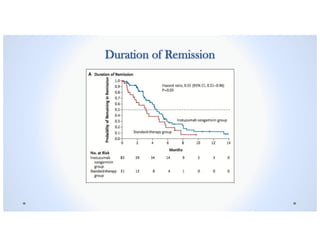
2. Duration of Remission: Time from remission to progressive disease (objective progression,
relapse, treatment discontinuation due to health deterioration) or death.1
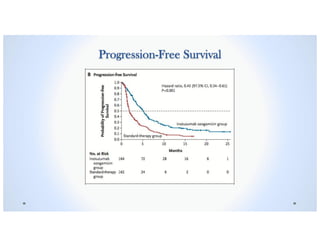
3. Progression-Free Survival: Time from randomization to the earliest of disease progression
(including objective progression, relapse from [CR/CRi], treatment discontinuation doe to global
deterioration of health status), starting new induction therapy or poststudy [SCT] without
achieving [CR/CRi], or death due to any cause, censored at the last valid disease assessment.1
4. Rate of Subsequent Stem-Cell Transplantation [SCT]1
5. Percentage of Patients, who achieved [CR], who had results below the threshold for
minimal residual disease specified as 0.01% bone marrow blasts
Monitoring Parameters
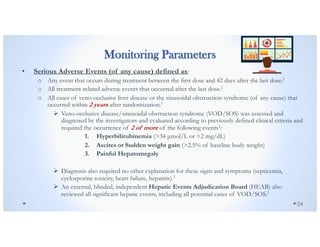
• Serious Adverse Events (of any cause) defined as:
o Any event that occurs during treatment between the first dose and 42 days after the last dose.1
o All treatment-related adverse events that occurred after the last dose.1
o All cases of veno-occlusive liver disease or the sinusoidal obstruction syndrome (of any cause) that
occurred within 2 years after randomization.1
Ø Veno-occlusive disease/sinusoidal obstruction syndrome (VOD/SOS) was assessed and
diagnosed by the investigators and evaluated according to previously defined clinical criteria and
required the occurrence of 2 of more of the following events1:
1. Hyperbilirubinemia (>34 µmol/L or >2 mg/dL)
2. Ascites or Sudden weight gain (>2.5% of baseline body weight)
3. Painful Hepatomegaly
Ø Diagnosis also required no other explanation for these signs and symptoms (septicemia,
cyclosporine toxicity, heart failure, hepatitis).1
Ø An external, blinded, independent Hepatic Events Adjudication Board (HEAB) also
reviewed all significant hepatic events, including all potential cases of VOD/SOS.1
24
Measurement Tools
1. Complete Blood Count (CBC): A full blood count test to measure the levels of
white blood cells, red blood cells, and platelets, which was needed and relied on to
calculate ANC and evaluate Complete Remission [CR].
2. Multicolor, Multi-parameter Flow Cytometry: The threshold for minimal residual
disease was specified as 0.01% bone marrow blasts and was assessed at a central
laboratory.
3. Bone Marrow Aspiration (or Bone Marrow Biopsy, if clinically indicated):
Performed for all patients with a disease assessment at screening, between Days 16
and 28 of Cycles 1, 2, and 3, and every 1 to 2 cycles thereafter; at the end-of-treatment
visit; during planned follow-up visits; and as clinically indicated.
4. Karyotype was assessed at a local laboratory.
5. Philadelphia Chromosome (Ph) positivity was assessed at a central or local
laboratory or through medical history.
INO-VATE Study Design and Methods
• Open-label (no blinding)
• Two-Arm/Group (326 patients underwent randomization,
only the first 219 [109 om each group] were included in the
primary intention-to-treat analysis of complete remission)
• 1:1 Randomization of Patients
• Phase 3 trial
• No Cross-Over was allowed
Eligibility/Inclusion Criteria
Patients must be/have:
• B- cell Acute Lymphoblastic Leukemia (ALL):
ü Relapsed or Refractory (≥ 5% bone marrow blasts on local morphologic analysis) AND
ü CD22-positive AND
ü Philadelphia chromosome (Ph) positive or negative
• Sex: Males and Females
• Age ≥ 18 years or older
• Scheduled to receive their 1st or 2nd Salvage treatment
• Lymphoblastic Lymphoma (except Burkitt Lymphoma)
• Eastern Cooperative Oncology Group performance status: ≤ 2
• Adequate Hepatic Function:
ü Total Serum Bilirubin ≤ 1.5 x Upper Limit of Normal [ULN] (except for documented
Gilbert Syndrome: ≤ 2 x ULN for hepatic abnormalities considered tumor-related)
ü Alanine Aminotransferase [ALT] and Aspartate Aminotransferase [AST]: ≤ 2.5 x ULN
ü Serum Creatinine [SCr] ≤ 2.5 x ULN OR Creatinine Clearance [CrCl] ≥ 40 mL/min
associated with ANY Serum Creatinine [SCr] level
Eligibility/Inclusion Criteria
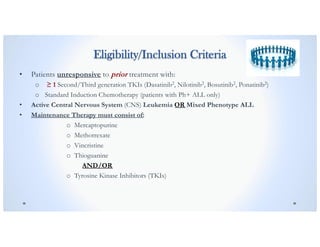
• Patients unresponsive to prior treatment with:
o ≥ 1 Second/Third generation TKIs (Dasatinib2, Nilotinib2, Bosutinib2, Ponatinib2)
o Standard Induction Chemotherapy (patients with Ph+ ALL only)
• Active Central Nervous System (CNS) Leukemia OR Mixed Phenotype ALL
• Maintenance Therapy must consist of:
o Mercaptopurine
o Methotrexate
o Vincristine
o Thioguanine
AND/OR
o Tyrosine Kinase Inhibitors (TKIs)
Exclusion Criteria
• Patients with:
o Peripheral Absolute Lymphoblast Count ≥ 10,000 cells/µL *Treatment to reduce circulating blasts
was allowed within 2 weeks of randomization with Hydroxyurea AND/OR Steroids/Vincristine
o Burkitt Lymphoma
o Isolated Testicular or CNS Extramedullary relapse
• Treatments NOT Allowed:
o Chemotherapy < 2 weeks before randomization *EXCEPT to reduce circulating lymphoblast count
or palliation [Steroids, Hydroxycarbamide, or Vincristine]
o Monoclonal Antibody treatment < 6 weeks before randomization (for Rituximab: ≥ 2 weeks before
randomization)
o Allogeneic Hematopoietic Stem Cell Transplantation (HSCT) ≤ 4 months before randomization
Treatment Groups
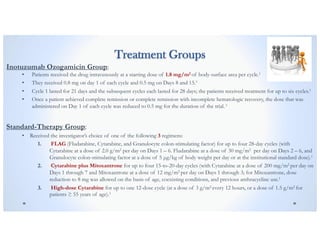
Inotuzumab Ozogamicin Group:
• Patients received the drug intravenously at a starting dose of 1.8 mg/m2 of body-surface area per cycle.1
• They received 0.8 mg on day 1 of each cycle and 0.5 mg on Days 8 and 15.1
• Cycle 1 lasted for 21 days and the subsequent cycles each lasted for 28 days; the patients received treatment for up to six cycles.1
• Once a patient achieved complete remission or complete remission with incomplete hematologic recovery, the dose that was
administered on Day 1 of each cycle was reduced to 0.5 mg for the duration of the trial. 1
Standard-Therapy Group:
• Received the investigator’s choice of one of the following 3 regimens:
1. FLAG (Fludarabine, Cytarabine, and Granulocyte colon-stimulating factor) for up to four 28-day cycles (with
Cytarabine at a dose of 2.0 g/m2 per day on Days 1 – 6. Fludarabine at a dose of 30 mg/m2 per day on Days 2 – 6, and
Granulocyte colon-stimulating factor at a dose of 5 µg/kg of body weight per day or at the institutional standard dose).1
2. Cytarabine plus Mitoxantrone for up to four 15-to-20-day cycles (with Cytarabine at a dose of 200 mg/m2 per day on
Days 1 through 7 and Mitoxantrone at a dose of 12 mg/m2 per day on Days 1 through 3; for Mitoxantrone, dose
reduction to 8 mg was allowed on the basis of age, coexisting conditions, and previous anthracycline use.1
3. High-dose Cytarabine for up to one 12-dose cycle (at a dose of 3 g/m2 every 12 hours, or a dose of 1.5 g/m2 for
patients ≥ 55 years of age).1
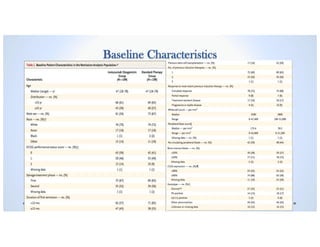
Baseline Characteristics
Statistical Analysis
• The sample size was calculated to allow adequate independent assessments of
between-group differences in the rate of complete remission and in overall
survival by splitting the one-sided alpha level of P<0.025 evenly between the
two primary end points.1
• What is an alpha value?
o The probability of concluding there is a difference between groups when there really is
no difference between them (making a Type I error).7
o A result is usually considered statistically significant if the probability of a Type I error
is less than 5% (P<0.05). It means that the probability that the result is due to chance is
less than one in 20.7
o The smaller the p-value, the greater the statistical significance.7
Statistical Analysis
• With a sample size of 218 patients and a one-sided alpha level of P<0.0125,
the study had 88.5% power to detect a difference in the rate of Complete
Remission [CR] (including Complete Remission with Incomplete Hematologic
Recovery [CRi]) of 24 percentage points between the two groups (61% in the
Inotuzumab Ozogamicin group vs. 37% in the standard-therapy group).
• What is power?
o The ability of a study to detect a significant difference between treatment groups;
the probability that a study will have a statistically significant result (P<0.05).7
o By convention, adequate study power is usually set at 0.8 (80%).
o Power increases as sample size increases.7
Subgroup Analysis
• Examination of outcomes in specific groups within a study in order to predict
who benefits or is harmed the most by treatment.
• Subgroup analyses should only be done by studies that have enough power.
• In general, subgroup analysis should only be used to identify research
questions to be addressed in future clinical trials.
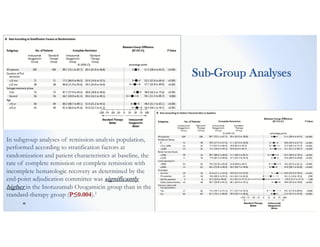
In subgroup analyses of remission-analysis population,
performed according to stratification factors at
randomization and patient characteristics at baseline, the
rate of complete remission or complete remission with
incomplete hematologic recovery as determined by the
end-point adjudication committee was significantly
higher in the Inotuzumab Ozogamicin group than in the
standard-therapy group (P≤0.004).1
Sub-Group Analyses
Statistical Tests
• The two-sided P values were determined by means of the Chi-square (X2) test or
Fisher’s exact test (if any cell count was <5).1
• The Chi-square (X2) test or Fisher’s exact test are appropriate when the null
hypothesis (Ho) is to be tested using nominal or ordinal data.
• What is nominal data?
o Categorical data with no order to categories
o Simplest level of measurement (weakest/lowest)
o Usually described in terms of percentages, proportions, ratio, rates (incidence, prevalence)
o Examples: Blood type, Treatment/Placebo, Disease/No Disease, Mortality (dead/alive)
• What is ordinal data?
o Categorical data that has an implied order
o The difference between two adjacent categories are not equal or measurable
o Usually described in terms of percentages, median, rates, ratio
o Examples: Stage of cancer, Pain scale, Heart Failure classifications, Apgar scores
Primary Results
• 1st Primary Objective: The rate of Complete Remission [CR] or Complete Remission
with Incomplete Hematologic Recovery [CRi] was significantly higher in the
Inotuzumab Ozogamicin group than in the Standard-therapy group (80.7% [95%
confidence interval {CI}, 72.1 to 87.8] vs. 29.4% [95% CI: 21.0 to 38.8], P<0.001).1
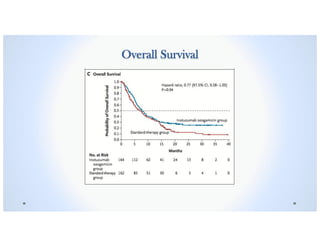
• 2nd Primary Objective: The median Overall Survival was 7.7 months (95% CI, 6.0 to
9.2) in the Inotuzumab Ozogamicin group vs. 6.7 months (95% CI, 4.9 to 8.3) in the
Standard-therapy group, P=0.04.1 ß 2nd OBJECTIVE NOT MET!
o A predetermined boundary of P=0.0208 was set to show significantly longer overall
survival in the Inzotuzumab Ozogamicin group than in the Standard-therapy group.
• The rate of 2-year Overall Survival was 23% (95% CI, 16 to 30) in the Inotuzumab
Ozogamicin group vs. 10% (95% CI, 5 to 16) in the Standard-therapy group.1
Overall Survival
Exploratory Post Hoc Analysis
• Data for Overall Survival appeared to depart from the proportional-hazards
assumption as reflected by an apparent heterogeneity in the curve for standard
therapy; therefore an exploratory post hoc analysis of restricted mean survival
time was applied (truncation time, 37.7 months) to alternatively define the
clinical benefit of Inotuzumab Ozogamicin.1
• In this analysis, mean Overall Survival was longer in the Inotuzumab
Ozogamicin group than in the Standard-therapy group (mean [±], 13.9±1.10
months vs. 9.9±0.85 months, P=0.005).1
Secondary Results
• Among the patients who achieved [CR] or {CRi], the percentage who had bone marrow
blast results below the 0.01% threshold for minimal residual disease was significantly
higher than in the Inotuzumab Ozogamicin group than in the Standard-therapy group
(78.4% [95% CI, 68.4 to 86.5] vs. 28.1% [95% CI, 13.7 to 46.7], P<0.001.1
• Significantly more patients proceeded to stem-cell transplantation directly after treatment
in the Inotuzumab Ozogamicin group than in the Standard-therapy group (41% [45 of 109
patients] vs. 11% [12 of 109 patients], P<0.001.1
• The Duration of Remission was longer in the Inotuzumab Ozogamicin group than in the
Standard-therapy group. The median duration of remission was 4.6 months (95% CI, 3.9
to 5.4) in the Inotuzumab Ozogamicin group vs. 3.1 months (95% CI, 1.4 to 4.9) in the
Standard-therapy group, P<0.03.1
• Progression-free Survival was significantly longer in the Inotuzumab Ozogamicin group
than in the Standard-therapy group (median, 5.0 months [95% CI, 3.7 to 5.6] vs. 1.8
months [95% CI, 1.5 to 2.2], P<0.001.1
Duration of Remission
Progression-Free Survival
Serious Adverse Events
The percentage of patients who had
serious adverse events was similar in
the Inotuzumab Ozogamicin group
and the Standard-therapy group
(48% and 46%, respectively).1
Febrile Neutropenia was the most
frequently reported serious adverse
event in both treatment groups.1
In both treatment groups, the most
common hematologic adverse event
of any cause were cytopenias.1
Liver-related adverse events were
more common in the Inotuzumab
Ozogamicin group than the
Standard-therapy group.1
Veno-occlusive disease occurred
more frequently in the Inotuzumab
Ozogamicin group than in the
Standard-therapy group (11% [15
patients] vs. 1% [1 patient]).1
In the Inotuzumab Ozogamicin
The most frequent liver-related
adverse events of any grade that
occurred during treatment were an
Increased Aspartate
Aminotransferase level (in 20% of
patients in the Inotuzumab
Ozogamicin group and 10% of
patients in the Standard-therapy
group), Hyperbilirubinemia (in 15%
and 10%, respectively), and
increased Alanine
Aminotransferase level (in 14% and
11% respectively.1
Strengths of the INO-VATE Study
• Phase 3 Trial: A larger selected sample size to assess efficacy, surpassing Phase I
and II trials for human safety, toxicity, and and knowledge of dose ranges to use
• 1:1 Randomization: Each patient has an equal chance of being assigned to any
of the two arms, which prevents selection bias
• Power of 88.5 (Adequate Power is 80%)7
• Well-balanced baseline patient characteristics
• Chemotherapy <2 weeks and Allogeneic Hematopoietic Stem Cell
Transplantation (HSCT) ≤ 4 months before randomization was NOT allowed,
to maintain the accuracy of results, reach statistical significance, and reduce bias
• Appropriateness of Statistical tests used to analyze results
• No Cross-Over; eliminates carryover effects of therapies and saves time to
evaluate an adequate wash-out period
• All authors had free access to data tables which they confirmed the accuracy of,
and drafted, reviewed, and decided together to publish the manuscript
Weaknesses of the INO-VATE Study
• Open-Label à SOURCE OF BIAS; if patients or investigators know
what group they are assigned to, they may report better results with the
active treatment and worse results with the control group.
Open-label studies tend to overestimate efficacy.7
• Second Primary Objective (Overall Survival) was not met
• The Remission rate associated with single-agent Inotuzumab
Ozogamicin that was observed in this trial was higher than a previous
reported rate of 58%,23 possibly because the patients involved in the
previous study were treated later in the the disease course.1
Clinical Significance
• The FDA has granted a priority review designation to the
investigational drug, Inoztumab Ozogamicin.
• Under the priority review program, the FDA will decide on the
biologics license application for Inotuzumab Ozogamicin within
6 months as compared with the standard 10-month review.3
• If approved, Inotuzumab Ozogamicin represents a new
treatment option for adult patients with relapsed or refractory
B-cell precursor ALL3 whose prognosis remains poor today.
Conclusions
• The rate of complete remission was significantly higher in the Inotuzumab Ozogamicin group was
than in the Standard Intensive Chemotherapy with adults with relapsed or refractory B-cell ALL.1
• Among patients who had Complete Remission [CR], the percentage who had bone marrow blast
results below the threshold for minimal residual disease was 2.8 times as high in the Inotuzumab
Ozogamicin group as in the Standard-therapy group (P<0.001).1
• More patients in the Inotuzumab Ozogamicin group proceeded to Stem-cell Transplantation after
treatment than after Standard-therapy treatment (41% vs. 11%, P<0.001).1
• Both Progression-Free and Overall Survival were longer with Inotuzumab Ozogamicin.1
• Veno-occlusive liver disease was a major adverse event associated with Inotuzumab Ozogamicin.
References
1. Kantarjian HM, DeAngelo DJ, Stelljes M, et al. Inotuzumab ozogamicin versus standard therapy for acute lymphoblastic leukemia.
N Engl J Med 2016; 375: 740-53/ DOI: 10.1056/NEJMoa1509277
2. PDQ® Adult Treatment Editorial Board. PDQ Adult Acute Lymphoblastic Leukemia Treatment. Bethesda, MD:
National Cancer Institute. Updated <03/16/2017>. Available at: https://www.cancer.gov/types/leukemia/hp/adult-all-
treatment-pdq. Accessed <05/19/2017>. [PMID: 26389171]
3. Inman, S. (2017, February 21). FDA Grants Inotuzumab Ozogamicin Priority Review for ALL. Retrieved May 19, 2017,
from http://www.onclive.com/web-exclusives/fda-grants-inotuzumab-ozogamicin-priority-review-for-all
4. Jabbour, E., Kantagrjian, H. & Cortes,J. (2015). Use of second and third-generation tyrosine kinase inhibitors in the
treatment of chronic myeloid leukemia: An evolving treatment paradigm. Clinical Lymphoma, Myeloma and Leukemia, 15(6),
323-334. DOI: 10.1016/j.clml.2015.03.006
5. Prinja, S., Gupta, N. & Verma, R. (2010), Censoring in clinical trials: Review of survival analysis techniques. Indian Journal
of Community Medicine, 35(2), 217. DOI: 10.4103/0970-0218.66859
6. Malone PM, Kier KL, Stanovich JE, Malone MJ. Drug Information: A Guide for Pharmacists. 5th Edition. New York,
NY: McGraw-Hill, 2014. ISBN: 9780071804349 (available in AccessPharmacy via St. John’s University Libraries)
7. Allen, Jill. (2005). Applying Study Results to Patient Care: Glossary of Study Design and Statistical Terms. Pharmacist’s
Latter/Prescriber’s Letter. Volume 21 – Number 210610
8. Seiter, K (2014, February 5). Sarkodee-Adoo, C; Talavera, F; Sacher, RA; Besa, EC, eds. "Acute Lymphoblastic
Leukemia". Medscape Reference. WebMD. Retrieved 19 May 2017.
9. American Cancer Society. Leukemia – Acute Lymphocytic (Adults). Available at:
http://www.cancer.org/acs/groups/cid/documents/webcontent/003109-pdf.pdf. Accessed May 19, 2017.
10. Pui CH, Jeha S: New therapeutic strategies for the treatment of acute lymphoblastic leukaemia. Nat Rev Drug Discov 6
(2): 149-65, 2007. [PUBMED Abstract]
References
11. American Cancer Society. Leukemia – Acute Lymphocytic (Adults). Available at:
http://www.cancer.org/acs/groups/cid/documents/webcontent/003109-pdf.pdf. Accessed May 19, 2017.
12. Manal Basyouni A. et al. Prognostic significance of survivin and tumor necrosis factor-alpha in adult acute lymphoblastic
leukemia. DOI:10.1016/j.clinbiochem.2011.08.1147.
13. National Cancer Institute: General Information About Adult Acute Lymphoblastic Leukemia (ALL). Available at:
http://www.cancer.gov/cancertopics/pdq/treatment/adultALL/HealthProfessional/page1. Accessed May 19. 2017.
14. Greer, J. P.; Arber, D. A.; Glader, B.; et al. (2013). Wintrobe's Clinical Hematology (13th ed.). Lippincott Williams & Wilkins.
ISBN 9781451172683.
15. Leukemia & Lymphoma Society. Acute Lymphoblastic Leukemia. Available at: http://www.lls.org/sites/default/ les/
le_assets/all.pdf. Accessed on May 19. 2017.
16. Fielding A. et al. Outcome of 609 adults after relapse of acute lymphoblastic leukemia (ALL); an MRC UKALL12/ECOG
2993 study. Blood. 2006; 944-950.
17. DiJoseph JF, Armellino DC, Boghaert ER, et al. Antibody-targeted chemotherapy with CMC-544: a CD22-targeted
immunoconjugate of calicheamicin for the treatment of B-lymphoid malignancies. Blood 2004;103:1807-14.
18. HinmanLM,HamannPR,WallaceR, Menendez AT, Durr FE, Upeslacis J. Prep- aration and characterization of monoclonal
antibody conjugates of the calichea- micins: a novel and potent family of antitumor antibiotics. Cancer Res 1993; 53:3336-42.
19. Shor B, Gerber HP, Sapra P. Preclinical and clinical development of inotuzumab ozogamicin in hematological malignancies.
Mol Immunol 2015;67(2 Pt A): 107-16.
20. Vaickus L, Ball ED, Foon KA. Immune markers in hematologic malignancies. Crit Rev Oncol Hematol 1991;11:267-97.
21. Schwartz-Albiez R, Dörken B, Monner DA, Moldenhauer G. CD22 antigen: bio- synthesis, glycosylation and surface
expression of a B lymphocyte protein involved in B cell activation and adhesion. Int Immunol 1991;3:623-33.
22. Jabbour E, O’Brien S, Ravandi F, Kan- tarjian H. Monoclonal antibodies in acute lymphoblastic leukemia. Blood 2015;125:
4010-6.
23. Kantarjian H, Thomas D, Jorgensen J, et al. Results of inotuzumab ozogamicin, a CD22 monoclonal antibody, in refrac- tory
and relapsed acute lymphocytic leu- kemia. Cancer 2013;119:2728-36.

Inotuzumab ozogamicin (BESPONSA)

  • 1.
    Inotuzumab Ozogamicin versus Standard Therapyfor Acute Lymphoblastic Leukemia (ALL) Oscar Kwan, PharmD. 2018 Candidate St. John’s University College of Pharmacy and Health Sciences oscar.kwan11@stjohns.edu
  • 2.
    Objectives • Review generalinformation on Acute Lymphoblastic Leukemia (ALL) and its current therapies • Describe the rationale, objectives, endpoints, and design of the INO-VATE ALL study • Provide an overview and summary of the mechanism of action of Inotuzumab Ozogamicin • Define all clinical and statistical terms given by the authors in the Supplementary Appendix • Identify measurement tools and discuss the biases, strengths, and limitations of the study • Analyze all data obtained in tables/figures and assess the appropriateness of statistical tests used • Summarize all valid conclusions obtained from the study and its clinical significance in practice
  • 3.
  • 4.
    B-Cell Acute LymphoblasticLeukemia (ALL) • Acute and Aggressive form of Leukemia (cancer of white blood cells) • Overproduction and Accumulation of cancerous, immature white blood cells, known as lymphoblasts1, in the bone marrow • Lymphoblasts can spread to blood, and infiltrate the lymph nodes, spleen, liver, central nervous system [CNS], and other organs2 • Reduced production of new, normal-functioning blood cells due to bone marrow damage and resource depletion by lymphocytes1 • If left untreated within a matter of months11, ALL can be FATAL9
  • 5.
    “Acute” “Chronic” Acute LymphocyticLeukemia Defined by… The World Health Organization 2008: v “Acute” ALL: Greater than 20% of bone marrow cells are lymphoblasts v “Chronic” ALL: Less than 20% of bone marrow cells are lymphoblasts
  • 6.
    Pathophysiology of ALL •ALL arises from malignant transformation of B- or T-cell progenitor cells10
  • 7.
    Inhibited Hematopoiesis 2016 TNKChildren’s Foundation (http://huggedandkissed.org/leukemia/)
  • 8.
    Microscopic Features • 3-4xlarger than a mature RBC (Red Blood Cell) • High Nuclear to Cytoplasmic ratio (N:C) • Round nucleus with immature chromatin (not clumped) • Less prominent nucleoli • Cytoplasm appears scant, light blue and lacks granules
  • 9.
  • 10.
    Signs & Symptoms Suppressionof Normal Hematopoiesis causes: o Weakness or Fatigue2 o Anemia (pallor, tachycardia, headache)8 o Fever or Night Sweats2 o Unexpected weight loss or anorexia2 o Pain in the bones or joints2 o Swelling or discomfort in the abdomen2 o Symptoms of an Infection2,8 : v Shortness of breath v Chest pain v Cough v Vomiting v Swollen lymph nodes of the neck, armpit, or groin (usually painless) o Increased risk and frequency of infections (especially bacterial infections like pneumonia due to neutropenia)8 o Thrombocytopenia2 : v Increased tendency to bruise or bleed easily Ø Bleeding gums Ø Purplish patches in the skin Ø Petechiae [flat, pinpoint spots under the skin] Doctors Health Press Consumer Health Digest
  • 12.
    Incidence and Epidemiology •An estimate of ALL in the United States in 2017: Ø New Cases2: 5,970 Ø Deaths2: 1,440 • ALL occurs in BOTH children and adults2 • It is the most common type of cancer in children (peak incidence at 2 to 5 years old)8 • Cure is a realistic goal, and is achieved in more than 80% in affected children8 • For adults, the prognosis is NOT as optimistic… Ø Only 20 to 40% of adults with ALL are cured with current treatment regimens12 • Internationally, ALL is more common in Caucasians than in Africans; it is more common in Hispanics and in Latin America14 Sallan SE; Hematology 2006
  • 13.
    Unmet Needs inAdult ALL • Older patients with ALL may have other comorbidities, including heart, lung or kidney disease or diabetes mellitus. If these are present, the doctor may select less toxic drugs or decrease the dosage and frequency of treatment.15 • Approximately half of the 2,000 U.S. adults who learn they have ALL this year will NOT respond to commonly used chemotherapy agents (refractory) or will eventually see their disease return (relapse).13 • The outlook for adults with relapsed or refractory ALL is poor.16 These patients have already tried and failed commonly used treatments, leaving very few treatment options available to them.16 • 9 out of 10 of these patients will NOT survive more than five years.16
  • 14.
    INO-VATE 1022 Trial “ALLthat has recurred after, or is refractory to, first-line therapy is a rapidly progressing and deadly disease,”3 “Based on the positive results of the INO-VATE 1022 Phase III trial, we believe Inotuzumab Ozogamicin, if approved, represents a new treatment option for adult patients with relapsed or refractory B-cell precursor ALL.”3 - Mace Rothenberg MD., Chief Development Officer, Oncology, Pfizer Global Product Development, the developer of the Inotuzumab Ozogamicin
  • 15.
    Trial Oversight • Theprotocol was approved by the independent ethics committee or the Institutional Review Board at each trial center.1 • Written informed consent was obtained in accordance with the provisions of the Declaration of Helsinki.1 • The trial was designed through a collaboration of the sponsor (Pfizer) and the lead investigators. Pfizer collected and held the data included in this report.1 • Generated data tables were freely accessible to all the authors, who, together with Pfizer representatives, were responsible for the analyses of the data.1 • All the authors contributed to the drafting and critical review of the manuscript, approved the final draft, and made the decision to submit the manuscript for publication.1 • All the authors vouch for the accuracy of the data and analysis and the adherence of the trial.1
  • 16.
    Inotuzumab Ozogamicin (CMC-544) •A humanized anti-CD22 monoclonal antibody conjugated to calicheamicin, a cytotoxic antibiotic agent.17-19 • CD22, is a cell-surface glycoprotein expressed in more than 90% of patients with B-cell ALL. It is not shed into the extracellular matrix, and has emerged as an attractive therapeutic target for B-cell cancers.20-22 Dove Medical Press
  • 17.
    Mechanism of Action 1.The CMC-544 antibody-antibiotic conjugate binds to the CD22 receptor. 2. The CD22-conjugate complex is rapidly internalized, and calicheamicin is released.1 3. Calicheamicin binds to the minor grove of DNA and induces double-strand cleavage and subsequent apoptosis.1 Leaders in Pharmaceutical Business Intelligence
  • 18.
    Rationale of theStudy • While many potential treatments have been studied, only a limited number of medicines for relapsed or refractory adults with ALL have been approved by the FDA and other regulatory authorities in the past decade. • The current standard treatment is intensive, lengthy chemotherapy with the goal of halting the signs and symptoms of ALL (called hematologic remission) and becoming eligible for a stem-cell transplant.11 • Allogeneic Stem-Cell Transplantation [SCT] is the main goal after salvage treatment because it is the ONLY potentially curative treatment option for adults with relapsed or refractory ALL.1 • A previous phase 2 study of Inotuzumab Ozogamcin, administered on either a weekly or a monthly schedule, for the treatment of patients with relapsed or refractory B-cell ALL showed antitumor activity.1
  • 19.
    Allogeneic Stem CellTransplantation [SCT]
  • 20.
    Current Standard ChemotherapyRegimens Complete Remission [CR] Rates1: o Adults with Newly diagnosed B-cell ALL: 60 to 90 % o However many patients relapse, and ONLY approximately 30 to 50% will have a disease-free survival lasting 3 years or longer. o Adults with Relapsed or Refractory ALL: 31 to 44% (if 1st salvage therapy) 18 to 25% (if 2nd salvage therapy) o Complete Remission [CR] is typically a prerequisite for subsequent allogeneic stem-cell transplantation, the low rates of complete remission associated with current chemotherapy regimens mean that few adults with relapsed or refractory B-cell ALL, 5 to 30% proceed to transplantation.1
  • 21.
    Intent of theStudy • To assess the clinical activity and safety of single-agent Inotuzumab Ozogamicin, as compared with standard intensive chemotherapy, when it is administered as the first or second salvage treatment in adults with relapsed or refractory B-cell ALL.1 • 1st Primary Objective: o To show significantly higher rates of Complete Remission [CR] or Complete Remission with Incomplete Hematologic Recovery [Cri] in the Inotozumab Ozogamacin group than in the Standard-therapy group. 1 • 2nd Primary Objective: o To show significantly longer Overall Survival in the Inotuzumab Ozogamicin group than in the Standard-therapy group, at a pre-specified boundary of P=0.0208.1
  • 22.
    Monitoring Parameters Primary EndPoints1: 1. Complete Remission [CR]: The disappearance of leukemia as indicated by < 5% marrow blasts and the absence of peripheral blasts, with recovery of hematopoiesis defined by ANC ≥ 1,000 cells/µL and platelets ≥ 100,000 cells/µL.1 C1 extramedullary disease status is required1; patients were considered to have C1 extramedullary disease status if the following criteria were met: q Complete disappearance of all measurable and non-measurable extramedullary disease with the exception of lesions for which the following must be true: for patients with at least one measurable lesion, all nodal masses > 1.5 cm in greatest transverse diameter (GTD) at baseline must have regressed to ≤ 1.5 cm in GTD and all nodal masses ≥ 1 cm and ≤ 1.5 cm in GTD at baseline must have regressed to < 1 cm GTD or they must have reduced by 75% in sum of products of greatest diameters (SPD).1 q No new lesions.1 q Spleen and other previously enlarged organs must have regressed in size and must not be palpable.1 q All disease must be assessed using the same technique as at baseline.1 2. Complete Remission with Incomplete Hematologic Recovery (CRi): Complete Remission [CR] except with ANC < 1,000 cells/µL and/or platelets < 100,000 cells/µL.1 3. Overall Survival: Time from randomization to death due to any cause, censored at the last known alive date.1
  • 23.
    Monitoring Parameters Secondary EndPoints1: 1. Safety Measures 2. Duration of Remission: Time from remission to progressive disease (objective progression, relapse, treatment discontinuation due to health deterioration) or death.1 3. Progression-Free Survival: Time from randomization to the earliest of disease progression (including objective progression, relapse from [CR/CRi], treatment discontinuation doe to global deterioration of health status), starting new induction therapy or poststudy [SCT] without achieving [CR/CRi], or death due to any cause, censored at the last valid disease assessment.1 4. Rate of Subsequent Stem-Cell Transplantation [SCT]1 5. Percentage of Patients, who achieved [CR], who had results below the threshold for minimal residual disease specified as 0.01% bone marrow blasts
  • 24.
    Monitoring Parameters • SeriousAdverse Events (of any cause) defined as: o Any event that occurs during treatment between the first dose and 42 days after the last dose.1 o All treatment-related adverse events that occurred after the last dose.1 o All cases of veno-occlusive liver disease or the sinusoidal obstruction syndrome (of any cause) that occurred within 2 years after randomization.1 Ø Veno-occlusive disease/sinusoidal obstruction syndrome (VOD/SOS) was assessed and diagnosed by the investigators and evaluated according to previously defined clinical criteria and required the occurrence of 2 of more of the following events1: 1. Hyperbilirubinemia (>34 µmol/L or >2 mg/dL) 2. Ascites or Sudden weight gain (>2.5% of baseline body weight) 3. Painful Hepatomegaly Ø Diagnosis also required no other explanation for these signs and symptoms (septicemia, cyclosporine toxicity, heart failure, hepatitis).1 Ø An external, blinded, independent Hepatic Events Adjudication Board (HEAB) also reviewed all significant hepatic events, including all potential cases of VOD/SOS.1 24
  • 25.
    Measurement Tools 1. CompleteBlood Count (CBC): A full blood count test to measure the levels of white blood cells, red blood cells, and platelets, which was needed and relied on to calculate ANC and evaluate Complete Remission [CR]. 2. Multicolor, Multi-parameter Flow Cytometry: The threshold for minimal residual disease was specified as 0.01% bone marrow blasts and was assessed at a central laboratory. 3. Bone Marrow Aspiration (or Bone Marrow Biopsy, if clinically indicated): Performed for all patients with a disease assessment at screening, between Days 16 and 28 of Cycles 1, 2, and 3, and every 1 to 2 cycles thereafter; at the end-of-treatment visit; during planned follow-up visits; and as clinically indicated. 4. Karyotype was assessed at a local laboratory. 5. Philadelphia Chromosome (Ph) positivity was assessed at a central or local laboratory or through medical history.
  • 26.
    INO-VATE Study Designand Methods • Open-label (no blinding) • Two-Arm/Group (326 patients underwent randomization, only the first 219 [109 om each group] were included in the primary intention-to-treat analysis of complete remission) • 1:1 Randomization of Patients • Phase 3 trial • No Cross-Over was allowed
  • 27.
    Eligibility/Inclusion Criteria Patients mustbe/have: • B- cell Acute Lymphoblastic Leukemia (ALL): ü Relapsed or Refractory (≥ 5% bone marrow blasts on local morphologic analysis) AND ü CD22-positive AND ü Philadelphia chromosome (Ph) positive or negative • Sex: Males and Females • Age ≥ 18 years or older • Scheduled to receive their 1st or 2nd Salvage treatment • Lymphoblastic Lymphoma (except Burkitt Lymphoma) • Eastern Cooperative Oncology Group performance status: ≤ 2 • Adequate Hepatic Function: ü Total Serum Bilirubin ≤ 1.5 x Upper Limit of Normal [ULN] (except for documented Gilbert Syndrome: ≤ 2 x ULN for hepatic abnormalities considered tumor-related) ü Alanine Aminotransferase [ALT] and Aspartate Aminotransferase [AST]: ≤ 2.5 x ULN ü Serum Creatinine [SCr] ≤ 2.5 x ULN OR Creatinine Clearance [CrCl] ≥ 40 mL/min associated with ANY Serum Creatinine [SCr] level
  • 28.
    Eligibility/Inclusion Criteria • Patientsunresponsive to prior treatment with: o ≥ 1 Second/Third generation TKIs (Dasatinib2, Nilotinib2, Bosutinib2, Ponatinib2) o Standard Induction Chemotherapy (patients with Ph+ ALL only) • Active Central Nervous System (CNS) Leukemia OR Mixed Phenotype ALL • Maintenance Therapy must consist of: o Mercaptopurine o Methotrexate o Vincristine o Thioguanine AND/OR o Tyrosine Kinase Inhibitors (TKIs)
  • 29.
    Exclusion Criteria • Patientswith: o Peripheral Absolute Lymphoblast Count ≥ 10,000 cells/µL *Treatment to reduce circulating blasts was allowed within 2 weeks of randomization with Hydroxyurea AND/OR Steroids/Vincristine o Burkitt Lymphoma o Isolated Testicular or CNS Extramedullary relapse • Treatments NOT Allowed: o Chemotherapy < 2 weeks before randomization *EXCEPT to reduce circulating lymphoblast count or palliation [Steroids, Hydroxycarbamide, or Vincristine] o Monoclonal Antibody treatment < 6 weeks before randomization (for Rituximab: ≥ 2 weeks before randomization) o Allogeneic Hematopoietic Stem Cell Transplantation (HSCT) ≤ 4 months before randomization
  • 30.
    Treatment Groups Inotuzumab OzogamicinGroup: • Patients received the drug intravenously at a starting dose of 1.8 mg/m2 of body-surface area per cycle.1 • They received 0.8 mg on day 1 of each cycle and 0.5 mg on Days 8 and 15.1 • Cycle 1 lasted for 21 days and the subsequent cycles each lasted for 28 days; the patients received treatment for up to six cycles.1 • Once a patient achieved complete remission or complete remission with incomplete hematologic recovery, the dose that was administered on Day 1 of each cycle was reduced to 0.5 mg for the duration of the trial. 1 Standard-Therapy Group: • Received the investigator’s choice of one of the following 3 regimens: 1. FLAG (Fludarabine, Cytarabine, and Granulocyte colon-stimulating factor) for up to four 28-day cycles (with Cytarabine at a dose of 2.0 g/m2 per day on Days 1 – 6. Fludarabine at a dose of 30 mg/m2 per day on Days 2 – 6, and Granulocyte colon-stimulating factor at a dose of 5 µg/kg of body weight per day or at the institutional standard dose).1 2. Cytarabine plus Mitoxantrone for up to four 15-to-20-day cycles (with Cytarabine at a dose of 200 mg/m2 per day on Days 1 through 7 and Mitoxantrone at a dose of 12 mg/m2 per day on Days 1 through 3; for Mitoxantrone, dose reduction to 8 mg was allowed on the basis of age, coexisting conditions, and previous anthracycline use.1 3. High-dose Cytarabine for up to one 12-dose cycle (at a dose of 3 g/m2 every 12 hours, or a dose of 1.5 g/m2 for patients ≥ 55 years of age).1
  • 31.
  • 32.
    Statistical Analysis • Thesample size was calculated to allow adequate independent assessments of between-group differences in the rate of complete remission and in overall survival by splitting the one-sided alpha level of P<0.025 evenly between the two primary end points.1 • What is an alpha value? o The probability of concluding there is a difference between groups when there really is no difference between them (making a Type I error).7 o A result is usually considered statistically significant if the probability of a Type I error is less than 5% (P<0.05). It means that the probability that the result is due to chance is less than one in 20.7 o The smaller the p-value, the greater the statistical significance.7
  • 33.
    Statistical Analysis • Witha sample size of 218 patients and a one-sided alpha level of P<0.0125, the study had 88.5% power to detect a difference in the rate of Complete Remission [CR] (including Complete Remission with Incomplete Hematologic Recovery [CRi]) of 24 percentage points between the two groups (61% in the Inotuzumab Ozogamicin group vs. 37% in the standard-therapy group). • What is power? o The ability of a study to detect a significant difference between treatment groups; the probability that a study will have a statistically significant result (P<0.05).7 o By convention, adequate study power is usually set at 0.8 (80%). o Power increases as sample size increases.7
  • 34.
    Subgroup Analysis • Examinationof outcomes in specific groups within a study in order to predict who benefits or is harmed the most by treatment. • Subgroup analyses should only be done by studies that have enough power. • In general, subgroup analysis should only be used to identify research questions to be addressed in future clinical trials.
  • 35.
    In subgroup analysesof remission-analysis population, performed according to stratification factors at randomization and patient characteristics at baseline, the rate of complete remission or complete remission with incomplete hematologic recovery as determined by the end-point adjudication committee was significantly higher in the Inotuzumab Ozogamicin group than in the standard-therapy group (P≤0.004).1 Sub-Group Analyses
  • 36.
    Statistical Tests • Thetwo-sided P values were determined by means of the Chi-square (X2) test or Fisher’s exact test (if any cell count was <5).1 • The Chi-square (X2) test or Fisher’s exact test are appropriate when the null hypothesis (Ho) is to be tested using nominal or ordinal data. • What is nominal data? o Categorical data with no order to categories o Simplest level of measurement (weakest/lowest) o Usually described in terms of percentages, proportions, ratio, rates (incidence, prevalence) o Examples: Blood type, Treatment/Placebo, Disease/No Disease, Mortality (dead/alive) • What is ordinal data? o Categorical data that has an implied order o The difference between two adjacent categories are not equal or measurable o Usually described in terms of percentages, median, rates, ratio o Examples: Stage of cancer, Pain scale, Heart Failure classifications, Apgar scores
  • 37.
    Primary Results • 1stPrimary Objective: The rate of Complete Remission [CR] or Complete Remission with Incomplete Hematologic Recovery [CRi] was significantly higher in the Inotuzumab Ozogamicin group than in the Standard-therapy group (80.7% [95% confidence interval {CI}, 72.1 to 87.8] vs. 29.4% [95% CI: 21.0 to 38.8], P<0.001).1 • 2nd Primary Objective: The median Overall Survival was 7.7 months (95% CI, 6.0 to 9.2) in the Inotuzumab Ozogamicin group vs. 6.7 months (95% CI, 4.9 to 8.3) in the Standard-therapy group, P=0.04.1 ß 2nd OBJECTIVE NOT MET! o A predetermined boundary of P=0.0208 was set to show significantly longer overall survival in the Inzotuzumab Ozogamicin group than in the Standard-therapy group. • The rate of 2-year Overall Survival was 23% (95% CI, 16 to 30) in the Inotuzumab Ozogamicin group vs. 10% (95% CI, 5 to 16) in the Standard-therapy group.1
  • 38.
  • 39.
    Exploratory Post HocAnalysis • Data for Overall Survival appeared to depart from the proportional-hazards assumption as reflected by an apparent heterogeneity in the curve for standard therapy; therefore an exploratory post hoc analysis of restricted mean survival time was applied (truncation time, 37.7 months) to alternatively define the clinical benefit of Inotuzumab Ozogamicin.1 • In this analysis, mean Overall Survival was longer in the Inotuzumab Ozogamicin group than in the Standard-therapy group (mean [±], 13.9±1.10 months vs. 9.9±0.85 months, P=0.005).1
  • 40.
    Secondary Results • Amongthe patients who achieved [CR] or {CRi], the percentage who had bone marrow blast results below the 0.01% threshold for minimal residual disease was significantly higher than in the Inotuzumab Ozogamicin group than in the Standard-therapy group (78.4% [95% CI, 68.4 to 86.5] vs. 28.1% [95% CI, 13.7 to 46.7], P<0.001.1 • Significantly more patients proceeded to stem-cell transplantation directly after treatment in the Inotuzumab Ozogamicin group than in the Standard-therapy group (41% [45 of 109 patients] vs. 11% [12 of 109 patients], P<0.001.1 • The Duration of Remission was longer in the Inotuzumab Ozogamicin group than in the Standard-therapy group. The median duration of remission was 4.6 months (95% CI, 3.9 to 5.4) in the Inotuzumab Ozogamicin group vs. 3.1 months (95% CI, 1.4 to 4.9) in the Standard-therapy group, P<0.03.1 • Progression-free Survival was significantly longer in the Inotuzumab Ozogamicin group than in the Standard-therapy group (median, 5.0 months [95% CI, 3.7 to 5.6] vs. 1.8 months [95% CI, 1.5 to 2.2], P<0.001.1
  • 41.
  • 42.
  • 43.
    Serious Adverse Events Thepercentage of patients who had serious adverse events was similar in the Inotuzumab Ozogamicin group and the Standard-therapy group (48% and 46%, respectively).1 Febrile Neutropenia was the most frequently reported serious adverse event in both treatment groups.1 In both treatment groups, the most common hematologic adverse event of any cause were cytopenias.1 Liver-related adverse events were more common in the Inotuzumab Ozogamicin group than the Standard-therapy group.1 Veno-occlusive disease occurred more frequently in the Inotuzumab Ozogamicin group than in the Standard-therapy group (11% [15 patients] vs. 1% [1 patient]).1 In the Inotuzumab Ozogamicin The most frequent liver-related adverse events of any grade that occurred during treatment were an Increased Aspartate Aminotransferase level (in 20% of patients in the Inotuzumab Ozogamicin group and 10% of patients in the Standard-therapy group), Hyperbilirubinemia (in 15% and 10%, respectively), and increased Alanine Aminotransferase level (in 14% and 11% respectively.1
  • 44.
    Strengths of theINO-VATE Study • Phase 3 Trial: A larger selected sample size to assess efficacy, surpassing Phase I and II trials for human safety, toxicity, and and knowledge of dose ranges to use • 1:1 Randomization: Each patient has an equal chance of being assigned to any of the two arms, which prevents selection bias • Power of 88.5 (Adequate Power is 80%)7 • Well-balanced baseline patient characteristics • Chemotherapy <2 weeks and Allogeneic Hematopoietic Stem Cell Transplantation (HSCT) ≤ 4 months before randomization was NOT allowed, to maintain the accuracy of results, reach statistical significance, and reduce bias • Appropriateness of Statistical tests used to analyze results • No Cross-Over; eliminates carryover effects of therapies and saves time to evaluate an adequate wash-out period • All authors had free access to data tables which they confirmed the accuracy of, and drafted, reviewed, and decided together to publish the manuscript
  • 45.
    Weaknesses of theINO-VATE Study • Open-Label à SOURCE OF BIAS; if patients or investigators know what group they are assigned to, they may report better results with the active treatment and worse results with the control group. Open-label studies tend to overestimate efficacy.7 • Second Primary Objective (Overall Survival) was not met • The Remission rate associated with single-agent Inotuzumab Ozogamicin that was observed in this trial was higher than a previous reported rate of 58%,23 possibly because the patients involved in the previous study were treated later in the the disease course.1
  • 46.
    Clinical Significance • TheFDA has granted a priority review designation to the investigational drug, Inoztumab Ozogamicin. • Under the priority review program, the FDA will decide on the biologics license application for Inotuzumab Ozogamicin within 6 months as compared with the standard 10-month review.3 • If approved, Inotuzumab Ozogamicin represents a new treatment option for adult patients with relapsed or refractory B-cell precursor ALL3 whose prognosis remains poor today.
  • 47.
    Conclusions • The rateof complete remission was significantly higher in the Inotuzumab Ozogamicin group was than in the Standard Intensive Chemotherapy with adults with relapsed or refractory B-cell ALL.1 • Among patients who had Complete Remission [CR], the percentage who had bone marrow blast results below the threshold for minimal residual disease was 2.8 times as high in the Inotuzumab Ozogamicin group as in the Standard-therapy group (P<0.001).1 • More patients in the Inotuzumab Ozogamicin group proceeded to Stem-cell Transplantation after treatment than after Standard-therapy treatment (41% vs. 11%, P<0.001).1 • Both Progression-Free and Overall Survival were longer with Inotuzumab Ozogamicin.1 • Veno-occlusive liver disease was a major adverse event associated with Inotuzumab Ozogamicin.
  • 48.
    References 1. Kantarjian HM,DeAngelo DJ, Stelljes M, et al. Inotuzumab ozogamicin versus standard therapy for acute lymphoblastic leukemia. N Engl J Med 2016; 375: 740-53/ DOI: 10.1056/NEJMoa1509277 2. PDQ® Adult Treatment Editorial Board. PDQ Adult Acute Lymphoblastic Leukemia Treatment. Bethesda, MD: National Cancer Institute. Updated <03/16/2017>. Available at: https://www.cancer.gov/types/leukemia/hp/adult-all- treatment-pdq. Accessed <05/19/2017>. [PMID: 26389171] 3. Inman, S. (2017, February 21). FDA Grants Inotuzumab Ozogamicin Priority Review for ALL. Retrieved May 19, 2017, from http://www.onclive.com/web-exclusives/fda-grants-inotuzumab-ozogamicin-priority-review-for-all 4. Jabbour, E., Kantagrjian, H. & Cortes,J. (2015). Use of second and third-generation tyrosine kinase inhibitors in the treatment of chronic myeloid leukemia: An evolving treatment paradigm. Clinical Lymphoma, Myeloma and Leukemia, 15(6), 323-334. DOI: 10.1016/j.clml.2015.03.006 5. Prinja, S., Gupta, N. & Verma, R. (2010), Censoring in clinical trials: Review of survival analysis techniques. Indian Journal of Community Medicine, 35(2), 217. DOI: 10.4103/0970-0218.66859 6. Malone PM, Kier KL, Stanovich JE, Malone MJ. Drug Information: A Guide for Pharmacists. 5th Edition. New York, NY: McGraw-Hill, 2014. ISBN: 9780071804349 (available in AccessPharmacy via St. John’s University Libraries) 7. Allen, Jill. (2005). Applying Study Results to Patient Care: Glossary of Study Design and Statistical Terms. Pharmacist’s Latter/Prescriber’s Letter. Volume 21 – Number 210610 8. Seiter, K (2014, February 5). Sarkodee-Adoo, C; Talavera, F; Sacher, RA; Besa, EC, eds. "Acute Lymphoblastic Leukemia". Medscape Reference. WebMD. Retrieved 19 May 2017. 9. American Cancer Society. Leukemia – Acute Lymphocytic (Adults). Available at: http://www.cancer.org/acs/groups/cid/documents/webcontent/003109-pdf.pdf. Accessed May 19, 2017. 10. Pui CH, Jeha S: New therapeutic strategies for the treatment of acute lymphoblastic leukaemia. Nat Rev Drug Discov 6 (2): 149-65, 2007. [PUBMED Abstract]
  • 49.
    References 11. American CancerSociety. Leukemia – Acute Lymphocytic (Adults). Available at: http://www.cancer.org/acs/groups/cid/documents/webcontent/003109-pdf.pdf. Accessed May 19, 2017. 12. Manal Basyouni A. et al. Prognostic significance of survivin and tumor necrosis factor-alpha in adult acute lymphoblastic leukemia. DOI:10.1016/j.clinbiochem.2011.08.1147. 13. National Cancer Institute: General Information About Adult Acute Lymphoblastic Leukemia (ALL). Available at: http://www.cancer.gov/cancertopics/pdq/treatment/adultALL/HealthProfessional/page1. Accessed May 19. 2017. 14. Greer, J. P.; Arber, D. A.; Glader, B.; et al. (2013). Wintrobe's Clinical Hematology (13th ed.). Lippincott Williams & Wilkins. ISBN 9781451172683. 15. Leukemia & Lymphoma Society. Acute Lymphoblastic Leukemia. Available at: http://www.lls.org/sites/default/ les/ le_assets/all.pdf. Accessed on May 19. 2017. 16. Fielding A. et al. Outcome of 609 adults after relapse of acute lymphoblastic leukemia (ALL); an MRC UKALL12/ECOG 2993 study. Blood. 2006; 944-950. 17. DiJoseph JF, Armellino DC, Boghaert ER, et al. Antibody-targeted chemotherapy with CMC-544: a CD22-targeted immunoconjugate of calicheamicin for the treatment of B-lymphoid malignancies. Blood 2004;103:1807-14. 18. HinmanLM,HamannPR,WallaceR, Menendez AT, Durr FE, Upeslacis J. Prep- aration and characterization of monoclonal antibody conjugates of the calichea- micins: a novel and potent family of antitumor antibiotics. Cancer Res 1993; 53:3336-42. 19. Shor B, Gerber HP, Sapra P. Preclinical and clinical development of inotuzumab ozogamicin in hematological malignancies. Mol Immunol 2015;67(2 Pt A): 107-16. 20. Vaickus L, Ball ED, Foon KA. Immune markers in hematologic malignancies. Crit Rev Oncol Hematol 1991;11:267-97. 21. Schwartz-Albiez R, Dörken B, Monner DA, Moldenhauer G. CD22 antigen: bio- synthesis, glycosylation and surface expression of a B lymphocyte protein involved in B cell activation and adhesion. Int Immunol 1991;3:623-33. 22. Jabbour E, O’Brien S, Ravandi F, Kan- tarjian H. Monoclonal antibodies in acute lymphoblastic leukemia. Blood 2015;125: 4010-6. 23. Kantarjian H, Thomas D, Jorgensen J, et al. Results of inotuzumab ozogamicin, a CD22 monoclonal antibody, in refrac- tory and relapsed acute lymphocytic leu- kemia. Cancer 2013;119:2728-36.