OIS – 12 November, 2015
David Southwell, President and CEO
Forward Looking Statements
This presentation contains forward-looking statements that are based on our management’s belief and assumptions and on information currently available
to our management. Although we believe that the expectations reflected in these forward-looking statements are reasonable, these statements relate to
future events or our future financial performance, and involve known and unknown risks, uncertainties and other factors that may cause our actual results,
levels of activity, performance or achievements to be materially different from any future results, levels of activity, performance or achievements expressed
or implied by these forward-looking statements.
In some cases, you can identify forward-looking statements by terminology such as “may,” “might,” “could,” “would,” “will,” “should,” “expect,” “intend,”
“plan,” “anticipate,” “believe,” “estimate,” “predict,” “project,” “target,” “potential,” “continue” or the negative of these terms or other comparable
terminology. These statements are only predictions. You should not place undue reliance on forward-looking statements because they involve known and
unknown risks, uncertainties and other factors, which are, in some cases, beyond our control and which could materially affect results. If one or more of
these risks or uncertainties occur, or if our underlying assumptions prove to be incorrect, actual events or results may vary significantly from those implied
or projected by the forward-looking statements. No forward-looking statement is a guarantee of future performance.
The forward-looking statements in this presentation represent our views as of the date of this presentation. We anticipate that subsequent events and
developments will cause our views to change. However, while we may elect to update these forward-looking statements at some point in the future, we
have no current intention of doing so except to the extent required by applicable law. You should therefore not rely on these forward-looking statements as
representing our views as of any date subsequent to the date of this presentation. These statements are also subject to a number of material risks and
uncertainties that are described more fully in the registration statement on Form S-1, including the prospectus, filed with the SEC.
We have filed a registration statement on Form S-1 (including a prospectus) with the SEC. Before you invest, you should read the prospectus in that
registration statement and other documents the issuer has filed with the SEC for more complete information about the issuer and this offering. You may get
these documents for free by visiting EDGAR on the SEC Web site at www.sec.gov. Alternatively, the issuer, any underwriter or any dealer participating in the
offering will arrange to send you the prospectus if you request it by calling (631) 274-2806 or (800) 747-3924.
All trademarks and registered trademarks are the property of their respective owners.
2
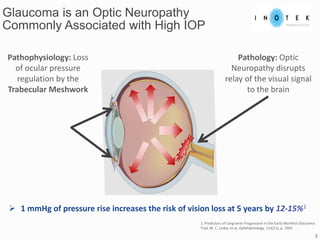
Glaucoma is an Optic Neuropathy
Commonly Associated with High IOP
3
 1 mmHg of pressure rise increases the risk of vision loss at 5 years by 12-15%1
1. Predictors of Long-term Progression in the Early Manifest Glaucoma
Trial, M. C. Leske, et al, Ophthalmology, 114(11), p. 1965
Pathophysiology: Loss
of ocular pressure
regulation by the
Trabecular Meshwork
Pathology: Optic
Neuropathy disrupts
relay of the visual signal
to the brain
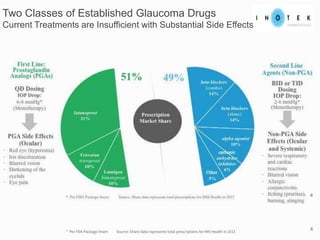
Two Classes of Established Glaucoma Drugs
Current Treatments are Insufficient with Substantial Side Effects
* Per FDA Package Insert Source: Share data represents total prescriptions for IMS Health in 2013
4
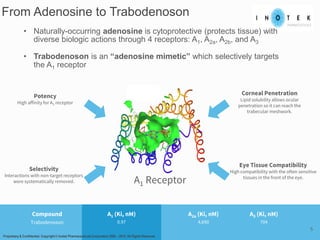
From Adenosine to Trabodenoson
A1 Receptor
• Naturally-occurring adenosine is cytoprotective (protects tissue) with
diverse biologic actions through 4 receptors: A1, A2a, A2b, and A3
• Trabodenoson is an “adenosine mimetic” which selectively targets
the A1 receptor
Selectivity
Interactions with non-target receptors
were systematically removed.
Eye Tissue Compatibility
High compatibility with the often sensitive
tissues in the front of the eye.
Corneal Penetration
Lipid solubility allows ocular
penetration so it can reach the
trabecular meshwork.
Potency
High affinity for A1 receptor
Compound
Trabodenoson
A1 (Ki, nM)
0.97
A2a (Ki, nM)
4,690
A3 (Ki, nM)
704
Proprietary & Confidential. Copyright © Inotek Pharmaceuticals Corporation 2000 – 2015. All Rights Reserved.
5
6
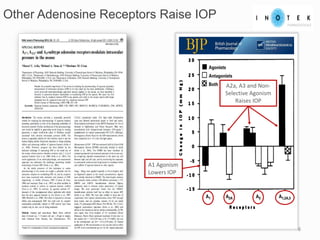
Other Adenosine Receptors Raise IOP
A1 Agonism
Lowers IOP
A2a, A3 and Non-
Selective Agonism
Raises IOP
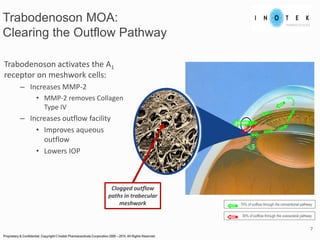
Trabodenoson MOA:
Clearing the Outflow Pathway
Proprietary & Confidential. Copyright © Inotek Pharmaceuticals Corporation 2000 – 2015. All Rights Reserved.
7
70% of outflow through the conventional pathway
30% of outflow through the uveoscleral pathway
Trabodenoson activates the A1
receptor on meshwork cells:
– Increases MMP-2
• MMP-2 removes Collagen
Type IV
– Increases outflow facility
• Improves aqueous
outflow
• Lowers IOP
Clogged outflow
paths in trabecular
meshwork
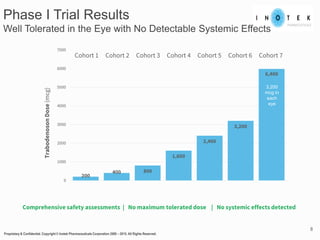
200
400 800
1,600
2,400
3,200
6,400
0
1000
2000
3000
4000
5000
6000
7000
Phase I Trial Results
Well Tolerated in the Eye with No Detectable Systemic Effects
Comprehensive safety assessments | No maximum tolerated dose | No systemic effects detected
TrabodenosonDose(mcg)
Cohort 1 Cohort 2 Cohort 3 Cohort 4 Cohort 5 Cohort 6 Cohort 7
3,200
mcg in
each
eye
Proprietary & Confidential. Copyright © Inotek Pharmaceuticals Corporation 2000 – 2015. All Rights Reserved.
8
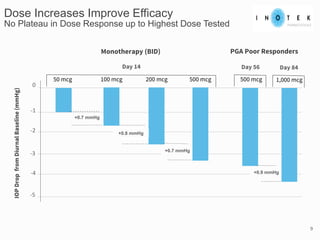
+0.9 mmHg
+0.7 mmHg
Dose Increases Improve Efficacy
No Plateau in Dose Response up to Highest Dose Tested
9
IOPDropfromDiurnalBaseline(mmHg)
50 mcg 100 mcg 200 mcg 500 mcg 500 mcg
Day 14 Day 56
1,000 mcg
Day 84
Monotherapy (BID) PGA Poor Responders
+0.7 mmHg
+0.8 mmHg
0
-1
-2
-3
-4
-5
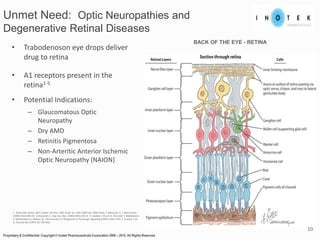
Unmet Need: Optic Neuropathies and
Degenerative Retinal Diseases
• Trabodenoson eye drops deliver
drug to retina
• A1 receptors present in the
retina1-5
• Potential Indications:
– Glaucomatous Optic
Neuropathy
– Dry AMD
– Retinitis Pigmentosa
– Non-Arteritic Anterior Ischemic
Optic Neuropathy (NAION)
BACK OF THE EYE - RETINA
Proprietary & Confidential. Copyright © Inotek Pharmaceuticals Corporation 2000 – 2015. All Rights Reserved.
10
1. Braas KM, Zarbin, MA, Snyder, SH Proc. Natl. Acad. Sci. USA (1987) 84: 3906-3910; 2. Blazynski, C, J. Neurochem.
(1990) 54(2):648-55; 3. Blazynski, C, Exp. Eye. Res. (1993) 56(5):595-9; 4. Iandiev I, Wurm A, Pannicke T, Wiedemann
P, Reichenbach A, Robson SC, Zimmermann H, Bringmann A, Purinergic Signalling (2007) 3:423–433; 5. Kvanta, A et
al, Exp Eye Res (1997) 65: 595-602.
THANK YOU

Inotek

  • 1.
    OIS – 12November, 2015 David Southwell, President and CEO
  • 2.
    Forward Looking Statements Thispresentation contains forward-looking statements that are based on our management’s belief and assumptions and on information currently available to our management. Although we believe that the expectations reflected in these forward-looking statements are reasonable, these statements relate to future events or our future financial performance, and involve known and unknown risks, uncertainties and other factors that may cause our actual results, levels of activity, performance or achievements to be materially different from any future results, levels of activity, performance or achievements expressed or implied by these forward-looking statements. In some cases, you can identify forward-looking statements by terminology such as “may,” “might,” “could,” “would,” “will,” “should,” “expect,” “intend,” “plan,” “anticipate,” “believe,” “estimate,” “predict,” “project,” “target,” “potential,” “continue” or the negative of these terms or other comparable terminology. These statements are only predictions. You should not place undue reliance on forward-looking statements because they involve known and unknown risks, uncertainties and other factors, which are, in some cases, beyond our control and which could materially affect results. If one or more of these risks or uncertainties occur, or if our underlying assumptions prove to be incorrect, actual events or results may vary significantly from those implied or projected by the forward-looking statements. No forward-looking statement is a guarantee of future performance. The forward-looking statements in this presentation represent our views as of the date of this presentation. We anticipate that subsequent events and developments will cause our views to change. However, while we may elect to update these forward-looking statements at some point in the future, we have no current intention of doing so except to the extent required by applicable law. You should therefore not rely on these forward-looking statements as representing our views as of any date subsequent to the date of this presentation. These statements are also subject to a number of material risks and uncertainties that are described more fully in the registration statement on Form S-1, including the prospectus, filed with the SEC. We have filed a registration statement on Form S-1 (including a prospectus) with the SEC. Before you invest, you should read the prospectus in that registration statement and other documents the issuer has filed with the SEC for more complete information about the issuer and this offering. You may get these documents for free by visiting EDGAR on the SEC Web site at www.sec.gov. Alternatively, the issuer, any underwriter or any dealer participating in the offering will arrange to send you the prospectus if you request it by calling (631) 274-2806 or (800) 747-3924. All trademarks and registered trademarks are the property of their respective owners. 2
  • 3.
    Glaucoma is anOptic Neuropathy Commonly Associated with High IOP 3  1 mmHg of pressure rise increases the risk of vision loss at 5 years by 12-15%1 1. Predictors of Long-term Progression in the Early Manifest Glaucoma Trial, M. C. Leske, et al, Ophthalmology, 114(11), p. 1965 Pathophysiology: Loss of ocular pressure regulation by the Trabecular Meshwork Pathology: Optic Neuropathy disrupts relay of the visual signal to the brain
  • 4.
    Two Classes ofEstablished Glaucoma Drugs Current Treatments are Insufficient with Substantial Side Effects * Per FDA Package Insert Source: Share data represents total prescriptions for IMS Health in 2013 4
  • 5.
    From Adenosine toTrabodenoson A1 Receptor • Naturally-occurring adenosine is cytoprotective (protects tissue) with diverse biologic actions through 4 receptors: A1, A2a, A2b, and A3 • Trabodenoson is an “adenosine mimetic” which selectively targets the A1 receptor Selectivity Interactions with non-target receptors were systematically removed. Eye Tissue Compatibility High compatibility with the often sensitive tissues in the front of the eye. Corneal Penetration Lipid solubility allows ocular penetration so it can reach the trabecular meshwork. Potency High affinity for A1 receptor Compound Trabodenoson A1 (Ki, nM) 0.97 A2a (Ki, nM) 4,690 A3 (Ki, nM) 704 Proprietary & Confidential. Copyright © Inotek Pharmaceuticals Corporation 2000 – 2015. All Rights Reserved. 5
  • 6.
    6 Other Adenosine ReceptorsRaise IOP A1 Agonism Lowers IOP A2a, A3 and Non- Selective Agonism Raises IOP
  • 7.
    Trabodenoson MOA: Clearing theOutflow Pathway Proprietary & Confidential. Copyright © Inotek Pharmaceuticals Corporation 2000 – 2015. All Rights Reserved. 7 70% of outflow through the conventional pathway 30% of outflow through the uveoscleral pathway Trabodenoson activates the A1 receptor on meshwork cells: – Increases MMP-2 • MMP-2 removes Collagen Type IV – Increases outflow facility • Improves aqueous outflow • Lowers IOP Clogged outflow paths in trabecular meshwork
  • 8.
    200 400 800 1,600 2,400 3,200 6,400 0 1000 2000 3000 4000 5000 6000 7000 Phase ITrial Results Well Tolerated in the Eye with No Detectable Systemic Effects Comprehensive safety assessments | No maximum tolerated dose | No systemic effects detected TrabodenosonDose(mcg) Cohort 1 Cohort 2 Cohort 3 Cohort 4 Cohort 5 Cohort 6 Cohort 7 3,200 mcg in each eye Proprietary & Confidential. Copyright © Inotek Pharmaceuticals Corporation 2000 – 2015. All Rights Reserved. 8
  • 9.
    +0.9 mmHg +0.7 mmHg DoseIncreases Improve Efficacy No Plateau in Dose Response up to Highest Dose Tested 9 IOPDropfromDiurnalBaseline(mmHg) 50 mcg 100 mcg 200 mcg 500 mcg 500 mcg Day 14 Day 56 1,000 mcg Day 84 Monotherapy (BID) PGA Poor Responders +0.7 mmHg +0.8 mmHg 0 -1 -2 -3 -4 -5
  • 10.
    Unmet Need: OpticNeuropathies and Degenerative Retinal Diseases • Trabodenoson eye drops deliver drug to retina • A1 receptors present in the retina1-5 • Potential Indications: – Glaucomatous Optic Neuropathy – Dry AMD – Retinitis Pigmentosa – Non-Arteritic Anterior Ischemic Optic Neuropathy (NAION) BACK OF THE EYE - RETINA Proprietary & Confidential. Copyright © Inotek Pharmaceuticals Corporation 2000 – 2015. All Rights Reserved. 10 1. Braas KM, Zarbin, MA, Snyder, SH Proc. Natl. Acad. Sci. USA (1987) 84: 3906-3910; 2. Blazynski, C, J. Neurochem. (1990) 54(2):648-55; 3. Blazynski, C, Exp. Eye. Res. (1993) 56(5):595-9; 4. Iandiev I, Wurm A, Pannicke T, Wiedemann P, Reichenbach A, Robson SC, Zimmermann H, Bringmann A, Purinergic Signalling (2007) 3:423–433; 5. Kvanta, A et al, Exp Eye Res (1997) 65: 595-602.
  • 11.