1
F A S T E R , S A F E R , S I M P L E R S U R G E R Y
Terrence Norchi, M.D.
President - CEO
2
Cautionary Statement Regarding Forward-Looking Statements
This	
  presenta,on	
  includes	
  forward-­‐looking	
  statements.	
  	
  We	
  make	
  forward-­‐looking	
  statements,	
  as	
  defined	
  by	
  the	
  “safe	
  harbor”	
  provisions	
  of	
  
the	
  Private	
  Securi,es	
  Li,ga,on	
  Reform	
  Act	
  of	
  1995,	
  and	
  in	
  some	
  cases,	
  you	
  can	
  iden,fy	
  these	
  statements	
  by	
  forward-­‐looking	
  words	
  such	
  as	
  
“if,”	
  “shall,”	
  “may,”	
  “might,”	
  “will	
  likely	
  result,”	
  “should,”	
  “expect,”	
  “plan,”	
  “an,cipate,”	
  “believe,”	
  “es,mate,”	
  “project,”	
  “intend,”	
  “goal,”	
  
“objec,ve,”	
  “predict,”	
  “poten,al”	
  or	
  “con,nue,”	
  or	
  the	
  nega,ve	
  of	
  these	
  terms	
  and	
  other	
  comparable	
  terminology.	
  	
  These	
  include	
  
statements	
  regarding:	
  our	
  ability	
  to	
  leverage	
  our	
  technology	
  plaLorm	
  in	
  the	
  development	
  of	
  our	
  lead	
  and	
  poten,al	
  pipeline	
  product	
  
candidates;	
  our	
  ability	
  to	
  design	
  and	
  conduct	
  development	
  ac,vi,es	
  and	
  studies	
  and	
  clinical	
  trials	
  for	
  our	
  lead	
  and	
  poten,al	
  pipeline	
  
product	
  candidates;	
  the	
  poten,al	
  ,ming	
  and	
  results	
  of	
  any	
  such	
  clinical	
  trials	
  we	
  may	
  conduct;	
  our	
  ability	
  to	
  obtain	
  regulatory	
  approvals	
  in	
  
order	
  to	
  market	
  any	
  planned	
  products;	
  our	
  ability	
  to	
  achieve	
  financial	
  projec,ons;	
  and	
  our	
  ability	
  to	
  achieve	
  milestones.	
  The	
  forward-­‐
looking	
  statements	
  in	
  this	
  presenta,on	
  are	
  based	
  on	
  management’s	
  current	
  expecta,ons,	
  es,mates,	
  forecasts	
  and	
  projec,ons	
  about	
  the	
  
Company	
  and	
  its	
  business,	
  all	
  of	
  which	
  could	
  prove	
  to	
  wrong.	
  Because	
  such	
  statements	
  deal	
  with	
  future	
  events,	
  they	
  are	
  subject	
  to	
  various	
  
risks	
  and	
  uncertain,es	
  and	
  actual	
  results	
  for	
  our	
  current	
  and	
  future	
  fiscal	
  years	
  could	
  differ	
  materially	
  from	
  the	
  Company's	
  current	
  
expecta,ons.	
  Factors	
  that	
  could	
  cause	
  the	
  Company's	
  results	
  to	
  differ	
  materially	
  from	
  those	
  expressed	
  in	
  forward-­‐looking	
  statements	
  
include,	
  without	
  limita,on,	
  the	
  following	
  risks:	
  we	
  have	
  es,mated	
  that	
  we	
  will	
  have	
  sufficient	
  cash	
  to	
  operate	
  our	
  business	
  through	
  
November	
  2014,	
  and	
  we	
  may	
  not	
  be	
  able	
  to	
  obtain	
  sufficient	
  financing	
  and/or	
  establish	
  necessary	
  rela,onships	
  with	
  third	
  par,es	
  to	
  
con,nue	
  to	
  pursue	
  our	
  business	
  plan;	
  the	
  stockholder	
  dilu,on	
  that	
  may	
  result	
  from	
  future	
  capital	
  raising	
  efforts	
  and	
  the	
  exercise	
  or	
  
conversion,	
  as	
  applicable	
  of	
  Arch’s	
  outstanding	
  op,ons	
  and	
  warrants;	
  an,-­‐dilu,on	
  protec,on	
  afforded	
  investors	
  in	
  prior	
  financing	
  
transac,ons	
  that	
  may	
  restrict	
  or	
  prohibit	
  Arch’s	
  ability	
  to	
  raise	
  capital	
  on	
  terms	
  favorable	
  to	
  the	
  Company	
  and	
  its	
  current	
  stockholders;	
  any	
  
development	
  ac,vi,es	
  or	
  clinical	
  trials	
  we	
  may	
  conduct	
  may	
  not	
  produce	
  favorable	
  results;	
  regulatory	
  agencies	
  may	
  require	
  that	
  we	
  
undertake	
  addi,onal	
  or	
  more	
  costly	
  studies	
  or	
  clinical	
  trials	
  than	
  we	
  presently	
  an,cipate;	
  we	
  may	
  never	
  gain	
  regulatory	
  approval	
  for	
  any	
  of	
  
our	
  product	
  candidates;	
  we	
  may	
  not	
  be	
  able	
  to	
  protect	
  our	
  intellectual	
  property	
  rights;	
  the	
  intellectual	
  property	
  of	
  others	
  and	
  any	
  asserted	
  
claims	
  of	
  infringement;	
  general	
  business	
  and	
  economic	
  condi,ons	
  may	
  limit	
  our	
  ability	
  to	
  obtain	
  necessary	
  capital;	
  the	
  consequences	
  of	
  
compe,,ve	
  factors	
  in	
  the	
  industry	
  in	
  which	
  we	
  operate	
  may	
  restrict	
  the	
  success	
  of	
  any	
  product	
  candidate	
  we	
  are	
  able	
  to	
  commercialize,	
  
and	
  we	
  may	
  not	
  be	
  able	
  to	
  aract	
  or	
  retain	
  key	
  personnel.	
  More	
  detailed	
  informa,on	
  about	
  us	
  and	
  the	
  risk	
  factors	
  that	
  may	
  affect	
  the	
  
realiza,on	
  of	
  any	
  forward-­‐looking	
  statements	
  is	
  set	
  forth	
  in	
  our	
  filings	
  with	
  the	
  Securi,es	
  and	
  Exchange	
  Commission,	
  including	
  our	
  Annual	
  
Report	
  on	
  Form	
  10-­‐K	
  filed	
  on	
  December	
  12,	
  2014	
  and	
  subsequent	
  filings	
  with	
  the	
  SEC	
  .	
  Such	
  documents	
  may	
  be	
  read	
  free	
  of	
  charge	
  on	
  the	
  
SEC’s	
  internet	
  site	
  at	
  hp://www.sec.gov.	
  You	
  are	
  cau,oned	
  not	
  to	
  place	
  undue	
  reliance	
  on	
  any	
  forward-­‐looking	
  statements	
  we	
  make	
  in	
  
this	
  presenta,on	
  given	
  these	
  risks	
  and	
  uncertain,es,	
  and	
  all	
  such	
  statements	
  are	
  qualified	
  in	
  their	
  en,rety	
  by	
  this	
  cau,onary	
  statement.	
  All	
  
forward-­‐looking	
  statements	
  speak	
  only	
  as	
  of	
  the	
  date	
  hereof,	
  and	
  we	
  undertake	
  no	
  obliga,on	
  to	
  revise	
  or	
  update	
  any	
  forward-­‐looking	
  
statement	
  to	
  reflect	
  events	
  or	
  circumstances	
  acer	
  the	
  	
  
date	
  hereof,	
  except	
  as	
  otherwise	
  required	
  by	
  law.	
  
3
Highlights
Investment Themes
Potential high margin (~biopharma) novel product entering a growing $5B market in
early 2016 with relatively low (device) capital requirements
First Planned Product AC5 Surgical Hemostatic DeviceTM; simple, effective, versatile, safe
Unique Technology MIT-licensed self-assembling peptide creates hemostatic barrier on wound
Recent News
Animal studies
efficacy in presence of “blood thinners”
faster time to stop bleeding vs branded hemostats of varying mechanisms
Safety study -no sign of interaction with human cell receptors or cell kinase enzymes
Medical device pathway confirmed in Europe
Activities Scale-up, biocompatibility, initiate first human trial
Pipeline Potential Applications in surgery, trauma, wound care, military medicine, other
OTCQB ARTH
4
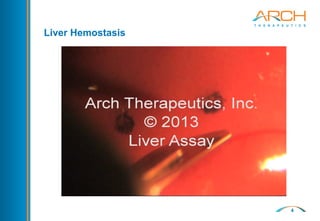
Liver Hemostasis
5
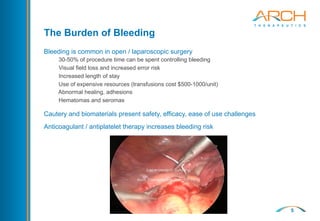
The Burden of Bleeding
Bleeding is common in open / laparoscopic surgery
30-50% of procedure time can be spent controlling bleeding
Visual field loss and increased error risk
Increased length of stay
Use of expensive resources (transfusions cost $500-1000/unit)
Abnormal healing, adhesions
Hematomas and seromas
Cautery and biomaterials present safety, efficacy, ease of use challenges
Anticoagulant / antiplatelet therapy increases bleeding risk
6
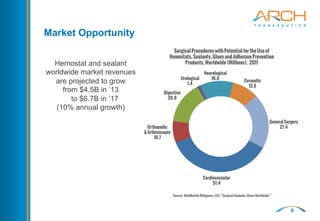
Market Opportunity
Hemostat and sealant
worldwide market revenues
are projected to grow
from $4.5B in ’13
to $6.7B in ’17
(10% annual growth)
	
  
Cardiovascular
51.4
GeneralSurgery
27.4
Cosmetic
12.6
Neurological
16.0
Source: MedMarketDilligence,LLC;“SurgicalSealants,GluesWorldwide.”
SurgicalProcedureswithPotentialfortheUseof
Hemostats,Sealants,GluesandAdhesionPrevention
Products,Worldwide(Millions). 2011
Urological
1.4
Digestive
20.9
Orthopedic
&Arthroscopic
10.7
7
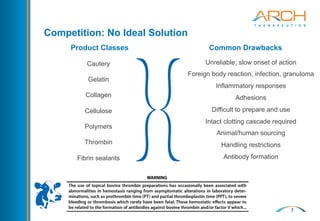
Competition: No Ideal Solution
Cautery
Gelatin
Collagen
Cellulose
Polymers
Thrombin
Fibrin sealants
Product Classes
Unreliable, slow onset of action
Foreign body reaction, infection, granuloma
Inflammatory responses
Adhesions
Difficult to prepare and use
Intact clotting cascade required
Animal/human sourcing
Handling restrictions
Antibody formation	
  
Common Drawbacks
8
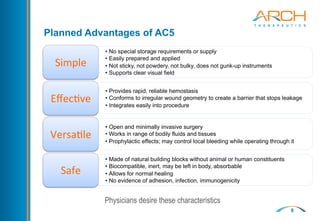
Planned Advantages of AC5
Physicians desire these characteristics
•  No special storage requirements or supply
•  Easily prepared and applied
•  Not sticky, not powdery, not bulky, does not gunk-up instruments
•  Supports clear visual field
Simple	
  
•  Provides rapid, reliable hemostasis
•  Conforms to irregular wound geometry to create a barrier that stops leakage
•  Integrates easily into procedure
Effec,ve	
  
•  Open and minimally invasive surgery
•  Works in range of bodily fluids and tissues
•  Prophylactic effects; may control local bleeding while operating through it
Versa,le	
  
•  Made of natural building blocks without animal or human constituents
•  Biocompatible, inert, may be left in body, absorbable
•  Allows for normal healing
•  No evidence of adhesion, infection, immunogenicity
Safe	
  
9
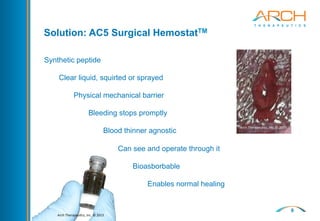
Solution: AC5 Surgical HemostatTM
Synthetic peptide
Clear liquid, squirted or sprayed
Physical mechanical barrier
Bleeding stops promptly
Blood thinner agnostic
Can see and operate through it
Bioasborbable
Enables normal healing
Arch	
  Therapeu,cs,	
  Inc.	
  ©	
  2015	
  
Arch	
  Therapeu,cs,	
  Inc.	
  ©	
  2015	
  
10
Liver
Arch	
  Therapeu,cs,	
  Inc.	
  ©	
  2014	
  
Arch	
  Therapeu,cs,	
  Inc.	
  ©	
  2014	
  
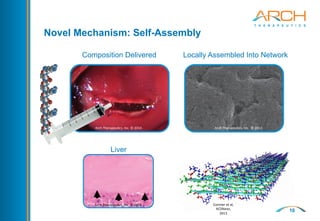
Novel Mechanism: Self-Assembly
Composition Delivered Locally Assembled Into Network
Arch	
  Therapeu,cs,	
  Inc.	
  	
  ©	
  2014	
  
Arch	
  Therapeu,cs,	
  Inc.	
  ©	
  2015	
  
Cormier	
  et	
  al,	
  
ACSNano,	


2013	
  
11
0%	
  
100%	
  
200%	
  
300%	
  
400%	
  
500%	
  
600%	
  
Unmedicated	
  
Control	
  
Unmedicated	


AC5	
  
Heparin	


Control	
  
Heparin	


AC5	
  
Heparin	
  
0%	
  
100%	
  
200%	
  
300%	
  
400%	
  
500%	
  
600%	
  
Unmedicated	
  
Control	
  
Unmedicated	


AC5	
  
Ticagrelor	


Control	
  
Ticagrelor	


AC5	
  
Ticagrelor	
  	
  
0%	
  
100%	
  
200%	
  
300%	
  
400%	
  
500%	
  
600%	
  
Unmedicated	
  
Control	
  
Unmedicated	


AC5	
  
Plavix	


Control	
  
Plavix	


AC5	
  
Plavix	
  
0%	
  
100%	
  
200%	
  
300%	
  
400%	
  
500%	
  
600%	
  
Unmedicated	
  
Control	
  
Unmedicated	


AC5	
  
ASA	


Control	
  
ASA	


AC5	
  
Aspirin	
  (ASA)	
  
0%	
  
100%	
  
200%	
  
300%	
  
400%	
  
500%	
  
600%	
  
Unmedicated	
  
Control	
  
Unmedicated	


AC5	
  
ASA/Plavix	


Control	
  
ASA/Plavix	


AC5	
  
Aspirin	
  +	
  Plavix	
  
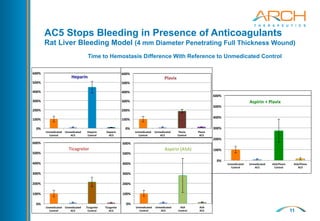
AC5 Stops Bleeding in Presence of Anticoagulants
Rat Liver Bleeding Model (4 mm Diameter Penetrating Full Thickness Wound)
Time to Hemostasis Difference With Reference to Unmedicated Control
12
Bleeding in Anticoagulated Patients Is Challenging
"There are an increasing number of patients on long-term therapy with antiplatelet agents and other
anticoagulants. We are often required to perform procedures and operations on patients with active antiplatelet and
anticoagulation therapy. Hemostasis for bleeding control in these patients is extraordinarily challenging. None
of the hemostatic agents available today have demonstrated enhanced efficacy in the setting of
antiplatelet therapy. The results described in this study are extremely promising because we surgeons need
improved hemostatic control in the setting of antiplatelet therapy, which many of our patients are required to
stay on for its cardioprotective effects.”
Dr. Paresh Shah, Director General Surgery and Vice Chair of Surgery at NYU Langone Medical Center
"There is a great need to continue to develop novel hemostatic agents and sealants that are efficacious in
surgical and trauma patients. In particular, the need is greatest in those patients whose underlying coagulation
cascade or platelet status is abnormal, whether due to concurrent antithrombotic therapy or an underlying
disease. Increasing numbers of patients are on anticoagulant or antiplatelet medications. This can present a challenge to
surgeons and other interventionalists when procedures are needed on these patients. These initial findings on the activity
of AC5 in this setting are very encouraging and may lead to significant benefit in the future.”
Steven Schwaitzberg, MD, Professor of Surgery at Harvard Medical School; advisor to Arch Therapeutics
13
Clinical Regulatory
Expected regulatory path: medical device
CE Mark EU (first focus)
PMA USA
Non-US clinical trial
AC5 Surgical HemostatTM for hemostasis
Likely primary endpoint: time to hemostasis
14
Market Size
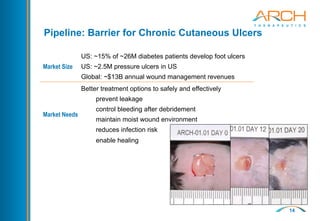
US: ~15% of ~26M diabetes patients develop foot ulcers
US: ~2.5M pressure ulcers in US
Global: ~$13B annual wound management revenues
Market Needs
Better treatment options to safely and effectively
prevent leakage
control bleeding after debridement
maintain moist wound environment
reduces infection risk
enable healing
Pipeline: Barrier for Chronic Cutaneous Ulcers
15
Intellectual Property: Broad Portfolio
Licensed from
Massachusetts
Institute of
Technology
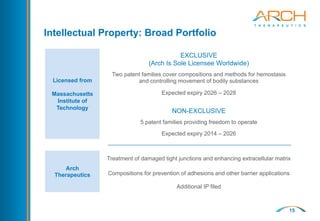
EXCLUSIVE
(Arch Is Sole Licensee Worldwide)
Two patent families cover compositions and methods for hemostasis
and controlling movement of bodily substances
Expected expiry 2026 – 2028
NON-EXCLUSIVE
5 patent families providing freedom to operate
Expected expiry 2014 – 2026
Arch
Therapeutics
Treatment of damaged tight junctions and enhancing extracellular matrix
Compositions for prevention of adhesions and other barrier applications
Additional IP filed
16
Board of Directors
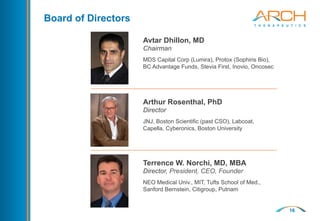
Avtar Dhillon, MD
Chairman
MDS Capital Corp (Lumira), Protox (Sophiris Bio),
BC Advantage Funds, Stevia First, Inovio, Oncosec
Arthur Rosenthal, PhD
Director
JNJ, Boston Scientific (past CSO), Labcoat,
Capella, Cyberonics, Boston University
Terrence W. Norchi, MD, MBA
Director, President, CEO, Founder
NEO Medical Univ., MIT, Tufts School of Med.,
Sanford Bernstein, Citigroup, Putnam
17
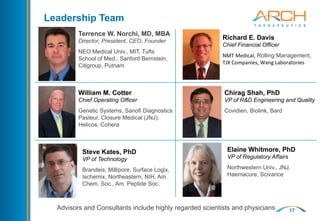
Leadership Team
William M. Cotter
Chief Operating Officer
Genetic Systems, Sanofi Diagnostics
Pasteur, Closure Medical (JNJ),
Helicos, Cohera
Richard E. Davis
Chief Financial Officer
NMT	
  Medical, Rolling Management,	
  
TJX	
  Companies,	
  Wang	
  Laboratories
Chirag Shah, PhD
VP of R&D Engineering and Quality
Covidien, Biolink, Bard
Steve Kates, PhD
VP of Technology
Brandeis, Millipore, Surface Logix,
Ischemix, Northeastern, NIH, Am.
Chem. Soc., Am. Peptide Soc.
Elaine Whitmore, PhD
VP of Regulatory Affairs
Northwestern Univ., JNJ,
Haemacure, Scivance
Terrence W. Norchi, MD, MBA
Director, President, CEO, Founder
NEO Medical Univ., MIT, Tufts
School of Med., Sanford Bernstein,
Citigroup, Putnam
Advisors and Consultants include highly regarded scientists and physicians
18
Milestones Planned for 2015
Data Obtain and disclose safety and performance data
Team Commence collaboration with CÚRAM (Ireland)
Regulatory Confirm CE Mark pathway plan
Clinical Initiate human clinical trial
Finance Secure capital including SFI grant for CÚRAM - Arch collaboration
Sales/Mkt Develop appropriate commercialization strategy / partnership
Pipeline Advance Chronic Cutaneous Ulcer and other Programs
IP Advance intellectual property portfolio
19
Contact Information
235 Walnut Street, Suite 6
Framingham, MA 01702 USA
Investor Relations
Tel: 1.855.340.ARTH (2784)
investors@archtherapeutics.com

Arth april2015

  • 1.
    1 F A ST E R , S A F E R , S I M P L E R S U R G E R Y Terrence Norchi, M.D. President - CEO
  • 2.
    2 Cautionary Statement RegardingForward-Looking Statements This  presenta,on  includes  forward-­‐looking  statements.    We  make  forward-­‐looking  statements,  as  defined  by  the  “safe  harbor”  provisions  of   the  Private  Securi,es  Li,ga,on  Reform  Act  of  1995,  and  in  some  cases,  you  can  iden,fy  these  statements  by  forward-­‐looking  words  such  as   “if,”  “shall,”  “may,”  “might,”  “will  likely  result,”  “should,”  “expect,”  “plan,”  “an,cipate,”  “believe,”  “es,mate,”  “project,”  “intend,”  “goal,”   “objec,ve,”  “predict,”  “poten,al”  or  “con,nue,”  or  the  nega,ve  of  these  terms  and  other  comparable  terminology.    These  include   statements  regarding:  our  ability  to  leverage  our  technology  plaLorm  in  the  development  of  our  lead  and  poten,al  pipeline  product   candidates;  our  ability  to  design  and  conduct  development  ac,vi,es  and  studies  and  clinical  trials  for  our  lead  and  poten,al  pipeline   product  candidates;  the  poten,al  ,ming  and  results  of  any  such  clinical  trials  we  may  conduct;  our  ability  to  obtain  regulatory  approvals  in   order  to  market  any  planned  products;  our  ability  to  achieve  financial  projec,ons;  and  our  ability  to  achieve  milestones.  The  forward-­‐ looking  statements  in  this  presenta,on  are  based  on  management’s  current  expecta,ons,  es,mates,  forecasts  and  projec,ons  about  the   Company  and  its  business,  all  of  which  could  prove  to  wrong.  Because  such  statements  deal  with  future  events,  they  are  subject  to  various   risks  and  uncertain,es  and  actual  results  for  our  current  and  future  fiscal  years  could  differ  materially  from  the  Company's  current   expecta,ons.  Factors  that  could  cause  the  Company's  results  to  differ  materially  from  those  expressed  in  forward-­‐looking  statements   include,  without  limita,on,  the  following  risks:  we  have  es,mated  that  we  will  have  sufficient  cash  to  operate  our  business  through   November  2014,  and  we  may  not  be  able  to  obtain  sufficient  financing  and/or  establish  necessary  rela,onships  with  third  par,es  to   con,nue  to  pursue  our  business  plan;  the  stockholder  dilu,on  that  may  result  from  future  capital  raising  efforts  and  the  exercise  or   conversion,  as  applicable  of  Arch’s  outstanding  op,ons  and  warrants;  an,-­‐dilu,on  protec,on  afforded  investors  in  prior  financing   transac,ons  that  may  restrict  or  prohibit  Arch’s  ability  to  raise  capital  on  terms  favorable  to  the  Company  and  its  current  stockholders;  any   development  ac,vi,es  or  clinical  trials  we  may  conduct  may  not  produce  favorable  results;  regulatory  agencies  may  require  that  we   undertake  addi,onal  or  more  costly  studies  or  clinical  trials  than  we  presently  an,cipate;  we  may  never  gain  regulatory  approval  for  any  of   our  product  candidates;  we  may  not  be  able  to  protect  our  intellectual  property  rights;  the  intellectual  property  of  others  and  any  asserted   claims  of  infringement;  general  business  and  economic  condi,ons  may  limit  our  ability  to  obtain  necessary  capital;  the  consequences  of   compe,,ve  factors  in  the  industry  in  which  we  operate  may  restrict  the  success  of  any  product  candidate  we  are  able  to  commercialize,   and  we  may  not  be  able  to  aract  or  retain  key  personnel.  More  detailed  informa,on  about  us  and  the  risk  factors  that  may  affect  the   realiza,on  of  any  forward-­‐looking  statements  is  set  forth  in  our  filings  with  the  Securi,es  and  Exchange  Commission,  including  our  Annual   Report  on  Form  10-­‐K  filed  on  December  12,  2014  and  subsequent  filings  with  the  SEC  .  Such  documents  may  be  read  free  of  charge  on  the   SEC’s  internet  site  at  hp://www.sec.gov.  You  are  cau,oned  not  to  place  undue  reliance  on  any  forward-­‐looking  statements  we  make  in   this  presenta,on  given  these  risks  and  uncertain,es,  and  all  such  statements  are  qualified  in  their  en,rety  by  this  cau,onary  statement.  All   forward-­‐looking  statements  speak  only  as  of  the  date  hereof,  and  we  undertake  no  obliga,on  to  revise  or  update  any  forward-­‐looking   statement  to  reflect  events  or  circumstances  acer  the     date  hereof,  except  as  otherwise  required  by  law.  
  • 3.
    3 Highlights Investment Themes Potential highmargin (~biopharma) novel product entering a growing $5B market in early 2016 with relatively low (device) capital requirements First Planned Product AC5 Surgical Hemostatic DeviceTM; simple, effective, versatile, safe Unique Technology MIT-licensed self-assembling peptide creates hemostatic barrier on wound Recent News Animal studies efficacy in presence of “blood thinners” faster time to stop bleeding vs branded hemostats of varying mechanisms Safety study -no sign of interaction with human cell receptors or cell kinase enzymes Medical device pathway confirmed in Europe Activities Scale-up, biocompatibility, initiate first human trial Pipeline Potential Applications in surgery, trauma, wound care, military medicine, other OTCQB ARTH
  • 4.
  • 5.
    5 The Burden ofBleeding Bleeding is common in open / laparoscopic surgery 30-50% of procedure time can be spent controlling bleeding Visual field loss and increased error risk Increased length of stay Use of expensive resources (transfusions cost $500-1000/unit) Abnormal healing, adhesions Hematomas and seromas Cautery and biomaterials present safety, efficacy, ease of use challenges Anticoagulant / antiplatelet therapy increases bleeding risk
  • 6.
    6 Market Opportunity Hemostat andsealant worldwide market revenues are projected to grow from $4.5B in ’13 to $6.7B in ’17 (10% annual growth)   Cardiovascular 51.4 GeneralSurgery 27.4 Cosmetic 12.6 Neurological 16.0 Source: MedMarketDilligence,LLC;“SurgicalSealants,GluesWorldwide.” SurgicalProcedureswithPotentialfortheUseof Hemostats,Sealants,GluesandAdhesionPrevention Products,Worldwide(Millions). 2011 Urological 1.4 Digestive 20.9 Orthopedic &Arthroscopic 10.7
  • 7.
    7 Competition: No IdealSolution Cautery Gelatin Collagen Cellulose Polymers Thrombin Fibrin sealants Product Classes Unreliable, slow onset of action Foreign body reaction, infection, granuloma Inflammatory responses Adhesions Difficult to prepare and use Intact clotting cascade required Animal/human sourcing Handling restrictions Antibody formation   Common Drawbacks
  • 8.
    8 Planned Advantages ofAC5 Physicians desire these characteristics •  No special storage requirements or supply •  Easily prepared and applied •  Not sticky, not powdery, not bulky, does not gunk-up instruments •  Supports clear visual field Simple   •  Provides rapid, reliable hemostasis •  Conforms to irregular wound geometry to create a barrier that stops leakage •  Integrates easily into procedure Effec,ve   •  Open and minimally invasive surgery •  Works in range of bodily fluids and tissues •  Prophylactic effects; may control local bleeding while operating through it Versa,le   •  Made of natural building blocks without animal or human constituents •  Biocompatible, inert, may be left in body, absorbable •  Allows for normal healing •  No evidence of adhesion, infection, immunogenicity Safe  
  • 9.
    9 Solution: AC5 SurgicalHemostatTM Synthetic peptide Clear liquid, squirted or sprayed Physical mechanical barrier Bleeding stops promptly Blood thinner agnostic Can see and operate through it Bioasborbable Enables normal healing Arch  Therapeu,cs,  Inc.  ©  2015   Arch  Therapeu,cs,  Inc.  ©  2015  
  • 10.
    10 Liver Arch  Therapeu,cs,  Inc.  ©  2014   Arch  Therapeu,cs,  Inc.  ©  2014   Novel Mechanism: Self-Assembly Composition Delivered Locally Assembled Into Network Arch  Therapeu,cs,  Inc.    ©  2014   Arch  Therapeu,cs,  Inc.  ©  2015   Cormier  et  al,   ACSNano,       2013  
  • 11.
    11 0%   100%   200%   300%   400%   500%   600%   Unmedicated   Control   Unmedicated                                 AC5   Heparin                                                 Control   Heparin                                               AC5   Heparin   0%   100%   200%   300%   400%   500%   600%   Unmedicated   Control   Unmedicated                       AC5   Ticagrelor                               Control   Ticagrelor                                         AC5   Ticagrelor     0%   100%   200%   300%   400%   500%   600%   Unmedicated   Control   Unmedicated                             AC5   Plavix                                               Control   Plavix                                                       AC5   Plavix   0%   100%   200%   300%   400%   500%   600%   Unmedicated   Control   Unmedicated                         AC5   ASA                                                   Control   ASA                                                             AC5   Aspirin  (ASA)   0%   100%   200%   300%   400%   500%   600%   Unmedicated   Control   Unmedicated                       AC5   ASA/Plavix                             Control   ASA/Plavix                                     AC5   Aspirin  +  Plavix   AC5 Stops Bleeding in Presence of Anticoagulants Rat Liver Bleeding Model (4 mm Diameter Penetrating Full Thickness Wound) Time to Hemostasis Difference With Reference to Unmedicated Control
  • 12.
    12 Bleeding in AnticoagulatedPatients Is Challenging "There are an increasing number of patients on long-term therapy with antiplatelet agents and other anticoagulants. We are often required to perform procedures and operations on patients with active antiplatelet and anticoagulation therapy. Hemostasis for bleeding control in these patients is extraordinarily challenging. None of the hemostatic agents available today have demonstrated enhanced efficacy in the setting of antiplatelet therapy. The results described in this study are extremely promising because we surgeons need improved hemostatic control in the setting of antiplatelet therapy, which many of our patients are required to stay on for its cardioprotective effects.” Dr. Paresh Shah, Director General Surgery and Vice Chair of Surgery at NYU Langone Medical Center "There is a great need to continue to develop novel hemostatic agents and sealants that are efficacious in surgical and trauma patients. In particular, the need is greatest in those patients whose underlying coagulation cascade or platelet status is abnormal, whether due to concurrent antithrombotic therapy or an underlying disease. Increasing numbers of patients are on anticoagulant or antiplatelet medications. This can present a challenge to surgeons and other interventionalists when procedures are needed on these patients. These initial findings on the activity of AC5 in this setting are very encouraging and may lead to significant benefit in the future.” Steven Schwaitzberg, MD, Professor of Surgery at Harvard Medical School; advisor to Arch Therapeutics
  • 13.
    13 Clinical Regulatory Expected regulatorypath: medical device CE Mark EU (first focus) PMA USA Non-US clinical trial AC5 Surgical HemostatTM for hemostasis Likely primary endpoint: time to hemostasis
  • 14.
    14 Market Size US: ~15%of ~26M diabetes patients develop foot ulcers US: ~2.5M pressure ulcers in US Global: ~$13B annual wound management revenues Market Needs Better treatment options to safely and effectively prevent leakage control bleeding after debridement maintain moist wound environment reduces infection risk enable healing Pipeline: Barrier for Chronic Cutaneous Ulcers
  • 15.
    15 Intellectual Property: BroadPortfolio Licensed from Massachusetts Institute of Technology EXCLUSIVE (Arch Is Sole Licensee Worldwide) Two patent families cover compositions and methods for hemostasis and controlling movement of bodily substances Expected expiry 2026 – 2028 NON-EXCLUSIVE 5 patent families providing freedom to operate Expected expiry 2014 – 2026 Arch Therapeutics Treatment of damaged tight junctions and enhancing extracellular matrix Compositions for prevention of adhesions and other barrier applications Additional IP filed
  • 16.
    16 Board of Directors AvtarDhillon, MD Chairman MDS Capital Corp (Lumira), Protox (Sophiris Bio), BC Advantage Funds, Stevia First, Inovio, Oncosec Arthur Rosenthal, PhD Director JNJ, Boston Scientific (past CSO), Labcoat, Capella, Cyberonics, Boston University Terrence W. Norchi, MD, MBA Director, President, CEO, Founder NEO Medical Univ., MIT, Tufts School of Med., Sanford Bernstein, Citigroup, Putnam
  • 17.
    17 Leadership Team William M.Cotter Chief Operating Officer Genetic Systems, Sanofi Diagnostics Pasteur, Closure Medical (JNJ), Helicos, Cohera Richard E. Davis Chief Financial Officer NMT  Medical, Rolling Management,   TJX  Companies,  Wang  Laboratories Chirag Shah, PhD VP of R&D Engineering and Quality Covidien, Biolink, Bard Steve Kates, PhD VP of Technology Brandeis, Millipore, Surface Logix, Ischemix, Northeastern, NIH, Am. Chem. Soc., Am. Peptide Soc. Elaine Whitmore, PhD VP of Regulatory Affairs Northwestern Univ., JNJ, Haemacure, Scivance Terrence W. Norchi, MD, MBA Director, President, CEO, Founder NEO Medical Univ., MIT, Tufts School of Med., Sanford Bernstein, Citigroup, Putnam Advisors and Consultants include highly regarded scientists and physicians
  • 18.
    18 Milestones Planned for2015 Data Obtain and disclose safety and performance data Team Commence collaboration with CÚRAM (Ireland) Regulatory Confirm CE Mark pathway plan Clinical Initiate human clinical trial Finance Secure capital including SFI grant for CÚRAM - Arch collaboration Sales/Mkt Develop appropriate commercialization strategy / partnership Pipeline Advance Chronic Cutaneous Ulcer and other Programs IP Advance intellectual property portfolio
  • 19.
    19 Contact Information 235 WalnutStreet, Suite 6 Framingham, MA 01702 USA Investor Relations Tel: 1.855.340.ARTH (2784) investors@archtherapeutics.com