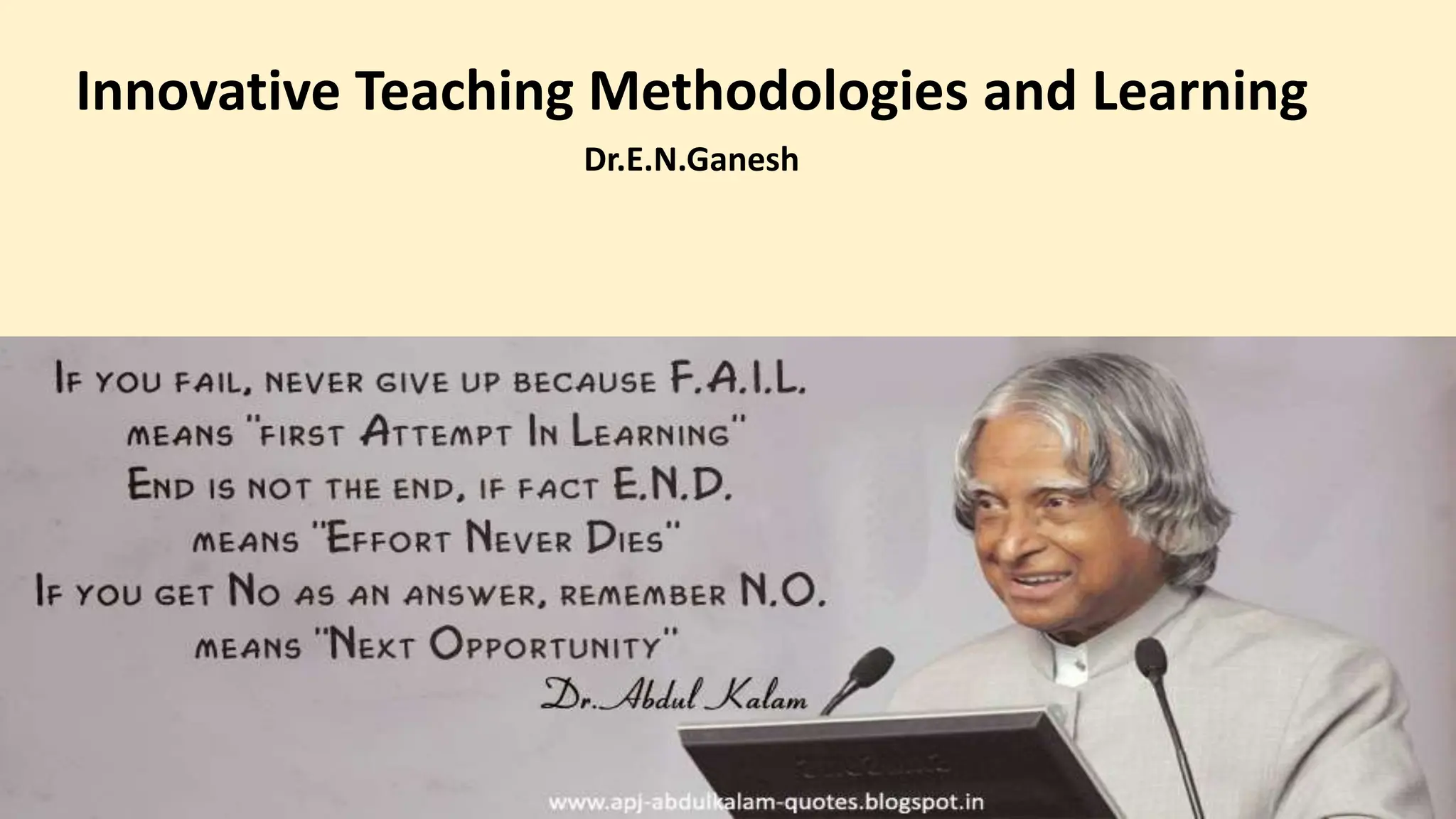
Innovative Teaching Methodologies and Learning
Dr.E.N.Ganesh
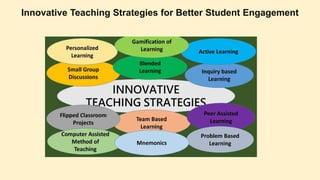
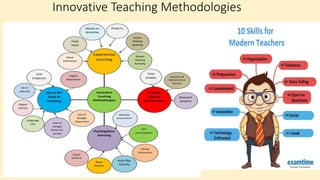
Innovative Teaching Strategies for Better Student Engagement
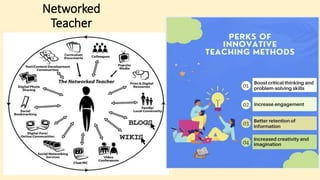
Networked
Teacher
Innovative Teaching Methodologies
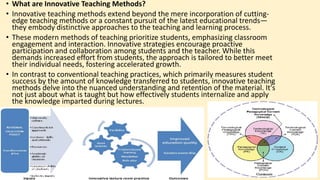
• What are Innovative Teaching Methods?
• Innovative teaching methods extend beyond the mere incorporation of cutting-
edge teaching methods or a constant pursuit of the latest educational trends—
they embody distinctive approaches to the teaching and learning process.
• These modern methods of teaching prioritize students, emphasizing classroom
engagement and interaction. Innovative strategies encourage proactive
participation and collaboration among students and the teacher. While this
demands increased effort from students, the approach is tailored to better meet
their individual needs, fostering accelerated growth.
• In contrast to conventional teaching practices, which primarily measures student
success by the amount of knowledge transferred to students, innovative teaching
methods delve into the nuanced understanding and retention of the material. It's
not just about what is taught but how effectively students internalize and apply
the knowledge imparted during lectures.
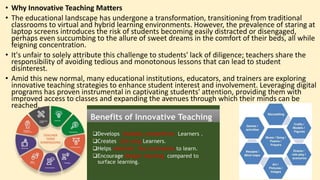
• Why Innovative Teaching Matters
• The educational landscape has undergone a transformation, transitioning from traditional
classrooms to virtual and hybrid learning environments. However, the prevalence of staring at
laptop screens introduces the risk of students becoming easily distracted or disengaged,
perhaps even succumbing to the allure of sweet dreams in the comfort of their beds, all while
feigning concentration.
• It's unfair to solely attribute this challenge to students' lack of diligence; teachers share the
responsibility of avoiding tedious and monotonous lessons that can lead to student
disinterest.
• Amid this new normal, many educational institutions, educators, and trainers are exploring
innovative teaching strategies to enhance student interest and involvement. Leveraging digital
programs has proven instrumental in captivating students' attention, providing them with
improved access to classes and expanding the avenues through which their minds can be
reached.
Types of Innovative teaching Methodologies
• Interactive Lessons
• Virtual Reality Technology
• Using Artificial Intelligence
• Blended Learning
• 3D Printing
• Design Thinking Process
• Project Based Learning
• Inquiry Based Learning
• Jigsaw
• Cloud Computing Techniques
• Flipped Classroon
• Peer Teaching
• Peer Feedback
• Crossover Teaching
• Personalized Learning
Types of Innovative teaching Methodologies
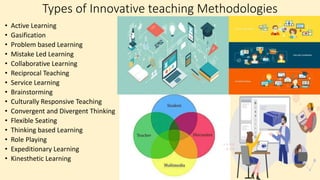
• Active Learning
• Gasification
• Problem based Learning
• Mistake Led Learning
• Collaborative Learning
• Reciprocal Teaching
• Service Learning
• Brainstorming
• Culturally Responsive Teaching
• Convergent and Divergent Thinking
• Flexible Seating
• Thinking based Learning
• Role Playing
• Expeditionary Learning
• Kinesthetic Learning
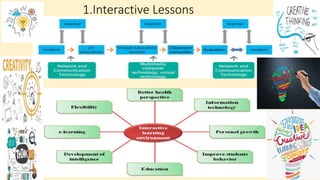
1.Interactive Lessons
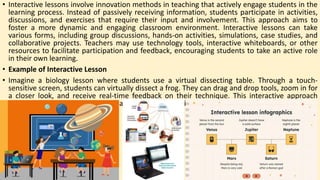
• Interactive lessons involve innovation methods in teaching that actively engage students in the
learning process. Instead of passively receiving information, students participate in activities,
discussions, and exercises that require their input and involvement. This approach aims to
foster a more dynamic and engaging classroom environment. Interactive lessons can take
various forms, including group discussions, hands-on activities, simulations, case studies, and
collaborative projects. Teachers may use technology tools, interactive whiteboards, or other
resources to facilitate participation and feedback, encouraging students to take an active role
in their own learning.
• Example of Interactive Lesson
• Imagine a biology lesson where students use a virtual dissecting table. Through a touch-
sensitive screen, students can virtually dissect a frog. They can drag and drop tools, zoom in for
a closer look, and receive real-time feedback on their technique. This interactive approach
engages students actively in the learning process, making it more memorable and enjoyable.
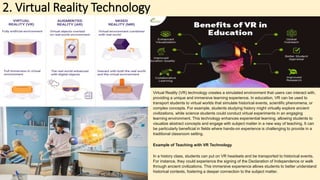
2. Virtual Reality Technology
Virtual Reality (VR) technology creates a simulated environment that users can interact with,
providing a unique and immersive learning experience. In education, VR can be used to
transport students to virtual worlds that simulate historical events, scientific phenomena, or
complex concepts. For example, students studying history might virtually explore ancient
civilizations, while science students could conduct virtual experiments in an engaging
learning environment. This technology enhances experiential learning, allowing students to
visualize abstract concepts and engage with subject matter in a new way of teaching. It can
be particularly beneficial in fields where hands-on experience is challenging to provide in a
traditional classroom setting.
Example of Teaching with VR Technology
In a history class, students can put on VR headsets and be transported to historical events.
For instance, they could experience the signing of the Declaration of Independence or walk
through ancient civilizations. This immersive experience allows students to better understand
historical contexts, fostering a deeper connection to the subject matter.
3.Artificial Intelligence
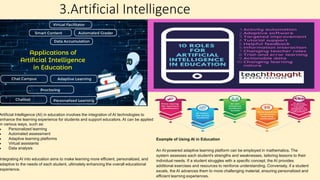
Artificial Intelligence (AI) in education involves the integration of AI technologies to
enhance the learning experience for students and support educators. AI can be applied
in various ways, such as:
 Personalized learning
 Automated assessment
 Adaptive learning platforms
 Virtual assistants
 Data analysis
Integrating AI into education aims to make learning more efficient, personalized, and
adaptive to the needs of each student, ultimately enhancing the overall educational
experience.
Example of Using AI in Education
An AI-powered adaptive learning platform can be employed in mathematics. The
system assesses each student's strengths and weaknesses, tailoring lessons to their
individual needs. If a student struggles with a specific concept, the AI provides
additional exercises and resources to reinforce understanding. Conversely, if a student
excels, the AI advances them to more challenging material, ensuring personalized and
efficient learning experiences.
4.Blended Learning
4.Blended Learning
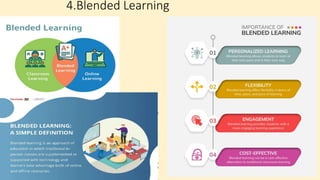
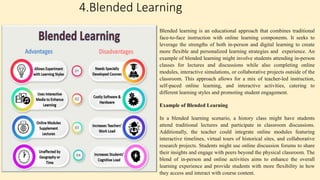
Blended learning is an educational approach that combines traditional
face-to-face instruction with online learning components. It seeks to
leverage the strengths of both in-person and digital learning to create
more flexible and personalized learning strategies and experience. An
example of blended learning might involve students attending in-person
classes for lectures and discussions while also completing online
modules, interactive simulations, or collaborative projects outside of the
classroom. This approach allows for a mix of teacher-led instruction,
self-paced online learning, and interactive activities, catering to
different learning styles and promoting student engagement.
Example of Blended Learning
In a blended learning scenario, a history class might have students
attend traditional lectures and participate in classroom discussions.
Additionally, the teacher could integrate online modules featuring
interactive timelines, virtual tours of historical sites, and collaborative
research projects. Students might use online discussion forums to share
their insights and engage with peers beyond the physical classroom. The
blend of in-person and online activities aims to enhance the overall
learning experience and provide students with more flexibility in how
they access and interact with course content.
5.3D Printing
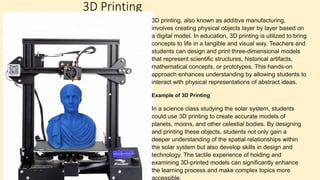
3D Printing
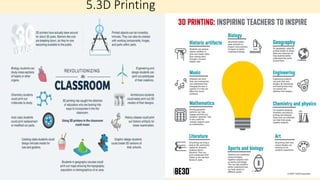
3D printing, also known as additive manufacturing,
involves creating physical objects layer by layer based on
a digital model. In education, 3D printing is utilized to bring
concepts to life in a tangible and visual way. Teachers and
students can design and print three-dimensional models
that represent scientific structures, historical artifacts,
mathematical concepts, or prototypes. This hands-on
approach enhances understanding by allowing students to
interact with physical representations of abstract ideas.
Example of 3D Printing
In a science class studying the solar system, students
could use 3D printing to create accurate models of
planets, moons, and other celestial bodies. By designing
and printing these objects, students not only gain a
deeper understanding of the spatial relationships within
the solar system but also develop skills in design and
technology. The tactile experience of holding and
examining 3D-printed models can significantly enhance
the learning process and make complex topics more
accessible.
6.Design Thinking Process
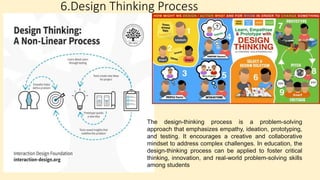
The design-thinking process is a problem-solving
approach that emphasizes empathy, ideation, prototyping,
and testing. It encourages a creative and collaborative
mindset to address complex challenges. In education, the
design-thinking process can be applied to foster critical
thinking, innovation, and real-world problem-solving skills
among students
6.Design Thinking Process
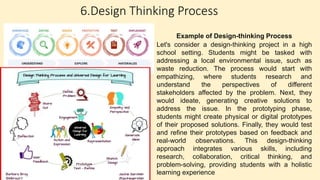
Example of Design-thinking Process
Let's consider a design-thinking project in a high
school setting. Students might be tasked with
addressing a local environmental issue, such as
waste reduction. The process would start with
empathizing, where students research and
understand the perspectives of different
stakeholders affected by the problem. Next, they
would ideate, generating creative solutions to
address the issue. In the prototyping phase,
students might create physical or digital prototypes
of their proposed solutions. Finally, they would test
and refine their prototypes based on feedback and
real-world observations. This design-thinking
approach integrates various skills, including
research, collaboration, critical thinking, and
problem-solving, providing students with a holistic
learning experience
7.Project-based Learning (PBL)
7.Project Based Learning
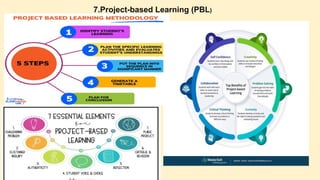
• Project-Based Learning is an instructional methodology that centers
around students completing projects that require them to apply their
knowledge and skills to real-world challenges. PBL emphasizes hands-on,
collaborative learning, fostering critical thinking and problem-solving skills.
• Example of Project-based Learning
• In a biology class, students could engage in a PBL project focused on
environmental conservation. The project might involve researching local
ecosystems, identifying environmental issues, proposing solutions, and
implementing a community awareness campaign. Throughout the project,
students would not only deepen their understanding of biology but also
develop research, communication, and teamwork skills as they work
towards a tangible goal.
8.Inquiry Based Learning
8.Inquiry based Learning
• Inquiry-Based Learning is an approach where
students actively explore and investigate
topics, posing questions and conducting
research to construct their understanding. This
method encourages curiosity, critical thinking,
and a deeper engagement with the subject
matter.
• Example of Inquiry-based Learning
• In a physics class, students could engage in an
inquiry-based project to explore the principles
of motion. They might formulate questions
about the factors affecting the speed of an
object and design experiments to test their
hypotheses. Through hands-on exploration
and data analysis, students would develop a
conceptual understanding of physics
principles while honing their research and
analytical skills.
9.JIGSAW
The Jigsaw technique is a cooperative learning strategy where students work collaboratively to
become experts on specific topics and then share their knowledge with their peers. This promotes
teamwork, communication, and a sense of shared responsibility for active learning method.
Example of Jigsaw
In a history class studying a particular time period, each student could be assigned to become an
"expert" on a different aspect, such as political, economic, social, or cultural elements of that era.
After researching and becoming knowledgeable in their area, students would then form new groups
with members who have expertise in different aspects. In these new groups, students share their
knowledge, creating a comprehensive understanding of the historical period through collaborative
learning
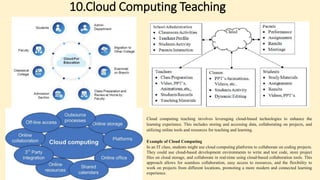
10.Cloud Computing Teaching
Cloud computing teaching involves leveraging cloud-based technologies to enhance the
learning experience. This includes storing and accessing data, collaborating on projects, and
utilizing online tools and resources for teaching and learning.
Example of Cloud Computing
In an IT class, students might use cloud computing platforms to collaborate on coding projects.
They could use cloud-based development environments to write and test code, store project
files on cloud storage, and collaborate in real-time using cloud-based collaboration tools. This
approach allows for seamless collaboration, easy access to resources, and the flexibility to
work on projects from different locations, promoting a more modern and connected learning
experience.
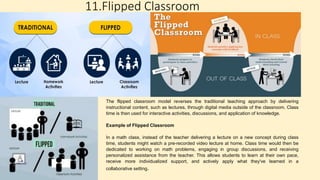
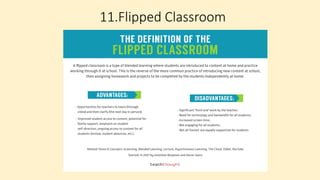
11.Flipped Classroom
The flipped classroom model reverses the traditional teaching approach by delivering
instructional content, such as lectures, through digital media outside of the classroom. Class
time is then used for interactive activities, discussions, and application of knowledge.
Example of Flipped Classroom
In a math class, instead of the teacher delivering a lecture on a new concept during class
time, students might watch a pre-recorded video lecture at home. Class time would then be
dedicated to working on math problems, engaging in group discussions, and receiving
personalized assistance from the teacher. This allows students to learn at their own pace,
receive more individualized support, and actively apply what they've learned in a
collaborative setting.
11.Flipped Classroom
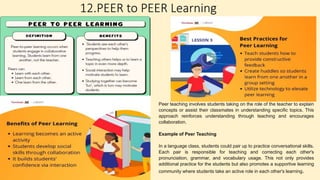
12.PEER to PEER Learning
Peer teaching involves students taking on the role of the teacher to explain
concepts or assist their classmates in understanding specific topics. This
approach reinforces understanding through teaching and encourages
collaboration.
Example of Peer Teaching
In a language class, students could pair up to practice conversational skills.
Each pair is responsible for teaching and correcting each other's
pronunciation, grammar, and vocabulary usage. This not only provides
additional practice for the students but also promotes a supportive learning
community where students take an active role in each other's learning.
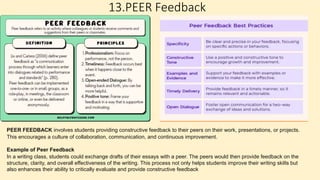
13.PEER Feedback
PEER FEEDBACK involves students providing constructive feedback to their peers on their work, presentations, or projects.
This encourages a culture of collaboration, communication, and continuous improvement.
Example of Peer Feedback
In a writing class, students could exchange drafts of their essays with a peer. The peers would then provide feedback on the
structure, clarity, and overall effectiveness of the writing. This process not only helps students improve their writing skills but
also enhances their ability to critically evaluate and provide constructive feedback
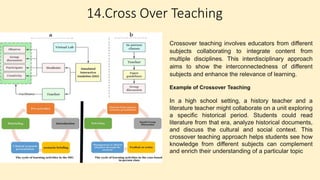
14.Cross Over Teaching
Crossover teaching involves educators from different
subjects collaborating to integrate content from
multiple disciplines. This interdisciplinary approach
aims to show the interconnectedness of different
subjects and enhance the relevance of learning.
Example of Crossover Teaching
In a high school setting, a history teacher and a
literature teacher might collaborate on a unit exploring
a specific historical period. Students could read
literature from that era, analyze historical documents,
and discuss the cultural and social context. This
crossover teaching approach helps students see how
knowledge from different subjects can complement
and enrich their understanding of a particular topic
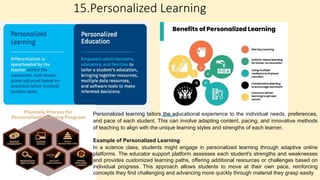
15.Personalized Learning
Personalized learning tailors the educational experience to the individual needs, preferences,
and pace of each student. This can involve adapting content, pacing, and innovative methods
of teaching to align with the unique learning styles and strengths of each learner.
Example of Personalized Learning
In a science class, students might engage in personalized learning through adaptive online
platforms. The educator support platform assesses each student's strengths and weaknesses
and provides customized learning paths, offering additional resources or challenges based on
individual progress. This approach allows students to move at their own pace, reinforcing
concepts they find challenging and advancing more quickly through material they grasp easily
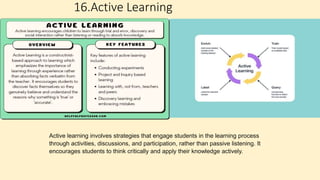
16.Active Learning
Active learning involves strategies that engage students in the learning process
through activities, discussions, and participation, rather than passive listening. It
encourages students to think critically and apply their knowledge actively.
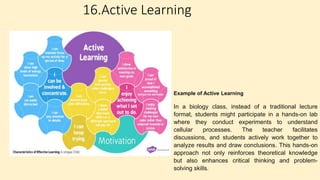
16.Active Learning
Example of Active Learning
In a biology class, instead of a traditional lecture
format, students might participate in a hands-on lab
where they conduct experiments to understand
cellular processes. The teacher facilitates
discussions, and students actively work together to
analyze results and draw conclusions. This hands-on
approach not only reinforces theoretical knowledge
but also enhances critical thinking and problem-
solving skills.
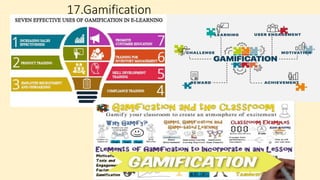
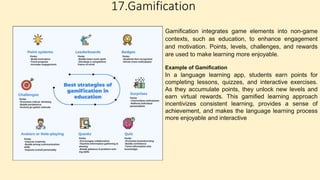
17.Gamification
17.Gamification
Gamification integrates game elements into non-game
contexts, such as education, to enhance engagement
and motivation. Points, levels, challenges, and rewards
are used to make learning more enjoyable.
Example of Gamification
In a language learning app, students earn points for
completing lessons, quizzes, and interactive exercises.
As they accumulate points, they unlock new levels and
earn virtual rewards. This gamified learning approach
incentivizes consistent learning, provides a sense of
achievement, and makes the language learning process
more enjoyable and interactive
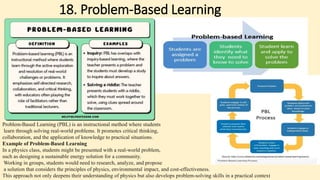
18. Problem-Based Learning
Problem-Based Learning (PBL) is an instructional method where students
learn through solving real-world problems. It promotes critical thinking,
collaboration, and the application of knowledge to practical situations.
Example of Problem-Based Learning
In a physics class, students might be presented with a real-world problem,
such as designing a sustainable energy solution for a community.
Working in groups, students would need to research, analyze, and propose
a solution that considers the principles of physics, environmental impact, and cost-effectiveness.
This approach not only deepens their understanding of physics but also develops problem-solving skills in a practical context
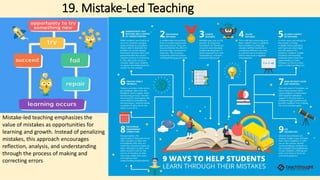
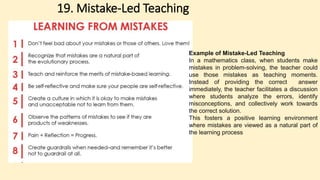
19. Mistake-Led Teaching
Mistake-led teaching emphasizes the
value of mistakes as opportunities for
learning and growth. Instead of penalizing
mistakes, this approach encourages
reflection, analysis, and understanding
through the process of making and
correcting errors
19. Mistake-Led Teaching
Example of Mistake-Led Teaching
In a mathematics class, when students make
mistakes in problem-solving, the teacher could
use those mistakes as teaching moments.
Instead of providing the correct answer
immediately, the teacher facilitates a discussion
where students analyze the errors, identify
misconceptions, and collectively work towards
the correct solution.
This fosters a positive learning environment
where mistakes are viewed as a natural part of
the learning process
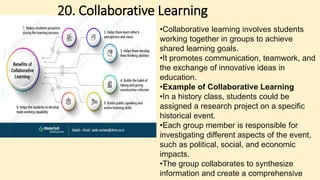
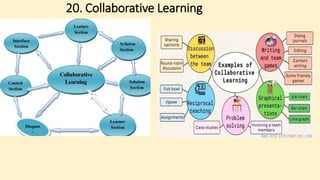
20. Collaborative Learning
•Collaborative learning involves students
working together in groups to achieve
shared learning goals.
•It promotes communication, teamwork, and
the exchange of innovative ideas in
education.
•Example of Collaborative Learning
•In a history class, students could be
assigned a research project on a specific
historical event.
•Each group member is responsible for
investigating different aspects of the event,
such as political, social, and economic
impacts.
•The group collaborates to synthesize
information and create a comprehensive
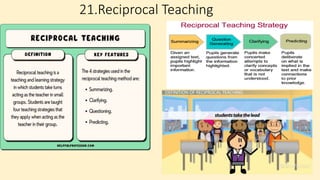
21.Reciprocal Teaching
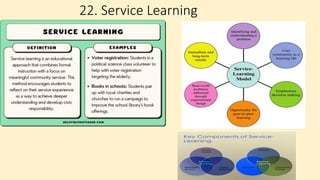
22. Service Learning
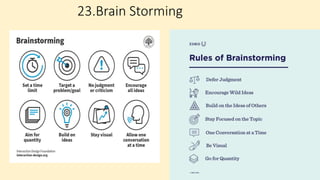
23.Brain Storming
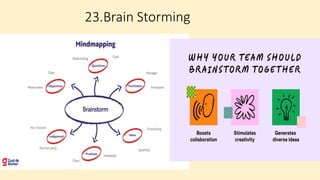
23.Brain Storming
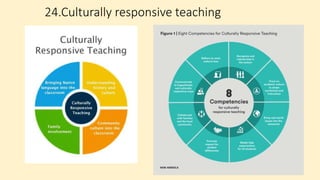
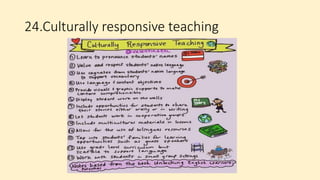
24.Culturally responsive teaching
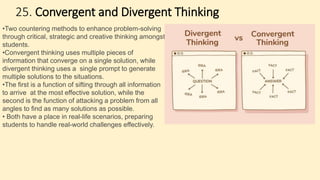
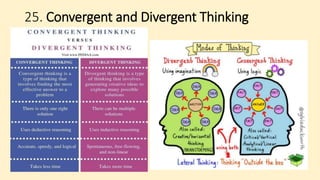
25. Convergent and Divergent Thinking
•Two countering methods to enhance problem-solving
through critical, strategic and creative thinking amongst
students.
•Convergent thinking uses multiple pieces of
information that converge on a single solution, while
divergent thinking uses a single prompt to generate
multiple solutions to the situations.
•The first is a function of sifting through all information
to arrive at the most effective solution, while the
second is the function of attacking a problem from all
angles to find as many solutions as possible.
• Both have a place in real-life scenarios, preparing
students to handle real-world challenges effectively.
25. Convergent and Divergent Thinking
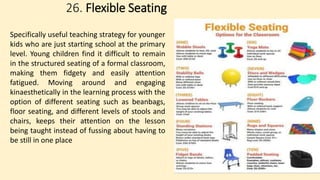
26. Flexible Seating
Specifically useful teaching strategy for younger
kids who are just starting school at the primary
level. Young children find it difficult to remain
in the structured seating of a formal classroom,
making them fidgety and easily attention
fatigued. Moving around and engaging
kinaesthetically in the learning process with the
option of different seating such as beanbags,
floor seating, and different levels of stools and
chairs, keeps their attention on the lesson
being taught instead of fussing about having to
be still in one place
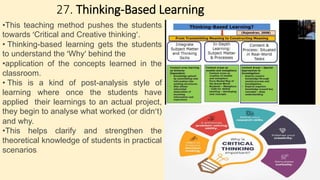
27. Thinking-Based Learning
•This teaching method pushes the students
towards ‘Critical and Creative thinking’.
• Thinking-based learning gets the students
to understand the ‘Why’ behind the
•application of the concepts learned in the
classroom.
• This is a kind of post-analysis style of
learning where once the students have
applied their learnings to an actual project,
they begin to analyse what worked (or didn’t)
and why.
•This helps clarify and strengthen the
theoretical knowledge of students in practical
scenarios.
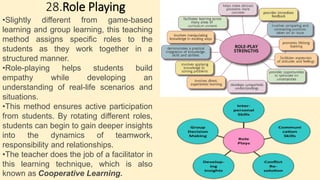
28.Role Playing
•Slightly different from game-based
learning and group learning, this teaching
method assigns specific roles to the
students as they work together in a
structured manner.
•Role-playing helps students build
empathy while developing an
understanding of real-life scenarios and
situations.
•This method ensures active participation
from students. By rotating different roles,
students can begin to gain deeper insights
into the dynamics of teamwork,
responsibility and relationships.
•The teacher does the job of a facilitator in
this learning technique, which is also
known as Cooperative Learning.
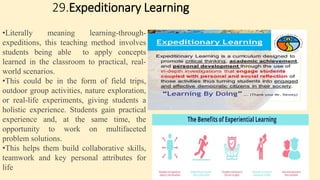
29.Expeditionary Learning
•Literally meaning learning-through-
expeditions, this teaching method involves
students being able to apply concepts
learned in the classroom to practical, real-
world scenarios.
•This could be in the form of field trips,
outdoor group activities, nature exploration,
or real-life experiments, giving students a
holistic experience. Students gain practical
experience and, at the same time, the
opportunity to work on multifaceted
problem solutions.
•This helps them build collaborative skills,
teamwork and key personal attributes for
life
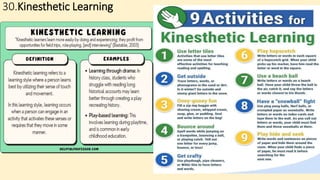
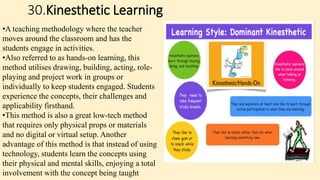
30.Kinesthetic Learning
•A teaching methodology where the teacher
moves around the classroom and has the
students engage in activities.
•Also referred to as hands-on learning, this
method utilises drawing, building, acting, role-
playing and project work in groups or
individually to keep students engaged. Students
experience the concepts, their challenges and
applicability firsthand.
•This method is also a great low-tech method
that requires only physical props or materials
and no digital or virtual setup. Another
advantage of this method is that instead of using
technology, students learn the concepts using
their physical and mental skills, enjoying a total
involvement with the concept being taught
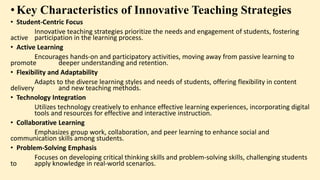
•Key Characteristics of Innovative Teaching Strategies
• Student-Centric Focus
Innovative teaching strategies prioritize the needs and engagement of students, fostering
active participation in the learning process.
• Active Learning
Encourages hands-on and participatory activities, moving away from passive learning to
promote deeper understanding and retention.
• Flexibility and Adaptability
Adapts to the diverse learning styles and needs of students, offering flexibility in content
delivery and new teaching methods.
• Technology Integration
Utilizes technology creatively to enhance effective learning experiences, incorporating digital
tools and resources for effective and interactive instruction.
• Collaborative Learning
Emphasizes group work, collaboration, and peer learning to enhance social and
communication skills among students.
• Problem-Solving Emphasis
Focuses on developing critical thinking skills and problem-solving skills, challenging students
to apply knowledge in real-world scenarios.
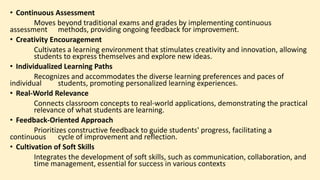
• Continuous Assessment
Moves beyond traditional exams and grades by implementing continuous
assessment methods, providing ongoing feedback for improvement.
• Creativity Encouragement
Cultivates a learning environment that stimulates creativity and innovation, allowing
students to express themselves and explore new ideas.
• Individualized Learning Paths
Recognizes and accommodates the diverse learning preferences and paces of
individual students, promoting personalized learning experiences.
• Real-World Relevance
Connects classroom concepts to real-world applications, demonstrating the practical
relevance of what students are learning.
• Feedback-Oriented Approach
Prioritizes constructive feedback to guide students' progress, facilitating a
continuous cycle of improvement and reflection.
• Cultivation of Soft Skills
Integrates the development of soft skills, such as communication, collaboration, and
time management, essential for success in various contexts
• Benefits of Innovative Teaching Methods
Explore the positive benefits for teachers of these seven innovations on students and why they merit consideration.
• Encourage Research:
Innovative approaches to education motivate students to delve into new things, utilizing various tools to broaden their
horizons and foster a spirit of exploration.
• Enhance Problem-Solving and Critical Thinking:
Creative and effective teaching methods empower students to learn at their own pace, challenging them to brainstorm
novel solutions rather than relying on pre-existing answers in textbooks.
• Facilitate Incremental Learning:
New teaching approaches involve breaking down information into smaller, more digestible parts, making it easier for
students to grasp fundamentals while avoiding overwhelming them with a deluge of knowledge.
• Cultivate Soft Skills:
Integrating complex tools into classwork enables students to acquire advanced skills. Engaging in individual or group
projects teaches time management, task prioritization, effective communication, collaboration, and other vital soft skills.
• Assess Understanding Beyond Grades:
Innovation method of teaching enables educators to monitor classes actively, gaining deeper insights into students'
challenges and learning capacities beyond what traditional grades and exams may reveal.
• Promote Self-Evaluation:
• Innovation teaching methods provided by teachers empower student learning to assess their own learning. Understanding
what they have mastered and identifying areas for improvement enhances their motivation to learn specific topics.
• Create Vibrant Classrooms:
• Innovation of teaching methods in education inject excitement into classrooms, preventing monotony. This dynamic approach
encourages students to actively participate, speak up, and foster increased interaction.
Thank you

Innovative Teaching Methodologies - 30 types of teaching methodologies

  • 1.
    Innovative Teaching Methodologiesand Learning Dr.E.N.Ganesh
  • 2.
    Innovative Teaching Strategiesfor Better Student Engagement
  • 3.
  • 4.
  • 5.
    • What areInnovative Teaching Methods? • Innovative teaching methods extend beyond the mere incorporation of cutting- edge teaching methods or a constant pursuit of the latest educational trends— they embody distinctive approaches to the teaching and learning process. • These modern methods of teaching prioritize students, emphasizing classroom engagement and interaction. Innovative strategies encourage proactive participation and collaboration among students and the teacher. While this demands increased effort from students, the approach is tailored to better meet their individual needs, fostering accelerated growth. • In contrast to conventional teaching practices, which primarily measures student success by the amount of knowledge transferred to students, innovative teaching methods delve into the nuanced understanding and retention of the material. It's not just about what is taught but how effectively students internalize and apply the knowledge imparted during lectures.
  • 6.
    • Why InnovativeTeaching Matters • The educational landscape has undergone a transformation, transitioning from traditional classrooms to virtual and hybrid learning environments. However, the prevalence of staring at laptop screens introduces the risk of students becoming easily distracted or disengaged, perhaps even succumbing to the allure of sweet dreams in the comfort of their beds, all while feigning concentration. • It's unfair to solely attribute this challenge to students' lack of diligence; teachers share the responsibility of avoiding tedious and monotonous lessons that can lead to student disinterest. • Amid this new normal, many educational institutions, educators, and trainers are exploring innovative teaching strategies to enhance student interest and involvement. Leveraging digital programs has proven instrumental in captivating students' attention, providing them with improved access to classes and expanding the avenues through which their minds can be reached.
  • 7.
    Types of Innovativeteaching Methodologies • Interactive Lessons • Virtual Reality Technology • Using Artificial Intelligence • Blended Learning • 3D Printing • Design Thinking Process • Project Based Learning • Inquiry Based Learning • Jigsaw • Cloud Computing Techniques • Flipped Classroon • Peer Teaching • Peer Feedback • Crossover Teaching • Personalized Learning
  • 8.
    Types of Innovativeteaching Methodologies • Active Learning • Gasification • Problem based Learning • Mistake Led Learning • Collaborative Learning • Reciprocal Teaching • Service Learning • Brainstorming • Culturally Responsive Teaching • Convergent and Divergent Thinking • Flexible Seating • Thinking based Learning • Role Playing • Expeditionary Learning • Kinesthetic Learning
  • 9.
  • 10.
    • Interactive lessonsinvolve innovation methods in teaching that actively engage students in the learning process. Instead of passively receiving information, students participate in activities, discussions, and exercises that require their input and involvement. This approach aims to foster a more dynamic and engaging classroom environment. Interactive lessons can take various forms, including group discussions, hands-on activities, simulations, case studies, and collaborative projects. Teachers may use technology tools, interactive whiteboards, or other resources to facilitate participation and feedback, encouraging students to take an active role in their own learning. • Example of Interactive Lesson • Imagine a biology lesson where students use a virtual dissecting table. Through a touch- sensitive screen, students can virtually dissect a frog. They can drag and drop tools, zoom in for a closer look, and receive real-time feedback on their technique. This interactive approach engages students actively in the learning process, making it more memorable and enjoyable.
  • 11.
    2. Virtual RealityTechnology Virtual Reality (VR) technology creates a simulated environment that users can interact with, providing a unique and immersive learning experience. In education, VR can be used to transport students to virtual worlds that simulate historical events, scientific phenomena, or complex concepts. For example, students studying history might virtually explore ancient civilizations, while science students could conduct virtual experiments in an engaging learning environment. This technology enhances experiential learning, allowing students to visualize abstract concepts and engage with subject matter in a new way of teaching. It can be particularly beneficial in fields where hands-on experience is challenging to provide in a traditional classroom setting. Example of Teaching with VR Technology In a history class, students can put on VR headsets and be transported to historical events. For instance, they could experience the signing of the Declaration of Independence or walk through ancient civilizations. This immersive experience allows students to better understand historical contexts, fostering a deeper connection to the subject matter.
  • 12.
    3.Artificial Intelligence Artificial Intelligence(AI) in education involves the integration of AI technologies to enhance the learning experience for students and support educators. AI can be applied in various ways, such as:  Personalized learning  Automated assessment  Adaptive learning platforms  Virtual assistants  Data analysis Integrating AI into education aims to make learning more efficient, personalized, and adaptive to the needs of each student, ultimately enhancing the overall educational experience. Example of Using AI in Education An AI-powered adaptive learning platform can be employed in mathematics. The system assesses each student's strengths and weaknesses, tailoring lessons to their individual needs. If a student struggles with a specific concept, the AI provides additional exercises and resources to reinforce understanding. Conversely, if a student excels, the AI advances them to more challenging material, ensuring personalized and efficient learning experiences.
  • 13.
  • 14.
    4.Blended Learning Blended learningis an educational approach that combines traditional face-to-face instruction with online learning components. It seeks to leverage the strengths of both in-person and digital learning to create more flexible and personalized learning strategies and experience. An example of blended learning might involve students attending in-person classes for lectures and discussions while also completing online modules, interactive simulations, or collaborative projects outside of the classroom. This approach allows for a mix of teacher-led instruction, self-paced online learning, and interactive activities, catering to different learning styles and promoting student engagement. Example of Blended Learning In a blended learning scenario, a history class might have students attend traditional lectures and participate in classroom discussions. Additionally, the teacher could integrate online modules featuring interactive timelines, virtual tours of historical sites, and collaborative research projects. Students might use online discussion forums to share their insights and engage with peers beyond the physical classroom. The blend of in-person and online activities aims to enhance the overall learning experience and provide students with more flexibility in how they access and interact with course content.
  • 15.
  • 16.
    3D Printing 3D printing,also known as additive manufacturing, involves creating physical objects layer by layer based on a digital model. In education, 3D printing is utilized to bring concepts to life in a tangible and visual way. Teachers and students can design and print three-dimensional models that represent scientific structures, historical artifacts, mathematical concepts, or prototypes. This hands-on approach enhances understanding by allowing students to interact with physical representations of abstract ideas. Example of 3D Printing In a science class studying the solar system, students could use 3D printing to create accurate models of planets, moons, and other celestial bodies. By designing and printing these objects, students not only gain a deeper understanding of the spatial relationships within the solar system but also develop skills in design and technology. The tactile experience of holding and examining 3D-printed models can significantly enhance the learning process and make complex topics more accessible.
  • 17.
    6.Design Thinking Process Thedesign-thinking process is a problem-solving approach that emphasizes empathy, ideation, prototyping, and testing. It encourages a creative and collaborative mindset to address complex challenges. In education, the design-thinking process can be applied to foster critical thinking, innovation, and real-world problem-solving skills among students
  • 18.
    6.Design Thinking Process Exampleof Design-thinking Process Let's consider a design-thinking project in a high school setting. Students might be tasked with addressing a local environmental issue, such as waste reduction. The process would start with empathizing, where students research and understand the perspectives of different stakeholders affected by the problem. Next, they would ideate, generating creative solutions to address the issue. In the prototyping phase, students might create physical or digital prototypes of their proposed solutions. Finally, they would test and refine their prototypes based on feedback and real-world observations. This design-thinking approach integrates various skills, including research, collaboration, critical thinking, and problem-solving, providing students with a holistic learning experience
  • 19.
  • 20.
    7.Project Based Learning •Project-Based Learning is an instructional methodology that centers around students completing projects that require them to apply their knowledge and skills to real-world challenges. PBL emphasizes hands-on, collaborative learning, fostering critical thinking and problem-solving skills. • Example of Project-based Learning • In a biology class, students could engage in a PBL project focused on environmental conservation. The project might involve researching local ecosystems, identifying environmental issues, proposing solutions, and implementing a community awareness campaign. Throughout the project, students would not only deepen their understanding of biology but also develop research, communication, and teamwork skills as they work towards a tangible goal.
  • 21.
  • 22.
    8.Inquiry based Learning •Inquiry-Based Learning is an approach where students actively explore and investigate topics, posing questions and conducting research to construct their understanding. This method encourages curiosity, critical thinking, and a deeper engagement with the subject matter. • Example of Inquiry-based Learning • In a physics class, students could engage in an inquiry-based project to explore the principles of motion. They might formulate questions about the factors affecting the speed of an object and design experiments to test their hypotheses. Through hands-on exploration and data analysis, students would develop a conceptual understanding of physics principles while honing their research and analytical skills.
  • 23.
    9.JIGSAW The Jigsaw techniqueis a cooperative learning strategy where students work collaboratively to become experts on specific topics and then share their knowledge with their peers. This promotes teamwork, communication, and a sense of shared responsibility for active learning method. Example of Jigsaw In a history class studying a particular time period, each student could be assigned to become an "expert" on a different aspect, such as political, economic, social, or cultural elements of that era. After researching and becoming knowledgeable in their area, students would then form new groups with members who have expertise in different aspects. In these new groups, students share their knowledge, creating a comprehensive understanding of the historical period through collaborative learning
  • 24.
    10.Cloud Computing Teaching Cloudcomputing teaching involves leveraging cloud-based technologies to enhance the learning experience. This includes storing and accessing data, collaborating on projects, and utilizing online tools and resources for teaching and learning. Example of Cloud Computing In an IT class, students might use cloud computing platforms to collaborate on coding projects. They could use cloud-based development environments to write and test code, store project files on cloud storage, and collaborate in real-time using cloud-based collaboration tools. This approach allows for seamless collaboration, easy access to resources, and the flexibility to work on projects from different locations, promoting a more modern and connected learning experience.
  • 25.
    11.Flipped Classroom The flippedclassroom model reverses the traditional teaching approach by delivering instructional content, such as lectures, through digital media outside of the classroom. Class time is then used for interactive activities, discussions, and application of knowledge. Example of Flipped Classroom In a math class, instead of the teacher delivering a lecture on a new concept during class time, students might watch a pre-recorded video lecture at home. Class time would then be dedicated to working on math problems, engaging in group discussions, and receiving personalized assistance from the teacher. This allows students to learn at their own pace, receive more individualized support, and actively apply what they've learned in a collaborative setting.
  • 26.
  • 27.
    12.PEER to PEERLearning Peer teaching involves students taking on the role of the teacher to explain concepts or assist their classmates in understanding specific topics. This approach reinforces understanding through teaching and encourages collaboration. Example of Peer Teaching In a language class, students could pair up to practice conversational skills. Each pair is responsible for teaching and correcting each other's pronunciation, grammar, and vocabulary usage. This not only provides additional practice for the students but also promotes a supportive learning community where students take an active role in each other's learning.
  • 28.
    13.PEER Feedback PEER FEEDBACKinvolves students providing constructive feedback to their peers on their work, presentations, or projects. This encourages a culture of collaboration, communication, and continuous improvement. Example of Peer Feedback In a writing class, students could exchange drafts of their essays with a peer. The peers would then provide feedback on the structure, clarity, and overall effectiveness of the writing. This process not only helps students improve their writing skills but also enhances their ability to critically evaluate and provide constructive feedback
  • 29.
    14.Cross Over Teaching Crossoverteaching involves educators from different subjects collaborating to integrate content from multiple disciplines. This interdisciplinary approach aims to show the interconnectedness of different subjects and enhance the relevance of learning. Example of Crossover Teaching In a high school setting, a history teacher and a literature teacher might collaborate on a unit exploring a specific historical period. Students could read literature from that era, analyze historical documents, and discuss the cultural and social context. This crossover teaching approach helps students see how knowledge from different subjects can complement and enrich their understanding of a particular topic
  • 30.
    15.Personalized Learning Personalized learningtailors the educational experience to the individual needs, preferences, and pace of each student. This can involve adapting content, pacing, and innovative methods of teaching to align with the unique learning styles and strengths of each learner. Example of Personalized Learning In a science class, students might engage in personalized learning through adaptive online platforms. The educator support platform assesses each student's strengths and weaknesses and provides customized learning paths, offering additional resources or challenges based on individual progress. This approach allows students to move at their own pace, reinforcing concepts they find challenging and advancing more quickly through material they grasp easily
  • 31.
    16.Active Learning Active learninginvolves strategies that engage students in the learning process through activities, discussions, and participation, rather than passive listening. It encourages students to think critically and apply their knowledge actively.
  • 32.
    16.Active Learning Example ofActive Learning In a biology class, instead of a traditional lecture format, students might participate in a hands-on lab where they conduct experiments to understand cellular processes. The teacher facilitates discussions, and students actively work together to analyze results and draw conclusions. This hands-on approach not only reinforces theoretical knowledge but also enhances critical thinking and problem- solving skills.
  • 33.
  • 34.
    17.Gamification Gamification integrates gameelements into non-game contexts, such as education, to enhance engagement and motivation. Points, levels, challenges, and rewards are used to make learning more enjoyable. Example of Gamification In a language learning app, students earn points for completing lessons, quizzes, and interactive exercises. As they accumulate points, they unlock new levels and earn virtual rewards. This gamified learning approach incentivizes consistent learning, provides a sense of achievement, and makes the language learning process more enjoyable and interactive
  • 35.
    18. Problem-Based Learning Problem-BasedLearning (PBL) is an instructional method where students learn through solving real-world problems. It promotes critical thinking, collaboration, and the application of knowledge to practical situations. Example of Problem-Based Learning In a physics class, students might be presented with a real-world problem, such as designing a sustainable energy solution for a community. Working in groups, students would need to research, analyze, and propose a solution that considers the principles of physics, environmental impact, and cost-effectiveness. This approach not only deepens their understanding of physics but also develops problem-solving skills in a practical context
  • 36.
    19. Mistake-Led Teaching Mistake-ledteaching emphasizes the value of mistakes as opportunities for learning and growth. Instead of penalizing mistakes, this approach encourages reflection, analysis, and understanding through the process of making and correcting errors
  • 37.
    19. Mistake-Led Teaching Exampleof Mistake-Led Teaching In a mathematics class, when students make mistakes in problem-solving, the teacher could use those mistakes as teaching moments. Instead of providing the correct answer immediately, the teacher facilitates a discussion where students analyze the errors, identify misconceptions, and collectively work towards the correct solution. This fosters a positive learning environment where mistakes are viewed as a natural part of the learning process
  • 38.
  • 39.
    20. Collaborative Learning •Collaborativelearning involves students working together in groups to achieve shared learning goals. •It promotes communication, teamwork, and the exchange of innovative ideas in education. •Example of Collaborative Learning •In a history class, students could be assigned a research project on a specific historical event. •Each group member is responsible for investigating different aspects of the event, such as political, social, and economic impacts. •The group collaborates to synthesize information and create a comprehensive
  • 40.
  • 41.
  • 42.
  • 43.
  • 44.
  • 45.
  • 46.
    25. Convergent andDivergent Thinking •Two countering methods to enhance problem-solving through critical, strategic and creative thinking amongst students. •Convergent thinking uses multiple pieces of information that converge on a single solution, while divergent thinking uses a single prompt to generate multiple solutions to the situations. •The first is a function of sifting through all information to arrive at the most effective solution, while the second is the function of attacking a problem from all angles to find as many solutions as possible. • Both have a place in real-life scenarios, preparing students to handle real-world challenges effectively.
  • 47.
    25. Convergent andDivergent Thinking
  • 48.
    26. Flexible Seating Specificallyuseful teaching strategy for younger kids who are just starting school at the primary level. Young children find it difficult to remain in the structured seating of a formal classroom, making them fidgety and easily attention fatigued. Moving around and engaging kinaesthetically in the learning process with the option of different seating such as beanbags, floor seating, and different levels of stools and chairs, keeps their attention on the lesson being taught instead of fussing about having to be still in one place
  • 49.
    27. Thinking-Based Learning •Thisteaching method pushes the students towards ‘Critical and Creative thinking’. • Thinking-based learning gets the students to understand the ‘Why’ behind the •application of the concepts learned in the classroom. • This is a kind of post-analysis style of learning where once the students have applied their learnings to an actual project, they begin to analyse what worked (or didn’t) and why. •This helps clarify and strengthen the theoretical knowledge of students in practical scenarios.
  • 50.
    28.Role Playing •Slightly differentfrom game-based learning and group learning, this teaching method assigns specific roles to the students as they work together in a structured manner. •Role-playing helps students build empathy while developing an understanding of real-life scenarios and situations. •This method ensures active participation from students. By rotating different roles, students can begin to gain deeper insights into the dynamics of teamwork, responsibility and relationships. •The teacher does the job of a facilitator in this learning technique, which is also known as Cooperative Learning.
  • 51.
    29.Expeditionary Learning •Literally meaninglearning-through- expeditions, this teaching method involves students being able to apply concepts learned in the classroom to practical, real- world scenarios. •This could be in the form of field trips, outdoor group activities, nature exploration, or real-life experiments, giving students a holistic experience. Students gain practical experience and, at the same time, the opportunity to work on multifaceted problem solutions. •This helps them build collaborative skills, teamwork and key personal attributes for life
  • 52.
  • 53.
    30.Kinesthetic Learning •A teachingmethodology where the teacher moves around the classroom and has the students engage in activities. •Also referred to as hands-on learning, this method utilises drawing, building, acting, role- playing and project work in groups or individually to keep students engaged. Students experience the concepts, their challenges and applicability firsthand. •This method is also a great low-tech method that requires only physical props or materials and no digital or virtual setup. Another advantage of this method is that instead of using technology, students learn the concepts using their physical and mental skills, enjoying a total involvement with the concept being taught
  • 54.
    •Key Characteristics ofInnovative Teaching Strategies • Student-Centric Focus Innovative teaching strategies prioritize the needs and engagement of students, fostering active participation in the learning process. • Active Learning Encourages hands-on and participatory activities, moving away from passive learning to promote deeper understanding and retention. • Flexibility and Adaptability Adapts to the diverse learning styles and needs of students, offering flexibility in content delivery and new teaching methods. • Technology Integration Utilizes technology creatively to enhance effective learning experiences, incorporating digital tools and resources for effective and interactive instruction. • Collaborative Learning Emphasizes group work, collaboration, and peer learning to enhance social and communication skills among students. • Problem-Solving Emphasis Focuses on developing critical thinking skills and problem-solving skills, challenging students to apply knowledge in real-world scenarios.
  • 55.
    • Continuous Assessment Movesbeyond traditional exams and grades by implementing continuous assessment methods, providing ongoing feedback for improvement. • Creativity Encouragement Cultivates a learning environment that stimulates creativity and innovation, allowing students to express themselves and explore new ideas. • Individualized Learning Paths Recognizes and accommodates the diverse learning preferences and paces of individual students, promoting personalized learning experiences. • Real-World Relevance Connects classroom concepts to real-world applications, demonstrating the practical relevance of what students are learning. • Feedback-Oriented Approach Prioritizes constructive feedback to guide students' progress, facilitating a continuous cycle of improvement and reflection. • Cultivation of Soft Skills Integrates the development of soft skills, such as communication, collaboration, and time management, essential for success in various contexts
  • 56.
    • Benefits ofInnovative Teaching Methods Explore the positive benefits for teachers of these seven innovations on students and why they merit consideration. • Encourage Research: Innovative approaches to education motivate students to delve into new things, utilizing various tools to broaden their horizons and foster a spirit of exploration. • Enhance Problem-Solving and Critical Thinking: Creative and effective teaching methods empower students to learn at their own pace, challenging them to brainstorm novel solutions rather than relying on pre-existing answers in textbooks. • Facilitate Incremental Learning: New teaching approaches involve breaking down information into smaller, more digestible parts, making it easier for students to grasp fundamentals while avoiding overwhelming them with a deluge of knowledge. • Cultivate Soft Skills: Integrating complex tools into classwork enables students to acquire advanced skills. Engaging in individual or group projects teaches time management, task prioritization, effective communication, collaboration, and other vital soft skills. • Assess Understanding Beyond Grades: Innovation method of teaching enables educators to monitor classes actively, gaining deeper insights into students' challenges and learning capacities beyond what traditional grades and exams may reveal. • Promote Self-Evaluation: • Innovation teaching methods provided by teachers empower student learning to assess their own learning. Understanding what they have mastered and identifying areas for improvement enhances their motivation to learn specific topics. • Create Vibrant Classrooms: • Innovation of teaching methods in education inject excitement into classrooms, preventing monotony. This dynamic approach encourages students to actively participate, speak up, and foster increased interaction.
  • 57.