1 
The Rules of Product Development 
MassChallenge / Skolkovo Super League 
Sep 10, 2014 
Rishi Dean | @rishidean
2 
Most startups fail
Source: 
h"p://bit.ly/ 
startupfailurerates 
3 
6 in 1000" 
funded
Source: 
h"p://bit.ly/ 
startupfailurerates 
4 
60% of those fail," 
30% flounder
Source: 
h"p://bit.ly/ 
startupfailurerates 
5 
<10% positive returns," 
<1% get big
Source: 
h"p://bit.ly/ 
startupfailurerates 
6 
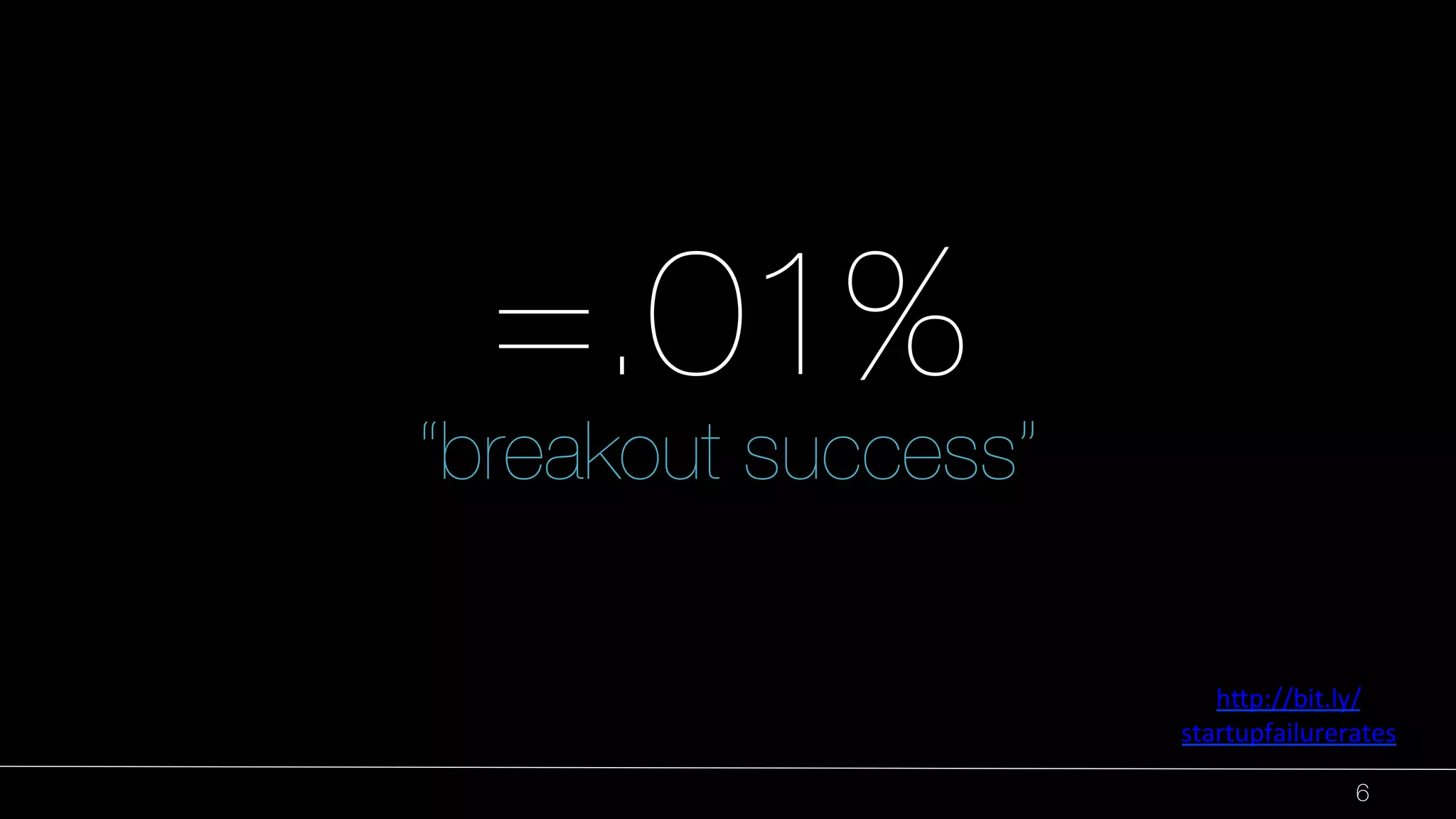
=.01%" 
“breakout success”
7 
1000x better?" 
= 10%
8 
WHY?
9 
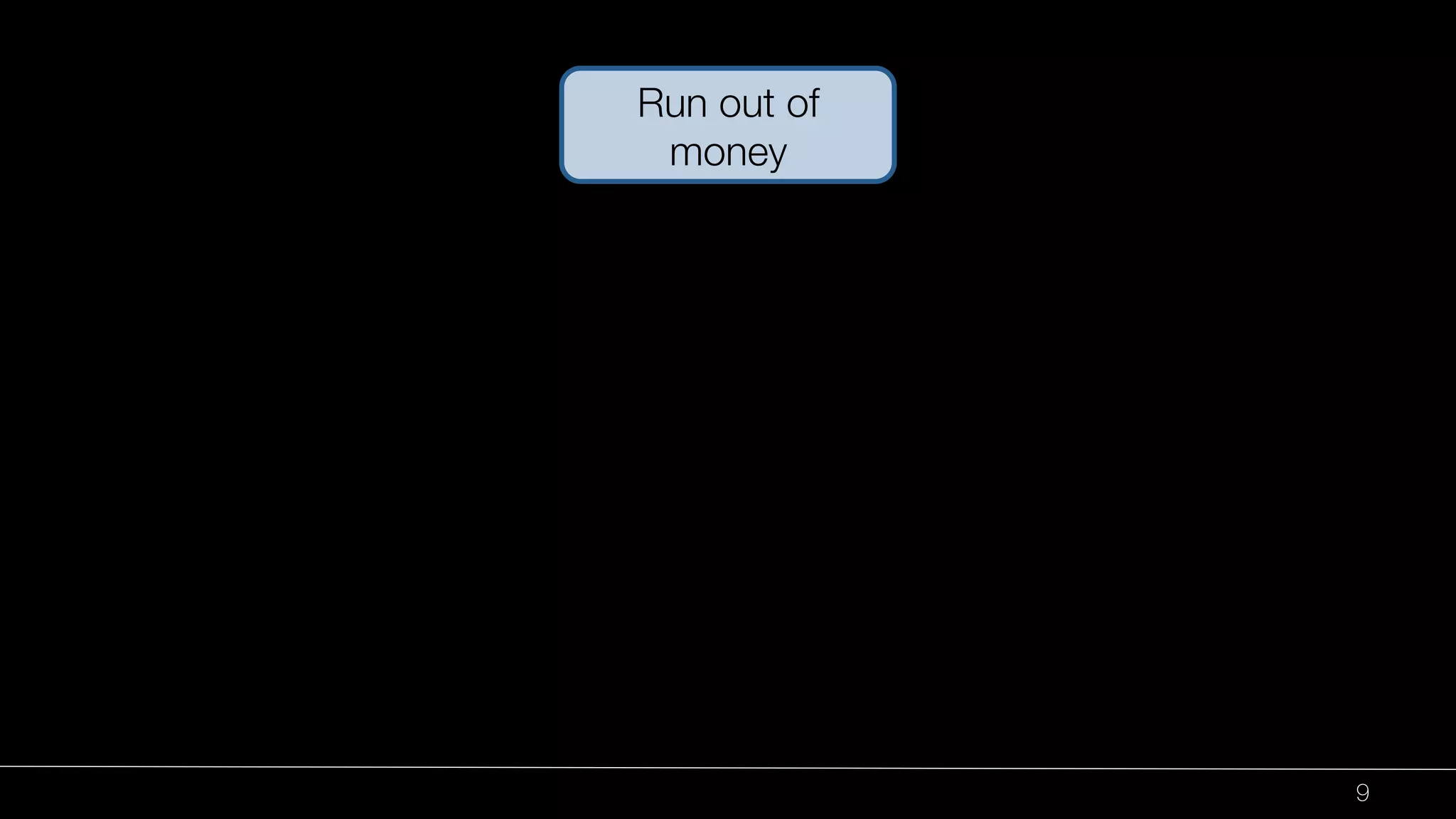
Run out of 
money
10 
Run out of 
money 
Not enough 
paying customers
11 
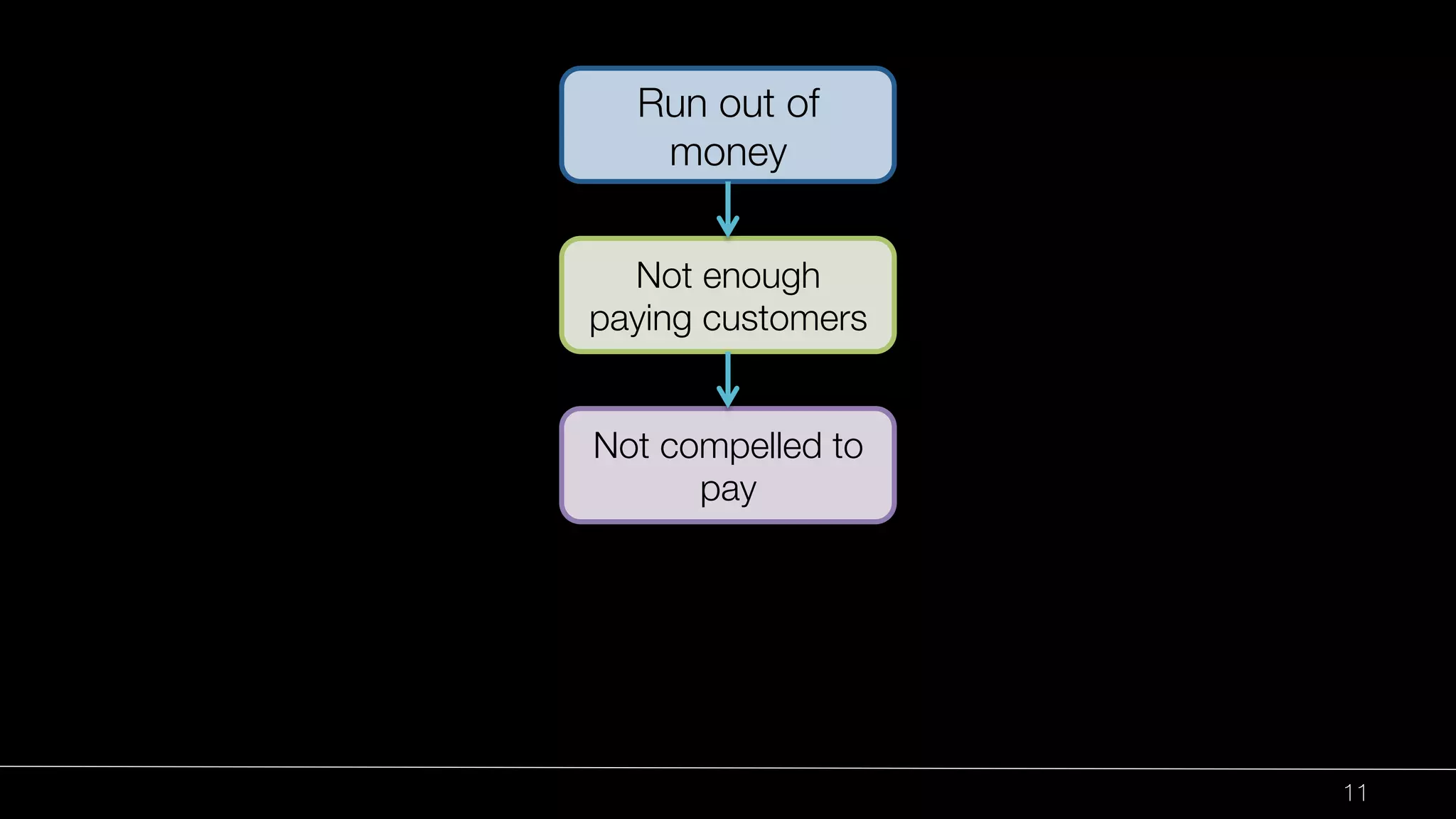
Run out of 
money 
Not enough 
paying customers 
Not compelled to 
pay
12 
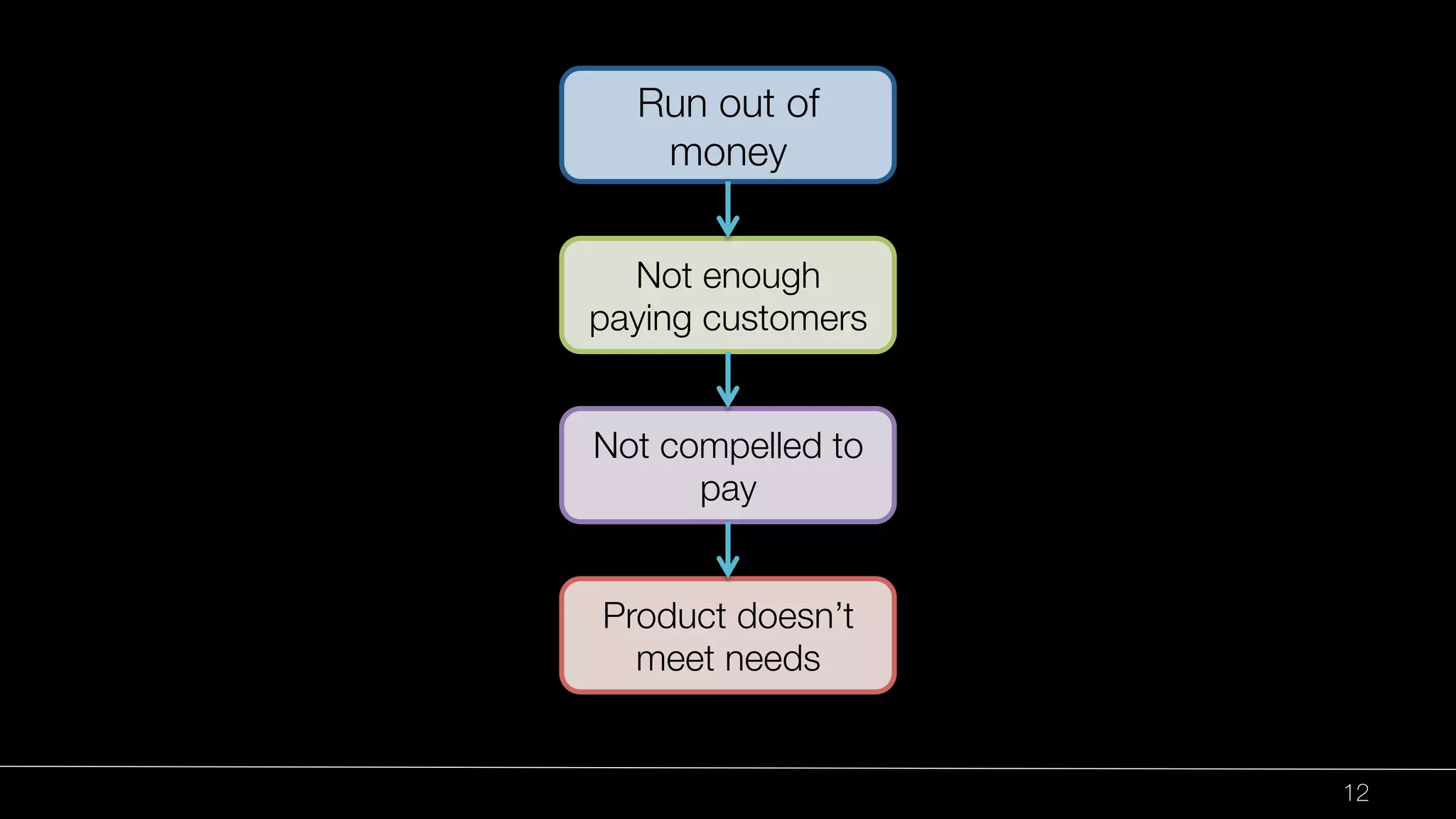
Run out of 
money 
Not enough 
paying customers 
Not compelled to 
pay 
Product doesn’t 
meet needs
13 
Product / Market Fit
The old product development model is outdated 
14 
§ Start with a firm vision & plan (MRD) 
§ Compile detailed specs (PRD) 
§ Develop via a “waterfall” model 
§ Converge to a massive “launch” 
§ Let the sales roll in 
Concept / 
Biz Plan 
Specs (MRD/PRD) 
Develop & QA 
Launch!
The old product development model is outdated 
15 
§ Start with a firm vision & plan (MRD) 
§ Compile detailed specs (PRD) 
§ Develop via a “waterfall” model 
§ Converge to a massive “launch” 
§ Let the sales roll in 
Concept / 
Biz Plan 
Specs (MRD/PRD) 
Develop & QA 
Launch!
16 
The biggest false 
assumption is that you 
know what you’re doing
17
18
19
20 
Premature scaling kills promising companies 
§ Actions don’t correspond to stage 
§ Discovery, validation, efficiency, scale, sustain 
§ De-synchronized customer, product, team, financials, 
business model 
§ Executing without a regular feedback loop 
§ Not adapting business model to a changing market,
21 
The pace of change is accelerating 
§ Globalization increases competition 
§ Lower technical barriers to entry 
§ Increased capital efficiency 
§ Cost of acquisition is near zero
22 
Accept it, you’re not Steve
23 
…but even he fails sometimes
“the greatest perfection is imperfection” -Lucilio Vanini 
24
25 
Product / Market Fit
26 
Understanding Product / Market Fit 
§ Product satisfies a compelling market need that is 
worth solving 
§ Market is large enough to build a business 
§ Sales are repeatable and scalable 
§ >= 40% of customers say they would be “very 
disappointed” without your product
Asking whether you’ve achieved product / market fit is 
27 
like asking how you know when you’re in love
28 
Actions before and after PMF are very different 
Before 
After 
§ Build the sales, marketing, and 
delivery machine 
§ Build the company 
§ Get big, fast 
¡ Customer discovery & validation 
¡ Measure, iterate, pivot 
¡ Burn as little as possible to 
survive
29 
But how do you 
get there?
30 
Start with your 
customer
31 
YOU are the customer 
You are close to the customer 
You are not the customer
32 
A “tail” of two customer types
33 
The Product / 
Market Matrix
34 
Characterizing your situation 
Market Hypothesis 
Product Hypothesis 
Untested 
Validated 
Validated 
Untested
35 
Characterizing your situation 
Market Hypothesis 
“Technology in search of a 
problem” 
(MIT) 
“Build it and they will 
come” 
(Apple / 37Signals) 
“Many right answers” 
(McKinsey) 
“Good hypothesis, no 
conclusions” 
(Lean) 
Product Hypothesis 
Untested 
Validated 
Validated 
Untested
36 
Characterizing your situation 
Market Hypothesis 
“Technology in search of a 
problem” 
(MIT) 
“Build it and they will 
come” 
(Apple / 37Signals) 
“Many right answers” 
(McKinsey) 
“Good hypothesis, no 
conclusions” 
(Lean) 
Product Hypothesis 
Untested 
Validated 
Validated 
Untested 
§ Figure out where you really are 
§ Different resources and inputs 
will determine your starting point 
§ Where you are should dictate 
milestones, revenue projections, 
funding requirements, etc. 
§ Assume you know less than you 
do, until revenue proves 
otherwise
37 
1) Build it and they will come 
Market Hypothesis 
“Technology in search of a 
problem” 
(MIT) 
Organic startup 
(founder / market fit) 
“Many right answers” 
(McKinsey) 
“Good hypothesis, no 
conclusions” 
(Lean) 
Product Hypothesis 
Untested 
Validated 
Validated 
Untested 
§ You are the customer 
§ Firm vision + iterative releases 
(e.g. 37Signals) 
§ Works in incremental or 
evolutionary innovation (slicker, 
quicker, better, cheaper) 
§ Technology-driven problems 
(e.g. cure cancer) where 
“invention risk” is the key
38 
2) Technology in search of a problem 
Market Hypothesis 
Rigorous market 
exploration 
“Build it and they will 
come” 
(Apple / 37Signals) 
“Many right answers” 
(McKinsey) 
“Good hypothesis, no 
conclusions” 
(Lean) 
Product Hypothesis 
Untested 
Validated 
Validated 
Untested 
§ Identify key markets with 
compelling dynamics 
§ Pick a few applications / 
markets and identify a 
hypothesis to solve for 
§ Look for markets primed for 
speed of innovation diffusion 
§ Understand the flow of $ and 
inject into an existing pattern
39 
3) Many right answers 
Market Hypothesis 
“Technology in search of a 
problem” 
(MIT) 
“Build it and they will 
come” 
(Apple / 37Signals) 
Prototype and expand 
“Good hypothesis, no 
conclusions” 
(Lean) 
Product Hypothesis 
Untested 
Validated 
Validated 
Untested 
§ You are close to the 
customer 
§ Lead users are easiest 
path: transform an ad-hoc 
solution to something 
mainstream 
§ “Imaginary assistant” notion 
§ Personae development 
§ Design thinking + agile 
development
40 
4) The truly lean startup 
Market Hypothesis 
“Technology in search of a 
problem” 
(MIT) 
“Build it and they will 
come” 
(Apple / 37Signals) 
“Many right answers” 
Hypothesis, test, learn(McKinsey) 
Product Hypothesis 
Untested 
Validated 
Validated 
Untested 
We 
Believe 
We’ve 
Tested 
We’ve 
Learned 
§ The faster you can move around 
this loop the faster your 
learnings accrue
41 
Some things are 
common
42 
Early stage startups live in uncertainty 
Market Hypothesis 
“Technology in search 
of a problem” 
“Build it and they will 
come” 
“Good hypothesis, no “Many right answers” 
conclusions” 
Product Hypothesis 
Untested 
Validated 
Validated 
Untested 
§ Disruptive companies with an 
unproven market have inherent 
uncertainty 
§ Starting point differs depending 
on available resources – goal is 
the same 
§ Not mutually exclusive models – 
overlapping principles: 
§ Prototyping 
§ Customer development 
§ MVP
43 
Mix qualitative and quantitative approaches to 
increase speed 
Market Hypothesis 
“Technology in search of a 
problem” 
(MIT) 
“Build it and they will 
come” 
(Apple / 37Signals) 
“Many right answers” 
(McKinsey) 
“Good hypothesis, no 
conclusions” 
(Lean) 
Product Hypothesis 
Untested 
Validated 
Validated 
Untested 
§ Data-driven feedback 
matters more to help find a 
market 
§ With a strong sense of the 
market, experience, 
“intuition” and the synthesis 
of qualitative feedback drive 
the process 
INTUITION 
/ 
QUALITATIVE 
DATA 
/ 
QUANTITATIVE
44 
Use the matrix 
as a tool
45 
Achieving PMF is a journey 
Market Hypothesis 
“Technology in search of a 
problem” 
(MIT) 
“Build it and they will 
come” 
(Apple / 37Signals) 
“Many right answers” 
(McKinsey) 
“Good hypothesis, no 
conclusions” 
(Lean) 
Product Hypothesis 
Untested 
Validated 
Validated 
Untested 
§ You will move between blocks 
as business / market evolve, or 
diversity across product lines 
§ You can remove uncertainty 
over time, but uncover others as 
you dig deeper
46 
Summing it up
47 
Product / market fit is the only priority in early 
stage startups 
§ Have a hypothesis but embrace your ignorance 
§ Pick the right starting point / approach to achieve PMF 
§ Set the business goals accordingly 
§ Travers the matrix FAST 
§ Prototype, listen, measure, learn, iterate 
§ THEN scale up the business
48 
Appendices
49 
The “Chasm” " 
Understanding dimensions of innovation
50 
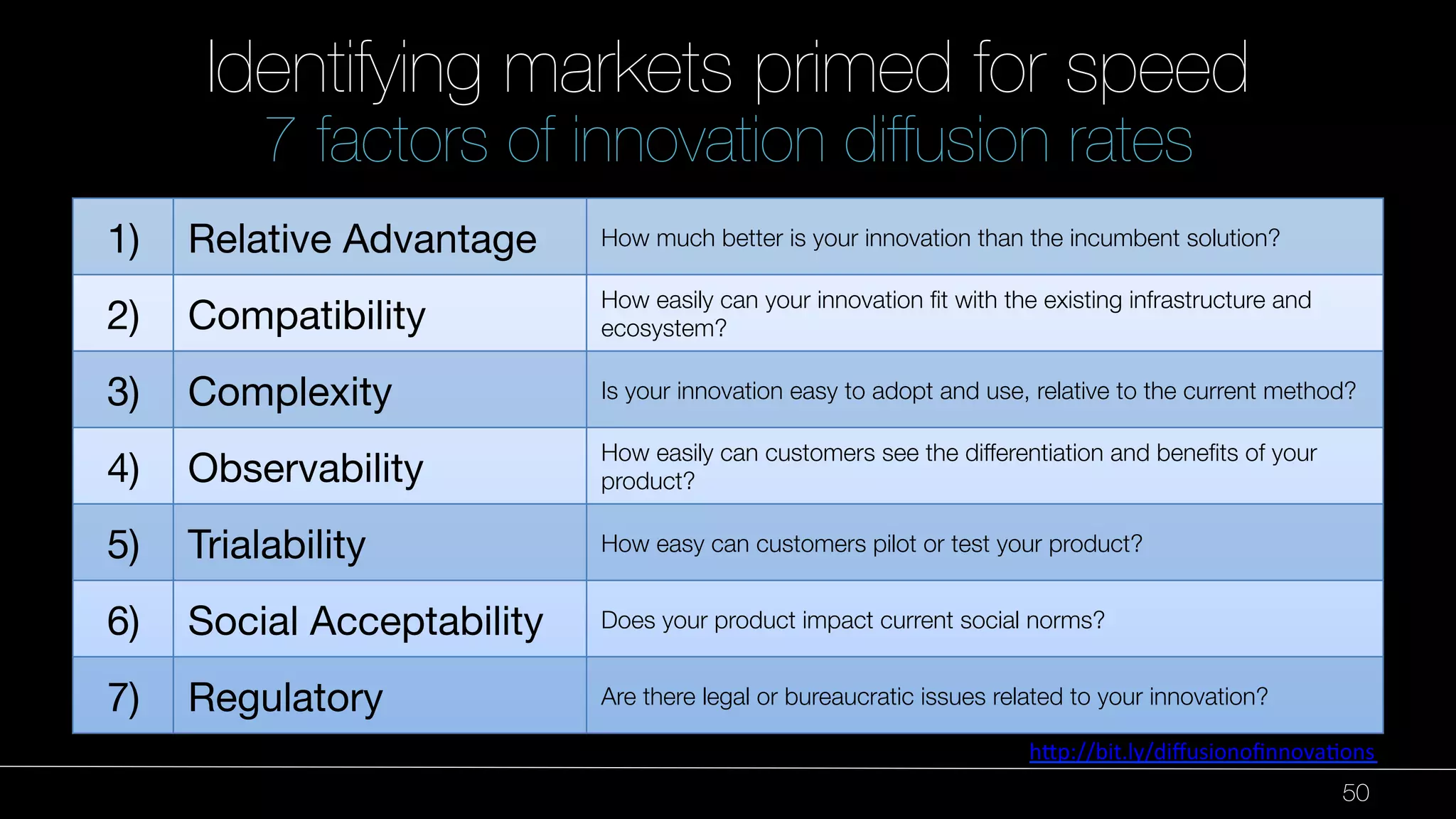
Identifying markets primed for speed" 
7 factors of innovation diffusion rates 
1) 
Relative Advantage 
How much better is your innovation than the incumbent solution? 
2) 
Compatibility 
How easily can your innovation fit with the existing infrastructure and 
ecosystem? 
3) 
Complexity 
Is your innovation easy to adopt and use, relative to the current method? 
4) 
Observability 
How easily can customers see the differentiation and benefits of your 
product? 
5) 
Trialability 
How easy can customers pilot or test your product? 
6) 
Social Acceptability 
Does your product impact current social norms? 
7) 
Regulatory 
Are there legal or bureaucratic issues related to your innovation? 
Source: 
h"p://bit.ly/diffusionofinnova9ons

The New Rules of Early-Stage Product Development (MassChallenge / Skolkovo)

  • 1.
    1 The Rulesof Product Development MassChallenge / Skolkovo Super League Sep 10, 2014 Rishi Dean | @rishidean
  • 2.
  • 3.
  • 4.
    Source: h"p://bit.ly/ startupfailurerates 4 60% of those fail," 30% flounder
  • 5.
    Source: h"p://bit.ly/ startupfailurerates 5 <10% positive returns," <1% get big
  • 6.
    Source: h"p://bit.ly/ startupfailurerates 6 =.01%" “breakout success”
  • 7.
  • 8.
  • 9.
    9 Run outof money
  • 10.
    10 Run outof money Not enough paying customers
  • 11.
    11 Run outof money Not enough paying customers Not compelled to pay
  • 12.
    12 Run outof money Not enough paying customers Not compelled to pay Product doesn’t meet needs
  • 13.
    13 Product /Market Fit
  • 14.
    The old productdevelopment model is outdated 14 § Start with a firm vision & plan (MRD) § Compile detailed specs (PRD) § Develop via a “waterfall” model § Converge to a massive “launch” § Let the sales roll in Concept / Biz Plan Specs (MRD/PRD) Develop & QA Launch!
  • 15.
    The old productdevelopment model is outdated 15 § Start with a firm vision & plan (MRD) § Compile detailed specs (PRD) § Develop via a “waterfall” model § Converge to a massive “launch” § Let the sales roll in Concept / Biz Plan Specs (MRD/PRD) Develop & QA Launch!
  • 16.
    16 The biggestfalse assumption is that you know what you’re doing
  • 17.
  • 18.
  • 19.
  • 20.
    20 Premature scalingkills promising companies § Actions don’t correspond to stage § Discovery, validation, efficiency, scale, sustain § De-synchronized customer, product, team, financials, business model § Executing without a regular feedback loop § Not adapting business model to a changing market,
  • 21.
    21 The paceof change is accelerating § Globalization increases competition § Lower technical barriers to entry § Increased capital efficiency § Cost of acquisition is near zero
  • 22.
    22 Accept it,you’re not Steve
  • 23.
    23 …but evenhe fails sometimes
  • 24.
    “the greatest perfectionis imperfection” -Lucilio Vanini 24
  • 25.
    25 Product /Market Fit
  • 26.
    26 Understanding Product/ Market Fit § Product satisfies a compelling market need that is worth solving § Market is large enough to build a business § Sales are repeatable and scalable § >= 40% of customers say they would be “very disappointed” without your product
  • 27.
    Asking whether you’veachieved product / market fit is 27 like asking how you know when you’re in love
  • 28.
    28 Actions beforeand after PMF are very different Before After § Build the sales, marketing, and delivery machine § Build the company § Get big, fast ¡ Customer discovery & validation ¡ Measure, iterate, pivot ¡ Burn as little as possible to survive
  • 29.
    29 But howdo you get there?
  • 30.
    30 Start withyour customer
  • 31.
    31 YOU arethe customer You are close to the customer You are not the customer
  • 32.
    32 A “tail”of two customer types
  • 33.
    33 The Product/ Market Matrix
  • 34.
    34 Characterizing yoursituation Market Hypothesis Product Hypothesis Untested Validated Validated Untested
  • 35.
    35 Characterizing yoursituation Market Hypothesis “Technology in search of a problem” (MIT) “Build it and they will come” (Apple / 37Signals) “Many right answers” (McKinsey) “Good hypothesis, no conclusions” (Lean) Product Hypothesis Untested Validated Validated Untested
  • 36.
    36 Characterizing yoursituation Market Hypothesis “Technology in search of a problem” (MIT) “Build it and they will come” (Apple / 37Signals) “Many right answers” (McKinsey) “Good hypothesis, no conclusions” (Lean) Product Hypothesis Untested Validated Validated Untested § Figure out where you really are § Different resources and inputs will determine your starting point § Where you are should dictate milestones, revenue projections, funding requirements, etc. § Assume you know less than you do, until revenue proves otherwise
  • 37.
    37 1) Buildit and they will come Market Hypothesis “Technology in search of a problem” (MIT) Organic startup (founder / market fit) “Many right answers” (McKinsey) “Good hypothesis, no conclusions” (Lean) Product Hypothesis Untested Validated Validated Untested § You are the customer § Firm vision + iterative releases (e.g. 37Signals) § Works in incremental or evolutionary innovation (slicker, quicker, better, cheaper) § Technology-driven problems (e.g. cure cancer) where “invention risk” is the key
  • 38.
    38 2) Technologyin search of a problem Market Hypothesis Rigorous market exploration “Build it and they will come” (Apple / 37Signals) “Many right answers” (McKinsey) “Good hypothesis, no conclusions” (Lean) Product Hypothesis Untested Validated Validated Untested § Identify key markets with compelling dynamics § Pick a few applications / markets and identify a hypothesis to solve for § Look for markets primed for speed of innovation diffusion § Understand the flow of $ and inject into an existing pattern
  • 39.
    39 3) Manyright answers Market Hypothesis “Technology in search of a problem” (MIT) “Build it and they will come” (Apple / 37Signals) Prototype and expand “Good hypothesis, no conclusions” (Lean) Product Hypothesis Untested Validated Validated Untested § You are close to the customer § Lead users are easiest path: transform an ad-hoc solution to something mainstream § “Imaginary assistant” notion § Personae development § Design thinking + agile development
  • 40.
    40 4) Thetruly lean startup Market Hypothesis “Technology in search of a problem” (MIT) “Build it and they will come” (Apple / 37Signals) “Many right answers” Hypothesis, test, learn(McKinsey) Product Hypothesis Untested Validated Validated Untested We Believe We’ve Tested We’ve Learned § The faster you can move around this loop the faster your learnings accrue
  • 41.
    41 Some thingsare common
  • 42.
    42 Early stagestartups live in uncertainty Market Hypothesis “Technology in search of a problem” “Build it and they will come” “Good hypothesis, no “Many right answers” conclusions” Product Hypothesis Untested Validated Validated Untested § Disruptive companies with an unproven market have inherent uncertainty § Starting point differs depending on available resources – goal is the same § Not mutually exclusive models – overlapping principles: § Prototyping § Customer development § MVP
  • 43.
    43 Mix qualitativeand quantitative approaches to increase speed Market Hypothesis “Technology in search of a problem” (MIT) “Build it and they will come” (Apple / 37Signals) “Many right answers” (McKinsey) “Good hypothesis, no conclusions” (Lean) Product Hypothesis Untested Validated Validated Untested § Data-driven feedback matters more to help find a market § With a strong sense of the market, experience, “intuition” and the synthesis of qualitative feedback drive the process INTUITION / QUALITATIVE DATA / QUANTITATIVE
  • 44.
    44 Use thematrix as a tool
  • 45.
    45 Achieving PMFis a journey Market Hypothesis “Technology in search of a problem” (MIT) “Build it and they will come” (Apple / 37Signals) “Many right answers” (McKinsey) “Good hypothesis, no conclusions” (Lean) Product Hypothesis Untested Validated Validated Untested § You will move between blocks as business / market evolve, or diversity across product lines § You can remove uncertainty over time, but uncover others as you dig deeper
  • 46.
  • 47.
    47 Product /market fit is the only priority in early stage startups § Have a hypothesis but embrace your ignorance § Pick the right starting point / approach to achieve PMF § Set the business goals accordingly § Travers the matrix FAST § Prototype, listen, measure, learn, iterate § THEN scale up the business
  • 48.
  • 49.
    49 The “Chasm”" Understanding dimensions of innovation
  • 50.
    50 Identifying marketsprimed for speed" 7 factors of innovation diffusion rates 1) Relative Advantage How much better is your innovation than the incumbent solution? 2) Compatibility How easily can your innovation fit with the existing infrastructure and ecosystem? 3) Complexity Is your innovation easy to adopt and use, relative to the current method? 4) Observability How easily can customers see the differentiation and benefits of your product? 5) Trialability How easy can customers pilot or test your product? 6) Social Acceptability Does your product impact current social norms? 7) Regulatory Are there legal or bureaucratic issues related to your innovation? Source: h"p://bit.ly/diffusionofinnova9ons