Management of Technological Innovation in Business
Most Technological Innovation Takes Place in Business You Must Understand the Business Viewpoint Even if You’re in Security, Health or Environment, if you Want to Guide or Stimulate Innovation
Definition: Elements of Management Control Guide  Administer
Technological Elements  of  Management Business Strategy Technology Forecasting Technological  and Market Intelligence Support and Finance Human Resources Management Risk Capital Technological Operations Technology Acquisition, Implementation  and Integration Management of Research and Development New Product Development
Definitions Technology Strategy : Anticipating and Planning for Technical Change A  ‘High-Tech’ Company : High Margins (‘Economic Rents’) due to Limited Competition by Dint of a Technological Monopoly Core Competence : A Skill in Technology, Marketing, Production, and/or Finance that Defines a Firm’s Competitive Advantage Core Technology : A Technology Necessary to a Product or to its Production or Servicing, and Not Substitutable:  Don’t Outsource This!
Distinguish Between Applied Research : Seek New Knowledge Toward a Practical Objective Long- vs. Short-Term Research  – Best Classification for Private Sector Management of Research Curiosity Motivated Research : Acquire New Knowledge for its Own Sake Basic Research : Push Back Frontiers of Knowledge – May be Curiosity Motivated or Applied
The Industrial Research and Development (R&D) Laboratory (Thomas Edison’s Most Important Invention) Industrial Research and Development Now Constitutes about 2/3 of US R&D
Classic Problem of Corporate  Conglomerate: R&D at Corporate HQ or at Business Unit? Corporate: Respond to Strategic Challenges and Opportunities  Business Unit: Responds to Immediate Needs of Existing Business
This issue is now moot Private R&D soared during the 1990s and is still high -- But it’s mostly development of new products tied to existing product areas Long-range research at the corporate level is much reduced, in part because of modularization
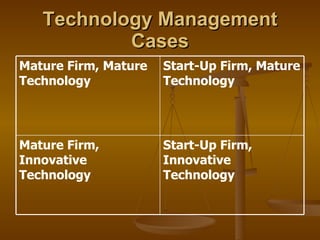
Technology Management Cases Start-Up Firm, Innovative Technology Mature Firm, Innovative Technology Start-Up Firm, Mature Technology Mature Firm, Mature Technology
1. Mature Firm,  Innovative Technology
Project Selection Criteria   (Summary) Sales Potential Growth Potential Payback Period and Profitability Competitor Reaction Legal and Ethical Capital Available Skills Available Physical Resources Available Management Support and Champion Community Acceptance
What and how big  is the  market? Who will use it? For what? What are they doing for that purpose now?  What is its advantage over existing technology (customer value-added)?  Remember: any innovation faces an uphill battle -- RULE OF THUMB: to displace an entrenched technology, a new technology needs a 10-fold cost/performance advantage
New Products: Phase Development  in Order To Minimize Risk Research Costs are ~1/10 of Development Costs So Demonstrate Technical Feasibility at Low Cost Demonstrate Commercial Feasibility if Milestones are Met Gradually Scale Up to Full Commercial Operation
Introducing New Operating Technology in a Mature Organization Rationalize Before You Introduce Technology GM-Perot Merger: Contrast with Saturn:  Be Aware of the Organizational and Human Consequences of Introduction of New Technology Co-Opt or Retrain Those Responsible for Implementation:
So Keep Venture Divisions Separate from Main Line  -- Or Out-Source Innovation to Smaller and More Nimble Companies, Since Radical Innovations Often Come from Outside an Industry Example: Big Pharma Companies  Buy   Innovative Products from Biotech Start-Ups
A Further Aside on Big Pharma Only Blockbusters Justify >$1/2 Billion in Development Costs to Meet FDA Requirements  Profits Depend on a Few Such Blockbusters –  A Very Fragile System As Patents Expire, Tremendous Pressures to Replace Blockbusters with New Cash Cows Future Emphasis on Personalized Medicine (Tailoring Recommendations to Individual Genome) puts this Model at Risk
New Worry: No Firm, No Matter How Large, Can Master All The Technology it Needs or All the Markets it Might Want to Enter So Create Strategic Alliances with Firms that Have the Technology or Know the Market
2. Mature Firm, Mature Technology
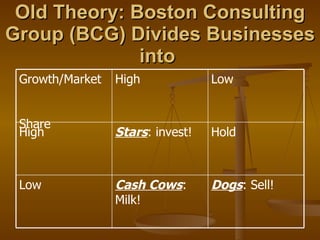
Old Theory: Boston Consulting Group (BCG) Divides Businesses into  Dogs : Sell! Cash Cows : Milk! Low Hold Stars : invest! High Low High Growth/Market  Share
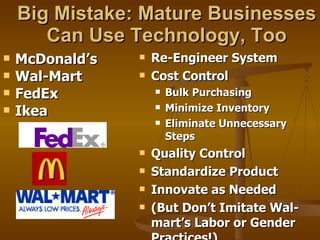
Big Mistake: Mature Businesses Can Use Technology, Too McDonald’s Wal-Mart FedEx Ikea Re-Engineer System Cost Control Bulk Purchasing Minimize Inventory Eliminate Unnecessary Steps Quality Control Standardize Product Innovate as Needed (But Don’t Imitate Wal-mart’s Labor or Gender Practices!)
3. Start-Up Firm,  State-of-the-Art Technology (These Firms are Vulnerable, but May Have Technologies Critical for Security, Environment, Health or Other Public Purposes)
The High-Tech Business Venture New Product Based on New Technology Focus on Identified Market and its Requirements Initial Venture Team:  Technology and Product Design Production Management Marketing Management Capital and Financial Management
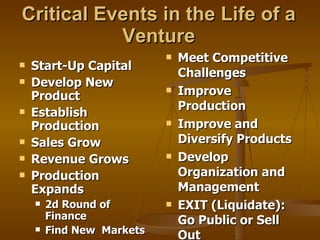
Critical Events in the Life of a Venture Start-Up Capital Develop New Product Establish Production Sales Grow Revenue Grows Production Expands 2d Round of Finance Find New  Markets Meet Competitive Challenges Improve Production Improve and Diversify Products Develop Organization and Management EXIT (Liquidate): Go Public or Sell Out
Threats to Cash Flow  of New Ventures Sales Projections and Production Outrun Sales, Inventory Piles Up Sales Outrun Production Production or Delivery Lags Demand Delayed or Insufficient Revenue Lag in Meeting Competitive Threat and Developing Second Generation Product
Growth Patterns of New Ventures Ideal : Rapid Initial Growth, Followed by Slower Expansion, Ending as a Large Firm Rare : Rapid Initial Growth, Followed by Severe Problems that are Successfully Resolved, with Resumption of Growth
Growth Patterns  of New Ventures (2) More Frequent : Rapid Initial Growth Levels Off as Competitors Enter Market. Company Finds Market Niche and Establishes Itself as Small or Medium Firm or Subsidiary of Larger Company Sad but Frequent : First Serious Troubles Kill Under-Capitalized Company Despite Initial Growth To the Investor, it may not be Worth it to Save Even a Good Idea: There’s a Better Use for the Money. This is why Government may invest in a company whose technology is deemed vital to national security.
The Business Plan The Document Critical to the Initial Success of the Firm Input to the ‘Deal Flow’ of the Venture Capital Firm Only A Few Percent of Deals Proffered are Financed
Purposes of the Business Plan Chart the Course of the New Venture: the Product, the Market, the Strategy Set Milestones  for Product Development and Launch, Market Development, Expansion Identify Needed Resources: Money, Staff, Facilities, Strategy Attract Risk Capital! A university or an NGO needs a business plan, too, if it’s trying to launch a product -- even if the motive isn’t profit.
Outline of the Business Plan Executive Summary: Attract Interest Enterprise Strategy and Technology Strategy Who’s the Customer? What’s the Value-Added? What’s the Price? Product/Service Strategy: Technical Specifications, Risks, Schedule
Outline of the Business Plan (2) Expected Competition  Manufacturing and Marketing Strategy, Including Distribution and Sales Management Team and Organization Staffing Plan Financial Plan Benchmarking
Sources of Capital Personal Resources: US Entrepreneur Is Expected To Be ‘In Hock to the  Eyeballs’ An ‘Angel’ (Relative or Rich Individual)  Strategic Alliance with Potential Customer, Technical Partner, Eventual Manufacturer Venture Capitalist (VC)
The More Sweat Equity You Have, the Less You Have to Give Up to the Venture Capitalist.  (But Don’t Be Too Greedy: 100% of Zero is Zero)
The Venture Capitalist:  the ‘Barracuda’ Normally an Active Investor An Interesting Job, Involved in Companies at Many Stages of the Product Cycle , but not as a first job Expects High Risks, High Returns Judges the Management Team, not the Technology Benefits from Low Capital Gains Tax Most Deal in Mezzanine or Secondary Finance Only a Few Specialize in First Round Financing,  Exit Strategy: ‘Go Public’ or Sell to Established Company
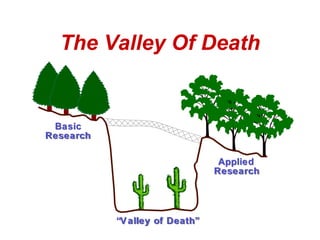
Venture Capital is Normally Available in the US at Most Levels of Risk, Except for High Risk,  Long Term Applied Research Projects Carried out in Government Laboratories The “Valley of Death” Between First Working Model and a Viable Business
The Valley Of Death
US Capital Markets are Extraordinarily Flexible Compared to Other Countries, which are Trying to Emulate the US Model with Mixed Success BUT Dot-Com Boom and Bust Show Tendency to Herd Mentality, Over-Investment Followed by Under-Investment Venture Capital Revived – and Then Collapsed Again with the Recession Perhaps a Bit of Humility is Appropriate after 1990s’ Triumphalism
Globalization,  Technology Transfer  and the Value Chain:
The Value Chain Definition: A connected series of organizations, resources, and knowledge streams involved in the creation and delivery of value to final customers.  Brand Definition and Marketing Often Constitute the Most Profitable Link and Can Squeeze the Margins Even of Efficient Suppliers, Although Sometimes a Key Technology Can Command High Margins.
Moving Up the Value Chain Carries Big Rewards,  but Also Big Risks It’s Your Product. You Find the Market, Develop the Product, Redesign it if it Doesn’t Sell, Fix it if it Doesn’t Work, and Keep up  with the Competition. If the Market Disappears, You’re Stuck.
How Technology is Acquired Non-Proprietary Technology Hire an Expert Take Courses Read Books  Proprietary Technology Direct Foreign Investment (DFI)  License the Technology Purchase the Technology Buy the Company that Owns the Technology Except for Passive DFI, These Require Investment of Personnel and Money Develop it Yourself by Doing Research, Development and Engineering (R, D & E)
Strategic Choice From the Viewpoint of the Technology Owner Integrate: Keep the Technology In-House Maintain Control of  Quality Timing Product Design Technology Essential if Technology is ‘Tacit’: i.e., Unarticulated, not Reduced to a Rule or Software Modularize: Subcontract to Specialists, Often Offshore Information Technology Allows Detailed Specification of Components New Emphasis on “Plug and Play” Trade-Off: Transfer Enough Technology so they can do the job, but not so much as to create a Competitor Some Offshore Vendors Even Become Product Designers These Must Choose Whether to Aspire to Having their own Brands, or Whether to Maintain the Trust of their Clients
Offshore Minimize Labor Costs Exploit Local Skills Take Advantage of Local Clusters Minimize Expenditure on Environment and Worker Safety (?) Local Procurement Speed Delivery Facilitate Just-in-Time Production Speed Response to Change in Markets Ease Management Control Assure Product Quality Safeguard Intellectual Property
From MNC Viewpoint,  the Trade-Off Depends on Skills Clusters Size of Home and Overseas Markets Culture of Firm Need to be Close to Market Transport Costs Communication Difficulties  Need for Close Management Control Need for Just-in-Time Supplies Need for Quick Response to Market Changes Role of Tacit Knowledge in the Integration of Design and Manufacture
Viewpoint of the  Technology Recipient Firm Desire to Move Up-Market to Higher Technology and More Profitable Links of Value Chain. This May Not be Easy. Higher Links May  Require Different Skills, or Public Policies and Infrastructure Investments Be Tightly Held  Endanger Relationships with Existing Customers Must Invest in Technology Absorption and Eventually in Own Research
After a Successful  Move Up-Market , A New Decision Must be Made as Competition Looms: Sell or Fight This Depends Partly on Company’s (and the Investors’ and the Bank’s) Ambition and Appetite for Risk

STIA305 07

  • 1.
    Management of TechnologicalInnovation in Business
  • 2.
    Most Technological InnovationTakes Place in Business You Must Understand the Business Viewpoint Even if You’re in Security, Health or Environment, if you Want to Guide or Stimulate Innovation
  • 3.
    Definition: Elements ofManagement Control Guide Administer
  • 4.
    Technological Elements of Management Business Strategy Technology Forecasting Technological and Market Intelligence Support and Finance Human Resources Management Risk Capital Technological Operations Technology Acquisition, Implementation and Integration Management of Research and Development New Product Development
  • 5.
    Definitions Technology Strategy: Anticipating and Planning for Technical Change A ‘High-Tech’ Company : High Margins (‘Economic Rents’) due to Limited Competition by Dint of a Technological Monopoly Core Competence : A Skill in Technology, Marketing, Production, and/or Finance that Defines a Firm’s Competitive Advantage Core Technology : A Technology Necessary to a Product or to its Production or Servicing, and Not Substitutable: Don’t Outsource This!
  • 6.
    Distinguish Between AppliedResearch : Seek New Knowledge Toward a Practical Objective Long- vs. Short-Term Research – Best Classification for Private Sector Management of Research Curiosity Motivated Research : Acquire New Knowledge for its Own Sake Basic Research : Push Back Frontiers of Knowledge – May be Curiosity Motivated or Applied
  • 7.
    The Industrial Researchand Development (R&D) Laboratory (Thomas Edison’s Most Important Invention) Industrial Research and Development Now Constitutes about 2/3 of US R&D
  • 8.
    Classic Problem ofCorporate Conglomerate: R&D at Corporate HQ or at Business Unit? Corporate: Respond to Strategic Challenges and Opportunities Business Unit: Responds to Immediate Needs of Existing Business
  • 9.
    This issue isnow moot Private R&D soared during the 1990s and is still high -- But it’s mostly development of new products tied to existing product areas Long-range research at the corporate level is much reduced, in part because of modularization
  • 10.
    Technology Management CasesStart-Up Firm, Innovative Technology Mature Firm, Innovative Technology Start-Up Firm, Mature Technology Mature Firm, Mature Technology
  • 11.
    1. Mature Firm, Innovative Technology
  • 12.
    Project Selection Criteria (Summary) Sales Potential Growth Potential Payback Period and Profitability Competitor Reaction Legal and Ethical Capital Available Skills Available Physical Resources Available Management Support and Champion Community Acceptance
  • 13.
    What and howbig is the market? Who will use it? For what? What are they doing for that purpose now? What is its advantage over existing technology (customer value-added)? Remember: any innovation faces an uphill battle -- RULE OF THUMB: to displace an entrenched technology, a new technology needs a 10-fold cost/performance advantage
  • 14.
    New Products: PhaseDevelopment in Order To Minimize Risk Research Costs are ~1/10 of Development Costs So Demonstrate Technical Feasibility at Low Cost Demonstrate Commercial Feasibility if Milestones are Met Gradually Scale Up to Full Commercial Operation
  • 15.
    Introducing New OperatingTechnology in a Mature Organization Rationalize Before You Introduce Technology GM-Perot Merger: Contrast with Saturn: Be Aware of the Organizational and Human Consequences of Introduction of New Technology Co-Opt or Retrain Those Responsible for Implementation:
  • 16.
    So Keep VentureDivisions Separate from Main Line -- Or Out-Source Innovation to Smaller and More Nimble Companies, Since Radical Innovations Often Come from Outside an Industry Example: Big Pharma Companies Buy Innovative Products from Biotech Start-Ups
  • 17.
    A Further Asideon Big Pharma Only Blockbusters Justify >$1/2 Billion in Development Costs to Meet FDA Requirements Profits Depend on a Few Such Blockbusters – A Very Fragile System As Patents Expire, Tremendous Pressures to Replace Blockbusters with New Cash Cows Future Emphasis on Personalized Medicine (Tailoring Recommendations to Individual Genome) puts this Model at Risk
  • 18.
    New Worry: NoFirm, No Matter How Large, Can Master All The Technology it Needs or All the Markets it Might Want to Enter So Create Strategic Alliances with Firms that Have the Technology or Know the Market
  • 19.
    2. Mature Firm,Mature Technology
  • 20.
    Old Theory: BostonConsulting Group (BCG) Divides Businesses into Dogs : Sell! Cash Cows : Milk! Low Hold Stars : invest! High Low High Growth/Market Share
  • 21.
    Big Mistake: MatureBusinesses Can Use Technology, Too McDonald’s Wal-Mart FedEx Ikea Re-Engineer System Cost Control Bulk Purchasing Minimize Inventory Eliminate Unnecessary Steps Quality Control Standardize Product Innovate as Needed (But Don’t Imitate Wal-mart’s Labor or Gender Practices!)
  • 22.
    3. Start-Up Firm, State-of-the-Art Technology (These Firms are Vulnerable, but May Have Technologies Critical for Security, Environment, Health or Other Public Purposes)
  • 23.
    The High-Tech BusinessVenture New Product Based on New Technology Focus on Identified Market and its Requirements Initial Venture Team: Technology and Product Design Production Management Marketing Management Capital and Financial Management
  • 24.
    Critical Events inthe Life of a Venture Start-Up Capital Develop New Product Establish Production Sales Grow Revenue Grows Production Expands 2d Round of Finance Find New Markets Meet Competitive Challenges Improve Production Improve and Diversify Products Develop Organization and Management EXIT (Liquidate): Go Public or Sell Out
  • 25.
    Threats to CashFlow of New Ventures Sales Projections and Production Outrun Sales, Inventory Piles Up Sales Outrun Production Production or Delivery Lags Demand Delayed or Insufficient Revenue Lag in Meeting Competitive Threat and Developing Second Generation Product
  • 26.
    Growth Patterns ofNew Ventures Ideal : Rapid Initial Growth, Followed by Slower Expansion, Ending as a Large Firm Rare : Rapid Initial Growth, Followed by Severe Problems that are Successfully Resolved, with Resumption of Growth
  • 27.
    Growth Patterns of New Ventures (2) More Frequent : Rapid Initial Growth Levels Off as Competitors Enter Market. Company Finds Market Niche and Establishes Itself as Small or Medium Firm or Subsidiary of Larger Company Sad but Frequent : First Serious Troubles Kill Under-Capitalized Company Despite Initial Growth To the Investor, it may not be Worth it to Save Even a Good Idea: There’s a Better Use for the Money. This is why Government may invest in a company whose technology is deemed vital to national security.
  • 28.
    The Business PlanThe Document Critical to the Initial Success of the Firm Input to the ‘Deal Flow’ of the Venture Capital Firm Only A Few Percent of Deals Proffered are Financed
  • 29.
    Purposes of theBusiness Plan Chart the Course of the New Venture: the Product, the Market, the Strategy Set Milestones for Product Development and Launch, Market Development, Expansion Identify Needed Resources: Money, Staff, Facilities, Strategy Attract Risk Capital! A university or an NGO needs a business plan, too, if it’s trying to launch a product -- even if the motive isn’t profit.
  • 30.
    Outline of theBusiness Plan Executive Summary: Attract Interest Enterprise Strategy and Technology Strategy Who’s the Customer? What’s the Value-Added? What’s the Price? Product/Service Strategy: Technical Specifications, Risks, Schedule
  • 31.
    Outline of theBusiness Plan (2) Expected Competition Manufacturing and Marketing Strategy, Including Distribution and Sales Management Team and Organization Staffing Plan Financial Plan Benchmarking
  • 32.
    Sources of CapitalPersonal Resources: US Entrepreneur Is Expected To Be ‘In Hock to the Eyeballs’ An ‘Angel’ (Relative or Rich Individual) Strategic Alliance with Potential Customer, Technical Partner, Eventual Manufacturer Venture Capitalist (VC)
  • 33.
    The More SweatEquity You Have, the Less You Have to Give Up to the Venture Capitalist. (But Don’t Be Too Greedy: 100% of Zero is Zero)
  • 34.
    The Venture Capitalist: the ‘Barracuda’ Normally an Active Investor An Interesting Job, Involved in Companies at Many Stages of the Product Cycle , but not as a first job Expects High Risks, High Returns Judges the Management Team, not the Technology Benefits from Low Capital Gains Tax Most Deal in Mezzanine or Secondary Finance Only a Few Specialize in First Round Financing, Exit Strategy: ‘Go Public’ or Sell to Established Company
  • 35.
    Venture Capital isNormally Available in the US at Most Levels of Risk, Except for High Risk, Long Term Applied Research Projects Carried out in Government Laboratories The “Valley of Death” Between First Working Model and a Viable Business
  • 36.
  • 37.
    US Capital Marketsare Extraordinarily Flexible Compared to Other Countries, which are Trying to Emulate the US Model with Mixed Success BUT Dot-Com Boom and Bust Show Tendency to Herd Mentality, Over-Investment Followed by Under-Investment Venture Capital Revived – and Then Collapsed Again with the Recession Perhaps a Bit of Humility is Appropriate after 1990s’ Triumphalism
  • 38.
    Globalization, TechnologyTransfer and the Value Chain:
  • 39.
    The Value ChainDefinition: A connected series of organizations, resources, and knowledge streams involved in the creation and delivery of value to final customers. Brand Definition and Marketing Often Constitute the Most Profitable Link and Can Squeeze the Margins Even of Efficient Suppliers, Although Sometimes a Key Technology Can Command High Margins.
  • 40.
    Moving Up theValue Chain Carries Big Rewards, but Also Big Risks It’s Your Product. You Find the Market, Develop the Product, Redesign it if it Doesn’t Sell, Fix it if it Doesn’t Work, and Keep up with the Competition. If the Market Disappears, You’re Stuck.
  • 41.
    How Technology isAcquired Non-Proprietary Technology Hire an Expert Take Courses Read Books Proprietary Technology Direct Foreign Investment (DFI) License the Technology Purchase the Technology Buy the Company that Owns the Technology Except for Passive DFI, These Require Investment of Personnel and Money Develop it Yourself by Doing Research, Development and Engineering (R, D & E)
  • 42.
    Strategic Choice Fromthe Viewpoint of the Technology Owner Integrate: Keep the Technology In-House Maintain Control of Quality Timing Product Design Technology Essential if Technology is ‘Tacit’: i.e., Unarticulated, not Reduced to a Rule or Software Modularize: Subcontract to Specialists, Often Offshore Information Technology Allows Detailed Specification of Components New Emphasis on “Plug and Play” Trade-Off: Transfer Enough Technology so they can do the job, but not so much as to create a Competitor Some Offshore Vendors Even Become Product Designers These Must Choose Whether to Aspire to Having their own Brands, or Whether to Maintain the Trust of their Clients
  • 43.
    Offshore Minimize LaborCosts Exploit Local Skills Take Advantage of Local Clusters Minimize Expenditure on Environment and Worker Safety (?) Local Procurement Speed Delivery Facilitate Just-in-Time Production Speed Response to Change in Markets Ease Management Control Assure Product Quality Safeguard Intellectual Property
  • 44.
    From MNC Viewpoint, the Trade-Off Depends on Skills Clusters Size of Home and Overseas Markets Culture of Firm Need to be Close to Market Transport Costs Communication Difficulties Need for Close Management Control Need for Just-in-Time Supplies Need for Quick Response to Market Changes Role of Tacit Knowledge in the Integration of Design and Manufacture
  • 45.
    Viewpoint of the Technology Recipient Firm Desire to Move Up-Market to Higher Technology and More Profitable Links of Value Chain. This May Not be Easy. Higher Links May Require Different Skills, or Public Policies and Infrastructure Investments Be Tightly Held Endanger Relationships with Existing Customers Must Invest in Technology Absorption and Eventually in Own Research
  • 46.
    After a Successful Move Up-Market , A New Decision Must be Made as Competition Looms: Sell or Fight This Depends Partly on Company’s (and the Investors’ and the Bank’s) Ambition and Appetite for Risk

Editor's Notes

  • #9 Corporate: Respond to Strategic Challenges and Opportunities (Recall Bucolic Post-War Corporate Laboratories) Business Unit: Responds to Immediate Needs of Existing Business Production Bottlenecks and Quality Glitches Improvements in Existing Products Extensions in Product Line Response to Customer Requests
  • #10 Private R&D soared during the 1990s and is still high But it’s mostly development of new products to take advantage of the explosion in information technology (maturing phase of Kondrateev cycle) Research is mostly tied to existing product areas Long-range research at the corporate level is much reduced, in part because of modularization: only IBM remains of the former giants (GE, AT&T, etc.), And even its efforts are smaller.
  • #16 Rationalize Before You Introduce Technology GM-Perot Merger: Automate a Poor System at Great Expense  A Fast, Inefficient System Contrast with Saturn: Introduce Japanese Management, Add a Little ‘Technology’ Be Aware of the Organizational and Human Consequences of Introduction of New Technology Co-Opt or Retrain Those Who Will be Responsible for Implementation: Unions, Teachers, Salesmen, Distributors
  • #18 Only Blockbusters Justify >$1/2 Billion in Development Costs to Meet FDA Requirements Profits Depend on a Few Such Blockbusters – A Very Fragile System As Patents Expire, Tremendous Pressures to Replace Blockbusters with New Cash Cows Stimulus to Research but also to Fraud, Cutting Corners Companies Fiercely Defend Intellectual Property Rights Future Emphasis on Personalized Medicine (Tailoring Recommendations to Individual Genome) puts this Model at Risk Much Weaker Economies of Scale Requires Redesign of FDA Testing Procedures
  • #36 Venture Capital is Normally Available in the US at Most Levels of Risk, Except for High Risk, Long Term Applied Research Projects Carried out in Government Laboratories The “Valley of Death” Between First Working Model and a Viable Business This Follows from the Institutional Divide between Basic Research (Usually at a University or Government Laboratory, Funded with Public Money) and Product Development (in a Private Firm, with Private Money) A Few, Important but Relatively Modest Government Programs Try to Bridge this Gap
  • #40 Venture Capital is Normally Available in the US at Most Levels of Risk, Except for High Risk, Long Term Applied Research Projects Carried out in Government Laboratories The “Valley of Death” Between First Working Model and a Viable Business This Follows from the Institutional Divide between Basic Research (Usually at a University or Government Laboratory, Funded with Public Money) and Product Development (in a Private Firm, with Private Money) A Few, Important but Relatively Modest Government Programs Try to Bridge this Gap
  • #46 Desire to Move Up-Market to Higher Technology and More Profitable Links of Value Chain. This May Not be Easy: Higher Links in the Value Chain May Require Different Skills, or Public Policies and Infrastructure Investments The Most Lucrative Parts of the Value Chain – Especially Brand Definition and Knowledge of Consumer Demand, but Sometimes Processing and Associated Technology -- May be Tightly Held Must Invest in Technology Absorption and Eventually in Own Research