Pack InnoTech Conference 2013, Thailand
Innovation that leads to cost reduction through change in structural pack design.
Packaging Innovation
Vs.
Value improvement programmes…
Innovation that leads to cost reduction through change in structural pack design
Conflicting forces?
Innovation that leads to cost reduction through change in structural pack design
• The innovation model
• Renovation & Innovation
• Innovation level & Projects categorization
• Consumer Insights…a multi–layered approach.
• Holistic design
• Reviewing effect on cost through change in structural packaging design
– Leading case
• Final conclusions & Q&A.
Agenda
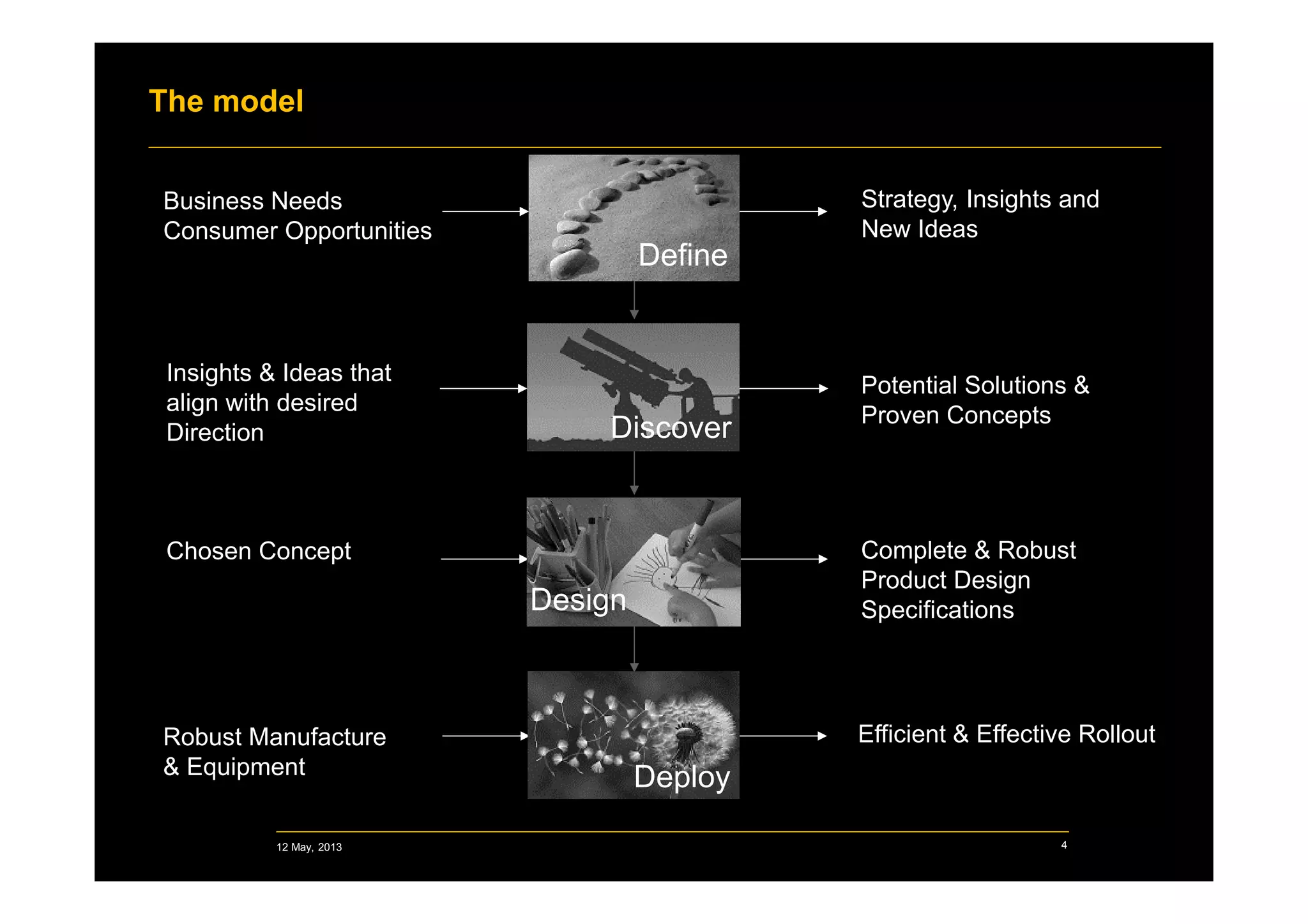
The model
412 May, 2013
Strategy, Insights and
New Ideas
Business Needs
Consumer Opportunities
Insights & Ideas that
align with desired
Direction
Potential Solutions &
Proven Concepts
Chosen Concept Complete & Robust
Product Design
Specifications
Robust Manufacture
& Equipment
Efficient & Effective Rollout
Define
Discover
Design
Deploy
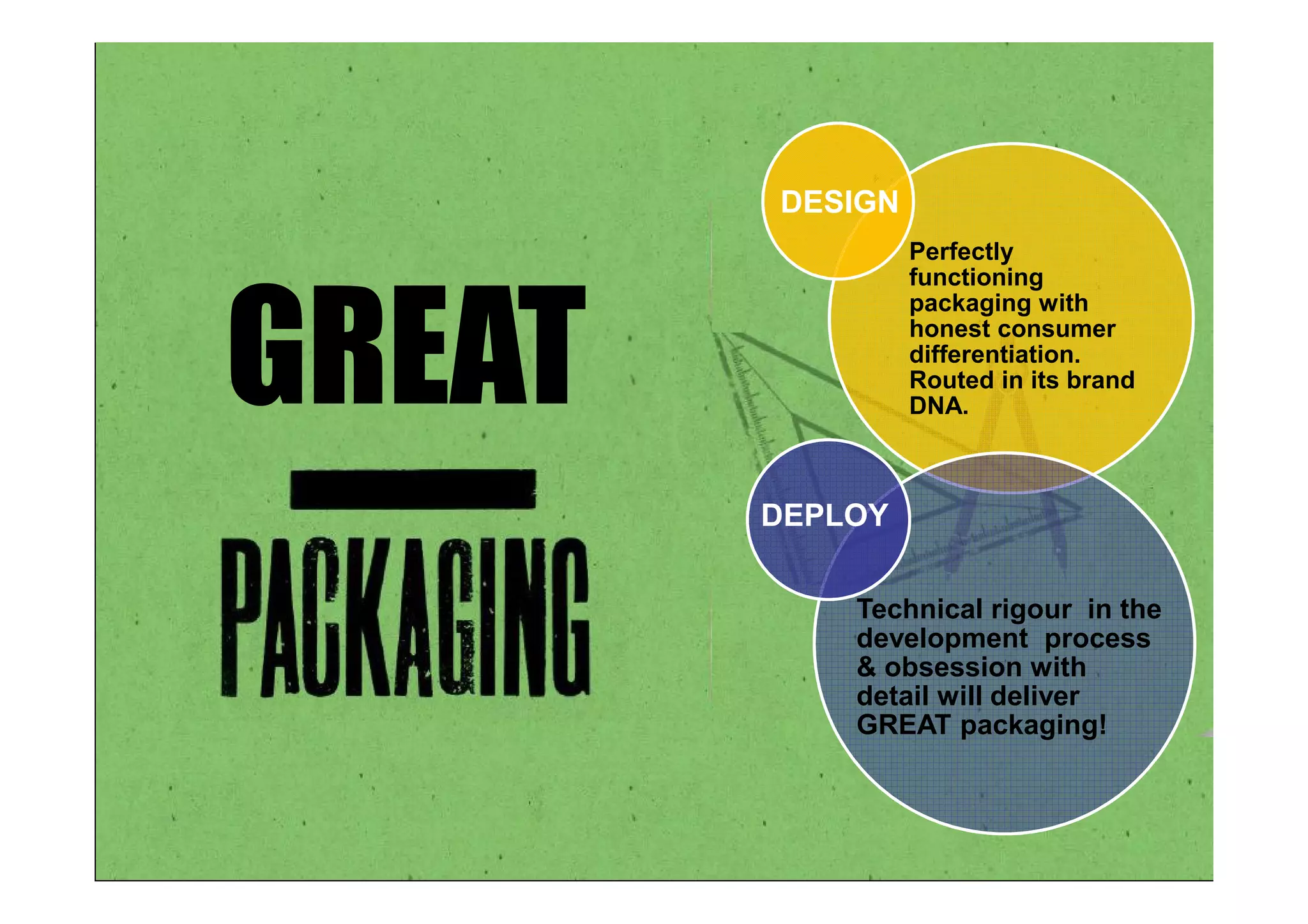
GREAT
DESIGN
Perfectly
functioning
packaging with
honest consumer
differentiation.
Routed in its brand
DNA.
DEPLOY
Technical rigour in the
development process
& obsession with
detail will deliver
GREAT packaging!
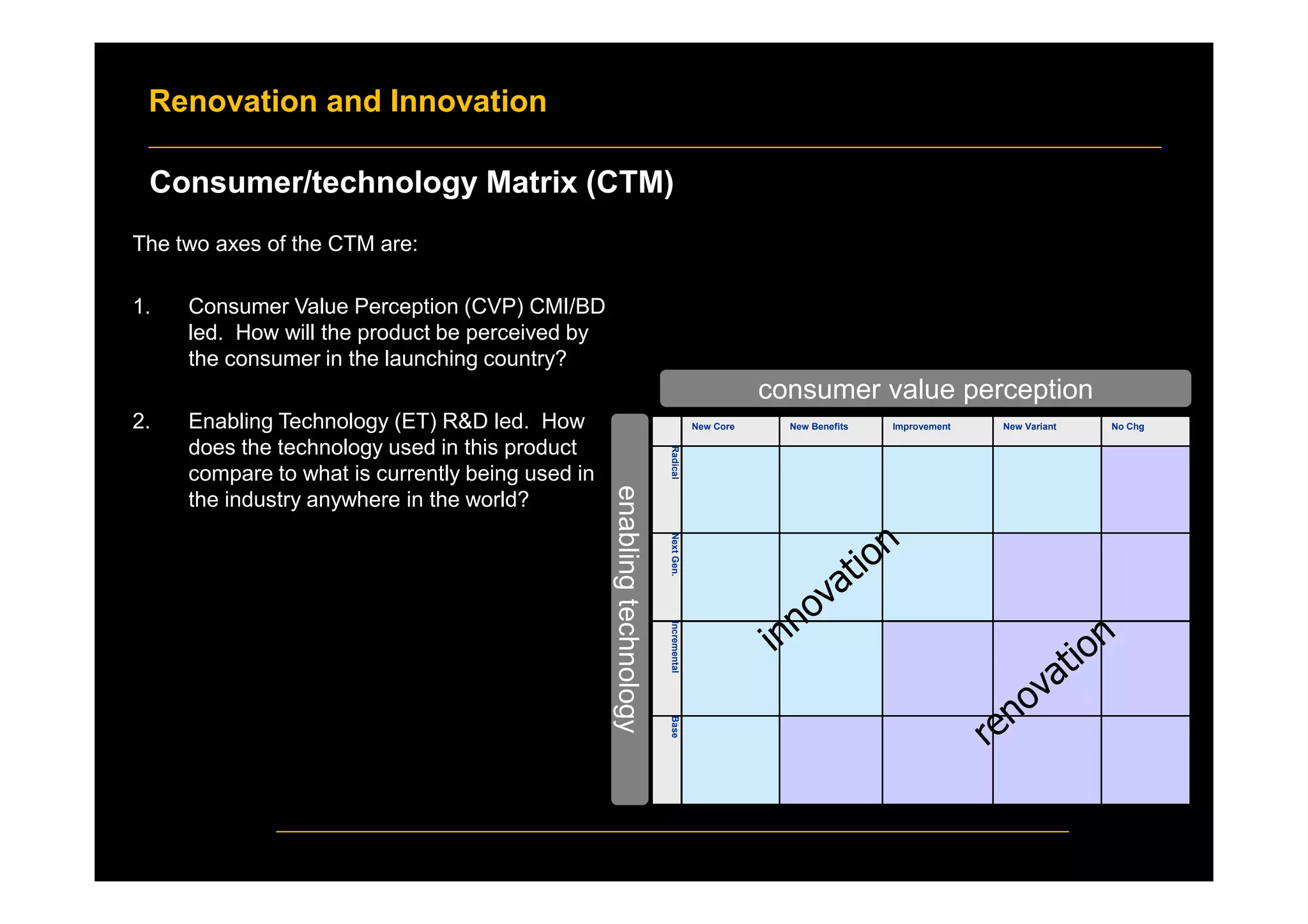
Renovation and Innovation
Consumer/technology Matrix (CTM)
New Core New Benefits Improvement New Variant No Chg
RadicalNextGen.IncrementalBase
consumer value perception
enablingtechnology
The two axes of the CTM are:
1. Consumer Value Perception (CVP) CMI/BD
led. How will the product be perceived by
the consumer in the launching country?
2. Enabling Technology (ET) R&D led. How
does the technology used in this product
compare to what is currently being used in
the industry anywhere in the world?
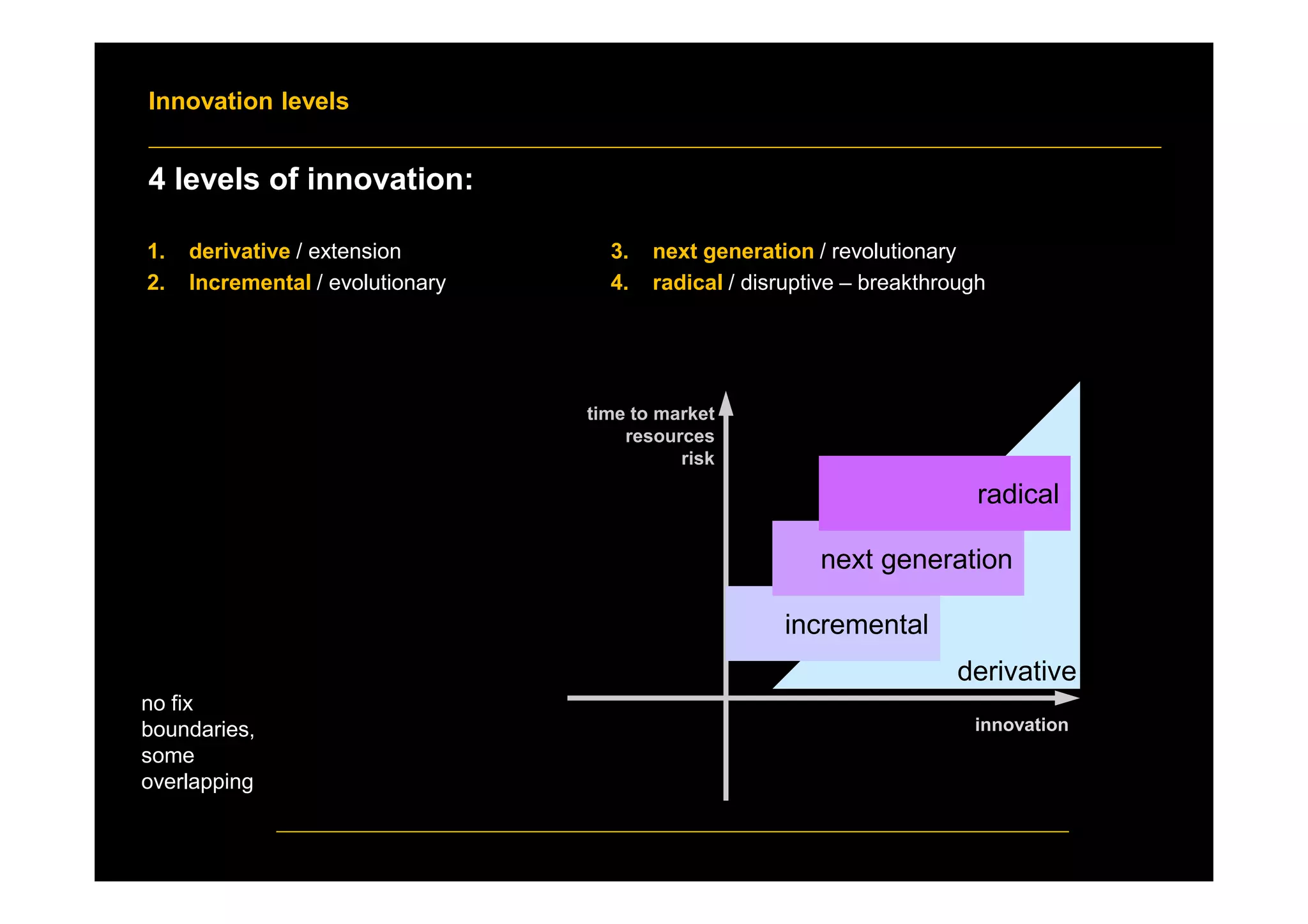
Innovation levels
1. derivative / extension
2. Incremental / evolutionary
3. next generation / revolutionary
4. radical / disruptive – breakthrough
4 levels of innovation:
no fix
boundaries,
some
overlapping
time to market
resources
risk
innovation
derivative
incremental
next generation
radical
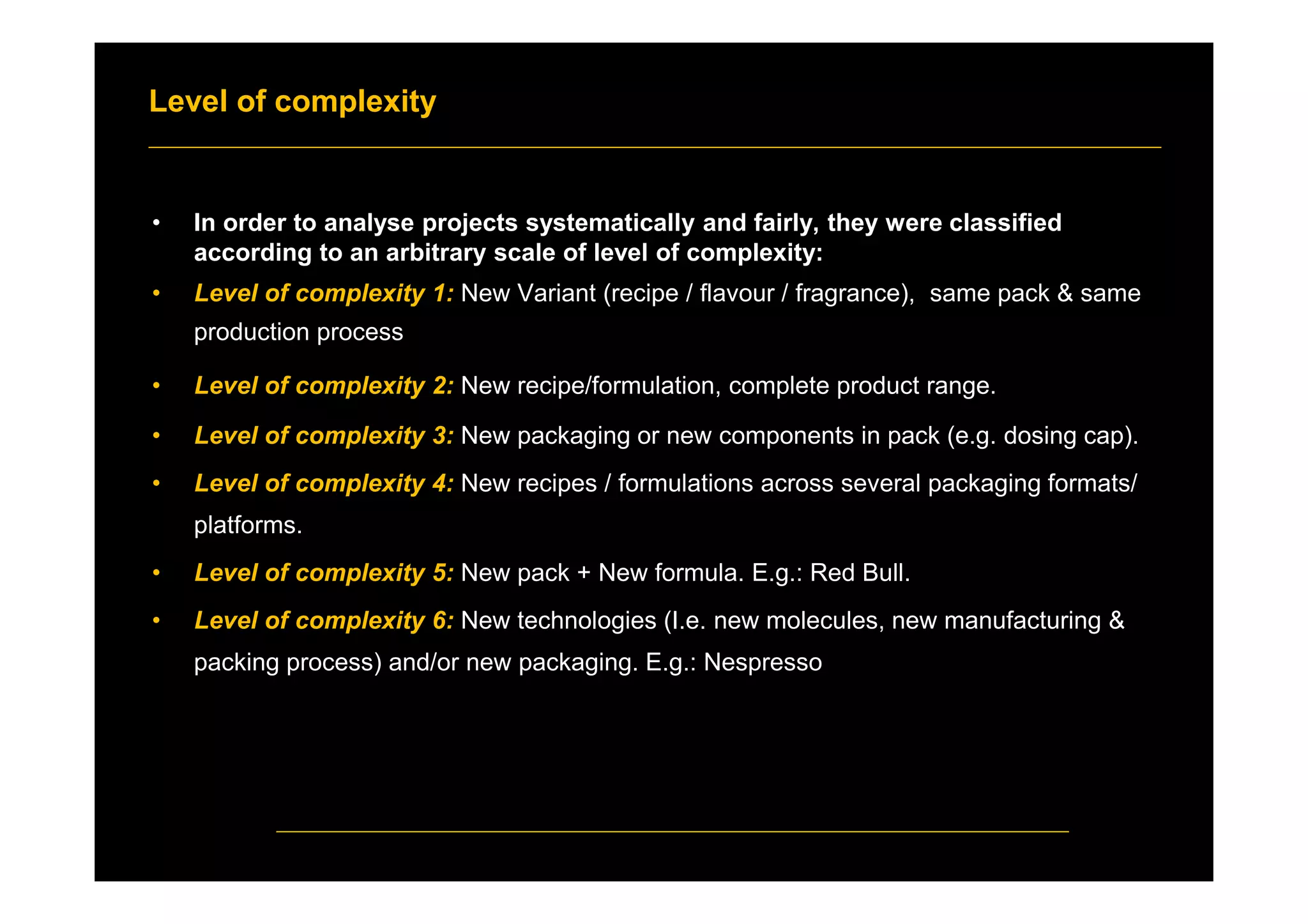
Level of complexity
• In order to analyse projects systematically and fairly, they were classified
according to an arbitrary scale of level of complexity:
• Level of complexity 1: New Variant (recipe / flavour / fragrance), same pack & same
production process
• Level of complexity 2: New recipe/formulation, complete product range.
• Level of complexity 3: New packaging or new components in pack (e.g. dosing cap).
• Level of complexity 4: New recipes / formulations across several packaging formats/
platforms.
• Level of complexity 5: New pack + New formula. E.g.: Red Bull.
• Level of complexity 6: New technologies (I.e. new molecules, new manufacturing &
packing process) and/or new packaging. E.g.: Nespresso
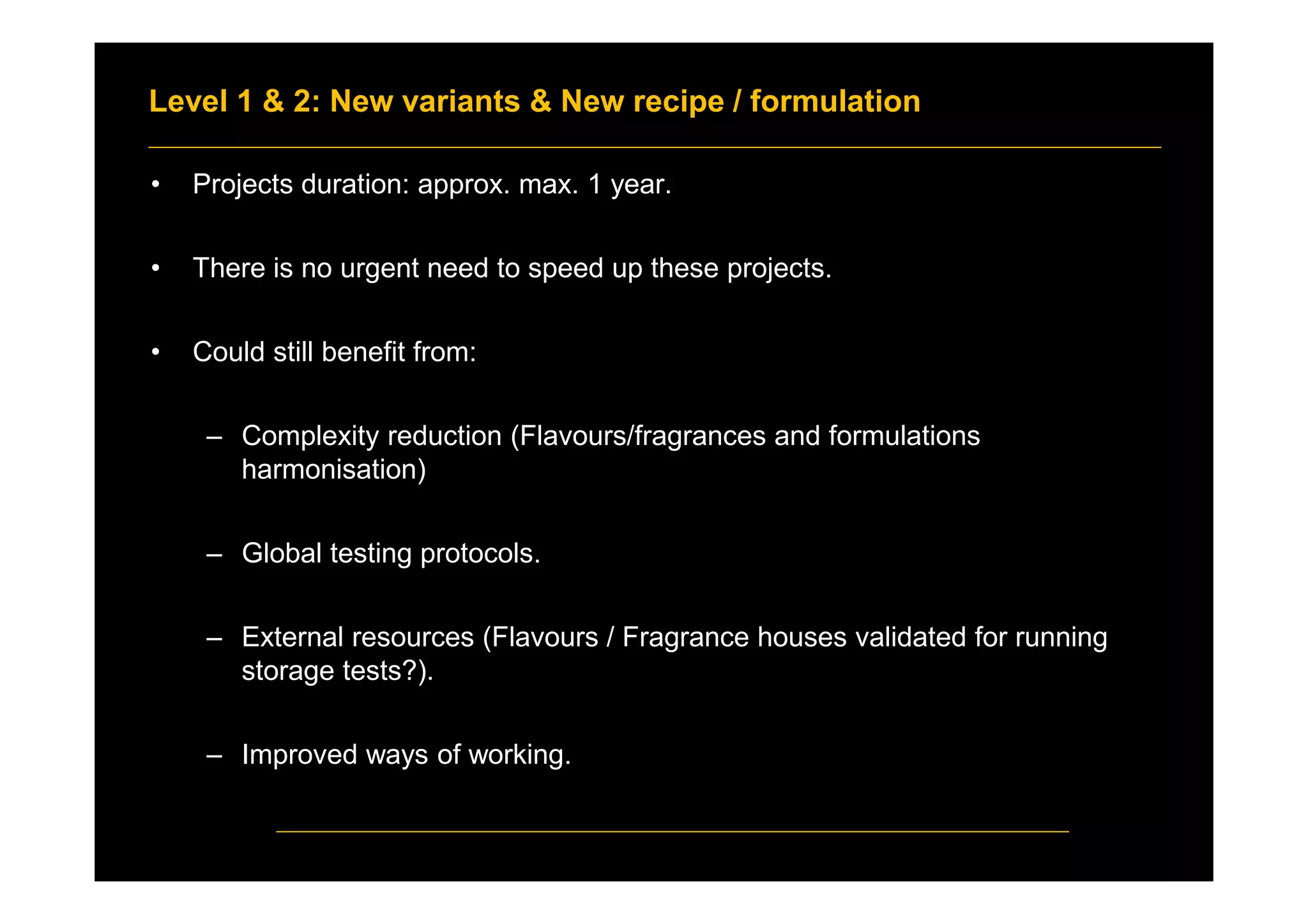
Level 1 & 2: New variants & New recipe / formulation
• Projects duration: approx. max. 1 year.
• There is no urgent need to speed up these projects.
• Could still benefit from:
– Complexity reduction (Flavours/fragrances and formulations
harmonisation)
– Global testing protocols.
– External resources (Flavours / Fragrance houses validated for running
storage tests?).
– Improved ways of working.
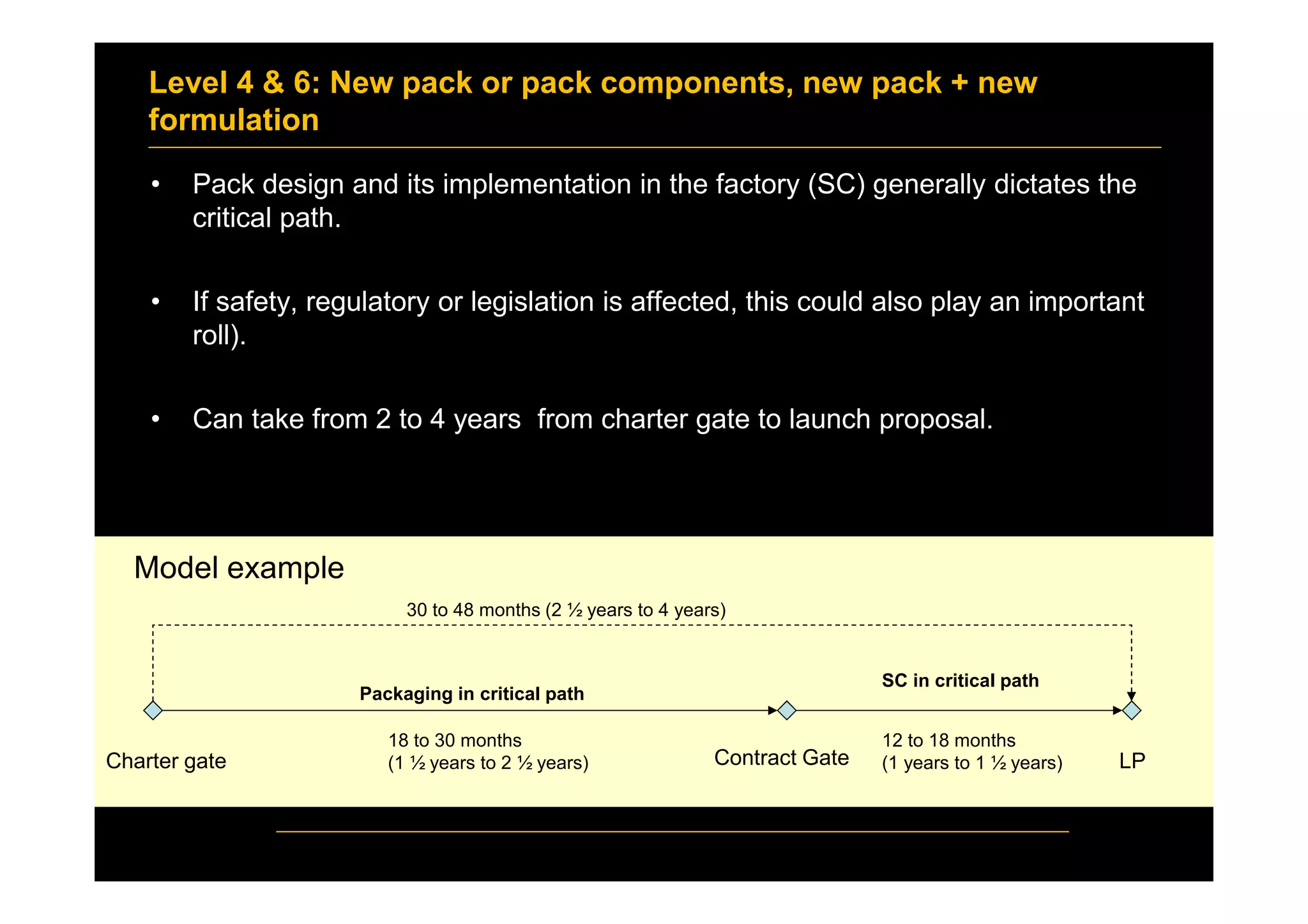
Level 4 & 6: New pack or pack components, new pack + new
formulation
• Pack design and its implementation in the factory (SC) generally dictates the
critical path.
• If safety, regulatory or legislation is affected, this could also play an important
roll).
• Can take from 2 to 4 years from charter gate to launch proposal.
18 to 30 months
(1 ½ years to 2 ½ years)Charter gate Contract Gate LP
12 to 18 months
(1 years to 1 ½ years)
Packaging in critical path
SC in critical path
30 to 48 months (2 ½ years to 4 years)
Model example
Charter gate Concept lock
(pack)
Prototype/pilot
tooling (pack)
Contract book
Technical design lock
(pack)
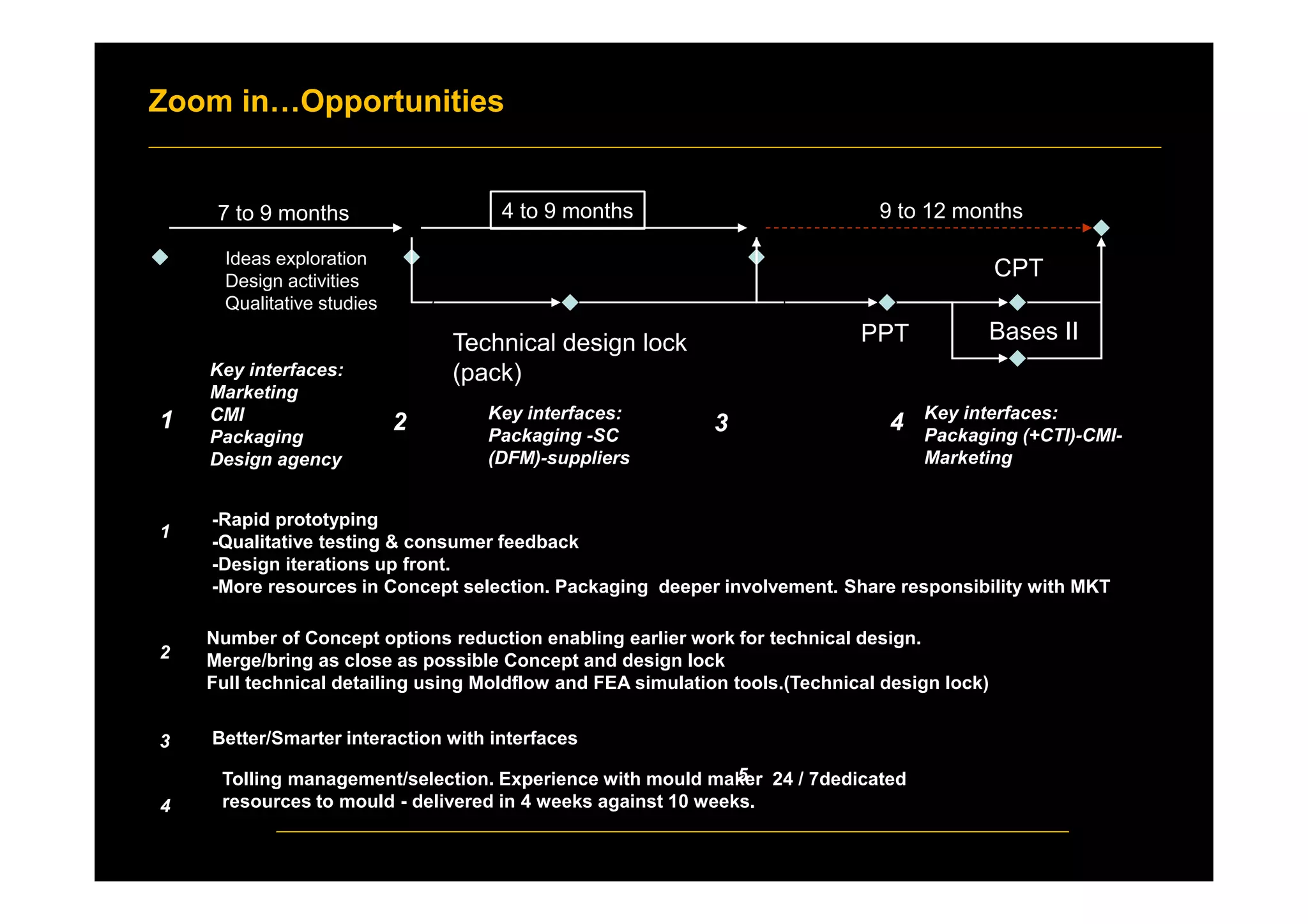
4 to 9 months
Key interfaces:
Packaging -SC
(DFM)-suppliers
7 to 9 months
Ideas exploration
Design activities
Qualitative studies
Key interfaces:
Marketing
CMI
Packaging
Design agency
PPT
CPT
Bases II
9 to 12 months
Key interfaces:
Packaging (+CTI)-CMI-
Marketing
1 2 43
5
1
-Rapid prototyping
-Qualitative testing & consumer feedback
-Design iterations up front.
-More resources in Concept selection. Packaging deeper involvement. Share responsibility with MKT
2
Number of Concept options reduction enabling earlier work for technical design.
Merge/bring as close as possible Concept and design lock
Full technical detailing using Moldflow and FEA simulation tools.(Technical design lock)
3 Better/Smarter interaction with interfaces
4
Tolling management/selection. Experience with mould maker 24 / 7dedicated
resources to mould - delivered in 4 weeks against 10 weeks.
Zoom in…Opportunities
R&D input
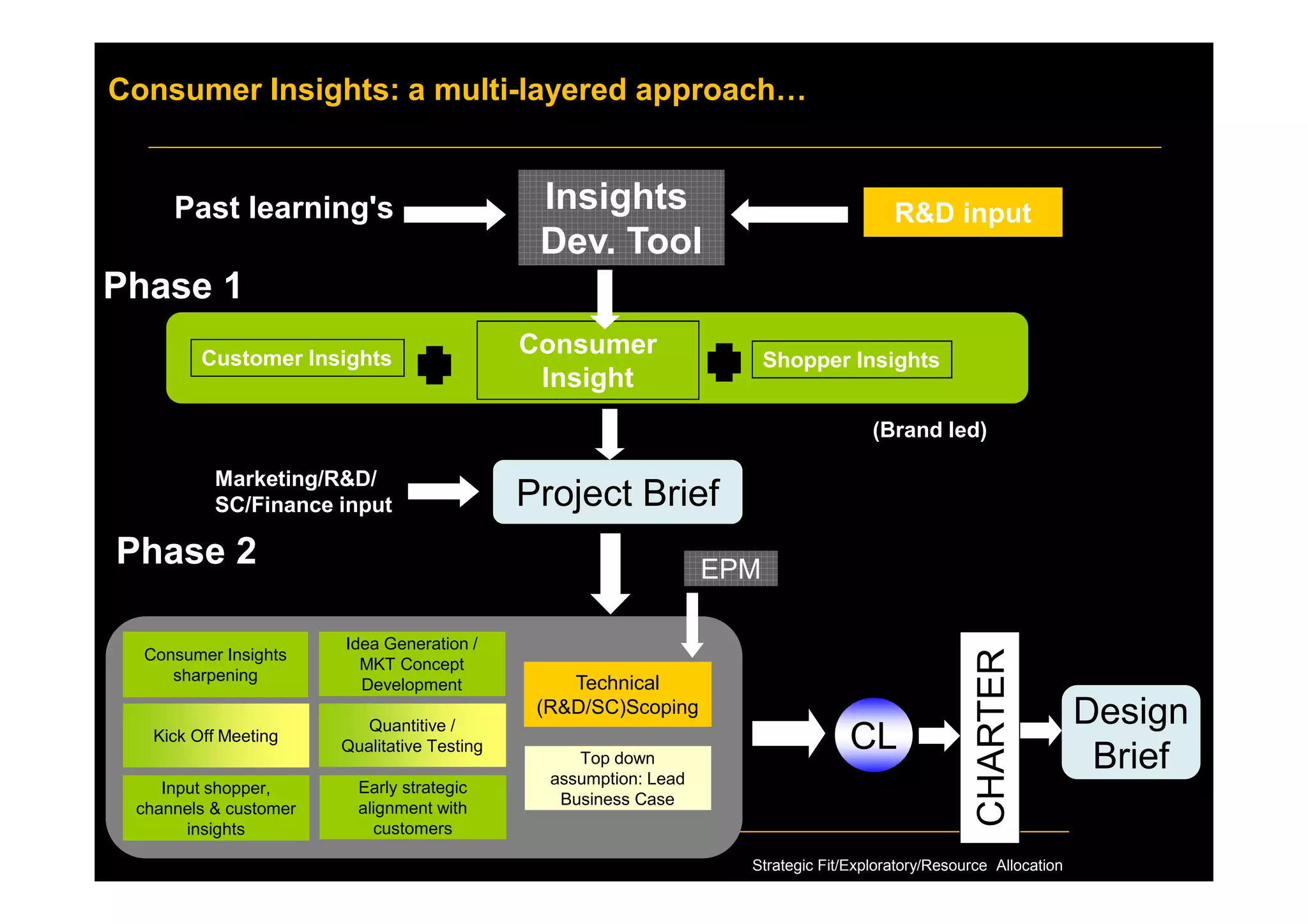
Consumer Insights: a multi-layered approach…
here we start? Ideas Phase overview
Consumer
Insight
Shopper InsightsCustomer Insights
Insights
Dev. Tool
Phase 1
(Brand led)
Marketing/R&D/
SC/Finance input
Phase 2
Consumer Insights
sharpening
Kick Off Meeting
Input shopper,
channels & customer
insights
Idea Generation /
MKT Concept
Development
Quantitive /
Qualitative Testing
Early strategic
alignment with
customers
Top down
assumption: Lead
Business Case
Technical
(R&D/SC)Scoping
EPM
Past learning's
Design
Brief
Project Brief
CL
CHARTER
Strategic Fit/Exploratory/Resource Allocation
Packaging is becoming the primary point
of contact for our consumers…
How will we differentiate?
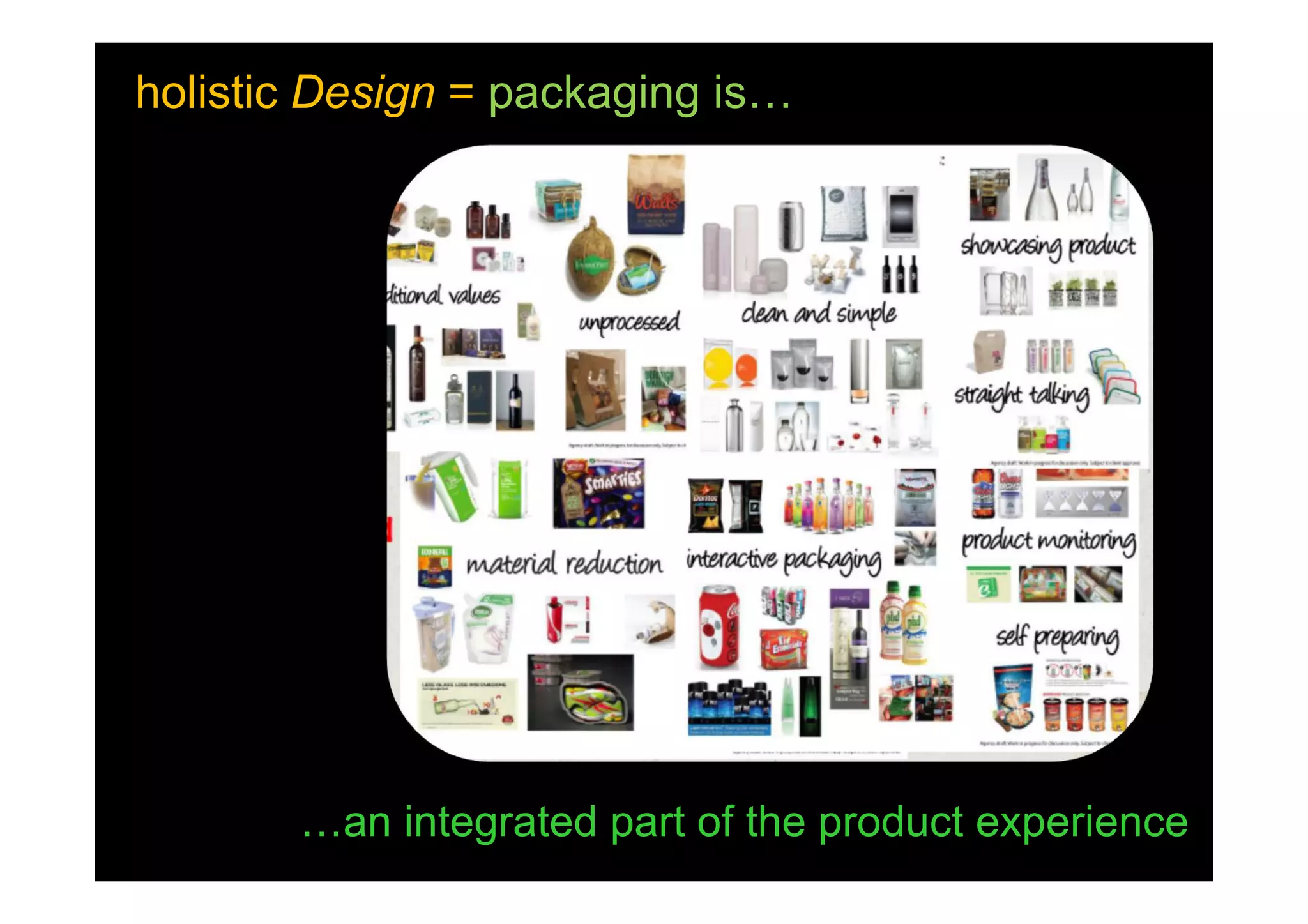
holistic Design = packaging is…
…an integrated part of the product experience
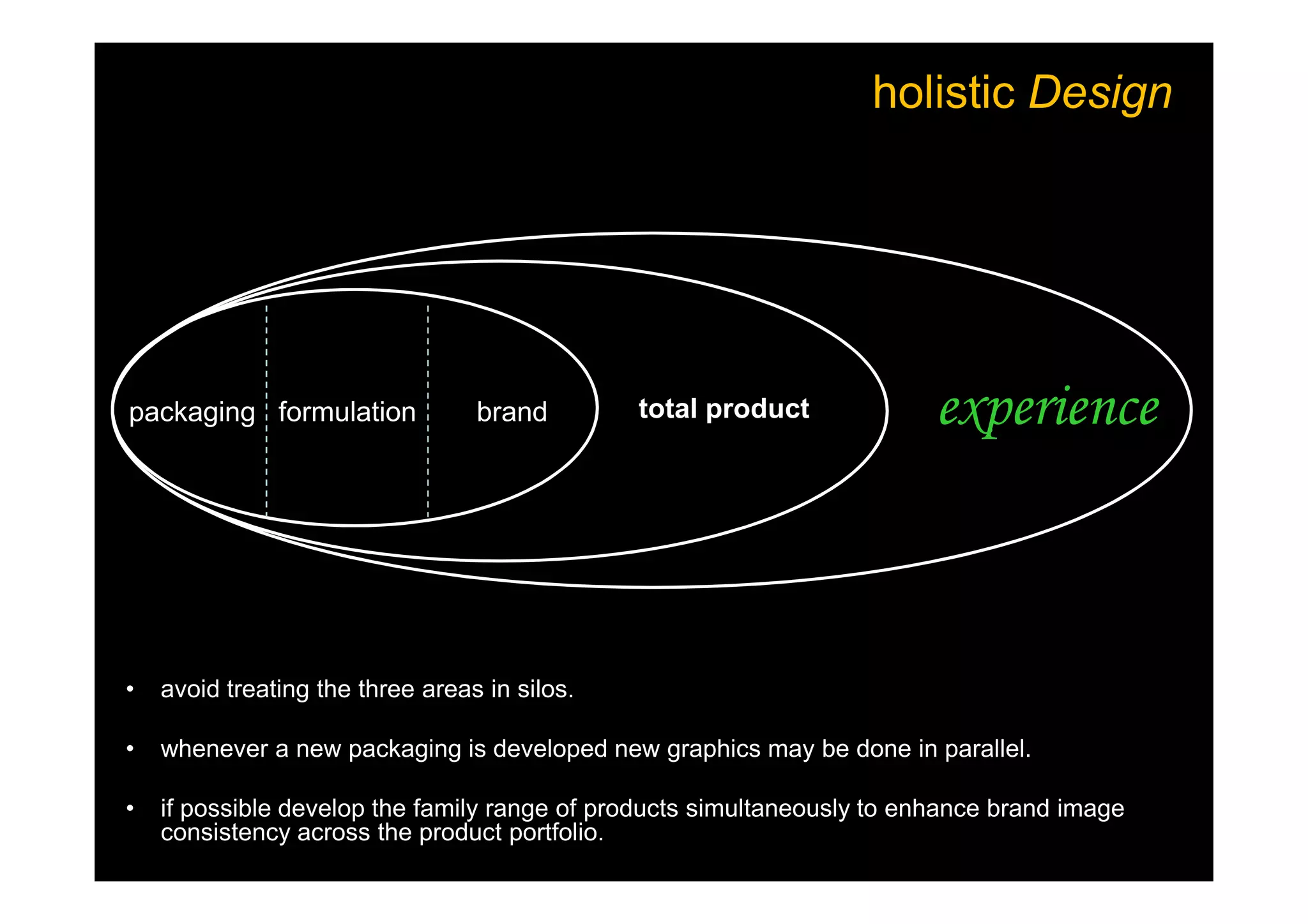
holistic Design
packaging formulation brand total product experience
• avoid treating the three areas in silos.
• whenever a new packaging is developed new graphics may be done in parallel.
• if possible develop the family range of products simultaneously to enhance brand image
consistency across the product portfolio.
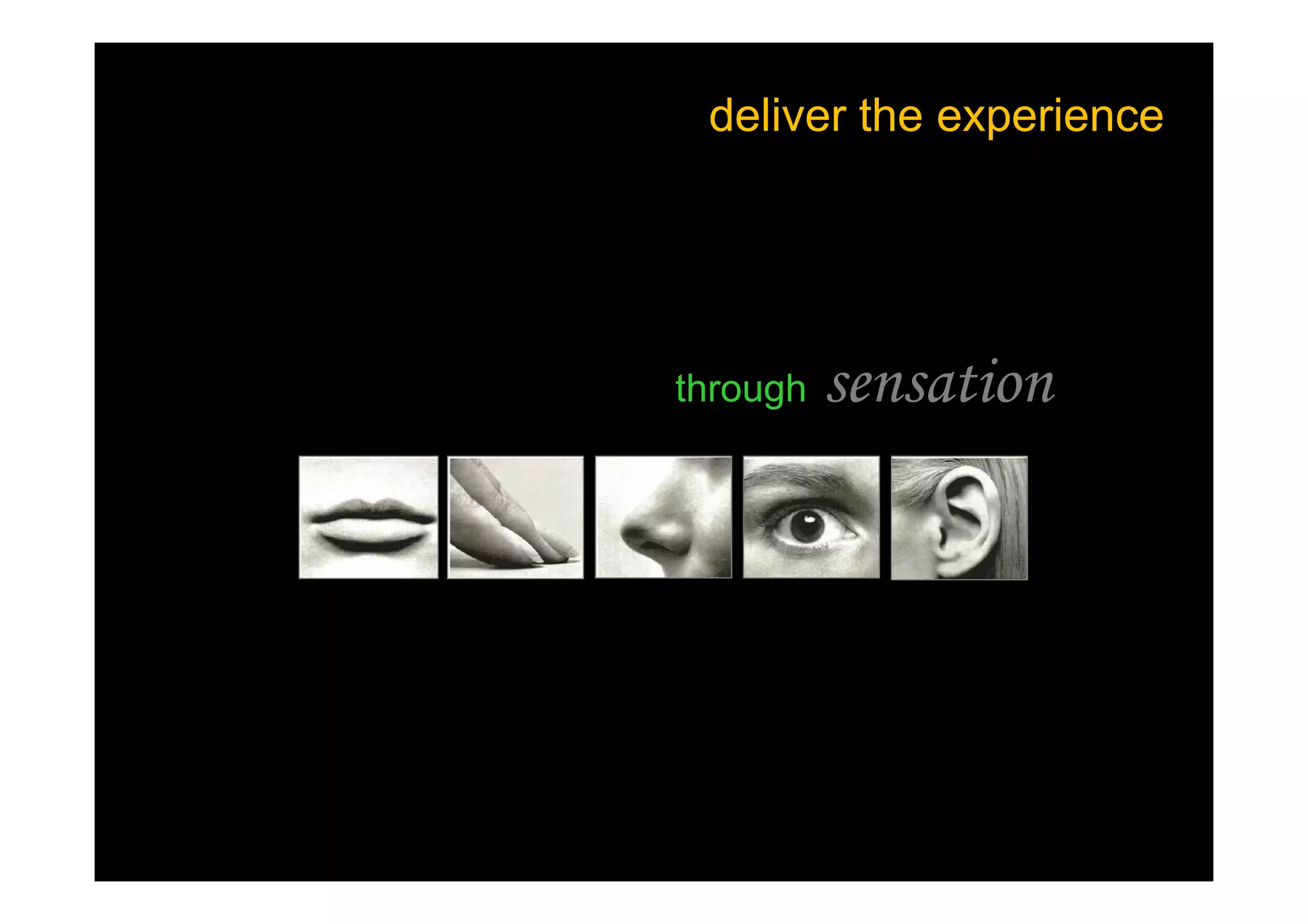
deliver the experience
emotion through sensation
Leading Case
the 'upside-down' roll-on!
Background
• Claimed to be the smoothest roll-on in the world, the upside-down roll-on features four
patented designs. It is the result of several years’ collaboration between Unilever and its
packaging suppliers.
• What were the insights?
1. No.1 in use consumer gross negative was the slow speed of drying (we want to deliver
a pack + formulation which is super fast dry).
2. Being ‘more green’ than competitors is a powerful claim for any brand and a compelling
draw for consumers. We knew we could claim the new Rexona roll-on ‘more green’ than
any other 50ml roll-on in the market by overhauling our design and manufacturing
process.
Project Brief: summary
• To make a significant advance in roll on packaging. We want a clear, consumer
perceivable step forward that will drive consumer preference and put us a step ahead
of the competition.
• To develop a new pack which has irresistible, 'for me' appeal for men and women.
• To develop a pack which 'feels right' for the '4' strategic brands - Rexona for men,
Rexona for women, Dove and Axe.
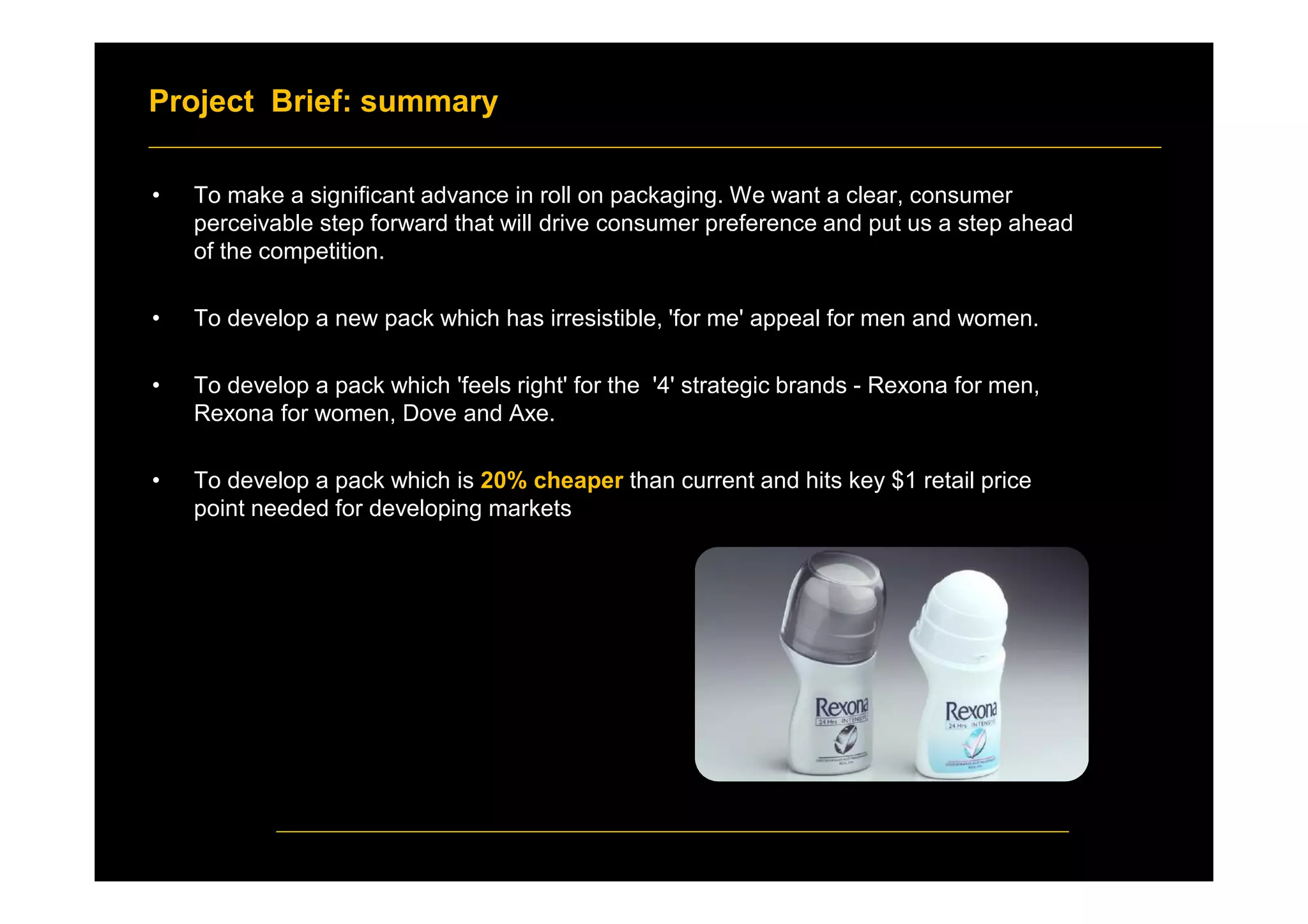
• To develop a pack which is 20% cheaper than current and hits key $1 retail price
point needed for developing markets
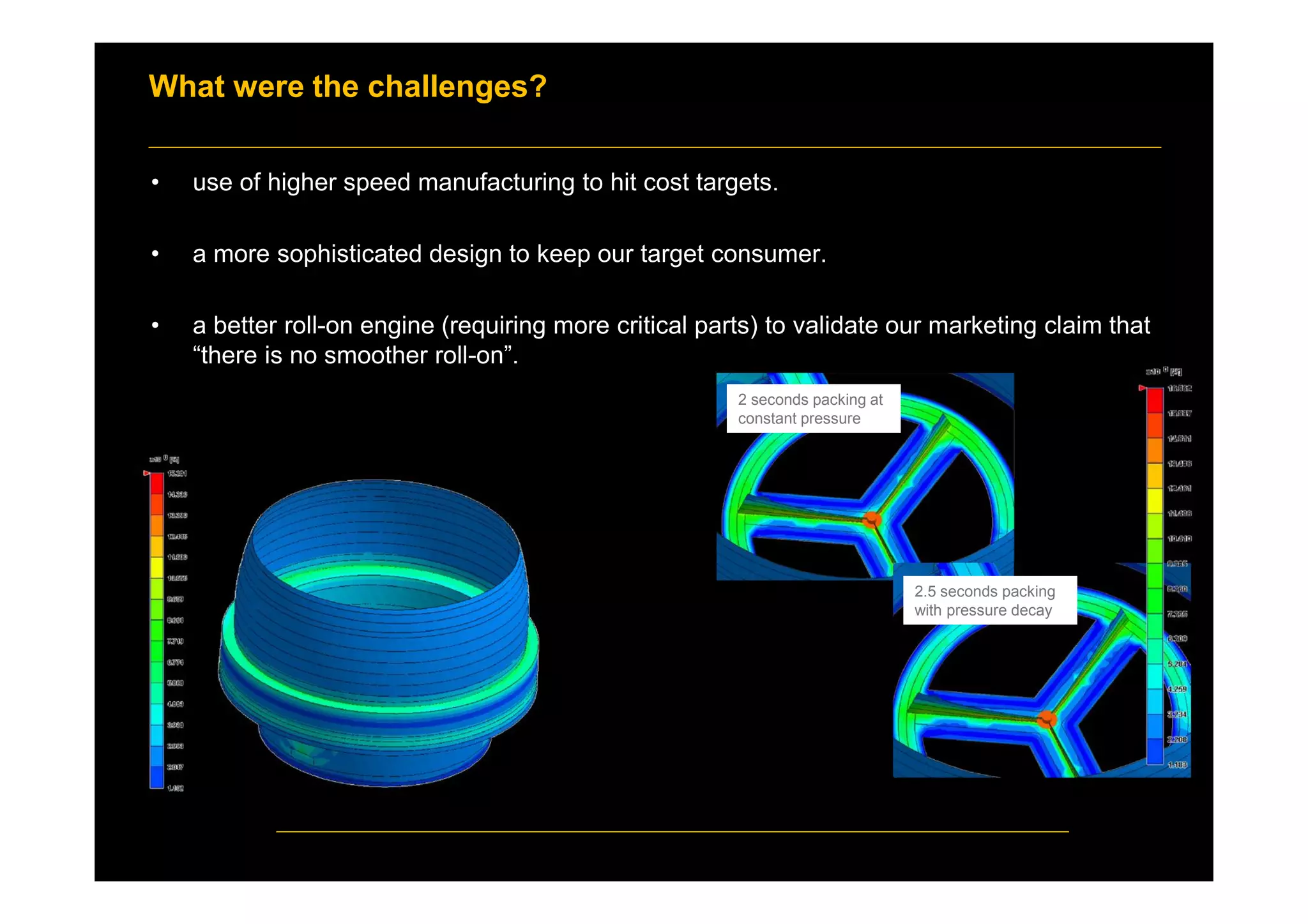
What were the challenges?
• use of higher speed manufacturing to hit cost targets.
• a more sophisticated design to keep our target consumer.
• a better roll-on engine (requiring more critical parts) to validate our marketing claim that
“there is no smoother roll-on”.
2 seconds packing at
constant pressure
2.5 seconds packing
with pressure decay
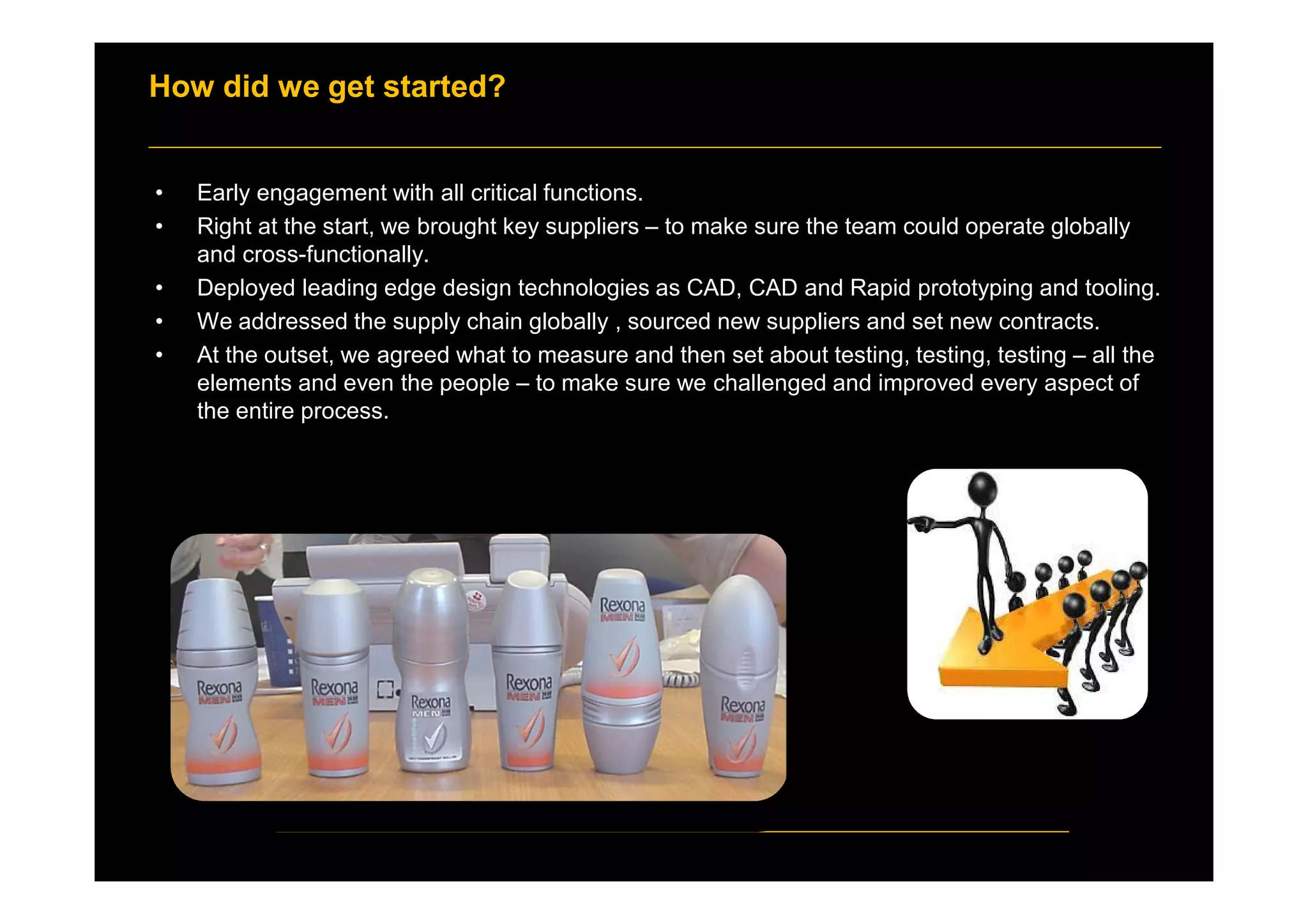
How did we get started?
• Early engagement with all critical functions.
• Right at the start, we brought key suppliers – to make sure the team could operate globally
and cross-functionally.
• Deployed leading edge design technologies as CAD, CAD and Rapid prototyping and tooling.
• We addressed the supply chain globally , sourced new suppliers and set new contracts.
• At the outset, we agreed what to measure and then set about testing, testing, testing – all the
elements and even the people – to make sure we challenged and improved every aspect of
the entire process.
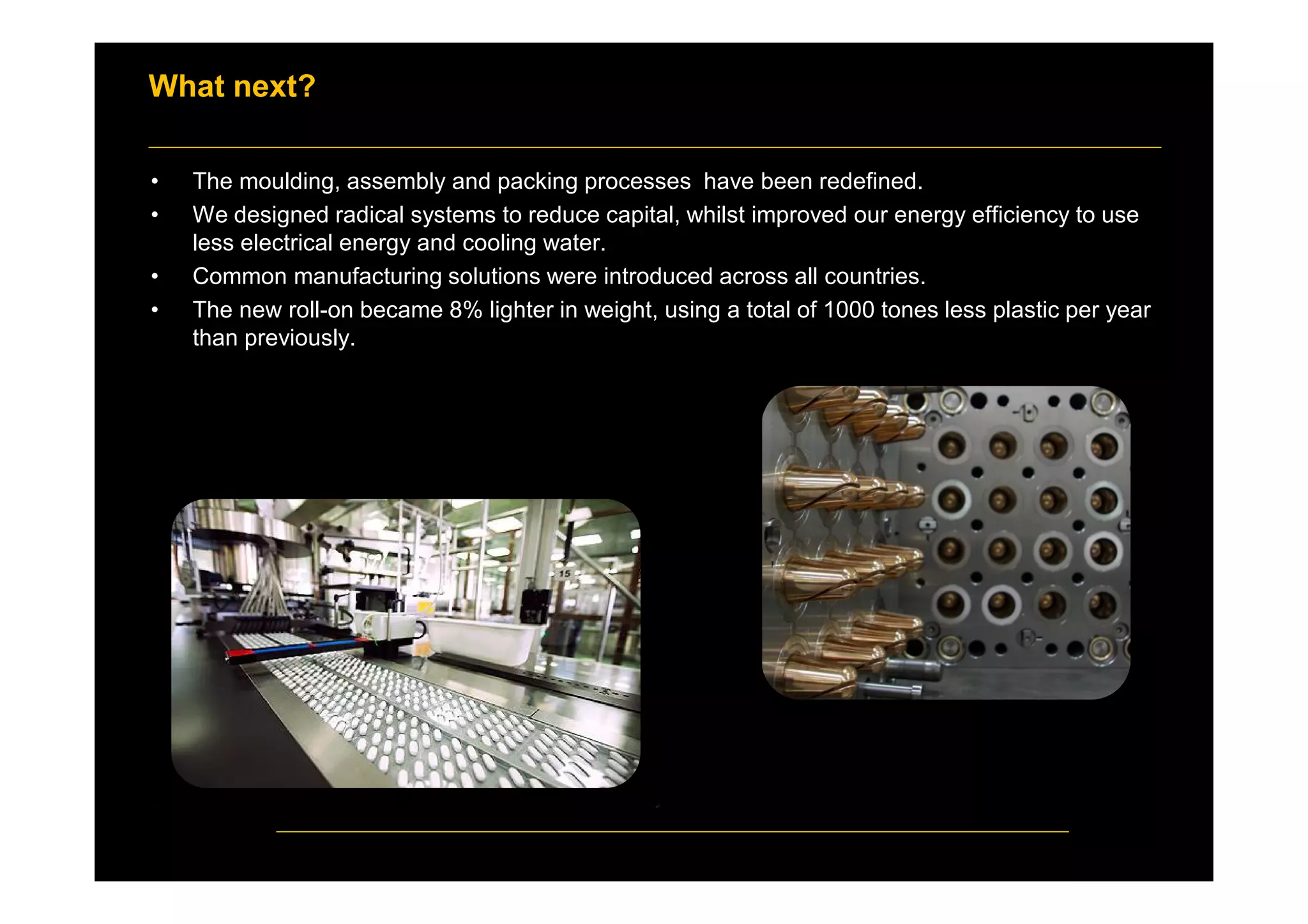
What next?
• The moulding, assembly and packing processes have been redefined.
• We designed radical systems to reduce capital, whilst improved our energy efficiency to use
less electrical energy and cooling water.
• Common manufacturing solutions were introduced across all countries.
• The new roll-on became 8% lighter in weight, using a total of 1000 tones less plastic per year
than previously.
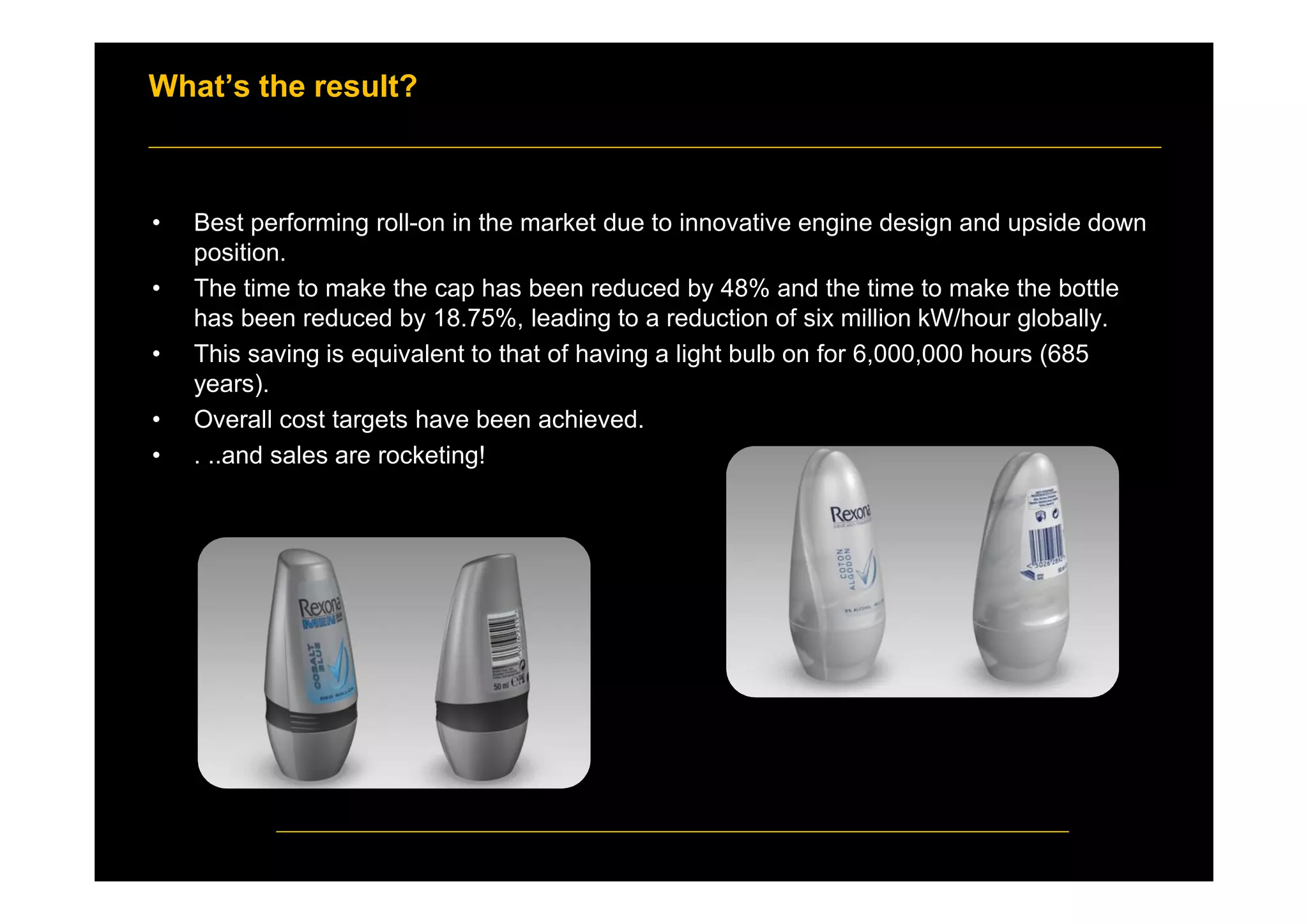
What’s the result?
• Best performing roll-on in the market due to innovative engine design and upside down
position.
• The time to make the cap has been reduced by 48% and the time to make the bottle
has been reduced by 18.75%, leading to a reduction of six million kW/hour globally.
• This saving is equivalent to that of having a light bulb on for 6,000,000 hours (685
years).
• Overall cost targets have been achieved.
• . ..and sales are rocketing!
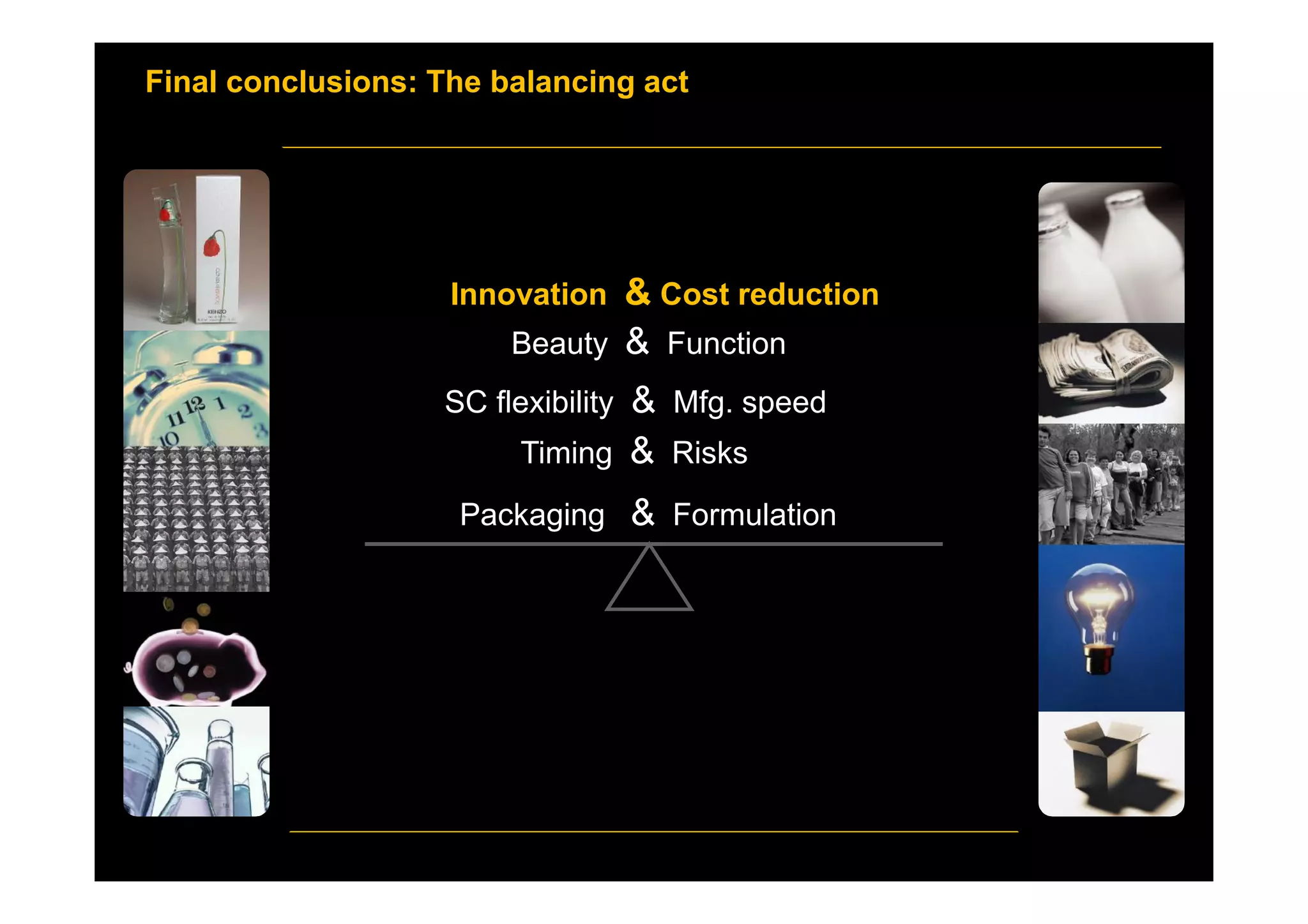
Innovation & Cost reduction
Final conclusions: The balancing act
SC flexibility & Mfg. speed
Beauty & Function
Timing & Risks
Packaging & Formulation
End…
AFRIS. AsianFoodRegulationInformationService.
We have the largest database of Asian food regulations in the world and it’s
FREE to use.
We publish a range of communication services, list a very large number of
food events and online educational webinars and continue to grow our Digital
Library.
We look forward to hearing from you soon!
www.asianfoodreg.com
adrienna@asianfoodreg.com

Innovation in Structural Pack Design

  • 1.
    Pack InnoTech Conference2013, Thailand Innovation that leads to cost reduction through change in structural pack design.
  • 2.
    Packaging Innovation Vs. Value improvementprogrammes… Innovation that leads to cost reduction through change in structural pack design Conflicting forces?
  • 3.
    Innovation that leadsto cost reduction through change in structural pack design • The innovation model • Renovation & Innovation • Innovation level & Projects categorization • Consumer Insights…a multi–layered approach. • Holistic design • Reviewing effect on cost through change in structural packaging design – Leading case • Final conclusions & Q&A. Agenda
  • 4.
    The model 412 May,2013 Strategy, Insights and New Ideas Business Needs Consumer Opportunities Insights & Ideas that align with desired Direction Potential Solutions & Proven Concepts Chosen Concept Complete & Robust Product Design Specifications Robust Manufacture & Equipment Efficient & Effective Rollout Define Discover Design Deploy
  • 5.
    GREAT DESIGN Perfectly functioning packaging with honest consumer differentiation. Routedin its brand DNA. DEPLOY Technical rigour in the development process & obsession with detail will deliver GREAT packaging!
  • 6.
    Renovation and Innovation Consumer/technologyMatrix (CTM) New Core New Benefits Improvement New Variant No Chg RadicalNextGen.IncrementalBase consumer value perception enablingtechnology The two axes of the CTM are: 1. Consumer Value Perception (CVP) CMI/BD led. How will the product be perceived by the consumer in the launching country? 2. Enabling Technology (ET) R&D led. How does the technology used in this product compare to what is currently being used in the industry anywhere in the world?
  • 7.
    Innovation levels 1. derivative/ extension 2. Incremental / evolutionary 3. next generation / revolutionary 4. radical / disruptive – breakthrough 4 levels of innovation: no fix boundaries, some overlapping time to market resources risk innovation derivative incremental next generation radical
  • 8.
    Level of complexity •In order to analyse projects systematically and fairly, they were classified according to an arbitrary scale of level of complexity: • Level of complexity 1: New Variant (recipe / flavour / fragrance), same pack & same production process • Level of complexity 2: New recipe/formulation, complete product range. • Level of complexity 3: New packaging or new components in pack (e.g. dosing cap). • Level of complexity 4: New recipes / formulations across several packaging formats/ platforms. • Level of complexity 5: New pack + New formula. E.g.: Red Bull. • Level of complexity 6: New technologies (I.e. new molecules, new manufacturing & packing process) and/or new packaging. E.g.: Nespresso
  • 9.
    Level 1 &2: New variants & New recipe / formulation • Projects duration: approx. max. 1 year. • There is no urgent need to speed up these projects. • Could still benefit from: – Complexity reduction (Flavours/fragrances and formulations harmonisation) – Global testing protocols. – External resources (Flavours / Fragrance houses validated for running storage tests?). – Improved ways of working.
  • 10.
    Level 4 &6: New pack or pack components, new pack + new formulation • Pack design and its implementation in the factory (SC) generally dictates the critical path. • If safety, regulatory or legislation is affected, this could also play an important roll). • Can take from 2 to 4 years from charter gate to launch proposal. 18 to 30 months (1 ½ years to 2 ½ years)Charter gate Contract Gate LP 12 to 18 months (1 years to 1 ½ years) Packaging in critical path SC in critical path 30 to 48 months (2 ½ years to 4 years) Model example
  • 11.
    Charter gate Conceptlock (pack) Prototype/pilot tooling (pack) Contract book Technical design lock (pack) 4 to 9 months Key interfaces: Packaging -SC (DFM)-suppliers 7 to 9 months Ideas exploration Design activities Qualitative studies Key interfaces: Marketing CMI Packaging Design agency PPT CPT Bases II 9 to 12 months Key interfaces: Packaging (+CTI)-CMI- Marketing 1 2 43 5 1 -Rapid prototyping -Qualitative testing & consumer feedback -Design iterations up front. -More resources in Concept selection. Packaging deeper involvement. Share responsibility with MKT 2 Number of Concept options reduction enabling earlier work for technical design. Merge/bring as close as possible Concept and design lock Full technical detailing using Moldflow and FEA simulation tools.(Technical design lock) 3 Better/Smarter interaction with interfaces 4 Tolling management/selection. Experience with mould maker 24 / 7dedicated resources to mould - delivered in 4 weeks against 10 weeks. Zoom in…Opportunities
  • 12.
    R&D input Consumer Insights:a multi-layered approach… here we start? Ideas Phase overview Consumer Insight Shopper InsightsCustomer Insights Insights Dev. Tool Phase 1 (Brand led) Marketing/R&D/ SC/Finance input Phase 2 Consumer Insights sharpening Kick Off Meeting Input shopper, channels & customer insights Idea Generation / MKT Concept Development Quantitive / Qualitative Testing Early strategic alignment with customers Top down assumption: Lead Business Case Technical (R&D/SC)Scoping EPM Past learning's Design Brief Project Brief CL CHARTER Strategic Fit/Exploratory/Resource Allocation
  • 13.
    Packaging is becomingthe primary point of contact for our consumers… How will we differentiate?
  • 14.
    holistic Design =packaging is… …an integrated part of the product experience
  • 15.
    holistic Design packaging formulationbrand total product experience • avoid treating the three areas in silos. • whenever a new packaging is developed new graphics may be done in parallel. • if possible develop the family range of products simultaneously to enhance brand image consistency across the product portfolio.
  • 16.
  • 17.
  • 18.
    Background • Claimed tobe the smoothest roll-on in the world, the upside-down roll-on features four patented designs. It is the result of several years’ collaboration between Unilever and its packaging suppliers. • What were the insights? 1. No.1 in use consumer gross negative was the slow speed of drying (we want to deliver a pack + formulation which is super fast dry). 2. Being ‘more green’ than competitors is a powerful claim for any brand and a compelling draw for consumers. We knew we could claim the new Rexona roll-on ‘more green’ than any other 50ml roll-on in the market by overhauling our design and manufacturing process.
  • 19.
    Project Brief: summary •To make a significant advance in roll on packaging. We want a clear, consumer perceivable step forward that will drive consumer preference and put us a step ahead of the competition. • To develop a new pack which has irresistible, 'for me' appeal for men and women. • To develop a pack which 'feels right' for the '4' strategic brands - Rexona for men, Rexona for women, Dove and Axe. • To develop a pack which is 20% cheaper than current and hits key $1 retail price point needed for developing markets
  • 20.
    What were thechallenges? • use of higher speed manufacturing to hit cost targets. • a more sophisticated design to keep our target consumer. • a better roll-on engine (requiring more critical parts) to validate our marketing claim that “there is no smoother roll-on”. 2 seconds packing at constant pressure 2.5 seconds packing with pressure decay
  • 21.
    How did weget started? • Early engagement with all critical functions. • Right at the start, we brought key suppliers – to make sure the team could operate globally and cross-functionally. • Deployed leading edge design technologies as CAD, CAD and Rapid prototyping and tooling. • We addressed the supply chain globally , sourced new suppliers and set new contracts. • At the outset, we agreed what to measure and then set about testing, testing, testing – all the elements and even the people – to make sure we challenged and improved every aspect of the entire process.
  • 22.
    What next? • Themoulding, assembly and packing processes have been redefined. • We designed radical systems to reduce capital, whilst improved our energy efficiency to use less electrical energy and cooling water. • Common manufacturing solutions were introduced across all countries. • The new roll-on became 8% lighter in weight, using a total of 1000 tones less plastic per year than previously.
  • 23.
    What’s the result? •Best performing roll-on in the market due to innovative engine design and upside down position. • The time to make the cap has been reduced by 48% and the time to make the bottle has been reduced by 18.75%, leading to a reduction of six million kW/hour globally. • This saving is equivalent to that of having a light bulb on for 6,000,000 hours (685 years). • Overall cost targets have been achieved. • . ..and sales are rocketing!
  • 24.
    Innovation & Costreduction Final conclusions: The balancing act SC flexibility & Mfg. speed Beauty & Function Timing & Risks Packaging & Formulation
  • 25.
  • 26.
    AFRIS. AsianFoodRegulationInformationService. We havethe largest database of Asian food regulations in the world and it’s FREE to use. We publish a range of communication services, list a very large number of food events and online educational webinars and continue to grow our Digital Library. We look forward to hearing from you soon! www.asianfoodreg.com adrienna@asianfoodreg.com