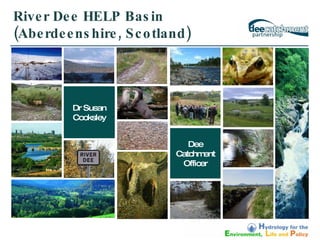
River Dee HELP Basin (Aberdeenshire, Scotland) Dr Susan Cooksley Dee Catchment Officer
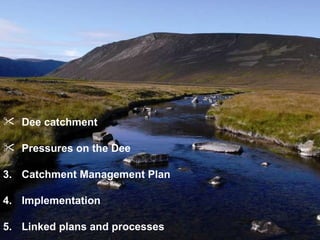
Dee catchment Pressures on the Dee Catchment Management Plan Implementation Linked plans and processes
Where is the Dee catchment? RIVER DEE Rises at 1220m 126 km long 2100 km 2 17 major tributaries
 
 
HABITATS Wetlands, bankside grasslands, riparian woodlands WATERS Rivers, burns, lochs, floodplains WILDLIFE Wych elm, freshwater pearl mussel, palmate newt, northern blue damsel fly, river lamprey, pipistrelle bat, water rail  and many others The Dee catchment’s waters
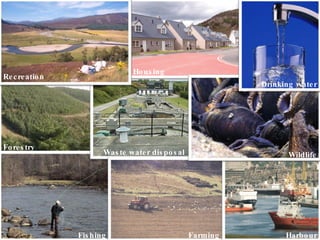
Recreation Forestry Fishing Housing Waste water disposal Farming Harbour Wildlife Drinking water
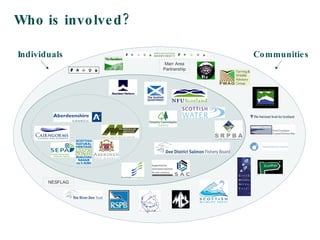
Marr Area Partnership NESFLAG Who is involved? Communities Individuals
 Provide a  strategic framework  for action    Promote widespread awareness and discussion  of the main issues  Facilitate  agreed solutions  – minimise conflicts Coordinate  activities and maximise benefits – land, water use Protect  special qualities    Develop projects  to tackle key issues    Provide a  source of information What is the role of the Dee Catchment Partnership?
2003 Steering Group formed 1999 Consultation on Issues document 2007 - 2012 Implementation phase 1 (2008-2013) Nov 2007 Publication of Dee CMP 2007 Revision 2005-2006 Working Groups develop draft Dee CMP 2013 Review Oct-Dec 2006 Public consultation on draft CMP W.F.D. S.A.C. Timeline
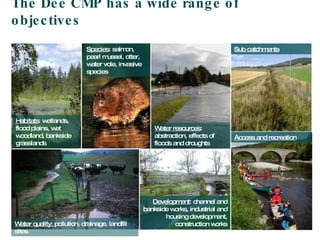
The Dee CMP has a wide range of objectives Water resources : abstraction, effects of floods and droughts Development : channel and bankside works, industrial and housing development, construction works Species : salmon, pearl mussel, otter, water vole, invasive species Access and recreation Habitats : wetlands, flood plains, wet woodland, bankside grasslands Sub catchments Water quality:  pollution, drainage, landfill sites
Partnership projects 2008-2013 1. Restoring urban watercourses 2. Reducing pollution from septic tanks 3. Reducing diffuse source pollution 4. Managing flows – runoff & storage
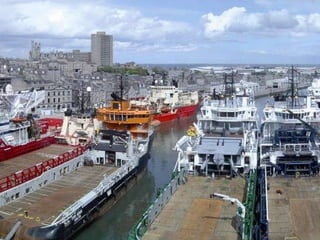
1. Restoring urban watercourses(chair: Aberdeen Harbour Board) Watercourse restoration Deculverting Coastal and harbour issues
2. Reducing pollution from septic tanks (chair: SEPA) Desk study to identify hotspots Targeted awareness raising Catchment-wide awareness
3. Reducing diffuse source pollution (chair: SNH) Agriculture Forestry Infrastructure
4. Managing flows – runoff and water storage (chair: Aberdeenshire Council) Upper Dee Riparian Woodland Restoration Upper Dee Floodplain Restoration Dee Sustainable Wetlands Aquarius - Sustainable flood management Micro-hydro strategy
Riparian woodland restoration Sustainable flood alleviation Floodplain restoration Wetland restoration Aberdeen City watercourse restoration Septic tanks improvements Aberdeen harbour – reduced litter and improved water quality Buffer strips
Coordination with other plans RBMP Local & structure plans Dee fishery plan NE & Cairngorms LBAPs CNPA Park Plan Dee CMP Access plans
Working with other catchment plans Eleven completed or ongoing CMPs in Scotland: Almond, Annan/Nith, Dee, Dee-Ken, Devon, Endrick, Loch Leven, Loch Lomond, Spey, South Esk, Tweed & Ythan Eight RBMPs Five Coastal Partnership Plans Local Biodiversity Action Plans
Dee Catchment Management Plan Priorities for implementation Implementation groups Stakeholder relationships Information exchange networks Regional, national and international recognition and involvement What have we achieved?
Dr Susan Cooksley Dee Catchment Officer c/o The Macaulay Institute, Craigiebucker, Aberdeen AB15 8QH 01224 395000  info@theriverdee.org  theriverdee.org

The Dee HELP Basin

  • 1.
    River Dee HELPBasin (Aberdeenshire, Scotland) Dr Susan Cooksley Dee Catchment Officer
  • 2.
    Dee catchment Pressureson the Dee Catchment Management Plan Implementation Linked plans and processes
  • 3.
    Where is theDee catchment? RIVER DEE Rises at 1220m 126 km long 2100 km 2 17 major tributaries
  • 4.
  • 5.
  • 6.
    HABITATS Wetlands, banksidegrasslands, riparian woodlands WATERS Rivers, burns, lochs, floodplains WILDLIFE Wych elm, freshwater pearl mussel, palmate newt, northern blue damsel fly, river lamprey, pipistrelle bat, water rail and many others The Dee catchment’s waters
  • 7.
    Recreation Forestry FishingHousing Waste water disposal Farming Harbour Wildlife Drinking water
  • 8.
    Marr Area PartnershipNESFLAG Who is involved? Communities Individuals
  • 9.
     Provide a strategic framework for action  Promote widespread awareness and discussion of the main issues  Facilitate agreed solutions – minimise conflicts Coordinate activities and maximise benefits – land, water use Protect special qualities  Develop projects to tackle key issues  Provide a source of information What is the role of the Dee Catchment Partnership?
  • 10.
    2003 Steering Groupformed 1999 Consultation on Issues document 2007 - 2012 Implementation phase 1 (2008-2013) Nov 2007 Publication of Dee CMP 2007 Revision 2005-2006 Working Groups develop draft Dee CMP 2013 Review Oct-Dec 2006 Public consultation on draft CMP W.F.D. S.A.C. Timeline
  • 11.
    The Dee CMPhas a wide range of objectives Water resources : abstraction, effects of floods and droughts Development : channel and bankside works, industrial and housing development, construction works Species : salmon, pearl mussel, otter, water vole, invasive species Access and recreation Habitats : wetlands, flood plains, wet woodland, bankside grasslands Sub catchments Water quality: pollution, drainage, landfill sites
  • 12.
    Partnership projects 2008-20131. Restoring urban watercourses 2. Reducing pollution from septic tanks 3. Reducing diffuse source pollution 4. Managing flows – runoff & storage
  • 13.
    1. Restoring urbanwatercourses(chair: Aberdeen Harbour Board) Watercourse restoration Deculverting Coastal and harbour issues
  • 14.
    2. Reducing pollutionfrom septic tanks (chair: SEPA) Desk study to identify hotspots Targeted awareness raising Catchment-wide awareness
  • 15.
    3. Reducing diffusesource pollution (chair: SNH) Agriculture Forestry Infrastructure
  • 16.
    4. Managing flows– runoff and water storage (chair: Aberdeenshire Council) Upper Dee Riparian Woodland Restoration Upper Dee Floodplain Restoration Dee Sustainable Wetlands Aquarius - Sustainable flood management Micro-hydro strategy
  • 17.
    Riparian woodland restorationSustainable flood alleviation Floodplain restoration Wetland restoration Aberdeen City watercourse restoration Septic tanks improvements Aberdeen harbour – reduced litter and improved water quality Buffer strips
  • 18.
    Coordination with otherplans RBMP Local & structure plans Dee fishery plan NE & Cairngorms LBAPs CNPA Park Plan Dee CMP Access plans
  • 19.
    Working with othercatchment plans Eleven completed or ongoing CMPs in Scotland: Almond, Annan/Nith, Dee, Dee-Ken, Devon, Endrick, Loch Leven, Loch Lomond, Spey, South Esk, Tweed & Ythan Eight RBMPs Five Coastal Partnership Plans Local Biodiversity Action Plans
  • 20.
    Dee Catchment ManagementPlan Priorities for implementation Implementation groups Stakeholder relationships Information exchange networks Regional, national and international recognition and involvement What have we achieved?
  • 21.
    Dr Susan CooksleyDee Catchment Officer c/o The Macaulay Institute, Craigiebucker, Aberdeen AB15 8QH 01224 395000 info@theriverdee.org theriverdee.org