Printhead Selection
Ink Jet Technology Showcase 2014
September 3-5, 2014
Hilton Charlotte University Place
Charlotte, North Carolina
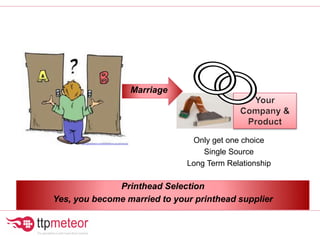
Printhead Selection
Yes, you become married to your printhead supplier
Marriage
Only get one choice
Single Source
Long Term Relationship
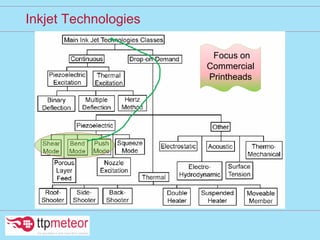
Inkjet Technologies
Focus on
Commercial
Printheads
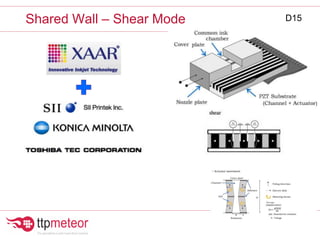
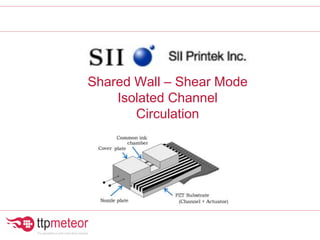
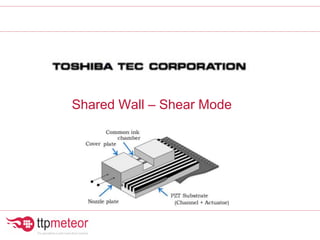
Shared Wall – Shear Mode D15
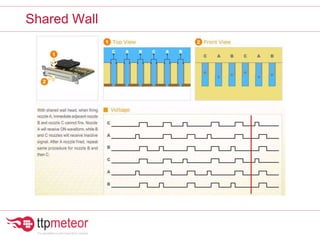
Shared Wall
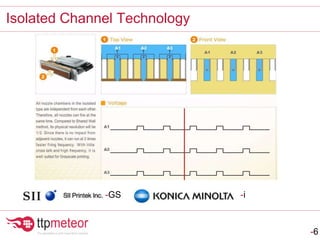
Isolated Channel Technology
-6
-GS -i
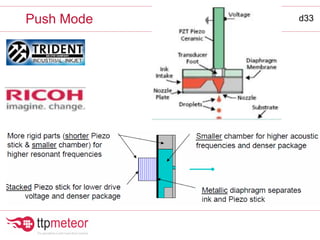
Push Mode d33
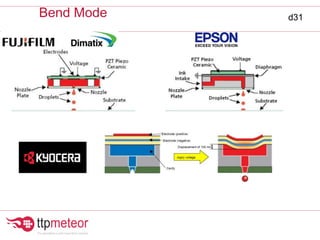
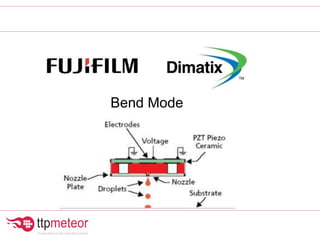
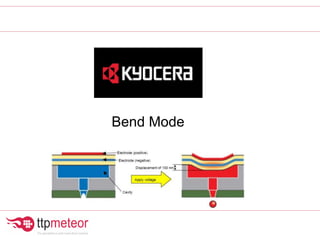
Bend Mode d31
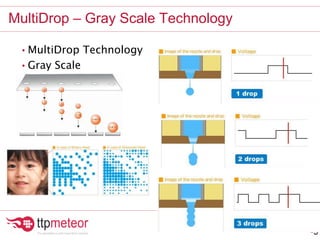
MultiDrop – Gray Scale Technology
-9
• MultiDrop Technology
• Gray Scale
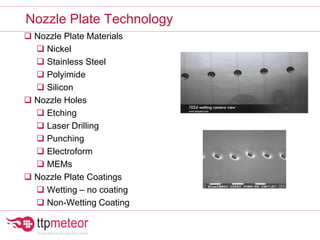
 Nozzle Plate Materials
 Nickel
 Stainless Steel
 Polyimide
 Silicon
 Nozzle Holes
 Etching
 Laser Drilling
 Punching
 Electroform
 MEMs
 Nozzle Plate Coatings
 Wetting – no coating
 Non-Wetting Coating
Nozzle Plate Technology
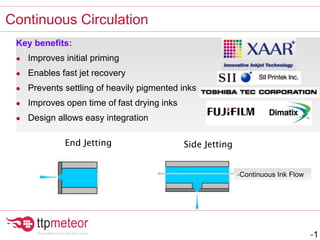
Key benefits:
 Improves initial priming
 Enables fast jet recovery
 Prevents settling of heavily pigmented inks
 Improves open time of fast drying inks
 Design allows easy integration
Continuous Circulation
-1
End Jetting Side Jetting
-Continuous Ink Flow
I don’t know!
Performance
Depends on the application
Reliability
Highly dependent on ink
chemistry and Cleanliness
Cost
Cost per nozzle
Replacement Cost
Efficiency
Let’s Look at what’s offered
Which Technology is best?
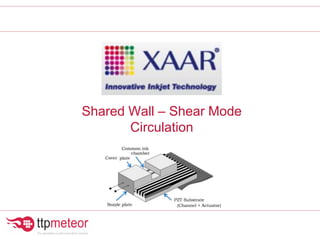
Shared Wall – Shear Mode
Circulation
Shared Wall – Shear Mode
Isolated Channel
Circulation
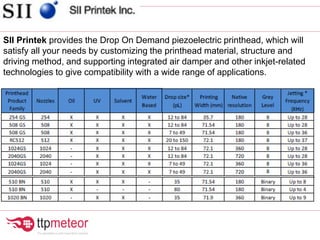
SII Printek provides the Drop On Demand piezoelectric printhead, which will
satisfy all your needs by customizing the printhead material, structure and
driving method, and supporting integrated air damper and other inkjet-related
technologies to give compatibility with a wide range of applications.
1024GS High productivity (600[μL/sec])
 Isolated channel technology:
 Grayscale & variable binary mode
 7 [pL] at one drop and maximum 49 [pL] at 7 drops.
 Built-in Ink Damper:
 Stable supply of ink to all 1024 nozzles.
RC1536
Performance SPT RC1536
RC1536
Print width 108.3mm
number of nozzles 1536
Resolution 360
Grayscale 8 levels
Drop Volume 17-100pl
Dot Frequency 10.4kHz (7drop)
Productivity/nozzle [kHz*pl] 1040
Productivity/head [ml/min] 95.8
number of heads/Bar*1
7
Max Discharge/Bar*2
[g/2
@25m/min]
48.8
(360dpi*634dpi)
*1: 1Bar=700mm
*2: Specific gravity=1.38
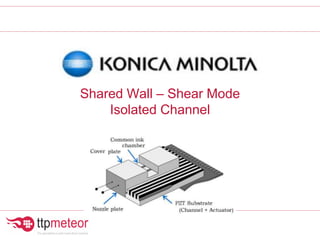
Shared Wall – Shear Mode
Isolated Channel
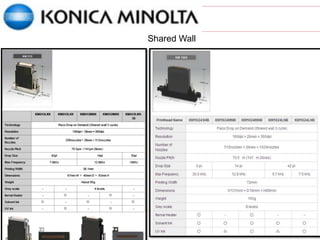
Shared Wall
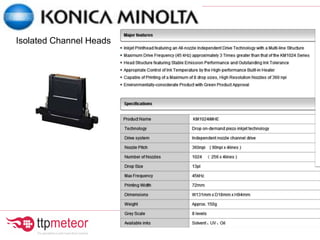
Isolated Channel Heads
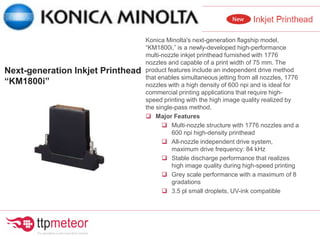
Konica Minolta's next-generation flagship model,
“KM1800i,” is a newly-developed high-performance
multi-nozzle inkjet printhead furnished with 1776
nozzles and capable of a print width of 75 mm. The
product features include an independent drive method
that enables simultaneous jetting from all nozzles, 1776
nozzles with a high density of 600 npi and is ideal for
commercial printing applications that require high-
speed printing with the high image quality realized by
the single-pass method.
 Major Features
 Multi-nozzle structure with 1776 nozzles and a
600 npi high-density printhead
 All-nozzle independent drive system,
maximum drive frequency: 84 kHz
 Stable discharge performance that realizes
high image quality during high-speed printing
 Grey scale performance with a maximum of 8
gradations
 3.5 pl small droplets, UV-ink compatible
Next-generation Inkjet Printhead
“KM1800i”
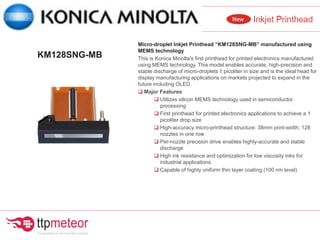
Micro-droplet Inkjet Printhead “KM128SNG-MB” manufactured using
MEMS technology
This is Konica Minolta's first printhead for printed electronics manufactured
using MEMS technology. This model enables accurate, high-precision and
stable discharge of micro-droplets 1 picoliter in size and is the ideal head for
display manufacturing applications on markets projected to expand in the
future including OLED.
 Major Features
 Utilizes silicon MEMS technology used in semiconductor
processing
 First printhead for printed electronics applications to achieve a 1
picoliter drop size
 High-accuracy micro-printhead structure: 38mm print-width; 128
nozzles in one row
 Per-nozzle precision drive enables highly-accurate and stable
discharge
 High ink resistance and optimization for low viscosity inks for
industrial applications
 Capable of highly uniform thin layer coating (100 nm level)
KM128SNG-MB
Shared Wall – Shear Mode
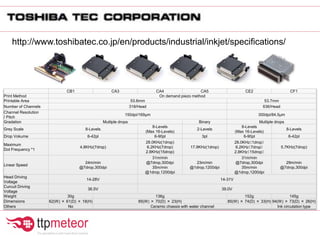
CB1 CA3 CA4 CA5 CE2 CF1
Print Method On demand piezo method
Printable Area 53.6mm 53.7mm
Number of Channels 318/Head 636/Head
Channel Resolution
/ Pitch
150dpi/169μm 300dpi/84.5μm
Gradation Mulitple drops Binary Mulitple drops
Grey Scale 8-Levels
8-Levels
(Max 16-Levels)
2-Levels
8-Levels
(Max 16-Levels)
8-Levels
Drop Vokume 6-42pl 6-90pl 3pl 6-90pl 6-42pl
Maximum
Dot Frequency *1
4.8KHz(7drop)
28.0KHz(1drop)
6.2KHz(7drop)
2.8KHz(15drop)
17.9KHz(1drop)
28.0KHz(1drop)
6.2KHz(7drop)
2.8KHz(15drop)
5.7KHz(7drop)
Linear Speed
24m/min
@7drop,300dpi
31m/min
@7drop,300dpi
35m/min
@1drop,1200dpi
23m/min
@1drop,1200dpi
31m/min
@7drop,300dpi
35m/min
@1drop,1200dpi
29m/min
@7drop,300dpi
Head Driving
Voltage
14-28V 14-31V
Curcuit Driving
Voltage
36.5V 39.0V
Weight 30g 136g 152g 145g
Dimensions 62(W) × 61(D) × 18(H) 85(W) × 70(D) × 23(H) 85(W) × 74(D) × 33(H) 94(W) × 73(D) × 26(H)
Others No Ceramic chassis with water channel Ink circulation type
http://www.toshibatec.co.jp/en/products/industrial/inkjet/specifications/
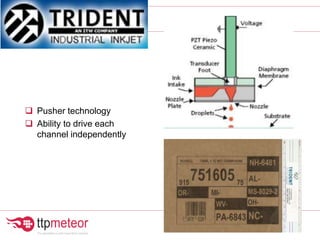
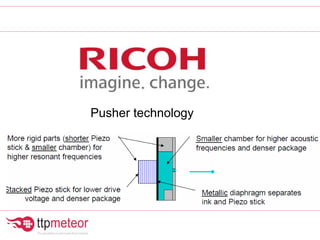
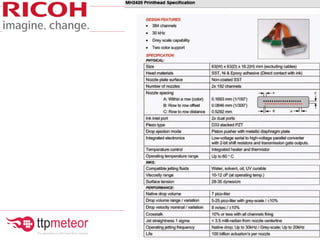
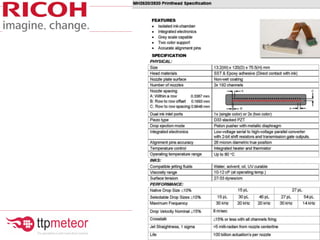
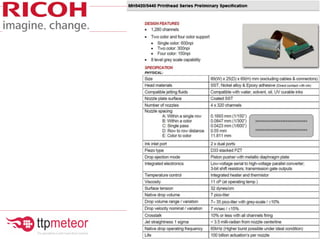
 Pusher technology
 Ability to drive each
channel independently
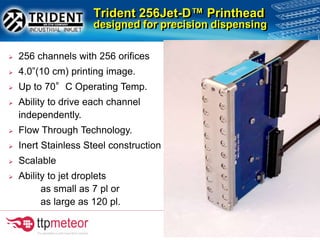
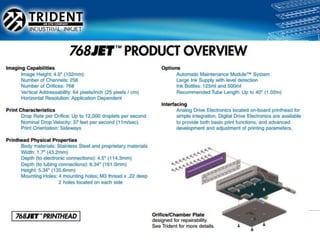
Trident 256Jet-D™ Printhead
designed for precision dispensing
 256 channels with 256 orifices
 4.0”(10 cm) printing image.
 Up to 70°C Operating Temp.
 Ability to drive each channel
independently.
 Flow Through Technology.
 Inert Stainless Steel construction
 Scalable
 Ability to jet droplets
as small as 7 pl or
as large as 120 pl.
Serviceable Design
Ability to Clean = Long Life!
 Polyimide
 Phosphoric Acid & KOH Alkaline Etchants
 Nanosilver ink
 Dielectric ink
 UV Cured Overcoat
 PEDOT:PSS
Examples:
Trident Jettable Materials
Pusher technology
Bend Mode
Commercial
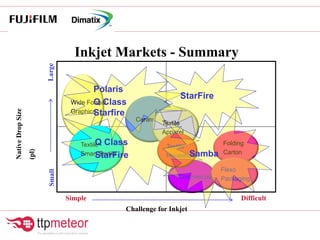
Inkjet Markets - Summary
NativeDropSize
(pl)
LargeSmall
Challenge for Inkjet
Simple Difficult
Wide Format
Graphics
Ceramic Tiles
Textile
Apparel
Folding
Carton
Textile
Smart Textile
Flexo
Packaging
Textile
Household
Polaris
Q Class
Starfire
Q Class
StarFire
StarFire
Samba
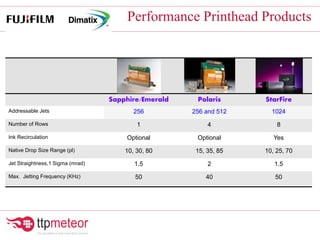
Performance Printhead Products
Sapphire/Emerald Polaris StarFire
Addressable Jets 256 256 and 512 1024
Number of Rows 1 4 8
Ink Recirculation Optional Optional Yes
Native Drop Size Range (pl) 10, 30, 80 15, 35, 85 10, 25, 70
Jet Straightness,1 Sigma (mrad) 1.5 2 1.5
Max. Jetting Frequency (KHz) 50 40 50
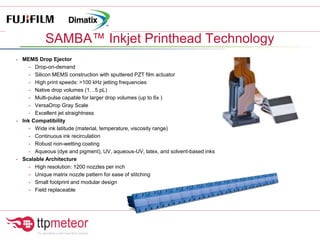
- MEMS Drop Ejector
- Drop-on-demand
- Silicon MEMS construction with sputtered PZT film actuator
- High print speeds: >100 kHz jetting frequencies
- Native drop volumes (1…5 pL)
- Multi-pulse capable for larger drop volumes (up to 6x )
- VersaDrop Gray Scale
- Excellent jet straightness
- Ink Compatibility
- Wide ink latitude (material, temperature, viscosity range)
- Continuous ink recirculation
- Robust non-wetting coating
- Aqueous (dye and pigment), UV, aqueous-UV, latex, and solvent-based inks
- Scalable Architecture
- High resolution: 1200 nozzles per inch
- Unique matrix nozzle pattern for ease of stitching
- Small footprint and modular design
- Field replaceable
SAMBA™ Inkjet Printhead Technology
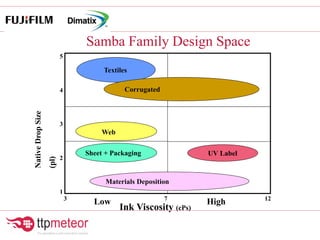
Samba Family Design Space
Ink Viscosity (cPs)
NativeDropSize
(pl)
High
Web
Low
Sheet + Packaging
Materials Deposition
Textiles
Corrugated
UV Label
3
4
5
2
1
3 7 12
Bend Mode
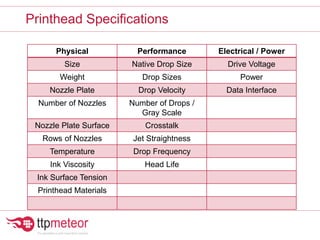
PRINTHEAD SPECIFICATIONS
DISCUSSION
Physical Performance Electrical / Power
Size Native Drop Size Drive Voltage
Weight Drop Sizes Power
Nozzle Plate Drop Velocity Data Interface
Number of Nozzles Number of Drops /
Gray Scale
Nozzle Plate Surface Crosstalk
Rows of Nozzles Jet Straightness
Temperature Drop Frequency
Ink Viscosity Head Life
Ink Surface Tension
Printhead Materials
Printhead Specifications
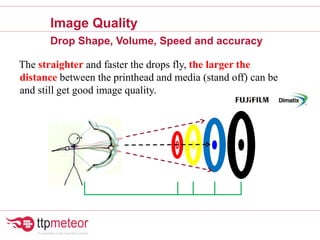
The straighter and faster the drops fly, the larger the
distance between the printhead and media (stand off) can be
and still get good image quality.
Image Quality
Drop Shape, Volume, Speed and accuracy
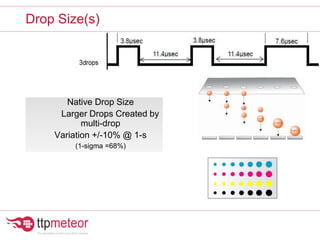
Drop Size(s)
Native Drop Size
Larger Drops Created by
multi-drop
Variation +/-10% @ 1-s
(1-sigma =68%)
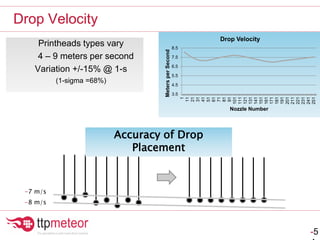
Drop Velocity
-5
-7 m/s
-8 m/s
3.5
4.5
5.5
6.5
7.5
8.5
1
11
21
31
41
51
61
71
81
91
101
111
121
131
141
151
161
171
181
191
201
211
221
231
241
251
MetersperSecond
Nozzle Number
Drop Velocity
Accuracy of Drop
Placement
Printheads types vary
4 – 9 meters per second
Variation +/-15% @ 1-s
(1-sigma =68%)
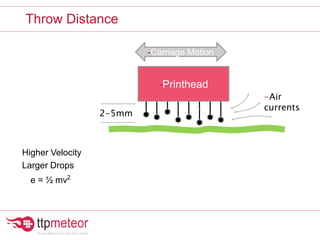
Throw Distance
-Printhead
2-5mm
-Carriage Motion
-Air
currents
Higher Velocity
Larger Drops
e = ½ mv2
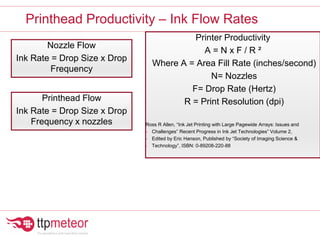
Printer Productivity
A = N x F / R ²
Where A = Area Fill Rate (inches/second)
N= Nozzles
F= Drop Rate (Hertz)
R = Print Resolution (dpi)
Ross R Allen, “Ink Jet Printing with Large Pagewide Arrays: Issues and
- Challenges” Recent Progress in Ink Jet Technologies” Volume 2,
- Edited by Eric Hanson, Published by “Society of Imaging Science &
- Technology”, ISBN: 0-89208-220-88
Printhead Productivity – Ink Flow Rates
Nozzle Flow
Ink Rate = Drop Size x Drop
Frequency
Printhead Flow
Ink Rate = Drop Size x Drop
Frequency x nozzles
Comparison: Ink Lay-Down at similar line speeds
Ceramic Ink SG1024M SG1024L* Competitor A Competitor Z
Large Drop (ng) 91 182 126 118
Max Freq (kHz) – Grayscale Mode 13.8 10 4.8 6
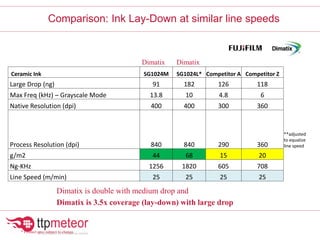
Native Resolution (dpi) 400 400 300 360
Process Resolution (dpi) 840 840 290 360
**adjusted
to equalize
line speed
g/m2 44 68 15 20
Ng-KHz 1256 1820 605 708
Line Speed (m/min) 25 25 25 25
Dimatix is double with medium drop and
Dimatix is 3.5x coverage (lay-down) with large drop
Dimatix Dimatix
* Product spec subject to change
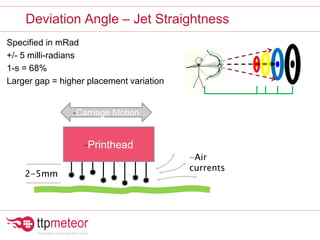
Specified in mRad
+/- 5 milli-radians
1-s = 68%
Larger gap = higher placement variation
Deviation Angle – Jet Straightness
-Printhead
2-5mm
-Carriage Motion
-Air
currents
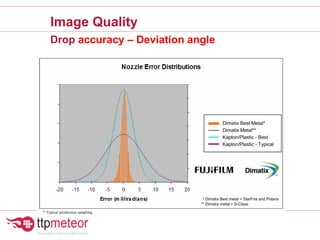
* Typical production sampling
Image Quality
Drop accuracy – Deviation angle
Dimatix Best Metal*
Dimatix Metal**
Kapton/Plastic - Best
Kapton/Plastic - Typical
* Dimatix Best metal = StarFire and Polaris
** Dimatix metal = S-Class
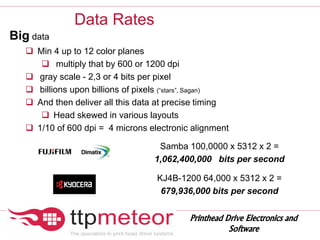
Data Rates
Big data
 Min 4 up to 12 color planes
 multiply that by 600 or 1200 dpi
 gray scale - 2,3 or 4 bits per pixel
 billions upon billions of pixels (“stars”, Sagan)
 And then deliver all this data at precise timing
 Head skewed in various layouts
 1/10 of 600 dpi = 4 microns electronic alignment
Printhead Drive Electronics and
Software
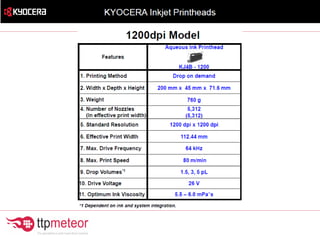
Samba 100,0000 x 5312 x 2 =
1,062,400,000 bits per second
KJ4B-1200 64,000 x 5312 x 2 =
679,936,000 bits per second
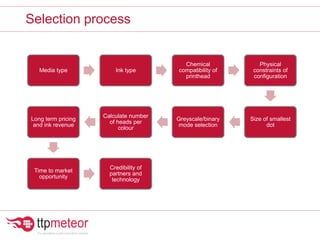
Media type Ink type
Chemical
compatibility of
printhead
Physical
constraints of
configuration
Size of smallest
dot
Greyscale/binary
mode selection
Calculate number
of heads per
colour
Long term pricing
and ink revenue
Time to market
opportunity
Credibility of
partners and
technology
Selection process
Thank You
The Technology Partnership plc ‘TTP’
Melbourn, Herts. SG8 6EE. UK
Mike Raymond
Technical Sales – Business Development
Philadelphia, USA
Mike.Raymond@ttpMeteor.com
-

IMI Printhead Selection Raymond 20140903 v1.0

  • 1.
    Printhead Selection Ink JetTechnology Showcase 2014 September 3-5, 2014 Hilton Charlotte University Place Charlotte, North Carolina
  • 2.
    Printhead Selection Yes, youbecome married to your printhead supplier Marriage Only get one choice Single Source Long Term Relationship
  • 3.
  • 4.
    Shared Wall –Shear Mode D15
  • 5.
  • 6.
  • 7.
  • 8.
  • 9.
    MultiDrop – GrayScale Technology -9 • MultiDrop Technology • Gray Scale
  • 10.
     Nozzle PlateMaterials  Nickel  Stainless Steel  Polyimide  Silicon  Nozzle Holes  Etching  Laser Drilling  Punching  Electroform  MEMs  Nozzle Plate Coatings  Wetting – no coating  Non-Wetting Coating Nozzle Plate Technology
  • 11.
    Key benefits:  Improvesinitial priming  Enables fast jet recovery  Prevents settling of heavily pigmented inks  Improves open time of fast drying inks  Design allows easy integration Continuous Circulation -1 End Jetting Side Jetting -Continuous Ink Flow
  • 12.
    I don’t know! Performance Dependson the application Reliability Highly dependent on ink chemistry and Cleanliness Cost Cost per nozzle Replacement Cost Efficiency Let’s Look at what’s offered Which Technology is best?
  • 13.
    Shared Wall –Shear Mode Circulation
  • 15.
    Shared Wall –Shear Mode Isolated Channel Circulation
  • 16.
    SII Printek providesthe Drop On Demand piezoelectric printhead, which will satisfy all your needs by customizing the printhead material, structure and driving method, and supporting integrated air damper and other inkjet-related technologies to give compatibility with a wide range of applications.
  • 17.
    1024GS High productivity(600[μL/sec])  Isolated channel technology:  Grayscale & variable binary mode  7 [pL] at one drop and maximum 49 [pL] at 7 drops.  Built-in Ink Damper:  Stable supply of ink to all 1024 nozzles.
  • 18.
    RC1536 Performance SPT RC1536 RC1536 Printwidth 108.3mm number of nozzles 1536 Resolution 360 Grayscale 8 levels Drop Volume 17-100pl Dot Frequency 10.4kHz (7drop) Productivity/nozzle [kHz*pl] 1040 Productivity/head [ml/min] 95.8 number of heads/Bar*1 7 Max Discharge/Bar*2 [g/2 @25m/min] 48.8 (360dpi*634dpi) *1: 1Bar=700mm *2: Specific gravity=1.38
  • 19.
    Shared Wall –Shear Mode Isolated Channel
  • 20.
  • 21.
  • 22.
    Konica Minolta's next-generationflagship model, “KM1800i,” is a newly-developed high-performance multi-nozzle inkjet printhead furnished with 1776 nozzles and capable of a print width of 75 mm. The product features include an independent drive method that enables simultaneous jetting from all nozzles, 1776 nozzles with a high density of 600 npi and is ideal for commercial printing applications that require high- speed printing with the high image quality realized by the single-pass method.  Major Features  Multi-nozzle structure with 1776 nozzles and a 600 npi high-density printhead  All-nozzle independent drive system, maximum drive frequency: 84 kHz  Stable discharge performance that realizes high image quality during high-speed printing  Grey scale performance with a maximum of 8 gradations  3.5 pl small droplets, UV-ink compatible Next-generation Inkjet Printhead “KM1800i”
  • 23.
    Micro-droplet Inkjet Printhead“KM128SNG-MB” manufactured using MEMS technology This is Konica Minolta's first printhead for printed electronics manufactured using MEMS technology. This model enables accurate, high-precision and stable discharge of micro-droplets 1 picoliter in size and is the ideal head for display manufacturing applications on markets projected to expand in the future including OLED.  Major Features  Utilizes silicon MEMS technology used in semiconductor processing  First printhead for printed electronics applications to achieve a 1 picoliter drop size  High-accuracy micro-printhead structure: 38mm print-width; 128 nozzles in one row  Per-nozzle precision drive enables highly-accurate and stable discharge  High ink resistance and optimization for low viscosity inks for industrial applications  Capable of highly uniform thin layer coating (100 nm level) KM128SNG-MB
  • 24.
    Shared Wall –Shear Mode
  • 25.
    CB1 CA3 CA4CA5 CE2 CF1 Print Method On demand piezo method Printable Area 53.6mm 53.7mm Number of Channels 318/Head 636/Head Channel Resolution / Pitch 150dpi/169μm 300dpi/84.5μm Gradation Mulitple drops Binary Mulitple drops Grey Scale 8-Levels 8-Levels (Max 16-Levels) 2-Levels 8-Levels (Max 16-Levels) 8-Levels Drop Vokume 6-42pl 6-90pl 3pl 6-90pl 6-42pl Maximum Dot Frequency *1 4.8KHz(7drop) 28.0KHz(1drop) 6.2KHz(7drop) 2.8KHz(15drop) 17.9KHz(1drop) 28.0KHz(1drop) 6.2KHz(7drop) 2.8KHz(15drop) 5.7KHz(7drop) Linear Speed 24m/min @7drop,300dpi 31m/min @7drop,300dpi 35m/min @1drop,1200dpi 23m/min @1drop,1200dpi 31m/min @7drop,300dpi 35m/min @1drop,1200dpi 29m/min @7drop,300dpi Head Driving Voltage 14-28V 14-31V Curcuit Driving Voltage 36.5V 39.0V Weight 30g 136g 152g 145g Dimensions 62(W) × 61(D) × 18(H) 85(W) × 70(D) × 23(H) 85(W) × 74(D) × 33(H) 94(W) × 73(D) × 26(H) Others No Ceramic chassis with water channel Ink circulation type http://www.toshibatec.co.jp/en/products/industrial/inkjet/specifications/
  • 26.
     Pusher technology Ability to drive each channel independently
  • 27.
    Trident 256Jet-D™ Printhead designedfor precision dispensing  256 channels with 256 orifices  4.0”(10 cm) printing image.  Up to 70°C Operating Temp.  Ability to drive each channel independently.  Flow Through Technology.  Inert Stainless Steel construction  Scalable  Ability to jet droplets as small as 7 pl or as large as 120 pl.
  • 28.
  • 29.
     Polyimide  PhosphoricAcid & KOH Alkaline Etchants  Nanosilver ink  Dielectric ink  UV Cured Overcoat  PEDOT:PSS Examples: Trident Jettable Materials
  • 31.
  • 37.
  • 38.
    Commercial Inkjet Markets -Summary NativeDropSize (pl) LargeSmall Challenge for Inkjet Simple Difficult Wide Format Graphics Ceramic Tiles Textile Apparel Folding Carton Textile Smart Textile Flexo Packaging Textile Household Polaris Q Class Starfire Q Class StarFire StarFire Samba
  • 39.
    Performance Printhead Products Sapphire/EmeraldPolaris StarFire Addressable Jets 256 256 and 512 1024 Number of Rows 1 4 8 Ink Recirculation Optional Optional Yes Native Drop Size Range (pl) 10, 30, 80 15, 35, 85 10, 25, 70 Jet Straightness,1 Sigma (mrad) 1.5 2 1.5 Max. Jetting Frequency (KHz) 50 40 50
  • 40.
    - MEMS DropEjector - Drop-on-demand - Silicon MEMS construction with sputtered PZT film actuator - High print speeds: >100 kHz jetting frequencies - Native drop volumes (1…5 pL) - Multi-pulse capable for larger drop volumes (up to 6x ) - VersaDrop Gray Scale - Excellent jet straightness - Ink Compatibility - Wide ink latitude (material, temperature, viscosity range) - Continuous ink recirculation - Robust non-wetting coating - Aqueous (dye and pigment), UV, aqueous-UV, latex, and solvent-based inks - Scalable Architecture - High resolution: 1200 nozzles per inch - Unique matrix nozzle pattern for ease of stitching - Small footprint and modular design - Field replaceable SAMBA™ Inkjet Printhead Technology
  • 41.
    Samba Family DesignSpace Ink Viscosity (cPs) NativeDropSize (pl) High Web Low Sheet + Packaging Materials Deposition Textiles Corrugated UV Label 3 4 5 2 1 3 7 12
  • 42.
  • 50.
  • 51.
    Physical Performance Electrical/ Power Size Native Drop Size Drive Voltage Weight Drop Sizes Power Nozzle Plate Drop Velocity Data Interface Number of Nozzles Number of Drops / Gray Scale Nozzle Plate Surface Crosstalk Rows of Nozzles Jet Straightness Temperature Drop Frequency Ink Viscosity Head Life Ink Surface Tension Printhead Materials Printhead Specifications
  • 52.
    The straighter andfaster the drops fly, the larger the distance between the printhead and media (stand off) can be and still get good image quality. Image Quality Drop Shape, Volume, Speed and accuracy
  • 53.
    Drop Size(s) Native DropSize Larger Drops Created by multi-drop Variation +/-10% @ 1-s (1-sigma =68%)
  • 54.
    Drop Velocity -5 -7 m/s -8m/s 3.5 4.5 5.5 6.5 7.5 8.5 1 11 21 31 41 51 61 71 81 91 101 111 121 131 141 151 161 171 181 191 201 211 221 231 241 251 MetersperSecond Nozzle Number Drop Velocity Accuracy of Drop Placement Printheads types vary 4 – 9 meters per second Variation +/-15% @ 1-s (1-sigma =68%)
  • 55.
  • 56.
    Printer Productivity A =N x F / R ² Where A = Area Fill Rate (inches/second) N= Nozzles F= Drop Rate (Hertz) R = Print Resolution (dpi) Ross R Allen, “Ink Jet Printing with Large Pagewide Arrays: Issues and - Challenges” Recent Progress in Ink Jet Technologies” Volume 2, - Edited by Eric Hanson, Published by “Society of Imaging Science & - Technology”, ISBN: 0-89208-220-88 Printhead Productivity – Ink Flow Rates Nozzle Flow Ink Rate = Drop Size x Drop Frequency Printhead Flow Ink Rate = Drop Size x Drop Frequency x nozzles
  • 57.
    Comparison: Ink Lay-Downat similar line speeds Ceramic Ink SG1024M SG1024L* Competitor A Competitor Z Large Drop (ng) 91 182 126 118 Max Freq (kHz) – Grayscale Mode 13.8 10 4.8 6 Native Resolution (dpi) 400 400 300 360 Process Resolution (dpi) 840 840 290 360 **adjusted to equalize line speed g/m2 44 68 15 20 Ng-KHz 1256 1820 605 708 Line Speed (m/min) 25 25 25 25 Dimatix is double with medium drop and Dimatix is 3.5x coverage (lay-down) with large drop Dimatix Dimatix * Product spec subject to change
  • 58.
    Specified in mRad +/-5 milli-radians 1-s = 68% Larger gap = higher placement variation Deviation Angle – Jet Straightness -Printhead 2-5mm -Carriage Motion -Air currents
  • 59.
    * Typical productionsampling Image Quality Drop accuracy – Deviation angle Dimatix Best Metal* Dimatix Metal** Kapton/Plastic - Best Kapton/Plastic - Typical * Dimatix Best metal = StarFire and Polaris ** Dimatix metal = S-Class
  • 60.
    Data Rates Big data Min 4 up to 12 color planes  multiply that by 600 or 1200 dpi  gray scale - 2,3 or 4 bits per pixel  billions upon billions of pixels (“stars”, Sagan)  And then deliver all this data at precise timing  Head skewed in various layouts  1/10 of 600 dpi = 4 microns electronic alignment Printhead Drive Electronics and Software Samba 100,0000 x 5312 x 2 = 1,062,400,000 bits per second KJ4B-1200 64,000 x 5312 x 2 = 679,936,000 bits per second
  • 61.
    Media type Inktype Chemical compatibility of printhead Physical constraints of configuration Size of smallest dot Greyscale/binary mode selection Calculate number of heads per colour Long term pricing and ink revenue Time to market opportunity Credibility of partners and technology Selection process
  • 62.
    Thank You The TechnologyPartnership plc ‘TTP’ Melbourn, Herts. SG8 6EE. UK Mike Raymond Technical Sales – Business Development Philadelphia, USA Mike.Raymond@ttpMeteor.com -