INK MIGRATION
UNDERSTANDING
FOOD • PHARMACEUTICALS • HEALTH & BEAUTY
● The printing on the outside
ends up in the product
INK
MIGRATION?
WHAT IS
What are the risks?
It puts consumer
health at risk
Changes the flavor and odor
of products
It violates regulations
It can damage the brand
reputation
BEWARE
The Low-Migration
Misconception
!
● Ink alone cannot be considered “low-migration”
until it’s actually applied to the packaging and
tested.
TESTING
CONSIDERATIONS
● Printing conditions - heat & humidity
● Food characteristics
● Ink coverage ratio
● Curing/drying time
● Storage and transportation conditions
● Expected shelf life
● Consumer usage
It’s More than the Ink &
Substrate
SET-OFF
MIGRATION
DIFFUSION
MIGRATION
GAS-PHASE
MIGRATION
1
2
3
INK
MIGRATION
TYPES OF
3
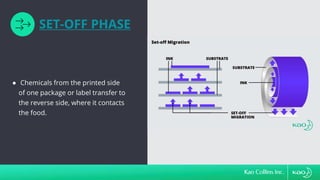
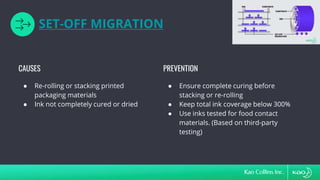
● Chemicals from the printed side
of one package or label transfer to
the reverse side, where it contacts
the food.
SET-OFF PHASE
SET-OFF MIGRATION
CAUSES
● Re-rolling or stacking printed
packaging materials
● Ink not completely cured or dried
PREVENTION
● Ensure complete curing before
stacking or re-rolling
● Keep total ink coverage below 300%
● Use inks tested for food contact
materials. (Based on third-party
testing)
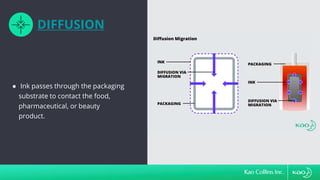
● Ink passes through the packaging
substrate to contact the food,
pharmaceutical, or beauty
product.
DIFFUSION
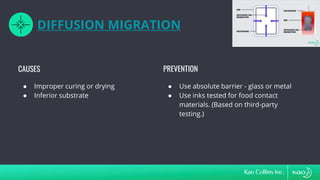
DIFFUSION MIGRATION
CAUSES
● Improper curing or drying
● Inferior substrate
PREVENTION
● Use absolute barrier - glass or metal
● Use inks tested for food contact
materials. (Based on third-party
testing.)
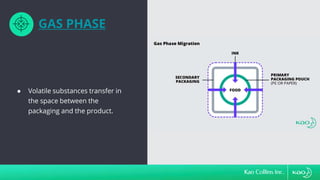
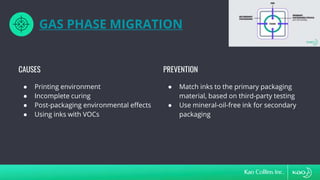
● Volatile substances transfer in
the space between the
packaging and the product.
GAS PHASE
GAS PHASE MIGRATION
CAUSES
● Printing environment
● Incomplete curing
● Post-packaging environmental effects
● Using inks with VOCs
PREVENTION
● Match inks to the primary packaging
material, based on third-party testing
● Use mineral-oil-free ink for secondary
packaging
GOOD MANUFACTURING
PRACTICES (GMPs)
QUALITY CONTROL
● A system to insure products are
consistently produced and controlled
based on quality standards.
PRACTICES
10
PROCEDURES
QUALITY CONTROL • GMPs ● Detailed written procedures
(easily understood)
● Track performance
● Verify calculations
● Tracing and tracking systems
1 10 GMPs
PLANT &
FACILITIES
QUALITY CONTROL • GMPs
● Free from contamination risk
● Operated in a suitable location
● Built to industry standards
● Designed to minimize risk
● Easy to clean and maintain
2 10 GMPs
DOCUMENTATION &
RECORD KEEPING
QUALITY CONTROL • GMPs
● Integrity of standard
operating procedures
● Design history file (DHF)
● Employee training
● Manage document changes
● Designed to minimize risk
● Easy to clean and maintain
3 10 GMPs
PERSONNEL
QUALITY CONTROL • GMPs ● Trained upon hiring
● Qualified for specific jobs
● Understanding of GMPs
● Ongoing annual training
● Traffic patterns for guests
and employees
4 10 GMPs
SANITATION
PROGRAMS
QUALITY CONTROL • GMPs
● Outline policies and
processes
● Avoiding cross
contamination
● Create master schedule
5 10 GMPs
WATER
POTABILITY
QUALITY CONTROL • GMPs
● Monitor sources
● Ensure proper plumbing
● Monitor ice
● Minimum annual testing
6 10 GMPs
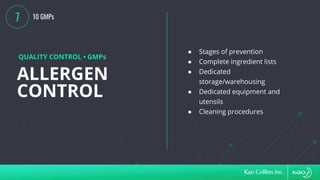
ALLERGEN
CONTROL
QUALITY CONTROL • GMPs
● Stages of prevention
● Complete ingredient lists
● Dedicated
storage/warehousing
● Dedicated equipment and
utensils
● Cleaning procedures
7 10 GMPs
EQUIPMENT,
UTENSILS &
MAINTENANCE
QUALITY CONTROL • GMPs
● Well-designed preventive
maintenance program
● Sanitation procedures
● Investigating, documenting
equipment failures
● Procedures for bringing new
equipment online
8 10 GMPs
RECEIVING,
WAREHOUSING,
SHIPPING
QUALITY CONTROL • GMPs ● Tracking from arrival to departure
● Storage in proper and sanitary
conditions
● Map of designated storage areas
● Supplier protocols
● Acceptance and rejections criteria
9 10 GMPs
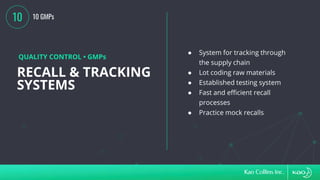
RECALL & TRACKING
SYSTEMS
QUALITY CONTROL • GMPs
● System for tracking through
the supply chain
● Lot coding raw materials
● Established testing system
● Fast and efficient recall
processes
● Practice mock recalls
10 10 GMPs
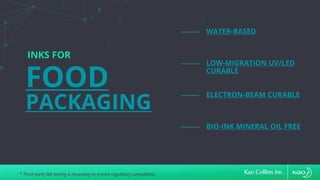
WATER-BASED
FOOD
PACKAGING
INKS FOR
LOW-MIGRATION UV/LED
CURABLE
ELECTRON-BEAM CURABLE
* Third-party lab testing is necessary to ensure regulatory compliance.
BIO-INK MINERAL OIL FREE
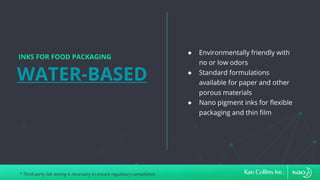
WATER-BASED
INKS FOR FOOD PACKAGING
● Environmentally friendly with
no or low odors
● Standard formulations
available for paper and other
porous materials
● Nano pigment inks for flexible
packaging and thin film
* Third-party lab testing is necessary to ensure regulatory compliance.
LOW-MIGRATION
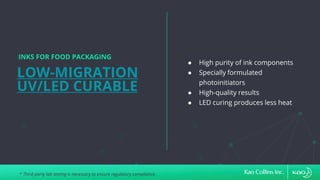
UV/LED CURABLE
INKS FOR FOOD PACKAGING
● High purity of ink components
● Specially formulated
photoinitiators
● High-quality results
● LED curing produces less heat
* Third-party lab testing is necessary to ensure regulatory compliance.
ELECTRON-BEAM
CURABLE
INKS FOR FOOD PACKAGING
● No photoinitiators used
● Low energy consumption
● No heat generated
● High visual appeal
● Instant curing
* Third-party lab testing is necessary to ensure regulatory compliance.
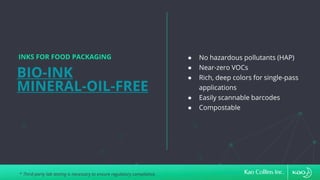
BIO-INK
MINERAL-OIL-FREE
INKS FOR FOOD PACKAGING ● No hazardous pollutants (HAP)
● Near-zero VOCs
● Rich, deep colors for single-pass
applications
● Easily scannable barcodes
● Compostable
* Third-party lab testing is necessary to ensure regulatory compliance.
● kaocollins.com
● (513) 948-9000
CONTACT
READ MORE
Prevent Ink Migration
Food-Grade Ink Regulations

What is Ink Migration in Packaging

  • 1.
    INK MIGRATION UNDERSTANDING FOOD •PHARMACEUTICALS • HEALTH & BEAUTY
  • 2.
    ● The printingon the outside ends up in the product INK MIGRATION? WHAT IS
  • 3.
    What are therisks? It puts consumer health at risk Changes the flavor and odor of products It violates regulations It can damage the brand reputation
  • 4.
    BEWARE The Low-Migration Misconception ! ● Inkalone cannot be considered “low-migration” until it’s actually applied to the packaging and tested.
  • 5.
    TESTING CONSIDERATIONS ● Printing conditions- heat & humidity ● Food characteristics ● Ink coverage ratio ● Curing/drying time ● Storage and transportation conditions ● Expected shelf life ● Consumer usage It’s More than the Ink & Substrate
  • 6.
  • 7.
    ● Chemicals fromthe printed side of one package or label transfer to the reverse side, where it contacts the food. SET-OFF PHASE
  • 8.
    SET-OFF MIGRATION CAUSES ● Re-rollingor stacking printed packaging materials ● Ink not completely cured or dried PREVENTION ● Ensure complete curing before stacking or re-rolling ● Keep total ink coverage below 300% ● Use inks tested for food contact materials. (Based on third-party testing)
  • 9.
    ● Ink passesthrough the packaging substrate to contact the food, pharmaceutical, or beauty product. DIFFUSION
  • 10.
    DIFFUSION MIGRATION CAUSES ● Impropercuring or drying ● Inferior substrate PREVENTION ● Use absolute barrier - glass or metal ● Use inks tested for food contact materials. (Based on third-party testing.)
  • 11.
    ● Volatile substancestransfer in the space between the packaging and the product. GAS PHASE
  • 12.
    GAS PHASE MIGRATION CAUSES ●Printing environment ● Incomplete curing ● Post-packaging environmental effects ● Using inks with VOCs PREVENTION ● Match inks to the primary packaging material, based on third-party testing ● Use mineral-oil-free ink for secondary packaging
  • 13.
    GOOD MANUFACTURING PRACTICES (GMPs) QUALITYCONTROL ● A system to insure products are consistently produced and controlled based on quality standards. PRACTICES 10
  • 14.
    PROCEDURES QUALITY CONTROL •GMPs ● Detailed written procedures (easily understood) ● Track performance ● Verify calculations ● Tracing and tracking systems 1 10 GMPs
  • 15.
    PLANT & FACILITIES QUALITY CONTROL• GMPs ● Free from contamination risk ● Operated in a suitable location ● Built to industry standards ● Designed to minimize risk ● Easy to clean and maintain 2 10 GMPs
  • 16.
    DOCUMENTATION & RECORD KEEPING QUALITYCONTROL • GMPs ● Integrity of standard operating procedures ● Design history file (DHF) ● Employee training ● Manage document changes ● Designed to minimize risk ● Easy to clean and maintain 3 10 GMPs
  • 17.
    PERSONNEL QUALITY CONTROL •GMPs ● Trained upon hiring ● Qualified for specific jobs ● Understanding of GMPs ● Ongoing annual training ● Traffic patterns for guests and employees 4 10 GMPs
  • 18.
    SANITATION PROGRAMS QUALITY CONTROL •GMPs ● Outline policies and processes ● Avoiding cross contamination ● Create master schedule 5 10 GMPs
  • 19.
    WATER POTABILITY QUALITY CONTROL •GMPs ● Monitor sources ● Ensure proper plumbing ● Monitor ice ● Minimum annual testing 6 10 GMPs
  • 20.
    ALLERGEN CONTROL QUALITY CONTROL •GMPs ● Stages of prevention ● Complete ingredient lists ● Dedicated storage/warehousing ● Dedicated equipment and utensils ● Cleaning procedures 7 10 GMPs
  • 21.
    EQUIPMENT, UTENSILS & MAINTENANCE QUALITY CONTROL• GMPs ● Well-designed preventive maintenance program ● Sanitation procedures ● Investigating, documenting equipment failures ● Procedures for bringing new equipment online 8 10 GMPs
  • 22.
    RECEIVING, WAREHOUSING, SHIPPING QUALITY CONTROL •GMPs ● Tracking from arrival to departure ● Storage in proper and sanitary conditions ● Map of designated storage areas ● Supplier protocols ● Acceptance and rejections criteria 9 10 GMPs
  • 23.
    RECALL & TRACKING SYSTEMS QUALITYCONTROL • GMPs ● System for tracking through the supply chain ● Lot coding raw materials ● Established testing system ● Fast and efficient recall processes ● Practice mock recalls 10 10 GMPs
  • 24.
    WATER-BASED FOOD PACKAGING INKS FOR LOW-MIGRATION UV/LED CURABLE ELECTRON-BEAMCURABLE * Third-party lab testing is necessary to ensure regulatory compliance. BIO-INK MINERAL OIL FREE
  • 25.
    WATER-BASED INKS FOR FOODPACKAGING ● Environmentally friendly with no or low odors ● Standard formulations available for paper and other porous materials ● Nano pigment inks for flexible packaging and thin film * Third-party lab testing is necessary to ensure regulatory compliance.
  • 26.
    LOW-MIGRATION UV/LED CURABLE INKS FORFOOD PACKAGING ● High purity of ink components ● Specially formulated photoinitiators ● High-quality results ● LED curing produces less heat * Third-party lab testing is necessary to ensure regulatory compliance.
  • 27.
    ELECTRON-BEAM CURABLE INKS FOR FOODPACKAGING ● No photoinitiators used ● Low energy consumption ● No heat generated ● High visual appeal ● Instant curing * Third-party lab testing is necessary to ensure regulatory compliance.
  • 28.
    BIO-INK MINERAL-OIL-FREE INKS FOR FOODPACKAGING ● No hazardous pollutants (HAP) ● Near-zero VOCs ● Rich, deep colors for single-pass applications ● Easily scannable barcodes ● Compostable * Third-party lab testing is necessary to ensure regulatory compliance.
  • 29.
    ● kaocollins.com ● (513)948-9000 CONTACT READ MORE Prevent Ink Migration Food-Grade Ink Regulations