INHERITANCE
AND
POLYMORPHISM
K.HARIPRITHA
II-MSC(IT)
Nadar Saraswathi College of Arts and
Science.Theni
INHERITANCE
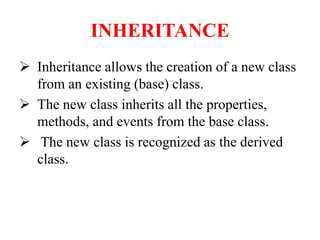
 Inheritance allows the creation of a new class
from an existing (base) class.
 The new class inherits all the properties,
methods, and events from the base class.
 The new class is recognized as the derived
class.
Inheritance Hierarchy
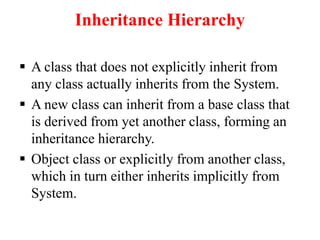
 A class that does not explicitly inherit from
any class actually inherits from the System.
 A new class can inherit from a base class that
is derived from yet another class, forming an
inheritance hierarchy.
 Object class or explicitly from another class,
which in turn either inherits implicitly from
System.
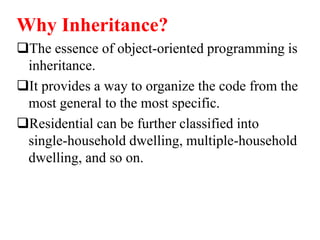
Why Inheritance?
The essence of object-oriented programming is
inheritance.
It provides a way to organize the code from the
most general to the most specific.
Residential can be further classified into
single-household dwelling, multiple-household
dwelling, and so on.
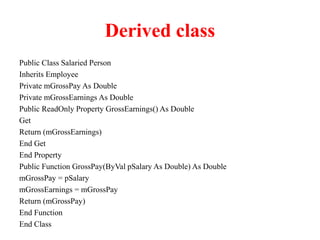
Derived class
Public Class Salaried Person
Inherits Employee
Private mGrossPay As Double
Private mGrossEarnings As Double
Public ReadOnly Property GrossEarnings() As Double
Get
Return (mGrossEarnings)
End Get
End Property
Public Function GrossPay(ByVal pSalary As Double) As Double
mGrossPay = pSalary
mGrossEarnings = mGrossPay
Return (mGrossPay)
End Function
End Class
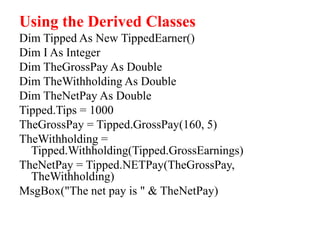
Using the Derived Classes
Dim Tipped As New TippedEarner()
Dim I As Integer
Dim TheGrossPay As Double
Dim TheWithholding As Double
Dim TheNetPay As Double
Tipped.Tips = 1000
TheGrossPay = Tipped.GrossPay(160, 5)
TheWithholding =
Tipped.Withholding(Tipped.GrossEarnings)
TheNetPay = Tipped.NETPay(TheGrossPay,
TheWithholding)
MsgBox("The net pay is " & TheNetPay)
Referencing the Class Itself and the
Base Class
 The method name conflicts with the reserved word for “Select
Case;” therefore, it must be qualified by either Me or MyBase.
 Me refers to the current (derived) class, while MyBase refers to the
base class.
 Because the method is inherited, either keyword will do that the
Text property is used without being qualified because there is no
name conflict.
 Shadows Property Text () As String
 To refer to Text in the text box, you code MyBase.Text; to refer to
the Text property in this derived class, you code Me.Text.
 inherited events, properties, and methods are referenced in the
derived class; and how to declare and reference properties and
methods that shadow members in the base class.
Creating Event Arguments
Create an event class. This class should be
Public, and can be separate from the
SortEngine class
Change the event declaration.
Change the arguments in the RaiseEvent
statement.
Hiding Members from Classes
Outside the Class Hierarchy
• Consider the code in a base class. Declaring such
a member as Friend will not do because this
member will still be visible to all other modules
in the same project.
• Declare the member as Protected. It makes the
base member visible to its derived classes, but not
visible to any classes that are not in the
inheritance hierarchy.
• The base class exposes two methods:
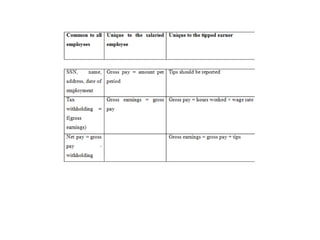
WithHolding and NetPay.
With these considerations, you will redesign the code
in the base class as follows:
 Withholding and NetPay will be exposed as properties
 There should be a procedure for the derived classes to
use to set the payroll data. This procedure will be named
SetPayData and declared as Protected because it will be
used exclusively by the derived classes.
 The methods to compute Withholding and NetPay will
be renamed as ComputeWithholding and
ComputeNetPay. These methods should be only used to
compute on the data made available by the SetPayData
method, and will be declared as Private.
Polymorphism
• Polymorphism refers to the capability to define
identically named methods or properties in multiple
classes.
• Polymorphism can be inheritance-based or interface-
based.
• Inheritance-based polymorphism involves defining the
methods or properties in the base class and requiring
the derived class to implement these members.
• Interface-based polymorphism involves defining the
methods or properties in an interface definition and
allowing these members to be implemented in various
classes.
Inheritance-Based Polymorphism
• This type of polymorphism is defined through
abstract classes that contain abstract methods or
properties.
• There are two types of accounts: real accounts
and nominal accounts. Real accounts have
substance and represent the company’s assets,
liabilities, or owners’ equity.
• Nominal accounts are revenues or expenses that
track the changes to owners’ equity. Net changes
in the nominal account are closed to an account
called income summary.
The Account class should have the following
properties and methods:
Properties:
o AccountNumber
o AccountName
o BeginningBalance—read only; the value is updated by the Close method explained
later in this section
o DebitTotal—representing all debit amounts posted to the account; a debit amount is
represented with a positive value; read only, computed by the Post method explained
later in this section
o CreditTotal—representing all credit amounts posted to the account; a credit amount is
represented with a negative value; read only, computed by the Post method
explained later in this section
o Balance—read only; representing the balance of the account; updated by the Post and
Close methods explained later in this section
Methods:
o Post—takes an amount as parameter to post to the account; a positive value is added to
the private copy of DebitTotal while a negative value is added to the private copy of
CreditTotal; this method also accumulates balance for the account internally
o Close—takes the income summary account as its parameter and requires different
implementations by this class’ derived class
The NominalAccount class should implement the Close
method as follows:
Its balance is posted to the income summary account,
using the Post method
All amount fields such as beginning balance, debit total,
credit total, and balance are set to zero .
The RealAccount class should implement the Close
method as follows:
Its beginning balance is set to the current balance, which
has been updated by the Post method, to carry forward
to the next accounting period
Its debit total and credit total are set to zero
Using Polymorphism
• The client code to use the same methods or
properties without regards to the differences in
implementation between classes.
• In the preceding example, any object of the
Account class (real or nominal) can be closed
with the Close method at run time without
encountering any problem, and the results will
be correct.
Why Inheritance-Based
Polymorphism
• If you do not use inheritance, you can still accomplish correct
“Close” by the use of If blocks in the Account class: one block
will handle the nominal account; the other will handle the real
account.
• The answer lies in that many other programming problems are
open-ended. At the time you are developing the base class, you
may not be aware of all possible scenarios to incorporate in the
If (or Select Case) blocks.
• On the other hand, using the inheritance-base polymorphism,
there is no need to revise the base class. All you have to do is
to develop another class derived from the base class to take
care of the new scenario.

inheritance and polymorphism

  • 1.
  • 2.
    INHERITANCE  Inheritance allowsthe creation of a new class from an existing (base) class.  The new class inherits all the properties, methods, and events from the base class.  The new class is recognized as the derived class.
  • 3.
    Inheritance Hierarchy  Aclass that does not explicitly inherit from any class actually inherits from the System.  A new class can inherit from a base class that is derived from yet another class, forming an inheritance hierarchy.  Object class or explicitly from another class, which in turn either inherits implicitly from System.
  • 4.
    Why Inheritance? The essenceof object-oriented programming is inheritance. It provides a way to organize the code from the most general to the most specific. Residential can be further classified into single-household dwelling, multiple-household dwelling, and so on.
  • 6.
    Derived class Public ClassSalaried Person Inherits Employee Private mGrossPay As Double Private mGrossEarnings As Double Public ReadOnly Property GrossEarnings() As Double Get Return (mGrossEarnings) End Get End Property Public Function GrossPay(ByVal pSalary As Double) As Double mGrossPay = pSalary mGrossEarnings = mGrossPay Return (mGrossPay) End Function End Class
  • 7.
    Using the DerivedClasses Dim Tipped As New TippedEarner() Dim I As Integer Dim TheGrossPay As Double Dim TheWithholding As Double Dim TheNetPay As Double Tipped.Tips = 1000 TheGrossPay = Tipped.GrossPay(160, 5) TheWithholding = Tipped.Withholding(Tipped.GrossEarnings) TheNetPay = Tipped.NETPay(TheGrossPay, TheWithholding) MsgBox("The net pay is " & TheNetPay)
  • 8.
    Referencing the ClassItself and the Base Class  The method name conflicts with the reserved word for “Select Case;” therefore, it must be qualified by either Me or MyBase.  Me refers to the current (derived) class, while MyBase refers to the base class.  Because the method is inherited, either keyword will do that the Text property is used without being qualified because there is no name conflict.  Shadows Property Text () As String  To refer to Text in the text box, you code MyBase.Text; to refer to the Text property in this derived class, you code Me.Text.  inherited events, properties, and methods are referenced in the derived class; and how to declare and reference properties and methods that shadow members in the base class.
  • 9.
    Creating Event Arguments Createan event class. This class should be Public, and can be separate from the SortEngine class Change the event declaration. Change the arguments in the RaiseEvent statement.
  • 10.
    Hiding Members fromClasses Outside the Class Hierarchy • Consider the code in a base class. Declaring such a member as Friend will not do because this member will still be visible to all other modules in the same project. • Declare the member as Protected. It makes the base member visible to its derived classes, but not visible to any classes that are not in the inheritance hierarchy. • The base class exposes two methods: WithHolding and NetPay.
  • 11.
    With these considerations,you will redesign the code in the base class as follows:  Withholding and NetPay will be exposed as properties  There should be a procedure for the derived classes to use to set the payroll data. This procedure will be named SetPayData and declared as Protected because it will be used exclusively by the derived classes.  The methods to compute Withholding and NetPay will be renamed as ComputeWithholding and ComputeNetPay. These methods should be only used to compute on the data made available by the SetPayData method, and will be declared as Private.
  • 12.
    Polymorphism • Polymorphism refersto the capability to define identically named methods or properties in multiple classes. • Polymorphism can be inheritance-based or interface- based. • Inheritance-based polymorphism involves defining the methods or properties in the base class and requiring the derived class to implement these members. • Interface-based polymorphism involves defining the methods or properties in an interface definition and allowing these members to be implemented in various classes.
  • 13.
    Inheritance-Based Polymorphism • Thistype of polymorphism is defined through abstract classes that contain abstract methods or properties. • There are two types of accounts: real accounts and nominal accounts. Real accounts have substance and represent the company’s assets, liabilities, or owners’ equity. • Nominal accounts are revenues or expenses that track the changes to owners’ equity. Net changes in the nominal account are closed to an account called income summary.
  • 14.
    The Account classshould have the following properties and methods: Properties: o AccountNumber o AccountName o BeginningBalance—read only; the value is updated by the Close method explained later in this section o DebitTotal—representing all debit amounts posted to the account; a debit amount is represented with a positive value; read only, computed by the Post method explained later in this section o CreditTotal—representing all credit amounts posted to the account; a credit amount is represented with a negative value; read only, computed by the Post method explained later in this section o Balance—read only; representing the balance of the account; updated by the Post and Close methods explained later in this section Methods: o Post—takes an amount as parameter to post to the account; a positive value is added to the private copy of DebitTotal while a negative value is added to the private copy of CreditTotal; this method also accumulates balance for the account internally o Close—takes the income summary account as its parameter and requires different implementations by this class’ derived class
  • 15.
    The NominalAccount classshould implement the Close method as follows: Its balance is posted to the income summary account, using the Post method All amount fields such as beginning balance, debit total, credit total, and balance are set to zero . The RealAccount class should implement the Close method as follows: Its beginning balance is set to the current balance, which has been updated by the Post method, to carry forward to the next accounting period Its debit total and credit total are set to zero
  • 16.
    Using Polymorphism • Theclient code to use the same methods or properties without regards to the differences in implementation between classes. • In the preceding example, any object of the Account class (real or nominal) can be closed with the Close method at run time without encountering any problem, and the results will be correct.
  • 17.
    Why Inheritance-Based Polymorphism • Ifyou do not use inheritance, you can still accomplish correct “Close” by the use of If blocks in the Account class: one block will handle the nominal account; the other will handle the real account. • The answer lies in that many other programming problems are open-ended. At the time you are developing the base class, you may not be aware of all possible scenarios to incorporate in the If (or Select Case) blocks. • On the other hand, using the inheritance-base polymorphism, there is no need to revise the base class. All you have to do is to develop another class derived from the base class to take care of the new scenario.