BY
K.HARIPRITHA II M.SC(IT)
NADAR SARASWATHI COLLEGE OF ARTS
AND SCIENCE,THENI.
ORACLE
Oracle
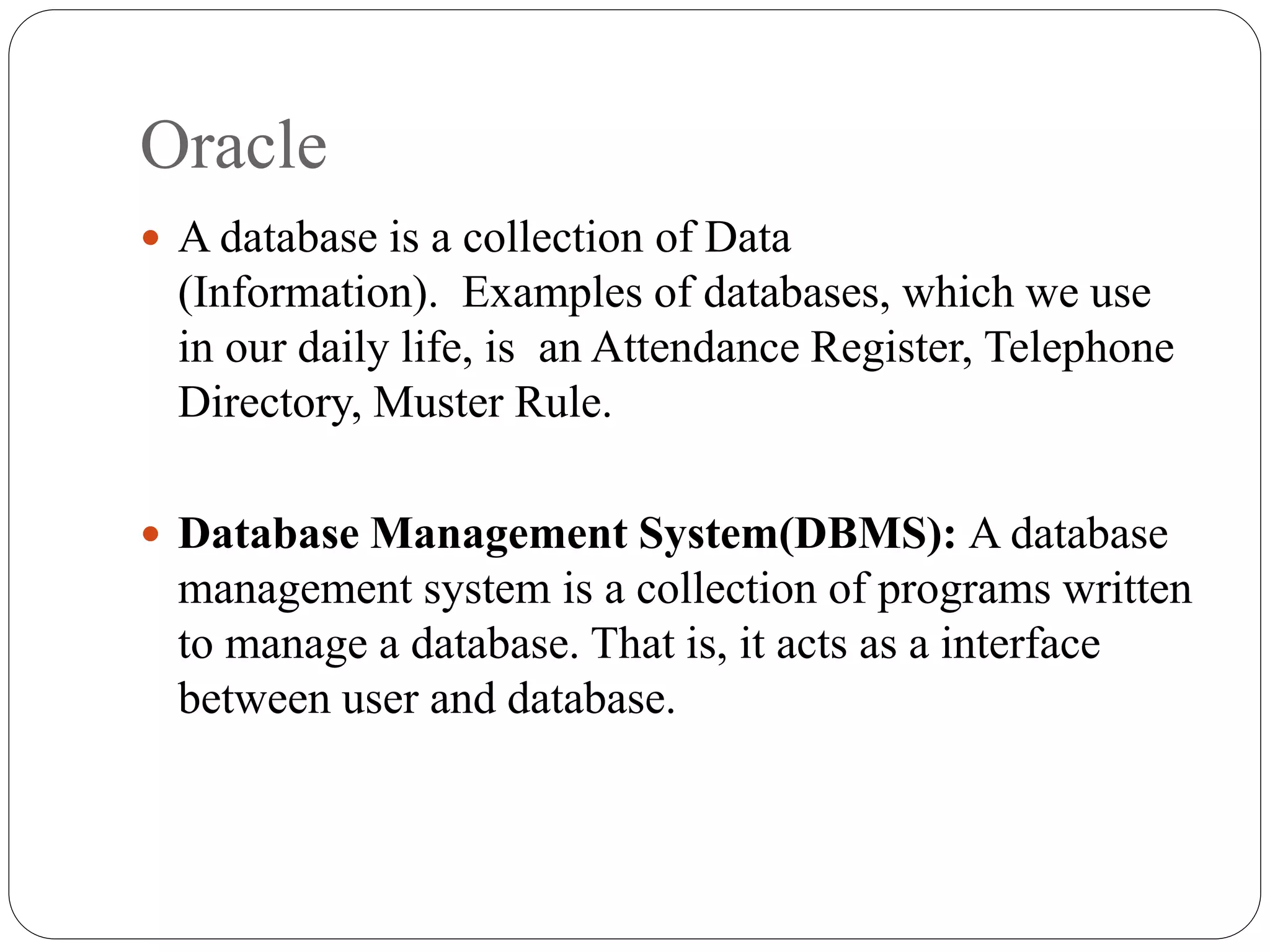
 A database is a collection of Data
(Information). Examples of databases, which we use
in our daily life, is an Attendance Register, Telephone
Directory, Muster Rule.
 Database Management System(DBMS): A database
management system is a collection of programs written
to manage a database. That is, it acts as a interface
between user and database.
Database Design and Querying tool
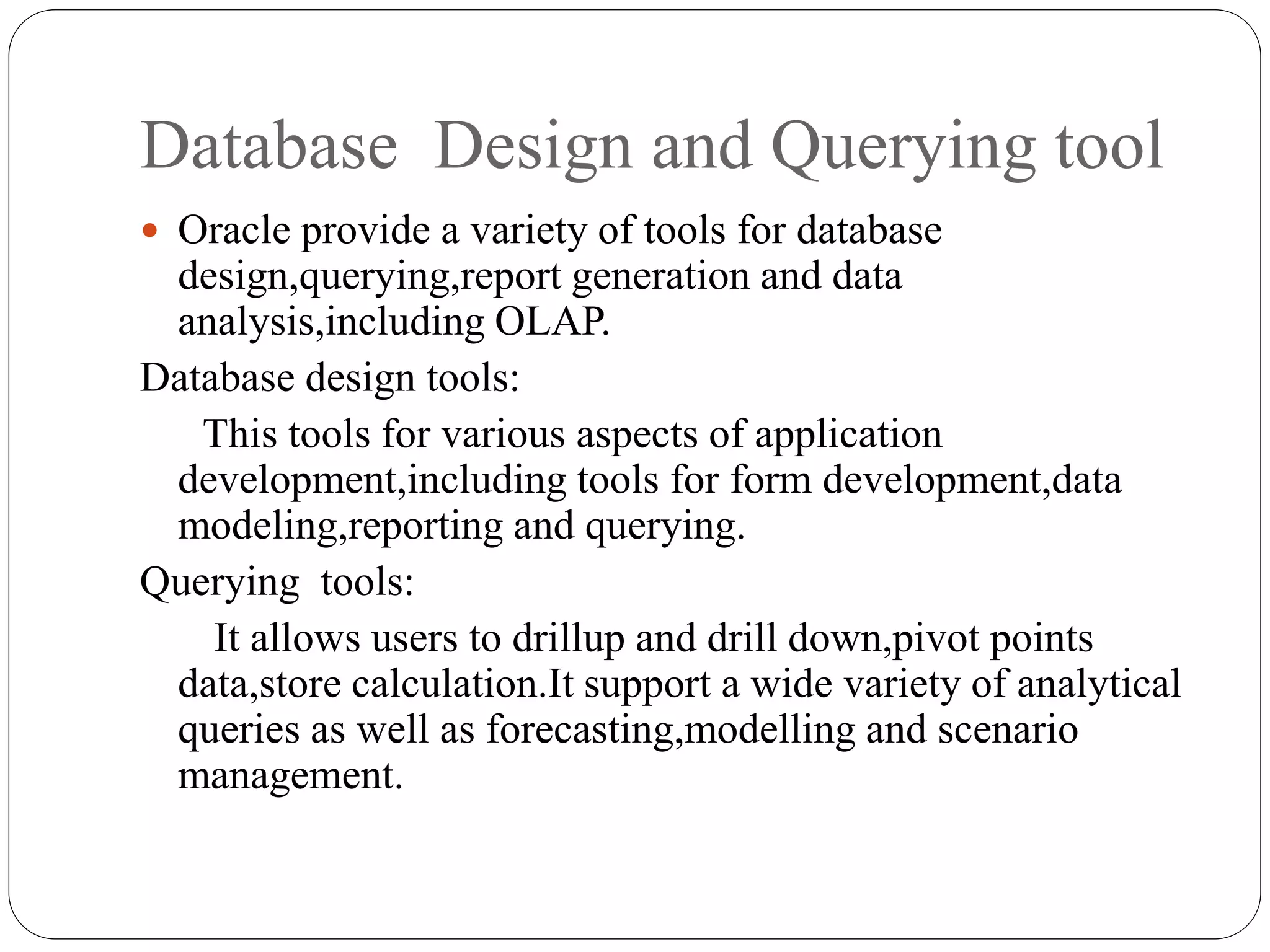
 Oracle provide a variety of tools for database
design,querying,report generation and data
analysis,including OLAP.
Database design tools:
This tools for various aspects of application
development,including tools for form development,data
modeling,reporting and querying.
Querying tools:
It allows users to drillup and drill down,pivot points
data,store calculation.It support a wide variety of analytical
queries as well as forecasting,modelling and scenario
management.
SQL Variation and extensions
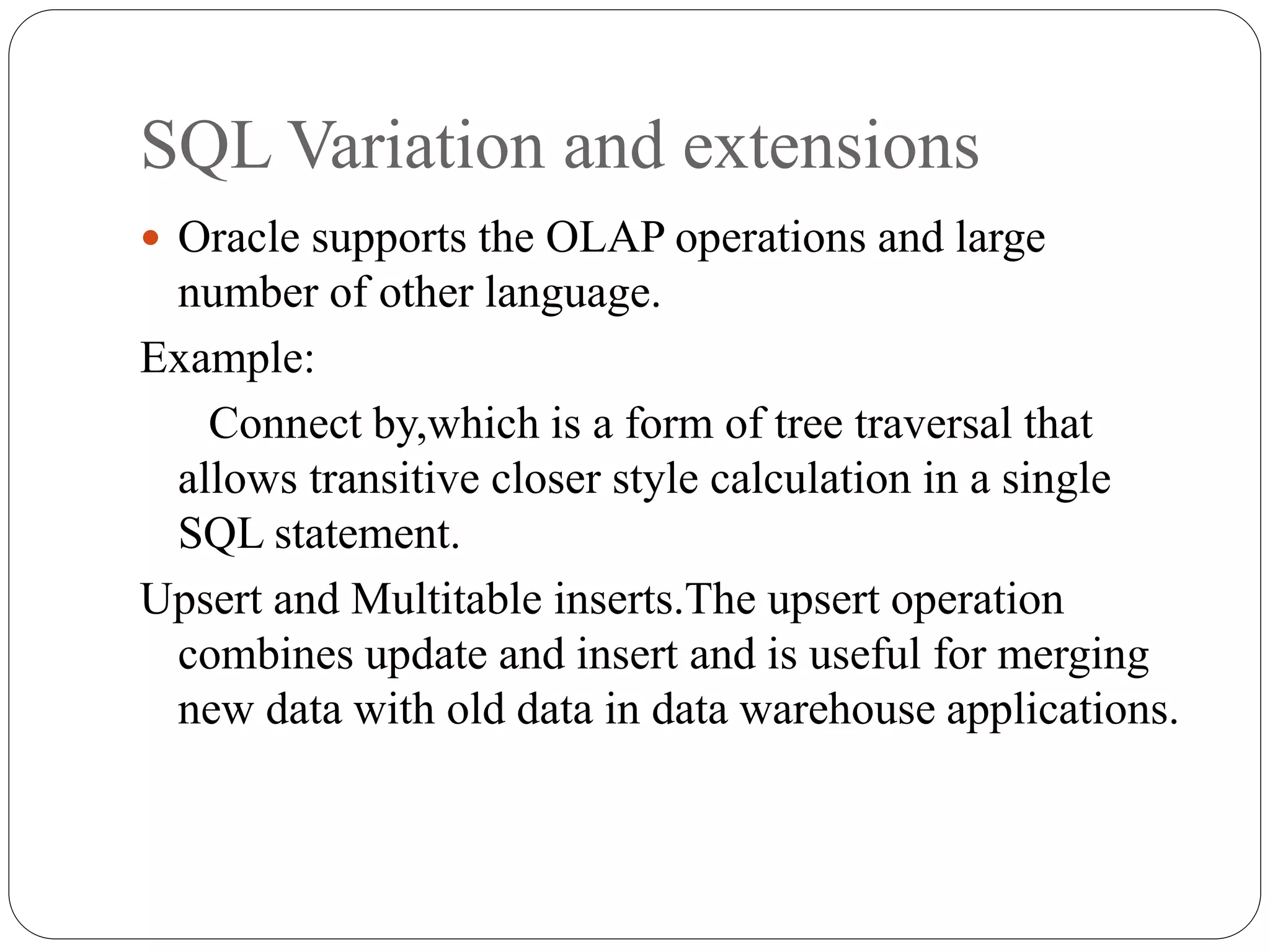
 Oracle supports the OLAP operations and large
number of other language.
Example:
Connect by,which is a form of tree traversal that
allows transitive closer style calculation in a single
SQL statement.
Upsert and Multitable inserts.The upsert operation
combines update and insert and is useful for merging
new data with old data in data warehouse applications.
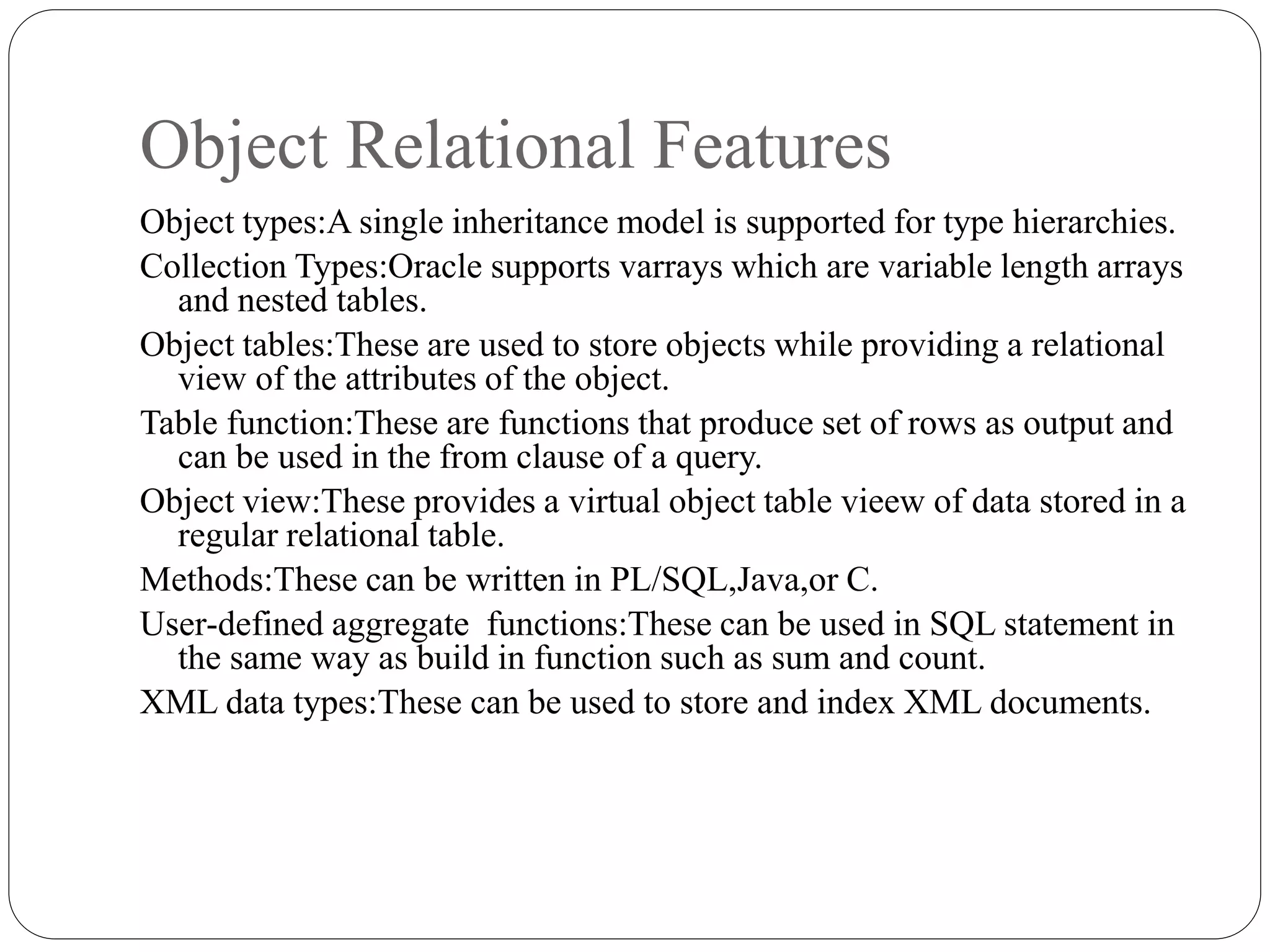
Object Relational Features
Object types:A single inheritance model is supported for type hierarchies.
Collection Types:Oracle supports varrays which are variable length arrays
and nested tables.
Object tables:These are used to store objects while providing a relational
view of the attributes of the object.
Table function:These are functions that produce set of rows as output and
can be used in the from clause of a query.
Object view:These provides a virtual object table vieew of data stored in a
regular relational table.
Methods:These can be written in PL/SQL,Java,or C.
User-defined aggregate functions:These can be used in SQL statement in
the same way as build in function such as sum and count.
XML data types:These can be used to store and index XML documents.
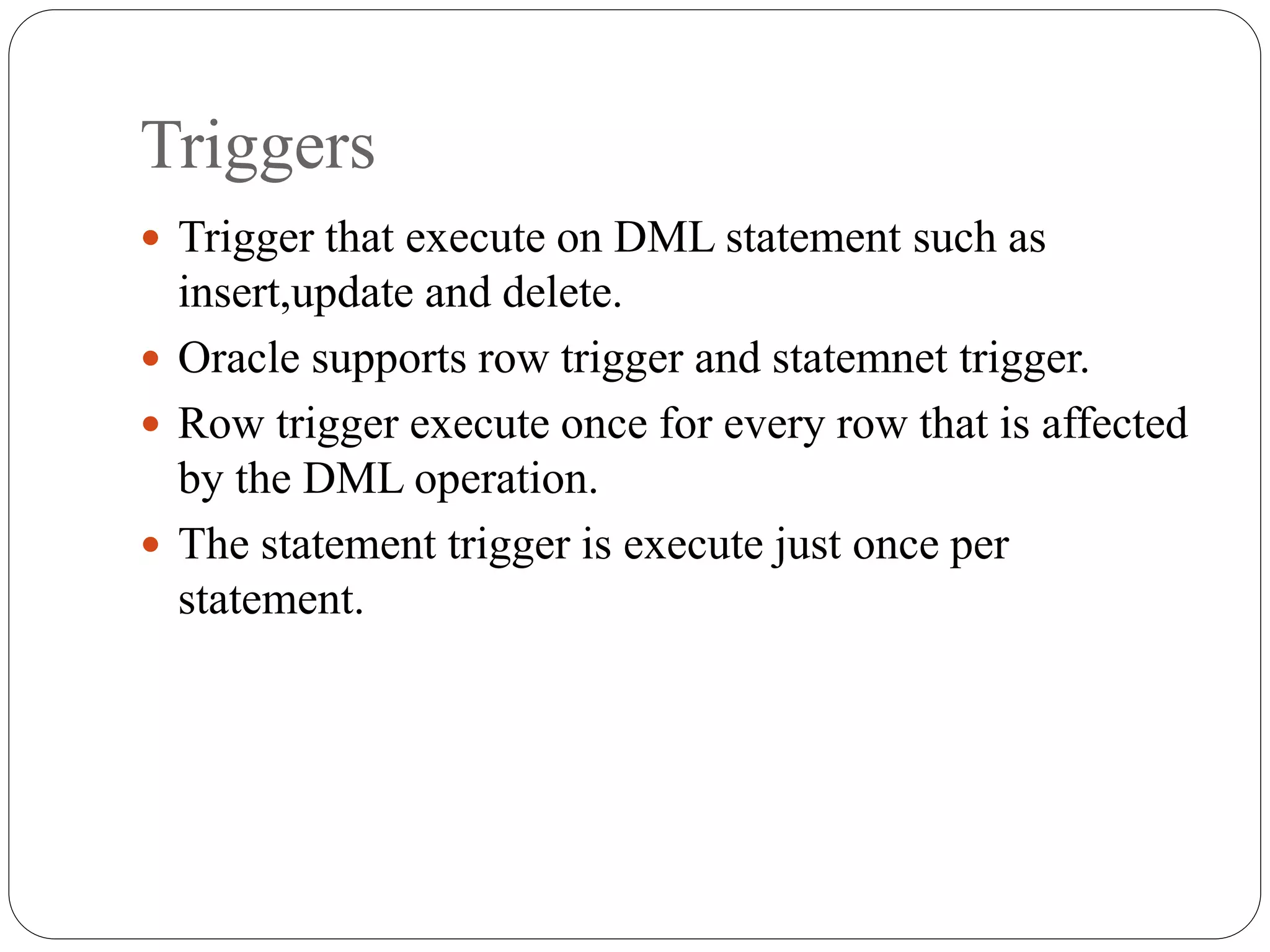
Triggers
 Trigger that execute on DML statement such as
insert,update and delete.
 Oracle supports row trigger and statemnet trigger.
 Row trigger execute once for every row that is affected
by the DML operation.
 The statement trigger is execute just once per
statement.
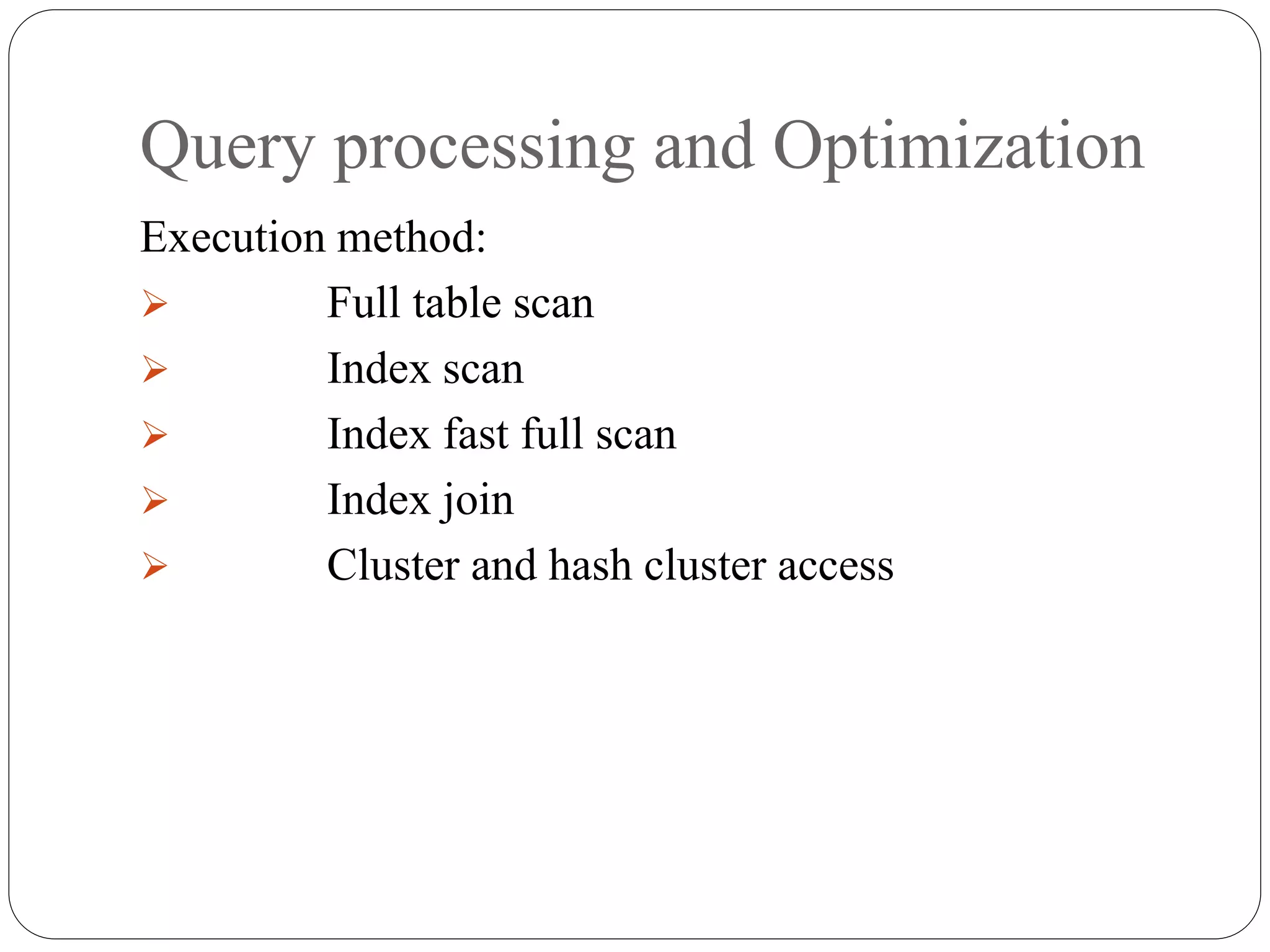
Query processing and Optimization
Execution method:
 Full table scan
 Index scan
 Index fast full scan
 Index join
 Cluster and hash cluster access
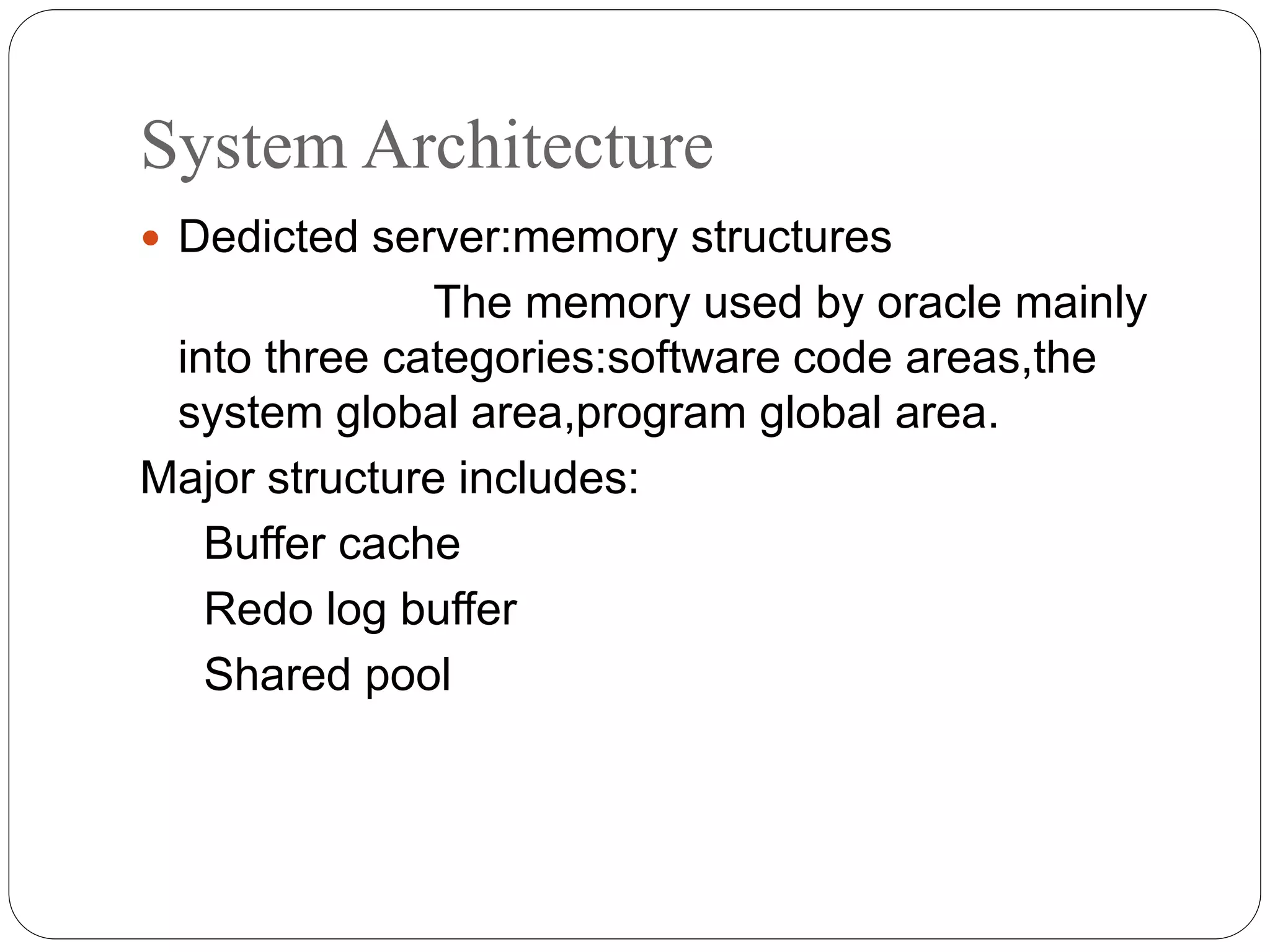
System Architecture
 Dedicted server:memory structures
The memory used by oracle mainly
into three categories:software code areas,the
system global area,program global area.
Major structure includes:
Buffer cache
Redo log buffer
Shared pool
Dedicated server:Process structure
There are two types of process that execute oracle
server code:Server process that process SQL
statement and background process that performs
various administrative and performance relatedd tasks
Database writter
Log writter
Check point
System moniter
Process moniter
Recoverer
Archiver
Replication:
 Oracle supports the several types of replication.
 The simple form of replication is snapshots.The snapshot
does not have to contain all the master table,that supports
two types of snapshots:read only and updatable.
Distributed database:
 It supports queries and transaction spanning multiple
database on different system.Oracle has to be build in
capability to optimize a query that includes tables at
different sites,retrive the relevant data and return the local
query.
External data sources:
Oracle has several mechanism for supporting external
data sources.The most common usage in data warehousing
when large amount of data are regularly loaded from a
transactional system.
SQL*loader:
Oracle has a direct load utility,SQL*loader, that
supports fast parallel loads of large amount of data from
externl files.It support a variety of data formats and its
perform various filtering operations on the data being
loaded.

oracle

  • 1.
    BY K.HARIPRITHA II M.SC(IT) NADARSARASWATHI COLLEGE OF ARTS AND SCIENCE,THENI. ORACLE
  • 2.
    Oracle  A databaseis a collection of Data (Information). Examples of databases, which we use in our daily life, is an Attendance Register, Telephone Directory, Muster Rule.  Database Management System(DBMS): A database management system is a collection of programs written to manage a database. That is, it acts as a interface between user and database.
  • 3.
    Database Design andQuerying tool  Oracle provide a variety of tools for database design,querying,report generation and data analysis,including OLAP. Database design tools: This tools for various aspects of application development,including tools for form development,data modeling,reporting and querying. Querying tools: It allows users to drillup and drill down,pivot points data,store calculation.It support a wide variety of analytical queries as well as forecasting,modelling and scenario management.
  • 4.
    SQL Variation andextensions  Oracle supports the OLAP operations and large number of other language. Example: Connect by,which is a form of tree traversal that allows transitive closer style calculation in a single SQL statement. Upsert and Multitable inserts.The upsert operation combines update and insert and is useful for merging new data with old data in data warehouse applications.
  • 5.
    Object Relational Features Objecttypes:A single inheritance model is supported for type hierarchies. Collection Types:Oracle supports varrays which are variable length arrays and nested tables. Object tables:These are used to store objects while providing a relational view of the attributes of the object. Table function:These are functions that produce set of rows as output and can be used in the from clause of a query. Object view:These provides a virtual object table vieew of data stored in a regular relational table. Methods:These can be written in PL/SQL,Java,or C. User-defined aggregate functions:These can be used in SQL statement in the same way as build in function such as sum and count. XML data types:These can be used to store and index XML documents.
  • 6.
    Triggers  Trigger thatexecute on DML statement such as insert,update and delete.  Oracle supports row trigger and statemnet trigger.  Row trigger execute once for every row that is affected by the DML operation.  The statement trigger is execute just once per statement.
  • 7.
    Query processing andOptimization Execution method:  Full table scan  Index scan  Index fast full scan  Index join  Cluster and hash cluster access
  • 8.
    System Architecture  Dedictedserver:memory structures The memory used by oracle mainly into three categories:software code areas,the system global area,program global area. Major structure includes: Buffer cache Redo log buffer Shared pool
  • 9.
    Dedicated server:Process structure Thereare two types of process that execute oracle server code:Server process that process SQL statement and background process that performs various administrative and performance relatedd tasks Database writter Log writter Check point System moniter Process moniter Recoverer Archiver
  • 10.
    Replication:  Oracle supportsthe several types of replication.  The simple form of replication is snapshots.The snapshot does not have to contain all the master table,that supports two types of snapshots:read only and updatable. Distributed database:  It supports queries and transaction spanning multiple database on different system.Oracle has to be build in capability to optimize a query that includes tables at different sites,retrive the relevant data and return the local query.
  • 11.
    External data sources: Oraclehas several mechanism for supporting external data sources.The most common usage in data warehousing when large amount of data are regularly loaded from a transactional system. SQL*loader: Oracle has a direct load utility,SQL*loader, that supports fast parallel loads of large amount of data from externl files.It support a variety of data formats and its perform various filtering operations on the data being loaded.