INHERITANCE
Chapter 10
INHERITANCE
 Mechanism for enhancing existing classes
 You need to implement a new class
 You have an existing class that represents a more
general concept is already available.
 New class can inherit from the existing class.
 Example
 BankAccount
 SavingsAccount
 Most of the methods of bank account apply to savings
account
 You need additional methods.
 In savings account you only specify new methods.
INHERITANCE
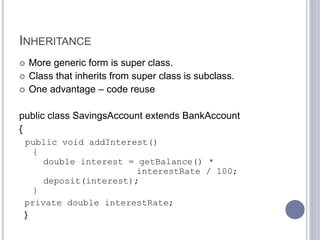
 More generic form is super class.
 Class that inherits from super class is subclass.
 One advantage – code reuse
public class SavingsAccount extends BankAccount
{
public void addInterest()
{
double interest = getBalance() *
interestRate / 100;
deposit(interest);
}
private double interestRate;
}
INHERITANCE
 BankAccount will have the methods
 deposit( )
 withdraw( )
 getBalance( )
 SavingsAccount will have the methods
 deposit( )
 withdraw( )
 getBalance( )
 addInterest( )
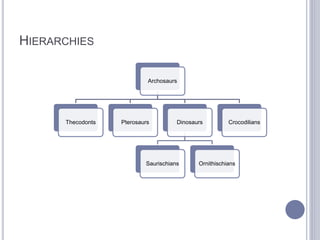
HIERARCHIES
Archosaurs
Thecodonts Pterosaurs Dinosaurs
Saurischians Ornithischians
Crocodilians
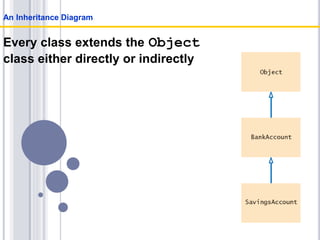
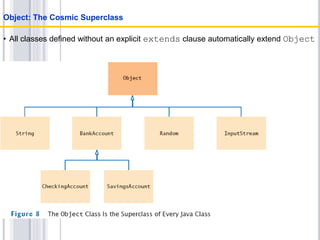
Every class extends the Object
class either directly or indirectly
An Inheritance Diagram
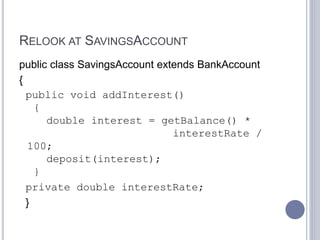
RELOOK AT SAVINGSACCOUNT
public class SavingsAccount extends BankAccount
{
public void addInterest()
{
double interest = getBalance() *
interestRate /
100;
deposit(interest);
}
private double interestRate;
}
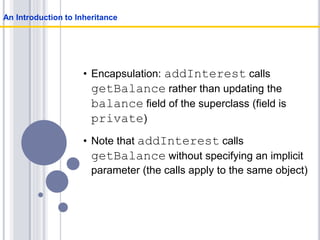
• Encapsulation: addInterest calls
getBalance rather than updating the
balance field of the superclass (field is
private)
• Note that addInterest calls
getBalance without specifying an implicit
parameter (the calls apply to the same object)
An Introduction to Inheritance
BigJavabyCayHorstmann
Copyright©2008byJohnWiley&Sons.Allrights
reserved.
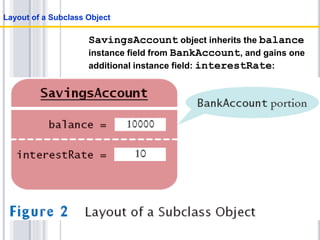
SavingsAccount object inherits the balance
instance field from BankAccount, and gains one
additional instance field: interestRate:
Layout of a Subclass Object
CHECK
 If the class Manager extends the class Employee,
which class is the superclass and which is the
subclass?
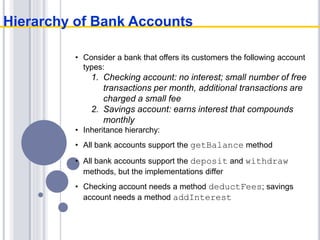
• Consider a bank that offers its customers the following account
types:
1. Checking account: no interest; small number of free
transactions per month, additional transactions are
charged a small fee
2. Savings account: earns interest that compounds
monthly
• Inheritance hierarchy:
• All bank accounts support the getBalance method
• All bank accounts support the deposit and withdraw
methods, but the implementations differ
• Checking account needs a method deductFees; savings
account needs a method addInterest
Hierarchy of Bank Accounts
• Override method:
• Supply a different implementation of a method that
exists in the superclass
• Must have same signature (same name and same
parameter types)
• If method is applied to an object of the subclass
type, the overriding method is executed
• Inherit method:
• Don't supply a new implementation of a method that
exists in superclass
•Superclass method can be applied to the
subclass objects
• Add method:
• Supply a new method that doesn't exist in the
superclass
• New method can be applied only to subclass
objects
Inheriting Methods
• Can't override fields
• Inherit field: All fields from the superclass are
automatically inherited
• Add field: Supply a new field that doesn't exist
in the superclass
• What if you define a new field with the same
name as a superclass field?
• Each object would have two instance
fields of the same name
• Fields can hold different values
• Legal but extremely undesirable
Inheriting Instance Fields
• Consider deposit method of
CheckingAccount
public void deposit(double amount)
{
transactionCount++;
// now add amount to balance
. . .
}
• Can't just add amount to balance
• balance is a private field of the superclass
• A subclass has no access to private fields of its
superclass
• Subclass must use public interface
Inherited Fields are Private
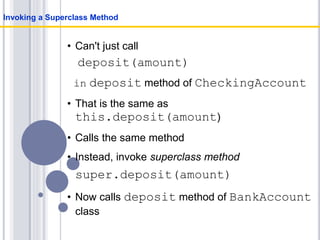
• Can't just call
deposit(amount)
in deposit method of CheckingAccount
• That is the same as
this.deposit(amount)
• Calls the same method
• Instead, invoke superclass method
super.deposit(amount)
• Now calls deposit method of BankAccount
class
Invoking a Superclass Method
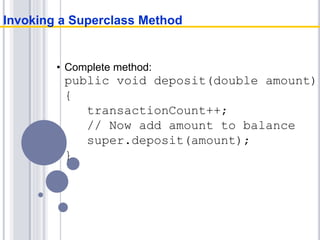
• Complete method:
public void deposit(double amount)
{
transactionCount++;
// Now add amount to balance
super.deposit(amount);
}
Invoking a Superclass Method
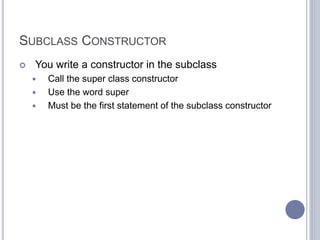
SUBCLASS CONSTRUCTOR
 You write a constructor in the subclass
 Call the super class constructor
 Use the word super
 Must be the first statement of the subclass constructor
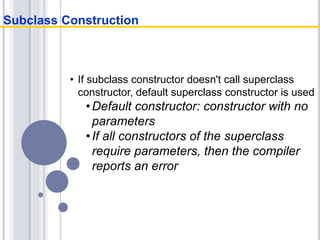
• If subclass constructor doesn't call superclass
constructor, default superclass constructor is used
•Default constructor: constructor with no
parameters
•If all constructors of the superclass
require parameters, then the compiler
reports an error
Subclass Construction
• Ok to convert subclass reference to superclass
reference
SavingsAccount collegeFund = new
SavingsAccount(10);
BankAccount anAccount =
collegeFund;
Object anObject = collegeFund;
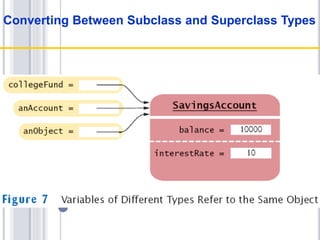
• The three object references stored in
collegeFund, anAccount, and
anObject all refer to the same object of type
SavingsAccount
Converting Between Subclass and Superclass
Types
Converting Between Subclass and Superclass Types
• Superclass references don't know the full story:
anAccount.deposit(1000); // OK
anAccount.addInterest();
// No--not a method of the class
to which anAccount
belongs
• When you convert between a subclass object to its
superclass type:
• The value of the reference stays the same – it is
the memory location of the object
• But, less information is known about the object
Converting Between Subclass and Superclass
Types
• Why would anyone want to know less about an object?
• Reuse code that knows about the superclass but not the subclass:
public void transfer(double amount, BankAccount other)
{
withdraw(amount);
other.deposit(amount);
}
Can be used to transfer money from any type of
BankAccount
Converting Between Subclass and Superclass Types (cont.)
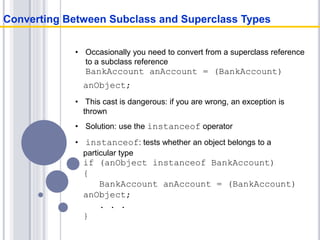
• Occasionally you need to convert from a superclass reference
to a subclass reference
BankAccount anAccount = (BankAccount)
anObject;
• This cast is dangerous: if you are wrong, an exception is
thrown
• Solution: use the instanceof operator
• instanceof: tests whether an object belongs to a
particular type
if (anObject instanceof BankAccount)
{
BankAccount anAccount = (BankAccount)
anObject;
. . .
}
Converting Between Subclass and Superclass Types
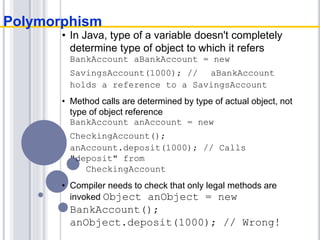
• In Java, type of a variable doesn't completely
determine type of object to which it refers
BankAccount aBankAccount = new
SavingsAccount(1000); // aBankAccount
holds a reference to a SavingsAccount
• Method calls are determined by type of actual object, not
type of object reference
BankAccount anAccount = new
CheckingAccount();
anAccount.deposit(1000); // Calls
"deposit" from
CheckingAccount
• Compiler needs to check that only legal methods are
invoked Object anObject = new
BankAccount();
anObject.deposit(1000); // Wrong!
Polymorphism
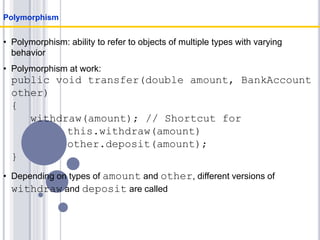
• Polymorphism: ability to refer to objects of multiple types with varying
behavior
• Polymorphism at work:
public void transfer(double amount, BankAccount
other)
{
withdraw(amount); // Shortcut for
this.withdraw(amount)
other.deposit(amount);
}
• Depending on types of amount and other, different versions of
withdraw and deposit are called
Polymorphism
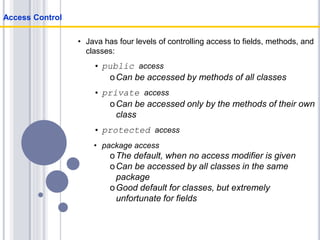
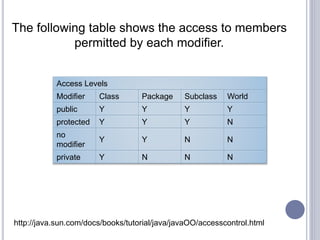
• Java has four levels of controlling access to fields, methods, and
classes:
• public access
oCan be accessed by methods of all classes
• private access
oCan be accessed only by the methods of their own
class
• protected access
• package access
oThe default, when no access modifier is given
oCan be accessed by all classes in the same
package
oGood default for classes, but extremely
unfortunate for fields
Access Control
Access Levels
Modifier Class Package Subclass World
public Y Y Y Y
protected Y Y Y N
no
modifier
Y Y N N
private Y N N N
The following table shows the access to members
permitted by each modifier.
http://java.sun.com/docs/books/tutorial/java/javaOO/accesscontrol.html
• All classes defined without an explicit extends clause automatically extend Object
Object: The Cosmic Superclass

Inheritance

  • 1.
  • 2.
    INHERITANCE  Mechanism forenhancing existing classes  You need to implement a new class  You have an existing class that represents a more general concept is already available.  New class can inherit from the existing class.  Example  BankAccount  SavingsAccount  Most of the methods of bank account apply to savings account  You need additional methods.  In savings account you only specify new methods.
  • 3.
    INHERITANCE  More genericform is super class.  Class that inherits from super class is subclass.  One advantage – code reuse public class SavingsAccount extends BankAccount { public void addInterest() { double interest = getBalance() * interestRate / 100; deposit(interest); } private double interestRate; }
  • 4.
    INHERITANCE  BankAccount willhave the methods  deposit( )  withdraw( )  getBalance( )  SavingsAccount will have the methods  deposit( )  withdraw( )  getBalance( )  addInterest( )
  • 5.
  • 6.
    Every class extendsthe Object class either directly or indirectly An Inheritance Diagram
  • 7.
    RELOOK AT SAVINGSACCOUNT publicclass SavingsAccount extends BankAccount { public void addInterest() { double interest = getBalance() * interestRate / 100; deposit(interest); } private double interestRate; }
  • 8.
    • Encapsulation: addInterestcalls getBalance rather than updating the balance field of the superclass (field is private) • Note that addInterest calls getBalance without specifying an implicit parameter (the calls apply to the same object) An Introduction to Inheritance
  • 9.
    BigJavabyCayHorstmann Copyright©2008byJohnWiley&Sons.Allrights reserved. SavingsAccount object inheritsthe balance instance field from BankAccount, and gains one additional instance field: interestRate: Layout of a Subclass Object
  • 10.
    CHECK  If theclass Manager extends the class Employee, which class is the superclass and which is the subclass?
  • 11.
    • Consider abank that offers its customers the following account types: 1. Checking account: no interest; small number of free transactions per month, additional transactions are charged a small fee 2. Savings account: earns interest that compounds monthly • Inheritance hierarchy: • All bank accounts support the getBalance method • All bank accounts support the deposit and withdraw methods, but the implementations differ • Checking account needs a method deductFees; savings account needs a method addInterest Hierarchy of Bank Accounts
  • 12.
    • Override method: •Supply a different implementation of a method that exists in the superclass • Must have same signature (same name and same parameter types) • If method is applied to an object of the subclass type, the overriding method is executed • Inherit method: • Don't supply a new implementation of a method that exists in superclass •Superclass method can be applied to the subclass objects • Add method: • Supply a new method that doesn't exist in the superclass • New method can be applied only to subclass objects Inheriting Methods
  • 13.
    • Can't overridefields • Inherit field: All fields from the superclass are automatically inherited • Add field: Supply a new field that doesn't exist in the superclass • What if you define a new field with the same name as a superclass field? • Each object would have two instance fields of the same name • Fields can hold different values • Legal but extremely undesirable Inheriting Instance Fields
  • 14.
    • Consider depositmethod of CheckingAccount public void deposit(double amount) { transactionCount++; // now add amount to balance . . . } • Can't just add amount to balance • balance is a private field of the superclass • A subclass has no access to private fields of its superclass • Subclass must use public interface Inherited Fields are Private
  • 15.
    • Can't justcall deposit(amount) in deposit method of CheckingAccount • That is the same as this.deposit(amount) • Calls the same method • Instead, invoke superclass method super.deposit(amount) • Now calls deposit method of BankAccount class Invoking a Superclass Method
  • 16.
    • Complete method: publicvoid deposit(double amount) { transactionCount++; // Now add amount to balance super.deposit(amount); } Invoking a Superclass Method
  • 17.
    SUBCLASS CONSTRUCTOR  Youwrite a constructor in the subclass  Call the super class constructor  Use the word super  Must be the first statement of the subclass constructor
  • 18.
    • If subclassconstructor doesn't call superclass constructor, default superclass constructor is used •Default constructor: constructor with no parameters •If all constructors of the superclass require parameters, then the compiler reports an error Subclass Construction
  • 19.
    • Ok toconvert subclass reference to superclass reference SavingsAccount collegeFund = new SavingsAccount(10); BankAccount anAccount = collegeFund; Object anObject = collegeFund; • The three object references stored in collegeFund, anAccount, and anObject all refer to the same object of type SavingsAccount Converting Between Subclass and Superclass Types
  • 20.
    Converting Between Subclassand Superclass Types
  • 21.
    • Superclass referencesdon't know the full story: anAccount.deposit(1000); // OK anAccount.addInterest(); // No--not a method of the class to which anAccount belongs • When you convert between a subclass object to its superclass type: • The value of the reference stays the same – it is the memory location of the object • But, less information is known about the object Converting Between Subclass and Superclass Types
  • 22.
    • Why wouldanyone want to know less about an object? • Reuse code that knows about the superclass but not the subclass: public void transfer(double amount, BankAccount other) { withdraw(amount); other.deposit(amount); } Can be used to transfer money from any type of BankAccount Converting Between Subclass and Superclass Types (cont.)
  • 23.
    • Occasionally youneed to convert from a superclass reference to a subclass reference BankAccount anAccount = (BankAccount) anObject; • This cast is dangerous: if you are wrong, an exception is thrown • Solution: use the instanceof operator • instanceof: tests whether an object belongs to a particular type if (anObject instanceof BankAccount) { BankAccount anAccount = (BankAccount) anObject; . . . } Converting Between Subclass and Superclass Types
  • 24.
    • In Java,type of a variable doesn't completely determine type of object to which it refers BankAccount aBankAccount = new SavingsAccount(1000); // aBankAccount holds a reference to a SavingsAccount • Method calls are determined by type of actual object, not type of object reference BankAccount anAccount = new CheckingAccount(); anAccount.deposit(1000); // Calls "deposit" from CheckingAccount • Compiler needs to check that only legal methods are invoked Object anObject = new BankAccount(); anObject.deposit(1000); // Wrong! Polymorphism
  • 25.
    • Polymorphism: abilityto refer to objects of multiple types with varying behavior • Polymorphism at work: public void transfer(double amount, BankAccount other) { withdraw(amount); // Shortcut for this.withdraw(amount) other.deposit(amount); } • Depending on types of amount and other, different versions of withdraw and deposit are called Polymorphism
  • 26.
    • Java hasfour levels of controlling access to fields, methods, and classes: • public access oCan be accessed by methods of all classes • private access oCan be accessed only by the methods of their own class • protected access • package access oThe default, when no access modifier is given oCan be accessed by all classes in the same package oGood default for classes, but extremely unfortunate for fields Access Control
  • 27.
    Access Levels Modifier ClassPackage Subclass World public Y Y Y Y protected Y Y Y N no modifier Y Y N N private Y N N N The following table shows the access to members permitted by each modifier. http://java.sun.com/docs/books/tutorial/java/javaOO/accesscontrol.html
  • 28.
    • All classesdefined without an explicit extends clause automatically extend Object Object: The Cosmic Superclass