The Inside on
Ingredient Branding
Waldemar Pfoertsch
2006
Agenda
• Defining Ingredient Branding
• Understanding Ingredient Branding
• Implementing and Managing
• New Application and Future Research
• Brand Management at CEIBS
The most famous example
of the “Brand in the Brand”
Jackson, Tim (1997)
Using the concept of
Ingredient Branding
or short: “InBranding”
Other Ingredient Branding Examples
• Microban
• Makrolon
• GoreTex
• Dolby Stereo
• Nirosta
Pfoertsch/Mueller (2005)
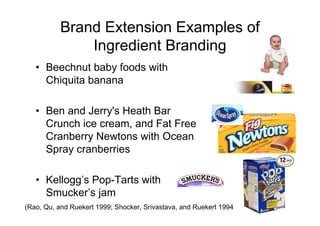
Brand Extension Examples of
Ingredient Branding
• Beechnut baby foods with
Chiquita banana
• Ben and Jerry's Heath Bar
Crunch ice cream, and Fat Free
Cranberry Newtons with Ocean
Spray cranberries
• Kellogg’s Pop-Tarts with
Smucker’s jam
(Rao, Qu, and Ruekert 1999; Shocker, Srivastava, and Ruekert 1994)
Company Owned Ingredient
Brands
David Aaker, 2003
Basic Motivation for Using
Ingredient Branding
• Enhances the differentiation of the host
brand from competition
• Improves competitiveness
• Enhances equity of host brand and “self-
brand”.
Desai/Keller (2002)David Aaker, 2003 McCarthy/Norris (1999)
Effects of Branded Ingredients
Norris/McCarthy (1999)
Change of Competitiveness
through Branded Ingredients
Norris/McCarthy (1999)
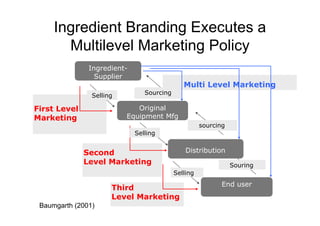
Ingredient Branding Executes a
Multilevel Marketing Policy
Third
Level Marketing
Multi Level Marketing
Ingredient-
Supplier
First Level
Marketing
Selling
Original
Equipment Mfg
Sourcing
End user
Selling
Souring
Second
Level Marketing
Distribution
sourcing
Selling
Baumgarth (2001)
Push und Pull by InBranding
Ingredient-
Producer
Final Product
Producer OEM
Final User
Sales-promotion to the
B2B Customer
Supply
Supply-push
Incentives to
demand creation
at the B2B customer
Supply-push
Incentives for
demand creation
at the final customer
Supply
Push
Sales-promoting from the
Ingredient supplier to the
final customer
Demand pull
Incentives for the
demand creation of a
certain ingredient in
the final product
Demand
Demand
Pull
Kotler/Pfoertsch (2006)
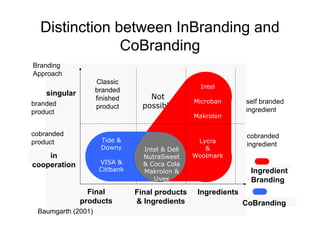
Distinction between InBranding and
CoBranding
Final
products
Final products
& Ingredients
Ingredients
singular
in
cooperation
Classic
branded
finished
product
Not
possible
CoBranding
Ingredient
Branding
Intel
Microban
Makrolon
Lycra
&
Woolmark
Branding
Approach
self branded
ingredient
cobranded
ingredient
cobranded
product
branded
product
Baumgarth (2001)
Tide &
Downy
VISA &
Citibank
Intel & Dell
NutraSweet
& Coca Cola
Makrolon &
Uvex
Implementation Steps for InBranding
Ingredient brand is present anywhere and
could not be used as a differentiator and is
pushing former supporters into price wars
Fiesco1-Effect4
Known ingredient brand is helping ist
supporter and other are benefiting from it
Repayment of
credit, synergy
3
Unknown ingredient brand becomes known
and famous
Break-through
and market proof
2
Unknown ingredient brand profits on the
back of well-known brands
Raising of credit,
exploitation of
reputation
1
DescriptionSteps
1) Named after „The conspiracy of Fiesco “, 1783 written by Friedrich Schiller: „Er
hat seine Schuldigkeit getan, er kann gehen“. „He paid his tribute, now it is time for
him to go". Bugdahl (1996)
Raising of credit,
exploitation of reputation
Start of the "Intel Inside"
campaign. The unknown
ingredient brand profits on
the back of the PC
manufacturers (OEMs) by
co-operation advertisement
1
Fiesco-Effect
Intel processors are used by
majority of all PC
manufacturers, thus a
differentiation is no longer
possible. While Intel
determines the market prices,
the PC manufacturers must
enter into a price war again.
Repayment of
credit
The acceptance of Intel
helps the co-operation
partners (OEMs) win more
customes.
3
2Break through
The acceptance of Intel rises
one year after start of the
"Intel Inside" campaign of
60% to over 80%, it
develops a demand pull (Pull
Through effect)
22
34
Kleinaltenkamp (2001)
Situation of Component Supplier
for InBranding
Increase of dependency against
quality problems from the OEMs
Higher cost and time
Increase need for quality
assurance
Visible target for competitive
attacks
Negative Image of OEM brands
Resistance of industrial
customers
Become known by the public
Create chances for competitive
differentiation
Establish entry barrier for
competitors
Increase of customer loyalty and
demand pull
Establish means against
replaceability
Positive image of OEM brands
Price-/Volume premium
Pull-creation
Creation of Brand Equity
Increase of market power versus
OEMs
RisksOpportunities
Risks and Opportunities for
Suppliers and OEM
Supplier
Increased demand
Better prices
Chances for growth
Lesser risk for substitution
Creation of entry barriers
Potential conflicts with OEM
Higher financial burden on
enduser communication
Higher risk of image damages
through product failure
OEM
Positive Image creation
Differentiation
Less marketing cost
Increased product value
Image risks
Weakening of own products
Increase of branding around
or in the core product
Risks
.
Possible
win-win
strategy
Increased
risk and
conflict
potential
Opportunities
Application Conditions of
InBranding
High
Low
Schiesser & Ariel
Deutsche
Bahn AG
&
Citibank
Complexity of components
in relation to final product
High Low
Example:
Micro processors (Intel)
ABS, ESP (Bosch)
Textile coding (Teflon)
Laminate (GoreTex)
Bicycle gears (Shimano)
Unsuitable for
Ingredient Branding
Suitable for Ingredient Branding
Important for
functionality of final
product
Pfoertsch/Mueller (2005)
More Insids on Conditions of
InBranding
High
Low
Schiesser & Ariel
Deutsche
Bahn AG
&
Citibank
Number of OEMs
Number of supplier
High Low
Example:
Micro processors (Intel)
ABS, ESP (Bosch)
Textile coding (Teflon)
Laminate (GoreTex)
Bicycle gears (Shimano)
Unsuitable for
Ingredient Branding
Suitable for Ingredient Branding
Pfoertsch/Mueller (2005)
Success Stories of InBrands
Intel Inside
Firma: Intel Corporation
Branche: Halbleiterindustrie
Produkte: Mikroprozessoren
Umsatz: 38,82 Mrd. US $(2005)
NutraSweet
Firma: NutraSweet Company
Branche: Lebensmittelindustrie
Produkte: Süßstoffe
Umsatz: 0,25 Mrd. US $ (2002)
Gore-Tex
Firma: W.L. Gore & Associates
Branche: Bekleidungsindustrie
Produkte: Textillaminate
Umsatz: 1,35 Mrd. US $ (2003)
Lycra
Firma: INVISTA
Branche: Textilindustrie
Produkte: Elastikfasern
Umsatz: 6,9 Mrd. US $ (2003)
Teflon
Firma: DuPont
Branche: Chemieindustrie
Produkte: Antihaftbeschichtung
Umsatz: 26,99 Mrd. US $ (2003)
Shimano
Firma: Shimano
Branche: Sportartikelindustrie
Produkte: Fahrradkomponenten
Umsatz: 1,6 Mrd. US $ (2004)
Tetra Pak
Firma: Tetra Pak
Branche: Verpackungsindustrie
Produkte: Verpackungssysteme
Umsatz: 7,3 Mrd. US $ (2003)
Makrolon
Firma: Bayer MaterialScience
Branche: chemische Industrie
Produkte: Kunststoffe
Umsatz: 10,7 Mrd. € (2005)
New Applications are on the Horizon
Z-Trim all-natural fat replacement products
soy protein
Open Research Questions
• Better understand how competitive
advantage can be achieved through the
use of ingredient branding .
• Establish brand metrics for multi-level
branding.
• Track and predict ingredient branding
success.
= Guild brands
= Service brands = OEM brands (industrial)
= OEM brands (consumer) = Retail brands (consumer) = Ingredient brands
time
Importance
of
branding
Increase of importance
of new branding
concepts
Industrial
Revolution
Relative decrease in importance of
consumer brands
1300 1850 1900 1950 1970 1990 2000 2050
Future of Ingredient Branding
Havenstein (2004):
The Future of Brand Management
at CEIBS
• Offer a series of dedicated Brand
Management Courses and Seminar
• Initiate and Supervise Research Work
• Establish a Center for Business Brand
Management (CBBM) at CEIBS and
• Organize the first Business Brand
Management Conference in 2008
Literature
• David Aaker, The Power of the Branded Differentiator, MIT Sloan Management Review
45 no1 83-7 Fall 2003
• Baumgarth, C Freter, H.;. (2001): Ingredient Branding . Begriff und theoretische
Begründung, in Esch, F.-R. (Hrsg.): Moderne Markenführung, 3. Auflage, Wiesbaden
2001, S. 317 - 343.
• Bugdahl, Volker (1996): Ingredient Branding – eine Markenstrategie für mehrere
Nutznießer, in: Markenartikel, Nr. 3/1996, S. 110-113
• Havenstein, Moritz (2004): Ingredient Branding. Die Wirkung der Markierung von
Produktbestandteilen bei konsumtiven Gebrauchsgütern. Gabler Edition Wissenschaft,
Wiesbaden
• Kalpesh Kaushik Desai & Kevin Lane Keller (2002), The Effects of Ingredient Branding
Strategies on Host Brand Extendibility, Journal of Marketing Vol. 66 (January 2002), 73-
93
• Kleinaltenkamp, Michael (2001): Ingredient Branding: Markenpolitik im Business-to-
Business-Geschäft, in: Köhler, R./Majer, W./Wiezorek, H. (Hrsg.): Erfolgsfaktor Marke,
München 2001, S. 261 . 270.
• Kotler, Philip and Pfoertsch, Waldemar (2006) B2B Brand Management Springer 2006
• Levin, A.J., Davis, C. and Levin, I. (1996), ``Theoretical and empirical linkages between
consumers' responses to different branding strategies'', Advances in Consumer
Research, Vol. 23, pp. 296-300.
• McCarthy Michael S., Norris Donald G. (1999) Improving competitive position using
branded ingredients, JOURNAL OF PRODUCT & BRAND MANAGEMENT, VOL. 8 NO.
4 1999, pp. 267-285
• Narasimhan, C. (1999), ``The new appeal of private brands'', Harvard Business Review,
May/June, p. 41.
• Norris, Donald G. (1992), "Ingredient Branding: A Strategy Option with Multiple
Beneficiaries," Journal of Consumer Marketing, 9(3), 19-31.
Literature
• Osselaer van, Stijn M.J. (2004) Of Rats and Brands: A Learning-and-Memory
Perspective on Consumer Decisions, Journal of Economic M:Business Administration and
Business Economics, Oct 2004
• Jackson, Tim (1997): Inside Intel: Andy Grove and the Rise of the World's Most Powerful
Chip Company. New York: Dutton (Penguin Books), 1997
• JANISZEWSKI, CHRIS and OSSELAER VAN Stiin M.J. ' (2000), A Connectionist Model
of Brand-Quality Associations, Vol. XXXVll (August 2000). JOURNAL OF MARKETING
RESEARCH. AUGUST 2000
• Pfoertsch, Waldemar and Mueller Intrajanto (2005) Marke in der Marke Ingredient
branding, Springer 2005
• Rao, Akshay R., Lu Ciu, and Robert W. Ruekert (1999), "Signalling Unobservable Product
Quality through a Brand Ally," Journal of Marketing Research, 37 (May), 258-68.
• Shocker, Allan D., Rajendra K. Srivastava, and Robert W. Ruekert (1994), "Challenges
and Opportunities Facing Brand Management: An Introduction to the Special Issue."
Journal of Marketing Research, 31 (May), 149-58.
• Simonin, B.L. and Ruth, J.A. (1998), ``Is a company known by the company it keeps?
Assessing the spill-over effects of brand alliances on consumer brand attitudes'', Journal
of Marketing Research, Vol. 35, February, pp. 30-42.
• Spethmann, B. and Benezra, K. (1994), ``Co-brand or be damned'', Brandweek, Vol. 35,
No. 45, pp. 20-5.
• Vaidyanathan, R., Aggarwal, R. and Brown, M.G. (1999), ``Intel inside, generic outside:
implications of ingredient branding for national and private label brands'', working paper,
University of Minnesota-Duluth.
• Vaidyanathan, Rajiv Aggarwal, Praveen (2000) Strategic brand alliances: implications of
ingredient branding for national and private label brands, JOURNAL OF PRODUCT &
BRAND MANAGEMENT, VOL. 9 NO. 4 2000, pp. 214-228
谢谢!
Prof. Dr.
Waldemar A. Pfoertsch
International Business
Pforzheim University
+49-171-536 8998
+1-224-388 2702
waldemar@pfoertsch.com
www.pfoertsch.com

Ingredient Branding

  • 1.
    The Inside on IngredientBranding Waldemar Pfoertsch 2006
  • 2.
    Agenda • Defining IngredientBranding • Understanding Ingredient Branding • Implementing and Managing • New Application and Future Research • Brand Management at CEIBS
  • 3.
    The most famousexample of the “Brand in the Brand” Jackson, Tim (1997) Using the concept of Ingredient Branding or short: “InBranding”
  • 4.
    Other Ingredient BrandingExamples • Microban • Makrolon • GoreTex • Dolby Stereo • Nirosta Pfoertsch/Mueller (2005)
  • 5.
    Brand Extension Examplesof Ingredient Branding • Beechnut baby foods with Chiquita banana • Ben and Jerry's Heath Bar Crunch ice cream, and Fat Free Cranberry Newtons with Ocean Spray cranberries • Kellogg’s Pop-Tarts with Smucker’s jam (Rao, Qu, and Ruekert 1999; Shocker, Srivastava, and Ruekert 1994)
  • 6.
  • 7.
    Basic Motivation forUsing Ingredient Branding • Enhances the differentiation of the host brand from competition • Improves competitiveness • Enhances equity of host brand and “self- brand”. Desai/Keller (2002)David Aaker, 2003 McCarthy/Norris (1999)
  • 8.
    Effects of BrandedIngredients Norris/McCarthy (1999)
  • 9.
    Change of Competitiveness throughBranded Ingredients Norris/McCarthy (1999)
  • 10.
    Ingredient Branding Executesa Multilevel Marketing Policy Third Level Marketing Multi Level Marketing Ingredient- Supplier First Level Marketing Selling Original Equipment Mfg Sourcing End user Selling Souring Second Level Marketing Distribution sourcing Selling Baumgarth (2001)
  • 11.
    Push und Pullby InBranding Ingredient- Producer Final Product Producer OEM Final User Sales-promotion to the B2B Customer Supply Supply-push Incentives to demand creation at the B2B customer Supply-push Incentives for demand creation at the final customer Supply Push Sales-promoting from the Ingredient supplier to the final customer Demand pull Incentives for the demand creation of a certain ingredient in the final product Demand Demand Pull Kotler/Pfoertsch (2006)
  • 12.
    Distinction between InBrandingand CoBranding Final products Final products & Ingredients Ingredients singular in cooperation Classic branded finished product Not possible CoBranding Ingredient Branding Intel Microban Makrolon Lycra & Woolmark Branding Approach self branded ingredient cobranded ingredient cobranded product branded product Baumgarth (2001) Tide & Downy VISA & Citibank Intel & Dell NutraSweet & Coca Cola Makrolon & Uvex
  • 13.
    Implementation Steps forInBranding Ingredient brand is present anywhere and could not be used as a differentiator and is pushing former supporters into price wars Fiesco1-Effect4 Known ingredient brand is helping ist supporter and other are benefiting from it Repayment of credit, synergy 3 Unknown ingredient brand becomes known and famous Break-through and market proof 2 Unknown ingredient brand profits on the back of well-known brands Raising of credit, exploitation of reputation 1 DescriptionSteps 1) Named after „The conspiracy of Fiesco “, 1783 written by Friedrich Schiller: „Er hat seine Schuldigkeit getan, er kann gehen“. „He paid his tribute, now it is time for him to go". Bugdahl (1996)
  • 14.
    Raising of credit, exploitationof reputation Start of the "Intel Inside" campaign. The unknown ingredient brand profits on the back of the PC manufacturers (OEMs) by co-operation advertisement 1 Fiesco-Effect Intel processors are used by majority of all PC manufacturers, thus a differentiation is no longer possible. While Intel determines the market prices, the PC manufacturers must enter into a price war again. Repayment of credit The acceptance of Intel helps the co-operation partners (OEMs) win more customes. 3 2Break through The acceptance of Intel rises one year after start of the "Intel Inside" campaign of 60% to over 80%, it develops a demand pull (Pull Through effect) 22 34 Kleinaltenkamp (2001)
  • 15.
    Situation of ComponentSupplier for InBranding Increase of dependency against quality problems from the OEMs Higher cost and time Increase need for quality assurance Visible target for competitive attacks Negative Image of OEM brands Resistance of industrial customers Become known by the public Create chances for competitive differentiation Establish entry barrier for competitors Increase of customer loyalty and demand pull Establish means against replaceability Positive image of OEM brands Price-/Volume premium Pull-creation Creation of Brand Equity Increase of market power versus OEMs RisksOpportunities
  • 16.
    Risks and Opportunitiesfor Suppliers and OEM Supplier Increased demand Better prices Chances for growth Lesser risk for substitution Creation of entry barriers Potential conflicts with OEM Higher financial burden on enduser communication Higher risk of image damages through product failure OEM Positive Image creation Differentiation Less marketing cost Increased product value Image risks Weakening of own products Increase of branding around or in the core product Risks . Possible win-win strategy Increased risk and conflict potential Opportunities
  • 17.
    Application Conditions of InBranding High Low Schiesser& Ariel Deutsche Bahn AG & Citibank Complexity of components in relation to final product High Low Example: Micro processors (Intel) ABS, ESP (Bosch) Textile coding (Teflon) Laminate (GoreTex) Bicycle gears (Shimano) Unsuitable for Ingredient Branding Suitable for Ingredient Branding Important for functionality of final product Pfoertsch/Mueller (2005)
  • 18.
    More Insids onConditions of InBranding High Low Schiesser & Ariel Deutsche Bahn AG & Citibank Number of OEMs Number of supplier High Low Example: Micro processors (Intel) ABS, ESP (Bosch) Textile coding (Teflon) Laminate (GoreTex) Bicycle gears (Shimano) Unsuitable for Ingredient Branding Suitable for Ingredient Branding Pfoertsch/Mueller (2005)
  • 19.
    Success Stories ofInBrands Intel Inside Firma: Intel Corporation Branche: Halbleiterindustrie Produkte: Mikroprozessoren Umsatz: 38,82 Mrd. US $(2005) NutraSweet Firma: NutraSweet Company Branche: Lebensmittelindustrie Produkte: Süßstoffe Umsatz: 0,25 Mrd. US $ (2002) Gore-Tex Firma: W.L. Gore & Associates Branche: Bekleidungsindustrie Produkte: Textillaminate Umsatz: 1,35 Mrd. US $ (2003) Lycra Firma: INVISTA Branche: Textilindustrie Produkte: Elastikfasern Umsatz: 6,9 Mrd. US $ (2003) Teflon Firma: DuPont Branche: Chemieindustrie Produkte: Antihaftbeschichtung Umsatz: 26,99 Mrd. US $ (2003) Shimano Firma: Shimano Branche: Sportartikelindustrie Produkte: Fahrradkomponenten Umsatz: 1,6 Mrd. US $ (2004) Tetra Pak Firma: Tetra Pak Branche: Verpackungsindustrie Produkte: Verpackungssysteme Umsatz: 7,3 Mrd. US $ (2003) Makrolon Firma: Bayer MaterialScience Branche: chemische Industrie Produkte: Kunststoffe Umsatz: 10,7 Mrd. € (2005)
  • 20.
    New Applications areon the Horizon Z-Trim all-natural fat replacement products soy protein
  • 21.
    Open Research Questions •Better understand how competitive advantage can be achieved through the use of ingredient branding . • Establish brand metrics for multi-level branding. • Track and predict ingredient branding success.
  • 22.
    = Guild brands =Service brands = OEM brands (industrial) = OEM brands (consumer) = Retail brands (consumer) = Ingredient brands time Importance of branding Increase of importance of new branding concepts Industrial Revolution Relative decrease in importance of consumer brands 1300 1850 1900 1950 1970 1990 2000 2050 Future of Ingredient Branding Havenstein (2004):
  • 23.
    The Future ofBrand Management at CEIBS • Offer a series of dedicated Brand Management Courses and Seminar • Initiate and Supervise Research Work • Establish a Center for Business Brand Management (CBBM) at CEIBS and • Organize the first Business Brand Management Conference in 2008
  • 24.
    Literature • David Aaker,The Power of the Branded Differentiator, MIT Sloan Management Review 45 no1 83-7 Fall 2003 • Baumgarth, C Freter, H.;. (2001): Ingredient Branding . Begriff und theoretische Begründung, in Esch, F.-R. (Hrsg.): Moderne Markenführung, 3. Auflage, Wiesbaden 2001, S. 317 - 343. • Bugdahl, Volker (1996): Ingredient Branding – eine Markenstrategie für mehrere Nutznießer, in: Markenartikel, Nr. 3/1996, S. 110-113 • Havenstein, Moritz (2004): Ingredient Branding. Die Wirkung der Markierung von Produktbestandteilen bei konsumtiven Gebrauchsgütern. Gabler Edition Wissenschaft, Wiesbaden • Kalpesh Kaushik Desai & Kevin Lane Keller (2002), The Effects of Ingredient Branding Strategies on Host Brand Extendibility, Journal of Marketing Vol. 66 (January 2002), 73- 93 • Kleinaltenkamp, Michael (2001): Ingredient Branding: Markenpolitik im Business-to- Business-Geschäft, in: Köhler, R./Majer, W./Wiezorek, H. (Hrsg.): Erfolgsfaktor Marke, München 2001, S. 261 . 270. • Kotler, Philip and Pfoertsch, Waldemar (2006) B2B Brand Management Springer 2006 • Levin, A.J., Davis, C. and Levin, I. (1996), ``Theoretical and empirical linkages between consumers' responses to different branding strategies'', Advances in Consumer Research, Vol. 23, pp. 296-300. • McCarthy Michael S., Norris Donald G. (1999) Improving competitive position using branded ingredients, JOURNAL OF PRODUCT & BRAND MANAGEMENT, VOL. 8 NO. 4 1999, pp. 267-285 • Narasimhan, C. (1999), ``The new appeal of private brands'', Harvard Business Review, May/June, p. 41. • Norris, Donald G. (1992), "Ingredient Branding: A Strategy Option with Multiple Beneficiaries," Journal of Consumer Marketing, 9(3), 19-31.
  • 25.
    Literature • Osselaer van,Stijn M.J. (2004) Of Rats and Brands: A Learning-and-Memory Perspective on Consumer Decisions, Journal of Economic M:Business Administration and Business Economics, Oct 2004 • Jackson, Tim (1997): Inside Intel: Andy Grove and the Rise of the World's Most Powerful Chip Company. New York: Dutton (Penguin Books), 1997 • JANISZEWSKI, CHRIS and OSSELAER VAN Stiin M.J. ' (2000), A Connectionist Model of Brand-Quality Associations, Vol. XXXVll (August 2000). JOURNAL OF MARKETING RESEARCH. AUGUST 2000 • Pfoertsch, Waldemar and Mueller Intrajanto (2005) Marke in der Marke Ingredient branding, Springer 2005 • Rao, Akshay R., Lu Ciu, and Robert W. Ruekert (1999), "Signalling Unobservable Product Quality through a Brand Ally," Journal of Marketing Research, 37 (May), 258-68. • Shocker, Allan D., Rajendra K. Srivastava, and Robert W. Ruekert (1994), "Challenges and Opportunities Facing Brand Management: An Introduction to the Special Issue." Journal of Marketing Research, 31 (May), 149-58. • Simonin, B.L. and Ruth, J.A. (1998), ``Is a company known by the company it keeps? Assessing the spill-over effects of brand alliances on consumer brand attitudes'', Journal of Marketing Research, Vol. 35, February, pp. 30-42. • Spethmann, B. and Benezra, K. (1994), ``Co-brand or be damned'', Brandweek, Vol. 35, No. 45, pp. 20-5. • Vaidyanathan, R., Aggarwal, R. and Brown, M.G. (1999), ``Intel inside, generic outside: implications of ingredient branding for national and private label brands'', working paper, University of Minnesota-Duluth. • Vaidyanathan, Rajiv Aggarwal, Praveen (2000) Strategic brand alliances: implications of ingredient branding for national and private label brands, JOURNAL OF PRODUCT & BRAND MANAGEMENT, VOL. 9 NO. 4 2000, pp. 214-228
  • 26.
    谢谢! Prof. Dr. Waldemar A.Pfoertsch International Business Pforzheim University +49-171-536 8998 +1-224-388 2702 waldemar@pfoertsch.com www.pfoertsch.com