Public
Ingredient Branding
A win-win situation or a zero-sum game?
Jeff Turner
Public
Why Ingredient Branding?
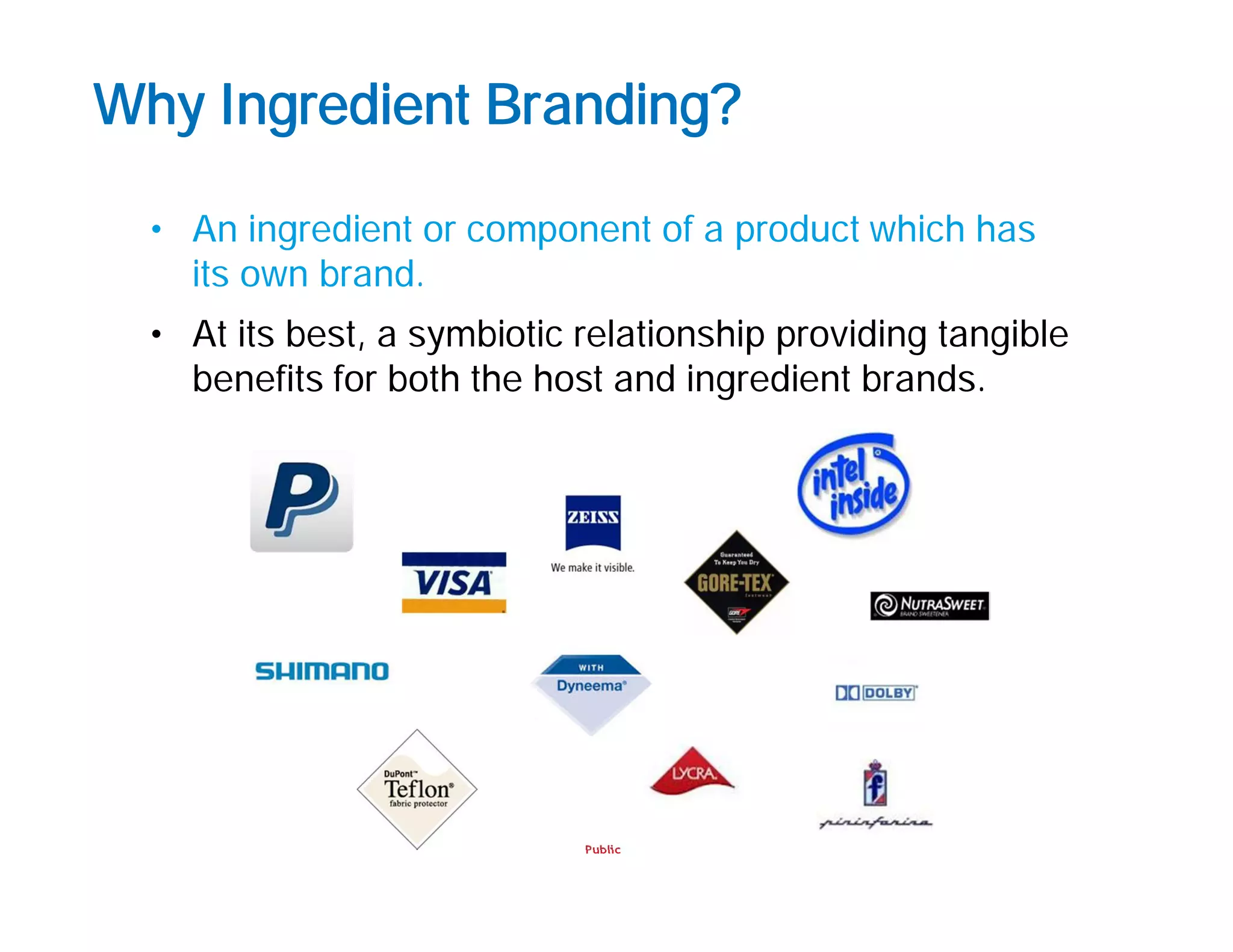
• An ingredient or component of a product which has
its own brand.
• At its best, a symbiotic relationship providing tangible
benefits for both the host and ingredient brands.
Public
Characteristics of an Ingredient Brand
• A clear, highly differentiating functional attribute -e.g.
Teflon® = non-stick
Dolby® = ultimate sound reproduction
Intel® = microprocessor performance
Goretex® = waterproof & breathable
Paypal® = simple on-line cashless payments
• Important to the functional performance of the end-product
• Adds associations of quality & performance
• High target audience relevance and preference
Public
The Ingredient’s Perspective
• A natural progression of branding the ingredient
– Involves extending the brand franchise beyond the direct
customer, ultimately to the final consumer
– Part of competitive marketing strategy
– Industrial trade-names can evolve to become consumer
brands over time - e.g. Teflon®, ABS
• A leadership characteristic
• Reinforces strategic relationships with key partners
Public
The Ingredient’s Trade-off.
+ Builds sustainable advantage
through preference and
specification
+ Supports price premium
+ Secures business versus
competition
+ Potential to transfer positive
equity from host brand
- Can limit future strategic options
- e.g. Intel in consumer
electronics
- Adds cost and complexity to
business
- Brand management is rarely
an ingredient supplier’s core
competence
- Risk of transfer of negative
image from host brand
- Can become a limit on revenue
growth if business model &
partner selection poorly executed
Public
The Host’s Perspective
• Ingredient brands provide reassurance of content &
product performance
• Allows host brand to concentrate on building
“lifestyle” image, unencumbered by need to
communicate physical attributes & benefits
• Relative ingredient brand strength, positioning and
life-cycle all factors in decision
Public
The Host’s Trade-off.
+ Leverage ingredient brand to
increase perceived value, quality
and performance
+ Gain market acceptance where
ingredient brand profile is stronger
than host’s
+ Especially true for smaller brands,
followers & new entrants
+ Increased distribution channel
acceptance
+ Preferential access to technology &
marketing support from supplier
+ Potential for higher margins & faster
inventory turns
- Higher costs (ingredient price
and/or license fee)
- Risk of negative image transfer
from ingredient - e.g. Teflon®
- Ingredient’s image dominates
host’s - e.g. Intel
- Who else gets it?
- Lack of control
- Differentiator becomes leveler
Public
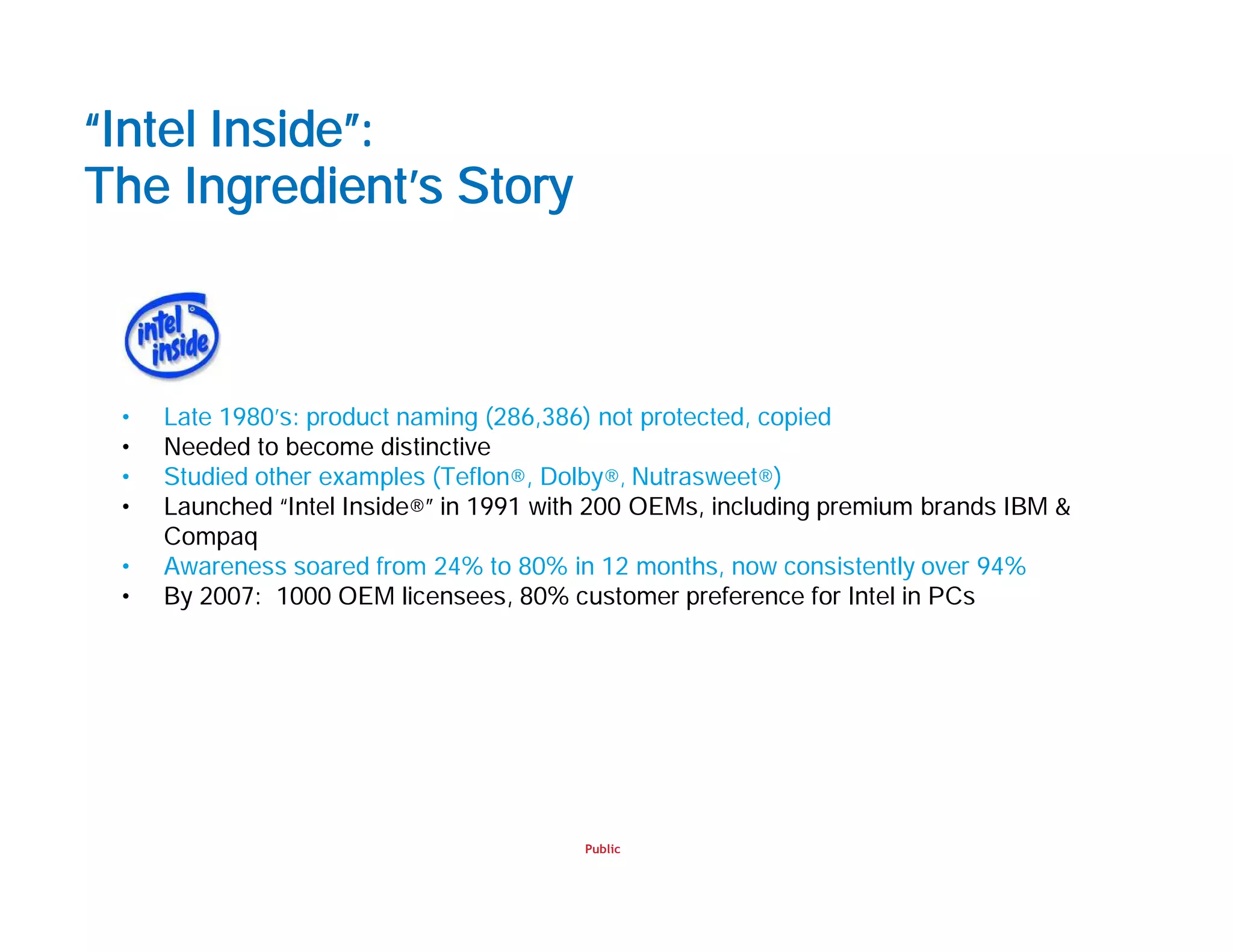
“Intel Inside”:
The Ingredient’s Story
• Late 1980’s: product naming (286,386) not protected, copied
• Needed to become distinctive
• Studied other examples (Teflon®, Dolby®, Nutrasweet®)
• Launched “Intel Inside®” in 1991 with 200 OEMs, including premium brands IBM &
Compaq
• Awareness soared from 24% to 80% in 12 months, now consistently over 94%
• By 2007: 1000 OEM licensees, 80% customer preference for Intel in PCs
Public
“Intel Inside”:
The Host’s Story
• An initial launch OEM, but withdrew after 18 months
• Perspective: legitimized smaller brands with inferior products
• Threatened by strength of ingredient brand
BUT:
• Reluctantly returned as licensee after sales dropped
Public
“Intel Inside”:
IBM: The Final Chapter
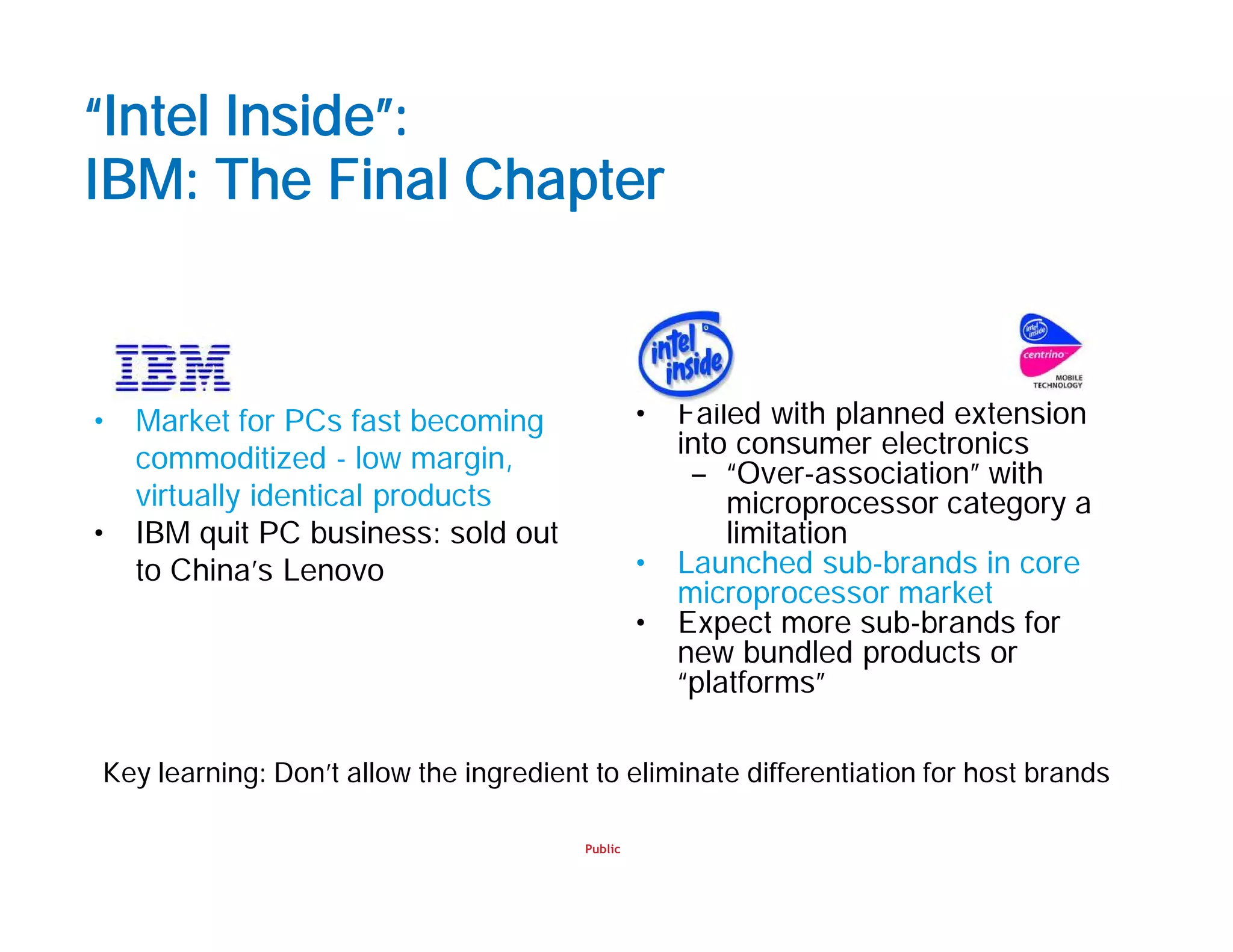
• Failed with planned extension
into consumer electronics
– “Over-association” with
microprocessor category a
limitation
• Launched sub-brands in core
microprocessor market
• Expect more sub-brands for
new bundled products or
“platforms”
• Market for PCs fast becoming
commoditized - low margin,
virtually identical products
• IBM quit PC business: sold out
to China’s Lenovo
Key learning: Don’t allow the ingredient to eliminate differentiation for host brands
Public
Lycra®: The Ingredient’s Story
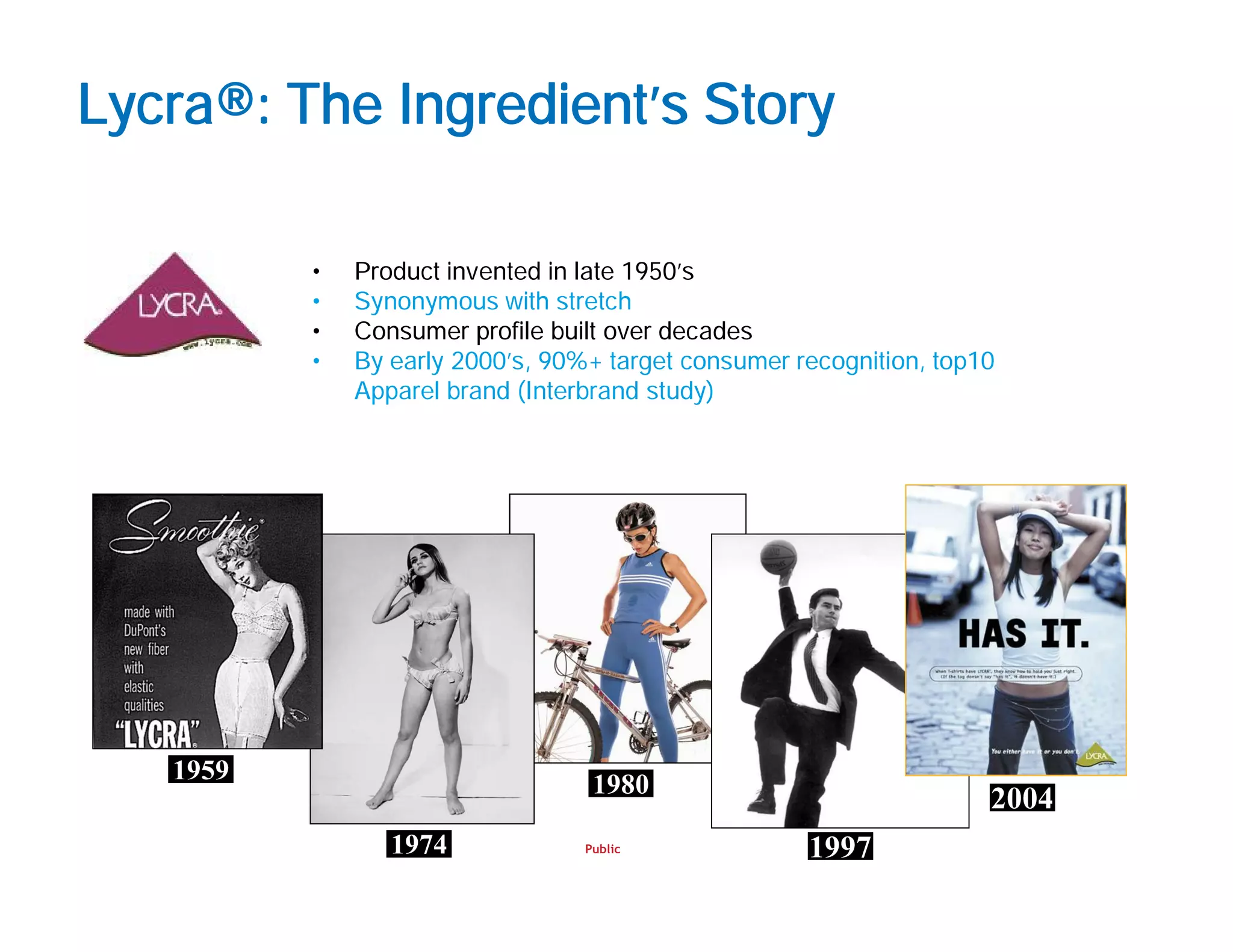
• Product invented in late 1950’s
• Synonymous with stretch
• Consumer profile built over decades
• By early 2000’s, 90%+ target consumer recognition, top10
Apparel brand (Interbrand study)
1959
1974
1980
1997
2004
Public
Lycra®: Host’s Story
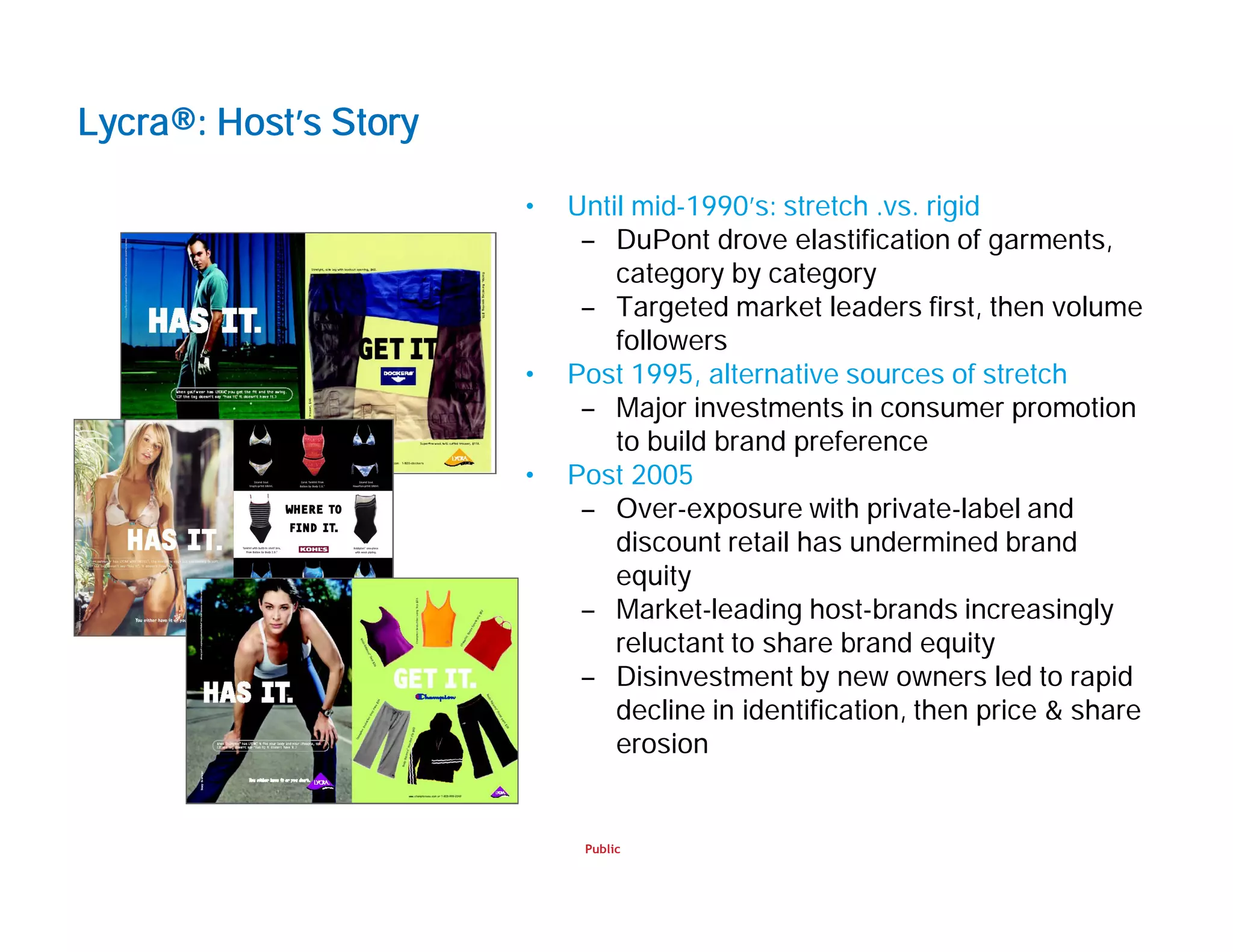
• Until mid-1990’s: stretch .vs. rigid
– DuPont drove elastification of garments,
category by category
– Targeted market leaders first, then volume
followers
• Post 1995, alternative sources of stretch
– Major investments in consumer promotion
to build brand preference
• Post 2005
– Over-exposure with private-label and
discount retail has undermined brand
equity
– Market-leading host-brands increasingly
reluctant to share brand equity
– Disinvestment by new owners led to rapid
decline in identification, then price & share
erosion
Public
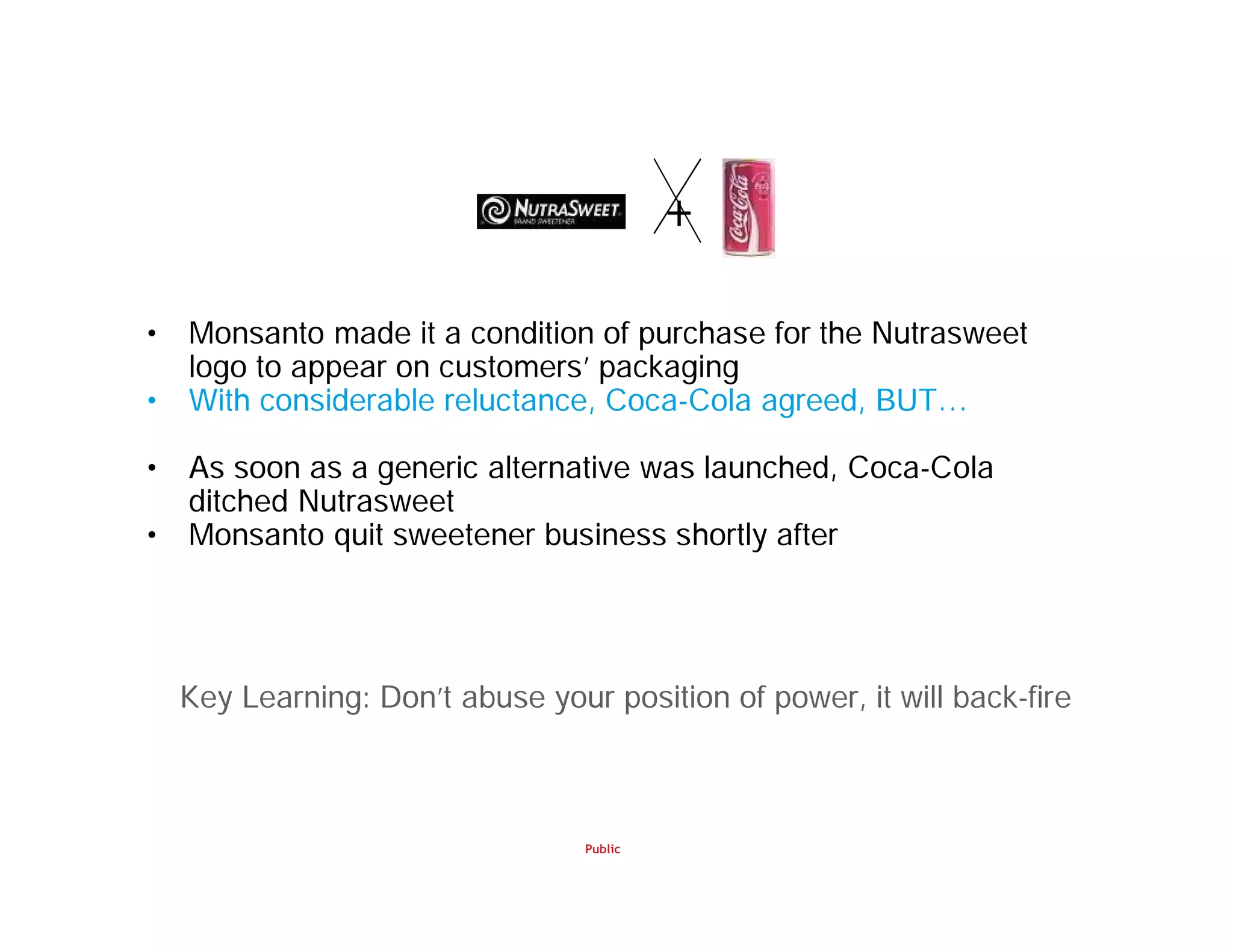
• Monsanto made it a condition of purchase for the Nutrasweet
logo to appear on customers’ packaging
• With considerable reluctance, Coca-Cola agreed, BUT…
• As soon as a generic alternative was launched, Coca-Cola
ditched Nutrasweet
• Monsanto quit sweetener business shortly after
+
Key Learning: Don’t abuse your position of power, it will back-fire
Public
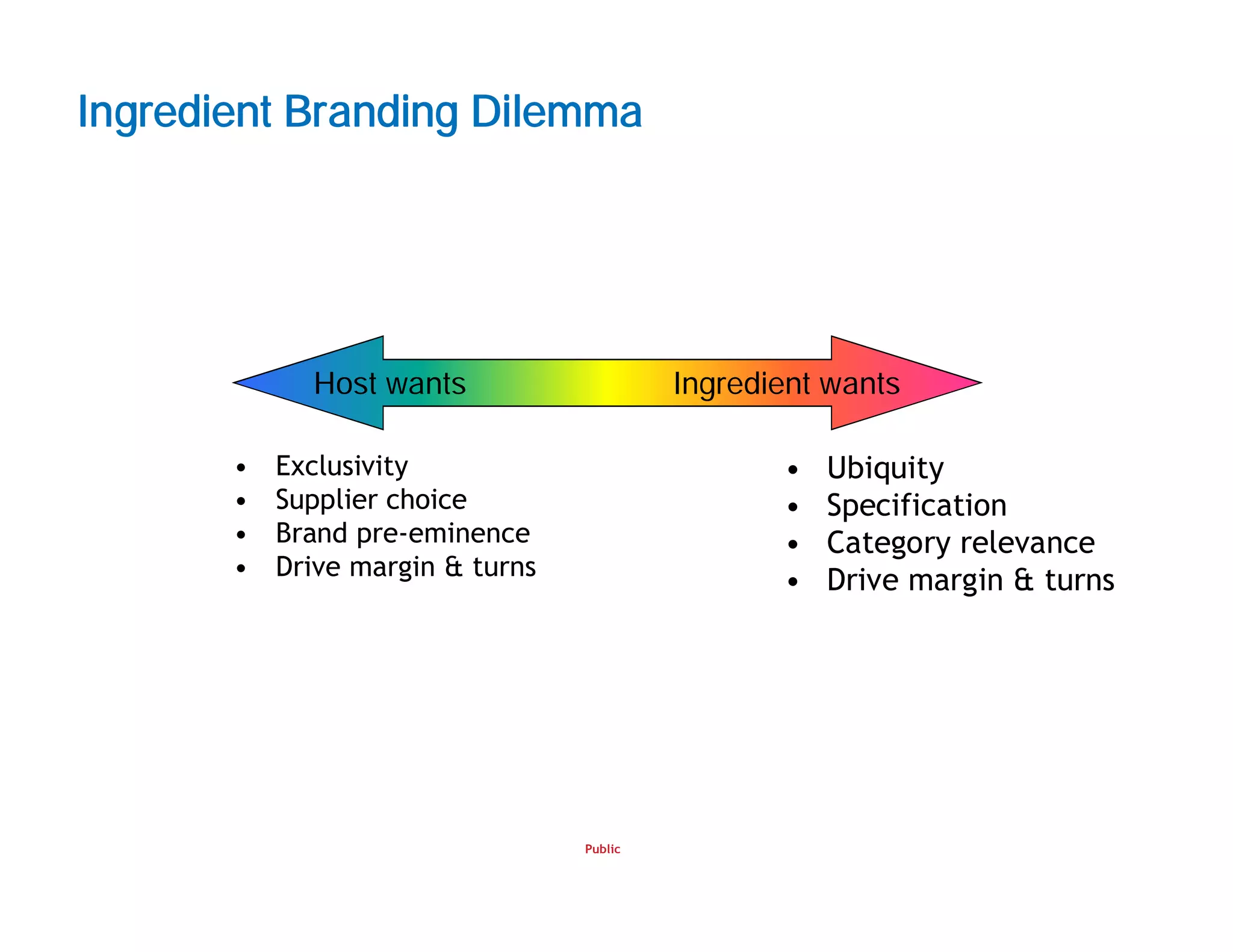
Ingredient Branding Dilemma
Host wants Ingredient wants
• Exclusivity
• Supplier choice
• Brand pre-eminence
• Drive margin & turns
• Ubiquity
• Specification
• Category relevance
• Drive margin & turns
Public
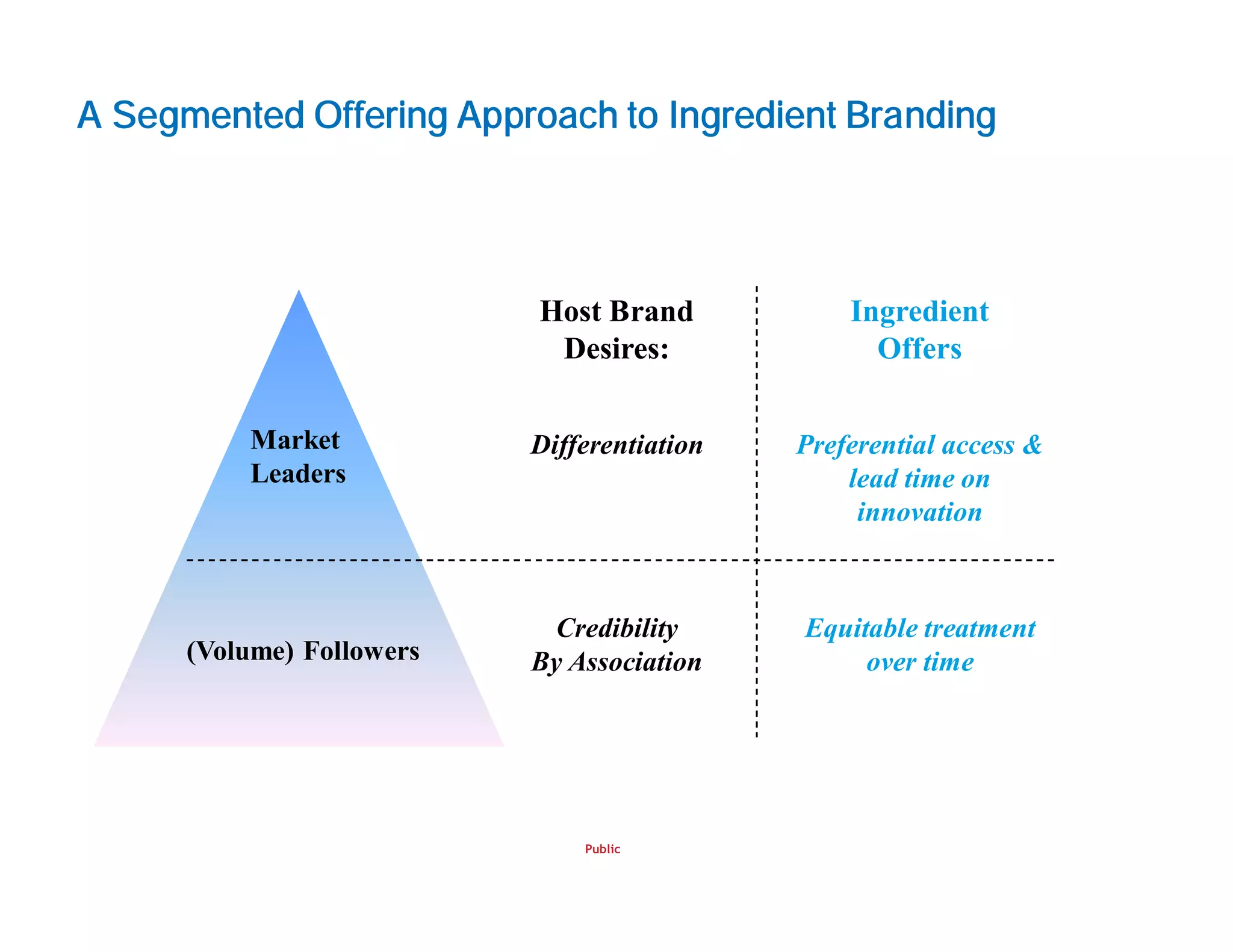
A Segmented Offering Approach to Ingredient Branding
Market
Leaders
(Volume) Followers
Host Brand
Desires:
Differentiation
Credibility
By Association
Ingredient
Offers
Preferential access &
lead time on
innovation
Equitable treatment
over time
Public
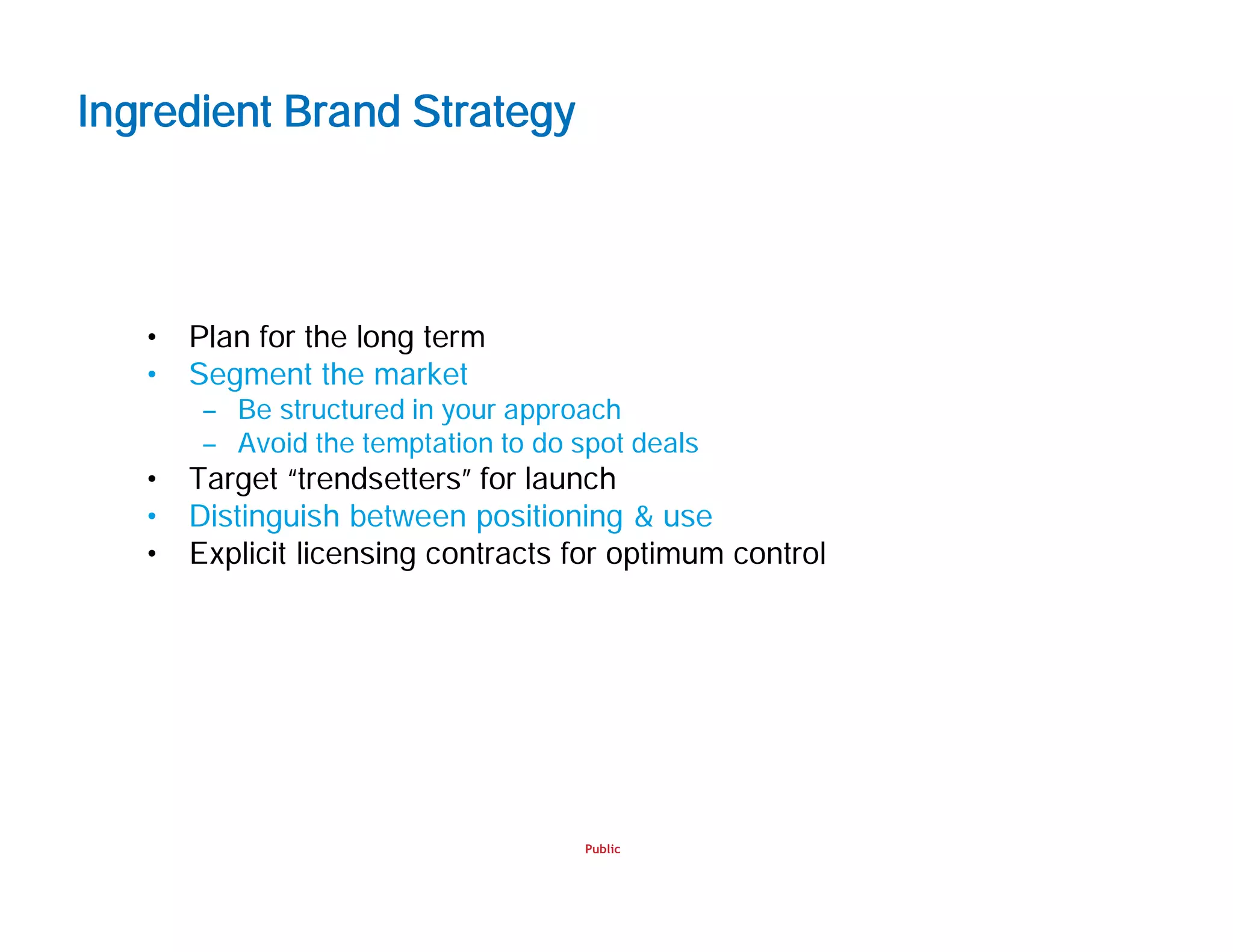
Ingredient Brand Strategy
• Plan for the long term
• Segment the market
– Be structured in your approach
– Avoid the temptation to do spot deals
• Target “trendsetters” for launch
• Distinguish between positioning & use
• Explicit licensing contracts for optimum control
Public
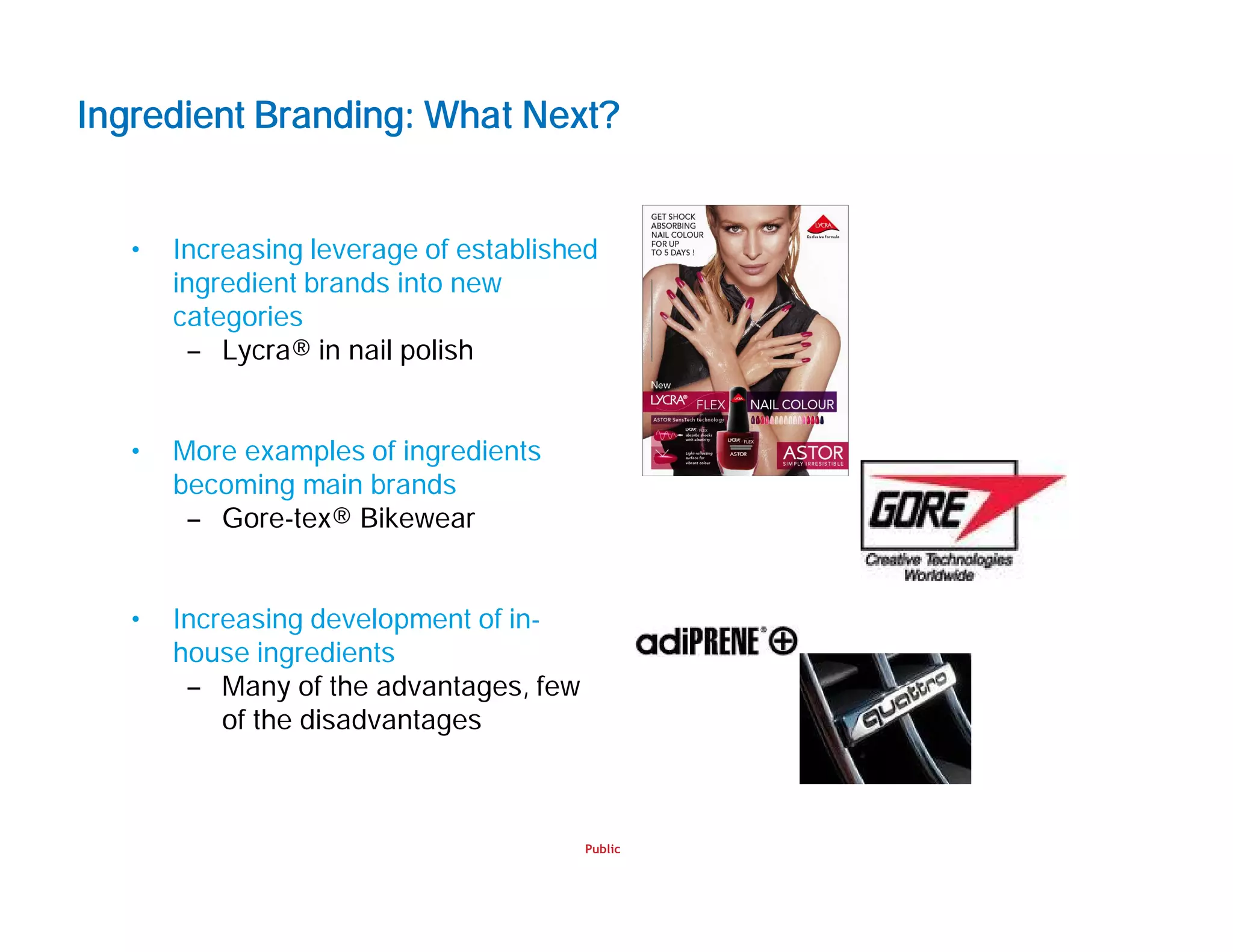
Ingredient Branding: What Next?
• Increasing leverage of established
ingredient brands into new
categories
– Lycra® in nail polish
• More examples of ingredients
becoming main brands
– Gore-tex® Bikewear
• Increasing development of in-
house ingredients
– Many of the advantages, few
of the disadvantages
Public
Ingredient Branding
A win-win situation or a zero-sum game?

Ingredient Brands: A practical guide & examples

  • 1.
    Public Ingredient Branding A win-winsituation or a zero-sum game? Jeff Turner
  • 2.
    Public Why Ingredient Branding? •An ingredient or component of a product which has its own brand. • At its best, a symbiotic relationship providing tangible benefits for both the host and ingredient brands.
  • 3.
    Public Characteristics of anIngredient Brand • A clear, highly differentiating functional attribute -e.g. Teflon® = non-stick Dolby® = ultimate sound reproduction Intel® = microprocessor performance Goretex® = waterproof & breathable Paypal® = simple on-line cashless payments • Important to the functional performance of the end-product • Adds associations of quality & performance • High target audience relevance and preference
  • 4.
    Public The Ingredient’s Perspective •A natural progression of branding the ingredient – Involves extending the brand franchise beyond the direct customer, ultimately to the final consumer – Part of competitive marketing strategy – Industrial trade-names can evolve to become consumer brands over time - e.g. Teflon®, ABS • A leadership characteristic • Reinforces strategic relationships with key partners
  • 5.
    Public The Ingredient’s Trade-off. +Builds sustainable advantage through preference and specification + Supports price premium + Secures business versus competition + Potential to transfer positive equity from host brand - Can limit future strategic options - e.g. Intel in consumer electronics - Adds cost and complexity to business - Brand management is rarely an ingredient supplier’s core competence - Risk of transfer of negative image from host brand - Can become a limit on revenue growth if business model & partner selection poorly executed
  • 6.
    Public The Host’s Perspective •Ingredient brands provide reassurance of content & product performance • Allows host brand to concentrate on building “lifestyle” image, unencumbered by need to communicate physical attributes & benefits • Relative ingredient brand strength, positioning and life-cycle all factors in decision
  • 7.
    Public The Host’s Trade-off. +Leverage ingredient brand to increase perceived value, quality and performance + Gain market acceptance where ingredient brand profile is stronger than host’s + Especially true for smaller brands, followers & new entrants + Increased distribution channel acceptance + Preferential access to technology & marketing support from supplier + Potential for higher margins & faster inventory turns - Higher costs (ingredient price and/or license fee) - Risk of negative image transfer from ingredient - e.g. Teflon® - Ingredient’s image dominates host’s - e.g. Intel - Who else gets it? - Lack of control - Differentiator becomes leveler
  • 8.
    Public “Intel Inside”: The Ingredient’sStory • Late 1980’s: product naming (286,386) not protected, copied • Needed to become distinctive • Studied other examples (Teflon®, Dolby®, Nutrasweet®) • Launched “Intel Inside®” in 1991 with 200 OEMs, including premium brands IBM & Compaq • Awareness soared from 24% to 80% in 12 months, now consistently over 94% • By 2007: 1000 OEM licensees, 80% customer preference for Intel in PCs
  • 9.
    Public “Intel Inside”: The Host’sStory • An initial launch OEM, but withdrew after 18 months • Perspective: legitimized smaller brands with inferior products • Threatened by strength of ingredient brand BUT: • Reluctantly returned as licensee after sales dropped
  • 10.
    Public “Intel Inside”: IBM: TheFinal Chapter • Failed with planned extension into consumer electronics – “Over-association” with microprocessor category a limitation • Launched sub-brands in core microprocessor market • Expect more sub-brands for new bundled products or “platforms” • Market for PCs fast becoming commoditized - low margin, virtually identical products • IBM quit PC business: sold out to China’s Lenovo Key learning: Don’t allow the ingredient to eliminate differentiation for host brands
  • 11.
    Public Lycra®: The Ingredient’sStory • Product invented in late 1950’s • Synonymous with stretch • Consumer profile built over decades • By early 2000’s, 90%+ target consumer recognition, top10 Apparel brand (Interbrand study) 1959 1974 1980 1997 2004
  • 12.
    Public Lycra®: Host’s Story •Until mid-1990’s: stretch .vs. rigid – DuPont drove elastification of garments, category by category – Targeted market leaders first, then volume followers • Post 1995, alternative sources of stretch – Major investments in consumer promotion to build brand preference • Post 2005 – Over-exposure with private-label and discount retail has undermined brand equity – Market-leading host-brands increasingly reluctant to share brand equity – Disinvestment by new owners led to rapid decline in identification, then price & share erosion
  • 13.
    Public • Monsanto madeit a condition of purchase for the Nutrasweet logo to appear on customers’ packaging • With considerable reluctance, Coca-Cola agreed, BUT… • As soon as a generic alternative was launched, Coca-Cola ditched Nutrasweet • Monsanto quit sweetener business shortly after + Key Learning: Don’t abuse your position of power, it will back-fire
  • 14.
    Public Ingredient Branding Dilemma Hostwants Ingredient wants • Exclusivity • Supplier choice • Brand pre-eminence • Drive margin & turns • Ubiquity • Specification • Category relevance • Drive margin & turns
  • 15.
    Public A Segmented OfferingApproach to Ingredient Branding Market Leaders (Volume) Followers Host Brand Desires: Differentiation Credibility By Association Ingredient Offers Preferential access & lead time on innovation Equitable treatment over time
  • 16.
    Public Ingredient Brand Strategy •Plan for the long term • Segment the market – Be structured in your approach – Avoid the temptation to do spot deals • Target “trendsetters” for launch • Distinguish between positioning & use • Explicit licensing contracts for optimum control
  • 17.
    Public Ingredient Branding: WhatNext? • Increasing leverage of established ingredient brands into new categories – Lycra® in nail polish • More examples of ingredients becoming main brands – Gore-tex® Bikewear • Increasing development of in- house ingredients – Many of the advantages, few of the disadvantages
  • 18.
    Public Ingredient Branding A win-winsituation or a zero-sum game?